




Abstract
This paper responds to the article by Daniel Hoornweg and Kevin Pope, on predictions for the world’s largest cities in the 21st century, in this issue of Environment and Urbanization. It recognizes the value and importance of this article in highlighting the very large likely scale of urban population growth up to 2100 and in initiating a discussion on what this might imply for the scale and distribution of the world’s largest cities. But it raises some concerns about the extent to which very large cities will grow in what are currently nations with very low per capita incomes. Mega-cities need to be underpinned by mega-economies. The world’s largest cities up to 2100 will mostly be those where private capital has chosen to invest, and much of this may not be in the cities identified in the Hoornweg and Pope article as likely to be the largest. The economic future, the development future (including whether the Sustainable Development Goals get met) and the ecological future (especially whether dangerous climate change is avoided) will so powerfully influence future city sizes.
I. Growth in the Planet’s Urban Population and in its Largest Cities
Current projections suggest that the world’s urban population will grow by 2.9 billion between 2015 and 2050, and it could grow by another 3 billion or more by 2100.(1) Where will this vast growth in the world’s urban population live? The paper by Daniel Hoornweg and Kevin Pope(2) considers what the world’s largest cities and their populations in 2100 will be under three different scenarios – see Table 1. There is not much variation in the list of the top five largest cities in 2100 among the three scenarios – but there are large differences in their populations. For instance, Lagos would have 61 million inhabitants in 2100 under SSP1 and over 100 million in SSP3.
The world’s five largest cities in 2100, according to different socioeconomic scenarios
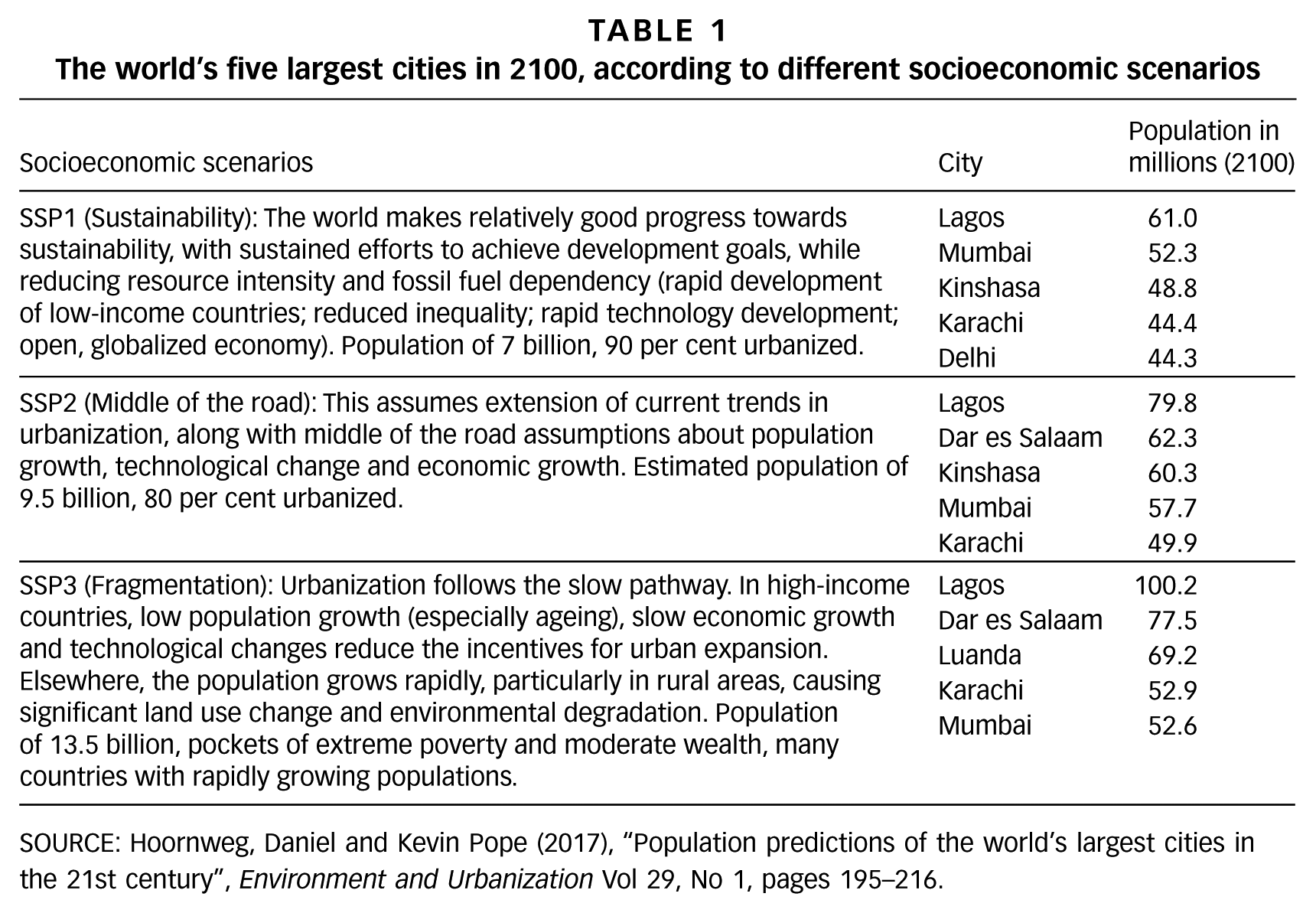
SOURCE: Hoornweg, Daniel and Kevin Pope (2017), “Population predictions of the world’s largest cities in the 21st century”, Environment and Urbanization Vol 29, No 1, pages 195–216.
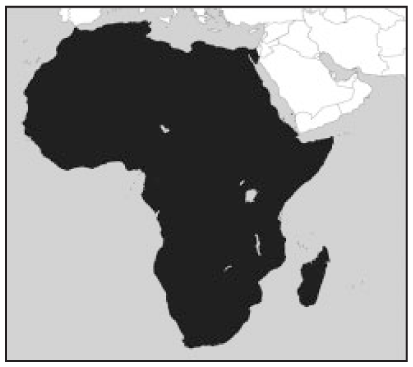
The Hoornweg and Pope paper also presents estimates for the populations of the world’s 101 largest cities in 2100 based on extrapolations of past growth rates. These present some surprises. Many of the world’s largest cities are projected to be in Africa. Indeed, 13 of the world’s 20 largest cities in 2100 may be in Africa (Table 2).
The world’s 20 largest cities in 2100 (based on projected populations)
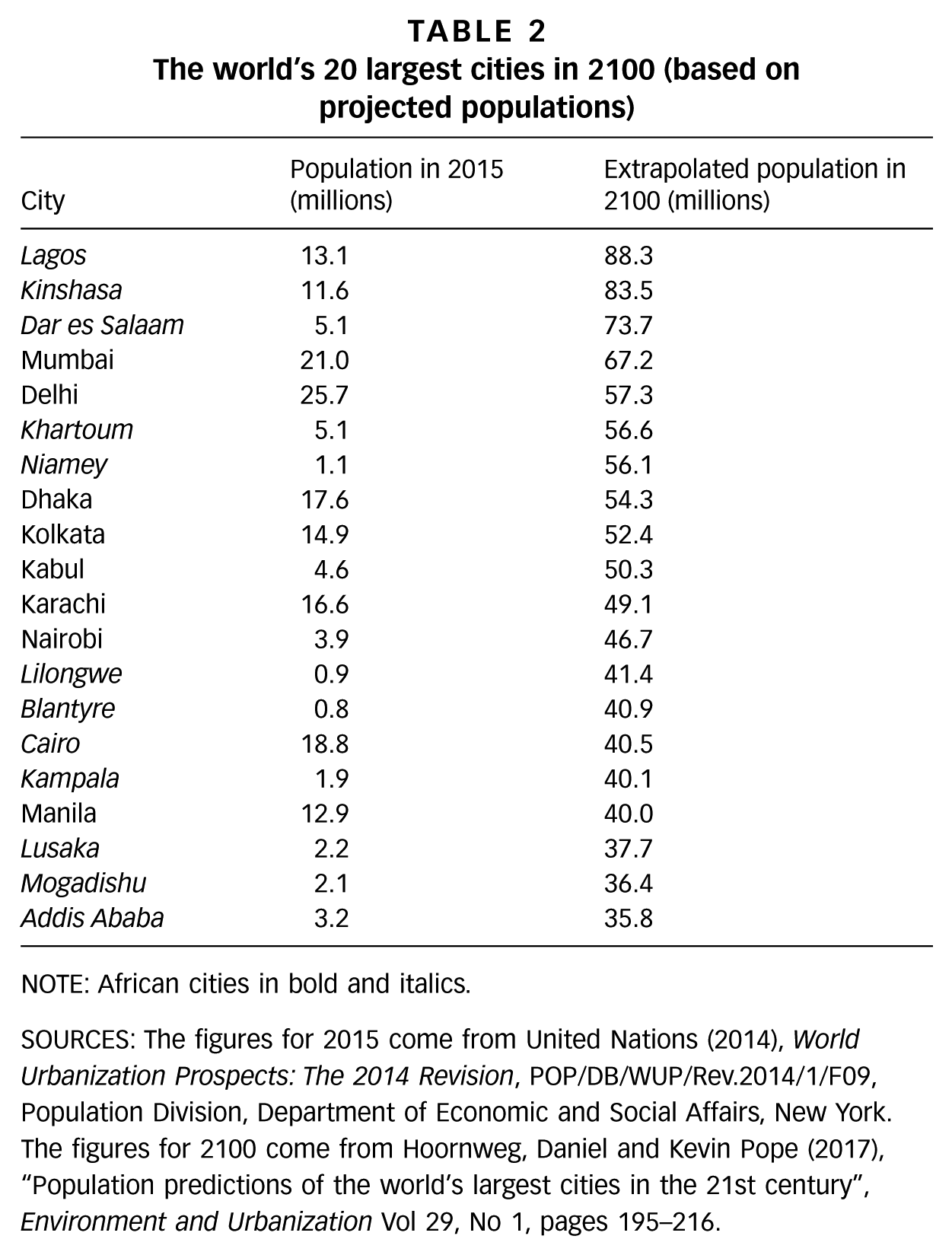
NOTE: African cities in bold and italics.
SOURCES: The figures for 2015 come from United Nations (2014), World Urbanization Prospects: The 2014 Revision, POP/DB/WUP/Rev.2014/1/F09, Population Division, Department of Economic and Social Affairs, New York. The figures for 2100 come from Hoornweg, Daniel and Kevin Pope (2017), “Population predictions of the world’s largest cities in the 21st century”, Environment and Urbanization Vol 29, No 1, pages 195–216.
II. Words of Caution
Large cities only exist because they have large economies. Mega-cities need mega-economies, even if in some cases, much of the economy is informal. There are some large cities that are exceptions – for instance cities that expand rapidly because of large numbers of refugees or internally displaced persons – but they are exceptions.
So an alternative approach to predicting the world’s largest cities in 2100 would be first to predict the world’s largest (national) economies in 2100, then to suggest how their economies will be distributed spatially (and so identify the largest cities), then to consider what this implies for their population (including net flows of migration). But of course, predicting the world’s largest economies and the size and nature of their economies in 2100 is even more fraught with uncertainty than population predictions.
So what could change in the 83 years up to 2100? If we had viewed China in 1977, who would have predicted that it would be among the world’s most rapidly growing economies from the early 1980s onwards? China has also had rapid urban population growth, and at present has many of the world’s largest cities. Who would have predicted the sudden appearance of Shenzhen, which went from nothing in 1977 to over 10 million inhabitants (and many millions more if migrant workers are counted as city residents)? Who, in the aftermath of the Vietnam War, would have predicted the economic success of Vietnam’s large cities? Who, on the other hand, would have known what would happen in Syria’s largest cities, which would have figured in a long list of the world’s largest cities without the terrible civil war that still continues there?
If we go back 83 years, we quickly call into question our capacity to predict city population trends based on past experience. Who would have predicted that the modest city of São Paulo, with fewer than a million inhabitants in 1933, would come to be the largest industrial city in South America by 1980? Or in the USA, that a whole new generation of towns in the South would produce many of the world’s fastest growing cities during the 20th century? Or that Europe would have a sharp decline in the proportion of the world’s largest cities as more decentralized patterns of urban development developed and as population growth rates fell? Who in 1933 would have imagined that Delhi (which at that time had under half a million inhabitants) would grow to 26 million in 2015? Or that the long-established dominance of India’s four largest cities (Kolkata, Mumbai, Delhi and Chennai) would be challenged by a new generation of rapidly growing cities such as Surat, Pune, Hyderabad, Bangalore and Ahmedabad? Or, to go back to Brazil, that a new generation of smaller but growing cities such as Porto Alegre and Curitiba would challenge São Paolo and Rio de Janeiro for attracting new investment? Who in 1933 would have predicted the development of many large Mexican cities close to the US border?
So can we imagine that the economic base in countries that at present have small economies might develop to support very large cities? To go back to the predictions for 2100, what would have to happen in Malawi for its two largest cities to multiply their populations more than 40-fold in the next 83 years? Or in Niger for Niamey to grow to 56.1 million in 2100? What would have to change to make Mogadishu – torn apart by civil war – a city with more than 36 million inhabitants? Dar es Salaam and Kampala are successful cities within their nations, but it is difficult to imagine an economy developing in either Tanzania or Uganda that could support a city of 74 million inhabitants, in the case of Dar, or 40 million inhabitants, as in Kampala.
A large part of the population projections for these African cities is linked to the assumption that very high population growth rates for their nations will continue. Niamey having 56.1 million inhabitants in 2100 does not seem to make any sense – but if Niger reaches its projected national population of 215 million in 2100, the projection for Niamey’s population does not seem so off.
So, for the urban future. So much of it depends on where private capital investment chooses to locate. Where these flows concentrate in large cities, we may well get many cities with 30 million or more inhabitants. But competent local governments in smaller cities can draw some of this away from the super-large cities. Total urban populations for all nations will be heavily influenced by the scale of natural increase in populations, but will the growth rates used in estimating future city populations really be sustained? We can anticipate (and even see already) more decentralized patterns of urban development in many regions.
As Hoornweg and Pope note, how will urban systems change in response to climate change, including sea-level rise for coastal cities? They note that nearly half of the projected 101 largest cities in 2100 are coastal cities. What would a world committed to climate change adaptation and mitigation bring to this? How would the urban future change if governments really took the Sustainable Development Goals seriously? The economic future, the development future (including whether the SDGs get met), and the ecological future (especially whether dangerous climate change is avoided) will so powerfully influence future city sizes. But there is much uncertainty as to how and how much.
Footnotes
Notes
1.
Hoornweg, Daniel and Kevin Pope (2017), “Population predictions for the world’s largest cities in the 21st century”, Environment and Urbanization Vol 29, No 1, pages 195–216.
2.
See reference 1.