




Abstract
The 2016 Habitat III conference in Quito provides a challenging opportunity to address widespread, persistent urban gender inequalities through the elaboration of a New Urban Agenda (NUA). To achieve the identified radical paradigm shift calls for critical reflection and clarification of the meaning of gender transformation as against gender mainstreaming, and the elaboration of a conceptual and operational framework that identifies urban pathways not only to empower individual women but also to collectively transform fundamental gender power relations. This paper describes the gender asset accumulation framework as one such approach, and identifies the existing evidence base on urban transformative gendered interventions in land tenure and housing, safety in public spaces, and informal economy activities. In assessing gender-related contributions to the Habitat III process, it highlights a conjuncture in the identification of the same three gender-transformative interventions in the Transformative Commitments section of the Zero Draft NUA. However, these have been diluted in the Revised Zero Draft, which does not create optimism for the final NUA. The paper concludes by suggesting that a potential strategy for the global urban gender networks and multiple voices of civil society and grassroots groups is to reach a consensus on a priority agenda, and post-Quito to collectively contest and negotiate its implementation.
Keywords
I. Introduction
Are women transforming cities or are cities spaces for challenging power relations and transforming gender relations? These fundamental and co-existing options underlie the complexities of gender power relations in urban contexts, which are examined in this paper. The starting point relates to the fact that, despite increasing recognition of the relationship between economic and social development in urban areas, current debates, policy and practice have not focused sufficiently on the impacts of gender inequality for how cities function, or on the role of women in urbanization processes. Concurrently, the upcoming United Nations Conference on Housing and Sustainable Urban Development (Habitat III), 2016’s major summit aimed at setting a global urbanization strategy, provides a unique opportunity to highlight the centrality of gender globally through the New Urban Agenda (NUA), not just as an “add on” but incorporated into the Transformative Commitments.(1) However, successful implementation will require a “radical paradigm shift”(2) that aims for transformative gendered pathways(3) to just and equitable cities, rather than focusing on interventions that identify women simply as a residual welfarist category.(4)
This paper contributes to this important agenda by reviewing progress to date, and analysing ongoing and upcoming strategies and actions to achieve such pathways. It positions the debate on gender transformation in a conceptual framework developed in a recently published book, Gender, Asset Accumulation, and Just Cities,(5) that considers how women’s accumulation of assets can pave the way for just, more equitable cities.
In Section II the paper clarifies the difference between gender mainstreaming and gender transformation, before outlining the conceptual framework for transformative pathways in Section III. Using this framework, it then examines the modest evidence base on the transformative gendered priorities that are essential for the NUA. These relate to such driving forces as housing, land, gender-based violence, transport, climate change and disasters with different gendered perspectives, including household headship and inter-generational asset accumulation. Examples of transformative practice highlight the significant role that international civil society and non-governmental gendered networks play in both design and implementation. Section IV provides a brief gendered review of different outputs associated with the Habitat III process. These include “formal” as well as “informal” initiatives, as well as both the Zero Draft and the Revised Zero Draft NUA. The paper then concludes with reflections on the post-Habitat III process.
II. What is Gender Transformation and Why is it important?
Recently, eminent feminist Gloria Steinem aptly commented: “In the 1970s my dreams were not big enough. I was looking at
As the decades have passed, so too have expectations, and this is certainly the case with Habitat III. Thus, in the build-up to the Quito conference the refrain on everyone’s lips is “transformation”. The UN background agenda, for instance, identifies “transforming cities” as an objective. Likewise, the Urban Thinkers Campuses – more than two-dozen global events aimed at formulating stakeholder input into Habitat III – “believe that urbanization … can lead to positive urban transformations”. Key technical papers that have informed this process have identified “transformative actions”, while the May 2016 Zero Draft called for “Transformative Commitments”.(7) There is even an NGO called Women Transforming Cities. Reinforcing Habitat III’s position, the 2030 Agenda for Sustainable Development states that “there is a critical need for a transformation change in development, so that no one is left behind”.
Yet there is no shared understanding of the term “transformation”; indeed the term has become so popularized that it may soon be meaningless, and without a consistent message. Achieving this understanding is particularly important in guaranteeing that the NUA provides a pathway towards “gender transformation”. A literature search of printed and online sources of the word “transformation” or associated terms, used in the context of gender relations and gender mainstreaming, shows no one dominant or widely used definition, as is the case with the term “gender mainstreaming”, but rather seven key usages.(8) Most often the term is used loosely, without a precise definition or elaboration, varying in syntax from verbs to nouns to adjectives. While in all cases the term is used to convey the implicit idea of change, what is to change or be changed varies greatly.
The 1995 Fourth World Conference on Women in Beijing, both pre- and post-event, was undoubtedly a major springboard for launching and popularizing the term’s usage. Although the word does not appear in the Beijing Declaration or the associated Platform for Action (PfA), the event itself was seen as the culmination of a major transformation in global policy for gender equality and women’s empowerment. In this vein, Subramanian, for example, refers to “the enormous agenda of transformation and change that was identified [in Beijing 1995]”.(9) Despite the lack of clear definition, or consensus as to whether it is an outcome or a process, the term “transformation” is widely recognized as referring to an inherently political act, and closely associated with changing social or gendered power relations. As such, it questions the status quo and in so doing alters the underlying power dynamics that perpetuate gender inequality.
However, the “how” and “who” that transform gender power relations are closely interrelated, with transformative processes neither easy nor straightforward. As Parpart(10) comments, “there is no one-shot solution to gender transformation, nor are solutions readily apparent”. While transformation takes place through social institutions, it is often difficult to identify the specific interventions that help to transform gender relations.(11) Equally, the positioning of institutional actors can influence their perception and identification of how transformation occurs. Thus UN Women(12) emphasizes that change is structural and “top-down”, while in contrast, NGOs such as Oxfam argue that social, economic and political transformation is more of a “bottom-up” process that only occurs in response to collective group demands.(13) Finally, there are those who identify transformation as both “top-down” and “bottom-up”, applying both to the lives of women and to bureaucracies, which then become a tool in transforming the lives of women.(14)
While changes at the level of individual consciousness and capacity are essential in processes of transformation, feminist analysts have long recognized that collective struggles of the oppressed for “representation, redistribution and recognition”(15) have generally proved far more effective in challenging the structure of oppression. The two are interrelated, however; as Kabeer,(16) for instance, has argued, often it is the capacity of women to collectively organize around their needs, interests and rights that is most likely to result in public recognition of their individual rights as workers, as women and as citizens. While empowerment can lead to transformation, ultimately the focus in this paper relates to the achievement that goes beyond individual women to structural changes in societal-level gender ideology.(17)
a. Looking backward to go forward: from gender mainstreaming to gender transformation
To understand the importance of a transformational approach to urbanization, it is useful to start by standing back and clarifying the relationship among gender mainstreaming, empowerment and transformation. This elaboration is grounded in the 1995 Beijing Platform for Action (PfA), which identified gender mainstreaming (GM) as the primary mechanism to reach the PfA’s ambitious goals of global gender equality and empowerment. GM in itself represented a fundamental paradigm shift away from the categorization of women as a vulnerable, disadvantaged group. Defined as a “twin-track” approach, as presented diagrammatically in Figure 1, GM comprises two components, identified as follows:
The integration of women’s and men’s concerns throughout the development process into all policies and projects, with equality the expected outcome.
Specific activities aimed at empowering women, with empowerment the expected outcome.(18)
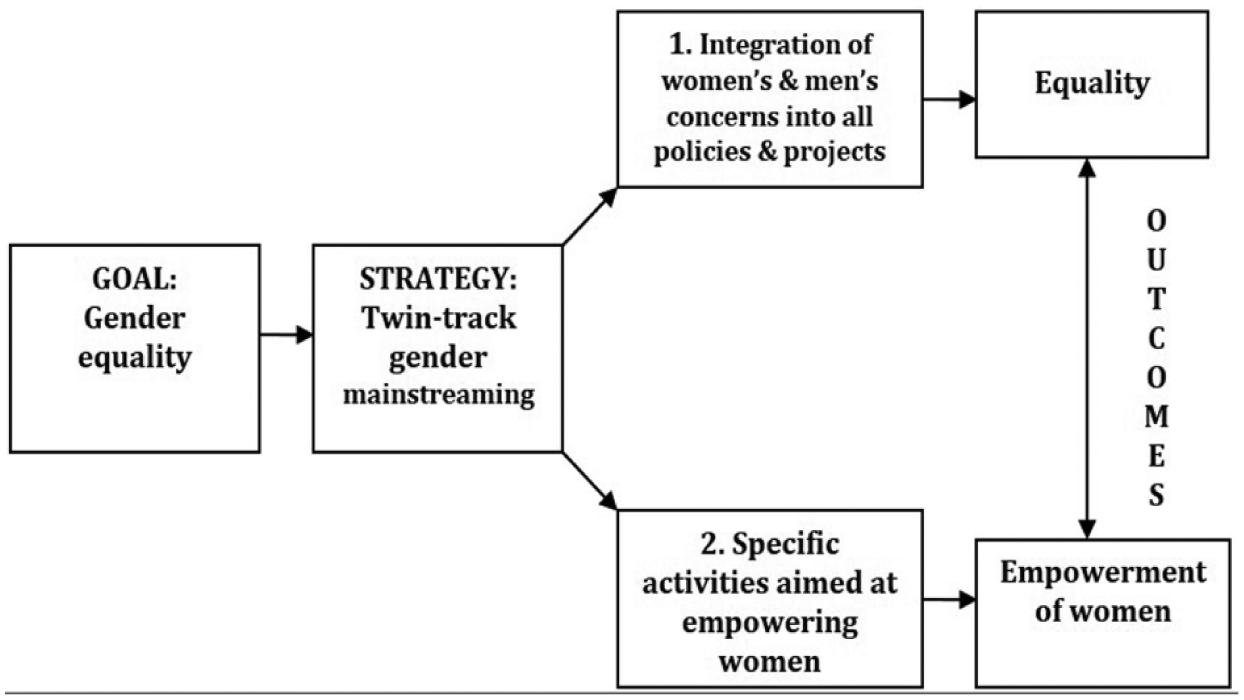
Components of a gender mainstreaming strategy
In 1997, the UN adopted GM as the framework for a global strategy for all policies and programmes in the UN system, while governments and civil society organizations across the world sought to implement the PfA by developing GM policies, strategies and methodologies. Despite conceptual confusions and the lack of a single blueprint for implementing GM, over the past two decades practitioners have grappled with the messy business of its mainstreaming, with its complex processes and interrelated analytical and operational components.
While progress has been recognized in soft sectors, such as health and education, this has been less the case in such hard sectors as urban infrastructure, land and housing. And despite such tinkering at the margins, overall, critiques of the limitations of gender mainstreaming are widespread. With the PfA based on the premise that improvement in the status of women could only be achieved by transforming gender relations, it has not been translated into practice. As Rosalind Eyben, former social development advisor for the UK’s Department of International Development (DFID), commented: “The 1995 Beijing Women’s Conference developed a vision of global social transformation; the transformational promise of Beijing failed to bring about a policy shift in favour of women’s empowerment.”(19)
The fact that broad inequalities remain more than 20 years after the Beijing PfA makes it critical to address this challenge with new approaches to GM. The convergence of the recent endorsement of both urbanization and gender equality in the Sustainable Development Goals, as well as the upcoming Habitat III conference, make 2016 an exciting new opportunity to address gender transformation in the urban context. The New Urban Agenda provides a unique occasion to incorporate the centrality of gender; indeed Eduardo Moreno, UN-Habitat’s director of research, has referred to the “programmatic mainstreaming of gender”, with the ultimate goal of achieving both gender equality and women’s empowerment.
However, if this is to be successful, the challenge is now to push the agenda further than ever before, with fundamental changes. This means going beyond women’s so-called vulnerability and exclusion, past the identification of women’s practical basic needs in urban planning, or even the strategic empowerment of individual women, to collective action capable of challenging fundamental inequalities. Only if the NUA effectively identifies pathways that challenge the wider structural power dynamics that perpetuate gender inequality, can it successfully promote more equitable, just cities. Otherwise, as Anne-Marie Goetz and Joanne Sandler, formerly with UN Women, have commented, gender mainstreaming, yet again, will be no more than a “pathetic illusion of transformation”.(20)
What does a potential urban gender transformation framework look like? The first element is the deconstruction of terminology. “Empowerment” needs to be clearly distinguished from “transformation”, or the two begin to converge, as the following differentiation shows:
The second element of urban gender transformation is the elaboration of a framework that specifically addresses such transformation. This is developed in the following section.
III. The Asset Accumulation Framework as a Pathway for Gender Transformation
With the accumulation of assets now widely recognized as an important route out of poverty,(22) more recent attention has focused on the fact that this can also be an important potential pathway for both gender empowerment and structural transformation.(23) An asset is generally defined as a “stock of financial, human, natural or social resources that can be acquired, developed, improved and transferred across generations. It generates flows or consumptions as well as additional stock”.(24) But assets are not just resources that people use to build livelihoods;
Figure 2 provides a diagrammatic representation of a framework of gendered asset accumulation pathways to empowerment and transformation. It illustrates how changes in persistent gender-based inequalities in access to financial, physical, productive, human, natural and social capital assets occur within contexts of broader driving forces presenting constraints as well as opportunities. At the macro level, these include economic globalization, demographic transition, climate change and disasters, while at the micro city level they relate to such driving forces as urban spatial agglomeration, political change, and violence and insecurity. Barriers include cultural norms such as those affecting gendered divisions of labour and female mobility – with implications for earnings, rights to public spaces, and participation in urban life. In addition, city-level institutions like municipalities and urban planning departments effectively prevent or promote gender-sensitive interventions.
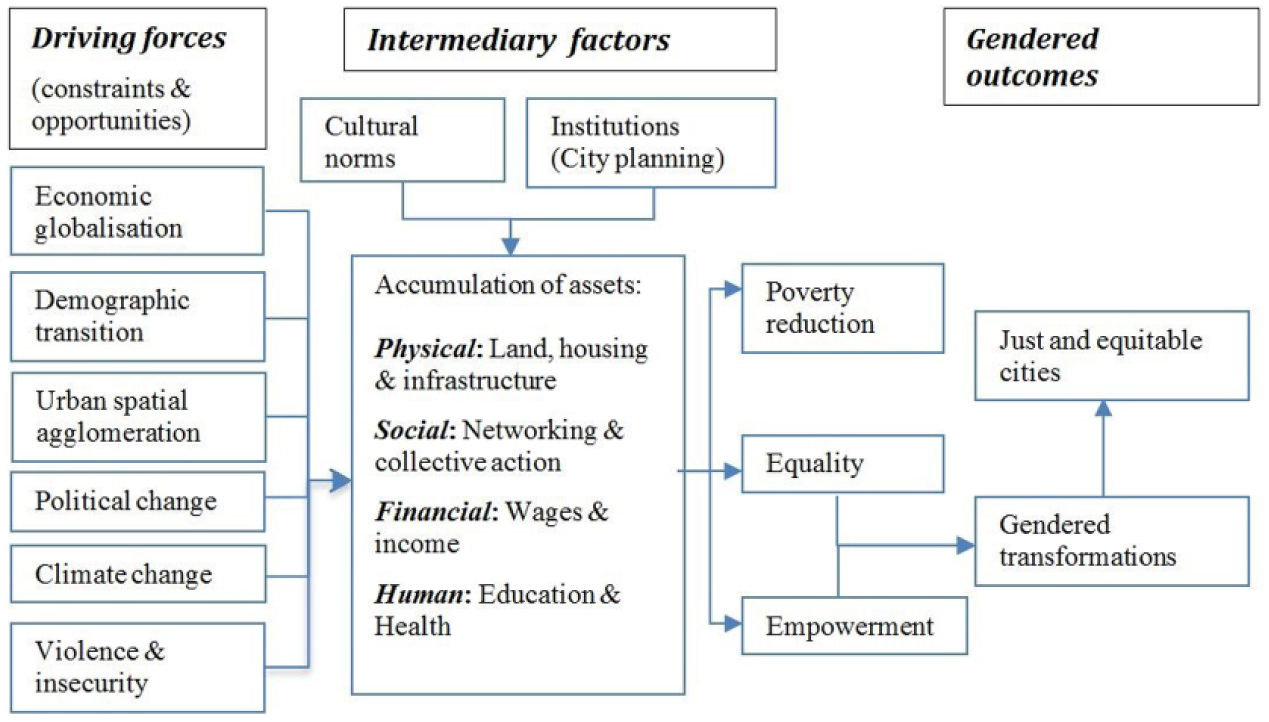
Gender asset accumulation pathways to empowerment and transformation
Despite such constraints, women, through their strategic agency in choices of asset accumulation solutions, achieve different gendered outcomes. Accumulated assets may reduce poverty; they may increase equality or empower individual women; and finally, through transformative processes they may successfully challenge power relations. However, it is important to recognize that while the strategic exercise of agency can erode inequalities and thereby address immediate practical needs, it does not necessarily destabilize wider structural inequalities, reaching so-called strategic interests.(27)
a. The evidence base on transformative gendered urban interventions
It would be simple if transformation occurred through straightforward concrete solutions, but reality is far more complex, particularly when it involves negotiation and contestation over power relations. It is abundantly clear that the pathway between individual empowerment and collective transformation is neither direct nor straightforwardly accomplished, and even more importantly involves long-term processes rather than time-bound “quick fixes”.
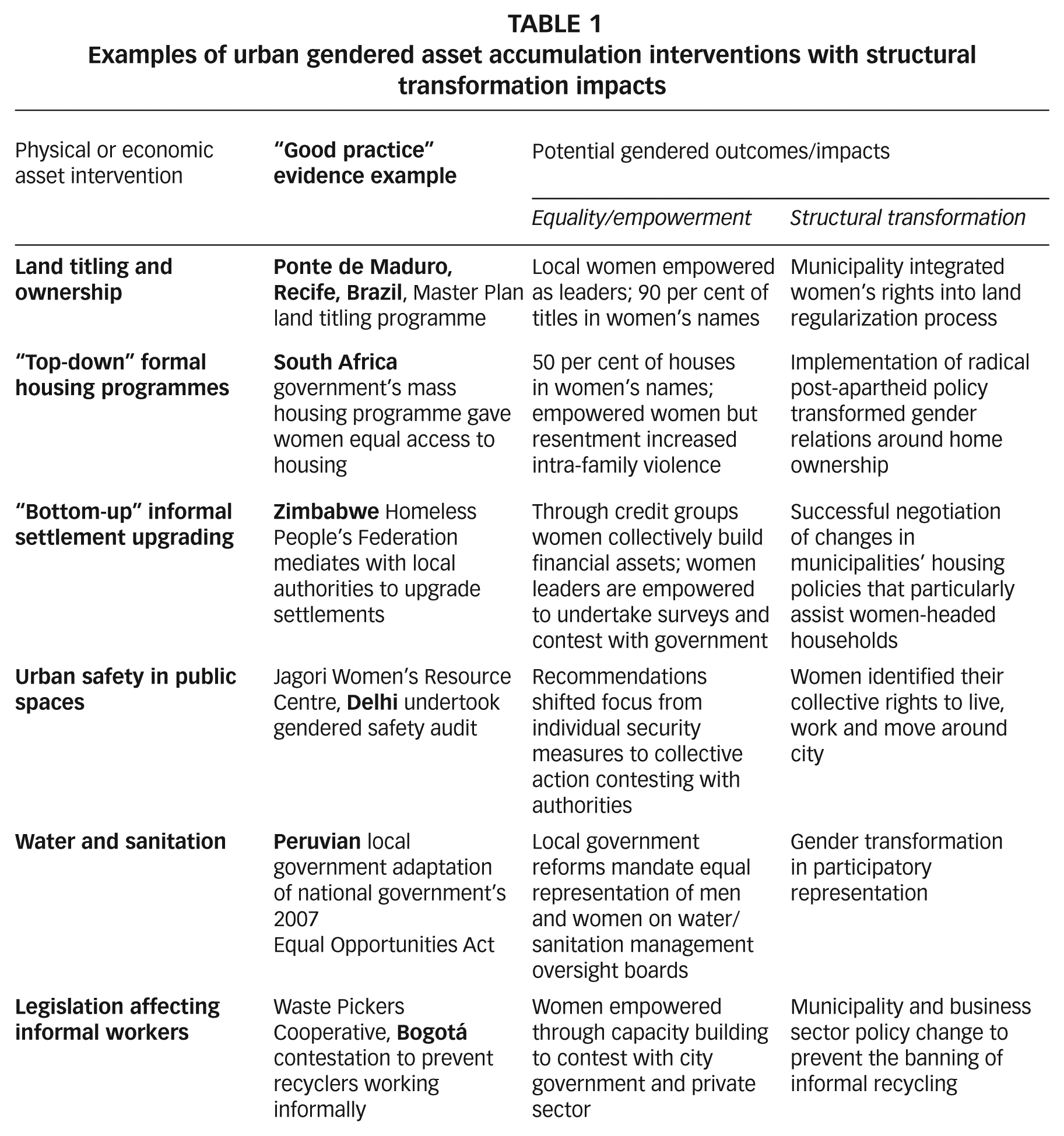
Despite the widespread rhetoric about gender transformation, to date the evidence base on structural transformative interventions is surprisingly limited and modest. This is illustrated by Table 1, which synthesizes “good practice” examples where the gendered urban asset accumulation of capital assets has resulted in structural changes in gender relations. It prioritizes sectors of particular relevance to the New Urban Agenda, such as urban infrastructure and human settlements, as against social sectors, which more commonly include health and education. Each example in Table 1 identifies potential differences in outcomes relating to equality and empowerment, as against structural transformation. This shows how easily the objective of individual women’s empowerment becomes conflated with fundamental structural transformation, and this conflation demonstrates the challenges associated with pushing forward a truly transformative agenda. The Table 1 synthesis is supported by the more detailed elaboration below of a number of remarkable, if unique, anecdotal examples drawn from the different urban sectors. These demonstrate the ways in which interventions have achieved transformative change.
Examples of urban gendered asset accumulation interventions with structural transformation impacts
To achieve this, Espaço Feminista volunteered to coordinate a pilot project in Ponte do Maduro, a 50-hectare settlement with 10,000 low-income families, and used Gender Evaluation Criteria (GEC) as a tool not only to monitor, evaluate and create accountability around the regularization process, but also to empower local women to become leaders in their own process. This ensured that communities were not just beneficiaries, but also the main actors in its implementation. In addition, the bottom-up approach was successful in overcoming the challenges of translating law into action, with this transformative process ensuring that women were guaranteed equal treatment throughout the process. Of 5,700 titles, 90 per cent are now issued to women, 37 per cent of whom head their households.(29)
In contrast, a recent transformative model is the South African post-apartheid state’s mass housing programme. Since 1994, this has provided over three million formal houses to low-income residents, with more than 50 per cent allocated to female beneficiaries. The outcomes have included empowered identities for women around home ownership, as well as social improvements in safety and security, gains in privacy, and reductions in intra-family domestic tension. At the same time, the accumulation of this physical asset has increased tensions over competing claims to housing, and associated violence, usually from male relatives.(30)
The Federation – together with its support NGO, Dialogue on Shelter – was established in the late 1990s, as a member of SDI. It started by organizing women to collectively strengthen their financial assets by saving in small groups, growing such that today there are 1,300 saving collectives with 53,000 household members in 53 urban centres. While men are not excluded, up to 80 per cent of the members are women. Through collective action the Federation began negotiating with local government authorities in Zimbabwean cities to secure land allocations where they could develop and upgrade housing.
The Federation first prioritized greenfield development, as in Victoria Falls and Mutare, but the benefits tended to accrue to better-off members, thus favouring existing power relations rather than radical transformative processes. Greenfield developments, while individually empowering particularly for women, were not collectively transformative, and disadvantaged the lowest-income households, many headed by women. Consequently the emphasis now has shifted to building collective capabilities to negotiate with local government authorities in cities such as Harare, Kariba and Bulawayo to upgrade existing low-income settlements. Rather than a small number of households receiving a large asset such as a house, a much larger number are reached through upgrading and service delivery. Over 12,000 families have now secured tenure rights, while the federation has saved over US$ 1 million since 2009 and accessed an additional US$ 10 million.(32)
This transformative initiative is in direct contrast to many “good practice” examples in public transportation, where separate facilities are provided for women to ensure that in crowded conditions men do not harass them. These include, for instance, women-only train carriages in areas of the Tokyo Metro system, women-only train wagons in Mumbai, and reserved carriages for women and children in the two front cars of the Manila light rail system. While the intention is to provide safe public transport free of sexual harassment, such transport strategies can then increase risks for women in the non-segregated transport sections while reinforcing gendered behavioural stereotypes and not achieving any fundamental structural transformations.(35)
ARB is supported by WIEGO, a research and advocacy membership-based network of informal workers’ associations. A key dimension of ARB’s transformative strategy is to challenge waste pickers’ self-perceptions, emphasizing their environmental role in developing their professional identity. Another strategy relates to the sense of agency that recyclers achieve through the organization’s ability to mediate between workers and the city authorities, creating leverage through marches, demonstrations, protests, and legal strategies that place pressure on authorities, particularly in relation to multinational waste companies and politicians’ threats to eliminate informal recycling.(37)
These examples all show that the engagement with gender as an issue of power and injustice requires strong organizational support, and an emphasis on collective action. An essential institutional pre-condition is often community social capital, with women in membership-/community-based organizations (MBO/CBOs) playing critical roles as both rank and file members and in leadership positions. But in most of the examples described in this paper, advocacy NGOs at local or international level have also provided crucial support to the success of transformative agendas. Of particular importance are the Huairou Commission, WIEGO and Shack/Slum Dwellers International (SDI). These three impressive global urban gender networks – each with different gendered objectives, intervention focus and political and advocacy agendas – have all played a prominent role in the Habitat III process.
IV. Habitat III and the New Urban Agenda
a. Formal and informal contributions to the Habitat III process
As Habitat III moves closer, initiatives to contribute to the NUA have intensified through formal “insider” meetings led by UN-Habitat; the more informal “outsider” events, many of them the result of civil society initiatives; and finally both the Zero Draft and Revised Zero Draft of the NUA, in which “informal” voices, such as those of civil society actors and institutions, have been incorporated into the “formal” process.
At the outset it is important to clarify whether a transformative gender agenda is achieved through its mainstreaming into the different stages preceding the final New Urban Agenda, or whether it is accomplished through the numbers of women involved in this process. In examining the contributions by formal initiatives to Habitat III initiatives, two senior professional women head the New York-based Habitat III Secretariat: Maryse Gautier of France and María Duarte from the conference host country, Ecuador. Equally significant, just under half (45 per cent) of the members of the Habitat III expert “policy units” are women. While this appears to have contributed to the incorporation of language on gender equality and women’s needs into the policy papers that each of these units released in February 2016, in itself this does not guarantee the incorporation of gender-transformative agendas.
How gender-transformative are the actions associated with the papers produced in the first stage of the UN-Habitat consultation process? As one policy unit member commented off the record, “the negotiated priorities had no overall logic”, and the references to gender appear to have reflected this. Implicit in the breadth of the range is the fact that gender issues fit more comfortably within “soft” social agendas rather than “hard” economic and physical planning design. A few of the policy documents, particularly Paper 1 on the right to the city, include transformative agendas, for instance in calling for “a city of gender equality which adopts all necessary measures to combat discrimination”. In a similar vein, some of the documents, such as Papers 3, 5 and 6 (on national urban policies, municipal/local finance, and urban spatial strategies, respectively), recognize women as actors involved in participatory processes of change, such as participatory budgeting. In direct contrast, others, such as Papers 2 and 7 (on socio-cultural urban frameworks and urban economic development strategies, respectively), still primarily include women as a vulnerable category in need of welfare, along with other marginalized and excluded groups. Finally, some of the documents, such as Papers 4, 8 and 9 (on urban governance, ecology and resilience, and services and technology, respectively), prefer gender-neutral language such as “members of society”, “humans” or “people”.(38)
Turning to the contributions by informal initiatives to Habitat III, examination of a range of websites clearly shows that civil society advocacy and activism has played a critical role in both setting the agenda and monitoring the insider process. Examples include a meeting that the Huairou Commission hosted in September, called “Engendering the New Urban Agenda”. During the last Habitat conference – Habitat II, held in 1996 in Istanbul – the mainstreaming of gender had not yet taken place. As a result, as the New School’s Michael Cohen has said, “women’s groups talked to women”.(39) Yet this time around, the Urban Thinkers Campuses have been able to turn this trend around. This includes events held on urban development organized by the Habitat International Coalition, those on housing led by Habitat for Humanity and SDI, informal economy initiatives run by WIEGO, and finally the gender-focused events managed by the Huairou Commission.
Another example is provided by the Urban Knowledge Series, annual lectures organized through UN-Habitat’s partnership with global universities, now in their third year. Series 1 and 2 saw an impressive balance between female and male lecturers (46/54 per cent). However, a review of lectures to date highlights the challenges that remain in the presentation of gender-transformative agendas. For instance, the majority of lecturers have referred simply to “people” or “poor people” rather than specifically to women and men, girls and boys. Several of the lecturers, with a specific women’s mandate, focused on women’s practical rather than strategic needs in urban planning. In the series, SDI representatives have gone the furthest in identifying women as actors in community surveys and advocacy work challenging local government and the private sector.
b. Gender transformation and the Zero Draft and Revised Zero Draft New Urban Agendas
Finally, as important second and third consultation stages, the Zero Draft NUA was launched online on 6 May 2016, closely followed by a Revised Zero Draft NUA on 18 June, some six weeks later. As mentioned above, the 22-page Zero Draft document starts boldly, calling for a “radical paradigm shift in the way cities and human settlements are planned”.(40) An extensive range of constituent priorities is endorsed and gender is no exception. Although the Revised Zero Draft’s Shared Vision tones down the language and aims to “produce just, inclusive, accessible and sustained cities”,(41) nevertheless it provides an impressive, comprehensive vision, aiming to “empower all women and girls, especially through their full and equal participation in decision-making, equal employment opportunities and pay, and preventing and significantly reducing all forms of violence in private and public spaces.”(42)
Coincidentally, the priorities identified in the evidence base on transformative gendered urban interventions in Section III above are also identified in both documents’ sections on “Transformative Commitments for Sustainable Urban Development”. However, the representations of women, and of gender empowerment and equality, vary depending on the issue.
The first such issue is adequate housing and shelter, a central concern in urban development. In the Zero Draft, the sub-section on security of land tenure calls for a commitment to develop “fit-for-purpose gender-responsive solutions…with particular attention to women’s tenure security as a cornerstone of their empowerment and gender equality and the realization of human rights”.(43) It is thus clearly focused on the gender empowerment–transformation continuum. However, in the Revised Zero Draft the language is toned down to “develop fit-for-purpose gender-responsive solutions within the continuum of land rights”,(44) dropping the language of empowerment, equality and human rights.
The second critical issue is safety in cities; while women’s needs are recognized, the language again is modified from one draft to the next. Thus the Zero Draft calls for the elimination of all forms of violence against all women and girls in public and private places through comprehensive multi-sectoral measures – including prosecution and punishment of perpetrators.(45) In contrast, the Revised Zero Draft only identifies that “certain social groups particularly women and girls, are particularly affected by urban violence”.(46) Third is the issue of opportunities for urban economic development, where the two drafts adopt almost the same language. The Zero Draft calls for “particular attention to the empowerment of women and their full and equal participation in the economy”;(47) more emphatically the Revised Zero Draft states, “we further commit to the empowerment of all women and girls in order to enable their effective, full and equal participation in the urban economy”.(48)
In direct contrast to calls or commitments in both Zero Drafts to address gender empowerment if not transformation per se, as discussed above, are numerous references to women as one part of a large and composite vulnerable group of overlapping and at times changing categories, with associated “top-down” welfarist recommendations to assist or protect them. Along with women, these variously include children, youth, persons with disabilities, older persons, indigenous peoples, grassroots organizations, informal inhabitants and workers, farmers, refugees, returnees, and internally displaced persons and migrants. In the Zero Draft, their specific challenges are acknowledged in the adoption section.(49) Following this, in the equitable access to infrastructure sub-section, sensitivity to their rights and needs is recognized.(50) Again, in the public spaces sub-section it is acknowledged that public spaces should be free from barriers that discourage the presence of this vulnerable group.(51) In the enabling and strengthening participation sub-section, where the vulnerable group is broadened to include men, it is stated that the group should be offered opportunities for dialogue that enable and strengthen participation.(52) Finally, the enabling business environment section calls for attention to ensure that this group (in this case, identified as young people, people with disabilities, women and others in vulnerable situations) have access to income-earning opportunities.(53) The Revised Zero Draft repeats this generic focus on women as one of a large and composite vulnerable group in a reduced number of sections, but also now includes commitments to “gender-sensitive responses” or “gender-responsive approaches” to the rights and needs of such vulnerable groups.(54)
The remaining 10 pages of the Zero Draft NUA focus on effective implementation of the NUA through policy frameworks at national, subnational and local government levels, as well as follow-up and review. In this earlier version, people, let alone women, virtually disappear off the page – there is only one reference to women in the entire implementation section.(55) The Revised Zero Draft, in contrast, is far more “people-centred”, calling for the promotion of more participatory approaches to urban policy and planning processes in a range of sectors.(56) One gender-related reference calls for “reliable disaggregated data by income, gender, age, race”, along with five further categories,(57) and a second asks that UN vehicle safety regulations pay special attention to the “needs of women and girls” (along with other identified vulnerable groups).(58) In the section on the means of implementation, an important reference to local government includes the recommendation that it expand its revenue base while ensuring that the (overlapping) categories of “women, poor households, and marginalized communities are not disproportionately affected”, and the section also notes that financial planning needs to include “gender-responsive budgeting”. Finally, it calls for government capacity to be strengthened to work with women as one part of a large and composite vulnerable group, while capacity development of this extensive group’s members is to be supported “to ensure their effective participation in urban development decision-making.”(59)
V. Conclusions
This paper has shown that gender inequality is undoubtedly recognized as a serious problem in the NUA process. There is strong congruence between the gender-transformative agenda in the Zero Draft NUA described in Section IV and the evidence-based examples of gendered, structurally transformative interventions described in Section III. Both identify three priorities with the potential not only to empower women but also to achieve structural gendered transformations. These relate to land tenure rights, safety and security, and informal economy opportunities. However, a comparison of the Zero Draft and Revised Draft shows that there has already been a retreat in scope from gender empowerment and equality to more generalized, undefined “gender-responsive” solutions. This is well illustrated by the shift or “dumbing down” of language and scope, as well as the repeated representation of women as one of a large and composite vulnerable group.
At this point in the Habitat III process, the Revised Zero Draft document is the best gauge or indicator of the likely outcome of the NUA, and in terms of gender mainstreaming the evidence suggests a retreat from a transformative to a welfarist approach. Although the inclusion of women as players in the decision-making processes of Habitat III has not guaranteed the effective implementation of such a transformative agenda, it has laid some important foundations in terms of gender priorities. However, if the final NUA signed in Quito is to implement transformative actions that will, at a minimum, change social relations in cities, and at best challenge unequal gender relations, then a more effective agenda focused on collective priorities is still required.
The real challenge that now confronts global urban gender networks, such as SDI, WIEGO and the Huairou Commission, along with the multiple voices of diverse women and men embedded in the complex web of civil society and grassroots institutions in cities across the world, is to move from a plethora of interests and needs, at times overlapping and competing, to reach a collective consensus on such a priority agenda. Ultimately it is only through contestation and negotiation that effective implementation of a successful agenda can be achieved that fundamentally transforms urban gender power relations. This will require a long process of sustained collaboration between civil society organizations, working in co-production with local government and other institutional partners, long after the bureaucrats and activists have packed their bags and left Quito.
Footnotes
Acknowledgements
My grateful thanks to David Satterthwaite for his encouragement in writing this article, facilitating greater visibility for gender transformation within the New Urban Agenda debate; to Katia Araujo for generosity in sharing Huairou Commission informal reports; to Sally Roever and Diana Mitlin for case study data; to Ana Marie Argilagos, Don Chen, Michael Cohen and Jan Peterson for assistance with the Ford Foundation-supported New York event where these issues were debated; to Sue Parnell, Cathy McIlwaine and Alfredo Stein for guidance; to Caren Biron for skillful editing of the short related Citiscope commentary; and to Sheridan Bartlett and Christine Ro for their impeccable editing.
2.
See reference 1, page 1.
3.
The term “pathway” is defined as a strategic route.
4.
Moser, C O N (2016a), “Can the New Urban Agenda fundamentally transform gender relations?”, Citiscope, 18 April, available at  .
.
5.
Edited by Caroline Moser, the book comprises 12 chapters by gendered urban researchers. See Moser, C O N (2016b), “Introduction: Towards a nexus linking gender, assets and transformational pathways in just cities”, in C O N Moser (editor), Gender, Asset Accumulation and Just Cities, Routledge, London.
6.
Steinem, G (2016), BBC 4 Radio Desert Island Discs, 20 March.
7.
See reference 1, page 3. Six weeks later this was followed by , Habitat III Revised Zero Draft of the New Urban Agenda, Nairobi. This remains a ‘living document’ with two further modified versions of the Draft New Urban Agenda published on the 18th and 26th July, both after the completion of this paper and so not included in the analysis.
8.
Moser, C O N (2014), “Gender planning and development: Revisiting, deconstructing and reflecting”, DPU60 Working Paper Series: Reflections No 165/60, Development Planning Unit, University College London.
9.
Subrahmanian, R (2007), “Making Sense of Gender in Shifting International Contexts: Some Reflections on Gender Mainstreaming”, in A Cornwall, E Harrison and A Whitehead (editors), Feminisms in Development: Contradictions, Contestations and Challenges, Zed Books, London, page 112.
10.
Parpart, J (2014), “Exploring the Transformative Potential of Gender Mainstreaming in International Development Institutions”, Journal of International Development Vol 26, No 3, pages 382–395, page 392.
11.
Hunt, J and N Kasynathan (2001), “Pathways to empowerment? Reflections on micro-finance and transformation in gender relations in South Asia”, Gender and Development Vol 9, No 1, pages 42–52, page 49.
12.
13.
Sweetman, C (2013), “Introduction: Feminist Solidarity and Collective Action”, Gender and Development Vol 21, No 2, pages 217–229, page 223.
14.
O’Neil, P and R Eyben (2013), “It’s fundamentally political: renovating the master’s house”, in R Eyben and L Turquet (editors), Feminists in Development Organizations, Practical Action Publishing, Rugby, pages 85–100, page 89.
15.
Fraser, N (2000), “Rethinking Recognition”, New Left Review Vol 3, pages 107–120, page 107.
16.
Kabeer, N (2008), “Paid Work, Women’s Empowerment and Gender Justice: Critical Pathways of Social Change”, Pathways Brief 3, Institute of Development Studies, University of Sussex, Brighton, page 27.
17.
Parpart, J (2008), “Rethinking gender and empowerment”, in V Desai and R B Potter (editors), The Companion to Development Studies, Second edition, Hodder Arnold, London, pages 355–359; also Rowlands, J (1997), Questioning Empowerment: Working with Women in Honduras, Oxfam, Oxford.
18.
See reference 8.
19.
Eyben, R (2013), “Gender mainstreaming, organizational change, and the politics of influencing”, in R Eyben and L Turquet (editors), Feminists in Development Organizations, Practical Action Publishing, Rugby, page 18.
20.
Goetz, A M and J Sandler (2007), “Swapping gender: from cross-cutting obscurity to sectoral security?”, in A Cornwall, E Harrison and A Whitehead (editors), Feminisms: Contradictions, Contestations and Challenges, Zed Books, London, page 162.
21.
The linkage between transformation and contestation was identified in earlier work on the continuum of violence interventions, where the distinction was made among interventions to reduce conflict and violence; interventions to manage violence and conflict; and interventions to contest the structural causes of violence and conflict. See Moser, C O N and C McIlwaine (2014), “New frontiers in twenty-first century urban conflict and violence”, Environment and Urbanization Vol 26, No 2, pages 331–344, page 338.
22.
Moser, C O N (editor) (2007), Reducing Global Poverty: the Case for Asset Accumulation, Brookings Press, Washington, DC; also Moser, C O N (2009), Ordinary Families: Extraordinary Lives: Assets and poverty reduction in Guayaquil, 1978-2004, Brookings Press, Washington, DC.
23.
See reference 4.
25.
Bebbington, A (1999), “Capitals and Capabilities: A Framework for Analysing Peasant Viability, Rural Livelihoods and Poverty”, World Development Vol 27, No 12, pages 2021–2044.
26.
Sen, A (1997), “Editorial: Human Capital and Human Capability”, World Development Vol 25, No 12, pages 1959–1961.
27.
See reference 4; also Moser, C O N (1993) Gender Planning and Development: Theory, Practice and Training, Routledge, London.
28.
Rakodi, C (2016), “Addressing gender inequalities in access to land and housing”, in C O N Moser (editor), Gender, Asset Accumulation and Just Cities, Routledge, London.
29.
Personal communication with Araujo, K, Huairou Commission director of programmes.
30.
Meth, P (2016), “The gendered contradictions in South Africa’s state housing: accumulation alongside an undermining of assets through housing”, in C O N Moser (editor), Gender, Asset Accumulation and Just Cities, London, Routledge.
31.
The term “slum” usually has derogatory connotations and can suggest that a settlement needs replacement or can legitimate the eviction of its residents. However, it is a difficult term to avoid for at least three reasons. First, some networks of neighbourhood organizations choose to identify themselves with a positive use of the term, partly to neutralize these negative connotations; one of the most successful is the National Slum Dwellers Federation in India. Second, the only global estimates for housing deficiencies, collected by the United Nations, are for what they term “slums”. And third, in some nations, there are advantages for residents of informal settlements if their settlement is recognized officially as a “slum”; indeed, the residents may lobby to get their settlement classified as a “notified slum”. Where the term is used in this journal, it refers to settlements characterized by at least some of the following features: a lack of formal recognition on the part of local government of the settlement and its residents; the absence of secure tenure for residents; inadequacies in provision for infrastructure and services; overcrowded and sub-standard dwellings; and location on land less than suitable for occupation. For a discussion of more precise ways to classify the range of housing sub-markets through which those with limited incomes buy, rent or build accommodation, see Environment and Urbanization Vol 1, No 2 (1989), available at .
32.
Chitekwe-Biti, B and D Mitlin (2016), “ ‘The devil is in the detail’: understanding how housing assets contribute to gender-just cities”, in C O N Moser (editor), Gender, Asset Accumulation and Just Cities, Routledge, London.
33.
Levy, C (2016), “Routes to the just city: towards gender equality in transport planning”, in in C O N Moser (editor), Gender, Asset Accumulation and Just Cities, Routledge, London.
34.
Whitzman, C, C Andrew and K Viswanath (2014), “Partnerships for women’s safety in the city: ‘four legs for a good table’”, Environment and Urbanization Vol 26, No 2, pages 443–456, pages 451–452.
35.
36.
Zevallos, M and R Pastor (2007), Water, gender and citizenship: Involving men and women in the management of water and sanitation services, Water and Sanitation Program, World Bank, Lima.
37.
Roever, S (2016), “Key drivers of asset erosion and accumulation in informal employment”, in C O N Moser (editor), Gender, Asset Accumulation and Just Cities, Routledge, London.
38.
39.
Cohen, M A (2016), “From Habitat II to Pachamama: a growing agenda and diminishing expectation for Habitat III”, Environment and Urbanization Vol 28, No 1, pages 35–48, page 41.
40.
See reference 1, page 1.
43.
See reference 1, page 6, paragraph 33.
45.
See reference 1, page 7, paragraph 40.
47.
See reference 1, page 10, paragraph 65.
49.
See reference 1, page 4, paragraph 12.
50.
See reference 1, page 5, paragraph 25.
51.
See reference 1, page 6, paragraph 36.
52.
See reference 1, page 7, paragraph 42.
53.
See reference 1, page 9, paragraph 57.
55.
See reference 1, page 20, paragraph 155.