




Abstract
This work draws from preliminary ethnographic research with a fisherwomen’s association in Udupi City, located on the southwestern coast of India. It shows how women have managed to keep capital-rich fish shops away from the sale of fish, preserving their traditional occupation for themselves through informal arrangements with the state. In the Indian context, in which caste remains an important organizing element within a secular framework of democracy and citizenship, I look at how women rely on their caste identities as Mogaveera fisherwomen, while simultaneously referring to their gender and experience of poverty to muster both caste-based political support and secular political resources for their livelihoods. Intersectionality as a concept for analysis is important to understand how both marginal and dominant identities of these women enable them to frame and formulate arguments that are acceptable to the state. I argue that in this particular case, gender, intertwined with caste and poverty, positions these fisherwomen in a fertile space for political alliances that tap into both caste and secular resources. These nuances enable us to see fisherwomen as a complex, heterogeneous group full of contradictions, rather than just poor fisherwomen. Thus, an analysis of gender as intertwined with experiences deriving from other social categories of caste and class allows us to see women’s livelihoods as a product of, as well as formative of, those specific experiences, opportunities and constraints they confront.
I. Introduction
This article is based on preliminary research conducted with a fisherwomen’s association in Udupi, south India, and is part of a larger project aimed at a feminist analysis of solidarity economy practices in Latin America and Asia. This research in Udupi seeks to understand how members of an association, called Udupi Hasi Meenu Marathagarara Sangha or Udupi Fresh Fish Sellers Association, have been able to protect their livelihoods in a capitalist context, in which fish shops with refrigeration and home delivery services have taken over fish sales in other parts of Mangaluru, where Udupi is located. (Since women fish sellers are referred to as fisherwomen in this region, I use this term in the paper.) With increasing urbanization of the city of Udupi, the Association supports solidarity amongst fisherwomen, enabling them to negotiate with the state for the protection of their livelihoods. The project seeks to broadly answer questions of women’s solidarity economy practices and social reproduction, engaging critically with these concepts. However, the specific questions this article poses are: How do women protect their livelihoods in a capitalist context? What political and personal strategies do they employ in this regard? How do they view and perceive their livelihoods in terms of their socially reproductive roles?
As Kabeer et al. argue, the biggest challenge in organizing workers in the informal economy is constructing a shared identity. Many of these women are in direct competition with each other and are located at different intersections of inequality in terms of class, race, caste and legal status. Their working conditions do not enable their recognition as workers. Given this context, organizations have to adopt a wide array of strategies to build and maintain solidarity between women, including the dissemination of information vital to their work, the provision of credit and other facilities to improve the conditions of their work, engagement in politics and policies, and mobilization of public and political consciousness of the importance of their work.(1)
In this instance, the fact that women sell in markets facilitates organization, and yet the fact that they compete with each other as sellers brings about tensions within the group. Maintaining a unified front thus requires broader strategies such as the provision of low-interest credit, enabling access to welfare services from the government and the negotiation of a place to sell fish. However, even for these material resources to be mobilized, a case has to be made in favour of the fisherwomen in the larger context of a capitalist economy. Since larger revenues can be made from bigger businesses selling fresh fish, which would then augment state revenues in the form of taxes, the sale of fish in the traditional way through fisherwomen is less attractive to the state. Why then would the state support these women? How has the Association garnered support?
It is here that an analysis of these fisherwomen’s identities and the intersection of their identities is important. In the act of mobilizing for resources, women’s groups tend to use a variety of strategies and political resources, drawing attention to their gender and frequently to other identities such as class, race and, in the Indian context, caste. While analysis of women’s organizations often focuses on their gendered experiences, an intersectional analysis can reveal how women’s experiences are in constant co-construction with other experiences of caste, class, etc.
Intersectionality as a concept was meant to reveal the problem with the category “women”, pointing to how dominant feminist movements (and projects) often excluded black women, women of colour, and lower-class women.(2) It pointed to the theoretical limitations of addressing women as a single group and called for an analysis that could bring experiences of those in the margins to the centre of theorizing.(3) Intersectionality’s concern with categories is in their use in theoretical analysis accounting for difference amongst women while accommodating critical feminist questions of essentialism. While the post-structuralist turn in feminism led to a critique of the essentialism of gender and social categories in themselves,(4) this abandonment of categories was unacceptable to identity theorists for whom the material consequences of these categories was important. As Davis argues, intersectionality provides a way of overcoming this problem by reconciling these two political projects of making social and material consequences of gender/race/class visible,(5) with methodologies compatible with the post-structuralist project of deconstructing categories, unmasking universalism, and exploring the dynamic and contradictory workings of power.(6) Lykke argues that intersectionality is thus a discursive site where different feminist positions are in critical dialogue or productive conflict with each other as a conceptual nodal point, which facilitates comparison of differences and similarities and provides “fertile soil for analytical sophistication that can strengthen political solidarity and action”.(7)
Since people’s experiences are multi-dimensional, involving a range of identities that have different structures and effects, feminists such as Yuval-Davis have pointed out the problems with an additive approach to the analysis of multiple marginalities. She argues that each social division has a different ontological basis, which is irreducible to other social divisions. In real everyday experiences of oppression, being oppressed, for example, as “a Black person” is always formed by and intermeshed with other social identities of gender, religion, caste, class, race, origin, etc. Thus she argues that one cannot essentialize “blackness”, “womanhood” or “working classness” as these experiences differ from context to context. What is important is to analyse how specific social positionings which may not always correspond with identities, are co-constructed and enmeshed with each other in particular locations and contexts. This analysis requires an examination of the specific social, political and economic processes involved in each historical, political and regional context to explain how different divisions are intermeshed to give rise to a particular effect that may differ across time and space.(8)
An intersectional analysis can thus provide a deeper understanding of how identities intersect in specific spaces and times to produce effects that may not be the same in other similar contexts. Using an intersectional approach to women’s organizations allows us to ask why certain women face greater oppression than others, and what differences there are between women, beyond their gender, that produce certain constellations of marginality or dominance. It allows us to see gender as differentially experienced by different women and allows us to uncover specific historical trajectories and relations that put certain groups of women at certain social axes.
In the Indian context the state has had to deal with intersectionality in its policies, accommodating groups suffering plural marginal identities. Laura Dudley Jenkins looks at this engagement with plural social categories by the Indian state, examining how affirmative action policies (called reservations or quotas in India) use an intersectional lens, addressing plural marginal identities, such as caste, class and gender.(9) The issue of difference amongst women has also surfaced within Indian feminist debates. The exclusion of Dalit women’s concerns from within the dominant feminist movement in India has led to academics calling for an analysis of difference.(10) Given this context of difference, an analysis of feminism in India has had to account for differences between women of religion, caste and class.(11) This analysis has been further enriched by studies of caste and religion in the contemporary context, in interaction with modern democratic structures and institutions. Rajni Kothari points to how caste and religion are rearticulated within secular frameworks of democracy and citizenship to produce new constellations of identity that emerge in interaction.(12) Within this framework, it becomes important to draw from intersectionality not only in terms of the intersection of identities but also in terms of the intersection of social categories that draw from frameworks of social organization, traditional and modern, that inform each other and play out in local politics in India.
In the case of the Udupi Fresh Fish Sellers Association, intersectionality enables a more complex analysis, uncovering elements that cannot be explained purely by gender. First of all, fishing is the traditional occupation of the Mogaveera community in the region and Mogaveera women have traditionally bartered and sold fish locally to sustain their families. In their interviews, fisherwomen continue to lay claim to their caste occupation: often speaking of their right to caste work, calling it jati kasubu in the Kannada language. Secondly, the Mogaveera community, being the second most numerically dominant community in Udupi, is politically powerful. This provides Mogaveera women with the political resources to muster support. Third, the Mogaveera community was traditionally matrilineal, like many other Tuluva (Tulu-speaking(13)) communities in the region,(14) making women central to the family. According to the interviews conducted so far with older fisherwomen, Mogaveera families have in the past depended primarily on women’s earnings. Women’s work of selling fish has been traditionally and historically encouraged. Fourth, as a considerable number of these women lack formal education and belong to the lower classes, poverty emerges as a concern around which secular policies tackling women’s poverty are mobilized.
Mogaveera fisherwomen, positioned within these axes of caste, gender, poverty and political status, discursively enlist these experiences, strategically choosing from them depending on the context and the position of those they seek to convince. The success of this initiative lies in the fact that these women have been able to muster both the marginal and dominant identities they inhabit, discursively constructing the terrain of fish sales as a woman’s right.(15) I argue that the way in which the gender identity of these fisherwomen is intertwined with their caste identity results in a specific understanding of “womanhood” that links Mogaveera women with the work of selling fish. This caste acceptance of fisherwomen, intertwined with their lower-class status and their status as primary breadwinners, enables political support from local political elites and state functionaries, allowing them to protect their livelihoods despite a larger capitalist context.
II. Methods
This article relies on interviews, observation and participant observation conducted over a period of four months from January to May 2016 in ongoing research. A total of 16 interviews have been conducted with fisherwomen who are members of this Association, in addition to interviews with the head of the Association, the administrative assistant of the Association, the head of a credit cooperative society that supports this organization, and a founding member of a cooperative bank founded by men from the Mogaveera community.(16) Observation and participant observation were carried out at three meetings of the fisherwomen,(17) as well as observation of their everyday activities to understand time use and the distribution of domestic tasks. I followed fisherwomen from their homes in the early morning as they went to the harbour to purchase fish and transported the fish to the market, observed their market activities, and finally followed them home in the evening. Apart from the field research, a considerable amount of locally written and published material on the Mogaveera community is also being reviewed, part of which is used here. While this research is in the beginning stages, with fieldwork meant to be completed by January 2017, these preliminary findings already allow for insights into the strategies that enable low-income women fish sellers to protect their livelihoods.
III. The Context
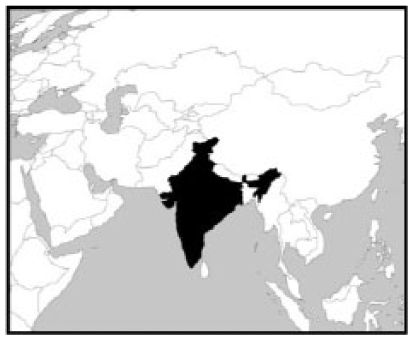
Udupi City is administratively classified as a town within the larger Udupi Taluk, which includes 15 other towns and 86 other villages.(18) Udupi Taluk, in turn, is part of the larger Udupi District, located within the city of Mangaluru on the western coast of the state of Karnataka. Udupi District forms part of the Udupi-Chikmagalur Assembly Constituency, one of the 28 assembly constituencies in Karnataka.(19) The Udupi district is home to a majority Hindu population with minority Muslim and Christian populations. The Billava caste is numerically dominant in the region, followed by the Mogaveera caste. The Mogaveeras in the region were traditionally involved in fishing and related occupations, and are listed under the Other Backward Classes (OBC) category.(20)
Fisheries on the western coast of India make use primarily of mechanized and motorized fishing vessels, differing in this regard from those on the eastern coast, where two-thirds of fishing vessels are still manually propelled.(21) The western coast also has a long history of fish exports. Udupi District is particularly distinct as it is a temple town (home to the Udupi Krishna Temple) that attracts tourists from all over India and the world, and also houses the Manipal University, one of the largest private education institutions in India. Thus the demand for fish locally is also quite high, driven not only by the local inhabitants but also by the many students and visitors from outside the region who throng the restaurants in the area.
The occupation of fishing and allied activities continues to be dominated by Mogaveeras today, even if some Mogaveeras have transitioned into non-fishing activities. While a considerable number of migrants work as head loaders, the sale of fish is largely dominated by Mogaveera women, who have traditionally sold fish that in the past were caught by male family members. Prior to the establishment of local markets, women bartered fish for rice through what was termed the Keka system, dealing primarily with agricultural caste groups that they were linked to through generations of bartering women. Older fisherwomen describe the harsh conditions in the past when they had to walk miles with a heavy basket of fish on their heads to the market or to Keka households to sell fish.(22) During these long journeys, Mogaveera fisherwomen often relied on other caste groups – such as the Bunts in the region – who accepted fish from them in exchange for rice and provided them with shelter. Women were able to sell fish because other women – older women, mothers, mothers-in-law, sisters or sisters-in-law – took over domestic chores at home. Thus women selling or exchanging fish for other necessities is something that is not just accepted, but encouraged.
The conditions of selling fish have changed. The majority of the fisherwomen sell directly to clients in the local markets (Photo 1). While these women may not be “poor” in the sense of earning less than two dollars a day, our research indicates that most of them could be considered close to poor. Even if they have food security, a considerable number of these women face crises during periods of disease or ill health and most of them send their children to public schools, being unable to pay for the private education that so many in India, even among manual labourers, consider essential to their children’s success.(23)
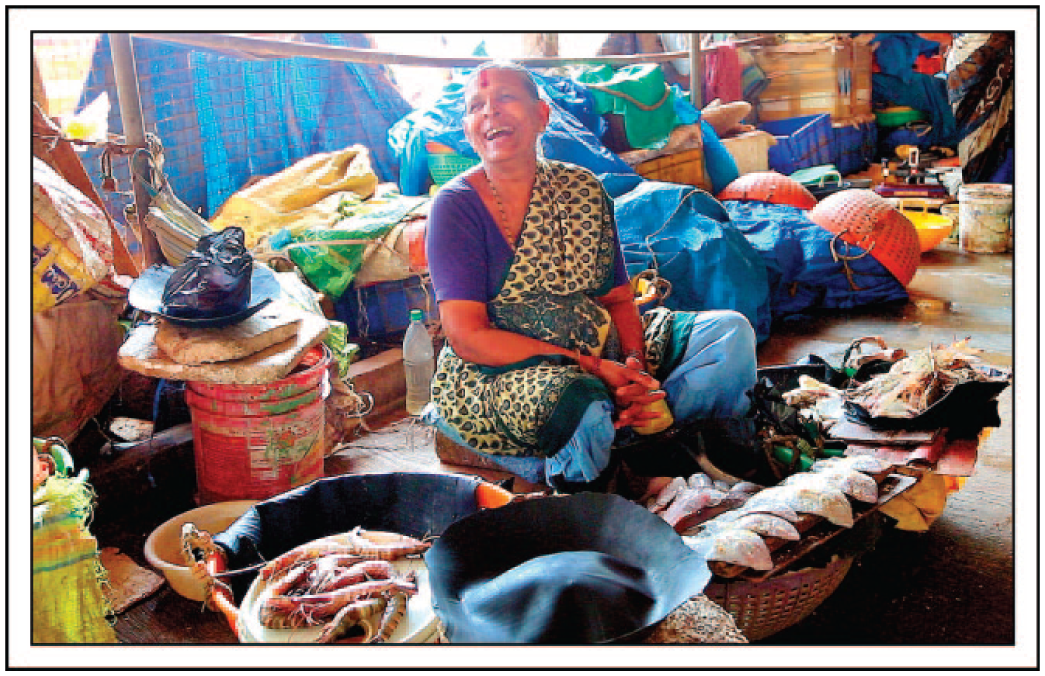
Udupi fish seller, May 2015
Today, even though the traditional matrilineal organization of the group has been replaced by patrilineal family organization through changes in laws,(24) Mogaveera fisherwomen continue to be economically active. However, fishing, as well as fish sales, has changed considerably. In the 1980s the construction of roads and highways and the improvement in travel, particularly the introduction of the auto rickshaws that many of the older women in this research referred to, allowed them to more easily transport the fish to markets. At around the same time, the mechanization of fishing and the introduction of ice factories resulted in a larger supply of fish that could stay fresh for longer periods of time. With ice and storage facilities at the harbour, women today experience less pressure to dispose of fish quickly. They are also able to sell fish in markets for better prices, without having to rely on barter under the Keka system, which was at times quite exploitative, as upper-caste groups often exercised power over these women.(25) However, as one fisherwoman told me, “we continue to be stressed about whether we will be able to sell our fish for a decent price, that worry remains”.
With mechanization of fishing and fewer Mogaveera men in fishing, a substantial number of fishermen, especially those who are employed on boats for fishing, are migrants from North Karnataka (primarily Bijapur), Orissa, Goa and Kerala. Interestingly, of the 16 fisherwomen who were interviewed, only three spoke of spouses who were fishermen, another three spoke of spouses working in fishing-related activities, and the remaining 10 spoke of husbands working in non-fishing activities.(26) Fish purchased by Mogaveera women at the harbour is loaded by migrant female day workers (also primarily from north Karnataka – Bijapur), called head loaders, into vehicles that transport both the fish and the women to the fish markets where they sell their wares. Women from the Kharvi community from neighbouring Goa and members of scheduled castes in the area often clean fish purchased by Mogaveera women (Photo 2). Both head loaders and women who clean fish are paid wages by Mogaveera women, who then sell the fish either directly to customers or to restaurants in their areas. Caste distinctions are thus clear among the fish sellers, the head loaders and the cleaners. Even if the fisherwomen’s Association insists that many non-Mogaveera women also sell fish, the dominant majority of its members are Mogaveeras.(27) It is undeniable that selling fish provides more flexibility than many other jobs available to women. Women can sell fish when they want and take a holiday when they want. While it may provide the same earnings as many other jobs available to them, such as in construction or in factories, women value their independence as fish sellers. It is a livelihood that fisherwomen consider viable and it enables them to educate their children, who then do not have to sell fish. Amongst the 16 women I interviewed, all spoke of wanting their children to be well educated and in more comfortable jobs.
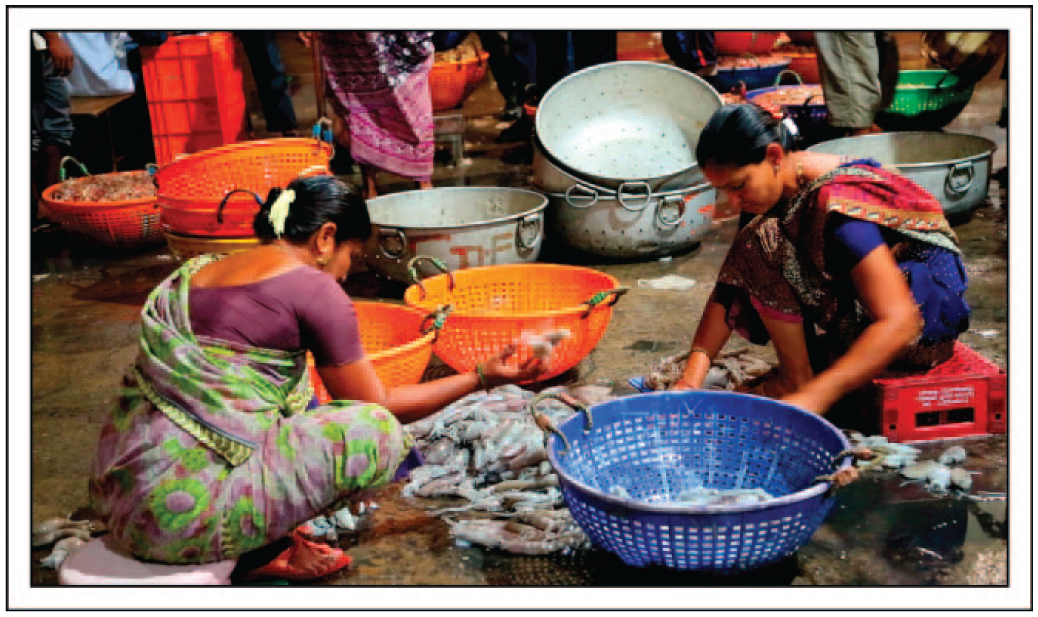
Udupi fish cleaner, May 2015
IV. The Struggle against Shops
While transportation and refrigeration have considerably improved the livelihood of selling fish, these facilities also make it possible for big fish shops to sell fresh fish, thus threatening the fisherwomen’s livelihoods. While the fisherwomen have no issue with smaller shops, arguing that these will not be able to make a profit after paying rent and expenses, they fear the large shopping mall type of establishments that can clearly threaten their livelihoods.
The Udupi Fresh Fish Seller’s Association was founded in 2010 to unite fisherwomen in their struggle against such large fish shops. This cooperative comprises about 1,631 women selling fresh fish, of which the large majority belong to the Mogaveera caste while a very small minority are women from the Kharvi community, also a traditional fishing community from neighbouring Goa.(28) The Association brings together fisherwomen from 36 fish markets in Udupi District.(29) It was founded by Baby Salian, a fisherwoman who has been selling fish for over 30 years now. In 2010, when a fish shop was set up in Saligrama, a village in Udupi Taluk, Baby Salian founded the Association to bring fisherwomen together in order to make demands of the state.(30) The Association made an appeal to the then home minister of Karnataka, requesting that he refuse licences to any new fresh fish outlets in Udupi District, as this would affect the livelihoods of over 10,000 fisherwomen directly selling fish and about 30,000 women indirectly associated with the sales of fresh fish – such as the head loaders who are involved in carrying fish in the harbour, and women who sort, clean and prepare seafood for consumption. Interestingly, only women selling fish are members of the Association, and head loaders and cleaners are not. As Baby Salian explained, because the fish sellers share the same work space – the fish market – as well as similar conditions of work that head loaders and cleaners working in the harbour do not, the Association only covers those who sell fish. Even though these other women are not members, the Association refers to the larger numbers of women working in fish sales-related activities in its advocacy claims. In response to their protest, the minister promised the Association that he would ensure that no new outlets for sale of fresh fish would be permitted.(31)
This informal arrangement made it possible for Udupi Taluk, to a considerable extent, to keep fish sales with the women, a trend that has died away in other parts of Mangaluru. Such informal political arrangements are common in cities in India and have been examined by Benjamin, who speaks of “informal connections” distinguishing connections at the local level with the local bureaucracy from those at the state and national levels.(32) In Mangaluru City, for instance, fisherwomen face heavy competition from fish shops.(33) This is explained in part by the greater size of Mangaluru, which makes a single fish market difficult to access for residents living far away. Udupi City is small enough for a single fish market. In other small towns and villages that are part of Udupi Taluk, women are also able to take advantage of the proximity of the market to all residents, and to continue selling fresh fish directly.(34) Restaurants in Manipal (where the university is) source fish from fisherwomen in Udupi City who supply both restaurants and the local population. Thus women have been able to largely protect their direct sales of fish to both individuals and larger establishments without any intermediaries. Since the activities of sorting, cleaning and sales are all done by women, their solidarity within the larger women’s group, extending beyond the members of the Association, ensures that intermediaries are largely kept out.
However, market forces are quite strong in the region, and with upper-class men who have access to capital vying to enter this profitable trade, women fish sellers are increasingly under pressure from fresh fish shops that provide competition. Despite the agreement with the home minister, fish shops resorted to obtaining permits from other administrative offices. For example, in 2014, following the issuance of permits by gram panchayaths (local village councils) to shops in Udupi, Brahmavar, Sastan, Kota, Saligrama, Saibarakatte, Hebri and Kundapura, the Association once again had to launch a protest before the deputy commissioner’s Office in Udupi. As a result of this protest, the then Udupi-Chikmaglur member of parliament, Shobha Karandlaje, once again assured the Association that she would discuss this with the deputy commissioner of Udupi, urging him to provide instructions to the gram panchayaths.(35) While gram panchayaths are authorized to issue permits and licences to shops, the agreement at a higher level with the home minister and the deputy commissioner would override their authority, and this overriding authority was disregarded in these cases. With their frequent protests, fisherwomen continue to apply pressure on the local administration to ensure the protection of their occupations. Within a larger neoliberal capitalist context, in which the state is largely allied to capital interests and enterprises, this fear of competition from larger vendors continues to run high amongst the fisherwomen.
Apart from resisting the establishment of fish shops in Udupi, the Association also organizes the fish markets that come under it. Women who want to sell fish in the affiliated markets are required to become members of the Association and are expected to adhere to the rules and regulations set forth for the peaceful management of fish markets. The Association has never refused any application for membership. In a meeting when one fisherwoman representing one of the markets responded negatively to an application by a woman for membership in the Association and a space to sell fish, the fisherwomen from the other markets supported the new entrant and argued that the Association is meant to help women in need. The Association organizes the space allotment of members, rotating women’s sites in the market every few months through a picking of lots. It also engages in other issues not related to fishing. For example, in a meeting held on February 2016, a fisherwoman suffering from cancer and undergoing chemotherapy was given a sum of INR 10,000 (approx. US$ 150) towards her treatment, collected on a voluntary basis from women from all the fish markets in Udupi. Thus the Association plays the role of a women’s solidarity network, in which women support each other not only professionally but also personally.
The Association maintains close ties with other fish federations and credit organizations. It is closely linked to the S.K. & Udupi District Co-operative Fish Marketing Federation, a government federation of fishermen and women, which provides financial and other forms of support to both men and women undertaking fish sales, fishing or related activities. The Federation channels credit through MMVSSN – herein referred to as the Society), which was formed in 2011, a year after the women’s Association was founded. Through membership in the Society fishermen and fisherwomen have access to credit at bank lending/preferential rates, as well as assistance in marketing seafood, access to subsidized fuel and ice for storage of fish, access to state welfare schemes including microcredit loans, state-sponsored housing, and supply of safety equipment to fishermen at sea.(36) The head of the fisherwomen’s Association is also a member of both the Federation and the Society. Her presence on the boards of the several other fishing-related organizations in the area and links to key functionaries of these organizations provide for a deeply entrenched network that the Association depends on. These links and networks enable the organizations’ access to government schemes and benefits, which they use to improve the lives of fisherwomen. For example, one such scheme that is presently being channelled through the Society is the Masthyashraya housing scheme, under which several fisherwomen have been able to access free housing provided by the state.(37)
V. Enlisting Support through Intersectional Identities
In our interviews, the director of the Association, Baby Salian, stressed the importance of support from diverse groups. The support of Mogaveera men is crucial and the Association strategically invites powerful and resourceful Mogaveera men to its events and meetings. In an Association meeting in which I participated, the foll: 6 women office holders were accompanied by two Mogaveera men, who provided advice to the women at different points in time. Baby Salian argues that Mogaveera men are important to the organization as they “guide” and “support” the Association in organizing the women. And members argue that the presence of Mogaveera men in meetings is important as they bring in broader knowledge of fishing. Yet the nature of discussions and the issues brought up and decided during these meetings have nothing to do with fishing in itself, but more to do with the organization of markets, allotment of spaces, threats to their livelihoods, etc. The role of men as “advisors” to the Association therefore seems to be more strategic than essential. For example, in a meeting held in February 2016, one of the men present was the chief executive officer of the Society.
Upper-class Mogaveera men have moved out of working in boats to owning boats or factories processing fish. While a considerable number of Mogaveera men have moved out of fishing, the large majority remain linked to fishing and fishing-related activities. For example, Mogaveera men work in cooperative banks that largely service fishermen in the region and in associations or organizations that provide services to fishermen.(38) As such, they become important supporters for the women’s Association, without taking over decision-making powers. Decision making within the Association is largely dependent on majority votes taken in monthly meetings, and while men can provide advice, women take decisions after discussing and debating the issue at hand.(39)
Involving Mogaveera men in the activities of the Association in a certain sense marks the territory of fishing and fish sales as a Mogaveera domain and reinforces caste ties and links between men and women within the community. The sense of community that women build and maintain with their men through the symbolic presence of men in their activities, enables them to obtain political support from their fellow Mogaveeras. In the last 13 elections of the Udupi Assembly Constituency,(40) Mogaveera elected representatives (MLAs) were successful in seven instances, and represented the constituency. Amongst these seven instances, in five cases the same Mogaveera woman – Manorama Madhavaraj (from the Mogaveera community but not a fisherwoman herself) – was elected. With Mogaveeras dominating the political landscape in the area, the caste identity of fisherwomen clearly plays a role in their ability to keep fish sales to themselves.
The fisherwomen have also been able to capitalize on their gender identity, recruiting politically strong women from other castes to support their Association. For example, since the establishment of the Association in 2010, they have enlisted the support of Shobha Karandlaje, a woman politician from the Gowda caste and the present MLA for the Udupi-Chikmagalur constituency. Drawing on a shared gender identity, the Association frequently invites her to its programmes and enlists her support. The appeal to gender was evident in an address to the Association in which she stated, “women today play a significant role in religious, political and social arena. She surpasses men in all spheres.”(41)
Along with gender, a common appeal is also made to women’s poverty while lobbying the state. In interviews with members of the Association and the Society, the sale of fish comes forth as critical to survival. In the statements made before the government, fisherwomen point to the inability of the government to provide alternatives to the thousands of fisherwomen engaged in this activity, and necessity and poverty are frequently invoked in arguments for state support. The lack of other viable alternatives is expressed in the interviews and the press reports on the demands made by the Association to the state.
The work and livelihoods of fisherwomen are key to lifting families out of poverty, and this fact too is consistently put forth before the state. The sale of fish is no longer preferred by younger Mogaveera women with higher education. Both the Association’s and the Society’s members speak of Mogaveera women transitioning out of fish sales, and other women – scheduled caste women and Kharvi women – moving into their place. And yet the sale of fish by these women is what has ensured their daughters’ transition out of the occupation and out of conditions of poverty. Poverty is thus crucial to their appeals and intersects with gender in the effects it has on women and their families.
Gender, poverty and caste intertwine in the manner in which the sale of fish as an occupation is constructed. That women sell fish and that only women should sell fish is asserted by the Association but also by all the fisherwomen interviewed. That men should not occupy this domain, that it is a woman’s space, emerges from all the interviews. That it has to be women selling fish is claimed on the ground that they are largely, and in many cases solely, responsible for their households.
This reliance on women’s work is not new. Most women spoke of their mothers working to take care of them. During the interviews, all but one woman spoke of their mothers selling fish, and 10 out of 16 women spoke of their mothers being the primary breadwinners. Within the matrilineal system, women were primarily responsible within households, and according to these interviewees, the role of men seemed to be marginal in sustaining their families. While the younger fisherwomen (two) spoke often of husbands contributing substantially to household incomes, the older fisherwomen (14) were more likely to be primarily responsible for managing their homes, with spouses only supplementing household incomes. In interviews with three Mogaveera men, women were described as primarily responsible for running the home. Men were frequently referred to as less responsible, often alcoholic or frequently sick. The Mogaveera fisherwoman is thus constructed as essentially hardworking, nurturing and caring, but also breadwinning, independent and responsible. There were no references made to men’s responsibility – to the contrary, women’s work was constructed as essential to support the larger good of the community. Thus, enabling women’s work also in a certain way ensures that women continue to be primarily responsible as breadwinners. Women also adopt this discourse and often refer to their work as essential to food security and education for their children, a project in which men seem to be less implicated.(42) This is less the case with the two younger women interviewed, who spoke of equally shared financial and domestic responsibilities at home.
But in all the interviews, what emerges is fish selling as an activity to sustain oneself and one’s family. The sale of fish for profit is rarely discussed. But here again this is because profits are rarely possible, not because women resist capital modes of production and exchange. For these women the task of selling fish encapsulates both activities of production and reproduction, with no necessity to make explicit what is implicit. Women speak of working to feed and educate their children and while referring to profits also refer to losses. Because of the unpredictability of sales, women speak of being able to make enough money to sustain their families. While some of the women do sell fish to larger buyers such as restaurants and tourist enterprises, these are few and far apart.
Thus, a complex and nuanced argument is made that is acceptable to local elites who are also located within local relations of caste, while at the same time acceptable to the policy discourse on poverty. The historical specificity of Mogaveera women as poor fisherwomen struggling to rise above poverty is interwoven with references to women’s primary responsibility towards their children, in a certain way fixing both caste and gendered meanings to the livelihood of selling fish. The occupation is in turn also constructed around this rhetoric of poverty, as a resource for poor women, as an occupation of necessity and thus as an occupation of the poor. While caste livelihoods are not explicitly claimed, it remains a central organizing element in the local politics and informal arrangements that sustain the Association.
VI. Conclusions
Even at this preliminary stage of research, this case offers good potential for an intersectional analysis as it shows how gender is intertwined with caste, political status and class. A purely gendered analysis without attention to these intersections would lack the historical, political and economic specificity that reveals the complex social relations that sustain this livelihood. While intersectionality as a concept emerged out of the fact that multiple marginal identities could render some women more vulnerable than others,(43) this example reveals how both marginal and dominant identities/statuses have been used by Mogaveera fisherwomen to enlist local political and state support in the protection of their livelihoods.
Caste continues to structure social relations, and the Mogaveera identity surfaces in conversations, interviews and exchanges even if it remains absent from the name of the Association as well as in its political rhetoric. Castes and livelihoods continue to be closely linked in India, and in the particular case of Udupi’s fisherwomen, this explains the solidarity that the Association has been able to maintain between fisherwomen as well as between Mogaveera men and women. However, the secular context in which they are located requires them to accept not only Mogaveera women but also others selling fish, however small and insignificant their numbers are.
But gender is also closely intertwined with caste to enable this success. Matrilineal organization and the gendered distribution of work and responsibilities within the family make Mogaveera women central to fish selling. Fisherwomen thus continue to be synonymous with Mogaveera women, even if many upper-class Mogaveeras are no longer engaged in fishing or fishing-related activities. Even if a so-called “right to a livelihood” cannot be claimed in a modern open economy, the right to a caste-based occupation emerges significantly in the interviews. The right to a caste occupation to fall back on in times of need is reframed in a secular context through appeals to poverty. Here, women ask what alternatives the state can provide poor women, if they lose their livelihoods. Drawing from the secular, rational discourses of poverty and gender, the Association advances the cause of “poor fisherwomen” and the “protection of livelihoods”. In a broader political context of ending poverty and ensuring gender equality, women as primary breadwinners – the new development agents – emerge as more responsible and thus more deserving of state protection and benefits. Both caste and secular resources are thus mobilized in protecting their livelihoods. From the demands made of the state, the political rhetoric of the organizations, and the everyday narratives that women engage in to describe their work, the terrain of fish sales thus emerges as primarily a poor Mogaveera woman’s domain – to be protected for the purpose of survival itself.
Footnotes
Acknowledgements
This paper draws on preliminary research conducted under the project “Feminist Analysis of Solidarity Economy Practices: Views from Latin America & India”, funded by the Swiss Network for International Studies, Geneva and directed by Dr Christine Verschuur, Graduate Institute of International and Development Studies, and Dr. Isabelle Guérin, Director of Research, Institute of Research for Development, France. I would like to thank Melvin Mathew Thomas, a Master’s student in Sociology at the Manipal Centre for Philosophy & Humanities, for the photographs used in this article.
1.
Kabeer, N, K Milward and R Sudarshan (2013), “Organising women workers in the informal economy”, Gender & Development Vol 21, No 2, pages 249–263.
2.
Crenshaw, K (1989), “Demarginalizing the Intersection of Race and Sex: A Black Feminist Critique of Antidiscrimination Doctrine, Feminist Theory and Antiracist Politics”, University of Chicago Legal Forum Vol 140, pages 138–167.
3.
Collins, P H (1990), Black Feminist Thought: Knowledge, Consciousness, and the Politics of Empowerment, Unwin Hyman, Boston; also Hooks, B (1984), Feminist Theory: From Margin to Center, South End Press, Boston.
4.
McCall, L (2005), “The Complexity of Intersectionality”, Signs Vol 30, No 3, pages 1771–1800.
5.
Davis, K (2008), “Intersectionality as buzzword: A sociology of science perspective on what makes a feminist theory successful”, Feminist Theory Vol 9, No 1, pages 67–85.
6.
Brah, A and A Phoenix (2004), “Ain’t I A Woman? Revisiting Intersectionality”, Journal of International Women’s Studies Vol 5, No 3, pages 75–86.
7.
Lykke, N (2011), “Intersectional analysis: Black box or useful critical feminist thinking technology”, in H Lutz, M Herrera-Vivar and V L Supik (editors), Framing intersectionality debates on a multi-faceted concept in gender studies, pages 207–221.
8.
Yuval-Davis, N (2006), “Intersectionality and Feminist Politics”, European Journal of Women’s Studies Vol 13, No 3, pages 193–209.
9.
Jenkins, L D (2003), Identity and Identification in India: Defining the Disadvantaged, Routledge, London and New York.
10.
Guru, Gopal (1995), “Dalit Women Talk Differently”, Economic and Political Weekly Vol 30, No 41, pages 2548–2550; also Kannabiran, Kalpana (2006), “A Cartography of Resistance: The National Federation of Dalit Women”, in Nira Yuval-Davis, Kalpana Kannabiran and Ulrike Vieten (editors), The situated politics of belonging, SAGE, pages 54–72; and Rege, Sharimila (1998), “Dalit Women Talk Differently: A Critique of ‘Difference’ and Towards a Dalit Feminist Standpoint Position”, Economic and Political Weekly Vol 33, No 44, pages 39–46.
11.
Chaudhuri, Maitrayee (2004), Feminism in India, Kali for Women, New Delhi.
12.
Kothari, R (editor) (1970), Caste in Indian Politics, Orient Blackswan, Hyderabad.
13.
Tulu is a southern language spoken in this region and the communities located in this region are commonly called Tuluvas, meaning Tulu-speaking communities.
14.
Ishii, M (2014), “Traces of reflexive imagination: Matriliny, modern law, and spirit worship in South India”, Asian Anthropology Vol 13, No 2, pages 106–123.
15.
While these women muster caste identity informally, they argue for poor women’s rights to livelihoods, including not only Mogaveera women but also women of other castes who support their work. I examine this in Section IV in detail.
16.
The head of the Association, Baby Salian; the Association’s administrative assistant, Ashwini; the Chief Executive Officer of Meenu Maratagarara Vividoddesha Souharda Sahakara Niyamita, Udupi (MMVSSN, meaning Fish Sellers Varied Interests Assistance Society), Prakash Suvarna; and one of the founder members of the Mahalakshmi Cooperative Bank, Udupi, Anand Putrana.
17.
I observed the first meeting, but in the second meeting, when the fisherwomen discussed health issues and the lack of medical insurance coverage for the group, I was roped into the discussion. I was asked for advice on how to negotiate for and obtain low-cost medical insurance because of my work at the Manipal University, which runs one of the best hospitals in the region – the Kasturba Medical College Hospital. During the third meeting, after gathering some information from the university, I discussed some of the options available with the university health care scheme, called Arogyaand. This was particularly relevant given my job at the Manipal University, which is linked to the Manipal Kasturba Medical Hospital.
18.
19.
20.
22.
Interviews with Baby Salian on 18 January 2016, relating how her mother sold fish, and Prakash Suvarna on 25 January 2016, on how his mother carried fish to surrounding villages.
23.
Since the quality of public education in India is poor, particularly at the primary school level, families that can afford it prefer to send their children to private schools, many of which charge quite low fees.
24.
Suchitra, J Y and H Swaminathan (2010), Asset Acquisition among Matrilineal and Patrilineal Communities: A Case Study of Coastal Karnataka No 3, Bangalore.
25.
Interview with Prakash Suvarna, who related what his mother told him about the Keka system, in which fisherwomen could sell only to those families their mothers had sold to. At times the prices fixed for fish were exploitative and fisherwomen were also asked to work in the fields during their visits to Keka households to sell fish.
26.
Interviews conducted in the Beedinagudde market and Malpe Bandar, both of which are located in Udupi City.
27.
While the exact numbers of non-Mogaveera women selling fish are not available with the Association, in an interview with a staff member of the Association’s office, she revealed that of the total 1,631 members, about 20–30 women may be non-Mogaveeras. From my preliminary research in three fishing markets in and around Udupi – Udupi City, Parkala, Malpe Bandar and Manipal – I have yet to meet a non-Mogaveera woman selling fish.
28.
In Kundapura about 500 fisherwomen have their own association, which works closely with the Udupi Association to keep fresh fish shops at bay. Interview with Ashwini, administrative assistant at the Association, on 12 March 2016.
29.
The fish markets with active members of the Association include fish markets in Karkala, Kapu and Brahmavara. It also includes fish markets within Udupi Taluk. In all it covers 36 fish markets that take active part in the Association’s activities. Interview with Ashwini, administrative assistant at the Association, on 12 March 2016.
30.
Alva, A (2010), “Fisherwomen’s association inaugurated in south Indian State”, Women in Fisheries, International Collective in Support of Fishworkers, 2 February, accessed 31 May 2016 at  .
.
31.
The then home minister, V S Acharya, made a promise to the Association that licences would not be granted to fish shops in Udupi. See Katapadi, P (2010), “Fresh Fish Sellers’ Association submits appeal to the Home Minister-Dr. V.S. Acharya”, Bellevision, 23 July, accessed 10 March 2016 at http://www.bellevision.com/belle/index.php?action=topnews&type=593.
32.
Benjamin, S (2000), “Governance, economic settings and poverty in Bangalore”, Environment and Urbanization Vol 12, No 1, pages 35–56.
33.
Interviews with Baby Salian and Prakash Suvarna.
34.
Interviews with Prakash Suvarna on 10 March 2016 and Anand Putrana on 23 March 2016.
35.
Katpadi, P (2014), “Udupi: Women fish sellers urge MP Shobha not to allow fish shops”, Utupi Today, 22 October, accessed 10 March 2016 at .
36.
37.
38.
For example, a group of Mogaveera men founded the Mahalakshmi Cooperative Bank Limited. Interview with Anand Putrana (on 23 May 2016), one of the founder members of the bank.
39.
Participant observation during the meeting of the Association on 20 February 2016.
40.
Prior to the delimitation of constituencies in 2008. In the elections held from 2009 onwards, the Udupi constituency was replaced by the Udupi-Chikmaglur constituency. After 2009 all three terms were occupied by candidates from the Chikmaglur region.
41.
Deccan Herald (2010), “Unity among women yield tremendous benefits: Shobha”, 1 February, accessed 10 March 2016 at .
42.
This is of course with respect to fisherwomen only as my interviews are only with these women. As my research does not extend to upper-class Mogaveera women, I am unable to say anything about them at the moment.
43.
See reference 2.