



Abstract
Over the past decade, housing policy in developing countries has witnessed an important shift. After decades of limited and in some cases decreasing investments in housing, there has been a sudden, extraordinarily large, and simultaneous expansion of multi-billion-dollar housing programmes. These new investments reveal a radical policy change, one that signals the serious and welcomed effort of tackling the looming affordability concerns that have been plaguing cities across the world. Yet this paper raises concerns over the direction of current housing policies and programmes. It argues that the new emphasis on addressing the problem through the production of industrial-scale new housing on the outskirts of cities, or through the development of new cities requiring extraordinarily expensive infrastructure, does not necessarily address the affordability concerns. For this reason, the paper raises a series of questions and offers recommendations that address some of the most important elements of decision-making that should be taken into account when planning affordable housing. These are meant to help identify why housing challenges arise, in order to avoid Thomas Pynchon’s well-known aphorism: “If they can get you asking the wrong questions, they don’t have to worry about answers.”
“Two vast and trunkless legs of stone Stand in the desert. Near them on the sand, Half sunk, a shattered visage lies, whose frown And wrinkled lip and sneer of cold command Tell that its sculptor well those passions read… on the pedestal these words appear: ‘My name is Ozymandias, King of Kings: Look on my works, ye mighty, and despair!’ Nothing beside remains. Round the decay Of that colossal wreck, boundless and bare, The lone and level sands stretch far away.” “Ozymandias”, Percy Bysshe Shelley
I. Introduction
Over the past decade, housing policy has witnessed an important shift. After decades of limited and in some cases decreasing investments in housing, there has been a sudden, extraordinarily large, and simultaneous expansion of multi-billion-dollar housing programmes. These new investments, whether they take the form of traditional public housing assistance, as witnessed earlier in many cities of the developed world, or that of massive investments in new cities and new urban enclaves within existing cities, reveal a radical policy change. This signals the serious effort to tackle the looming affordability concerns that have been plaguing cities across the world.
This shift towards the recognition of the importance of housing in urban development is not only welcome; it is also necessary in a world that, between 1950 and 2030, will have witnessed urban population growth nine times greater than the increase that took place in the previous 200 years. The affordability challenge has been more often discussed in the context of rising real estate prices in cities such as London and New York. But the situation is certainly more critical in the growing cities of the global South, where the number of urbanites living in inadequate housing with no access to services continues to increase and is currently estimated at 863 million (in contrast to 760 million in 2000 and 650 million in 1990).(1) When we consider that 95 per cent of the increase in the world’s urban population will be in the developing world,(2) it becomes apparent that the magnitude of housing needs will put immense pressure on cities of the South. Yet is the large-scale production of new housing units, as recently suggested by the McKinsey Institute,(3) the most cost-effective way to address the affordability challenge?
This paper raises concerns over the direction of current housing policies and programmes. It argues that the new emphasis on addressing the problem through the production of industrial-scale new housing on the outskirts of cities, or through the development of new cities requiring extraordinarily expensive infrastructure, does not necessarily address the affordability concerns; nor does it seem capable of creating cities that will be, as Edward Glaeser put it, man’s greatest invention. On the contrary, we question the efficiency of these approaches and, in particular, their adequacy in the context of countries and regions that urbanize at very low income levels. Rather than offering pragmatic responses to the housing challenge, we believe that the programmes undertaken illustrate the landscape of Percy Bysshe Shelley’s poem “Ozymandias”, dangerously echoing past failures of social housing as witnessed in the post-World War II era in European and American cities.(4)
This paper raises a series of questions, and offers recommendations that address some of the most important elements that should be taken into account when planning affordable housing. Our analysis suggests that in many cases these elements have yet to be given serious thought. As a result, billions of dollars of public money are being spent on projects that do little to address housing affordability concerns even when those concerns are a primary motivation for the expenditures. This paper does not attempt to undertake the sort of detailed public finance analysis of different programme options that one might expect would precede the implementation of such programmes. Rather, it considers how a public servant might respond when asked by political decision-makers to build 300,000 new housing units, as was the case for one of the participants at the Bellagio discussions that helped inform this paper. In an attempt to help respond to this query we list five questions, which could guide policymakers in their search for more effective ways to meet the housing affordability challenge.
The plan of the paper is as follows: In the next section we provide a broad overview of the new programmes and their salient characteristics. In Section III, we pose and provide answers to five questions policymakers might consider when implementing such programmes. Section IV makes recommendations about how to proceed, followed by concluding remarks.
II. The Shift to Large-Scale New Housing(5)
Map 1 presents an overview of different programmes that have been initiated during the past decade. It classifies them based on the number of units produced and presents different flows of capital and knowledge expertise. As illustrated by the map, the programmes span geographic regions of the South. It is worth noting the flows of both expertise and capital from the United States, China, Russia and European countries towards developing countries, particularly in the case of sub-Saharan African nations.
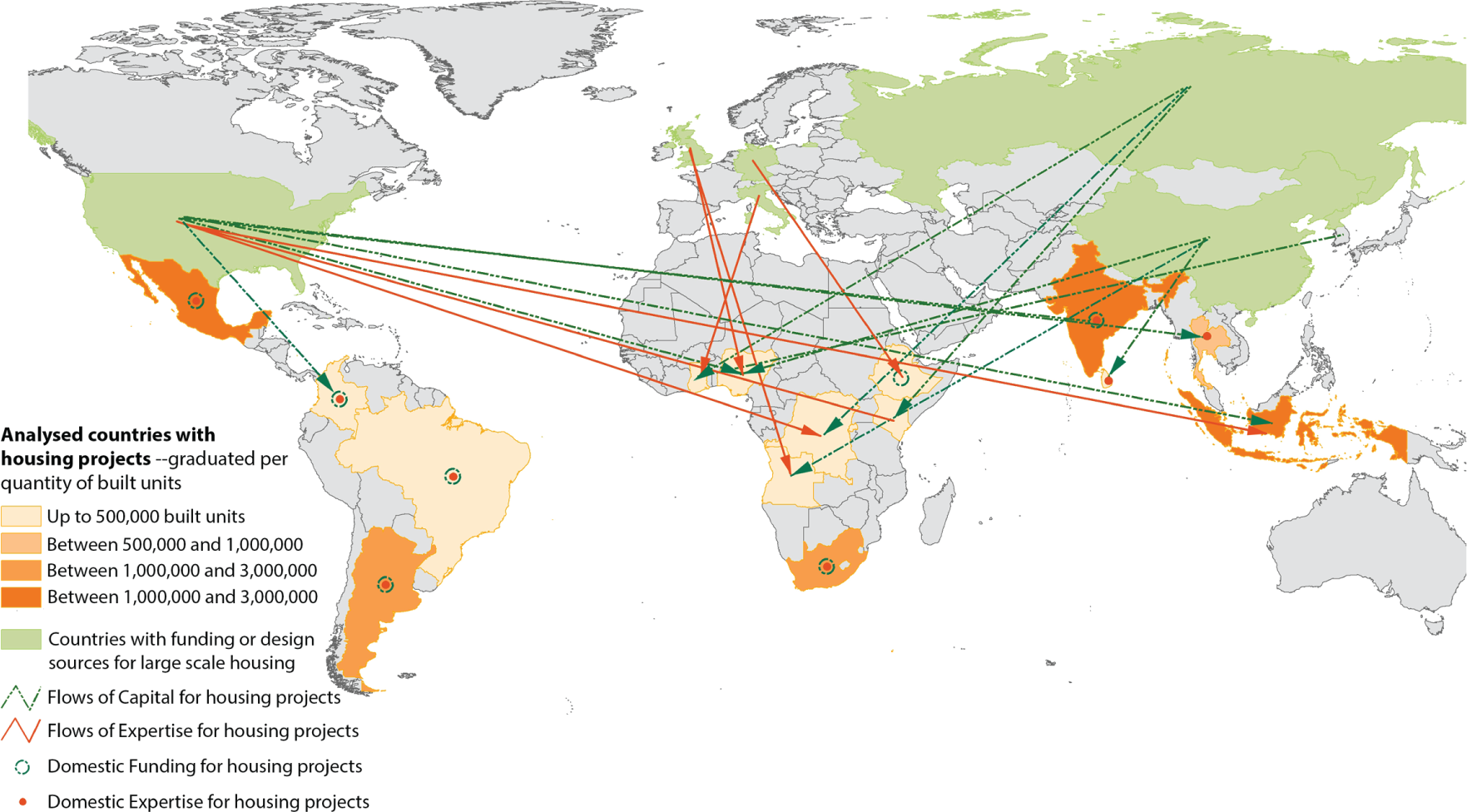
International linkages of new housing/urban programmes
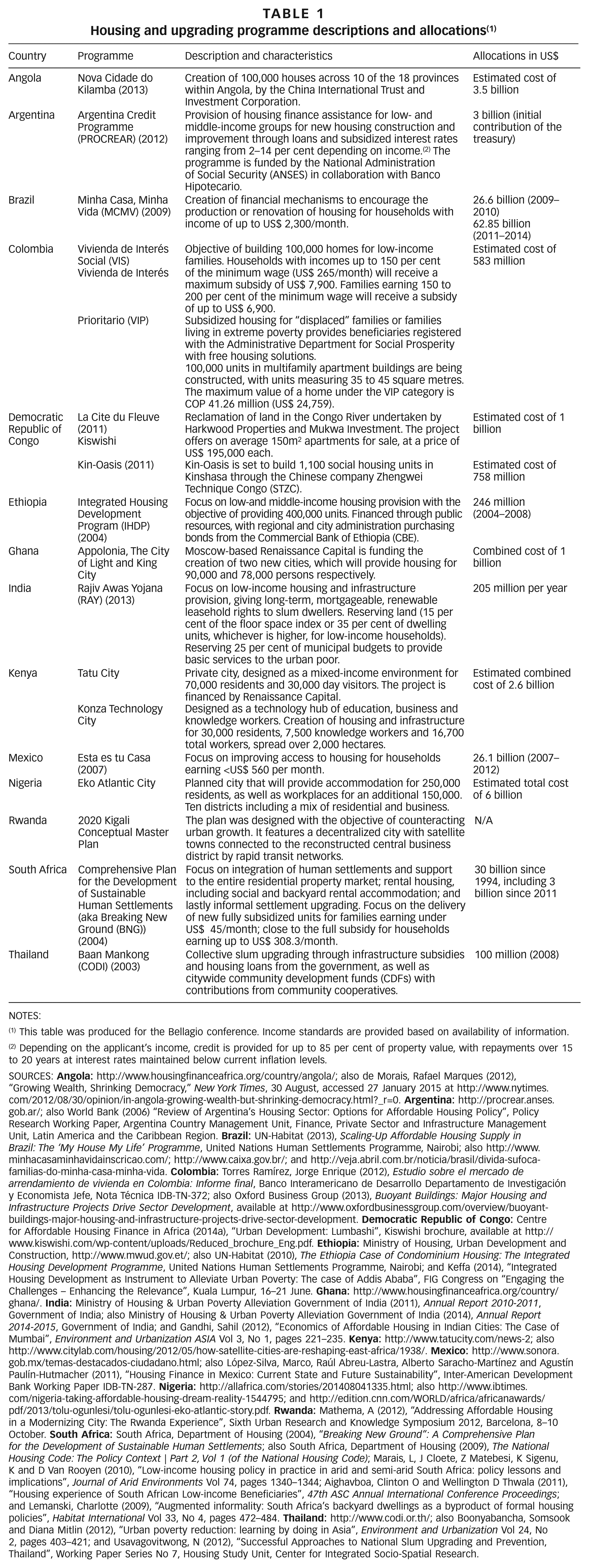
Another interesting element, as seen in Table 1, is the range of interventions in terms of their expected outcomes, objectives and funding allocations. Far from being identical, the programmes aim to tackle the housing deficit and affordability concerns through a variety of interventions. Some programmes are implemented under national housing policies that seek to facilitate housing assistance through housing production and better access to housing finance, as seen in Latin America (Argentina, Brazil, Colombia, Mexico). Other programmes focus on new housing production coupled with more traditional slum(6) upgrading activities, as for instance in the cases of India’s Rajiv Awas Yojana and South Africa’s recent Breaking New Ground – programmes that include service provision and legal titling. In the case of Thailand, Baan Mankong’s main characteristic is its focus on collective improvements, as the programme is centred on communities rather than individual household recipients for housing and infrastructure provision.
Housing and upgrading programme descriptions and allocations (1)
NOTES:
This table was produced for the Bellagio conference. Income standards are provided based on availability of information.
Depending on the applicant’s income, credit is provided for up to 85 per cent of property value, with repayments over 15 to 20 years at interest rates maintained below current inflation levels.
SOURCES:
Finally, we deemed it necessary to include a range of initiatives that do not fall strictly under the logic of housing provision, but nevertheless encompass an important housing aspect. This is the case with recent projects in Angola, the Democratic Republic of Congo (DRC), Kenya and Nigeria. While the scope of each project varies, there seems to be an underlying logic that Chen et al. termed the “Angola mode,” which describes natural resource-backed financing deals for the provision of infrastructure and housing.(7) This approach is beginning to gain traction in sub-Saharan Africa, with the creation of new urban enclaves where financing and construction are provided by other countries, mainly China. This trend is worrying in the context of African urbanization, where housing, especially for the lower class and lower-middle class, is informal and the process of formal investment in housing for ordinary urban households has yet to get underway.(8)
Certainly, the financial details of the new programmes should be carefully evaluated, particularly in areas where affordability is difficult to tackle given the low incomes, as in the case of many sub-Saharan African cities. Further detailed analysis of such initiatives would be helpful in supporting an understanding of the viability, risks, and distributional consequences of many of the new programmes. We have undertaken a beginning in this regard in another paper.(9) But our purpose in the present paper is to reveal the complex linkages between housing and urban development, and to demonstrate that the way housing is provided has important implications for those linkages. Therefore, in the next section we focus on a series of common elements that transcend the distinctive nature of each programme. In the next section we also offer a series of questions that help frame the rationale of intervention in housing but that could also provide guidelines for thinking of housing policy in a wider perspective.
III. Questions for Policy Development
a. Is the social contract for urban development with cities or housing suppliers?
An important part of the housing challenge is balancing new development with the existing urban fabric. Housing plays a special role in this process. It determines where people live and which kinds of spatial arrangements will regulate the city’s productive structure and its ability to generate inclusive growth. Yet one of the common elements found in the majority of programmes is the focus on housing construction at the periphery of cities, often very far from existing urban labour markets. What exacerbates this condition is that housing production is rarely coordinated with the necessary investments in infrastructure, particularly with transport systems that facilitate mobility. As Rojas notes,(10) in the case of the Latin American countries in his study, the programmes tend to create poorly served housing subdivisions without the neighborhood services that make up a large proportion of the benefits associated with housing provision. Thus, when housing policy is not seen within a broader urban perspective, incorporating the role of connectivity, it can result in outcomes such as the large-scale housing projects on the outskirts of cities that deny residents access to the labour markets – as is the case of Angola’s new US$ 3.5-billion city Kilamba, almost 20 miles from the capital.
A consequence of housing developments far from transport infrastructure, without local centres or mixed uses, is that the housing provided does not lead to inclusion; nor does it allow the returns to the existing urban fabric to be exploited. In this sense, the putative cost savings of industrial housing projects can be very misleading. They may be able to produce housing at lower costs, but these costs do not take account of the much higher transport and commuting costs for residents, as shown by Bertaud for South Africa.(11) Nor do they produce the spillover effects on productivity provided by more integrated communities, as shown by Glaeser, Gyourko and Saiz and Carlino, Chatterjee and Hunt.(12) Further evidence of these sorts of problems was recently demonstrated by Celhay and Sanhueza, who showed that in Santiago de Chile, public housing projects created social isolation and limited access to real economic opportunities.(13) More recently, Barnhardt, Field and Pande provide similar experimental evidence on the long-run impacts of a public housing programme in India, which shares many design characteristics with the country’s ongoing scheme, Affordable Housing in Partnership. They show that, 14 years after the programme’s implementation in Ahmedabad, the beneficiaries reported improved housing farther from the city centre, but no change in family income or human capital. Beneficiaries also reported increased isolation from family and caste networks and lower access to informal insurance, which explains why 32 per cent of those who initially opted in returned to informal, lower-quality housing in more centrally located areas.(14)
Indeed, while housing policy is important, this perspective implies that housing programmes should be part of a broader urban social contract, which should focus on the inclusiveness and social cohesion outcomes to be achieved through access to more affordable housing, rather than myopically on housing production. This broader contract should also recognize that besides the direct concern with people’s ability to afford basic shelter, housing provided in cities is important for two larger reasons: first, because it provides access to the most productive jobs and so can improve welfare; and second, because housing in cities allows for infrastructure costs to be shared by more users, thereby significantly lowering the costs of provision.(15)
b. Are urban regulations a central cause of the housing affordability problem?
Almost all cities have both building standards and rules governing population density. Such regulations can generate standardization, making properties easier to value, and can determine how spread-out a city will be – due to building height limitations, for example. When standards are too rigid, they can have severe adverse effects on both city development and housing affordability. Of the many regulations that govern urban transactions, those that regulate density and building standards have the most significant effect on housing affordability.
Density
Urban density is a topic that has long been taken into account by urban planners but is relatively neglected by economists. The public sector has an overriding say in determining built-up density or, more accurately, in dictating floor area ratios.(16) It also determines density through the expansion of infrastructure, the extension of the grids, etc. Hence, whether or not public officials want it, or are even aware of their role in this regard, their decisions often have an enormous effect on urban density and the cost of city infrastructure.
As shown by Angel, Sheppard and Civco,(17) the footprint of cities throughout the world is expanding at a faster pace than the urban population is growing. While expansion is the obvious way to increase the supply of housing, when provided in an unplanned way its benefits are greatly reduced. Paul Collier notes: “Density is a public good: it benefits everyone through opening the possibilities of production-at-scale.”(18) But if officials attempt to limit density too much, the result will be much higher land prices, such as those observed in Mumbai, which are approaching those of New York City, a place with much higher per-capita income.
If a city is to be able to provide the agglomeration economies that characterize denser living, mobility, among other things, is exceedingly important. For example, the lower or more unstable a household’s income, the more it values accommodation close to income-earning opportunities,(19) and hence the greater the density and the smaller the floor area it will be willing to accept in order to be near jobs.
Building standards
All cities need building standards, which protect against defects or provide the less than obvious features of a good – such as how well the sewer line is connected. In addition, standards are often much easier to observe and implement during construction than after completion, and the standardization they generate can make housing easier to value. When standards are appropriate for actual and anticipated income, they function as a form of mental shorthand that reduces decision costs.
In many postcolonial African and Indian cities, regulations on such features as wall thickness, room size, depth of foundations, and minimum size of plot set building standards that are unaffordable for ordinary households. Collier(20) indicates that many sub-Saharan African countries simply adopted the standards of the 1947 British Town and Country Planning Act, raising the question: How out of line with African incomes were the standards of that act? The key indication that regulations are excessive is that housing construction has bifurcated, with regulations being ignored in the informal market, which caters to most ordinary households in sub-Saharan African cities.
Housing affordability is almost everywhere affected by often well-intended regulations that dictate various aesthetic views of what appropriate standards should be. As shown by Bertaud(21) and Glaeser, Gyourko and Saks,(22) these standards often act very much like an implicit tax on real estate and particularly on the real estate of the poor, who, because of these regulations, have to bear higher costs for properties that remain outside of the ambit of legal transactions.
c. Which kinds of urban and related financial regulations are essential?
According to Bertrand Renaud, “Cities are built the way they are financed”.(23) Among the most fundamental of regulations are those dealing with the housing finance question. A house is usually most families’ largest single purchase, and its acquisition can profoundly affect the wellbeing of buyers and their children. But not only does housing represent a large share of household wealth, it is also a complex good whose many different, and often not obvious, characteristics can have implications for how effectively a property is valued. Finally, housing is a good that has unusually high transaction costs.(24) With such expensive, complicated goods, regulatory guidance is unambiguously important.
Moreover, housing decisions often involve transactions between, on the one hand, fairly unsophisticated borrowers with very limited ability to diversify, and, on the other, sophisticated, diversified financial institutions. Two seemingly innocuous housing finance-related regulations provide examples of the significant implications regulations can have for the way the housing and financial markets more generally function:
Those governing loans that are denominated in foreign exchange, as applied, often with disastrous results, in many of the reforming socialist economies – such as Hungary, Romania and the Czech Republic.
Those allowing lenders to garnish future earnings of borrowers if the house value has fallen below the outstanding mortgage at the time of loan termination.
When the regulation of such complicated transactions is insufficient, the effects are severe and spill over to the rest of the economy.
d. How can the existing urban capital stock help address housing affordability?
One of the common characteristics of the programmes studied, and in line with recent recommendations from the McKinsey Institute,(25) is the objective of addressing the housing backlog by the production of new units. Most governments allocate substantial parts of their resources to the construction of new units because of the view that economies of scale in new production have a greater impact than improvements in existing housing conditions. Yet, even in the most ambitious of the programmes studied, new housing production accounts for only a small percentage of the already existing housing stock. Perhaps a more effective way to address housing concerns would be to look at the existing housing. Policies that allow the existing stock to be used most efficiently can have far larger effects on supply, and hence on affordability, simply because of the enormous difference in scale between new and existing housing. For instance, if the existing stock accounts for 95 per cent of the housing supplied, and the new stock 5 per cent, then a 6 per cent reduction in the cost of the existing stock will have about the same effect on housing supply as a doubling of new production.(26)
Moreover, if a unit can reasonably be expected to have a longer life than the household occupying it, then the unit can be expected to “filter” to another family, as the original occupants move elsewhere. In addition, because the house would have depreciated over time, it would be of lower quality and, accordingly, lower cost. Hence one would expect the unit to filter down to a lower-income family. The question is how rapidly housing values depreciate relative to the income levels of the lower-income households. Recent empirical work in the United States, by Rosenthal,(27) indicates that the value of older houses declines quickly enough that better-quality houses become more affordable to lower-income families. That is, the US housing stock does indeed filter down to lower-income families. In short, at least in the US, the filtering process appears to work, so that the most effective way to assist low-income families with gaining access to better housing is to provide them assistance with housing in the existing market.
How, then, can the existing housing stock be made more responsive to high demands? As Bertaud(28) and Hammam(29) indicate, there are many ways to do this: permitting taller buildings; changing minimum plot and/or house size; permitting more downsized units, as proposed in New York City and as practised in Paris; and implementing policies that tax idle land. When a city’s most expensive land is covered with low-rise units or empty lots, one of the key incentives offered by city living – the ability to substitute structures for land when the land becomes expensive – is lost.
Of course, it is not always the case that the supply of land is such that affordable housing in relatively central locations can be easily realized. For example, to give a sense of how much more productive, and hence expensive, cities can be, according to Business Insider the five largest cities in the United States produce almost a quarter of the country’s GDP with 6 per cent of the country’s population.(30) As a direct consequence of the location of these high-productivity jobs, housing in these cities will be relatively expensive. In addition, in many cities, topography also plays a significant role, as documented by Saiz.(31) He shows that in places where there is steep terrain, or waterfronts, the ability to increase housing supply is much more limited. So, in some places, the housing affordability challenge is one marked by resource costs. It is not amendable by policy but is rather a signal of how to spatially allocate resources. Nevertheless, in many places – taking into account London’s green belts first proposed by the Greater London Regional Planning Committee in 1935, Californian coastal cities, heritage restrictions in Paris, height control in Mumbai, and many other cities – certain policies serve to make housing so unaffordable for so many that even tripling new housing production will not offset the cost increases related to restrictive development policies.
e. What role do carefully targeted subsidies play in addressing housing affordability?
The issue of subsidies is a central one for any housing programme. How well expenditures are targeted also bears great significance for the long-run financial sustainability of the programmes. In some housing production schemes – for instance, in the approach taken in the DRC – the housing produced by the government is affordable without a subsidy only to the richest 6.5 per cent of the population (Figure 1). When governments produce only very expensive housing, as in Angola (Figure 2) and the DRC, only the rich can afford to occupy it and even they often need subsidies. In such cases, government expenditures do not address affordability concerns and do not respond to the housing needs of lower- and middle-income families. Rather, in order to make housing affordable, governments further subsidize the middle- to high-income classes, as was the case in Kilamba, where units valued at US$ 120,000 ended up being sold at US$ 84,200 in order to make them affordable for middle-level civil servants.(32)
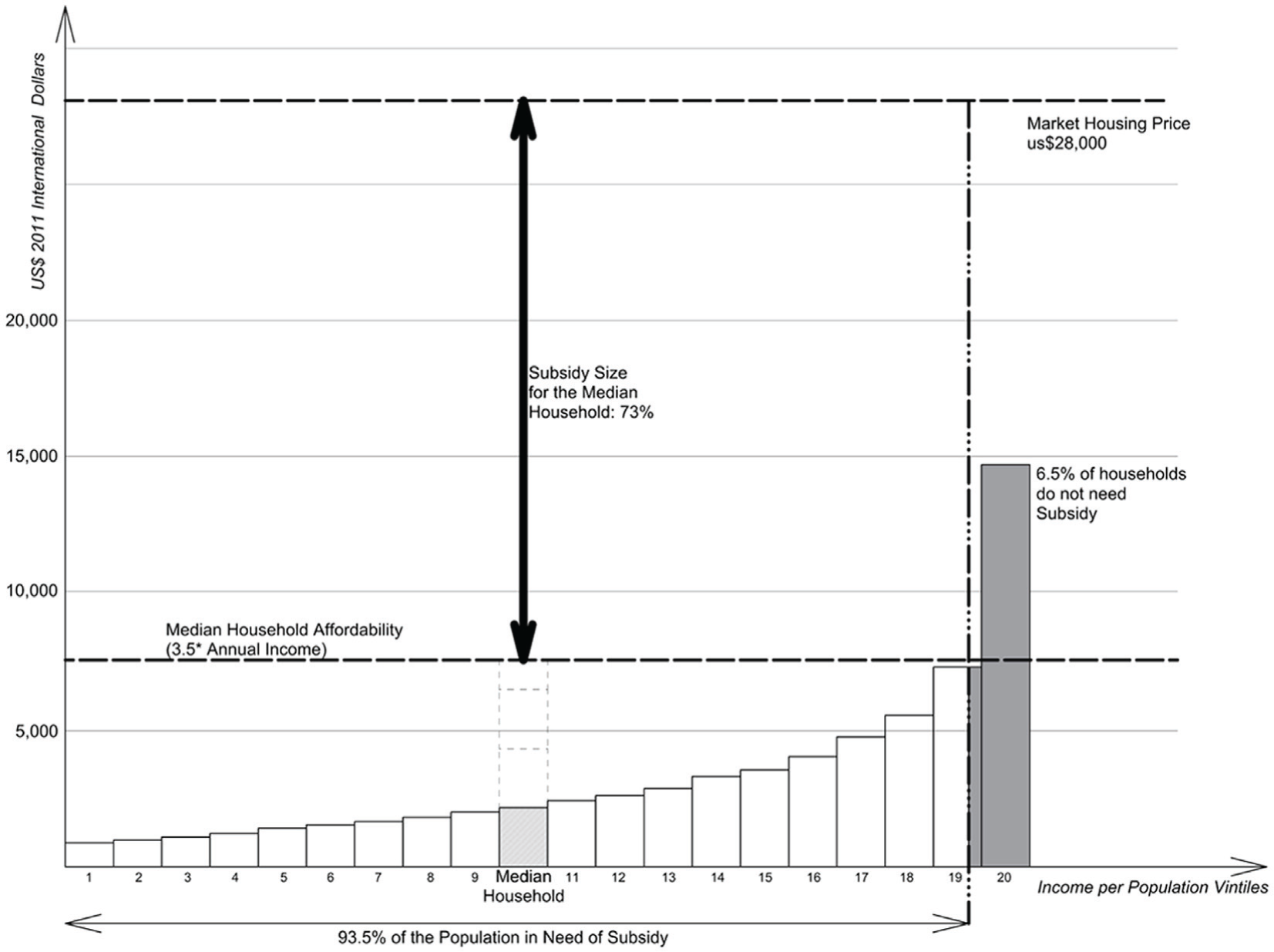
Housing affordability in the DRC
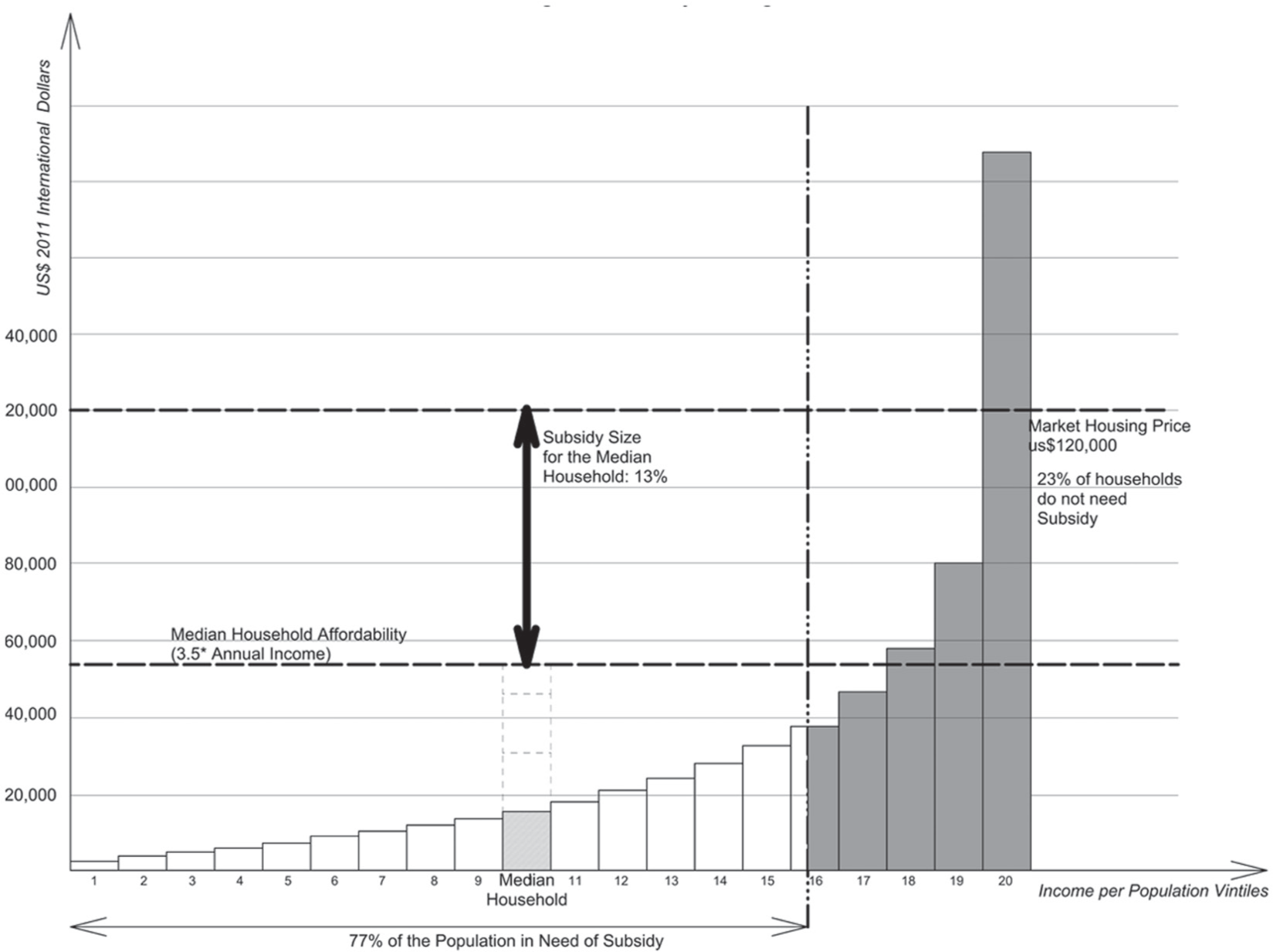
Housing affordability in Kilamba, Angola
There is an extensive literature on how to most effectively provide subsidies. A traditional public finance perspective suggests that beyond the question of targeting, there are other fundamental qualities of well-designed housing subsidies. For instance, if subsidies are transparently provided, their accountability is more likely to be maximized. Similarly, if the size of the subsidy is such that it is “just enough” to induce a shift of recipients to better housing, the subsidy will not provide windfalls or affect behaviour. While perhaps difficult to judge precisely, subsidies beyond what might be called “an inducing level” of the sort described by Wasmer(33) are wasted; they indirectly fund expenditures other than those intended by the subsidy.
So, while precision about how much is needed to induce a certain behaviour is perhaps too much to ask for, it is important to realize that very high subsidy rates almost certainly result in waste. Moreover, these costs also increase sharply as the size of the per-unit subsidy increases. For example, the almost 100 per cent subsidy of the housing component of the South African Reconstruction and Development Programme can easily create indirect resource costs that equal half the subsidy itself. These deadweight losses are at least four times more than the amount that would be implied by a 20 per cent per-unit subsidy.(34)
Finally, in keeping with the need for an urban social contract rather than a sectoral housing perspective, it is important that housing subsidies be designed in ways that build upon rather than ignore community inputs. Such inputs are obviously important to achieve the inclusiveness that Hausmann refers to,(35) and they can engage the resources, energy and knowledge of the community.
The case of Thailand illustrates how in many instances, inclusiveness and scale can be achieved, perhaps more slowly at first, by working with active community engagement. This approach, as described by Boonyabancha,(36) implies a shift from policies focused strictly on producing new housing units to an approach focused on improving the living conditions of the population within the city itself. What differentiates the Thai programme from the others presented here is that its approach is structured around the allocation of funds to organized communities to carry out improvements they themselves have identified. While the approach may have higher startup costs, it offers greater durability and integration into the urban context. Evidence of the effectiveness of this approach comes from the US$ 100 million Baan Mankong programme of the Thai government, which was recently subjected to a rigorous statistical evaluation. The programme was designed by Boonyabancha, secretary-general of the Asian Coalition for Housing Rights (ACHR) and former director of the Thai government’s Community Organization Development Institute (CODI), the entity responsible for the implementation of Baan Mankong. The evaluation of the programme was done by the Thai Development Research Institute, a well-regarded Bangkok-based think tank. Among other desirable outcomes, that study shows that communities assisted by the programme had significantly improved conditions relative to those in similar communities that did not receive assistance. And families in assisted communities increased their educational expenditures for their children and had much better business prospects than those in similar, but unassisted, communities.
This strong evidence from Thailand provides a promising strategy for the ongoing expansion of such initiatives centred on community engagement in other Asian countries, particularly through the work of ACHR and its programme Asian Coalition for Community Action (ACCA).(37) A recent assessment of this programme from the World Bank has shown that:
“when compared with other approaches to upgrading low-income areas, such as public housing or sites and services programs, ACCA appears to perform well through its carefully-designed and targeted subsidy, its capacity to detect ‘signals of seriousness’ on the part of the community (thereby targeting assistance to those who value it the most), and its capacity to slow down the process of real estate development in ways that reduce some of the speculative waves that often characterize urban redevelopment.”(38)
IV. Recommendations: A Roadmap for an Inclusive Housing Policy
This section offers a number of recommendations so that the policies underway in so many countries might be reconsidered. The perspective of our recommendations is similar to that of one of the foremost observers of housing policy, the late John Quigley, who suggested that it is impossible to understand housing policy without historical context.(39)
a. The parties involved should be convened more broadly
The new programmes contain an extraordinary amount of detail regarding the allocation of resources. It is impossible to do justice to all the programmes without knowing all the relevant facts and motivations. Nevertheless, billions of dollars’ worth of investments are being made. A gathering of the countries involved could lead to opportunities for learning from each other. The World Bank Institute, in partnership with the governments of Brazil, India and South Africa, has already initiated a dialogue among some of the countries involved. It would be important to prepare for such a meeting by placing special emphasis on emerging problems and solutions. Answers to the questions raised here may provide a basis for such an evaluation.
b. The financial details of the new approaches should be carefully evaluated, particularly in Africa
The World Bank and the UK Department for International Development have begun research programmes on African urbanization. This work could have very high payoffs in terms of how we think about housing affordability and the urbanization process. However, it is unlikely to address questions regarding the feasibility of the new approaches now being developed. Impartial analysis of such proposals would be helpful in understanding the viability, risks and distributional consequences of many of the new programmes.
Many of the schemes that have been proposed so far have been badly structured, often with little attention paid to their inherent flaws. For example, UN-Habitat’s review(40) of a proposed US$ 11 billion plan for slum upgrading in Kenya provides a positive review of a programme that was deeply flawed from the outset. Similarly, McKinsey’s recommendations(41) for addressing the global affordability challenge would be rejected out of hand by most analysts. Finally, many well-known engineering/architectural firms have provided plans for reimagining cities – in Kenya, Rwanda and Ghana – but rarely do these “fantasies,” as Watson characterizes them,(42) correspond to reality and more importantly respond to the affordability concerns.
c. Better data and research on urbanization are needed
Concerns about rapid urbanization and the housing conditions of the urban poor have prompted the creation of an urban Sustainable Development Goal (SDG) that calls for making cities and human settlements inclusive, safe, resilient and sustainable. A precondition for fulfilling the objectives of the urban SDG goal is having better local data in order to gain a thorough understanding of the actual living and housing conditions in informal settlements. While the data collected by UN-Habitat give an aggregate perspective on conditions, current measurements provide little to no information on conditions in specific locations. Beyond a few case studies(43) that disaggregate their findings at the intra-urban level, most data are limited to urban aggregates and formal housing markets. This can be misleading, as when conditions are averaged, the deterioration experienced by the majority of urban residents in sub-Saharan Africa who live in informal settlements is more than offset by the improvements for the minority living in formal housing. As a result it is impossible to say what the realities are on the ground and which policies work, which in turn affects the ability to provide adequate housing and services for the urban poor. Further analysis of informal housing markets, to gain an understanding of the behaviour, priorities and housing standards of low-income urbanites, is seriously needed if policies to address what appears to be a growing problem are to be developed. Like the attempt to construct new cities without addressing the fundamental problems besetting the existing ones, efforts to create new urban indicators fail to appreciate just how weak existing data are, particularly in the places that have the largest needs in terms of housing.
There are efforts towards achieving a better knowledge of housing conditions. For instance, Shack/Slum Dwellers International (SDI), a transnational network of the urban poor, has conducted over 6,000 settlement profiles and enumerations in Africa, Asia and Latin America, and this number increases each year. The purpose of the profiles and enumerations is largely to build community self-awareness and social capital. Patel et al. note: “Through enumerations [communities of the urban poor] survey and map themselves, and build the skills and knowledge to represent themselves and their needs to government. At the same time, they develop a critical collective identity that helps form the political basis for their engagement with government.”(44) The transformative merits of this strategy have been covered in the literature.(45)
More recently, Kallergis(46) shows in the case of Uganda that this rich set of data on urban areas that are usually underrepresented in national censuses can yield important information on how household and dwelling characteristics affect housing costs, in ways that are consistent with previous empirical results. Thus, beyond the undeniable social capacity-building merits of SDI’s approach, the survey results are credible and hence could serve as an effective low-cost basis for better information.
d. Many cities have very limited governance capabilities; in such places, community groups are an essential policy instrument
Perhaps one of the most serious impediments in addressing housing and infrastructure provision relates to the low capacity of local governance witnessed in many rapidly urbanizing countries that urbanize at low income levels.(47) As a result, local government resources remain scarce, and autonomy from the central government is not always achieved. Given these conditions, it seems unrealistic for local governments to make investments in expensive housing and citywide infrastructure services. In such places, the engagement with community organizations can provide an important first step in co-producing local public goods at the neighborhood level. This engagement has been often misinterpreted as a shift in responsibility from local government to communities, to the detriment of improvements in local governance. Yet there is no empirical evidence revealing whether this is in fact a concern, or whether such efforts actually enhance accountability and ultimately improve local governance. There are many examples, such as the Orangi Pilot Project in Pakistan or the Slum Sanitation Program in Mumbai, that have shown the positive outcomes of engaging with communities at the neighborhood level; these can grow from local to citywide and even national policies. Of course, scaling up these efforts is often difficult, and many of these initiatives stumble on institutional challenges. But as shown by McGranahan,(48) there are also successful responses that could be replicated in other settings and areas of local public goods provision.
e. A shift is needed from housing policy to broader urban land management
One of the main shortcomings of the housing programmes presented above is their incapacity to incorporate the question of housing into the broader urban land management context. Angel et al.(49) and Angel (50) have shown that the footprint of cities throughout the world, and especially in rapidly urbanizing areas, is growing rapidly and largely haphazardly. If this growth is not managed, the urban periphery, where land is usually more affordable, remains disconnected from the rest of the city. Focusing on simple steps in order to manage urban expansion, such as making realistic projections about the amount of land that the growing urban population will require and where the physical expansion of the city is likely to take place, could yield much higher returns than the industrialized housing provision recommended by McKinsey. Research by O’Grady(51) has shown how New York City’s 1811 Street Grid – a plan that Rem Koolhaas called “the most courageous act of prediction in Western civilization”,(52) and which laid out the streets before development – has resulted in enormous efficiency gains.(53) Perhaps more importantly, the New York grid has increased connectivity, offered better coordination, and encouraged investment, easier access, and lower input requirements for public networked infrastructure through what O’Grady calls the predictability of expansion.(54) In that sense, managing expansion rather than increasing the number of new housing units can be a more efficient solution in order to tackle affordability.
V. Conclusions
Billions of dollars are now being spent around the world in attempts to help cities remain the centres of culture and creativity they have always been. Unfortunately, these expenditures are rarely structured in a way that will improve housing affordability or result in more inclusive cities. Indeed, in many places the programmes could have long-term detrimental effects. Moreover, as the experiences of a number of countries indicate, once an approach has taken root it is very difficult to change. What is even more troubling is that in the regions and countries where housing issues are more acute, the flawed approaches are most prevalent. Expenditures on isolated, expensive enclaves, tech hubs and satellite cities will do little to boost the ability of cities to serve as a platform for inclusive growth.
The main message of this paper is a rather simple one: that the housing affordability challenge should not be thought in isolation but rather as including many different sorts of challenges, all of which are part of a complex urban conundrum. As such, the affordability challenge that cities worldwide are currently facing should not be posed in simplistic terms. Merely relying on the creation of new units, and then measuring the outcome of policies based on the number of units constructed, will do little to ensure affordable housing. Rather, we propose that the effects of housing policy be analyzed within a broader framework and in terms of actual outcomes. From this view, a careful prior understanding of the larger urban policy environment, as it pertains to income levels, land use availability, regulatory frameworks and wider urban expansion characteristics of urban areas, is necessary for housing policies to be effective and for urbanization to become the springboard of equitable growth.
Footnotes
Acknowledgements
This paper was informed by discussions at the Rockefeller Foundation conference on “Improving the Emerging Consensus on Government Efforts to Transform Cities in Emerging Economies” held at the Bellagio Center in Lake Como, Italy, 2014, and was funded by the Rockefeller Foundation. However, the views expressed do not necessarily reflect the Foundation’s views. The complete publication can be downloaded from:  .
.
1.
UN-Habitat, ICLEI-Local Governments for Sustainability, and United Cities and Local Governments of Africa (2014), The State of African Cities, 2014: Re-Imagining Sustainable Urban Transitions, United Nations, New York and Geneva.
2.
United Nations (2014), World Urbanization Prospects, The 2014 Revision, New York and Geneva, File 3, available at .
3.
Woetzel, Jonathan, Sangeeth Ram, Jan Mischke, Nicklas Garemo and Shirish Sankhe (2014), A blueprint for addressing the global affordable housing challenge, McKinsey Global Institute, available at .
4.
Perhaps the most striking symbolic image of such failures came with the demolition of the Pruitt-Igoe housing complex in St. Louis, Missouri; what initially was hailed as an innovative housing solution was torn down 20 years later.
5.
This section relies on background work that was prepared for the Bellagio conference.
6.
The term “slum” usually has derogatory connotations and can suggest that a settlement needs replacement or can legitimate the eviction of its residents. However, it is a difficult term to avoid for at least three reasons. First, some networks of neighbourhood organizations choose to identify themselves with a positive use of the term, partly to neutralize these negative connotations; one of the most successful is the National Slum Dwellers Federation in India. Second, the only global estimates for housing deficiencies, collected by the United Nations, are for what they term “slums”. And third, in some nations, there are advantages for residents of informal settlements if their settlement is recognized officially as a “slum”; indeed, the residents may lobby to get their settlement classified as a “notified slum”. Where the term is used in this journal, it refers to settlements characterized by at least some of the following features: a lack of formal recognition on the part of local government of the settlement and its residents; the absence of secure tenure for residents; inadequacies in provision for infrastructure and services; overcrowded and sub-standard dwellings; and location on land less than suitable for occupation. For a discussion of more precise ways to classify the range of housing sub-markets through which those with limited incomes buy, rent or build accommodation, see Environment and Urbanization Vol 1, No 2 (1989), available at .
7.
Chen, C, P Chiu, R Orr and A Goldstein (2007), “An Empirical Analysis of Chinese Construction Firms’ Entry into Africa”, Paper prepared for the CRIOCM2007 International Symposium on Advancement of Construction Management and Real Estate, Sydney, 8–13 August.
8.
Collier, Paul and Anthony J Venables (2014), “Housing and Urbanization in Africa: Unleashing a Formal Market Process”, World Bank Policy Research Working Paper 6871, Washington, DC.
9.
Buckley, R M, A Kallergis and L Wainer (forthcoming, 2016), “The Emergence of Large-Scale Housing Programs: Beyond a Public Finance Perspective”, Habitat International.
10.
Rojas, E (2015), “Housing Policies, Quality of Housing and Urban Development Lessons from the Latin American Experience 1960 - 2010”, Paper prepared for the 2015 World Bank Conference on Land and Poverty, Washington, DC, 23–27 March.
11.
Bertaud, Alain (2012), “Converting Land into Affordable Housing Floor Space”, Paper prepared for the World Bank Sixth Urban Research and Knowledge Symposium, October.
12.
For example, the Carlino, Chatterjee and Hunt study demonstrates that patent intensity is positively related to the density of employment in the highly urbanized portions of metropolitan areas: All else being equal, a city with twice the employment density (jobs per square mile) of another city will exhibit a patent intensity (patents per capita) that is 20 per cent higher. Glaeser, Edward L, Joseph Gyourko and Albert Saiz (2008), “Housing Supply and Housing Bubbles”, Journal of Urban Economics Vol 64, No 2, pages 198–217; also Carlino, Gerald A, Satyajit Chatterjee and Robert M Hunt (2006), “Urban Density and the Rate of Invention”, Working Paper No 06-14, Federal Reserve Bank of Philadelphia.
13.
Celhay, Pablo and Claudia Sanhueza (2011), “Location, Location, Location: Labor Outcomes in Urban Slums of Santiago-Chile”, Instituto de Políticas Públicas Documento de Trabajo 3, Facultad de Economía y Empresa.
14.
Barnhardt, S, E Field and R Pande (2015), “Moving to Opportunity or Isolation? Network Effects of a Randomized Housing Lottery in Urban India”, Working Paper 21419, National Bureau of Economic Research.
15.
According to Hausmann, this type of urban inclusiveness should be stressed because it is a strategy that allows for the exploitation of the returns to scale of large fixed infrastructure investments. He argues that a strategy for inclusive growth not only offers distributional benefits, but also lowers the cost of paying for the fixed infrastructure costs that connect underserved populations to networks of production. Hausmann, Ricardo (2014), “The Economics of Inclusion”, Project Syndicate, 7 November, available at .
16.
In effect, as Bertaud shows in an NYU blog post, density can be higher in areas with very low floor area regulations, as they are in Mumbai’s slums. Bertaud, Alain (2015), “Greater Mumbai’s Draft Development Plan: Good for Housing, Transport, and Jobs”, New York University, Marron Institute of Urban Management, 16 April, available at .
17.
Angel, Shlomo, Stephen C Sheppard and Daniel L Civco (2005), The Dynamics of Global Urban Expansion, Transport and Urban Development Department, World Bank, Washington DC.
18.
Quote from the Bellagio convening.
19.
Satterthwaite, D (2011), “Upgrading Dense Informal Settlements: The Potential for Health and Well-Being”, LSE Cities, November, available at .
20.
Collier, Paul (2012), “Housing in Low-Income Cities: Learning from 19th Century European Urbanization”, Social Europe, 11 April, available at .
21.
Bertaud, Alain (2010), “Land Markets, Government Interventions, and Housing Affordability”, Wolfensohn Center for Development Working Paper 17, Brookings Institution, available at .
22.
Glaeser, Edward L, Joseph Gyourko and Raven Saks (2005), “Why Have Housing Prices Gone Up?”, Working Paper 11129, National Bureau of Economic Research.
23.
Quote retrieved from Malpezzi, S (2014), “Global Perspectives on Housing Markets and Policy”, Working Paper 3, Marron Institute of Urban Management, New York University.
24.
Smith, Lawrence B, Kenneth T Rosen and George Fallis (1988), “Recent Developments in Economic Models of Housing Markets”, Journal of Economic Literature Vol 26, No 1, pages 29–64.
25.
See reference 3.
26.
A doubling of the supply of new housing will add 5 per cent to the existing stock of housing. A 6 per cent reduction in the cost of the 95 per cent of housing supplied by the existing stock of housing results in a similar increase in supply.
27.
Rosenthal, Stuart S (2014), “Are Private Markets and Filtering a Viable Source of Low-Income Housing? Estimates from a ‘Repeat Income’ Model”, American Economic Review Vol 104, No 2, pages 687–706.
28.
See reference 21.
29.
Hammam, Sonia (2014), “Housing Matters”, World Bank Policy Research Working Paper 6876, Washington, DC.
30.
31.
Saiz, A (2010), “The Geographic Determinants of Housing Supply”, Quarterly Journal of Economics Vol 125, No 3, pages 1253–1296.
32.
Cain, A (2014), “African urban fantasies: past lessons and emerging realities”, Environment and Urbanization Vol 26, No 2, pages 561–567.
33.
Wasmer, Etienne (2012), “Ex-Ante and Ex-Post Evaluation of the 1989 French Welfare Reform Using a Natural Experiment: The 1908 Social Laws in Alsace-Moselle”, 2012 Meeting Paper 478, Society for Economic Dynamics, available at .
34.
A deadweight loss is a loss of resources that occurs when the demand or supply of a good is affected by monopoly pricing, externalities, and taxes or subsidies. The term “deadweight loss” is also referred to as the “excess burden” of taxation.
36.
Boonyabancha, Somsook (2009), “Land for housing the poor — by the poor: experiences from the Baan Mankong nationwide slum upgrading Programme in Thailand”, Environment and Urbanization Vol 21, No 2, pages 309–329.
37.
Boonyabancha, Somsook and Diana Mitlin (2012), “Urban Poverty Reduction: Learning by Doing in Asia”, Environment and Urbanization Vol 24, No 2, pages 403–421.
39.
Quigley, John M (2007), “Just Suppose: Housing Subsidies for Low-Income Renters”, Berkeley Program on Housing and Urban Policy Working Paper W06-005, University of California, Berkeley.
40.
41.
See reference 3.
42.
Watson, Vanessa (2014), “African urban fantasies: dreams or nightmares?”, Environment and Urbanization Vol 26, No 1, pages 215–231.
43.
Brueckner, Jan K (2013), Slums in Developing Countries: New Evidence for Indonesia, University of California, Irvine.
44.
Patel, Sheela, Carrie Baptist and Celine D’Cruz (2012), “Knowledge is power – informal communities assert their right to the city through SDI and community-led enumerations”, Environment and Urbanization Vol 24, No 1, pages 13–26, page 14.
45.
See reference 44; also Karanja, Irene (2010), “An enumeration and mapping of informal settlements in Kisumu, Kenya, implemented by their inhabitants”, Environment and Urbanization Vol 22, No 1, pages 217–239; and Makau, Jack, Skye Dobson and Edith Samia (2014), “The five-city enumeration: the role of participatory enumerations in developing community capacity and partnerships with government in Uganda”, Environment and Urbanization Vol 24, No 1, pages 31–46.
46.
Kallergis, A (2015), “Is It Possible to Collect Low-Cost Data on Slum Conditions? Evidence from Uganda”, Public and Urban Policy Research Working Paper, The New School, New York.
47.
Cities Alliance & United Cities and Local Governments of Africa (2013), Assessing the Institutional Environment of Local Governments in Africa.
48.
49.
See reference 17.
50.
Angel, Shlomo (2012), Planet of Cities, Lincoln Institute of Land Policy, Cambridge, MA.
51.
O’Grady, Trevor (2014), “Spatial Institutions in Urban Economies: How City Grids Affect Density and Development”, Harvard University.
52.
Koolhaas, R (1994), Delirious New York: A retroactive manifesto for Manhattan, Monacelli Press, New York.
53.
Among these gains are the benefits stemming from the initial partition of land into uniform rectangular blocks, which limits incentives to form incompatible subdivisions and reduces irregular property shapes.
54.
See reference 51.