




Abstract
China has seen rapid economic development and urbanization, and this has included the upgrading of traditional sanitation systems. But the speed of this transition raises concerns about the coexistence of diverging sanitation practices and their impact. This paper asks how this coexistence is experienced by low-income urban residents in Shanghai. It is based on field research during four weeks in July 2013, which involved in-depth, open-ended interviews with 20 low-income urban residents. The article concludes that these diverging everyday practices are situated at the core of urban socio-spatial differentiation, inequality, exclusion and discrimination. Particularly affected are rural-to-urban migrants and ageing working-class residents, for whom the lack of access to improved sanitation may be associated with stigmatization and social isolation. Future research should examine how changing sanitation cultures under urban development and diverging sanitation practices in different contexts can affect family ties, social relations and socio-spatial integration. To view an animated video that illustrates the ideas discussed in this paper, please visit https://youtu.be/BPEU_apfoLo
I. Introduction
Ever since reform and opening up began in 1978, China has seen rapid economic development and urbanization. The encroachment of urban sprawl upon agricultural land and villages(1) and the ongoing replacement of old and impoverished urban neighbourhoods (home to the urban poor and rural-to-urban migrants) with new-built gated communities for an emerging middle class in the country’s cities(2) have led to the coexistence of very diverse urban groups in what Wissink and colleagues refer to as “patchworked, unifunctional, and monocultural enclaves”.(3) This coexistence of old and new, rich and poor, old and young – an expression of escalating social, economic and spatial inequalities – includes the coexistence of various systems of sanitation and the diverging practices of sanitation associated with them.
Although it has been suggested that the spaces in between “enclaves” can play a positive role in the negotiation of urban coexistence,(4) the impact of diverging everyday practices of sanitation on long- and short-term differentiation in the transitioning Chinese city has remained largely unexplored. This paper, therefore, asks how the coexistence of diverging sanitation practices under conditions of rapid urban development is experienced by low-income urban residents in their everyday lives.
Previous studies of sanitation in China have focused primarily on regional disparities in sanitation infrastructure provision or the technical, “hard” aspects thereof. Disparities in basic sanitation provision – as well as in the quality of sanitation infrastructure – exist between the coastal areas and Inner and Western China as well as between urban and rural areas; for instance, it is estimated that 74 per cent of people in urban areas have access to improved sanitation, compared to 56 per cent in rural areas.(5) Pointing out the problems associated with the adoption of centralized sewer-based systems in fast-growing, often water-scarce urban contexts, scholars have explored potential alternatives, such as decentralized and dry sanitation systems.(6) Yet despite the country’s rapid economic development and its remarkable advances in the provision of improved sanitation, the percentage of urban residents in China forced to defecate in the open has been reported to have grown from 3 per cent to 6 per cent between 1990 and 2008.(7) More recent statistics estimating access to sanitation at 100 per cent(8) seem to overlook the fate of rural-to-urban migrants and low-income urban residents.(9) These groups – among them a rapidly increasing proportion of senior citizens – suffer discrimination and exclusion in many areas of their everyday lives: health, housing and education provision are but a few.(10) The perception of diverging sanitation practices of low-income urban residents, who are excluded from access to mainstream, modern sanitation infrastructure, may therefore further exacerbate the experience of existing and potential socio-material inequalities.
This paper seeks to draw attention to the “soft” aspects of everyday sanitation. Sanitation is embedded in the everyday in that it connects, in the words of McFarlane and colleagues, “body, infrastructure, city, health, education, livelihood, social relations, private-public relations and modernity”.(11) Everyday sanitation, here, begins to locate experiences “on the ground” within a nexus of larger, complex transitions in cultural beliefs, social norms, spatial expectations, ecological requirements and economic drivers. This research builds on the understanding that everyday sanitation practices and the perceptions of these practices are manifestations of socio-material inequalities. Therefore, the experience of everyday sanitation offers a suitable lens through which to explore existing and emerging socio-spatial differentiation under conditions of rapid urban development in Shanghai.
The next section provides a brief history of sanitation and modernization in urban China. This is followed by an outline of the research approach and an account of the sanitation experiences of low-income urban residents in two inner-city neighbourhoods in Shanghai. The article concludes with the argument that the coexistence of different sanitation systems and therefore practices as a result of rapid urban development and transformation is closely linked with processes of differentiation and stigmatization, with implications for the individual experience of the everyday as well as the longer-term trajectories of marginalized urban residents.
II. ModerniZing Sanitation in Urban China
China’s traditional agriculture was based around human waste and coupled animal and plant production.(12) Human waste was considered a valuable commodity.(13) In a closed-loop system, households collected waste in terracotta jars with air-tight seals. These were emptied into special carts in the early mornings, transported to the closest canal and shipped to the countryside on boats. Mixed with other waste and composted, human waste was used as organic fertilizer in the production of food.(14)
The collection and disposal of human waste in cities was carried out without any attempt to conceal what a Western observer described as its “more nauseating aspects, except where such action has been influenced by foreigners”.(15) Foreign settlements are said to have created a model for the development of modern waste management in China.(16) The first hygiene campaign was organized by Shanghai’s Public Health Bureau in 1928. The municipality expelled impoverished “hut dwellers” (mostly rural-to-urban migrants) from the international settlement and urged its urban citizens to clean their work spaces and residences in order to create a healthy population and sanitary city – to “construct an orderly urban society” and “reorganise urban space”.(17) However, another Western observer in the 1930s commented: “until plumbers can devise some method of flushing a toilet so that the human fertilizer will not be sluiced into sewers where it is lost to the hungry soil that needs it so urgently, the development of the plumbing business in China will necessarily lag far behind any other modern industry”. The use of sanitary plumbing, according to this source, “does violence to the instincts of the Chinese” and “many who live in modern Shanghai apartments often flush a toilet with a feeling of guilt and regret at the waste of fertilizer which would add to the production of a bean field or bring blooms to a flower garden”.(18)
In the late 1960s, the collection of human waste as traditionally practised was abandoned over hygiene considerations in most areas of Shanghai. Where households had no access to the modern sewage system, the government installed central excrement collection stations in neighbourhoods. Now, residents had to carry their night pots to an excrement collection station nearby and dispose of their waste themselves. Urban redevelopment has led to the steady decline of excrement collection stations in the city, but their number stands still at approximately 2,000 across Shanghai(19) (Figure 1 and Photo 1). Some rely on septic tanks; others discharge directly into the municipal sewage system.
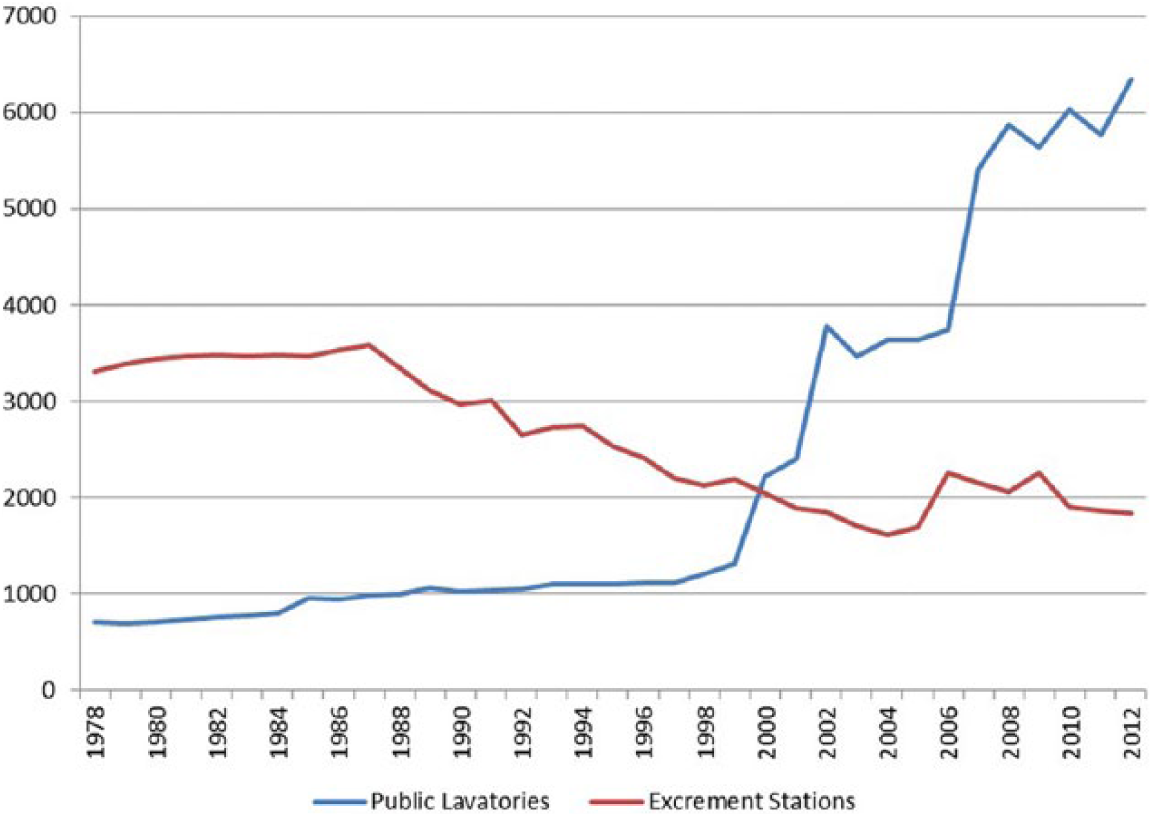
Growing number of public lavatories and shrinking number of excrement stations in Shanghai
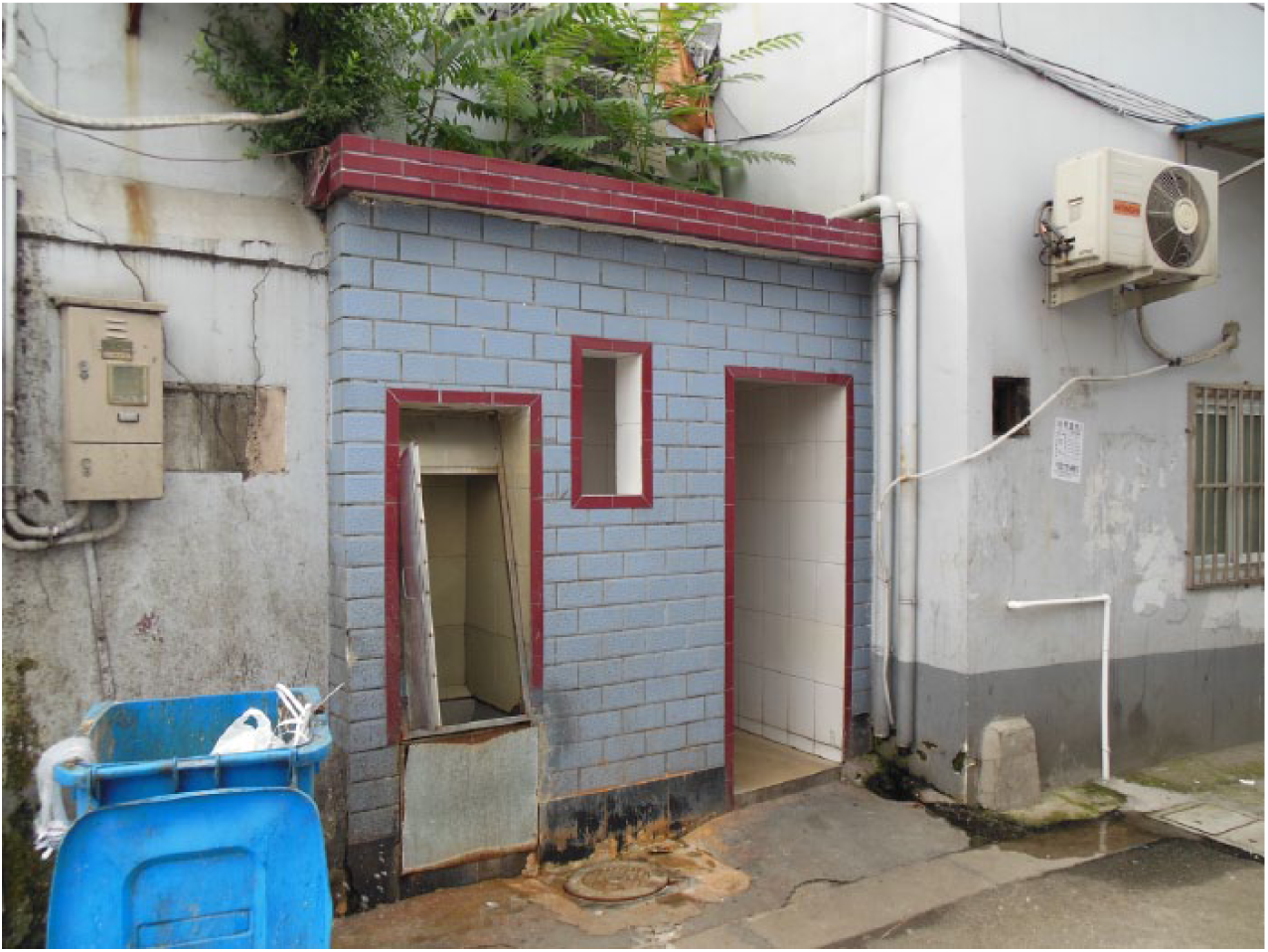
Central excrement collection station, Shanghai
Once China opened its doors to the West in the early 1980s, Shanghai’s government recognized the lack of publicly accessible toilets as an urgent challenge. Since then, and especially in view of the Shanghai World Expo 2010, enormous improvements have been made, as indicated in Figure 1. Public toilet blocks continue to be constructed and maintained by the municipal government, although a few charge a small amount (RMB 1; about US$ 0.16) for their use. In the near future, the city plans to invest in the installation of flush toilets for residents of old residential areas that are not slated for redevelopment.(20)
Over the past decades, China has experienced a decoupling of human waste and animal and plant production. As in other developing countries, the state seeks to attract investment and to implement various forms of infrastructure deemed appropriate for globalizing service and financial industries. Urbanization and growing labour costs have contributed to the sharp decline of recycling rates for organic materials in agriculture and increasingly less sustainable methods of food production.(21) Despite being energy-intensive, in that they require fresh water, sewage treatment, sewers and the replacement of organic with inorganic fertilizers, water closets are now considered the most progressive and hygienic option to deal with human waste. Today, according to a local official, the city is concerned with two major tasks: extending the opening hours of public toilets (currently, most close at 9 pm); and providing information on their locations.(22) The government has addressed the latter by installing city-wide signage and launching the highly successful Shanghai Toilet Guide. This mobile phone application locates the closest public facility – one of currently 8,000 – and informs users about the availability of toilet paper and Western-style toilets.(23)
However, not everyone has access to mainstream sanitation facilities, and diverging sanitation practices coexist. How this contributes to further socio-spatial differentiation within the context of contemporary Shanghai – and urban China more generally – remains a relatively new and unexplored topic. The following sections will address this gap by providing an initial overview of the emerging issues around everyday sanitation infrastructure and practices under conditions of high-speed urban development in contemporary Shanghai.
III. Methodology
Following Chambers’ call to “put the last first”,(24) the research approach moves away from surveys based on pre-conceived survey questions and attempts, instead, to sketch the perspectives of low-income, marginalized urban residents in the contemporary city. This more intimate view may contribute to a more complete understanding of the short- and long-term multi-dimensional issues that may result from uneven urban development and diverging sanitation practices in seemingly sanitized Shanghai; it may help to formulate timely directions for further research around urban sanitation in China in the future.
The field research was carried out over four weeks in July 2013 in several low-income areas in Shanghai. In order to develop a better understanding of the impact of coexistence between different spatial typologies and social groups on perceptions and practices of sanitation, two areas were selected on the basis of their spatial characteristics (i.e., old neighbourhoods near new-built residential compounds) and social mix of inhabitants (i.e., long-term, low-income urban residents and recent rural-to-urban migrants versus urban middle-class residents). In both areas, the majority of residents lacked access to flush toilets; they used night pots and emptied them at allocated neighbourhood excrement collection stations (Photo 1).
One case study area, Caojiacun, was demolished at the end of 2014. At the time of the field research, it was home to an older generation of retired or laid-off workers as well as recent rural-to-urban migrants. It had been established around a century ago and was known as a typical Subei neighbourhood.(25) Ever since redevelopment of the wider area began in the late 1990s and this neighbourhood was surrounded by an ever-growing number of high-rise gated communities for the new middle class, residents were anxiously awaiting the demolition of their neighbourhood and their resettlement to newly-built flats elsewhere.
The other case study area was established on unwanted land, the site of a former mass grave, in the early 1940s, when some 4,000 poor families from all over the country settled here. In the mid-1990s, private developers bought the land north of the narrow street – Huining Lu – that runs through the neighbourhood, demolished existing housing and replaced it with a gated high-rise compound. Attached to the walls of a state-owned factory, the remaining houses to the south of the street remained untouched.
It should be noted that the research reported here was conducted as part of a scoping study aiming to develop a more comprehensive understanding of sanitation conditions and practices in low-income neighbourhoods. The research adopted a largely participatory methodology, paying special attention to not inconveniencing research participants or making them feel uncomfortable in any way. Unlike conditions elsewhere,(26) sanitation is only beginning to be perceived as a taboo subject in China and it can be said that people are still generally happy to discuss the subject without inhibition. My research assistant and I approached potential interviewees informally and conversations took place in a rather casual manner, allowing participants to choose freely how much or how little of their sanitation experiences to share. Although we had planned to speak to low-income urban residents, middle-class urban residents and rural-to-urban migrants, due to time constraints we chose to focus mainly on the first group. This paper is based on in-depth, open-ended interviews with 20 low-income urban residents of the two case study neighbourhoods.
Although we were mindful to focus the interviews on participants’ experience and perceptions of sanitation infrastructure and practices, it should be noted that owing to the nature of the selected case study areas (i.e., neighbourhoods slated for future redevelopment or currently on the verge of demolition and displacement), participants often diverted the discussion to their disgruntlement with processes of urban development, land grabbing, forced eviction, imprisonment and other grave themes – which, although of great importance, cannot be discussed in detail within this article. They require appropriate treatment and in-depth study in the future.
IV. Everyday Practices of Sanitation and Differentiation
This section reports on the main sanitation-related concerns of research participants. Those most adversely affected by exclusion from access to mainstream sanitation infrastructure appear to be the elderly, low-income urban residents and rural-to-urban migrants.
a. Isolated ageing
Economic progress and rising expectations have had an impact on family structure and traditional living arrangements.(27) The authority of the elderly was once undisputed – traditional China has frequently been described as a “gerontocracy”(28) – but is beginning to fade. The formerly common multi-generational household model is breaking up and the elderly are frequently left to live alone in old and impoverished neighbourhoods.(29)
Mr and Mrs Huang,(30) typical Caojiacun residents, are both in their late 80s. They remember the time when theirs was a quiet neighbourhood for families with children. They used to place their household’s night pot in front of the entrance to their house, so that its contents could be collected early in the morning. The excrement was then transported onto a boat on the Suzhou Creek nearby and shipped to the countryside, where it was sold to farmers. “This system was much more organic”, they say; “the fertilizers they use nowadays are poison”.(31)
But once the central excrement collection system was introduced in their neighbourhood some 20 years ago, the Huangs, then in their late 60s, installed a flush toilet. There is no door to the small room under the stairs where the bowl is located and they only use it to empty their night pot, which they prefer and continue to use. They say that having the flush toilet in the house made life more convenient for them as they grew older; it saved them the daily trips to the excrement collection station.
But not everyone in the neighbourhood is as lucky. Mrs Wong’s woes are representative of those of many: also in her 80s, she lives alone in a small house only a couple of lanes away. Her husband passed away and her children are white-collar professionals and live in modern high-rise buildings far away. She is too old and ill to make the journey to their homes. In the past, it was common for them to come for dinner at her house on Saturdays. The whole family would also come together on special occasions, such as Chinese New Year. But with time, these visits became more and more sporadic and have ceased almost entirely ever since her grandchildren reached their teenage years. “I can’t afford a modern toilet”, Mrs Wong laments.(32) “And you know how it is: when the children come to visit, after two hours or so one will have to go to the toilet. But they’re scared and disgusted. They don’t know how to use a night pot any more. So they don’t come. They call, but they won’t visit.”
b. Disputed ownership
Mr Hu was born in the Huining Lu neighbourhood in 1946. He and his family shared his parents’ tiny house with them until their recent death. Then, following a long dispute among the three surviving sons, the house was divided into three parts: one third for each of the brothers. Mr Hu and his wife have had to live without private access to tap water ever since because the only available tap is located in part of the house belonging to one of the brothers. In this situation, he laments, “it is difficult to have friends and family come and visit; no one will visit a place without running water and a toilet”.(33) Luckily, the neighbourhood committee (juweihui) sponsored the external tidying-up and painting of all homes in Huining Lu in expectation of the Shanghai Expo 2010. As part of the campaign, a block of public water taps was installed on the pavement across the street (Photo 2). Although this was generally considered a great improvement, having to cross the street when in need of water made the predominantly elderly residents feel unsafe. Reportedly, speeding cars had caused many accidents; residents experienced them as encroaching upon their common space, the street.
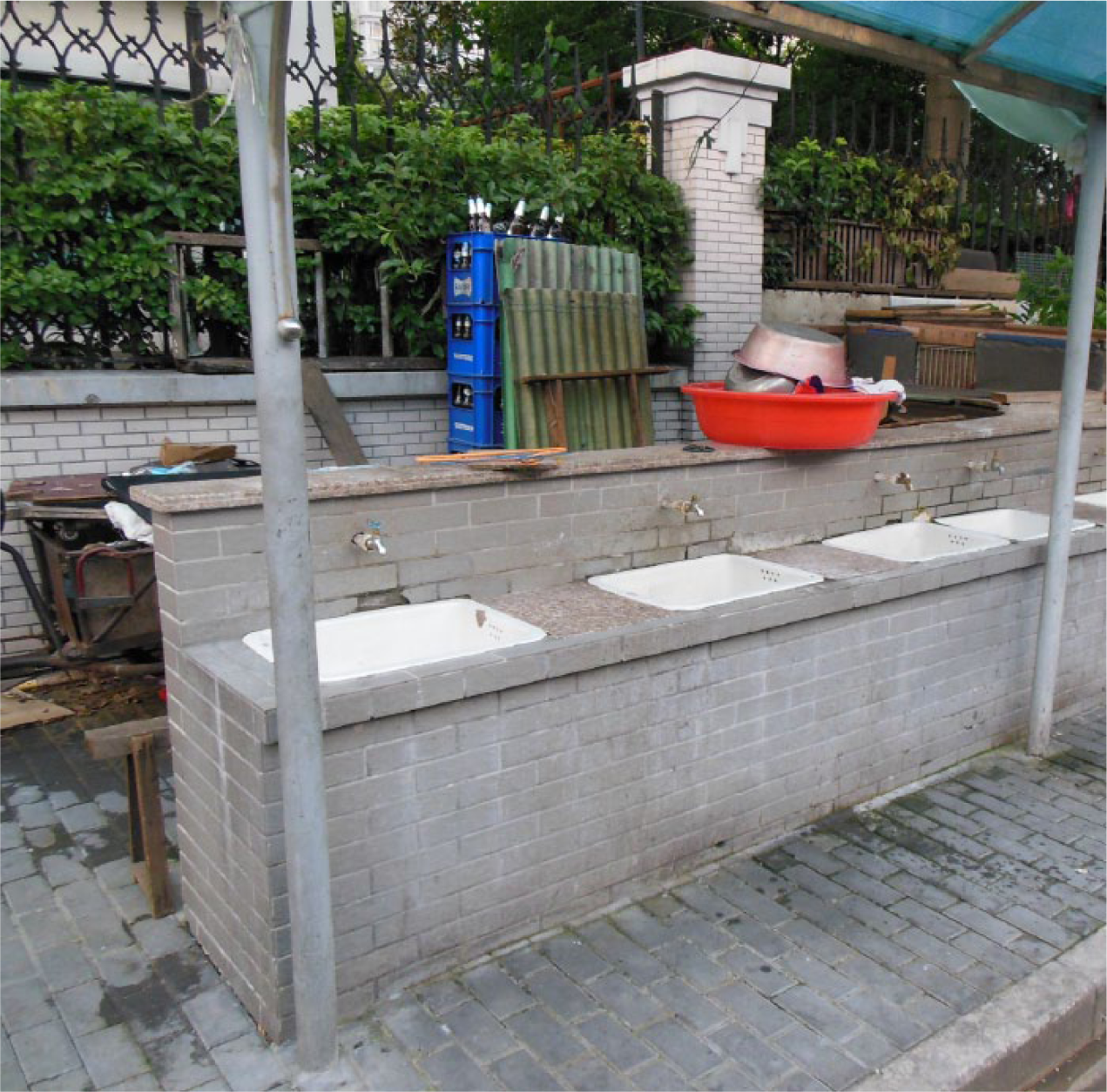
Public water taps, built for local residents in expectation of the Expo 2010
c. Conditional commitment
For Mr Jiang, next door, the Shanghai Expo 2010 came as a blessing. Like many others, he invested his savings to add an extra storey to his house without applying for a building permit. “The government”, he says, “was too busy renovating the city to monitor what we poor people did during this time.”(34) Although his son graduated from a renowned Shanghai university, he has been unable to find employment appropriate to his qualifications and now works as a shop clerk. Mr Jiang, who had spent some time in prison several decades earlier, attributes this to the background checks conducted by respective employers. But it is the family’s living conditions that impact on the son’s marriage prospects: “There have been many girlfriends,” Mr Jiang explains, but “the moment they come home to meet us, they run. They see it’s a small house, and, although we have water, we still have to use the night pot. You eat here and you shit here, you see. Same place. There is no toilet. Young women want their own private toilet nowadays. We can’t offer that. So they run” (Photo 3).
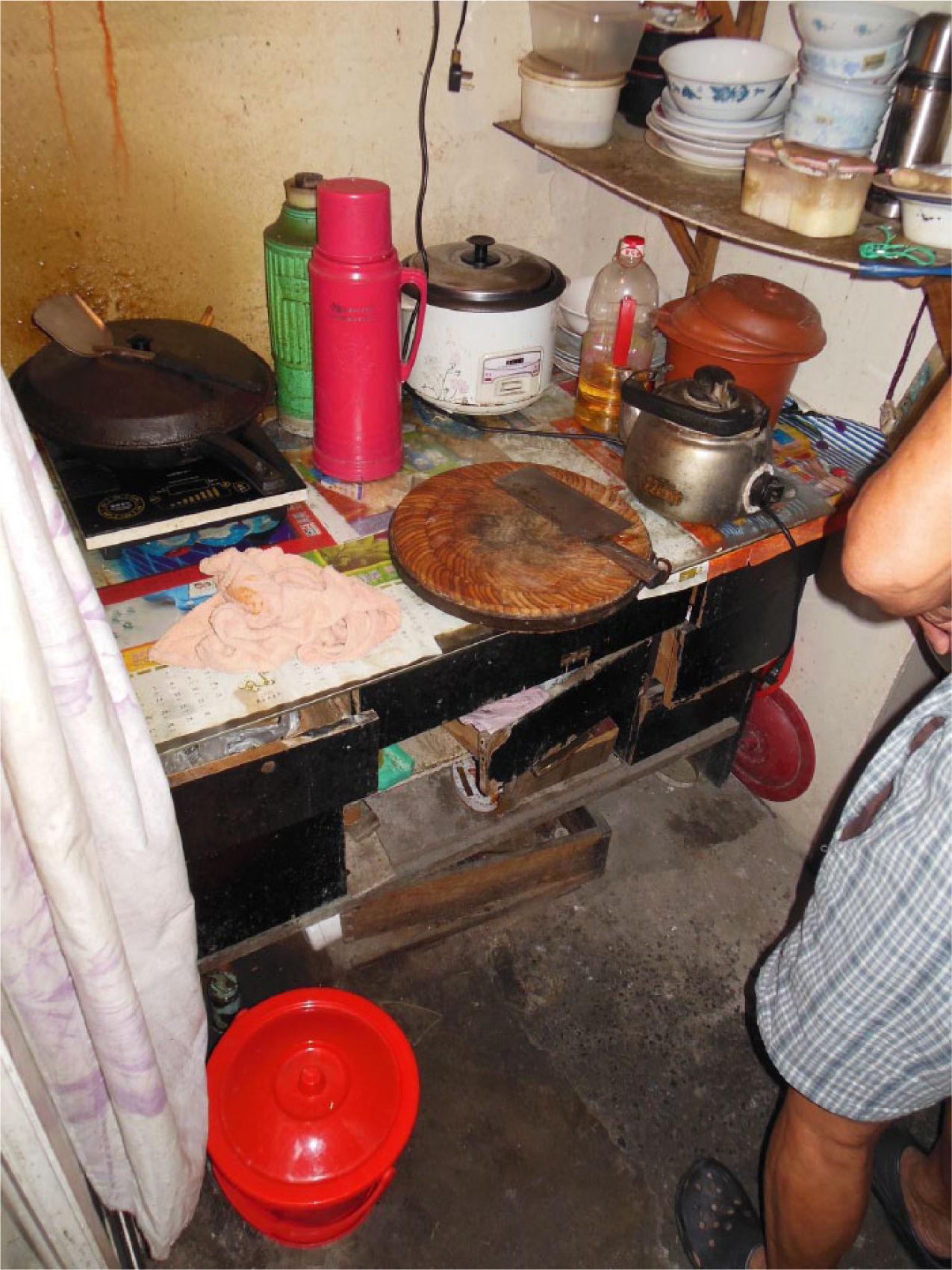
“You eat here and you shit here”
This development marks a sharp transition from customs in the past. Mrs Chen, a neighbour in her late 50s, remembers what it was like to share a small house with her husband and his parents as a new bride in the 1980s: “In the beginning, it was awkward. Couples needed to get used to each other. Us women, we would send the men out and hide behind a curtain in the corner to use the night pot. The men would pay to use the bath house when they had to go… But with time, you get used to it. It’s family.”(35)
d. Uncertain futures
A bit further down the road, Mr Zhu, in his late 50s, explains that the areas surrounding his neighbourhood have been under redevelopment for much of the past 10 years.(36) He put his life on hold in expectation of his own, government-ordered relocation. Had he known that it would take this long, he says, he would have installed a flush toilet years ago. Looking around, he comments: “Really, all people should have private toilets. This way, they won’t disturb each other with sounds and smells. It is a lot more civilised to have a Western-style toilet. Look at the new apartment buildings. They all have at least two Western-style toilets in a flat. Now, that’s human. It’s not very civilised to shit where you eat.”
The Zhu family use night pots and they empty them into a septic tank a couple of hundred metres away. There used to be a proper central excrement collection station nearby, but the demolition company demolished it years earlier – “probably by mistake”, says Mr Zhu. The government installed a “temporary” excrement collection station for the remaining population of low-income urban residents and migrant construction workers. The structure is now used as both a collection station and a public toilet: only a short walk from Shanghai’s busy central business district, predominantly migrant men, small children and sometimes women can be seen squatting above a hole in a raised concrete slab, surrounded only by three polycarbonate partition walls.
e. Redefined urbanity
Because rural-to-urban migrants have limited access to the housing market and affordable housing in cities like Shanghai, many live in cramped conditions in low-income neighbourhoods or in basic housing provided by their employer.(37) Consequently, they have limited access to modern sanitation and therefore rely on central excrement collection stations or public facilities. Among many longer-term urban dwellers there seems to be an ingrained attitude, based on both observation and perception, that rural-to-urban migrants never develop the habit of using a toilet and that, therefore, they fail to teach their children to use toilets. “Kids just take their pants off and shit in the middle of the street; and they don’t even wipe their arses after. Shanghainese kids would never do that!” says Mr Huang.(38) Although they often share sanitation infrastructure with their migrant neighbours, many urban dwellers distinguish between their own practices – in their view, urban and sophisticated – and those of migrants. Representative of many, Mrs Wong says: “There are too many migrants here now, and they don’t know how to do their ‘business’ properly; they make the neighbourhood dirty because they come from the countryside. The juweihui stopped making their rounds. They don’t care anymore.”(39) In the past, representatives of these local neighbourhood committees (juweihui) used to check the sanitary status of all homes at least once a week to make sure that neighbourhoods were clean and up to the government’s hygiene standard. Hardly trying to disguise her hostility, Mrs Wong continues as she points at a group of migrants passing by the window: “Look at them. They are not very well educated. Once local residents started moving out and migrants began to move in, 10–15 years ago, it all started going downhill. Between cars and walls, you will always find shit in the morning. They pee and shit everywhere.”
V. Conclusions
This article offers an initial exploration of the role of diverging everyday practices of sanitation in the negotiation of urban coexistence in transitioning Shanghai. In particular, it explores how, under conditions of rapid urban development and therefore uneven access to advanced sanitation infrastructure, the practice of sanitation is experienced by low-income urban residents in their everyday lives.
Drawing attention to the “soft” aspects of everyday sanitation, the paper shows that everyday sanitation practices and people’s perceptions of them are, indeed, manifestations of socio-material inequalities. China’s transition from a closed-loop sanitation system to the (quite possibly unsustainable) current system of human waste disposal is rapidly taking shape in large parts of the country’s cities. However, the adoption of mainstream sanitation infrastructure happens at different speeds and not all areas (and people) are evenly covered. Just as old and new neighbourhoods continue to exist side-by-side, so do different sanitation systems and therefore practices. Those most adversely affected by exclusion from access to mainstream sanitation infrastructure appear to be the elderly, low-income urban residents and rural-to-urban migrants.
Frequently left to live alone in old and impoverished neighbourhoods, the elderly can find it difficult to access central excrement collection stations to dispose of their waste. They prefer the possibility of managing within the confines of their homes, even if that means, as in the example given earlier, using makeshift water closets that are not connected to the sewage system. Younger members of the family can have expectations of the kind and quality of the sanitation infrastructure they are willing to use. As a result, they can be reluctant to visit the elderly for prolonged periods. This can have direct negative implications for family relations and ties. Furthermore, young men, in particular, struggle to meet the ever-higher expectations of potential future wives; those without access to mainstream sanitation are often unable to find a spouse.
The relentless redevelopment of urban areas has led to an increased awareness of property and value among all urban residents, regardless of their socioeconomic status. Property ownership is often disputed and this leads to broken family ties, as already small homes are physically divided between family members, leaving some without access to running water. For those awaiting government-ordered and development-induced relocation, long-term, lasting uncertainty about the timing of their relocation serves to prevent them from investing in possible improvements to their homes and in upgraded sanitation facilities, in particular.
Although sanitation practices in the past had mostly ceased to be the subject of prescribed rituals or taboos in China – manifested vividly in the occasional lack of doors to public or institutional toilets, for instance – the current race for urban development and globalization seems to be contributing to a rapid cultural shift and renewed consciousness about what does or does not constitute “appropriate” sanitation. Indeed, just as Joshi et al. observe elsewhere, there seems to be “universal aspiration among a diverse group of the urban poor to facilities and services that provide personal privacy and dignity and ensure a clean and healthy living environment”; what is “appropriate” is determined by “local culture, individual needs and preferences, and by what is seen and learnt from the media and from one another.”(40)
Lastly, many rural-to-urban migrants live under sub-standard conditions in low-income neighbourhoods with limited access to modern sanitation. They are blamed for the decline of the urban living environment by long-term urban residents, who develop categories to describe their own sanitation practices as urban and sophisticated – in contrast to those uneducated and dirty ones of rural-to-urban migrants.
Advances in technology and diverging everyday practices of personal hygiene are therefore situated at the core of urban socio-spatial differentiation, inequality, exclusion and discrimination. Particularly affected in these neighbourhoods in Shanghai are rural-to-urban migrants and ageing working-class residents who often lack access to “improved” sanitation and suffer stigmatization and social isolation. Future research should therefore examine how changing sanitation cultures under urban development and diverging sanitation practices affect family ties, social relations and socio-spatial integration. Specific research questions might be how and why the everyday sanitation practices of rural-to-urban migrants differ from those of urban long-term urban residents; and what the implications for their socio-spatial integration might be. Furthermore, future research should address the physical and social consequences of lack of access to modern sanitation for people above 65 in a rapidly ageing society, determining likely implications for policy, planning and design.
Footnotes
Acknowledgements
As always, thank you to Jaye Shen, who worked with me in the field. The critical suggestions of two anonymous reviewers and the editors are highly appreciated. I am also grateful for feedback received following presentations at the RGS-IBG Annual International Conference 2013; the 6th International Forum for Contemporary Chinese Studies (IFCCS 6) Joint Conference; and the University of Nottingham, Georg-August-Universität Göttingen, Swiss Federal Institute of Technology, and University of Manchester.
Funding:
The research was supported by the Research Stimulation Fund, University of Manchester and by the cities@ manchester Animated Urbanism initiative.
1.
Wu, Fulong, Fangzhu Zhang and Chris Webster (2013), “Informality and the Development and Demolition of Urban Villages in the Chinese Peri-urban Area”, Urban Studies Vol 50, No 10, pages 1919–1934.
2.
He, Shenjing (2007), “State-sponsored Gentrification under Market Transition: The Case of Shanghai”, Urban Affairs Review Vol 43, No 2, pages 171–198; also He, Shenjing and Fulong Wu (2007), “Socio-spatial impacts of property-led redevelopment on China’s urban neighbourhoods”, Cities Vol 24, No 3, pages 194–208; Wu, Fulong (2009), “Neo-urbanism in the making under China’s market transition”, City Vol 13, No 4, pages 418–431; Wu, Fulong (2010), “Gated and packaged suburbia: Packaging and branding Chinese suburban residential development”, Cities Vol 27, No 5, pages 385–396; and Wu, Qiyan, Jianquan Cheng, Guo Chen, Denial J Hammel and Xiaohui Wu (2014), “Socio-spatial differentiation and residential segregation in the Chinese city based on the 2000 community-level census data: A case study of the inner city of Nanjing”, Cities Vol 39, pages 109–119.
3.
For instance, Wissink, Bart, Ronald van Kempen, Yiping Fang and Si-ming Li (2012), “Introduction—Living in Chinese Enclave Cities”, Urban Geography Vol 33, No 2, pages 161–166.
4.
Iossifova, Deljana (2015), “Borderland Urbanism: seeing between enclaves”, Urban Geography Vol 36, No 1, pages 90–108.
5.
Shen, Dajun (2006), Access to Water and Sanitation in China: History, current situation and challenges, Human Development Report Office Occasional Paper, United Nations Development Programme; also Yang, Hong, Jim A Wright and Stephen W Gundry (2012), “Water: Improve access to sanitation in China”, Nature Vol 488, No 7409, page 32.
6.
For instance, Medilanski, Edi, Liang Chuan, Hans-Joachim Mosler, Roland Schertenleib and Tove Larsen (2007), “Identifying the Institutional Decision Process to Introduce Decentralized Sanitation in the City of Kunming (China)”, Environmental Management Vol 39, No 5, pages 648–662; also Flores, Amparo, Arno Rosemarin and Richard Fenner (2009), “Evaluating the Sustainability of an Innovative Dry Sanitation (Ecosan) System in China as Compared to a Conventional Waterborne Sanitation System”, Proceedings of the Water Environment Federation 2009, pages 6734–6751; and McConville, Jennifer and Arno Rosemarin (2011), Urine diversion dry toilets in multi-storey buildings: Erdos City, Inner Mongolia Autonomous Region, China, Sustainable Sanitation Alliance, Stockholm.
7.
8.
9.
Chai, Joseph C H and B Karin Chai (1997), “China’s floating population and its implications”, International Journal of Social Economics Vol 24, No 7/8/9, pages 1038–1051.
10.
See Li, Bingqin (2004) “Urban Social Exclusion in Transitional China”, CASEpaper 82, London School of Economics Centre for Analysis of Social Exclusion, London; Tong, HongMei, Daniel W L Lai, Qun Zeng and WenYan Xu (2011),”Effects of Social Exclusion on Depressive Symptoms: Elderly Chinese Living Alone in Shanghai, China”, Journal of Cross-Cultural Gerontology Vol 26, No 4, pages 349–364; Liu, Li-Juan, Yun-Feng Fu, Li Qu and Yue Wang (2014), “Home Health Care Needs and Willingness to Pay for Home Health Care Among the Empty-nest Elderly in Shanghai, China”, International Journal of Gerontology Vol 8, No 1, pages 31–36; Luo, Weixiang and Yu Xie (2014), “Socio-economic disparities in mortality among the elderly in China”, Population Studies Vol 68, No 3, pages 305–320; and McFarlane, Colin, Renu Desai and Steve Graham (2014), “Informal Urban Sanitation: Everyday Life, Poverty, and Comparison”, Annals of the Association of American Geographers Vol 104, No 5, pages 989–1011.
12.
Luo, Shiming (2002), The Utilization of Human Excreta in Chinese Agriculture and the Challenge Faced, EcoSanRes.
13.
Crow, Carl (1937), The Chinese are like that, Harper & Brothers, New York and London.
14.
King, Franklin Hiram (1911), Farmers of forty centuries, or permanent agriculture in China, Korea and Japan, Mrs F H King, Madison, WI.
15.
See reference 13.
16.
Tong, Cheuk-kei (2009), “Municipal waste management in Shanghai, 1866-1949”, Master of Philosophy, The University of Hong Kong.
17.
Nakajima, Chieko (2008), “Health and Hygiene in Mass Mobilization: Hygiene Campaign in Shanghai, 1920-1945”, Twentieth-Century China Vol 34, No 1, pages 42–72.
18.
See reference 13.
19.
Assuming that one excrement collection station serves some 500–800 people, this number suggests that a minimum of 1,000,000 people in Shanghai – over 4 per cent of the total registered resident population – continue to rely on night pots and central excrement collection as their main sanitation infrastructure. This estimate excludes a substantial number of unregistered rural-to-urban migrants who are very likely to depend on this same sanitation infrastructure.
20.
Email correspondence with official at Shanghai Public Health Bureau, August 2013.
21.
Natural nutrients accounted for only 35 per cent at the beginning of this century. Ju, Xiaotang, Fusuo Zhang, Xuemei Bao, V Römheld and M Roelcke (2005), “Utilization and management of organic wastes in Chinese agriculture: Past, present and perspectives”, Science in China Series C: Life Sciences Vol 48, No 2, pages 965–979.
22.
Email correspondence with official at Shanghai Public Health Bureau, August 2013.
23.
Griffiths, James (2013), “In Shanghai? Need to pee? There’s an app for that,” Shanghaiist, 21 March, accessed 21 July 2013 at  .
.
24.
See Chambers, Robert (1983), Rural development: Putting the last first, Longman, London. Of course, Chambers’ work was predominantly concerned with the rural context.
25.
During the last century, migrants from Subei were linked with notions of poverty and rural backwardness and confined to Subei settlements on the edges of the formal city. See Honig, Emily (1992), Creating Chinese Ethnicity: Subei People in Shanghai, 1850-1980, Yale University Press, New Haven, CT.
26.
See reference 10, McFarlane et al. (2014); also Jewitt, Sarah (2011), “Geographies of shit: Spatial and temporal variations in attitudes towards human waste”, Progress in Human Geography Vol 35, No 5, pages 608–626; Jewitt, Sarah and Harriet Ryley (2014), “It’s a girl thing: Menstruation, school attendance, spatial mobility and wider gender inequalities in Kenya”, Geoforum Vol 56, pages 137–147; and Srivastava, Vinay Kumar (2014), “On Sanitation: A Memory Ethnography”, Social Change Vol 44, No 2, pages 275–290.
27.
Lei, Xiaoyan, John Strauss, Meng Tien and Yaohui Zhao (2011), “Living arrangements of the elderly in China: Evidence from CHARLS”, RAND Labor and Population Working Paper WR866; also Sun, Xiaojie, Henry Lucas, Qingyue Meng and Yaoguang Zhang (2011), “Associations between living arrangements and health-related quality of life of urban elderly people: a study from China”, Quality of Life Research Vol 20, No 3, pages 359–369.
28.
Cheung, L Y, E R Cho, D Lum, T Y Tang and H B Yau (1980), “The Chinese elderly and family structure: implications for health care”, Public Health Reports Vol 95, No 5, pages 491–495.
30.
All names have been changed in the interests of interview participants.
31.
Interview with Mr and Mrs Huang, July 2013.
32.
Interview with Mrs Wong, July 2013.
33.
Interview with Mr Hu, July 2014.
34.
Interview with Mr Jiang, July 2013.
35.
Interview with Mrs Chen, July 2013.
36.
Interview with Mr Zhu, July 2013.
37.
For instance, see Li, Zhigang and Fulong Wu (2013), “Residential Satisfaction in China’s Informal Settlements: A Case Study of Beijing, Shanghai, and Guangzhou”, Urban Geography Vol 34, No 7, pages 923–949; also Wu, Fulong, Fangzhu Zhang and Chris Webster (2013), Rural Migrants in Urban China: Enclaves and Transient Urbanism, Routledge, London and New York.
38.
Interview with Mr Huang, July 2013.
39.
Interview with Mrs Wong, July 2013.
40.
Joshi, Deepa, Ben Fawcett and Fouzia Mannan (2011), “Health, hygiene and appropriate sanitation: experiences and perceptions of the urban poor”, Environment and Urbanization Vol 23, No 1, pages 91–111.