




Abstract
Intersectoral collaboration is important for policy implementation. However, effective collaboration may be difficult to achieve because of poor internal drive to collaborate, disagreements on framing the problem, institutional constraints and poor leadership. This article examines how competitive campaigns stimulate intersectoral collaboration in the context of healthy urban planning. We examine the case of the Creating Hygienic City Campaign in Jingchang, China from 2006 to 2011, illustrating how the city resorted to intersectoral collaboration to achieve the multiple targets and thus improved public and environmental hygiene. The paper argues that a competitive campaign, when well-organized, can overcome some of the barriers to intersectoral collaboration by building a campaign organization team, legitimizing the leadership, and enhancing public awareness and involvement. The article also suggests that the campaign approach in its current form failed to involve local authorities in setting the targets and was unable to sustain certain efforts.
Keywords
I. Introduction
Well-planned cities can have a positive influence on the health of residents and create the basis for a health-promoting physical environment, whereas poor planning may exacerbate unhealthy lifestyles, for instance by contributing to the lack of physical activity and the prevalence of smoking; or to the poor health outcomes associated with inadequate water and sanitation provision.(1) Well-planned cities that facilitate the improvement of public health are the result of cooperation of multiple stakeholders. For example, the government health department plans, regulates, finances and administers standards of hygiene; schools and the media raise public awareness through education and media campaigns; the construction sector provides the infrastructure needed; the health sector provides health services directly; and the general public helps to maintain public hygiene and takes actions to improve private health. Intersectoral collaboration is required in order to create healthy cities.
The World Health Organization (WHO) has explicitly promoted the intersectoral approach since the 1978 Alma-Ata Declaration on Primary Health Care.(2) According to WHO, “an important objective of intersectoral action is to achieve greater awareness of health and health equity consequences of policy decisions and organizational practice in different sectors, and through this, move in the direction of healthy public policy and practice across sectors”.(3) Recent emphasis on the social and environmental determinants of health calls for more evidence and practical guidance on how to advance healthy public policies and urban environments in order to promote health and to ensure that intersectoral action can be effectively and sustainably carried out in cities.(4)
In practice, it may be difficult to establish collaboration across sectors and to maintain the partnership for an extended period. Failure is often blamed on agencies holding fast to their power and refusing to compromise, disagreements on framing the problems, institutional constraints and poor leadership.(5)
The competitive campaigns to be discussed in this paper refer to the top-down motivation strategy in which the initiator (a higher authority) sets a series of targets for the participants (lower authorities) to compete against each other or pass the benchmarks to become a winner. The participants are localities at the same level of jurisdiction (countries, cities, neighbourhoods or villages). In the West, this type of motivation strategy started to gain significance in the 1990s, but only became of interest to academic research very recently. The campaigns that have attracted the most attention are competitions for hosting large-scale events, such as the Olympic Games and World Fairs. Other forms of competitive campaigns seek long-lasting transformation, such as the annual competition for the European Capital of Culture, European Healthy City, the Resilient Australia Award, and many similar awards in countries around the world.
Competitive campaigns have been used most widely in the field of public health and environment. The recent social and environmental challenges in world public health call for more evidence on how to advance healthy public policies and urban environments with multi-sectoral involvement.(6) Some researchers have studied the economic impacts of competitive campaigns;(7) others have examined their social implications.(8)
Begun in the 1950s, the Creating Hygienic City Campaign (CHCC) in the People’s Republic of China is a long-lasting series of competitive campaigns aiming to improve public hygiene, environmental health and their governance. The format of the CHCC has also been spread to other policy areas in China, such as Garden City (started in 1992), City for Tourism (1995), Forest City (2004) and Civilized City (2005). Despite their many years of experience, the actual outcomes of the CHCC have rarely been studied systematically. Publications in Chinese are mostly non-academic comment pieces expressing local governments’ determination to achieve good results, or media coverage arguing that the campaigns had disturbed people’s daily life and exposing fraudulent behaviour on the part of local governments. It can be hard to tell why these campaigns have not yet been abolished, given the number of these complaints. We argue that the CHCC as a strategy for motivation has functioned as a tool to push local stakeholders to collaborate intensively during the campaign period, which would be difficult to achieve otherwise. As a result, it has been a policy tool beloved by policy-makers; it is powerful in areas requiring strong collaboration, but not in areas that do not need it.
This paper studies closely the case of Jinchang in Gansu Province, which participated in the CHCC from 2006 to 2011. After discussing the theoretical literature on how competitive campaigns may motivate intersectoral collaboration and the use of competitive campaigns in China, we then show how the Jinchang campaign was organized locally and the ways in which local stakeholders ended up working together.
II. Competitive Campaigns and Intersectoral Collaboration: A Review of the Literature
The benefits of intersectoral and interorganizational collaboration have been championed by numerous authors since the 1970s. However, collaboration across sectors is difficult to achieve. In practice it means that unconnected stakeholders have to meet, set up a jointly-agreed work plan and make compromises.(9)
A precondition for stakeholders to agree to collaborate is that they recognize their interdependency. Otherwise, no action would be taken. Before collaboration happens, however, stakeholders can fail to recognize their interdependency, and intersectoral initiatives may face passive resistance. Frequently, even with the intention to collaborate, it may not lead to action. This could result from, for instance:
poorly articulated goals or problems;
shortage of legitimacy or authority of the convenor or leader; and/or
institutional constraints (e.g. organizational interests), existing practice (e.g. accounting time schedule and amount), or the self-interest of professionals.(10)
These constraints may lead to different kinds of problems and varying ideas about how to solve them. When there is no consensus about the nature of the problems and no agreement on the ways to approach them, collaboration may not be realized.(11) These difficulties become greater as public organizations become more specialized and as the numbers of organizations from different sectors grow.(12)
The emergence of a crisis can challenge such barriers to collaboration. As pointed out by Verhoest et al.,(13) a crisis can generate a sense of urgency, pushing stakeholders to achieve a negotiated order and to seek innovative ideas to achieve collaboration. But what happens if there is no crisis or other pressing cause for cooperation? This is an important question in the context of environmental hygiene and public health because prevention is crucial in both fields. Even if there is no immediate threat, negative health effects can accumulate over time. When awareness of the problem is low, internal motivation for joint action is also likely to be low. This can lead to uncontrollable health disasters and poor responses in the face of disaster. The outbreak of SARS in China in 2002 is an example. External stimuli, in the form of legislation, media coverage, or endorsement or promotion by higher authorities or international organizations, can help to foster intersectoral collaboration.(14) Such external stimuli function by enhancing awareness, generating a sense of shared urgency, or creating political or economic pressure on stakeholders.(15)
A competitive campaign is in essence an external stimulus and has been used in various forms internationally, such as the European Capital of Culture and WHO’s Healthy Cities programmes. In its European Healthy City project, WHO successfully got city stakeholders to realize the importance of collaborative efforts in improving public health through health promotion activities.(16) Competitive campaigns stimulate collaboration by several mechanisms.
III. The Background of the CHCC
In the 1950s, the Patriotic Hygiene Campaign was started in China to counteract biological warfare during the Korean War and was turned into a long-lasting public campaign to improve public hygiene and to control disease from 1957 onwards.(22) With several changes during the past six decades, the campaign grew to be much more complicated than it was originally. The CHCC was introduced in 1992 to replace the Patriotic Hygiene Campaign and to reflect the spirit of reform, although the name of the organizing body remains the Patriotic Hygiene Committee to this day.
The CHCC aims not only to clean up the public environment and educate people in the participating cities but is also combined with major planning initiatives to transform urban appearance and promote environmental cleanliness – such as infrastructure for pollution prevention and sewage treatment. In addition to soft targets such as “visual cleanliness”, the campaign sets hard targets, such as the proportion of wastewater treated or the number of public toilets per unit of population. Participating cities have to implement a range of improvements to meet the targets set by the campaign organizer in the Ministry of Health in Beijing. In a last phase, achievements are checked by a group of inspectors who rely on both objective and subjective judgements to decide whether a city can receive the title of “Hygienic City”.
A sense of competition is found at every stage of the CHCC. The first is the competitive entry into the campaign. Once a city is selected by the provincial authorities as a participant in the campaign, the province contributes some funding and gives the green light for many local initiatives (“policy support”). In the Chinese system, local governments approach the higher authorities not only for more funding but also for policy support – i.e. permission to enforce policies that may not be permitted elsewhere. The greater autonomy that local governments receive as a result of “policy support” is regarded as an invaluable resource. As one province may have only one or two campaign participants each year, a city government that wishes to participate in the national campaign has to impress the provincial authorities by outperforming other cities in the same province and by lobbying the authorities in competition with other cities.
Once a city is selected, it has to meet multiple targets to win the title. Local officials, particularly the top leaders of a city, would be ashamed if they failed to deliver the winning results, while the leaders of a winning city could obtain a promotion. This works at all levels. During the campaign, a local official who fails to meet the target set by his/her supervisor to support the campaign could be replaced by someone else. Moreover, even though cities are not directly evaluated against each other, it is clear that the efforts of participants to outshine other cities in the same campaign and the best performers of the past have raised performance expectations over time.(23)
Lastly, competition is also widely used during the campaign as a motivation tool for local participation. There are competitions between government departments, neighbourhoods, businesses, individuals and schools – such as school challenges and writing competitions, or cleaning competitions between neighbourhoods. These small competitions all contribute to the larger campaign. In the next section, we use the case of Jinchang City to examine more closely how the campaign works as a motivation for intersectoral collaboration. A case study of a small city like Jinchang helps to establish the reality at the lowest end of the policy hierarchy.
IV. The Case of Jinchang
Jinchang City is located in Gansu Province in the north-western hinterland; the city is known as the “Capital of Nickel” because of its rich nickel mining industry. The city was founded in 1981 to accommodate two giant enterprises, Jinchuan Mining Company and Baye Construction Corporation.(24) According to the 2010 census, the number of permanent residents was 464,050, with 288,400 living in Jinchuan District, the only urban area.(25)
Jinchang was selected as the site for this research for several reasons. Most importantly, it participated in the CHCC and won the title of National Hygienic City in 2011. Thus it is a “successful” example of health promotion in an urban setting. In 2011, Jinchang passed the final assessment and received the title of “National Hygienic City”. A set of technical review reports by the inspectors indicated that Jinchang passed the thresholds.(26) As there are more than 800 indicators, it is impossible to report all of them in this paper. Some summary information provides a basic idea of what the campaign achieved.
a. Data collection
To carry out the research, the researchers visited Jinchang on 1–2 April 2013. Qualitative data were collected through in-depth interviews with five officers working for the Jinchang Patriotic Hygiene Campaign Committee Office and the Deputy Mayor of Jinchang, Ms Ying Zhou. We also carried out a focus group discussion with 19 participants, including 15 local government officials, two neighbourhood community leaders and two enterprise managers. These included all the government departments involved in the campaign. Interviews with local government officials took 25 minutes each, and the interview with the deputy mayor lasted for an hour. The focus group session took three-and-a-half hours. The research team also visited some sites that were transformed during the campaign – such as a street market, the sewage treatment plant, the mine and a landfill park – to gain a better understanding of what actually happened and how collaborative groups of government departments were called in to facilitate enforcement.
In addition, the researchers collected secondhand information such as central and local government documents produced for the campaign; statistics provided by local governments, enterprises and public health institutions (such as the local Centre for Disease Control); and academic publications showing pre- and post-campaign health outcomes. Internet webpages and newspaper coverage were used as additional sources of information to double-check the firsthand data.
b. Defining the “problem”
Before participating in the campaign, Jinchang suffered from several serious public health challenges resulting from poor public and environmental hygiene. Industrial pollution and the harsh environment resulting from poor urban planning affected the health and quality of life of the city’s inhabitants. Pollution from the nickel industry, in the form of dust and smoke, was damaging both people’s health and the environment. Other forms of pollution included metallurgical and mining wastewater and solid waste. In 2003, Jinchang was listed as one of the 10 most polluted cities in China.(34) Moreover, residential and factory areas were mixed, and residents living close to the plants suffered from exceptionally high levels of pollution. Jinchang is located in the Hexi Corridor, which suffers from strong winds, sand storms and low precipitation; this helped to spread the environmental damage caused by the industrial activities. Before the campaign, people had to wear face masks whenever the Jinchuan Company emitted waste gas. As a local resident said, “In the morning, it could be choking just walking in the street. Few people dared to go out to do morning exercises.”(35) This forced local residents to lead a less active life.
The poor awareness of public hygiene and health by both the local government and residents contributed to the serious threats to public health. Public funds were not usually allocated to improve basic services and infrastructure, even though Jinchang was not a poor city. Public toilets were badly maintained, garbage collection and sewage treatment facilities were primitive, and control of biological vectors (e.g. bugs and rats) was not developed. It was not unusual to see people spitting, urinating or even defecating in the street. There were also poor hygiene conditions in the service sector. Dirty restaurants, kitchens and food stalls spread infectious diseases. When people became ill, they often continued to work, including people working in food production, catering or other service sectors. According to Zhang et al., cases of tuberculosis increased from 297 in 2001 to 683 in 2006. A survey carried out in Jinchang among 4,136 people aged 15–82 years in 1991 showed that 19.02 per cent of residents suffered from high blood pressure, which was higher than the national average of that time (11.26 per cent).(36) The explanations for the higher incidence of high blood pressure given by Fang, Wei, Li et al. were the dry and cold climate, air pollution, unhealthy diets with high salt and fat consumption, the large proportion of long-term smokers, and poor awareness of the health effects of smoking.(37)
To address these problems, several important city-level changes were necessary: to improve the cleanliness of the city, to separate the residential and industrial areas, to reduce air pollution, to process sewage and garbage, to develop the capacity to cope with a growing city, and to improve the city government’s capacity to address public hygiene and health. To complete these tasks, it was crucial to secure the collaboration of several stakeholders since responsibility for these problems was scattered across many fields and many government departments that rarely worked together. Before the campaign, there were discussions within the government about the needed improvements, but whenever the solution required joint action, no action was taken.(38)
The fact that a campaign could actually deal with these problems was not initially obvious to Jinchang’s leaders. In 2006, Jiayuguan, the first city in Gansu Province to receive the title of National Hygienic City, celebrated its success, and officials from the Patriotic Hygiene Campaign Committee Offices (PHCCO) of Gansu Province and from Jinchang City attended the event. At this event, the provincial official signalled openly to the director of the PHCCO of Jinchang that, after the first success in the province, Jinchang could volunteer to be the next participant. This message was passed on to the city’s mayor. To begin with, the city leadership did not have much idea of how to achieve the campaign goals and some government departments were not keen to be part of it. However, participating in the campaign gave the city leadership an overall goal to pursue, i.e. to win the title of National Hygienic City.
To prepare Jinchang for the campaign, the relevant city officials received training provided by the campaign organizer in Beijing and by the provincial Health Bureau in Lanzhou. The heads of government departments also visited other cities that had already won the title of National Hygienic City. These activities helped to clarify the subgoals and provided operational guidelines. As noted by a campaign officer from the PHCCO of Jinchang: “At the beginning of the campaign, we thought it was maybe another window dressing project and had no clue what to do. We thought if we just followed the example of others and did the minimum, we would be able to achieve the results. As we took the training and discussed with people from other cities, we realized that it was different. By participating in the campaign, we [the government] actually made promises to the general public. We had to deliver what we had promised and satisfy the local people.”(39)
In this sense, participating in the campaign helped to establish a unified goal and helped the local officials to realize that the campaign should not be treated as a formality.
c. Roles of the convenor and his assistant
The convenor of the campaign was the then mayor Liping Zhang. The determination of the city leadership to push the campaign agenda forward was particularly important for consolidating the team. As mentioned by the director of the Jinchang PHCCO, some local government departments were initially reluctant to support the campaign, but the mayor was ready to put pressure on the non-performers. The mayor treated the campaign as his signature initiative (and he was indeed promoted as a result of its success). As one of the most senior managers of the city, the mayor does not belong to any department and has the power to dismiss officials from local government departments. If a local government department did not conform, the leader of that department would be called in to make promises in public or talk to the mayor in person. If all these efforts failed, the non-performer would be replaced by another official. Sometimes this happened on the spot. This gave the mayor great authority as the convenor of the campaign.
The PHCCO was the core administrative office for the support groups and coordinated the daily operation of the campaign. It was independent of other government departments and reported directly to the mayor and the Steering Group (Figure 1). If it was difficult to get the departments to work together in a support group, the leader of the group concerned would report to the PHCCO, which would then discuss or negotiate the matter with the non-collaborators. To put public pressure on the non-collaborators, the director of the Jinchang PHCCO was given authority by the mayor to reveal the unsolved problems via public media. In this sense, the media became a monitoring tool of government performance. The level of commitment by the convenor put tremendous pressure on the local officials to conform and helped to overcome passive resistance.
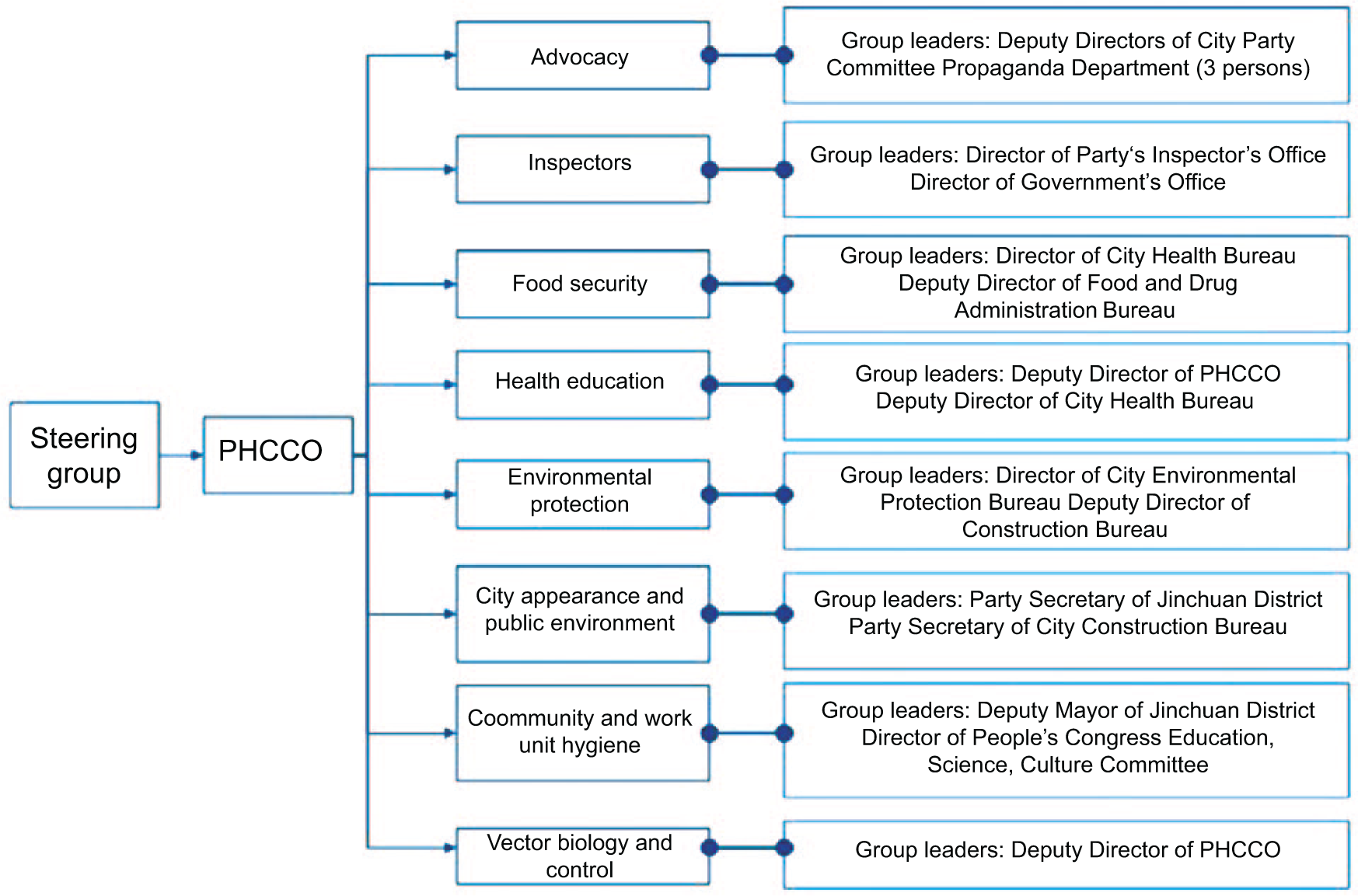
Campaign organizational chart
At the same time, because the mayor and the director of Jinchang PHCCO did not represent departmental interests, their career futures were tied to the campaign. Thus, they would also not act in favour of friends who did not perform. Once this understanding was established, the departments became more actively involved.
d. Organization of the collaboration
Organizational structure
The convenor of the campaign was the mayor. To make sure that all the sectors would be able to contribute on a daily basis, a “Jinchang City Creating National Hygienic City Steering Group” was set up to lead the campaign. The Steering Group was responsible for setting out the campaign agenda and coordinating campaign activities. Steering Group members were from 39 government agencies and businesses. With the leaders of all sectors on board, the Steering Group had the authority and know-how to negotiate and make decisions without having to consult the departments.
For daily operations, the Steering Group allocated tasks to the support groups according to the nature of the tasks. The members of each support group varied according to the tasks involved (Figure 1). There were changes in the inclusion of stakeholders over time as the Steering Group realized that some stakeholders were important for the campaign but had been left out. For example, the big businesses were not part of the campaign initially. The mayor realized that without their collaboration it would be impossible to complete the campaign tasks, so the chief executive officers of the Jinchuan Mining Company and the Baye Construction Corporation were invited to join the Steering Group, and the companies were also represented in the support groups.
Meetings
The support groups held weekly work meetings for their members. The Steering Group and the support groups met every month to report progress and discuss concerns. When necessary, additional meetings were also held – such as emergency meetings after detection of major problems. Joint enforcement events (discussed below) were another way to bring different departments together to assess the situation and make joint commitments on funding and implementation.
Responsibilities
The campaign had a two-part but tightly knit responsibility system. One part was a task-based system in which the government departments made sure that all stakeholders met the campaign criteria in their own field of responsibility. Members of the support groups and the PHCCO were responsible for checking the outcomes regularly and pushing for further improvement. The other part was a spatial responsibility system, which divided the city into squares. The smallest could be as small as 20 metres by 20 metres. The neighbourhood authorities or the occupant of the space, e.g. a state enterprise, would be responsible for drawing the squares and allocating the responsible persons. They were also layered by jurisdiction. Each square at each level had dedicated organizations (government departments or enterprises), communities and households/individuals who would make sure that every part of the square would meet all the targets.
These two parts, the task-based and the spatial responsibility systems, worked together during the campaign. For example, in the context of environmental cleanliness, the support group of City Appearance and Public Environment would be held accountable for all tasks assigned to this group. The group was led by the Jinchuan district government and officials from 12 government departments, who worked in their fields of expertise. The tasks that each department took on were agreed in advance. In terms of spatial responsibility, the Department of Environmental Protection was responsible for the streets, and the neighbourhood committees for residential and community business areas.
In the neighbourhoods, households were responsible for cleanliness outside their homes. Each Communist Party member was responsible for one public facility in the neighbourhood that he/she lived in and for reporting to the neighbourhood committee when the facility needed to be repaired. If there were more party members than facilities, two of them might share responsibilities. The principle is that everyone should have a task and every facility should have someone keeping an eye on it.
Neighbourhood committees also organized volunteers to check each square (defined as a certain number of square metres by the neighbourhood officials) in their territory to make sure that, within this area, nothing would go wrong. The idea was to hold at least one person responsible for every inch of public space. This multilayered responsibility system offered a structure for collaboration among the general public, government departments and other actors even if they had not actively sought collaborative actions.
The responsibilities were set dynamically as the campaign progressed and when tasks were considered to have been allocated inappropriately. For example, the PHCCO, acting as the coordinator, initially controlled the allocation of funding for the campaign. The city treasury handed over a block of funds to the PHCCO but the PHCCO did not have the know-how to manage funding accounts and assess the financial needs of a project. Once this problem was identified, authority was quickly handed back to the city treasury.
e. Mechanisms for intersectoral collaboration
Joint enforcement
A dedicated Bureau of Joint Enforcement was set up to administer the on-site enforcement meetings. For instance, before the campaign, a shopping street might not have had a sewer and the shop owners would pour wastewater into the street. Building a sewer would involve construction, transportation control, trade and industry registration, and the consent of local businesses. Prior to the campaign, government departments came individually and left without doing anything as they could not secure the support of other departments for the project. During the campaign, once the problem was reported, the Bureau of Joint Enforcement would issue a Notice of Improvement to the government departments concerned. The bureau would set a date on which officers from all relevant departments had to attend an on-site meeting. All responsible departments had to state when and how they would act.(40) As a result, the problems were solved much more quickly than before.
Joint finance
The financial investments needed for the campaign were significant. In total, between 2006 and 2011, the city invested Chinese yuan (CNY) 2,290 million (about US$ 377.9 million).(41)
At national level, there was media criticism saying that local governments spent a colossal amount of money cleaning up cities in a short time. A closer look at the case of Jinchang revealed a different picture; the spending was not necessarily dedicated to the campaign initially. For example, the mining company invested around CNY 1,000 million in reducing industrial pollution and energy saving, equivalent to 43.65 per cent of the total investment and a significant contribution to the city’s improved air quality and energy saving outcomes. Even without the hygiene campaign, the money would have been spent independently by the company. However, the campaign provided a framework that showed the linkage of spending from different sources. It was getting clearer to the local government departments that without investment from the enterprises, participating in the campaign would not have been possible. Recognizing this relationship through the campaign made it a lot easier for the companies and the government departments to work together.
Jinchang participated in another campaign called “Creating National Civilized City” before it entered the Hygienic City Campaign, but it did not succeed after a year’s effort. As a result, much public infrastructure was already in place as the city decided to shift its focus to work on the hygiene campaign. Thus, there was a continuation of efforts for improvement of the public environment and behavioural change. Deducting expenditure on past and ongoing activities that were not initiated by the CHCC, the Hygiene City Campaign spending was not as much as the media suggested.(42)
What the campaign achieved effectively was consolidation of different sources of spending under one overarching theme. The added value of the campaign was to set priorities for spending at a fixed point in time and to focus more on areas that needed collaboration.
Public involvement
In Jinchang, the mass media – including radio, television, newspapers, and public facilities such as billboards and blackboards – were used to publish government regulations and public health knowledge on hygiene and healthy lifestyles.(43) People were invited to the radio and television stations to discuss and debate topical issues during the campaign and were encouraged to suggest solutions to problems. Publicity events also took place in schools. For example, children were encouraged to pass hygiene knowledge to their parents, to volunteer to clean up the city, or to patrol to prevent unhealthy behaviour in public spaces. The general public was also advised to give up smoking and encouraged to persuade parents, colleagues or friends to do the same.(44)
Neighbourhoods and workplaces were staffed with full- or part-time employees working on the hygiene campaign. They worked together with other neighbourhood and workplace management staff to organize residents and employees to carry out cleaning of neighbourhoods and factories during weekends. There were also local competitions and assessments to motivate public participation. Community and work unit hotlines were introduced for the public to report problems. Unsolved problems were reported via the mass media.
If it had not been a competitive campaign, the public might not have become so involved. The campaign instilled a sense of pride among residents, particularly in the final phase. The public gradually turned from passively accepting the campaign to actively monitoring its progress.
V. Conclusions: Competitive Campaigns and Intersectoral Collaboration
This research shows that a competitive campaign has its advantages in motivating stakeholders to solve common problems through intersectoral collaboration. On the basis of this research, we argue that when intersectoral collaboration is stimulated by a competitive campaign, goals are better defined, convenors have more authority, and public support is greater. These factors may help to overcome the usual barriers to collaboration. The case of Jinchang illustrates these findings and demonstrates the facilitators for intersectoral action.
First, the competitive campaign consolidated multiple targets into a clearly defined goal for the stakeholders to pursue. The CHCC transformed more than 800 single targets into one goal: to win the title of a hygienic city. In this way, each stakeholder faced a question: “Given that we want to win the campaign, what would be the most effective/efficient role for me to play as a team member?” To answer this question, stakeholders showed that the intention to win the campaign enhanced the willingness of the team members to compromise and respond to group interests.
Second, the convenor of the collaboration needs to enjoy the trust of the stakeholders and to have the authority and know-how to motivate collaboration. In Jinchang, the campaign was of paramount importance to the mayor. The motivation of the mayor came from the possibility for him to outshine other leaders and be promoted if the campaign succeeded. A cynical view would consider that he did all this for personal interests. However, in a campaign like this, his personal interests were in line with those of the campaign organizer: winning by improving the public hygiene of the city. Administratively, the mayor had the support of a sophisticated network in governing the campaign, which brought the decision-makers in each sector on board. Within this network, experts and decision-makers were included and there were clearly defined responsibility and performance requirements. Ultimately, the mayor had the power to fire uncooperative or non-performing leaders in the government. In this context, the campaign encouraged strong leadership.
Third, the improvement of public health and environmental hygiene depends on both service providers and users. Without good awareness and persistent hygiene behaviours among the general public, relying solely on good service provision would mean high costs in maintaining the results, particularly if the campaign lasted for a long time. Jinchang’s case confirms the important role played by the public. What is more, as the campaign moved on, the general public was increasingly actively involved. This might have contributed to increased health awareness among the residents of Jinchang.
However, these benefits cannot solve the main problem: that is, that the efforts and outcomes of any campaign are difficult to sustain. Since the interorganizational structure of collaboration is often built specifically for the campaign, the structure is likely to be abandoned when it ends. The CHCC made stakeholders realize the potential and benefits of collaboration, but this recognition might not guarantee sufficiently strong incentives to sustain the collaboration. This has been a problem in many campaigns in the past. To overcome this problem, the CHCC introduced a revisit by inspectors every three years for the winners. The cities that have yet to “win” would continue to be inspected until they are able to win the title. If a city’s hygiene deteriorates seriously, it will lose the title. For example, the city of Jiayuguan received a warning from the provincial government and would have lost the title if it had not improved. Local authorities can take advantage of these inspections. For instance, if not motivated, a city may wait until just before the inspection is due to clean up in a hurry. This would result in occasional resumption of collaboration but not in sustainment of it.
A logical solution to achieve a long-lasting collaboration would be to keep the competitive spirit going. At the time of our fieldwork in Jinchang (April 2013), the group leading the campaign had not been dismissed. This was because Jinchang, as of 2013, was trying to acquire five other related titles (Civilized City, Healthy City, Garden City, Public Cultural Facility Model City and Environmental Protection Model City). In this way, the Jinchang administration would have to continue to collaborate on new campaigns that, if followed diligently, would help the city to further upgrade its infrastructure and improve its environmental standards.
On a note of reservation, a competitive campaign is a top-down policy instrument. The targets set by the higher authorities do not necessarily take local circumstances into account as much as they should. Cities in a vast country like China are very different in their environmental, social and economic circumstances, and not all standards set by the central government would suit local conditions. For example, Jinchang’s natural environment is very dry, and adding greenery to its public space turned out to be much more expensive than in cities with a more humid climate. Jinchang is better off financially than many other cities in western China because of its rich nickel deposits. It can afford to meet higher standards even if they are not suitable to local circumstances. However, this means that some poorer cities that cannot afford to spend so much money on the campaign or cannot sustain the campaign results afterwards would not be able to be part of the major public health and environmental improvement movements.
In this context, it is recommended that the top-down approach be combined with a bottom-up approach to allow local governments and communities to develop improvement plans that they can afford to achieve. One concern regarding this approach is that, if there is no common national standard, it would be difficult to tell who the actual winners are, and this might undermine the campaign spirit. However, the campaign is not only about how clean or how green the place is at the time of the inspection; it is about building up long-term results and the capacity to maintain public health and hygiene. As a result, the campaign targets can be revised, or a new set of campaigns can be introduced to reward improvements, innovative activities or cost-efficient operations. In this way, poorer places could also be included in the motivation structure.
The experience of Jinchang offers important insights for other cities in China and globally, particularly those in developing countries, that aim to improve the urban environment and promote public health. The incentive for public hygiene improvement does not have to come from middle-class awareness or from widespread health crises such as those experienced in Europe during the Industrial Revolution or during the SARS crisis in China. State-led competitive campaigns in areas where public awareness is low can potentially enhance consciousness about a topic in a relatively short time. However, the effectiveness of such campaigns requires strong political will. There must be concerted efforts from many sectors of society led by a carefully designed management structure that produces clear responsibilities and outcome expectations for everyone involved.
Footnotes
Acknowledgements
The research was funded by the WHO Centre for Health Development in Kobe, Japan. We thank Riikka Rantala, Francisco Armada, Amit Prasad and Mariko Yoko for their helpful comments on the earlier versions of this paper.
1.
2.
3.
4.
5.
Fear, H and P Barnett (2003), “Holding Fast: the Experience of Collaboration in a Competitive Environment”, Health Promotion International Vol 18, No 1, pages 5–14.
6.
See reference 3.
7.
Baade, R A and V A Matheson (2012), “An Evaluation of the Economic Impact of National Football League Mega-Events”, in K G Quinn (editor), The Economics of the National Football League: The State of the Art, pages 243–258, Springer, New York; also Whitson, D, J Horne and W Manzenreiter (2006), “Underestimated costs and overestimated benefits? Comparing the outcomes of sports mega-events in Canada and Japan”, Sociological Review Vol 54 (Suppl. 2), pages 71–89; and Jones, C (2001), “Mega-events and host-region impacts: determining the true worth of the 1999 Rugby World Cup”, International Journal of Tourism Research Vol 3, No 3, pages 241–251.
8.
See for instance Shin, H B and B Li (2013), “Whose games? The costs of being ‘Olympic citizens’ in Beijing”, Environment and Urbanization Vol 25, No 2, pages 559–576; also Ritchie, J B and B H Smith (1991), “The impact of a mega-event on host region awareness: a longitudinal study”, Journal of Travel Research Vol 30, No 1, pages 3–10; and de Leeuw, E (2012), “Do healthy cities work? A logic of method for assessing impact and outcome of healthy cities”, Journal of Urban Health Vol 89, No 2, pages 217–231.
9.
Innes, J E and D E Booher (2010), Planning with Complexity: An Introduction to Collaborative Rationality for Public Policy, Routledge, New York.
10.
Hudson, B (2000), “Interagency collaboration—a sceptical view”, in A Brechin, H Brown and M A Eby (editors), Critical Practice in Health and Social Care, SAGE, London, pages 253–274.
11.
Gray, B (2004), “Strong opposition: frame-based resistance to collaboration”, Journal of Community & Applied Social Psychology Vol 14, No 3, pages 166–176.
12.
Axelsson, R and S B Axelsson (2006), “Integration and Collaboration in Public Health—A Conceptual Framework”, The International Journal of Health Planning and Management Vol 21, No 1, pages 75–88.
13.
Verhoest, K, B Verschuere and G Bouckaert (2007), “Pressure, Legitimacy, and Innovative Behaviour by Public Organizations”, Governance Vol 20, pages 469–497.
14.
Goumans, M and J Springett (1997), “From Projects to Policy: ‘Healthy Cities’ as a Mechanism for Policy Change for Health?”, Health Promotion International Vol 12, No 4, pages 311–322; also Bouwen, R and T Taillieu (2004), “Multi-Party Collaboration as Social Learning for Interdependence: Developing Relational Knowing For Sustainable Natural Resource Management”, Journal of Community & Applied Social Psychology Vol 14, No 3, pages 137–153.
15.
Dodgson, M (1993), “Organizational Learning: A Review of Some Literatures”, Organization Studies Vol 14, No 3, pages 375–394.
16.
Barton, H, C Mitcham and C Tsourou (2003), Healthy Urban Planning In Practice: Experience of European Cities, World Health Organization Regional Office for Europe, Copenhagen.
17.
Zhang, Y and B Li (2011), “Motivating service improvement with awards and competitions - hygienic city campaigns in China”, Environment and Urbanization Vol 23, No 1, pages 41–56; also Boyne, G A (1998), “Competitive tendering in local government: a review of theory and evidence”, Public Administration Vol 76, No 4, pages 695–712.
18.
Jones, J and M M Barry (2011), “Exploring the Relationship between Synergy and Partnership Functioning Factors in Health Promotion Partnerships”, Health Promotion International Vol 26, No 4, pages 408–420.
19.
Wood, D J and B Gray (1991), “Toward a Comprehensive Theory of Collaboration”, The Journal of Applied Behavioural Science Vol 27, No 2, pages 139–162.
20.
Huxham, C and S Vangen (2000), “Leadership in the shaping and implementation of collaboration agendas: How things happen in a (not quite) joined-up world”, Academy of Management Journal Vol 43, No 6, pages 1159–1175.
24.
Gansu Statistical Bureau (2011), “An Analysis of Industrial Development in Jinchang in the Past 30 Years (Jinchang jianshi sanshi nian gongye jingji fazhan fenxi)”, Xinhuanet Gansu China, 19 October, available at  .
.
25.
Jinchang Statistical Bureau (2011), “The Sixth National Census Data Bulletin for Jinchang City (2010)”, Gansu Daily, 13 May, available at .
26.
27.
28.
National Environmental Protection Bureau (2006), 2005 Annual Report on National Urban Environmental Management and Comprehensive Improvement (2005 Quanguo chengshi huanjing guanli yu zonghe zhengzhi niandu baoggo), accessed 10 May 2014 at .
29.
30.
Fang, H, C Li, Y Fang, X Zhao, H Deng, Z Qi and C Wei (2010), “A Regression Analysis of the Impact of Health Education on People with High Blood Pressure in Jinchang Gansu (gansu jinchangshi gaoxueya huanzhe jiankang jiaoyu jieguo huigui fenxi)”, Health Vocational Education Vol 28, No 20, pages 142–143.
31.
Jinchang Daily (2011), “Jinchang Municipal People’s Government Notice: Smoking in Public Places Is Banned in the Whole City”, available at .
32.
See reference 30.
33.
These numbers were based on a series of surveys carried out with the help of the Jinchang Survey Team of the Gansu Statistical Bureau. No details on the data collection methods of these surveys are published. Jinchang Survey Team of the National Statistics Bureau (2011), “Public Satisfaction Survey of the CHCC in Jinchang”, Jinchang Daily, 27 May, available at .
34.
Chen, J (2004), “China’s Largest Nickel Base Jinchuan to Invest 30 Billion to Produce Blue Sky (Woguo Zuida de Nie Gongye Jidi Jinchuan Gongsi Touzi 30YI Jingua Lantian)”, Xinhua News Agency, 3 August, available at
35.
China Youth Daily (2011), “China’s Nickel Capital Successfully Transformed (Zho-ngguó niè do-u jı-ncha-ng chénggo-ng zhuaˇnxíng)”, 14 January, available at .
36.
Zhang, Y, Y Luo, Y Zhao et al. (2012), “Jinchang 2001–2009 TB Control Program Cost-Benefit Analyses”, Chinese Primary Health Care Vol 26, No 4, pages 51–53.
37.
Fang, H, Z Wei, C Li et al. (2002), “Present Stage Investigation and Research of Hypertension Prevention in the District of Jinchang GanSu (Gansusheng Jinchang diqu gaoxueyabing fangzhi xianzhuang diaoyan)”, Chinese Journal of Hypertension (gaoxueya zazhi) Vol 10, No 4, pages 372–375.
38.
Director of the Bureau of Joint Enforcement, 1 April 2013.
39.
Campaign officer of the PHCCO, 1 April 2013.
40.
Director of the Bureau of Environmental Hygiene Administration, Focus group discussion on 2 April 2013.
41.
The exchange rate used in this article is US$ 1 = CNY 6.06 (17 January 2014).
42.
If a city indeed started from scratch, expenditure would be enormous, the campaign would usually take much longer than in Jinchang, and the spending would be spread over a longer period.
43.
For example, according to the Jinchang Game Show on Creating National Civilized City and National Hygienic City, healthy habits include: washing hands and not sharing towels; brushing teeth twice a day and not sharing toothbrushes; regularly showering, hair cutting, and nail cutting; dressing in clean and tidy clothes; drying bedding in the sun frequently; refraining from littering and spitting; avoiding smoking and drunkenness; exercising once every day; vaccinating children as required; and studying health information voluntarily.
44.
Xie, X (2011), “The Advantage of CHCC Was Mass Participation”, Gansu Daily, 15 July, available at .