




Abstract
Despite significant contributions to human health, livelihoods and food security, urban agriculture in Dar es Salaam has received relatively little political support from central and local government due to its informal state. As a result, many urban farmers’ experience insecurity of land access and ownership, and are unable to invest in the improvement of their land, inputs and infrastructure. Although there have been several attempts by various international and foreign organizations to legitimize and institutionalize urban agriculture in Dar es Salaam, very little has changed politically over the past 30 years. This study focuses on the current incorporation of urban agriculture into the Dar es Salaam 2012−2032 Master Plan (still unapproved as of June 2013), and examines how local and central governments legitimize the practice of urban agriculture. It also looks at how greater acceptance, or institutionalization, can take place through formalized processes. The past and present legitimization processes for urban agriculture in Dar es Salaam, and their intended and unintended outcomes, provide an in-depth analysis for this case study. It argues that the sustainability of urban agriculture is largely dependent on political commitment from both local and central government. Legitimization of the practice through policy and rules and regulations can facilitate the further institutionalization of urban agriculture, especially in land use planning. However, it can also further marginalize urban farmers who cultivate open spaces within the city. Nonetheless, urban agriculture will continue to persist, adapting and innovating under the pressures of urbanization.
Keywords
I. Introduction
Urban agriculture in Dar es Salaam has had an important and historical influence on the urban food system as a whole as well as on urban dwellers’ livelihoods and diets. Between 1967 and 1991, the percentage of households practising urban agriculture rose from 18 to 67 per cent. According to Amend et al.,(1) 60 per cent of the eggs and 90 per cent of the leafy green vegetables consumed within the city were produced locally in urban and peri-urban areas in 1999. Research conducted in 2007 concluded that 70 per cent of the milk consumed in Dar es Salaam was produced in the city,(2) and an additional 74 per cent of urban dwellers kept livestock.(3)
In 1997, urban agriculture contributed at least 60 per cent to the informal sector and was the second largest employer.(4) In 2000, urban agriculture was an important income source for approximately 4,000 urban dwellers in Dar es Salaam.(5) Typically, urban farmers in the city earn a monthly net income of US$ 60 from irrigated mixed vegetable farming, whereas the monthly net income per capita in Tanzania is only US$ 24.(6)
Although there has been an acknowledgement of urban agriculture’s contribution to food security, urban greening and informal employment, there is still a major divide between the perception of the activity by decision makers and by farmers. Urban agriculture is still considered to be a less important land use and urban activity by urban authorities.
Stakeholders promoting urban agriculture suggest that urban agriculture is “… not given its value”(7) for two defining reasons: comparative value of land and “colonial” thinking.(8) The phenomenon of evaluating land based on its market value is not specific to Dar es Salaam. The dichotomy between the market value and the holistic value of land represents an imbalance in how urban agriculture is thus perceived. As there is no specific means of assessing the holistic value of land, it is difficult to evaluate the monetary significance of the positive externalities created by urban agriculture, such as improved household food security, income generation, urban greening or the ability to send one’s children to school. By default, the relative market value of land is the simplest and most accepted means of assessing land value. However, the integration of urban agriculture as a function of the urban landscape is often missing in land use planning. With a more holistic approach, the evaluation of landscape units should be based on three inter-dependent factors: function analysis, function valuation and conflict analysis.(9) This approach takes into consideration a more balanced socio-cultural, ecological and economic view of land appraisal and function.
However, the highly integrated urban agriculture system in Dar es Salaam is not recognized by decision makers due to its informal and unregulated nature. This is exemplified in the way some planners refuse outright to acknowledge such use of space in Dar es Salaam, and their negative attitude towards it. Moreover, a blind eye is often turned to the large group of farmers who depend on the use of open spaces for urban agriculture to generate their primary or only income.(10)
Urban agriculture is arguably defined by the city itself. Often with reference to urban agriculture in North America or Europe, urban planners, as well as other stakeholders, have demanded a definition of the practice that takes the local context into consideration. Traditionally speaking, “urban” and “agriculture” simply do not coincide; they are but a mere paradox for urban planners. The term “agriculture” itself evokes images of large tracts of land under cultivation.
Although there have been several attempts to formalize urban agriculture in Dar es Salaam, the practice has still not been recognized as a legitimate use of open space by municipal and central government authorities. Thus, this study begs two important questions. First, why has a practice that contributes so significantly to employment, food security and nutrition, human health and household livelihoods remained relatively side-lined by local and central governments? And second, how can this be changed?
In an attempt to answer these questions, this study uses the case of the current legitimization process of urban agriculture in Dar es Salaam to argue that the sustainability of the practice is largely dependent on political commitment from both local and central government. Legitimization of urban agriculture through policy and rules and regulations can facilitate its further institutionalization, especially in land use planning. Nonetheless, excessive top-down influence can affect the further marginalization of urban farmers.
II. Methodology
Data collection was undertaken while working as an urban agriculture project officer with Sustainable Cities International (SCI) in Dar es Salaam between February and August 2010. Fieldwork conducted in collaboration with the Sustainable Cities International Network Africa Programme (SCINAP) between February and April 2012 also provided empirical data.
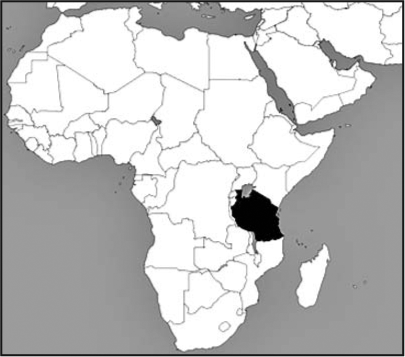
The study area was selected following the recent urban agriculture legitimization process facilitated by SCINAP, and the 2012 period of research was carried out as a follow-up to the legitimization process initiated in 2010. The study took place within the city of Dar es Salaam, which includes the three municipalities of Temeke, Kinondoni and Ilala.
Participatory action research and semi-structured interviews conducted with 42 key stakeholders formed the main research method for the study. Interviews with three of the farmers’ groups were conducted as focus groups. Four other stakeholders were interviewed informally during site visits and during related meetings. The interviews focused on the key stakeholders’ experiences with urban agriculture and their thoughts on past and present legitimization processes. These interviews were complemented by attendance at related workshops, stakeholder consultations, conferences, site visits and visioning and strategic planning sessions in 2010 and 2012. In addition, government and institutional documents such as the minutes from visioning session meetings and the Dar es Salaam 2012−2032 Master Plan preliminary draft also provided supplementary data.
III. Legitimization of Urban Agriculture in Dar es Salaam
a. Background on urban agriculture in Dar es Salaam
Despite the significant contribution of urban agriculture to urban livelihoods, access to land and insecurity of tenure still pose the greatest challenges to urban farmers.(11) However, in order to understand why this is, it is important to first look at the classifications of intra-urban and peri-urban agriculture in Dar es Salaam.
Backyard farming, or home gardening, is one of the least threatened forms of intra-urban agriculture, as it is carried out on privately owned land. It is generally practised by what Lee-Smith refers to as “the better-off”,(12) as they have access to this land. While municipal law dictates relevant by-laws, such as plot size and the amount of livestock allowed per household, backyard urban agriculture still remains highly unregulated. Planners and other municipal authorities generally do not perceive home gardening negatively, and furthermore, most local and central government representatives in this study referenced their own gardens, and in some cases the livestock they keep.
Open space urban agriculture is another form of intra-urban agriculture, which refers to a rather broad land use category. It is most often found on roadsides, near railroad tracks, under power lines and on marginal lands such as river valleys or flood plains. The urban poor who would otherwise not have access to land practise open space agriculture.(13) In medium- to high-density areas, many open spaces are currently deemed unsuitable for urban agriculture because of urban development and concerns about soil and water contamination and hazards such as flooding.(14) These farmers are arguably the most vulnerable due to the informal nature of the practice and because their land rights and land access vary between sites: “… in most cases urban agriculture has been in the leftovers, the land pockets […] most areas which are not suitable for urban development are being constantly used for agricultural purposes […] the land for agricultural purposes is constantly being reduced because it is not formalized to be purely for agricultural purposes.” (Head municipal planner, Temeke municipality)
Peri-urban agriculture is practised on the periphery of the city and exhibits similar traits to rural agriculture. Such farms are located approximately 15−25 kilometres from the city centre and contribute largely to the urban food system. An estimated 35,000 peri-urban households depend on fruit and vegetable production for their income.(15) Peri-urban agriculture is also threatened by urbanization.
b. Land tenure and access
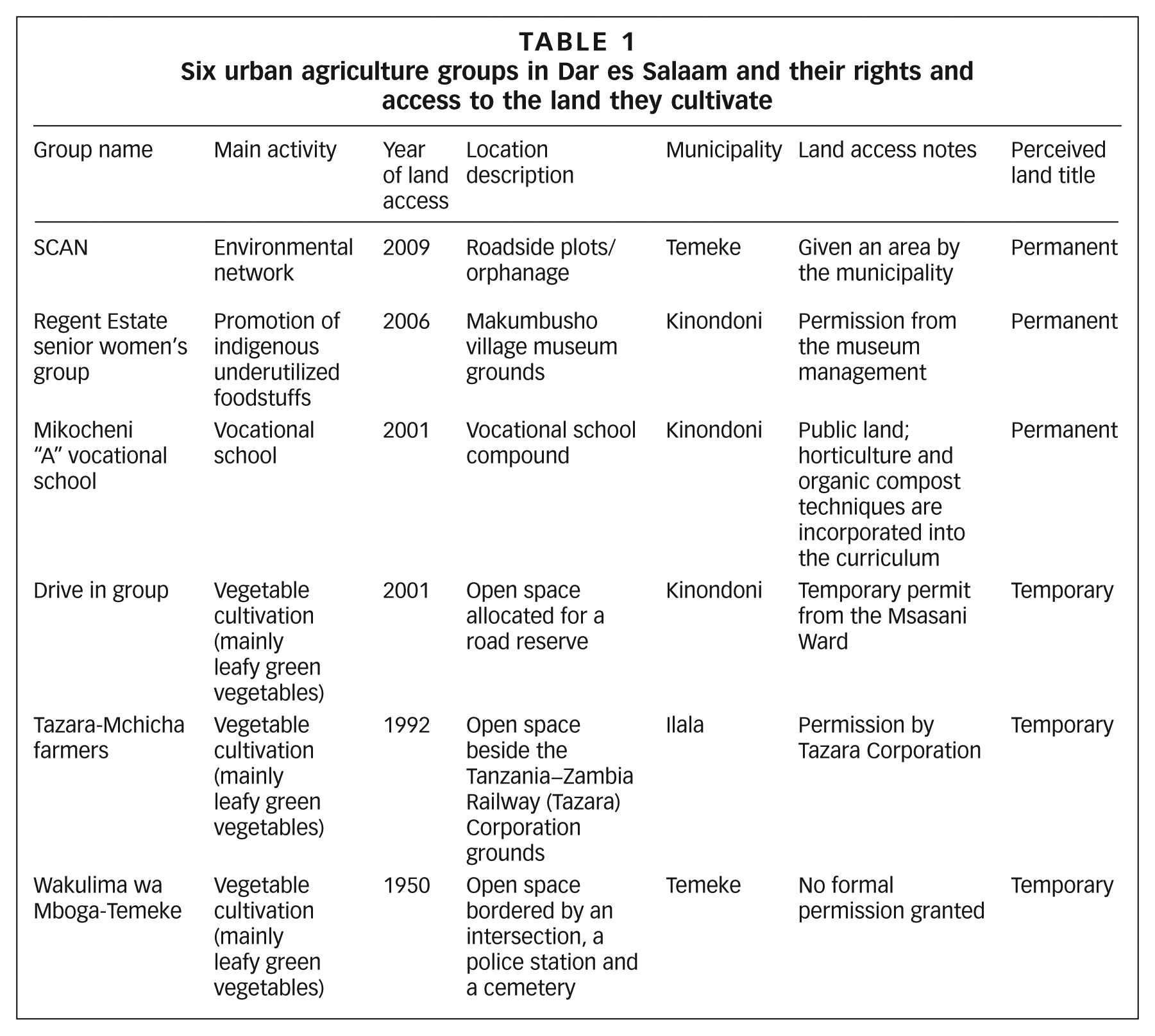
The farmers interviewed in this study occupy a variety of locations, from open spaces to school compounds. All six of the urban farmers’ groups interviewed (representing more than 200 farmers) obtained permission to use the land they cultivate through different means (Table 1). Those who perceived their land title as permanent generally practised agriculture as a supplement to their main activity. For example, the Mikocheni “A” vocational school uses urban agriculture as a hands-on teaching method. Moreover, farmers’ vulnerability is highly dependent on their location within the city: “Urban agriculture is operating in areas where there is no pressure from planning for development […] as long as it is operating on marginal land, which is very much difficult to build on, it’s surviving. But once it moves into the areas where the land use planning is taking place, where the municipalities have interest to change land use and develop houses and what not, or to develop for different activities, then it is very vulnerable.” (Director of the Institute of Human Settlements Studies, Ardhi University)
Six urban agriculture groups in Dar es Salaam and their rights and access to the land they cultivate
An urban farmer adds to this by noting that the instability of his group’s tenure is highly dependent on the economic climate: “This is a temporary place. However, [we] don’t feel a large threat right now since the current economic situation does not allow for investment on the land. Even if [we] are going to be out of this place, it is not going to be today or tomorrow. This is an open space where no one can come and say that they want to build a building here. So [we] feel that [we] will be here a very long time.” (Open space farmer, Temeke municipality)
Open space urban agriculture in Dar es Salaam is part of a dynamic system. It displays elements of what Lee-Smith(16) and Amend et al.(17) characterize as “shifting cultivation” in the urban context: “… even with increasing population densities in certain parts of the city, urban agriculture will not disappear. Production sites might disappear in one area while they emerge in other parts of town.”(18) A 2010 spatial data study of urban crop production in Dar es Salaam suggested that “… the overall amount of cultivated open spaces has basically remained the same during the past two decades, whereas the locations of the agricultural areas have changed considerably.”(19) However, the growth of unplanned settlements still remains a large threat to agricultural land in both the peri-urban and urban areas of Dar es Salaam.
Urban agriculture has persisted as a dynamic process within the city under varying degrees of restrictions, rules and regulations and is “… neither a declining [n]or temporary phenomenon”,(20) despite the fact that many farmers lack secure tenure.
c. Urban agriculture in the strategic urban development plan
In past years, two independent processes have attempted to address the issues of land tenure through the formalization of urban agriculture zones, namely the 1979 Dar es Salaam Master Plan and the 1992−2003 Sustainable Dar es Salaam Project (SDP) under the UN−Habitat Sustainable Cities Programme (SCP). The Strategic Urban Development Plan (SUDP) stemmed from the SCP and put focus on the importance of maintaining space for urban agriculture. Under the SUDP, urban agriculture was acknowledged as “… a mechanism to alleviate population pressure on urban areas, promote sustainable practices and to foster local, community-based participation in development.”(21) A mixed land use strategy was also proposed by the SUDP Urban Agriculture Working Group.(22)
Several other research and development projects for urban farmers have been carried out in Dar es Salaam since the 1970s.(23) Within the last 20 years, the former German Agency for Technical Cooperation’s Urban Vegetable Promotion Project and the Canadian International Development Research Council’s (IDRC) support for local researchers under the SDP have been notable contributions. However, little research on the follow-up to these projects and their long-term impact has been conducted.
The SDP identified urban agriculture as an environmental issue within Dar es Salaam. Its significant contribution to income generation and food security was also noted. However, the working group found that if practised incorrectly it could result in environmental and human health risks.(24)
However, due to what is classified as ignorance and lack of ownership and government inclusion, the SDP “collapsed”(25) after the project was given over to the government and the funding period came to a close. According to Kombe’s analysis of the process, the SDP was “… established as a semi-autonomous unit”(26) separate from local government, which led to both a breakdown in communication between stakeholders and a distrust of the working groups.(27)
One former SDP Urban Agriculture Working Group member blames the government’s allegiance to “rigid” master planning processes for not adopting the SDP.(28) Another contributor to the working group from Ardhi University in Dar es Salaam noted that the central government considered it a “trial and error concept” that was not based on theoretical research, and consequently they felt like “guinea pigs”(29) in an experimental process: “… there are two weaknesses in the concept. One, I would say is that it was being propagated during a time when we have a generation of people within the system who did believe in the old schools, who were trained in the old days, and who had power and responsibility at the ministry. Therefore, they were sceptical about the potency of the new concept when you compare the master plan. Master planning is a government tool. It receives government approval. It is what we know … it is what common people know … The other type is urban planning where there is a lot of flexibility, where there are no rigid definitions, where you have to bargain as you go … There was a feeling that this was too loose to guide the city.” (Former SDP Urban Agriculture Working Group member, Ardhi University)
According to representatives from the Spatial Planning Department at the Ministry of Lands, Housing and Human Settlements Development (MLHHSD), the SUDP lacked “coordination”: “I know that it was a new programme and people were not acquainted with that one. So they were just fumbling about and there was not enough coordination … so it just ended that way.” (Assistant Director, Urban Design Renewal, MLHHSD)
Urban agriculture in Dar es Salaam has endured a long history of varying levels of support and development. Despite the political climate, it has proved persistent over time. In addition, it has systematically contributed to the livelihoods and diets of city dwellers and has played a significant role in the greater urban food system.
d. The SCINAP urban agriculture legitimization process in Dar es Salaam
Despite the work of the Urban Agriculture Working Group under the SDP, the issue of conserving land for urban agriculture in Dar es Salaam lay relatively “dormant”(30) between 2003 and 2010. At the beginning of 2012, the Sustainable Cities International Network Africa Programme (SCINAP), a chapter of the Canadian NGO Sustainable Cities International, began to re-stimulate the process once again (Figure 1 on page 8). However, SCINAP tried to take what they saw as a different approach to the SUDP by including more collaboration with central and local government as well as the farmers themselves: “… combining practice and influencing policy, it is something that has been lacking in many NGOs. But it is useful because if you support a project that is contradicting policies then obviously your efforts are short term … The only problem is that it takes a lot of time because you need to talk at the lowest level and talk at the highest level and expect them to understand each other.” (Programme coordinator, SCINAP)
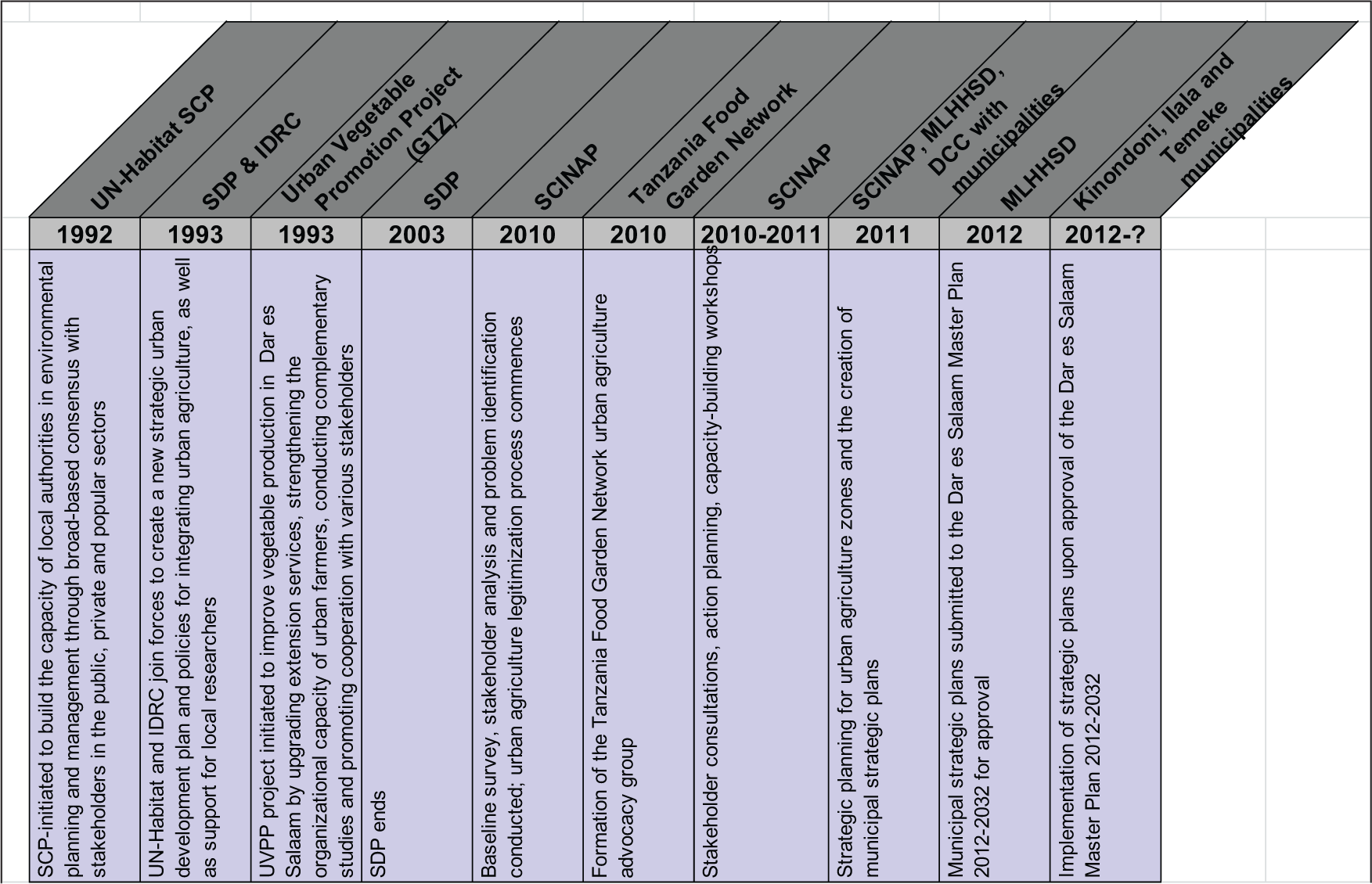
Urban agriculture legitimization processes and stakeholders 1992−2012
With these initial circumstances in mind SCINAP began investigating how to initiate a multi-stakeholder process to address urban agriculture in Dar es Salaam.(31) During a baseline survey of the challenges experienced by open space urban farmers in 2010, those most frequently mentioned were access to water and seeds, proper places to market produce, and soil inputs such as manure and fertilizers. Above all, the greatest challenge identified by farmers was the right to and ownership of the land they were occupying to produce food.
Although the majority of the farmers’ groups interviewed at the time had no access to clean water, they could not build on-site wells because they did not own the land. Farmers explained that they had little incentive to construct wells (other than the open wells to catch rain and floodwater that are found on many sites) as they could potentially be evicted from the land at any time without compensation. In addition, these farmers could not access government assistance from programmes such as the District Agricultural Development Plans(32) because they did not have legal title to the land that they cultivated. Thus, according to the farmers, ownership of the land would help end the vicious cycle of not being able to access funds to, for example, construct wells for safe water because they did not possess title to the land.
Consultations with the MLHHSD presented another key issue: until urban agriculture became a formalized land use within the proposed Dar es Salaam 2012−2023 Master Plan, they refused to acknowledge it. Although rules and regulations, such as by-laws, were already in place, the land itself had never been legally allocated or earmarked for agriculture (except for activities that took place in privately owned backyards or compounds). Therefore, according to the MLHHSD, legitimization of urban agriculture in Dar es Salaam was essentially the only way in which local and central government would legally recognize the practice as a formal land use.
From this consultation process, as well as the baseline survey and in-depth discussions with urban agriculture stakeholders, SCINAP began facilitating a multi-stakeholder process to legitimize urban agriculture. Because of the various levels of central and local government directly and indirectly involved in urban agriculture, SCINAP tried to initiate simultaneous top-down and bottom-up processes in order to drive forward the formal legitimization.
The incorporation of urban agriculture into the Dar es Salaam 2012−2032 Master Plan (still unapproved as of June 2013) has come in the form of zones facilitated through land use planning. Each of the three municipalities in Dar es Salaam accepted the role of designing their own strategic plans for urban agriculture, which later incorporated a total of 30 zones. The three municipal Agriculture and Livestock Departments selected the zones, all of which are situated within the peri-urban areas of the city, in collaboration with the three Municipal Town Planning Departments. This alone has been noted as a major achievement as these departments reportedly rarely, if ever, collaborate. Three of the five agriculture extension agents interviewed in this study felt that there will be progress due to this unique teamwork.
The two inter-dependent processes of formalization and implementation define the legitimization of urban agriculture in Dar es Salaam. Formalization was carried out mainly between the three municipalities, with final approval, and incorporation into the Dar es Salaam 2012−2032 Master Plan was facilitated by the MLHHSD. The implementation process will be the responsibility of all six levels of local government, with inclusion of the regional commission.
The last Dar es Salaam master plan was created in 1979 as an update of plans prepared after 1968. The Dar es Salaam 2012−2032 Master Plan, which was still in draft form at the time of research and was still unapproved as of June 2013, builds on the 1979 master plan. It is jointly prepared by a group of foreign and local consultants, the MLHHSD and the Dar es Salaam city council. According to the preliminary draft: “The design of the future growth of the town will be based on the main concept of building a sustainable city, that is giving great importance to the relationship between physical structure, environmental characteristics of the metropolitan area, socioeconomic aims of the project (in terms of economics and welfare too) and an effective functional efficiency, particularly in terms of mobility.”(33)
In the context of urban agriculture, the master plan will focus on urban development through the: “… preservation of the environmental characteristics of the urbanized and non-urbanized zones, with attention to [the] urban agriculture but also to the main actual environmental challenges, particularly the ones generated by [the] climate change in terms of coastal erosion and flooding phenomena.”(34)
Recognition of urban agriculture is apparent through its ability to address environmental challenges and its significant role in the realization of the goals and objectives of the master plan.
e. Small losses for long-term gains?
The incorporation of urban agriculture into the master plan is an acknowledgement of its practice within urban planning. However, it is unclear how zoning agricultural land on the periphery of the city will benefit the existing open space farmers who cultivate in the medium- and high-density areas of the city. Therefore, zoning may further marginalize open space urban farmers by allowing urbanization to gradually push them onto smaller plots of land, into the peri-urban areas or, even possibly, away from farming activities.(35) A former SCINAP urban agriculture project officer thinks that “… if by creating these zones on the periphery you now have been able to cut off urban agriculture in the city, then for sure it will continue to marginalize it more.”
According to the MLHHSD, urban agriculture will be treated like any other land use. However, according to a representative from the MLHHSD the urban agriculture zones were chosen because they “… are not highly competitive with other urban uses.”
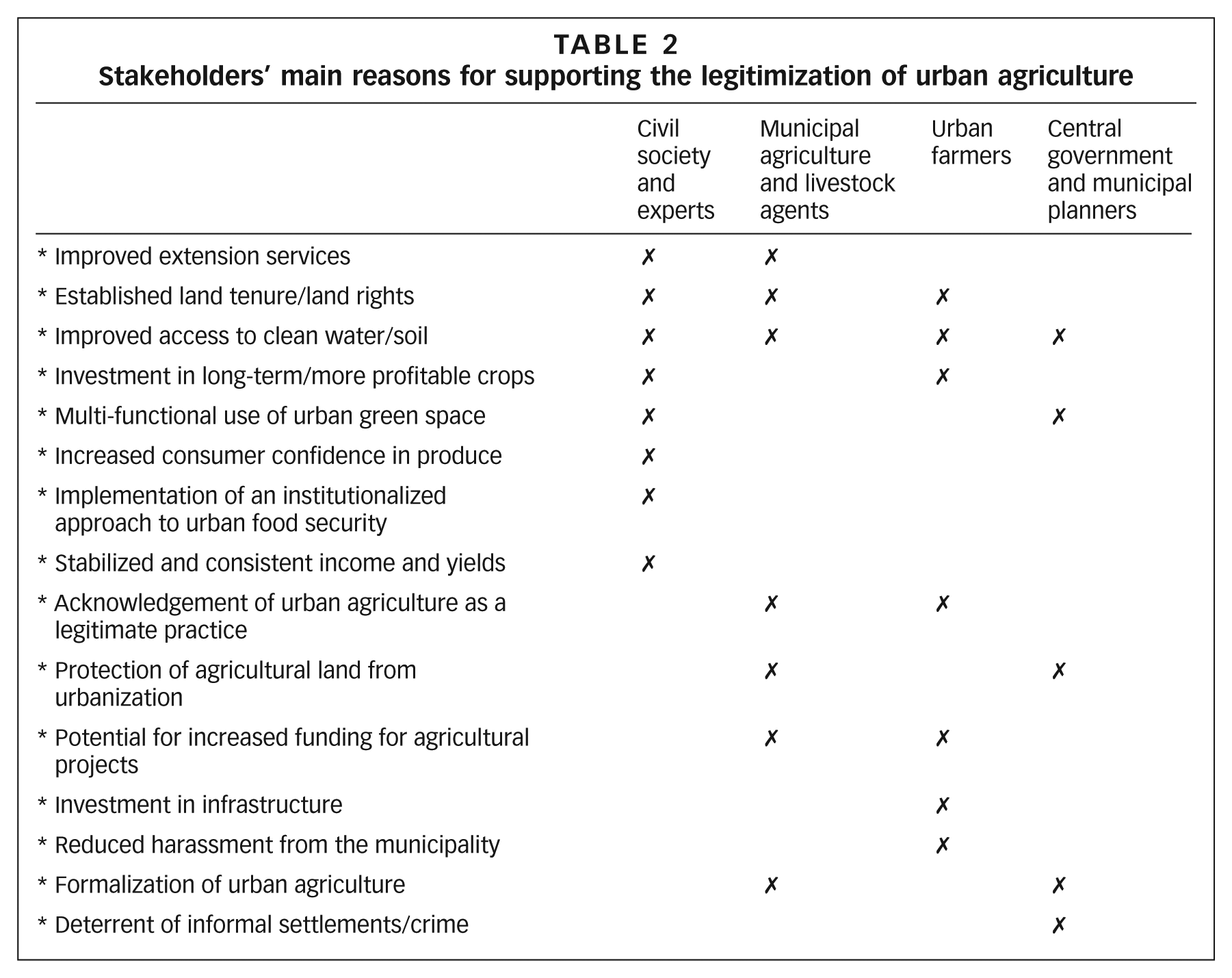
Nevertheless, according to all key stakeholders interviewed in this study, urban agriculture cannot let its fate be determined by inevitable urbanization. Although all stakeholders agree that legitimizing urban agriculture is an important step towards institutionalizing the practice, each stakeholder group has their own reasons for supporting such an initiative (Table 2). Generally, the interviewees within each stakeholder group (as categorized in Table 2) concurred with the opinions of their peers.
Stakeholders’ main reasons for supporting the legitimization of urban agriculture
One common view shared by government representatives is the need to formalize the informal: “It is part of the city but we need to have a proper definition of urban agriculture … It has got its place in urban life and I think that it should be there to stay … It is supposed to be done according to all the laws obtaining to town planning. That is the point.” (Assistant Director, Urban Design Renewal, MLHHSD)
Other stakeholders representing government bodies, such as agriculture and livestock extension services, also feel that the creation of zones for urban agriculture can help to preserve agricultural land from the inevitable forces of urbanization: “People from the rural to the urban are shifting and they occupy a lot of land and I think that the authorities will be forced to plan for the people who are coming. And without addressing urban agriculture, even those areas will be occupied with buildings and settlements to accommodate those people.” (Urban agriculture and livestock extension agent, Temeke municipality)
However, urban planners indicate that the zones will promote more large-scale, commercial agriculture rather than the subsistence and small-scale agriculture most common in Dar es Salaam. According to a representative of the Urban Design Renewal Department of the MLHHSD, “… we need to have an agriculture that is transformed, not a peasantry thing.”
The latter statement reflects the paradigm that still shapes the general attitude towards urban agriculture, which is that agriculture is a rural act. Agriculture is often equated with large tracts of land and is therefore deemed non-existent when practised in the city. Thus, the inability of the government to recognize urban agriculture within the city is what one stakeholder refers to as a significant “missing link”.(36)
Agriculture extension agents, experts and urban farmers alike ridicule urban planning authorities for ignoring the current situation; they argue that the authorities are not in support of open spaces under cultivation in the city because the practice is not taxed and does not bring in revenue for the district councils. However, the formalization of urban agriculture will integrate urban agriculture as a “function of the city”,(37) subsequently enabling municipalities to collect taxes from the landowners, which is not the case at present.
The zoning of land is just one of the many means of legitimizing urban agriculture. Although urban farmers welcomed the idea of creating urban agriculture zones, all those interviewed in this study were opposed to their being located in the peri-urban areas because of the high transportation costs from their homes to these sites. For them, it could also mean that formalization would inevitably lead to more control by the municipal authorities: “If the municipality gets too involved they will ask for taxes, which is a huge disadvantage to [us]. The more they get involved, the more they will want to know what [we] are doing and how much [we] are earning, then they will want to take some of [our] profits in taxes.” (Open space farmer, Kinondoni municipality)
But for many, the current state of urban agriculture in Dar es Salaam can no longer remain unaddressed, even if it does mean that some farmers will lose their land in order to make larger gains for urban agriculture in the future: “I think that some farmers will definitely be kicked off their farms if they legitimize it because there will be places that can’t be preserved where they are farming now … And the city is going to expand and if we don’t reserve land now, all of the farmland will be gone.” (Former urban agriculture project officer, SCINAP)
However, through interviews with farmers it became evident that their involvement in strategic planning processes was limited, and they were mostly included at the beginning of the legitimization process. The urban farmers in this study had heard of the concept of urban agriculture zones during the original stakeholder consultations. However, their knowledge was limited and few were able to name the areas within their municipality that had been earmarked for zoning within the municipal strategic plans. All the farmers groups were under the impression that once these areas had been incorporated into the master plan they would be able to cultivate in the zones closest to where they currently farmed. However, according to the three municipal Agriculture and Livestock Departments, many of these areas are already occupied by existing farmers, thus making it difficult for new groups to gain access to the land. Furthermore, land access will be granted through a selection process and administered by local government bodies.
In addition, the timeline of the Dar es Salaam 2012−2032 Master Plan process has been extended many times since the first proposed implementation date, and as of June 2013 had still not been approved. Consequently, some stakeholders are weary of the process. Two consultants developing the master plan hinted at their doubts about the whole process, seeing as most aspects of the 1979 master plan, as well as the SUDP, have never been implemented. According to past and previous SCINAP urban agriculture project officers, there are other pitfalls in the SCINAP approach, and ensuring involvement from all stakeholders has been both “bureaucratic” as well as a “waiting game”. Input from urban farmers, municipal planners, NGOs, universities, experts, agriculture extension agents and central government ministries has been both an asset and a challenge to achieving the overall goal of zoning land for urban agriculture.
The varying opinions on how urban agriculture should be governed and implemented indicate a wide gap between stakeholder paradigms. Arguably, any long-term change that is to be implemented must go hand in hand with a paradigm shift that is not only inclusive of top-down and bottom up-processes, but also acknowledges the roles of all stakeholders.
IV. Paradigm Shift
Many stakeholders often pointed to the comparative value of land and “colonial” thinking(38) as the contributing factors to the predominant paradigm recognized by urban planners and other key decision makers in Dar es Salaam.
Increasing land market values in Dar es Salaam threaten the open spaces occupied by urban farmers. Land speculation taking place in all urban land area densities hastens the pace of urban development,(39) and informal markets dominate transactions.(40) The immediate and short-term value of the land appears to outweigh the long-term and relatively priceless value of the benefits of urban food production, food security and employment: “I see increasing threats due to market pressure because if the values are increasing, any square metre of land is becoming vulnerable. The increasing market pressure will definitely push out some of the activities for urban agriculture because of the value of land and the real estate development is very high now. It is a booming market for investment in building activity and this is a threat for urban agriculture, whether peri-urban or inner-city agriculture on marginal land.” (Director, Institute of Human Settlements Studies, Ardhi University)
The “colonial” thinking referred to by one stakeholder from Dar es Salaam city council draws from an ideology exported by European economies that aims to maintain the divide between rural and urban, in order to keep rural populations away from urban areas except when they administer services.(41) However, during the difficult economic circumstances of the 1970s, the government promoted self-sufficiency in order to reduce inflation. Yet under the old school of urban planning, by-laws instituted in colonial times past were re-enacted when urban agriculture was found to have various negative effects on the urban environment.(42) Since then, the by-laws have remained in place and urban planners have remained strongly committed to both these and to master planning.
As an agrarian society, land availability outside Dar es Salaam can conceal the role of urban agriculture and its importance to urban livelihoods, food security and nutrition. The ever-present push to develop the city has led to a negative perception of anything that is not seen as modern, and as a consequence has led to nicknames such as Dar es Salaam kijiji, or Dar es Salaam village. As a result, urban agriculture is often equated to “a peasantry exercise”, according to one representative from the MLHHSD, and is treated as an insignificant, backwards activity that does not fit into modern urban development.
On the other hand a pure focus on infrastructure as a sole means of urban development creates what one stakeholder calls a development “bottleneck” in urban planning: “I think the issue is really a question of mentality, mindset. It is kind of a colonial kind of thinking, that if you talk about the urban it is mainly roads and buildings but not agriculture. Agriculture is mainly a rural kind of activity and in some places you can have buildings, roads but you can also have gardens in the cities!” (Representative, Food and Agriculture Organization of the United Nations, Tanzania Office)
Another stakeholder also echoed this sentiment: “It is a kind of ignorance. I say this because Dar es Salaam is among the cities that are expected to be considered as a sustainable city, but any sustainable city must have a component of urban agriculture. But for them they don’t understand that. [Council leaders] think that a sustainable city only having [sic.] buildings everywhere … and petrol stations!” (Agriculture extension agent #1, Kinondoni municipality)
His colleague adds that this predominant paradigm is due to the fact that the municipal councils: “… are not taking urban agriculture as a serious issue because they are focusing on what the department produces, you know what I mean … contributes to the council ‘basket’. So if you look at the Trade Department, the Tax Department … they are taking a lot from the community, so that the council can get a lot of revenue. But if you come to this agriculture [sic.] … we are focusing on services. So we are not producing, so the department who is not putting anything into the director’s basket, it seems that they are doing nothing. You see, we are giving services … you can’t quantify it … They don’t care about it. What they care [sic.] is money. If you are paying money, this is OK − you are doing a good job; but if you are changing people’s lives they say no … So that is what they evaluate … but our work is complete [sic.] 100 per cent services! We are not getting anything from the farmers.” (Agriculture extension agent #2, Kinondoni municipality)
However, according to farmers, extension agents and experts, support for the legitimization process of urban agriculture may only be a verbal façade, as they have yet to see either any implementation or financial assistance from the municipalities. Nonetheless, some progress has been made: “… when we started this process, town planners didn’t see urban agriculture as a very good use of land … but I think now there is an increasing acceptance that … you can farm in urban areas because there is a problem of food shortage, there is a problem of unemployment … and now people are more accepting of urban agriculture than in the past.” (Programme Director, SCINAP)
Regardless of their doubts about the true level of acceptance of urban agriculture at the political level, agriculture and livestock extension agents from all three municipalities were grateful for municipal planners’ approval of the drafts they had prepared demarcating the proposed urban agriculture zones. They claimed that this type of intra-municipal collaboration had never taken place prior to the urban agriculture legitimization process facilitated by SCINAP.
V. Determining Success
a. Co-ownership
Throughout the legitimization process, SCINAP has played the role of facilitator. This decision stems from an institutional desire to create a stakeholder-driven process that will extend well beyond their three-year project funding period. The intended sustainability of the legitimization of urban agriculture is founded on the principle of local ownership.
With legitimization, institutionalization of the concept of urban agriculture must follow; a practice that has not become an institutional norm cannot be legitimized because it will still be seen as an illegitimate and informal practice. Thus, the change must come from the relevant actors themselves. Furthermore, with the sustainability of the legitimization process in mind, SCINAP has planned their low-impact exit strategy by ensuring the co-ownership of the project: “For urban agriculture, I think that we have created enough momentum to keep the process going. For example, for all three municipalities who developed the strategy, now they are in consultation with the Planning Department more than before they started … Now we have broken the ice. We have kept them talking to each other … We are also saying, once all these three strategic plans are approved, Dar es Salaam city council has accepted producing [sic.] a citywide document … Many stakeholders are going to read the document and appreciate it and awareness would be created. Lastly, in terms of sustainability of the idea, the municipal Agriculture and Livestock Department in Dar es Salaam has always been working with farmers. So we are not bringing something new. But what we have done was actually bring a lot of awareness of the importance of their work.” (Programme coordinator, SCINAP)
Up until now, SCINAP has maintained a good relationship with all of the stakeholders who have participated in the legitimization process, all of whom appear to be appreciative of the role that SCINAP has played.
b. Championing: a push from the right corners
As discussed in Section III(c), significant government support is needed in order to drive the legitimization of urban agriculture forward; if there is no institutional belief in the process, then arguably the project will be short-lived. Thus, many argue that recognition of urban agriculture by political figures is one of the few means of institutionalizing the practice as a legitimate urban land use: “… if a politician is trying to say [sic.] that we need to carry it out, implementation would be easy … I think those land use planners are aware of this, but when it comes to other uses they have to address those people who need land for other use, apart from urban agriculture. Some are aware and they know that, but other people do not see that fact.” (Municipal agriculture extension agent, Temeke municipality)
Furthermore, paradigm shifts, co-ownership and championing can all help towards a more sustainable development of urban agriculture: “We have a challenge that there are some political leaders that don’t agree on the issue of urban agriculture. And when these people speak something [sic.], it is captured by many people. There is a great audience; when you [sic.] hear from these political leaders they think that that is the right thing, than [sic.] when they hear from the experts, from let’s say urban management.” (Founder, SCAN)
In its role as a respected NGO operating in Dar es Salaam, SCINAP has been able to navigate through the government system and enter into negotiations in circumstances where others might not. The municipal Agriculture and Livestock Department has noted that, acting alone, they would not have been able to push their agenda through or be taken seriously by higher levels of local and central government: “…Sustainable Cities have managed to create a kind of link, or a kind of road map with these guys so that we can tell them that they don’t know how to use the land. They think that land is only for housing but land is not only for housing … By expanding the city vertically, it implies that you are leaving land open for other activities. This is very important.” (Agriculture extension agent, Kinondoni municipality)
Still, due to the difficult and low level of interaction between municipal and central government representatives and their constituents, many urban farmers feel a sense of “… total despair that the government can do anything for them.”(43) Thus, an intermediary facilitating the otherwise non-existent internal government interactions as well as external stakeholder interactions is important under the political circumstances in Dar es Salaam.
However, regardless of the progress that has been made within the last two years of the legitimization plan, there is still an underlying sense of doubt that all stakeholders’ visions for the outcome of the legitimization process will be accommodated. Facilitation of the process has not been as neutral as hoped: “This process is difficult because we are supporting the municipality and not necessarily the farmers. Like, in the end, there will be farmers who will benefit from it, but it is a selected few and maybe we wouldn’t have as much of an impact as maybe we could. But that is also from my experience working in development; the municipalities are settled here and they have their authority [of plan how they see fit in their municipality and what they are allowed to plan [sic.]]. So they are going to do what they are going to do anyways. So if we can play a part in maybe, you know, looking at different approaches or maybe changing different behaviour I guess that can help.” (Urban agriculture project officer, SCINAP)
Furthermore, there is little trust that municipal and local government will implement the strategic plans for zoning urban agriculture due to a lack of long-term planning: “The government just doesn’t have the capacity to implement that. They simply don’t … Any process like this will have winners and losers and I guess that is the best that we can do; or what Sustainable Cities can do is try to minimize the impact on the losers and try to find the ways around it. I mean even if they get the permits, who allots them? Like who gets to decide? Do they have to pay? Do they not? Does the ministry decide? Do the municipalities decide? That is the whole minefield right there … it is very worrisome. It might just be another SUDP plan, it is going to sit on the shelf for five years and nobody cares about it …” (Former urban agriculture project officer, SCINAP)
Thus, co-ownership of the process of legitimization combined with political championing could hold the key to the institutionalization of urban agriculture in Dar es Salaam. However, as mentioned in Section IV, this cannot take place without a significant paradigm shift from the decision makers.
c. Ensuring sustainability
Implementation of the urban agriculture zones in the coming years will depend a lot on a combination of co-ownership and political champions, as well as the approval of the master plan. Furthermore, as learned from the SUDP, an adequate budget must be allocated to assist in the implementation and monitoring of the zones. The underfunded Agriculture and Livestock Departments from each municipality, as well as various levels of local government such as wards and sub-wards, must be allowed to function and assist in the development of agriculture in the urban context. Thus, implementation must concur with relevant capacity-building of those who will be conducting the implementation.
On the other hand, as many stakeholders have suggested, there must be accountability. One way to achieve this is through the development of grassroots urban agriculture advocacy groups(44) and the creation of a broader policy forum where stakeholders can interact and engage in dialogue.(45) The politicization of urban agriculture demands equal force to be exerted by urban farmers, as different actors operate within their respective capacities to exert their control over the same urban space.(46)
In order to ensure sustainable implementation and future acknowledgement of urban agriculture, it must be seen as a genuinely accepted element of the urban environment. Without such recognition, urban agriculture policy will continue to ebb and flow along with the political and economic climate, as it has in the past.
In addition, in order to address the greater urban food system, a more inclusive strategy is needed rather than confining agriculture to certain zones.(47) Greater acknowledgement and promotion of home gardening should also be reconsidered and integrated into informal and formal settlements for the purposes of both employment and household food security.
VI. Conclusions and Outlook
Pending approval of the master plan, will the current legitimization process for urban agriculture fail upon implementation or can it be used to set an example for land use planning for urban agriculture in Africa? Overall, there is a general sentiment that action needs to be taken to address the land rights of urban farmers. However, as noted by stakeholders such as agriculture and livestock extension agents, experts, urban agriculture practitioners and farmers, there are also undercurrents of doubt that the current legitimization process will be fully implemented.
The creation of urban agriculture zones on the periphery of the city will most likely further the marginalization of open space farmers in Dar es Salaam. However, based on past trends it will not lead to an outright displacement of farmers. The zones also have the capability to conserve agricultural land on the periphery of the city and give protection from future urbanization.
Nonetheless, the case of Dar es Salaam is a clear example of a cross-sectoral, multi-stakeholder process that integrates urban agriculture into urban planning and demonstrates the challenges and opportunities present in bridging the gap between farmers and policy makers. Placing urban agriculture on the political agenda and creating recognition for the practice in institutional terms may be one step towards achieving long-term sustainability, but as the key stakeholders interviewed in the study have recognized it is a combination of clear political will, co-ownership and an overall paradigm shift that will drive such a project further.
Furthermore, based on the historical background of urban agriculture under a variety of political climates, evidence has shown that urban agriculture in Dar es Salaam will most likely remain a dynamic and persistent activity regardless of the legitimization process under the Dar es Salaam 2013−2032 master planning or the pending approval of the master plan itself.
Footnotes
1.
Amend, J, P Jacobi and S Kiango (2000), “Urban agriculture in Dar es Salaam: providing for an indispensable part of the diet”, in N Bakker, M Dubbeling, S Guendel, U Sabel Koschella and H de Zeeuw (editors), Growing Cities, Growing Food, Urban Agriculture on the Policy Agenda, Deutsche Stiftung fur Internationale Entwicklung (DSE), Germany, pages 99–117.
2.
Lee-Smith, D and G Prain (2006), “Understanding the links between agriculture and health: Focus 13”, IFPRI, Washington DC, 2 pages.
4.
De Zeeuw, H, M Dubbeling and R Van Veenhuizen (2010), Cities, Poverty and Food: Multi-stakeholder Policy and Planning in Urban Agriculture, Practical Action Publishing Ltd, Warwickshire, 190 pages.
5.
Dongus, S (2000), “Vegetable production on open spaces – spatial changes from 1992 to 1999”, Dar es Salaam Urban Vegetable Promotion Project, Albert-Ludwigs-University of Freiburg, accessed 20 May 2012 at  .
.
6.
Drechsel, P, S Graefe, M Sonou and O Cofie (2006), “Informal irrigation in urban West Africa: an overview”, IMWI, Colombo, 34 pages.
7.
Personal communication with N Dimaliymo, 22 February 2012.
8.
Personal communication with R Laizer, 30 April 2012.
9.
De Groot, R (2006), “Function analysis and valuation as a tool to assess land use conflicts in planning for sustainable, multi-functional landscapes”, Landscape and Urban Planning Vol 75, No 3−4, pages 175–186.
10.
McLees, L (2011), “Access to land for urban farming in Dar es Salaam, Tanzania: histories, benefits and insecure tenure”, Modern African Studies Vol 1797, No 82, pages 601–624.
11.
See reference 1; also see reference 4; and see reference 5.
12.
Lee-Smith, D (2010), “Cities feeding people: an update on urban agriculture in equatorial Africa”, Environment and Urbanization Vol 22, No 2, October, pages 483–499.
13.
See reference 12.
14.
Sawio, C (1998a), “Urban agriculture and the sustainable Dar es Salaam project”, Cities Feeding People (CFP) Series, Report No 10, IDRC, Ottawa, 18 pages; also Convery, I, C Howorth and P O’Keefe (2001), “Gardening to reduce hazard: urban agriculture in Tanzania”, Land Degradation & Development Vol 12, No 3, pages 285–291.
15.
Stevenson, C, P Xavery and A Wendeline (1996), “Market production of fruits and vegetables in the peri-urban area of Dar es Salaam”, Urban Vegetable Promotion Project, Dar es Salaam, 40 pages.
16.
See reference 12.
17.
See reference 1.
18.
See reference 1, page 278.
19.
Drechsel, P and S Dongus (2010), “Dynamics and sustainability of urban agriculture: examples from sub-Saharan Africa”, Sustainability Science Vol 5, No 1, page 73.
20.
See reference 19, page 77.
21.
Sawio, C (1998b), “Managing urban agriculture in Dar es Salaam”, Cities Feeding People (CFP) Series, Report No 20, IDRC, Ottawa, page 4.
22.
See reference 21.
23.
See reference 1.
24.
See reference 21.
25.
Personal communication with A Kyessi, 2 March 2012.
26.
Kombe, W (2001), “Institutionalizing the concept of environmental planning and management (EPM): successes and challenges in Dar es Salaam”, in D Westerndorf and D Eade, Development and Cities: Essays from Development in Practice, UNRISD and Oxfam, page 82.
27.
See reference 26.
28.
Personal communication with A Kyessi, 2 March 2012.
29.
Personal communication with W Kombe, 14 February 2012.
30.
Personal communication with A Kyessi, 2 March 2012.
31.
In addition to the long-term project of legitimization, SCINAP has also been involved in creating short-term projects such as school gardening, composting and farming on secure, municipally owned open spaces. These projects aim to demonstrate how urban agriculture can be organized under formal circumstances.
32.
District Agricultural Development Plan funds are provided through the donor-funded national government’s Agriculture Sectoral Development Programme, and primarily finance district agriculture and livestock offices by providing funds for investment and project implementation, capacity-building for staff and extension agents and to facilitate farmer group training and workshops.
33.
Afri Arch, B Happold, D Moss and Q Consult (2012), “Dar es Salaam 2012−2032 Master Plan, preliminary draft”, page 22.
34.
See reference 33, page 22.
35.
Personal communication with O Bailey, 13 February 2012.
36.
Personal communication with E Bakenge, 15 February 2012.
37.
Personal communication with N Dimalimo, 22 February 2012.
38.
Personal communication with R Laizer, 30 April 2012.
39.
Kombe, W (2010), “Land acquisition for public use: emerging conflicts and their socio-political implications”, Working Paper No 82 (Series 2), DFID, London, 30 pages.
40.
Kironde, J (2000), “Understanding land markets in African urban areas: the case of Dar es Salaam, Tanzania”, Habitat International Vol 24, No 2, pages 151–165.
41.
Karanja, N, D Lee-Smith and G Prain (2010), African Urban Harvest: Agriculture in the Cities of Cameroon, Kenya and Uganda, Springer, New York and IDRC, Ottawa, 300 pages.
42.
Mlozi, M (2003), “Legal and policy aspects of urban agriculture in Tanzania”, Urban Agriculture Magazine No 11, RUAF, Wageningen, pages 40–41.
43.
Personal communication with F Njegeje, 18 February 2012.
44.
Although it will not be elaborated within this paper, it should be noted that the Tanzania Food Garden Network (TaFoGaNet) serves as an advocacy group for urban farmers in Dar es Salaam.
45.
Personal communication with D Lee-Smith, 20 February, 2012.
46.
Bucio Galindo, A (2001), “The political ecology of urban agriculture in Mexico City: an actor-oriented approach to explore the links with urban planning”, Paper presented at the Workshop on Appropriate Methodologies for UPA Research and Planning, Nairobi, October 2001, 12 pages.
47.
Personal communication with D Lee-Smith, 20 February 2012; also personal communication with A Kyessi, 2 March 2012.