




Abstract
There is a growing, although still far from comprehensive, literature within China on the impacts of climate change in urban areas; also an evolving policy framework at national level to address these concerns and an increased interest in climate change adaptation from many local governments. This paper summarizes the urban risks and vulnerabilities highlighted by the literature, and reviews central and local government responses. It then assesses policy response, including how this considers vulnerability and future risks, formulates an adaptation strategy, engages stakeholders and assesses adaptive capacity. This shows how the Chinese system limits the influence on climate change adaptation of residents and small businesses, and of social scientists. The reasons for this include the tendency to use climate change as an economic growth engine (and GDP growth remains the most important factor for assessing local government officials’ performance), little provision for participation in policy-making, and weak post-implementation evaluation once a policy has been scaled up at national level. These have affected the quality of evidence-based policy-making and make it difficult to draw lessons from unsuccessful practice.
I. Introduction
An increasing number of scientific studies, many on urban areas, have established how China is being affected by climate change in many ways. This includes more extreme temperatures and rainfall (and associated flooding) and more frequent cyclones, all of which have serious impacts on the economy, people’s health and their quality of life. Some parts of China are more seriously affected than others.
In 2007, China started to develop a national policy framework to address climate change challenges, which has included adaptation policies to help people cope with the impacts in both rural and urban areas. The system has evolved rapidly and continues to do so. In the context of the determined government campaign, many local governments are eager to act; but little information is available on the outcomes of adaptation efforts to date and there has been little consideration of the implications, positive and negative, of some of the adaptation actions. Such information is greatly needed in order to understand the effectiveness of the adaptation measures already in place and the long-term direction of policy changes.
This paper seeks to provide a brief overview of how urban areas are being affected by climate change and how they fit into China’s current climate change adaptation efforts. It examines the policy framework of climate change adaptation and considers its strengths and weaknesses, especially in relation to urban development and the roles of local government. It emphasizes that an effective adaptation framework needs to respond to the priorities of various stakeholders, to regional differences and to the cyclical nature of policy evolvement, and it considers the challenges that each of these pose to the current policy framework.
II. An Overview of Climate Change in China
China has experienced climate warming in the last 100 years, and this trend has been particularly strong in the past 50. It has been more pronounced in winter than in summer and the rate of increase more pronounced in the lowest temperatures than in the corresponding highest temperatures in each period concerned;(1) recent studies have offered further evidence of higher air and surface temperatures.(2) Changes in temperature extremes are consistent with this warming trend, and the more extreme temperatures can be found in the northeastern, northern and northwestern provinces of China.(3) Long-term changes have been detected using tree-ring studies, which confirm that the warming trend in the past 50 years or so has been abnormal.(4) It is estimated that by 2030, temperatures in the northwest will be 1.9−2.3°C higher and in the southeast 1.6−2.0°C higher. On the Tibetan Plateau, they could be 2.2−2.6°C higher. A further assessment published in 2011 supports these predictions.(5)
Temperatures are not only higher, but warm seasons last longer. One study found that the number of summer days increased at a rate of 1.18 days per 10 years between 1961 and 2003(6) and similar results emerged using traditional calendar cycles.(7)
At the national level in the past 100+ years, trends in annual rainfall changes have not been obvious. Reductions in annual precipitation began in the 1950s, while in the decade 1991−2000 there was some increase. However, if examined by region, the variations are significant. Since 1990, for instance, northern provinces have been more likely to suffer from droughts and southern provinces more likely to suffer from floods.(8) While most areas in the north, the eastern part of the northwest and the northeast faced an annual rate of decline of 2−4 millimetres, in the south and southwest regions precipitation increased significantly, by 2−6 millimetres annually.(9) Recent studies provide supporting evidence – for instance, that the number of days of heavy precipitation increased significantly and the number of consecutive dry days decreased.(10) The Yangtze River basin, southeastern and northwestern China had the most obvious upward trend in all indicators on precipitation, whereas the Yellow River basin and northern China experienced the opposite. A forecast in 2007 predicted that in the next 50 years annual precipitation would increase. By 2020, annual rainfall is expected to increase by 2−3 per cent and by 2050 by 5−7 per cent over 2007 levels.(11)
A summary of some of the characteristics of extreme weather in China noted that the number of days with extreme high temperatures had risen and the number with extreme low temperatures had fallen.(12) The percentage of intense precipitation days and the size of drought areas have both grown over time, and although stormy weather is expected in summer in China, rainfall is considered to have become more concentrated.(13)
The IPCC’s 2007 assessment highlighted how projected sea level rise could inundate large areas of coastal lowland and greatly increase the number of people at risk from storm surges.(14) Between 2001 and 2010, the average sea level reached an historical high, 25 millimetres higher than in 1991−2000 and 55 millimetres higher than in 1981−1990.(15) Some areas such as the Yangtze River delta and its adjacent northern region have suffered from inundated land.(16) One estimate for the contribution of global warming to sea level rise in China is 0.14−0.16 millimetres per year.(17)
The IPCC’s assessment pointed to climate change-related melting of glaciers and of the large numbers of people in China who depend on glacier melt for their water supplies.(18) Glaciers are projected to retreat and continue to melt in this century,(19) but the resultant increase in glacier runoff should be temporary and may stop if the glaciers reach a new equilibrium.
Urban effects have added to the severity of some climate change impacts. For example, cities on the whole have higher temperatures than rural areas. The heat island effect is stronger during the day than at night;(20) it is lower for indicators calculated by average highest temperature and stronger for indicators calculated by average lowest temperature. In some large cities such as Beijing, dry island effect helps to make the heat island effect more tolerable.(21)
Land surface temperature has a direct impact on air temperature and it is also one of the key parameters in the physics of land surface processes at regional and global levels.(22) Large built-up areas, higher population densities and areas with water and grassland all influence land surface temperature.(23) The patterns of land usage may also help generate the urban heat island (UHI) effect, for example fragmented open spaces may help to relieve UHI.(24) The conversion of rural land (mostly irrigated cropland) to urban land cover results in significant changes to near-surface temperature, humidity, wind speed and precipitation and contributes to UHI.(25) However, when built-up areas include open spaces, the UHI effect may also be relieved.(26)
III. The Implications For Urban Areas
These climate trends have significant implications for China’s urban areas, as well as for the rest of the country, affecting water and electricity supplies, infrastructure and human health. There is no comprehensive literature detailing these impacts, but some sense can be provided from the work that has been done.
Reductions in water supply, relative to demand, are an important consideration and can be caused by various natural and social reasons, but almost certainly climate change plays a role. It can be a mixed role, however. In the summer of 2011, for instance, some cities in southwest China suffered from serious drought as a result of long-lasting hot weather affecting water reservoirs. However, in the summer of 2012 many cities in south and southwest China suffered from rainstorms that caused urban flooding. While river flow in the Tarim basin region had been reduced as a result of higher temperatures, overall water supply did not change much since precipitation increased simultaneously.(27) Many areas are susceptible to increased salinity of their groundwater as well as surface water resources, especially along the coast because of sea level rise.(28)
Water demand is more unambiguously affected. As overall temperatures increase, especially when summers become longer, water consumption will increase along with water losses due to evaporation. For example, in northwestern and central China, where the warming trend has been more visible, water consumption grew as the temperature rose. This affects agricultural activities but also urban water usage for industry and for daily consumption. An analysis of the water usage of urban residents in Xi’an between 1978 and 2007 found that for every 1°C increase in average urban temperature, water consumption by urban residents would increase by 1.093 cubic metres per person per year.(29)
Drawing on data collected in Beijing between 1990 and 2005, Huang et al. argue that the combination of climate warming and economic development (which includes growing industrial water usage) has been the biggest cause of Beijing’s water shortage.(30) Several studies suggest that shortages are particularly serious in cities where water supply comes from fewer sources and where population and economic growth are particularly rapid.(31)
Higher summer temperatures also cause increased electricity consumption because of the greater use of various cooling appliances (such as air-conditioning and refrigeration). It is estimated that between 1961 and 2005, a 1°C increase in daily average temperature in Shanghai led to a 3.67 million kwh increase in daily electricity consumption.(32) Such an increase can pose a threat to the security of regional energy supply.(33)
There are serious health concerns associated with higher summer temperatures and the more frequent occurrence of extreme weather conditions. Warming summers come with heat waves, which lead to increased morbidity and mortality from cardiovascular, cerebrovascular and respiratory diseases.(34) There is a significant association between diurnal temperature range and cardiovascular mortality among the elderly population in Hong Kong.(35) Data from Shanghai for 1975–2004 show that the urban heat island effect and extremely high temperatures are directly responsible for the increased summer mortality rate.(36) Relatively speaking, in the northern part of China, high summer temperatures are partially alleviated by the dry island effect.(37)
Some diseases have spread to different parts of the country or returned to places where they had previously disappeared. This is mainly due to the shifting of terrestrial eco-zones caused by a warming climate.(38)
Finally, there is the issue of the high concentration of China’s urban population and many of its largest and most successful cities in the coastal zone, which is highly exposed to typhoon risk. The safety of the population and the economy will depend increasingly on well-implemented disaster risk reduction.(39) Heavy rainfall associated with tropical cyclones is likely to increase with continued warming. The IPCC’s fourth assessment noted that three of China’s largest and most economically important cities are in mega-deltas − Tianjin (Huanghe-Huaihe), Shanghai (Changjiang) and Guangzhou (Zhujiang) − and these are at risk of sea level rise, storm surges and floods.(40)
IV. The Policy Framework in China and its Local Urban Implications
There is a growing capacity in China to respond to climate change-related concerns, and government has developed a range of policies for adaptation to climate change. In 2007, the central government published a National Programme on Climate Change. A special task force was set up, led by the then Premier Wen Jiabao, which was in charge of liaising with 20 ministers; at this stage, climate change was only a concern of the central government. In 2008, a specialized central government department (Department of Climate Change) was set up under the Ministry of National Development and Reform Commission. In 2010, within each government ministry, special liaison offices were set up to coordinate the work between ministries.
Starting in 2008, the state council has published an annual White Paper on policies and actions, reviewing the policies and setting new goals.(41) Each year’s White Paper contains a section on adaptation. In the first report, the focus was on what China had done, and the discussion on what to do in the future was not very detailed. This coincided with the fact that at the time, the policy focus was still on climate change mitigation. Over time, more detailed targets were set. The most recent document is the 2011 Chinese Climate Change Policy and Action, which laid out the plan for 2011−2016 and in which there is a section on adaptation to climate change.
To tackle health-related problems, in 2007 the Chinese government published the first Action Plan on Environment and Health (2007−2015).(42) The plan aims to establish nationwide surveillance networks for environment and health, and encourages government agencies and stakeholders to share information in order to tackle problems. Furthermore, the government will try to improve legislation and inter-departmental coordination, involve health authorities in environmental management, and increase the number of staff members at the local level.(43) Over time, there has been a growing awareness that local governments should be the key players in legislating and implementing responses to climate change, with the central government only offering guidelines. Efforts to get local governments (provincial and municipal levels) involved started in 2008, and by the end of 2010, each province had drawn up its own Climate Change Adaptation Plan; Qinghai province was the first to produce local legislation.(44) Every provincial level government mirrors the national level institutions and has set up their own special task force and specialized offices. Some cities that are at a lower administrative level but with special importance for climate change also have their own offices.(45) In this way, a government system based on the traditional grid structure (tiaotiao kuaikuai) has been set up.
Having the policy-making structure in place does not necessarily mean the system has the capacity for effective policy-making. Awareness, knowledge and skill and other factors are also necessary. To gain a better understanding of the causes and possible impacts of climate change, a large amount of funding was allocated for scientific and technological research for reducing carbon dioxide emissions and understanding climate change. The amount of dedicated research funding during the Eleventh Five-Year Plan period (2006−2010) was RMB seven billion yuan (US$ 11 million). By the end of 2010, 288 research centres and 91 research labs were being sponsored by the national government. These research centres and labs will inform and offer consultation services to policy makers.(46)
Non-governmental organizations have also played their part in the policy framework. China Carbon Forum is a dedicated forum that offers networking, information-sharing and lobbying opportunities for international businesses and NGOs in China. The forum organizes regular networking and speaking events to develop professional communities around key issues, to share and disseminate information on important themes, and to discuss with Chinese regulators the challenges faced by foreign and local companies.(47) Various business associations have offered to establish industrial standards, promote new technologies, collect statistical information and disseminate promotional materials to their members. Various charities are also active in educating the general public.(48) At the same time, central government ministries have teamed up with international organizations to offer training courses for local policy makers and implementers.(49)
One of the main approaches to developing local initiatives is piloting, whereby local governments (either at the provincial or city level) carry out pilot schemes of relevance to the intended policy changes.(50) In 2010, five provinces and eight cities were appointed to experiment with lowering carbon emissions, and the appointment of city pilots was through voluntary agreement with local governments. This meant that cities decided to take on pilot schemes based on central government guidelines, but would draw up their own plans on the goals and how to achieve them.(51) This is different from the traditional top-down approach in that local governments can put forward plans that are better suited to local circumstances.(52)
Some of the specific measures that have been developed in urban areas include the following. In areas of water shortage, such as Guizhou and Yunnan, the local government took the initiative to explore groundwater sources to maintain water supply. New technologies have also been introduced to enhance drought relief capacity.(53) In some western and central provinces where areas become uninhabitable because of frequent droughts, migration projects have been introduced − these include constructing houses, re-employment, infrastructure and providing basic services – and these projects are jointly funded by local authorities and central government.(54)
To reduce the impact of extreme weather, the government invested in weather forecast services to help people understand climate changes; they also distributed information on preventive methods and self-protection against extreme weather conditions.(55) The information became increasingly accessible to farmers as well as city dwellers via the internet and mass media.
To reduce high temperatures in urban areas, various city campaigns were introduced with the aim of increasing green space in cities (and also to improve air quality).(56) Urban development and regeneration helped to remove some properties at risk, such as old dilapidated houses in areas at risk of flooding during storms.(57) Roof gardens were considered to be an important way of reducing urban heat island effects in cities, and Beijing started to stipulate roof garden legislation in 2004. According to the Beijing Urban Environment Construction Plan, 30 per cent of high-rise buildings and 60 per cent of low-rise buildings should have roof gardens. Other local governments, such as Shanghai, Hangzhou, Beijing, Shenzhen, Changsha and Guangzhou, introduced their own planning policies to build roof gardens.
V. Assessing Progress in Urban Adaptation in China
In 2004, Lim et al. proposed an adaptation policy framework for climate change that has been widely used to assess the adaptation frameworks in different countries.(58) This framework includes the process of policy formation, which is meant to be long term and focuses on capacity-building, but also highlights the role of different stakeholders, both top down and bottom up. It stresses the following aspects:
Although not explicitly expressed, there are three assumptions behind Lim et al.’s framework. It assumes first of all that local policy makers have incentives to address the impact of climate change and ways to integrate adaptation strategies into the national policy process. Second, it implies that there is an established framework to engage stakeholders, and a platform for sustained dialogue. Finally, there is the expectation that policy makers are interested in assessing past adaptive efforts and accept that an adaptation project is only the beginning of a longer-term effort.
Using this externally developed framework to assess the Chinese framework might become a cause of criticism given the circumstances of the Chinese political, administrative, economic, social and environmental systems and the numerous local variations. The following discussion, however, is not an attempt to impose Lim et al.’s framework on China but, rather, to use it as a benchmark to highlight the causes of some of the problems faced in the Chinese context.
China has done a lot of work on several of these framework fronts: assessing current vulnerability; assessing future climate risks; developing scenarios of future climate vulnerability; and formulating adaptation strategies at both the national and local levels. However, as is widely recognized, implementation and the engagement of stakeholders are much weaker than legislation, and the capacity to assess and respond still leaves much to be desired.(59) Stakeholders’ participation, in particular that of people whose livelihoods may be affected by the policies, is not yet routinized.(60) Also, given the status of the current policy framework, it is difficult to assess whether local governments have internalized climate change concerns and would progress if there were no further campaigns and pressure from the centre.
Under the current system in China, the three assumptions on which Lim et al.’s framework is based cannot hold up. With regard to local policy makers’ incentives to address the impact of climate change, the current motivation structure within the Chinese system means that environmental policies need to be included within the discourse of economic growth. Throughout years of economic reform, the central government has made GDP growth the most important factor for assessing local government officials’ performance. Despite more recent initiatives to promote social development, economic growth is still of paramount importance at the local level.(61) If a policy initiative is to be accepted locally, it needs to be built into the growth framework.(62) The report entitled China 2030, issued by the World Bank (2013) (63) highlights this. It promotes a green economy that tries to mitigate climate change but stresses specifically that this would not affect the competitiveness of the economy and would not hurt growth. Held et al. observe that even with some changes in the government structure to integrate policy-making at different levels, the “… deeply entrenched commercial, bureaucratic and political interests and the current structure of its economy”, which is heavily dependent on fossil fuels, means that China will continue to “… face immense challenges to its governance capacity” of climate change policies.(64)
There is not yet an effective channel for engaging stakeholders in sustained dialogue in the policy area of climate change. No institutionalized democratic or lobbying system allows the involvement of people who are not recognized by the government as being “relevant” to the discussion. These issues can be observed in several dimensions.
Policy makers also need to understand better the human, social and economic costs of climate change, beyond simple measures of GDP loss. Studies on costs related to climate change have been concentrated in the field of sea level measurement, with a focus on estimating loss of local GDP if a certain area of land were inundated.(66) Little research has been carried out on human losses, job losses and relief costs related to disasters. This is particularly relevant to cities, with their high concentrations of people. If these factors were included in analyses and used as references for policy-making, the stakes might be considered to be much higher. Furthermore, policy makers need more solid information on the scale of the problem, especially when they prioritize areas for resource allocation. As this becomes a more serious concern, the involvement of social scientists should be crucial. The government’s proposal for changes (China’s Policies and Actions for Addressing Climate Change published in 2011) stresses that the research focus on the impact and evaluation of climate change should not only be on economic concerns but also on social perspectives. Public health is going to play a bigger role.
Within the government system, there are also very large differences between local governments. Evidence on climate change suggests much local variation. This reality, along with large variations in the scale and prosperity of different localities and different understandings of the relevant issues, means that local governments’ capacity and incentive to engage can vary greatly. Central government needs to take advantage of local resources and know-how to be able to make sense of the relationship between local climate change scenarios, vulnerability, costs and possible solutions. The local government system was set up in order to address problems such as these, while central government focuses on agenda-setting and offers financial transfers to encourage local compliance. But while on paper it looks as if climate change is moving higher up the local government agenda, in reality local governments have learnt to internalize the need to adapt to climate change.(73) They use new tradeable instruments in the international and domestic financial markets to receive financial support, or even benefit from the “concept” of climate change. But projects can also be hijacked by local governments for business interests. A widely reported scandal is that the local government in Huaibin county, Xinyang city, Henan province, did not use the money allocated by higher authorities to help migrants resettle in subsidized houses. Instead, they sold the land allocated for relocation to private developers and asked migrants to buy houses at market price.(74)
A study in the Sanjiangyuan migrant resettlement area found that migrants experienced various difficulties during the resettlement process, including feelings of isolation, discrimination from local residents, being trapped in poverty and unable to adapt to an urban lifestyle.(76) But few social scientists are engaged in this type of research. Some independent project evaluations are carried out, but mostly for the purpose of project completion. The focus is generally on the number of people who have been moved successfully; if any post-settlement social problems are alluded to, there is very little detail.
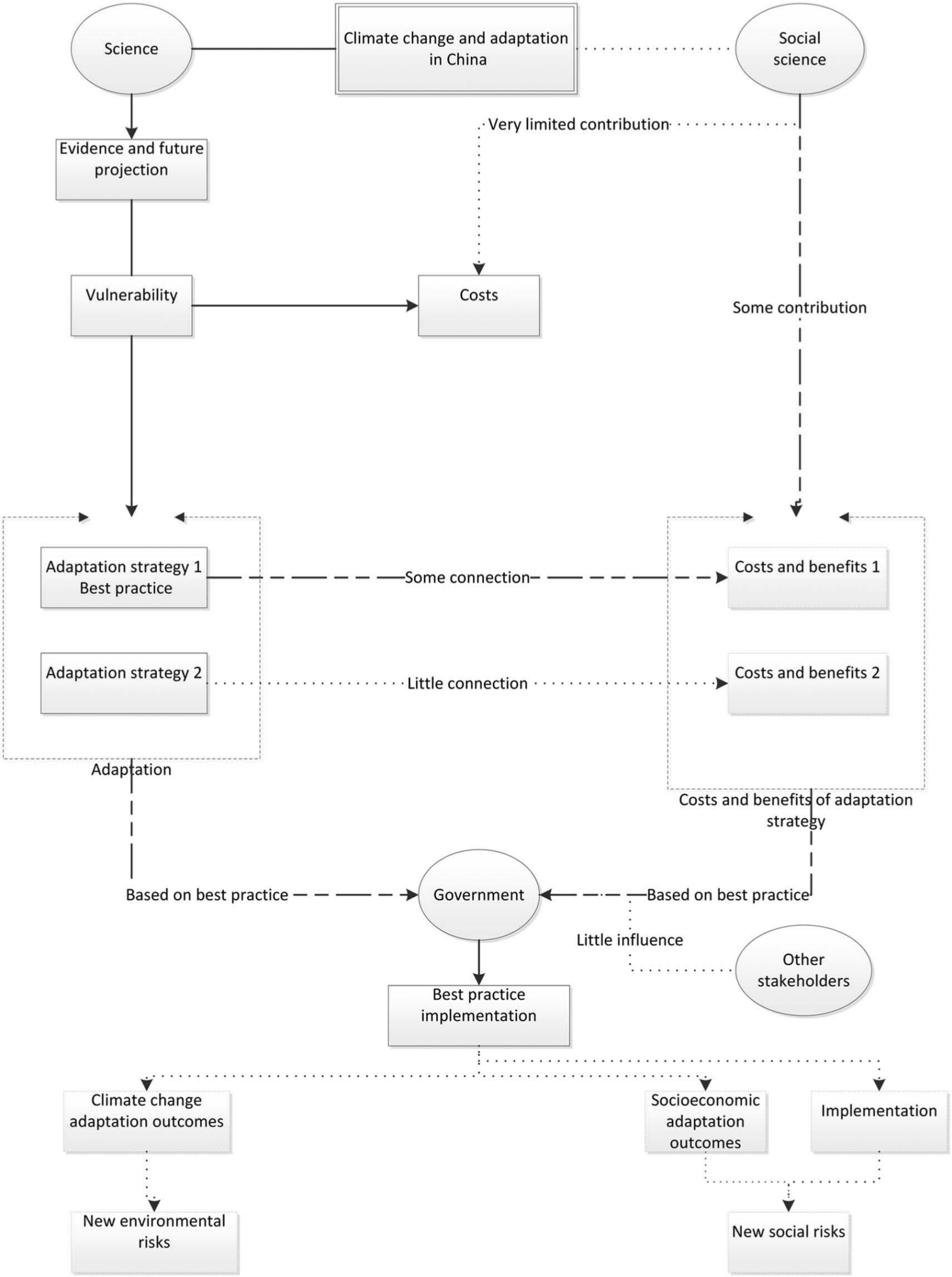
Figure 1 illustrates how the current framework works. While it illustrates the strength of the links with science and an understanding of the evidence of climate change, it also shows the three main weaknesses. First, social scientists and non-government stakeholders have yet to play a significant role in policy consultation. Second, there are few institutionalized channels to allow non-government and non-academic stakeholders to influence policy-making, and the possible impacts on the people affected are not evaluated before or after policies are formulated. Third, policy experimentation and the focus on rolling out successful cases means that comprehensive further assessment of adopted policies is not a priority. The consequences of this practice are two-fold. First, once the stage of rolling out successful policies at the national level is reached, some parts of the country that have failed to develop best practices will have to adopt new policies that are not designed to fit local needs. This may cause local resistance at the implementation stage. Second, new social and environmental risks that may arise from the adopted policies may not be monitored by the researchers who have a crucial part in feeding information to the decision makers.
Climate Change and Adaptation in China
VI. Conclusions
This paper suggests that climate change policy in China has evolved in response to water and energy shortages, health concerns, urban infrastructure damage, land inundation and GDP losses. The Chinese government has been quick to set up a policy framework that is strong in gathering scientific evidence and in rapidly producing legislation. However, there are some fundamental problems in the system that limit the effectiveness of adaptation.
The Chinese system suffers from poor local motivation and the lack of a platform for continued dialogue with key stakeholders. A policy process that is in theory evidence based (“experiment first – scale up later”) is in fact limited by a focus on success and a lack of attention to objections, failures or limitations. Localized policy-making tends to treat central government mandates as guidelines to be manipulated for local interests. This is complicated by the fact that GDP growth is still the most important factor for assessing local government officials’ performance.
With a few exceptions, policy-making at the local level is not participatory and is biased towards evidence from the natural sciences. Evaluations by social scientists only play a marginal role. This makes it difficult to establish a more solid understanding of the factors that have contributed to the success or failure of certain policies – and thus to develop a body of knowledge that is central to addressing newly emerging risks from earlier adaptation efforts. To improve the framework, it is important to find ways of aligning local and central interests. The most straightforward way to achieve this in an authoritarian regime such as China’s would be to reform the bureaucratic assessment system so that the internalization of the need for climate change adaptation is not centred on GDP growth. However, unlike GDP growth, climate change adaptation can hardly be measured by a single indicator. The governing capacity of the centre would be unavoidably challenged. Greater efforts to engage social scientists, NGOs and the general public in decision-making and post-project assessment would be crucial to the viability of genuinely evidence-based policy-making and adjustment. They might even be able to develop cheaper and more satisfactory methods for obtaining results. However, local officials who have to report to higher authorities but not to the local people have considerable incentive to keep any negative responses to local policies to a minimum. Again, this brings us back to the issue of how to reconcile central and local interests to make local authorities voluntarily pursue better adaptation outcomes. So far, the Chinese framework seems to have been constrained by the governance bottleneck that is ultimately political in origin.
Footnotes
1.
Cruz, R, H Harasawa, M Lal, S Wu, Y Anokhin, B Punsalmaa, Y Honda, M Jafari, C Li and N Huu Ninh (2007), “Asia”, in M L Parry, O F Canziani, J P Palutikof, P J van der Linden and C E Hanson (editors), Climate Change 2007: Impacts, Adaptation and Vulnerability, Contribution of Working Group II to the Fourth Assessment Report of the Intergovernmental Panel on Climate Change, Cambridge University Press, Cambridge, Chapter 10, pages 470−506.
2.
Bin, H, J Wang and H Zhang (2010), “Comparison of summer temperature change characteristics between arid region and monsoon region in China in recent years”, Arid Land Geography (Ganhan Diqu Dili) Vol 33, No 6, pages 874−877; also Dai, S, C Liu and G Qi (2010), “Impact assessment of climate change on Haidong agricultural region in Qinghai and its adaptive countermeasures”, (Qihou bianhua dui qinghai haidong nongye qu de yingxiang pinggu yu shiying duice), Anhui Agricultural Science (Anhui Nongye Kexue) Vol 10, pages 6608−6610; Li, Z and Z Yan (2009), “Homogenized daily mean/maximum/minimum temperature series for China, 1960−2008”, Atmospheric and Oceanic Science Letters Vol 2, No 4, pages 237−243; Zhang, Q and C Xu (2009), “Changes of temperature extremes for 1960–2004 in far-west China”, Stochastic Environmental Research Vol 23, pages 721−735; and Zhang, Q, C Zhang, H Bai et al. (2010), “New development of climate change in northwest China and its impact on arid environment”, Journal of Arid Meteorology Vol 28, No 1, pages 1−7.
3.
You, Q, S Kang, E Aguilar et al. (2011), “Changes in daily climate extremes in China and their connection to the large-scale atmospheric circulation during 1961–2003”, Climate Dynamics Vol 36, No 11/12, pages 2399−2417.
4.
Shi, J, E Cook, H Lu and J Li (2010), “Tree-ring-based winter temperature reconstruction for the lower reaches of the Yangtze river in southeast China”, Clim Res Vol 41, pages 169−175.
5.
The 2nd Climate Change National Evaluation Report (2011), China Science Press, accessed 23 June 2012 at  .
.
6.
See reference 3.
7.
Qian, C, Z Yan and C Fu (2011), “Climatic changes in the 24 solar terms during 1960–2008”, Chinese Science Bulletin Vol 57, No 2/3, pages 276−286.
8.
Yang, C, Z Yu and Z Hao (2012), “Impact of climate change on flood and drought events in Huaihe river basin, China”, Hydrology Research Vol 43, No 1/2, pages 14−22.
9.
See reference 5.
10.
See reference 3.
11.
National Development and Reform Commission (NDRC) (2007), China’s National Climate Change Programme, accessed 23 June 2012 at .
12.
Ren, G, Y Chen, X Zou et al. (2011), “Change in climatic extremes over mainland China based on an integrated extreme climate index”, Climate Research Vol 50, No 2, pages 113−124.
13.
See reference 12.
14.
See IPCC (2007), Fourth Assessment Report. Summary for Policy Makers, accessed 23 June 2012 at http://scholar.google.co.uk/scholar?q=IPCC+Fourth+Assessment+Report+&hl=en&btnG=Search&as_sdt=1,5&as_sdtp=on#9; also Lal, P, T Mitchell, R Mechler, S Hochrainer et al. (2012), “National systems for managing the risks from climate extremes and disasters”, in C B Field, V Barros, T F Stocker et al. (editors), Managing the Risks of Extreme Events and Disasters to Advance Climate Change Adaptation, Cambridge University Press, Cambridge, pages 339−392.
15.
PRC State Ocean Administration (2010), China Sea Bulletin (Nian Zhongguo Haipingmian Gongbao), accessed 23 June 2012 at .
16.
Wangkang, F, Z Yin and J Yin (2011), “Analysis on typhoon-induced storm surge vulnerability of China’s coastal areas on rising sea level background” (Haipingmian shangsheng Beijing xia zhongguo yanhai taifeng fengbao chao cuiruoxing fenxi), Journal of Tropical Oceanography (Redai Haiyang Xuebao) Vol 30, No 6, pages 31−36.
17.
Ren, J, B Ye, Y Ding et al. (2011), “Initial estimate of the contribution of cryospheric change in China to sea level rise” (Zhongguo bingdongquan bianhua dui haipingmian shangsheng qianzai de gongxian de chubu guji), Chinese Sci. Bull. (Zhongguo Kexue) Vol 56, No 14, pages 1084−1087.
18.
See reference 1; also see Stern, Nicholas (2007), The Economics of Climate Change: The Stern Review, Cambridge University Press, Cambridge, 692 pages.
19.
Piao, S, P Ciais, Y Huang et al. (2010), “The impacts of climate change on water resources and agriculture in China”, Nature Vol 467, No 7311, pages 43−51.
20.
Zhang, L, G Ren J Liu, Y Zhou, Y Ren, A Zhang and Y Feng (2011), “Urban effect on trends of extreme temperature indices at Beijing meteorological station” (Chengshihua dui Beijing qixiangzhan jiduan qiwen zhishu qushi bianhua de yingxiang), Chinese Journal of Geophysics (Diqiu Wuli Xuebao) Vol 54, No 5, pages 1150−1159.
21.
Wang, X and Y Gong (2010), “The impact of an urban dry island on the summer heat wave and sultry weather in Beijing city” (Chengshi gandaodui beijing xiaji gaowen menre tianqi de yingxiang), Science China Press (Zhongguo Kexue) Vol 55, No 11, pages 1043−1047.
22.
Zhang, J and Y Wang (2008), “Study of the relationships between the spatial extent of surface urban heat islands and urban characteristic factors based on Landsat ETM+ data”, Sensors Vol 8, No 11, pages 7453−7468.
23.
Chen, X, H Zhao, P Li and Z Yin (2006), “Remote sensing image-based analysis of the relationship between urban heat island and land use/cover changes”, Remote Sensing of Environment Vol 104, No 2, pages 133−146, accessed 23 June 2012 at Elsevier. doi:10.1016/j.rse.2005.11.016; also see reference 22; Wen, X, X Yang and G Hu (2011), “Relationship between land cover ratio and urban heat island from remote sensing and automatic weather stations data”, Journal of the Indian Society of Remote Sensing Vol 39, No 2, pages 193−201; and Liu, K, X Gu, T Yu, Z Gao, W Gao and C Liu (2011), “Relationships between urban heat island effect and land use and land cover change around urban weather stations” (Chengshi taizhan zhoubian redao xiaoying he tudi liyong yu fubei bianhua guanxi), Climatic and Environmental Research (Qihou yu Huanjing Yanjiu) Vol 6, pages 707−716.
25.
Gu, C, L Hu, X Zhang, X Wang and J Guo (2011), “Climate change and urbanization in the Yangtze river delta”, Habitat International Vol 35, No 4, pages 544−552; also see reference 23, .
26.
Liu, S, X Mo, Z Lin, Y Xu, J Ji, G Wen and J Richey (2010), “Crop yield responses to climate change in the Huang-Huai-Hai plain of China”, Agricultural Water Management Vol 97, No 8, pages 1195−1209.
28.
See reference 1.
29.
Zhang, H, J Dong, J Yan and N Yan (2009), “Urban domestic water consumption’s response to climate change in Xi’an city” (Xi’an shi chengshi shenghuo yongshui dui qihou bianhua yingxiang fenxi), Resources Science (Ziyuan Kexue) Vol 31, No 6, pages 1040−1045.
30.
Huang, Q, C He, P Shi, Y Zhao and Y Yang (2009), “Modelling water resources carrying-capacity change under stress of drought and socioeconomic development in Beijing” (Qihou ganhan he jingji fazhan shuangchong yali xia de beijing shuiziyuan chengzaili bianhua qingjing moni yanjiu), Journal of Natural Resources (Ziran Ziyuan Xuebao) Vol 24, No 5, pages 859−870.
31.
Dong, S, S Tao, W Yang, Z Li and Y Li (2011), “The impacts of climate change on urban agglomeration in the central and western regions of China” (Qihou bianhua dui woguo zhongxibu diqu chengshi qun de yingxiang), Journal of Arid Land Resources and Environment (Ganhanqu Ziyuan yu Huanjing) Vol 25, No 2, pages 72−76.
32.
Shi, J, L Cui and Z Tian (2009), “Climatic characteristics of high and low temperature and its effecting factors in Shanghai” (Shanghai gaowen he diwen qiwen bianhua tezhong jiqi yingxiang yinsu), Resources and Environment in the Yangtze Basin (Changing Liuyu Ziyuan yu Huanjing) Vol 12, pages 1143−1148.
33.
See reference 31.
34.
Kan, H, R Chen and S Tong (2011), “Ambient air pollution, climate change and population health in China”, Environment International (forthcoming), accessed 23 June 2012 at http://www.sciencedirect.com/science/article/pii/S0160412011000535?_alid=1834210744&_rdoc=29&_fmt=high&_origin=search&_docanchor=&_ct=1837&_zone=rslt_list_item&md5=a4fde89c482541ca00f7b5943dde564d.
35.
Tam, W W, T W Wong, S Y Chair and A H Wong (2009), “Diurnal temperature range and daily cardiovascular mortalities among the elderly in Hong Kong”, Arch. Environ. Occup. Health Vol 64, pages 202–206.
36.
Tan, J, Y Zheng, X Tang and C Guo (2010), “The urban heat island and its impact on heat waves and human health in Shanghai”, Int. J. Biometeorol Vol 54, pages 75−84.
37.
See reference 21.
38.
See reference 34; also see see reference 8; and Zhou, X, G Yang, K Yang et al. (2008), “Potential impact of climate change on schistosomiasis transmission in China”, The American Journal of Tropical Medicine and Hygiene Vol 78, No 2, pages 188−194.
39.
See reference 14, Lal et al. (2012); also Roeth, H (2009), “The development of a public−private partnership framework and action plan for disaster risk reduction (DRR) in East Asia”, United Nations International Strategy for Disasters Reduction, Secretariat Asia and the Pacific Bangkok, accessed 12 April 2013 at , 68 pages.
40.
See reference 1.
42.
Ministry of Health, PRC (2007), “Action plan on environment and health”, accessed 23 June 2012 at .
43.
Kan, H (2009), “Environment and health in China: challenges and opportunities”, Environmental Health Perspectives Vol 117, No 12, pages A530−A530.
44.
China’s Cabinet (2011), “White Paper: China’s policies and actions for addressing climate change”, Beijing, accessed 23 June 2012 at .
45.
See reference 44.
46.
See reference 44.
47.
Held, D, E-M Nag and C Roger (2011), “The governance of climate change in China, preliminary report”, LSE−AFD Climate Governance Programme, LSE Global Governance Working Paper 01/2011, accessed 12 April 2013 at , page 65.
48.
See reference 44.
49.
See reference 44.
50.
Cai, H and D Treisman (2006), “Did government decentralization cause China’s economic miracle?”, World Politics Vol 58, pages 505−535, accessed 23 June 2012 at http://journals.cambridge.org/abstract_S004388710002092X; also World Bank (2013), China 2030 : Building a Modern, Harmonious and Creative Society, accessed 12 April 2013 at , page 445.
51.
Hu, Y (2007), “Implementation of voluntary agreements for energy efficiency in China”, Energy Policy Vol 35, No 11, pages 5541–5548; also Price, L, E Worrell, J Sinton and J Yun (2003), “Voluntary agreements for increasing energy efficiency in industry: case study of a pilot project with the steel industry in Shandong province, China”, Lawrence Berkeley National Laboratory, accessed 23 June 2012 at .
52.
Eichhorst, U and D Bongardt (2009), “Towards cooperative policy approaches in China – drivers for voluntary agreements on industrial energy efficiency in Nanjing”, Energy Policy Vol 37, No 5, pages 1855−1865.
53.
Duan, H and D Zhao (2011), “Application of UPVC well pipe for drought relief in Yunnan” (UPVC jingguan zai Yunnan kanghan gongshuijing zhong de yingyong), Exploration Engineering (Tankuang Gongcheng) No 5, pages 34−36.
54.
Yinchuan Ethnic Affairs Commission (2011), “Ningxia ecological migration project to get the first 1.5 billion yuan of special subsidies from the central government” (Ningxia shengtai yimin gongcheng huode diyipi guojia zhuanxiang buzhu zijin 15yi yuan), Yinchuan, 21 March, accessed 23 June 2012 at .
55.
Zhou, S and H Zhu (2010), “Economic analysis of climate change impact on the rice yield in southern China and its adaptive strategy” (Qihoubianhua dui zhongguo nanfang shuidao chanliang de jingji yingxiang jiqi shiying celue), China Population, Resources and Environment Vol 20, No 10, pages 152−157.
56.
Zhang, Y and B Li (2011), “Motivating service improvement with awards and competitions − hygienic city campaigns in China”, Environment and Urbanization Vol 23, No 1, April, pages 41−56.
57.
Lu, M, M Liu, R Quan, L Zhang and J Wang (2010), “Analysis of system characteristics and vulnerability of rainstorm hazards in Shanghai” (Shanghai baoyu zaihai de xitong tezheng yu cuiruo xingfenxi), Huadong Normal University Journal (Huadong Shifan Daxue Xuebao (Ziran Kexue Ban)) Vol 2, pages 10–15.
58.
Lim, B, E Spanger-Siegfried, I Burton, E L Malone and S Huq (editors) (2004), Adaptation Policy Frameworks for Climate Change: Developing Strategies, Policies and Measures, Cambridge University Press, Cambridge Mass, accessed 12 April 2013 at , 258 pages.
59.
Yu, Y and Z Lin (2010), “The construction of a legislation system to respond to climate change in China” (Woguo yingdui qihou bianhua lifa tixi de jianshe), China Annual Meeting of Environmental Science 2010, accessed 23 June 2012 at .
60.
Climate China Action Network (2010), “A proposal by Chinese NGOs on climate change adaptation” (Zhongguo minjian zuzhi guanyu zhongguo yingdui qihou bianhua lifa de jianyi), accessed 23 June 2012 at .
61.
Zheng, J, A Bigsten and A Hu (2009), “Can China’s growth be sustained? A productivity perspective”, World Development Vol 37, No 4, pages 874–888.
62.
Schwartz, J (2004), “Environmental NGOs in China: roles and limits”, Pacific Affairs Vol 77, No 1, pages 29−49.
64.
See reference 47, page 51.
65.
Yi, S and J Liu (2009), “I openly call for emissions cuts. Where China and the world discuss the environment”, accessed 23 June 2012 at .
67.
Zhou, J and X Feng (2011), “Cognition of adaptation to climate change and its policy evaluation”, China Population Resources and Environment Vol 21, No 7, pages 57−61.
68.
Orderud, G, J Luo and G Zhuang (2010), “A comparative study on attitudes towards climate change between the Chinese and Norwegian university students” (Qihou bianhua: guannian yu xingdong de chayi−yixiang guanyu zhongguo he nuewei daxuesheng dui qihou bianhua taidu de bijiao yanjiu), Chinese Journal of European Studies (Ouzhou Yanjiu) Vol 6, pages 89−100.
69.
Gilley, B (2012), “Authoritarian environmentalism and China’s response to climate change”, Environmental Politics Vol 21, No 2, pages 287−307; also Xu, B and J Ye (2011), “Analysis of NGO’s role in response to the global environment and climate change” (Qianxi feizhengfu zuzhi zai yingdui quanqiu huanjing he qihou bianhua wenti zhong de zuoyong), Journal of Shanghai Institute of Public Administration (Shanghai Xingzheng Xueyuan Yuanbao) Vol 1, pages 79−88.
70.
See reference 47.
72.
Xie, L (2011), “China’s environmental activism in the age of globalization”, Asian Politics and Policy Vol 3, No 2, pages 207–224.
73.
Qi, Y and L Ma (2008), “Translating a global issue into local priority. China’s local government response to climate change”, The Journal of Environment and Development Vol 17, No 4, pages 379−400.
74.
Guo, X (2012), “Resettlement houses turned into commercial houses − a leak in the system” (Anzhifang bian shangpinfang yu jidanshang liefeng youguan), Northeast News, Shenyang, 20 March.
75.
Heilmann, S (2008), “Policy experimentation in China’s economic rise”, Studies in Comparative International Development Vol 43, pages 1−26.
76.
Xu, J (2008), “The research tendency of the migrations in San Jiang Yuan area” (Sanjiangyuan shengtai yimin yanjiu quxiang tansuo), Tibetan Studies (Xizang Yanjiu) Vol 3, pages 114–120.