



Abstract
Transport is a critical system in the city, which, through providing access to essential activities, enables diverse women and men, girls and boys to “appropriate” their right to the city and to realize a fully rounded and substantive urban citizenship. Yet, despite decades of work on gender in urban development and urban planning, mainstream transport planning still remains largely untouched by debates on diversity and difference in cities. The tendency to focus on the economic and now environmental aspects continues to dominate urban transport. In contrast, concerns for the identity of urban residents or “users” are addressed through, and ultimately marginalized to, “the social” and distributional aspects of urban transport planning. This paper argues that the distributional aspects of transport are cross cutting, and go beyond the disaggregation of transport users by social relations such as class, gender, age and ethnicity. The social identities of transport “users” are deeply embedded in social relations and urban practices, the latter ranging from the everyday lives of people to urban policies and planning. Furthermore, in transport, these social relations are played out in public space, with implications for how diverse women and men, girls and boys are able to exercise individual and collective “travel choice” and negotiate access to essential activities in the city. Recognition of these processes, as reflected in the “deep distribution” of the transport system, is essential to reframing the notion of “travel choice” and, ultimately, to urban transport and urban planning that is committed to social justice in cities.
I. Why Gender and the Right to the City in Urban Transport?
It is some 25 years since the first work on gender and transport was published, including my own contribution focusing on the underlying gender assumptions in transport planning.(1) Much of this early work aimed at making women visible in urban transport, by showing the different travel patterns of women and men. However, while some offered deeper understandings of why these differences emerge and why they are overlooked in transport planning, many of the contributions were “…restricted to the realm of behavioural differences.”(2)
To date, the literature that addresses gender in transport issues in cities and urban areas of the global South continues to expand but is still relatively scarce.(3) This mirrors the relatively small proportion of investment and research in transport in urban areas of the global South, and the even smaller proportion of investment and research focused on addressing poverty and urban transport there.(4) Reflecting on the effectiveness of our understanding of the “transport–development interface”, it is sobering to consider that:
“The theory linking transport influences to social and economic change has not really been refined much beyond the general and aggregative levels&. Few studies have addressed the matter of the distributional consequences of change nor derived comprehensive explanation to deal with this set of issues.”(5)
Perhaps more concerning is that 25 years on, gender and all issues relating to distributional questions in transport are identified with “the social”, which in turn is marginalized from the mainstream focus on economics, and now the burgeoning area of the environmental, in transport studies and planning.(6)
With more than half the world’s population living in cities, and with the predicted rates of urbanization and/or urban growth in Africa, Asia, Latin America and the Middle East, urban transport(7) is clearly a critical sector on which to focus current and future work. Moreover, changing urban structures and the resultant spatial distribution of activities and people in most medium and large-sized cities in the global South makes transport an essential means for women and men, girls and boys to access activities in the city, enabling them to live lives of quality. Yet in most of these cities, “…transport systems & propagate an unfair distribution of accessibility and reproduce safety and environmental inequities.”(8) Growing inequalities in cities, particularly under the impact of structural adjustment and globalization, have refocused attention on the right to the city of all its inhabitants.(9) The “unfair distribution of accessibility” in contemporary cities is a major constraint on particular groups of urban inhabitants being able to exercise their “choices” associated with the right to the city. In this context, Lefebvre’s notions of the right to appropriation and the right to participation are useful concepts in examining gender in transport and “travel choice”. (10)
This paper will explore this relationship by deconstructing the notion of “travel choice” and reframing it in the context of first, power relations and their intersectionality played out in private and public space; and second, the right to the city debates. By incorporating the right to the city, this paper takes a normative approach, but it also argues for “…the importance of the gender dimension in the construction of a
II. Reframing “Travel Choice”
The notion of “travel choice” is central to the modelling processes in mainstream transport planning. These models are based on:
“…the paradigm of rational man”, [sic] underpinned by “& neoclassical economic concepts, focusing upon the representation of people as individual rational choice makers, interacting together to form a state of equilibrium”(12) and acting “& to maximize her utilities&applied to traveller behaviour to stimulate choices of destination, mode, route and time.”(13)
This conceptualization of travel choice is problematic, because it is based on an implicit assumption that “&individual decision-making is made in a social vacuum.”(14) It does not recognize at least three critical issues central to transport and transport planning, namely the different social positions and multiple identities of transport users; the social construction of space, public and private; and the politics of transport in the context of social relations.
a. Social position and multiple identities: access and control
Given the intersection of social relations, the social position of transport users reflects multiple identities of gender, class, ethnicity, religion, sexuality, age and mental/physical ability, which account for difference and inequality but which are also dynamic and open to change. To date, development planning of all kinds has not succeeded in conceptualizing, formulating, implementing and institutionalizing planning that addresses these multiple and simultaneous identities of women and men,(15) and transport planning is no exception. The different and unequal social position of transport users reframes the traditional notion of travel choice that apparently maximizes utility. Rather, by virtue of the differently valued social roles and unequal access to and control over resources that different social positions offer, decisions about transport are a series of trade-offs about the purposes of travel, when to travel, how to travel – indeed whether to travel or not. Moreover, these are not individual decisions but are taken in the context of unequal power relations in the household, in the community and in the city.
However, while mainstream transport planning does not recognize the social position of transport users, it is not ideologically neutral either. As the initial gender critiques of transport planning revealed, transport policy and planning is predicated on a number of implicit assumptions, which bias its outcomes. One such set of assumptions relates directly to gender relations and, in their understanding of the structure of households, the division of labour in households and the control of resources in decision-making in households, are informed by essentially “western” and middle-class values.(16) As many scholars and practitioners have argued, these assumptions are not based on any empirical reality in most urban contexts worldwide. Overlaid on these gender-based assumptions are other transport biases, namely a focus on the (male) journey to work and on motorized transport, particularly the private car, which is largely unaffordable to most poor urban women and men.(17) The overall outcome is a transport system that does not reflect the needs of the majority of urban dwellers, offering a range of transport options that are accessible only to some and thus does not provide the basis for making optimal travel choices. Neither do the travel patterns that emerge from these so-called “travel choices” reflect trips that were suppressed, re-routed or delayed.(18)
These debates about the distortions in travel choice clearly reflect questions of inequality, and therefore distributional issues, in mainstream transport planning. Recognizing the social position of transport users on the basis of their gender and its intersection with other social relations builds part of the foundation for understanding such distributional questions in transport. Other transport scholars(19) are also concerned with the significance of the social position of transport users through the lens of social exclusion, defined as:
“&the lack or denial of resources, rights, goods and services, and the inability to participate in the normal relationships and activities available to the majority of people in a society, whether in economic, social, cultural or political arenas. It affects both the quality of life of individuals and the equity and cohesion of society as a whole.”(20)
The concept has been applied mainly in the UK, more recently in Europe, and only in a limited way in cities of the global South.(21)
The conflation and marginalization of distributional issues with “the social” has also been noted, and an argument made to re-conceptualize distribution from a peripheral to a mainstream issue in transport planning as follows:
“It would be more useful to define [transport] impacts and then recognize that each potentially has an economic, environmental and social dimension – all of which may have distributional consequences.”(22)
In this formulation, the authors define distributional impacts as spatial, temporal and socio-demographic. Issues of gender, class, age, ethnicity and race are placed under the socioeconomic category but recognized as operating in all three. While this “proposal” is extremely pertinent and timely, it still appears to fall within a behavioural paradigm, which does not problematize the power relations embedded in it.
Other critiques of utility-based notions of travel choice include recognition of beliefs and attitudes, emotion and “bounded rationality”, perceived losses and gains (prospect theory), feedback and social learning.(23) Although these lines of enquiry raise interesting questions, at base they do not address issues of power or social position of individual travellers. This is so even in the case where, in examining the possibilities for behaviour change, reference is made to social dilemmas coming from “…conflicting individual and collective interests.(24) Nevertheless, individual and conflicting interests are central to an understanding of travel choice placed in a wider critique of the social construction of urban space and its interaction with transport.
b. Social construction of (public and private) space and interests: access, mobility and autonomy
The relationship between transport and land use has long been a concern of transport planning, although many would argue that transport decisions have not always been based on an explicit integration of these urban processes. Moreover, the understanding of transport and land use has been underpinned by a consensus view of society(25) and does not explain urban processes in the context of the powerful forces driving capitalist development. Gender research in transport has made a particularly interesting contribution to such an understanding of urban development:
“Gender differences in transport contributed to a larger theoretical project in feminist geography: the critique of urban land use structure in contemporary capitalism, of the spatial separation of production and reproduction, and of the cultural dichotomy of public and private space.”(26)
Without detailing the debates in this “larger project”, the following points are important to this discussion. Feminist geographers, while accepting that there is a close relationship between urbanization and capitalism, critique the proposition that urbanization – and consequently land development and use – is predominantly a “class phenomenon”, as characterized by authors such as Harvey. They provide a coherent account of the intersection of class and gender in urban processes, demonstrating how gender is central to the notion of reproduction and therefore production. This relates to the increasing separation of home and work under capitalist urbanization and the false dichotomy between the association of private space with reproduction, consumption and women, and public space with production, politics and men. It is also a critique of Castells’ framing of “the urban question” as being concerned with the “reproduction of labour power” rather than, or as well as, production, but without a comprehensive gendering of the notion of “reproduction of labour power”.(27) Finally, along with other scholars, feminist geographers challenge the dichotomous gender characterization between reproduction and production, along with separation of the private and public spheres, insisting that “…greater consideration…be given, as in the treatment of production and reproduction, to the interaction and interconnectivity of the two spheres”,(28) both structurally and in the space and time of everyday lives.
In an exploration of reproduction, building on the work of Benería(29) and Harris and Young,(30) I demonstrate how these dichotomous gender characterizations are produced and reproduced by the intersection of all social relations, including class, ethnicity, religion and age, in the ideologies that underpin societal attitudes, including in our scholarly and professional disciplines.(31) One of the implications, in particular the conflation of biological reproduction with social reproduction, results in “…a range of expressions of men’s control [including state control] of women’s reproduction in nearly all societies”, which includes “…restrictions on women’s mobility.”(32)
From the point of view of transport, three related factors emerge in reframing the notion of “travel choice” from this analysis of the urban. The first is that decisions about travel are not based on the social position of women and men alone. They are also influenced by the interrelationships between transport in urban areas and the “&socioeconomic, political and environmental processes [that] create, reproduce and transform not only the places in which we live, but also the social relations between men and women in these places.”(33) This not only accounts for the reproduction of powerful dominant interests in the transport system, but also in the spatial structure and land uses of the city, creating a framework of inequality in which decisions about travel are made. This is an understanding of transport and transport planning as conflictual and contested, a far cry from the consensual paradigms of mainstream transport planning.
The second factor is that the intrinsic “public space nature” of transport is not problematized at all in behavioural approaches to transport and travel patterns. Most women – and some men – do not have the full autonomy to move in public space because of the social control exercised in the interests of dominant gender, class, ethnic, religious, sexuality and age groups. Therefore, a third factor to consider in an understanding of “travel choice” is that decisions to travel are made on the basis of norms exercised in the private as well as the public sphere, based on support and/or permission, persuasion and/or prohibition, verbal and/or physical. It is no accident that along with providing a deeper understanding of gender roles, the primary focus of research on gender and transport has been on male sexual violence in public and private space, and the constraints on women’s travel patterns to and from employment, with a respective focus on fear of violence and social relations in the household and the workplace “…as central mechanisms of oppression.”(34)
Along with a recognition of the social position of transport users on the basis of gender and other intersecting social relations, understanding transport in the context of the “…interrelations between socially constructed gender relations and socially constructed environments”(35) acknowledges the “deep distributional” issues in urban transport and urban transport planning. An approach that recognizes “deep distribution” builds the foundations for an understanding of transport based on the articulation of power relations in public and private space at the level of the household, community and society that generate the structural inequality and dominant relations under which decisions about “travel choice” are negotiated and made.
c. Scales of gendered spatial politics: the right to the city
Treating the notion of travel choice in a “social vacuum” results in an understanding of transport that is also devoid of politics. How can such a central urban investment with such widespread implications for urban inhabitants, from land values to forced evictions to access to the livelihood and social opportunities offered by the city, be devoid of politics? In reframing travel choice as a political act rather than a technical exercise, the contemporary discussion related to the “right to the city” (RTTC) is attractive.
These interrelationships between a biased transport system, the social and unequal position of transport users, and socially constructed inequality in urban environments take on a particular form in the restructuring of contemporary cities, where transport is a central sphere of action in what Harvey(36) refers to as “processes of creative destruction”. Although these processes will not be explored in detail in this paper, their recognition is important to the context in which “travel choices” and the RTTC are framed. Deregulation and the penetration of the market into areas previously controlled and managed by the state have resulted in a reconfiguration of public and private relationships and space in the city. Investment in transport is a good reflection of these changes, as the modernization of transport infrastructure is seen as a critical driver in making cities globally competitive in the image of the “world class city”. In cities all over the global South the result has been the “accumulation of dispossession”, expressed in a number of impacts including market and forced evictions(37) and a transport system, implemented through new partnerships between private service providers and the state, which is out of the reach of the majority of poor urban inhabitants. Cities are sites of “…processes of creative destruction that have dispossessed the masses of any right to the city whatsoever.”(38)
Furthermore: “The right to the city is far more than the individual liberty to access urban resources: it is a right to change ourselves by changing the city.”(39) Interpreting this much-quoted line from Harvey from a gender perspective, the RTTC offers hope for change not only for our future cities and their governance but also for our “socially constructed” selves, so that women and men, girls and boys can live everyday lives in both recognition and equality. Current formulations of change in transport studies focus on the “…design of ‘social nudges’ to change travel behaviour” (40) “…to make choices that are better for them and society.” (41) This formulation of change is problematic in two senses. It runs the risk of directing attention away from structural inequalities and issues of “deep distribution”, making individuals “the problem”. Equally important, the question of consciousness is also absent. Claiming the RTTC requires a change in individual and collective consciousness, challenging prevailing ideologies through an awareness and a rejection of current structural inequalities, and the collective construction of a mobilizing vision of a more socially just city in which equal opportunity for material well-being, recognition and democratic decision-making are central principles. What can transport offer this transformative process of consciousness raising? In the following sections it is argued that the contested intersection of the public and private spheres from which decisions relating to transport are negotiated offers some interesting potential for changing individual and collective consciousness.
Finally, in the context of the dominant apolitical character of transport planning, the RTTC is a clear statement of the opposite. “Lefebvre’s right is both a cry and a demand, a cry out of necessity and a demand for something more.”(42) This firmly roots transport, and the individual and collective choices made about it, in a political framework. It also roots it in a discussion of urban citizenship, which “&.is not so much about legality than about legitimacy.”(43) Urban citizenship is about the right to be in and of the city. In cities of the global South, for women and men excluded in different context-specific ways from the city on the basis of their gender and other intersecting social identities, such legitimacy is fundamental and often the basis for moving beyond either being invisible or being bulldozed to more constructive policies and planning.
However, using the banner of RTTC for transport will not automatically lead to a supportive policy environment for the deprived, dominated and oppressed in the city. This is an ongoing struggle, the dimensions of which need to be operationalized, in this case from an urban transport perspective. Lefebvre argues that “…the right…to participation and appropriation…are implied in the right to the city.”(44) The following is a discussion of how each might have theoretical and practical application to an inclusive and democratically formulated, implemented and managed transport system in the city.
The right to appropriate implies the use and occupation of urban space. This is clearly differentiated from the notion of domination and exchange,(45) which would encompass property ownership and the increasing privatization of space in the contemporary city. Transport is unique in its capacity to engage with the right to appropriation in two ways. First, the access provided by transport is one dimension of the right to appropriate urban space for a range of uses that are important to the daily lives of different and unequally positioned women and men, girls and boys. Transport access is understood not only in geographical terms as the distance between different locations in the city involving movement at different levels of public space. It also encompasses economic concerns related to affordability, sociocultural aspects related to safety and security in public space, and the physical issues of comfort and ease of design in the use of transport and its related infrastructure. Second, the act of travelling is a form of appropriation of public space in the city in its own right. The freedom to move in public space without physical or verbal threat is both of material and symbolic meaning to women and to particular men (for example, on the basis of racial or sexual identities) in ways that are context specific.
While the first form of appropriation relates to accessibility, the second form could be said to relate to the question of mobility. The two work together in understanding transport and the right to appropriation, based on a particular understanding of mobility. Historically, the distinction between the two and an emphasis on accessibility has been at the core of more progressive views of transport,(46) well highlighted in the following quotation about the current emphasis on mobility as an end in itself in Indian urban transport planning:
“The solutions offered by transport policies and public–private partnerships posit methods of transit that purport to be universally accessible, yet are in empirical fact out of the reach of the majority& Rather than ensuring the directness of links and a density of connectors, by accounting for geographical destination of activities, mobility in and of itself becomes a performance objective in planning, with greater public investment in roads easily accessible by car users rather than modes that facilitate multi-modal access for heterogeneous publics. The unresolved dilemma in the Indian planning scenario is on where good mobility is seen as a sufficient condition for accessibility.”(47)
However, current research provides a new focus on “mobilities” as a way to view contemporary processes and experiences of globalization and technological change, either “…positively coded as progress, freedom or modernity itself” or raising “…issues of restricted movement, vigilance and control.”(48) There is also a current tendency to use “mobility” instead of transport “…to signal the new framing of the topic within social and cultural geographies of mobility.”(49) The right to mobility in public space is just such an issue, and a way to challenge, theoretically and in practice, the social control exerted on different groups to move freely in public space in the name of identity-based ideologies presented as “natural” or in some cases “god given”.
Alongside the right to appropriation, the right to participation is a key dimension of the RTTC’s focus on “…the exercise of a collective power to reshape the processes of urbanization.”(50) Thus, the right to participation demands…
“…greater democratic control over the production and utilization of the surplus. Since the urban process is a major channel of surplus use, establishing democratic management over its urban deployment constitutes the right to the city.”(51)
Keeping in mind Lefebvre’s insistence on a “…real and active participation”,(52) transport also offers a two-fold view of participation. First, it focuses on the right to participate in decision-making about urban transport, something that has been limited so far in transport planning in most parts of the world. Second, participation also encompasses the access provided by transport to travel in order to participate in decisions about the making of the built environment and the politics of the city. Both kinds of participation involve an engagement with the public sphere of politics, traditionally the realm of men and one in which women face many constraints related to gender and its intersection with other social relations.
III. Gender Relations in Transport: The Right to Appropriation
From the research undertaken over the last 25 years, what can be said about transport and how it relates to the two-fold understanding of the right to appropriation presented above − that is, the access provided by transport to enable the appropriation of urban space for a range of uses that are important to the daily lives of women and men, girls and boys; and the capacity to exercise autonomous agency around being mobile in public space?
Some clear patterns have emerged in the research on how gender impacts on transport. However, one needs to be careful about what it tells us about the right to appropriate the city. For a start, they reflect an aggregation of individual travel, not a collective use and occupation of space. Nevertheless, transport patterns disaggregated by gender do indicate that women and men use the city differently in terms of purpose, location, time and mode of travel. Some of the research shows the impact of multiple identities on the use of transport, with patterns correlated with differences in income, education and location in the city(53) as well as with marital status and household composition.
Thus, in most contexts men tend to travel more than women. While work trips account for the highest proportion of both women and men’s trips, men tend to undertake more of them and to more distant locations – see, for example, Hanoi, Vietnam (Figure 1). Women tend to do more trips related to reproductive work than men and more multi-purpose trips, or “trip chaining”. There are also clear temporal gender differences. In most contexts, men do more peak travelling than women, when service provision is relatively better, and women tend to do more off-peak trips during the day than men, when transport services are less frequent – see, for example, Lima, Peru (Figure 2).
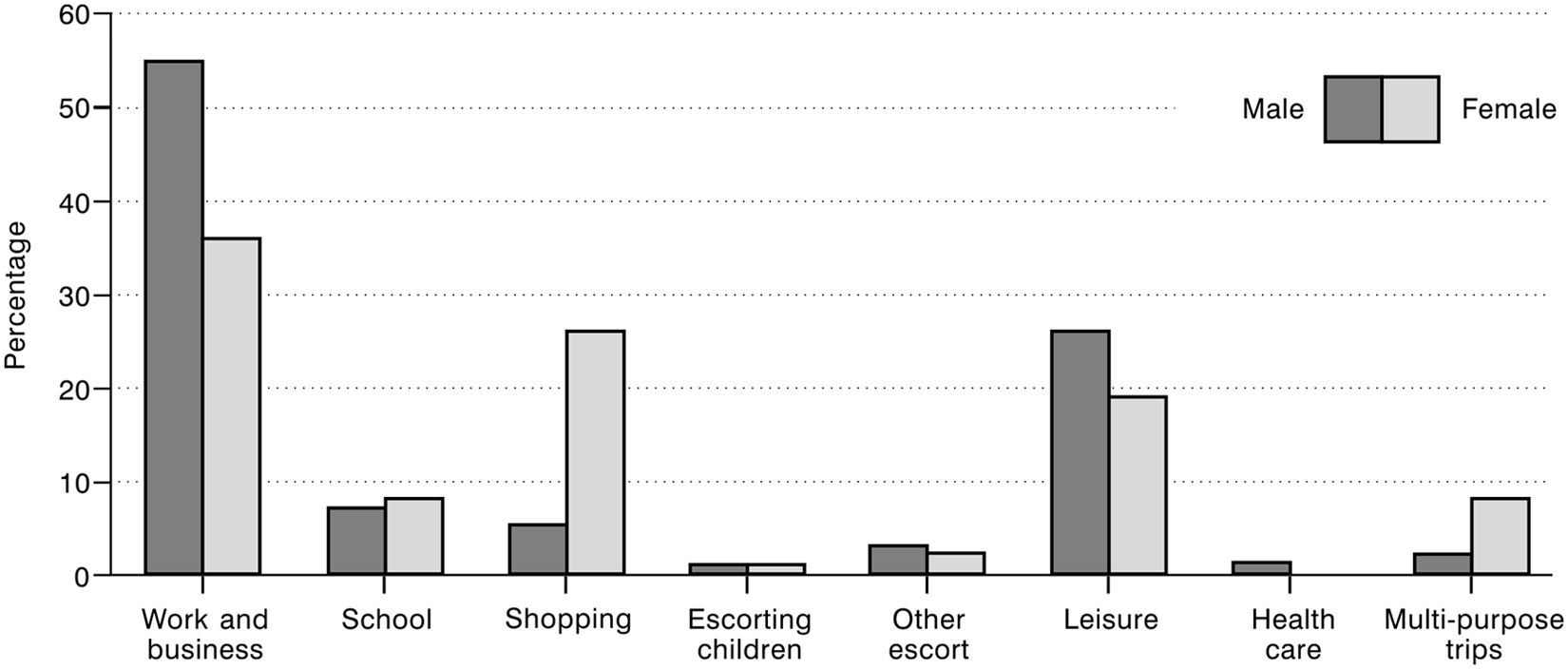
Purpose of trip according to gender, Hanoi, Vietnam
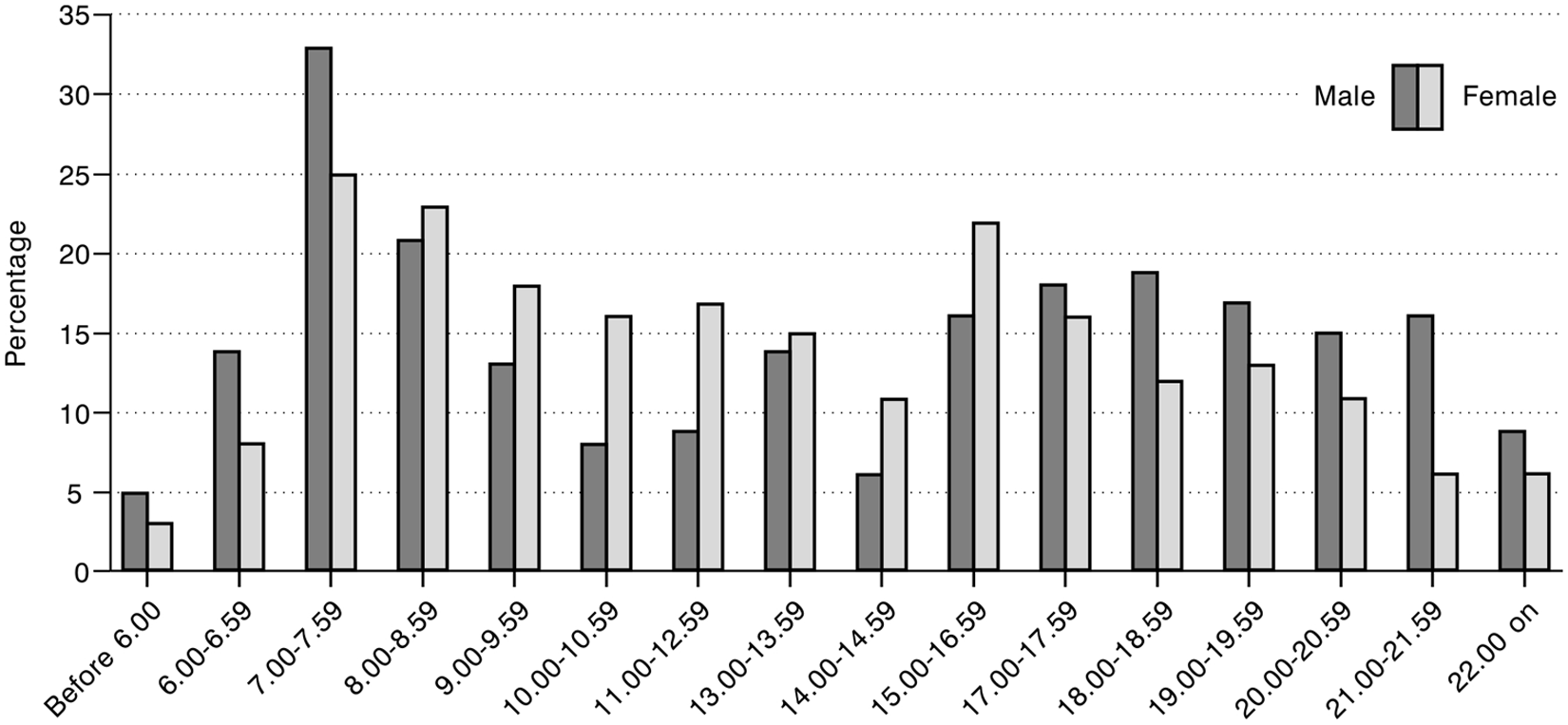
The use of public transport by gender and time, Lima, Peru (multiple responses)
Women tend to use different and cheaper modes of transport than men, particularly low-income women − for example, the modal use in Johannesburg, South Africa, which shows the intersection of gender, race and, implicitly through the mode, class (Figure 3). Giving some clues to inter-household distribution of resources and negotiation, where there is a family car men will tend to use it, also keeping in mind that in cities in the global South women are less likely to have driving licences than men. Finally, poor women and men tend to walk more than those who are better off, with poor women tending to walk most.(54) The lack of “travel choice”, resulting in a trade-off between cost and modal selection, is clearly expressed in the context of Nairobi slums, which “&are relatively well connected by privately owned and operated transit vans and small buses called matatus. The slum residents are walking largely because they cannot afford the motorized options.”(55) Accidents are a serious problem for pedestrians, who often use roads with no pavements and in conflict with road traffic. However, the death rate for men killed on roads tends to be higher than for women. For example, in São Paulo, men account for 76 per cent of pedestrian fatalities and 86 per cent of vehicle fatalities.(56)
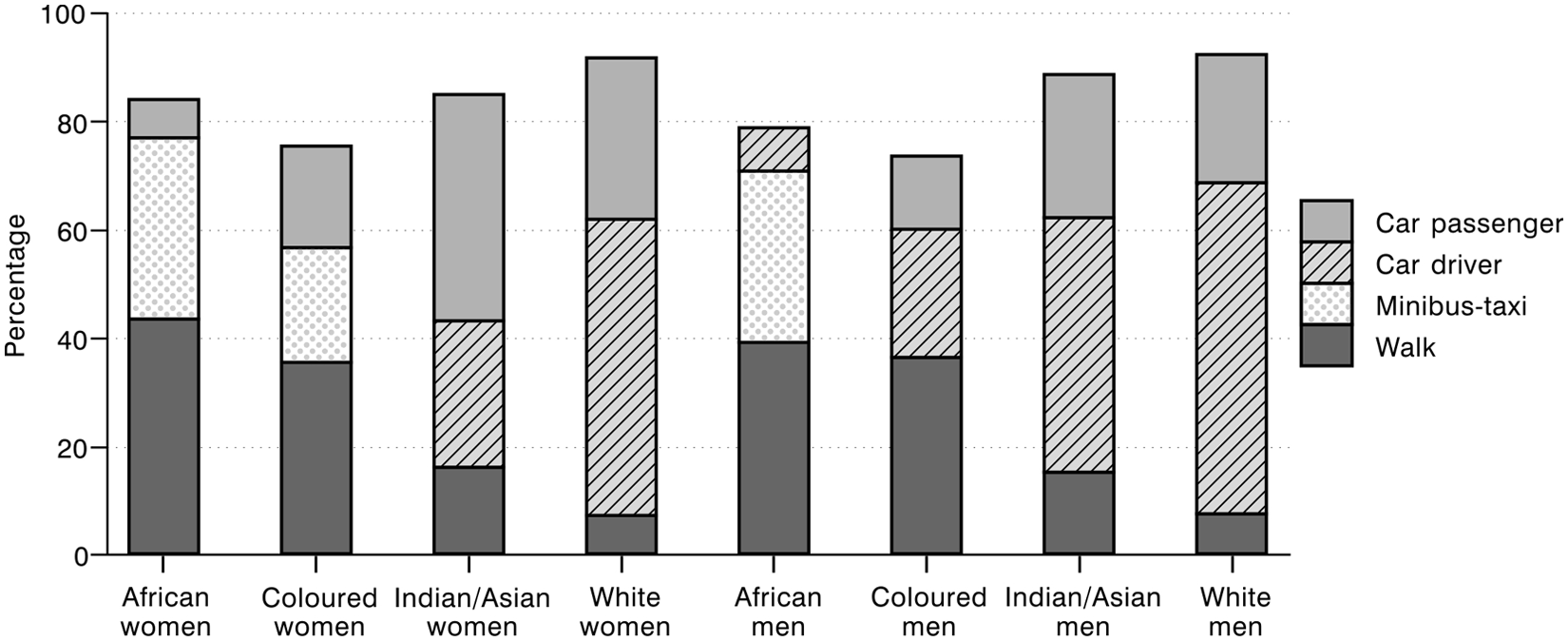
Modal choice by gender and race, Johannesburg, South Africa
Not unsurprisingly, the issue of safety and security in the different public spaces of transport modes (e.g. buses and taxis), routes (e.g. streets) and hubs (e.g. bus stations) is widely addressed. Women tend to experience more violence through thefts and verbal and physical/sexual abuse while waiting for and using public transport. Some groups of men also experience abuse on transport, for example around their race or sexuality. Violence is a problem for women on all transport modes and routes. For example, a study in Delhi, India, found that:
“Women are the targets of sexual harassment while travelling to work and practically every woman interviewed had anecdotal evidence of suffering from the same. Harassment while walking down the street or travelling on a bus is a common occurrence for working women and is exacerbated by the absence of adequate lighting on streets and subways and by the small, lonely paths connecting the slum with the bus stops.”(57)
During the Arab Spring and in its aftermath in Cairo, Egypt, women experienced and are still experiencing high levels of sexual harassment in public spaces, and the following statement encapsulates the challenge of women’s right to appropriation vividly:
“&despite claims made by men, harassment is not a harmless, direct reaction by men to women but an institutionalized system of violence that functions to police women’s participation, freedom of movement and behaviour in public spaces. It is not how women behave in the public sphere that makes them vulnerable to street harassment; it is that they have chosen to enter the public sphere at all.”(58)
A critical caveat in these general findings is that political, socioeconomic and environmental context is all important, and differently located cities in time and space will certainly account for very different decisions about, and experiences of, travel by different groups in different parts of different cities.(59) This research is also mainly quantitative, and the disaggregation of travel patterns by sex gives a clear view of the gender division of labour. As the research acknowledges, these patterns reflect that while in most societies women retain domestic and child care responsibilities, increasing numbers of women are balancing these with productive work. Indeed, there is a concentration of research focused on travel to work that:
“…derives in part from its power as a metaphor& it is the single human activity that most clearly bridges the symbolic and spatial distinction between public and private which is a feature of western urbanism. It is the actual and metaphoric link between the spheres and spaces of production and reproduction, work and home.”(60)
Furthermore, travel to work is not only a reflection of the need and desire of women to work but also of the spatial use of the city and its intersection with the gendered spatial labour markets in cities.(61)
However, we do not have a deeper understanding of the trade-offs diverse women and men have made in their decisions to travel, which requires complementary qualitative research. With few exceptions,(62) the research does not reflect the negotiation within the private sphere of the household about women and men’s travel in the public sphere. What are the possibilities for changing gender relations in either sphere because of the dynamic relationship between decisions in the private sphere and accessibility and mobility in public space?
This challenges two related dimensions of the RTTC discourse. First, it points to the importance of recognizing that the relationship between the appropriation of space in the public sphere is contingent on and influenced by decisions in the private sphere. The decision to travel is negotiated in the household because it implies moving into the public space of the city. Focusing on the question of consciousness, scholarship outside the transport field suggests that women’s negotiation in the household is based on positions that derive neither from false consciousness nor from conscious collusion but from positions of power available to them.(63) At the same time, women’s appropriation of the city through mobility in public space and accessibility to what the city offers may strengthen women’s agency and autonomy, with implications for relations in the household. We do have some insights into these issues but they generate more questions than answers.
Second, it highlights how the right of appropriation through equal transport access to necessities and opportunities in the city is both conceptual and practical. With the separation of home and work and the growth, dispersal and restructuring of cities, transport is a use value that has become a necessity for urban inhabitants. “Only state intervention can achieve the levels of security, social welfare and (relative) equity of access to mobility.”(64) However, transport is commodified in most cities, and with the advent of neo-liberal policies, private operators driven by profit are increasingly involved in urban transport provision, which is increasingly expensive to access. This shifts the discussion from the use of transport to facilitate the right to appropriate the city, to rights in the city,(65) for example, the right to employment, the right to housing and the right to affordable, convenient and safe transport.
IV. Gender Relations in Transport: The Right to Participation
In most contemporary cities, the right to participation in decision-making about transport is a demand in the form of collective protest against transport planning decisions already taken. These are usually angry collective responses to either the way transport systems are designed or managed − for example, mobilization around higher fares − or to proposals or forced evictions in order to build new or extend old infrastructure. Perhaps more accurately defined as appropriation in the name of recognition and participation, the latter is an increasingly common event in the context of contemporary urban restructuring in which the upgrading of transport infrastructure is a central strategy. For example, the upgrading of transport in Mumbai and Delhi, India, is seen as a key intervention in the creation of “world class cities”.(66) In the context of the World Bank-supported Mumbai Urban Transport Project, despite ongoing negotiations by organized communities with Indian Railways and other government agencies, slum dwellers along the railway line were bulldozed. The National Slum Dwellers Federation, which incorporates Mahila Milan, a women’s collective, occupied the Kanjur Marg railway line in protest, bringing services to a halt in a show of strength to bring Indian Railways and its local partners back to the negotiating table.(67)
Such forms of temporary appropriation are critical moments in an ongoing struggle to demand more participation and democratic governance in the planning of urban transport. As a largely expert-led and top-down intervention, there are not many positive examples worldwide of active support for public participation in transport planning, let alone where this has been done in a gender sensitive manner. Indeed…
“&to develop an effective transport policy framework which embraces bottom-up strategies will require a sea change in the traditional attitudes of transport experts and the organizational culture of the profession.”(68)
Although this is a statement made in the context of the UK, it applies worldwide. The current discourses about participation in transport planning, with the exception of those concerned with social exclusion,(69) are either “extractive” in character, focusing on wider consultation with travellers to improve data in transport surveys, or relate to “&partnership structures&and mean more about partnership of a wider range of professional service providers than users.”(70)
An understanding of gendered access and mobilities could also contribute to more hybrid notions of collective power. Politics in urban areas is imbued with a spatiality, either at the point of production (trade unions, workers’ organizations) or at the point of residence (community-based organizations organizing over issues of “collective consumptions”). Often, this is presented as a dichotomy of male and female realms, respectively, which belies the interaction and fluidity between them. At the point of production transport can be a focus of mobilization, for example the safety of women workers when travelling to and from work,(71) or a means to get safely to workers meetings and demonstrations. At the point of residence, transport may be the focus of residentially based political organization, a scale at which Moser(72) highlights the gendered difference between the community management roles of women (organizing around issues related to reproduction at the point of residence) and the community politics roles of men, the latter often carrying more access to resources and power.
Because transport implies accessibility and mobility to citywide activities and opportunities, it also offers a cross-scalar configuration of politics, enabling women and men to access different political spaces in the city. Debates about extending public participation in transport planning in the UK recognize this more strategic entry point for participation at the citywide scale as well as in more local transport planning.(73) This opens up interesting but complex spaces for the right to participation. Experience in other areas of planning would suggest that women are more likely to be included in participatory initiatives at the local level, and explicit steps would have to be taken to connect to existing gender-based movements to ensure their equal participation at city level. Women’s almost universal under-representation in formal (party) politics “…must not be confused with absence of any political activity”,(74) since women are often also involved in more “informal” politics at community level.
The role of transport in facilitating the right to participation in other policy and planning in the city is under-researched. What is clear is that the right to participate, whether in transport or other urban planning, is a struggle that requires the construction of a collective consciousness and social movements around the RTTC.
“Thus, strategies for a progressive transformation lie in a complex process of political alliance building, on the basis of intersecting identities where common sources of exclusion, exploitation and oppression are acknowledged, and the interlinked agendas for recognition and redistribution are brought together.(75)
Possible forms for such movements are various – a forum, a coalition, an alliance, a movement, an assembly(76) − but the challenge in constructing them is great. The very difference in social positions of urban dwellers and their translation into conflictive interests in the city, which have been highlighted in this paper as critical to a deeper understanding of decisions to travel, are precisely those forces that divide political movements. For example, with respect to class differences in Chennai:
“…the right to the city as a concept is highly ambiguous, given that there are multiple understandings of open spaces and what the right to the city might mean. Middle-class activism does not take account of these multiple understandings and, as a result, the right to the city becomes subservient to bourgeois citizenship. For the poor, there is no right to the city.”(77)
Tactics are also important and should not be conflated with the discourse of “rights talk”. Thus, while women in Shack Dwellers International and the Asian Coalition of Housing Rights recognize their experience of inequality and injustice in the city, they “…seek the ‘identity’ of constructive engagement, not of insurgency”,(78) which they associate with rights.
Nevertheless, transport is an issue that has the power to cut across difference. For example, the question of safety and security along transport routes and in transport modes alone is an issue that can mobilize a city. While the current discourse on the RTTC focuses on collective rights, when it comes down to it, claiming the collective right to participate is contingent on decisions in the household as well as in the local and wider community, reflecting an interaction between the private and the public realm about which we need more qualitative research. Does access to urban activities and mobility in public space empower (or disempower) different women and men? In what ways? How do they take this experience back into decision-making in the household? How do they take it into urban politics? Responding to these kinds of questions is crucial to deepening an understanding of multi-scalar social relations in urban contexts. “Being mobile is not just about geographical space but also, and probably above all, about social space.”(79) – and political space as the right to participate in the struggle for the RTTC.
V. Transport Planning Revisited
This paper argues that a paradigm shift in transport planning is way overdue. Some 25 years after researchers and practitioners began to highlight the importance of gender relations in urban transport, there is still a lacuna in transport planning’s understanding of the everyday lives of women and men, girls and boys in urban areas. Exploring the “deep distributional” dimensions of “travel choice” in urban transport and transport planning reframes not just the understanding of social relations and urban transport but also the very behavioural foundations of transport planning itself.
However, reframing understandings of diversity and inequality…
“…in paradigms which are deeply embedded in policy making and planning involves more than the power of rational argument. It is closely intertwined with political processes and a change in consciousness which questions and deconstructs the fundamentals of current power relations and their expression in diverse and multiple identities in contemporary societies.”(80)
For this reason, the mobilizing potential of the right to the city may be a useful contribution to the struggle for change in transport planning. “Understanding the urban form in development projects and transportation needs to recast the understanding of the public as a space of common interest, a collective aspiration”, Murthy argues in the context of India.(81)
However, as stated at the beginning, the arguments developed in this paper are not only normative. A gender and RTTC perspective strengthens not only a critical understanding of transport in urban development but also the predictive capacities of transport planning and its capacity to respond to urgent urban development challenges in the context of active democratic politics.
If “…public space must be understood as a gauge of the regimes of justice extant at any particular moment”,(82) where does this leave the current state of gender relations in transport and women’s access to public space in our cities and urban areas?
Footnotes
1.
Levy (1992); also  .
.
4.
See Salon and Gulyani (2010), page 642; also .
7.
In this paper, urban transport is understood as the interrelationship between transport and urban processes, and the practices of transport planning – which together could be understood as a transport system.
9.
Harvey (2008); also .
16.
On assumptions in policy and planning in general, see Moser (1989). On assumptions in transport planning, see .
18.
Avineri (2012); also .
19.
See, for example, Preston and Rajé (2007); also Stanley and Lucas (2008); and .
20.
Levitas et al. (2007) in , page 1323.
28.
Little, Peake and Richardson (1988), page 17.
33.
Little, Peake and Richardson (1988), pages 1−2.
35.
Little, Peake and Richardson (1988), page 2.
37.
See, for example, Hasan (2006); also Patel, d’Cruz and Burra (2002).
43.
46.
Levy, (1992); also .
54.
See, for example, Anand and Tiwari (2006); also .
64.
Docherty, Shaw and Gather (2004), page 259. Their argument is that the state intervenes in transport, seeking to maximize the social value of transport as a public good, following Schumpter’s notion of a public good.
66.
Patel, d’Cruz and Burra (2002); also .
73.
Booth and Richardson (2001); also .
82.
Mitchell (2003), page 235, following .