




Abstract
This paper examines patterns of adaptive behaviour in low-income settlements(1) in Khulna, Bangladesh’s third largest city. It contrasts the adaptive behaviours of “squatter” households who “own” their land with those of tenants who rent dwellings from private landlords, and finds significant differences between the adaptive behaviours of owners and renters. This is important, as most knowledge about low-income settlements in Bangladesh originates from “owned” settlements – often called “public settlements”, as the land is officially public land. But the future growth of low-income settlements in the country is likely to be increasingly on private land, with rented dwellings. Policy lessons generated from settlements with “squatters” may be inappropriate for the next generation of “slums” that will house millions of rural migrants and people displaced by climate change. The conclusions argue that agencies seeking to assist low-income households in Bangladesh will need to craft different strategies for settlements according to different types of land tenure.
I. Introduction
Resolving the challenges that face growing numbers of poor urban people in low-income countries is a critical development task, especially in an era of climate change. More than one-third of the 2.5 billion urban dwellers in these countries already live in low-income settlements and the numbers increase by at least six million each year.(2) Climate change is influencing this trend in many ways, not least by propelling rural–urban migration of poor people.(3) In Bangladesh alone, 8–10 million people are expected to be displaced by 2050. This involves predominantly poor rural people moving to low-income urban settlements, where nearly 35 per cent of Bangladesh’s urban population currently live.(4) The number of poor urban people is expected to outnumber the rural poor by around 2040.(5) The share of people living as tenants in low-income private settlements has already risen from 48.8 per cent in 1996 to 70.3 per cent in 2005, indicating a major shift in tenure options for these people.(6)
The challenges facing the urban poor and their ability to adapt vary between households and settlements. This resonates with the notion that “… ‘context is king’ for adaptation to climate in cities”(7) and that security of land tenure is a particularly important contextual factor. Past research has confirmed that:
only when poor urban people’s tenure is relatively secure will they invest in shelter and basic service provision;(8)
security of tenure raises the prospects for both direct and indirect adaptation initiatives;(9) and
insecure tenure often results in higher rates of mobility, undermining community-based adaptation efforts.(10)
However, it remains a disturbing trend that poor people’s access to land and dwellings in urban areas is neglected by politicians, policy makers and policies.(11) In Bangladesh, the 1994 National Housing Policy barely mentioned the urban poor.(12) The policy was re-drafted in 2004, offering some acknowledgement of poor people’s rights, but it still awaits approval.(13) Against this backdrop, urban poverty continues to rise, resulting in a range of informal and sometimes illegal tenure arrangements. A recent study has identified 14 land tenure arrangements within three broad categories – squatters, private settlements and other (street dwellers, tied tenants, communal owners).(14) Squatting involves households occupying a parcel of land that formally belongs to someone else (public or private) while paying no financial compensation. In Bangladesh, squatting on private land is uncommon, so that the terms “public settlements” and “squatter settlements” are often used interchangeably. Squatter settlements are usually owner-occupied but have some tenants, whereas private settlements are fully tenant based except for a few, if any, resident owners.
A tenant household in a private settlement has a very different life experience from that of a homeowner in a squatter settlement. The squatter household can usually make some claim of ownership over (or rights to) the land, as they own their dwelling and do not have to pay rent.(15) In contrast, the dictum that “home is the most important asset” does not hold true for tenant households. The tenant household in a private settlement has no claim of ownership over the land or dwelling and tenants have to pay rent, often more than 20 per cent of their monthly household income.(16) Tenants in private settlements cannot also effectively engage with external actors and rarely get involved in social mobilization. Hence, tenants in private settlements develop quite different adaptation practices to those of squatters on public land.
This leads to our central concern – that adaptation practices feasible in one form of tenure arrangement may not be applicable in another. In Bangladesh, little analytical work is available on how people’s adaptation practices relate to their tenure arrangements; most literature focuses on large squatter settlements built on public land.(17) This paper seeks to address this knowledge gap by examining the contrasting patterns of adaptive behaviour in low-income settlements in Khulna. In particular, it contrasts the adaptive behaviours of “squatter” households and those renting from private landlords.
II. Analytical Framework
Our core hypothesis is that people living in squatter settlements, especially those long established on public land, are better placed to develop effective adaptive practices than people living in rental accommodation in private settlements. Despite the fear of eviction, squatter owner–dwellers enjoy informal and partial land ownership rights that enable them to develop a range of practices to reduce vulnerability. Institutions such as NGOs and donors usually prioritize public settlements, particularly large settlements, for basic services provision. Their selection of a settlement can be influenced by whether the municipal government recognizes its existence, which in Bangladesh is indicated by the issuing of a holding tax number to individual dwellings.(18) In contrast, private settlements are usually small or medium sized and rarely attract external institutional support. People usually reside there for shorter periods and have little incentive to adapt dwellings and are discouraged from developing home-based enterprises. Newcomers are also unlikely to be included in electoral/voter lists for the corresponding municipal constituency.
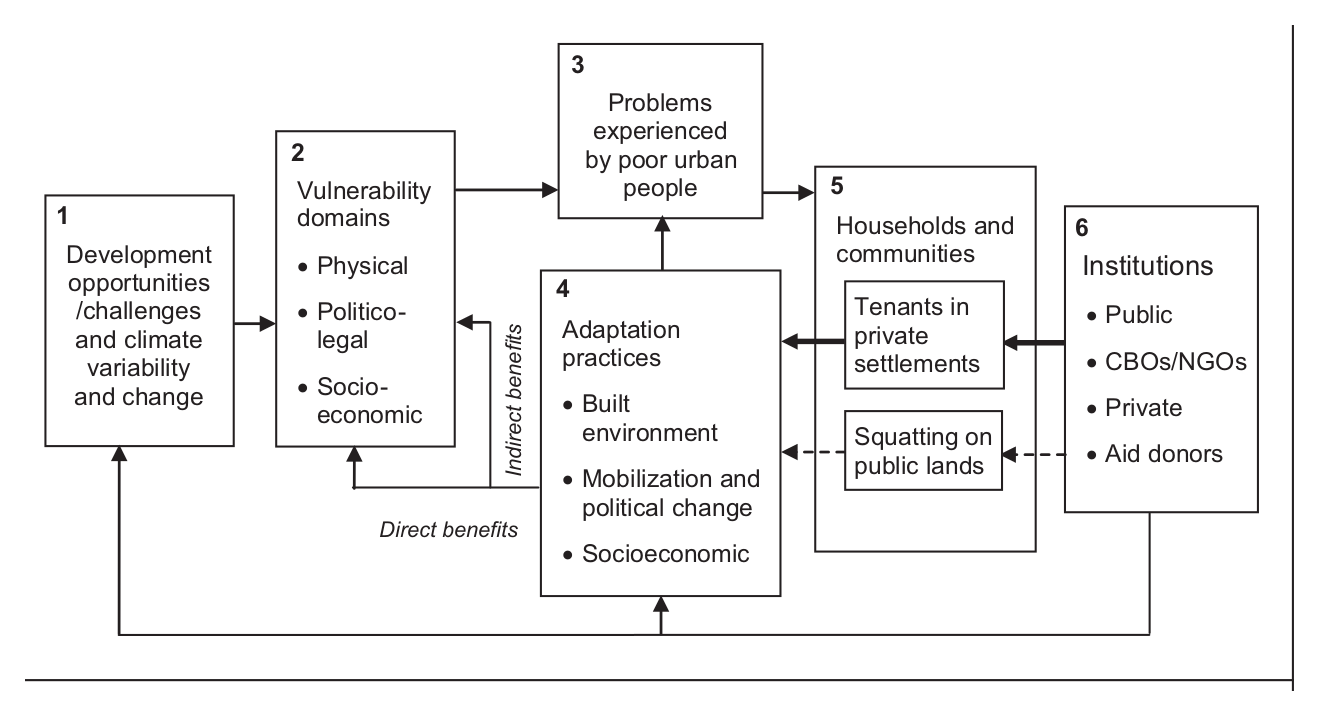
To examine this hypothesis, we apply a framework incorporating key elements that facilitate and/or hinder access to, and influence over, resources, decision-making and actions on climate change adaptation by poor urban people (Figure 1). Emphasis is placed on how the adaptation practices of poor urban households and communities have been shaped. This reflects our positioning of poor urban people as innovative individuals, whose abilities, preferences, aspirations and struggles are reflected in the practices that they develop.
Analytical framework
We frame adaptation within the broader processes of development opportunities (e.g. increased demand for labour because of globalization), development challenges (e.g. global financial crisis) and climate variability and change. This helps us conceptualize climate change as just one additional factor that is, and will become increasingly, important in addressing poverty within an already complex and dynamic livelihood context for poor urban people. Likewise, we believe that poverty and vulnerability do not coincide in the same way in all cases, and among poor urban people there are varying levels of vulnerability.(19)
We use, therefore, a slightly modified typology of vulnerability than is commonly followed. The literature often differentiates vulnerability into physical (external) and social (internal) categories.(20) But we found it useful to sub-divide social vulnerability into politico-legal and socioeconomic vulnerability, given the importance of these dimensions in the lives of low-income people in Khulna. This approach fits well with the widely held understanding that “…vulnerability represents the system or the community’s physical, economic, social or political susceptibility to damage.”(21)
Of course, each of the three vulnerability domains is a collective expression of factors experienced by people in different contexts with differing consequences. In order to highlight the comparability between public and private settlements, we analyze these factors by relevance to vulnerability
To be consistent with our analysis of vulnerabilities, we also structure adaptation practices under three broad domains: built environment, mobilization and political action, and socioeconomy. Our assumption is that people develop practices based on their perceptions of vulnerability and their individual and collective resources. External institutions – encompassing public bodies, civil society organizations (CSOs) and non-governmental organizations (NGOs), aid agencies and private actors – can support as well as hinder these processes, both directly and indirectly.
III. Khulna: Brief Background
Khulna stands on the banks of the Rupsha and Bhairab rivers and is the third largest city in Bangladesh. It had about one million inhabitants in 2010.(24) During the late 1950s–1960s, Khulna became an important centre for industrial development, but the economy stalled after independence in 1971. The city–region has seen economic revival since the early 1990s, partly due to a growth in shrimp farming and processing activities, and is likely to experience a massive boost when the Padma multi-purpose bridge is constructed.
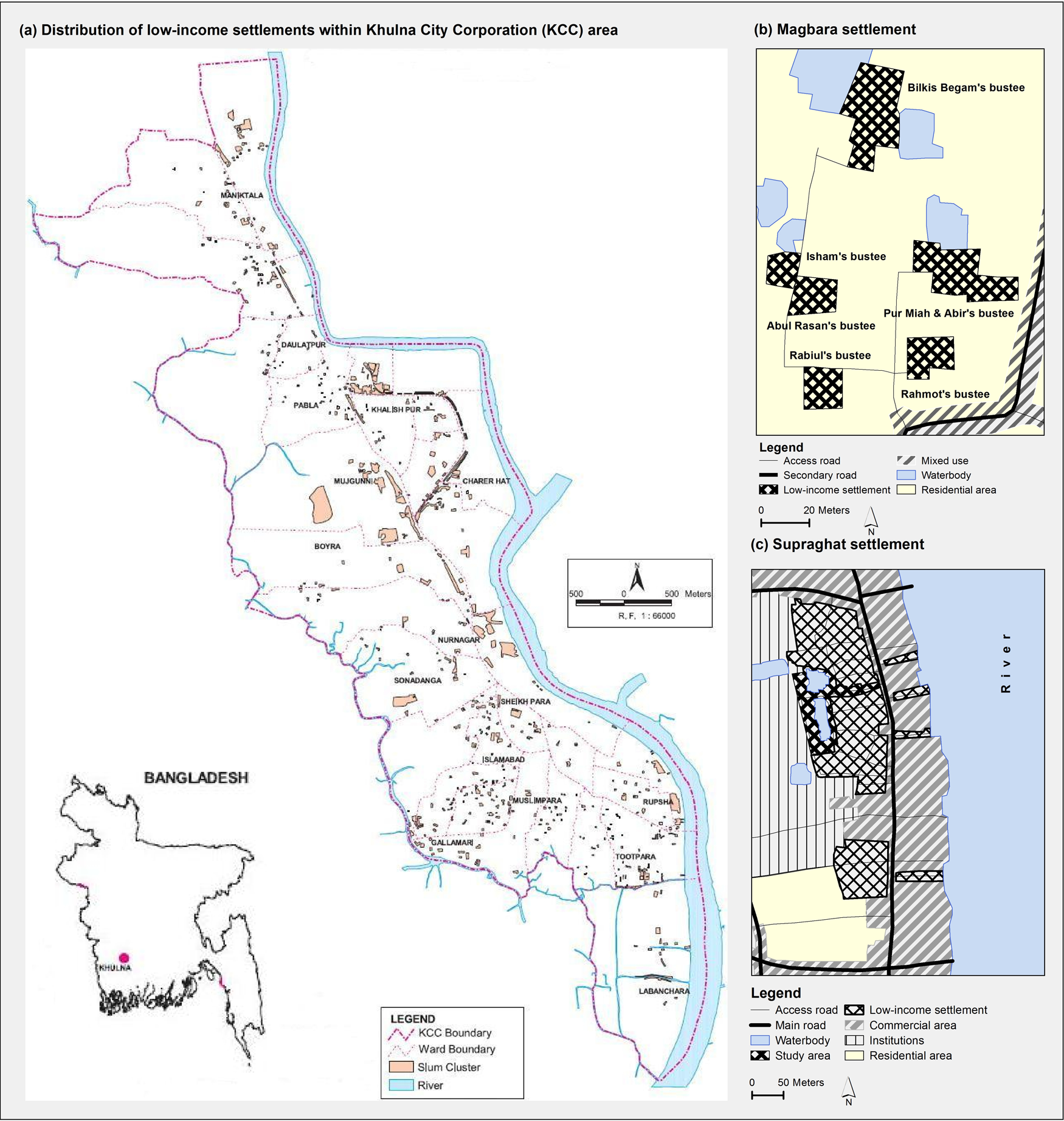
A Centre for Urban Studies (CUS) study estimated that in 2005 around 188,000 people (19.5 per cent of the city’s population) lived in 520 low-income communities in Khulna (Figure 2).(25) The 2005 Household Income and Expenditure Survey (HIES), however, found that the incidence of poverty in Khulna was 40.4 per cent, much higher than in Dhaka (20.2 per cent) and Chittagong (27.8 per cent).(26) Note that there is a massive unexplained gap between the CUS estimate of the number of dwellers in low-income settlements and the HIES poverty incidence figure in Khulna.
Khulna’s administrative divisions and distribution of low-income settlements, and the case study sites
Notwithstanding this ambiguity, it is evident that a large minority of the city’s population is poor and that the number of people living in low-income settlements in the city has been increasing (with displaced people from recent cyclones) and will continue to increase. The city is in the southwest of Bangladesh, where climate change consequences are expected to be particularly severe. The city–region is flat, poorly drained, experiences cyclones and is, on average, only 2.5 metres above mean sea level. There are a range of vulnerabilities for the city, including: a rise in extreme rainfall incidents; sea level rises (20–40 centimetres by 2050, exacerbated by subsidence); rises in intensity and frequency of both coastal and inland flooding, and also waterlogging; and high salinity levels and scarcity of safe water.(27)
The impacts of heightened climate variability (and perhaps climate change) are already evident. In the past 10 years, nearly all of the city’s residents have been affected by one or more major problems – for example, river flooding, cyclones, waterlogging or salinity.(28) In future, the challenges facing poor and vulnerable people in Khulna will be compounded in at least three ways by climate change, namely sudden onset events (e.g. floods and cyclones), slow onset processes (e.g. coastal erosion and saline intrusion) and cascade effects (e.g. compounding of existing problems by straining overstretched public services).(29)
IV. Methodology and Case Study Sites
A detailed comparison of two settlements was undertaken, and findings were triangulated by short visits to other settlements, discussions with key informants and analysis of the academic and “grey” literatures. The settlements were selected after a reconnaissance survey of five potential case study areas (shortlisted in consultation with Khulna-based NGOs/CSOs) and an assessment of their suitability as case study sites, using six pre-defined criteria.(30) In each settlement, we applied the same methodology for data collection:
introduced ourselves to community leaders and explained our research;
introduced the research team to each household head and conducted a questionnaire survey of all households;
analyzed the initial survey results and selected 25 households for life history interviews;
conducted participatory exercises of settlement problems with groups from each area; and
held discussions with key informants about our findings, to check accuracy and validity.
In addition, we held a concluding dialogue with members of the local academic community, policy makers, civil society organizations and members of the selected settlements for a broader testing of findings (more than 50 representatives from 20 organizations).(31)
We chose Magbara and Supraghat as the two case study settlements (Figure 2), as they represented the two most common low-income settlement types in Khulna – namely a private and a public settlement, respectively.(32) Magbara has evolved over the past decade on a number of closely located, privately owned land holdings (sub-units). The landowners have developed a common type of rented dwelling for tenants and we studied six sub-units with six separate owners. Three of them are absentee owners, two live just outside of their settlement compounds and one is a resident owner. The tenants are relatively mobile, with the average stay being two years and the longest nine years. Our sample comprised 70 households, with 311 residents, all Muslims. The population density is relatively low, ranging from 1,600 to 3,800 persons per hectare, with an average of 2,500.
In contrast, Supraghat has evolved over the past 40 years on land owned partly by the government and partly by a Christian religious organization. Most residents enjoy unauthorized land ownership, either by being the original settlers or by (informally) purchasing the land from the original settlers or their successors. It is the biggest (by population size) settlement in Khulna, with 3,700 households, 15,875 residents and a population density of 6,400 people per hectare.(33) As we could only study part of the settlement in detail, we selected an area where environmental problems were particularly evident. This comprised 145 households (24 Christian and 121 Muslim), of which only 11 (7.5 per cent) were tenant households. There is one absentee landlord with five rental units and three resident owners each with two units.
V. Living in Magbara and Supraghat: Challenges and Vulnerabilities
a. Challenges
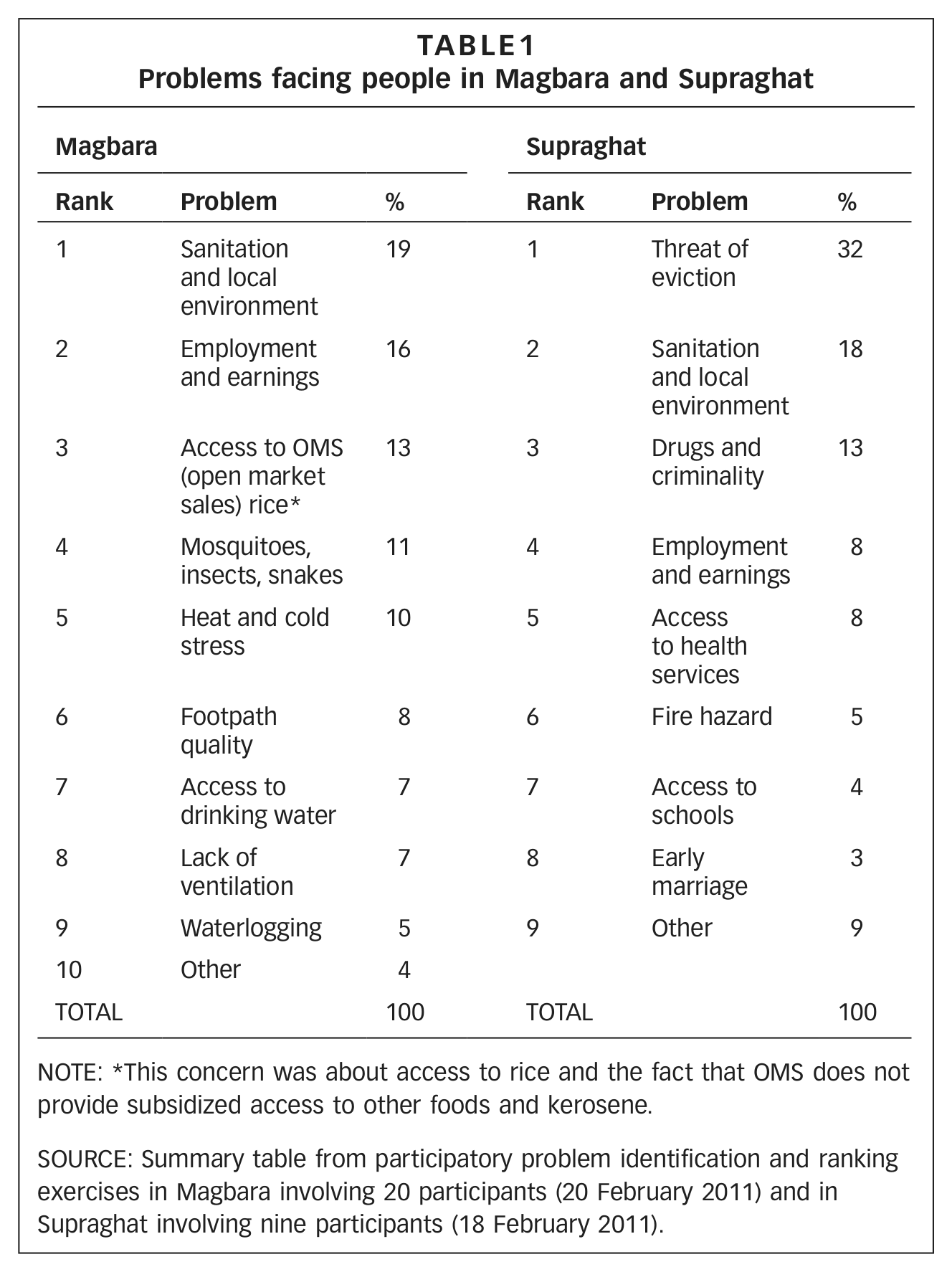
Table 1 presents a list of problems identified through participatory exercises. It provides an initial structure for examining the much larger body of material from our survey and life history datasets, and reveals some of the main differences and similarities between life in a public or a private settlement. Three particular differences stand out. First, the people of Supraghat report the threat of eviction as their biggest problem, whereas no-one in Magbara mentioned eviction as a threat, despite their tenure being dependent on paying rent and other factors. While residents in Supraghat felt they had some permanent claim or right to their land and dwelling, residents in Magbara accepted the logic of the rental market – if you cannot pay your rent, you will have to move out.
Problems facing people in Magbara and Supraghat
NOTE: *This concern was about access to rice and the fact that OMS does not provide subsidized access to other foods and kerosene.
SOURCE: Summary table from participatory problem identification and ranking exercises in Magbara involving 20 participants (20 February 2011) and in Supraghat involving nine participants (18 February 2011).
Second, residents in Supraghat complained that drug trading, drug abuse and associated problems (noise, needles on the ground) were a major concern. Magbara residents had no problems with anti-social behaviour, as landowners informally controlled public access.(34) While “drugs” are a genuine problem for people in Supraghat, the contrast with Magbara reveals how the public settlement is fully embedded in the economic and social life of Khulna, with both positive and negative consequences. On the positive side, being integrated into the city means that its residents have a greater variety of economic opportunities than people in Magbara. On the downside, the very nature of Supraghat’s integration makes the presence of drug traders/users and local mastaans (muscle men or thugs) inescapable. Supraghat’s integration is an outcome of its co-evolution with surrounding vibrant river port-based commercial activities, which also include drug trafficking and timber smuggling from the sundarbans (mangroves). A system of “porous bureaucracy”(35) works as a backdrop for local economic elites to control these illegal activities with the help of local mastaans, and the entanglement of Supraghat dwellers in this process. In contrast, Magbara’s lack of integration is down to its locational disadvantages (in the middle of a residential area, isolated from bustling informal economic activities), the rental-based tenure system, and socioeconomic restrictions and the political neglect that this entails.
The third major difference is how Supraghat residents were concerned about access to health and education services (and under “other” they also commented on problems of accessing old age and widow’s pensions and the lack of a municipal dustbin service). This emerged very strongly in individual interviews. Magbara residents talked about lack of access to health services and schools but they did not perceive access to such services as a right. While Supraghat residents complained of the government letting them down, people in Magbara were disappointed but did not recognize that there was a duty bearer responsible for basic service delivery.
In terms of similarities, there are two main observations. For both settlements, sanitation and local environmental problems were grave issues – in virtually all low-income settlements in Bangladesh sanitation services and pollution are severe and endemic problems. Second, concerns about employment and earnings (lack of employment, seasonal unemployment and low wages) were identified as a major problem. This reflects the over-saturated labour market for unskilled and low-skilled jobs in Khulna, but as discussed below, the constraints on people in private settlements are much greater than in public settlements.
b. Vulnerability
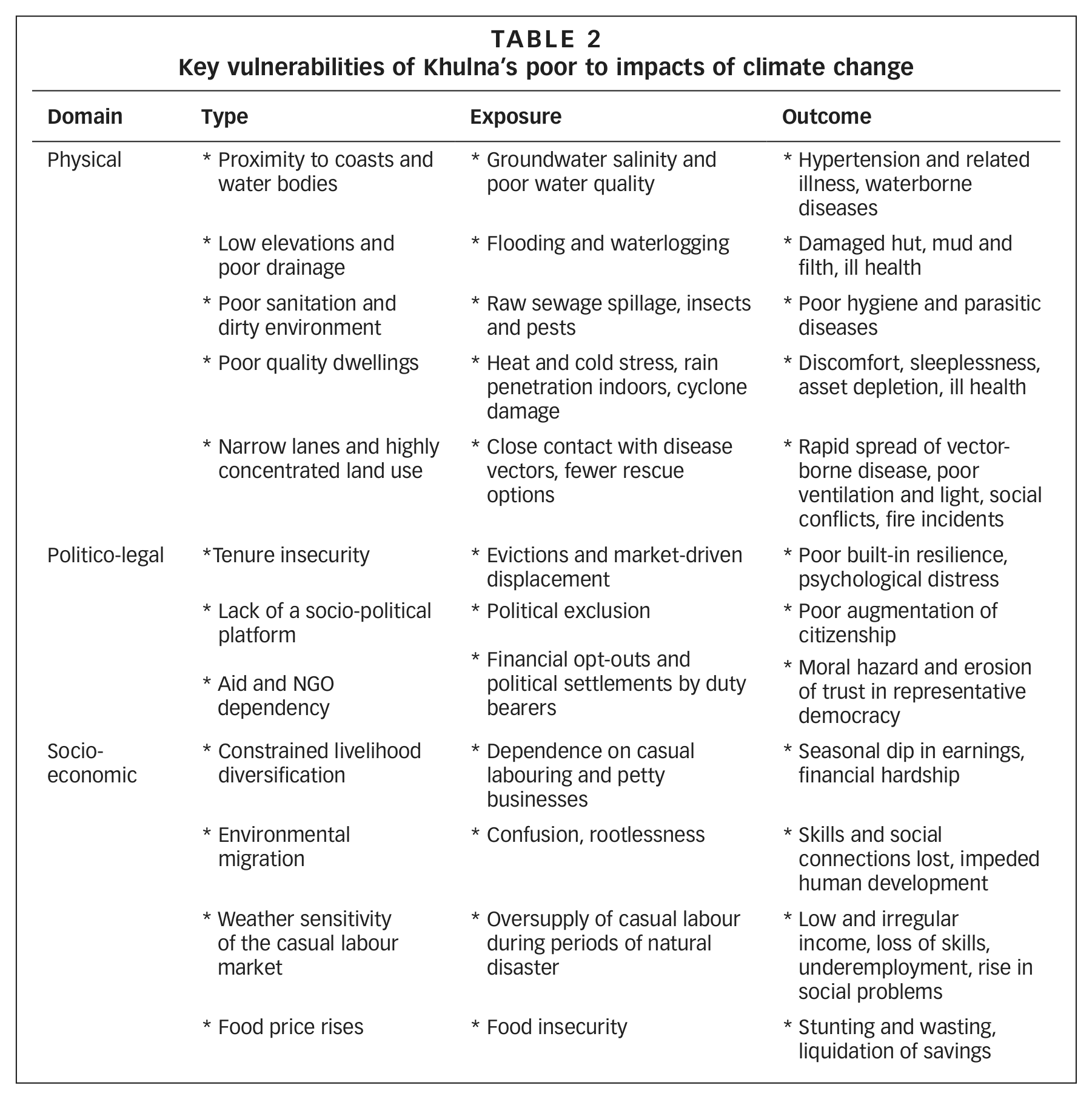
Table 2 provides an overview of vulnerability by type, exposure and outcome and in relation to the three domains noted above. Our examination reveals that people are more concerned about politico-legal issues, such as eviction (in public settlements), or socioeconomic issues, such as unemployment (in private settlements), than anything else. In general, low-income settlements are marked by high levels of physical vulnerability, mainly as a consequence of their high politico-legal and socioeconomic vulnerabilities.
Key vulnerabilities of Khulna’s poor to impacts of climate change
i. Physical vulnerability
High levels of physical vulnerability are evident in all of Khulna’s low-income settlements, but these vary in nature and extent, both within and across settlements. All the available evidence on climate change suggests that these problems will increase in coming years. We identify the following five forms of physical vulnerability as particularly significant in Magbara and Supraghat.
ii. Politico-legal vulnerability
Our data point to three main political and legal constraints. First, the lack of low-income settlement policy leads to different outcomes for residents in the two settlements. Magbara residents report that in the absence of a minimum standard for low-income rental units, the landowners’ service provision is ad hoc: inadequate climate proofing; unsafe, inadequate and badly designed infrastructure; avoidance of essential maintenance to tackle recurrent weather events; and construction of new rental units without a corresponding increase in service provision. In contrast, Supraghat residents report a double effect. On the one hand, with the constant fear of eviction, investment in their built environment is circumscribed. They are unable to elevate their land to the surrounding level, and many have constructed dwellings on risky locations, using inferior materials. On the other hand, vested outside interest groups(39) practise informal development controls (e.g. by banning the construction of permanent structures above the ground floor), so that residents cannot consolidate further their claims on the land. This undermines the ability of residents to enhance their built-in resilience.(40)
Second, the lack of a socio-political platform leads to different outcomes in the two settlements, with residents in Magbara experiencing political exclusion, whereas in Supraghat they practise patronage democracy.(41) Political exclusion in Magbara results partly from short-term tenancies, leading to newcomers’ exclusion from the voter lists and subsequently from electoral democracy and access to powerful political actors.(42) However, in Supraghat residents can access political actors at almost all levels, but as illegal occupants their links with rent-seeking local elites are built on dependency rather than citizenship rights. The residents feel that people look at them as if they did not belong there. In particular, they feel their links with powerful people become ineffective in relation to their number one problem – eviction. They are forced to stage demonstrations in symbolic places, such as in front of the press club and outside the residences and offices of politicians and elected officials.
The third politico-legal factor relates to NGO/donor-led external support in basic service provisioning. Our interviews reveal two reasons for the lack of external support in Magbara. One, the selection criteria of all major NGO/donor projects show a big settlement bias – small settlements like Magbara are hardly picked up. Second, landowners lack information on both the availability of, and whether they would qualify for, such support. In contrast, most residents in Supraghat report that their lives are much better than before thanks to growing levels of NGO/donor support. However, our key informant and household interviews reveal two nagging concerns. First, communities are being organized as a delivery chain for donor-funded projects rather than as a socio-democratic unit. Such a mechanistic approach harbours dependency rather than a nurturing of community organizations(43) and hinders community-based adaptation.(44) Second, the practice of non-financial engagement in donor projects by the municipal government has given elected officials an opportunity to practise financial opt-outs. This allows local politicians to enjoy image creation without having to make a financial contribution, and donors acquire political support for their projects involving political settlements rather than political buy-in.
iii. Socioeconomic vulnerability
Unlike physical and politico-legal vulnerabilities, socioeconomic vulnerabilities are more idiosyncratic.(45) Our analysis also suggests that in Khulna’s low-income settlements, variations in tenure arrangements can lead to differing levels of socioeconomic vulnerability by giving rise to different, or altering the manifestation of similar, root causes. We focus on four forms of socioeconomic vulnerability as particularly significant in Magbara and Supraghat.
Beyond this “soft landing”, however, environmental migrants in Magbara remain socially and economically disadvantaged. They report skills and wage underemployment. While men can find casual daily labouring work, women find it harder to be economically active. In their villages they grew vegetables and reared livestock, but in urban areas there is no use for such skills. It takes time for them to accept socially undermining urban job roles such as that of a housemaid. But they have little choice, and working as a housemaid remains the income source for 90 per cent of working women in Magbara. By comparison, a cyclone victim family who managed to establish a social life in Supraghat benefited massively from full integration into Khulna’s informal economy. While the family is highly entrepreneurial and has benefited from vital initial family support, we cannot ignore the role of economic opportunities around Supraghat that supported the household labour mobilization.(48)
Yet the cyclone victim family in Supraghat as well the cyclone victims in Magbara reveal deeper levels of distress. They have left behind family members and children have dropped out of school, with the girls entering into early marriages and the boys going out to work. Above all, they are “confused” about where their future is – in the cities or in their ancestral lands.
Two other groups reporting high weather sensitivity with regard to their work are ghoramis (house builders who use traditional building materials such as bamboo and golpata) and vendors of fish and seasonal fruit and vegetables. We found ghoramis concentrated only in Supraghat but vendors were present in both settlements. Our interviews revealed that the market for traditional building materials had recently collapsed.(50) Consequently, many ghoramis have given up their profession to become construction labourers. However, they found the diversification less rewarding (as they are new to the activity) and more competitive (as the demand for unskilled jobs increased). Similarly, vendors of fish and seasonal fruit and vegetables report rapid rotting of products during increasingly common heat waves.
VI. Understanding Adaptation Practices
In total we identified 11 sub-categories and 27 individual practices under three domains (Table 3). As a comparison, we assessed the availability of these practices using a four-point indicative scale. A stark contrast emerged between the abilities of Magbara and Supraghat residents to develop these practices, with the latter significantly outperforming the former.
Adaptation practices by type and availability in Magbara and Supraghat
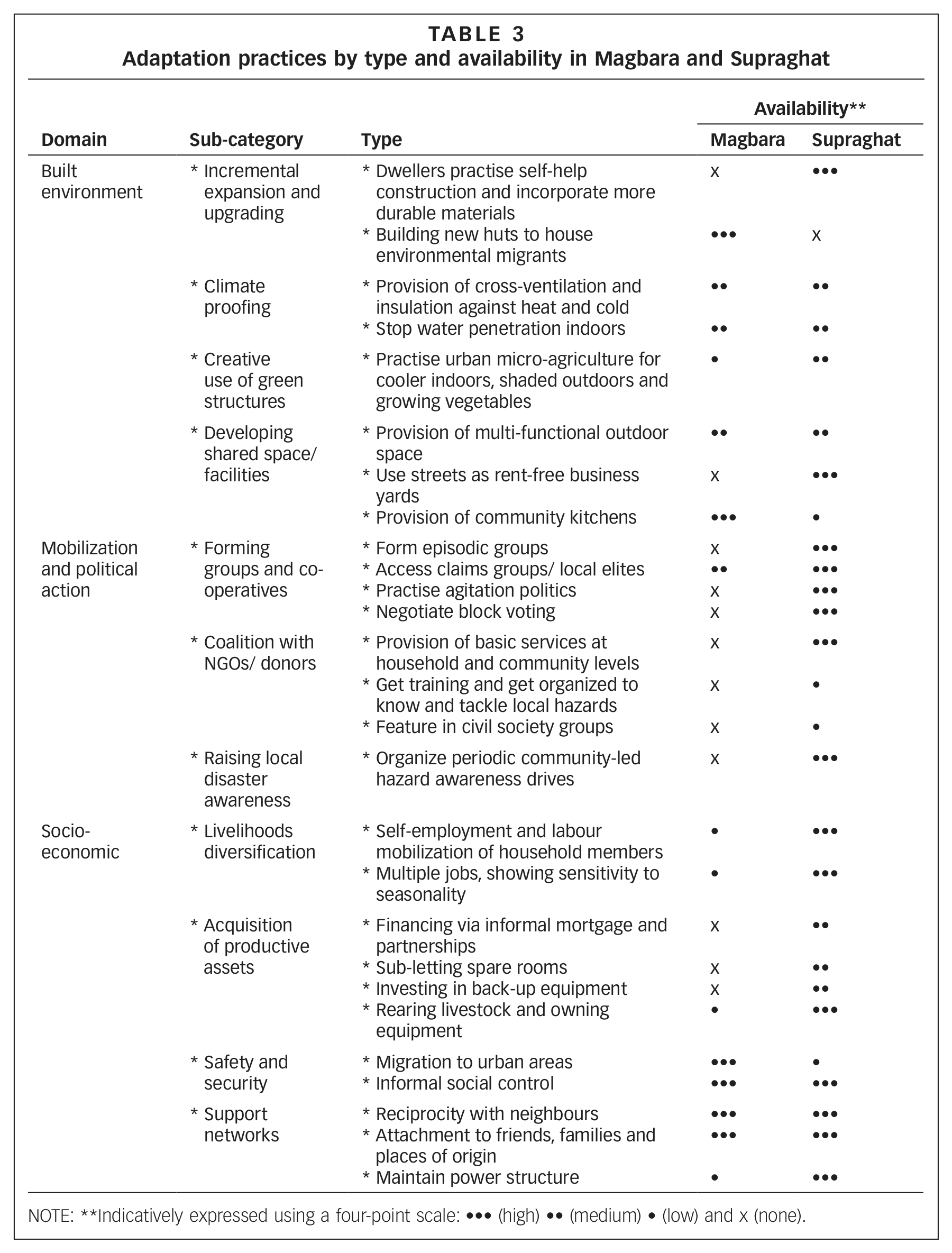
NOTE: **Indicatively expressed using a four-point scale: ••• (high) •• (medium) • (low) and x (none).
a. Built environment changes and adaptation
We identified four sub-categories and eight practices under this theme, and found many differences and some similarities between Magbara and Supraghat. In terms of differences, there are three main observations. First, there are no dweller-led changes to the built environment in Magbara. The residents do not own their living space – they are not allowed to or interested in making changes to their rental units, except for installing portable equipment such as fans. For similar reasons, the use of common spaces as business yards is also absent in Magbara. In contrast, both of these practices are quite common in Supraghat. Second, in Magbara we witnessed a remarkable example of market response, with landlords rapidly constructing new dwellings for the victims of cyclone Aila. Supraghat, in contrast, remained mostly shut off to victims of recent cyclones. And third, community kitchens are quite common in Magbara, but rare in Supraghat. This implies that the centralization of certain common facilities may only be possible in private settlements where one person controls a block of units. Each homeowner in Supraghat claims ownership of a small patch of the land that they are occupying collectively. Paradoxically, while they organize around shared problems that their illegal occupation entails (e.g. eviction threats), they behave selfishly when it comes to securing individual benefits. One of four landlords in Supraghat made sure that a donor-funded water point was installed within his premises to ensure that his tenants had easy access to it.
In terms of similarities, dwellings in both settlements show medium level practice with regard to providing cross-ventilation, using cloth canopies to insulate against heat and cold, taking basic precautions against rainwater penetrating indoors such as putting earthen cooking stoves on slightly higher ground, and providing multifunctional space.
b. Mobilization and political action
There is a much wider gap between Magbara’s and Supraghat’s residents’ involvement in community mobilization and political action. We identified eight practices belonging to three sub-categories, and found that Supraghat residents are quite active in all of them compared to Magbara residents’ involvement in just one – access to claim groups.
c. Social and economic adaptation
We identified 11 practices corresponding to four sub-categories: livelihood diversification; acquisition of productive assets; safety and security; and support networks. Our interviews and observations provided evidence that, while the residents in Magbara underperform in terms of the first two sub-categories, they are on equal terms with the residents in Supraghat in all but two aspects of the third and fourth sub-categories.
In terms of livelihood diversification, more effective practices take hold mostly in Supraghat. For example, we found one household established an innovative business of supplying generator-based electricity to shrimp-processing houses that required an uninterrupted electricity supply. Another household head showed a remarkable transition, from starting life as a rickshaw puller to establishing a shrimp-processing and supply business following diagnosis of and recovery from tuberculosis. In contrast, Magbara residents have at best been able to only slightly diversify their jobs (e.g. from rickshaw puller to construction labourer); we found no evidence of home-based businesses.
Landlords’ restrictions on using indoor spaces and adjacent yards for making and selling retail products (e.g. selling tree bark, sorting and selling waste) and other barriers (e.g. lack of capital, motivation or external support) also prevent Magbara residents from acquiring productive assets. We found only one example of a household having a major productive asset – a portable concrete vibrator. But in Supraghat, we found many examples of households with productive assets, for example sub-letting spare rooms, investing in back-ups (e.g. a back-up generator by the electricity supply business owner mentioned above) and securing informal mortgages.
In terms of safety and security, dwellers in Magbara reported both better and equal outcomes compared to Supraghat dwellers. The better outcome reflects the direct and indirect benefits of Magbara landowners’ quick response to accommodating new migrants as a group. For environmental migrants, this has reduced the insecurity attached to their journey to urban life. This was not the case in Supraghat. The equal outcome reflects the value of different, but similarly effective, forms of informal social control practised in both settlements. In Magbara, the residents remain under the aegis of the landowners, whereas Supraghat residents rely on their collective actions to tackle anti-social behaviour.
Finally, the residents of both settlements practise highly effective forms of reciprocity and attachment with neighbours, friends and family members. Even newcomers to Magbara have strong rural–urban links, partly because they came from nearby villages.(54) Residents in Supraghat also maintain strong rural–urban networks, but in contrast, they also maintain a local power structure that includes actors at multiple levels, from street level political leaders to locally powerful economic elites and to political elites at the city and national levels.
VII. Conclusions
The study demonstrates a close association between land tenure arrangements and people’s experience of vulnerability and their ability to develop adaptation practices. The Supraghat case study confirms that tenure insecurity is the biggest source of vulnerability for residents of public settlements in Khulna (and in Bangladesh). It shows that the processes through which residents establish informal claims on their land and dwellings help them to become fully integrated within the informal economic, social and political life of the city. This creates space and opportunity for a range of adaptation practices. But, with concern over tenure security sapping their enthusiasm, energy and aspirations, residents of public settlements are unable to realize their full potential.
In contrast, the Magbara case study confirms that private tenants lack permanency in, and ownership of, their living space – their tenure. This discourages them from investing in shelter, basic services and neighbourhood development. The landlords also mediate tenants’ access to public and external institutions. This has both positive and negative consequences. While it prevents anti-social activities within the settlement, it also filters out potential adaptation benefits to tenants of having access to external support. Thus the virtuous circle of people’s investment in better housing and basic services over time, improving their health and quality of life, and making more time and energy available for productive activities by household members(55) is not available to those living in private settlements.
Technically, the findings in this study have been derived from a comparison of two settlements, with a focus on tenancy and informal ownership. The data, however, clearly show that there are other important manifestations of tenure issues, including:
long-term urban dwellers (with an accompanying sense of greater entitlement) compared to recent migrants (still coping with all that this implies);
more permanent versus more transient residents, with the impact this has on political access; and
living in large public settlements versus small private ones, resulting in differential access to external institutions.
The actual impact of these differences can vary for both renters and owners. But the general lack of control over tenure issues affects the adaptation strategies of both, suggesting that effective policies must address the diversity of tenure issues. In future, climate change is likely to reinforce low-income settlements’ case for policy attention, especially on private land, as in most cities that is where expansion of low-income settlements will take place. As illustrated in this paper, despite facing many challenges, Khulna’s poor are rarely able to return to their ancestral lands because of the destruction of rural livelihoods caused, for example, by frequent and intense cyclones and storm surges and growing levels of saline intrusion.
Our study indicates a need for policy change at both the national and city levels. At the national level, there is a need to evaluate how tenure security can be included systematically in official policies and plans. Background work has already been done in the form of mapping and census of slums in urban Bangladesh.(56) Can this inform a much-needed low-income settlement policy in the country, either made afresh or by amending and finalizing the 2004 draft National Housing Policy? The formation of the National Urban Forum in 2011 is a positive development in this regard. But will this forum represent owners of private settlements? Its first annual meeting certainly did not include them.(57)
At the city level, an important policy outcome is the need to observe how informal land markets operate for the poor, and how the market conditions can be improved. A debate as to whether the market should be regulated or supported becomes important. In an ideal world, as Saunders argues, “&you need to have both a free market in widely held private property and a strong and assertive government willing to spend heavily on this transition.”(58) However, in Bangladesh the low-income urban land market is entirely informal – it will take considerable time and effort to regularize it, even if it were possible. Until then, spending by government and/or donors will be subject to elite capture.(59)
A more feasible approach would be to provide the market actors with information on climate change adaptation, combined with conditional grants for financially constrained developers/owners of low-income settlements. With access to information, the dwelling owners will find simple ways to help themselves and their tenants improve their adaptation potential. When the availability of, and access to, information has been sufficiently improved, the tenants will also be able to decide which settlements to move to. The entire process requires active participation of civil society organizations and, ideally, associations of slum dwellers.
As a final comment, we acknowledge two potential limitations of the study. First, the Supraghat settlement illustrates the profile of a public settlement where owner-occupancy dominates and where the level of squatter tenancy is insignificant. While this is common in Khulna, it is less typical in bigger cities such as Dhaka or Chittagong, where squatter tenancy is more common. Second, in Magbara, landowners are also the dwelling owners. But in many private settlements, especially those owned by political/economic elites who avoid day-to-day interaction with low-income people, the practice of land rental is more common. Land rental allows dwellings to be constructed and rented out by a third-party developer, while some basic services, e.g. water and electricity, are included in the land rental arrangement. While we remain confident that our findings can still be generalized across towns and cities of Bangladesh, further research is required to confirm this.
Footnotes
Acknowledgements
This paper originates from ongoing ESRC–DFID-sponsored research on Community and Institutional Responses to the Challenges facing Poor Urban People in Bangladesh in an Era of Global Warming (RES-167-25-0510). We are particularly thankful to the residents of Magbara and Supraghat settlements and numerous key informants who gave us and fellow researchers so much of their time. We also acknowledge helpful and constructive comments from two anonymous reviewers
1.
These are often referred to as “slums”, but we try to avoid the term because of its pejorative undertones. It usually has derogatory connotations and can suggest that a settlement needs replacement or can legitimate the eviction of its residents. However, it is a difficult term to avoid for at least three reasons. First, some networks of neighbourhood organizations choose to identify themselves with a positive use of the term, partly to neutralize these negative connotations; one of the most successful is the National Slum Dwellers Federation in India. Second, the only global estimates for housing deficiencies, collected by the United Nations, are for what they term “slums”. And third, in some nations, there are advantages for residents of informal settlements if their settlement is recognized officially as a “slum”; indeed, the residents may lobby to get their settlement classified as a “notified slum”. Where the term is used in this journal, it refers to settlements characterized by at least some of the following features: a lack of formal recognition on the part of local government of the settlement and its residents; the absence of secure tenure for residents; inadequacies in provision for infrastructure and services; overcrowded and sub-standard dwellings; and location on land less than suitable for occupation. For a discussion of more precise ways to classify the range of housing sub-markets through which those with limited incomes buy, rent or build accommodation, see Environment and Urbanization Vol 1, No 2, October (1989), available at  .
.
2.
3.
McLeman, Robert (2011), Climate Change, Migration and Critical International Security Considerations, IOM Migration Research Series No 42, International Organization for Migration (IOM), Geneva, 56 pages.
4.
5.
Eusuf, Mohammad (2012), “Dynamics of urban poverty in Bangladesh”, unpublished PhD thesis, University of Manchester.
6.
Angeles, Gustavo, Peter Lance, Janine Barden-O’Fallon, Nazrul Islam, A Q M Mahbub and Nurul Islam Nazem (2009), “The 2005 census and mapping of slums in Bangladesh: design, select results and application”, International Journal of Health Geographics Vol 8, No 32, 19 pages (published online).
7.
Fragkias, Michail (2010), “Towards a new science and practice of adaptation to climate change in urban areas”, UGEC Viewpoints No 4, page 31.
8.
See Baud, Isa (2000), Collective Action, Enablement and Partnerships, Issues in Urban Development, Inaugural Address, Free University, Amsterdam, 27 October 2000, 21 pages.
9.
Reale, Andreana and John Handmer (2011), “Land tenure, disasters and vulnerability”, Disasters Vol 35, No 1, pages 160–182.
10.
Ahammed, Ranju (2011), “Constraints of pro-poor climate change adaptation in Chittagong city”, Environment and Urbanization Vol 23, No 2, October, pages 503–515.
11.
Banks, Nicola, Manoj Roy and David Hulme (2011), “Neglecting the urban poor in Bangladesh: research, policy and action in the context of climate change”, Environment and Urbanization Vol 23, No 2, October, pages 487–502.
12.
Rahman, M Mahbubur (2001), “Bastee eviction and housing rights: a case study of Dhaka, Bangladesh”, Habitat International Vol 25, No 1, pages 49–67.
13.
Ahmed, K Iftekhar (2007), Urban Poor Housing in Bangladesh and Potential Role of ACHR, Asian Coalition for Housing Rights (ACHR), Bangkok, 29 pages.
14.
Shafi, Salma A and Geoffrey Payne (2007), Land Tenure Security and Land Administration in Bangladesh, Local Partnerships for Urban Poverty Alleviation Project (LPUPAP), Local Government Engineering Department (LGED), Dhaka, 55 pages. Tied tenants are defined as those who live in residential quarters as employees of government, semi-government or private commercial and industrial organizations. Their tenure is tied to retaining their employment.
15.
Although they may have to pay other charges; see Brueckner, Jan K and Harris Selod (2009), “A theory of urban squatting and land tenure formalization in developing countries”, American Economic Journal: Economic Policy Vol 1, No 1, pages 28–51.
16.
See reference 11
17.
See reference 11
18.
See reference 14
19.
See Hulme, Mike (2009), Why We Disagree about Climate Change: Understanding Controversy, Inaction and Opportunity, Cambridge University Press, 432 pages.
20.
See Moser, Caroline, Andrew Norton, Alfredo Stein and Sophia Georgieva (2010), “Pro-poor adaptation to climate change in urban clusters: case studies of vulnerability and resilience in Kenya and Nicaragua”, World Bank Report No 54947-GLB, The World Bank, Washington DC, 96 pages.
21.
See Birkmann, Jörn (2006), “Measuring vulnerability to promote disaster-resilient societies: conceptual framework and definitions”, in Jörn Birkmann (editor), Measuring Vulnerability to Natural Hazards, United Nations University Press, Tokyo, page 21.
22.
Sumner, Andy and Rich Mallett (2011), “Snakes and ladders, buffers and passports: re-thinking poverty, vulnerability and well-being”, IDS Working Paper 83, Institute of Development Studies, Brighton, 37 pages.
23.
Alwang, Jeffrey, Paul B Siegel and Steen L Jorgensen (2001), “Vulnerability: a view from different disciplines”, Social Protection Discussion Paper Series 0115, World Bank, Washington DC, 60 pages.
24.
Orda, Evelyn (2008), “Bangladesh: supporting the establishment of the Khulna Water Supply and Sewage Authority”, ADB Technical Assistance Consultant’s Report (Project No 42171), ADB, Dhaka, 81 pages.
25.
Islam, Nazrul, A Q M Mahbub, Nurul Islam Nazem, Gustavo Angeles and Peter M Lance (2006), Slums of Urban Bangladesh: Mapping and Census 2005, Centre for Urban Studies (CUS), Dhaka, 54 pages.
27.
28.
See reference 27
29.
Walsham, Mathew (2010), Assessing the Evidence: Environment, Climate Change and Migration in Bangladesh, International Organization for Migration (IOM), Dhaka, 89 pages.
30.
See Roy, Manoj, Ferdous Jahan and David Hulme (2012), “Community and institutional responses to the challenges facing poor urban people in Khulna, Bangladesh in an era of global warming”, BWPI Working Paper 163, Brooks World Poverty Institute, Manchester, 64 pages.
31.
See reference 30 for fuller details.
32.
The settlements’ names have been changed in order to preserve anonymity.
33.
See reference 25
34.
All six sub-units have gated boundaries. While the general public has easy access to the settlements, the access/tenancy of troublemakers is informally controlled. Even absentee landlords get support from resident and other landlords living in close proximity in implementing this informal control.
35.
Benjamin, Solomon (2004), “Urban land transformation for pro-poor economies”, Geoforum Vol 35, pages 177–187.
36.
Khan, Aneire, Santosh Kumar Mojumder, Sari Kovats and Paolo Vineis (2008), “Saline contamination of drinking water in Bangladesh”, The Lancet Vol 371, 2 February, page 385.
37.
Elahi, K Maudood and Sabiha Sultana (2010), “Resurgence of malaria in Bangladesh”, in Rais Akhtar, Ashok K Dutt and Vandana Wadhwa (editors), Malaria in South Asia: Eradication and Resurgence During the Second Half of the Twentieth Century, Advances in Asian Human–Environmental Research Vol 1, Springer, London, pages 107–122.
38.
Alam, Mohammad Shafiul, Hirotomo Kato, Mizuho Fukushige, Yukiko Wagatsuma and Makoto Itoh (2012), “Application of RFLP–PCR-based identification for sand fly surveillance in an area endemic for Kala-Azar in Mymensingh, Bangladesh”, Journal of Parasitology Research Vol 2012, Article ID 467821, 4 pages.
39.
See reference 30
40.
Jabeen, Huraera, Cassidy Johnson and Adriana Allen (2010), “Built-in resilience: learning from grassroots coping strategies for climate variability”, Environment and Urbanization Vol 22, No 2, October, pages 415–431.
41.
Chandra, Kanchan (2007), “Counting heads: a theory of voter and elite behaviour in patronage democracies”, in Herbert Kitschelt and Steven I Wilkinson (editors), Patrons, Clients and Policies: Patterns of Democratic Accountability and Political Competition, Cambridge University Press, pages 84–109.
42.
de Wit, Joop and Erhard Berner (2009), “Progressive patronage? Municipalities, NGOs, CBOs and the limits to slum dwellers’ empowerment”, Development and Change Vol 40, No 5, pages 927–947.
43.
Krishna, Anirudh (2003), “Partnerships between local governments and community-based organizations: exploring the scope for synergy”, Public Administration and Development Vol 23, pages 361–371.
44.
Dodman, David and Diana Mitlin (2011), “Challenges for community-based adaptation: discovering the potential for transformation”, Journal of International Development, doi: 10.1002/jid.1772.
45.
Christoplos, Ian, Simon Anderson, Margaret Arnold, Victor Galaz, Merylyn Hedger, Richard J T Klein and Katell Le Goulven (2009), “The human dimension of climate adaptation: the importance of local and institutional issues”, Commission on Climate Change and Development, Stockholm, 38 pages.
46.
Banerjee, Abhijit V and Esther Duflo (2007), “The economic lives of the poor”, The Journal of Economic Perspectives Vol 21, No 1, pages 141–167.
47.
48.
See reference 30
49.
See reference 30
50.
See reference 30
51.
This seems to be realistic, as a recent report quotes World Bank Group President Bob Zoellick as estimating, in April 2008, “& a doubling of food prices over the last three years” (page 1). See Keats, Sharada, Steve Wiggins, Julia Compton and Marcella Vigneri (2010), “Food price transmission: rising international cereals prices and domestic markets”, ODI Project Briefing No 48, Overseas Development Institute, London, 4 pages.
52.
Silver, Eric and Lisa L Miller (2004), “Sources of informal social control in Chicago neighbourhoods”, Criminology Vol 42, No 3, pages 551–583.
53.
See reference 30 for a detailed account of NGO/donor activities.
54.
Geographically, Khulna city is not located far from the villages from which these people have migrated – for example, it is only two hours by public transport to Dakop, an Aila-affected area. But the prospect of agriculture-based rural livelihoods is diminishing due to growing saline intrusion and frequent destruction by severe cyclones. Consequently, these migrants have no choice but to migrate to cities such as Khulna.
55.
Rakodi, Carole (1999), “A capital assets framework for analyzing household livelihood strategies: implications for policy”, Development Policy Review Vol 17, No 3, pages 315–342.
56.
See reference 25; also Fortuny, Guillem, Richard Geier and Richard Marshall (2011), Poor Settlements in Bangladesh: An Assessment of 29 UPPR Towns and Cities, Urban Partnerships for Poverty Reduction Project, Dhaka, 107 pages.
57.
Personal observation.
58.
Saunders, Doug (2010), Arrival City: How the Largest Migration in History is Reshaping our World, Pantheon Books, New York, page 288.
59.
Rahman, Hossain Zillur (editor) (2011), Urban Bangladesh: Challenges of Transition, Power and Participation Research Centre, Dhaka, 140 pages.