




Abstract
The reality of supporting community-based urban disaster risk reduction is daunting. This paper provides a cross-cultural analysis of the experiences of Oxfam GB in supporting urban community-based disaster risk reduction in Haiti, Guyana and the Dominican Republic. The paper focuses on the efforts of Oxfam GB and its local partners to overcome the determining influence of local governance on who benefits from interventions, and the longevity of positive outcomes. The most successful projects built on strong pre-existing partnerships with buy-in from local and municipal government, promoted longevity in physical and social infrastructure through dual use investments that had an everyday as well as a disaster risk reduction purpose, and integrated technological and lay focus exercises to generate local participation as well as provide baselines for project planning. Overall, however, disaster risk reduction was constrained by a lack of vision and funding constraints, which prevented root causes in the wider urban and regional environment or political economy to be tackled.
Keywords
I. Introduction: Urban Disaster Risk Reduction
Humanitarian actors and donors alike are developing new agendas for urban disaster risk reduction (DRR). The depth, variation and scale of urban disaster risk has been documented for some time.(1) A study only of large coastal cities calculated that some 40 million people are currently exposed to a one in 100 year flood event (0.6 per cent of the global population), with the at-risk population potentially growing to 150 million by the 2070s when climate change impacts, including sea level rise, may become very difficult to manage locally.(2) Despite such work, it has taken large, urban-based disasters such as the Haitian earthquake of 2010 and disasters so extensive that they have incorporated urban and rural areas (the 2004 Asian tsunami, for example), to push urban risk reduction up the policy ladder.
Part of the justification for belated entry of development and humanitarian actors into urban DRR has been a belief that urban problems were largely a function of infrastructure planning, and so best addressed by engineering and technological solutions. But even engineering is not a technical act alone – the choice, design standards and delivery of engineering projects are embedded in the politics and power relations of the city.(3) A review of World Bank lending for the period 1984–2005 found that of 197 completed mitigation projects, 26 per cent showed flaws in design and half had been damaged by a subsequent event – the lack of appropriate design and oversight reveal both weaknesses in government and the marginalization of civil society or lay voices in the city.(4) Similarly, land use planning, while superficially a technical act, is more often a reflection (not to say tool of) the dominant interests in a city and their vision for its future – the frequency with which low-income and informal communities are cleared, or at best cleaned, in advance of global sporting events or international conferences is a case in point.
The danger of relying on technological solutions to confront urban disaster risk is made even clearer when one considers the large and growing urban populations in small, medium and large centres that lie outside of the capacity of city governments to plan for.(5) In some cases, organized civil society actors have come to fill this governance space. Local civil society action includes focused work on meeting basic needs (water and sanitation) but also the lobbying of government to protect land rights and support local economic development.(6) Among the urban civil society groups with the greatest impact have been those that are formed of networks of local community-based organizations, bringing local legitimacy and knowledge together with the political benefits of scale and strategic action. Much of the most well-documented work at this scale, including that aimed at supporting climate change adaptation, has been found in cities in Asia and Latin America.(7) There are, however, many cities in these regions and elsewhere where political histories have not supported the development of strong civil society. Here, external initiatives aiming to build urban DRR capacity face particular challenges in needing to work with local partners to strengthen knowledge and skills in real-time, as part of risk mitigation project delivery.
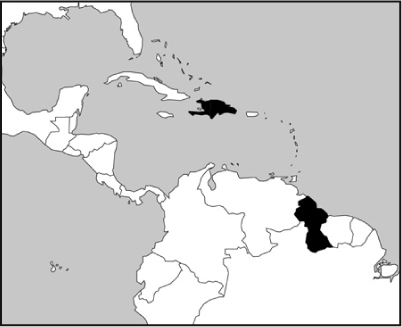
The following analysis reports on the challenges and successes of just such an initiative. Oxfam’s work in the Caribbean has sought to build local governance capacity for urban DRR in contexts of both strong (Santo Domingo, Dominican Republic) and weak (Port au Prince and Cap Haitien, Haiti, and Greater Georgetown, Guyana) urban civil society. This provides lessons for future work as well as an opportunity for comparative analysis. The paper draws from research conducted with Oxfam GB,(8) but the views expressed are those of the author alone. Across these projects Oxfam acted as the implementing or coordinating agency, with financial support from the Department of Humanitarian Aid of the European Commission (DIPECHO), and in Port au Prince from the World Bank through the government of Haiti. DIPECHO supports projects worldwide and aims to promote inexpensive, community-based disaster preparedness; most interventions are short-term pilot projects.
Oxfam’s engagement in each city varied and this framed what was possible. In Georgetown, initial involvement followed extensive urban and rural flooding in 2005, but was constrained by the closing of the Oxfam GB country office; in Santo Domingo, a long-term and continuing country presence through Intermón Oxfam and close relationships with local civil society nurtured an expanding programme of activity initiated in 2007; in Cap Haitien, continuing Oxfam GB presence enabled a string of programmes from 2003, which adapted project delivery in response to the demands of local government; in Port au Prince, consistent Oxfam presence and formal partnership with the government of Haiti through a World Bank/government of Haiti project allowed influence on the formal governance regime for urban DRR, although work, which started in 2006, was interrupted by the Haitian earthquake of 2010.
Data presented in this paper were collected in April/May 2010 using documentary evidence and fieldwork. Primary data drew from site visits, semi-structured interviews with representatives of all stakeholder groups and from those at risk, to government and civil society agencies and Oxfam staff. These were supported by a small number of group discussions with community members, and a visual assessment of mitigation works and early warning, community alert and first response equipment.
Following this introduction, an overview of the risk profiles of each city and Oxfam’s intervention are presented. This prepares the way for comparative analysis structured around five key themes:
project impacts for target communities;
partner coordination and participation;
social equity;
partner perceptions of urban hindering and facilitating factors; and
output sustainability and transferability.
In conclusion, key lessons for appropriate, equitable and sustainable urban DRR are discussed.
II. Urban Disaster Risk Profiles and Project Structure
In each case, Oxfam GB’s focus was on hydro-meteorological hazards (flooding associated with storms and hurricanes and rainfall-triggered mass movements, e.g. landslides and rock falls) and related processes such as risk of sea level rise. However, geophysical and temperature hazards were not a focus of the work. As was demonstrated in Port au Prince (see the case of Tabarre municipality below), capacity can be transferable. This section describes the risk profile and the structure of Oxfam’s interventions for each city in turn.
a. Santo Domingo
Santo Domingo is exposed to flooding and landslides associated with tropical storms and hurricanes. Oxfam’s partner communities (Capotillo, La Zurza, Simon Bolivar, Gualay, Los Cañitas, Los Guandules, Guachupita and Las Ceinega) included some of the most densely populated and exposed in the city, characterized by thousands of dwellings perched on precarious limestone cliff faces or ravine slopes or on the flood plain immediately adjacent to the River Isabella. Levels of poverty were high, although basic services and, in some cases, tenure had been attained. Local social organizing was also evident but had been undermined by organized drugs and crime. The choice of partner communities was determined by their risk profiles but also because of strong local connections enjoyed by the implementing partner, a social development NGO called the Instituto Dominicano Desarollo Integral (IDDI). Created in 1984, IDDI(9) is a well-established non-government organization. In a highly politicized urban context, IDDI has maintained legitimacy through avoiding involvement in party politics. A core aspect of IDDI’s work centres upon community capacity-building in low-income neighbourhoods of Santo Domingo, built around projects that include solid waste management, microcredit, infrastructure provision, education programmes and primary health promotion, the latter facilitated through a network of street level community health promotoras.(10) Community members not only act as volunteers but have been recruited to staff positions so that IDDI is now a hybrid, offering external technical skills and contacts to the international donor community and close, personal ties into local communities.
IDDI took on the role of implementing agent, with Oxfam providing technical support. IDDI had not worked on urban DRR before and has since become a champion, opening its own disaster management department. This was an unplanned and very positive outcome of Oxfam’s work, adding to the voices of those involved and creating a skills base for mainstreaming urban DRR into development in the city. The partnerships between IDDI and Oxfam benefited from an existing good relationship built up through previous project collaborations. Through this programme of works, the relationship was further strengthened. IDDI was well placed, despite its lack of previous work on urban DRR, because of its long history of engagement in social development and its position as a well-respected and trusted agency, both within the communities at risk and with government actors. More practically, Oxfam could build on IDDI’s existing social structures, which included an active network of local health promoters and past successes at building and maintaining local community organization, including social enterprises.
Community level work under each completed project was split into three phases. Months 1–6 included sensitization and implementation of awareness-raising (including family visits, talks with groups of families, video forums and discussions, community theatre, a song contest and a “vulnerability fair” to celebrate the international day of DRR); training (including monitoring hazard and early warning, emergency shelter management and first aid); focus (using both community and technical knowledge); and community group formation. Months 7–12 saw the completion of physical mitigation works, including emergency access stairs, bridges, drains and walkways along ravines (applying the risk maps and managed with community groups). Months 13–15 focused on facilitating transfer and on IDDI’s retreat from a leadership role. From the end of the project, IDDI continued to keep in touch with committees and individuals through a range of other social and environmental projects, with additional interaction during times of disaster. IDDI’s long-term local commitment, including the employment of local residents, guaranteed an ongoing relationship.
During the project, one member of IDDI stayed in direct contact with community members and leaders to make communication easy and to maintain trust. Three early warning and evacuation drills were practiced, with increasing complexity. The first used only a megaphone, with no preparation for the community; the second was able to use constructed evacuation routes and identified emergency shelters; and the third integrated non-local actors – ambulances, civil defence – and simulated injury. The aim was to prepare people and agencies but also to witness the contributions of each stage of the project and to maintain community interest. Evaluation was formalized and ongoing throughout the project lifespan.
The wider risk management community and public were engaged through a media campaign, “Reduce Vulnerability”, using television and radio. Actors such as civil defence, the police and the Dominican Red Cross sat on local committees and were made aware of the project from its inception, but no specific effort was made to alter the overarching institutional architecture. Rather, the municipality was integrated into the project through its role in coordinating disaster response with civil defence and as a gatekeeper to political interests, as well as the provision of basic needs underpinning disaster risk reduction.
b. Georgetown’s peri-urban communities
From Georgetown’s urban core, and stretching for more than 100 kilometres, linear, peri-urban settlements lie between the sea wall and inland water conservancies that store water to irrigate rice and sugar production on Guyana’s Atlantic coastline. Many of these settlements lie at or below sea level and are exposed to flooding from heavy rain and breaches and overtopping of the sea wall or inland water conservancy dam. The communities are largely segregated into predominantly Afro-Guyanese and Indo-Guyanese settlements, with local government reflecting the segregated, racialized politics of the country. Livelihoods are mixed and include small-scale urban livestock rearing, poultry and cash crop farming, and commuting along the coast or into Georgetown for work (and in some cases for secondary school). Poverty levels are high and are exacerbated by physical vulnerability, with the poor often residing in ground level wooden or concrete houses. Traditional housing is built up on stilts to aid air circulation but also provides a flood risk reduction function; however, as families expand and cultural tastes change, the ground floor space has frequently been converted for new accommodation. Localized flooding is very frequent, and in 2005 a national emergency was declared following heavy rainfall and flooding along the entire coast, including Georgetown.
Two project cycles have been completed (2005–2007 and 2007–2009), building on relief work undertaken following the 2005 floods. Local initiatives focused on 20 settlements in Region 4. Two local partners were engaged to help in implementation, namely Women Across Differences (WAD), a predominantly Afro-Guyanese gender NGO, and the Guyana Rice Producers Association (GRPA), an NGO supporting small rice farmers. Neither organization had any previous experience of DRR work (although WAD has gone on to become involved in consultations on a national disaster management plan and to coordinate international meetings on adaptation to climate change). WAD managed local awareness-raising and GRPA focused on livelihood development, with Oxfam maintaining a considerable role in managing implementation of community level activity through a cohort of young community mobilizers employed and trained by Oxfam’s temporary project office. Guyana’s limited civil society and Oxfam’s lack of experience in Guyana generated challenges for project management. That Oxfam closed its country office at the end of the project also led some respondents to describe a sense of abandonment. This was despite the Guyana Red Cross having taken on the management of community groups (with no additional funding) at the close of the project. The reluctance of regional government to officially sanction Oxfam’s work at the local government level exacerbated the failure to gain formal support from national government and civil defence. This slowed project implementation, leading to rushed delivery and limited post-project sustainability as local community groups had no formal mechanisms for support. Local governments (neighbourhood democratic councils) were so lacking in funds and human capacity that even where good will existed support was constrained.
Of the 20 target communities, one was abandoned through lack of local interest and two combined into a single case in response to security concerns following an upsurge in armed crime. The largest proportion of effort, time and resource in project management and implementation was expended on local risk awareness-raising and training activities, including street theatre and school days, the latter also providing an opportunity to showcase first aid and other risk-related skills. This work was prioritized in an effort to first sensitize individuals then to provide a resource for community group formation and leadership. Community group members then underwent further training, including evacuation and emergency shelter management, and provided local knowledge for risk-mapping activities (which also included a technical component) that fed into the location of small physical mitigation works. These works helped provide a focus for group activity; the most common outputs were small bridges across drainage canals. Additional small projects were specifically targeted at making schools safer from flooding. Regional and local government permission was required for mitigation projects, providing an opportunity to engage these actors.
The lack of a developed risk management culture and set of supporting institutions in Guyana required additional emphasis in this project on institutional strengthening at the national level. This was a positive contribution in its own right and the hope was that such strengthening would also provide a supporting institutional infrastructure for the community groups (although this did not materialize). Perhaps most notable was a series of workshops on the Sphere Standards, set up for civil defence, the Guyana Red Cross and other interested parties such as the UNDP. For many, this was their first exposure to the Sphere Standards,(11) leading to quite a discussion of how to manage relief provision.
c. Cap Haitien
A regional capital in northern Haiti, and not directly affected by the 2010 earthquake, Cap Haitien has grown rapidly in the last decade with low-income households forced to colonize increasingly marginal land. Many families now live on steep hillsides or on the coastal plain. Some of the most marginalized live on land reclaimed from the sea through the dumping of compressed solid waste; this is the main destination for waste in the absence of a landfill or other waste management system. The city is administered through three city district and one city centre authority. Oxfam projects concentrated on the three district level administrations and their residents, with the city centre population displaying less relative hydro-meteorological risk. Flooding was primarily associated with poor drain maintenance. Landslides also occurred and were made worse by the clearance of slope vegetation around dwellings.
Civil society and government in Haiti are weak. Consequently, Oxfam GB acted as the primary implementing agent through a permanent office that continues to operate. Three projects were completed and each developed a different organizational or physical element of disaster risk reduction. The first project (2003–2004) was interrupted because of political insecurity. Despite this, it succeeded in widespread awareness-raising (e.g. using radio programmes), and from this built 22 Neighbourhood Civil Protection Committees (NCPCs). Physical investment to improve evacuation (stairs, paths and a bridge) was also undertaken; and the project also sought to strengthen the national civil protection system through training. The second project, undertaken over four months in 2005, supported the continued development of the NCPCs through organized drain cleaning in advance of the hurricane season. This was accompanied by further public awareness-raising (radio programmes were aired once more and information packs distributed). In neither project were the NCPCs able to forge strong links with local government as they operated at too local a scale to be officially recognized. The third project (2008–2009) aimed to address this by creating three organizations (local committees). Each corresponded with the administrative jurisdiction of a municipal section, allowing it to be recognized within the legal system of civil protection. The local committee groups included representatives from NCPCs together with local government-elected members.
d. Port au Prince
Metropolitan Port au Prince is a rapidly expanding urban centre and national capital. Very weak civil society, coupled with a long history of corruption, state violence and organized violent crime and widespread poverty means that there are few strong local institutions or resources. The city is exposed to hurricanes and tropical storms and has large numbers of residents living on steep ravine and hill slopes also exposed to landslides. On 12 January 2010, the city was hit by a devastating earthquake.
In contrast to the other projects reviewed here, work in Port au Prince was contracted out to Oxfam GB through a World Bank/government of Haiti programme on disaster risk reduction, which followed major flooding in 2004. Project aims were predetermined by the programme structure. The principal difference to Oxfam’s DIPECHO-funded work was the reduced attention on community level organization building. Instead, emphasis was placed on strengthening at the urban municipal level and more ambitious local mitigation works were possible. Five municipalities from within Port au Prince were included. In each, a municipal level committee was either created (Port au Prince and Tabarre) or strengthened (Delmas, Petionville and Carfur). Members, including representatives from government offices and community groups, were trained and risk assessments were undertaken with the participation of group members and scientists. These led to the formulation of risk management contingency plans. Emergency response equipment was given to each committee and mitigation works of up to US$ 45,000 were planned. To support each district level committee, one or two community groups were formed and members were trained. Civil protection contributed through providing trainers and helping with the choice of mitigation projects. A public information campaign was also undertaken and administered through the mayor and district level groups.
e. Synthesis of Oxfam’s project structure
Oxfam applied a broadly similar project template to each case (Figure 1). This was determined by what could be achieved given the funding constraints, timeframe and interests imposed by donors, and also the skills and expectations of Oxfam and its local partners. The approach targeted action at two levels: local actors at risk and the urban risk management community.
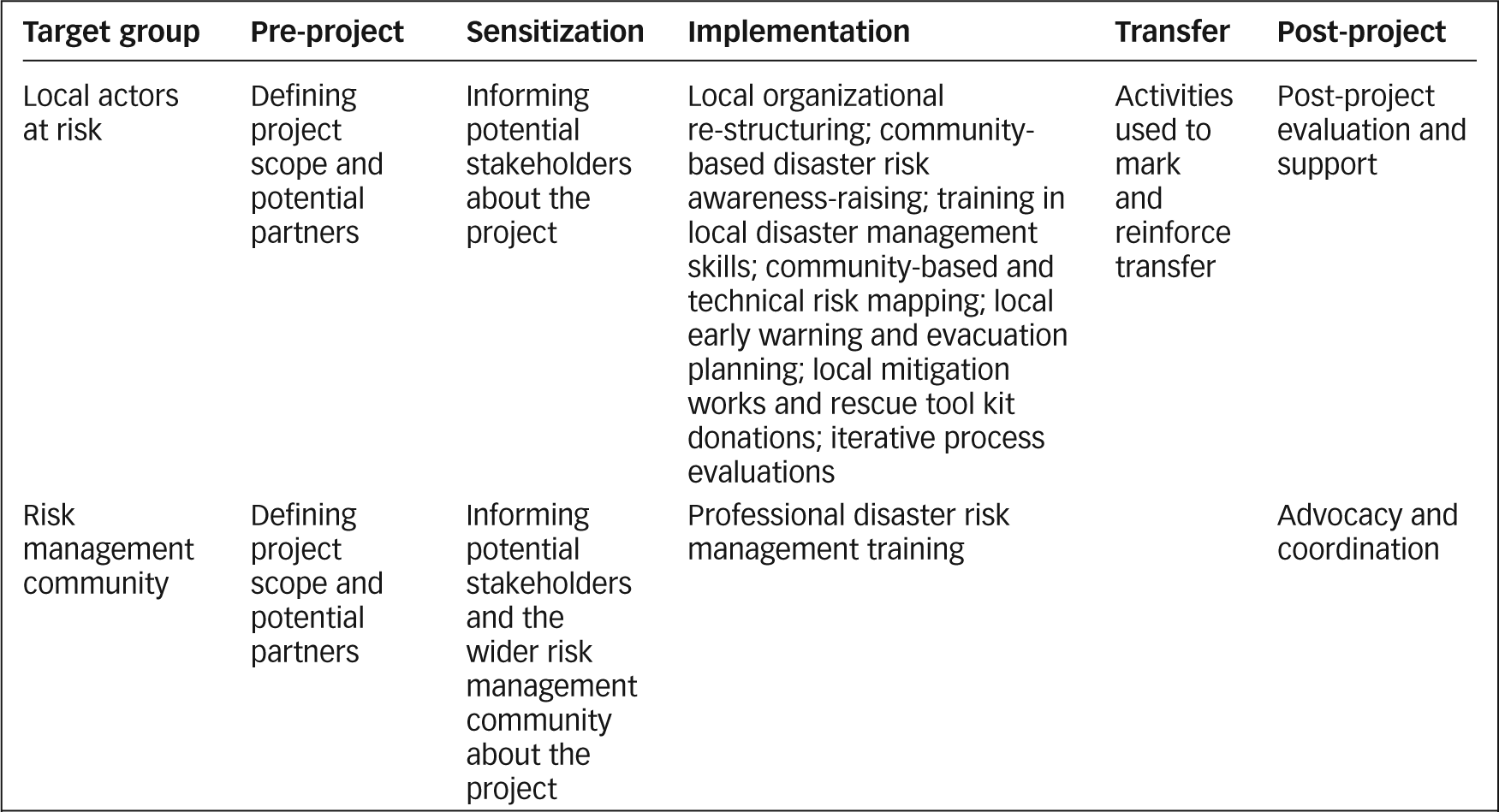
The Oxfam urban disaster risk reduction (DRR) approach
The novelty of urban DRR work required careful pre-project scoping and sensitization phases. This was especially so, for example in Guyana, where the urban risk management system was in flux, with a number of overlapping jurisdictions and gaps in policy; but also in Haiti, where formal structures were not supported by financial or human capacity. In some projects, this period was longer than expected, putting pressure on subsequent elements in an already compressed agenda. During implementation, the most creative and time-consuming activities fell under community awareness-raising. This was essential as a pre-requisite for building community groups and also as an end in its own right for raising knowledge of local risk and risk reduction options. The tools applied were influenced by local resources. In Santo Domingo, IDDI’s strong local ties and existing network of street level promoters enabled awareness-raising to be delivered direct to individual families. In Guyana, WAD used contacts to deliver street performance and school training days. In Cap Haitien, local DRR groups managed community days.
A significant investment was also made in skills training for local community group members, including hazard and vulnerability mapping, evacuation, search and rescue, water rescue, first aid and emergency shelter management. Training in organizational and project management was also provided. In Haiti, municipal and local groups took responsibility for financial and operational management during the completion of local mitigation works.
In each case, risk mapping was a pivotal element of programming. Following on from broad public awareness-raising, risk mapping was a practical mechanism for bringing together a core group of engaged citizens with project team members. This core group often then fed into the leadership of community groups. The focus involved the identification of hazard, vulnerability and capacity. Methodologies ranged from those that apply sophisticated technology to map and model risk and scientific skill with which to quantify hazard probabilities and potential impact scenarios, to those that, rather, rest on local and lay knowledge and the production of maps using everyday materials. The choice of methodology in part rests on the extent to which the focus is aiming for scientific rigour and accuracy in outcome or is conceived as a tool for awareness-raising and community-building around risk and its management.(12) Oxfam’s projects needed both technical outcomes to help select and locate small-scale mitigation works and capacity-building. Placing focus early on in the project cycle, but following wide public awareness-raising, helped achieve the latter aim. Getting the balance right between technical and lay input was not easy. In Guyana, a lack of technical capacity led to maps having limited practical use – many simply showed road networks with an arbitrary line to indicate that flooding was a greater hazard further inland. In contrast, focus in Cap Haitien deployed a highly technical approach, with resulting geographic information system maps only accessible through a small number of laptop computers. Technology afforded some legitimacy to the project for local government but alienated local actors and proved short lived, as computers broke down. In Santo Domingo, technical mapping was undertaken in parallel with community mapping projects. In one instance, community leaders stood on a bridge and pointed out places prone to flooding. This approach worked well; it gave a visible face to the project and helped consolidate the leadership group, while the necessary technical data was also collected and finally, both types of data combined.
The formation of citizen DRR groups built on sensitization, awareness-raising and training. Group focus and momentum was maintained through ongoing training activities and participation in project deliverables such as focus, mitigation works and the development and implementation of community early warning systems and (in Santo Domingo) emergency drills.
Transfer was marked most clearly in Cap Haitien, where a community event attracted 500 people. Training certificates and prizes for the best community group activities were given. Post-project activities included project evaluation, with some support for community groups and further advocacy at the municipal level.
III. Project Impacts for Target Communities
Figure 2 shows the number of citizen groups formed and the estimated number of local residents contacted in each case through awareness-raising activities. Citizen groups operated at the local, community and municipal levels, ideally at the lowest administrative level recognized by a formal government agency (local government or civil defence). The aim was to facilitate formal partnership and support for citizen groups at the end of the Oxfam project. This was quite a challenge and contrasts with rural work, where local level organization is often able to represent household interests and liaise with government. The larger populations in urban areas mean the lowest levels of government often cover large populations, requiring multiple levels of organization to be formed so as to provide the dual tasks of local mobilization and liaison with government and other extra-local actors.
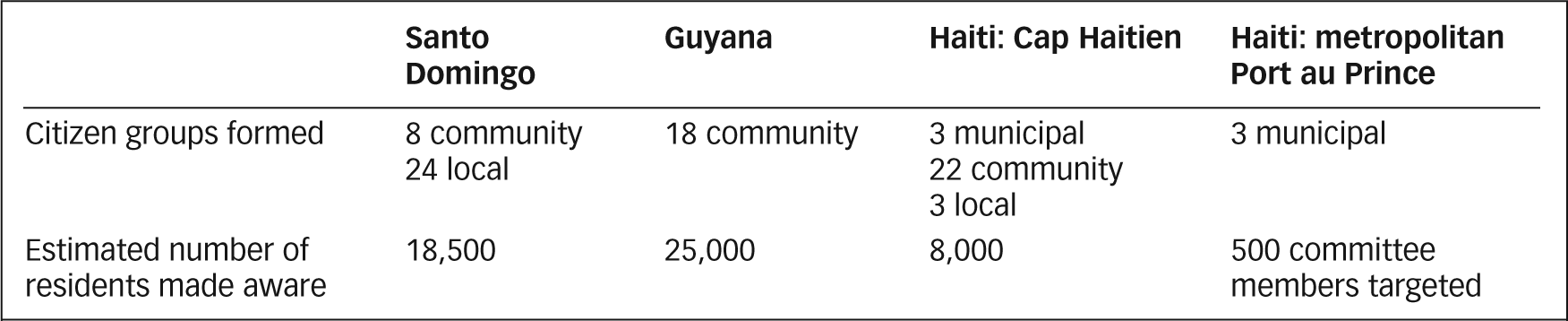
Indicators of project impact
In addition to the target groups identified in Figure 2, work in Santo Domingo and Guyana focused on raising awareness through education systems, with 3,000 and 865 schoolchildren exposed to DRR training, respectively.
Field observations highlighted the difficulty of sustaining project outputs where groups failed to gain local government or other support. At the time of the study, only two local groups were active in Guyana. This said, groups continued to provide local representatives where opportunity existed in municipal risk management (e.g. in Haiti and Santo Domingo), and a resource of skilled and informed local individuals strengthened local capacity during disaster response. This was evident in Tabarre (Port au Prince), where the municipal committee reported acting immediately following the 2010 earthquake. The group organized search and rescue and first aid for four days until support from the Dominican Republic arrived. Where groups were strong, and especially in Santo Domingo, impacts went beyond DRR to include contributions to local social capital and also improved relationships with city authorities. In Santo Domingo, improved relations between the community and the police were notable and important during everyday life as well as in times of emergency with a police presence on the streets and in public emergency shelters, whereas beforehand they would have been absent and mistrusted.
Urban risk mitigation projects were delivered with each project. These served instrumentally to mitigate hazard or reduce vulnerability, but more than this they provided a focus for community group mobilization and a vehicle for training. The impacts of these works were greatest when they met an everyday development need (e.g. improved access stairways or bridges) as well as improving risk management (evacuation and emergency services access routes). On only two occasions was this not the case, where drain cleaning was undertaken in preference to capital projects. The resultant impacts were much needed but short lived.
At the level of urban risk management, the most notable impact was felt in Guyana. Here, for the first time, the Civil Defence Commission and other government and non-government actors were exposed to the Sphere Standards. While these standards have not been accepted uncritically, they have been welcomed and put to use in designing emergency parcels and emergency shelter management guidelines.
IV. Partner Coordination and Participation
Local as well as city level actors participated in each project. The level of local participation increased over the project lifetime, from consultation and information-sharing during sensitization to more formal partnership at implementation (which included collaboration in the planning and implementation of local awareness-raising and mitigation works). During the transitional period and into the post-project phase, local actors took over the management of community and local groups and responsibility for future activity. However, it proved much harder to support the extension of the formalized rights of participation with the power and recognized authority to make participation and decision-making real. In the stages of sensitization and implementation, transfer of funding and skills did allow meaningful participation. But as Oxfam and its implementing partners pulled away during the transfer and post-project phases, so too did the power to participate in shaping local risk management drain away. This resulted in the opening of a power–participation gap (Figure 3),(13) where formal rights were not reinforced by the ability to act.
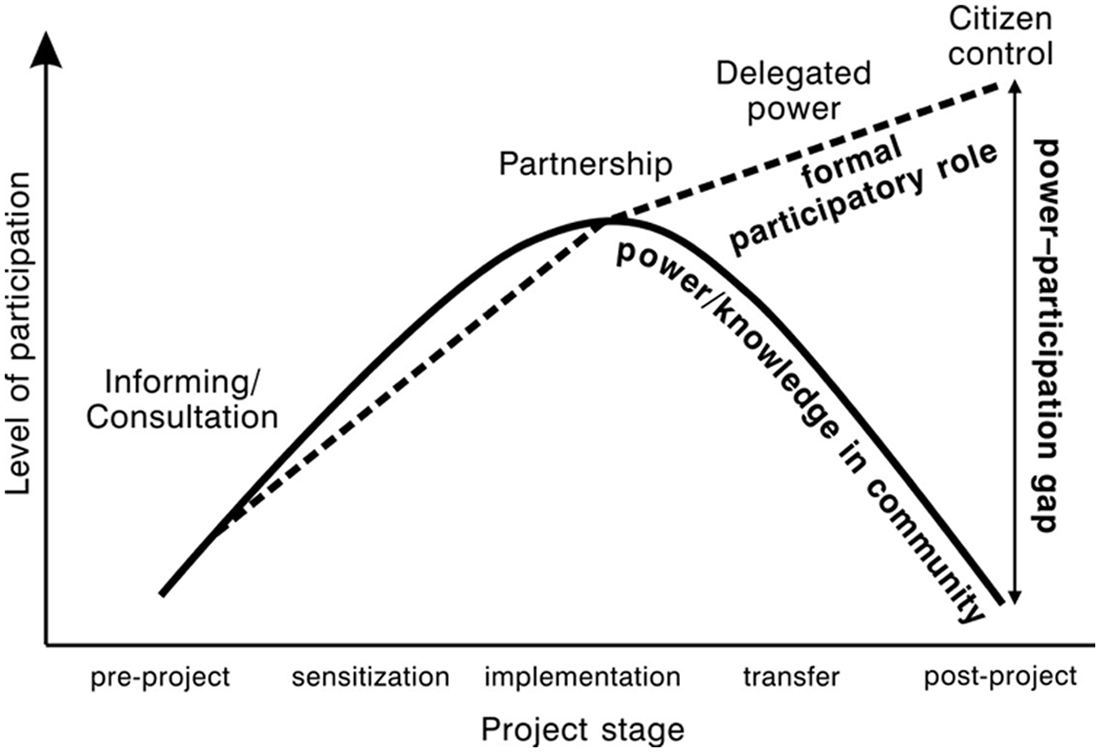
Coordination and participation
The principal reason for the power–participation gap was the lack of a significant and committed partner to support local activity after Oxfam’s departure. This was felt most keenly in Guyana, where local government and civil defence were not prepared to formally recognize community groups. In Haiti, while municipal groups were legally recognized, a lack of resources and political will brought further activity to a standstill. Only in Santo Domingo was this gap closed. Here, IDDI provided continuity in support, and key actors in urban governance, including the Red Cross, civil protection and a local development committee group (“Junta de Vencinos”), sat on community committees. In terms of strategic project planning, the short lifespan of most projects proved a barrier when compared to the deep-rooted social, economic and political pressures experienced by local partners that pulled them away from community activity. Generating trust between local government and community groups takes time, and the lesson from these cases is that without medium-term commitment from delivery agents (Oxfam and IDDI), the likelihood of community group sustainability is very low. The demand for more extended commitment from delivery agents is in conflict with a desire to prevent dependency. IDDI offered one way around this dilemma, with its range of commitments at the local level providing local supporting structures; for example, a meeting space, human resources and financial support were provided by a community solid waste business in one barrio. While still associated with IDDI management, responsibility for community businesses lies in the community so that lines of dependency, while still a potential risk, are at least tied more closely to community actors and organizations. An exception to problems of group sustainability emerged when groups were confronted by disasters during their formative stages, which galvanized support and membership (e.g. Hurricane Jeanne in Cap Haitien in 2004). Migration was anticipated as a challenge for maintaining community cohesion and engagement, but across these projects in and out migration rates were not high. Moreover, in Santo Domingo, IDDI’s permanent networks of neighbourhood level social promoters identified and included recent in-migrants in ongoing social development programmes, including those relating to Oxfam’s urban DRR work.
V. Social Equity
Concerns for social equity, including those influenced by gender, age and ethnicity, were mainstreamed into project design and implementation; this meant being aware of local gendered relations and cultures of participation. In practical terms, this meant encouraging involvement in citizen groups and activities for women in Haiti and men in Santo Domingo and Guyana. While opportunities were created, there appears to have been little additional involvement of target groups beyond isolated examples. This is to be expected in projects with short implementation periods and confronting deeply embedded and institutionalized gendered roles and relations. In Port au Prince, for example, municipal groups were required to include membership from several interested government agencies all of which were disproportionately staffed by men, so that Oxfam’s groups, in turn, were male dominated. One exception was a group in Cap Haitien, led by a woman who purposefully sought to recruit and support other female members. Despite this imbalance, important progress was made in incorporating gendered viewpoints into planning decisions, for example by including women’s concerns for safety and hygiene in the design and management of public emergency shelters and in the staffing and training of emergency personnel in Santo Domingo. Efforts to bring men into project activities included local sports and social events in Guyana, but impacts were short lived.
Acknowledging the importance of youth in bringing energy and longevity to projects, initiatives targeted young people through school training days and lively community activities, including sports, music and other social events (these were also directed at drawing the participation of men). These initiatives met with some success. Youth involvement, especially in Haiti and Santo Domingo, was high. Impact in Santo Domingo can be seen by the numbers, especially of young women, who wanted to act as social promoters. Young people were an important beneficiary group that benefited from greater interaction within and between neighbourhoods, with some respondents describing reduced inter-neighbourhood tensions and gang violence as an important and unexpected outcome of projects. These were impacts that went beyond, reinforced and added value to urban DRR.
VI. Partner Perceptions of Urban Hindering and Facilitating Factors
Urban contexts influence risk and its management in many ways. Discussions with respondents identified a number of local pressures that were felt to influence the local production of hazard and also social vulnerability, or shape the capacity of local actors and their partners seeking to reduce disaster risk proactively. These are presented in Figure 4 and apply across all cases, although with some differences in emphasis. Under vulnerability challenges, social tensions were most closely associated with heterogeneous community structure in Haiti, although across all cases, Oxfam was required to invest more time and energy in building collaboration than it might have expected in a rural context. The impact of in-migration was reduced in Santo Domingo, where street level community health promotoras working with IDDI were able to monitor and engage with new arrivals. Out-migration was most evident in Guyana and fed a larger malaise with aspirations for moving on in life being connected to moving out of Guyana – emigration was preferable to confronting development challenges at home. Capacity to reduce risk was challenged especially in Georgetown by the long commuting journeys required of those living in linear, peri-urban settlements. Local social tensions and risk to local activists challenged community capacity-building in each study site, although this was expressed differently. In Guyana, escalating gun crime led to temporary withdrawal from one community (Buxton). More positively, in Santo Domingo the dual strategy of community level negotiation and integrated training camps for youth from all communities proved useful vehicles for building trust, allowing work to be undertaken including a bridge that against local expectation reduced violent interaction between young people from neighbouring communities.
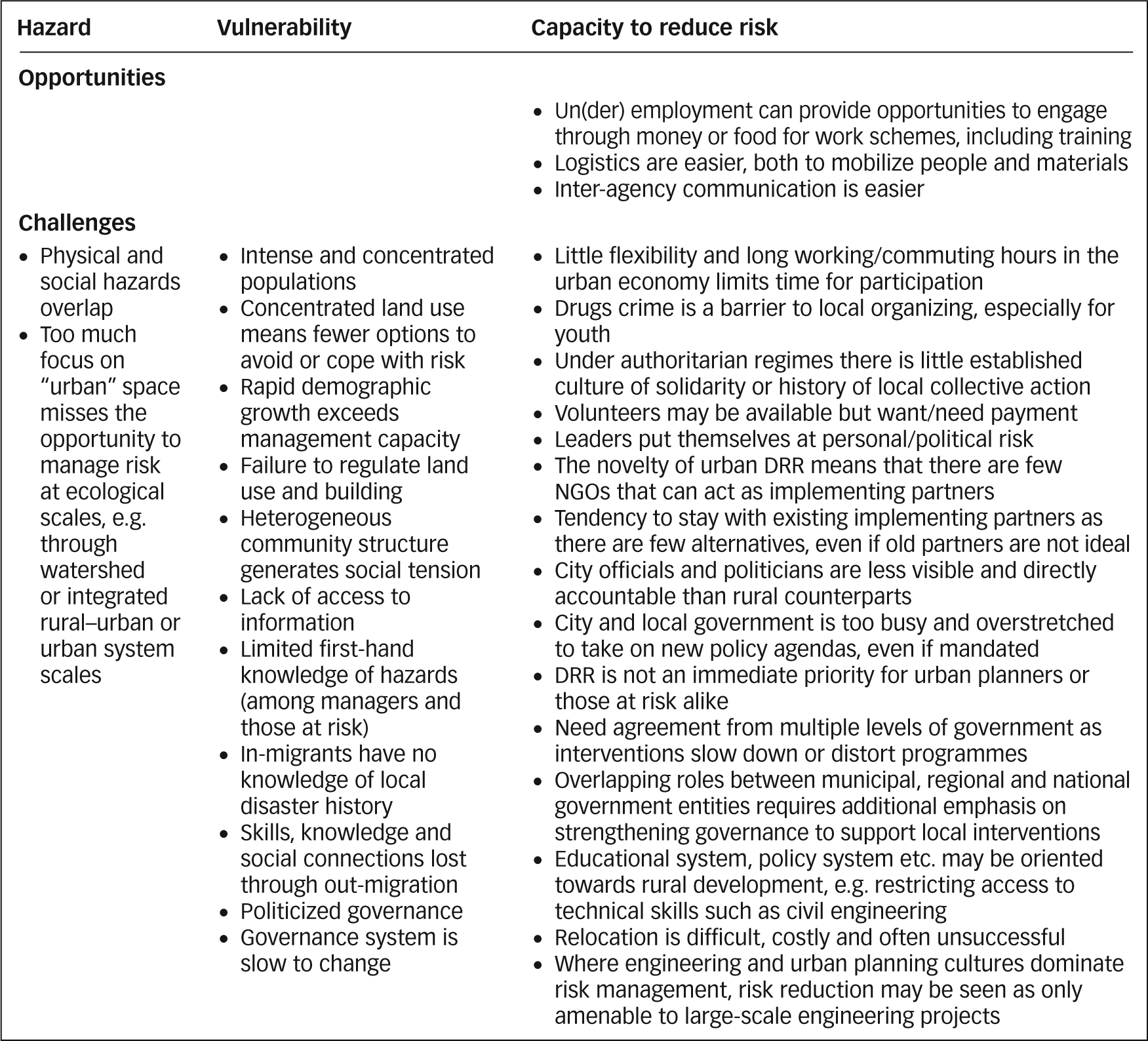
Challenges and opportunities in urban disaster risk reduction (DRR)
VII. Output Sustainability and Transferability
Projects were planned for medium- to long-term sustainability, with the aim that physical and social outputs, from awareness levels to citizen groups, would persist for five or more years and ideally would become stable parts of urban risk governance systems through entering into partnerships with legally mandated agencies. Sustainability in this sense refers to the longevity of project outputs. Measuring this is difficult, especially for social outputs. Physical mitigation works such as bridges and retention walls will likely last into the long term and there have been no visible signs of deterioration. The exception has been drain-cleaning activities, where drains have once again become blocked with plastic rubbish. Least sustainable have been the integrated electronic river level and flood alert systems installed in some communities in Santo Domingo. Once equipment had been lost or damaged it was too expensive to replace, and consequently none of the systems still function. Instead, residents have installed simple water level marker posts, with local residents volunteering to raise the alarm. Good will from civil defence means that this could be coordinated and resources focused at times when extreme events are expected.
Social outputs are less easy to monitor. Awareness-raising was one of the most creative and dynamic aspects of the projects and required a significant investment in project time and resources, and it had a dramatic impact in the short term. Training in disaster management for community and committee members was similarly well supported during project implementation. However, it was not possible to observe lasting changes to behaviour that would indicate sustainability. This does not mean that changes did not take place, with new knowledge and social ties lying latent; but over time, if they are not exercised, both human and social capital tend to degrade. Where hazards were experienced (in Haiti and Santo Domingo), evacuation and emergency shelter management continued to be improved. Beyond local project elements, Oxfam’s legacy included, for example, enhanced awareness and willingness to reduce urban risk among key stakeholders; also IDDI’s new Risk Management Unit; and the Guyana civil defence organizational review and exposure to and enthusiasm for Sphere Standards.
Least sustainable, as described above, were the citizen groups. Only in Santo Domingo was there clear success. This was achieved through embedding these groups in wider social systems that established a value for such activity. Membership was seen as rational and as a virtue (not a means of personal enrichment, source of political exposure and risk or a drain on time, as was the case in Georgetown and Haiti), and groups had a purpose that was given stability through close ties with IDDI’s other community-based initiatives. Even where local groups in Santo Domingo might not have met often, their leaders and members were part of IDDI’s wider network. In essence, the failure of groups in Guyana and Haiti was understandable from the perspective of local actors who were caught in social contexts where group membership is economically and socially costly and not a priority. Community groups in Georgetown and Haiti were also constrained by a lack of support from government agencies. In Georgetown, lack of capacity and perhaps an unwillingness to share authority and a worry that this may undermine local legitimacy meant few positive replies to requests from community groups for access to local machinery to clean drains; at a higher level, lack of any formal recognition from regional government or the Guyana Civil Defence Commission left community groups unsupported once Oxfam withdrew. In Haiti, a rigid bureaucratic culture in government affected community groups, which in some instances became paralyzed for lack of formal letters granting approval of plans of action or recognizing the appropriateness of risk maps. Without these formal letters (word of mouth was not sufficient), group members felt they lacked legitimacy to act and were unwilling to act outside of formal procedure. Both the Guyanese and Haitian cases demonstrate the power of government at local and high levels to slow down and stifle community action through bureaucratic process. In neither case was government actively hostile to community action, but lack of active support and official recognition was sufficient for local actors to feel a lack of legitimacy and to constrain their own actions. In Santo Domingo, a more open and diversified urban governance regime, and one with a long history of local action at political and practical levels, presented an operating environment where local activity was recognized as legitimate. That the cases reviewed here were supported by IDDI and Oxfam – both well-respected civil society actors connected to municipal government – helped foster government acceptance.
Beyond the sustainability of planned outputs, the 2010 earthquake that hit Port au Prince revealed the transferability of DRR interventions across hazard types. Tabarre municipality was among the most engaged in the Oxfam project, with its mayor having previously worked in civil protection. During emergency response, the Tabarre citizen group became the primary local organizing authority, coordinating the acquisition and distribution of emergency medical supplies and providing safe refuge until the arrival four days later of the first non-local actors, the Dominican Republic civil defence. Strong local leadership and political will provided the basis for organizational resilience in this case.
VIII. Conclusions
Oxfam’s experience in the Caribbean is important as one of the first systematic and cross-cultural attempts to mainstream urban DRR into local and urban development. While much can be learnt from the detailed application of methods in these cases, it is also important to reflect on the structures that shaped what was possible for Oxfam and its local partners. Influential here, and especially in a young policy domain, was the vision of urban DRR held by Oxfam and project donors. The primary donor in this case was DIPECHO, effectively the sole champion providing dedicated funding for urban DRR in the Caribbean region. Oxfam’s strengths and DIPECHO’s institutional priorities bounded what was possible. Projects were required to be discrete (completed in a matter of months and with a local geographical focus – i.e. they could not straddle urban–rural contexts). The result was a narrow range of projects, as demonstrated by the common project template, and an approach that found it hard to tackle the root causes of risk. That said, the ambition to address root causes did exist, and governance as well as local capacity-building were central to project design even if limited support and tight time frames constrained what was possible. Constraints can be seen, for example, in the lack of any application of urban DRR work that has been successfully applied elsewhere in the Americas and that would have supported sustainability here, notably community solid waste management businesses – if connected to urban DRR these could provide an incentive for cleaning drains; also community urban orchards, which combine livelihood with slope stabilization and an opportunity for risk awareness-raising. A tight urban focus denied the frequent observation that hazards and vulnerabilities felt in urban places often have root causes elsewhere (in deforestation or rural underdevelopment), just as urban systems can influence risk in downstream rural places (e.g. through urban river management that accelerates and concentrates downstream flood risk). It is perhaps beyond the scope of single projects, but with greater support and a more programmatic approach to urban risk reduction, rural places should also be considered. In Guyana, the inclusion by Oxfam and DIPECHO of peri-urban settlements as part of the social and economic matrix of urban life is to be applauded in this regard.
Urban governance lay at the heart of Oxfam’s interventions. The dual targeting of local actors (and the building of citizen groups as well as popular risk awareness) alongside the sensitization and training of urban and national authorities was an essential component of the Oxfam approach and one that was needed to provide any buy-in from risk management and development agencies for locally driven DRR work. The great challenges faced in mobilizing and supporting citizen groups and action lie at both levels in the motivation of local actors and the institutional context and drivers of urban governance regimes. In this sense, urban DRR is part of wider processes and the politics of urban governance. Activities such as citizen mobilization that might threaten or be perceived to threaten municipal government, local political power blocks and the urban status quo more generally, need to be presented and managed with great care. The relative success of work in Santo Domingo highlights the importance of local partners that are respected by citizens and responsible agencies alike. In contrast, the more limited success in Haiti and Guyana flags the additional effort needed, and perhaps reduced outcomes to be expected, from working in governance systems that are weak or lack inclusivity or political support for urban DRR. Scale in urban governance also presented a challenge, with tensions between the desire to build citizen groups that could openly represent and organically connect with local communities and, at the same time, be of sufficient scale to be recognized by local government. This was most keenly felt in Haiti, with the result that two levels of citizen group needed to be constructed and supported.
The experience of these projects shows that in contexts where local and municipal government does not have the capacity or will to champion urban DRR, the most important resource for project effectiveness is an experienced, self-critical, locally respected and politically independent implementing partner. Cultivating new and maintaining existing local implementing partners helps secure outcomes, extend competencies and stimulate future project inputs. At the level of project deliverables, the most valued observed outputs were those interventions that served everyday as well as disaster risk functions, notably stairways and bridges that enabled market access and greater social interaction (and, in the case of Santo Domingo, stimulated new local businesses as well as building trust between neighbourhoods) in addition to providing emergency access. It may not be going too far to claim that this dual functionality is an essential component for investments that are cost-effective and locally valued.
Perhaps more than anything, these case studies show the opportunities that interventions in urban DRR can provide for realizing integrated urban development. For example, good urban DRR needs to work across scales, connecting governance with local awareness and raising skills; also bind domains of activity, linking economic with social and environmental processes; and where programmatic vision allows it, meld rural, peri-urban and urban concerns. These are all basic requirements of integrated development. In this sense, the multi-functionality of DRR investments (for everyday use as well as for reducing disaster risk) is not a weakness suggesting vague aims but an asset, at once signalling the importance of an integrated approach – something that those at risk, including local government, are only too aware of but that donors continue to find difficult to programme for. There is great potential for urban DRR to present locally relevant projects that can galvanize community actors as well as urban managers, and that out of necessity bring together questions for social development, livelihood, urban governance, land use and rights as well as physical infrastructure. Through this, urban DRR can provide a missing motivation for integrated development, but realizing this opportunity requires a reframing of urban DRR by donors and implementing agencies.
Footnotes
1.
Kreimer, A and M Munasinghe (editors) (1992), Environmental Management and Urban Vulnerability, World Bank Discussion Paper No 168, World Bank, Washington DC, 12 pages; also Mitchell, J K (editor) (1999), Crucibles of Hazard: Mega-Cities and Disasters in Transition, UNU Press, Tokyo, 450 pages; and Pelling, M (2003), The Vulnerability of Cities: Natural Disaster and Social Resilience, Earthscan, London, 224 pages.
2.
Nicholls, R J, S Hanson, C Herweijer, N Patmore, S Hallegatte, J Corfee-Morlot, J Château and R Muir Wood (2008), Ranking Port Cities with High Exposure and Vulnerability to Climate Extremes: Exposure Estimates, OECD Environment Working Paper No 1, OECD, Paris, 63 pages.
3.
Swyngedouw, E A (1997), “Power, nature and the city: the conquest of water and the political ecology of urbanization in Guayaquil, Ecuador 1880–1990”, Environment and Planning A Vol 29, pages 311–332.
4.

7.
Bicknell, J, D Dodman and D Satterthwaite (editors) (2009), Adapting Cities to Climate Change: Understanding and Addressing the Development Challenges, Earthscan, London, 397 pages.
8.
Pelling, M (2010), Review and Systematization of Disaster Preparedness Experiences in Urban Areas in the Caribbean Region, Oxfam GB, Oxford, 85 pages.
11.
12.
Pelling, M (2007), “Learning from others: scope and challenges for participatory disaster risk assessment”, Disasters Vol 31, No 4, pages 373–385.
13.
Arnstein, S R (1969), “A ladder of citizen participation”, Journal of the American Institute of Planners Vol 35, No 4, pages 216–224.