




Abstract
There has been a long tradition in making ice structures, but the development of technical improvements for making ice buildings is a new field with just a handful of researchers. Most of the projects were realized by professors in cooperation with their students as part of their education in architecture and civil engineering. The following professors have realized ice projects in this setting: Heinz Isler realized some experiments since the 1950s; Tsutomu Kokawa created in the past three decades several ice domes in the north of Japan with a span up to 25 m; Lancelot Coar realized a number of fabric formed ice shell structures including fiberglass bars and hanging fabric as a mold for an ice shell in 2011 and in 2015 he produced an fabric-formed ice origami structure in cooperation with MIT (Caitlin Mueller) and VUB (Lars de Laet). Arno Pronk realized several ice projects such as the 2004 artificially cooled igloo, in 2014 and 2015 dome structures with an inflatable mold in Finland and in 2016–2019, an ice dome, several ice towers and a 3D printed gridshell of ice in Harbin (China) as a cooperation between the Universities of Eindhoven & Leuven (Pronk) and Harbin (Wu and Luo). In cooperation between the University of Alberta and Eindhoven two ice beams were realized during a workshop in 2020. In this paper we will present the motivation and learning experiences of students involved in learning-by-doing by realizing one large project in ice. The 2014–2016 projects were evaluated by Sanders and Overtoom; using questionnaires among the participants by mixed cultural teams under extreme conditions. By comparing the results in different situations and cultures we have found common rules for the success of those kinds of educational projects. In this paper we suggest that the synergy among students participating in one main project without a clear individual goal can be very large. The paper will present the success factors for projects to be perceived as a good learning experience.
Introduction
This part of the paper will give a short summary of the most important ice projects/structures in the past. The oldest “ice” structures known are igloos made from snow blocks. They are shaped like a cate-node to avoid tensile stresses. The gaps in between the blocks are filled with snow. The heating in the igloo will melt the inner surface of the igloo. Later this melting water will freeze again making a layer of ice. The layer of ice formed at the inside of the igloo will make it a continues structural shell and contributes to the strength of the igloo.
A Japanese variant of the igloo is the Japanese “Kamakura.” A “Kamakura” is a Japanese traditional snow hut, which has been built since the beginning of the 20th century. The snow hut is formed by digging out snow from a small pile of natural wet snow. The Kamakura is usually constructed with uncompacted snow, resulting in small dimensions because of the low mechanical properties. 1
Based on the knowledge and experience with snow structures snow hotels have been developed for commercial exploration. Most ice hotels are constructed using a patented arched steel mold with a height up to 5 m and a span of 6 m. Multiple molds are connected to create a long tunnel. At first natural snow was used to create the snow walls of the structure, but later the construction material was replaced by artificial snow. Special wet snow, called “Snice,” is sprayed on the mold using front loaders, snow canons, snow blowers and snow throwers.
One of the first major attempts to fortify ice happened in 1942 about 400 km southwest of Edmonton by Geoffrey Pyke. The name of the project was “Habbakuk.” The Canadian government was tasked with building a model of a boat with reinforced ice at the Jasper’s Patricia Lake. As reinforced ice required more work than regular ice, it would increase costs up to half the price of a regular aircraft carrier. Therefore a officials decided a flotilla of reinforced ice vessels would be impractical and by the summer of 1943, this project was dead. Since then some research was done into reinforced ice but up to 2014 no applications were realized.
Heinz Isler (1926–2009) used natural forms as a reference for his designs. Isler is mostly known for his thin shell structures, where he used the physical principles of nature as his starting point. He made ice structures by spraying water on fabrics or inflatables in winter at low temperatures. By applying multiple layers of water, a shell structure was formed with a thickness of only a few millimeters. 2
In 2003, in the north of Finland, Matti Orpana developed a method for creating igloo-shaped ice hotels made of a half ellipsoid with a span and height of 15 m. They were the biggest one-surface igloos made with an inflatable mold. The vertical section of the igloo is formed like a catenary. The inflatable is covered with ice or snow. In ice the wall thickness at the foundation is approximately 900 mm and in snow the walls are about 3000 mm thick.
Tsutomu Kokawa has studied the effects and behavior of ice shells for many years. In 1985 he started his first experiment with the construction of a 5 m and 10 m ice shell. These relatively small shell structures gave a good impression on the behavior of the material ice and the unique construction method he developed. In 2001 he finished the largest ice shell structure so far with dimensions of 25 m internal span and a height of 9.2 m. 3 The construction method developed by Kokawa consists of three important parts: the foundation ring, inflatable mold and spraying of the ice shell on the mold. The inflatable mold is pushed against a rope net and the inflatable will form bulges in between the ropes of the net structure. After inflation the rope net is in equilibrium with the inflatable and will form bulges in between the ropes of the net structure. The combination of the bulges and the net gives the 3D mold for a ribbed ice shell. The interior of the ice shell reveals a rib structure in the same pattern as the rope cover. This rib pattern improves the structural behavior of the shell.
In September 2004 Pronk et al. made an igloo for a business fair in Amsterdam. The igloo was made at an air temperature of 20°C. 4 Two thousand meter of ducts was wound around the inflatable mold to create a grid of ducts with a spacing of 5 cm. The ducts where connected to a cooling device filled with water-glycol with a temperature of –12°C. The ducts were sprayed from the outside with a fog of water after the forming of the ice shell at the outside the inflatable was removed and the ducts where sprayed on the inside of the igloo.
Many projects were realized by professors in cooperation with their students as part of their education in architecture and civil engineering. The projects below were realized in China, Canada and Finland over the last 6 years (2014–2020). They have been analysed on the educational goals. This paper presents the results.
First Canadian project
Professor Lancelot Coar has been testing the potentials of ice in structural shells at the Centre for Architectural Structures and Technology (CAST) at The University of Manitoba since 2010. Being situated in central Canada, the climate and isolation from oceanic atmospheric influence allows for a steady and predictable cold winter climate in which to perform such experiments, with temperatures stabilizing between –12°C and –40°C. These experiments have provided two types of opportunities for students to take part in. One is when students can volunteer as participants in their free time, and the other is when the project can be integrated into the curriculum in the Department of Architecture. Over the past 7 years, professor Coar has built six ice structures with student participation.5,6
In the winter of 2017 Coar partnered with Dr. Sigrid Adriaenssens and Michael Cox (Princeton University), Dr. Lars De Laet (Vrije Universiteit Brussel) and Mark West to create a fabric formed ice shell supported by a bending active frame, see Figure 1 and 2. The primary experiment in this project was to test if the bending active frame could follow the principle stress lines produced by a computational model of a four-pointed vault. The project allowed for multiple phases that students could participate in. Students in this project volunteered their time outside of classes as the curriculum schedule did not align with the project schedule. Preliminary design and analysis work were carried out by Coar, Cox, and Adriaenssens helping to produce a focused plan for the pre-fabrication, erection, and testing phases of the project. Student participation was solicited through advertisement by email and posters throughout the school. Twenty-seven students volunteered from across the faculty and in both undergraduate and graduate levels.
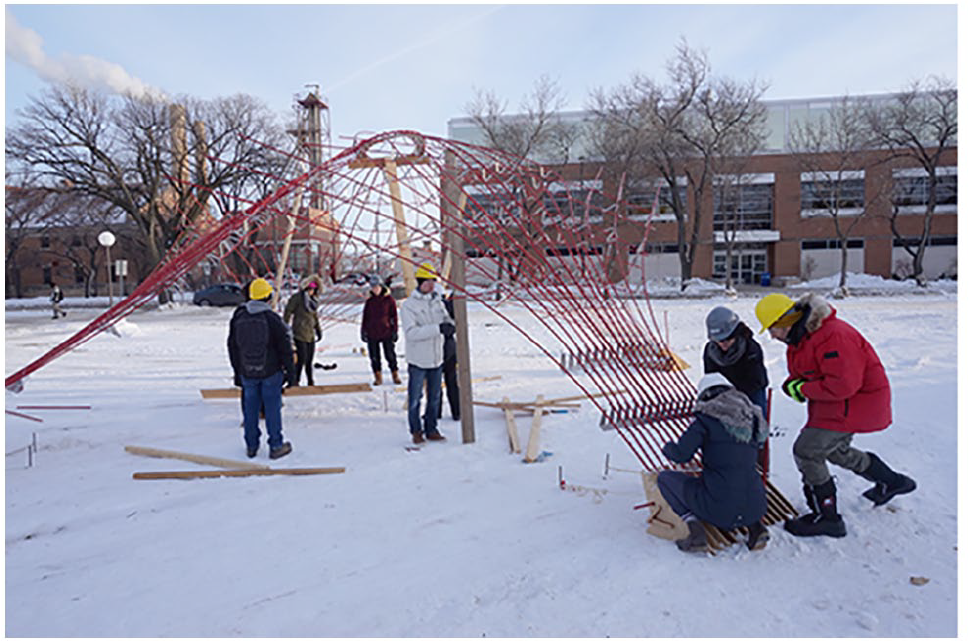
Students assembling the bending active framed vault (photo by Dominique Rey and Lancelot Coar).
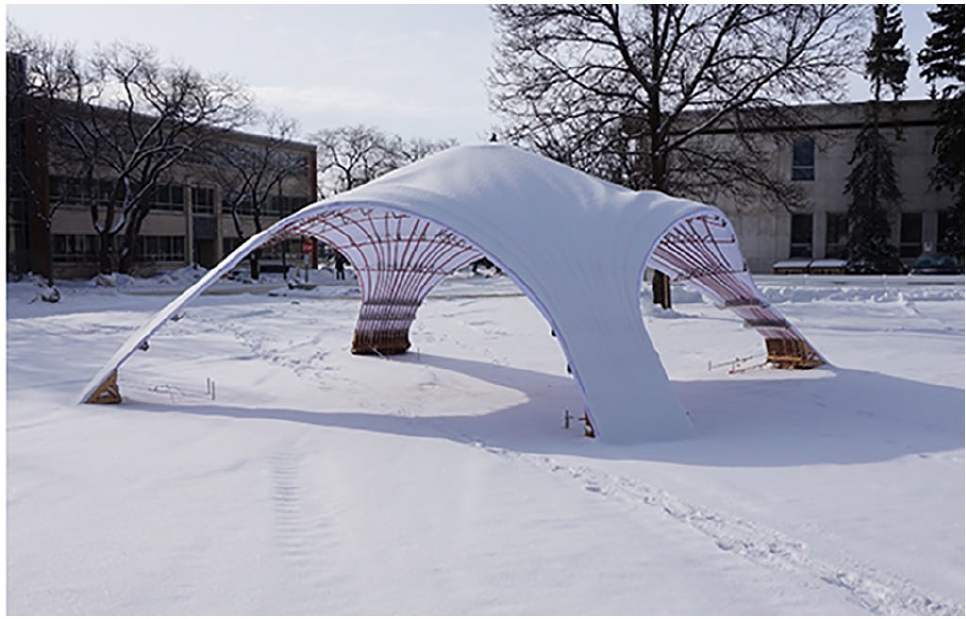
Completed ice shell structure (photo by Dominique Rey and Lancelot Coar).
Once on-site students were teamed up to provide equal balance in skill, experience, and workforce. The pre-fabrication phase allowed students to become familiar with the fiberglass bars and the assembly system, which was made as simple as possible so as to take advantage of a wide range of skill levels. Once the fiberglass frame was pre-assembled, the system was brought outside to the site, and erected by students. The frame assembly was dynamic and unusual, compared to traditional more rigid building systems and thus generated a lot of interest and curiosity in the students. Following this, a 9.1 m × 9.1 m square fabric panel that one team assembled was pulled across the frame to establish the fabric formwork. Once in place, students took part in shifts to spray the fabric with water and create the layers of ice on the fabric. This was a particularly rewarding phase of the project representing as many students have never seen or created an ice structure, especially at such a large scale.
Throughout the project, Coar and Cox used the opportunity of each phase to discuss the principles of structural behavior, material properties, and construction logic. These conversations were intended to be instructive but also to provide an opportunity for students to recognize the value of their hands-on experience as an important opportunity to enhance their understanding of construction and structural theory taught in courses in the classroom setting. During the project documentation became an important tool to both record the progress of the work, but as well to keep a live record to share with participants. One student volunteered to photograph the work and develop a project website that allowed for continual updating of the project during each phase, so that students who could not attend certain stages of the project could keep track with the progress. This website also acted as a central database for the project partners in the USA and Belgium.
Second Canadian project
In 2020 Pronk organized a workshop with eight students (see Figure 3) at the University of Alberta in Canada. 7 They have been working outside since before dawn; mixing a slurry of water and paper together, pouring the resulting concoction into a prestressed foil fixed on a wooden frame and smoothing it as it freezes. Pronk estimates that his reinforced ice can be as much as three times stronger than regular frozen water. Usually, ice is very brittle, but adding fiber like paper or wood pulp makes it stronger and ductile. The fiber also acts as an insulator, and ensures the ice does not melt as fast. The materials are affordable and natural. Therefore, they do not harm the environment. In this case, the fiber used to create these ice beams is toilet paper.
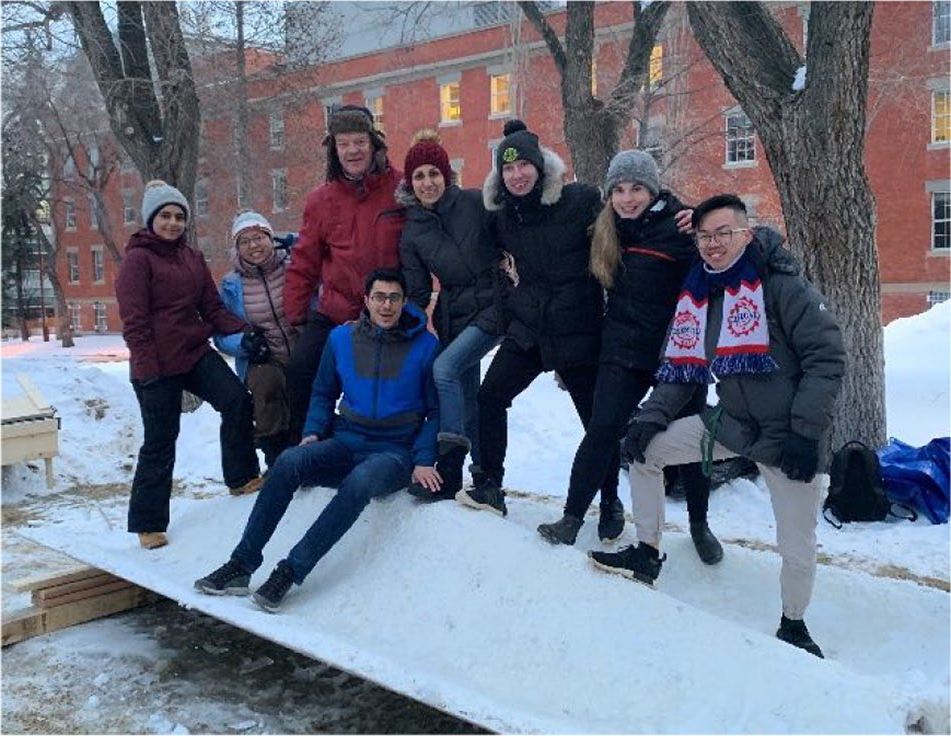
Student team on top of V-shaped ice beam (photos by Codie Mc Lachlan).
The next day, the team removed the ice beams from their fabric mold. Both V-shaped beams were a little over 6 cm thick, see Figure 4. The sun was just visible over the horizon as they propped up each beam with pieces of wood placed under the ends. Students took turns adding concrete blocks on top—creating a “point load,” to determine how much weight each beam could hold. The skinnier beam took 270 kg before it crumbles, while the larger one took 350 kg before succumbing to the bricks.
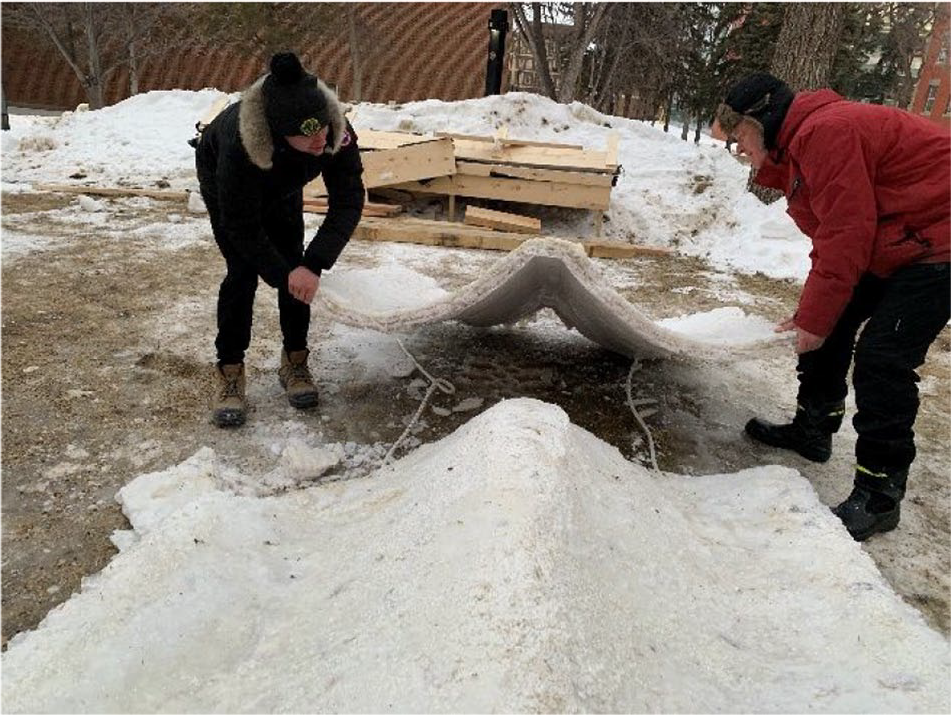
Section of V-shaped ice beam.
Pronk sees the future of building with ice in projects that need to be strong but can be hard to clean up, such as temporary foundations for drilling rigs. He also says it might have future applications, such as research on Mars, where the environment is very cold. This project with Canadian engineering students might inspire them to new possibilities in cold climates.
The Finnish projects
The Pykrete Dome by Pronk and Borgart8,9 was the first project which combined the use of reinforced ice, a spraying method that is usually used for shotcrete and an inflatable mold. The project was based on research by Glockner, 10 Kokawa, 11 and Vasiliev et al. 12 Pronk researched how to spray a fiber-reinforced snow slush with several pumps, see Figure 5. First, the compression on the slush in the pump turned the slush into ice blocking the pumps. In order to tackle this problem, the method of Kokawa to mix snow and water in thin layers on the surface of an inflatable was followed and adjusted by adding fibers of sawdust to the water. The mixing of sawdust fibers, snow and water on the surface of the inflatable is a very delicate process. Therefore, it was hard to guarantee the quality of the mixture. Later this was improved by using cellulose-reinforced ice without snow. The water/fiber mixture partially melts the snow and makes a thin slush layer on top of the inflatable or ice shell. After the freezing of the slush a new layer can be sprayed on top of the old one. Different kinds of fibers and materials were tested. 10% (weight) of fine sawdust from wood turned out to be the best as well as cellulose. Because sawdust was more affordable and easily available, this material was used for the construction of the Pykrete Dome.
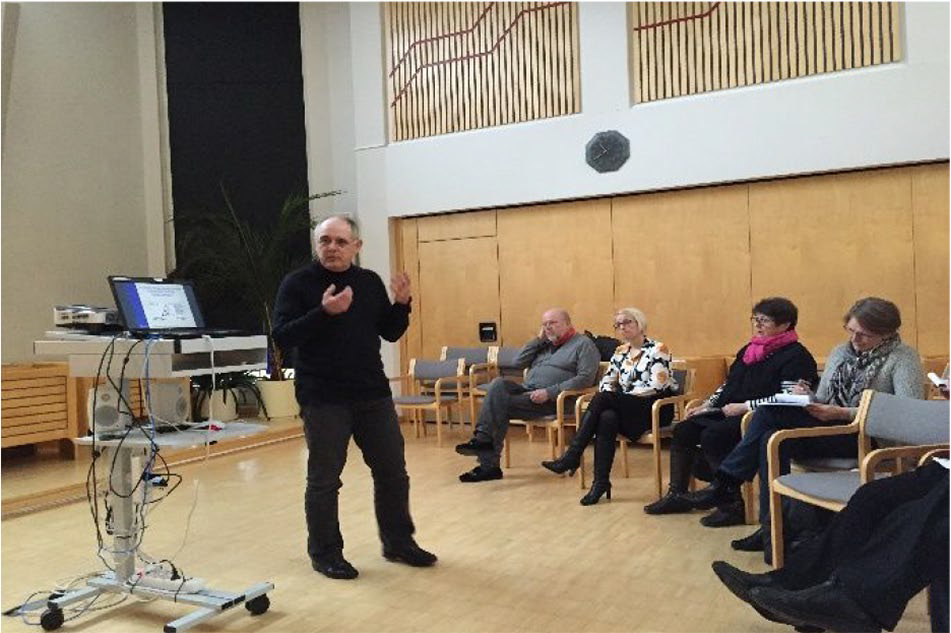
Masterclass on sustainable resident initiative at Juuka January 2016 (photo by Fred Sanders).
After the realization of the Pykrete Dome the challenge was to realize more vertical structures like towers. Inspired by the Sagrada Familia by Antoni Gaudi in Barcelona a design for a church with five tower domes was made with a nave connecting the towers, see Figure 6. The form-finding of the towers and nave was done with the reversed catenary method as was practised by Gaudi. To come to feasible measurements the size to the towers and nave were reduced about five times. The internal measurements of the towers were 30 m height by 11.2 m wide, 21 m height by 4.2 m wide and 18 m height by 4.2 m wide. The towers were made by inflatables connected to the soil by anchors. The average thickness of the ice surface was 20 cm. 12
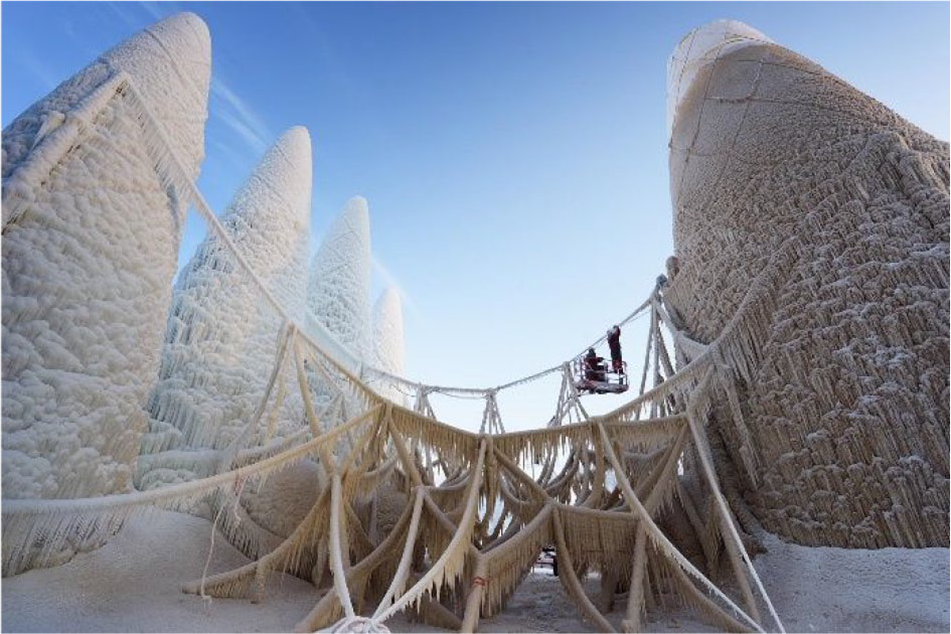
Sagrada Familia in Ice, Finland 2015 (photo by Bart van Overbeeke).
The Da Vinci’s Bridge in Ice was inspired from sketches of Leonardo da Vinci. In order to realize this bridge design in ice a mixture of water and 2% cellulose was used. This cellulose mixture was sprayed on an inflatable with pumps and fire hoses. The inflatable was made in the Netherlands from polyester PVC-coated strips with a width of 2 m, welded together. The inflatable had a surface of 2500 m² and a mass of 1600 kg. Due to unexpected fluctuations in the climate the temperature at the end of January became above 0°C. In addition, it had been raining for several days. As a result, the structural capacity of the ice was lost. The dead load of the ice was too much, and unfortunately caused an implosion of the inflatable mold.
The Chinese project
Harbin, located in the north-east part of China, is called the “Ice City” because of its cold weather in winter. Since 1985, the Harbin International Ice and Snow Sculpture Festival which is the largest ice and snow festival in the world take place here with a theme annually. During this festival, ice buildings made out of ice blocks are built with high ornamental values but with very low practical values. These ice blocks are cut and hauled directly from the Songhua River.
In December 2016, one dome and two towers of cellulose-reinforced ice were built in Harbin (China) in a cooperation between Harbin Institute of Technology (Wu and Luo) and Eindhoven University of Technology and KU Leuven (Pronk), see Figure 7. The ice dome was designed from the shape of an inversed lotus flower with a span of 11.0 m and a rise of 4.3 m. The ice tower consisted of a 4.0-m high vertical cube with six entrances, it is a modern version of a Chinese tower and also refers to a flamenco dress. All the three structures were constructed by cellulose-reinforced ice. The ice composites were sprayed on inflatable molds, which were removed after the materials freeze.
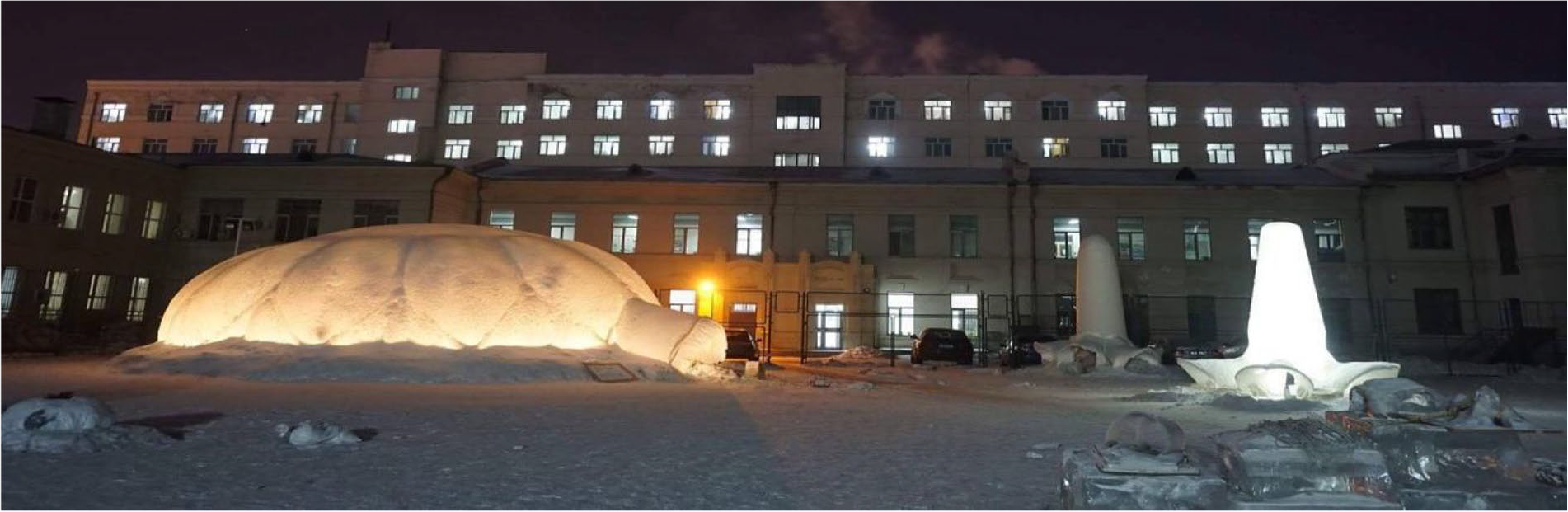
The three ice structures in Harbin, China, 2016 (photo by Luo Peng).
In China, it is the first time to construct this type of ice structures with ice composite materials. To do this, a Sino-Euro Joint Studio of Ice Architecture Construction was organized by the School of Architecture of Harbin Institute of Technology. Supervised by Wu, Luo, and Pronk, 43 Chinese students (including three master students and three bachelor students from School of Civil Engineering, 15 master students and 22 bachelor students from School of Architecture), two Dutch master students and two Belgian master students majored in architecture joined these pilot projects. After the preparation work of 3 months and the construction work of 14 days, these projects were built successfully with different cultural and professional backgrounds. These projects also attracted some local people or student volunteers from other universities.
The structures were made by using inflatable molds consisting of PVC polyester membranes. Two ice composite shells were built in Harbin in December 2016. 13 The mold for the ice dome structure was a result of the manipulation of a synclastic membrane with a rope net. The mold for the ice tower structure consisted of some anticlastic surfaces. Form-finding of the inflatables was modeled with the program EasyForm (a self-programmed plug-in in Grasshopper based on Vector Form Intrinsic Finite Element method). In a low-temperature work environment (–10°C and below), the shell structures were constructed on the inflatable molds. The cellulose-water mixture was sprayed in thin layers continuously and uniformly in order to make the surface of a shell of cellulose-reinforced ice. The fluidness of the reinforced materials during the spraying process, the reinforcement ratios, the construction sequence, the construction speed and other detailed techniques were tested and analyzed.
The questionnaire
In December 2017 a Questionnaire on learning topics is done in the three-parallel ice-building projects concerning Juuka Finland, Manitoba Canada and Harbin China. These projects are related to each other by the in IASS Project initiators of respectively the faculties of Architecture belonging to the Universities of Technology from Eindhoven, Manitoba and Harbin. This is the third questionnaire in a row with focus on learning results of ice building. In December 2014 a Questionnaire on group dynamics with special focus on teamwork learning and teamwork results is done during the ice dome building at Juuka Finland. The results were published as result of the Juuka Finland ISOFF Ice Symposium. 15 The conclusions called that leader type participants and local heroics do stimulate the most of the other participants special in the severe and exciting final stage of the ice building project. Apparently, the participants during the project learned how to motivate themselves under changing circumstances.
During the Harbin China ice building December 2016 recently, a questionnaire is done on the role of cultural differences and communication in relation to result and success (not published yet and without SSPS analysis yet). As the Harbin China 2016 project was concerning the cultural-mix different to the three former pure European Juuka Finland projects with participants from China and Europe there was interesting in learning how cultural and language difference could be of influence to results and success. One of the results was that using English as main language solved most of the language and cultural differences for the project. A striking difference showed to be the need of advanced project planning under the Chinese participants mainly. More than the European people they asked for better planning preparation and cooperation in decision making. All participants showed to be hard working, result driven and motivated into the learning experience of the ice building project.
Based on the experience and results of these two questionnaires the logical step towards a questionnaire on all the university related ice building projects concerning learning experiences could be made easily with necessity. The former questionnaires though with focus on results and preparation already ended out in learning experiences. The universities related became interested in the learning aspect too. Thirdly from the questionairing done the technique delivered insight how to handle questionnaires under the extreme circumstances of ice building. The result was the questionnaire on the practice of learning during and as result of the ice building projects to be researched on the Finnish, Canadian and China project mentioned. Based on the experiences delivered by these projects there is chosen for a questionnaire after and not during the ice building itself. This to achieve a higher percentage of questionnaire participation. Secondly the questionnaire could be done by internet filling up the data base directly with less work generating more quality on the data.
As “Conceptual model” reflection for this questionnaire research is found in Bloom’s “Pyramid of Learning Levels” 15 , see Figure 8. The six levels of learning according to Bloom: Remembering, Comprehending, Applying, Analyzing, Synthesizing, and Evaluating could simply be related to the practice of learning during the ice building projects. With Bloom’s foundation the questionnaire asked for expectations, motivation factors, personal feelings, technological learning aspects, teambuilding and other organizing experiences and general hints for making results better. This resulted in two series of five questions respectively related to technical and non-technical related learning aspects.
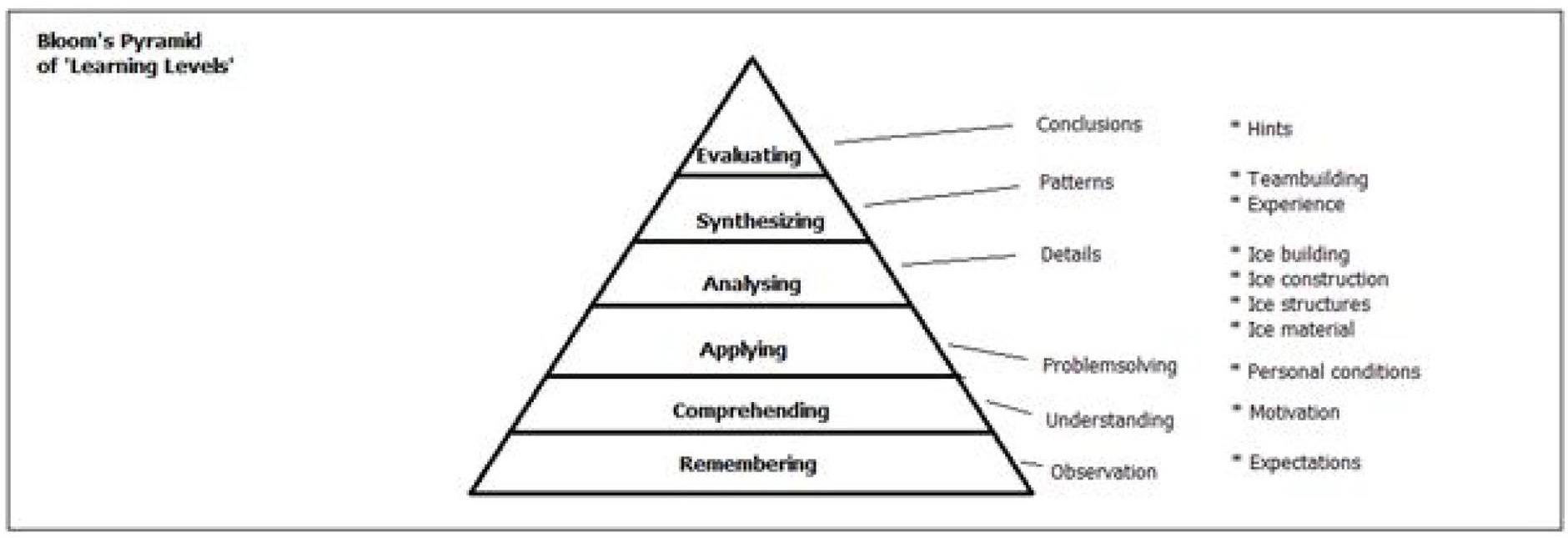
Pyramid of learning levels’. 14
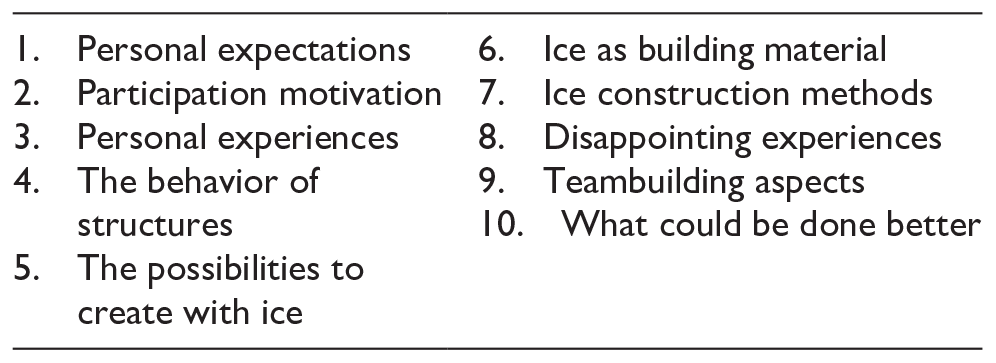
Therewith the questionnaire questions became, “What did you learn about”:
Method
The link to the digital survey was distributed via e-mail to all past contributors, via the coordinators of each of the projects. Eighty-nine Respondents started the survey (26 respondents from the Chinese project, 45 respondents from the Finnish projects, 12 from the Winnipeg project and 7 from the Edmonton project). Only respondents with a 90% or more completion rate were included in the analysis, ending up with a total of 69 (15 respondents from the Chinese project, 36 respondents from the Finnish projects, 10 from the Winnipeg project and 7 from the Edmonton project). The response rate for the different locations ware for: China 15/26 is 58%, Finland 36/45 is 80%, Winnipeg 10/12 is 83% and Edmonton 7/7 is 100%
The answers to the open questions (“What was your main motivation to participate in the process,” “what was your most valuable experience,” what was your most disappointing experience,” What were your expectations for the project,” and “If you participate again, what would you like to change”) and where respondents were asked to write down an example of what they learned (“I learned a lot about the behavior of structures,” “I was surprised by what is possible to create with ice,” “I learned a lot about construction methods,” and “I learned a lot about teambuilding”) were first qualitatively analyzed on content before categorizing them. For example, the open answer on the question “What was your most valuable experience” was “Working together with friends and locals in a new environment” and was categorized as “people.” Following the categorization, categories were checked with the other authors before they were entered in a statistics program (spss) with the rest of the data.
The results
To find out whether there were differences between the countries in how the projects were rated, means were compared between Edmonton (Canada), Winnipeg (Canada), Finland, and China. On three variables (with a scale from 1 “totally disagree” to 10 “totally agree”) differences between the projects in the three countries were found, see Figure 9. On the variable “I learned a lot about the behavior of structures” Winnipeg scored highest, followed by China, and lastly Edmonton and Finland (China (m = 7.8) <–> Finland (m = 6.03) <-> Winnipeg (m = 8.8) <-> Edmonton (m = 6)). For the third variable, “I would participate again” Finland scored lower than Winnipeg and Edmonton, but there were no differences with China (Finland (m = 7.97) <-> Winnipeg (m = 9.6) <-> Edmonton (m = 9.7)). For two variables Winnipeg scored the highest comparing to Edmonton, China and Finland. For the third Winnipeg (9.6) was slightly lower than Edmonton 9.7) For the variable “I would like to organise a small project myself” Winnipeg had a higher mean score than Edmonton, Finland and China (Winnipeg (m = 7.8) <–> Edmonton (m = 7.6), Finland (m = 5.31), China (m = 4.92)), see visualization. Thus, some differences between the projects were noticeable in the experiences of the participants, but it is not clear from only the data as to why they are different.
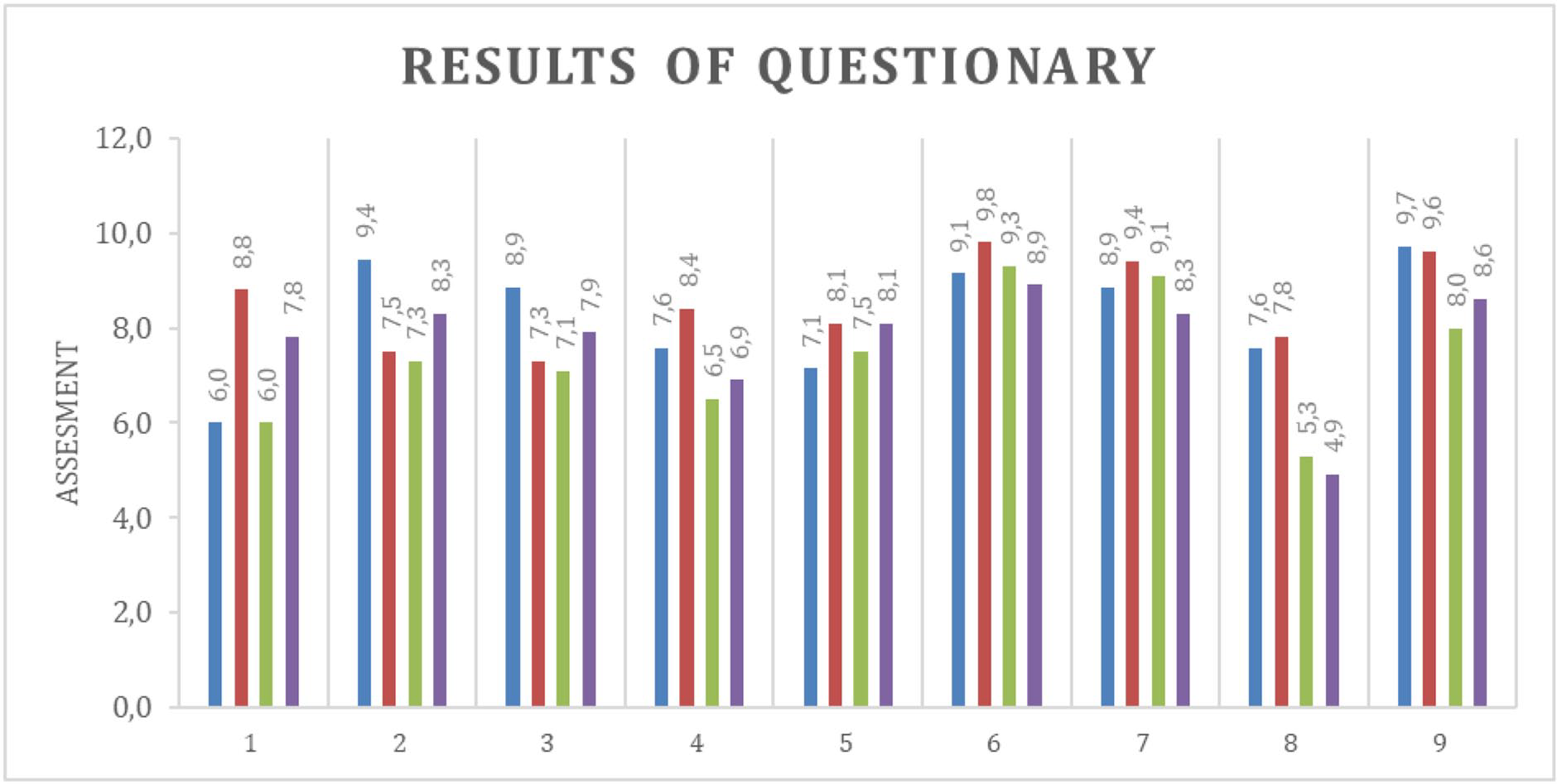
Results of questionnaire: blue = Edmonton, red = Winnipeg, green = Finland and purple = China.
The question was whether participants of the projects learned something about the construction with ice, and if so, which factors were important for the overall experience and motivation to learn. Therefore, the score (rate on a scale of 1 “totally disagree” to 10 “totally agree”) on the statement “It was worth it” was taken as a measure of success (min = 5, max = 10, mean = 9.24). A linear regression analysis with “it was worth it” as a dependent variable and as independent variables “I liked working in a team working towards a common goal”, I would like to organise a small project myself,” “I learned a lot about the behavior of structures,” “I was surprised by what is possible to create with ice,” “I learned a lot about ice as a material,” “I learned a lot about construction methods,” “I learned a lot about building,” and “I would participate again.”
There was a significant change for the model as a whole (sign F change = 0.00, adj. R2 = 0.609), but only “I liked working in a team working towards a common goal” was a significant contributor (sign = 0.00, beta = 0.629). It seems that for a worthy experience, working in a team towards one common goal is more important than learning about the technical content of building something with ice.
I learned a lot about the behavior of structures
I was surprised by what is possible to create with ice
I learned a lot about ice as a material
I learned a lot about construction methods
I learned a lot about team building
It was worth it
I liked working towards a common goal
I would like to organise a small project myself
I would participate again
Considering the learning experiences of the participants, we asked to what extent they agreed with what they learned on certain topics (1 “not at all” to 10 “completely”). With means around 7 (“I learned a lot about the behavior of structures” mean = 6.89, “I was surprised by what is possible to create with ice” mean = 7.66, “I learned a lot about ice as a material” mean = 7.31, “I learned a lot about construction methods” mean = 6.89, and “I learned a lot about team building” mean = 7.73), the project seems to have been successful in offering a learning experience, both for the team building aspect as for the technical content of building with ice.
The variables that were categorised based on content were entered in crosstabs to find which categories were mentioned the most by the people who agreed most with the statement “It was worth it.” Most 10’s given by the respondents to the statement describe “construction process” as the motivation to participate, “people” as the most valuable experience, “construction” as the most disappointing experience, “knowledge” and “project management” as expectations for the project, and “project management” as what they would be most likely to change.
When zooming in on what aspects for team building experiences were important, apart from specific comments about the team also communication and organization was mentioned often by respondents indicating they agreed a lot with the statement.
Overall, it can be said that from linear regression analysis with “it was worth it” related factors, “teambuilding and experiences” scored better then “the ice related technical” reasons for participating the ice-building projects in China, Finland and Canada. Although scanning “topic learning factors” showed that the main factor for participation was the ice-construction process itself. Still therewith “working with people” was mentioned as the most “valuable experience” while “the construction itself” was mentioned as disappointing. What shows a remarkable difference in between the “construction process” and the “construction result.” Apparently “working with others on the ice project” shows to more important for participating then the “ice building itself.” Overall, it can be said that the participating people mostly students learned actively by participating and working on the ice building project almost on all levels of Bloom’s pyramid of learning levels. Therewith it is not surprising that “being part of a team” scored better among the participating students then the “technological aspect” of the ice-building projects. Students being young and very motivated into learning logically do go for the highest levels of learning being “patterns of people’s behavior” and “searching conclusions.”
Conclusion and acknowledgements
In summary, all projects have been appreciated very well for their learning goals and group dynamics. Both individuals and the group as a whole play a role in how successful the project was. Good teamwork and the fact that every single person contributes to a unique and spectacular project influence the project in a positive way. The final conclusion is that large international projects such as described above result in both the gathering in-depth knowledge on the subject and an increase in motivation of students in their education. Thus, a perfect synergy between research and education is realized by these projects. We kindly thank all participants that have responded to the questionnaire.
Footnotes
Declaration of conflicting interests
The author(s) declared no potential conflicts of interest with respect to the research, authorship, and/or publication of this article.
Funding
The author(s) received no financial support for the research, authorship, and/or publication of this article.
