




Abstract
Background
Academic writing is essential for researchers to present the research output in a legitimate manner with a precise and clear representation of research data, but few have mastered the art of writing well. Research and researchers are responsible for upholding academic honesty, integrity, and ethics. Needless to say, plagiarism has been around since antiquity, but it has never been as pervasive as it is now. Plagiarism is gradually ingraining itself into our educational system. Pupils are increasingly using the Internet and ICT-based tools to find quick “shortcuts” to the worthwhile but time-consuming task of preparing research papers. Being the third-largest publishing nation, it is the duty of the stakeholders to uphold and work for publication excellence with research ethics and honesty. Since there are so many research articles being published, it is important to understand publishing ethics and anti-plagiarism software in the research domain. If authors are taking ideas from previously published documents or other authors’ works, it is important to ensure acknowledgment and credit in terms of citations, bibliographical references, providing in-text citations, footnotes, and quoting them in any standard citation style. Plagiarism can also be defined as the paraphrasing and text recycling of documents. The challenges in research, which compromise ethics, are also from different stages of research, which include fabrication and falsification of data, AI-based text-generating tools, test recycling, ghostwriting, image plagiarism, audio-to-text-converting tools, etc. A one-stop solution to address all these issues on a single platform is not feasible as it involves multi-level checks and proper policy blended to be implemented at many levels.
Objectivity
In this paper, analysis and study examine the national awareness of anti-plagiarism software. The primary objectives of the study are to raise awareness and investigate the current state and status of the use of anti-plagiarism software in Bharat (PDS).
Methodology
The data was collected through the portals and websites of ShodhShuddhi, Shodhganga, and the INFLIBNET Centre. Initiated with 200 universities in the year 2015, about 1086 higher education institutions (HEIs) are provided with PDS under ShodhShuddhi, out of which 894 institutions are active in using software for checking similarities. Three years of usage by active institutions are taken for analysis and study by 1.3 lakh faculty members and research scholars. The increase in usage, even during COVID time, shows that awareness is created in the nation, and the percentage of similarity in first document submission is also coming down gradually in the nation. Character building in academic matters and innovations are key outcomes that can be achieved by addressing plagiarism to strive for a knowledge-based nation.
Keywords
Introduction
Millions of documents have been published globally. India ranks behind the US and China as the third-largest publishing nation (India Today, 2020). There are numerous documents on the internet that can be accessed for free and others that require a subscription. Anyone can view all the documents with ease. Due to time constraints, ignorance, or any other reason, a writer could either plagiarize the work of another author without giving them credit or paraphrase or recycle the text of other works. In order to develop new ideas, concepts, methods, and results based on previously accepted theories, research involves both the invention of new knowledge and the imaginative application of preexisting knowledge (Chien, 2017). But research must be carried out responsibly, without stealing ideas from other scholars. The study concentrated on educating UG, PG, and research scholars in India on the value of original writing and avoiding plagiarism. (Singh et al., 2023).
2018 UGC regulations for promoting academic integrity and preventing plagiarism in higher education
Penalties as per the UGC draft
On September 21st, 2019, the government of India’s Ministry of Education began implementing the “ShodhShuddhi” programme, which gives universities free access to plagiarism detection software. The Inflibnet Center is in charge of carrying out this effort under the direction of the MHRD. “ShodhShuddhi” is a combination of the Sanskrit words “Shodh” and “Shuddhi” (https://pds.inflibnet.ac.in). ShodhShuddhi is a method for removing plagiarism from a study that employs plagiarism detection software (Shodhsuddhi, 2022).
Information and Library Network (Inflibnet) Centre is an autonomous Inter-University Centre of the University Grants Commission (UGC) of India. The UGC launched this significant national programme in 1999. Over 100 universities and institutes were offered the anti-plagiarism programmes iThenticate and Turnitin in 2014–2015 by the Inflibnet Centre, which has long taken the lead in the fight against plagiarism in academic and research works (Kumar and Arora, 2015). Universities that have complied with the Section 12(B)/2F provisions of the UGC Act and signed the Shodhganga/Shodhgangotri Memorandum of Understanding with the INFLIBNET Center are now a part of the Shodhsuddhi Project and use Ouriginal plagiarism detection software (Inflibnet.ac.in).
A web-based plagiarism detection software system called Urkund, which was renamed Ouriginal after March 15, 2021, is being made available to all universities and institutions in India as part of the “ShodhShuddhi” programme after being selected through a global tender process by the Inflibnet Centre (Parmar and Matieda, 2021). The Ouriginal plagiarism detection software has several useful features, including easy monitoring, faculty accounts, reports with side-by-side comparison, the ability to understand paraphrased content by looking at text matches, similarity reports, a percentage of plagiarism, support for multiple Indian languages, and many more (Subaveerapandiyan and Sakthivel, 2022; Whittle and Murdoch-Eaton, 2008).
Types of institutes.
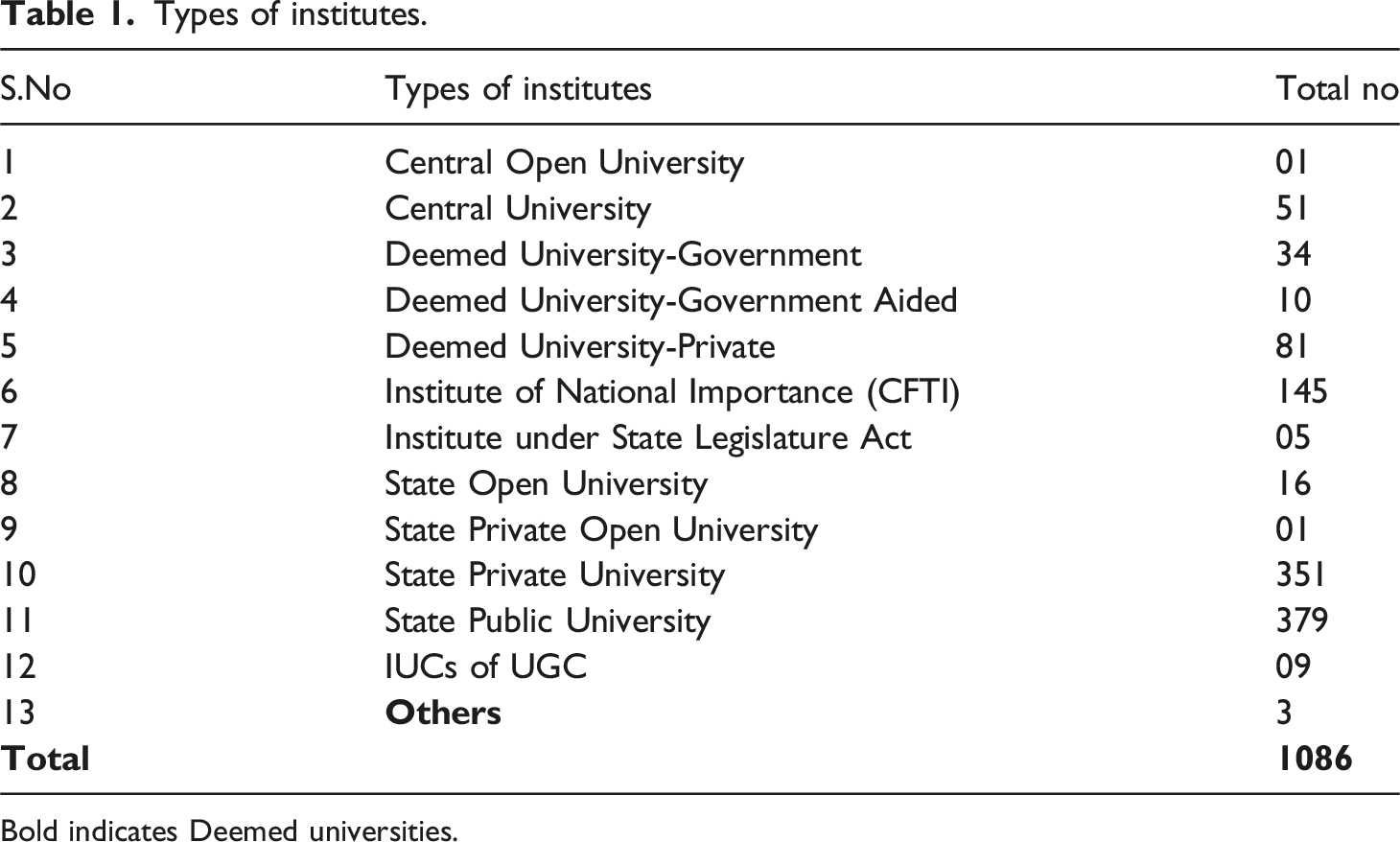
Bold indicates Deemed universities.
Types of institutes
Objectives of the study
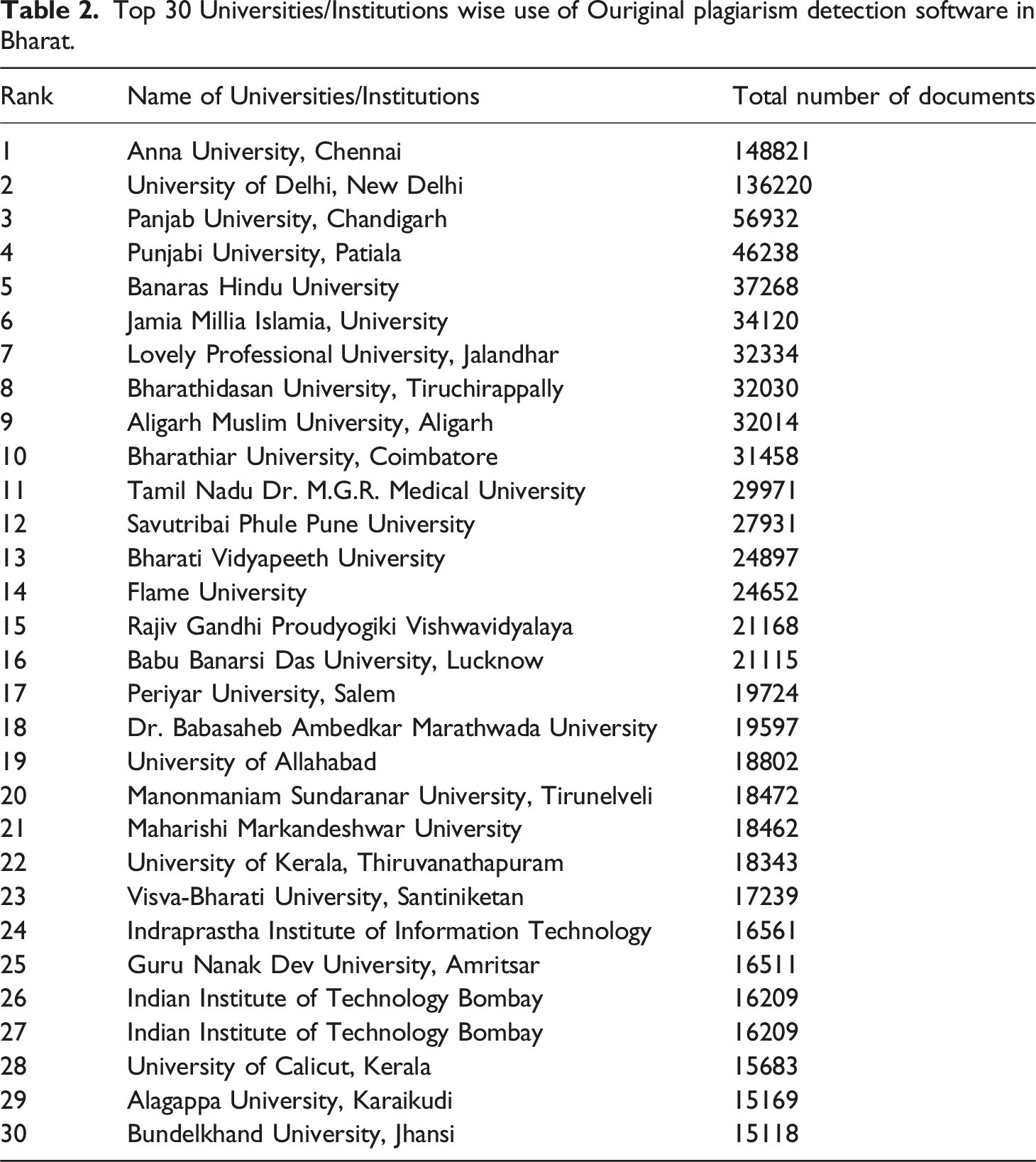
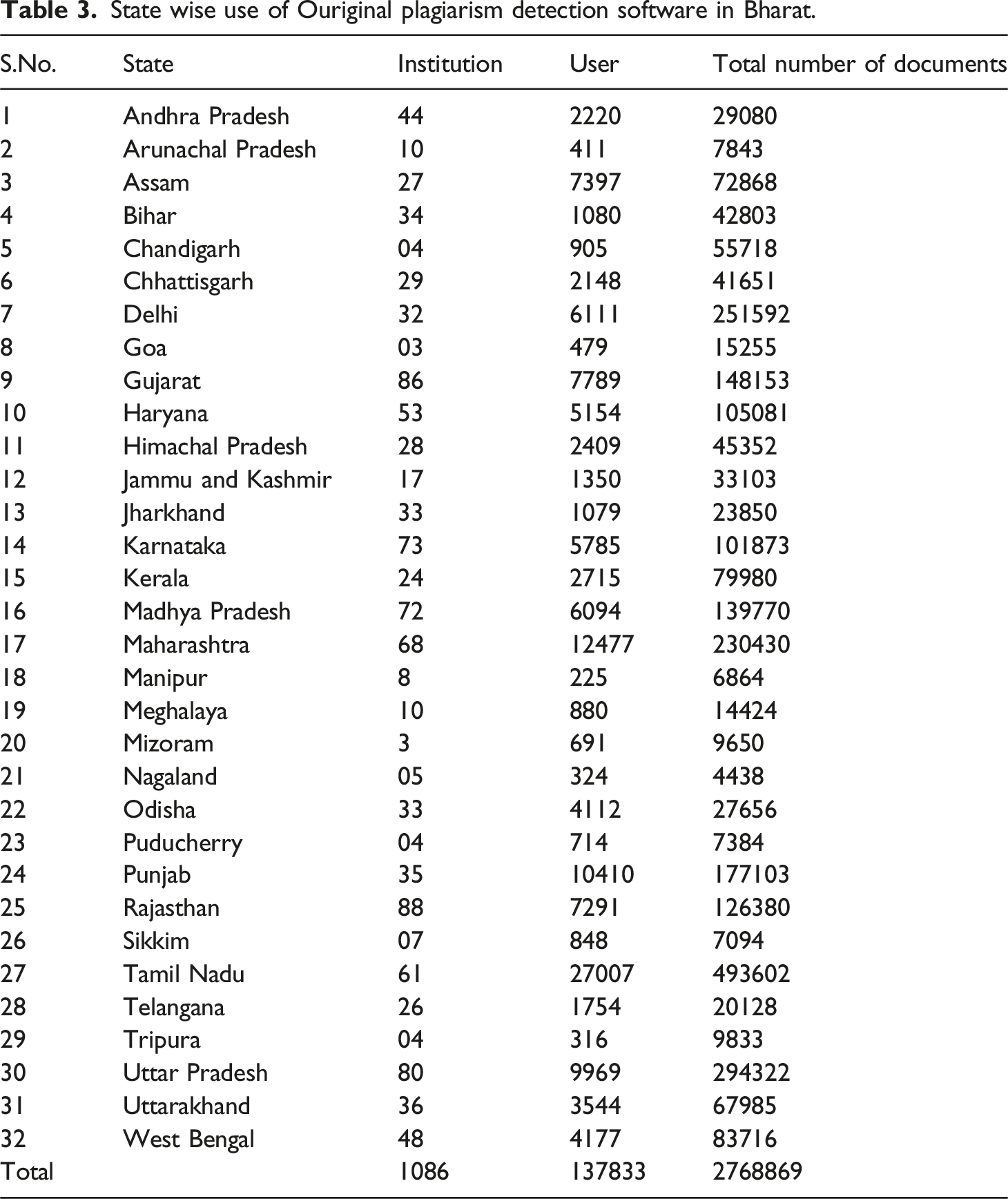
• To determine which 30 Indian universities or other institutions are the highest users of Ouriginal plagiarism detection software. • To ensure that the awareness regarding anti-plagiarism software in Bharat. • To investigate the overall number of documents examined in Bharat annually. • To be informed about the state-by-state usage in Bharat of Ouriginal plagiarism detection software. • To ascertain Shodhsuddhi’s total page views for the year 2022.
Limitation and methodology of the present study
Researchers have gathered data from the websites of pds.inflibnet.ac.in, inflibnet.ac.in, and shodhganga.inflibnet.ac.in for the current study. Data was collected till December 2022. (September 2019 to December 2022). The study is restricted by the Ouriginal anti-plagiarism tools made available by Inflibnet as part of the ShodhShuddhi initiative in Bharat. Data was collected, organized, and tabulated with the help of MS-Excel or MS-Word. There are 1086 institutions or universities that have participated in the Shodhsuddhi project for plagiarism check, but 197 institutions or universities have zero submissions. So those were excluded from the study. Only 889 institutions or universities are active.
Data analysis and Interpretation
Top 30 Universities/Institutions wise use of Ouriginal plagiarism detection software in Bharat.
State wise use of Ouriginal plagiarism detection software in Bharat.
Total numbers of documents are checked per year in Bharat.
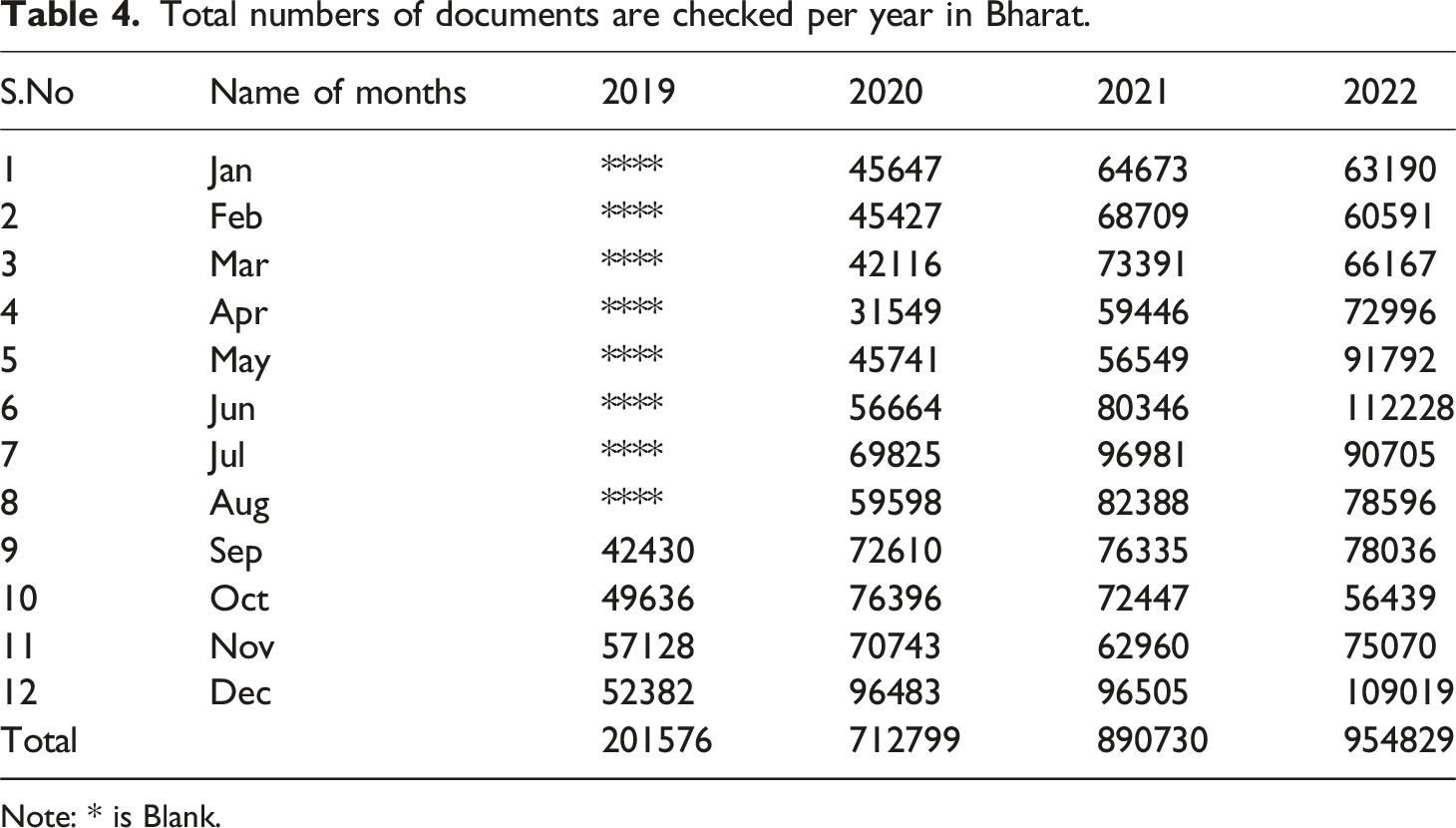
Note: * is Blank.
The table and figure examine how Ouriginal plagiarism software was used in India from September 2019 to December 2022. The table and figure demonstrate the year-by-year papers that Indian universities and institutions checked using Ouriginal plagiarism software. The number of documents reviewed in India is constantly increasing. Only 25, 58,358 documents were verified in India for plagiarism in the 3 years from 2020 to 2022. The numbers that have been checked above show that Indian authors are aware of plagiarism. The month of December has seen a steady rise in the number of documents submitted for plagiarism checks in India from 2020 to 2022, according to the data. (Figures 1 and 2). Total numbers of documents are checked per year in Bharat. Total page views in shodhsuddhi.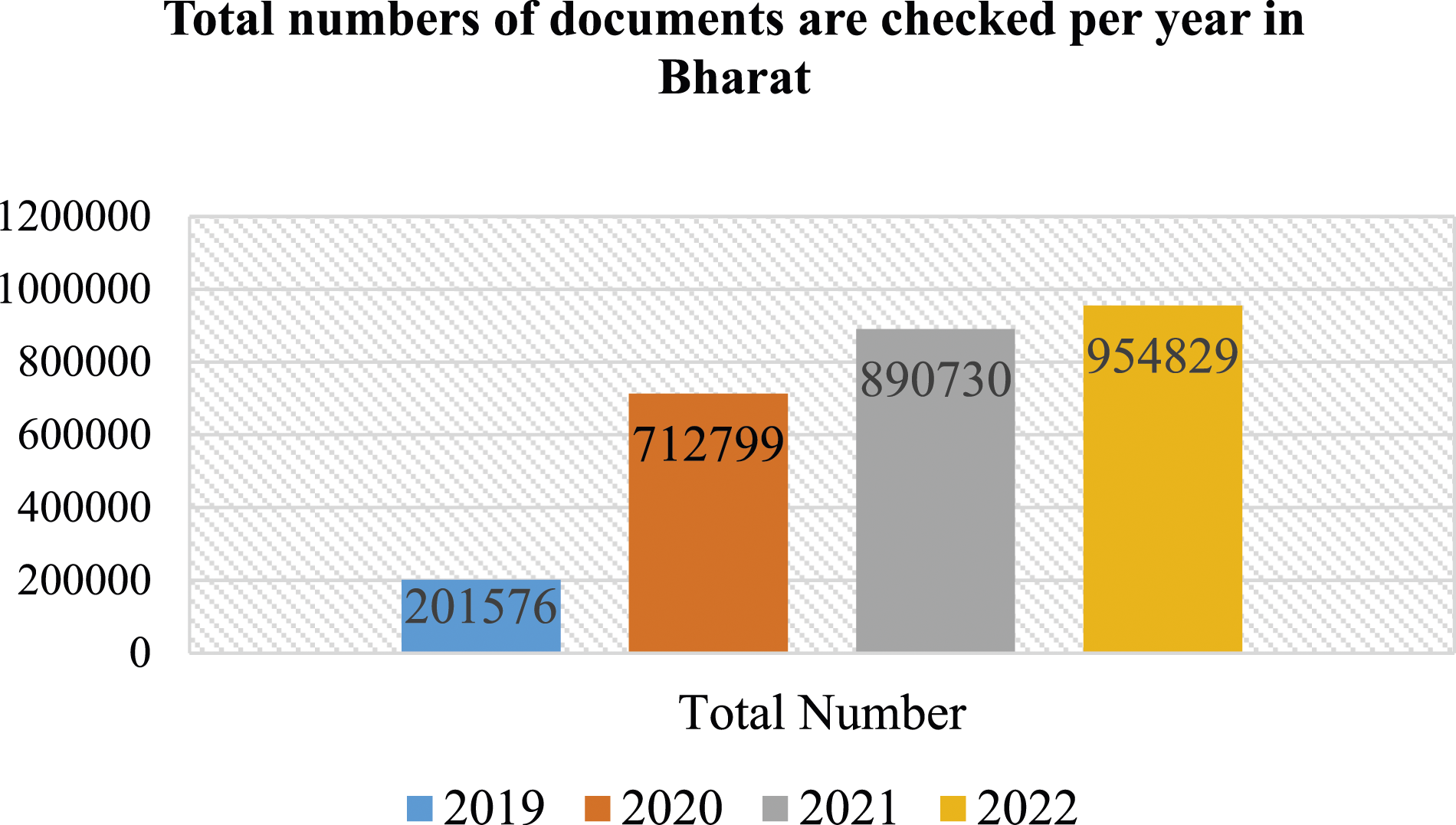
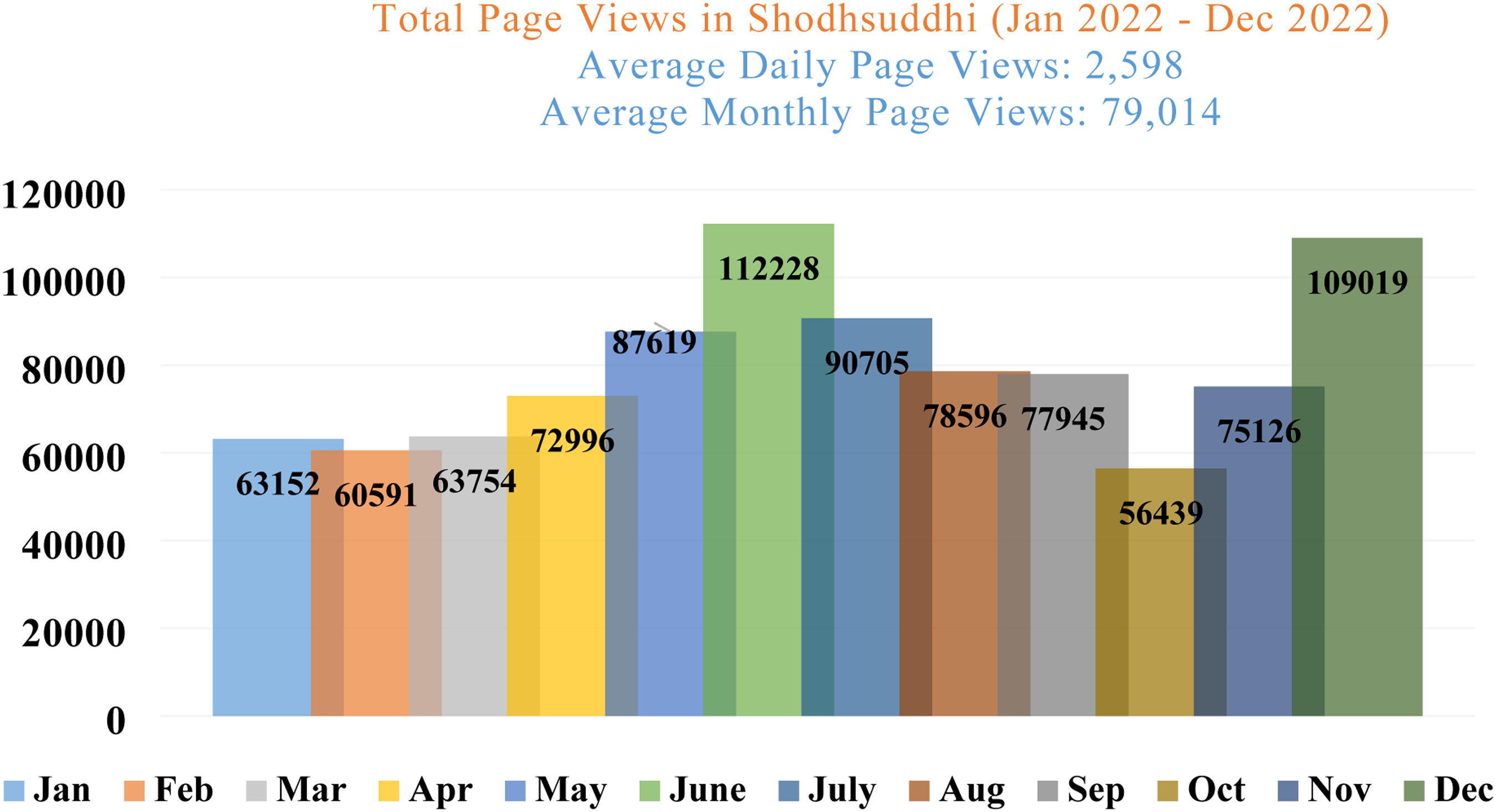
The above figure shows the total page views on the Shodhsuddhi website during 2022.948170 hits were received during 2022. According to the data, the months of June and December received the most views.
Average Daily Page views: 948170/365 = 2598
Average Monthly Page views: 948170/12 = 79014.
Discussion
There are 77358 Indian theses submitted in Shodhganga (Reservoir of Indian Theses) (Shodhganga, 2022) only in year 2022 with the plagiarism checked report (shodhganga.inflibnet.ac.in). The data showed that Indians author seriousness. The ShodhShuddhi programme was initiated by the ministry of education, government of Bharat (https://pds.inflibnet.ac.in/) for all Indian universities or institutions. The (Whittle and Murdoch-Eaton, 2008) ShodhShuddhi initiative is the best way to promote scientific productivity because it is available to all higher institutions that have signed a MoU with the ShodhShuddhi project, its available at free of cost to all higher institutions, so there is no need to purchase or subscribe to any other plagiarism tools. The ShodhShuddhi initiative also supports the One Nation, One Plagiarism tool for all Indian universities or institutions. It is a cost-saver, or when the same plagiarism tool is used by all Indian universities or institutions, there is more chance to get more authentic plagiarism reports. The finding of present study supports the previous study (Parmar and Matieda 2021). In the prior study (Chien, 2017), stealing work or ideas was also addressed; now it’s time to raise awareness of publication ethics, maintain academic integrity and establish a plagiarism-free learning environment. (Kale, 2019; Opara & Ezeonye, 2021; Subaveerapandiyan & Sakthivel 2022). Paraphrasing and text recycling are also components of plagiarism, so authors exercise greater caution. At the present time, we have major challenges in the field of plagiarism. Lots of techniques are available, like artificial intelligence (AI) text generators tools, image plagiarism, sound, and voice-to-text converters, all of which present unique challenges. It is time to understand its seriousness and the need to solve these unique challenges very soon.
Conclusion
The twenty-first century is plagued by a serious problem called academic dishonesty. (Singh and Mahawar, 2020; Singh et al., 2022). Plagiarism in research is a sign of misconduct. It is wrong and unethical to claim someone else’s intellectual effort as one’s own. The Indian government’s ShodhShuddhi initiative is a critical step in ensuring that Indian authors work in an environment free from plagiarism and preserving the reputation of educational institutions. Giving authors credit is made easier by plagiarism-detecting technologies. The current study is beneficial for spreading knowledge about plagiarism detection tools. According to the study, 1086 Indian universities and institutes use the original plagiarism detection tools provided by the MHRD-directed Shodhsuddhi project of Inflibnet, but 889 educational institutions are active. The results of the study demonstrate that Indian authors are knowledgeable of plagiarism, academic ethics, and integrity. 2757934 research documents have been checked in India in the past 40 months, which demonstrates the level of awareness. The study also focused on creating awareness among UG and PG students and research scholars in India regarding the importance of self-writing and plagiarism.
Suggestions
• Start educating undergraduate students (UG) and Postgraduate students (PG) about the importance of writing all assignments in your own words and properly citing your sources so that, in the future, they will be able to produce articles and theses without plagiarizing. • Addressing all UG and PG students with the intention of educating them on the value of writing assignments on their own words and ensuring that they are free of plagiarism in the next few years. • The study’s findings suggest that professors and librarians provide lectures on referencing styles like APA, MLA, Chicago etc. so that authors can easily write references or cite the documents, as well as the importance of anti-plagiarism software. Anti-plagiarism software alerts the author to previous research.
Footnotes
Declaration of conflicting interests
The author(s) declared no potential conflicts of interest with respect to the research, authorship, and/or publication of this article.
Funding
The author(s) received no financial support for the research, authorship, and/or publication of this article.