




Abstract
This paper explores the National Emergency Library (NEL) created by the Internet Archive (IA) in response to the COVID-19 pandemic. The NEL allowed unrestricted access to the IA’s collection of digitized books, suspending the waitlist imposed by the Controlled Digital Lending system. The study uses Carol Bacchi’s What’s the Problem Represented to be (WPR) approach to analyze problem representations in media narratives and understand the response to the NEL. The study covers articles written between March 2020 and 2 years after, using a threepronged reading consisting of a distant, middle, and close reading. The analysis reveals that the IA and NEL are not necessarily consistent with piracy or shadow libraries, but that they differ in complexity and compliance with copyright law. The paper contributes to a critical understanding of how problem representations are constructed and shaped in media narratives, and how this affects digital libraries in times of crisis, and subsequently, policy discourse for all libraries. Overall, the paper highlights the complexities and nuances surrounding the NEL and its response to the COVID-19 pandemic, as well as the implications of this response for digital libraries and copyright law.
Since 1996 the Internet Archive has been working on archiving the internet, this to capture the ephemeral nature of “online” and storing it. The Internet Archive (IA) works as a non-profit and defines itself as a digital library of “internet sites and other cultural artifacts in digital form” (Internet Archive, n.d). The archive works through several different programs such as the Wayback Machine, which has taken interactive “snapshots” of internet web pages allowing for the nostalgic user to browse the internet of the past. As the IA positions itself as a library first and foremost, it also hosts one of the most expansive and comprehensive collections of scanned books in the world through the Open Library, a library collection that occupies a startling 45 Petabytes of server space (archive.org/about). This collection is treated equivalently to a physical collection through the Controlled Digital Lending (CDL) system, meaning that the amount of loans of a book corresponds with the number of physical copies the IA owns (Hansen and Courtney, 2023). The aim of the IA project is “to provide Universal Access to All Knowledge” (Internet Archive, n.d).
A shadow library is a systematic and illegal platform for book piracy (Bodó, et al., 2020). Like any “normal” library the various shadow libraries take on different shapes in terns if collections and structure. Some shadow libraries focus primarily on scholarly articles, using users’ institutional access to mass download copies through donations or brute force (hacking, phishing) (Kehnemuyi, Larsen, 2019). Other shadow libraries aim at having larger collections of both fiction, non-fiction, and comic books, whilst some run more boutique approaches catering to distinct subjects. Often, they are sustained through user uploads and donations, creating an illicit network of shadow “librarians” (Kjellström, 2022). They are illegal because they remove paywalls and material restrictions instigated by copyright and intellectual property law, working through circumventing the systems of control set in place to ‘freely’ disseminate literature through various websites and torrent hubs.
In late March 2020, the stark reality of the COVID-19 global pandemic hit the library sphere. All over the world lockdowns created an untenable situation, and library patrons and readers were unable to access books for leisure or academic purposes. In a response to the crisis, the IA created the National Emergency Library (NEL) to service, primarily a US readership, with books. The NEL worked primarily through suspending the waitlist imposed on the IA’s collection of digitized books, meaning that several patrons could borrow books unrestricted, rather than through the CDL-system. This meant that all waiting lists for books were removed, and complete access to the collection was given. In a blog post regarding the NEL the IA explained the NEL program in the following way “The library system, because of our national emergency, is coming to aid those that are forced to learn at home… This was our dream for the original Internet coming to life: the library at everyone’s fingertips” (Freeland, 2020).
On June first, 2020, the publishers Hachette, HarperCollins, Penguin Random House, and Wiley collectively filed a complaint regarding copyright infringement. The complaint claims that the IA is “engaged in willful mass copyright infringement” (Case 1:20-cv-04160). Furthermore, the complaint points out that the IA “grossly exceed legitimate library services” and that the nature of the NEL is “Consistent with the deplorable nature of piracy” (Hachette Book Group v Internet Archive, 2020).
With the NEL, IA has moved into unchartered territories with its already questioned practice regarding the dissemination of digital books. The copyright industry has long waited for an opportunity to further regulate the CDL and control the distribution of scanned books. This paper aims at understanding how the solutions imposed by the IA at the precipice of the corona pandemic, swiftly went from heralded to criticized, and further, how the auspices of crisis were manipulated to institute legal action on the NEL – and beyond. In addition to this overarching aim, the NEL will be put in contrast to shadow libraries to further define the term and situate it in a current case, this is done with hope to illuminate where the borders of copyright and intellectual property are drawn in the publishing community. More succinctly, this article aims to map the discourses surrounding the lawsuit and the NEL, to understand the differences between the NEL and a shadow library.
Data
To conduct a distant reading analysis on the establishment and downfall of the National Emergency Library (NEL), I collected newspaper articles using the Dow Jones Factiva database. To refine my search, I used the search string “National Emergency Library” AND “Internet Archive” and limited my search to English-only articles from the past 5 years. This ensured that my results would be relevant and not contain any older articles.
I only selected articles that had at least 100 words discussing the NEL or the Internet Archive’s free and open lending implementation. This gave me a total of 104 articles, which I then narrowed down to 64 by removing duplicate articles using Factiva's filtration. I then added an additional 17 articles found through traditional search engines, resulting in a total of 78 articles for analysis. These articles where searched using googles news search using the keywords “NEL”, “Internet Archive” and filtered for the same time-period as the Factiva search.
Some of the chosen articles only provided links to other newspapers or magazines not included in Factiva's database. To address this, the full articles were retrieved using Factiva as a starting point. I also sorted out articles that were thematically focused on “things to do during the pandemic” but still included mentions of the NEL if they met the prerequisite of having at least 100 words discussing the topic. Additionally, some articles were chosen despite only briefly mentioning the NEL because of their overall nature, such as an editorial on the importance of copyright or the spread of knowledge. In all, my process for collecting articles was comprehensive, ensuring that I had a diverse and relevant collection for analysis.
The collected articles will both be used for close and distant reading. The total amount of articles will be used for the distant reading section, to give an overview of the trends regarding the overarching story of the NEL, whilst the 17 articles that were handpicked from a series of google searches will be used for more in-depth reading and discussion.
Method and theory
The analysis covers articles written between the NEL’s announcement in March 2020 and 2 years after, consisting of approximately 78 articles with a closer reading of 17. The analysis is informed by Carol Bacchi’s WPR and is structured through a loose framework of close and distant readings. By doing so, the study aims to contribute to a critical understanding of how problem representations are constructed and shaped in media narratives, how this affects digital libraries in times of crisis, and subsequently, how these problem representations have an effect and influence on policy discourse for all libraries.
The study is informed by Bacchi’s six-step approach to understand how the problems of copyright infringement, libraries, and fair-use are represented in the media narratives surrounding the NEL (Bacchi, 2009: 2-19). To do so, a closer reading of selected articles, which chronicle the NEL from its inception through the lawsuit and the consequences for the NEL, the IA, as well as the overall idea underpinning their model in a post-pandemic world. Furthermore, the analysis aims to identify the dominant problem representations between text and context, to decipher how different media outlets created and circulated sets of signifiers that produced ideas of piracy akin to the archetypical shadow library. This constitutes the closer reading.
For the distant reading, two quantitative methods were employed: topic modeling analysis using the python library gensim with a Latent Dirichlet Allocation (LDA) model, and sentiment analysis using nltk’s Valence Aware Dictionary and sEntiment Reasoner (VADER). LDA is a probabilistic model assuming that the corpus (in this case the articles) has a mixture of topics, and that each topic is represented by a series of words. The total number of words for analysis were 55804. These have been filtered through a stopword filter, meaning that words that convey little meaning, but are in abundance (such as “as”, “the”, “very” etc.) are filtered away.
As the topic for all the articles used was overall similar, since they all dealt with the NEL. The LDA model was used to produce a limited number of topics, five of which were distinct enough to be used in the analysis, in total the model was set to create 50 topics. Due to the similarities between the articles a lot of the words that surfaced within each topic were frequently repeated.
VADER is a pre-trained sentiment analysis tool that operates using pre-ordained rules. It is designed to understand the sentiment of a text and provide a score based on three categories: neutral, positive, and negative. The score is created by calculating the presence of certain words within the corpus and contains an array of lexical rules such as intensifiers, contradictions, and positive and negative words. For this study it will provide an overall idea of how the wording in the articles have been affectively shaped. These methods were used to thematize the corpus and inform the readings.
The analysis is guided by the understanding that there is no distinction between discursive and non-discursive practices, treating the shadow library concept as a discursive object. By regarding the concept shadow library as a discursive object, steps can be taken towards understanding how discourses on for example piracy or legitimacy can transform the understanding of a legal archival project into a systematic illegal operation.
Results
In this section results from the distant readings are showed. The results are represented in a few different ways, these will be explained and discussed in relation to problem representations. By beginning with a wider perspective, an initial hint can be given as to how the articles are written on a more contextual level focusing on questions such as: “what is the problem?” and how has this representation of the problem come about?” (Bacchi, 2009: 4,6).
To understand this following section, it's necessary to begin with some transparency. Figure 1, a bar chart, provides insight into how to approach the upcoming topic modelling, and sentiment analysis. The chart indicates that the most common words in the corpus are predictable ones like “library,” “book,” and “copyright.” However, it’s the less frequently used words at the tail end of the chart that are the most intriguing, such as “pandemic,” “program,” “legal,” and “kahle.” The figure depicts the most used words in the articles. The x-axis shows the 30 most frequently used words, whilst the y-axis shows the frequency of each word.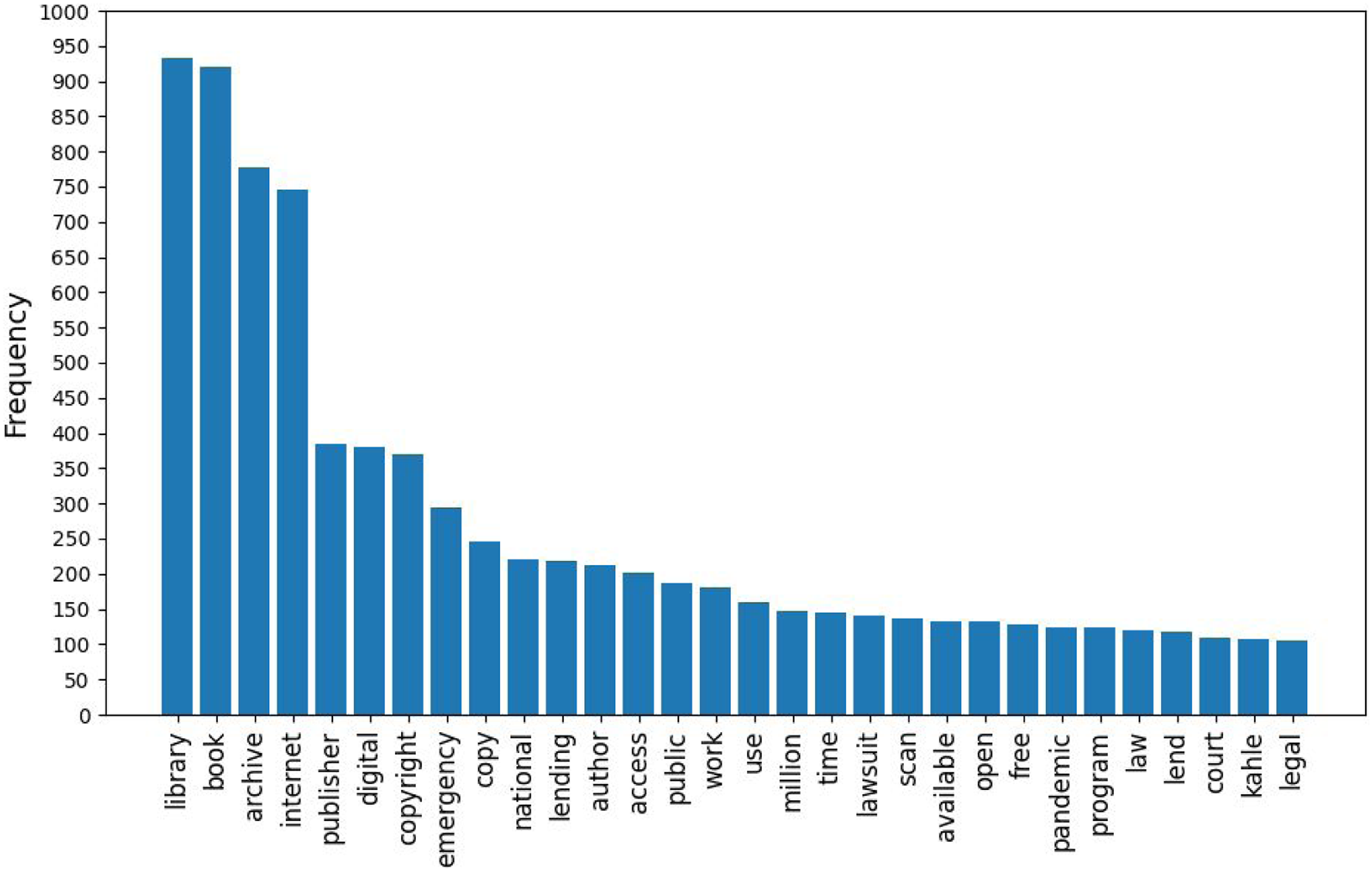
As most of the articles about the NEL deal focus on how it was a boon during the pandemic or the complaint that the Internet Archive faced, we might expect to find more words related to these issues in the chart. The only trace of this can be found in the word’s “copyright” and “publisher.” However, these are not as strong an indication as words like “court,” “legal,” or “law,” which would be more telling. On the other hand, “pandemic,” “program,” and “kahle” (in reference to Brewster Kahle, founder of the Internet Archive) could indicate that the NEL is connected to broader societal issues such as the impact of the pandemic on libraries and digital programs. Therefore, it could be more important to pay attention to the less frequently used words in addition to the more common ones to gain a more comprehensive understanding of the topics and issues discussed in the text. Overall, the bar chart provides a useful tool for identifying patterns and themes in the text, but a more nuanced approach is necessary to fully grasp the complexity of the issues at hand.
From a WPR (What's the Problem Represented to be?) perspective, it's important to distinguish the actual problem from any textual content. This helps us identify different entry points to understand how a problem is represented (Bacchi, 2009). At first glance, the bar chart might seem to provide a weighted perspective on what's important in the text. However, the same could be said of the rest of the results in this section. Figure 2. The topics and their corresponding words, as can be gleamed, many of the words are repeated throughout.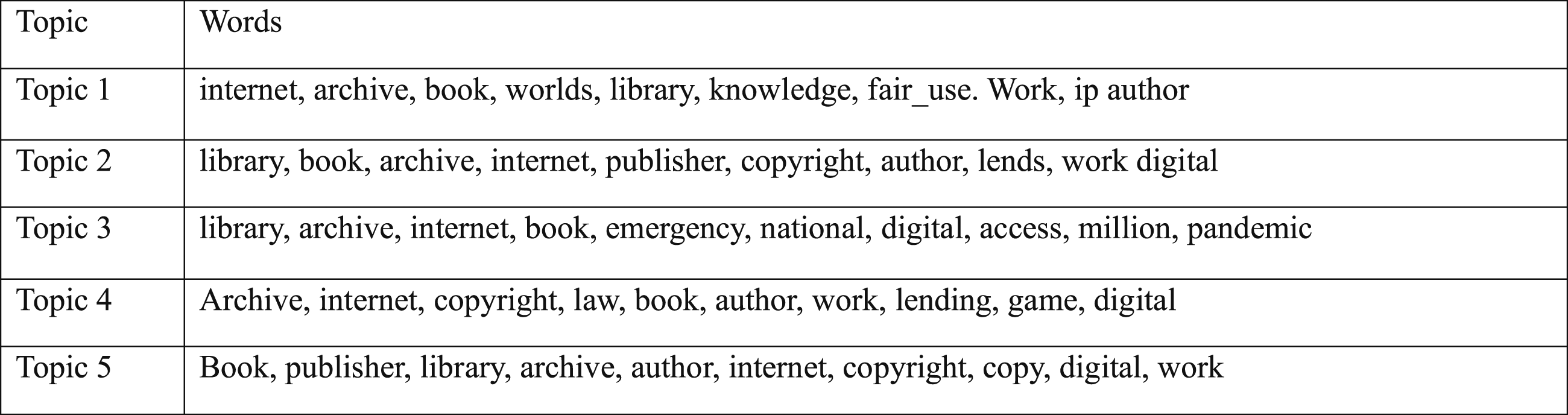
As expected, the most common words, as seen in the bar chart, are overly represented in each topic, this is expected due to their overwhelming presence in all the articles. And much like the bar chart, the topics, at face value, do not give much indication to how the problem is represented. However, with the context in place, a few things can be said about the topics and how they can further inform the problems within the texts. The first topics contains the words fair_use, IP, and author which all relate to discussion on copyright and intellectual property rights. Topic 2 is more closely related to publishing and lending practice, most likely relating the topic to controlled digital lending. Topic 3 discusses the crisis which produced the need for the NEL. Topic 4 is most likely related to the legal discussions found in the texts and should be regarded as corresponding topic with regards to the legal battle. Topic 5 is on the relation between publishers, authors, and the idea of copyright in the digital age. It is important to note that this are not the definite answers for what the topics are related to, but the result of intimate knowledge of the context as well as the overall corpus studied.
Using the WPR approach requires a thinking of oneself as part of the data, as the process of identifying a problem requires a degree of subjectivity (Bacchi, 2012: 22). When looking at the topics overall, there are several avenues of problems to concern oneself with, however, for this study, the most important is the discursive process that turned the organization and their efforts from a trusted non-profit to a purveyor of pirated books. From this perspective, topics 1, 3, and 5 are most important as they signal this process in the dataset. The other topics give the same indications but are more intricately interwoven. To further elucidate the relation between the topics, a representation of their relationship to each other is important.
Figure 3 is a network graph of the topics and their relations to each other. In it, one can see which words are unique for each topic, and which words are shared over several different topics. Topic 5, as mentioned, sits right in the middle, sharing almost every single word with topics 4 and 2. The only outlier being the word “game”. In topic 4, “game” has a large prevalence due to a longer article discussing the NEL in general (and the lawsuit), as well as the large collection of games that can be found on the Internet Archive. Topics 1 and 3 shine with their distinct nature in Figure 3, showing that they deal with two specific types of articles that were written during the process this study aims to map. Topic 3 is the problem representation of the beginning, with words such as “pandemic”, “access”, “millions”, “national”, and “emergency”. This topic reflects the sentiments that were found in articles published at the onset of the NEL, these articles were largely informative, positive (or neutral if short). At the point in time which topic 3 can be construed from, there was a general acceptance to the NEL and the IA as a whole, in the next section there will be indications showing that this was not universal, however, almost all the articles written share the general sentiment. If the problem is perceived at being the process of turning IA to a shadow library, the problem representation in the topic gives overall authority to the IA, not as a source of piracy, but as a legitimate actor. A network representation of the topics, showing the connections between the words in the topics, gives a clearer view of the intricate nature between certain topics.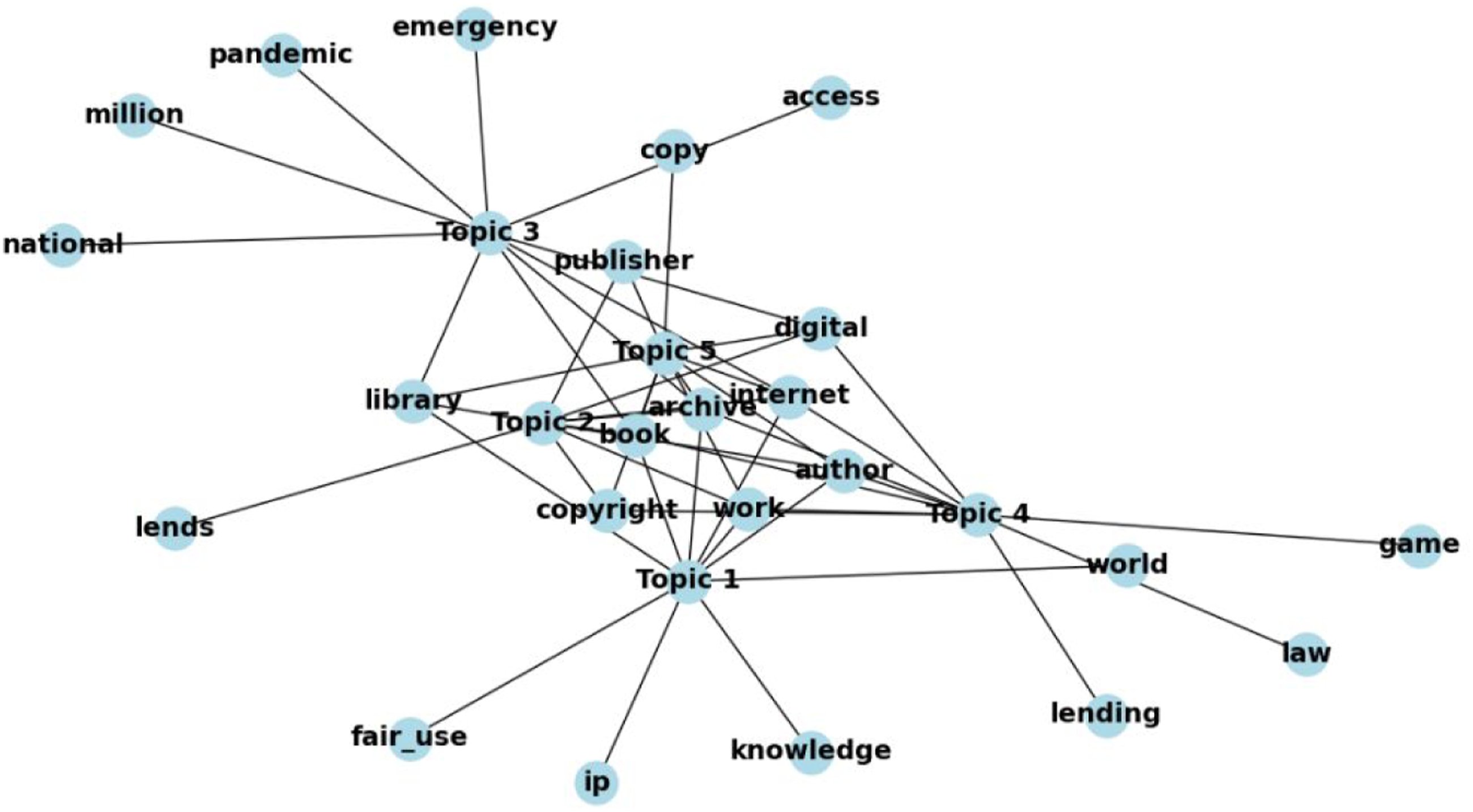
Topic 1 can be seen as where the sentiment of the discussions begins to shift, here the distinction of the problem is made clearer. It deals with aspects of the articles which begin to question the legal dimension of the NEL. Words like “IP”, “fair_use”, “author”, and “world” are indications of this. Of these, the word “world” may seem like an outlier, but this was often a response from the IA, citing that they were sharing knowledge with institutions around the world. On the other hand, this was also cited by authors as problematic when making their works freely available to the world despite being a national emergency. Furthermore, topic one gives indication towards the legal troubles of the NEL and the subsequent representation of the problem of authority connected to the representation of the NEL in media discourses. The general sentiment is not necessarily negative, but reflective of multitudinal perspectives on the use of scanned books, their use-value in a crisis and the tensions surrounding the potentiality of copyright infringement.
When viewing the proximity of the topics a clearer distinction of the problem representation can be discerned, within the messy graph, a wider story can be told, a story of emergency, lending, law, and copyright. Central within the graph is also the most used words (as seen in Figure 1).
For a final assessment of the larger picture, Figure 4 gives the results of the sentiment analysis performed on all the articles for the chosen period. Overall, the articles were positive, however there was not a big gap between negative and positive sentiments. Neutrality was quite low, showing that polarization between and within and between articles were quite high. Generally, this is reflective of any divisive topic. As mentioned, there were supporters and detractors of the NEL throughout the entire process. But despite this, the media helped shape a story of a rise and downfall, this story will be further discussed in the following section, where a closer reading of a selection of articles will give a clearer picture of how the sentiments and topics were constructed. The result of the sentiment analysis, showing the overall emotional tone of the articles.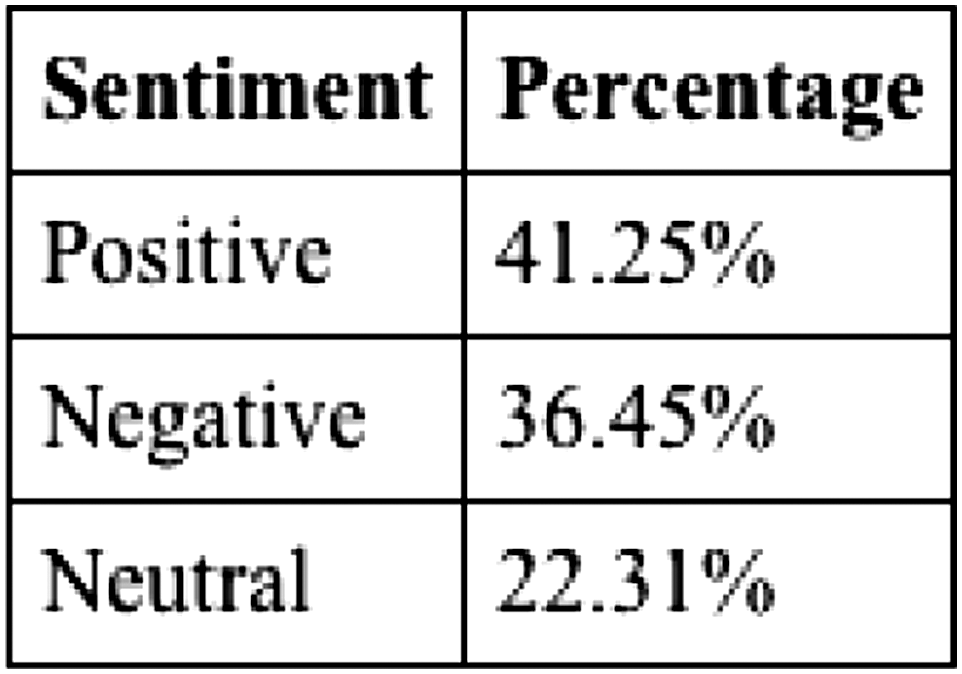
Discussion
In this section the study will take aim at consolidating the results from the distant reading with a closer look on some of the sources used. To bring additional coherence to this section, it is chronologically split into a few themes. The first theme is “beginnings”, in it the announcement of the NEL will be dissected, to understand under what discursive premises it was established. This theme is followed by “the shift”, which in this context will both refer to an actual as well as a discursive switch. With ‘the shift’, previously appreciative and newer sources display a sense of doubt regarding the NEL. The theme also aims at analyzing those articles that are in clear opposition to the project, how this represents problem formulations, and how they have affected the Internet Archive, authority, and the discussion on copyright. The last theme will discuss how the ongoing lawsuit of the IA is shaped in media discourse, the effects of its results, and a comparison between what the NEL and IA represents in comparison with actual piracy.
Beginnings
The NEL began with a statement by Brewster Kahle, the founder of the Internet Archive, it was a message of hope. In the statement he claimed that the NEL was “the library of their dreams”, “a library at everyone’s fingertips” (Freeland, 2020). By doing so, he began a discussion of the NEL as an emancipatory project, one which places the NEL within the discourse on the practice of librarianship. Building the “dream library” around the opportunity of access for everyone in conjunction with the IA’s general goal of providing “universal access of all knowledge” does however, challenge the hegemony of copyright laws. The social practice of universality within the discourse of librarianship thus subverts the social practice of “common good” and “fair payment to authors” instilled in the discourse on copyright, something that will be returned to in the following sections.
The first statement on the NEL was echoed in the language of the initial sets of articles, further pushing the idealized idea of the library as a space outside conventional boundaries. This is reflected in a New Yorker article by Jill Lepore titled “The National Emergency Library Is a Gift to Readers Everywhere”. The title in and of itself challenges the articulations established in the discourse on copyright, and instead, premiers the articulations rooted in discourses on the universality of the “dream library”, primarily in the wording “gift to readers everywhere”. On the topic of copyright in the article, a lawyer points out that “libraries have copyright superpowers that they can use in an emergency like this one”, underlining a sort of hegemony of libraries, in which the power relations place the production of meaning of copyright in the hands of the librarian. Subsequently, this constitutes a definitory statement that gives material change in the hands of librarians, partially as copyright deals with material entities, but also as librarians seemed to be granted an unconventional degree of authority as crisis occurs.
The consequence of these statements is that the library, and in extension librarians, may supersede conventional measures in times of crisis. This emphasizes what Laclau calls “hegemonic aggregation and articulation” where the, as we will see, transient rights of the library are extended beyond the conventional, granting this universality in the face of crisis to all libraries (Laclau, 2007: 57). The same starting point can be found in the NPR article “'National Emergency Library’ Lends A Hand — And Lots Of Books! — During Pandemic” which, much like the New Yorker’s piece, emphasizes the positive nature of the NEL, additionally, the article accentuates that the initiative is sponsored by prominent members of the library field.
Both pieces are largely informative and supportive, and both contribute to an understanding of the project as a wholly positive. Both articles and those like them, are most likely correlated with topics 3 which tend toward the informative and descriptive. As the most words in the topics are mostly reflective of the original statement made by the IA. This can be further motivated by other more informative headlines such as: “The Internet Archive launched a public no-wait digitized library of over 1 million books that are normally only available to schools and libraries” and “National Emergency Library Provides Free Access to 1.4 Million Books Online”.
What occurred in the beginning of the NEL was not that the Internet Archive was effectively the hegemonic authority in terms of copyright, but rather that the cultural hegemony of copyright, not as a concept, but as an institution (i.e., policy makers, publishers etc.) was momentarily dissolved in the face of crisis (Bartow, 2004). This breakage got expressed in the media expressions seen above. The novelty of the NEL, and the concurring circumstances was the correct situation for the breakage to occur, showing that the representation of the “problem” of copyright, as a limiting societal factor in face of crisis, could be intervened upon for larger societal good.
Other, less sizeable news outlets offered a more nuanced description of the project at its inception. Arstechnica, for example, shared the generally positive outlook as those reflected in the pieces by NPR and the New Yorker, whilst not granting the NEL the same no-holds-barred affordances in terms of copyright: “t's an amazing resource—one that will provide a lot of value to people stuck at home due to the coronavirus. But as a copyright nerd, I also couldn't help wondering: is this legal?” (Lee, 2020). This article, and its considerations, lie at the precipice of shifting opinions on the measures enacted throughout the NEL. This also gives a clear indication of the core of the problem, when it comes to the process of shifting opinions and the heart of the problem: authority, either as articulation or as hegemony. The following section will show how the representation of authority is shifted in the media, accentuating that the article from Arstechnica was only a mild preface of the ensuing discussion on authority within the media, with regards to NEL and even the IA’s library.
The shift
As the National Emergency Library (NEL) gained popularity and attention from larger publishing houses, critiques against the solution emerged, leading to four publishing houses suing the NEL. The shift in understanding can be seen in an NPR article that added a disclaimer to their previously positive sentiment, acknowledging authors’ allegations that the Internet Archive obtained their works without permission.
The first detractors against the NEL were the Copyright Alliance, a non-profit group dedicated to “advocating policies that promote and preserve the value of copyright and to protecting the rights of creators and innovators” (Copyright Alliance, 2016). In an article written in the online magazine TorrentFreak, they were quoted saying that the actions of the NEL were “particularly vile” and calling them “looters taking advantage at a time of crisis” (Maxwell, 2020). Vox also published several articles highlighting the problem of the NEL. One of them was centered on authors who argued that the Emergency Library was illegal and taking away a source of income from authors when they needed it the most. In the article, there are a few questions of authority that are mentioned. “The Emergency Library wasn’t a true library at all, authors argued. What it was doing was not only illegal but also taking a source of income away from authors when they needed it most” (Grady, 2020).
In both the article from Vox and TorrentFreak, the problem of authority is actualized through the economic devastation felt by authors during the pandemic, this is also highlighted in the byline of the article: “Authors are suffering under the pandemic economy, too. They say the Emergency Library will make things worse”. Not only is the problem of authority centered on the fiscal aspects of the NEL, but also on an institutional level, as the project has authors claiming it is no” true library at all”. In a second article from Vox, on the copyright complaint shows how the representation of the NEL in the media had shifted. Despite a somewhat neutral title: “A lawsuit is threatening the Internet Archive — but it’s not as dire as you may have heard”, the byline was more damning: “The Internet Archive spent years testing the boundaries of copyright law. Has it gone too far?” (Romano, 2020). The byline gives indication to how the representation of the problem of authority is dealt with during the shift of sentiment in the articles, tying it into larger questions of publisher and library policy. This is further supported in the closing argument of the article: “Because the Internet Archive is a well-established vanguard of open access, the lawsuit could potentially have a larger, chilling effect on internet archival and research practices — even if it fails, and even if that wasn’t the original intent. Let’s hope that the publishing industry can also recognize the Internet Archive as a force for good, before the lawsuit renders it a cautionary tale.” (Romano, 2020).
The quote positions the IA as an authority on open access, positioning the entire phenomena as potentially threatened if the lawsuit would come to its conclusion, effectively showing how “the shift” not only illustrates the discursive consequences of perceiving the NEL as an act of piracy, but that it may affect a larger policy discussion surpassing the IA’s OpenLibrary. Moreover, this points to how an identified problem representation may only be an indication of larger chain of events, meaning that viewing the cycle of the NEL as going from a “good thing” to a “bad thing” may obfuscate the other core matters at play, such as a larger battle against the idea of digital books outside conventional formats. The same sentiments are reflected from the opposite spectrum by the Washington Post editorial board, which puts the onus on the libraries for the faulty interpretation of fair use laws: “The Internet Archive’s approach is much like piracy and less like a library. The repository ought to negotiate with publishers to get more books to more people — but also more money to more authors who’ve rightfully earned it. Yet what this kerfuffle over a non-library reveals is really a library problem. The legal and business landscape lags a public that more and more is reading digitally. Publishers impose fees and conditions that they consider necessary to stay afloat and librarians consider draconian. It’s past time to catch up: The National Emergency Library isn’t really a library, but libraries are facing a bit of a national emergency.” (Board, 2020).
As many others in reference to the IA, post copyright complaint, the authority given to libraries and librarians diminished and been replaced by a negation of their status of library at all. In comparison with the statements that said that the emergency library was necessary because of the crisis, the authors guild, for example, claimed that the IA used the crisis to “advance a copyright ideology that violates current federal law” (Authors Guild, 2020). These examples pinpoint how a problem representation often consists of tensions and contradictions depending on the actors involved (Bacchi, 2009).
Despite the legal battle and negative critiques against the NEL, there were also articles that were positive about the initiative. The sentiment analysis of articles on the NEL shows a balance of positive and negative articles (Figure 4). One such positive article was published by The Verge, which highlighted the importance of the NEL during the pandemic and praised the Internet Archive for its efforts to make books available to people in need. This positive representation of the NEL highlights the tension between copyright law and the public interest in times of crisis, and the role of libraries in promoting access to knowledge.
The issue of authority, become apparently central to the tension between copyright holders and advocates of Open Access. The positive articles about the NEL suggest a resistance to the dominant discourse of copyright and highlight the importance of promoting greater access to knowledge and information during times of crisis. However, the negative critiques against the NEL also raise questions about who has the authority to provide access to knowledge and how this access should be regulated, highlighting the issue of power and the need for greater equity in the distribution of knowledge. The discursive shift of the NEL can be observed as it is formulated in a discourse centered on copyright, rather than librarianship. The shift displaced the “dream library” and equated it with theft, constructing the NEL as a shadow library. The authors' claims extended beyond the NEL, opposing the allowances given in the articulations of copyright centered in the discourse of librarianship granted by previous articles. The NPR, Washington Post, and several other articles emphasized the non-librarian, pirate-like behavior of the Internet Archive by utilizing the term “sharing without permission” rather than “lending,”, or “piracy” and “non-library”, placing the Internet Archive within a discourse on copyright or piracy instead of librarianship. This shift renegotiates the previously mentioned authority of librarians on the formulation of copyright in times of crises and systemic overhaul.
Conclusion - crisis?
The legal battle between publishers and the Internet Archive is just one example of the ongoing tensions between copyright holders and advocates of Open Access. Copyright law, which is designed to protect the rights of creators and copyright owners, can also be seen as a barrier to the free flow of information and knowledge, which is reflective in the initiative Battle for Libraries, an advocational group working on the behalf of the IA and CDL. Fair use, which allows for limited use of copyrighted material without permission, is often invoked by advocates to enable greater access to knowledge. However, the invoking of fair use and the unique for the USA, first-sale-doctrine, makes the question of what is and what is not infringement a complicated matter.
In the digital age, the role of libraries has also come under scrutiny. Traditionally, libraries have been seen as repositories of knowledge and information and have played a vital role in promoting access to information for all. However, the rise of digital technologies has forced the traditional model of libraries to change especially as the lines between libraries, publishers, and tech companies become blurred, which is also a critique put forth by advocates for the IA pointing to the rights of library patrons to be able to borrow books without “having to fear surveillance from Big Tech intermediaries like Amazon and Overdrive, which are motivated by profit to invade the privacy of people seeking knowledge.” (Fight For the Future, n.d). Furthermore, criticism has been raised against the large publishers for using libraries as customer service for their e-book databases.
Against this backdrop, the legal battle between publishers and the Internet Archive takes on greater significance. The Internet Archive's National Emergency Library, which made hundreds of thousands of books available online during the COVID-19 pandemic, was seen by some as a necessary response to the crisis, while others saw it as a violation of copyright law. The court ruling against controlled digital lending and the Internet Archive, which found that the library’s practices exceeded the scope of fair use, has been celebrated by some as a victory for copyright holders, claiming that the NEL and CDL was a “legally absurd theory of fair use” whilst reaffirming that “authors love libraries” (Anderson, 2023). The emergence of shadow libraries as a response to the oligopoly of, primarily academic, publishers and the power imbalance between copyright holders and the public raises questions about the role of libraries and the distribution of knowledge and information. Viewing shadow libraries as a response to this power imbalance could be enough to equate them with the IA. However, it is crucial to understand that shadow libraries operate within entirely different frameworks than the IA. Comparing them is unfair to both parties, as it dilutes the separate goals pursued by the IA versus any given shadow library. It is important to note that the mention of shadow libraries did not occur throughout the debacle, but the treatment and wordings used to describe the project are akin to the fashion in which shadow libraries have been discussed (positively and negatively), both in purview of legal matters and news.
While the IA, with the NEL, may have momentarily acted as a shadow library – considering the unrestricted access to books and, according to some, a justified disregard for copyright law – its complexities differ from traditional shadow libraries. In contrast, the first copyright complaint filed by the Hachette Group in June 2020 specifically pointed to the NEL as being “consistent with the deplorable nature of piracy,” which to a degree equated them to shadow libraries (Hachette Group v Internet Archive, 2020). Nevertheless, their compliance with the copyright complaint highlights their position within traditional information infrastructure. Shadow libraries, on the other hand, have faced numerous legal challenges from copyright holders, who view them as a threat to their power and profit. Sci-Hub has been involved in lawsuits or closures in seven countries, including the USA, UK, and Russia; despite this, they still have a functioning domain active today. The same story can be repeated with another shadow library, Z-library, which faced arrests of two administrators in November 2022, followed by shutdowns of both their clear web and dark web addresses – yet they persist.
The radical nature of what the Hachette Group would call “deplorable” pirates is not only related to the shadow libraries' lackadaisical approach to copyright. It is defined by their rhizomatic structure, ability to exist multitudinously throughout several different online spaces, and, for the most part, their strict secrecy (in terms of administrators, location of servers, etc.). Furthermore, the legal battles against shadow libraries also raise questions about the state's role in regulating access to knowledge and information. Copyright law is an essential tool for protecting the rights of creators and copyright owners, but it must also balance the public interest in accessing knowledge and information. In this sense, copyright law can be seen as a regulatory tool used by the state to manage the distribution of knowledge and information. The way in which the NEL, Controlled Digital Lending. and more succinctly, the problem of authority in media discourses surrounding the initiative has been represented as a tension between publishers and digital libraries – or copyright infringement (piracy) versus unfettered democratization of information. This shows that the tension between copyright holders and Open Access advocates highlights the need for a more equitable distribution of knowledge and information. The legal battle between publishers and the Internet Archive underscores the ongoing tensions between copyright law, fair use, and the role of libraries in the digital age. But it also reveals other interesting facets, surprisingly absent from discussions, such as the previous court case against Google, and more importantly, the several court cases and shutdown orders against actual shadow libraries like Sci-Hub and Z-library. Under the auspices of crisis, the NEL may have extended into copyright infringement, but not intentionally, and not as pirates.
Footnotes
Declaration of conflicting interests
The author(s) declared no potential conflicts of interest with respect to the research, authorship, and/or publication of this article.
Funding
The author(s) received no financial support for the research, authorship, and/or publication of this article.
