




Abstract
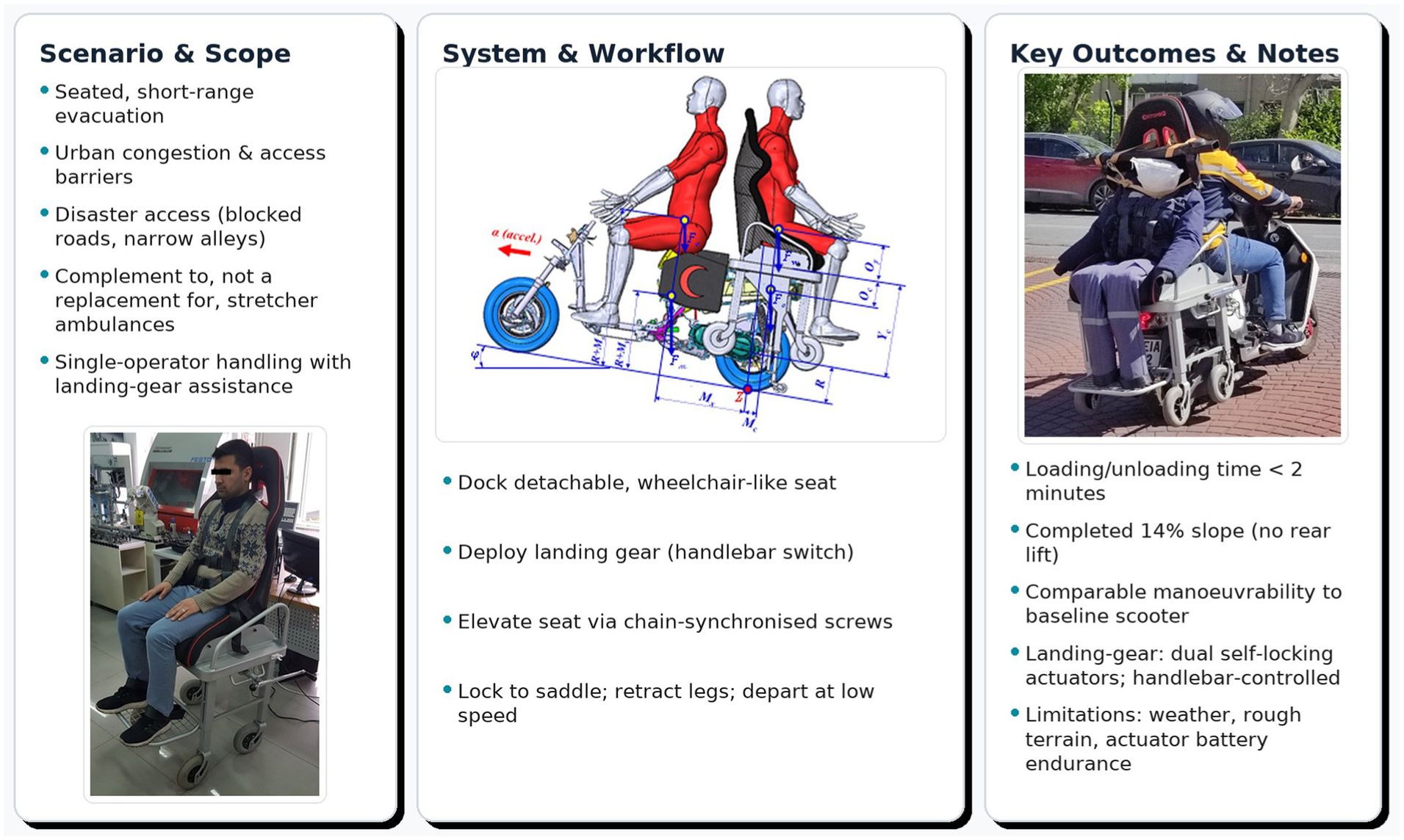
This study aims to develop an effective system for transporting civilians injured in natural disasters, accidents, or terrorist attacks to hospitals quickly. The system’s design, prototyping, and performance tests focussed on ensuring that a patient could be seated in a modular chair, easily lifted and secured to the back of a motorcycle, while maintaining balance during loading, transport, and unloading. A key requirement was enabling a single operator to carry out the operation safely, with the patient seated backward. The design includes a detachable seat, which is similar to a wheelchair, connected to the motorcycle. A prototype was built and tested on a cargo scooter with a 125 -cc engine. After analysis, simulations, and successful road tests with a full-size passenger test dummy, the data showed that the system’s performance matched theoretical expectations, particularly in speed and cornering. The prototype demonstrated excellent road performance. In addition, the measured loading and unloading time of the patient seat was below 2 min, and the prototype completed the 50 m, 14% slope (Track2) without rearing or instability. Manoeuvrability results were compared against the baseline scooter (driver only), showing similar speeds and slightly lower lateral accelerations due to cautious driving.
Keywords
Get full access to this article
View all access options for this article.