



Abstract
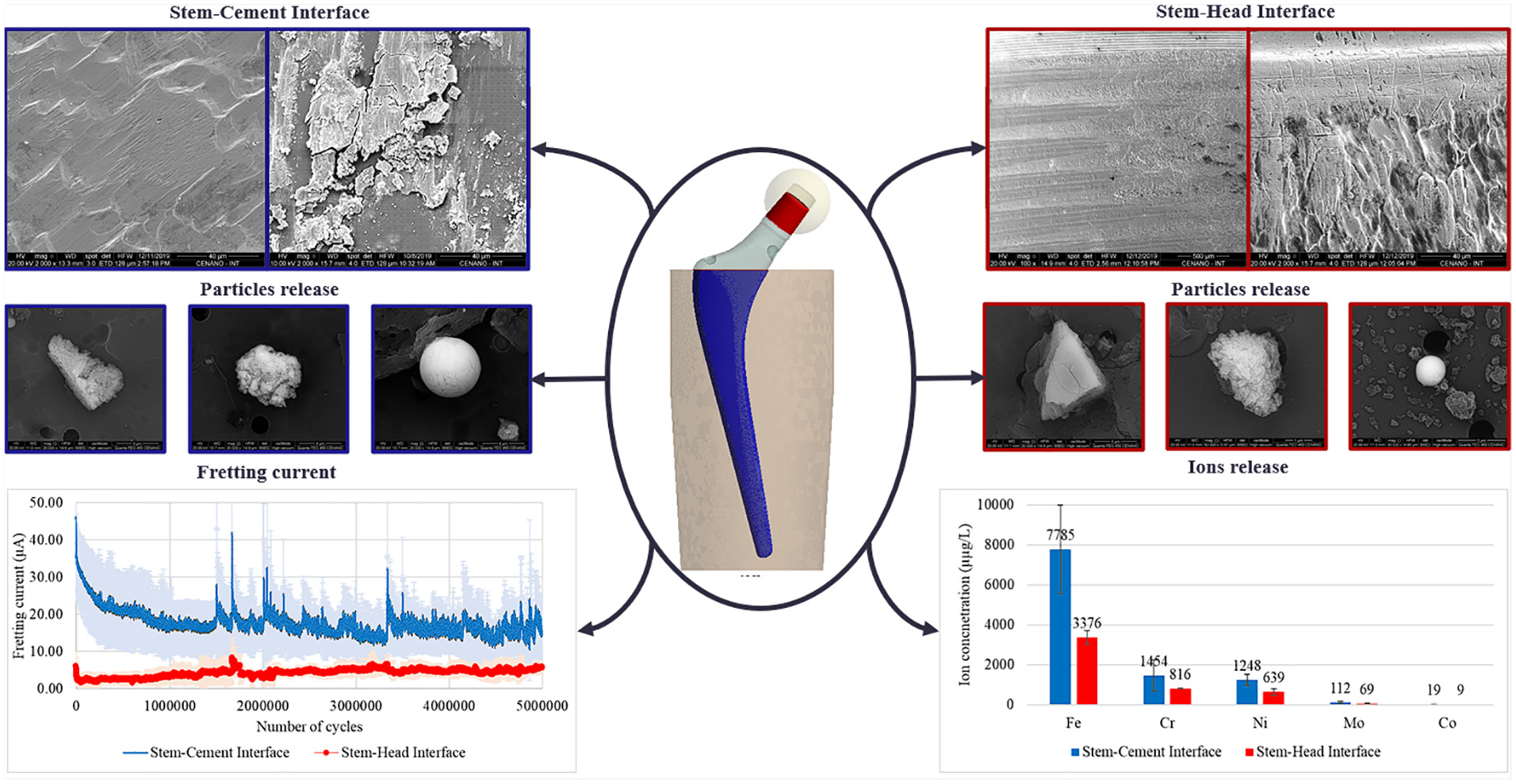
Degradation of implants by fretting-corrosion is the main source of released metal ions and debris, leading to adverse tissue reactions. Cemented stems have two interfaces that could be degraded: stem-cement and stem-head. This study aimed to identify which interface suffers the most severe degradation and, for this reason, is potentially more harmful to the human body. For this purpose, six pairs of stems and femoral heads made of stainless steel were divided into two groups according to the interface to be evaluated: I (stem-cement) and II (stem-head). The implants of both groups were subjected to a fretting-corrosion test, applying cyclic loading in corrosive environment for five million cycles. Fretting-corrosion mechanism was evaluated using electrochemical tests, optical microscopy, SEM/EDS analysis, and ions and particles analysis. The fretting current of the stem-cement interfaces was greater than that of the stem-head interfaces. SEM analysis showed the occurrence of corrosion and wear mechanisms, which are found in many published cases of retrieval analyses, indicating that there is a correlation between the mechanisms identified in benchtop test and those in retrieved stems. The amount of particles released in both interfaces was similar to that identified in retrieval analyses. For the stem-cement interface, the amount of particles released was higher than that associated with the stem-head interface. The stem-cement interface resulted in a greater release of ions than the stem-head interface. This reinforces the hypothesis that stem degradation at the stem-cement interface could be more harmful to the human body than that at the stem-head interface.
Keywords
Get full access to this article
View all access options for this article.