



Abstract
This paper explores a novel method for creating an ultra-low adhesion leaf layer on a rail using a full-scale wheel/rail rig. Ultra-low adhesion layers were generated using leaf powder for the first time on a linear full-scale rig. The layers are compared chemically and physically to other layers from the laboratory and field. Testing of the adhesion evolution of the leaf contaminated layers over 50 cycles is explored, and compared to dry and wet rails.
Introduction
Safe train operation requires the coefficient of traction (CoT) to be above 0.1. 1 Ultra-low adhesion occurs when traction is below 0.05 2 and can be caused by leaves. This low level of traction has been observed in the field3,4 and recreated in laboratory testing. 5 Recent collisions on the railways have been attributed to low adhesion leaf layers in Salisbury 6 and the Czech Republic. 7
A range of different methods have been developed to recreate leaf contamination for experimentation and to assess mitigation. Testing has used a variety of leaf types, sycamore,8,9 poplar, 10 elm, 11 cherry blossom 12 or a mixture.5,13,14 Although work has shown that there is little difference between leaf types chemically or tribologically (as a powder),15,16 a layer creation standard should focus on “problem” species as defined by the railway industry. 2
The age and condition of leaves in testing has also varied, with both green8,10 and brown14,17,18 used. Both ages of leaves reduced the CoT below that of water, 19 but a brown leaf extract created significantly lower friction than that of the green leaf. Green leaves had a more instantaneous effect in scaled testing, 20 but brown leaves were better able to create a persistent leaf layer with the characteristic black colouration.
A wide variety of delivery methods have been used to apply leaves to test low adhesion on the railhead. Experimentalists have applied leaf extracts created by soaking leaves (and steel) in water.5,19 However, testing focused on layer creation mainly used crushed, cut or whole leaves9,15,17–22 combined with water. The use of whole or powdered leaves is effective at creating lasting low adhesion layers that can survive repeated cycles in rigs or on the railhead, for example on the HAROLD full-scale rig, 23 whereas the extracts were never intended for this purpose and have not been investigated for layer formation capacities.
Standards exist for creating low adhesion with leaves on twin disk rigs, 24 but there is no industrial standard for creating leaf layers on railheads. The current methodology for testing mitigation is paper tape as an analogue for leaf low adhesion.25–27 This reliably creates low adhesion when combined with water, compared to using leaves which can be laborious. 18 Tape has been shown to generate ultra-low adhesion in the full-scale wheel/rail test facility (FSR) at the University of Sheffield. 28 A standard for leaf layer creation would improve understanding of how layers form and give the ability to test them in a controlled manner, as well as evaluating friction management products and mitigation techniques.
This technical note outlines the efforts to create low adhesion leaf layers on rail sections using a “linear” full-scale rig. This has not been achieved before, as was being attempted as part of wider work on transience of leaf low adhesion layers.
Method
Leaf layers were created using the FSR,
29
as shown in Figure 1. The rig is made up of a train wheel on a rail section that is pulled by a hydraulic actuator enabling it to move under the wheel. A chain attached to the wheel is used to induce creep at the desired level in the contact by increasing the speed of the wheel, compared to the rail. A normal force can be applied to the wheel, and the coefficient of traction measured from the ratio of normal and tangential forces. These forces are measured directly from the rig using load cells. Diagram of FSR.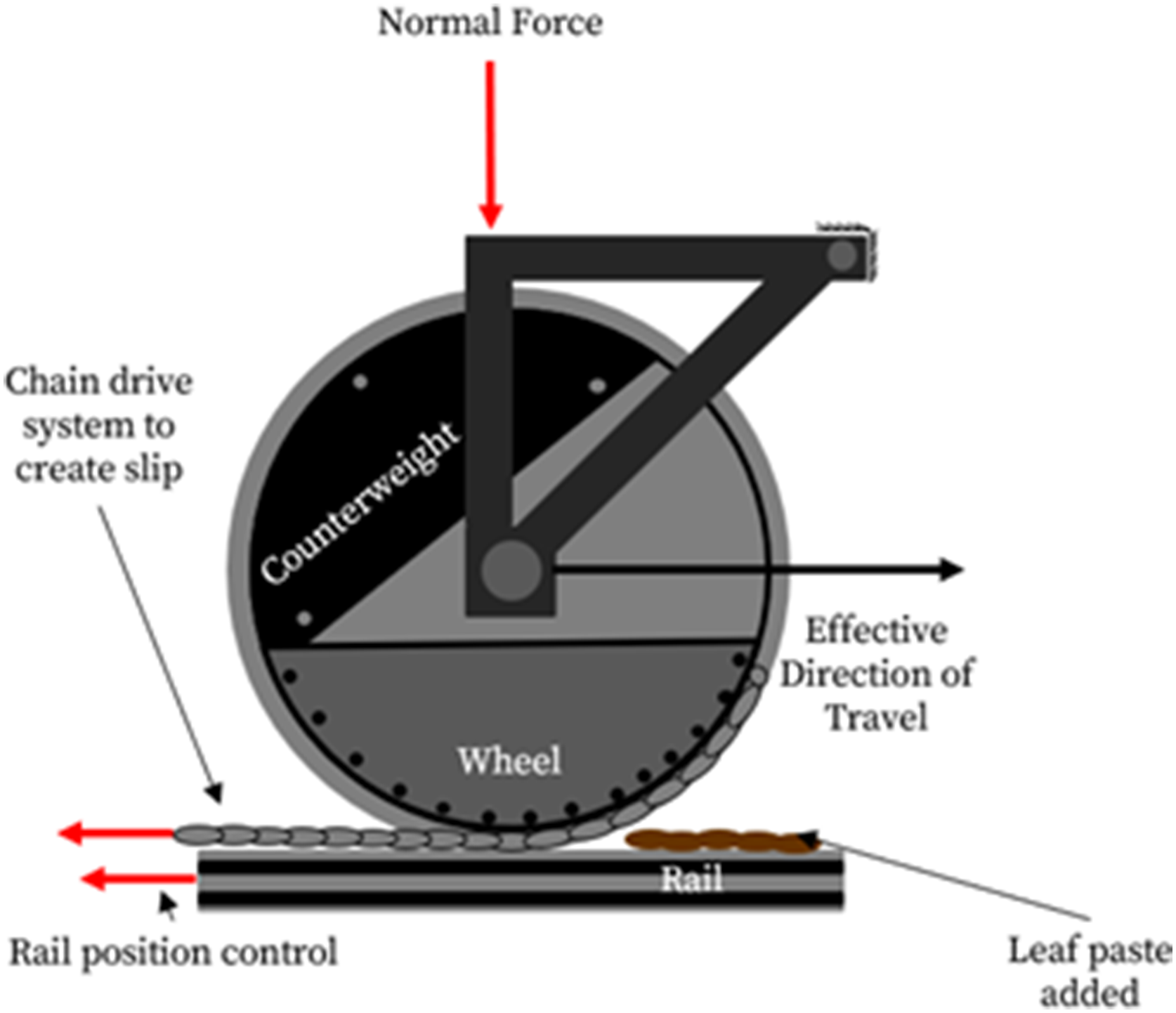
Sections of R260 rail were used which had a highly oxidised surface. Before any leaf treatments were conducted, the rail was run over with 10 dry cycles to remove this layer.
FSR settings.
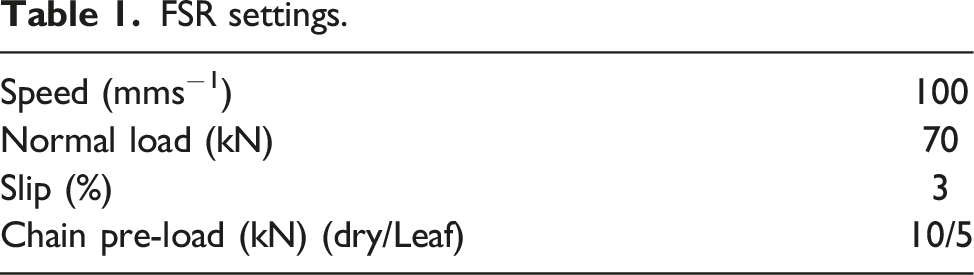
The vertical load of 70kN (contact pressure 1100 MPa
30
) used for the layer creation is similar to a modern Diesel Multiple Unit. A nominal slip of 3% was used with the intention of creating the layer more effectively as higher slip values might accelerate the development of leaf layers.
31
Images from the layer creation are shown in Figure 2. The ambient conditions were 20.1°C and a relative humidity of 51%. Leaf layer creation on Rail 2: (a) Leaf paste applied to railhead, (b) Layer after 10 axle passes, (c) Leaf layer detail after 20 axle passes.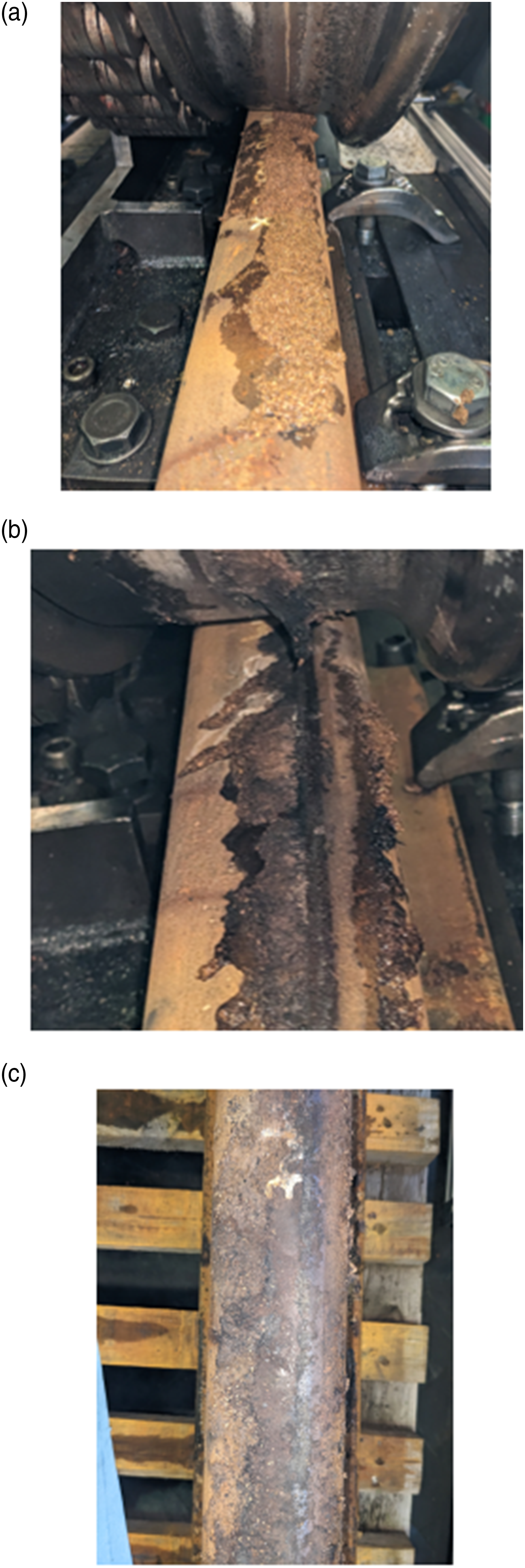
Results
Low adhesion creation
This method allowed for the creation of ultra-low adhesion of less than 0.05 CoT. The results are shown in Figure 3. Median CoT evolution for test rail sections.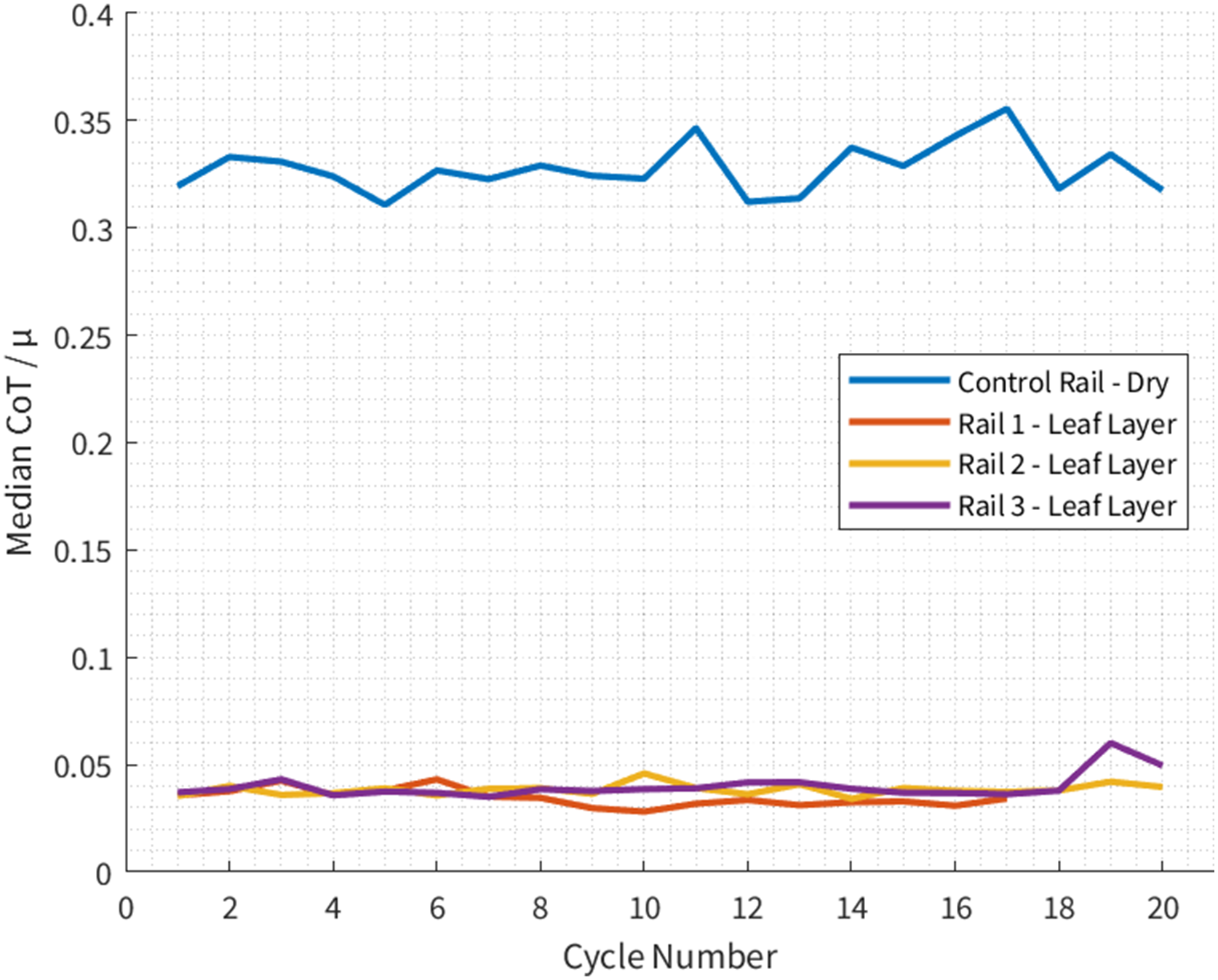
Rail section summary.

Ultra-low adhesion with leaves has been generated on the HAROLD full-scale rotational rig, 23 but previous testing using the FSR was only able to achieve ultra-low adhesion using wetted paper tape at 2% slip and 40 mms−1 speed 28 as a leaf analogue. This is the first time that ultra-low adhesion has been created in a full-scale linear rig using leaf material.
The leaf contaminated rail sections had a significantly reduced CoT compared to dry cycles. This testing was able to maintain ultra-low adhesion consistently across the cycles with Rail 3 reading above the 0.05 limit for one cycle. Lots of leaf material was pushed out of the contact (Figure 2(b)), it was observed that leaf material was retained on the wheel during each test. This material contaminated the contact area on every pass, potentially leading to more persistent low adhesion conditions, compared to if the wheel was cleaned after each cycle.
The leaf layers were assessed using a handheld Fourier-Transform Infrared Spectrometer (FT-IR), with spectra shown in Figure 4. The scans demonstrate the significant chemical change that has occurred in the leaf layer creation process from powder to layer, it also establishes the consistency of the change across all of the created layers. The only significant difference between the created layers seen in the FTIR spectra is in the absorbance, reflecting a slightly thinner layer at the point tested on Rail 1. (a) FT-IR spectra for dry sycamore powder (b) Spectra for sycamore leaf layer created on FSR and dry rail surface spectra for comparison.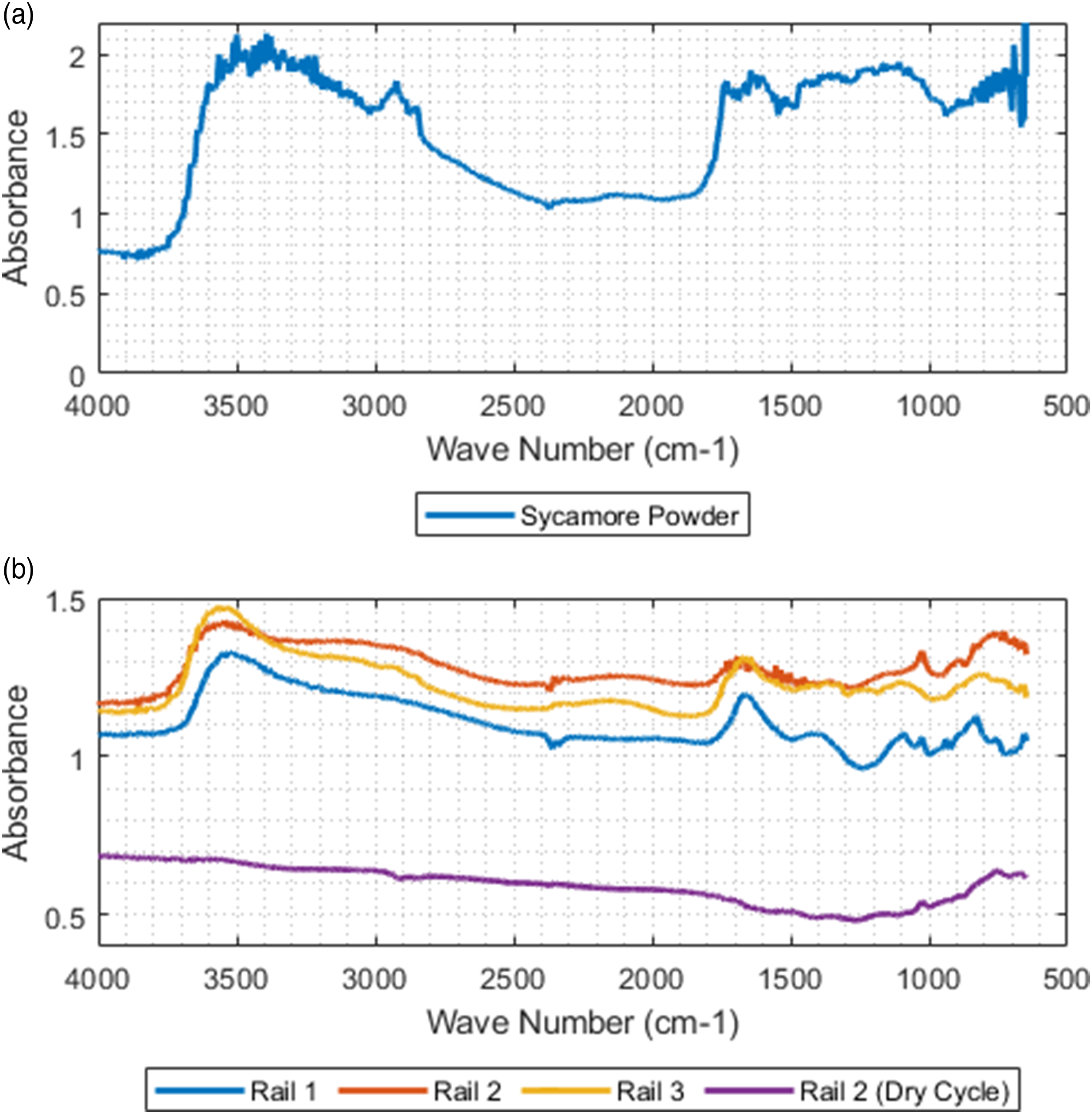
Comparison with other leaf layers
Observation from the testing saw a rapid change in colour from brown to the characteristic black layer seen in field 32 and laboratory testing. 9 The FSR created layers had an average thickness of 98 µm which is comparable to field layers that have been subjected to limited axle passes 25 and those from HAROLD layer creation testing.
The spectra for the leaf layers from the FSR was compared to other leaf layers in Figure 5. The spectra were collected using the same equipment used for Figure 4 during field and rig testing. The layers created using the High Pressure Torsion rig
33
were less chemically changed from the sycamore powder (Figure 4(a)) than leaf layers tested on the HAROLD rig and this FSR layer creation. The rigs using conditions closer to those seen on the line (full scale wheel etc) had a spectra closer to the field leaf layer. This spectra was taken from a location surrounded by birch and oak trees, and the spectrum is dominated by water due to rain (∼3650 cm−1). Comparison of FSR layer spectra with other created and found leaf layers.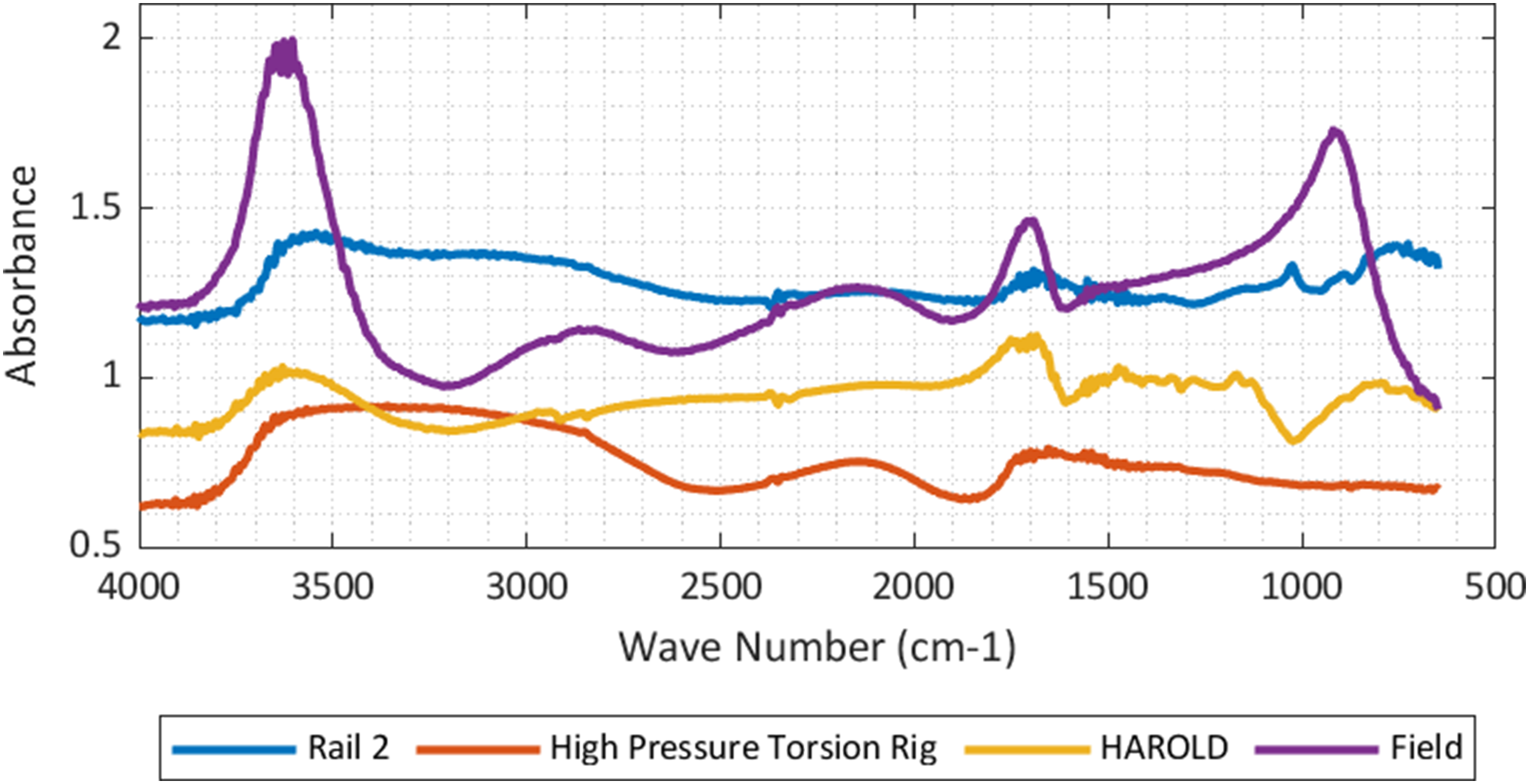
The spectra for the layers created in the FSR also align with created layers from literature. The FSR layers have the O-H stretch peak (3600 cm−1) and C = C (1660 cm−1) peaks seen previous work where leaf layers were created8,9 as well as matching databases for these specific organic bonds. 34
Adhesion recovery assessment
Adhesion recovery of leaf layers was assessed against dry and wet conditions across 50 cycles, as shown in Figure 6. The wet cycle was completed after water spray applications equivalent to 5 mL water across the whole contact path. The leaf layer was prepared as described in the Method section. Adhesion recovery assessment for a range of conditions on the FSR.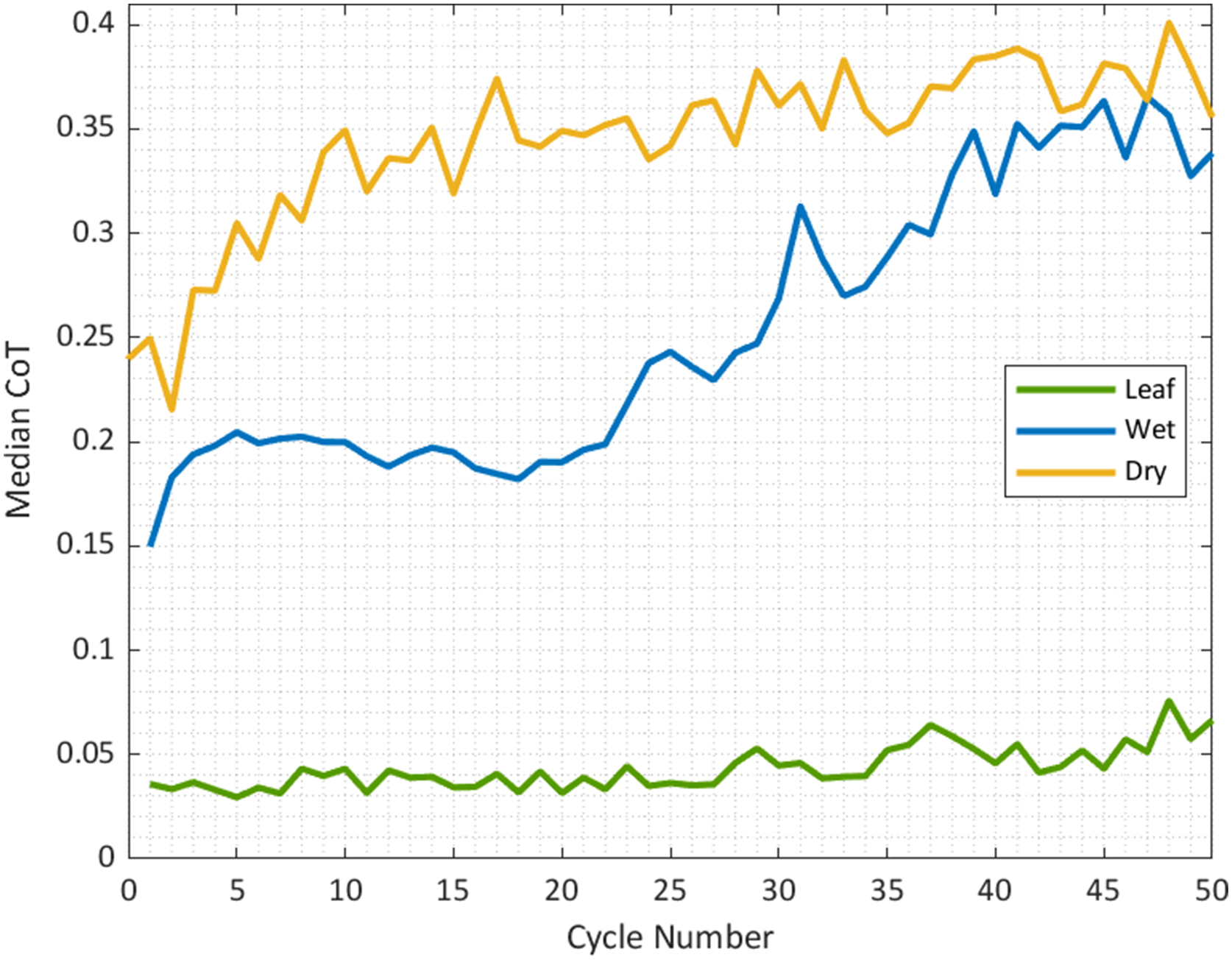
The dry rail was run for 60 cycle with an initially oxidised surface (final 50 shown in Figure 6). It had a stable high CoT, after the first 30 cycles removed the oxidised surface. The wetted rail slowly recovered to the dry levels. The leaf contaminated rail remained persistently low at <0.05 for 28 cycles and remaining at <0.1 across the 50 cycles. The maintenance of the low adhesion may be due to leaf build up on the wheel rather than the rail, as the contact band was visibly more clean than after 20 cycles.
Summary and next steps
Using the novel method outlined, ultra-low adhesion has been created on a linear full-scale rig using leaf material for the first time. Before this point it has not been possible to study leaf ultra-low adhesion on the on the Full Scale Rig (or any other linear rig) directly. The layers reliably created traction in the ultra-low regime (µ<0.05). The layers were also chemically consistent, and had similar physical and visual characteristics to other created layers and those on mainline rail.
Using the method, a layer was tested for adhesion recovery against dry and wet rails. The leaf contaminated rail maintained low adhesion across 50 cycles, with the wet and dry tests recovering to stable, high adhesion values across the same number of axle passes.
The ability to create a leaf layer with ultra-low adhesion in the linear full-scale rig allows for a range of testing. Future testing will evaluate the longevity of leaf layers, and evaluate leaf layers by introducing water and additional leaf material, mimicking the field development of leaf layers.
Footnotes
Acknowledgements
The authors appreciate the contribution of the Railway Safety and Standard Board (RSSB) towards this research through the COF-UOS-06 project and the EPSRC Programme Grant “Friction: The Tribology Enigma” (EP/R001766/1). For the purpose of open access, the author has applied a Creative Commons Attribution (CC BY) license to any Author Accepted Manuscript version arising.
Declaration of conflicting interests
The author(s) declared no potential conflicts of interest with respect to the research, authorship, and/or publication of this article.
Funding
The author(s) received no financial support for the research, authorship, and/or publication of this article.
