



Abstract
The provision of safe, efficient, reliable and affordable railway transport requires the railway track infrastructure to be maintained to an appropriate condition. Given the constrained budgets under which the infrastructure is managed, maintenance needs to be predicted in advance of track failure, prioritized and identified risks and uncertainties need to be considered within the decision-making process. This paper describes a risk-informed approach that can be used to economically justify railway track infrastructure conditions by comparing on a life-cycle basis infrastructure maintenance costs, train operating costs, travel time costs, safety, social and environmental impacts. The approach represents a step-change for the railway industry as it will enable economic maintenance standards to be derived which considers the needs of the infrastructure operator, but also those of users, train operating companies and the environment. Further, the risk-informed capability of the tool enables asset managers to deal with uncertainties associated with forecasting costs and the effects of track maintenance, and unavailability of data. The Monte Carlo simulation technique and a Fuzzy reasoning approach are used to address safety data uncertainties through probabilistic risk assessment allied to expert opinion. The approach is illustrated using data from three routes on the UK mainline railway network. The results demonstrate that the approach can be used to support strategic and tactical levels of railway asset management to inform plausible design and maintenance strategies that realise the maximum benefit for the available budget.
Keywords
Introduction
The railways are crucial to a country’s socio-economic development as they are can provide safe, affordable, efficient, reliable public transport at low environmental cost and are a significant provider of jobs and tax revenues. Consequently, sustainable transport policies in many countries are encouraging a shift of passengers and freight from road to rail. With the rise in road traffic, which is seen as a less green form of transport and the associated road congestion, there is an increasing demand for railways to expand their capacity, availability and carry goods and passengers at ever-higher speeds. By 2025, railways are expected to carry 11,912 billion tonne-kilometres of freight and 5,149 billion passenger kilometres worldwide; an increase of 14.75% and 37.2% respectively from 2015. 1 Between 1993–94 and 2019–20 railway passenger journeys have increased by 63.5%, 137% and 236% in India, the UK and the USA respectively.2–4 Although safety is of critical importance to railway operators, increasing usage results in faster degradation of railway track infrastructure and therefore increases in the train operating costs, environmental impacts and risk of accidents. For instance, there were 360 train accidents in 2018–19 on the UK mainline railway, with 26 of them classified as Potentially Higher Risk Train Accidents (PHRTA) resulting in at least one death, considerable delay costs, track downtime and damage to property. 2 Six out of the 26 PHRTA were derailments. 2 While the causes of derailment are generally classified as infrastructure, rolling stock, and operation failure and environment-related, many studies have shown that the likelihood5–7 and severity 8 of derailment increases as track quality worsens. For example, track infrastructure-related problems were responsible for 39% of the derailments in the UK during 2018–19 and more than half of these were due to track geometry defects. 2 Track geometry issues were also identified to be a major reason for both passenger and freight train derailments in the USA.6,9,10 Adequate inspection and timely maintenance however have proven effective in controlling the risk of derailments. 11 For example, in India, timely maintenance and renewal of the track infrastructure led to a 30% reduction in derailments between 2010–2018 (3).
Given that railway maintenance budgets are limited, the ever-increasing use of the infrastructure and associated increased degradation, the need to plan maintenance well in advance and the pressures to make the infrastructure continuously available and safe, there is a need for cost-benefit approaches which can support the planning and prioritisation of railway maintenance. 12 The railway industry worldwide is increasingly focusing on the application of risk management approaches to reduce system failures or track degradation, and thereby derailments. 13 Consequently, and following international standards on risk management such as ISO 15686-5 and EN 60300-3-314,15 there is an additional impetus to incorporate risk management within asset management processes. For example, the standardised risk management processes adopted by the railway industry in the UK,16,17 Sweden 18 and Australia. 19 These initiatives have been supported by academic research that has developed risk assessment approaches at asset level for structures,20,21 earthworks,22,23 drainage 24 railway track,25–27 stations, 28 rolling stock 29 and at the railway systems level. 30 While all these techniques demonstrate the importance of using available datasets to identify and assess the potential risks, there is a paucity of knowledge associated with derailment risk management when there is a lack or unavailability of risk data.31–34 Expert knowledge, experience and/or engineering judgement are often employed in other sectors to deal with such situations.35–38 Despite the high frequency of occurrence of track quality-related derailments, the current accident reporting processes within the railway industry are ineffective in estimating the severity of derailments.6,10,39 Therefore, railway risk analysts and asset managers often have to make decisions in circumstances where the risk data are incomplete or there is a high level of uncertainty involved in the risk data. Moreover, there is a paucity of research advising the infrastructure managers on how to quantify the safety risk of track condition, particularly derailments, when the maintenance intervention limits are surpassed. 40
Since maintenance funding is provided from the public purse, maintenance investments should be made equitably and transparently to maximise benefits to all stakeholders whilst minimising the costs to the environment. Railway track condition, and therefore maintenance strategy, directly impacts track use costs (including train operation, accident, environmental and delay costs). Therefore, maintenance decisions can only be taken responsibly when the costs and benefits of maintenance alternatives (i.e. total railway transport costs) are compared on a long-term, whole life-cycle cost (WLCC) basis. Further, decisions and strategies for renewing, maintaining and operating railway infrastructure need to consider any ambiguities inherent in the data, including future uncertainties. In part due to the segregation of the railway industry, in which the management of the infrastructure is apart from the ownership and operation of rolling stock, existing asset management methodologies and tools in the railway industry tend to focus on particular elements of the system. Therefore they fail to consider the impacts of maintenance interventions on all stakeholders and the environment. For example, Network Rail (NR), the owner and maintainer of railway infrastructure in the UK, has developed a ‘track decision support tool’ (TDST) to identify the root cause of a track failure, identify precursors to track defects and prioritise work based on risk. However, the TDST does not allow decision-makers to test different maintenance regimes to determine whether or not the current plans are optimal and economically justifiable. Some academic efforts have also been undertaken to consider the impacts to multiple stakeholders 41 while allowing for direct comparison between the costs and effects of track maintenance interventions such as delays, 42 safety, 43 societal 44 and environmental impacts; 45 maintenance planning 46 and remote condition monitoring. 47 Nevertheless, they either do not adequately account for data uncertainties or do not consider the total railway transport costs within the decision-making process.
To address these issues, a unique risk-informed decision support approach that uses a whole life cycle cost analysis (WLCCA) approach under uncertainty has been developed by the authors. 26 It takes into account the costs, benefits of track maintenance strategies to track maintainers, train operators, users and the environment (i.e. the whole railway system). This paper describes the development of the derailment risk model that is employed within 26 to facilitate the assessment of derailment risks associated with different maintenance strategies using expert opinion.
We also discuss more generally how the suggested approach can be incorporated within railway asset management. A novel risk-informed framework is presented to this end. The feasibility of the WLCCA approach is demonstrated on three routes on the UK mainline railway network to illustrate the useability of the approach.
Risk-informed railway asset management framework
Railway asset management is a systematic, coordinated set of activities and practices that are carried out to manage the performance of assets, at minimal risk, for a given budget over their life cycle to satisfy the railway authority’s business policies. The business policies define what the railway authority is aiming to achieve and why and are usually governed by stakeholder expectations, budgets, performance indicators and other targets. The key performance indicators provide a measure of how each component of the asset management system is implemented (e.g. delivery of work plans aligned to asset strategies) and its impact on the performance of the railway infrastructure (e.g. track condition, failures, capacity, costs etc.). In practice, however, given the limited available resources, funding for track inspection and maintenance is finite and needs to be targeted.
Railway infrastructure owners and managers are also required to understand and manage a variety of risks (e.g. derailments, train collisions, flooded tracks, transport of dangerous goods.). A clear understanding of the criticality of the infrastructure, the risk events and their potential impacts can be used to support asset management by informing the mitigation plans and the organisations’ business policies. Risk assessment involves the processes of risk identification, risk analysis, risk evaluation 15 and provides a rational foundation for objective decision making by systematically using the available information to estimate the risks involved. Risk controlling and monitoring phases is a continuous process that allows the effectiveness of the risk responses to be determined and identified and residual risks to be monitored. Decisions and plans for renewing, maintaining and operating the railway infrastructure should consider uncertainties in data, assumptions and hazards or other events that may occur (e.g. derailments, flooding, drainage failure etc.). Thus asset and risk management should not be separate and independent of the railway authority’s business management but should be a means of informing policy, planning and operations in the context of the physical infrastructure asset and its associated impacts to give a clearer focus for decision making.
Figure 1 summarises conceptually how asset and risk management contributes to the railway authority’s business policies and decision-making, through the four management functions of strategic planning, programming, preparation and operations management. This translates into short-, medium-, and long-term operational decisions ranging from managing an asset component to the whole railway network while identifying critical assets and risks associated with the operational activities. At the strategic level of management, the railway authority’s vision and mission are expressed in the corporate plan as part of strategic planning activities, an asset management framework is set, levels of service are aligned with strategic objectives, performance targets are agreed and the context for risk management is established. 48 A high-level assessment of risk exposures is often carried out for the whole network and contributed to identifying long-term funding and mitigation plans for reducing the risks to acceptable levels. Tactical level management concerns implementing the asset management framework and translating vision and mission statements to objectives and performance indicators. This contributes to medium-term decision making involving multi-year expenditure requirements and identification of maintenance schemes, critical failure modes and critical assets at the route level. Operational management, on the other hand, is associated with defining standards and intervention levels of infrastructure asset condition at the track section (e.g. 200 m sections) or sub-section level. This translates into immediate short term decision making including maintenance needs assessment. Strategies are developed to conduct a detailed analysis of asset conditions and thereafter implement works programmes.
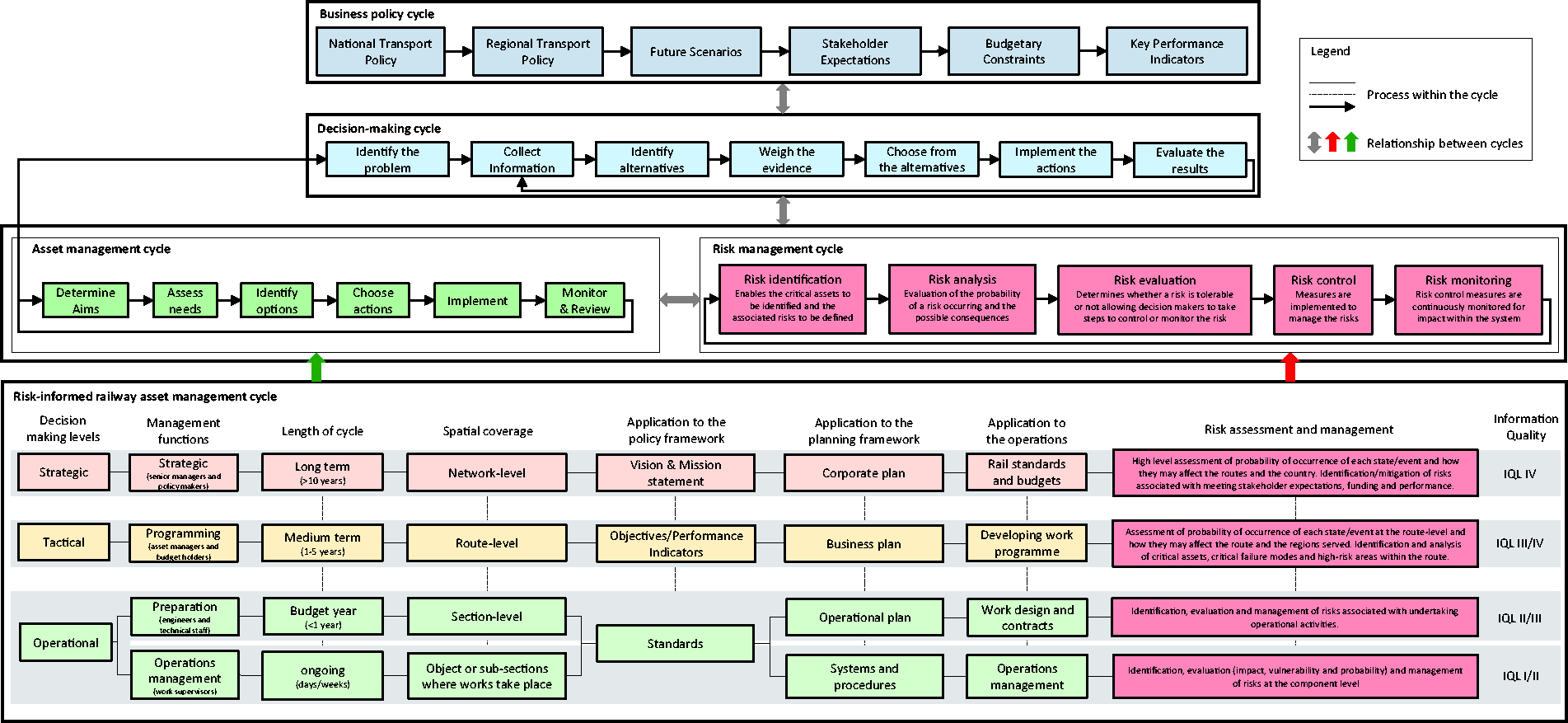
Risk-informed asset management framework for railway track infrastructure.
Data to information
Across all the three decision-making levels (i.e. strategic, tactical and operational), the understanding of the asset deterioration through better condition information; quantifying the impact of maintenance as an alternative to full renewal; and applying risk-informed whole life cycle cost models to compare the costs, impact on train operations, safety, environment and society, for a range of possible maintenance and renewal regimes needs to be considered. Fit for purpose information is essential for developing the appropriate asset strategies and for producing and implementing work and operational plans. To this end, the concept of information quality levels (IQL) introduced by the World Bank
48
has been used to suggest the data requirements for different levels of railway asset management activity shown in Figure 1. IQL I: Most comprehensive level of detail that is mainly used as a benchmark for other measurement methods and research purposes. IQL II: Sufficient level of detail to distinguish the performance and economic returns of different technical options. It is typically used for project design, supervision and testing. IQL III: Summary details with categorised or aggregate values for the route and is typically used for preliminary design, programming and budget preparations. IQL IV: The basic summary statistics of inventory, performance and utilisation, of interest to infrastructure providers and users; typically used for network statistics and strategic planning.
It can be seen from Figure 1 that the amount of information required to aid asset and risk management at different management functions increases progressively in intensity, but reduces in the extent of its network coverage.
Overview of the decision support approach
The approach presented within this paper can be employed at the strategic and tactical levels of management shown in Figure 1. It is designed to compare the costs of different railway track maintenance strategies with the associated safety risks and environmental performance, to inform an appropriate maintenance strategy. The approach aids the decision-maker, who needs to define which goals need to be prioritized according to the business need/policies. For example, given a required track condition what is the best maintenance strategy to achieve this over a given planning horizon? Or for a given route, what is the most economically appropriate track condition and what is the most appropriate way of achieving this? This is significant for the industry as enables economic maintenance standards to be derived which considers the needs of the infrastructure operator, but also those of users, train operating companies and the environment. Further, the risk-informed capability of the tool enables asset managers to deal with uncertainties associated with forecasting costs and the effects of track maintenance.
Whole life cycle cost analysis
The WLCCA model considers the direct and indirect costs and benefits to all the stakeholders as a function of track quality. As the track quality deteriorates over time, track use costs increase as a result of a rise in fuel consumption, environmental emissions and train maintenance requirements. Lower track quality results in higher dynamic loads, which in turn accelerates track quality deterioration. 49 Deterioration of track quality also poses a safety issue due to potential derailments. Furthermore, when the track quality is below unacceptable levels, speed restrictions are imposed to avoid derailments and this can result in delays. Reduced travel comfort and the increase in delays on lines where track quality is poor may also result in passengers and goods moving to other modes of transportation. This can in turn result in more road congestion, a higher probability of road accidents and an increase in emission from road vehicles.
The WLCC considered are those associated with ballasted track construction, maintenance, decommissioning, track use, mode change and the environment. Together these are considered herein to represent total transport costs. Railway track maintenance and renewal costs are those to do with the direct costs to inspect, maintain and renew the railway track structure and the indirect costs associated with track maintenance such as delays, accidents and emissions. Track use costs include train operation costs (i.e. the maintenance of rolling stock, fuel consumption and derailments), environmental costs and travel time. Mode change is associated with a perceived change in socio-economic costs incurred by railway users. De-commissioning costs are associated with disposing of track assets at the end of their useful life. The simplified WLCC calculations under uncertainty are illustrated in equations (1) to (5). Further details can be found in the published work by the authors. 26
The total railway transport cost,


The direct and indirect costs associated with railway track maintenance are the sum of the costs of inspection (

The railway track use costs,

For a section of track of length, L, the costs incurred to dispose of, or recycle, each track asset, x, at the end of the useful life of the asset, is given by equation (5).

WLCCA requires the prediction of current and future maintenance requirements for which the rate of deterioration of track components needs to be determined. Widely used track deterioration models consider the prediction of vertical track settlement as the main controlling factor for track geometry and therefore for track maintenance.50–52 Most of these models predict the vertical track settlement as a function of the number of loading cycles, while some as a function of average train speed and a few as a function of the effectiveness of maintenance interventions. Consequently, the approach described herein uses vertical track geometry as the sole measure of track quality. The required track condition data can be assessed by measuring the geometry of the railway tracks, while the empirical analysis of the collected data using track deterioration models would aid in informing and predicting the deterioration trend and maintenance effectiveness associated with each track section. 53
Risk assessment
Even though track deterioration modelling is carried out based on standards adopted by the railway authorities, limited research has focused on the effects of surpassing these standards. To address this, this paper proposes a new risk-informed approach to assess the impact of railway track quality on the risk of derailments and in so doing provides decision-makers with a risk model to facilitate maintenance planning. The risk model deals with data uncertainties by employing an expert opinion based system that models the relationship between derailment severity and track quality using a combination of a probabilistic and qualitative approach. This is achieved by a combined Monte Carlo-Fuzzy approach (MCFA) to determine the severity of a potential derailment as a function of track quality. The use of the Fuzzy approach allows imprecision or approximate information collected from experts to be involved in the risk assessment process. Monte Carlo simulation is employed to calculate the distribution of the severity of track-quality related derailments.
The proposed approach consists of five phases: risk identification, risk analysis phase employing MCFA, risk evaluation and risk monitoring phase; the structure is presented in Figure 2. The preliminary phase of the risk assessment process begins with establishing the context of risk management (e.g. rules and regulations of transport authorities, safety policies etc.), defining the problem (e.g. track quality-related derailments), identifying the associated hazards and collecting the relevant data and information. Hazard identification allows the consideration of different events that contribute to a track-quality related derailment i.e. different levels of track quality or track maintenance strategies. Data and information collection and analysis aim to develop a good understanding of the PHRTAs occurred over the years and to generate a body of information. If the historical data is unavailable or incomplete or there is a high level of uncertainty, expert and engineering judgements should be applied. The risk of a failure event in the railway safety risk analysis is determined by two risk factors, i.e. probability and consequence of a hazard event. The information gained from data and information collection informs the fuzzy rule base (or qualitative descriptors) and associated membership functions of the probability and severity of track quality-related derailments within the design phase. The fuzzy rule base for the task at hand is determined by data and failure analysis and human expert judgement. The background of the experts is analysed to allocate relevant expert weight (EW) to capture their varied expertise and knowledge in railway asset management and safety. As the fuzzy rules are linguistic rather than numerical, they provide a natural framework for expressing human knowledge. Thus, experts often find fuzzy rules to be a convenient way to express their knowledge about the relationship between input and output variables. The risk analysis phase quantifies the risks using the proposed MCFA and compares these with predefined criteria to enable risk response strategies to be formulated and implemented. E.g. if medium track quality is resulting in major derailments, then maintenance interventions can be planned. This allows the decision-maker to foresee the effect of any risk. 16
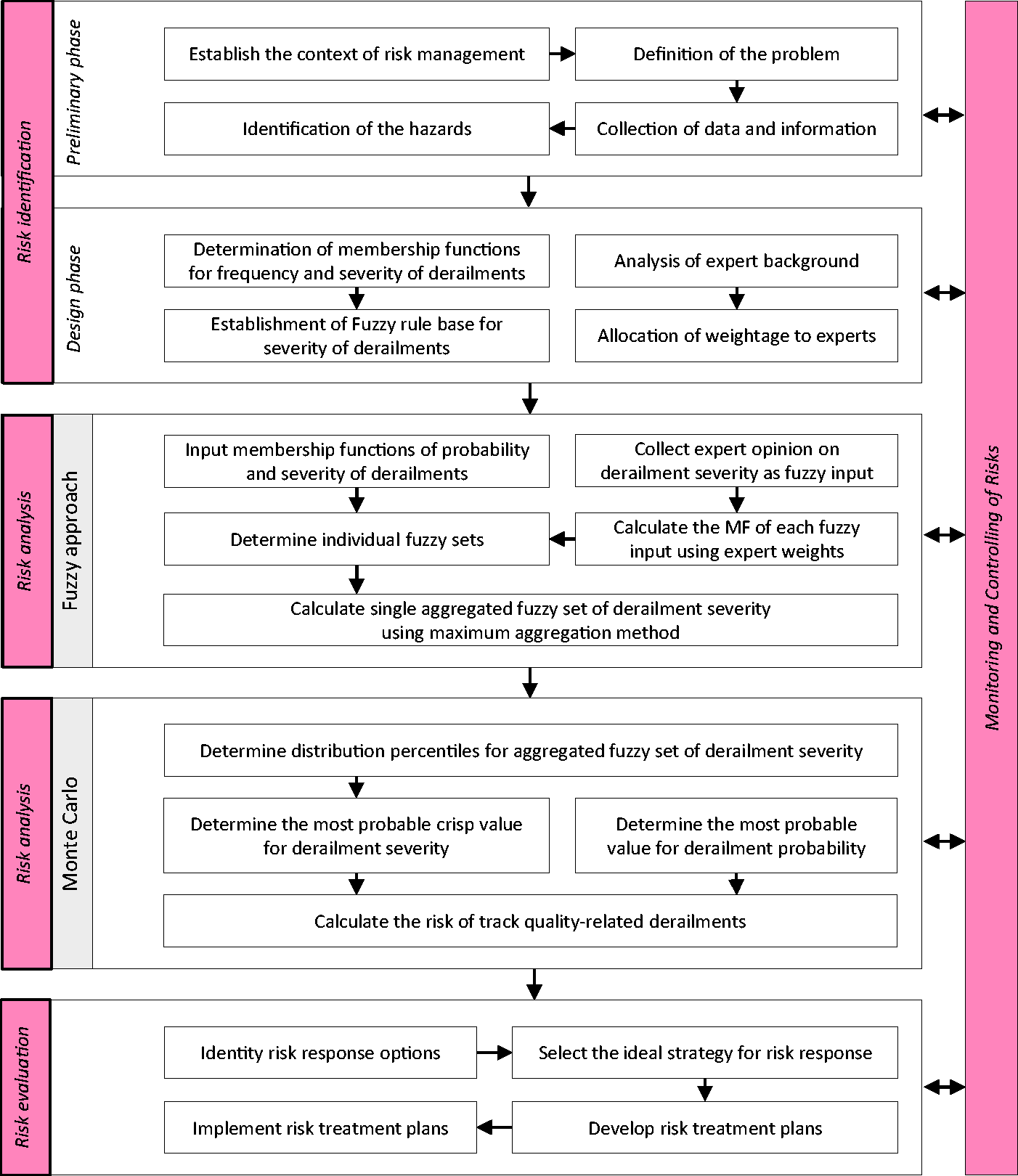
Flow chart of the integrated Monte Carlo-Fuzzy approach for risk assessment of track-quality related derailments.
Monte Carlo-fuzzy approach (MCFA)
While solving real-life problems, both uncertainty and imprecision could be encountered. Monte Carlo simulations have been employed widely for addressing probabilistic uncertainty,54–56 while the Fuzzy approach has been used successfully to address uncertainties arising from subjective and linguistically expressed data.57–59 Hence, a combination of Monte Carlo Simulation and Fuzzy approach can be used when decision-makers resort to subjective judgment within risk assessment for dealing with uncertainties associated with lack of data.60–62 Since such an approach has been adopted successfully for safety risk assessment within the airline, 37 shipping, 63 construction, 57 chemical 59 and power generation 64 industries it was decided to explore a similar approach for the proposed approach. It was found to be an appropriate modelling approach for unique failure events with only limited historical data.
The proposed MCFA employs expert opinion to deal with uncertainty associated with estimating the risk of derailments when subjected to different track maintenance strategies (or track quality levels). Fuzzy reasoning is used to analyse the expert opinion data, and Monte Carlo simulation is used to generate the probability distribution of the derailment severity from the fuzzy sets. The following steps provide further details of the proposed MCFA: membership functions The probability distribution functions and/or membership functions for the uncertain parameters (i.e. probability and severity of derailments) are defined. The probability of a derailment ( fuzzification The normalised input variables (i.e. derailment severity indicators) are fuzzified by being transformed to linguistic values that have two fuzzy sets: ‘Minor’ (MIN) and ‘Major’ (MAJ). These indicators describe the severity of a derailment i.e. damage to infrastructure and rolling stock, service disruptions and casualties. The qualitative descriptors for the derailment severity used in the proposed approach are described in an if-then rules format as shown below: If the derailment is PHRTA resulting in <50% delays on the route, then it is MIN If the derailment is PHRTA resulting in >50% delays or train cancellations on the route, then it is MAJ Both the linguistic variables (i.e. Minor and Major) were assigned the triangular membership functions i.e. (0, 0.25, 0.50) for MIN and (0.50, 0.75, 1) for MAJ. Such an approach was adopted by.29,32,33,68 expert opinion and allocation of weights The risk assessment process in the proposed approach involves experts from different backgrounds and disciplines, with experience in railway asset management and safety. Expert opinion was solicited to collect information on the severity of derailments associated with different levels of track quality (low, medium and good) while considering operational and strategic aspects of the railway track/route. Since the experts may have a varied experience, Expert Weighting (EW) was introduced to capture the variation effectively.
32
The EW of ith expert within n number of experts can be obtained from equation (6) d. aggregation A single aggregated fuzzy set is obtained by combining the outcomes of each expert’s opinion (i.e. weighted fuzzy outputs), using the maximum aggregation method.32,60 Hence, the aggregated fuzzy set (maximum), μsev(x), is obtained using equation (7) where e. defuzzification Defuzzification is the final step of the fuzzy method, in which a crisp value is estimated. It provides a representative value that can be used in the calculations and subsequent deductions. The input to the defuzzification step is a single fuzzy set produced in the aggregation step (from equation (7)). The most commonly used centroid of area method29,32,60 is employed for this purpose and is given by equation (8). This technique takes the centre of gravity of the membership function of the conclusion, which combines the triangular membership function of each if-then rule. f. monte carlo simulation Monte Carlo simulation is used to calculate the distribution percentile of the crisp values obtained from the defuzzification step, an approach suggested by.58,60 In this study, 10,000 iterations of Monte Carlo simulation were conducted, for each track quality level, the most probable crisp value for the severity of the derailment ( g. risk estimation The impact costs of derailments (
Where REi is the weight assigned to the ith expert based on their experience. REi takes a value between 0 to 1 and is defined in a way that the higher the number, the greater the importance is assigned to the expert’s opinion. Each Fuzzy input is multiplied by each EW’s and is matched to their respective triangular membership functions by using the if-then rules to give weighted fuzzy outcomes for each expert’s opinion, as suggested by.
60
Where is (
Where




Implementation
Data on the direct and indirect costs associated with track construction, maintenance, use and end of life obtained for the commuter (Sutton Coldfield-Lichfield City), high-speed passenger (London Euston-Birmingham New Street) and mixed traffic (Coventry-Birmingham New Street) routes on the UK mainline railway network have been used to demonstrate the risk-informed approach. The candidate maintenance strategies that result in different average track quality levels (expressed in standard deviations (SD) of vertical settlement) were identified using a probabilistic track deterioration model developed by 55 and the resulting track quality levels were classified poor (>2.7 mm SD), medium (1.2–2.7 mm SD) and good (<1.2 mm SD) (see 26 for the maintenance strategies adopted for the case studies). For each route, firstly, the risk of derailments associated with candidate strategies was estimated using the proposed MCFA presented in Figure 2, and secondly, the direct and indirect costs associated with candidate maintenance strategies were estimated using the WLCCA model (summarised in equations (1) to (5)).
The use of expert opinion was identified as a useful approach for overcoming issues associated with the unavailability of data on derailments where track quality was the causing factor. UK’s Railway Group Guidance Note 69 and RSSB 70 also identifies the use of expert judgement in assessing risks of hazardous events when no data is available. To quantify the severity of derailments associated with different average track quality levels, a workshop was conducted with a panel of four experts. The experts were asked to rate, using a questionnaire, the severity of derailment (Major or Minor) associated with maintaining the track at three different quality levels (Poor, Medium or Good) while considering operational aspects such as frequency and speed of trains, type of vehicles and the strategic importance of each assessed route. The experts provided their judgement on the severity of derailments associated with different track maintenance strategies (presented in Table 1). Using this information, the severity of track-quality related derailments were estimated by employing the MCFA proposed within this paper (see Table 1). The probability of track quality-related derailments was quantified based on information in the Train Accident Precursor Indicator Model and Safety Risk Model 71 which states that track quality-related derailments have a national frequency of 0.053 events/year although the model does not relate these to particular values of track quality. For the three representative track sections, the frequency of occurrence of derailments was assumed to follow a Poisson’s distribution (see Table 1).
Expert opinion data and results from the MCFA for calculating the risk of track quality-related derailment (MAJ: Major, MIN: Minor).
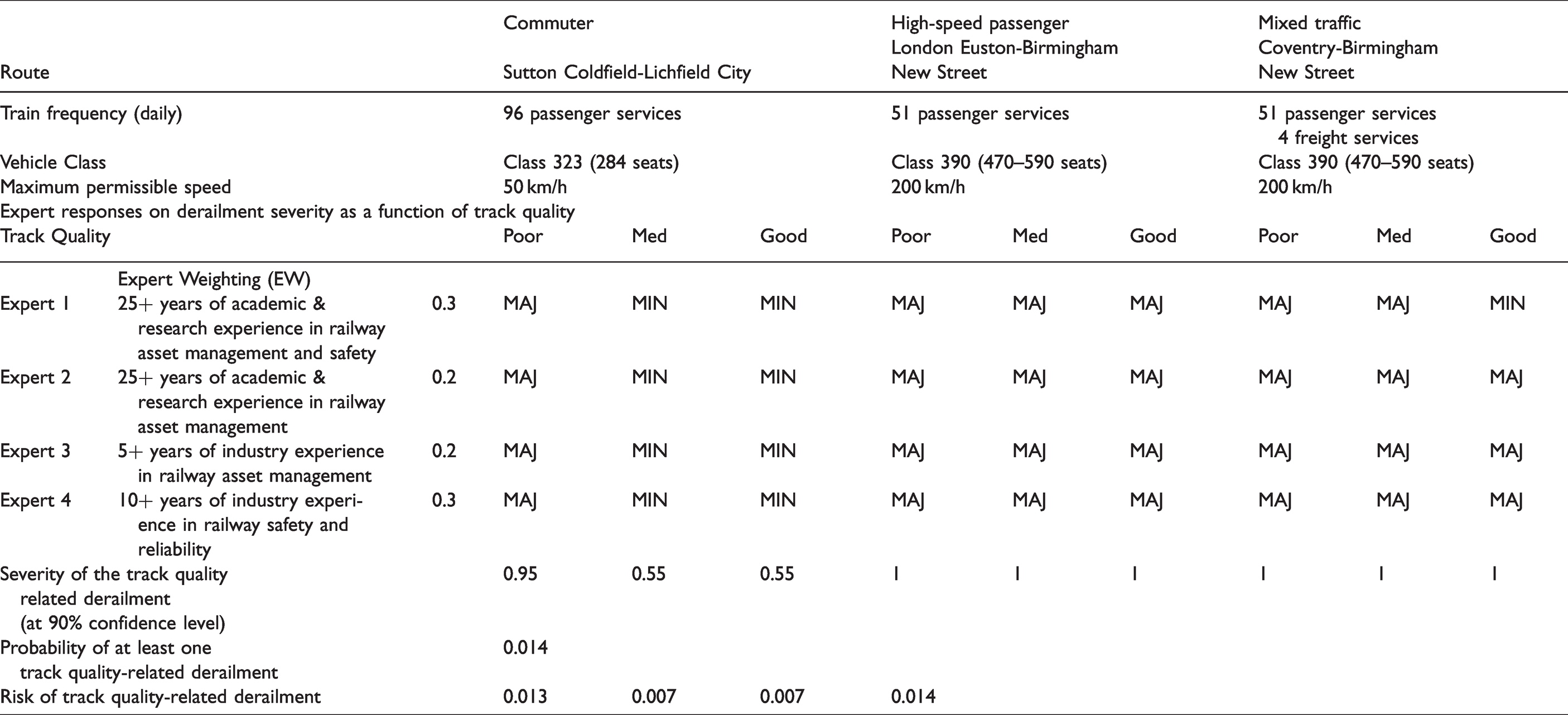
The average cost of derailment on the UK mainline is estimated to be £6,61,073 72 while considering the damage to track infrastructure and rolling stock, service disruptions, casualties and environmental impacts. The impact costs of derailments on the analysed routes were calculated using equation (9) and the results are presented in Figures 3(a), 4(a) and 5(a). The results show that strategies to maintain passenger and mixed-traffic routes at low and medium track quality result in higher risks of derailments. The experts believed that the commuter route, owing to lower operational speeds, would have a high severity of derailment only when maintained at a lower track quality. All the experts unanimously agreed that while higher track quality might result in a low probability of derailments across all three selected route types, the frequency and speed of trains on each route will have an impact on the derailment severity. E.g. experts suggested that the passenger and mixed route might have a major derailment even when maintained at a good track quality considering the impacts of an accident on such critical routes.

(a) Risk of derailments, (b) investment in track maintenance and (c) total railway transport costs as a function of track quality on the commuter route.

(a) Risk of derailments, (b) investment in track maintenance and (c) total railway transport costs as a function of track quality on the high-speed passenger route.
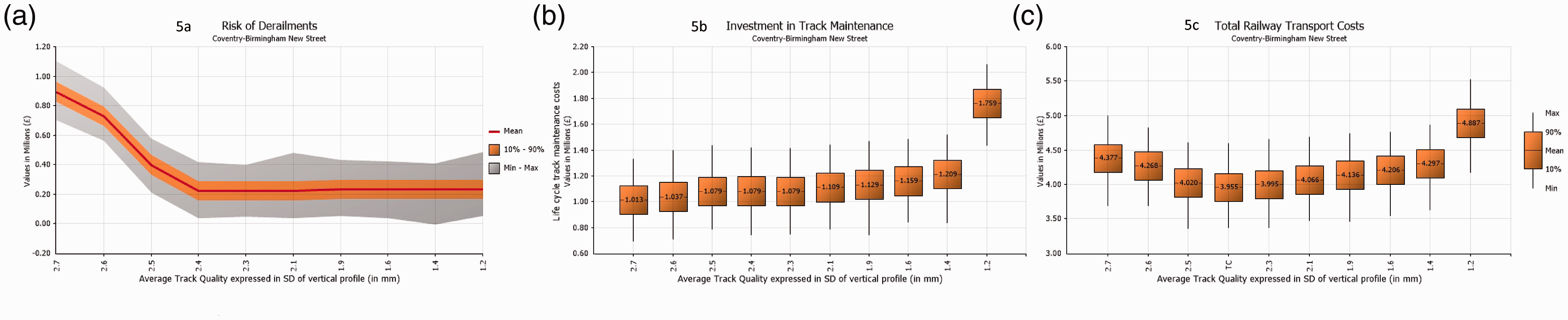
(a) Risk of derailments, (b) investment in track maintenance and (c) total railway transport costs as a function of track quality on the mixed-traffic route.
An analysis was carried out to quantify the contribution of construction, track maintenance and renewal, track use and end-of-life costs on the total railway transport costs for a representative 200-metre long track section (of homogenous construction, maintenance and renewal history, and social and economic geography) on each of the routes. Figure 6(a) to (c) presents the results of 10,000 possible scenarios generated using Monte Carlo simulations. It can be observed from Figure 6(a) to (c) that track use costs have the greatest impact on the total railway transport costs for all three routes. The proposed risk-informed approach calculates track use costs as a function of the average track quality. To this end, it can be argued that the track quality achieved during construction and track maintenance and renewal are the primary indicators of track use costs. It may be expected that a higher initial quality track as a result of higher construction standards would require higher construction costs but result in lower end-of-life costs and lesser deterioration rates, provided track usage and efficiency of maintenance activities remain the same. On the other hand, the end-of-life costs have the least impact on the total transport costs. Current practices in the industry are that, when replacing materials from site at the end-of-life, they are seen as life expired. However, if they are refurbished to a quality that is acceptable for reuse, the need and cost of procuring new materials can be reduced. Employing the proposed approach within decision-making can thus aid in identifying more economically beneficial maintenance standards.
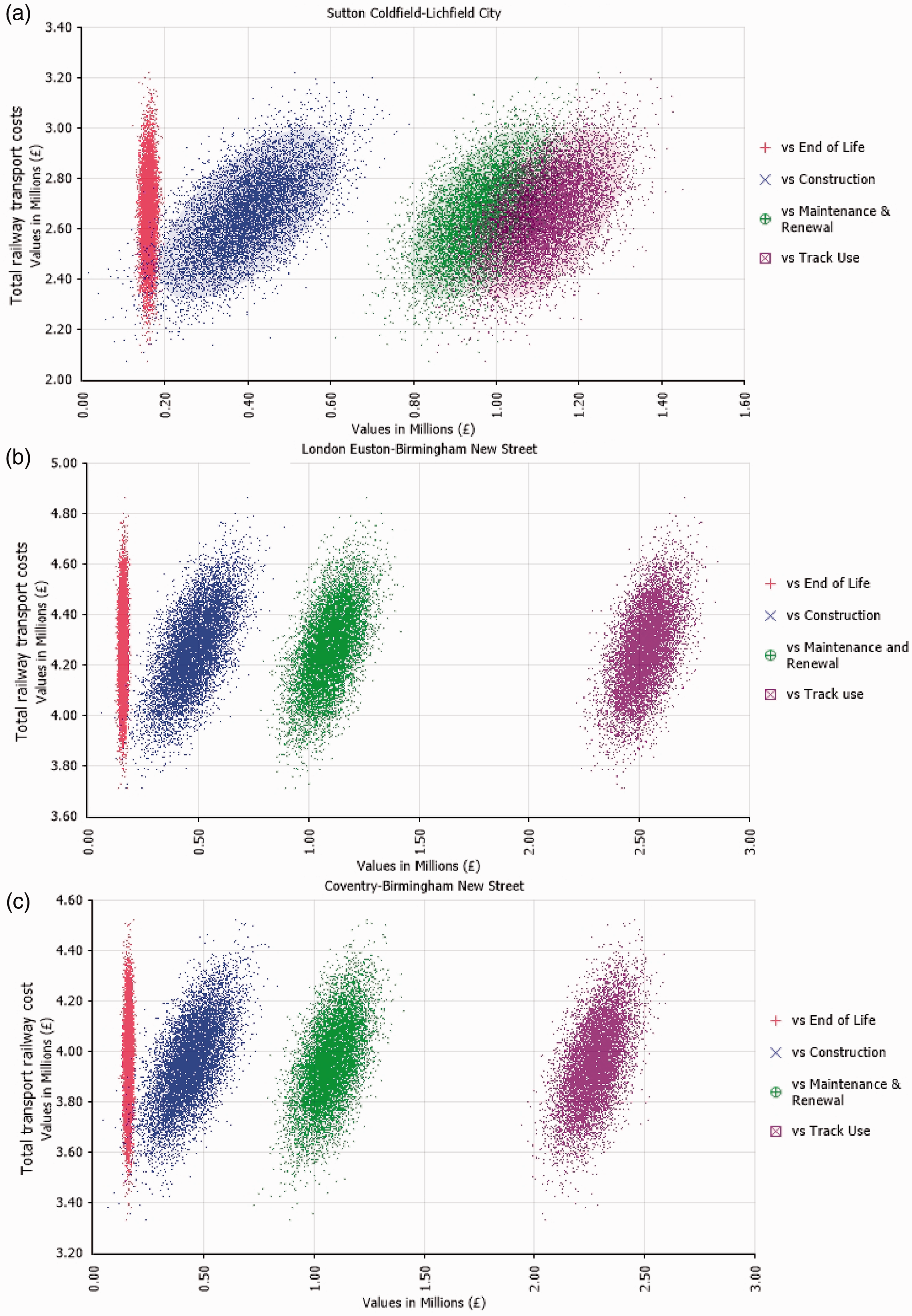
Contribution of different WLCC to the total railway transport cost for (a) the commuter (b) high-speed passenger and (c) mixed traffic routes.
Discussion
The approach introduced within this paper models the impact of different maintenance interventions in terms of safety to identify track maintenance strategies that reduce the safety risk to as low as reasonably possible (ALARP). For example, results from the case study (from Figures 3(a), 4(a) and 5(a)) suggests that the mixed-freight and high-speed passenger routes can be maintained at 2.4 mm SD to reduce the risk of derailments to ALARP. It can also be observed that this strategy results in the lowest total transport costs (from Figures 4(c) and 5(c)). This shows that the proposed risk-informed asset management approach and the resulting decision support tool 73 can also aid in identifying economically justified track maintenance strategies that consider the impacts on different stakeholders. It can be seen from Figure b-c that an increase in the current maintenance investment on the London to Birmingham route by approximately 2.5% over the life cycle of the railway track results in an annual saving of £3000 per meter. This is significant when compared with the current industry practices that fail to consider the whole life cycle costs and benefits of the operation and maintenance of each asset. It appears that the main reason for this is the misalignment of incentives provided to track maintainers and train operators, resulting in each stakeholder seeking to reduce their costs without considering the needs of all stakeholders.
The proposed approach can be used to support strategic planning and, programming levels of railway track asset management (see Figure 1). For strategic planning, the approach can be used to explore the budgets required to achieve given levels of overall average railway network track condition and to understand the associated risks of maintaining the network at these levels. Similarly, the approach can be used to argue for funds to achieve improvements in average network condition and to reduce risk. At the programming level the approach can be used to compare, on a cost-benefit basis, different railway track design and maintenance strategies for individual routes or track sections.
Since the tool is designed for strategic planning and programming the data required is IQL III-IV i.e. summary data. Much of this information and at this level of detail is now routinely collected by railway infrastructure managers. While considering the indirect or direct costs of track maintenance within the decision making, there are some challenges concerning the lack of data associated with costs, impacts, benefits, the effectiveness of maintenance interventions, risk of accidents etc. giving rise to uncertainties. However, the proposed Monte Carlo-Fuzzy approach deals with such uncertainties using expert opinion and probability judgements, and conclusions on the acceptability of the results are made directly based on derived probabilities and confidence levels. Data requirements, and therefore the computational time required to run the model and to analyse the results, can be reduced considerably by carefully selecting a sufficient number of representative track sections to portray adequately the characteristics of the entire network.
Although the proposed approach provides, for the first time, railway policy and decision-makers with a transparent means to appraise the risks and costs of track maintenance strategies using a whole life cycle approach under uncertainty, it is acknowledged that there are some limitations of the approach which are being addressed through on-going research. These include a comprehensive analysis of the probability of derailments as a function of track quality and the impact of different rolling stocks on the track deterioration rates.
Conclusion
Railway networks in many countries are being required to carry ever greater amounts of traffic and at higher speeds. Asset managers are therefore tasked with providing more efficient maintenance strategies which can be adopted in shorter time frames and often with less budget. In order, therefore, to ensure that railways continue to be safe, efficient, reliable and affordable, risk-informed asset management strategies are required which enable preventative maintenance to be prioritized across the network. To ensure the needs of all stakeholders are considered appropriate cost-benefit approaches are required. Earlier work by the authors 26 demonstrated such an approach. However, identified risks and uncertainties also need to be considered within the decision-making process because the unavailability, or lack of data, can give rise to uncertainties within risk assessment, which hinders effective decision making. To address this, the paper advocates an approach to deal with ambiguous, incomplete and uncertain information within the assessment processes. The approach is incorporated within the method described in. 26 It demonstrated, via three case studies, that subjective information such as expert knowledge and engineering judgement can effectively augment the available data for assessing the risk of derailments associated with different track maintenance strategies. The proposed risk assessment approach of combining the Monte Carlo and Fuzzy approach allows imprecise linguistic expressions to be used to capture expert opinion to assess the impacts, or severity, of derailments. Careful consideration of the number and diversity of experts is important for any application of the proposed approach to ensure the accuracy of the risk assessment and to avoid bias. To this end, expert judgement was weighted according to their specialist knowledge and experience thereby allowing the opinions of a variety of experts to be considered rationally. The proposed approach enables risk management officials and decision-makers to improve their understanding of risks associated with railway track conditions, the impacts of risk mitigation decisions and thus enabling efficient asset management.
Footnotes
Acknowledgements
The authors gratefully acknowledge the experts from the University of Birmingham’s Birmingham Centre for Railway Research and Education, Network Rail and Intellex Consulting Services for their time and effort in participating in the data collection workshop. The authors are thankful to Network Rail and in particular, Dr Mohamed Wehbi for providing data for the case studies. The efforts by Mr Nitesh Menon in developing the software component of the RiTRAK tool are acknowledged with gratitude
Declaration of Conflicting Interests
The author(s) declared no potential conflicts of interest with respect to the research, authorship, and/or publication of this article.
Funding
The author(s) disclosed receipt of the following financial support for the research, authorship, and/or publication of this article: The financial support from the Engineering and Physical Sciences Research Council’s Impact Acceleration Account is acknowledged with gratitude.
