




Abstract
Improving energy efficiency and reducing CO2 emissions are becoming very essential worldwide. To encourage the development and application of energy-efficient and low-emission technologies and to increase people's awareness of energy-saving, many energy labelling systems are developed and utilized in most countries. Since energy labelling systems have a significant impact, more and more sectors are developing their energy labelling systems to have their products included. Globally, the transport sector consumes a great proportion of energy and is responsible for considerable CO2 emissions. Although rail vehicles have relatively high energy efficiency, a labelling system has not been developed in the railway sector, whereas other modes of transport have developed energy efficiency indicators or energy labelling systems. Therefore, it is necessary to develop an energy labelling system for rail vehicles to promote rail transport and develop the technology of rail vehicles. First, this paper gives a review of the existing energy labelling systems. Second, it summarizes the rail needs and rail stakeholders’ interests regarding energy efficiency and corresponding labelling. Last but not least, a proposal for an energy labelling system for rail vehicles is given.
Keywords
Introduction
Improving energy efficiency and reducing CO2 emissions are becoming very essential worldwide. More advanced technologies which can effectively use energy and significantly cut CO2 emissions are being developed and used. To limit the usage of inefficient products, regulate the market and raise people's awareness of energy-saving, policy-makers have the responsibility to encourage the development and application of these technologies. 1 In this way, energy labelling systems for evaluating the energy efficiencies of different products are initiated in most countries and by some international organizations.
The history of energy labelling is about a half a century old. France set standards for refrigerators in 1966, whereas other European countries introduced legislation mandating efficiency information labels and performance standards in the 1960s and 1970s. Japan, Canada and the U.S. followed with programmes on energy labels. 2 Today, all developed countries and some developing countries have set up their energy labelling systems for a wide range of products, mainly for household products but also for light road vehicles, some office equipment and even buildings in some countries.1–4
The transport sector uses a considerable amount of energy, globally about 28% of the total energy in 2015. 5 To protect the environment and encourage energy-efficient technologies, most countries have set up energy labelling systems to classify the performance of some road vehicles. Some international organizations, like the International Civil Aviation Organization (ICAO) and the International Maritime Organization (IMO), have developed methods to evaluate the energy efficiency and to enforce the minimum acceptable energy efficiencies within their sectors.6,7 Although some train operators have developed CO2 footprint indicators based on statistics and travelling distance,8,9 there is, unfortunately, no coordinated energy labelling system or energy efficiency indicator in the rail transport sector today. Compared with other transport modes, rail transport is still well known for its energy efficiency and often has low CO2 emissions.
However, rail vehicles operate within a wide range of speeds and in many different working conditions, which makes the development of an energy labelling system for rail vehicles quite complex. To not only enhance the attractiveness of rail transport but also to encourage the application of energy-efficient products and to incentivize the development of railway technology, there is a need to develop a labelling system to reflect and evaluate the energy efficiency of different categories of rail vehicles.
In proposing an energy labelling system for rail vehicles, this paper first reviews the existing energy labelling systems of household products and some methods to evaluate the energy efficiency of other transport modes than rail. Second, this study summarizes the rail stakeholders' interests regarding energy efficiency and energy labelling. Third, the study proposes an energy-labelling system for rail vehicles. Finally, this paper draws some concluding remarks for developing an energy-labelling system for rail vehicles.
Review of energy-labelling systems
A variety of energy labelling systems exist in the world and are applied to a wide range of products. This section introduces the fundamentals of developing the energy labelling systems and reviews the existing energy-labelling systems. More extensive information of the existing energy labelling systems can be found in FINE-1. 10
General
An energy label is a marking with instruction list to show a product's energy usage or efficiency level in operation according to a common measure. The label alerts targeted groups to the energy usage or operational costs of the appliance and enables direct comparison of energy efficiencies among various products. The principle of an energy labelling system contains three key elements: protocol, label and standard. 1
The protocol specifies how to measure or simulate energy usage of the models with various functions and how to make their energy usages comparable. In reality, there are many uncertainties about operating conditions, setups, climate and human behaviour, all of which significantly affect the energy usage. To coordinate these diversities and make the labelled products comparable, the protocol plays the main role in an energy labelling system and includes energy usage metrics, operating cycles and conditions, performance metrics, model categories, allowable tolerances and measuring instrument specification. For the operating conditions, the main factors which guide the development of the protocol are simplicity, reproducibility and representativeness. EU tends to adopt the test protocols developed by the International Organization for Standardization (ISO) and the International Electro-technical Commission (IEC), while the U.S. and Japan prefer to develop their own protocols. Other countries tend to develop their protocols based on one of the three protocols.
In an energy labelling system, the label is responsible for indicating the energy efficiency and some other key features and for conveying them to the targeted groups. Most labels rely on graphics to draw attention and to convey information. Generally, there are two kinds of labels: comparison label, which makes the comparison between different product models possible, and endorsement label, which only indicates that the model has a better performance than a common level. Usually, the comparison label is mandatory in most countries. Regarding the comparison label, there are three general approaches: efficiency range of the products available, pre-defined efficiency categories and target efficiency levels. The range label uses linear graphics to describe how the energy usage or efficiency of the labelled model compares with the most-efficient and the least-efficient models sold on the market. The category label classifies energy efficiency of the labelled product according to pre-defined efficiency limits. The target label uses a symbolic mark to indicate the ratio between the labelled product's energy efficiency and a targeted efficiency level.
The standard is used to define energy efficiency and to regulate the acceptable efficiency in use. It is the mandatory regulation to define efficiency classes and to stipulate the minimum efficiency level of a product acceptable for selling or using. Although the efficiency classes and the standard play different roles in the encouragement of energy-efficient technology and the restriction of low-efficient products, in most cases they work together. The buyers can make their own choice in a purchase, but once the product falls out of a certain energy efficiency range, this inefficient product is not allowed to be sold. There are two basic approaches to establish the standard values: statistical method and engineering/economics method. In the statistical approach, the energy efficiencies of all product models on the market are evaluated to establish the efficiency levels. In the engineering/economics approach, the standards are established to feasibly reflect technological and economic improvement and target.
Many countries and international organizations have developed their energy-labelling systems for different products based on the general principles above. In all developed countries and some developing countries, energy labelling systems apply to most household products and in some countries also some other products, such as road vehicles, office products and even houses. For example, EnergyGuide label in the U.S. mainly applies to household products; 11 Top Runner Target Product Standard in Japan covers household products, electronic devices, light road vehicles and some office equipment; 12 Energy Star system, an endorsement label, is recognized by most countries and covering a wide range of products; 13 EU energy label applies to household products. 14 ICAO and IMO not only encourage the application of advanced technologies and renewable energy but also have developed means to indicate and regulate energy efficiency within their sectors.6,7 In some EU countries, some more sectors are subjected to energy labelling systems.14,15 For example, in Sweden, energy usage of houses is subjected to an energy labelling system which classifies the houses into seven energy efficiency classes. 4
Household products
Household products use a significant amount of energy and have numerous models, functions and setups. In 2015, the residential sector consumed about 25% of the total energy regarding its final usage. 5 Today, most household products are subjected to energy labelling systems which indicate energy efficiency of the labelled products and stipulate the minimum efficiency level acceptable for selling or using. The labelling systems also assist customers to be informed about operational costs and environmental issues.
Most household appliances work in an indoor environment, i.e. a uniform and simplified condition, and only consume electricity as energy, which makes the energy quantities comparable and easy to measure. There are many kinds of energy labelling systems for household products in the world, as shown in Figure 1. There are comparison labels, e.g. the EU energy labelling system, the U.S. EnergyGuide, the Japanese Top-Runner Program and The China Energy Label (CEL), all of which indicate the energy efficiencies at specified operational conditions and classify energy efficiency levels. In addition, there are endorsement labels which only indicate better energy efficiency than a certain level, e.g. the Energy Star, the Chinese Energy Conservation Program, South Korean High-Efficiency Appliance Certification Program and EU Eco-label.3,16 The three comparison labelling systems in the U.S., EU and Japan are the most common, and most other energy labelling systems are somehow variants or developed from them.
Comparative labels: (a) EU, (b) China, (c) Japan, (d) U.S. Endorsement labels: (e) Energy Star, (f) Chinese Energy Conservation Program, (g) South Korean High-Efficiency Appliance Certification Program and (h) EU Eco-label.
3
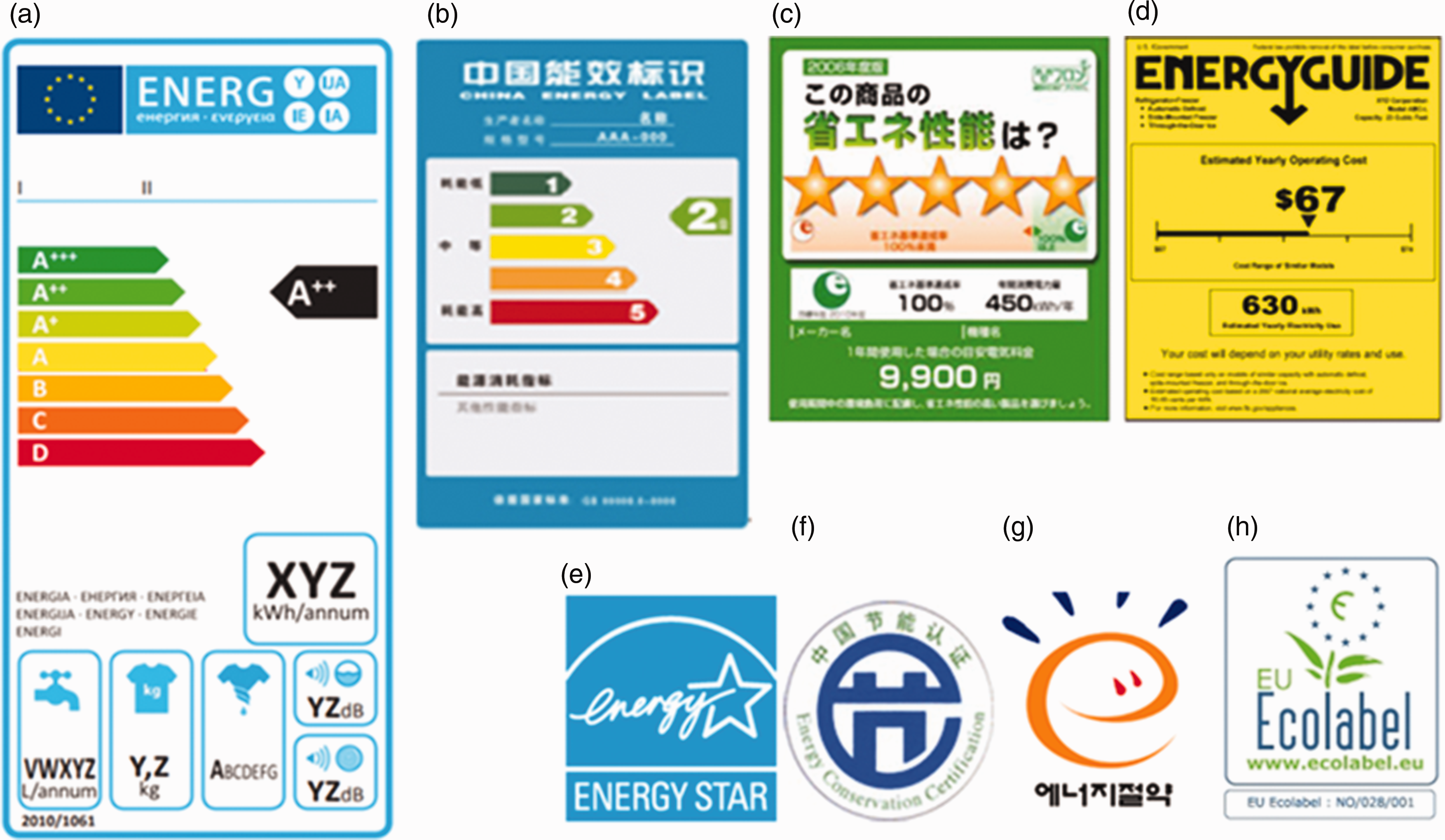
Canada and the U.S. have in most cases the same or very similar energy efficiency standards as well as protocols. The U.S. EnergyGuide labels and the Canadian EnerGuide labels focus on monetary information and display estimated yearly operating costs related to energy. They use range labels with linear graphics to show the energy costs of the labelled model in comparison with the most-efficient and least-efficient models on the market, as shown in Figure 1(d). In the U.S., all major home appliances must meet the energy efficiency standards set by the U.S. Department of Energy (DOE). 17 Manufacturers must use standardized test procedures to prove the energy efficiency of their products and display the results on the energy labels. Since the systems compare similar products on the market within a certain period, the labelling scale changes over time and therefore has to be frequently updated. 1
Japanese top-runner efficiency standard is enforced by the Energy conservation law in Japan and displays both economic and energy information stating yearly energy costs. The standard is applied to most household products, office equipment, some electronics and light road vehicles (passenger and freight, below 3.5 tonnes).11,18 It is a target labelling system using symbolic marks to indicate the ratio between the energy efficiency of a labelled product and a targeted efficiency level, as shown in Figure 1(c). This enables consumers to compare the energy efficiencies among different products in a relative and quantitative way. The system also provides information about future improvement.
EU established an energy efficiency labelling scheme in 1992, which today covers most household appliances (even for non-household usage): refrigerators, freezers; washing machines; dishwashers; ovens; water heaters; lamps; air-conditioning appliances; TV sets; tyres for road vehicles. 14 According to the energy labelling system, household appliances for sale or hire must be accompanied by a fiche and a label with information on energy efficiency. The labelling system classifies the energy efficiency of the labelled model into different energy efficiency classes according to pre-defined efficiency levels, as shown in Figure 1(a). The system must contain the following information: supplier's name, model identifier, energy efficiency category and standardized energy usage. The energy usage is measured based on standardized working conditions to balance the diversity of models and working environments. 19 For example, annual usage of washing machines is converted into 220 standardized washing cycles with three specified loading factors and two specified water temperatures. 20 For air conditioning, to standardize variation of outdoor temperature within a year, several discrete temperature points with different occurrences are used. 21 Regarding classification, an Energy Efficiency Index (EEI), i.e. a ratio between the standardized energy usage and a reference energy usage determined by its functioning features, is used to classify the energy efficiency levels according to pre-defined classes from A to G, with A being the most efficient and G the least. To accommodate advances in energy efficiency, A + and A+ + etc. have been added for some products thereafter. Although this system is relatively stable, it has to introduce more energy classes to accommodate future improvement in the long term. In addition, some other key performances are also included for some products, e.g. capacity, water usage and noise level. This system only compares the labelled product against the pre-defined efficiency levels rather than the other product models. Since all EU countries have the same energy labelling system, this allows the manufacturers to use a single label for the products in the EU. 19
Besides the EU energy labelling system, there is an EU Eco-label in use, which covers a very wide range of products and services (except medical products for human use and veterinary use), it is a voluntary scheme to market the products or service with not only high energy efficiency but also low environmental impact. 22
Transport modes except for rail
In 2015, the transport sector consumed about 28% of the total energy regarding its final usage. 5 Different from household products, the function of all transport modes is to provide transportation services, i.e. moving passengers or goods from one place to another. There are several important items for all transport modes: e.g. energy usage, CO2 emissions, travelling time, safety and comfort. The transport modes may in principle be compared with each other in fuel units or in CO2 emissions per passenger or tonne per km (pkm or tkm), but different forms of transportation have different energy labelling methods or efficiency indicators according to their features. Strictly speaking, only light road vehicles have energy labelling systems, but they differ much among countries, while aeroplanes and vessels only have energy-efficiency indicators to reflect their CO2 efficiencies.
Road vehicles consume much more energy in total than other modes of transport, especially in the form of fossil fuel, which leads to significant CO2 emissions and heavy pollution in many populous cities. To effectively use energy and reduce CO2 emissions, many countries have set up energy labelling systems for cars to classify their energy efficiencies. However, the energy labelling systems for cars in the world differ very much, as shown in Figure 2.23,24
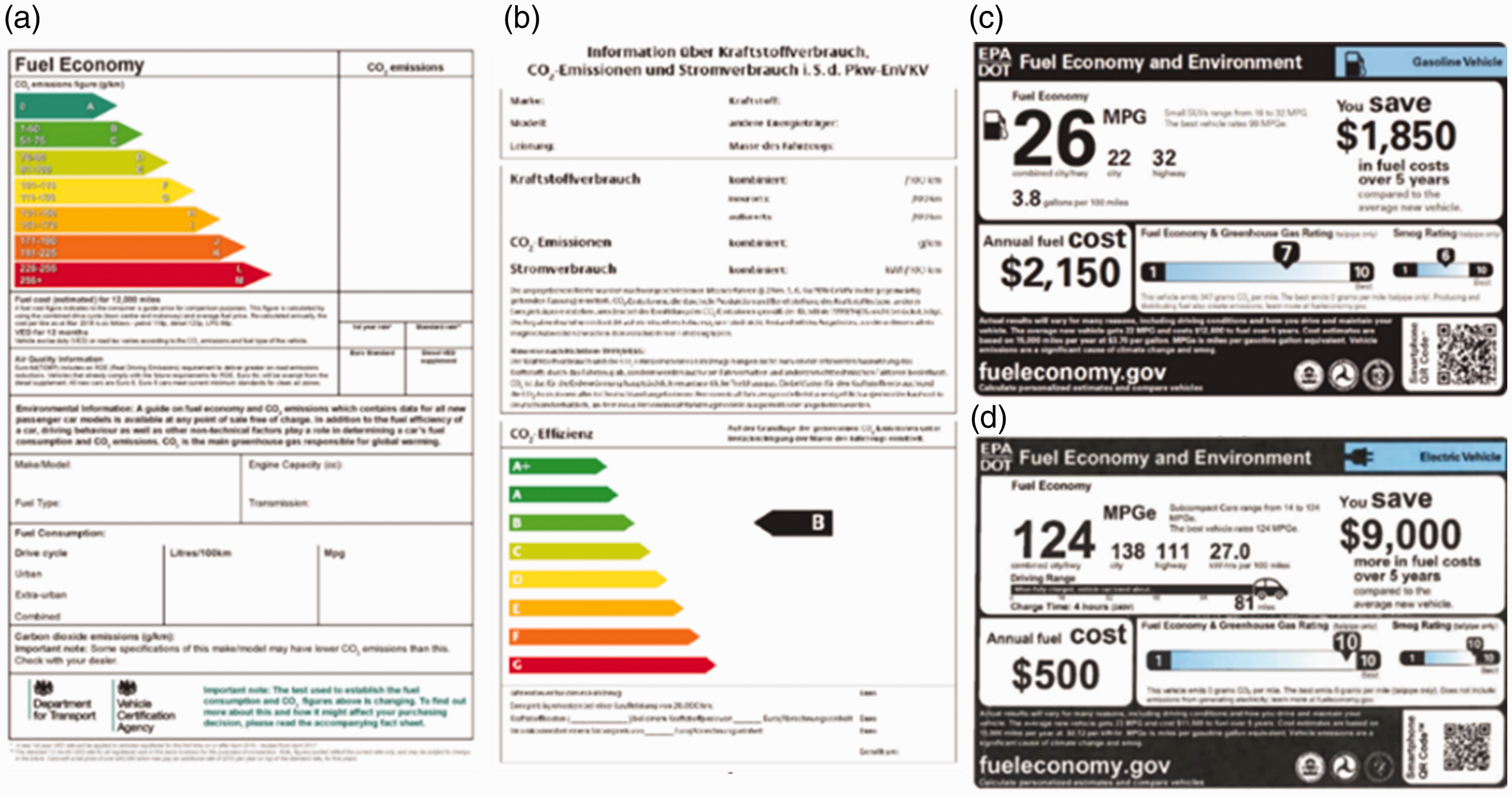
In the EU, the energy efficiency of cars is evaluated in terms of CO2 emissions. The energy label includes the following information: brand, model, version, fuel type, transmission type, weight, fuel usages (in litre/100 km) and average CO2 emissions of the full test cycle (in g/km). 25 The labelling system is based on Tank-To-Wheel (TTW) emissions, so electric cars are stated as having zero emission, which in most cases is not true. 26 Due to the lack of specific requirements on the format of the energy label, EU member states implement the labelling systems differently 27 and therefore have no uniform energy label for cars. Most EU countries regulate the format and details of the energy label, but the Czech Republic and Poland have neither standardized label format nor efficiency classification.
The efficiency classifications also deviate much in different EU countries, so the same car can be classified into different classes. Most EU countries use a direct method to classify the energy efficiency, in which the car models are classified by the absolute CO2 emissions, as the UK example in Figure 2(a). Under the direct method, the labelled car model is compared with all cars on the market, so small and light cars generally give relatively low CO2 emissions and show high energy efficiency. Meanwhile, some countries use an indirect method, like Germany, Spain and the Netherlands. For example, in the German example of Figure 2(b), the labelled car is firstly categorized into groups based on car weight and then the labelled car model only compares its CO2 emissions against a reference value from a standardized car model in its group. The indirect method thus only shows the energy efficiency of the labelled car against cars with similar features. 28 The information stated in the EU labels is relatively stable and does not need frequent updating, but the CO2 emissions of electric cars are somehow hidden by this labelling system.
The U.S. energy labelling system highlights fuel economy instead of energy usage. The U.S. Environmental Protection Agency (EPA) and the National Highway Traffic Safety Administration (NHTSA) have developed energy labels on energy efficiency and environmental comparison for all types of road vehicles, including battery electric vehicles (BEV) and plug-in hybrid electric vehicles (PHEV). The vehicle's fuel performance is indicated by miles per gallon of fuel (MPG), as shown in Figure 2(c), while vehicles running on other fuel types use petrol–energy equivalent MPG (MPGe) according to pre-defined conversion ratios, 19 as shown in Figure 2(d). All the labels must include the following information: fuel type, fuel economy, fuel usage and CO2 emission rating, CO2 emissions per mile, annual fuel costs or savings against the new vehicle average, and a rating for smog-forming pollutants.29,30 The labelled vehicle is compared with the new cars sold on the market, so the information on the label has to be frequently updated, but this system can indicate fuel efficiencies of vehicles with different fuel types.
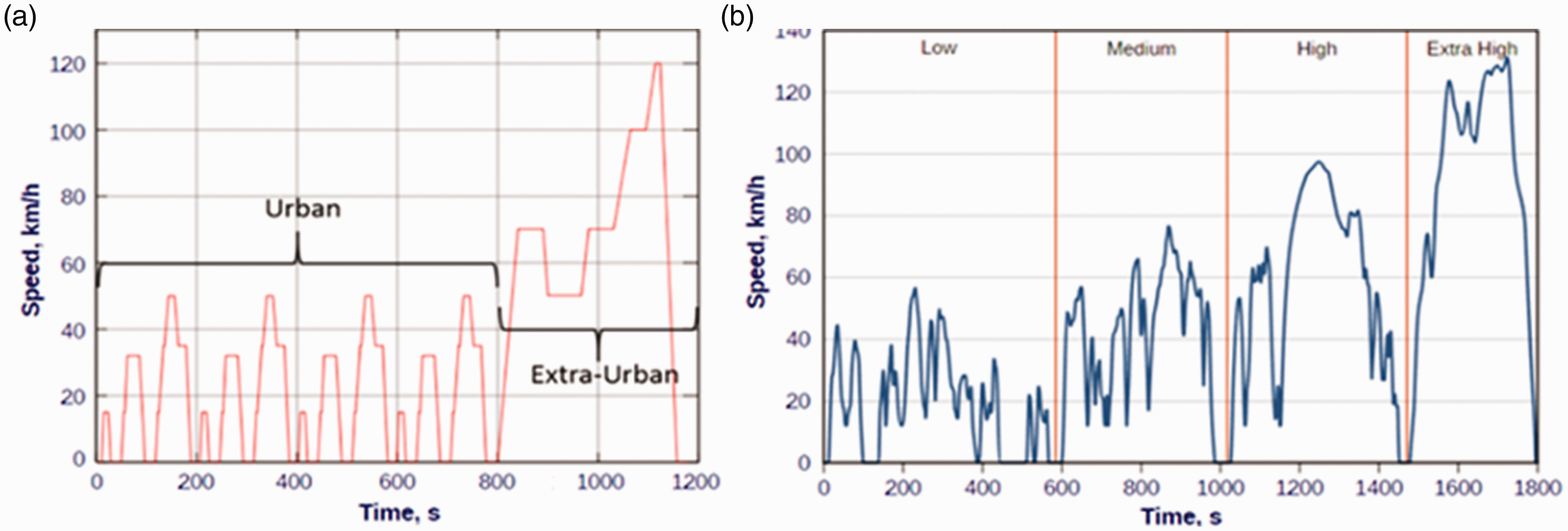
Testing measure and condition are important issues in labelling energy usage of road vehicles. For example, the U.S. uses the Federal Test Procedure (FTP), Japan uses JC08 driving mode for light vehicles and EU recently started to use the Worldwide Harmonized Light Vehicles Test Procedure (WLTP) in place of the so-called New European Driving Cycle (NEDC), as shown in Figure 3, to better reflect the real driving style and indicate energy usage.
31
Even though WLTP is designed to unify different test procedures in the world, it has not yet been widely adopted outside Europe. To simplify the test cycles and remove the impacts from environment and drivers, all car tests are conducted on a test rig with friction, drag and inertia force imitated but without auxiliary loads.
31
Therefore, energy usages are highly dependent on the standardized testing scenarios.
Some international transport organizations have developed methods to indicate energy efficiency and set targeted fuel efficiency within their sectors. The ICAO has developed a CO2 standard metric value (MV) to evaluate the energy efficiency of aeroplanes for a specified operational condition, 6 where somehow only the cruising phase (altitudes above 1000 m) is considered, seating density is standardized to eliminate the diversity of seat arrangements and three standardized weights related to the maximum take-off weight (MTOW) are used. Due to this simplification, the results show much lower energy usage than a real case. To let passengers be informed of the average CO2 footprint, ICAO has developed Carbon Emissions Calculator Methodology (CECM), 32 which gives each passenger an estimation of CO2 emissions and is included on the air ticket. However, it is based on the statistics of all types of aeroplanes, so it does not reflect energy efficiency of a specified aeroplane.
Maritime shipping is often CO2-efficient due to its large capacity and low operational speed. To use more energy-efficient equipment and to improve energy efficiency, the IMO has developed an Energy Efficiency Design Index (EEDI) since 2011. 7 EEDI estimates CO2 emissions per tonne and per nautical mile of goods at its design speed. 33
Rail vehicle energy labelling
All other transport modes than rail have developed energy labelling systems or energy consumption indicators to evaluate the energy efficiency of their products and set up long-term goals to control energy usage and reduce CO2 emissions. For rail transport, there is, thus, no energy labelling system or efficiency indicator developed up to now. To not only promote rail transport as an energy-efficient transport mode but also give an incentive to development of rail vehicle technology, it is time for rail transport to develop an effective method to evaluate its energy efficiency of various categories of rail vehicles and to meet the interests of the relevant stakeholders.
Background
In 2015, rail transport completed 6.9% of the total traffic volume in the world but was only responsible for 2% of the energy usage among all transport modes. 5 Rail transport is well known for its high energy efficiency and often low CO2 emissions, but the market share of rail transport is relatively low. 5
To promote rail transport, some train operators have individually developed CO2 footprint systems for their passengers, which is based on statistics of energy usage and travelling distance. For example, the French train operator SNCF has developed a CO2 footprint calculator and provides the passengers with this information in its ticket booking system. 8 It is calculated according to the travelling distance and the average amount of CO2 emissions per kilometre per train type. The average CO2 emissions are calculated according to the statistics of energy usage per train type multiplying a predefined CO2 emission factor per energy type. Similarly, the German train operator DB has also developed a distance-based CO2 footprint calculator, meanwhile, it also compares with CO2 emissions of other modes of transport. 9 Since this kind of CO2 footprint calculators only statistically gives passengers an estimation of CO2 emissions and cannot reflect any energy or CO2 efficiency, they are neither an energy labelling system nor an efficiency indicator.
There are many factors linked to the performance of rail vehicles as well as other transport modes: e.g. energy usage, CO2 emissions, travelling time, costs, punctuality, ride comfort and safety. Generally, rail transport is responsible for both passenger and cargo transport. Road transport is the main competitor to rail transport for short and medium distance and air transport for medium and long distance. Compared with other transportation modes, rail transport has some distinguishing features.
Rail vehicles follow the track – the path is therefore well defined. Although rail traffic cannot provide as high flexibility as road traffic and as fast speed as air traffic, it has a good balance among all factors. The operational speeds of rail vehicles cover a wide range, from high-speed railway trains to low-speed tramways. The rail vehicles are usually powered by electricity or diesel. With the development of technology, energy usage for rail passenger and freight transport has decreased much in the past decades. 5 The wide application of electric power makes rail vehicles less dependent on fossil fuels than other transport modes, while other transport modes are just seeking to use electricity as traction power. More and more electricity generated from renewable sources (wind, hydro and solar) can make rail transport even more environment-friendly.
All rail vehicles and railway infrastructures belong to enterprises, organizations or governments, rather than private person ownership. Rules and regulations regarding rail vehicles and infrastructures are strictly enforced. Also, due to its large capacity and low running resistance, rail vehicles have high energy efficiency. Large space and auxiliary equipment make rail vehicles normally more comfortable than other modes of transport. Normally, the service life of rail vehicles is about 30 years, much longer than road vehicles, so any changes or development of rail vehicles in the long term should be considered. On the way to develop an energy labelling system for rail vehicles, the features mentioned above should be taken into consideration.
Interests of stakeholders
Stakeholder analysis of energy labelling of rail vehicles. 34
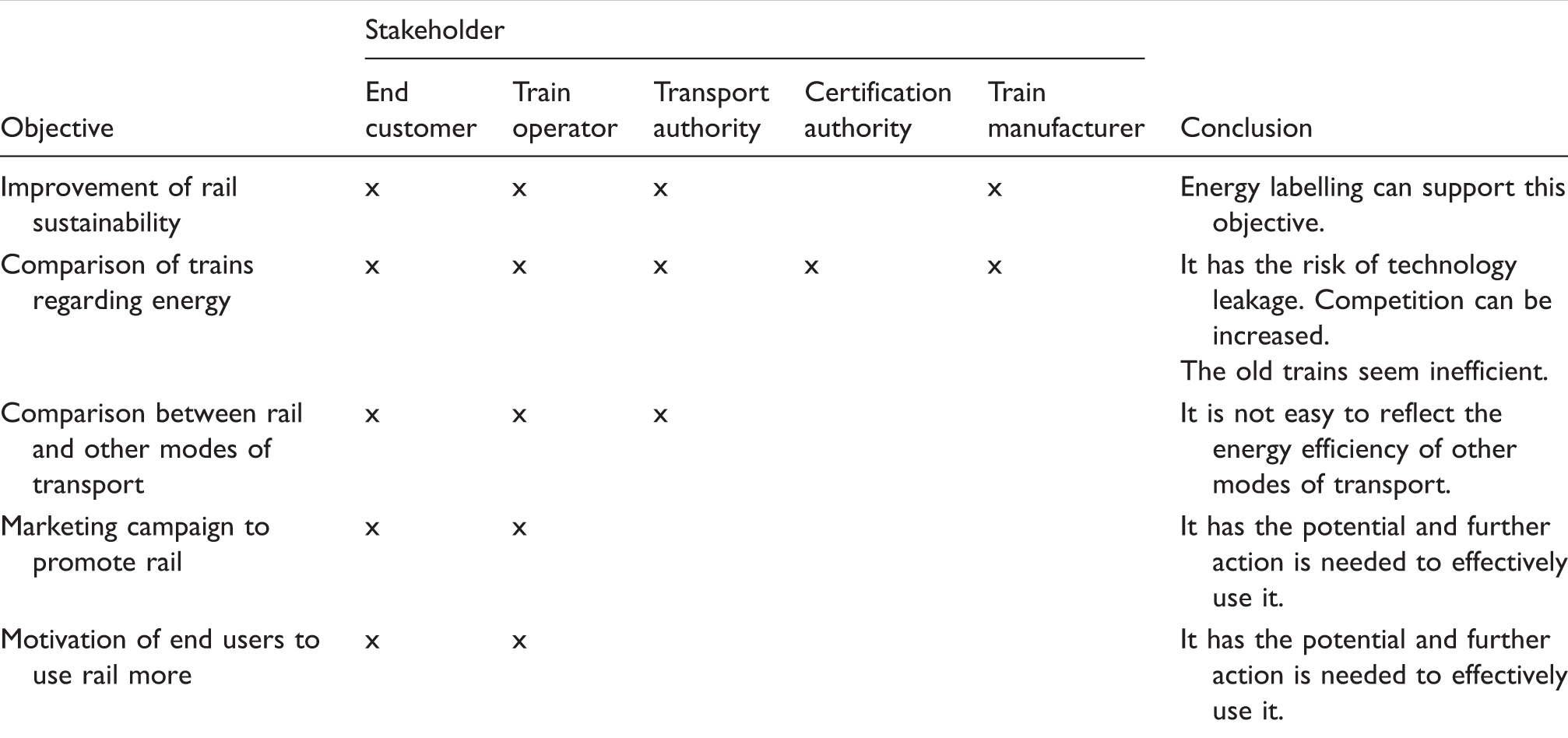
For rail transport, the train operators and the end users are separate entities. Energy-efficient rail vehicles are economically beneficial for train operators. The environmental impact of the efficient trains is more interesting for the end users as well as transport authorities. Certification authorities are more interested in comparison of different rail vehicles regarding energy usage. The manufacturers are balancing technical and commercial level. Since some train operators use Sustainable Finance to fund their purchase of new rolling stocks, the manufacturers are having more and more interests in demonstrating green credentials of their products. Other relevant stakeholders are interested in the entire improvement of rail transport in energy efficiency. Compared with household products and road vehicles, the service life of rail vehicles is much longer, around 30 years. Therefore, even though the energy efficiency is high when the trains are delivered, due to technology development in the long term they may, after many years in service, not be as good as the new trains. However, they would still be relatively energy-efficient in terms of energy per pkm or tkm. The energy usages of rail vehicles are heavily dependent on the operational conditions.
The CO2 emissions of rail vehicles are often associated with the CO2 intensity of the energy the train operators use. Therefore, sufficient considerations should be given to the stakeholders in developing an energy labelling system. Otherwise, it may not be possible to reach consensus and hard to promote an energy labelling system in practice.
Methodology
Since the operational speed of rail vehicles covers a wide range and the working conditions and train setups differ much, it is necessary to use a coordinated and widely accepted methodology to determine the energy efficiency of rail vehicles and to make a fair comparison.
The European standard EN 50591, ‘Specification and verification of energy consumption for railway rolling stock’, has been developed to regulate measurement and calculation of energy efficiency of rail vehicles in which the operational conditions and functionalities of the trains are well stated, e.g. the loading condition, line speed profile, track topography, temperature, functions, energy usages and method to calculate and verify energy usages. In EN 50591, the rail services are grouped into the following six categories:
35
Suburban (passenger service) Regional (passenger service) Intercity (passenger service) High speed (passenger service) Freight mainline Metro (passenger service).
For determination of train energy efficiency, the line speed profile and the track topography for each category are defined. All working conditions are statistically extracted from real working conditions of EU railways and metros. The state-of-the-art technology defines the power, performance and efficiency of key components of vehicle modules with respect to each train category, which provides reference values of detailed technical information and service conditions. Although EN 50591 is not explicitly developed for energy labelling, it can potentially be used to develop the protocol of an energy labelling system for rail vehicles.
Proposal
Since EN 50591 will be in force, which standardizes the calculation and measurement of the energy efficiency of rail vehicles, a European energy labelling system should be aligned with this standard. Based on the characteristics of rail transport and the interests of all types of stakeholders, an energy labelling system for rail vehicles is proposed in this section.
According to EN 50591, there are two methods to determine rail vehicle energy usage: simulation and on-track measurement. For the energy labelling, simulations for the standardized conditions are recommended, because the energy labelling can be done before the physical train is delivered. However, the train operators and transport authorities should have the right to verify the energy usages stated on the energy label by on-track tests.
The protocol for the suggested energy labelling system is developed based on EN 50591. Energy or fuel type is stated on the label. Since electric traction is widely used and people are familiar with electric energy, the energy unit of Wh is proposed to indicate the energy usage. Regarding the energy boundary condition, and since the energy labelling system is designed to evaluate the energy efficiency of rail vehicles rather than the entire rail system, the net energy intake from pantograph or third rail and the thermal energy content provided by fuel in the train tank etc. are used, while energy losses beyond them are not considered. For hybrid rail vehicles, the most energy-efficient traction system should be used in energy labelling.
Rail vehicles are complex systems which consist of many sub-systems for various functions, such as traction, braking, signalling, lighting, HVAC, entertainment and so on. To coordinate different methods to determine energy usage and to make trains with different functions and setups comparable, the total energy usage of rail vehicles is divided into three energy parts corresponding to EN 50591:
Part 1: Traction and auxiliaries with a commercial operation, without HVAC Part 2: Traction and auxiliaries without commercial operation and in parking mode, without HVAC Part 3: HVAC.
The part 1 energy is mainly used in service, which can in a standardized condition reflect the energy efficiency in traction and braking as well as the running resistance. This energy part is relatively stable and often declared by other modes of transport. The other two parts are heavily dependent on operation and climate conditions.
Since there are many types of trains running at different speeds and for different purposes, they are divided into different train categories, according to EN 50591 (see Methodology), and stated on the energy label. Payload and capacity are important factors which affect energy usage, which need to be displayed on the energy label. For passenger trains, the payload is defined by the train capacity and occupancy rate. To accommodate passenger flow variation, a standardized occupancy rate in percentage is suggested. At present, EN 50591 suggests 50% relative to the seating capacity for all passenger train categories, which means the total mass is the train mass in working order plus half the mass of the maximum number of seated passengers. For mainline freight trains, the standardized payload condition and train configuration are defined by EN 50591, which means the total mass is the locomotive mass in working order plus a half-loaded trailing consist.
To provide a common ‘playground’ for trains to compete against each other, line speed profile, topography and time table are standardized for each train category in EN 50591. The not fully fixed timetables of most train categories in EN 50591 give some flexibility in choosing a train speed profile and driving style, so it is suggested to operate the labelled train in the most energy-efficient way. Regarding environmental conditions, the constant environmental data according to EN 50591 is used to simulate the Part 1 and Part 2 energies above. The dynamic environmental temperatures are only used to simulate the Part 3 energy with temperature operational points defined in EN 50591 based on three climate zones in Europe, but the energy usage for climate zone II is proposed to be compulsorily stated on the energy label.
Efficiency indicators are the core of energy labelling. There are two kinds of efficiencies: energy efficiency and CO2 efficiency. The Part 1 energy is divided by average transport volume and expressed as Wh/passenger-km (Wh/pkm) for passenger trains and Wh/tonne-km (Wh/tkm) for freight trains. The average transport volume is associated with the payload. Also, the energy of Part 2 and Part 3 is divided by the average traffic volume based on an annual basis. The total energy efficiency is thus the sum of three parts.
CO2 efficiency is often provided by other modes of transport and shows the environmental impact. Therefore, the CO2 efficiency indicator meets the interests of the public and transport authorities. However, since the CO2 intensity of the energy bought/used by the train operator, here electricity, can deviate very much and change over time, the CO2 efficiency is designed to be based on train operator data (or country average). As for the energy efficiency, the CO2 emissions should be divided by average traffic volume and expressed as gCO2/pkm for passenger trains and gCO2/tkm for freight trains.
The energy label should be designed to cover the interests of all types of stakeholders. The labelling system contains two labels for different purposes: an EU-wise energy efficiency declaration and a CO2 emission label for the train operator. The following key information is suggested to be stated on the two labels: manufacturer, product model and delivery year, train category and train capacity.
For the EU-wise energy efficiency declaration, the label graphics are designed to be aligned with the common format of the EU energy label for household products, as shown in Figure 4(a). For a specific rail vehicle, the information on the label is stable from time to time and effective within the EU. The energy efficiency (sum of Part 1, 2 and 3 contributions) of the labelled rail vehicle is classified according to pre-defined energy classes A–G. Span limits of each efficiency class should be further investigated in the future and agreed by all relevant stakeholders.
Example of energy label for rail vehicles: (a) the EU-wise energy efficiency declaration and (b) the operator-wise CO2 label.
33
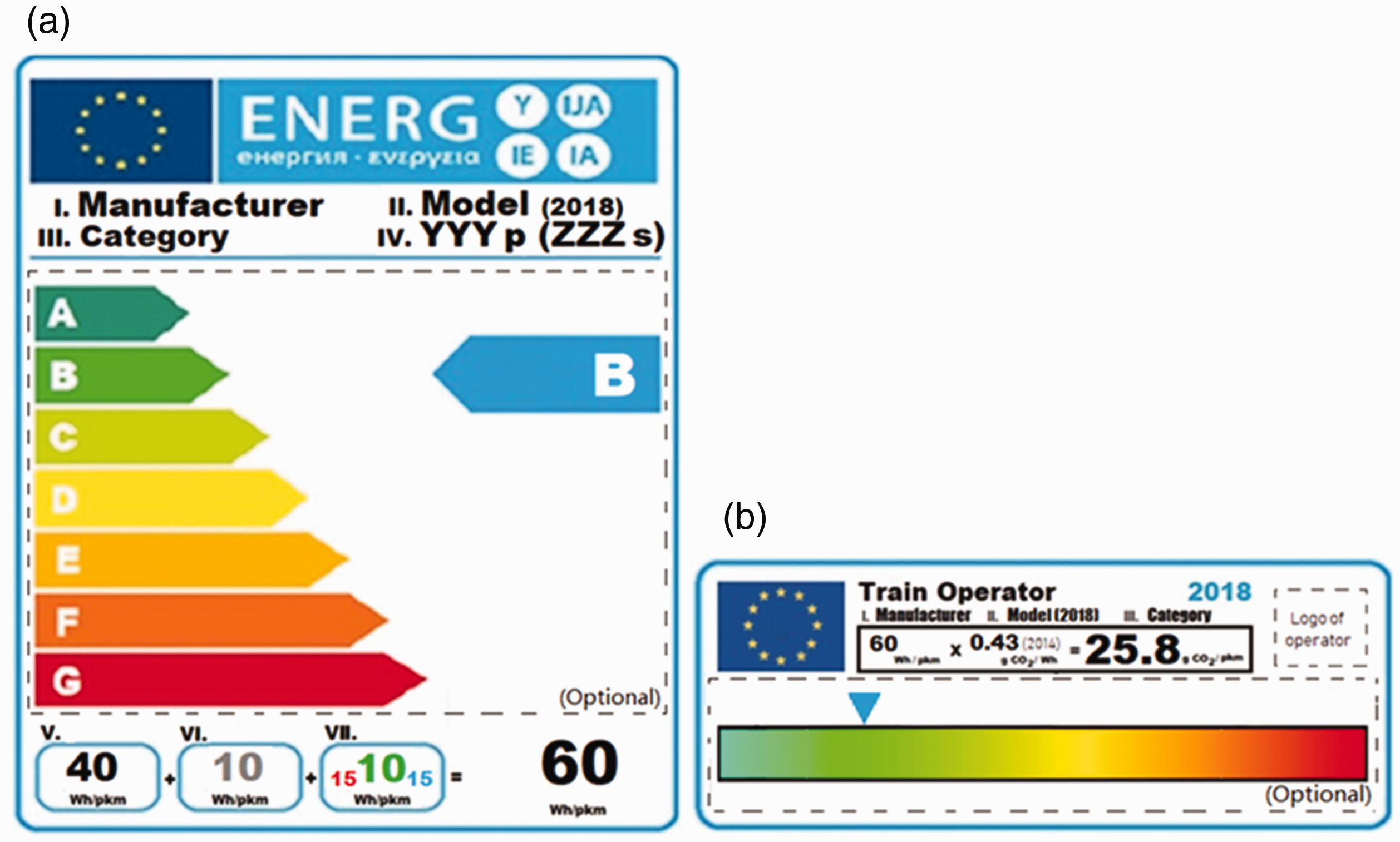
For the operator-wise CO2 label, the CO2 intensity is the key indicator, which directly shows the environmental impact, as shown in Figure 4(b). Due to the diversity of CO2 intensities in electricity generation and more renewable energy used, an operator-wise based on the CO2 intensity is suggested. The CO2 label is to promote the train service and the train operators have the responsibility in using, defining and updating the information on the CO2 label.
Regarding application, in the bids from the train manufacturers the energy efficiency and label are encouraged to be specified as one part of the tender documents. Environmental symbols (endorsement labels) may be extracted from the labels. In practice, it can appear on the passenger trains. The train operators can use the energy label in sales activities, like advertisements in general media, and the energy efficiency can be displayed in the ticket booking system.
Since developing a proper energy labelling system is a long-term work, the energy label needs frequent updating at the beginning in response to feedbacks from practices and the development of technology. The train manufacturers, train operators and transport authorities have the responsibility to update/renew and improve the energy label.
Last but not least, because the energy labelling system means to boost rail transport, it is important to make all relevant stakeholders interested in this concept and involved in the application. The train manufacturers, train operators and transport authorities have the right to decide on how to use and display the energy label. To let the energy labelling system be more inclusive, the energy labelling system is designed to be a voluntary campaign, so all the stakeholders have the right to decide:
whether a specific rail vehicle is subjected to the energy labelling system, which information is disclosable to the public or other parties, and when the rail vehicle ceases the application of the energy labelling system.
Concluding remarks
Many countries and international organizations are trying to improve energy efficiency and to reduce CO2 emissions. To achieve these goals, energy labelling systems have been developed to indicate energy efficiencies and to limit the usage of inefficient products. Some energy labelling systems have been developed and used for two or three decades. They are still regularly updated to widely cover different types of products and to effectively reflect energy usages in response to technical development and efficiency improvement. As they work well, more and more countries and sectors are developing their energy labelling systems to have their sectors included. Due to numerous types, designs and setups of rail vehicles and trains and a huge diversity of climates and operating conditions, there is currently no common method to indicate energy efficiency and environmental impacts of rail vehicles. As rail transport is an energy-efficient transport mode, rail stakeholders should be willing to establish an energy labelling system to evaluate rail vehicles and to follow the global trend. In response, the present paper has given an overview of existing energy labelling systems in other sectors, studied the features of rail transport and interests of rail stakeholders and, finally, proposed an energy labelling system for rail vehicles.
The development of an energy labelling system for rail vehicles is necessary. It can provide a possibility to reflect the energy and CO2 efficiencies of rail vehicles. Passengers, train operators and transport authorities can, therefore, be well informed of energy efficiency, making rational choices between transport modes and trains. For the train operators and manufacturers, the labelling system makes energy efficiency and performance of their fleet manageable, encourages the application of energy-efficient trains and incentives technical innovations. In the long term, the energy labelling system can assist infrastructure managers and governments to set up energy-related policies and traffic development strategies. For the entire rail sector, the labelling system can graphically show to the public the technical improvement on energy saving and cutting CO2 emissions as well as the technical upgrading from one level to another. More passengers and other end users are expected to be attracted. Although it would take some time to develop a proper energy labelling system, establishing an energy labelling system within the rail sector will have a significant and profound influence, promoting rail transport into an even more energy-efficient and even lower CO2-emission transport mode for the future.
Footnotes
Acknowledgements
This paper reflects only the authors' view and the Shift2Rail Joint Undertaking is not responsible for any use that may be made of the information it contains.
Declaration of Conflicting Interests
The author(s) declared no potential conflicts of interest with respect to the research, authorship, and/or publication of this article.
Funding
The author(s) disclosed receipt of the following financial support for the research, authorship, and/or publication of this article: This work has been delivered in FINE-1 project that has received funding from the European Union's Horizon 2020 research and innovation programme under grant agreement number 730818. The funding from Trafikverket (Swedish Transport Administration) is also acknowledged.
