




Abstract
Planning and scheduling activities within the rail industry have benefited from developments in computer-based simulation and modelling techniques over the last 25 years. Increasingly, the use of computational intelligence in such tasks is featuring more heavily in research publications. This paper examines a number of common rail-based planning and scheduling activities and how they benefit from five broad technology approaches. Summary tables of papers are provided relating to rail planning and scheduling activities and to the use of expert and decision systems in the rail industry.
Introduction
Planning and scheduling is a core activity in most industries, and none more so than the rail industry. Figure 1 shows a number of important aspects of planning and scheduling relevant to the rail industry. These aspects were identified from the findings of a think tank event held at the launch of the AUTONOM (Integrated through-life support for high-value systems) project sponsored by the Engineering and Physical Sciences Research Council, a UK-government-backed major research funder, and UK rail infrastructure provider Network Rail (Network Rail is the organisation that is responsible for maintaining and developing the UK’s rail infrastructure including signalling, bridges, tunnels, level crossings, viaducts and 17 key stations within the country).
Planning and scheduling activities relevant to the rail industry.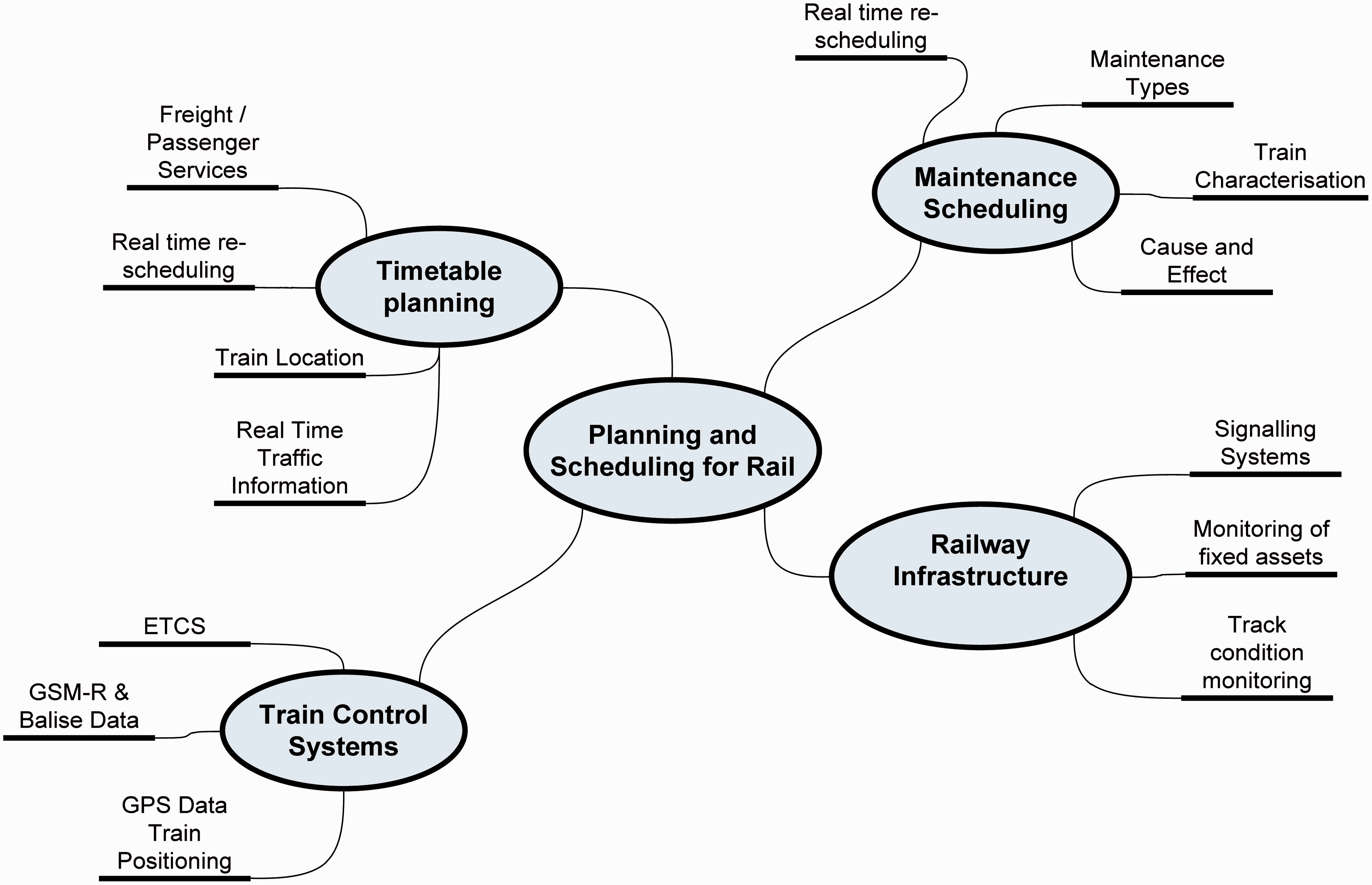
The think tank group was made up of senior representatives of Network Rail and other corporate partners of the wider AUTONOM project. Of particular interest to this group was the area of planning and scheduling in relation to autonomous systems and the potential advantages such systems can bring. The four areas shown in Figure 1 demonstrate the potential for automation and have been highlighted as priority areas by Network Rail and the authors. The following subject areas are investigated in more detail in relation to the elements outlined in Figure 1.
Autonomous systems
Such systems may range from semi-automated to totally autonomous (without human intervention) operation. Semi-automated operation includes European train control system (ETCS) in-cab signalling and automated train braking systems. Fully automated operation examples include the automated operation of trains.
Data mining
The practice of data mining is the identification of structural patterns in data and links between data points that are not readily discoverable. Rail industry data collected from train-based and wayside sensors provide a vast potential repository for data mining.
Knowledge engineering frameworks
Knowledge engineering is similar to the discipline of software engineering; it turns the process of constructing knowledge-based systems from an art into an engineering discipline. Such practice is required in the design of new information management systems for rail.
Expert and decision support systems
An expert system is a computer system that emulates the decision-making ability of a human expert; they can also provide decision-making support. A decision support system aids a user in their decision-making by providing possible solutions for a problem area. Decision support can be seen in the use of more sophisticated rail scheduling software.
Semantic technologies
Ontologies can be thought of as maps between vocabularies that allow document creators to know how to describe their documents. The wide variety of protocols for the transfer of data in rail applications provides the opportunity for semantic description of such data to aid interoperability.
Planning and scheduling: Approaches that can be applied
Planning and scheduling is a wide subject area relating to both manufacturing and service industries (Pinedo 1 ). In manufacturing one of the most common uses of scheduling is in the flow shop. Cheng et al. 2 describe such a case where the scheduling of jobs through batch processing machines is considered. Within the rail industry scheduling can apply to a variety of topics as evidenced in Figure 1. The work of Cao et al. 3 examines the problem of mixed-speed train scheduling on a high-speed line; where the flow of trains, travelling at different rates along a rail line, must be continuous. Rail maintenance scheduling has been addressed by Lautala and Pouryousef 4 who describe a preventive maintenance scheduling problem modelling approach for preventative maintenance. In this approach parameters related to specific line specifications, drawn from three high-speed line case studies, are defined as a series of descriptive analytical tables. One of the more recent areas for investigation in relation to rail industry scheduling problems has been the use of soft computing techniques. Hu et al. 5 propose a scheduling approach utilising a particle swarm algorithm to optimise the scheduling within an urban rail network, based on data hosted in a cloud repository.
Autonomous systems
Autonomous systems can contain complex control logic often incorporating computational intelligence techniques such as fuzzy logic and genetic algorithms. Such systems are linked to physical objects to provide sensing capabilities, to control the motion of mobile hardware assets and activities of both fixed and mobile assets. Agents are one avenue of research for the autonomous control of assets. Agents are said to embody two principles: an ability to act autonomously and the capability to interact with other agents (Wooldridge 6 ). Multi-agent systems are then, by definition, interacting collections of agents (Wooldridge 6 ).
Fisher 7 has investigated the design and evaluation of agents providing a framework for the temporal execution of agent designs. This work was motivated by the lack of such a framework and methods to assess the actual behaviour of agents once designed.
Learning algorithms have also been employed in the control of autonomous systems. Reinforcement learning is likened by Sutton 8 to a mapping between situations and actions in response to a reward. Reinforcement learning is prominent in autonomous control research and agent theory. Policy search is a technique from the area of reinforcement learning in which a probability distribution is assigned to a set of possible actions. Deisenroth and Rasmussen 9 put forward an approach for data-efficient policy search and apply it to control tasks such as the cart-pole learning task.
The subject of autonomous real-time planning has been investigated by Cresswell et al. 10 in their work on the learning object-centred models system. Automated planning has also been investigated by Fernandez et al. 11 who propose an architecture for the automation of data mining tasks. Again the Planning Domain Definition language features heavily in this approach. The papers included in this section so far, while not currently applied to rail uses, do hold some potential for further investigation with regards to autonomous rail research. There are only limited investigations into full autonomous operation within the railway industry, usually concentrating on automatic operation of metro/light rail systems as in Dominguez et al. 12 and Wackrow and Slamen. 13 Opportunities exist to review maintenance planning and scheduling, among other activities, with a view to autonomous or semi-autonomous operation.
Data mining
The area of data mining has increased in importance in-line with the increasing ability for information systems to capture and preserve data. In tandem with this is the maturing of computational intelligence techniques used for the identification of patterns in the collected data (Witten and Frank 14 ). The rail industry is both a producer of data and a user of the knowledge extracted from such data sets.
The work of Goverde and Meng 15 utilises train describer records (describer records contain operational information about the track and train movements) to improve the performance of infrastructure and train services. This paper outlines tools for the mining of train describer data, and its analysis, for the purpose of increasing capacity, punctuality and reliability while improving safety. Of interest in this area is the mining of supervisory control and data acquisition (SCADA) data. SCADA systems are employed in a range of industrial scenarios including rail (Hadžiosmanovic et al. 16 ). The work of Hadžiosmanovic et al. 16 mines SCADA data in a workflow-centric manner with regard to the identification of anomalous log traces that could indicate incorrect use of the system or a potential security breach.
The mining of rail data in the form of business processes is explored by Kecman and Goverde. 17 Train describer event data is mined by a process mining tool to provide a more informed analysis of potential train path conflicts (to minimise disruptions to trains in the network and improve safety). Business process mining aims to rediscover a process from event log data (recorded executions of business processes) typically drawn from enterprise software systems. The practice of business process mining is further described in Van der Aalst and Weijters 18 and a range of techniques are referenced in Tiwari et al. 19
Knowledge engineering frameworks and ontology
Knowledge engineering concerns the practice of designing and building knowledge-based systems. In the opinion of Studer et al. 20 the practice of knowledge engineering (KE) should adopt formal structured approaches inherent in a discipline such as software engineering. In essence KE has, since the work of Studer et al., 20 become a discipline that has its own set of frameworks and methodological approach. Studer et al. 20 mentions three frameworks for knowledge engineering: CommonKADS, MIKE and PROTEGE-II.
A critical component of KE is the use of semantic technologies utilising XML meta-descriptions of objects and ontologies, enabling an enhanced level of contextual meaning to be expressed through knowledge systems. Ontologies, in particular, have had a significant role to play in semantic web technologies and in the use of computational intelligence techniques in KE. Ontologies can be thought of as a type of dictionary that links together corresponding words in different vocabularies, allowing document creators to know how best to describe their documents. As Antoniou and van Harmelen 21 put it ‘an ontology consists of a finite list of terms and the relationships between these terms’. This can make such documents, at least partially, machine understandable with the application of artificial intelligence algorithms.
The case for the use of ontologies in rail industry applications is made by Easton et al.; 22 in that the proliferation of legacy systems in the industry together with the range of alternative terms used by different parties to refer to the same entity make ontology use highly desirable. An example use of ontologies in the rail industry is given by Briola et al. 23 These authors utilise ontologies, along with natural language processing, to manage traffic control within a railway network (using representative test data sets). Work by Zarri et al. 24 examines the generation of business rules from a semantic knowledge system for use in the checking of hazardous materials being transported by rail. In this work the ontological approach aids the development and structuring of If/Then rules concerning the checking of hazardous materials transported in rail wagons.
Semantic technologies
Semantic technologies rely on ontologies for their definition and context. Semantic languages often employ XML as a framework due to its ability to provide a structured meta-description for combination with or attachment to another digital object. Bousse et al. 25 extend one such semantic language, SysML (systems modeling language), for use with rail safety systems. The case study described by Bousse et al. 25 concerns a railway crossing controller made up of a set of sensors fitted to a level crossing. The SysML specification is modified with suitable additions to describe the correct monitoring and functioning of the crossing. The modelling of such safety control systems in the rail industry may be carried out in a language such as UML. Berkenkötter and Hannemann 26 outline an approach utilising UML 2.0 for such a task, utilising semantic descriptions. The use of such a modelling paradigm with a semantic XML description could provide a powerful tool for the exploration, verification and enforcement of a control system. Network Rail have also been investigating the use of the IEC 61850 standard used by the electrical supply industry in their use of XML coding as a communication interface between power supply systems and controllers (Burnham 27 ) with the aim of being able to remotely monitor the condition of suitably equipped power supply systems within the network.
Semantic process mining is another recent extension of an existing technique with ontological and semantic capabilities. Jareevongpiboon and Janecek 28 concentrate on the direct addition of semantics to business processes. With this technique business process event logs are annotated with ontologically defined concept descriptions. A number of ontological resources are utilised for the annotation: a domain ontology (for the domain concerning the business processes); company ontology (containing company-specific definitions) and definitions from relevant databases (Jareevongpiboon and Janecek). 28
Semantic technologies provide a new method of data description for potential use in the rail industry. Many data interchange standards still exist in the rail networks of Europe and semantics provide the potential for providing a harmonised way of exchanging information between different systems; a useful requirement, considering the range of technologies being introduced in both rail vehicles and trackside, when considering their intelligent control.
Expert and decision support systems
Expert systems within the rail industry can take many forms and may be used to address a number of areas. Saa et al. 29 outline an ontology-driven expert decision support system for the design of railway electrification systems. This approach is based on the development of a knowledge database composed of expert views and used to inform the design process. The intended automation of the collection and use of expert views will be facilitated though the further development and use of a rules engine. Such systems may also be autonomous in their operation, and are often employed in the task of monitoring assets. Palte 30 makes the point that remote vehicle monitoring systems, for rail vehicles, must be capable of communicating their collected data and analysis in an informative and appropriate way to interested parties; Palte 30 presents a commentary of a number of salient factors for designers of such monitoring systems to take into account. Zhang 31 puts forward a framework for the monitoring of maintenance, repair and operation (MRO) activities regarding high-speed trains. This approach, based on the use of radio frequency identification sensors, utilises complex event processing and semantics to evaluate the efficiency of MRO activities. Condition monitoring of rail vehicles is also the subject of the work of Firlik et al. 32 who examine light rail systems from this perspective. This paper examines the dynamic adjustment of maintenance needs and track speed limits based on sensor readings from axle boxes. Such autonomous functionality is still new in the rail industry, with only the most recent papers giving serious attention to it.
Intelligent decision support systems are now becoming a reality in the rail industry. Ngigi et al. 33 detail the progress in predictive control methods and their relevance to condition monitoring activities related to rail. Such systems can be used to support decisions on when to perform maintenance and renewals tasks. In particular a class of algorithms known as model predictive control (MPC) attempt to optimise future behaviour of assets by computing a sequence of modified actions. One such control method is the Kalman filter, which has been utilised in the assessment of the dynamic performance of rail vehicle components while in motion. In addition wheelset condition monitoring (WCM) systems are now used to assess a range of wheel-related degradation instances and include systems such as: wheel impact detectors, hot axle bearing detection, brake pad inspection systems and automatic vehicle identification systems. The authors acknowledge that the combination of WCM and simulation techniques is required for high-performance real-time condition monitoring of rail vehicles and the support of maintenance decisions.
One interesting development, with possible application to safety uses in the rail industry, is the introduction of the European GALILEO satellite navigation system. This system will potentially be a rival for the global positioning system (GPS) and, unlike standard GPS, will in time be certified for use in railway safety applications (Beugin et al. 34 ). The work of Beugin et al. 34 envisages a time when all trains will be fitted with intelligent communication systems capable of transmitting their real-time position and health to control centres. Safety-critical situations, such as velocity of a train in speed-restricted sections of lines and location of a train within signalling blocks, are potential application areas for real-time location technology (Beugin et al. 34 ).
Planning and scheduling applied to rail research subject areas
Timetable planning
Timetable planning is an active area of research for the rail industry. The work of Yang et al. 35 investigates the development of incomplete cyclic timetables for trains. Real-time re-scheduling of trains is the subject of Wegele et al., 36 where genetic algorithms are used to perform a heuristic re-ordering of trains when delays are encountered in the rail network. The mark-up language RailML is also mentioned in this work. RailML is a metadata language, utilising XML, which defines a set of common rail-specific terminology as meta descriptions. RailML is only mentioned in a few papers at present (RailML is detailed in Nash et al. 37 ). The practice behind train dispatching is outlined by Kuckelberg and Wendler 38 who aim to address the conflicts that arise when trains block each other due to delays. These authors provide an algorithmic software tool incorporating a strategy building approach to conflict resolution and a system framework.
The timetabling problem is framed by Ho et al., 39 as one of multi-objective optimisation in that a feasible solution must be identified within a limited time constraint that satisfies a number of objectives. Particle swarm optimisation (PSO) is used to design a timetable for a railway network that operates as an open market (an open market network usually consists of an infrastructure provider and a number of competing train operating companies). In PSO optimisation each particle in a swarm represents a potential solution to an optimisation problem through its location within the swarm (Ho et al. 39 ). The optimisation of timetables has also been addressed by Forsgren et al. 40 who provide an optimisation tool that is also capable of conflict resolution. In this approach, existing timetables are fed in and then optimised while still allowing timetable planners to make their own adjustments. Albrecht et al. 41 take an approach to timetable revision that involves the use of a problem space search heuristic to generate alternative solutions. This approach is particularly relevant to re-scheduling situations due to track and infrastructure maintenance needs. The simulation of rail systems to aid planning and timetable design has been investigated by Besinovic et al. 42 who aim to determine real train running time and speed profiles. In the work of Pellegrini et al., 43 who propose a simulation model utilising mixed-integer linear programming, the area of train routing and scheduling for complex rail junctions is explored. This research aims to achieve optimised routing for trains in the event of unexpected disruptions to track availability. Different levels of granularity (locking of routes and of just track sections) were considered. The locking of track sections involved in the finer granularity gave higher-quality solutions (shorter delays). In future work the authors aim to use the model in a rolling-horizon framework. The mixed integer linear programing construct is also deployed in a simulation by Rudan et al. 44 who investigate the area of dynamic railway scheduling. A number of constraints are considered in this work describing the normal scheduled operation of trains, including time taken at junctions, dwell time at stations and timetabled journey commencement. On average a 30% reduction in delays can be achieved using this approach. Another advantage of this approach is its ability to highlight the most delay-prone trains in the network. Additional work in this area includes Ruan et al. 45 who utilise a genetic algorithm approach to determine the parameters that should be examined by a rail system simulation, in terms of safety-critical operation.
A salient point is made by Crevier et al. 46 in that the financially viable operation of rail networks normally involves the inclusion of freight services and that such services can present scheduling challenges. The combination of network scheduling and pricing is considered in this work with a mixed-integer approach presented and the consideration of two pricing policies, disjoint (separate prices are given for each itinerary) and common (where a common tariff is used for all itineraries). From this research, it was found that a disjoint pricing policy provided more revenue, with future work concentrating on the ability of the customer to select a tariff. This research is one of the few works to consider profitable freight pricing with scheduling.
The area of rail yards is in part the subject of Marinov et al. 47 who examine the use of simulation software to model rail timetable and network management decisions. This paper describes common yard types and approaches to modelling common factors such as wagon speeds, section lengths and train manoeuvring parameters. The further work of Marinov and Viegas 48 examines the simulation of rail freight by examining the rail network as a set of entities (such as yards, stations, lines) and looks at the queuing situations at each entity.
Scheduling of trains in terms of energy-efficiency goals is another active area of interest and one such approach is described in the work of Hu et al. 5 This approach utilises a combination of a standard multi-objective optimisation algorithm and a fuzzy multi-objective optimisation approach to find train allocations and movements that balance fuel efficiency with passenger travel time. Timetable and planning robustness related to the movement of long-haul trains is the subject of the work of Pudney et al. 49 who utilise a Monte Carlo approach to locomotive movements in the Australian rail network.
Train control systems
One of the major developments in train control systems in recent years has been the European rail traffic management system (ERTMS). The ERTMS system is composed of two main entities, the European train control system (ETCS) and global system for mobile communications-railway (GSM-R) (Abed 50 ). ETCS is comprised of two main components, the automatic train protection system (automated emergency braking at red signals) and signalling system (in-cab signalling). GSM-R is an international standard for mobile voice and data communication transmission in a railway environment and primarily used for train to control centre communication. The different levels of ERTMS are detailed in Abed. 50
An interesting paper in the area of certification of ERTMS systems for installation in European rail networks has been produced by Jabri et al. 51 This paper puts forward a method based on a combination of UML (Unified Modelling Language) and Petri nets for this purpose.
Alternative train control systems are being developed outside of Europe. In Baba et al. 52 the advanced train administration and communications system is outlined. This system, developed by Hitachi and the East Japan Railway Company, operates in a similar way to ERTMS and corresponds to level 3 of the European system (Baba et al. 52 ).
Energy conservation is another recent topic for research within the field of train control systems. According to Xun et al.
53
there are four types of energy saving actions that can take place within train operation.
Energy efficient train driving style. Coordination of trains in real-time. Timetabling for energy efficiency. Inclusion of energy efficiency goals in planning activities.
Xun et al. 53 point to the use of re-generative breaking to contribute to energy savings and define two types of control for this mode; train dwell time and train running time (these two types are discussed in more detail in Wong and Ho 54 ). Xun et al. 53 stress the importance of fully automated operation of trains running within such an energy-efficient system. Further work by Park et al. 55 examines the prediction of energy consumption related to the driving of electric trains in the Korean rail network through the utilisation of simulation techniques. An optimal train driving strategy is also put forward by Bocharnikov et al. 56 who examine this area in relation to electrically powered suburban railways. This technique utilises a genetic algorithm to identify optimal train trajectories from a set of simulations. In addition energy-efficient driving of trains is the subject of the work of Ke et al. 57 who look at this subject in relation to rapid transit systems with the aim of optimising speed of service with the need for reduced energy consumption.
The modelling and verification of control systems for high-speed trains is a necessary step in the assurance of the safe operation of modern rail lines. Lv et al. 58 put forward such a model capable of describing hybrid systems that compose most modern high-speed train control systems. Train protection systems and the problem of train over-speed has been the subject of research by Guo et al. 59 In this work the authors describe the simulation of a train protection system with the aim of reducing the development time of a working real life system.
Although this area is dominated by ERTMS and ETCS, it should be noted that additional systems are also relevant in the delivery of safe and efficient train control, such as those involved in efficient driving strategies for rail vehicles.
Railway infrastructure
Increasingly the rail industry is looking to autonomous and intelligent systems to address the maintenance needs of its infrastructure. According to Dadashi et al.
59
this introduction of intelligent infrastructure has been brought about by the need to move from reactive to diagnostic and prognostic modes of railway maintenance where faults are predicted and potentially designed out of the system (Dadashi et al.
60
). Three main uses of intelligent infrastructure have been highlighted by Dadashi et al.:
60
data acquisition: to obtain data from fixed assets such as signals, bridges and points; health assessment: to ascertain the health status of the aforementioned fixed assets; advisory notification: to deliver diagnostic and prognostic information to operators and add to a decision support knowledge base.
Further to these definitions Dadashi et al.
60
provides an outline data processing framework for intelligent railway infrastructure. Rail inspection is a substantive topic for research; Popović et al.
61
gives a comprehensive overview of the subject with regard to common rail defects. Rail maintenance is also the subject of Bouillaut et al.
62
who provide an approach and a decision support tool for the reliability maintenance of underground rail tracks. The approach taken in this work is to utilise a Bayesian network for the modelling of maintenance strategies to detect and prevent broken rails. In addition the work of Guler
63
describes a decision support system for railway track maintenance and renewal programmes, which is comprised of rules developed from interviews with track experts and secondary research sources. Nystrom and Soderholm
64
present a method for the prioritisation of railway maintenance actions. Zhao et al.
65
also examine scheduling activities in the form of synchronised rail track component renewal. In this work they utilise a genetic algorithm approach to optimise track renewal activities; thus, minimising the cost incurred and track possession time.
The automated inspection of rail track is the subject of the work of Li et al. 66 who present a method to detect track components using a computer-vision-based system. In addition GPS data along with a distance measurement instrument are used to improve the accuracy of track components detection. Rail ties and anchors are vital components in the attachment of rails to track. These components must be in a good maintenance condition and have the correct spacing to make the track safe. The system can achieve up to 99% accuracy in the identification of rail ties. Future work includes the use of a modified imaging system and improved track illumination in order to reduce the number of false-positive readings recorded. Another example of automated track inspection is given by Resendiz et al. 67 who have developed an algorithm that can identify periodically occurring track components. Signal processing and a spectral estimation technique are used in the development of the technique. The MUSIC (multiple signal classification) technique was selected in this research due to its ability to detect multiple repeating instances in data streams containing noise. Future work aims to develop the system to a level of accuracy where it can operate autonomously.
A major safety concern for rail networks is the stability of the track. In the work of Ahmad et al. 68 a track stability management tool is developed for the assessment of temperature and amount of track deformation. A margin of safety, along with a range of allowable temperature tolerances for tracks, has been calculated in this work that allows for decisions to be made on when maintenance teams are to be sent out on inspections and when the setting of speed limits in hot weather is appropriate.
Track geometry inspection technology is the subject of the work of Li et al. 69 who propose a neural network technique to recognise complex patterns between track geometry and vehicle response. Their performance-based track geometry inspection system relates track geometry and vehicle speed to actual vehicle performance in real-time. This system has been tested against historical data of past derailments and vehicle performance issues related to track geometry.
One novel development for rail maintenance is the use of handheld computers to display rail-specific special information such as track layouts (Dadashi et al. 70 ). Such a system could be used to highlight danger areas and prominent landmarks to line workers who do not have local knowledge of a particular work site. Dadashi et al. 70 put forward the point that electronic layouts are more practical than paper-based ones for night working and working in bad weather conditions.
Signalling systems
Beyond the area of train control systems, such as ETCS, considerable research has been carried out in the area of signalling and its analysis for safety-related purposes. The work of Filip et al. 71 examines the use of global navigation satellite systems (GNNS) in relation to railway safety applications. In this study the authors examine the applicability of existing GNSS technologies and their modes for use in the railway industry, highlighting their current limitations. As Filip et al. 72 mentions satellite technology will have a significant impact on the railways, in that the trackside sensor equipment (such as Balaises and hot box sensors) will be superseded by asset-located sensors that determine the actual real-time position via satellite. Filip et al. 72 go on to mention the European Galileo satellite system currently under development and its applicability to railway signalling.
As mentioned already railway signalling research has been conducted involving areas such as satellite technology71,72 though there has also been an investigation into the use of Internet protocol for the control of signals reducing the need for the installation of traditional copper wiring (Endo et al. 73 ). The general trend in signalling research is that the real-time location and monitoring of rail asset condition as data inputs to signalling systems is now on the near horizon; though knowledge of the impact on planning and scheduling activities brought about by this new paradigm is not as well-developed. One of the more relevant works in this direction is that of Lai and Wang 74 who address capacity planning from the perspective of new signalling systems and track layout designs. A paper of particular interest as a primer for further planning and scheduling research is that of Dicembre and Ricci 75 who investigate the effect of factors such as signalling and capacity on high-density urban rail corridors. In summary, in the European rail sector, although ETCS (in-train cab signal system) is seen as the future for many main lines it is likely that for cost, and in some cases logistical reasons, traditional track side signalling equipment will remain in branch lines for many decades. This necessitates the need for ongoing maintenance and renewal of such track side assets.
Maintenance
As mentioned by Dadashi et al. 60 there has been a move from reactive to diagnostic and prognostic modes of railway maintenance; where fault diagnosis and prediction are key. As part of this movement work has been conducted into the area of fault states and the interdependencies between the states in Schöbel and Maly. 76 This paper makes clear the need for active monitoring of rail vehicles so logical connections between fault states can be made and acted upon in a timely manner.
As in the work of Dadashi et al. 70 (discussed in the infrastructure section) data from assets deployed in the field can increasingly be made available to mobile devices. Bye 77 details the use of mobile devices and the design of application interfaces with case studies drawn from the UK infrastructure provider Network Rail.
The subject of risk-centred maintenance is investigated by Selvik and Aven. 78 These authors make the point that reliability-centred maintenance for preventative maintenance practice is well understood in industry, though it does present limitations when used to quantify risk and uncertainty in projects. In order to address this limitation the authors introduce the reliability and risk-centred maintenance framework that provides a methodology for the communication and quantification of risk in maintenance practice. In general a good review of scheduling techniques for preventative maintenance is provided by Soh et al. 79
The importance of organisational design in railway maintenance operations is highlighted by Jiang et al. 80 Maintenance operations may be performed by a collection of co-operating organisations, having a model of how such organisations operate together is, in the opinion of Jiang et al. 80 essential. Jiang et al. 80 put forward the OperA + framework, which is an agent-based framework allowing for the creation of dynamic representations of organisational interaction. Such an agent-based approach is said, by Jiang et al. 80 to provide a more accurate model of both real life and future organisation interaction scenarios.
The scheduling of rail maintenance teams is the subject of the work of Peng et al. 81 where a time–space network is proposed to optimise the assignment of workers. A number of constraints, drawn from industry practice, are proposed in this work, such as: time windows, travel costs, and parallel execution of projects. Local search algorithms are utilised to solve sub-divisions of the problem space. The work has been applied to a railroad network and has outperformed industry standard manual practices. In future work the authors propose the inclusion of further constraints reflecting latest practice in the rail industry.
In Peng et al. 82 the optimal routing and scheduling of periodic inspections in a rail network are explored in the context of long-term planning. A heuristic algorithm is put forward as part of this research that utilises a local search method, thereby allowing for the scheduling problem to be divided into sub sets, as in similar work by Peng and Ouyang. 83 Improved results are found over existing manual techniques, although this approach is only able to add new tasks at the end of the schedule rather than within the schedule.
Schlake et al. 84 makes the point that wayside monitoring of railcars is essential for the enablement of predictive maintenance practice. This research looked at the economic impact of train delays and the effect of introducing lean production methods on mainline railway operations to improve railcar inspection processes facilitated by monitoring equipment. The cost savings provided by improved maintenance practices were estimated by this study at over $15,000,000 a year.
The work of Hajibabai et al. 85 focuses on the mining of data collected from rail carriages utilising wheel impact load detectors and wheel profile detectors. A regression analysis was performed to predict with 90% efficiency high impact wheel train stops within a 30 day period.
Increasingly industry is looking towards the provision of support service packages to complement the products that they sell. This product service system approach (which is expanded on in Baines et al. 86 ) involves manufacturers having to calculate the cost of maintaining products over set periods of time. Dersin and Valenzuela 87 describe the use of Petri nets to model the maintenance costs inherent in a rail system. The Petri net models are used in conjunction with a policy planning tool to simulate the processes required for different maintenance policies.
The area of semantics and their use in maintenance practice is the research subject of Matsokis et al. 88 A great deal of maintenance-related data held on assets is not described and recorded in any uniform way at present; the work of Matsokis et al. 88 aims to address this issue by providing an ontology model for maintenance practice. Although the authors have not expressly based their work in the rail industry, the applicability of their methodology is implied.
Opportunities with semantic technology
As mentioned earlier, the value of knowledge-based systems in the rail industry is rapidly increasing. The use of ontologies and semantic technology increases the potential usefulness of data stores and legacy data repositories. The ability to draw meaning from data in a context-relevant fashion is becoming a new research focus in the industry and is of direct relevance for the development of autonomous systems for rail.
The mining of text resources for knowledge has received considerable attention in recent years. In particular, the area of web mining has become popular with organisations using data mining techniques to identify solutions to problems from web-based materials. One such approach is put forward by Thorleuchter and van den Poel 89 who investigate the use of web mining to discover new technological developments based on optimised parameter values. Such a technique could be valuable in the rail industry for the identification of potential solutions from proprietary data sources. Due to the array of potential data sources in the rail industry a web mining approach may allow for unified access to these sources.
Web mining is of great relevance to the rail industry as both web and rail industry sources of information may possess varying degrees of structure. Web mining largely involves the mining of unstructured context-rich information from a variety of text-based sources (Cambria et al. 90 ). The mining of personal opinions is one such target of web mining techniques. Cambria et al. 90 explore the subject of sentiment analysis, in which the meaning of personal opinions on social blogs and other sources are sought, using a combination of data mining and other computational techniques.
In similar work Mostafa 91 uses text mining coupled with a Lexicon (dictionary) containing words with known sentiment descriptions to mine consumer sentiments about brands recorded in social blogs. Cruz et al. 92 also explore the area of opinion mining using a domain-oriented approach. In their approach Cruz et al. 92 opinions are extracted from user-generated product reviews. The authors find that domain-oriented approaches produce more accurate opinion extraction systems; their approach also utilises a method to determine the polarity and strength of the polarity of reviews. The work of Robaldo and Di Caro 93 is notable here as they provide an XML mark-up language for use in opinion mining called OpinionMining-ML.
A final example of the use of ontologies in the management of rail systems is provided by Briola et al. 23 who present a semantic architecture for the centralised control of railway traffic. One of the main advantages of this system is the ability for a user to make natural language queries on the data being collected. Two key objectives of this approach are to reduce the overall cost of managing the rail system through autonomous or semi-autonomous operation and the ability to make real-time changes to train movements and their scheduling when encountering problems that may lead to service disruption such as faulty trains and damage within the infrastructure (Briola et al. 23 ).
An Analysis of Planning and Scheduling Papers
Although the papers reviewed in this paper have been assigned to particular headings based on their central concept many benefit from more than one approach. Table 1 shows a number of opportunities for the use of different technologies within rail industry planning and scheduling activities. From Table 1 it was possible to construct a pie chart of the literature review papers relating to planning and scheduling activities within the rail industry based on the technologies that they utilised. Figure 2 demonstrates that 58% of the papers feature expert and decision support systems, with 14% utilising semantic technologies. From this analysis it can also be seen that more recent papers are now referring to autonomous applications, though they are mainly restricted to applications such as the automatic or semi-automatic operation of metro systems.
Technologies used in rail planning and scheduling papers. Technologies and their application to planning and scheduling activities within the rail industry.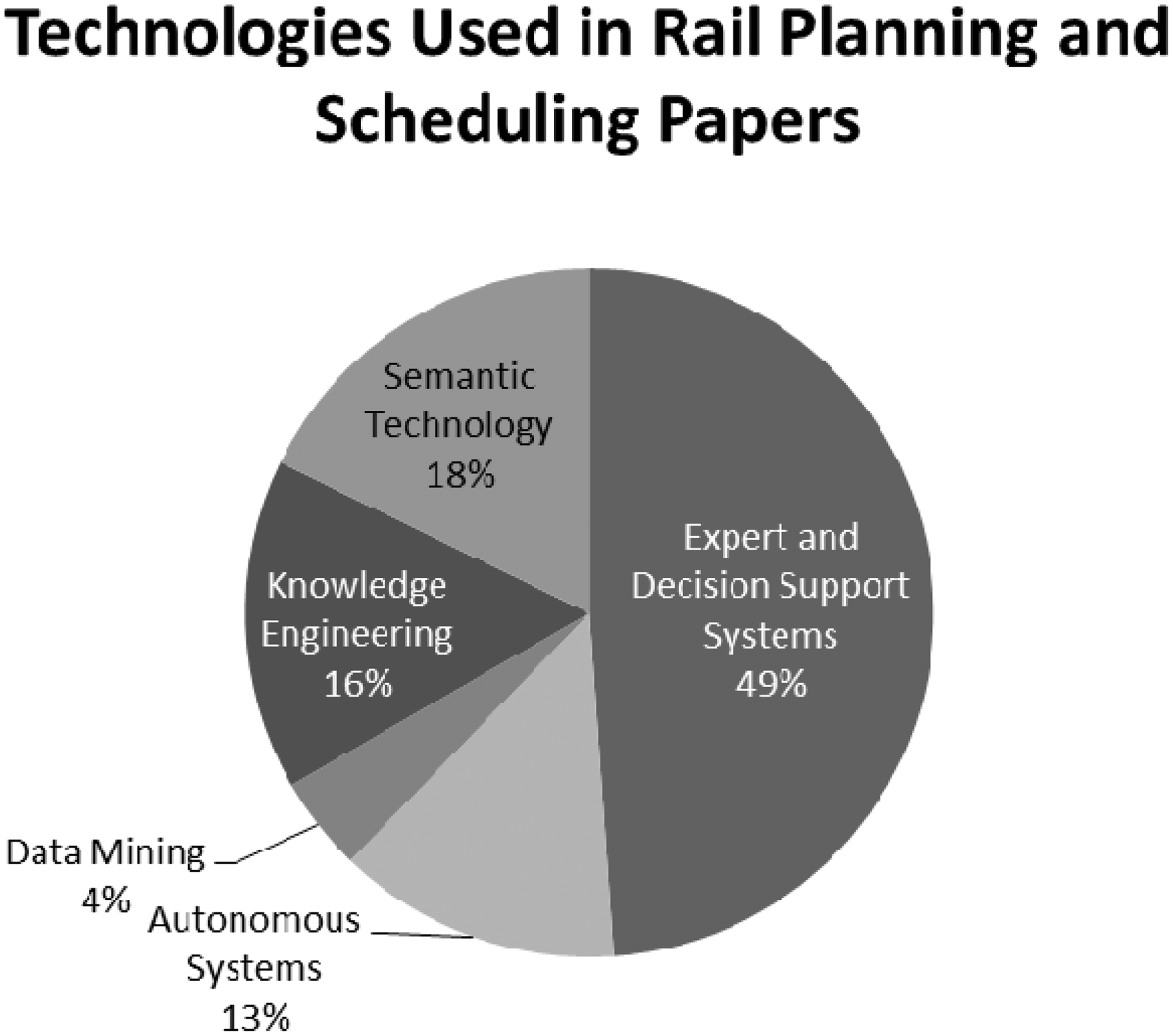
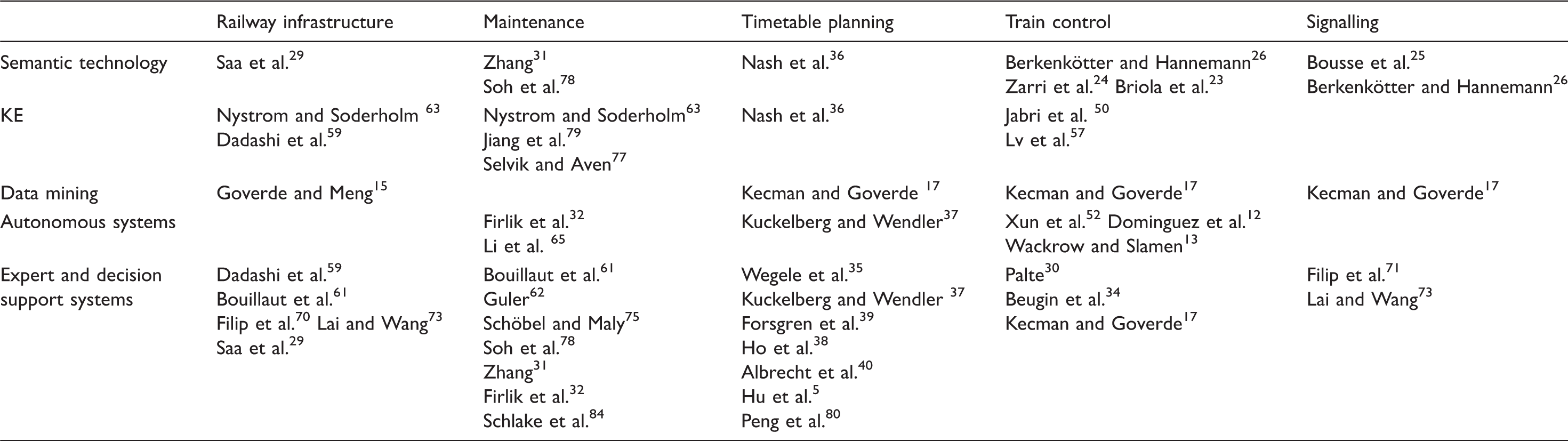
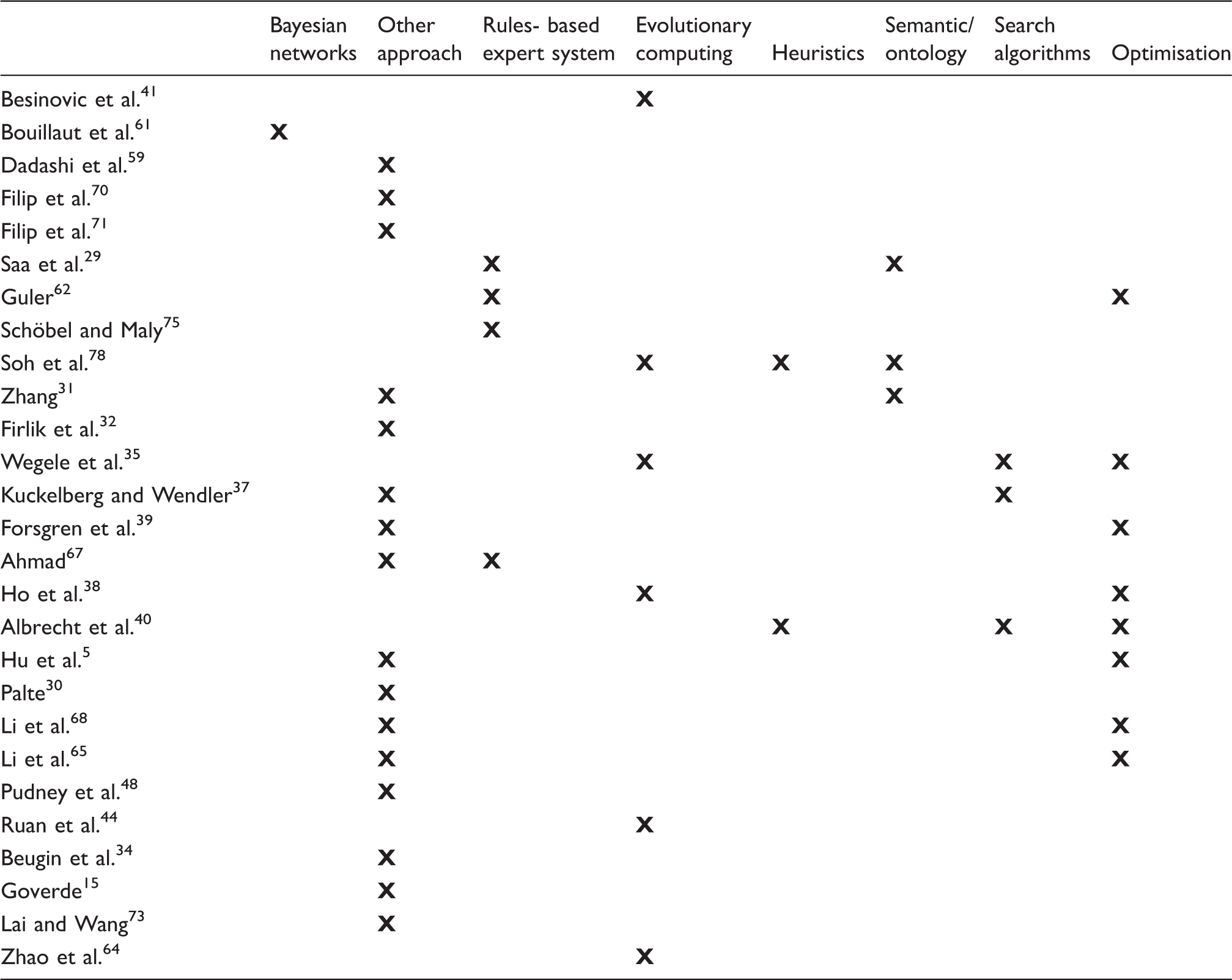
Table 2 further examines the area of expert and decision support systems, breaking down the papers by their use of specific technologies. From this table it can be seen that many papers feature optimisation as one approach to scheduling. Evolutionary computing is another technique featured in papers, particularly with regard to its use in timetable planning. Increasingly, there is a trend towards the integration and use of semantic technologies with artificial intelligence algorithms with the aim to provide enhanced support to decision-makers. This trend is likely to continue in the future with the increasing utilisation and acceptance of knowledge-based and autonomous systems in the rail industry. Through this review it is clear that a significant proportion of the papers provide custom algorithms to planning and scheduling problems in the rail industry; this suggests that scope exists to provide new approaches to planning and scheduling. Table 2 provides a summary of the use of particular computing techniques within the rail industry (also shown as a pie chart in Figure 3) and can be used to cross reference with Table 1 to find relevant areas of application.
Papers featuring expert and decision support systems. Papers featuring expert and decision support systems (filtered by approaches employed).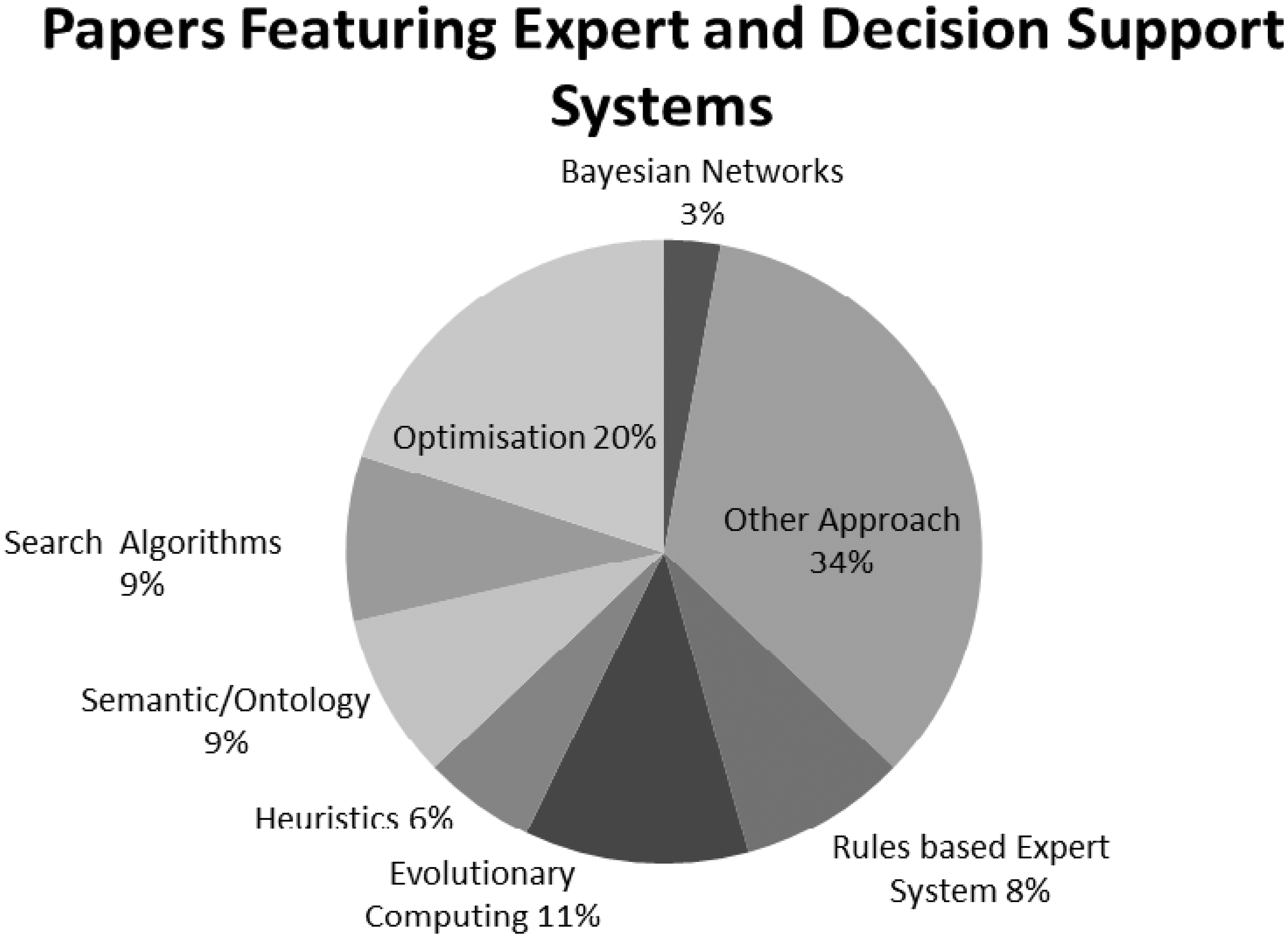
Conclusions
This paper has outlined a set of key planning and scheduling issues relevant to the rail industry. In addition, research works relating to current planning and scheduling issues in rail have been identified. This review of research related to the rail industry in Europe is supplemented with relevant international papers. There is an increased focus on knowledge- based systems in the rail industry. The use of ontologies and semantic technology increases the potential usefulness of data stores and legacy data repositories. The ability to draw meaning from data in a context-relevant fashion is becoming a new research focus in the industry and is of direct relevance for the development of both knowledge-based and autonomous systems for rail.
Footnotes
Funding
The author(s) disclosed receipt of the following financial support for the research, authorship, and/or publication of this article: This research has been funded by the Engineering and Physical Sciences Research Council and Network Rail.