




Abstract
This study is an attempt to assess the micro-electrical discharge machining behavior of Kevlar–carbon hybrid composites using Box–Behnken design (BBD)-based regression analysis coupled with grey-relational analysis (GRA), and artificial neural network (ANN) modeling. Seventeen experimental trials were produced from the BBD, inclusive of repetitions. The variation of machining time (MT) and dimensional deviation (DD) was studied with respect to pulse on time (Ton), voltage (V), and tool rotation (TR). The analysis of variance (ANOVA) was carried out to develop the regression model for each output response. A multilayer feed-forward neural network was employed in the ANN modeling, comprising four neurons in the input layer, 10 neurons in the hidden layer, and two neurons in the output layer. The regression models for MT and DD, derived from ANOVA, aligned effectively with the experimental data. The maximum error values for the regression models of MT and DD are 0.0207 and 0.04483, respectively. Ton and TR were the most critical parameters for MT and DD, as seen by their greater F-values (89.68 and 38.02). Controlling these factors precisely and accurately will optimize machining performance. The best input parameters for minimum MT and DD from the GRA are: Ton - 30 µs, V - 220 V, and TR - 300 rpm. At ideal input factor levels, MT and DD values from GRA were 800 s and 69 µm, respectively. Experimental grey-relational grade (GRGrade) was 0.898974, around 4.95% different than predicted (0.85656). The ANN model predicted MT and DD values close to the experimental values. The greatest ANN prediction errors were 5.68% for MT and 9.22% for DD. The ANN model is adequate because the correlation coefficient (R = 0.99411) is near 1. This study suggests hybrid composite manufacturing industries apply multiresponse optimization with MT and DD.
This is a visual representation of the abstract.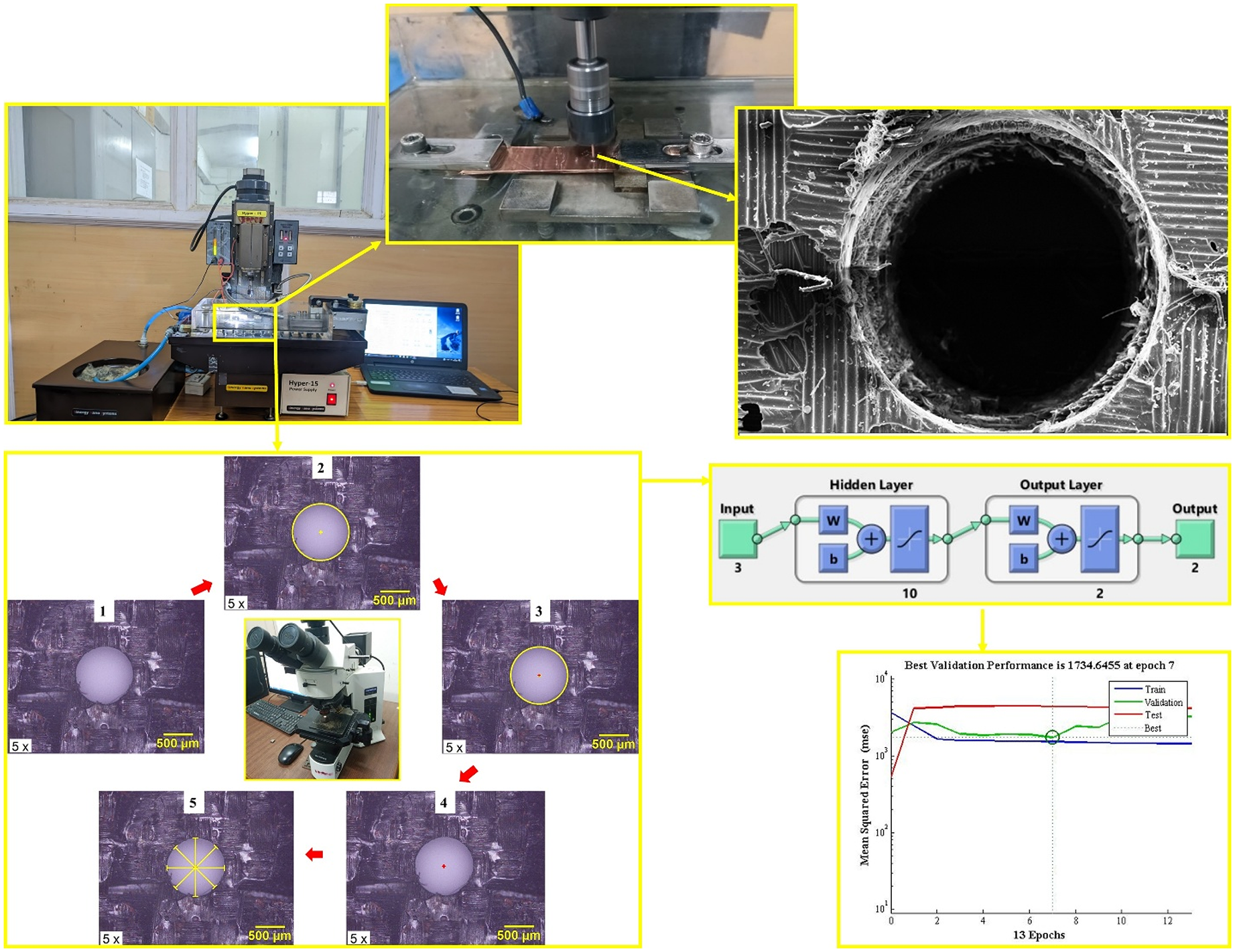
Keywords
Get full access to this article
View all access options for this article.
References
Supplementary Material
Please find the following supplemental material available below.
For Open Access articles published under a Creative Commons License, all supplemental material carries the same license as the article it is associated with.
For non-Open Access articles published, all supplemental material carries a non-exclusive license, and permission requests for re-use of supplemental material or any part of supplemental material shall be sent directly to the copyright owner as specified in the copyright notice associated with the article.


