




Abstract
This research investigates the effects of continuous tungsten inert gas arcing (C-TIGA) and pulsed tungsten inert gas arcing (P-TIGA) processes on the hardness of case-hardenable low-alloy steels, focusing on AISI 8620 steel. The study investigates the influence of arc parameters on mechanical properties and microstructural changes. The modified surface of AISI 8620 steel was investigated analytically and validated through experiments. Using an 18 mm thick AISI 8620 steel plate, C-TIGA and P-TIGA processes are employed in one pass with subsequent hardness measurements in the fusion zone and heat-affected zone (HAZ). The results show a remarkable improvement in the hardness of the modified zone compared to the base metal, with a noteworthy increase of 127 ± 20% and 77 ± 25% for C-TIGA and P-TIGA processes, respectively. Notably, at equivalent arc currents, P-TIGA outperforms C-TIGA, achieving a hardness increase of over 20 ± 10% in the modified zone. In addition, the careful control of process parameters in P-TIGA leads to a better change in the thermal and mechanical properties of rolling bearing steel compared to C-TIGA. The combination of significantly increased surface hardness and an extensively modified zone depth contributes to increased wear resistance and compressive stresses in the matrix. In particular, the P-TIGA process is shown to be superior as it has greater modified zone depth, narrower HAZ width, and higher hardness. This research establishes P-TIGA as a promising method for surface modification and offers significant improvements over the traditional C-TIGA method.
This is a visual representation of the abstract.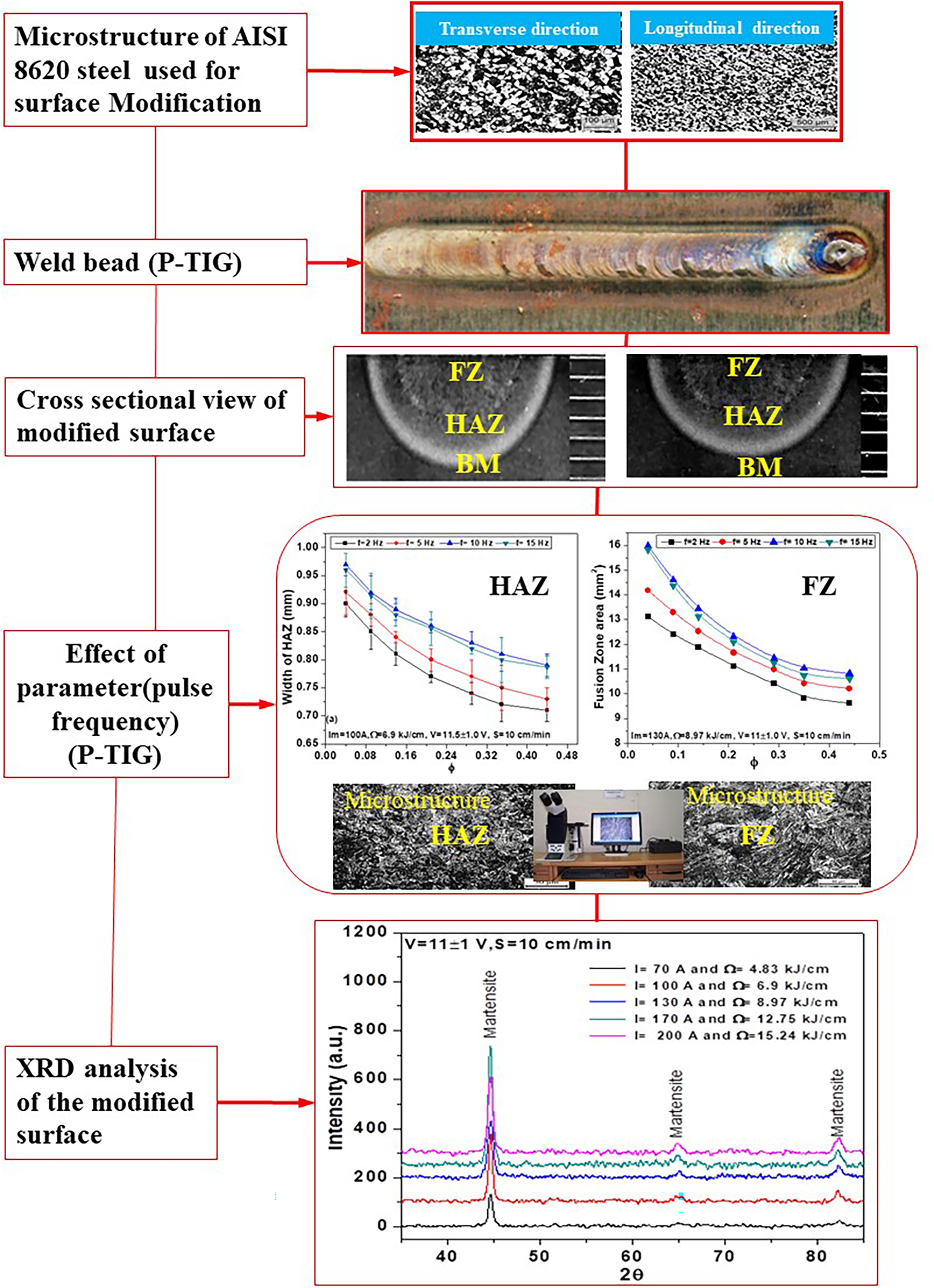
Get full access to this article
View all access options for this article.
References
Supplementary Material
Please find the following supplemental material available below.
For Open Access articles published under a Creative Commons License, all supplemental material carries the same license as the article it is associated with.
For non-Open Access articles published, all supplemental material carries a non-exclusive license, and permission requests for re-use of supplemental material or any part of supplemental material shall be sent directly to the copyright owner as specified in the copyright notice associated with the article.
