



Abstract
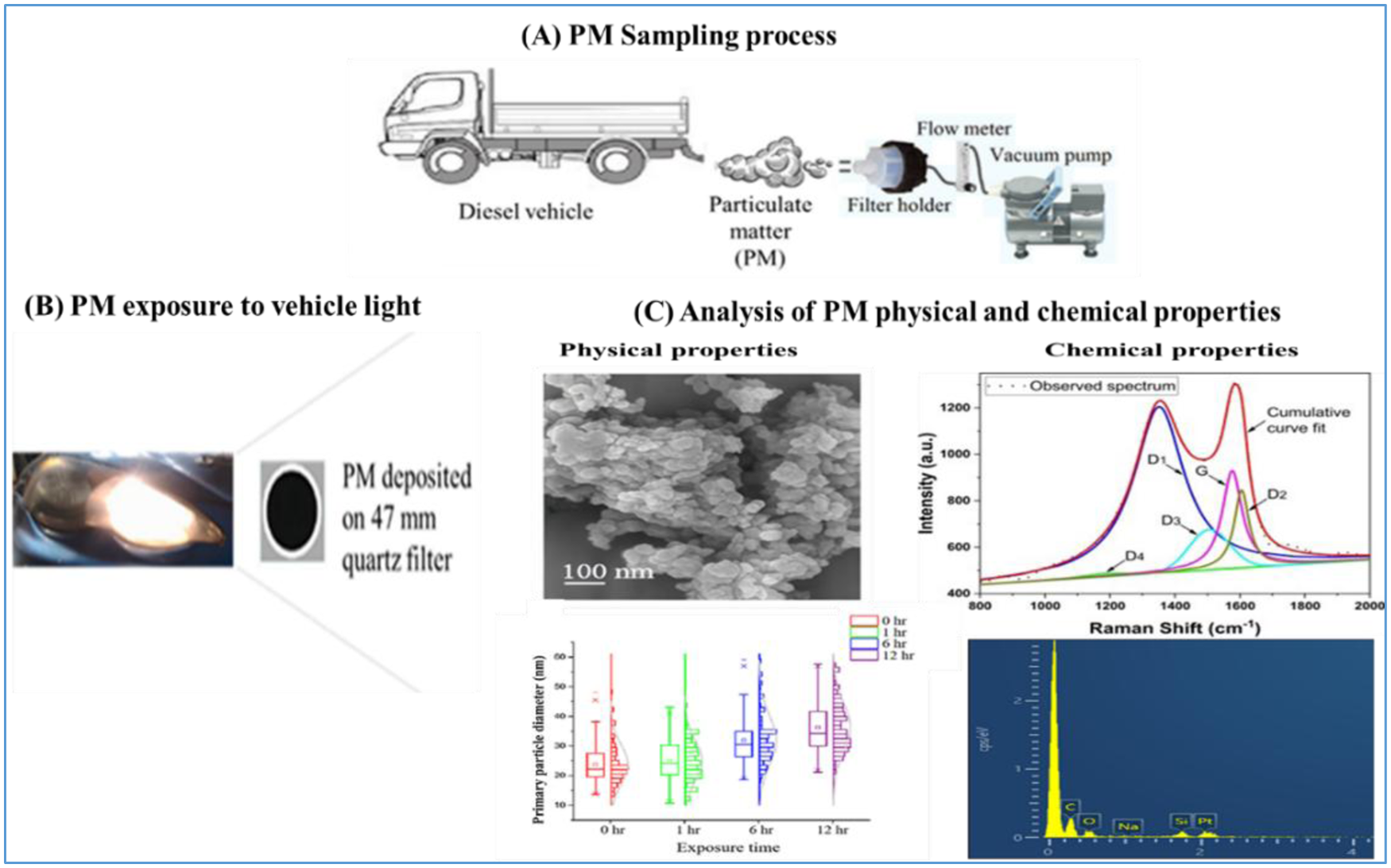
This study investigates the effect of irradiation from the two most widely used vehicle lights, namely, High-intensity discharge (HID) and Light-emitting diode (LED), on the physical and chemical properties of both aged and fresh PM emitted from a diesel vehicle under idle and full throttle engine operating conditions. The PM samples were exposed to vehicle light for 1, 6, and 12 h at a constant distance of 10 cm while PM samples without exposure (0 h) served as the control. The results of physical microscopic and chemical analyses of PM samples show that HID light exposure for 1, 6, and 12 h increases the average sizes of aged PM particles by 8.6%, 15.5%, and 27.6%; PM particles at idle engine speed by 26.3%, 58.0%, and 68.4%, and; PM particles at full throttle condition by 13.6%, 45.5%, and 68.2%, respectively. Similarly, LED light exposure for 1, 6, and 12 h, increases the average sizes of aged PM particles by 5.2%, 6.9%, and 17.2%; PM particles at idle engine speed by 21.1%, 47.4%, and 73.6%, and PM particles at full throttle by 9.1%, 36.4%, and 54.5%, respectively. Furthermore, chemical properties of PM samples show remarkable changes.
Keywords
Get full access to this article
View all access options for this article.
References
Supplementary Material
Please find the following supplemental material available below.
For Open Access articles published under a Creative Commons License, all supplemental material carries the same license as the article it is associated with.
For non-Open Access articles published, all supplemental material carries a non-exclusive license, and permission requests for re-use of supplemental material or any part of supplemental material shall be sent directly to the copyright owner as specified in the copyright notice associated with the article.
