




Abstract
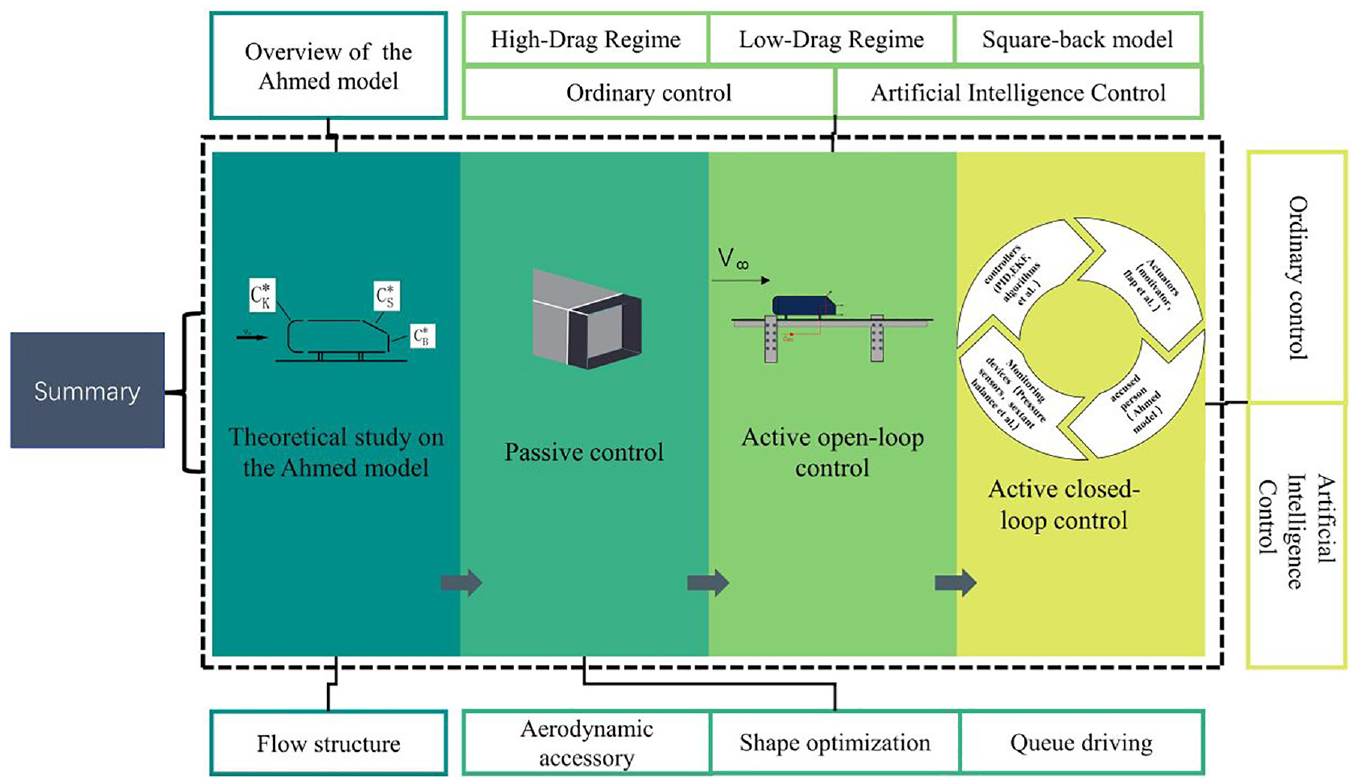
The drag coefficient is a key indicator of automobile performance, playing a crucial role in enhancing driving stability and reducing energy consumption. As the global society’s concern for resources continues to heat up, more and more attention has been paid to the development of means of automobile drag reduction, and the Ahmed body has become the object of extensive research because of its simple and representative model structure. This paper provides an overview of the structure of the three-dimensional flow field around the Ahmed body and reviews the research done by researchers in recent years on drag reduction in this body. We classify drag reduction methods into passive and active categories based on the presence or absence of energy inputs. Passive drag reduction is further subdivided into aerodynamic accessories, shape optimization, and platoon. Meanwhile, active drag reduction is categorized into open-loop and closed-loop control, with each further divided into conventional control and artificial intelligence control. The article reviews and summarizes each category, and concludes by addressing the challenges in drag reduction using the Ahmed body and expressing anticipation for future research directions.
Get full access to this article
View all access options for this article.