



Abstract
The environmental impact of ICEVs (internal combustion engine vehicles) have led to increasing numbers of EVs (electric vehicles) and plug-in hybrid vehicles being developed. However, current HVAC (heating, ventilation and air conditioning) systems can heavily impact energy consumption, reducing EV range. MVHR (mechanical ventilation with heat recovery) is an approach to minimise the HVAC energy consumption currently used in buildings to meet the Passivhaus building standard and can be used for both heating and cooling. In this work a MATLAB Simulink model and a road load model are used to quantify potential energy reduction and corresponding range savings from an automotive MVHR HVAC system. The model is calibrated against data from the industry sponsor for a baseline non-MVHR vehicle. The results show a 74.3%–94.9% HVAC energy consumption and corresponding range savings of a mean average of 8.8%–11.0% range savings over the baseline case without MVHR, and a corresponding 0.5%–2.5% range increase over the industry sponsor’s vehicle’s range under certification conditions. The work concludes that the application of MVHR technology to automotive cases is beneficial.
Introduction
It is widely accepted that greenhouse gases directly affect global warming; greenhouse gases include CO2, CH4, HFCs and PFCs among others. 1 Global warming has seen a rise in global temperatures as well as increasing numbers of natural disasters, extreme weather events, species extinction and rising sea levels.1–7 ICEV’s are major contributors to CO2 emissions – according to the IEA, the transportation sector represents a quarter of the world’s CO2 emissions, and over 30% of the UK’s. 8 Furthermore, burning fossil fuels like petrol and diesel also produces air pollutants such as PM, SO2, NOx, HCs, VOCs, CO and NH3 9 which are regarded as the most critical environmental human health hazard 10 – resulting in an eighth of global deaths. 1 EVs consume up to 49% less energy than ICEVs and avoid exhaust emissions.11,12 Manufacturers throughout Europe and across the globe are being pushed to lower vehicle emissions and to invest into the development of EVs through emissions-based taxation and other legislation. 9 To improve EV sales, several barriers to EV adoption need to be overcome, including price, charging infrastructure, range concerns and consumer perception.3,13–15 Both Bonges et al. 14 and Noel et al. 15 state that the main public concern about EVs is their limited range and Kambly and Bradley 16 states that the main reason is an EVs inability to consistently meet a range target. A solution to extend range and improve range consistency without enlarging or developing the battery involves minimising auxiliary loads. HVAC systems are the greatest auxiliary load in EVs and significantly impact battery longevity and range17–19; hence, substantial savings can be made by improving HVAC efficiency.
The most basic HVAC system for EV’s includes a PTC heater element for heating and, optionally, an electric compressor for A/C. 20 For their simplicity, PTC heater elements are the most used in EVs, with typical power ratings of 4–6 kW 21 ; they can be used to heat a water-glycol mix or directly heat the air flow into the cabin. 21 HVAC systems make up 20%–40% of the total energy consumption of EVs dependent on ambient temperature and driving conditions. 17 Figure 1 shows a diagram of the overall EV energy consumption, with the HVAC consumption at 23.7%; hence, at 40%, the HVAC system would be consuming more energy than traction.
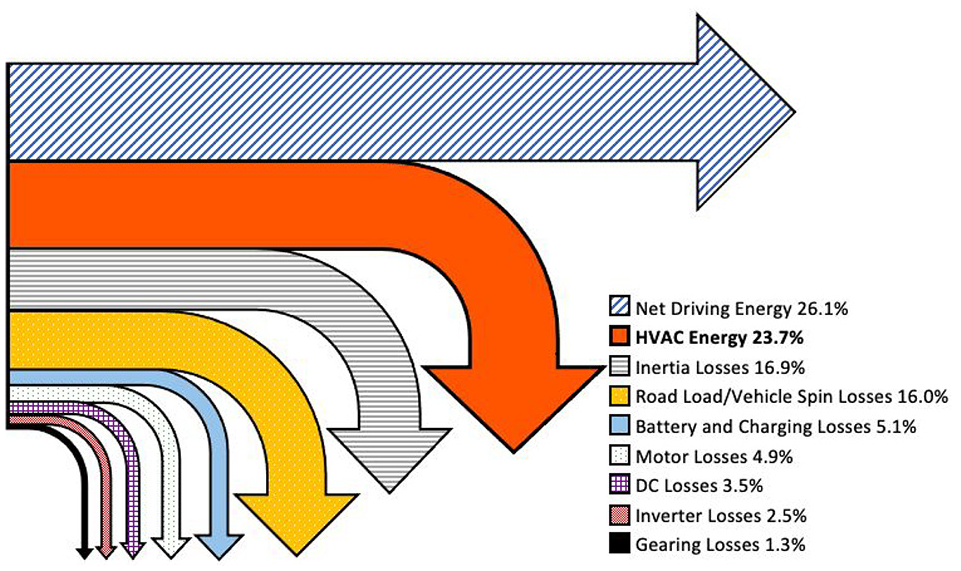
Sankey diagram showing energy distribution of EV on UDDS drive cycle at −6°C, data from Hayes and Davis. 22
When comparing the literature, the mean average range reductions found were 45.9% and 16% for heating and cooling respectively; with a standard deviation (heating) of 5.5%18,19,23–28 showing high confidence in the range reduction values. The dominant solution for reducing HVAC consumption is currently heat pumps. 20 Heat pumps use a conventional A/C system with an additional heat exchanger and expansion valve27,29 and can lower HVAC energy consumption by 38.9% (averaged from Peng and Du, 20 Lajunen 21 and Rabl 29 ). However, they have low system efficiency 20 ; challenging and complex control systems 21 ; cannot provide instantaneous heat transfer 29 ; are considered ineffective in cold climates20,21,25–27,30; and use refrigerants which have environmental concerns and legislative restrictions. 20 Cabin air recirculation is also used by some manufacturers to reduce HVAC energy consumption. 31 This method has been found to reduce AC power by 6.1%, however, care must be taken to avoid low cabin air quality and windscreen fogging. 31
MVHR transfers heat between the extracted and incoming ventilation air in a room or building. 32 The extract and supply airflow rates must be kept as close as possible to avoid efficiency losses from pressurisation of the building. 33 The extracted air in the case of buildings is warm and moist – coming from bathrooms and kitchens, and generally this heat is used to warm the cold and dry outside air. 32 MVHR units contain an air-to-air heat exchanger and supply and extract fans. 32 Its effectiveness is directly dependent on the efficiency of these components, the buildings airtightness and the air flowrate 33 . MVHR also provides better indoor air quality.34–36 This includes: less temperature discomfort34,35,37,38; less humidity and condensation 33 ; less draughts and odours 34 and up to 48% reduced indoor CO2 levels.33,36,37,39 Generally, MVHR is used to achieve the Passivhaus Standard which is one of the most internationally recognised and widely used low energy building design standards.37,40 The minimum air flowrate for Passivhaus dwellings is 30 m3/h/person. 41
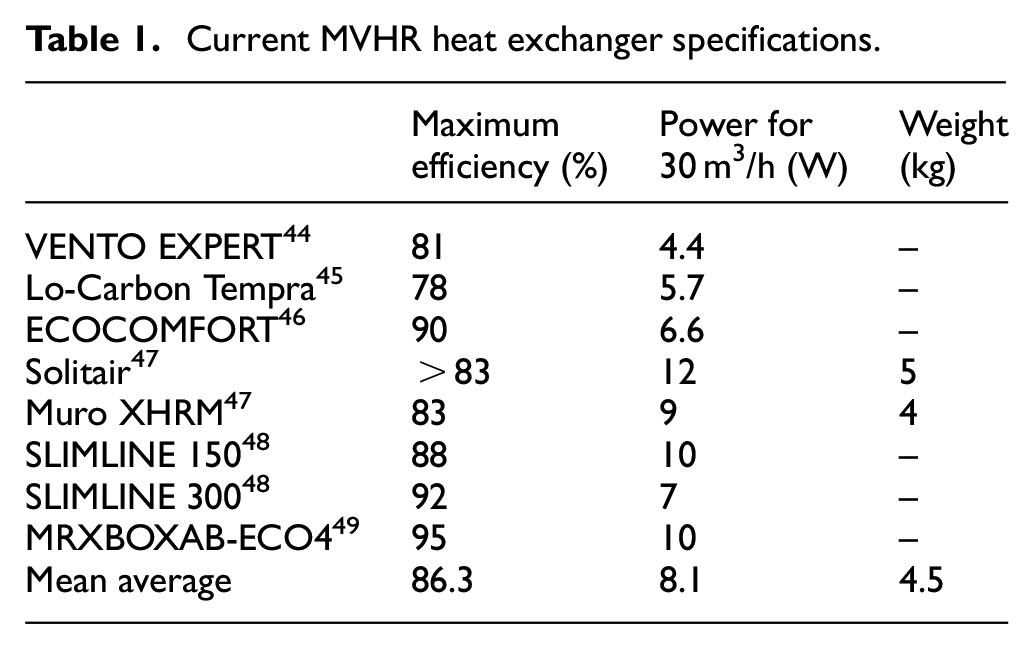
Table 1 compares eight single-room MVHR units, where the mean averages can be used as a general idea of MVHR capabilities. Generally, efficiencies are above 80%, with the highest efficiency at 95%. The mean average power required to maintain an airflow of 30 m3/h is 8.1 W, therefore, a power consumption of approximately 10 W can be assumed to allow for power losses. However, the prices found on manufacturer websites range from £240 to £515 per MVHR unit,42,43 hence, there is currently significant cost to this technology. Although, it is worth noting that this is retail cost, and includes technology such as Wi-Fi control, humidity sensing and timers for intermittent extraction which will not be of use in automotive applications.
Current MVHR heat exchanger specifications.
The purpose of this paper is to find the potential energy consumption savings from an automotive MVHR HVAC system and the resulting EV range benefits at vehicle certification conditions and varying real-world ambient temperatures. This paper will detail the MATLAB Simulink model built to analyse the energy consumption; the verification and validation of the model; the vehicle road load model used for analysis and all of the results gathered.
Modelling
Figure 2 shows how a typical MVHR system could be integrated into an automotive HVAC system. Ambient air passes through the MVHR unit and then the heater/cooler, before entering the cabin. This ensures that the air entering the cabin is the correct temperature, which is important as changes in inflow air temperature must be minimised to avoid passenger discomfort. To prevent cabin pressurisation, the input and output flowrates are maintained equal. A recirculation feedback loop of cabin air is used to enable rapid and efficient achievement of the setpoint by heating the cabin air as well as the fresh air; and a bypass is used for atypical cases when the cabin air temperature is further from the setpoint than ambient temperature – such as when a vehicle emerges from indoor storage facilities. One potential issue of this design is stale air from the recirculation loop; however, choosing an appropriate minimum fresh air flowrate into the cabin (
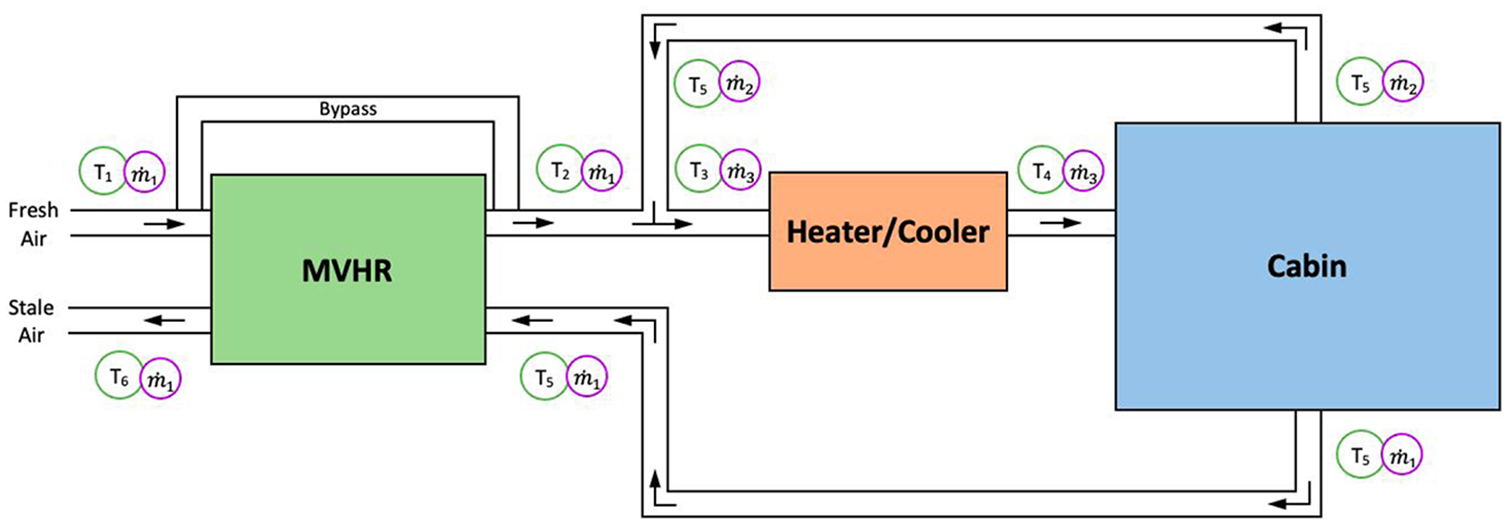
Schematic of MVHR HVAC system.
Each temperature (other than the input
System parameters.
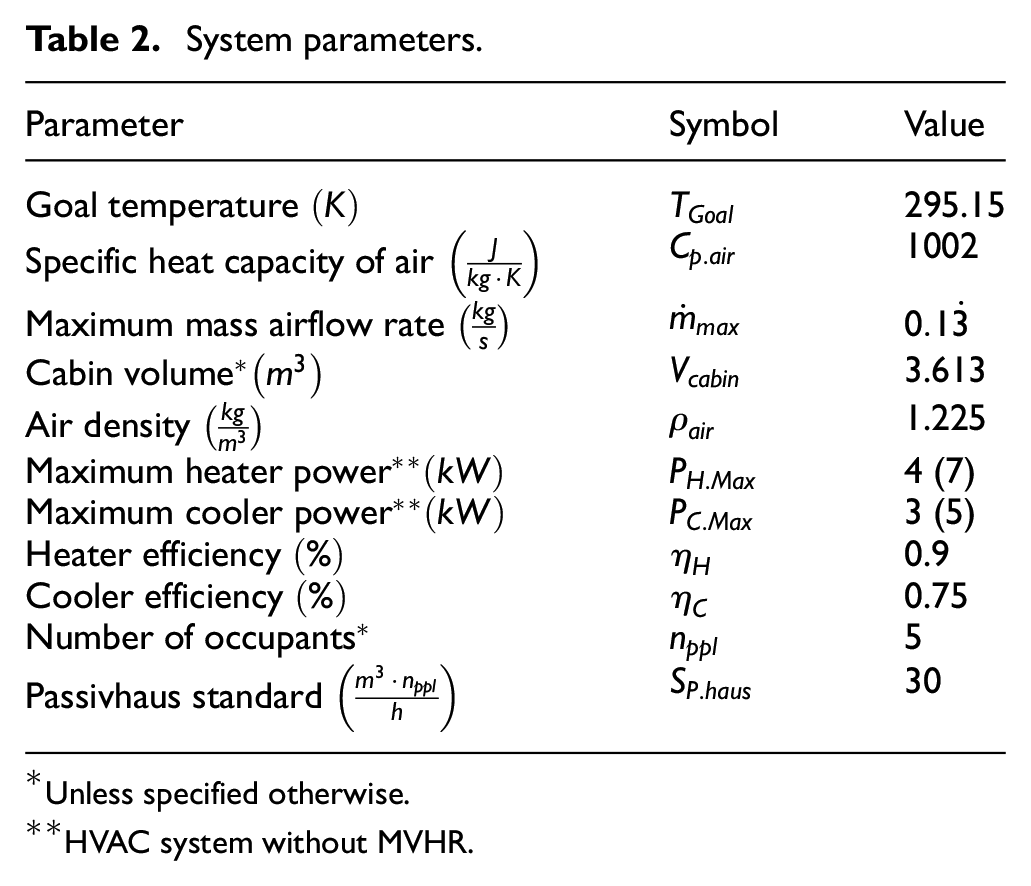
Unless specified otherwise.
HVAC system without MVHR.
The cabin has one incoming airstream – fresh air that has passed through the MVHR and heater/cooler – and two outgoing streams – one for recirculation and one exiting the vehicle (Figure 2). Hence the net power can be found using equation (1); where power is used rather than heat current (

The total thermal energy of the cabin’s air volume is:

Which has the initial condition:

Rearranging the same energy equation, then finds the cabin air temperature:

Moreover, by definition,

The heater/cooler unit needs to deliver power to the air going through it into the cabin to change the cabin air temperature to meet the setpoint temperature. First the error between the cabin temperature and setpoint is calculated, this feeds into a PID controller to compute the power requirement. The 10 W MVHR power consumption (from Table 1, including losses) is added and then the power is integrated to find the energy consumption, where 5% losses are included.
A basic means of controlling the flowrate is needed to maintain the minimum air refresh rate and give the heater/cooler the opportunity to control the cabin volume. Hence, the mass flowrate was proportionally related to the heater/cooler power, that is, when the cabin temperature to setpoint error is high, the heater cooler power (

Hence, as

Where equation (8) holds to avoid cabin pressurisation, as stated in the Schematic section.

MVHR units transfer the heat between the input ambient air (

To maximise efficiency, whenever
After the MVHR unit, cabin air (

As the industry sponsors’ vehicle does not use air recirculation, when the MVHR efficiency is set to zero – that is, there is no MVHR system –
Once the air enters the heater/cooler, the power requirement from the heater/cooler (calculated using a PID controller as discussed previously) is used to calculate the temperature of the air going into the cabin (

Where the subscript H/C represents heater or cooler – as different efficiencies have been used for the two systems (90% 50 and 75% assumed, respectively).
This completes the model description, from this point the calculations cycle back to the T5 subsystem and repeat continuously for the time specified with a MATLAB Simulink automatic fixed-step solver and time-base.
To analyse any potential benefits of the MVHR HVAC system, the energy consumption results from the MATLAB Simulink model must be converted into vehicle savings to calculate EV range savings. The method chosen for this is a vehicle road load model – chosen for its simplicity and readily available equations. When at constant speed, a vehicle is subjected to tractive resistance – resistance to motion. This consists of aerodynamic resistance, rolling resistance and incline resistance. When accelerating, there is an acceleration force moving the vehicle forwards. The equations for these forces form the road load model and can be used to calculate vehicle power and energy requirements. The model’s algorithm is shown in Table 3, the test scenario for the investigations undertaken here is the WLTP drive-cycle, 51 but this could be modified to follow any pre-defined speed/time profile.
Algorithm used for vehicle road load model.
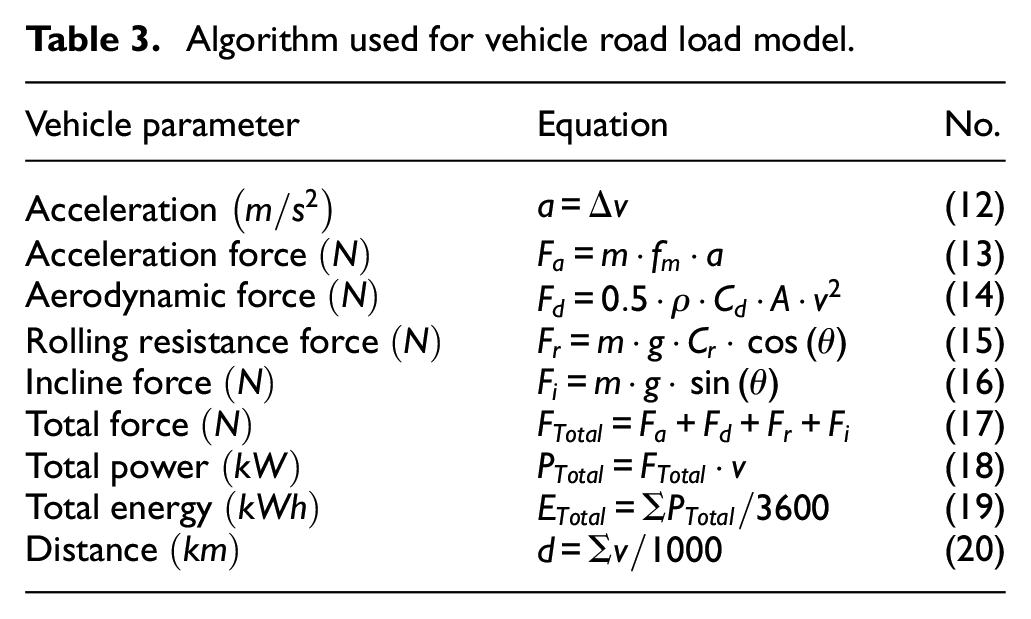
The model begins with the time and vehicle speed (
For model analysis, energy consumption and EV range savings have been calculated. Percentage energy savings have been found using equation (21).

Where
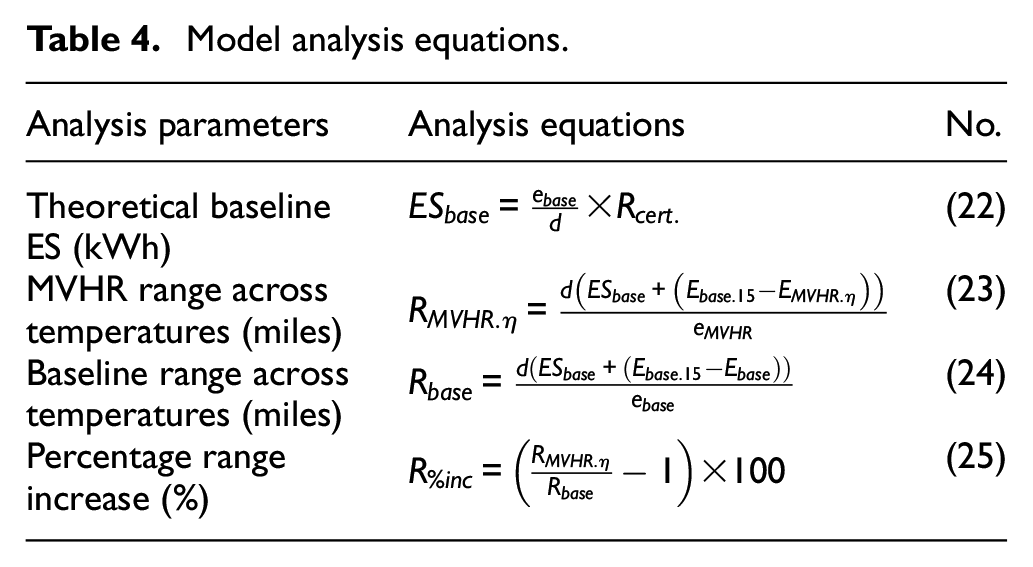
Percentage EV range increases have been found using equations (22)–(25) in Table 4. Where
Model analysis equations.
The PID controller was manually tuned to meet the target performance – where maximum targets of one oscillation and 6 min to setpoint have been set. This aligns with the attribute targets and typical performance of the industry sponsors’ vehicle.
To verify the model, component and system level tests were undertaken. Component testing explored typical and boundary cases for each significant portion of model functionality and system testing involved regression testing of existing functionality and new features as they were added.
The model was validated against the baseline performance data provided by the industry sponsor, the results and modelling inaccuracy are shown in Figure 3, where the model results begin to deviate at extreme temperatures. This is likely due to the differences in minimum air flowrate into the cabin as well as simplified losses and parameters. However, generally, the energy consumptions follow a similar trend; hence, for a simple model applied to proof-of-concept study, it shows an appropriate fit to the data. Therefore, the model can be deemed as valid for this project.
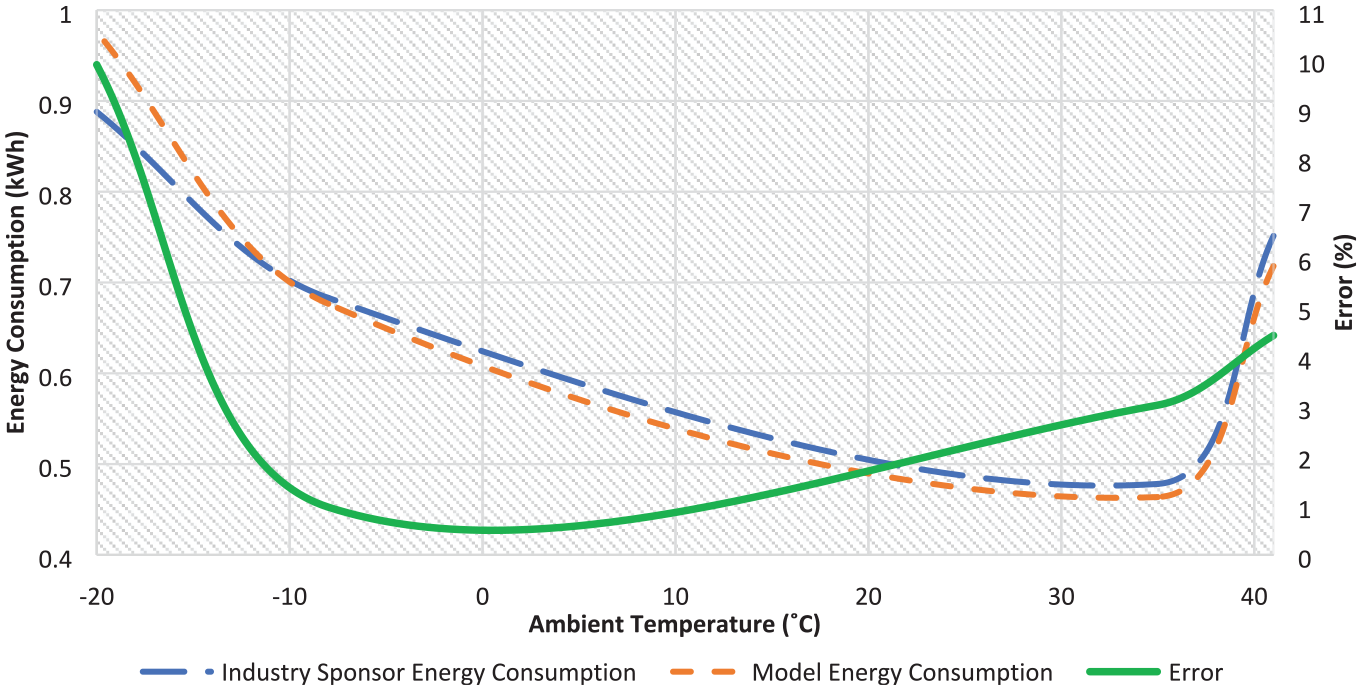
Comparing the energy consumption between the model and the industry sponsors data. 56
Results
A range of temperatures (
When comparing the ‘time to setpoint’ for a range of heater/cooler powers over the temperature range, the MVHR systems can maintain the baselines time to setpoint, other than in extreme temperatures (−20°C and 50°C) where it is slightly increased. The maximum power capability for the heater/cooler with the MVHR HVAC system can also be reduced from 7 kW/5 kW to 4 kW/3 kW without detriment. Figure 4 shows the steady state power savings over the temperature range for the MVHR efficiencies selected; where the steady state power consumption of the HVAC system occurs after the cabin reaches the setpoint temperature. Low stable power consumption becomes increasingly important with longer journeys – where the initial power boost to get the temperature to setpoint becomes insignificant. The percentage savings are broadly proportional with increasing MVHR efficiency. The change between heating and cooling is seen as the efficiency of the heater element and cooling system differ – with the heater element set at 90% efficiency and cooling system set at 75% efficiency. Therefore, at higher MVHR efficiencies, lower heater/cooler efficiencies have less effect on the overall power consumption (the two lines merge) and hence, cheaper heating/cooling systems could be used.
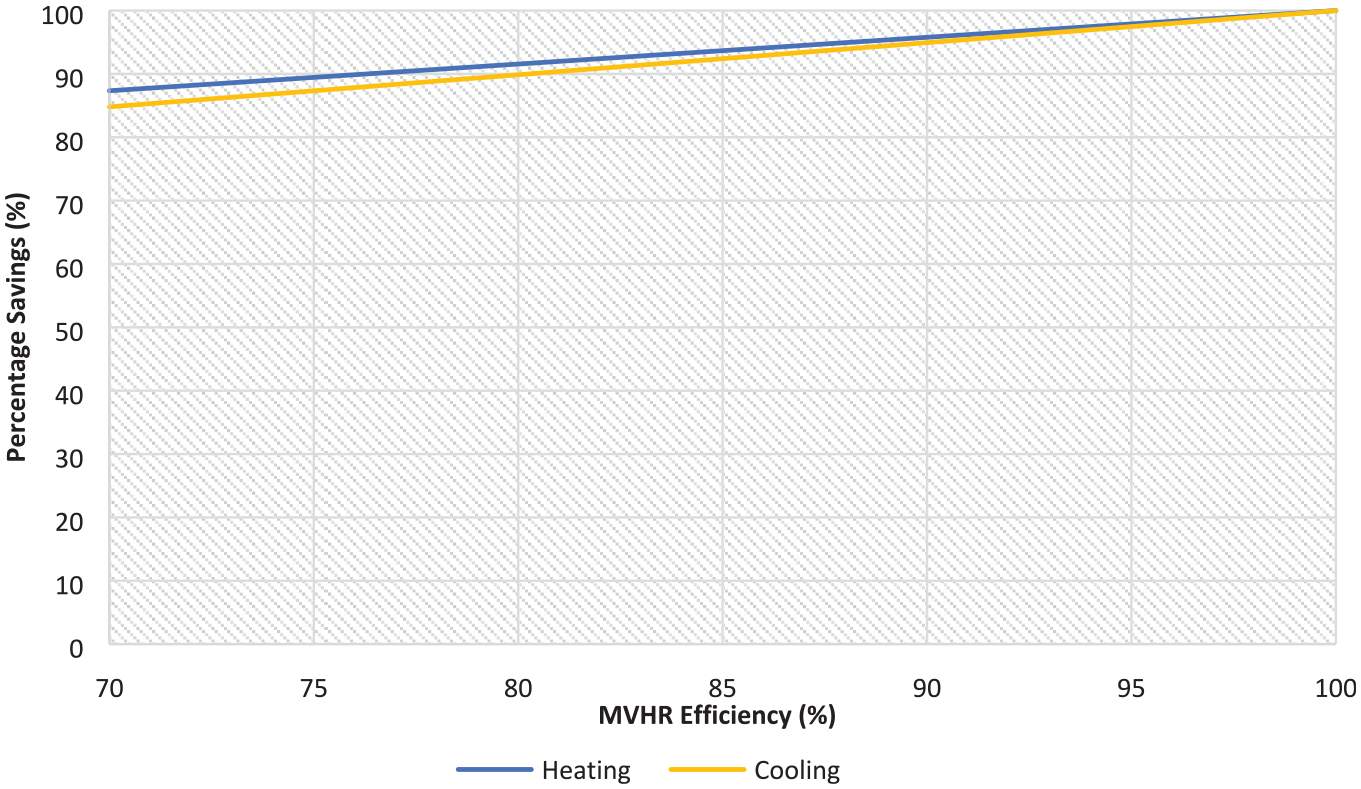
Stabilised power consumption savings for heating and cooling against the baseline case.
Figure 5 compares the HVAC energy consumption savings of the different MVHR efficiencies – compared with the baseline case over 1800 s (the WLTP drive-cycle time); where higher MVHR efficiencies lead to greater energy savings over the whole temperature range. The savings slightly dip in mild ambient temperatures because less HVAC energy is consumed in mild temperatures, and there is less variation between cabin setpoint and ambient temperature, hence, less savings are made. However, even in these conditions savings of up to 93% are made – benefits are seen in all climates. It is also worth noting the previously mentioned achievability of 80%–95+% MVHR efficiency which show minimum energy consumption savings of 74% compared to the baseline system. However, if cost/space saving becomes a priority, the 70% efficient MVHR still gives a 65%–66% reduction in HVAC energy consumption.
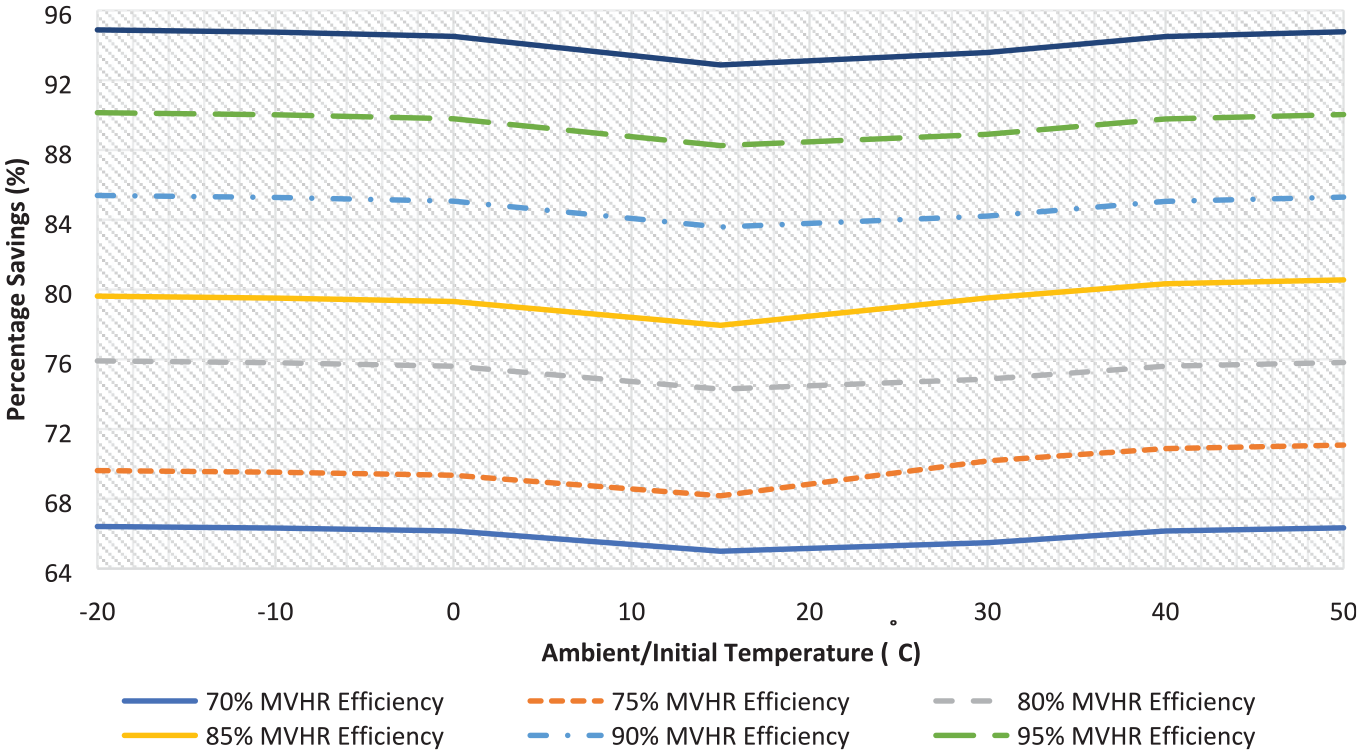
Energy consumption percentage savings comparison of MVHR efficiencies against the baseline case.
This section will quantify the benefits resulting from the reductions in power and energy consumption discussed above. The energy consumption data has been inputted into a road load model to find the associated range benefits over the WLTP test cycle. An estimated weight of the total system (4 kg), minus an estimated 1 kg from the heater/cooler power requirement reductions, has been added to the overall vehicle weight for these cases. A reduction of 1 kg has been estimated by assuming the heater/cooler power is proportional to its weight – hence, power reductions have been ‘converted’ to weight savings. Range savings have also been compared to the industry sponsors’ vehicles WLTP certified EV range. 53
The industry sponsors’ vehicle is a PHEV with a 24-mile range, all savings found should scale for a full EV. Figure 6(a) compares the range benefits from different MVHR efficiencies, where the 0% efficient MVHR system represents the baseline system without MVHR. The figure shows the baseline system to have large drops in range at extreme temperatures – with the largest drop of 14.8% at −20°C, where MVHR systems show range increases of up to 20%. In mild temperatures (15°C) these savings reduce to 2.8%, hence, although reduced in mild temperatures, there are benefits in all climates. Moreover, the lowest expected MVHR efficiency of 80% – from Table 1– has a maximum decrease of 1.25% across the full range of ambient temperatures in comparison to the 14°C ambient condition certified range of WLTP. The figure also shows that MVHR systems have increasingly more ‘stable’ ranges, that is, less variation from the certified range. From 90% efficiency, the MVHR system does not drop below the certified range regardless of temperature, hence, the range becomes almost independent of ambient temperature. This ‘stable’ consumption enables more accurate EV range prediction in all climates, which corresponds with a reduction in driver range anxiety.
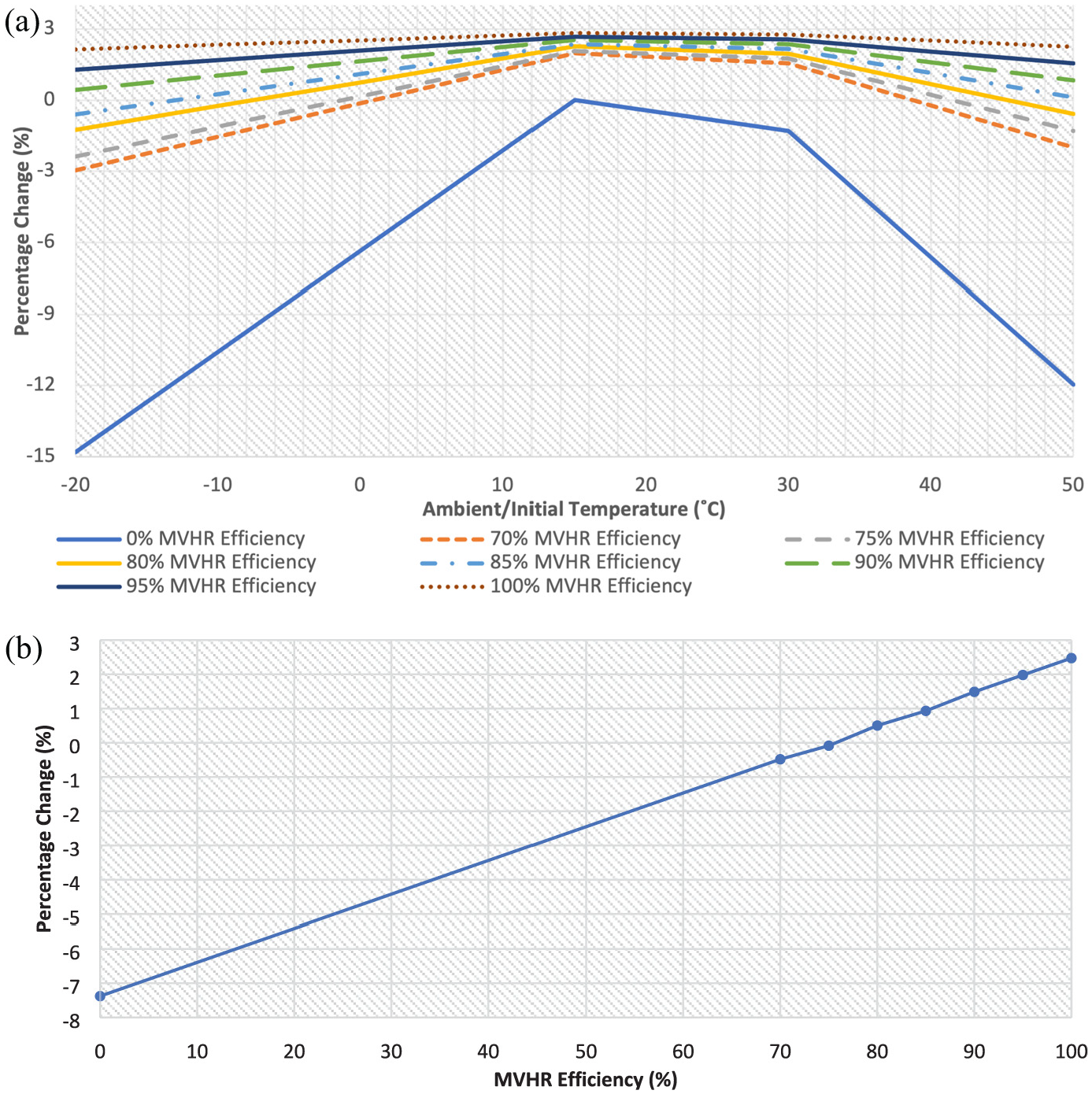
Comparing MVHR EV ranges (a) and mean EV ranges (b) to the certified value.
Figure 6(b) shows that the mean average range results are approximately linear; moreover, 80+% MVHR efficiency is required for the mean range to surpass the certified range. This suggests that the minimum efficiency for the MVHR system – to reap the best benefits – should be 80%.
Figure 7 shows the HVAC energy consumption savings comparison for cabin volume and number of occupants against the baseline case. These can be used to analyse what vehicle types are most suited for the MVHR technology. From Figure 7(a), smaller vehicle cabins generally give the largest energy consumption savings – likely due to the greater cabin energy losses in larger vehicles. There is a maximum difference of approximately 2.5% in savings between the vehicle cabin sizes selected – which range from 2.0 to 4.4 m3 (depicting small to large cabins). Hence, although larger vehicles may see lower results, their overall savings are still high. Moreover, all other results have used a 3.613 m3 cabin volume, hence, most vehicle HVAC savings will be greater than those presented. From Figure 7(b), fewer occupants give larger energy consumption savings – less fresh air is required in the cabin for adequate air quality (where the Passivhaus standard has been used in this case). This shows that the most efficient HVAC systems will be in vehicles that seat fewer passengers. It also shows that the greatest savings can be made if passenger detection or CO2 sensors are incorporated into the HVAC system to adjust the fresh air flowrate into the cabin. This minimises the fresh air into the cabin, saving up to 15% more energy in a five-seater vehicle – this will increase with the number of seats in the vehicle, giving greater benefit for people carriers, minibuses, etc. Furthermore, in both cases, an MVHR efficiency of 80% has been used, so savings will also be increased if a more efficient system is used.
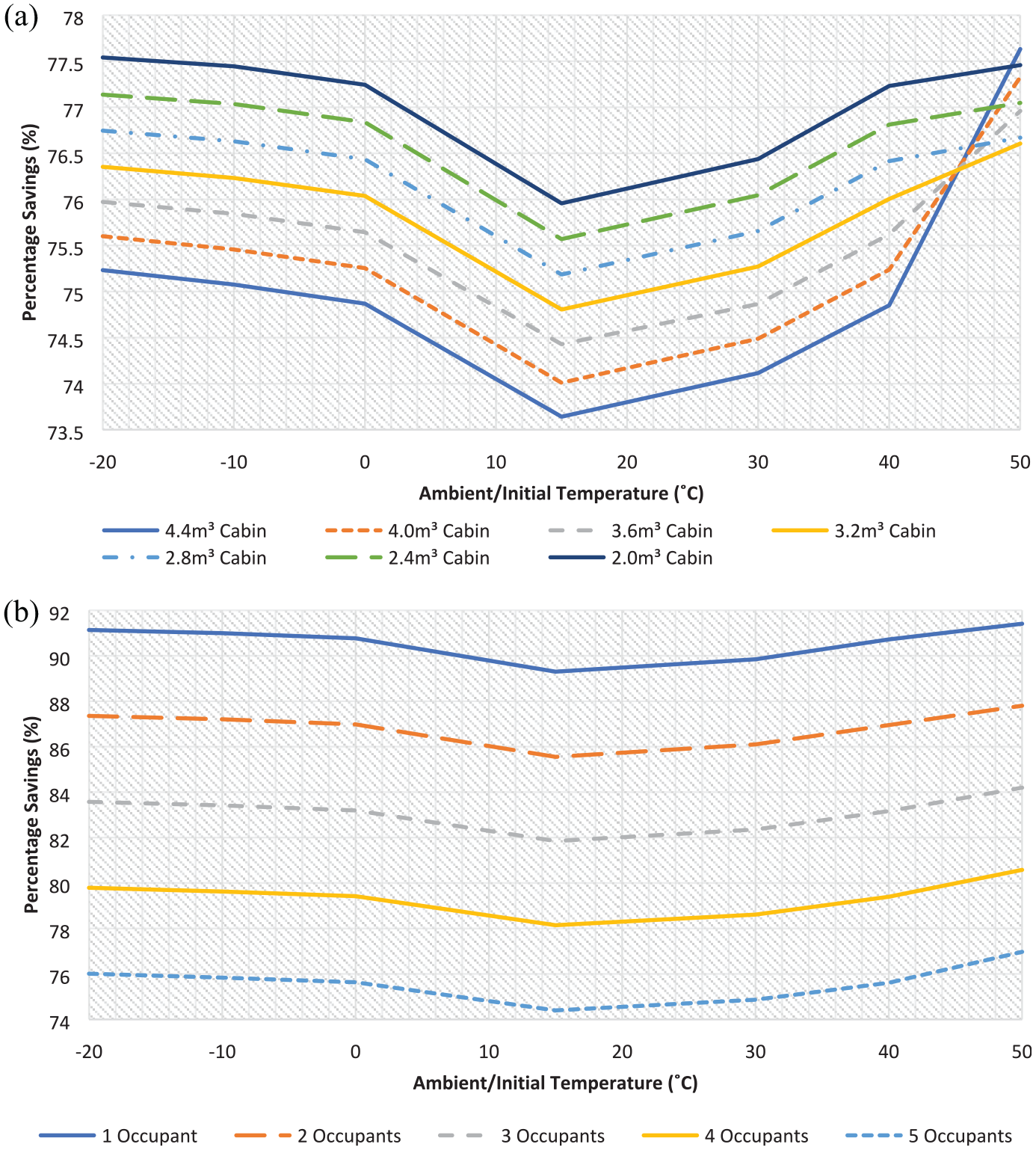
Comparison of HVAC energy consumption savings for different cabin volumes (a) and different numbers of occupants and (b) against the baseline case.
Conclusion
Results have shown that HVAC energy consumption savings of 74.3%–94.9% are achievable with MVHR HVAC systems as opposed to the mean average stated automotive energy consumption savings of 38.9% from heat pumps – currently the most popular alternative HVAC system used in EVs. Therefore, improvements of at least 35.4% can be expected over a heat pump system, and 74.3% over a PTC system. This shows a clear advancement in HVAC consumption savings.
The calculated EV range improvements from these consumption savings are also significant – with a mean average of 8.8%–11.0% range savings over the baseline case without MVHR, and 0.5%–2.5% range savings over the industry sponsor’s vehicle’s range under certification conditions. Generally, more extreme temperatures result in higher savings; however, savings are still found in mild ambient temperatures. Hence, MVHR systems will be beneficial for EV range in all climates. Moreover, as the EV range becomes more independent to ambient temperature, the certified EV range becomes more accurate as well as being extended; so, EV range anxiety will reduce. This will also impact all climates as EV drivers will not be as restricted in travel outside of their local area/climate.
Footnotes
Acknowledgements
The authors gratefully acknowledge the industry sponsor and the University of Warwick for all the support given for this research.
Declaration of conflicting interests
The author(s) declared no potential conflicts of interest with respect to the research, authorship, and/or publication of this article.
Funding
The author(s) received no financial support for the research, authorship, and/or publication of this article.
