




Abstract
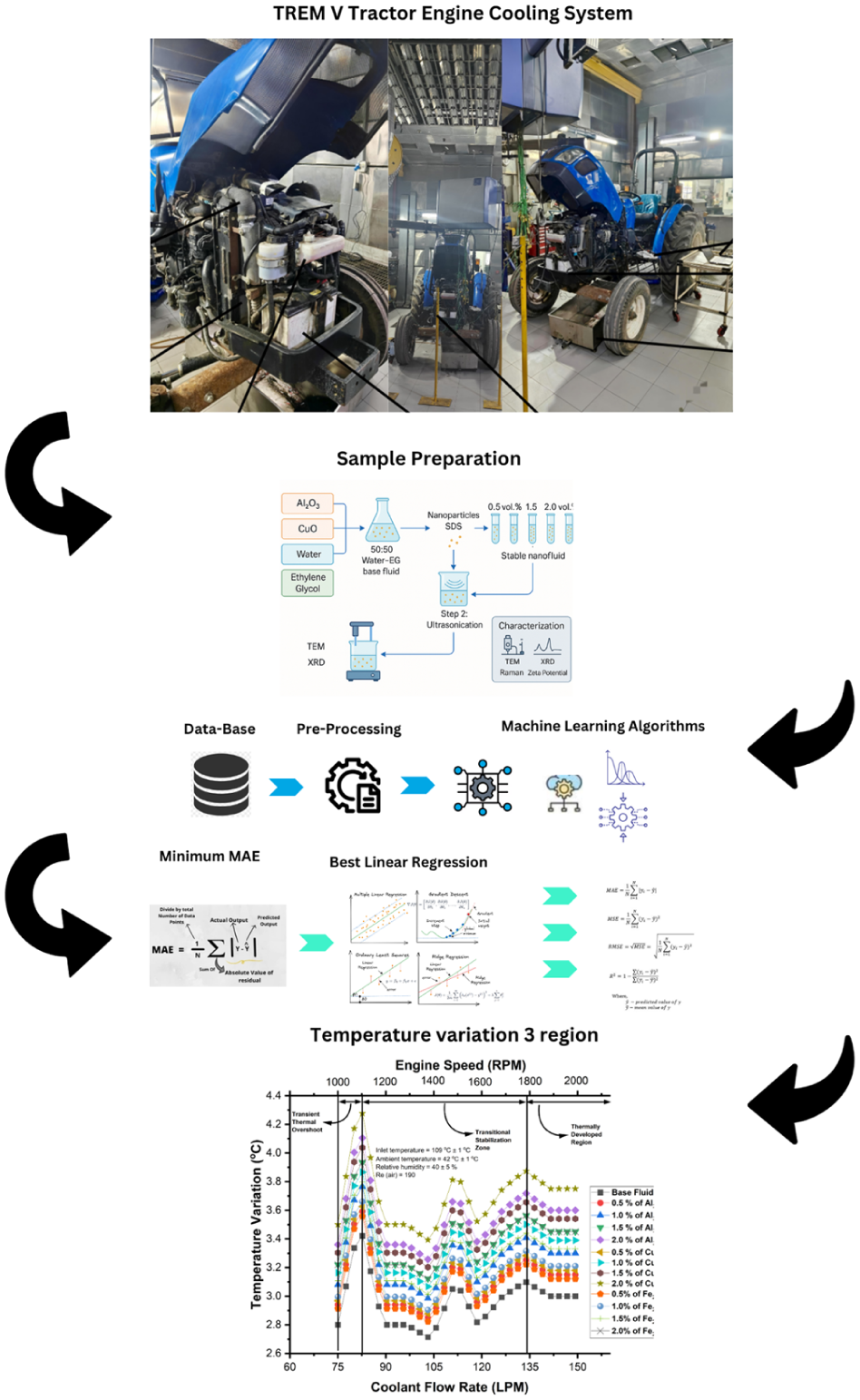
Efficient thermal management of high-load stationary and agricultural engines is critical for maintaining performance, reliability, and emission compliance. Conventional ethylene glycol-water coolants often fail to meet these demands under sustained operation. This study presents a nanofluid enhanced radiator cooling system that integrates real-engine heat-balance analysis with nanofluid-assisted radiator enhancement, using ECU-regulated, OBD-monitored operating conditions, the analysis is carried out at engine powered high flow rate of coolant. The objective was to experimentally quantify the influence of coolant flow rate, nanofluid concentration, and engine speed on overall cooling-system performance and to develop predictive models for rapid optimization. Experiments were conducted on a TREM V turbocharged diesel engine, comparing base ethylene glycol–water coolant with Al2O3, Fe2O3, and CuO nanofluids across flow rates of 75–149 LPM and engine speeds of 1000–2000 rpm. Measured parameters included temperature drop, Nusselt number, pressure drop, and radiator effectiveness, which were analyzed using ensemble machine-learning models trained on correlation matrices and heat-map features. Results showed that CuO/EG nanofluid achieved up to 27% higher convective heat transfer and 36% improvement in radiator effectiveness, with only a 2%–4.5% increase in pressure drop under high-flow turbulent regime representative of real tractor operating conditions. The trained models achieved R2 > 0.995 and MAPE < 1% for both Nusselt number and Darcy friction factor predictions. The study demonstrates a practical, real-time methodology for improving cooling efficiency and provides a foundation for adaptive control and waste-heat recovery in future heavy-duty thermal management systems.
Get full access to this article
View all access options for this article.