




Abstract
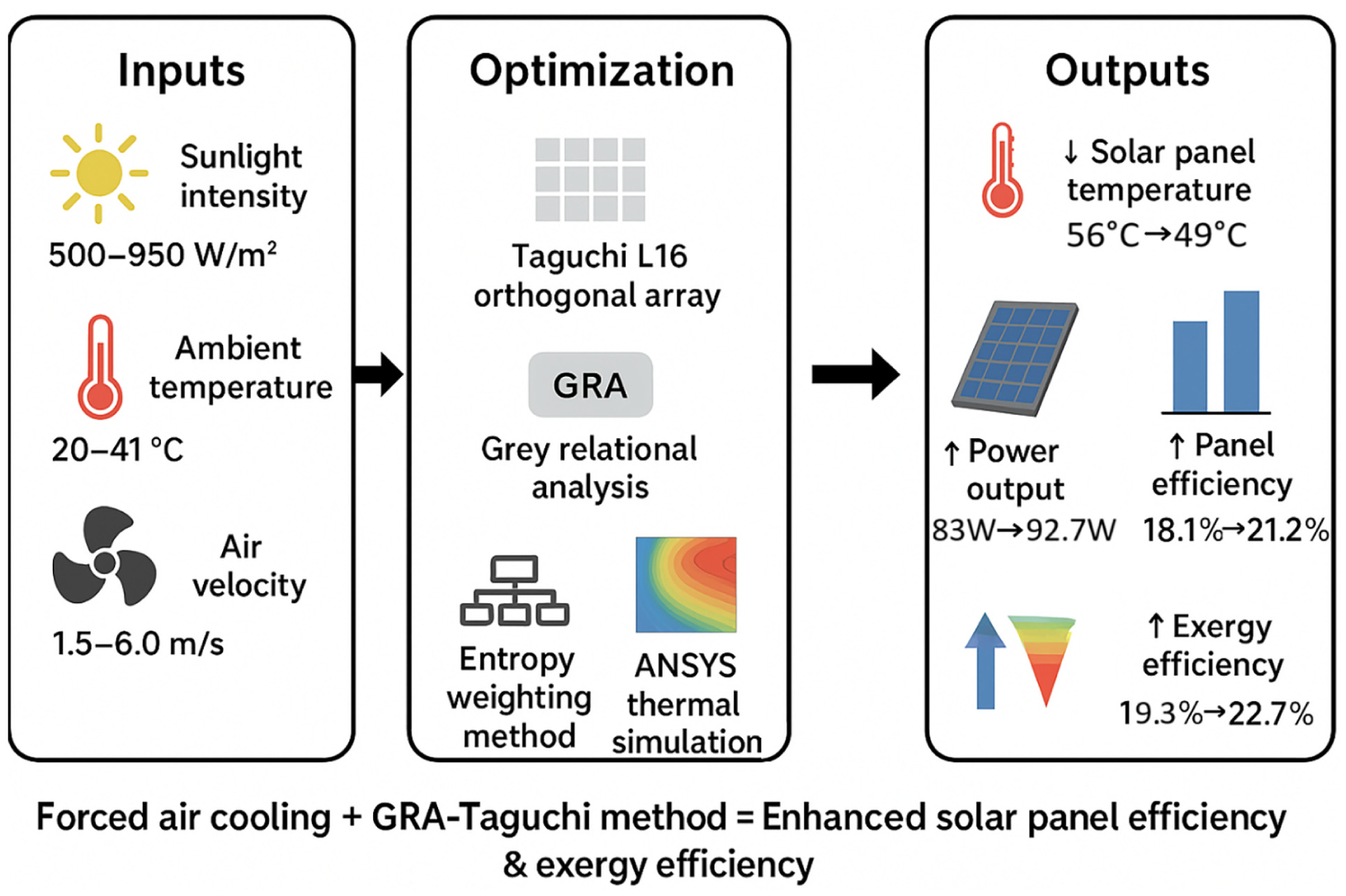
The performance of photovoltaic (PV) modules deteriorates at elevated operating temperatures, reducing efficiency and lifespan. This study experimentally investigates the application of a forced air-cooling system on a 100 W solar panel, with optimization carried out using the Taguchi method integrated with Gray Relational Analysis (GRA) and validated through ANSYS simulations. Three factors—solar flux (500–950 W/m2), ambient temperature (20°C–41°C), and air velocity (1.5–6.0 m/s)—were tested at four levels. Results indicate that the optimal operating conditions (solar flux = 650 W/m2, air velocity = 4.5 m/s, ambient temperature = 41°C) reduced the panel surface temperature from 56.3°C to 49°C, increased power output from 83 to 92.7 W, enhanced solar efficiency from 18.1% to 21.2%, and improved exergy efficiency from 19.3% to 22.7%. The ANOVA results showed that ambient temperature had the highest contribution (≈59%) to efficiency improvements, while solar flux had the strongest influence on power output. This study fills a gap in the literature by integrating GRA-based Taguchi optimization with numerical simulations for simultaneous improvement of multiple performance indicators. The findings highlight a practical and low-cost cooling strategy that can significantly enhance PV performance in high-temperature regions or remote areas without external power requirements, showing the novelty of the present study. Graphical is shown below to indicate the same.
Get full access to this article
View all access options for this article.