



Abstract
A numerical model was established by using ABAQUS for a police riot suit which was composed of nylon, foam polyethylene and sandwich board under low energy impact provided by 7.5 kg ball head impact assembly. The impact force and the energy absorbed by the riot suit are numerically analyzed, and the structure of the riot suit is improved. The results show that the peak impact force of the improved riot suit is reduced by 11.7%, and the energy absorbed by the improved riot suit is increased by 12.1%. The accuracy of the numerical model is verified by comparing the low energy impact test of the riot suit. The obtained results can provide theoretical guidance for the structural design of the police riot suit.
Introduction
Police riot suit is mainly used to protect against sharp objects, sticks and various non-explosive projectiles. The structure of the police riot suit selected in this paper is shown in Figure 1. The structure of the police riot suit mainly consists of three layers, the outermost layer is curved nylon board (PA) which is used to resist puncture. The middle layer is foamed polyethylene (EPE), and the inner layer is a sandwich board consisting of two layers of ethylene-vinyl acetate polymer foam (EVA) and one layer of polyurethane foam (PU). EVA and PU are combined into a sandwich board (EVA+PU+EVA) structure, which can not only absorb shock but also consume impact energy to the maximum extent. 1
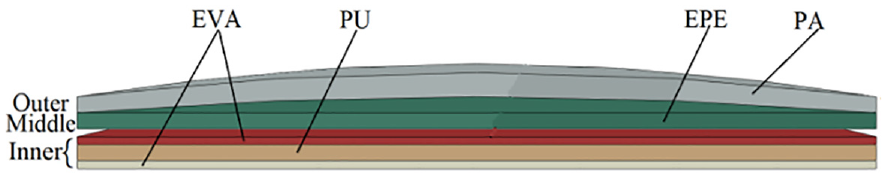
Structure of police riot suit.
The impact resistance test of police riot suit is an important prerequisite to ensure the safety of riot personnel. At present, impact testing machine is used to test the impact resistance performance of police riot suit, which is of high cost. Moreover, in order to obtain reliable impact resistance results, the test period is long. In addition, most impact studies on police riot suits are conducted for impact performance test of specific single material,2–5 but lack of impact performance test of multi-layer series stacked products. 6 In this paper, ABAQUS is used to establish a numerical model of low energy impact of multi-layer material series stacked riot suit. By adjusting the structural thickness of different combination layers, the riot suit structure with better impact resistance was obtained. It is proved that the model can accurately simulate the impact resistance of police riot suit by comparing the experimental results. Both simulation and test, a spherical steel column with a mass of 7.5 kg was used to fall from a height of 1.36 m and vertically impact the center of the riot suit at an initial contact speed of 5.16 m/s.
Theory and method
Constitutive model of riot suit material
The outermost layer of the riot police suit is nylon (PA), and the middle layer of the combined inner layer is polyurethane (PU). According to the stress-strain relationship at different strain rates, the plastic properties of the nylon and polyurethane are more sensitive to strain rates, and the yield stress is positively correlated with strain rate. Therefore, nylon (PA) and polyurethane (PU) satisfy Cowper-Symonds model,2,7 which can be expressed as follows:

where σy is the yield stress of material, C and P is the strain rate constant of the material, σ0 is the initial yield stress of the material, β is the adjustable parameter, Ep is the plastic strengthening modulus;
When the adjustable parameter β is 0, it represents the plastic follow-up strengthening model, and the plastic strengthening modulus and plastic strain rate have no influence on the dynamic characteristics of the material. When the adjustable parameter β is 1, it represents the isotropic strengthening model. The material property parameters of nylon (PA) and polyurethane (PU) in the Cowper-Symonds model are shown in Table 1.

The middle layer of the police riot suit is made of foamed polyethylene (EPE). According to the stress-strain relationship of the foamed polyethylene (EPE), it satisfies the Johnson-Cook constitutive model, 4 which is also a commonly used model in impact problems and simplifies the form of constitutive model. The basic expression of Johnson-Cook constitutive model is as follows:

where σ is the Von Misses equivalent stress, ε is the equivalent plastic strain, A is the yield strength, B and n are strain hardening parameters, C is the empirical strain rate sensitivity coefficient, m is the temperature softening effect parameter,
Material parameters of EPE. 4

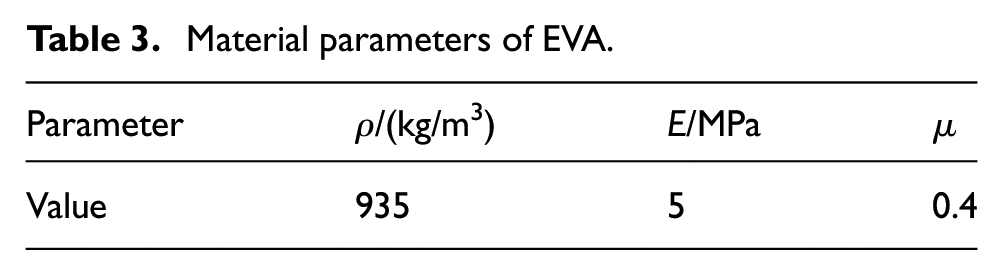
The ethylene-vinyl acetate (EVA) of the inner layer of the riot suit adopts the linear elastic constitutive model, and the parameters to be set are shown in Table 3.
Material parameters of EVA.
Equivalent impact model
Hertz contact theory is usually adopted in the impact contact process between two components, which equates the contact between two objects to spring-damping system. The commonly used spring-damping system models mainly include linear spring-damping model, nonlinear spring-damping model, linear spring-nonlinear damping model and nonlinear hysteresis damping model. 8 The impact assembly consists of an acceleration sensor, a force sensor, a hammer frame, a sensor base and a hammer head. Since the contact between the hammer head of the impact assembly and the impact riot equipment is non-planar, there is geometric nonlinear caused by the radius of curvature. In the impact process, material nonlinear and other problems still exist, so this paper establishes an impact equivalent model of impact assembly impacting riot equipment based on the nonlinear hysteresis damping model, as shown in Figure 2.
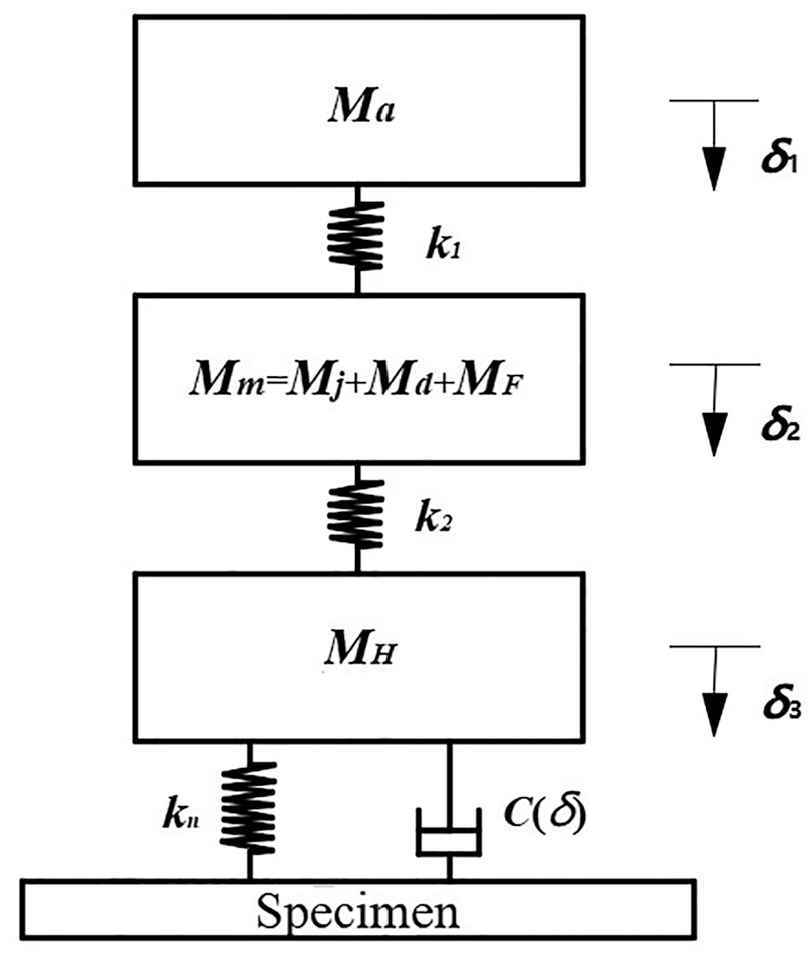
Equivalent impact model.
In the Figure 2, k1 is the equivalent contact stiffness coefficient between acceleration sensor and hammer frame. k2 is the equivalent contact stiffness coefficient between force sensor and hammer. kn is the equivalent contact stiffness coefficient between impact assembly and riot suit.
Therefore, the dynamic equations established for acceleration sensor, impact assembly and hammer head are:



The connections between acceleration sensor and assembly, also between force sensor and hammer head both adopt screw thread. Therefore, the damping coefficient does not need to be considered. Moreover, the stiffness coefficient of spring connected by screw thread is much higher than the contact stiffness coefficient between impact assembly and specimen. The difference among the displacements of the impact assembly is negligible. Suppose that δ1, δ2, and δ3 are equal to the displacement δ of the impact assembly. Therefore, the equivalent dynamic equation based on the nonlinear hysteresis damping model can be transformed to the following equation:

According to the nonlinear hysteresis damping model,9–12 the contact force between the impact assembly and the specimen is:

where Fn is the normal contact force, Fk is the spring force generated by the equivalent spring, Fc is the damping force due to the equivalent damping, kn is the equivalent contact stiffness of the model, δ is the normal deformation of the contact point, α is the contact force index, C is the equivalent contact damping of the model, which is a function of the normal deformation,


where v0 is the impact velocity, which is also the velocity when the impact assembly first touches the specimen. e is the recovery coefficient, Ri is the radius of curvature of the contact object.

where σs is the ultimate stress value of the material.
According to formula (7)∼(11), the value of contact force is related to equivalent contact stiffness and equivalent contact damping. However, the equivalent contact stiffness is not only related to the material properties but also to the equivalent contact radius, and the equivalent contact damping is related to the material recovery coefficient, contact force index and initial impact velocity. To sum up, the influencing factors of contact force in impact process mainly include material type, impact velocity, equivalent mass and equivalent contact radius. This provides theoretical basis for impact simulation and test analysis.
Conditions of simulation
The basic size of the riot suit after simplifying is about 500 × 500 × 42 mm, and the thickness of different layers is different. The thickness of PA layer is 10 mm, EPE layer is 12 mm, EVA layer is 5 mm and PU layer is 10 mm. The total thickness is about 42 mm. According to formula (7)∼(11), material characteristics of riot suit and curvature characteristics of the outermost nylon plate should be preserved, and macro size should remain unchanged as far as possible. The outer nylon board (PA) of the riot suit has convex grain on its surface, which mainly increases friction and has little influence on its impact performance. Therefore, the convex grain on the surface is ignored in modeling, but the radius of curvature of upper and lower panels of nylon board is not ignored. The modeling function of ABAQUS is used to model the structure of the simplified riot suit in full size. Through this representative full size model, the impact resistance performance of the riot suit with complex shape is demonstrated.
According to the standard GA 420–2008 of the Ministry of Public Security, 13 the impact test of police riot suit mainly uses a ball-shaped steel column with a diameter of 96 mm and a mass of 7.5 kg, which falls freely from a height of 1.36 m and provides 100 J of energy to impact the designated impact point of the riot suit.
In order to improve the calculation efficiency, the air resistance and the friction between the falling hammer and the guide rail in the falling process are ignored. According to the law of energy conservation:

where M is the total mass of the falling object, v is the initial velocity of the drop hammer when it first makes contact with the riot suit, h is the falling height of the hammer head. The M is 7.5 kg, and the h is 1.36 m. Substitute the above data into formula (11), v can be calculated as 5.16 m/s. The initial speed is taken as the initial condition of the predefined field in the simulation model.
Material parameter setting
According to the constitutive model parameters of nylon board (PA), polyurethane (PU), foamed polyethylene (EPE) and ethylene-vinyl acetate (EVA) in Tables 1 to 3, the material parameter values are assigned to the designated layer of riot suit. This paper mainly studies the impact response characteristics of riot suit, so the hammer head is set as a rigid body with a mass of 7.5 kg.
The establishment of finite element model
Conduct the finite-element mesh division of the riot suit, the grid type is hexahedron grid, and the element type is C3D8. The tie command is used to bind EVA and PU. A face contact is established between the hammer head and the nylon board, and the contact type is hard contact. Other contacts are set as universal contacts. The normal behavior of universal contact is hard contact to avoid penetration between layers. The tangential behavior adopts Lagrange multiplier method and the friction coefficient is set at 0.05. The specific parameter settings are shown in the Figure 3. During the impact test, the riot suit is placed horizontally on the impact test table, so the boundary condition of the model is that the displacement of the bottom surface of the inner sandwich plate of the riot suit along the vertical direction is 0. The predefined field is set as the hammer head moves along the z positive direction (vertically downward) at a speed of 5.16 m/s. The impact of impact assembly on riot suits is a transient process, so the total impact time can be set to 0.02 s to simulate the whole impact process. 6 The established numerical analysis model of police riot suit is shown in Figure 3.
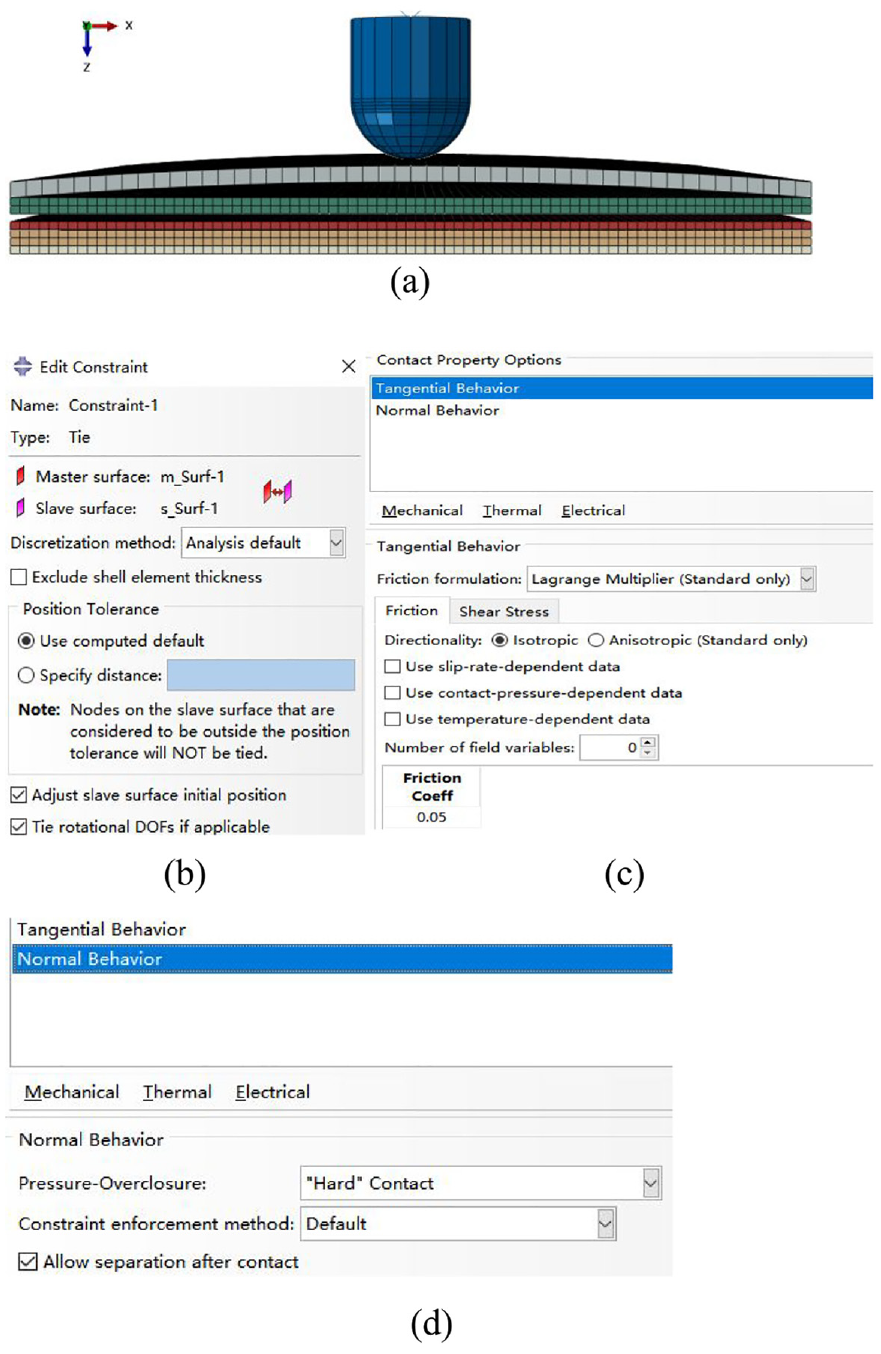
Numerical analysis model of police riot suit: (a) finite-element model, (b) tie constraint and (c and d) universal contacts.
Results and discussion
Analysis of energy
The energy time history curve of the overall model in the impact process is shown in Figure 4. ALLAE is the artificial pseudo-strain energy consumed to control hourglass deformation, and ETOTAL is the total energy of the system. If the ratio of ALLAE/ETOTAL is less than 5%, the established numerical model is correct. 14 The 7.5 kg impact assembly falls free from 1.36 m, providing a total ETOTAL of 100 J of system energy. Figure 4 shows that the ratio of ALLAE to ETOTAL is less than 1%, so the established numerical model is correct. According to the above modeling, the initial state is defined as the hammer in contact with the specimen and moves in the positive direction of z axis at 5.16 m/s. The kinetic energy of the hammer (ALLKE) decreases at the beginning of the movement and reaches the minimum value of 10.7 J at about 77 ms. At this point, the kinetic energy is mainly transformed into the internal energy of the system (ALLIE), the energy consumed by the plastic deformation of the specimen and the energy consumed by part of the elastic deformation. After 77 ms, the hammer head moves along the negative direction of z axis (vertically upward) under the action of the internal energy of the specimen. After 100 ms, the kinetic energy of the hammer head tends to a fixed value, about 25 J. In the process of energy conversion, the trend of kinetic energy and internal energy is opposite. The energy consumed by the plastic deformation (ALLPE) of the final specimen is about 33.3 J.
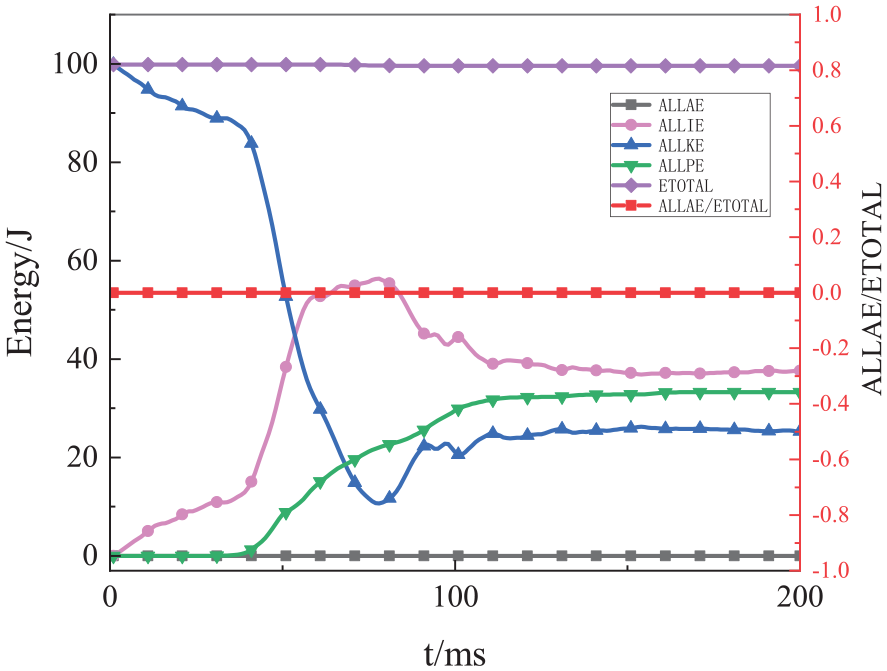
Energy time history curve of the whole model during impact process.
Impact effect analysis
(1) Impact effect analysis of different thickness of foamed polyethylene (EPE)
The numerical analysis model was used to compare the relationship between different thickness of foamed polyethylene (EPE) and impact force. When the thickness of foamed polyethylene (EPE) is set as 10, 12, 15, 17, and 20 mm respectively, the time history curve of impact force can be obtained as shown in Figure 5.
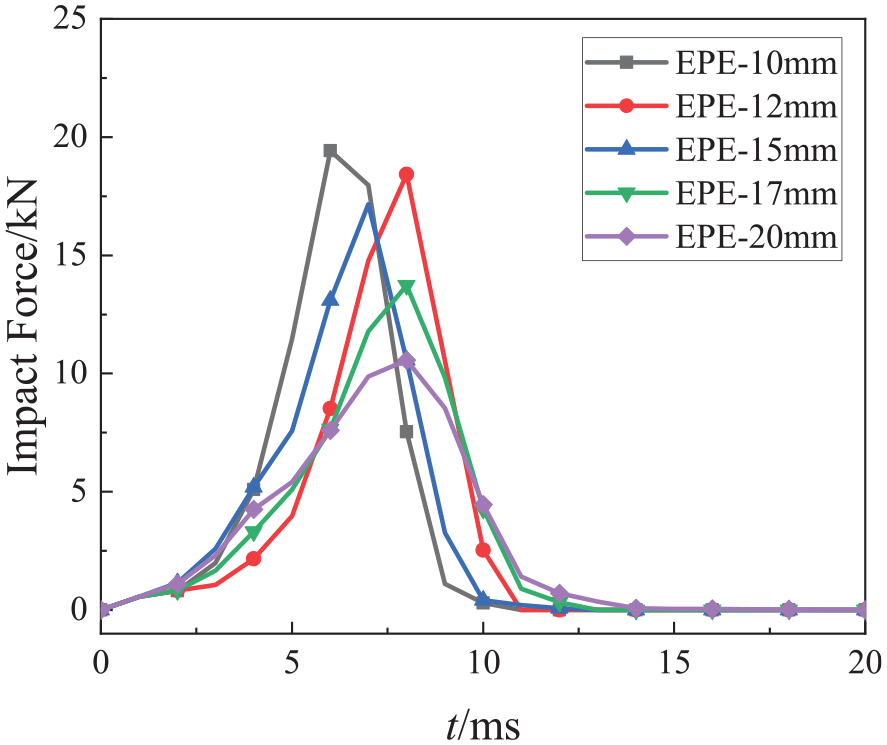
F-t curves of different thickness of EPE.
Taking the initial impact point of the hammer head and riot suit as the origin, the displacement of the initial impact point of the hammer head and the riot suit as the abscissa, and the impact force received by the specimen as the ordinate, the impact force-displacement curve of the riot suit was obtained as shown in Figure 6. In the closed curves in Figure 6 for different thickness of formed polyethylene (EPE), the upper parts indicate the loading stage (impacting stage), and the lower parts represent the unloading stage (rebounding stage).
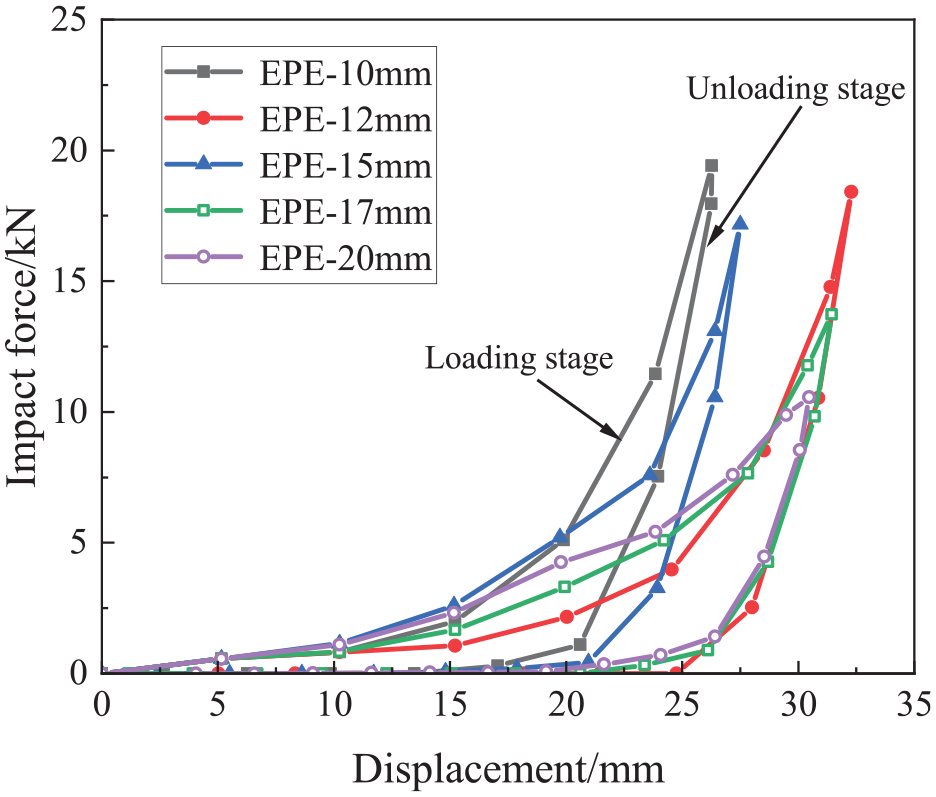
F-x curves of different thickness of EPE.
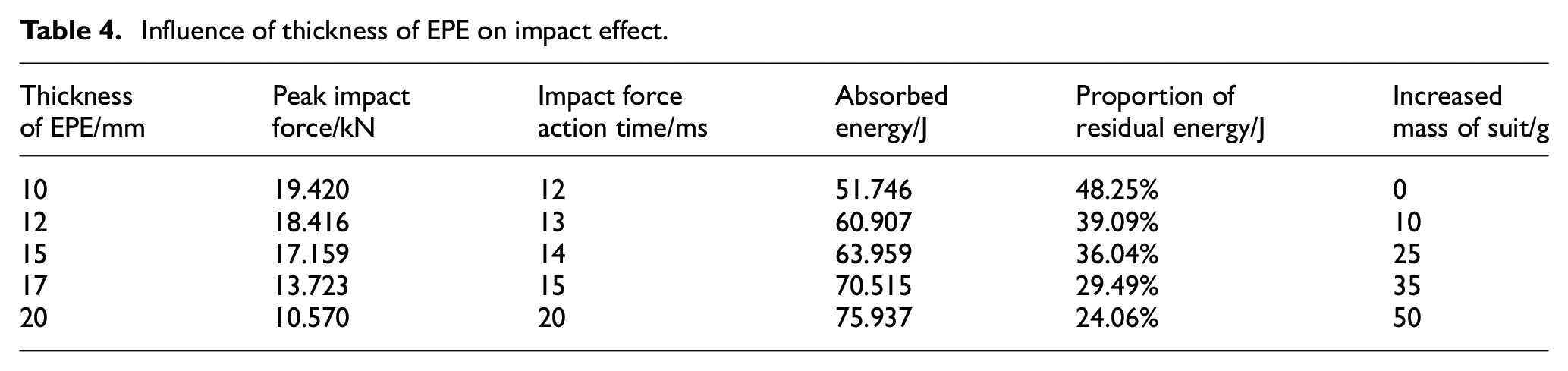
The proportion of residual energy is defined as the ratio of the rebound energy of hammer head to the maximum absorbed energy by riot suit. If the ratio is large, the deformation of riot suit is mainly elastic deformation, while if the ratio is small, the deformation of riot suit is mainly plastic deformation. According to the analysis in Figures 5 and 6, the influence of different thickness of foaming polyethylene (EPE) on the impact effect of riot suit can be obtained, as shown in Table 4 and Figure 7.
Influence of thickness of EPE on impact effect.
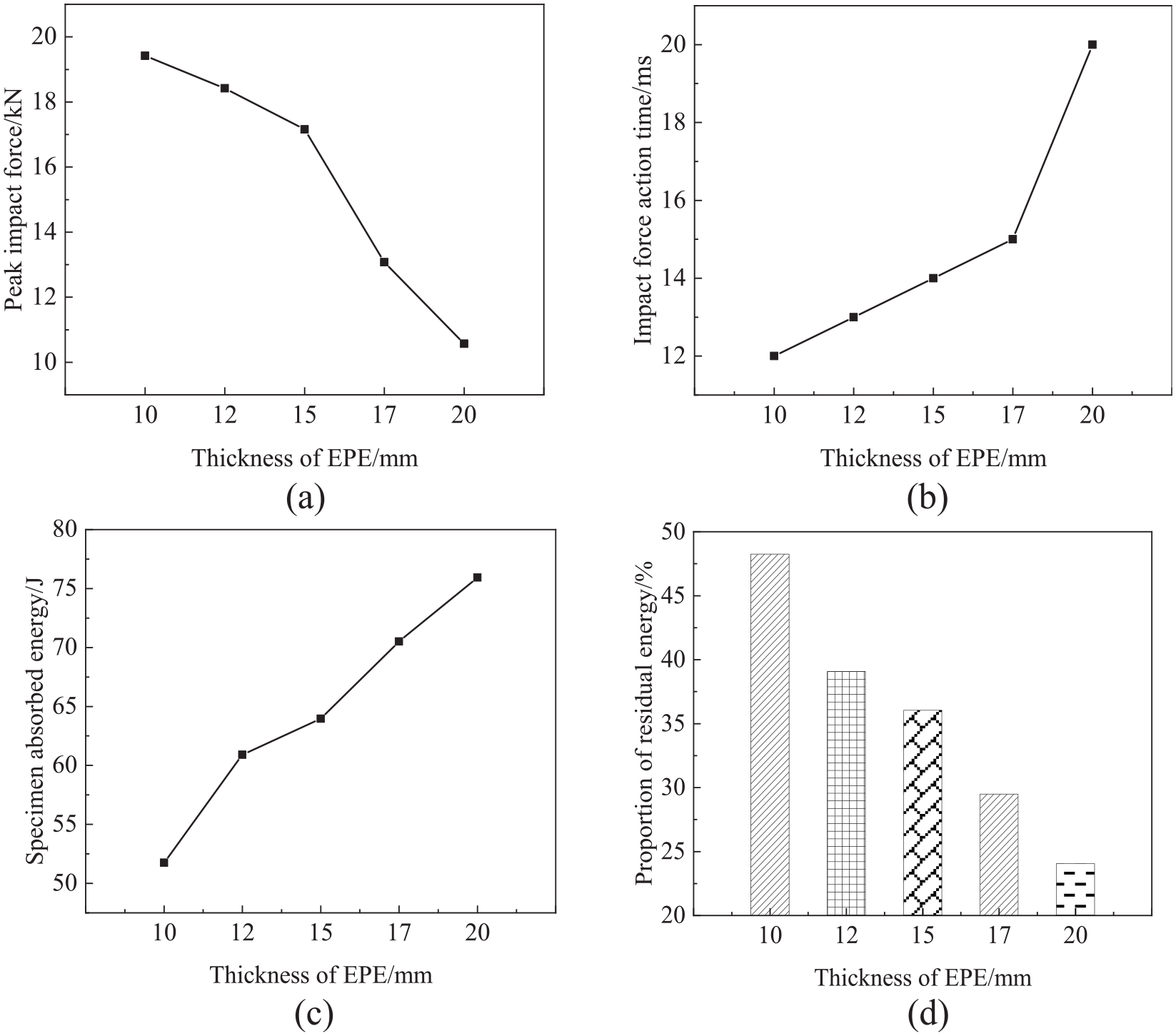
Influence of different thickness of EPE on impact effect: (a) peak impact force, (b) impact force action time, (c)specimen absorbed energy, and (d) proportion of residual energy.
According to Figures 5–7 and Table 4, with the increase of the thickness of foamed polyethylene (EPE), the peak impact force decreases, the duration of impact force is prolonged, and the energy absorbed by the riot suit increases, thus the impact resistance is enhanced. According to Figure 5, as the thickness of foamed polyethylene increases, the equivalent mass increases, the recovery coefficient decreases, the equivalent contact damping increases, the energy absorption enhances, and the cushioning effect of the riot suit increases. Therefore, as the thickness of foamed polyethylene increases, the peak time of impact force is delayed. According to Figure 7(a), when the thickness of foamed polyethylene (EPE) is from 10 to 15 mm, the absolute value of slope of the curve is smaller than that of the thickness from 15 to 20 mm. Therefore, when the thickness of foamed polyethylene (EPE) is from 15 mm to 20 mm, changing the thickness of EPE can significantly reduce the peak impact force. According to Table 4 and Figure 7(c), when the thickness of foamed polyethylene (EPE) changes from 10 to 12 mm, the absorption energy increases from 51.746 to 60.907 J, an increase of 17.7%, the mass of suit increased by only 10 g, and the energy absorption performance of riot suit is significantly enhanced. According to Figure 7(d), as the thickness of low-density polyethylene (EPE) increases, the proportion of residual energy decreases, and the riot suit absorbs energy mainly through plastic deformation.
(2) Impact effect analysis of different types of nylon board (PA) with different upper curvatures
According to the structure of the riot suit in Figure 1, the outermost layer of the riot suit is nylon board (PA). When the thickness of foaming polyethylene (EPE) is 10 mm (cf. PA-0 in Figure 8), the numerical analysis model is used to compare the relationship between different types of nylon board (PA) and impact force. The type description of nylon board (PA) is shown in Figure 8 and Table 5.
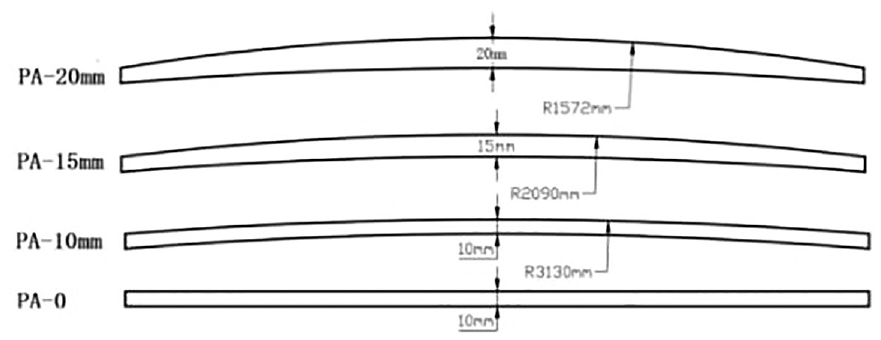
Different types of PA board.
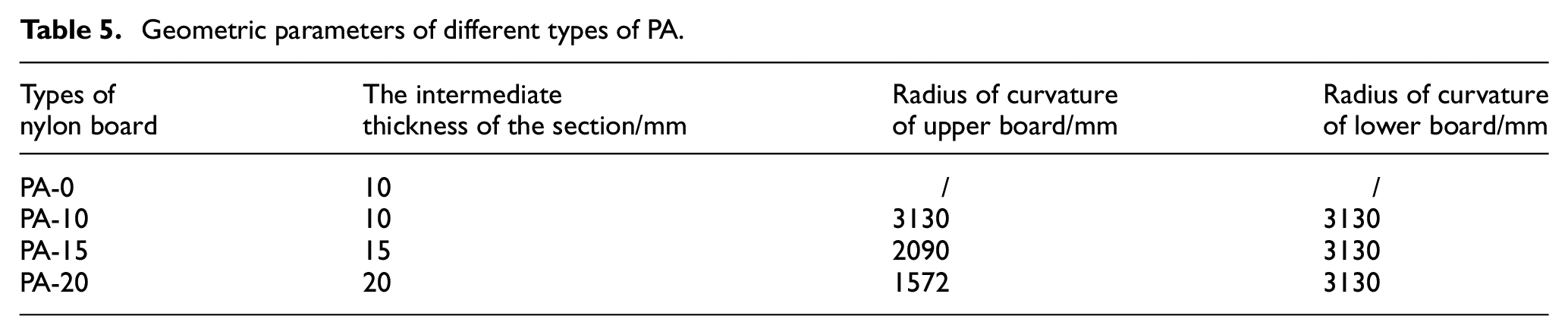
Geometric parameters of different types of PA.
The time history curve of impact force of different types of Nylon board (PA) obtained by simulation is shown in Figure 9, and the impact force-displacement curve is shown in Figure 10.
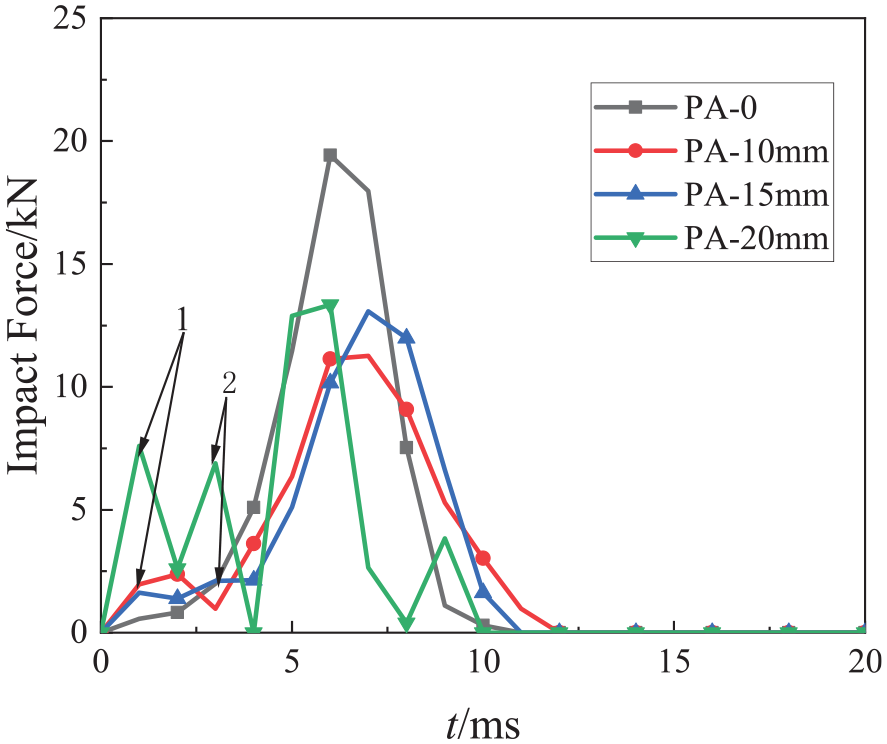
F-t curves for different types of PA.
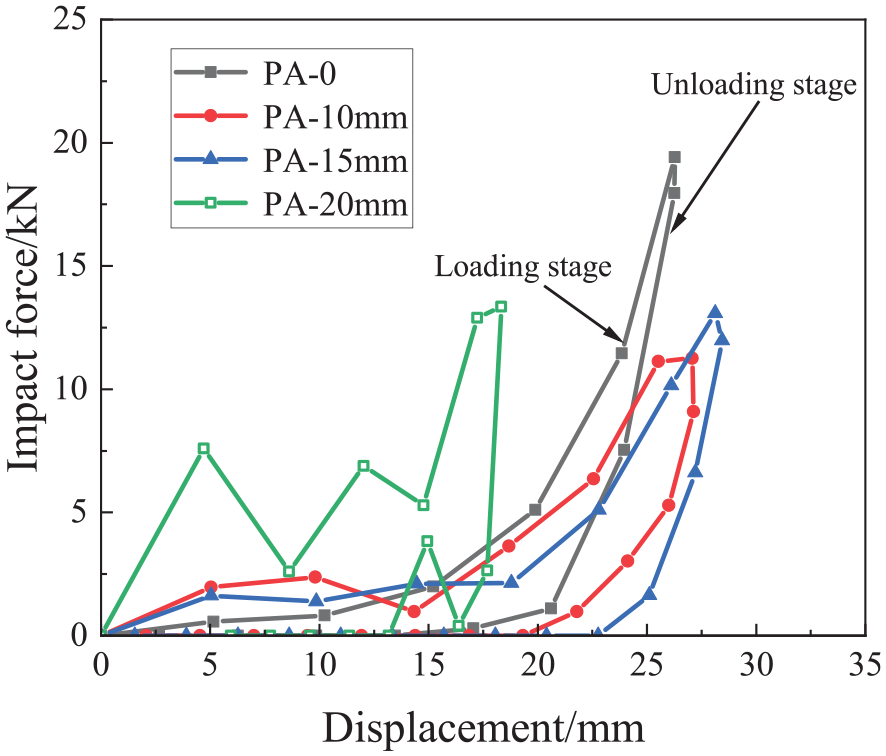
F-x curves for different types of PA.
According to Figures 9 and 10 and Table 6, the peak impact force is non-monotonic along with the upper radius curvature of nylon board (PA). When the nylon board (PA) is flat, the equivalent contact radius is larger than that when the nylon board is curved. Similarly, when nylon board (PA) is flat, the equivalent contact stiffness is greater than that when nylon board (PA) is curved, by which the maximum impact peak, the least energy absorption, the worst impact resistance were produced. When the type of nylon board was changed from PA-0 to PA-10 mm, the absorption energy increased from 51.746 to 74.293 J, a significant increase of 43.6%. According to Figure 9, when the intermediate thickness of nylon board (PA) is 15 and 20 mm, there will be multiple shocks. In Figure 9, local peak point 1 represents the contact between nylon board (PA) and foamed polyethylene (EPE), and local peak point 2 represents the contact between foamed polyethylene (EPE) and sandwich board. When the two impact peaks appear, the three layers of the riot suit are all in contact, and the hammer head continues to move along the positive direction of z (vertically downward), and the impact force reaches the maximum peak value in the whole process. According to Table 6, compared with PA-0, the peak impact force of PA-10 mm decreased from 19.420 to 11.258 N, decreasing by 42.0%. Compared with PA-15 mm, the peak impact force of PA-10 mm increases from 11.258 to 13.073 N, an increase of 16.1%. Therefore, when the nylon board type is PA-10 mm and the curvature radius of upper and lower boards are both 3130 mm, the lowest peak impact force appears.
Influence of different types of PA on impact effect.
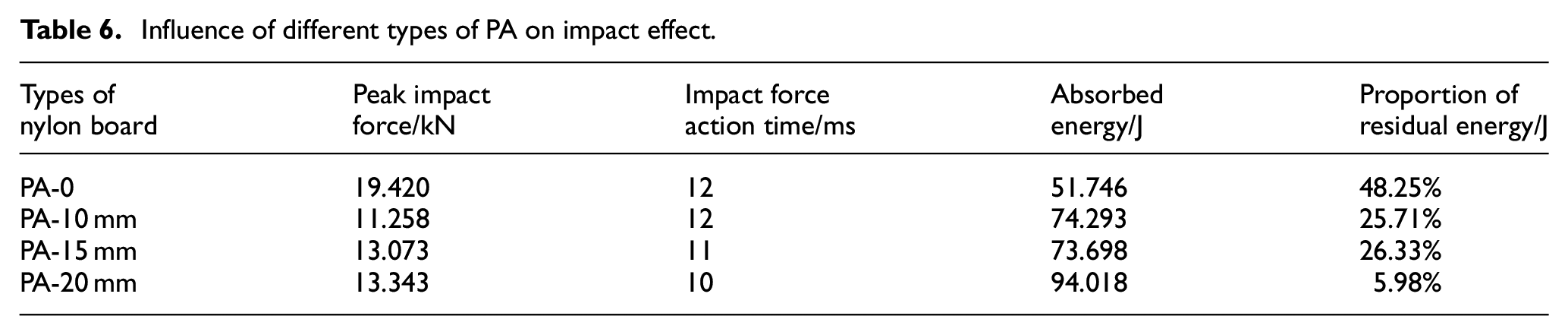
To sum up, although the thickness of foamed polyethylene (EPE) is 20 mm, the peak impact force is greatly reduced (cf. Table 4). And when the middle thickness of nylon board (PA) is 20 mm, the upper radius of curvature is 1572 mm, and the lower radius of curvature is 3130 mm, the absorption energy is the largest, but the thickness of the above-mentioned layers is too thick, which is not conducive to the carrying and wearing. Considering the comprehensive properties of good impact resistance and wear performance, the thickness of foamed polyethylene (EPE) is 12 mm and the type of nylon board (PA) is PA-10 mm.
Analysis of apparent damage after impact
In order to study the damage impedance of riot suit, the impact effect analysis also includes the impact apparent damage. 15 In this paper, impact damage problems such as damage area (DA), damage width (DW) and damage depth (DD) are studied. The damage area is defined as the spherical crown area of the crater after impact, the damage width is defined as the circular diameter of the largest opening part of the spherical crown, and the damage depth is the height difference between the lowest position of the damage point and the plane around the damage. When the nylon board type is PA-15 mm and the thickness of foaming polyethylene (EPE) is 10 mm, the police riot suit is impacted by 100 J energy provided by 7.5 kg impact assembly, and the initial contact moment between the hammer and the riot suit is taken as the starting point of time. According to the simulation, when t = 7 ms, the maximum deformation of riot suit occurs. As can be seen from Figure 11 of the stress nephogram along the A-A middle section of the riot suit, the maximum stress is 53.5 MPa. The middle foamed polyethylene (EPE) and sandwich board are flattened, and the upper nylon board (PA) is warped. When t = 20 ms, at the end moment of impact, the stress nephogram of nylon plate (PA) is shown in Figure 12, indicating that the final damage is approximately circular in the middle.
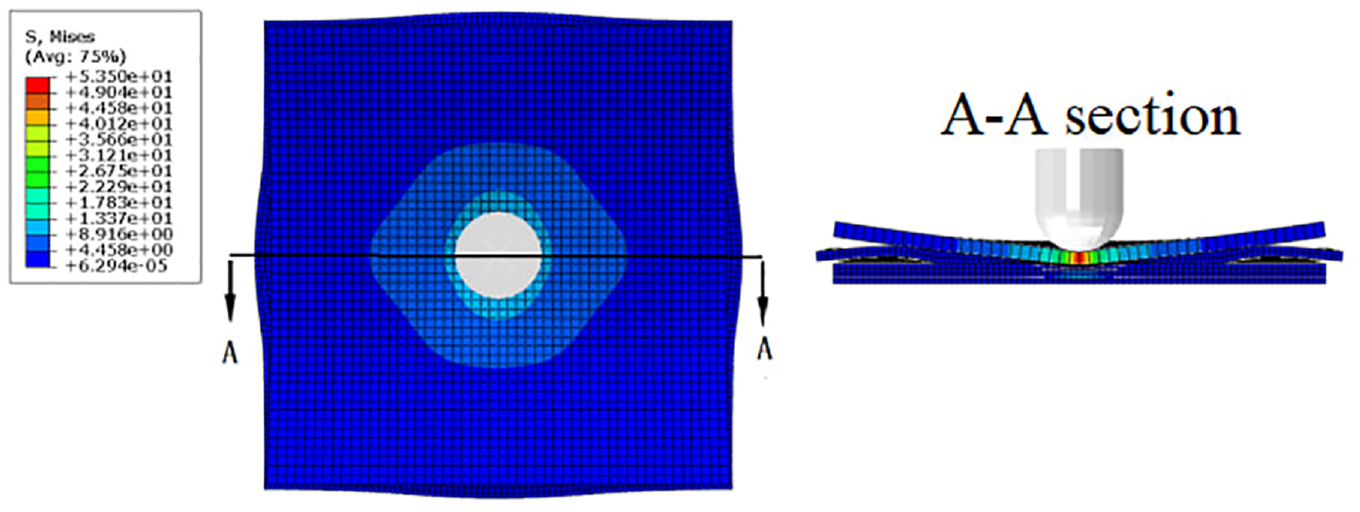
Stress nephogram of the middle section at t = 7ms.
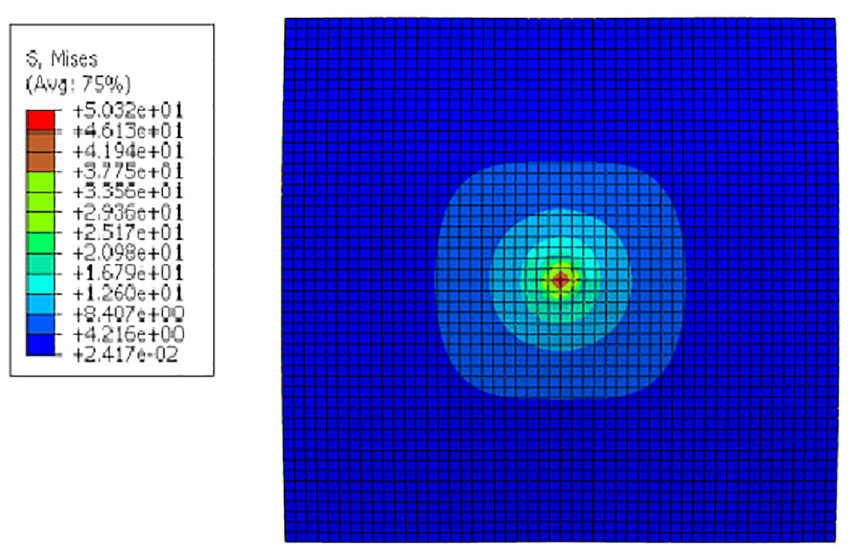
Stress nephogram of nylon board at t = 20ms.
Impact test verification
In order to verify the correctness of the above numerical simulation model, a drop hammer impact test machine as shown in Figure 13 was used to conduct impact test on selected police riot suit. The equipment of the impact test system mainly includes self-made simple drop weight impact testing machine, DH5922N data acquisition box, DH5857-1 charge modulator, DYTRAN 1060C series piezoelectric force sensor and police riot suit. The basic size of the police riot suit, which is placed horizontally on the ground to provide support through a rigid ground, is about 500 × 500 × 42 mm. Since the data measured by the sensor is not the actual impact force between the hammer head and the specimen, it is necessary to analyze the force of the impact assembly and the sensor, and revise the data measured by the sensor to obtain the actual impact force between the hammer head and the riot suit. 16
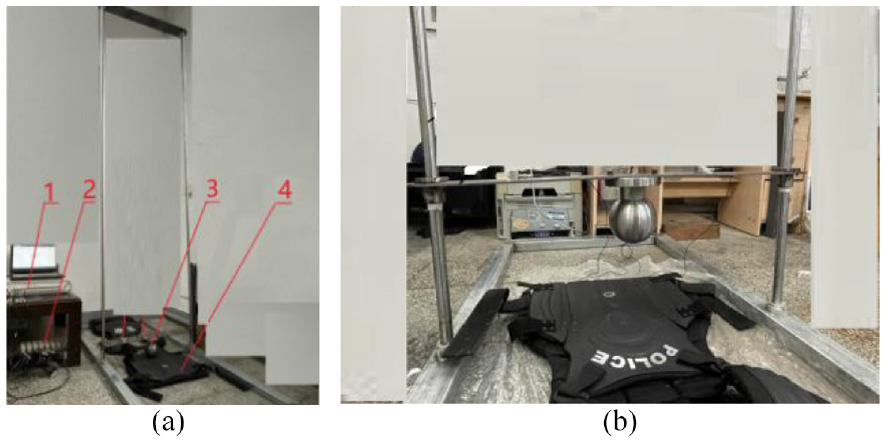
Impact test setup site: (a)the layout: 1-Data acquisition toolbox. 2-Charge amplifier. 3-Impact assembly.4-Riot suit and (b) local enlarged picture of impact assembly.
Comparison of time history curves of impact forces
Numerical simulation was conducted for the riot suit with foaming polyethylene (EPE) thickness of 10 mm and nylon board type of PA-15 mm. The simulation results were compared with the impact time history curve of the impact test, as shown in Figure 14.
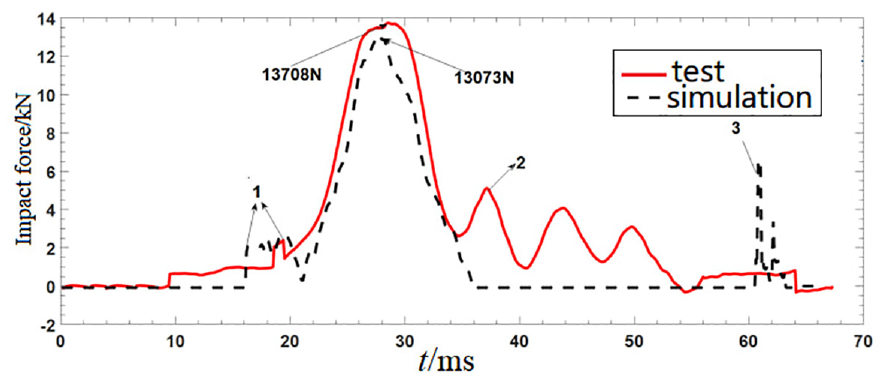
Time history curve of test and simulation impact force.
As can be seen from the test curve in Figure 14, contact force is generated between the outermost layer of curved nylon and the middle layer of foamed polyethylene (EPE) after the riot suit is impacted by the hammer head. This contact force is superimposed on the impact force, thus producing a smaller local peak 1. With the increase of time, the test value of impact force gradually increases to the maximum 13708N, and the hammer head is bounced by the elastic potential energy of the riot suit, and the contact force gradually decreases. However, in the process of reduction, several local peaks similar to local peak 2 appear, which is caused by the hammer head repeatedly hitting the riot suit. The time history curve of test impact force shows multiple impact phenomenon, and the reason is that when the hammer head impacts the specimen, the hammer head moves in reverse. However, the upward movement direction of the hammer head and the direction of gravity are not exactly on the same line because of the imperfect installation of the whole test set, which makes the impact assembly press and rub the guide rods, and produces additional friction force, which can slow the hammer quickly and result in multiple impacts. But the friction and air resistance are ignored in numerical simulation. In simulation, when the hammer head moves backwards, only the gravitational acceleration g exists and the speed changes slowly, so the time of the simulation impact peak 3 is delayed.
The time history curve of the test impact force of riot suit is consistent with that of simulation, and the peak error of impact force is only 4.6%. Therefore, it is reliable to use the numerical analysis model to analyze impact response of riot suit. In Figure 14, the time history curve of the test impact force fluctuates slightly as it tends to zero (56 ms −64 ms), which is often referred to as “falling hammer ringing bell.” 17 The main reason for this phenomenon is that the connection of the impact assembly (hammer head, sensor, sensor base) is not close, leading to the vibration of the time history curve.
Comparison of apparent impact damage
Figure 15(a) is the apparent damage diagram of nylon board (PA) impact, and Figure 15(b) is the apparent damage diagram of sandwich board impact. It can be seen from the comparison of the test impact apparent damage results with the numerical simulation results in Figure 12. The shape of the apparent damage is approximately round, the damage area is the sphere crown area of the crater after impact, the damage width is the circular diameter of the largest opening part of the sphere crown, and the damage depth is the height difference between the lowest position of the damage point and the plane around the damage. The damage width and damage depth were measured by micrometer, and the apparent damage area was measured by modeling method. The apparent damage analysis results are shown in Table 7.
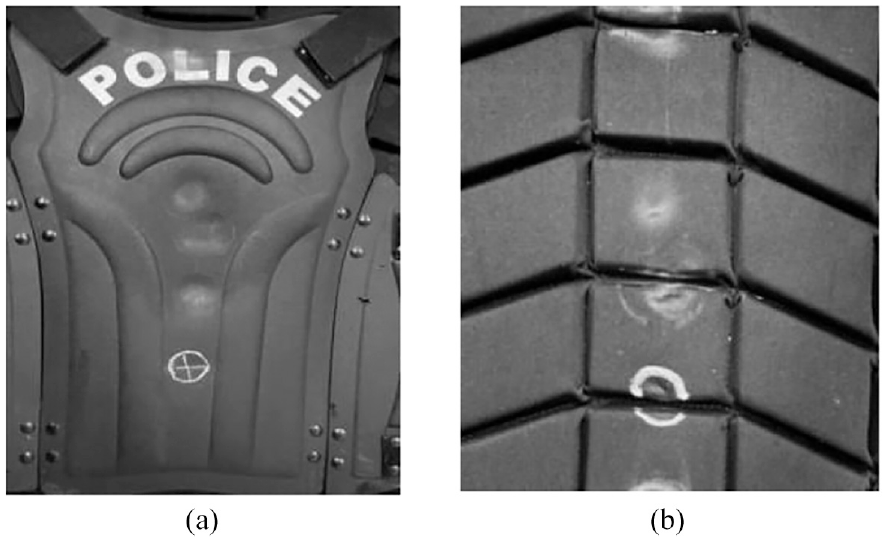
Damage of specimen in impact test: (a)apparent damage diagram of nylon board (PA) impact (b) apparent damage diagram of sandwich board impact.
Comparative analysis of damage.
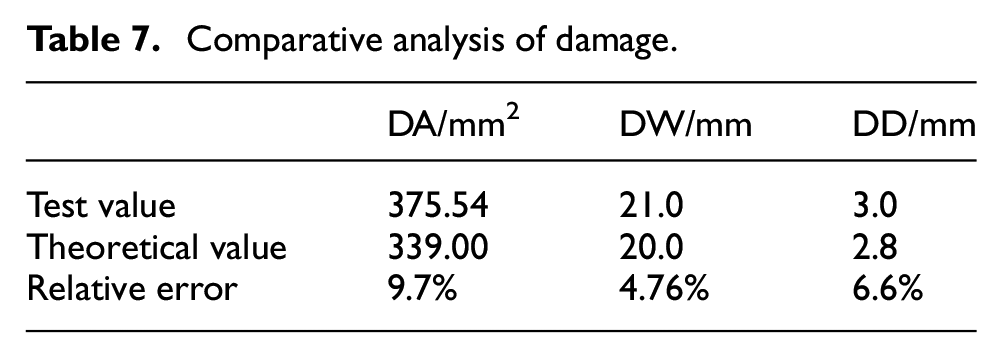
Under the impact of 100 J energy, the nylon board (PA) near the impact point has local plastic deformation, and the sandwich board and expanded polyethylene (EPE) are flattened. The apparent damage results of impact test and numerical simulation have a little error, but the error is within the allowable range, and the apparent damage shape is basically consistent. It also shows that the numerical model established to simulate the impact resistance of riot suit is credible and applicable.
Performance comparison of riot suit after improvement
The former thickness of foaming polyethylene (EPE) of the original riot suit is 10 mm, and the former nylon board (PA) type is PA-15 mm. According to the numerical simulation results, when the thickness of foaming polyethylene (EPE) is 12 mm and the type of nylon board (PA) is PA-10 mm, the impact resistance of riot suit is the best. In order to improve the following calculation efficiency, the secondary impact period in the simulation is not calculated. The simulation impact performance of the improved riot suit is compared with that of the test result of the original riot suit. Time history curves of impact force before and after improvement are compared as shown in Figure 16, and the curves of impact force-displacement before and after improvement are also compared in Figure 17.
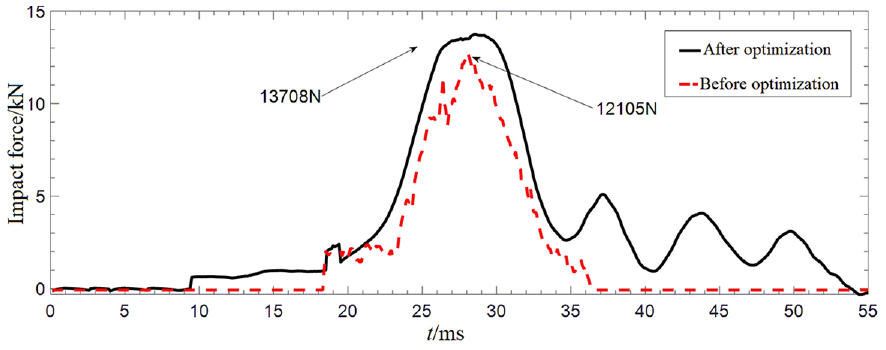
F-t comparison before and after riot suit improvement.
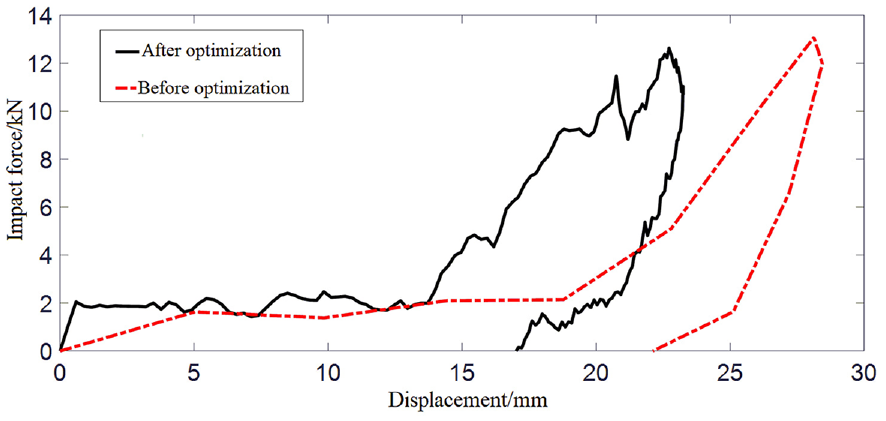
F-x comparison before and after riot suit optimization.
According to the results in Figure 16, after improvement of riot suit, the peak impact force decreases from 13,708 to 12,105 N, reducing by 11.7%. According to the area enclosed by the closed curves in Figure 17, it can be calculated the energy absorbed by the riot suit increased from 73.698 to 82.603 J with an increase of 12.1%. The improved riot suit has better impact resistance.
Conclusions
In this paper, a numerical analysis model of police riot suit with multiple layers stacked in series is established. The correctness of the numerical analysis model is verified by impact test. The numerical analysis with the established model saves the design cycle and impact test cost of police riot suit.
Through the established numerical analysis model, the influence of different thicknesses of foamed polyethylene (EPE) on the impact resistance of police riot clothing was analyzed and compared. Research shows that with the increase of the thickness of foamed polyethylene (EPE), the equivalent contact damping increases, the duration of contact force is prolonged, and the energy absorbed by the riot suit is more, the impact resistance is stronger. The influence of different types of nylon board (PA) on the impact resistance of riot suit is also compared. The results show that when the types of nylon board (PA) are PA-10 mm, PA-15 mm, and PA-20 mm, the impact resistance of PA-10 mm is better. Compared with PA-0 nylon board, the equivalent contact stiffness of PA-10 mm is significantly reduced, resulting in the maximum impact load reduced by 13.9% and the absorption energy of riot suit increased by 43.6%.
The results of numerical analysis were used to improve the structure of the riot suit. Compared with the original riot suit, the peak impact force of the improved riot suit was reduced by 11.7% and the absorption energy was increased by 12.1%, but the mass of suit increased by only 10 g.
Footnotes
Declaration of conflicting interests
The author(s) declared no potential conflicts of interest with respect to the research, authorship, and/or publication of this article.
Funding
The author(s) received no financial support for the research, authorship, and/or publication of this article.