



Abstract
In order to improve the performance of automotive product platforms and product families while keeping high development efficiency, a product family optimization design method that combines shared variable decision-making and multidisciplinary design optimization (MDO) is proposed. First, the basic concepts related to product family design optimization were clarified. Then, the mathematical description and MDO model of the product family optimization problem were established, and the improved product family design process was given. Finally, for the chassis product family optimization problem of an automotive product platform, the effectiveness of the proposed optimization method, and design process were exemplified. The results show that the collaboratively optimized product family can effectively handle the coordination between multiple products and multiple targets, compared to Non-platform development, it can maximize the generalization rate of vehicle parts and components under the premise of ensuring key performance, and give full play to the advantages of product platforms.
Keywords
Introduction
For the modular platform can improve the generalization rate of vehicle parts, reduce costs, and shorten the development and manufacturing cycle,1–3 the concept of the automotive product platform is favored by international mainstream original equipment manufacturers (OEMs), since its release in 2012, Volkswagen’s modularer querbaukasten (MQB) platform has launched more than 60 models and produced more than 100 million vehicles, reflecting the strong vitality and technological advantages of the automotive product platform. 4 The difference between electric vehicles and traditional fuel ones lies in that the former has a high degree of freedom in spatial layout and soft connections between components. The concept of platformization is more significant, and it has become a technical roadblock in engineering development recently. 5 There is no doubt that a systematic and reasonable exploration should be made for the design and development of electric vehicle product families. As a typical multi-category, multi-disciplinary, and multi-objective optimization problem, the optimization design theory of product families has become a research hotspot.
Product family platform designs are divided into two types: module-based and scale-based. The former means that modules can be shared among certain variants, and each variant is equipped with some unique modules or functions.6–9 It emphasizes the mapping relationship between functions and modules, and meets different needs by combining modules. Scale-based refers to designing for a family of products that all possesses the same variables; some variants take common values on some of these variables, while other variables take unique values. This paper focuses on scaled-based product family design (PFD). 10
The core of scale-based PFD is the product platform. As we know, reduction of costs for commonality may be at the expense of compromise in individually-optimized product performance.11,12 A wise commonality decision can maximize sharing while ensuring that product performance loss is within a suitable range. Fellini 13 and Fellini et al.14,15 proposed a shared component decision-making method based on sensitivity analysis, which can be used to solve large-scale computational design problems. Cluster analysis16,17 can improve the efficiency of shared decision-making, which combines with information entropy theory to select appropriate shared variables. 18 Sensitivity index (SI), quantified correlation (QC), and coefficient of variation (CV) are treated as evaluation indicators to select the design variables with lower sensitivity as sharing variables. 19 But the product family of vehicles is a complex engineering problem, the single product based on vehicle module involving multiple disciplines, Khalkhali et al. 20 combined the methods of technique for order preference by similarity to an ideal solution (TOPSIS) and nondominated sorting genetic algorithms-II (NSGA-II) to find the optimal design of the electric power steering system in the automotive platform design. Shah et al. 21 summarized and improved some multi-objective optimization (MOO) algorithms, and used visual analysis to solve the problem of platform design. Baishu et al. 22 established a mapping relationship between user needs and product family functions, providing a systematic analysis method for the market positioning and planning of product families. However, in terms of balancing the sharing rate and performance loss, the above researches are based on multi-objective optimization, 23 while the development of the vehicle product family involves multiple disciplines, especially with respect to electric vehicles with more advanced features and system complexity. The inter-disciplinary coupling relationship is intricate and complicated, which brings great difficulties to the design of the vehicle product family, and it cannot be simply understood as a multi-objective optimization problem. 24 Meanwhile, multi-objective optimization theory is still immature in solving complex problems including convergence problems. Multidisciplinary design optimization (MDO) is considered to be the best method to solve this type of multidisciplinary coupled complex system problem. Allison 25 introduced the idea of hierarchical decoupling into product family design for the first time, and took analytical target cascading (ATC) and collaborative optimization (CO) as examples to discuss the key differences of the two methods in actual calculation examples. For the analysis of vehicle product family system modeling, on the one hand, it is necessary to fully explore the coupling relationship between various systems and to use the synergistic effects generated by the interaction between disciplines to solve the modeling problem of complex systems; on the other hand, in order to meet the needs of modularization and platform design of electrified chassis, it is essential to make an overall planning layout for the automotive product family, based on the multidisciplinary design optimization theory; multi-level optimization ideas are also needed, considering the design requirements of individual products in the product family in parallel to obtain the overall optimal solution of the system.
The basic concepts of product family and product platform
A product family is a collection of individual products that shares common components and is used to meet a range of different market demands. The product platform is the core of the product family design, the basis for deriving new variant products, and a collection of modules with a relatively stable structure and reusability that can be shared by a series of products. The development of platform-based product family is considered to be the best way to reflect shared relationships and configure personalized products. Taking the car chassis system as an example, as shown in Figure 1, in the basic platform design scheme, some components can be customized and modified to obtain different types of chassis to meet the needs of various vehicles.
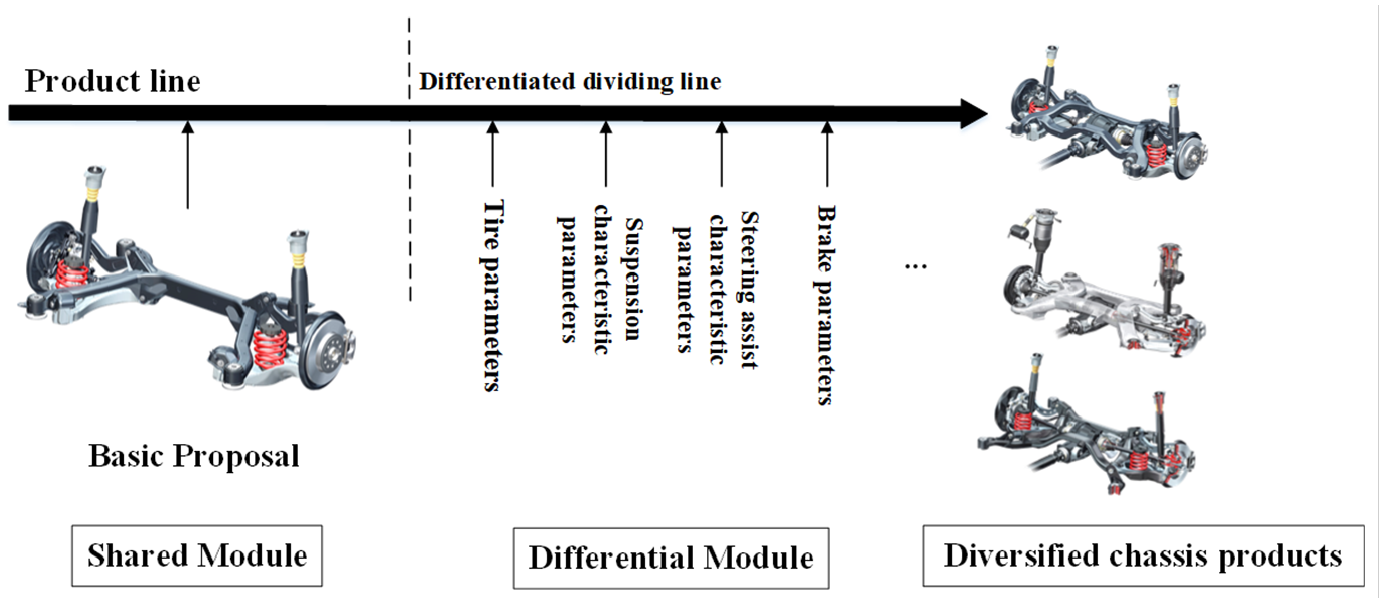
Diversified chassis product family.
Product family design involves the following basic concepts: design variables, components, products, and the sequence shows a progressive relationship between them, as shown in Figure 2. Components are located at the middle level. A component corresponds to multiple design variables, and a product is composed of multiple components. Different products can achieve platformization by sharing design variables or components.
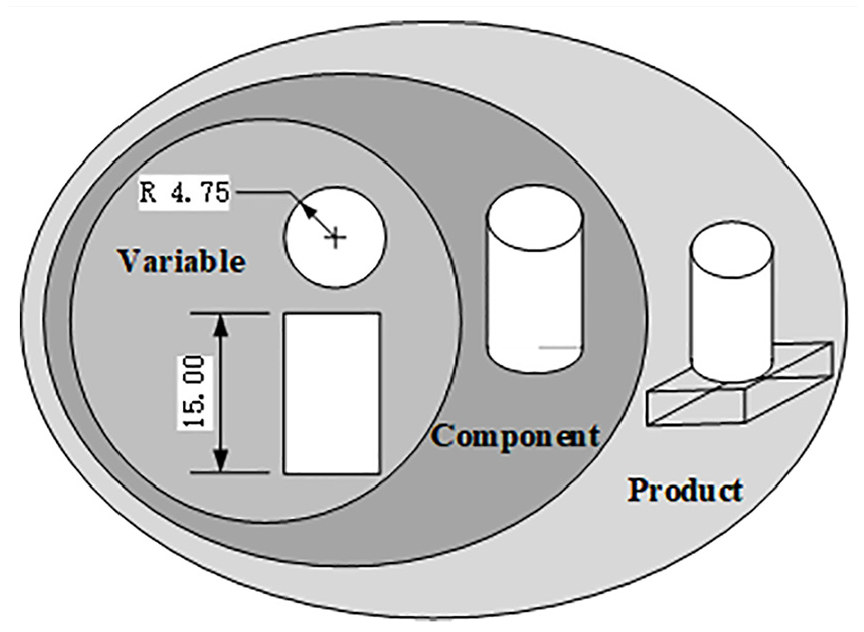
Product design problem hierarchies.
Optimal design of product platform based on MDO
The design problem of the automotive product family is a typical complex engineering problem, involving performance coordination and balancing between multiple components and multiple products. The fundamental purpose of multidisciplinary design optimization is to obtain the overall optimal solution of the system by fully exploring and utilizing the synergies generated by the interaction between various disciplines (subsystems), improving the quality of the product and shortening the design cycle through the realization of parallel design, which fits the design philosophy of the automotive product family.
Product family optimization problem mathematical description
The essence of the product family design problem is to select the best shared design variables and to make effective decisions on them, improving the generalization rate of vehicle parts, reducing costs, and shortening development and manufacturing cycles by platform development. The product family development problem can be described as the following mathematical form:
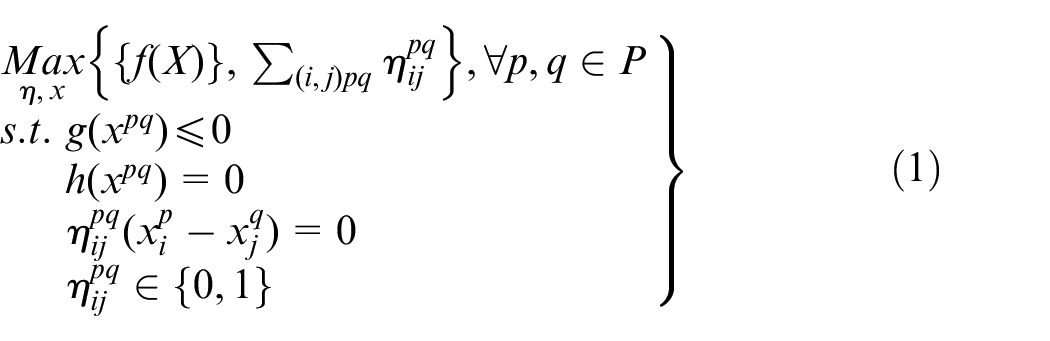
where,

where,

where,
MDO model of product family optimized design
In the product family design process, instead of a single product, the entire product family needs to be optimized. The design process can be handled as a multi-level optimization problem, as shown in Figure 3. The optimization of product family based on MDO idea includes the following steps:
Define the overall performance design indicators of the product family.
Decompose and allocate the overall performance design indicators to the lower layer system.
Design the analysis system according to the index value to be achieved, and establish the analysis model and design model.
Verify that the indicators of each layer ultimately meet the overall design indicators.
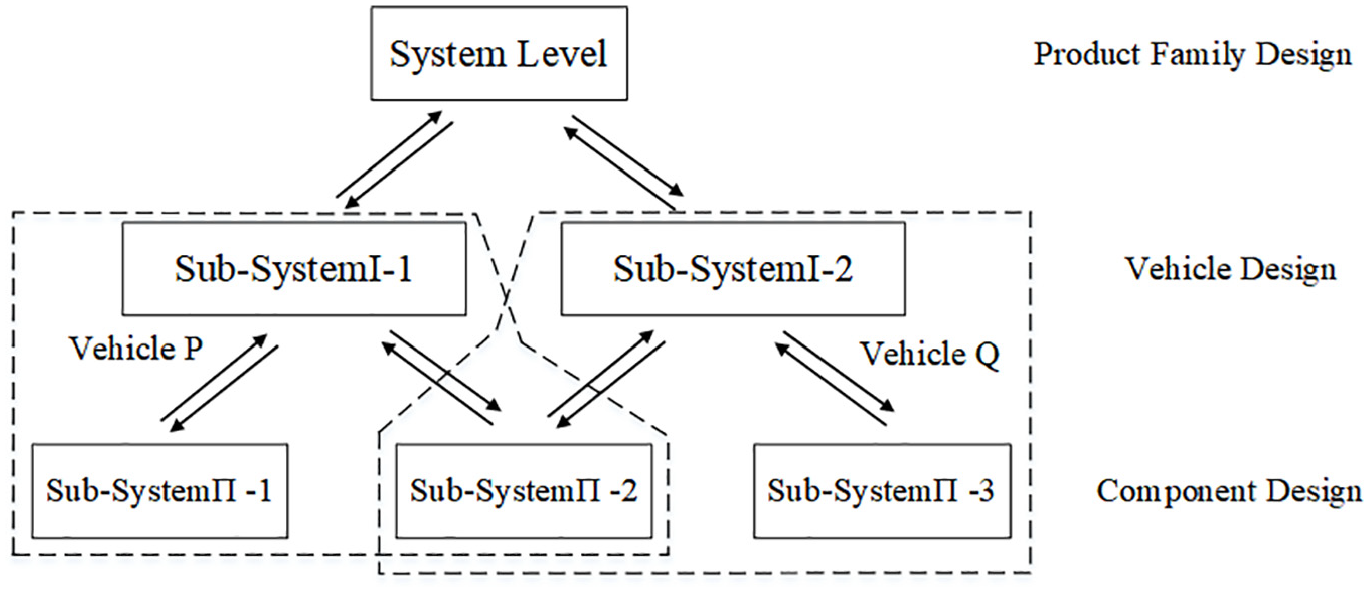
Product family design based on MDO.
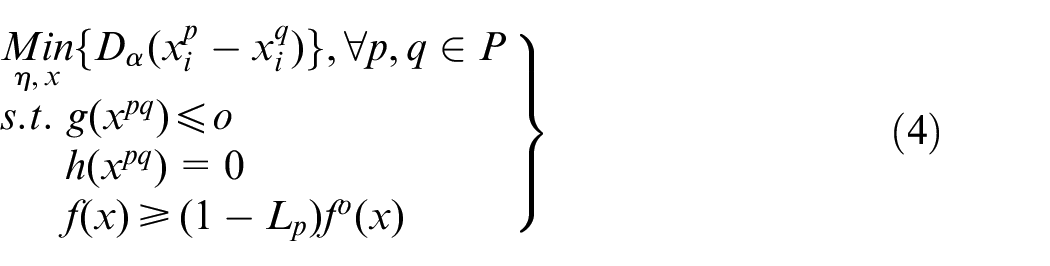
In order to solve the multi-disciplinary and multi-object coupling phenomenon existing in the design process of the product family, the multi-level computing framework is adopted to execute the parallel operation of each subsystem (discipline). In Figure 3, the top-down system level, subsystem level I, and subsystem level II correspond to the overall design of the product family, the design of a single vehicle model and the design of components. The system-level optimization calculation of the overall performance of the product family can be described as follows:
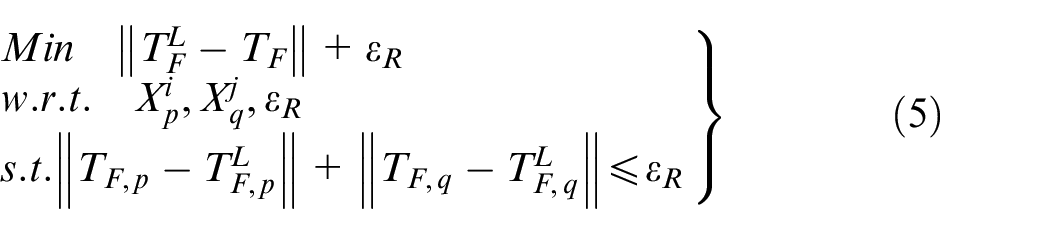
where,

where,

Multidisciplinary design optimization methods are introduced into the design of product families, and modifications are made on the traditional single product optimization framework to suit shared elements and optimization goals at each level. After the sharing platform is determined, the hierarchical division of various product design issues, as well as the necessary analysis models, product family and vehicle model targets are cascaded into systems, subsystems and components. In this way, the design requirements and consistency constraints of all elements including the product platform can be met, and the benefits of the product family can be maximized.
Optimization process of product family based on MDO
The multidisciplinary design optimization method can be introduced into the design of the product family, and modified on the optimization framework of the traditional single product to adapt to the shared elements and the optimization goals of each level, to maximize the performance of the product family. This paper proposes a product family design process based on the MDO framework, as shown in Figure 4.
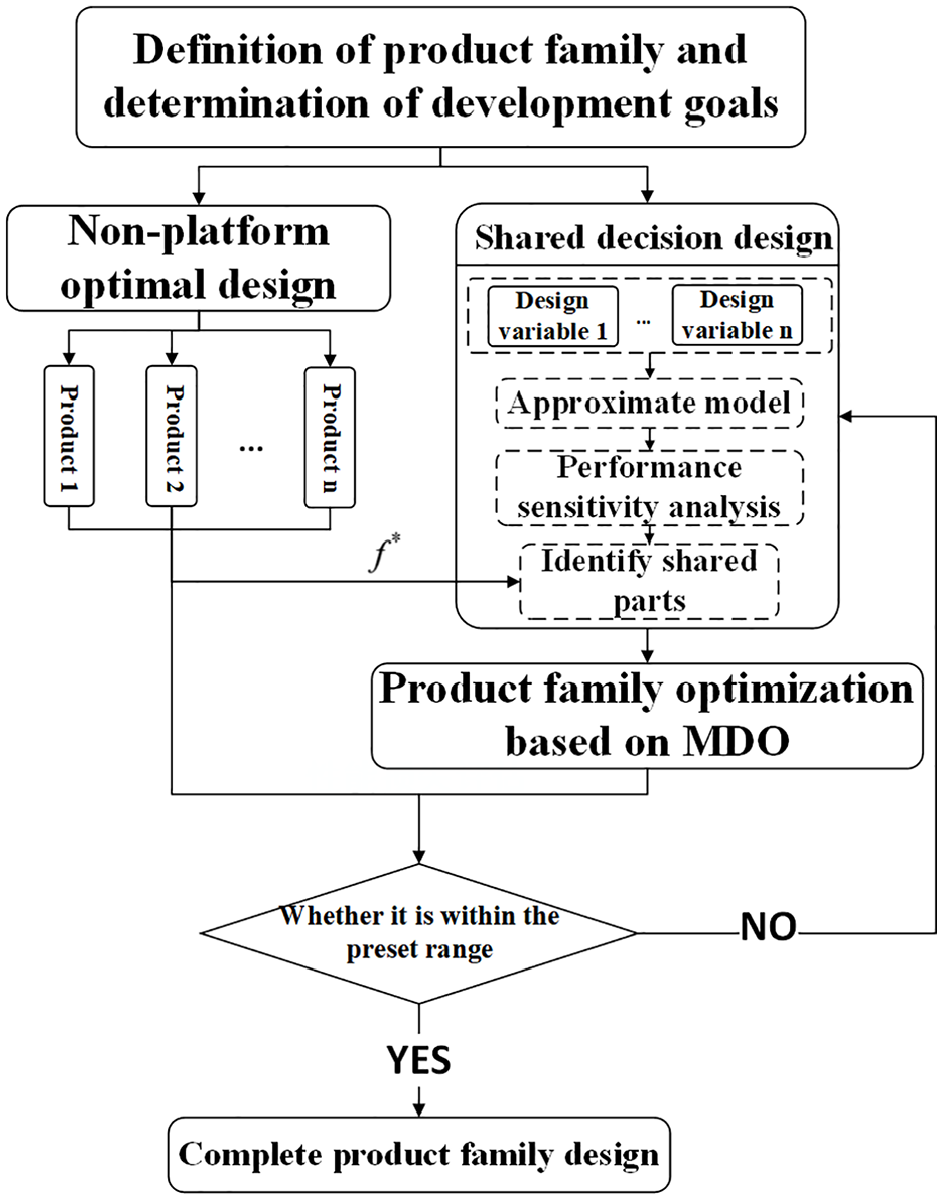
The design process of MDO product family.
First, it is necessary to define the design criteria of individual products in the product family, establish the mapping relationship between micro design variables and macro performance, and find out the consistency and difference between products. Then, the non-platform design of a single product is performed to obtain the optimal solution of the product performance, so as to compare with the product produced by the platform to verify the effectiveness of the product family design. In the process of shared decision-making design, for the model is relatively complex, firstly, an approximate model is established to reflect the algebraic relationship between the design variable and the objective function, and then the shared variable is determined through sensitivity analysis. Finally, the entire product family is optimized through the MDO framework shown in Figure 3 to obtain the final product parameters. Compared with the non-platform design, if the performance loss is within the preset range, it is considered reasonable, otherwise redesign should be carried out.
Examples
In order to illustrate the practical application of multidisciplinary design optimization methods in product family design, this paper reflects the mapping relationship between product macro performance and micro design variables by building chassis suspension and steering system models. A seven-degree-of-freedom mathematical model of integrated electric power steering is built in Matlab/Simulink. As shown in Figure 5, the suspension model and the electric power steering system model built by the state space method are integrated. The integrated system can fully reflect the interaction among the various subsystems, providing a carrier for multi-objective collaborative optimization.
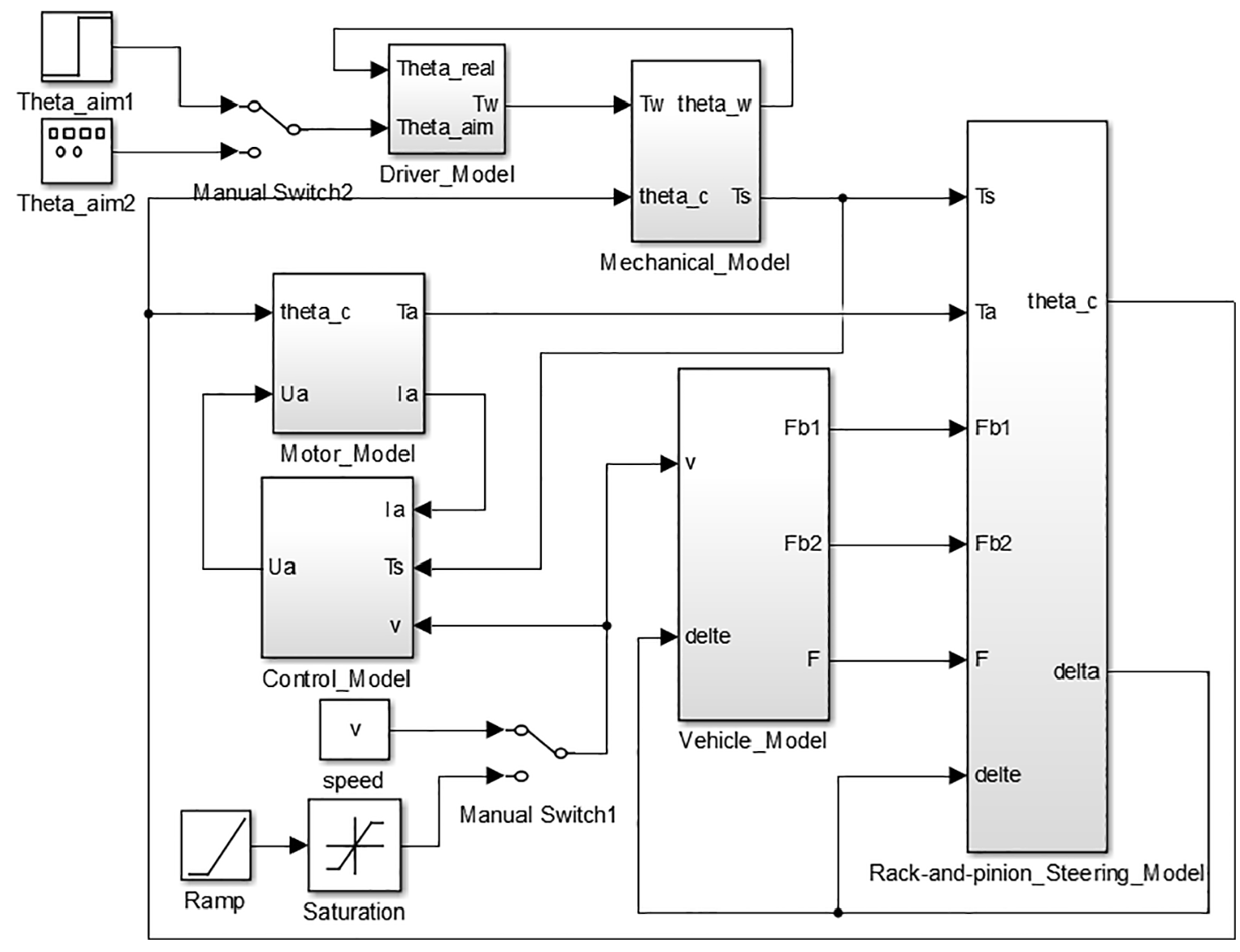
Suspension and steering integrated system model.
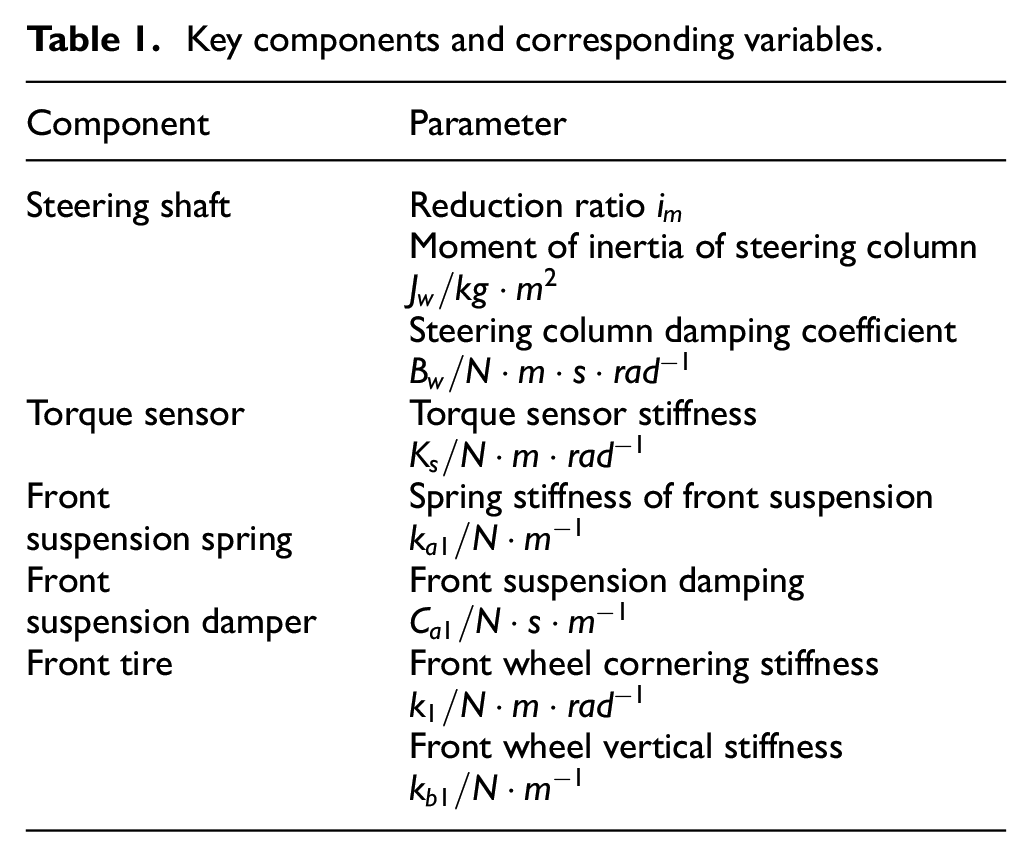
By analyzing the sharing possibilities of key components in Table 1, the steering shaft, torque sensor, front suspension spring, damper, and front tire are selected as the design objects of the shared components, a total of eight parameters including the reduction ratio of the reduction mechanism
Key components and corresponding variables.
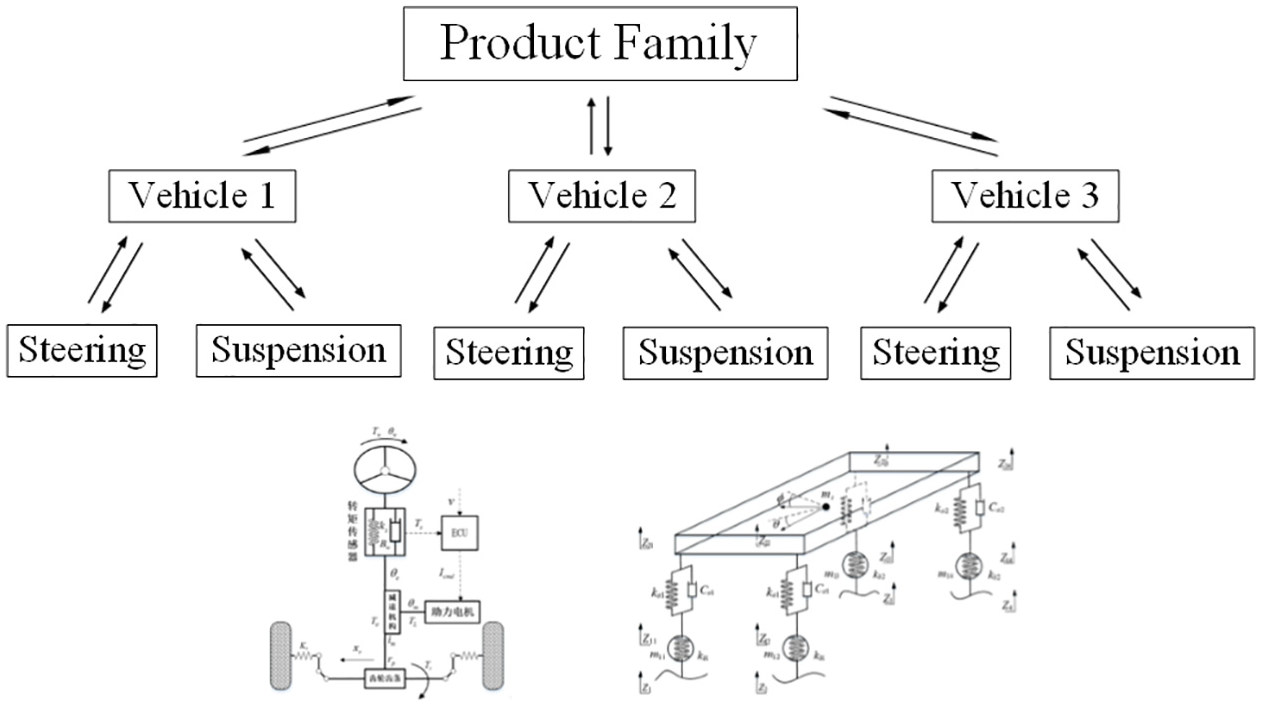
The framework of product family design.
This paper defines three types of chassis for sharing decision-making design, which increases the sharing of as many variables as possible under the premise of ensuring product performance, and fully utilizes the advantages of platformized production.
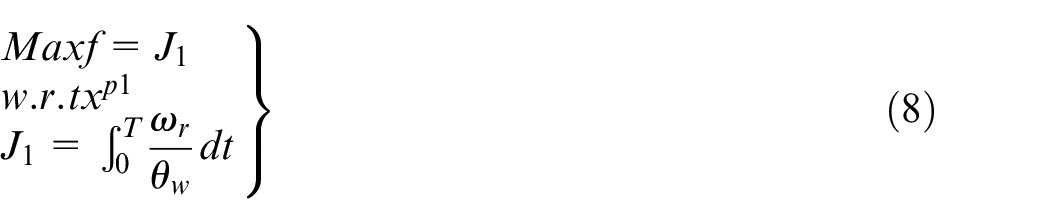
Vehicle 1 is defined as a sports car chassis with a standard wheelbase, which pays more attention to handling, that is to say, possessing requirements for steering sensitivity. It is proposed to use the ratio of yaw rate
Vehicle 2 is defined as a standard-wheelbase version of a comfortable chassis, which has some requirements for the ride comfort of the vehicle. And the ride comfort is quantified by the weighted sum of body acceleration

Vehicle 3 is defined as the long-wheelbase version of the comfortable chassis, whose design goals are consistent with the second one, both of which are to achieve better ride comfort. However, the dimensional parameters of the product itself have changed: the wheelbase and the track of the latter one are appropriately lengthened. Among these three products, the design goals of the second and third ones remain the same; while for the first and second products, they are different or even contradict each other. By solving such a typical calculation example, the difference between the two types of designs in making shared-decisions can be shown clearly.
At first, the optimal design of each product without sharing any variables should be calculated. To be clear, considering the model is relatively complex, in order to improve the calculation efficiency, an approximate model is built in advance. The model utilizes radial basis function (RBF) neural network, taking 122 sets of data generated by design of experiment (DOE) sampling as samples, and finally uses 15 sets of data for error analysis. For vehicle 1, Table 2 lists 20 of these data for error analysis.
Results obtained from Matlab for some of Vehicle 1.
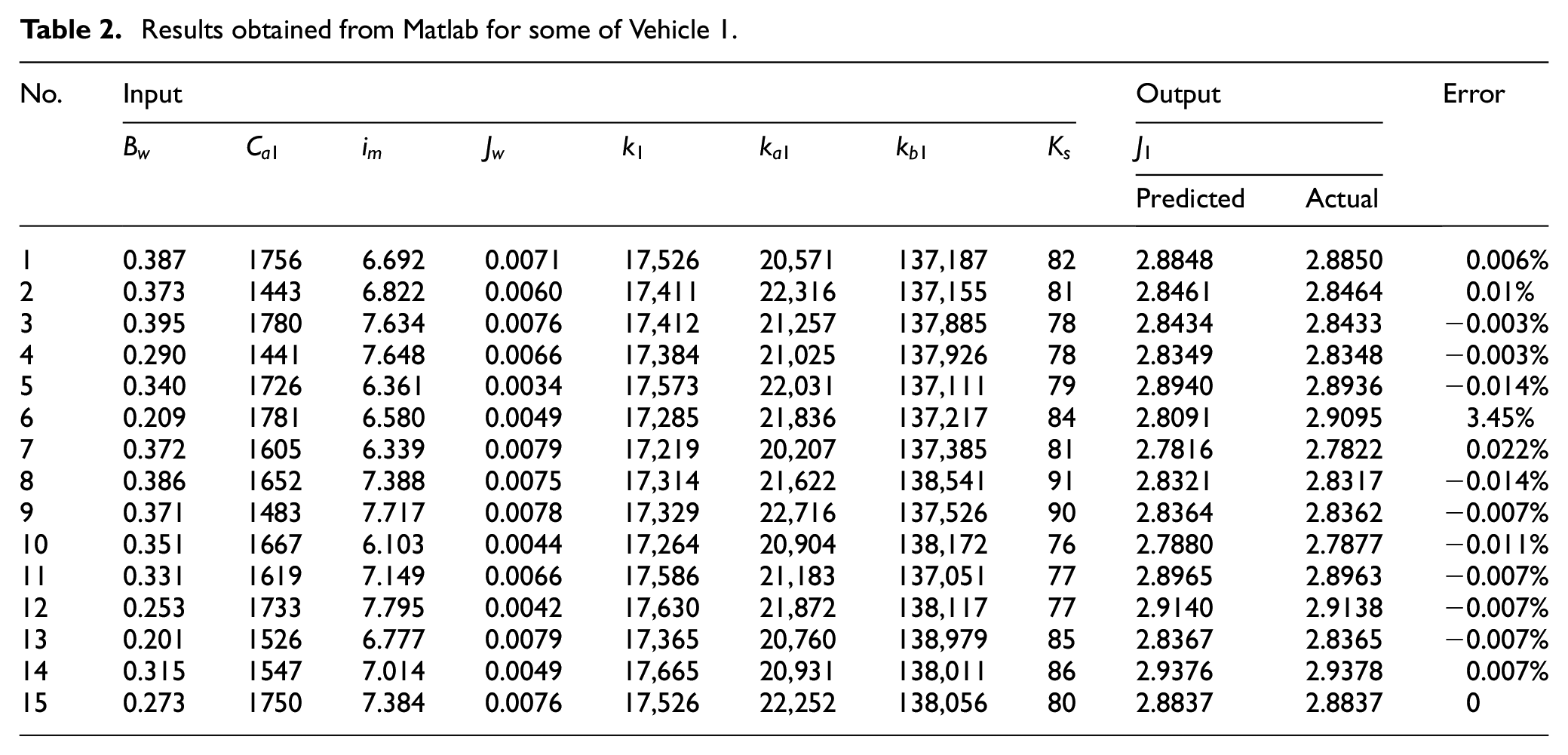
The data of vehicle 2 and vehicle 3 are not listed here. The ratio R2 of the squared regressions and squared deviations of the approximate models of the three vehicle is 0.99995, 0.99943, and 0.99933, respectively, which are all close to 1, so the approximate model is considered effective. Table 3 shows the values of performance indicators and design variables when designing each vehicle separately.
Product design variables and objective function values.
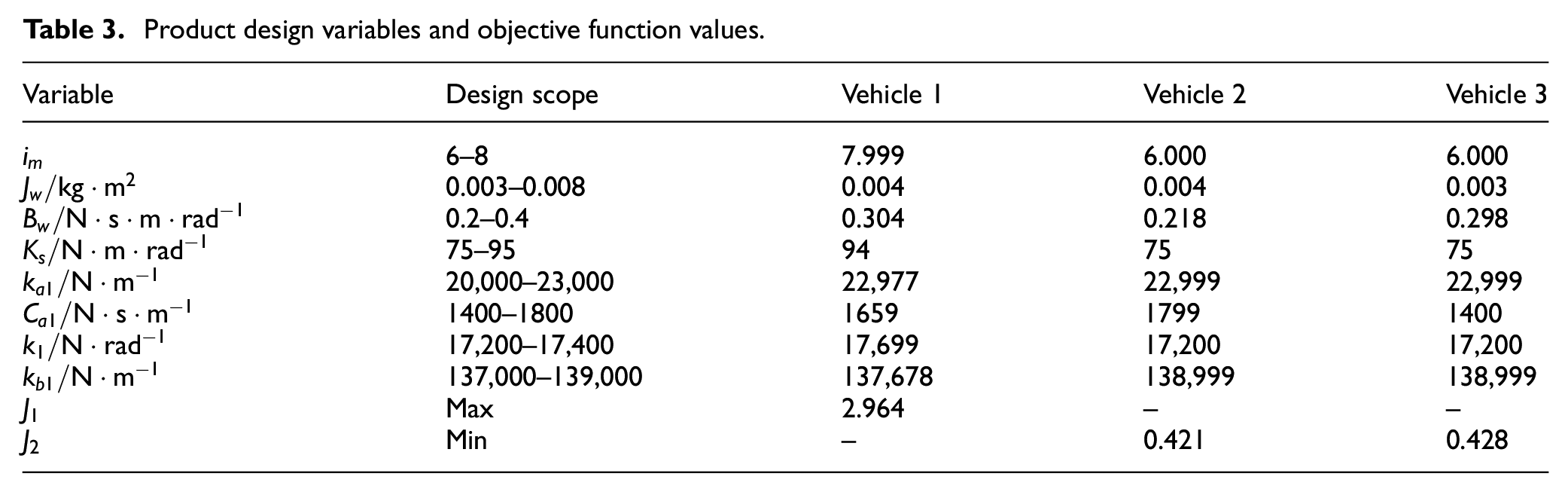
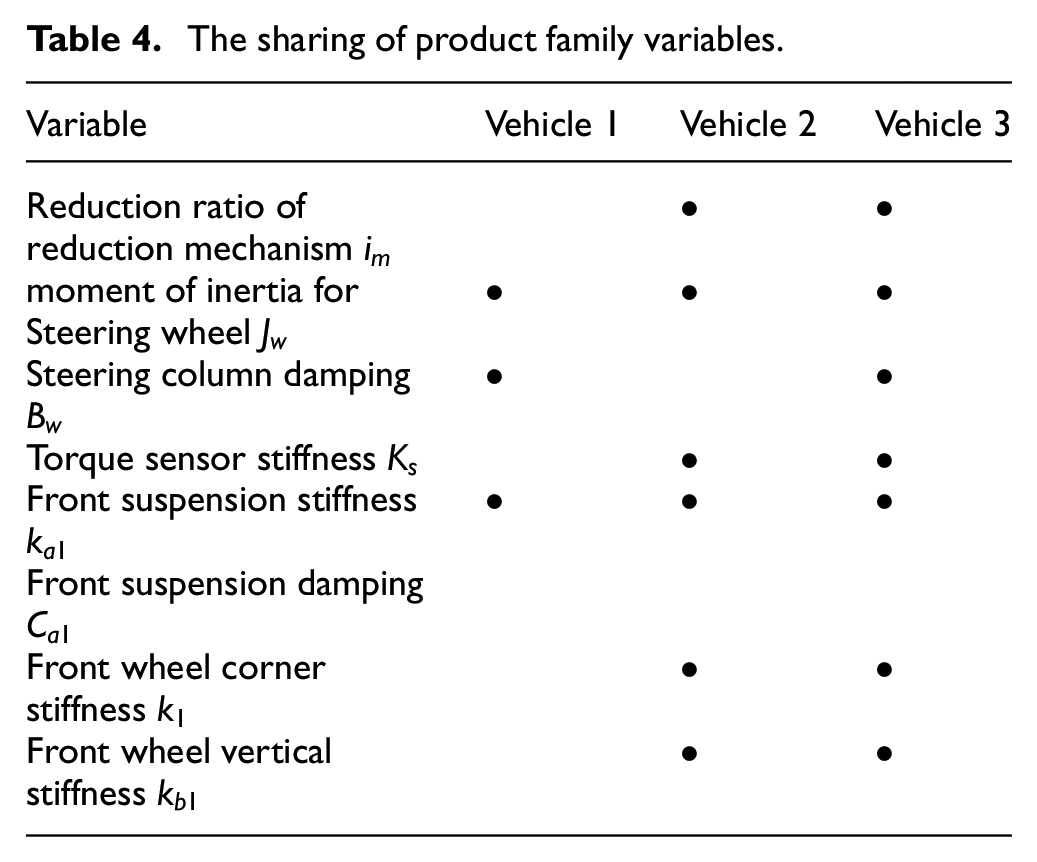
It can be seen from the table that the numerical values of the shaded parts of the same row are almost the same, which means that the design variable can be shared under the condition that the performance of each product is unchanged, but only a few of these shared variables are not enough to form platform production, the possibility of sharing other variables needs to be explored. After sharing the variables, each product sacrifices its degrees of freedom, that is to say, losing the autonomy to decide on the shared variables, so the performance of the product will be degraded compared to before. However, considering the advantages brought by platformized production, performance degradation of a single product can be accepted within the required range. The sensitivity analysis of the remaining variables is shown in Figures 7 and 8. Sensitivity analysis of the remaining variables are shown in Figures 7 and 8, for
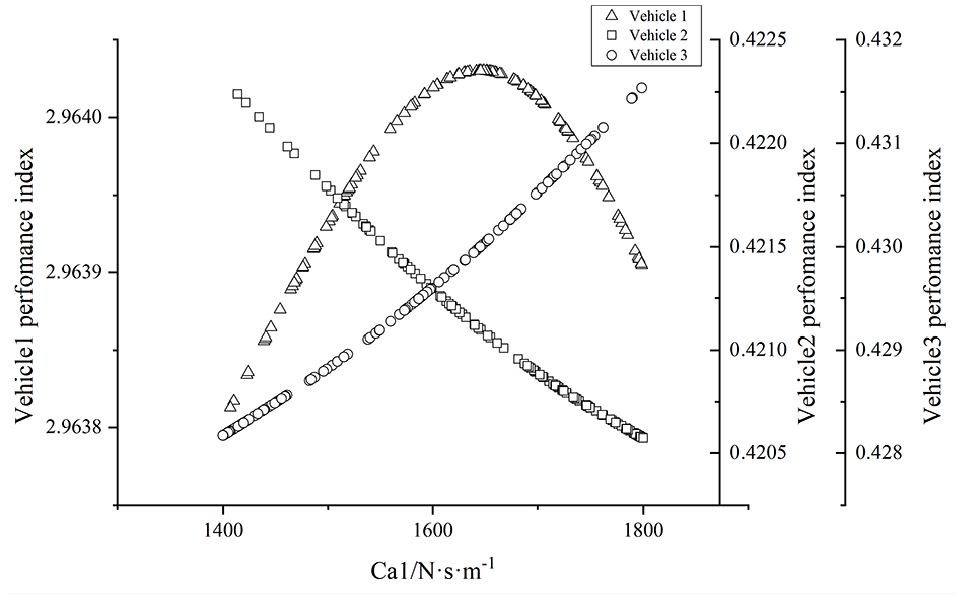
The sensitivity curve of the front suspension damping.
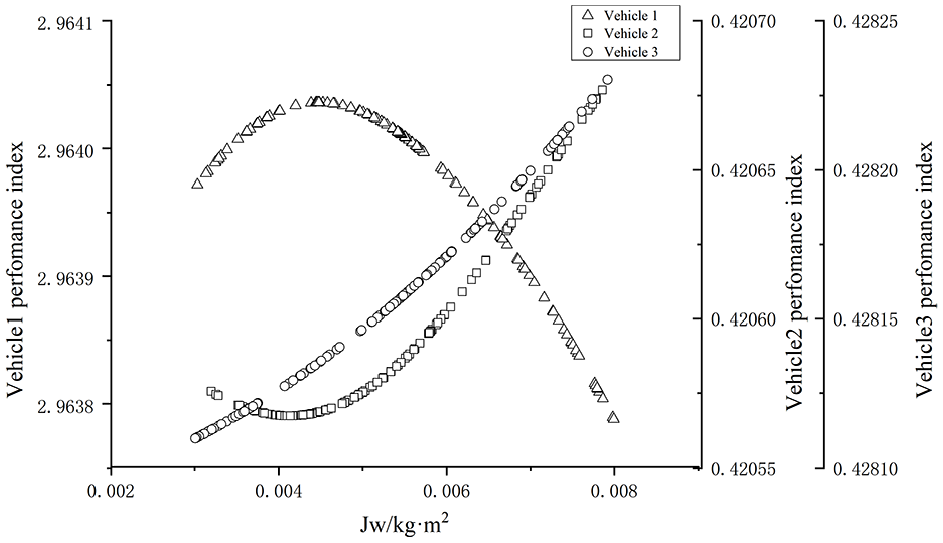
The sensitivity curve of the rotational inertia of steering wheel.
The sharing of product family variables.
In view of the many characteristics of the subsystems in this paper, the collaborative optimization method in the multidisciplinary design optimization is used to solve this system problem. To accomplish multi-objective optimization tasks, the basic idea is to construct a system layer to coordinate the inconsistency of the results of each subtask. When each subtask optimized, the influence of other systems can be ignored, and only the constraints of this discipline need to be satisfied. Compared with the traditional normalization algorithm, the collaborative optimization method can perform a global search to avoid falling into the trap of local optimum, 26 and can also avoid the situation where the weight factor cannot be determined due to insufficient experience.
For the different positioning of the three car models referred in this paper, the design goals of the corresponding subsystems are also different. As shown in Figure 9, the system-level design is for the entire product platform. There are certain technical requirements for the design variables shared among the products, which are used as the system-level design goals. After calculation, the requirements are passed to each subsystem. While the goal of each subsystem is to minimize the consistency equation of the shared variables and pass it to the system level as a system-level constraint, on the premise of satisfying the respective performance requirements.
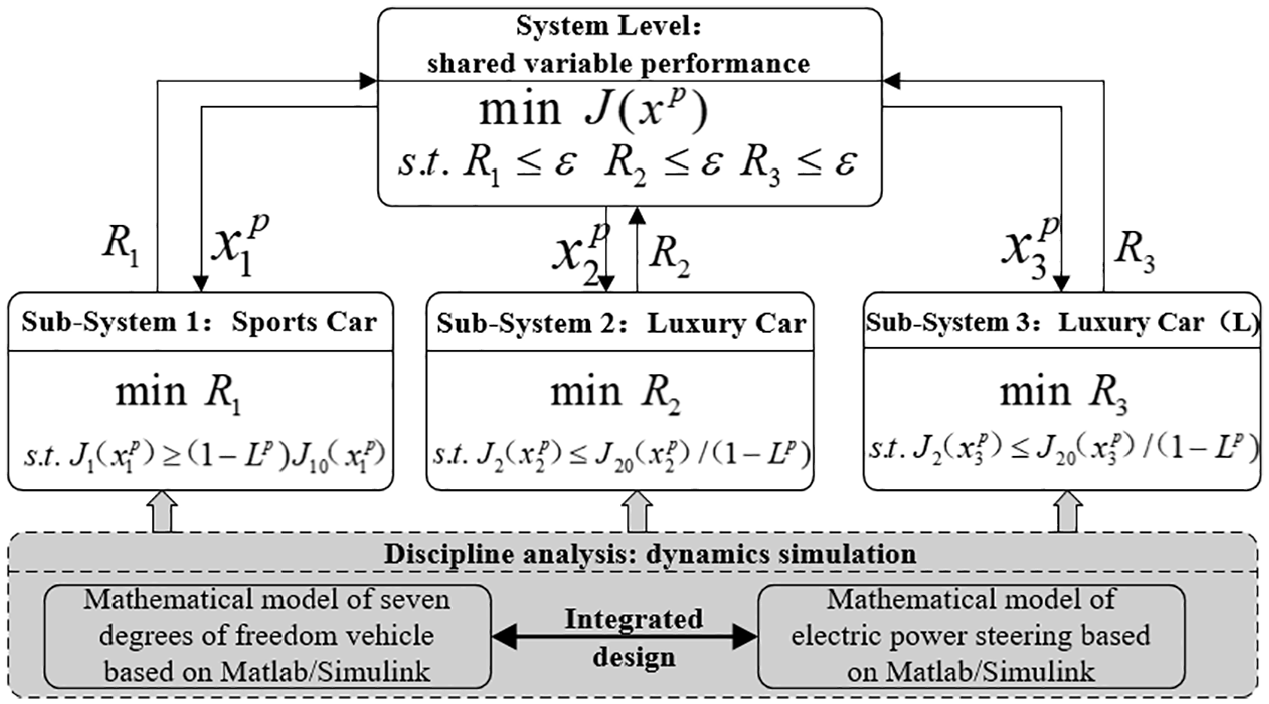
CO optimization framework of the product family.
Result analysis
In order to study the design requirements of different car models in the product family further, the relationship among the performance indicators of each car model is analyzed by changing the values of the eight design variables. As shown in Figure 10, the color changes on the picture represent the overall performance index of the product family when the design variable takes the current value, and the values range from 0.01898 to 0.02640. The green area indicates that the objective function value is low and the performance is good, while the red area indicates that the objective function value is high and the performance is poor. The abscissa of Figure 10(a) represents the performance index value J1 of vehicle 1, and the ordinate represents the performance index value J2 of vehicle 2. From formula (8) and formula (9), the value of J1 should be as large as possible, while J2 should be as small as possible. It is shown in the graph that the optimal solution is not a point, but a solution set consisting of a series of points. For such a Pareto problem, it is necessary to manually set constraints to obtain a unique solution. Figure 10(b) shows the relationship between the performance of vehicle 1 and vehicle 3. It is also impossible to find the only optimal solution. The enhancement of the performance of one will inevitably lead to the decrease of that of the other. While in Figure 10(c), the performance indexes of vehicle 2 and 3 cannot be small enough, the solutions in the bottom left consist of candidate solution set.
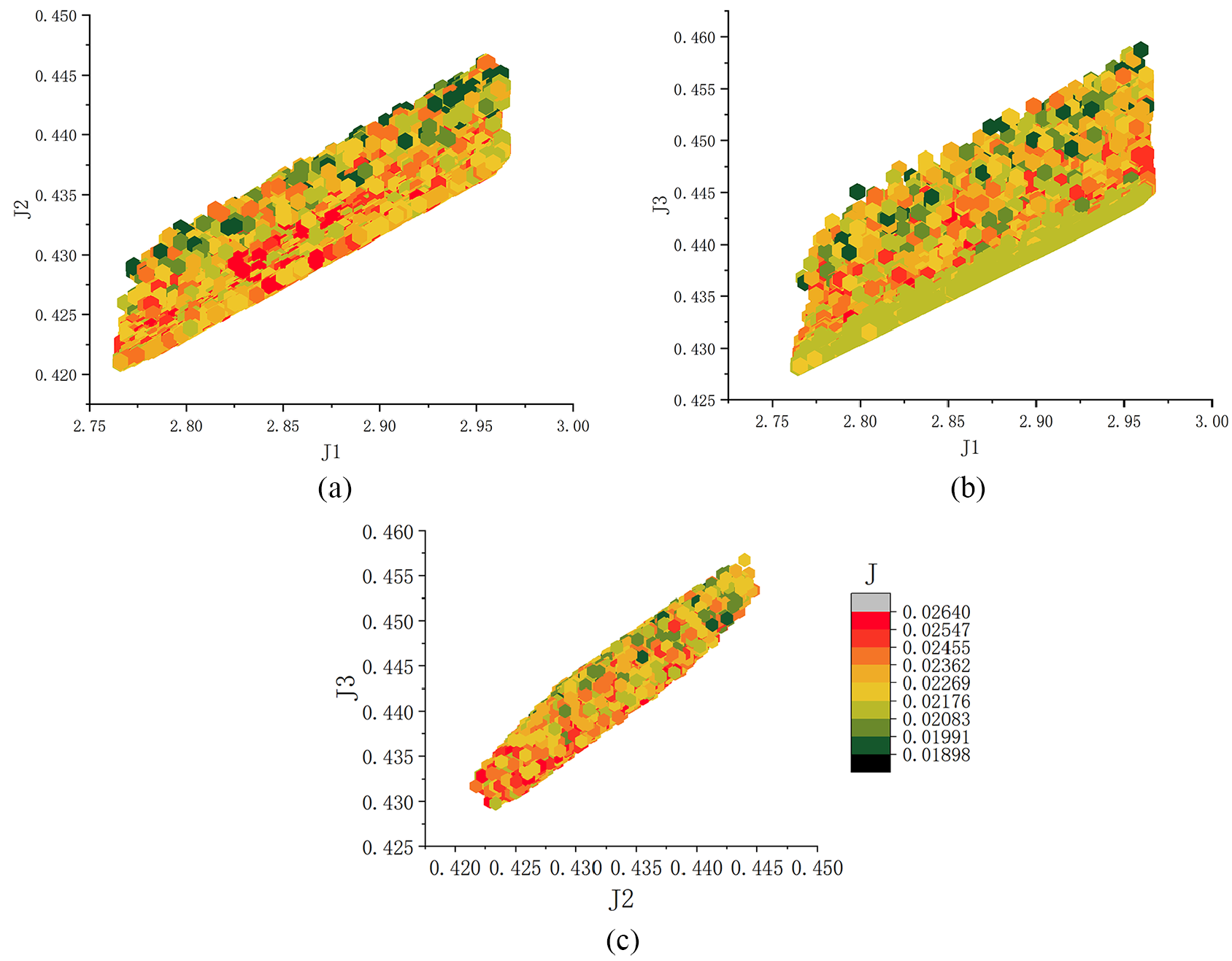
The 2D relationship diagrams of design targets.
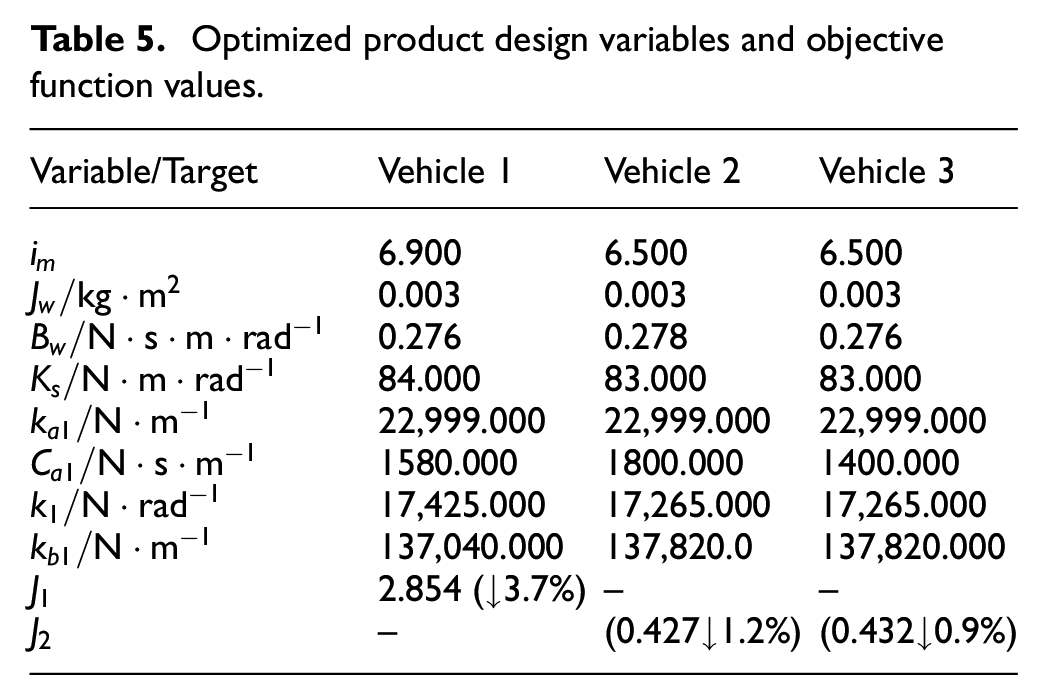
The optimization process of the product family utilizes multi-island genetic algorithm (MIGA). The target responses of the eight design variables are shown in Figure 11. The results of the calculation model captured in Figure 9 are put on the corresponding axis, so as to highlight the conflict of each model’s target from a high-dimensional perspective. The three coordinate axes represent the performance index function values of vehicle 1, vehicle 2, and vehicle 3, respectively, while the overall design target value of the product family maps the color change. By manually setting the size of the performance loss factor to determine the weight problem of each target, the final unique solution could be obtained. The values of the optimized design variables are shown in Table 5.
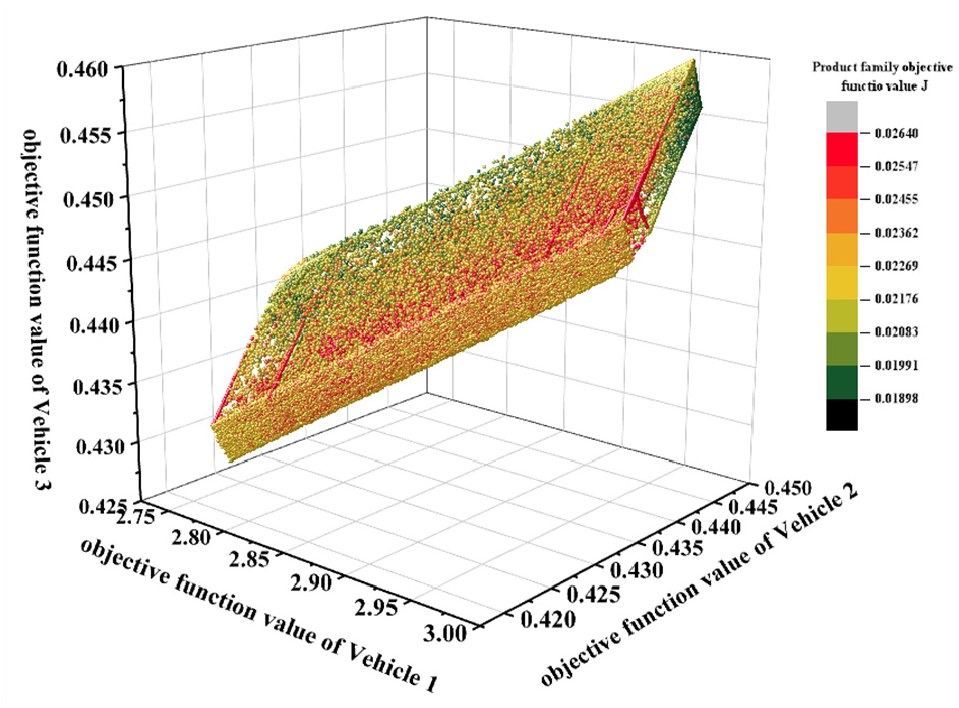
The 3D response graph of design targets.
Optimized product design variables and objective function values.
Conclusions
According to the development needs of product families, a platform design process of vehicle chassis system based on multidisciplinary design optimization method is proposed, which includes shared decision-making design and MDO design optimization. It applies multi-level, multidisciplinary optimization ideas and considers products in parallel individual products, as a consequence of which, the family can obtain the overall optimal solution of the system, improve the generalization rate of vehicle parts, and shorten the development cycle.
In the stage of shared decision-making design, the problem of selecting shared variables in platform design through sensitivity analysis is proposed. Using the data sampled by DOE, an RBF approximate model of vehicle chassis system dynamics is established to improve computational efficiency and provide data support for sensitivity analysis. The results show that each design variable has a great influence on the performance index. This method can effectively make up for the shortcomings caused by choosing shared variables purely according to design experience.
By establishing MDO optimization model, the design problems are divided into layers, and the overall performance design indicators are allocated to the subsystems. The consistency equation is used to coordinate the inconsistencies between the subsystems, and the trade-off relationship between the sharing rate and product performance in the Pareto frontier is adjusted by giving a performance loss factor. MDO can effectively solve the coupling relationship of different disciplines, and is more suitable for the optimized design of product family than MOO.
For the optimization of the chassis product family of a high-performance pure electric passenger car product platform, the MIGA algorithm is used to optimize the CO model of the product family. The optimization results show that the system can effectively handle the coupling problem between multiple targets, and the performance index values of each product are all within the allowable fluctuation range (5%). The high sharing rate, suggesting fully utilization of the advantages of chassis platform production, has great guiding significance in designing more complex vehicle product families.
Footnotes
Declaration of conflicting interests
The author(s) declared no potential conflicts of interest with respect to the research, authorship, and/or publication of this article.
Funding
The author(s) disclosed receipt of the following financial support for the research, authorship, and/or publication of this article: This work is supported by the National Key R&D Program of China (2017YFB0103704) and the National Natural Science Foundation of China (51675044).
