




Abstract
The steel production scheduling is a typical continuous/discrete hybrid process; it is dynamic and difficult to predict. The scheduling model is the core object of steel production scheduling, and its modeling methods directly affect the precise decision-making and execution efficiency of scheduling. However, the current linear program and simulation model do not yet realize the scheduling model quick reuse and dynamic construction. Therefore, a new model knowledgeable encapsulation method is proposed, which consists of a knowledgeable encapsulation framework and knowledgeable mapping method. The knowledgeable encapsulation framework includes the model knowledge description interface, model knowledge publication interface, model knowledge behavior interface, and a web platform. The interfaces and the platform are designed to help model providers to encapsulate the scheduling model in an open network environment. The mapping method is constructed to strengthen the relationship between the model knowledge. Finally, a knowledge encapsulation platform is established to verify the effectiveness of the model knowledge encapsulation method.
Keywords
Introduction
With the proposal of intelligent manufacturing architecture, such as Industries 4.0, the steel industry has made significant progress.1–3 Steel production scheduling reliability and robustness strongly depend on enterprise intelligence level. Thus, it is widely accepted that steel scheduling based on knowledge engineering is an important aspect to improve the enterprises’ intelligence. 4
For the past decades, many enterprises developed production planning and scheduling systems such as manufacturing execution system, 5 enterprise resource planning, 6 and advanced planning system. 7 With the application of artificial intelligence and knowledge engineering, scholars put forward methods to solve the steel scheduling in the following two aspects: intelligent optimization combined with the mathematical model and scheduling modeling based on knowledge engineering.
The intelligent optimization of the model uses the intelligent algorithm to solve the scheduling mathematical model.8–10 Wen et al. 11 embedded the trained neural network into the genetic algorithm to optimize remanufacturing production scheduling. Su et al. 12 proposed a fuzzy genetic algorithm to solve the integrated optimization of steel production. Yu and Pan 13 established a new multi-objective nonlinear programming model and proposed a three-stage rescheduling framework. Wang et al. 14 based on the Internet and physical manufacturing system, defined the active scheduling and passive scheduling. Based on the characteristics of job-shop, Jiang et al. 15 optimized the scheduling rules with a genetic algorithm. In general, the intelligent optimization combined with the mathematical model is based on the specific problems to build a unique model, which causes the model difficult to reuse. Furthermore, if the knowledge as an “adhesive” between the model, module, and subsystem, and all parts of the steel production scheduling system can effectively and flexibly be integrated into a theoretical scheduling framework, it will be a new way to optimize model quick reuse and dynamic construction. With the application of knowledge engineering, intelligent modeling and human–computer interaction can improve the reusability of scheduling model.16–19
The scheduling modeling based on knowledge engineering used the knowledge to solve the problems. In the agent of steel scheduling, Liu et al. 20 proposed a digital twin agent driven by cyber-physical systems and realized the scheduling model dynamic construction. In knowledge decision-making, SR Cuesta et al. 21 proposed a web decision support system for steel-making status monitoring and improvement. In the model knowledge description, Chen et al. 22 used the knowledge description and matching based on feature similarity to solve the job-shop scheduling problem. In the model knowledge reasoning, there are rule-based reasoning 23 and case-based reasoning. 24 In the knowledgeable manufacturing, Yan and colleague25,26 established theory, modeling, and scheduling optimization method about the knowledgeable manufacturing system. Jiang et al.27,28 introduced a knowledge network system and established the knowledge base of steel hybrid process. Although the research of knowledge engineering made many achievements, the study is still in the stage of theoretical exploration and application design.
In summary, the scheduling of steel has not only typical multi-constraints, multi-objective, uncertainly, large scale, continuous and discrete coexistence but also have strong coupling between multi-disturbance and multi-process and the change in scheduling cycle triggered by events.29,30 These will lead to the instability and distortion of task-model matching and model-algorithm matching under the traditional scheduling method, and it is difficult to guarantee the recall and precision of the model set. Moreover, the modeling-matching-algorithm solving of steel production scheduling is interwoven with consistency and strong coupling. They interact with each other, and the state is complex. Through the research of model knowledge encapsulation, it will effectively reduce the dependence of scheduling modeling and matching on the steel production scheduling scene, improve the reusability and adaptability of the model, and the accuracy of model matching. However, there are still many difficulties in the research of steel production scheduling based on “model knowledge encapsulation.”
Balance of the model completeness. The scheduling process of steel production is dynamic and difficult to predict. On one hand, building a simplified model will cause the distortion of information, and it is difficult to get a feasible solution or a satisfactory solution; On the other hand, building complex model will lead to multiple geometric growths of calculation.
Reusability of the model. The many kinds of knowledge in the steel scheduling process (such as rules, cases, and algorithms) are difficult to express and standardization. Model knowledge has heterogeneous and loose coupling. It leads to the fact that the knowledge cannot be directly invoked unless through an interface. These factors make the model difficult to use.
The mapping between model knowledge. After knowledge representation of the model’s attributes, data, operations, and rules, the multi-relationship and the complex spatial network structure will be formed between models. How to build the mapping relationship between the model’s knowledge is also difficult.
Therefore, in this article, the knowledgeable encapsulation of the steel scheduling model is presented to realize the reuse and dynamic construction of model. It is significant to explore the knowledge encapsulation framework and standardization encapsulation method of the steel scheduling model.
The rest of this article is structured as follows. Section “Inspiration” shows the inspiration for knowledgeable encapsulation of the steel scheduling model. In section “Knowledgeable encapsulation framework of steel scheduling model,” the knowledgeable encapsulation framework of steel scheduling model is established. In section “Knowledgeable encapsulation method of steel scheduling model,” the detailed knowledgeable encapsulation method is proposed. Section “Example of knowledge encapsulation of steel production scheduling model” shows the instantiation process of model knowledgeable encapsulation. Section “Conclusion” gives the conclusion and the prospect of related work.
Inspiration
Encapsulation (packaging) refers to the process of assembling the integrated circuit into the microchips or hiding the attributes and implementation details of the object, only exposing the interface. The earliest packaging ideology came from the physical package, mainly to protect integrated circuits and chips. 31 Different from physical packaging, virtual encapsulation uses computer technology to encapsulate the programs, functions, protocols, forming the virtual resources.32–34 Yin et al. 35 divided cloud service encapsulation into three modes: high-level encapsulation, portion encapsulation, and nearly none encapsulation. Yue et al. 36 used the unified data exchange expression model to express the data of geographic model. Xing et al. 37 put forward a service encapsulation strategy and establish an online geological processing detection system.
The significance of encapsulation is not only to make the scheduling process form standardized models or firmware more quickly but also to make heterogeneous model resources co-exist in the same environment and convenient to reuse. The encapsulation is expanded and strengthens the communication among models, achieve the reusability of the scheduling model, and improve the modeling efficiency.38–41 As shown in Figure 1, in the knowledge domain, the knowledge component space description model includes the model knowledge, meta knowledge, and algorithm knowledge. Through the attribute modeling and knowledgeable interface, the model will be encapsulated as an independent knowledge unit for invoking. The encapsulation expressed as an event handler, including the data, handler, and method, which through the knowledge represents to realize. Thus, the scheduling model can be achieved quickly to reuse and dynamic construction.
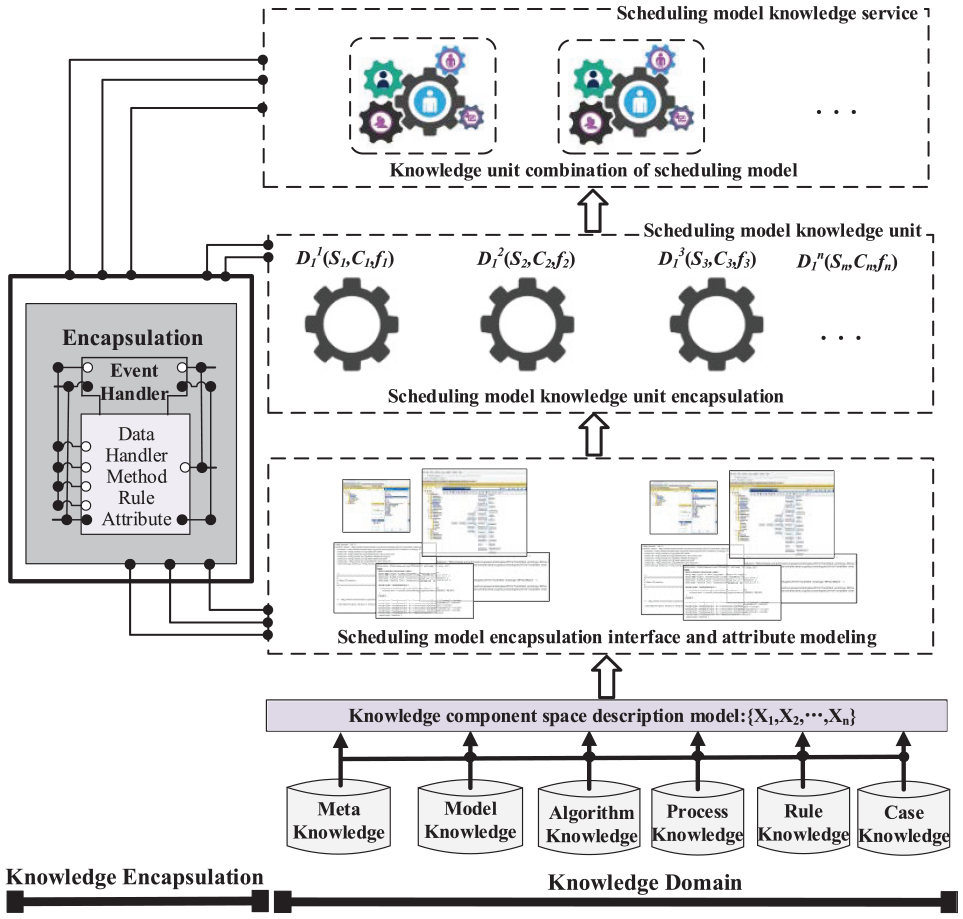
Knowledge encapsulation strategy of steel production scheduling model.
Knowledgeable encapsulation framework of steel scheduling model
As shown in Figure 2, an encapsulation framework is proposed to realize the knowledgeable encapsulation of steel scheduling model. The encapsulated model can be deployed in the model base and published as model services in the network environment. Model demander can search model and configure model parameters to analyze different scheduling problems. The framework includes three interfaces and a knowledgeable encapsulation platform.
The model knowledge description interface is to describe the attributes and related information of the model, forming the standard model description template. The template including model related information (model name, keywords) and resources. It also has the provider’s individual information (name, mailbox) that the model demander could search models.
The model knowledge publication interface is responsible for describing the publishing environment of model. The model provider can provide the required publishing information (system configuration, operating environment) with the help of the publication interface. Through this interface, the model can be fully deployed and described in model base.
The model knowledge behavior interface describes the behavior state, the input (request), and the output (corresponding) of the model. It can encapsulate the model’s original execution program as a standard model knowledge unit. Among them, the interface uses a unified data representation strategy and programming tasks to transform the complex scheduling model information into a series of data, input, output, and model state.
The scheduling model knowledgeable encapsulation platform provides various production scheduling model services. The model provider can complete the model description, data definition, and model publishing. The model demander can retrieve the required model and invoke or construct the model through configuration parameters.
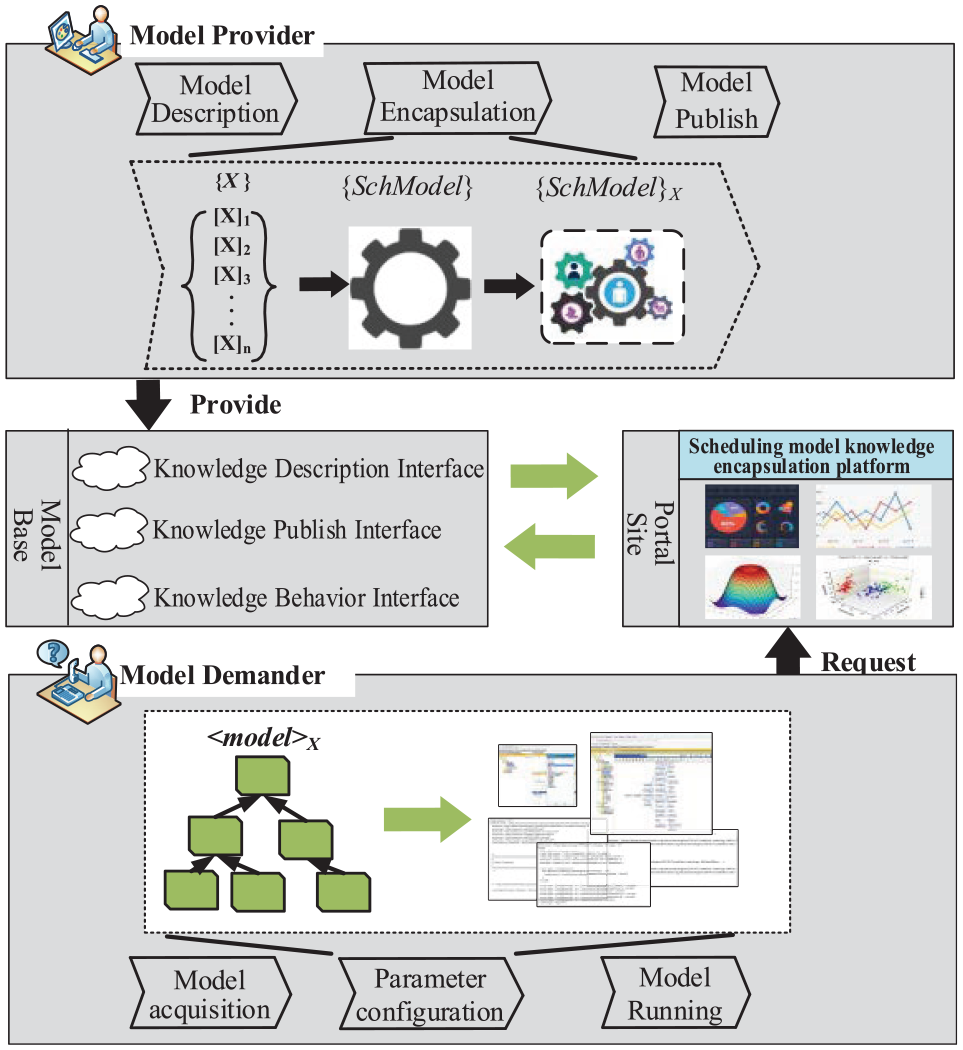
Knowledge encapsulation framework of steel production scheduling model.
Knowledgeable encapsulation method of steel scheduling model
Design of model knowledge description interface and knowledge publication interface
Model knowledgeable encapsulation is to standardize description and knowledge representation of various scheduling model knowledge and form the standard model description template. Equations (1)–(4) are the general model of steel production scheduling
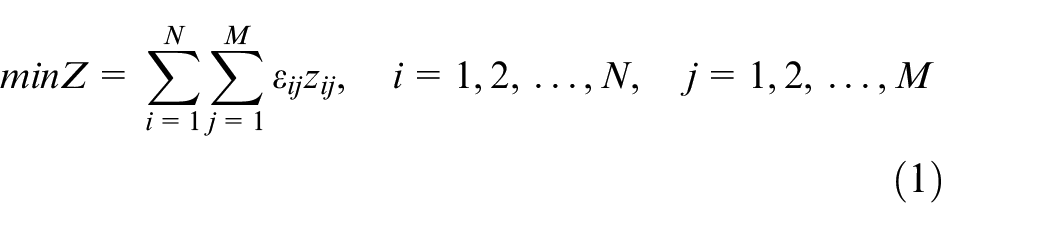
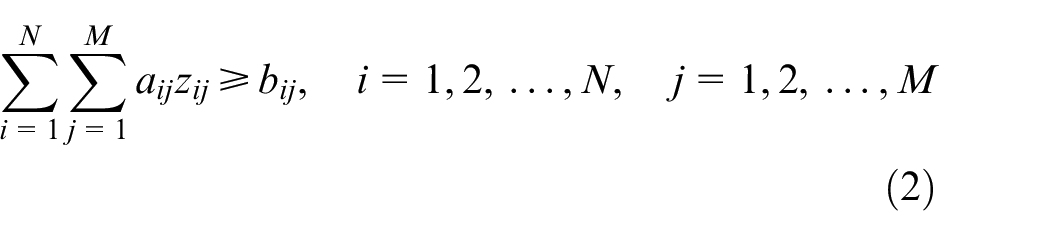
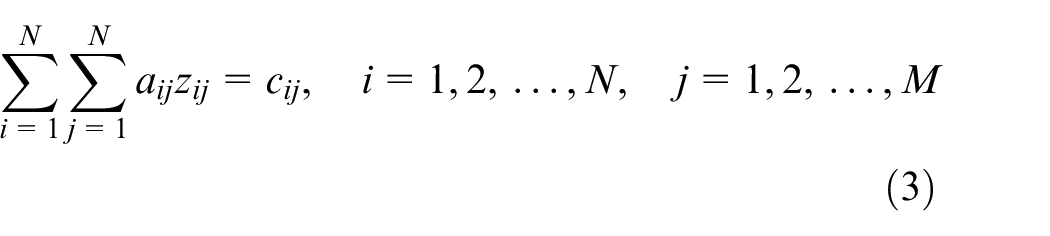

Equation (1) is the objective function, where N is the total number of the contract, M is the total number of the process,
In General, the steel scheduling model can form a standard model description template that includes the name, object, and constraint. As shown in the left part of Figure 3, the model knowledge description interface (it is represented as SchModelEncapsulation) is designed. The set includes an attribute, addAttribute, and getAttribute method. And the steel scheduling model (SchModel) can be described as a model description template: SchModel = {SchModelID, SchModelBasicInfo, SchModelFunc, SchModelApp, SchModelState}.
SchModelID is the number of SchModel, and each model has a unique number.
SchModelBasicInfo is the basic attribute set of the SchModel. SchModelBasicInfo = {SchmodelName, SchModelInfo, SchModelProvider, SchModelIP, SchModelParameter}. Among them, SchmodelName is the model name; SchModelInfo is the keywords, abstract, and language of the model; SchModelProvider is the information of the provider; SchModelIP is the IP of the SchModel; and SchModelParameter is the parameter set of models.
SchModelFunc is the function attribute set of SchModel, SchModelFunc = {SchModelTask, SchModelConstraint, SchModelEnvironment, SchModels}. Among them, SchModelTask is the scheduling model task, SchModelCconstraint is the model constraints, SchModelEnvironment is the running environment, and SchModels is the customized content by the provider.
SchModelApp is the information about the usage characteristics of the SchModel.SchModel App = {SchModelTime, SchModelCost, SchModelDegree}. Among them, SchModelTime is the reference running time, SchModelCost is the price standard of the model, and SchModelDegree is the user satisfaction degree of the model.
SchModelState is the state attribute of the SchModel. SchModelState = {SchModelCurrent-State, SchModelCompletedTask, SchModelWaitTask}. Among them, SchModel CurrentState is the current state of the models, SchModelCompletedTask is the completed task of the model, and SchModelWaitTask is the queued task of the model.
The publication interface is to deploy the model service. As shown in the right part of Figure 3, the model service needs to be deployed in a reasonable computing environment, which needs to consider the dependence, user privileges, and other factors. Therefore, the model knowledge publication interface includes SchModel execution message (SchModelExecutio), user permission message (UserPermission), model file path (ModelFilePath), model platform (ModelPlatForm), model configuration (ModelConfigure), and enumeration type of operation platform <enumPlatformType>. Version represents the model version. The PlatForm represents the type of platform. Userpermission represents the user’s permission information; ModelFile represents the path and directory of the model load file; ModelFilePath represents the configuration data and running environment parameters of the model; ModelPlatForm indicates the detection of the model running environment information, including the system version (check_sys()), kernel version (check_kernel_version()), and detection of user permissions (set_user_permission()).
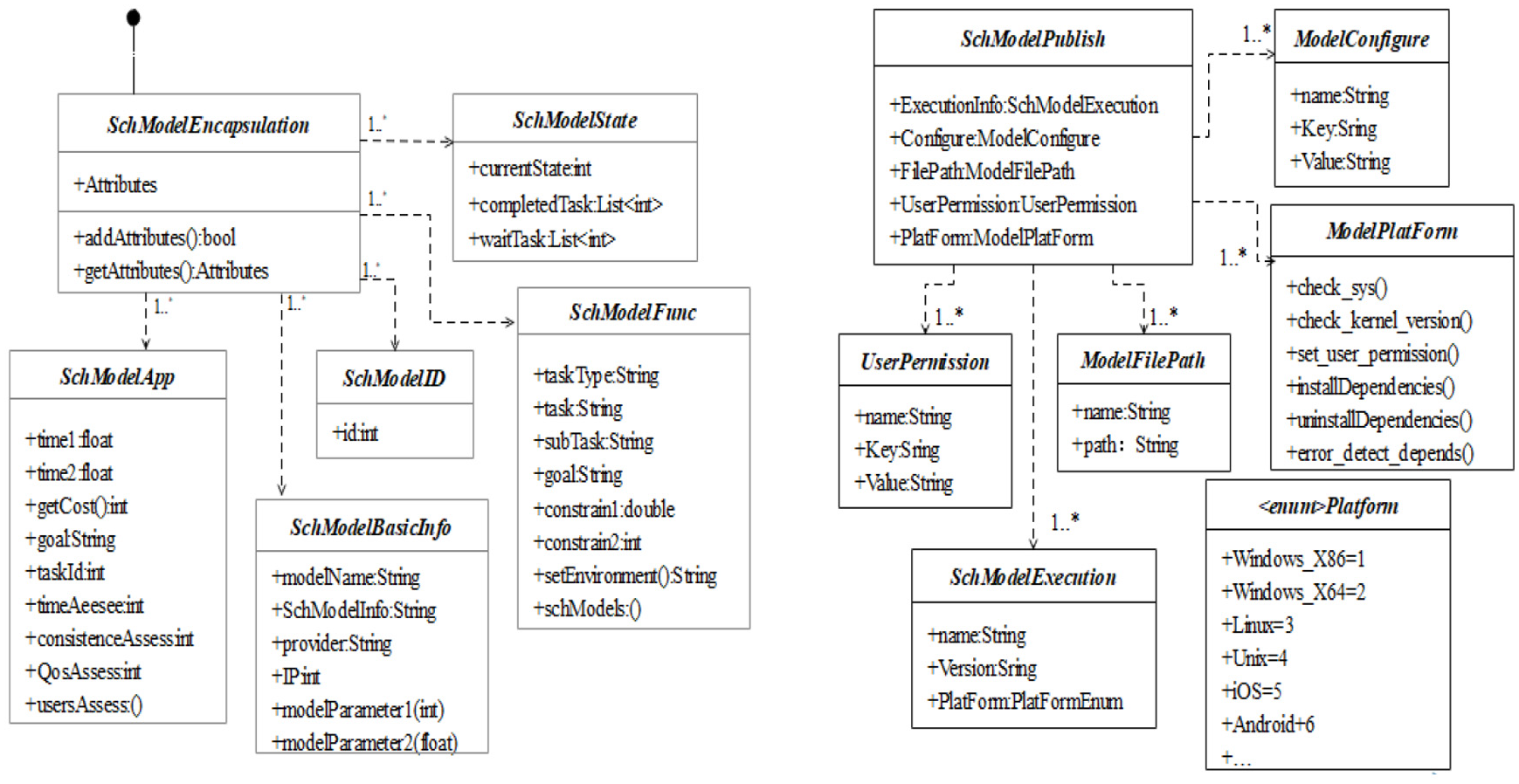
UML description interface and release interface of scheduling model.
Model knowledge behavior interface design
SS Yue et al. 42 designed the universal data exchange (UDX) model for geographic model data and its enhanced semantic schema. The UDX model realized the unified expression of the geographic model data and the description information. It also shielded the heterogeneity of model data. Based on this, this article uses the UDX model as the encapsulation method of steel scheduling model.
As shown in Figure 4, UDX mainly includes data objects (UDX data) and enhanced semantic schema (UDX schema). The UDX data include node and kernel. Node determined the model’s hierarchical structure. Kernel represents the specific behavior of the node. The root node and all its child nodes constitute a UDX data set. As shown in the left part of Figure 4, the <enumSchKernel> of the UDX model is defined. Take the furnace planning model as an example, as shown in the right part of Figure 4. The child nodes are used to describe the corresponding attributes of the model. At the same time, the child node “SchModelFunc” can be multi-layer and multi-column to represent the specific attributes and parameters in detail. Through the UDX, the whole furnace planning model presents as a mesh structure.
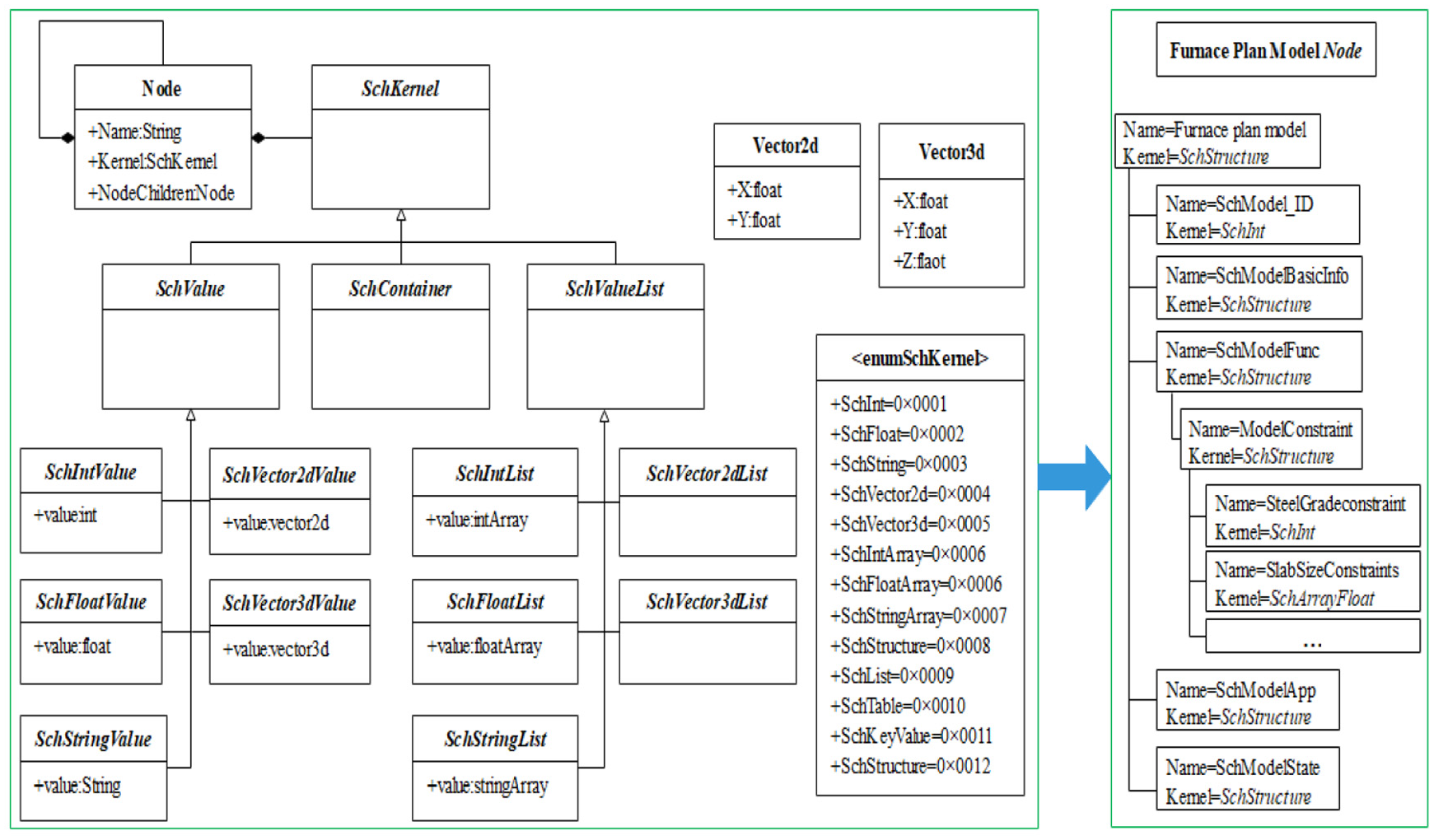
UDX description of UDX basic model and scheduling model.
The model implementation process involves many intermediate steps, and there will be much interaction. As shown in Figure 5, the process can be regarded as a black box composed of multiple model states. The input is the data or request. The output is the different states of the model, and it can be regarded as different model events with request data and response data. The process of each model transition relies on external transformation rules, algorithms, and the external knowledge base.
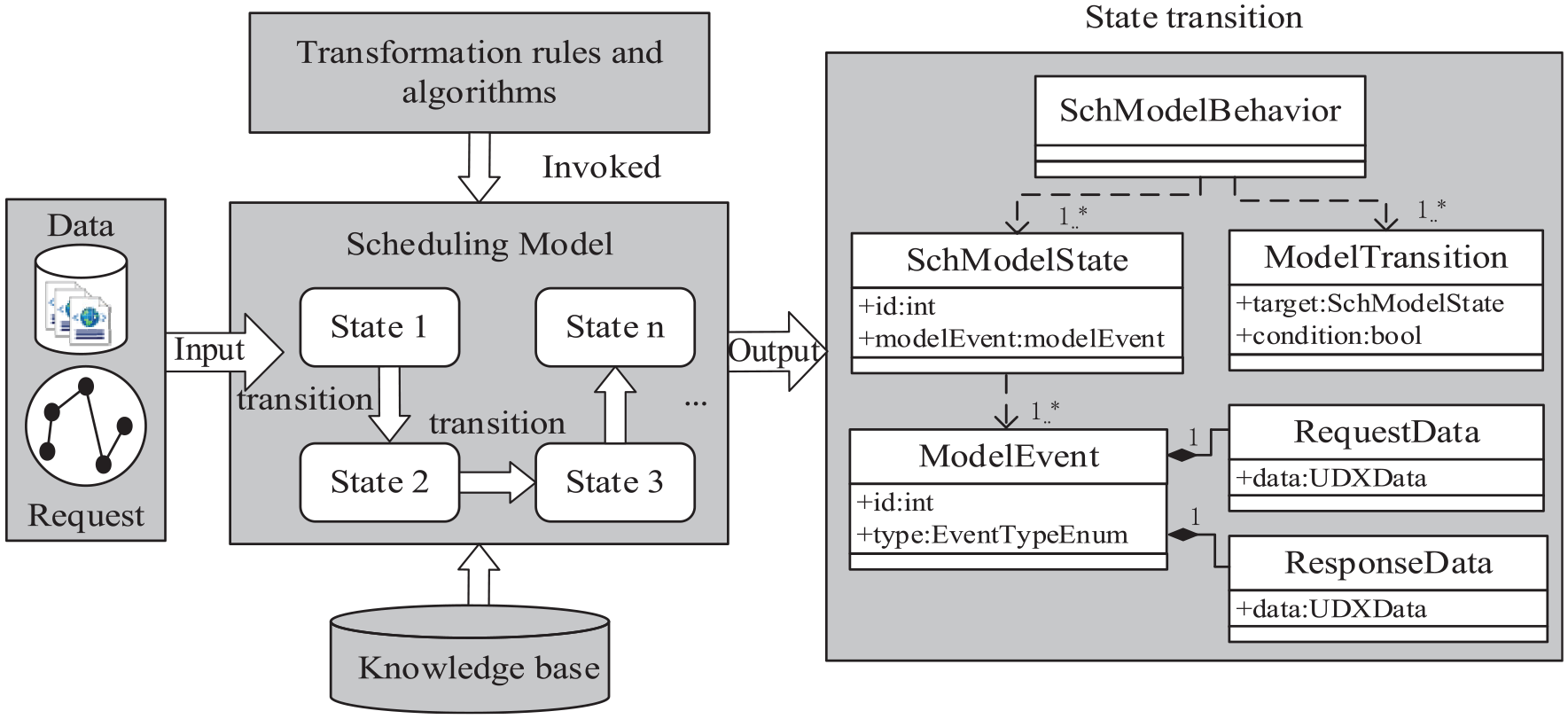
Interaction during execution.
As shown in Figure 6, the model knowledge behavior interface including the SchModelState, RelatedDataSet, ModelEvent, RequestData, and ResponseData of the SchModel, as well as the three basic model properties (SchModelApp, SchModelFunc, and SchModelBasic) and the model state enumeration <enumEvent-Type>. ModelState includes one or more model events; each of them represents the state migration and mapping changes in the model.
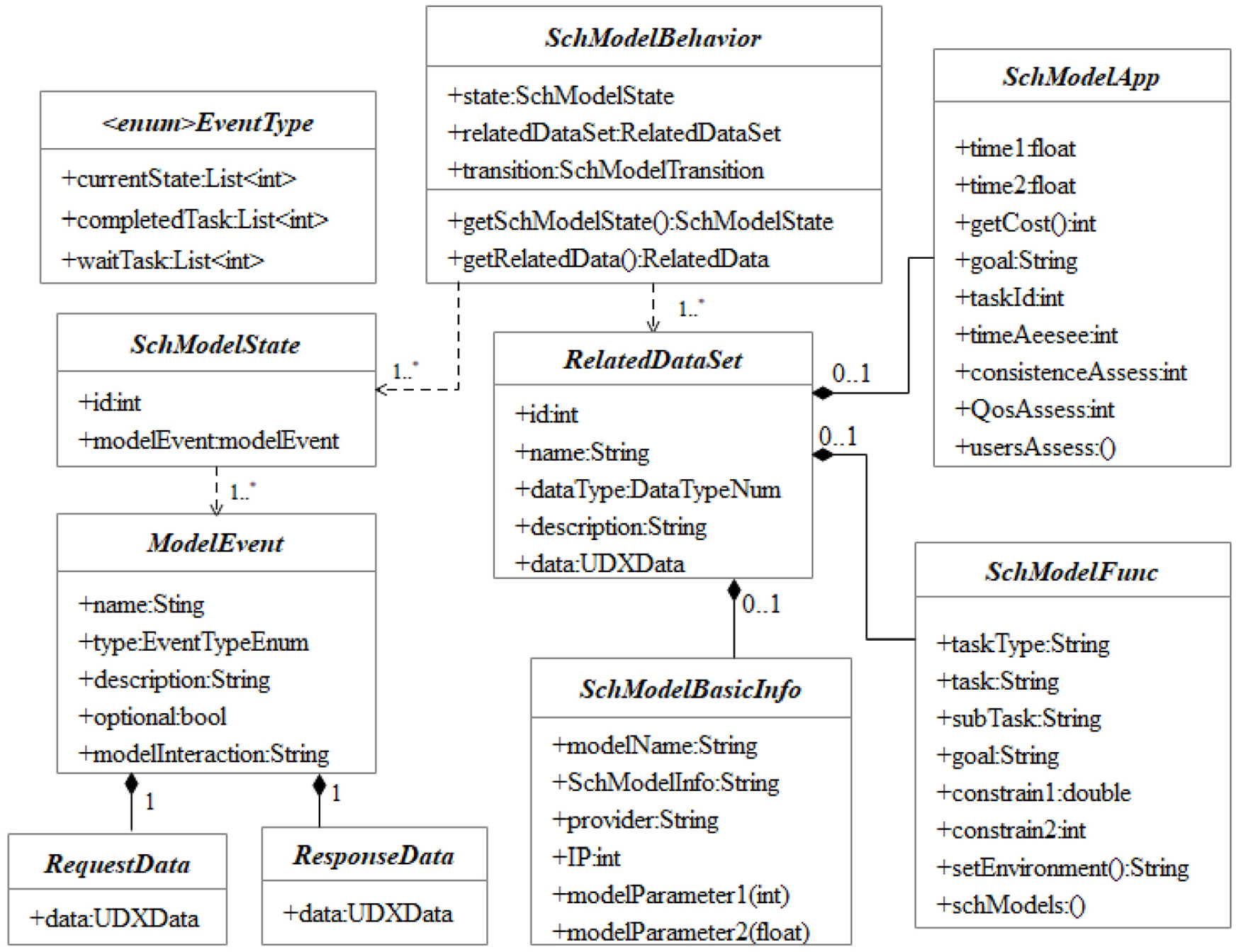
Behavior diagram of production scheduling model.
The knowledgeable encapsulation process of steel scheduling model
The process of model knowledgeable encapsulation, as shown in Figure 7, is as follows: (1) General representation of scheduling model. The model provider analyzes the model and extracts the general information (such as target, constraint). (2) General description of scheduling model. Use the model description template to describe the model (to realize the knowledge description interface of the model). (3) Encapsulation of scheduling model. The computing logic of scheduling model is abstracted into the state transition and the “kernel” to running (to realize the model knowledge behavior interface). (4) Publish scheduling model. The implementation of the model publication interface requires the help of the model provider, collects, and arranges the dependencies, and the running environment of the scheduling model (to realize the model knowledge publication interface). (5) Knowledge mapping of scheduling model. There will be knowledge transfer and exchange in the scheduling process of model, so the knowledge mapping mechanism of the scheduling model is established.
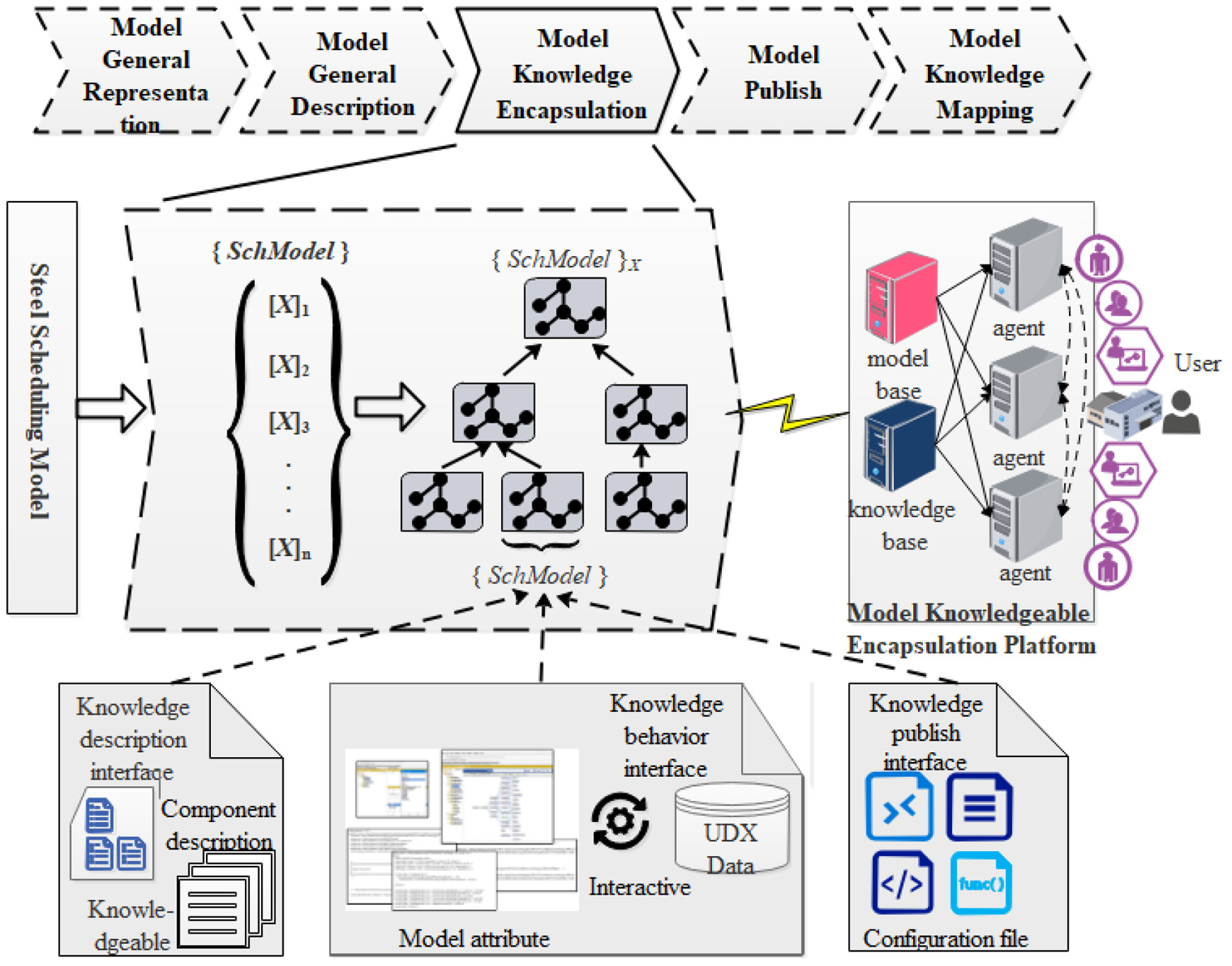
Model knowledgeable encapsulation process.
As shown in the middle part of Figure 7, through the description, encapsulation, and publishing operations, scheduling model is encapsulated as the scheduling model knowledge unit {SchModel}. The knowledge exchange and mapping between the scheduling model knowledge units will form the scheduling model class {SchModle} x . Through the integration of the model base and knowledge base, the scheduling model will be published on the model knowledgeable encapsulation platforms for different types of model users.
Knowledge mapping of steel scheduling model
The knowledge mapping is to exchange knowledge among different knowledge units and form new knowledge. According to UDX data structure (node and kernel), as shown in the left part of Figure 8, theSchModel as a tree structure that contains nodes and edges. The nodes are described as different levels of SchModel. The edge is the relationship between the SchModel knowledge. In the middle part of Figure 8, the model knowledge unit is divided into three levels that called knowledge mapping space.
The complete knowledge unit service of SchModel was represented as
The knowledge unit of SchModel was represented as
The inside of the knowledge unit of SchModel was represented as
According to the description of model knowledge units in different levels, there exists the mapping relationship between models
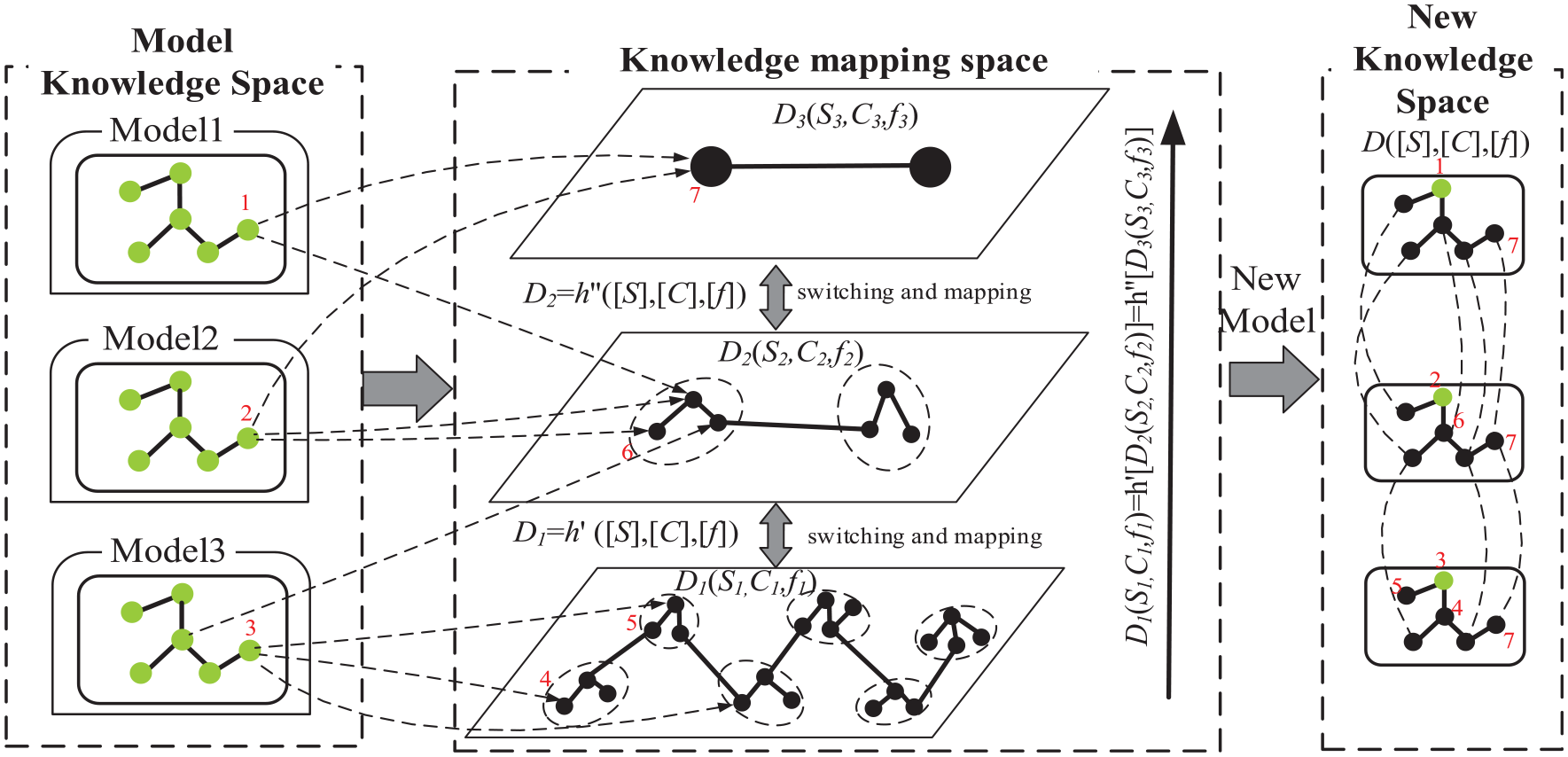
Knowledge exchange and mapping of steel production scheduling model.
Example of knowledge encapsulation of steel production scheduling model
As shown in Figure 9, the encapsulation processes are demonstrated used XML. The upper left part of Figure 9 shows the encapsulation model files, execution program, runtime source, and dependencies of scheduling model. The model basic code associated with the web service invocation command is adopted, as shown in the top right of Figure 9, including model knowledge description interface, model knowledge behavior interface, and the model knowledge publication interface. The description documents of model are built with XML, as shown at the bottom of Figure 9. The description interface of model shows the attribute node-set and its child node attributes of scheduling model. The model behavior interface displayed as the change in model state, including the start and the end of different model events, as well as the loading and response of related data. The model publication interface shows the platform environment, dependencies, user permission settings, and other associated resources when the model is running.
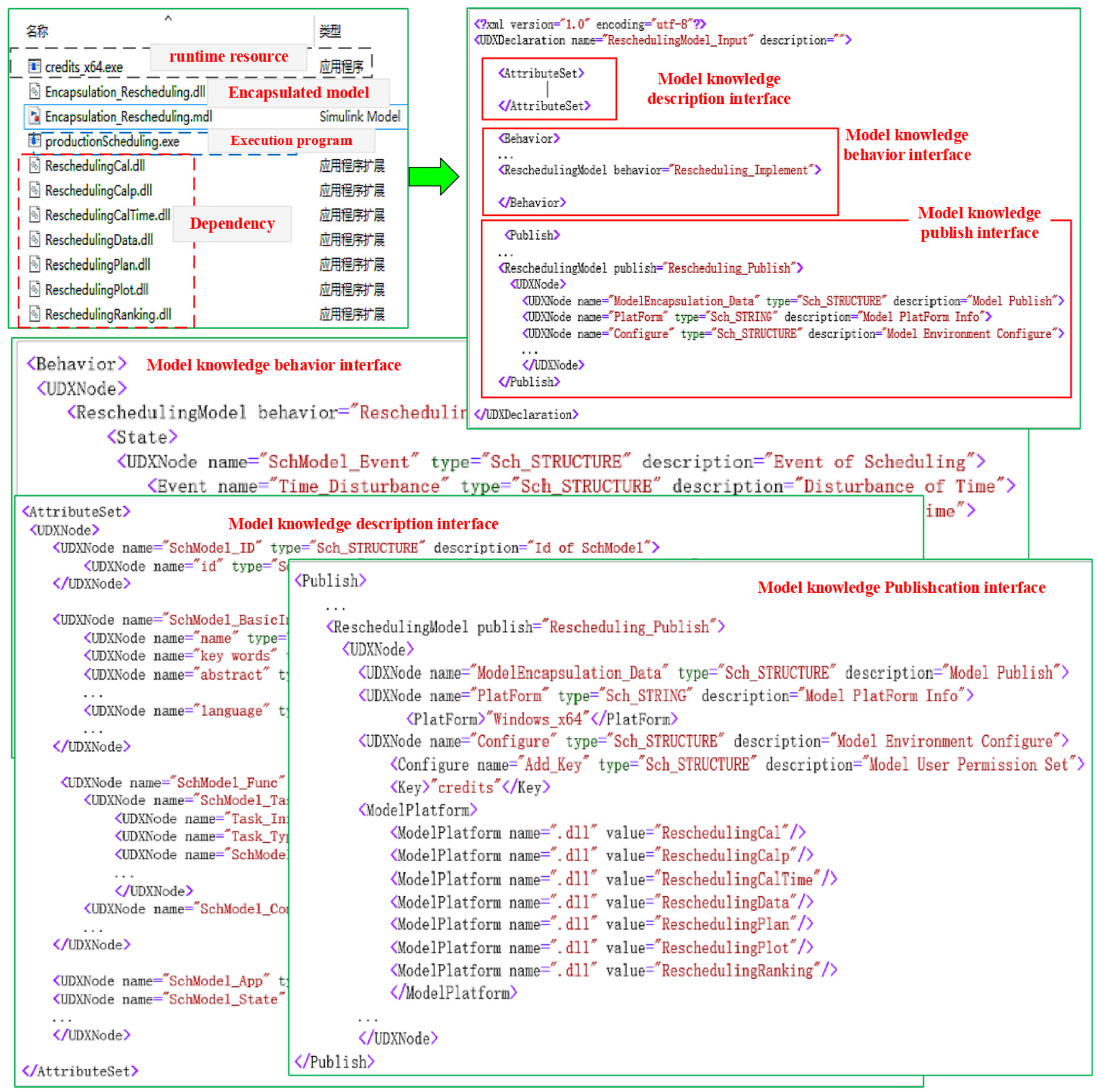
Encapsulation case based on rescheduling model.
In Figure 10, model dynamic construction and reuse process are presented. The model description panel can help model providers describe model properties and basic information. The model behavior definition panel describes the execution status and obtains relevant information of model. The model data definition panel is to define and transform the data in the process of model execution. The model resource panel contains the primary classification and retrieval services of model resources. The function of model operation panel is to run the encapsulated model data after the model is validated. When the encapsulation model unable to satisfy the requirements, the model will be re-defined in the description panel, behavior definition panel, and data definition panel. Through the three panels, the basic information, parameter, data set (including input data and output data), the kernel of each model attribute, and the state of the model will be modified. Based on this, the model only needs to modify some data and information. A new model will be quickly constructed.
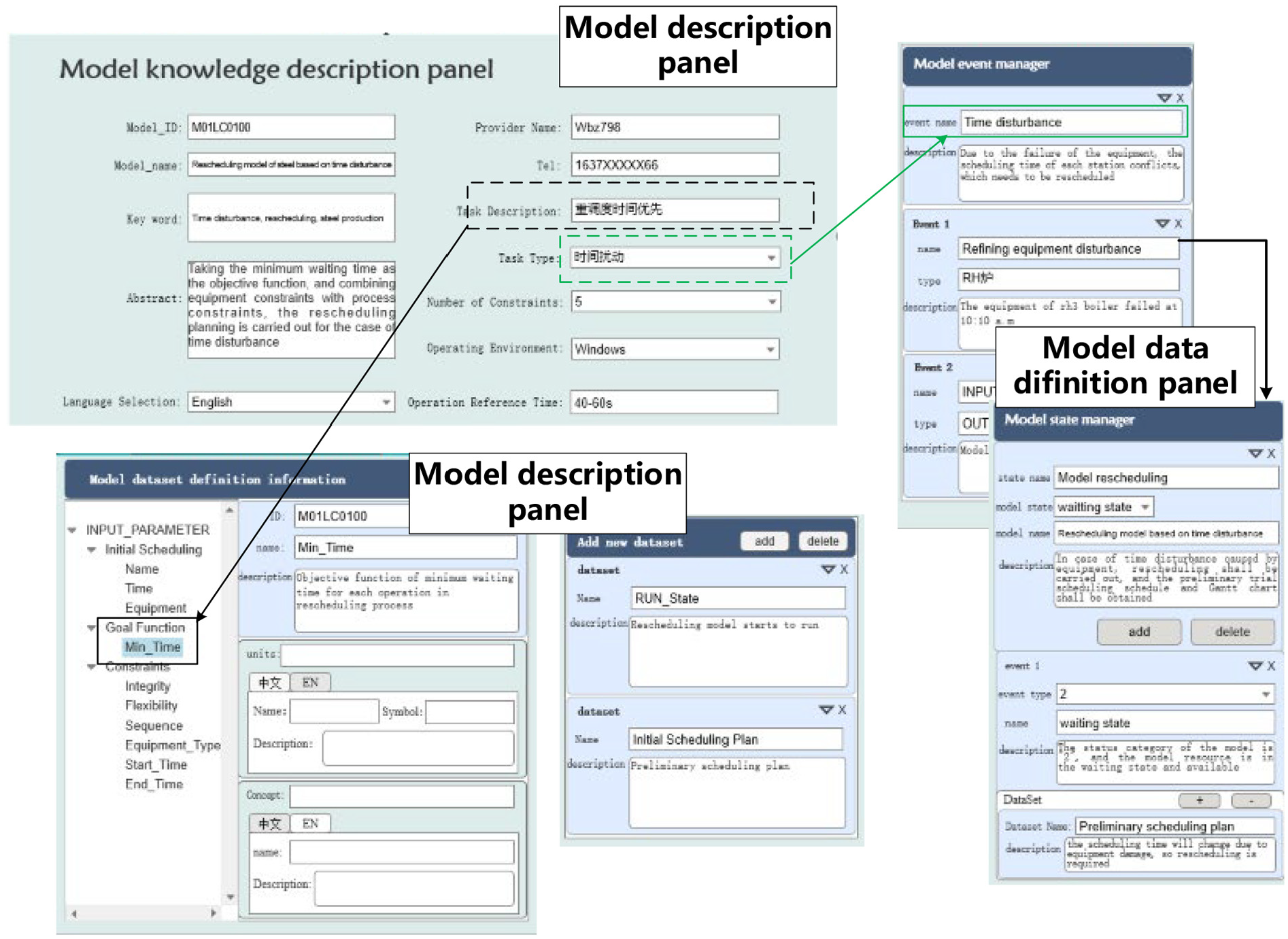
Model dynamic construction and reuse.
In Figure 11, a web-based scheduling model knowledge encapsulation platform is presented. It includes the home page (Figure 11(a)), model knowledge description panel (Figure 11(b)), model behavior definition panel (Figure 11(c)), model data definition panel (Figure 11(d)), model resource panel (Figure 11(e)), and model run panel (Figure 11(f)). The model resource panel contains the primary classification and retrieval services of model resources, as well as the basic information. The model knowledge description panel, model behavior definition panel, and model data definition panel are developed to help model demander to modify the model parameter, characteristic, and other data set. The home page manages the other panel, and publishing or retrieval model, as well as provides updated information. Through this model service, the user can make the scheduling model quickly reuse and dynamic construction.
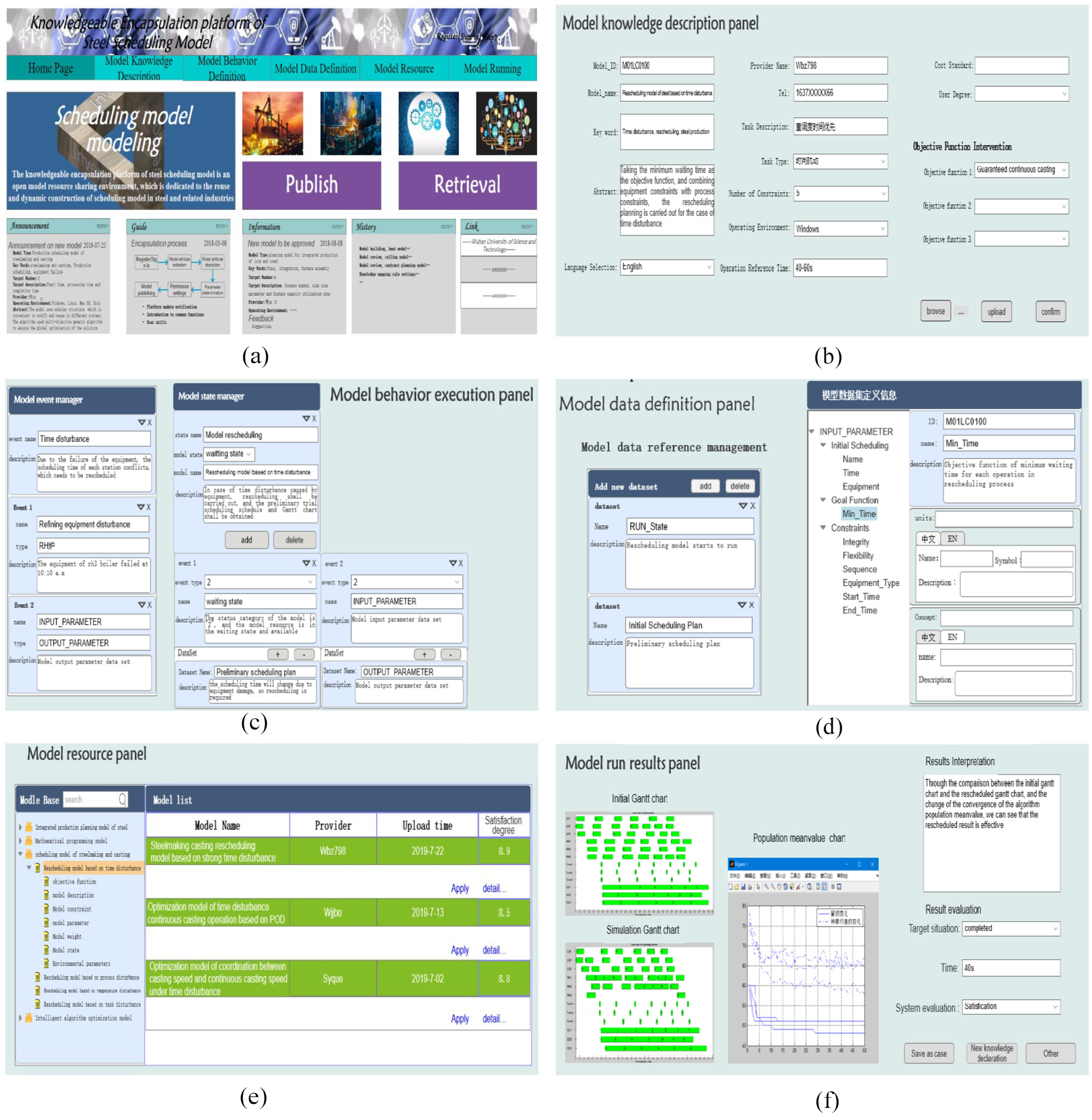
Scheduling model knowledgeable encapsulation platform: (a) Home page. (b) Model knowledge description panel. (c) Model behavior definition panel. (d) Model data definition panel. (e) Model resource panel. (f) Model run panel.
In Figure 11, the steel rescheduling model based on time disturbance is encapsulated. There are three LD, seven LF (2 LF, 3 RH, and 2 VD), and three CC. The scheduling problem occurs when having three sets each of LD, RH, and CC. When RH3 fails, the casting time needs to be delayed, and maintenance needs to be done after the casting is completed. The original scheduling plan cannot be implemented. The occurrence time is t = 10:10, and the expected start-up time is t = 15:00. The detailed information is shown in Tables 1–3.
Equipment processing time.
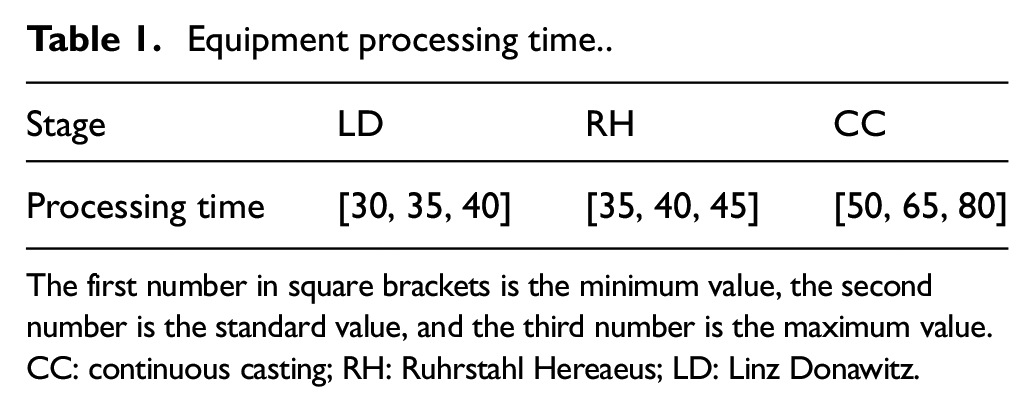
The first number in square brackets is the minimum value, the second number is the standard value, and the third number is the maximum value.
CC: continuous casting; RH: Ruhrstahl Hereaeus; LD: Linz Donawitz.
Transport time between stations.
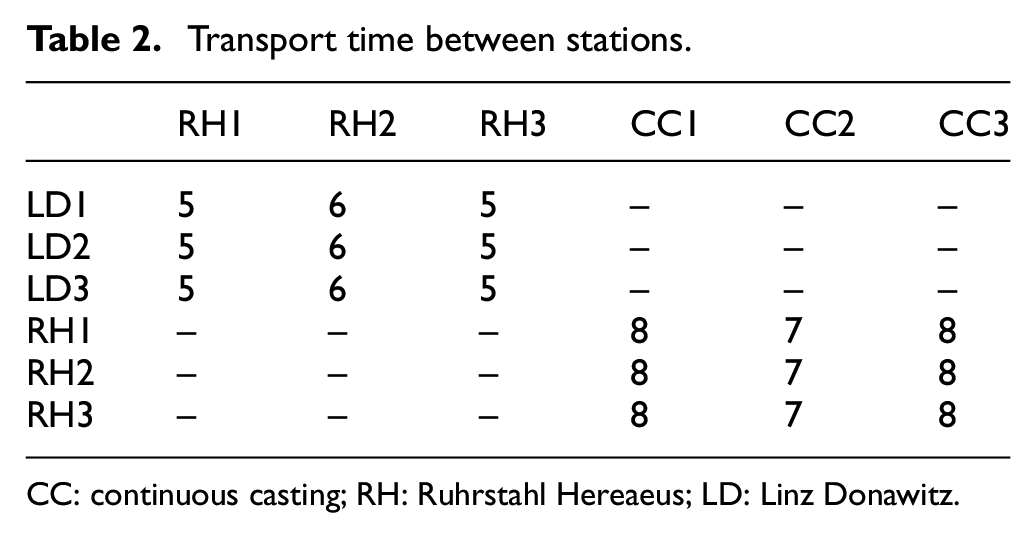
CC: continuous casting; RH: Ruhrstahl Hereaeus; LD: Linz Donawitz.
Equipment failure.
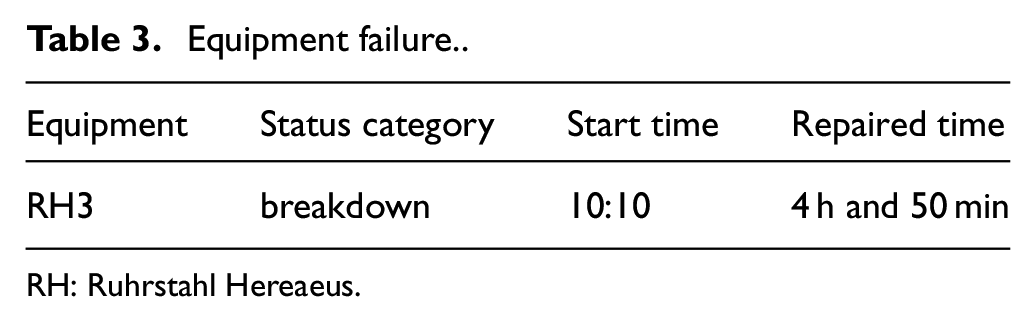
RH: Ruhrstahl Hereaeus.
The steel rescheduling model is defined using the model knowledge description interface. Then, the model events and model states of steel rescheduling model are represented, and their data and events are abstracted into recognizable parameters and data sets. Through the description and definition of the input data type of the model, the “kernel” of each model attribute is determined. Finally, by running the model, we get the scheduling Gantt chart and the change in population mean. Through the Gantt chart before and after scheduling, the validity of knowledge encapsulation of the rescheduling model is verified.
Conclusion
The knowledgeable encapsulation method of steel production scheduling model was purposed in this article, which signed for model reuse and dynamic construction in the field of steel schedule. And the main work is summarized as follows:
A complete model knowledgeable encapsulation strategy and framework were proposed for the steel schedule. The scheduling model is difficult to quickly reuse and dynamic construction, and it is leading the modeling inefficient. Thus, it introduced the encapsulation, and the encapsulation strategy and framework were established.
The knowledge description interface, knowledge publication interface, knowledge behavior interface, and the encapsulation platform were designed to support the model knowledgeable encapsulation. The description interface and the publication interface completed model description and publish. The behavior interface includes model states, change, and event execution.
Based on .net, an experimental model knowledgeable web service platform was developed. Through the platform, a rescheduling model was encapsulated to verify the effectiveness of the knowledgeable encapsulation method.
However, the research of model knowledgeable encapsulation still needs to be improved. It is a challenge to express the steel scheduling model in a more straightforward and more structured way. The models’ construction still requires programming knowledge and a large number of manual operations. Besides, after the model was encapsulated, the knowledge mapping and exchange between models are also a complex problem. Next, we will study the model knowledge mapping and model intelligent building under the steel production scheduling problem.
Footnotes
Declaration of conflicting interests
The author(s) declared no potential conflicts of interest with respect to the research, authorship, and/or publication of this article.
Funding
The author(s) disclosed receipt of the following financial support for the research, authorship, and/or publication of this article: This work was supported by the National Natural Science Foundation of China (Nos. 51975431 and 71271160), and Beijing Science and Technology Major Project (No. Z191100002719004).
