




Abstract
This study draws a holistic view of the supply chain with three service strategies – namely, after-sales service; maintenance, repair and operations; and the product-service system – by analysing over 71 articles in this field. In this investigation, the content analysis is used to scrutinize the research to establish the knowledge, reveal the research opportunities and propose research strategies. The supply chain for product-service system depends more heavily on the implementation of the cooperation, collaboration and integration principles in operation. However, a complete analysis reveals that those crucial principles did not embody in current literature. Current research also failed to discuss the service operation decisions by modelling the intricate relations among them in a broad product-service supply chain context. Thus, the future research directions include developing service demand forecasting models; combining the time-series methods and the causal methods; establishing service resource planning models; addressing the relations between service deliverables, service capacity and the service resource; and strengthening the quantitative evaluation of the product-service supply chain performance with a systemic view. Moreover, by addressing the principles of cooperation, collaboration and integration, the added values of this review are the proposed research strategies for integrated forecasting of product services, integrated product-service resource allocation and scheduling, and systematic performance evaluation of the product-service supply chain. The findings and the proposed research strategies develop an in-depth understanding of product-service supply chain applications and serve as a basis for future research.
Introduction
The global market is on the shift from product to service in the last decade. Traditional manufacturing firms are striving to change their product-centred strategy by offering the product-service packages;1–3 however, great arduousness was found in practice.4,5 One of the main impediments lies in the service supply chain (SC) management. The product-service supply chain (PSSC) not only seeks to reduce the service cost and improve customers’ satisfaction but also needs to pursue the environmental and social goals.6–8 Manufacturers’ long-lasting responsibility of the products entails the firms to fulfil customer’s service requirement efficiently.9,10 The product-service providers are encouraged to integrate the service resources belonging to partners and cooperate with all the actors of the PSSC to enhance its competitiveness.
There are three service strategies discussed in literature, namely, after-sales service (ASS); maintenance, repair and operations (MRO); and the product-service system (PSS). In particular, the new emerging PSS extends the service connotation by covering the service activities over product lifecycle. Ingersoll Rand, 11 who is one of the largest air compressor manufacturers in the world, offers on-site service, such as air compressor installation; online service, for example, remote technological training; and offline service, such as air compressor cleaning and upgrading. Even for the air compressor overhaul, there are options for repairing the product in customers’ company or transferring to its service factory. All the service items offered by Ingersoll Rand can be integrated into customized service packages in their PSS. The SCs associated with the service strategies are mentioned as PSSC applications in this study, which are interpreted as SC for ASS, SC for MRO and the SC for PSS. Academia and firms’ interests in the SC management under those service strategies have been growing recently. This can be seen by numerous papers published in this field referring to their definitions and specific service scenarios. The connections of the service supply systems and the underground foundations for the successful service strategy need to be clarified and developed in detail, in order to provide scholars and practitioners with methodologies capable of clearly expressing and quantifying their service potentials. It therefore seems appropriate to follow up the reviews performed in 2006 and 2019 with a new paper that takes stock of developments since then and answers questions such as following:
Research Question 1. What are the identifications and connections among the PSSC applications?
Research Question 2. What are the current research focuses and the research gaps in this domain?
Research Question 3. What are technical points to extend the current research streams?
To establish the knowledge in this field further, the SCs under different service strategies are compared by examining their definitions and critical elements. And then, in order to extract the future opportunities and structure research strategies in PSSC, we analysed the extant literature on product-service demand management, product-service resource (PSR) allocation, information and communication technologies (ICTs) and the performance evaluation. In this study, the content analysis method is used to scrutinize the literature in order to reveal the research gaps and draw research strategies.
The article proceeds as follows. The research methodology is introduced in the ‘Research methodology’ section. The comparison of the PSSC applications is presented in the ‘Comparison of the PSSC applications’ section. In the ‘PSSC management decisions and modelling techniques’ section, an extensive analysis of the research is provided. A list of issues requiring further research is highlighted in the ‘Research gaps and opportunities’ section. The future research strategies are proposed in the ‘Proposed research strategies for PSSC’ section. Finally, a conclusion with the contribution of this study is given in the ‘Conclusion’ section.
Research methodology
The content analysis methodology is used for the literature analysis in this review. Content analysis can be used as an instrument not only for determining key ideas but also for measuring comparative positions and trends in reporting and themes in publications. 12 The strength of this method lies in organizing the literature in various databases in a way that simplifies and clarifies their relationships, 13 and making replicable and valid inferences from texts to the contexts of their use. 14 This retrospective aspect of content analysis also allows it to be unobtrusive, thereby eliminating unwanted interaction effects between subject and researcher. 13 The literature is collected primarily from electronic databases such as ScienceDirect, Emerald Insight, Taylor & Francis and Inderscience.
A keyword-based search is effective and efficient in addressing a specific topic. Based on a preliminary scan of the literature, the combined keywords were used to generate a reasonable list of results, namely, service/servitization/repair/maintenance+manufacture/SC/demand/spare parts/repairable part/information/resource. Afterwards, since this investigation deals with the service for complex physical product or equipment associated with long-range service, the articles that investigate the intangible service only, such as tourism services, port service, aviation services and the consumer product, like food, are discarded for further analysis. Moreover, the research results were limited to academic articles under the assumption that high-quality articles are eventually published there. Hence, doctoral theses, network studies, proceedings and books were excluded.
The vital components in content analysis could be phrases, topics or other characteristics. 15 The selected literature is then segregated into three content categories, as shown in Figure 1. The service strategies are considered as ASS, MRO and PSS. The implementation of these service strategies requires the support of the PSSC. The analysis of PSSC applications can be compared in a set of components, such as objectives, actors and relationship of partners. The research in this field is categorized into four groups, which are demand forecasting, resource management, application of information technology and performance evaluation with a view of SC. The PSSC management decisions and the modelling techniques are analysed. Finally, the current research gaps are highlighted, and future research strategies are proposed.
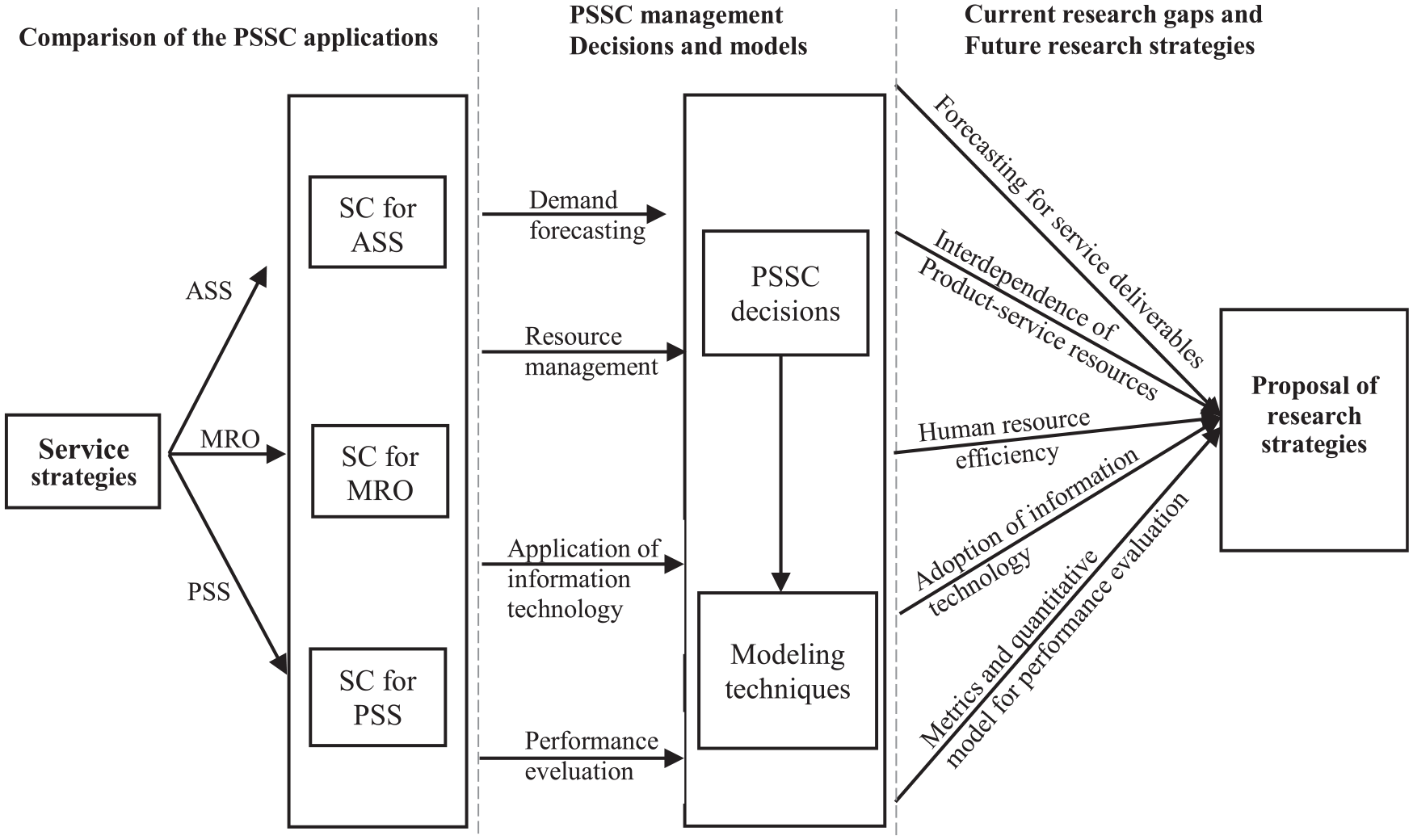
Framework for the literature analysis.
From all the collected literature, 71 articles were found to be closely related to this study. The papers are grouped for different PSSC applications and management focus, as shown in Figure 2. The sizes of the circles in Figure 2 indicate the research intensity under each group. Very few of the studies that are failed to be categorized into the groups in the horizontal axis are not reported in Figure 2, such as the investigations on PSSC framework by Xu et al. 11 and on service parts logistics network design by Candas and Kutanoglu. 16 The review shows that most of the literature focuses on SC for ASS. Similarly, the PSR management has attracted most scholars.
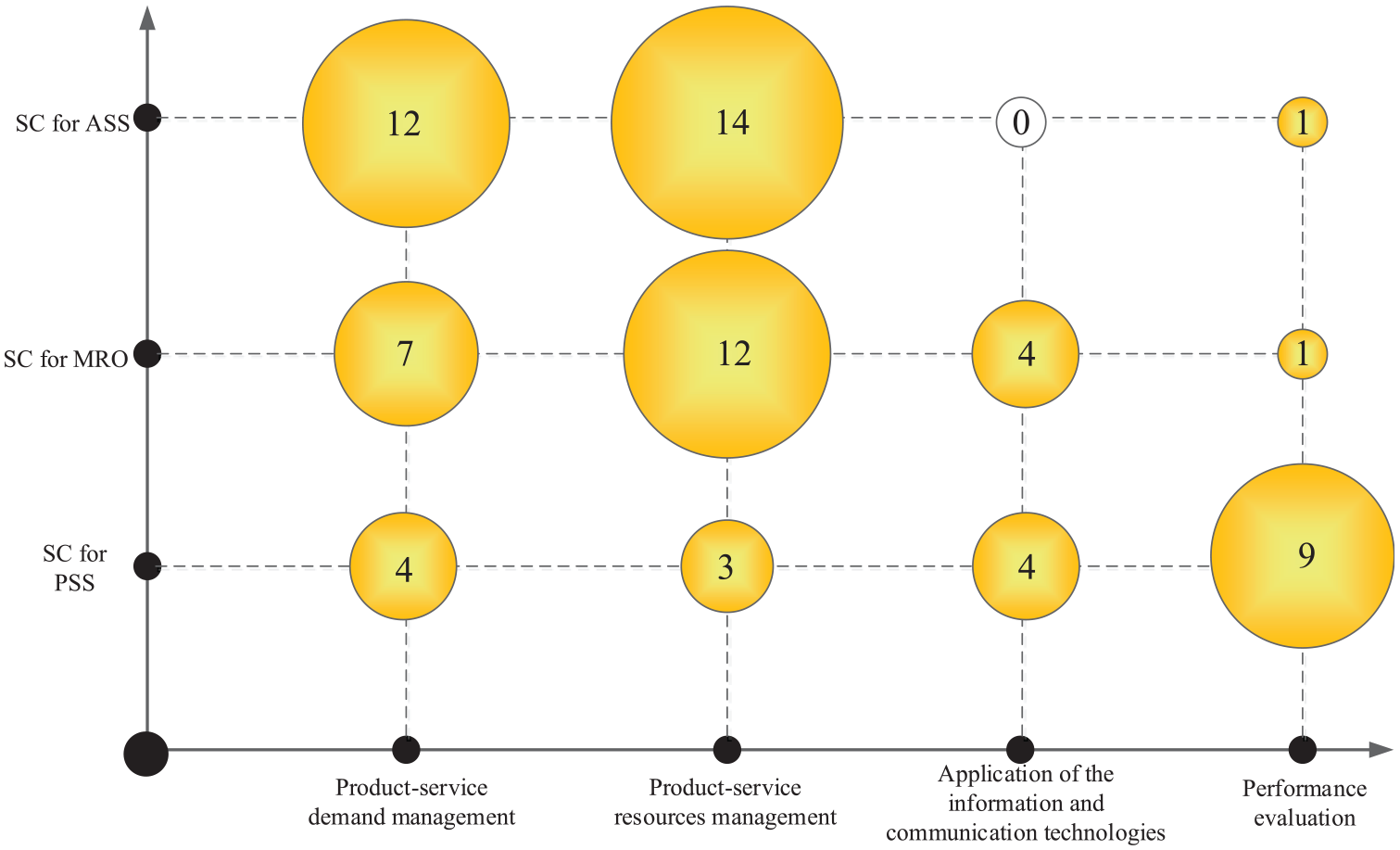
Research intensity for PSSC management.
Comparison of the PSSC applications
The ASS is often provided by manufacturer or retailer freely during usage,17,18 especially when the customer experiences any problem.19,20 Thus, the SC for ASS provides supporting tangibles to customers economically and timely in the products’ usage. The maintenance consists of more service items than the ASS, like online-inspection.21–23 The SC for MRO aims to keep the equipment reliable and functionally available for its intended use economically.10,22,24 As a result, the original equipment manufacturer, manufacturers, distributors, customers, third-party service provider and kinds of integrated suppliers should work closely with each other. Compared with other two service strategies, the PSS provides integrated tangible and intangible service and the network consists of suppliers, service providers, consumers and other supporting units.25,26 For example, Mori Seiki, who is a machine tool manufacturer, and Wollschläger, who offers a tool cabinet based on the remote service technology, work closely and provide value-added service for their common customers, such as maintenance, field service, spare parts business and customer training, and remote service. 27 Thus, a PSS provider and its partners need to align their profit incentive mechanism, rather than a simple formal relationship. In particular, the co-creating value should be highlighted in SC for PSS.28–30
In a general sense, the SC for ASS and the SC for MRO represent the systems responding to customer demand afterwards and in advance, while the SC for PSS represents a system responding to customer value. The SC for ASS is a customer demand-driven system, the SC for MRO is a cost-driven one and the SC for PSS is a value-driven system creating values for all the stakeholders sustainably and ecologically. The value co-creation in PSS requires firms to develop new business models to support both the benefit sharing and risk sharing among all the partners, including the customers, who are often only treated as service receivers in ASS or MRO. Consequently, compared with other PSSC applications, the collaboration and cooperation are underlined mostly in SC for PSS. The service activities in SC for PSS cover most of the implicit and explicit service demands along product lifecycle. Thus, the SC for PSS gets more intricate due to its extended function of the SC integration and the product lifecycle management. Both the industry and academia claim that the PSS is the most promising service strategy. It is essential to understand service supply system in the context of PSS for firms and scholars.
PSSC management decisions and modelling techniques
Product-service demand management
The customer demand on PSS environment is the concept with a rich connotation, which includes the spare parts, maintenance and other service packages. In order to reduce the supply lead times22,31 and improve the efficiency of the maintenance management of assets, 22 services demand forecasting has attracted a considerable amount of research in recent years, especially for spare parts. The customer demand under product-service environment also includes the maintenance, PSS and other service products. The adoption of forecasting methods is subjected to the availability of data on explanatory variables, such as the availability of historical demand, product sales and the failed component replacement.
The features of demands for spare parts can be different due to the types of the products and its application background, such as discontinued product, 32 intermittent demand31,33 and repairable spare parts. 34 Thus, a variety of methods are employed to predict the spare parts. Boylan and Syntetos 35 categorize the forecasting techniques for spare parts into two groups: causal methods and time-series methods. Wang and Syntetos 33 and Sheu and Kuo 36 link the spare parts forecasting to the equipment maintenance activities. Both the results show that the maintenance-driven models are associated with a better performance than the well-known time-series methods. However, most of the present work focused on the one-dimensional preventive maintenance, such as the usage of time-based preventive maintenance and corrective maintenance. Hu et al. 37 introduce a two-dimensional – namely, calendar time and usage time – preventive policy for spare parts replacement based on both calendar time and usage time. Dombi et al. 38 develop a knowledge discovery–based approach considering the turning points of the purchase lifecycle curve. The main strength of this approach is able to indicate the turning points of the purchase lifecycle curve. Zhu et al. 31 combine the extreme value theory with an empirical forecasting method to predict the overlapping lead time demand for spare parts.
Only a few studies are observed on forecasting for maintenance or PSS. Using grey theory and evaluation diagnosis, Sheu and Kuo 36 construct a forecasting model for the prediction of preventive maintenance timing of various machines. Browell et al. 39 develop a probabilistic approach to the short-term scheduling problem based on a cost-loss model for individual maintenance missions and probabilistic forecasts of appropriate access windows. Their analysis shows that this method is able to increase the utilization of possible access windows compared to using deterministic decision rules. Baptista et al. 40 adopt an auto-regressive moving average model along with data-driven techniques to forecast the fault events for predictive maintenance. However, since the PSS consists of a set of deliverables, the predication for PSS is more intricate than that in other service strategies. As claimed by De Coster, 41 the recognition of forecasting approaches for PSS applications is still unclear. De Coster 41 establishes a collaborative approach based on PSS staff being geographically co-located to predict the revenues of the PSS. In this study, three revenue sources, which are the PSS contracts, product sales and the bespoke/consulting, are recognized for PSS firms. The collaborative approach for PSS forecast is extended by Xu et al. 42 They develop a multi-level combined forecasting model for the PSS of the air compressor. The air compressor PSS are broken down into three levels in a hierarchical service structure. The first level represents product-service task, like air compressor installation; the second level refers to service item, like skid-mounted service; and the third level is service package, like super energy service. A kind of service at the high level often contains several types of services at the low level. By establishing the relations among the deliverables in the model, they show that the mean relative deviation of the forecasts is reduced sharply at almost all the air compressor PSS levels.
PSR management
Service organizations should manage service resources optimally to support the product-service provision. Owing to the variety of the service deliverables, the required service resources include material resource, human resource, information resource, knowledge resource and other auxiliary resources. However, most of the observed literature focuses on the spare parts and MRO resource; 43 only a few of them discuss the human resource and the comprehensive PSS resource.
There is a trade-off between the service quality and the inventory levels. The former promises customer satisfaction and the latter makes such practice expensive. 44 Thus, the inventory level is a critical decision in spare parts management. The spare parts SC is often a multi-echelon divergent network with multiple repair shops. Rezapour et al. 45 develop an integrated model to qualify the outflow of the facilities. The result shows that the bullwhip effect contributes to neutralize the impact of uncertainties. Adopting a genetic programming–based symbolic regression method, Ghaddar et al. 46 investigate the spare parts stocking problems with the level of repair analysis. It is worth noting that there is a fast growing literature on optimizing maintenance policies and spare parts jointly, such as those by Panagiotidou, 47 Wang and Liu, 48 and Zhang and Zeng. 49 Those studies share the similar finding that the firms are able to reduce the inventory cost with a slight loss in the service level by optimizing the maintenance and spare parts inventory policies jointly. Authors also connect the inventory level with other decisions in MRO, such as the spare parts allocation, 24 production quantity 50 and the date of parts’ order. 51 Li et al. 50 develop a stochastic programming model for SC planning of MRO spare parts. However, this investigation fails to incorporate the user’s benefits when minimizing the cost of the distribution, production costs and the storage. Using an efficient approximation method, Rezaei Somarin et al. 24 develop an optimal emergency resupply policy for repairable parts.
Since a set of resources should be arranged simultaneously for service delivery, it is essential to borrow qualitative or quantitative models to optimize resource preparation. Yeddanapudi et al. 52 and Saygin and Tamma 43 develop strategies and principles for maintenance resource allocation. Manzini et al. 23 establish a mixed integer linear programming model to schedule the preventive maintenance activities with cost, reliability and resource constraints. By introducing the radio-frequency identification (RFID) technology, Saygin and Tamma 43 propose the resource allocation policies for aerospace maintenance via simulation. uit het Broek et al. 53 design a simulation model considering stochastic processes, such as weather patterns and component failures, to investigate resource sharing of the jack-up vessels for offshore wind farm maintenance. Since human is the most active role among the service resources, the salaries of the workforce often dominate the maintenance-related cost.23,54,55 In order to lower the size of the workforce, Khalili et al. 56 propose a fuzzy queue method to reduce the idle time of the workforce. Considering the cooperation of the cross-trained workers, Xu et al. 57 develop 0–1 programming model and the Non-dominated Sorting Genetic Algorithm–II (NSGA-II) to schedule the service engineers. Ertogral and Öztürk 58 introduce a mixed integer programming model for production scheduling and workforce capacity planning with the purpose of minimizing the inventory holding and workforce-related cost in airline industry. Only two articles are observed to handle the service resources with a holistic view in PSS. Cao and Jiang 59 present a non-linear linear model to configure the warehouse PSS resources. The hierarchical structure of the resource configuration is developed, and the optimal solution is obtained by the analytical target cascading algorithm. Aiming to improve the customer satisfaction and resource utilization efficiency, Ding et al. 60 propose a non-linear model for the service resource scheduling for PSS.
Application of the ICTs
ICTs include a wide range of software and hardware systems used for data generation and processing. 61 It is an essential enabling tool for the identification of the unique product or part as well as their working conditions. 62 In order to decrease the process time in an MRO shop with ICTs, a hardware simulation method is introduced. Wei et al. 63 propose an ICT handheld solution to track and trace MRO activities for aerospace industries. Shih et al. 28 provide a visual mapping method by highlighting quantitative evaluation of the application of the ICTs in PSS. With the purpose of ICT selection for freight transport, Muerza et al. 61 establish a technological shrub that allows interdependencies between the functionality systems and a multi-criteria selection approach. Mourtzis et al. 64 develop a cloud-based platform for condition-based preventive maintenance in PSS. Unlike traditional maintenance models, Xia et al. 65 consider both the product-service paradigm and the individual machine degradation, and draw a leasing policy to schedule the preventive maintenance operations. Rymaszewska et al. 66 develop a framework to connect the value creation and the servitization processes with the data generated by the ICTs.
Performance evaluation
It is necessary to build a general and recognized methodology to evaluate and qualify the effectiveness and the efficiency the service systems. 67 Concerns have been paid to the performance evaluation on PSSC by developing appropriate metrics and approaches.67,68 The metrics discussed in literature include the cost/profit, competitiveness, quality of service, flexibility, resource efficiency, innovation, collaboration and the sustainability.
Almost all of the existing studies distinguish the cost or profit in a service system, followed by the metrics of the competitiveness,67,69–73 quality of service68–71,73,74 and the flexibility.68–70,72,73 Comparably, the innovation in the SC operation or service design and the collaboration among the actors have been received limited attention in literature. The former is only mentioned by Danxia et al. 70 and Durugbo and Riedel, 67 while the latter is only valued by Durugbo and Riedel, 67 Danxia et al., 70 Cho et al. 71 and Medini et al. 74 In a general sense, both the strategic indicators and the operational indicators have been incorporated in the existing studies. Gaiardelli et al. 69 propose a framework for the performance measurement of SC for ASS by integrating the indicators at various SC levels. A model is proposed by Durugbo and Riedel 67 for evaluating the readiness of collaborative networked organizations for PSS provision. Both the structural evaluation of the service network and the behavioural evaluation of the SC actors are included. In particular, this investigation attaches importance to the flexibility, innovation and the collaboration of a service system, as are often neglected by other literature. The similar metrics are also valued by Danxia et al., 70 who consider 22 assessment criteria and establish a performance evaluation system based upon the data envelopment analysis and the analytic hierarchy process. Medini et al. 74 combine the performance assessment and PSS design to assist the PSS implementation. Sofianti 68 develop a framework to measure the PSS of generator set distributors with the perspective of two dimensions: customer perspective and provider perspective, and tangible part and intangible part. Kjaer et al. 72 present the guidelines consisting of six steps to assess the environmental performance of PSS by elaborating the lifecycle evaluation process. Tseng et al. 73 introduce a hierarchical network based on the Fuzzy Delphi Method and analytical network process to evaluate the sustainability of the service SC. It is also worth noting that the approaches based on hierarchical network are adopted by Danxia et al., 70 Cho et al. 71 and Tseng et al. 73 in evaluating the performance of a service system.
Research gaps and opportunities
Aiming to promise an effective and profitable PSSC, the article examines the current research in terms of product-service demand forecasting, PSR management, ICT applications and performance evaluation. The research gaps and opportunities are discussed and summarized in the section.
The common forecasting approaches for service deliverables are still absent. The ability to satisfy customer’s requirement within expected time windows depends on the ability to predict demand. Most of the research in literature adopted the time-series methods, and the causal methods have not received enough attention. The forecasting approaches based on historical data have experienced difficulties in capturing service demand.21,45 Because the requirement for product services is influenced by multiple factors and the existing forecasting techniques are unable to guide the PSSC to arrange the service resource. Hence, the integration of multiple dimensions of the system is required to deal with the product-service forecasting, such as the geographical dispersed facilities and organizations, and the maintenance activities. The relations among different product-service deliverables also should be taken into account in the forecasting. The forecasts at different levels of the hierarchical PSS structure are not independent. 42 Thus, a general forecast model is required to combine the time-series methods and the causal methods by analysing the cause and the relations between different deliverables.
Little attention was paid to the interdependence of different PSRs. Firms are not able to prepare isolated service products in advance, because they are non-storable commodities. It is necessary to allocate the right resources at the right time to adapt to variational service demand. Nevertheless, the traditional scheduling techniques assume that each type of service resources is prepared independently. In practice, customers’ service demands could be generated simultaneously and the limited available PSRs should be allocated efficiently between them. 60 Studies in this area also can be extended by taking the repair prioritization of the products with various failure modes into account when allocating the service resources. Although there are some suggestions for various service resource optimization, the underlined mechanism that interprets how those resources form the service capacity is still under-investigated. Thus, research on this subject is also encouraged to address the relations between service deliverables, service capacity and the service resource.
Limited works have been reported from the perspective of human resource efficiency. The field service often requires the service engineers shifting between different customers. The efficiency of the human resource poses significant effects on both the service level and cost. However, it is common to treat it as a constraint in maintenance, such as the studies by Manzini et al. 23 and Touat et al. 54 The customer’s participation in the service delivery results in uncertainties in PSSC. With the aim of maximizing human resource efficiency, a robust service resource supply system is another research direction.
Limited works have been reported from the application of ICTs. ICT solutions can enhance visibility and the collaboration between the organizations via real-time data exchange in PSSC networks. Through the significance of exploring ICTs in MRO is recognized by Muerza et al., 61 Liu et al. 62 and Wei et al., 63 the application of advanced information technology deserves further investigation. New decision-making models and intelligent algorithms should be developed to support the online and real-time management optimization in the demand forecasting, inventory control, and logistics optimization. Moreover, the industrial big data analysis is also one of the promising techniques to improve the performance of the PSSC.
The literature is almost unanimous in quantitative evaluation of the performance of the PSSC. Studies have paid attention to the metrics and methods of performance assessment for service design and delivery system. However, most of them elaborate this topic with the view of PSS, like Medini et al. 74 and Sofianti, 68 rather than an SC perspective. Scholars are trying to develop appropriate evaluation system for PSSC, but as a complicated social technology application, the value proposition of broad stakeholders has not been incorporated in the performance management. A multi-attribute set of measures reporting the concerns both of the PSSC system and its individual firms needs to be developed. Nonetheless, the existing research is mainly manufacturer-oriented or customer-oriented, and neglects the interests of other stakeholders in SC. 72 The performance evaluation system can be enriched with a board indicator to better represent all the partners’ value propositions. The social and environmental aspects of the sustainability of the PSS also should be highlighted in the PSSC performance evaluation.72,75,76 Above all, current research in this field underlines the evaluation framework and the metrics development, and only very limited quantitative evaluation models are observed in the existing studies.
Proposed research strategies for PSSC
In this section, we try to put forward some ideas for the most urging research questions in PSSC, rather than seek to fill all the research gaps discussed above. Thus, we propose research strategies that require cooperation, collaboration and integration by all stakeholders in product-service prediction, PSR allocation and scheduling, and performance evaluation of the PSSC.
Integrated forecasting for product services
Although forecasting is a hot topic in SC, service forecasting is still an under-exploited field. As the product services are provided actively rather than a response to the downtime, accurate demand forecasting is incredibly important for optimal resource planning and balancing service supply and demand. 22 The deviation would be incredibly high when prediction model neglects the lifecycle structure. In light of the in-depth literature analysis, a forecasting framework with three dimensions for product services is put forward in Figure 3.
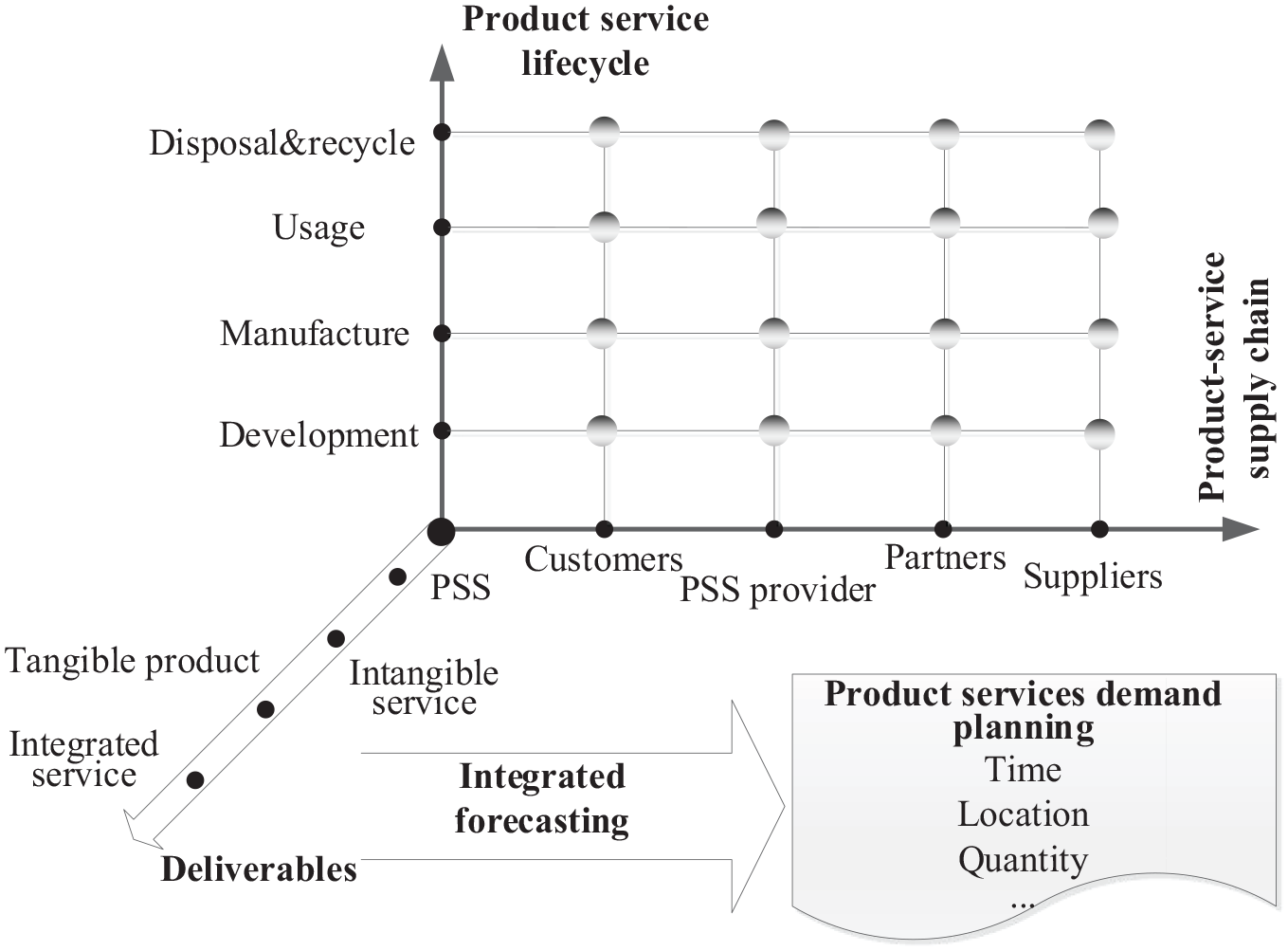
Three dimensions in integrated forecasting for product services.
The deliverables under the PSS strategy incorporate PSS, intangible service (such as repair), tangible product (such as spare parts) and the integrated service (such as spare parts replacement). The first dimension is to establish the correlations between the forecasts for different deliverables. For instance, the requirement for spare parts and the requirement for repair service are not independent, because customers have their own decisions to buy the spare parts and repair the product by themselves, or to buy the repair service including the spare parts. 42 The second dimension lies in the SC. Since the same deliverable is often offered by more than one organization in the PSSC, for instance, both the PSS provider and its supplier could be involved in the spare parts preparation simultaneously, 11 the extensive cooperation and collaboration along the PSSC are also necessary. The third dimension refers to the product lifecycle integration. The design information and the working condition would affect the lifespan of a component. For instance, the lifespan of an operating item is not only determined by the deterioration mechanism, it is also governed by the maintenance strategy.47,49 Consequently, it is essential to take advantage of the information collected at all the lifecycle stages for the product-service demand prediction. This framework forms the base for developing the mathematical forecasting models for further research. For firms, they are suggested to connect the service forecasting activity to PSS design and elaborate this framework to establish the customized service forecasting approach.
Integrated PSR allocation and scheduling
A flexible and integrated PSR management system contributes to the effective and efficient PSSC. The development of the service capacity depends on the appropriate distribution of the resources, as requires various resources being allocated coordinately.27,45,77 The PSR allocation and scheduling strategies are shown in Figure 4.
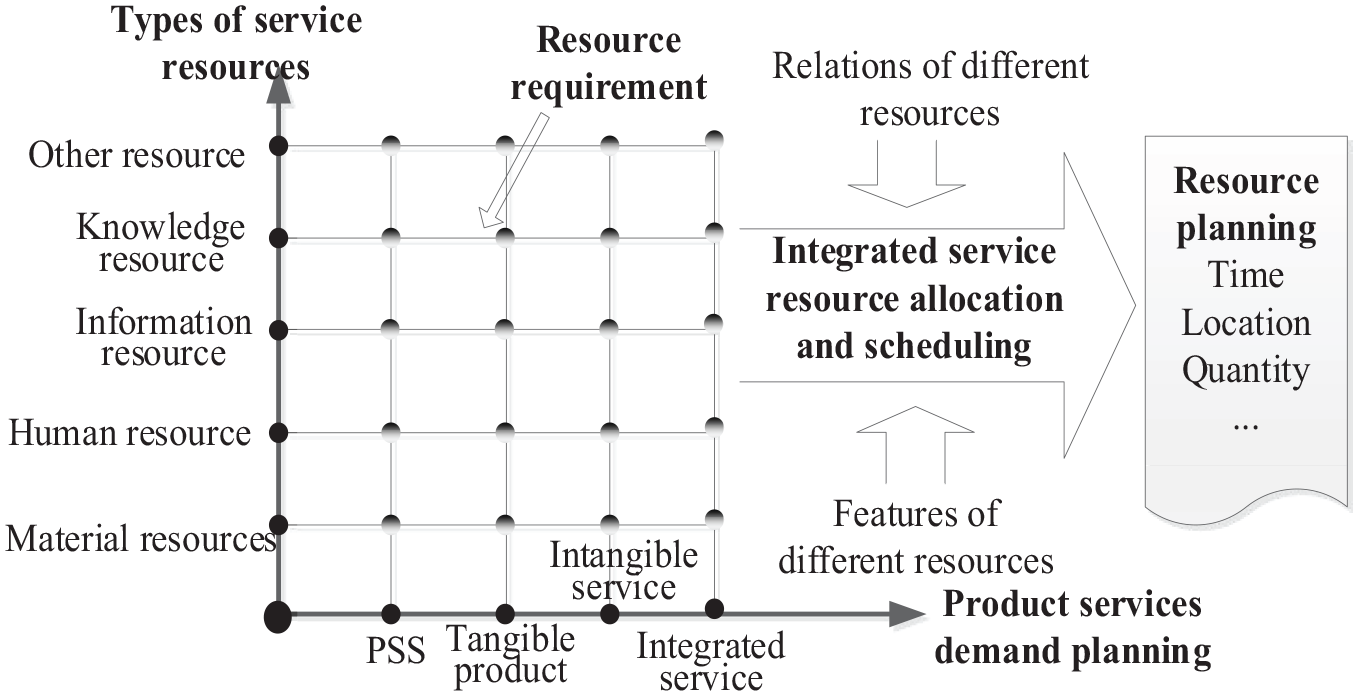
Product-service resource allocation and scheduling strategies.
The delivery of the service package relies on a set of PSRs. For instance, the firms should prepare the spare part, repair engineers, and the necessary tools synchronously when offering the spare part replacement service. Thus, the quantitative relations between the deliverables and the PSRs should be established in advance. Furthermore, the resources are multi-attributes, such as the fixed and removable, reusable and non-reusable. In particular, some PSR performs its function associated with another resource, for instance, the tool cannot form service capacity without engineers. The researchers can extend this framework to consider the heterogeneity of the resources as well as their relations while modelling the PSR planning problems. In addition, the robust optimization model is recommended to make a response to uncertainties in the PSSC, such as stochastic failure rates of the product, unpredictable service time spans and unstable human reliability. As for the industry, firms are advised to examine and prepare the necessary resources with their partners before making any service commitment.
Systematic performance evaluation of the PSSC
According to the proportion of the revenue of service, there are three business models in industry (see the axis of ordinates in Figure 5), which are differential in performance evaluation criteria. Nevertheless, it is common that the three forms exist simultaneously in an organization and share homogeneous PSRs. This phenomenon should be considered in the performance evaluation. Since the service is offered in an extended value creation network, both the cooperation of the firms and the individual stakeholder’s value propositions should be highlighted. Moreover, the performance evaluation of the PSSC can be carried out on three levels according to the timescale of the data collection, which are operational level, tactical level and the strategic level (see Figure 5). The performance on operational level depends most heavily on the organizational collaboration, while the performance on strategic level relies most extremely on the inter-organizational cooperation. For firms, Figure 5 offers a holistic view on the performance analysis of the PSSC. For researchers, a combined approach of data envelopment analysis and the analytic network process are recommended. The key advantage of the former is to assess a multi-input and multi-output system using relative efficiency, 78 while the main strength of the latter lies in structuring the evaluation problem and reveals the relations of the elements. 79 In addition, the evaluation results that incorporate economic, social and the environmental criteria should be manifested with the implication and instructions to motivate the organization to achieve sustainability.
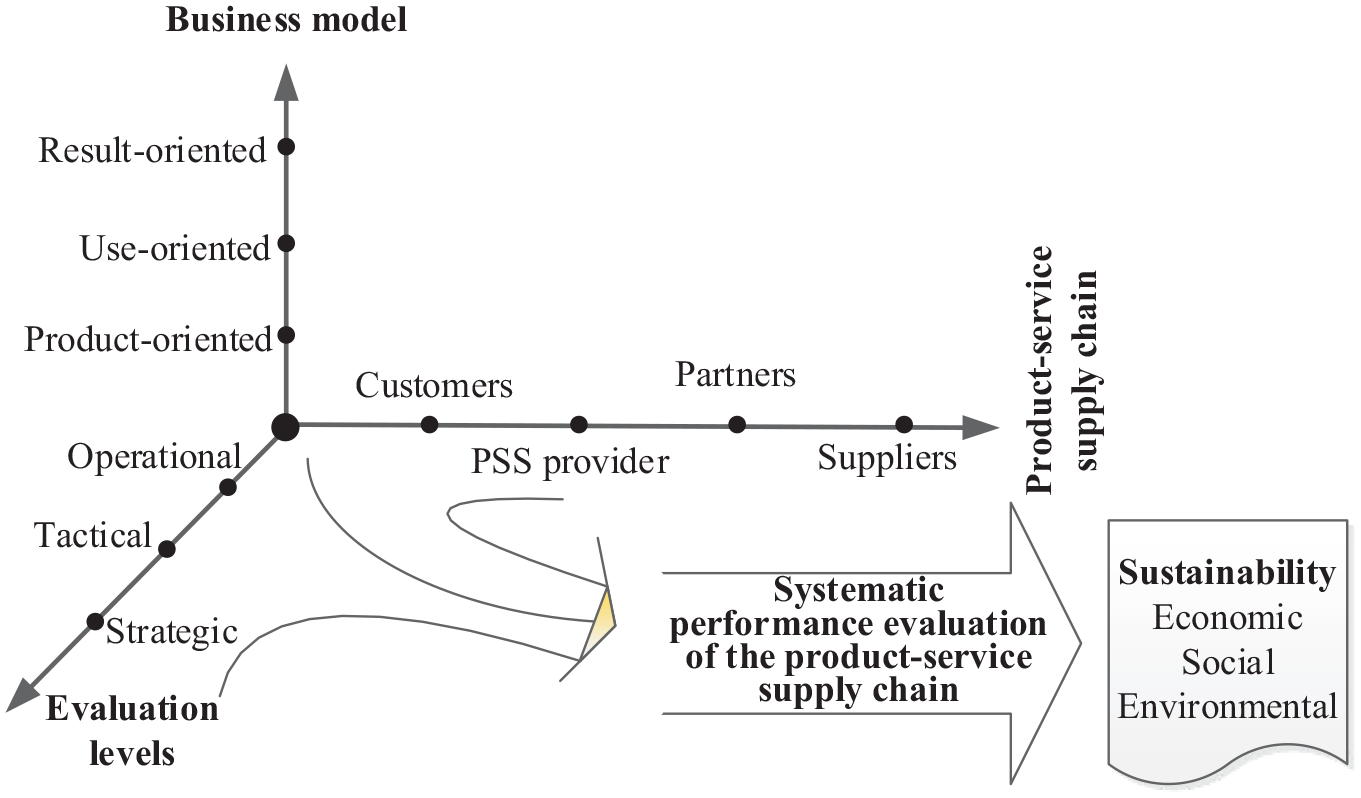
Systematic performance evaluation of the product-service supply chain.
Conclusion
The aim of our research is to identify, present and summarize the literature about PSSC applications, in order to give a clear overview on this topic that is attracting more and more interest from scholars and practitioners. Using content analysis, we draw a holistic perspective of the PSSC. This study enriches the SC literature by presenting a detailed investigation into PSSC collection. In order to address the first research question, the SCs under the service strategies of ASS, MRO and PSS are distinguished, and their main elements are compared in terms of definitions, objectives, motivations, primary deliverables, service durations, main providers, service outsourcing, partners’ cooperation and role of customers. As a response to the second research question, the current research is analysed, and research gaps are identified by classifying the literature into four subsections, namely, the product-service demand management, PSR management, application of the information technology and the performance evaluation. By addressing the principles of cooperation, collaboration and integration, the added values of this review are the proposed research strategies for integrated forecasting for product services, integrated PSR allocation and scheduling, and systematic performance evaluation of the PSSC.
Although the PSS strategy is highly recommended by both the academia and industry, one of the main findings of the content analysis is that the recent study on SC for PSS has been undertaken in limited scope. Compared with other two PSSC applications, the SC for PSS is an extended value network and depends more heavily on the implementation of the cooperation, collaboration and integration principles in operation. However, a complete analysis reveals that those crucial guidelines are failed to be embodied in current literature. In particular, the quantitative models for product-service demand forecasting neglect the module division in service packages. Moreover, when it comes to the intricate relations among the decision factors for specific operation scenario, such as the resource optimization, making use of collected information and performance evaluation, few of the models discuss the problems in a broad PSSC context. Thus, the future research directions include developing service demand forecasting models; combining the time-series methods and the causal methods; establishing service resource planning models; addressing the relations between service deliverables, service capacity and the service resource; and strengthening the quantitative evaluation of the PSSC performance with a systemic view. From the viewpoint of professional practice, the findings and proposed research strategies develop an in-depth understanding of the PSSC applications and offer a new avenue for further exploration and contribution to this discipline. For firms, it is also possible to take advantage of the proposed framework to establish their service business management system with a PSSC view.
Footnotes
Declaration of conflicting interests
The author(s) declared no potential conflicts of interest with respect to the research, authorship, and/or publication of this article.
Funding
The author(s) disclosed receipt of the following financial support for the research, authorship, and/or publication of this article: The work described in this paper was supported by the National Natural Science Foundation of China (grant no. 71702073); the Natural Science Foundation of Jiangsu Province, China (grant no. BK20170774); National Science and Technology Major Project (2017-0011-0012), the Aeronautical Science Foundation of China (grant no. 2018ZE52057); the China Postdoctoral Science Foundation (grant no. 2018M640483); National Science and Technology Major Project (2017-I-0011-0012), the National Key Research and Development Programme of China (grant no. 2018YFF0213701); and the Postdoctoral Preferred Foundation of Zhejiang Province, China (grant no. zj20180024). The partial contribution in this paper was possible due to the funding provided to these authors by the National Natural Science Foundation of China (grant nos 71774081, 51705250 and 71632008).
