



Abstract
By the knowledge transferring in different areas, analogical design has been considered as a powerful approach to promote the generation of novel ideas in product conceptual design. An efficient representation scheme for design knowledge is vital to implement analogical transferring. In this article, inspired from the structure mapping mechanism of analogical reasoning, a structure mapping–based representation was proposed to support designers to search and use design analogies. This representation can provide designers with insights into the structural information of knowledge situations, and consequently designers are able to implement the corresponding design analogy search at the level of the structural similarity, rather than the functional or superficial similarity. Based on this new representation scheme, a structure mapping–based analogical design framework was developed. In this framework, patents are used as the source of analogical knowledge, and the relational structure–based representation for the patent knowledge is created using the advanced natural language processing tools/algorithms. Next, the search of design analogies is implemented by means of the vector space model, and a new structure mapping–based concept generation model can finally guide the designers to use design analogies. An industrial case and a compared experiment were carried out to verify the feasibility and effectiveness of the proposed framework.
Keywords
Introduction
Innovation design is the driving force for maintaining the competitiveness of products in the market. The accumulation and application of knowledge can enhance the research and development capability of enterprises, thus increasing the potential of providing new products to the market continuously. Conceptual design phase is fundamental to achieve innovation in new product development, because this phase assumes a very important role in creating new product concepts which meet requirements. Based on the transferring of knowledge among different scientific areas, analogical design has been a powerful approach to mitigate design fixation, explore novel concepts, and thus enhance design creativity, 1 which usually follows the process of encoding/representing the existing design knowledge, retrieving the source knowledge, mapping the source knowledge to target problems, and generating design solutions.2–4 In this process, encoding/representing existing design knowledge is the vital first step, because an efficient representation scheme/model can inform designer or computational system of an explicit way to explore, understand, and make better use of knowledge.5,6 With such a representation scheme, some potential similarities between knowledge and design problem can be defined, and consequently analogy-based designs happen in conceptual design process.
Understanding the cognitive mechanism of analogical reasoning has been accepted as a critical step in developing and evolving the methodologies guiding analogical design.4,7 This work tries to explore a representation for design analogy based on some cognitive models that describe the process of analogical transfer, one widely accepted model being the structure mapping theory (SMT).8,9 As revealed by the SMT, the similarity comparison, mapping, and transferring between the relational structures of two situations hold the key to generating insightful inferences by analogical thinking.8,9 Relational structure, also called structural information, consists of a system of concrete relationships (e.g. causality) between the individual parts or items within a knowledge situation.8,9 According to the SMT, it is obvious that if the representation for design analogy can convey the relational structures of knowledge situations, then design analogies would be searched and used in an effective and valuable way. However, in previous researches on analogical design, most of the analogy representations cannot provide designers with insights into the concrete structural information, including three categories:
Representation based on engineering attribute. The process of conceptual design can be characterized as defining function specification, seeking principle solutions and finally formulating physical structure, and the involved engineering attributes (i.e. function, principle, and structure) can be used for the representation and comparison of design outputs, and further to find design analogies from them, such as in the researches by Qian and Gero, 10 McAdams and Wood, 11 Sartori et al., 12 Fantoni et al., 13 and Agyemang et al. 14
Representation driven by expert schema. As a problem-solving principle or procedure extracted from design cases, expert schema can either be used to arouse innovation by solving design problems or contradictions, or work as the descriptive medium to associate more other cases to be used for analogy search. Abstracted from a great number of patents, the inventive principles in TRIZ (the Russian acronym for theory of inventive problem solving) are the typical expert schemas which could not only solve innovative design problems15,16 but also associate instance analogies.17,18
Representation adopting semantic keyword. The semantics of the engineering attributes or technical principles implicit in knowledge situations usually can be distributed over some specific keywords, and these semantic keywords can work as the computational medium to measure the similarity used for identifying design analogies, such as in the researches of Fantoni et al., 19 Verhaegen et al., 2 Linsey et al., 3 Murphy et al., 4 Cheong and Shu, 20 and Li et al. 21
The above representation schemes have been used to define corresponding similarity criteria used for searching candidate design analogies, such as the function-flow concept similarity, 11 the hybrid similarity considering certain properties, functions and used technologies of products, 2 and the similarity based on the functional verbs vector, 4 and relevant studies showed that these similarity criteria work well in finding analogies. However, designers cannot gain insights into the relational structures from the representations of the analogies searched, because the characteristic elements in these representation schemes are either only the concepts with a high degree of generalization (e.g. function-flow terms, inventive principles), or the fine-grained linguistic elements without a clear presentation of semantic relations (e.g. functional verbs, technology-related words). As a result, if designers want to efficiently and explicitly use the analogies searched by these representations to generate design solutions, they have to pay extra cognitive effort to extract concrete structural information from the knowledge situations of analogies. However, the capacity for a designer to perform the extraction process will be limited by his or her expertise and design experience, especially for the novice who tends to focus on surface features when using analogy. 22
Therefore, the work presented here attempts to propose a relational structure-based representation for design knowledge/problem, and this representation scheme is reversely constructed based on the structure mapping mechanism of analogical reasoning. Then, a structure mapping analogical design framework is developed upon this representation. In the framework, a structural or schema similarity is defined to search design analogies, and a structure mapping–based concept generation model is built to guide designers in using the relational structures of analogies to synthesize conceptual design solutions. As patent has become an increasingly important knowledge source to support product development activities,23,24 the new analogy representation and search are developed from the patent database. The proposed framework is aimed at helping designers in an industry setting look for cross-domain analogous solution patterns to inspire conceptual solutions generation for design problems. In section “State of the art,” states of the art on analogical design are reviewed. Section “Overall scheme of the structure mapping–based analogical design framework” specifies the new knowledge representation and design analogy search as well as the concept generation model. Section “Validation study” presents an industrial case and a compared experiment to verify the feasibility and effectiveness of the proposed framework, followed by the conclusions and future work in the last section.
State of the art
Creation originates from the transformation of conceptual space, relying on transferring knowledge from one situation to another by some mappings between different knowledge systems. 25 The key of mapping is to find out the similarities in some aspects between current problems and the acquired knowledge or experience. As one of the central abilities in the development of human cognition, analogical reasoning is a similarity-based means to drive knowledge transfer and recombination, providing an insightful way for human to associate knowledge, construe problems, and foster new inferences. 26 To understand the cognitive process of analogical reasoning, the SMT has informed the academia of a structural view of interpreting similarity and analogy. It reveals that an expressive analogy is about the comparison, mapping, and information transferring between the relational structures of different situations, rather than the surface features, and the precondition is to discover the structural similarity (i.e. relational similarity) between different situations, rather than the attributional similarity (i.e. superficial similarity).8,9 Surface features refer to entities or the descriptive attributes of entities within a knowledge situation, while relational structure consists of a system of relations between individual parts of a situation. When two situations being compared are almost different on the surface, the potential for achieving innovation in generating solutions by analogy is noticeable in most cases, 9 such as in the application of analogies which come from the field with far analogical distance. 27 In order to generate insightful inferences, the SMT attempts to transfer the causal structure from the source situation to the target. 8 Some mapping strategies/rules derived from the causal structure have been experimentally verified to be helpful in promoting the use of analogies.22,28 On the whole, the cognitive analogical process revealed by the SMT is based on the relational representation for information and the corresponding information processing.
By identifying and transferring nonobvious analogous solutions, analogical design offers an effective approach to solve design problem and generate new ideas, as well as mitigate design fixation, during the conceptual design phase of new product development. 1 To implement and facilitate analogical design, researchers have created various ways to formulate design problem and represent design knowledge and then to retrieve useful knowledge as analogical stimuli. For example, Qian and Gero 10 used a function–behavior–structure framework to represent design knowledge and explore cross-domain analogies. Based on the functional models constructed for products, McAdams and Wood 11 measured the similarity of products according to their functions and flows, and such functional similarity worked to select analogous products from a database. Goel and Bhatta 29 developed an IDeAL system which adopted a structure–behavior–function model to reformulate problem and also to extract design patterns from design cases as the analogies to solve target problems. To aid biomimetic concept generation, Sartori et al. 12 represented biological examples and their functionality by a State-Action-Part-Phenomenon-Input-oRgan-Effect model, and this causality model was used to determine some underlying similarities, so as to match biological analogies for corresponding technical problems. Through functional analysis, Fantoni et al. 13 encoded a database of design instances by functional terms describing their subfunctions and then abstracted design problem into subfunctions which are used to search analogies from the database by the occurrence analysis on functions. Agyemang et al. 14 transformed the generic functional model into a critical chain model used for design analogy identification, and the latter is composed of flows and functions that are significantly related to the performance of a design. Unlike the above methods using functional representations for analogy search, some structured analogical design methods take schematization concepts directly as analogical stimuli or use the schematization concepts to organize instance knowledge as the source for analogy search. TRIZ is such a structured method for analogical design that abstracts problem into some contradictions 15 and then develops solutions using the 40 inventive principles as conceptual analogies. 16 Inspiration from instance knowledge/analogies is also quite important in transforming the schematization solutions in TRIZ into specific solutions. Therefore, by means of textual analysis, Souili and Cavallucci 30 and Souili et al. 31 proposed a linguistic method to automatically extract engineering parameters and corresponding contradictions from patents, so as to identify relevant instance analogies for TRIZ. Prickett and Aparicio, 17 and Yan et al. 18 constructed ontologies based on TRIZ concepts and the semantic relationships among them, and the ontologies could be used to classify and organize instance knowledge as the source of analogical stimuli. In the above analogical design processes/methodologies, both functional representation and schematization representation serve more to the association and search of design analogies, because characteristic elements in the two are only domain-independent abstract concepts, such as function-flow terms, physical effects, and inventive principles. Therefore, the two representations tend to inspire general ideas rather than specific design solutions. Even if the instance analogies (e.g. patents or biological examples) have been gained via the two representations, extracting fine-grained structural information used for analogical transfer from analogies remains a challenging task for designers. This problem also exists in the analogical design methods which adopt semantic keywords to represent design knowledge and problem. The features in the existing semantic representations usually are linguistic elements obtained by information extraction or semantic extension, such as functional verbs, technology-related nouns, or adjectives. In most cases, these feature elements are isolated from each other, and there is a lack of causal connections among them. Thus, the semantic keyword representation also cannot convey the complete relational structures of design analogies to designers, although its advantage is adapting to the large-scale design analogy search. For example, Fantoni et al. 19 looked for analogical inspirations from databases by the lexical analysis of functional synonyms and antonyms. Verhaegen et al. 2 searched analogies from a database of product knowledge by automatically identifying function, technology, and other property words from knowledge texts. Linsey et al. 3 used a WordTree method to identify functional keywords through investigating lexical relationships (e.g. synonyms), and the keywords were used to retrieve cross-domain sources for analogies. Murphy et al. 4 generated a generic functional vocabulary by analyzing patent documents and then constructed functional vector space model (VSM) to search analogies from the patents. After implementing syntactic analysis on biology text, Cheong and Shu 20 defined syntactic rules to retrieve single-sentence-level biological analogies from the parsed text. Li et al. 21 extracted problem solved concept (PSC) terms related to the required functions, system errors, and users’ difficulties and needs from patents, and the PSC terms were used to construct vectors for patents, so as to compute cosine similarity used for selecting patents as analogies.
Overall scheme of the structure mapping–based analogical design framework
Due to the importance of the SMT demonstrated by previous researches in cognitive study, this article extended the application of the SMT into analogy-based product design and proposed a structure mapping–based analogical design framework to support conceptual design, as shown in Figure 1. The inputs of the framework are the patent knowledge source (as mentioned previously) and the problem statement, and the main part of the framework consists of four operations which corresponds to the four steps of human analogical reasoning: (1) encode knowledge source and represent the target problem, (2) retrieve appropriate source analogies, (3) mapping between target problem and source analogies, and (4) generate inferences (i.e. solutions) from the mapping results. To realize these operations, four corresponding methods were developed in each stage. It is worth pointing out that the core foundation of this framework is the relational structure–based representation of design knowledge and problem. In this representation, relational structure–related information was adopted to characterize existing knowledge and the current design problem (Step 1 in Figure 1). Following this representation, a VSM-based similarity quantization criterion was proposed for the analogy search in Step 2. Based on the representation principle, a relational structure mapping mechanism was developed to map the searched analogies to the target problem in Step 3, and subsequently a structure mapping–based reasoning could help designers to generate final design solutions in Step 4. The detail of these methods will be specified in the following sections.
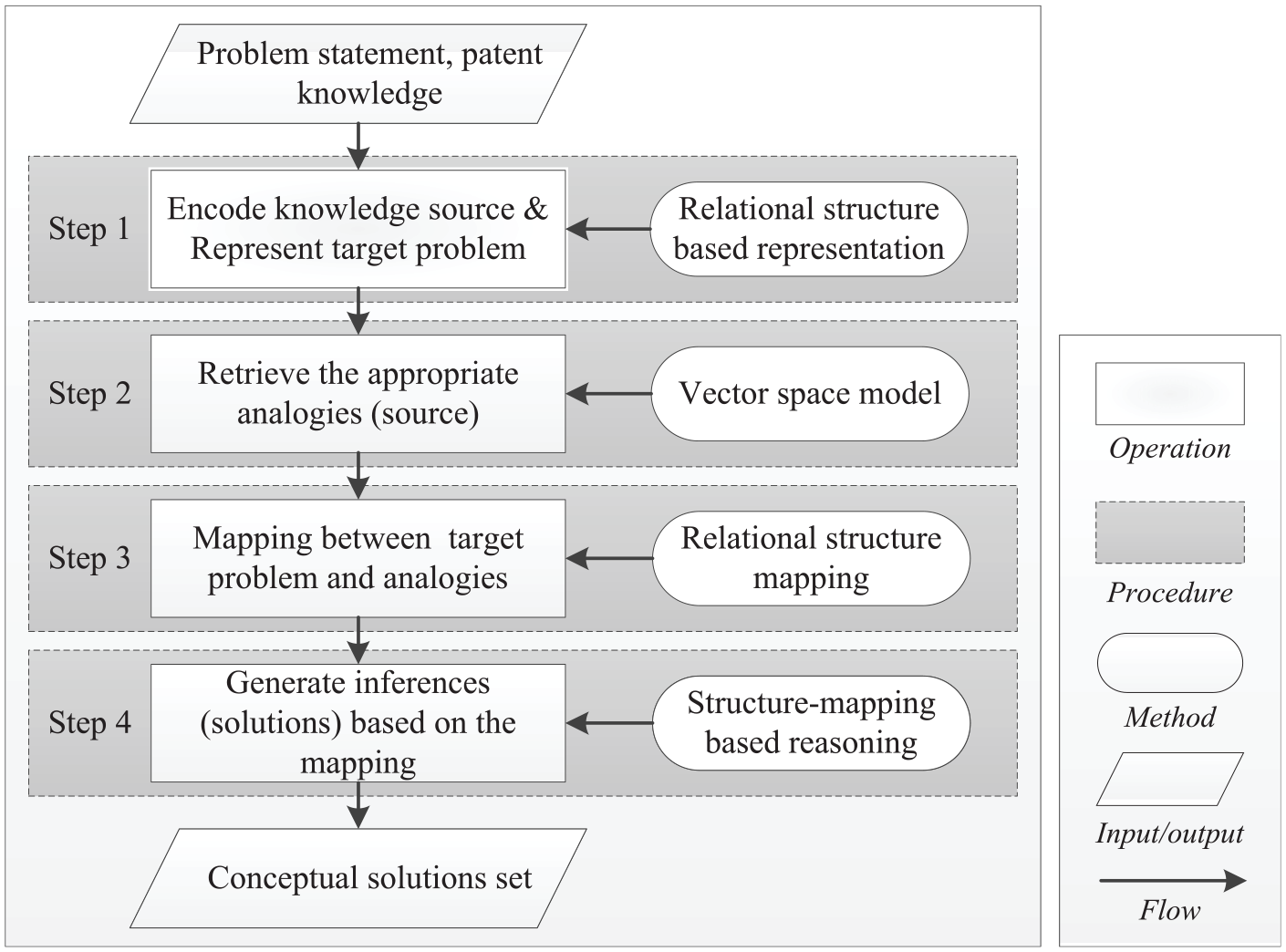
Overview of the structure mapping–based analogical design framework.
Structure mapping–based representation
The meta model of representation
A triad model {fact, predicate calculus, schema}, which provides constructive elements for the relational structure, is used to represent knowledge source and design problem. Definitions of the elements in this triad are given as below.
Definition 1
The fact (FA) of knowledge or problem means the information about the architecture, components, and operational mechanism of the technical system hidden in knowledge or problem situation. The difference is that the FA of knowledge is relevant to the technical innovations, while the FA of problem is relevant to the technical problems or contradictions.
Definition 2
The predicate calculus (PC) of knowledge or problem is transformed from its facts. The PC expresses the textual description of FA in terms of causal logic, and it consists of entities and predicates. Entities are the logic individuals within a situation, including the objects (e.g. component, action object, and abstract effect) and constants. Predicates refer to any functor used to describe the actions to entities, the nature of entities, or the relations between entities. Relation predicate is the most common and important one, which denotes the logical connection among multiple arguments and covers low-order relation (i.e. the first-order) and high-order relation (i.e. the second-order). The high-order relation predicates (e.g. cause, rely, and imply) can be regarded as a logical connective between different predicates, namely treating other predicates as arguments. A combination of the first-order relation and the second-order relation is used to present the relational structure, which can transmit the technical innovations of knowledge or the technical contradictions of problem through causal expressions.
Definition 3
The schema of knowledge is generalized from the relational structure of knowledge situation and named as cognitive schema (CS). Consequently, the technical innovations can be described by CS as

The schema of problem is generalized from the relational structure of problem situation and named as requirement schema (RS). Consequently, the solution directions of problem can be described by RS as

For knowledge, “
Relational structure-based knowledge processing
In this study, patents were used as the knowledge source, and information on technical innovations were extracted from them and used to create their relational structures. Patent data were retrieved from the comprehensive service platform of State Intellectual Property Office (SIPO). The SIPO platform covers Chinese patents which are organized by the International Patent Classification (IPC) and provides the public with manually added English abstracts from the patent documents, therefore it allows the text analysis on these Chinese inventions. These English abstracts can provide the public with a general insight into the technical proposals and inventive advantages of patents.
An example of relational structure–based representation of a patent is shown in Figure 2. First, two topic extraction (TE) methods, that is, the terminological method and the grammatical method, 32 are applied to extract the information related to the technical innovations from the abstract of patent. The rules used in the TE methods are listed in Table 1. Specifically, the terminological method is used to extract the target sentences which contain the predefined terms related to technical innovation. The predefined terms are composed of functional terms and terms with positive polarity. Then, by means of word tokenization and part-of-speech (POS) tagging, the grammatical method identifies the POS of all words in the target sentences and then nouns, verbs, noun phrases (e.g. “adjective + noun”), and verb phrases (e.g. “adverb + verb”) are extracted by the POS tags. For example, NN, NNS, NNP, and NNPS are the POS tags used to extract the nouns. After that, the resultant nouns, noun phrases, verbs, and verb phrases are used to create the relational structure of the patent. Specifically, the nouns or noun phrases function as the entities to compose the relational structure, while the verbs or verb phrases function as the low-order relation predicates of the corresponding entity pairs. Finally, the high-order relations between the low-order relation predicates are manually determined according to the context of technical innovation information, and it is because no specific syntactic carriers (e.g. verbs or verb phrases can act as the syntactic carriers of low-order relation predicates) can express the high-order relations, especially for those high-order relations whose arguments (i.e. low-order relations) appear in different sentences.
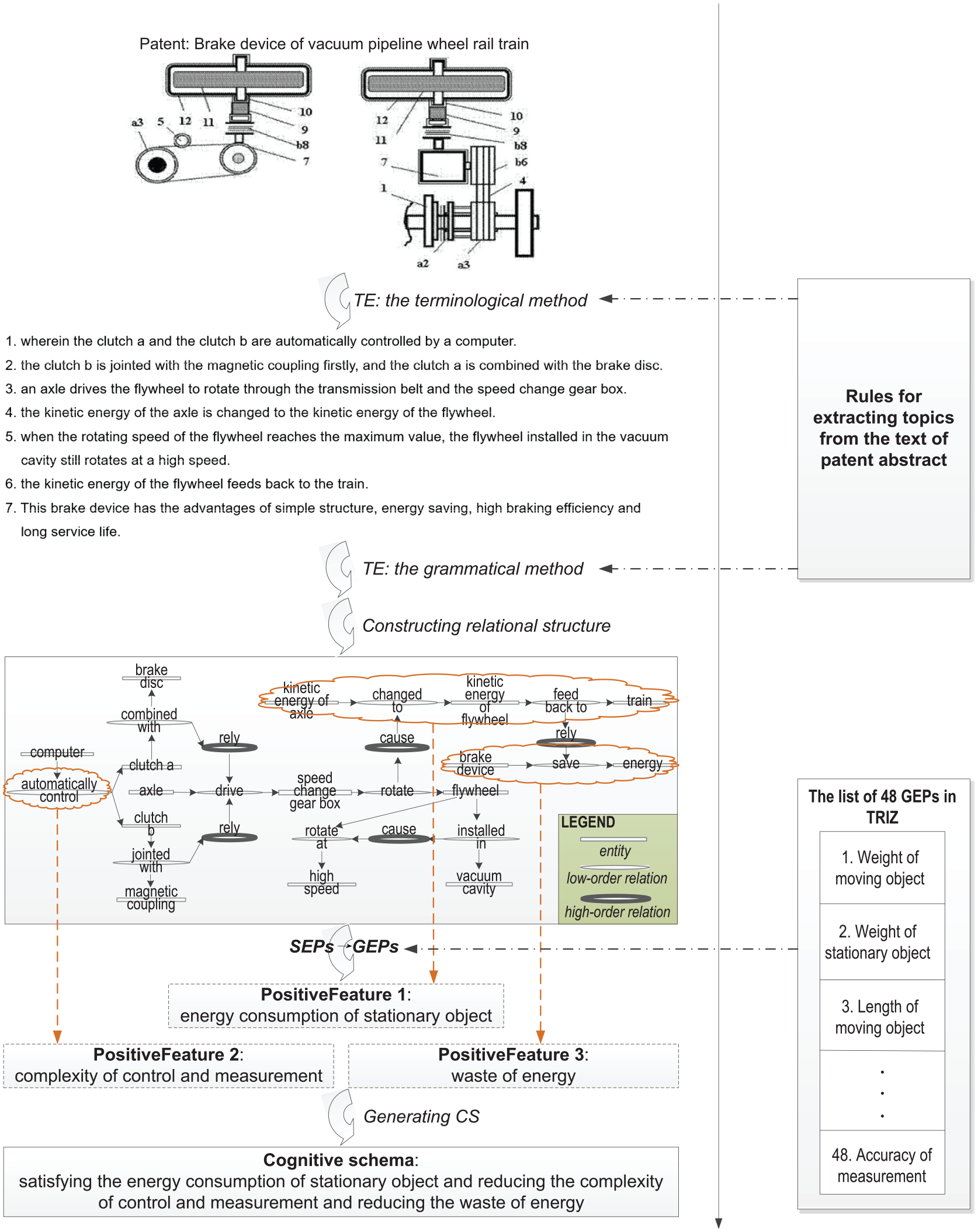
An example of representing a patent by relational structure.
Rules used for topic extraction.
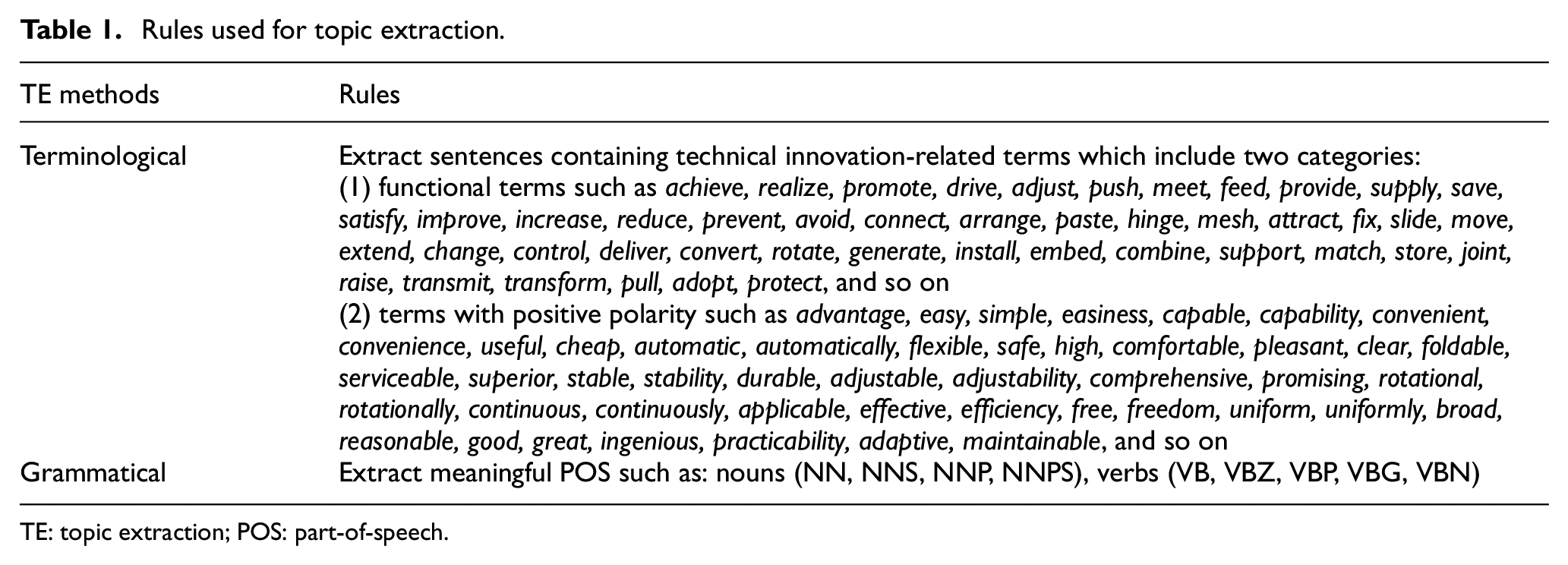
TE: topic extraction; POS: part-of-speech.
The next step is to generalize the relational structure of patent to generate its CS. The generic engineering parameter (GEP) in TRIZ can provide standard terminologies to describe the technical features 33 (e.g. energy consumption of stationary object, complexity of control of measurement, and the waste of energy, as shown in Figure 2) of a technical system; therefore, GEPs are applied in the proposed representation to generate the CS of patent. According to the entities and causal relationships conveyed by the relational structure, the positive effects which have already achieved in the patent can be generalized into a series of positive actions on the implicit GEPs, such as satisfying the energy consumption of stationary object, reducing the complexity of control of measurement, and reducing the waste of energy. The critical thing in this generalization process is to identify GEPs. Based on the works of Souili and Cavallucci 30 and Souili et al., 31 syntactic rules/patterns were developed to identify the implicit GEPs from the relational structure, and they could locate the specific engineering parameters (SEPs) and transform them into the GEPs.
Relational structure–based problem formulation
The aim of problem formulation is to identify the root causes and form a representation structure for problems. Based on such representation structure, the essence of problems can be well extracted, and similarity criteria can be consequently defined to explore design solutions from the knowledge domain. In this article, the relational structure–based representation of design problem consists of three steps:
The first step is to extract problem facts from the problem statement. Problem facts are the information about the underlying technical system and its operational mechanism, and they objectively exist in the problem context. Since problem facts are often accompanied by some information about the technical problems needing to solve, therefore, some predefined terms which describe the required functions, system errors or deficiencies, and users’ difficulties and needs can be used to perceive and identify problem facts from the problem statement. Typical terms related to technical problem include drawback, matter, trouble, defect, fail, error, difficult, restrict, limit, disable, burden, need, desire, demand, require, danger, pervert, and so on. 32
The second step is to build the relational structure of problem based on the extracted problem facts. Due to the sentential nature of problem facts, the word tokenization and the POS tagging can be applied to identify nouns/noun phrases and verbs/verb phrases, which respectively function as the entities and the low-order relation predicates (connecting the corresponding entities) of problem relational structure. Next, the high-order relations can be determined based on the problem context.
The final step is to generalize the relational structure of problem to generate RS. The relational structure can extract the negative technical features of the technical system hidden in problem, such as poor adaptability, too many harmful factors, and insufficient efficiency of operation. Furthermore, RS interprets these negative technical features as corresponding positive effects which can indicate the resolving directions of problem, such as improving the adaptability, reducing harmful factors, and improving the efficiency of operation. To seek for normalization, the descriptions about the positive actions on the GEPs are used to express the to-be-achieved positive effects. RS consisted of these positive effects. During the generation of RS, the query on the GEP list of the TRIZ 33 can facilitate the identification of GEPs from problem relational structure.
Schema-based design analogy retrieval
The retrieval of design analogy is implemented by computing the similarity between the CSs of patents and the RS of a design problem. The characteristic words extracted from the schemas function as the computational medium of the calculation of this similarity. Here, a method combining the VSM, the term frequency-inverse document frequency (TF-IDF), and the cosine similarity is applied to realize the schema-based design analogy retrieval.
Generation of characteristic vocabulary for creating schema vector
The VSM is a powerful tool for information retrieval. 34 In the VSM, the objects of retrieve are represented by vectors of terms, and the terms are extracted from a characteristic vocabulary. For example, a functional characteristic vocabulary-based VSM has been applied to implement the retrieval of analogous patents. 4 In this work, VSM is used to map the schemas of the patents and design problem into the term-vector space through a characteristic vocabulary-based indexing algorithm. If there are x terms in the characteristic vocabulary, then the schemas will be represented as x-dimensional vectors. Consequently, VSM can provide a simple path to quantify the similarity between RS and CSs. The characteristic vocabulary used by us is also called CS vocabulary, because it covers the nouns, verbs, and adjectives which are extracted from the CSs by POS tagging. In traditional VSM, the semantic relations among different terms of characteristic vectors are not considered, 35 and this can lead to a mistake that two terms which represent the same concept are treated as two different terms. To address this, the hypernymy/hyponymy of the WordNet is applied to reduce the space of terms in CS vocabulary before schema vectors are created. Specifically, if two terms have hypernymy/hyponymy relations, they will be merged into the hypernym. Moreover, natural language toolkits, like the Porter Stemmer and the WordNet Lemmatizer, can be applied to strip the suffixes (e.g. -ing, -s, -es) of the nouns and verbs in CS vocabulary to further simplify the space of terms. Since the 48 GEPs in TRIZ 33 are used to create the main descriptive content of CSs, therefore, as the number of patents increases, the number of the terms in CS vocabulary will gradually reach a convergence. The benefits of CS vocabulary as a finite set include two aspects: (1) the dimension of schema vectors and the dimension of zero elements in schema vectors can be well restricted and (2) the emergence of irrelevant terms with relatively very low schema frequency can also be eliminated; consequently, the application of TF-IDF will not lead to the appearance of noise elements which have relatively large weights in schema vectors. The two aspects are helpful to improve the calculation effect of the cosine of angle between a pair of schema vectors.
Design analogy retrieval based on schema vector cosine
In this stage, the CSs of patents and the RS of design problem are all mapped into the schema term-vector space by a CS vocabulary-based indexing algorithm, and consequently a schema vector matrix consisting of CS vectors and a RS vector are generated. When assigning values to the elements in this matrix, the weighting factors, term frequency (TF) and the inverse document frequency (IDF), are considered rather than just counting the occurrence of the characteristic terms in schemas. TF-IDF tends to weight the rare characteristic terms higher than the common. 36 Based on the works of Salton and Buckley 36 and Robertson and Walker, 37 the equation used to calculate TF-IDFs is given as

where
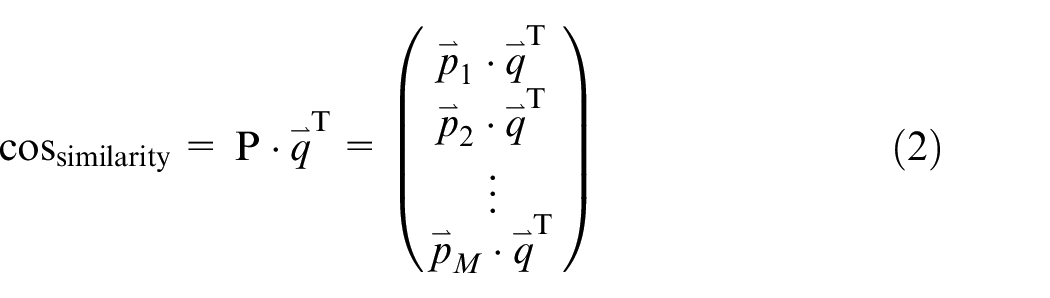
where P is the unit CS vector matrix,
By integrating the CS vocabulary-based VSM, the TF-IDF, and the cosine similarity, a tool called analogical knowledge searcher (AKS) was developed by the graphical user interface (GUI), and the search of design analogies from the patents could be interactively and visually supported by this tool. As shown in Figure 3, when the RS of a problem is input into the AKS as the user query, the sorted patent entries as well as the global similarity scores are output as response. Besides, the AKS has the functions of extracting the top ranked patents and filtering patents by a similarity score range. In addition, the AKS allows designers to check and view the relevant contents of patent entries which are presented in the form of a formalized knowledge template. This knowledge-checking function is intended to facilitate designers’ understanding and awareness on the relevant knowledge information. One pop-up knowledge-checking window in Figure 3 shows the relational structure–based representation information and relevant figures extracted from one retrieved patent.
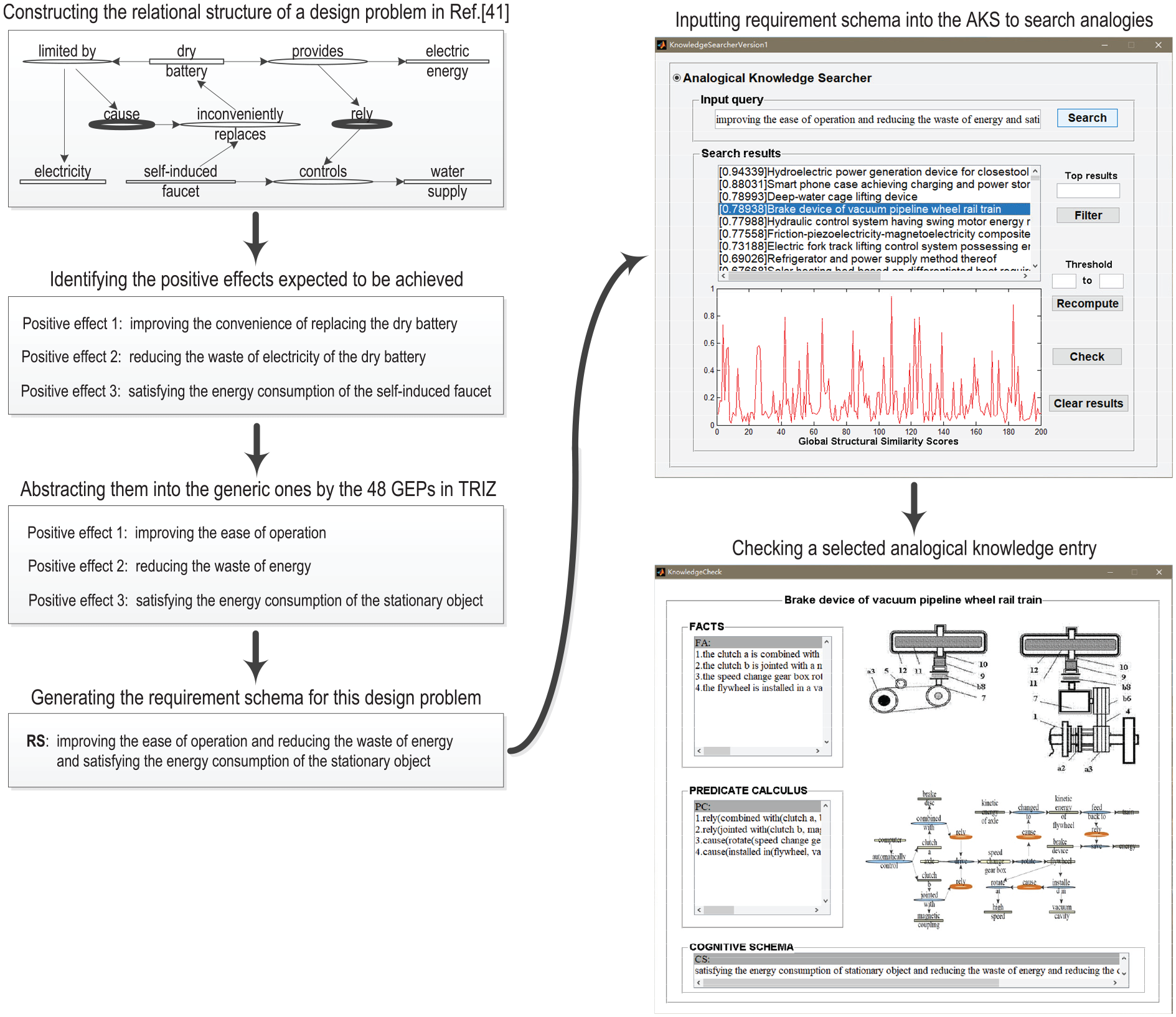
An example of searching design analogy for a design problem using the AKS tool.
Structure mapping–based concept generation model
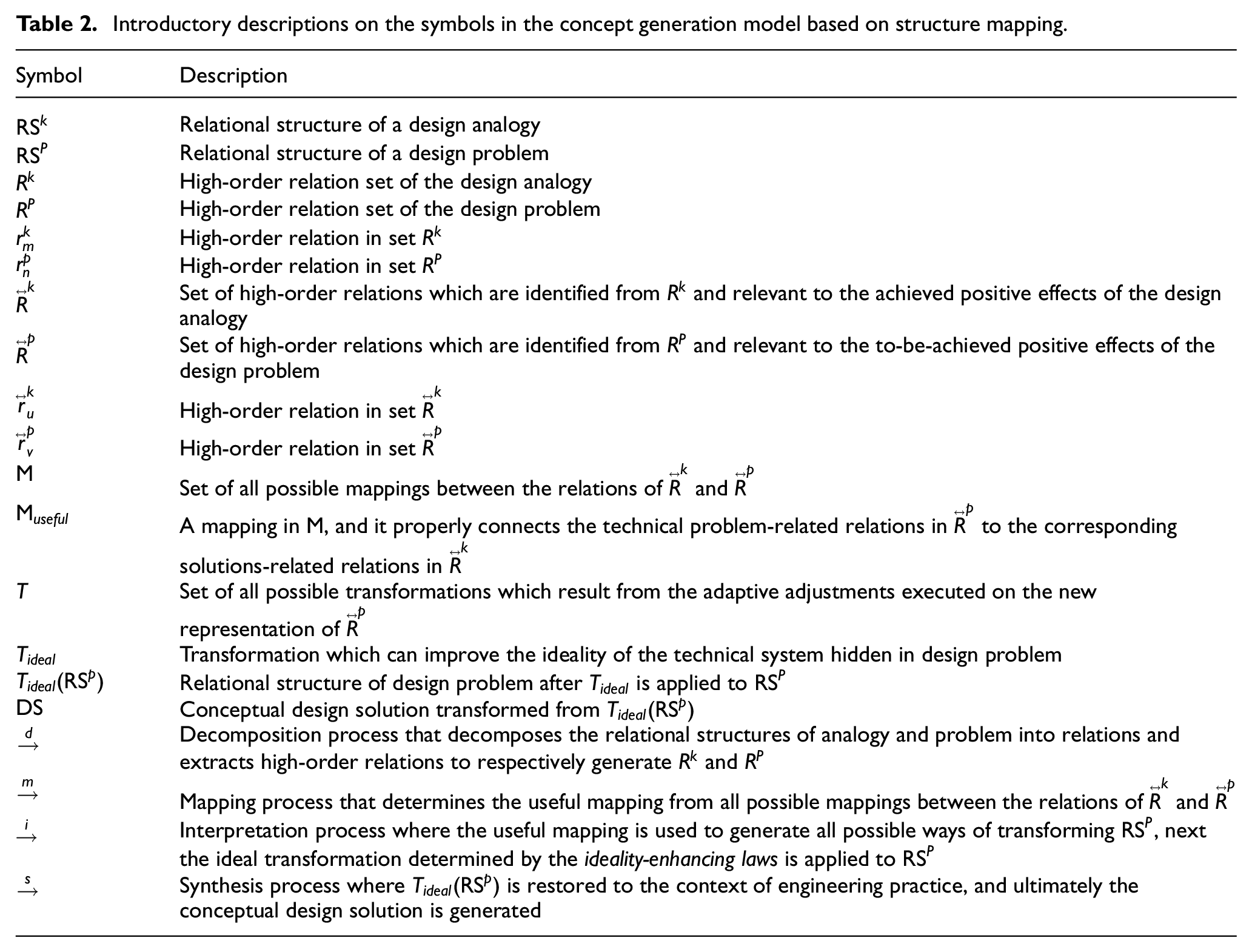
In this work, if an analogical knowledge entry has high schema similarity with the target design problem, it will be considered as a candidate design analogy. Higher schema similarity means more possibilities of applying some parts of the relational structure of the candidate analogy to adaptively reform the relational structure of problem, and further to generate conceptual design solutions. To facilitate such relational structure–based process of knowledge transferring and design reasoning, a concept generation model based on structure mapping (Figure 4) has been constructed. The symbols used in the model are explained in Table 2.

Concept generation model based on structure mapping.
Introductory descriptions on the symbols in the concept generation model based on structure mapping.
The decomposition process

The next is the mapping process

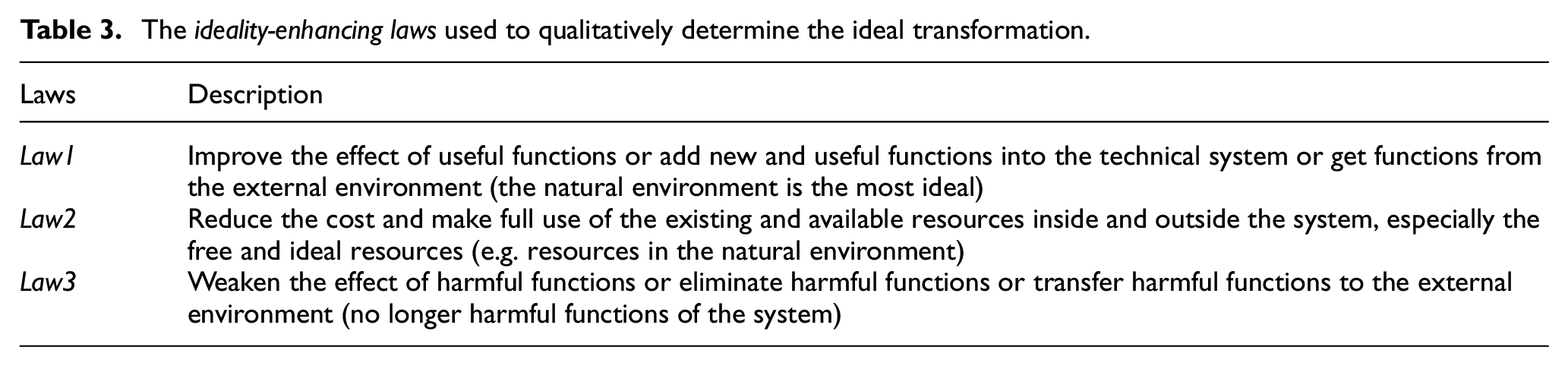
In the interpreting process

The ideality-enhancing laws used to qualitatively determine the ideal transformation.
Finally, as presented by equation (6), the synthesis process, that is,

Validation study
Two validation studies were carried out to evaluate the analogical design framework proposed in this article: one was an industrial improvement design, which served as a proof of concept to the framework; the other was an experimental study, in which the efficiency of the proposed framework was verified by comparing with one existing method. Two hundred patents were randomly selected and retrieved from the SIPO platform, which were distributed over 102 subclasses of IPC. As shown in Figure 5, the number (horizontal axis) of patents granted in each of the 102 IPCs ranges from 1 to 11, and each IPC (vertical axis) corresponds to one technical field (so these IPCs covered a broad range of technical fields). For example, F15B refers to “Systems Acting by Means of Fluids in General & Fluid-Pressure Actuators.” The motivation of randomly selecting these patents to do the validation test is to demonstrate that the proposed framework can be extended and applied to any patent set.
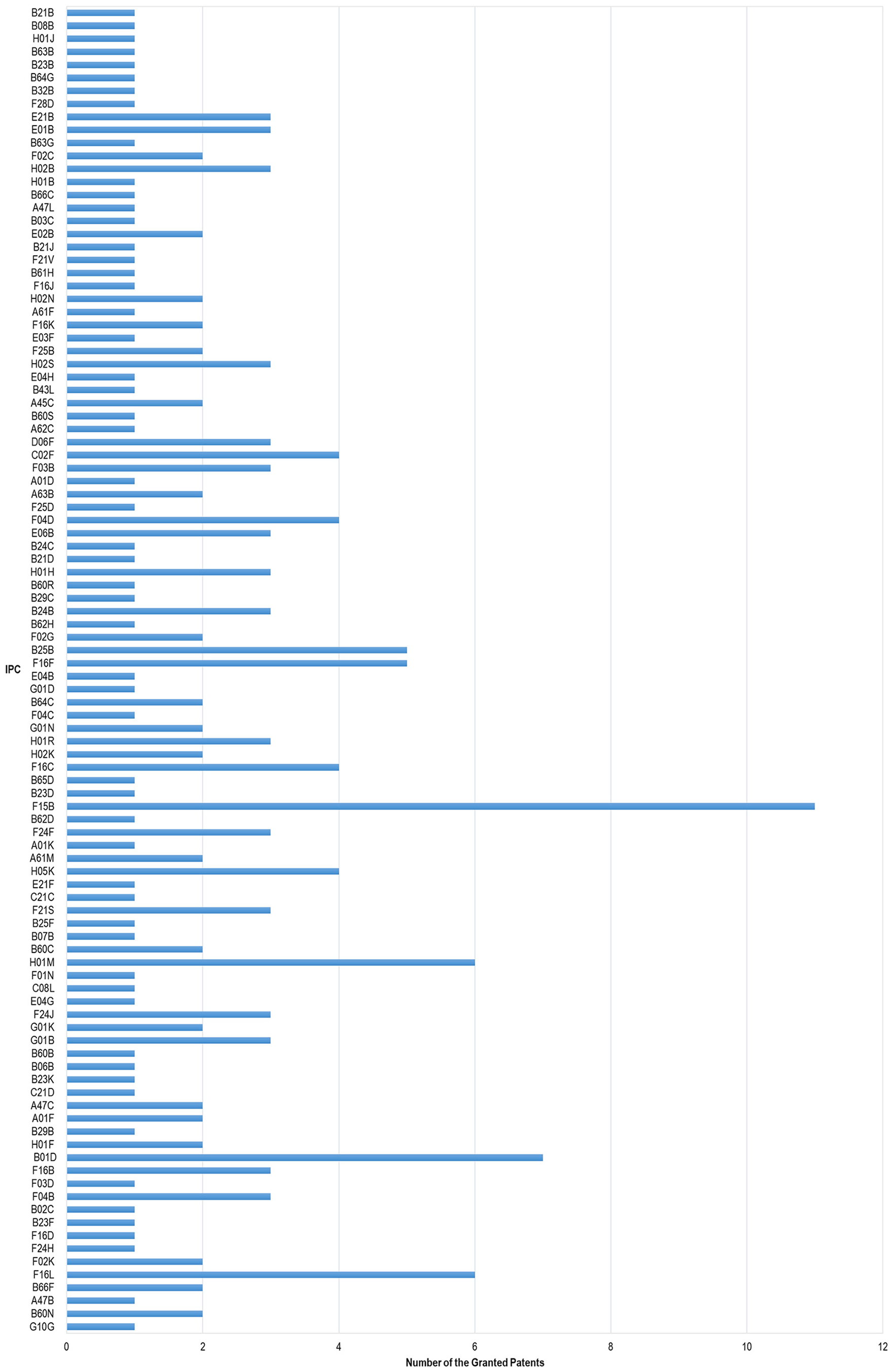
The IPC distribution of the 200 patents used in the validation test.
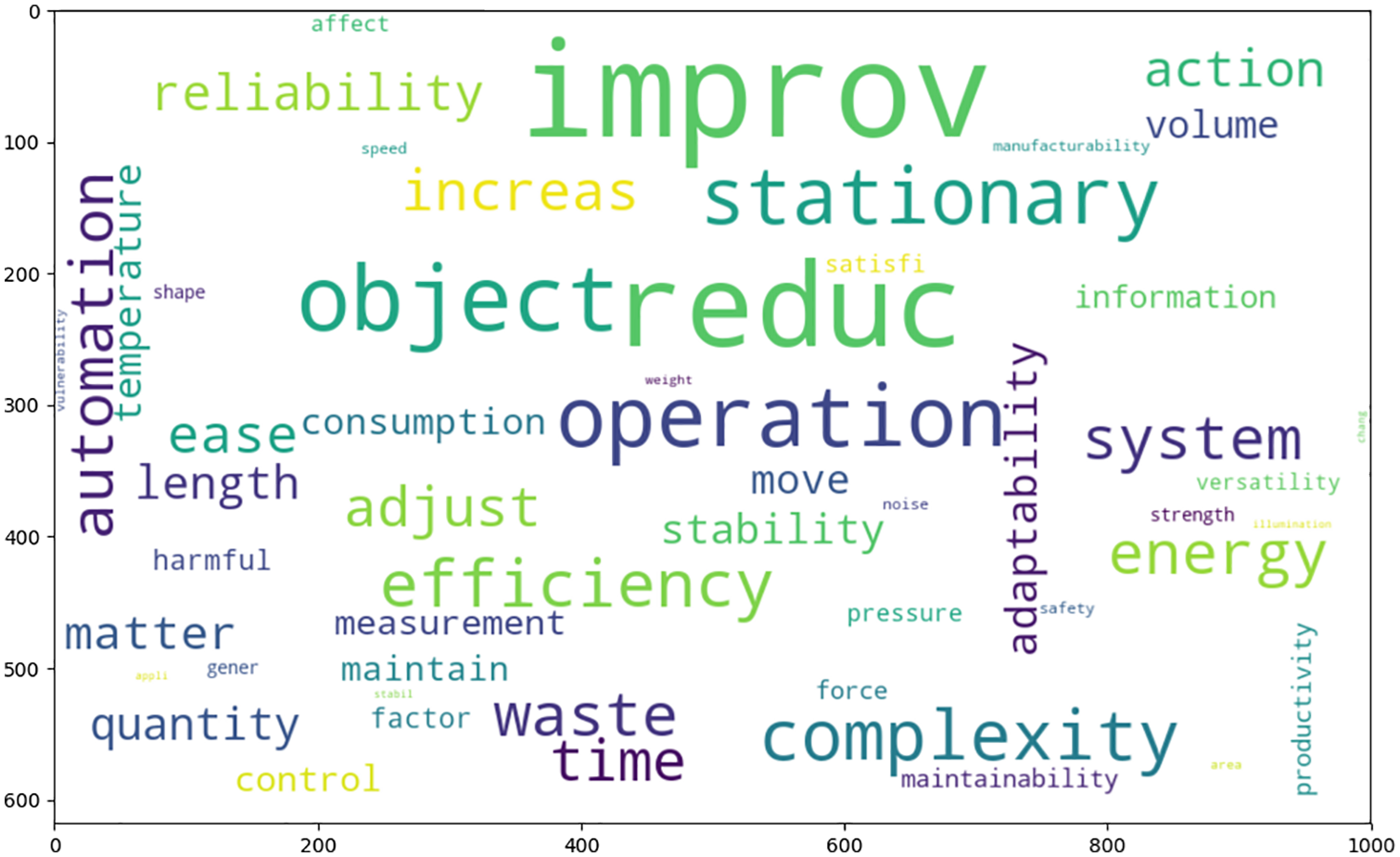
First, the regular expression (RE) module in Python 3.6.4 was used to extract the sentences containing the technical innovation–related terms from the abstracts of these patents. After that, the NLTK (natural language toolkit) word tokenization and POS tagger were used to determine the nouns, verbs, noun phrases, and verb phrases from the target sentences. The resultant words or phrases were used to construct the relational structures for the patents. Next, based on the syntactic rules proposed by Souili and Cavallucci 30 and Souili et al., 31 SEPs were identified from the relational structures and transformed into the corresponding GEPs, and the CSs of the patents were generated subsequently. Finally, a combination tool of the POS tagger, the WordNet thesaurus, the Porter Stemmer, and the WordNet Lemmatizer was applied to extract nouns, verbs, and adjectives from the CSs and to generate the simplified characteristic vocabulary, that is, CS vocabulary. As shown in Figure 6, a word cloud is adopted to present the resultant CS vocabulary, in which there are 53 characteristic terms involving 44 GEPs. Note that the terms with relatively large font sizes in Figure 6 are the frequent terms. The representation information extracted from the patents and the CS vocabulary were imported and integrated into the developed AKS tool, which could export structural analogies (i.e. analogies having structural/schema similarity with design problem) for the following case studies.
Word cloud of the resultant CS vocabulary.
The improvement design of the detector subsystem of the PipeGuard
This industrial improvement design comes from Chatzigeorgiou et al., 38 who have designed an in-pipe leak detection robotic system named PipeGuard. The three-dimensional (3D) model of the detector subsystem of PipeGuard is shown in Figure 7. The membrane is suspended by the drum, and the drum is fixed on a concentric gimbal which allows the drum to perform small rotations. When there is a leak, the membrane touches the pipe and covers the leak due to the suction effect of pressure drop. The friction between membrane and pipe forces the drum to pivot about the x and y axis. The rotation of the drum can be sensed by sensors and treated as leakage signal. However, the drum is a rigid body which is unadjustable in size. This leads to a limit working range of the membrane, and the detector can only detect the pipe with the unchangeable size. To address this, the design of the detector subsystem of PipeGuard should be improved.
Problem formulation process and searching process of analogical knowledge for the PipeGuard case.
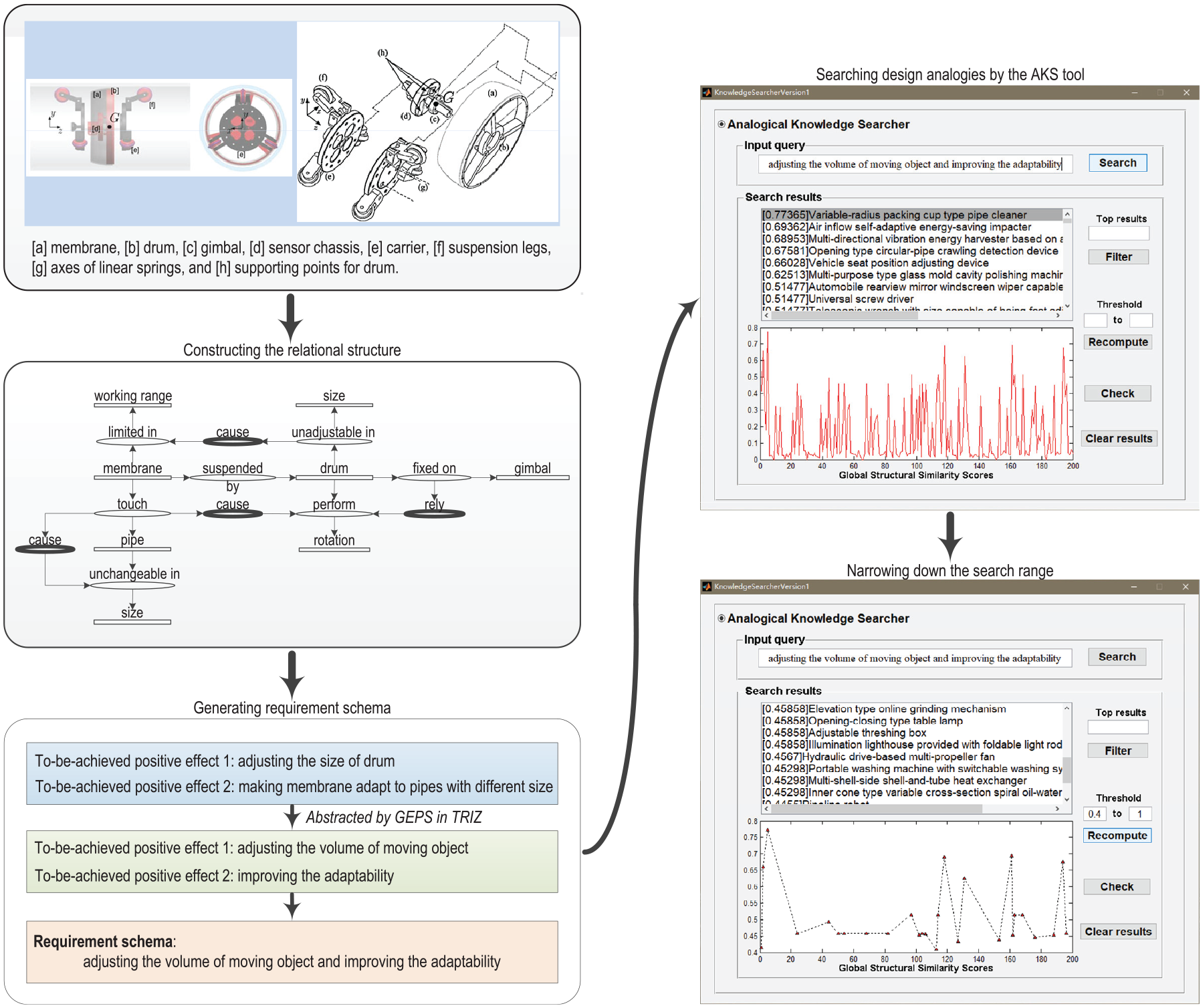
The process of formulating this design problem and searching design analogies is shown in Figure 7. First, the facts of this design problem were perceived and identified as the membrane is suspended by the drum which is fixed on the gimbal. When the membrane touches the pipe, the drum performs rotation. The size of the drum is unadjustable, therefore the working range of the membrane is limited and the size of the pipe to be detected is unchangeable.
Then, nouns, noun phrases, verbs, and verb phrases were extracted from these problem facts and used to construct the relational structure. Next, identified from the problem relational structure, the to-be-achieved positive effects included “adjusting the size of the drum” and “making the membrane adapt to the pipes with different sizes,” which could be further generalized as “adjusting the volume of moving object” and “improving the adaptability,” respectively. Accordingly, the RS of this design problem was described as “adjusting the volume of moving object and improving the adaptability.” Finally, RS was input into the AKS tool as a query, and a schema similarity range (0.4–1.0) was applied to narrow down the search range of design analogies. After the filtering process, 27 analogical knowledge entries were stored, and among them, there were 3 near-field analogies and 17 far-field analogies that were useful. We selected three of them as examples shown below:
“Variable-radius packing cup type pipe cleaner” is a near-field analogy and the idea of this analogy is the combination of packing cup and cylinder to adjust the size of an in-pipe cleaning device.
“Opening type circular-pipe crawling detection device” is another analogy from the near field, and in this analogy the device adjusts its detecting range by changing the quantity of the connecting ring and sleeve ring.
“Opening-closing type table lamp” is a far-field analogy, and the idea of this analogy is the integration of sliding sleeve, link mechanism, and screw drive to continuously adjust the brightness of a table lamp.
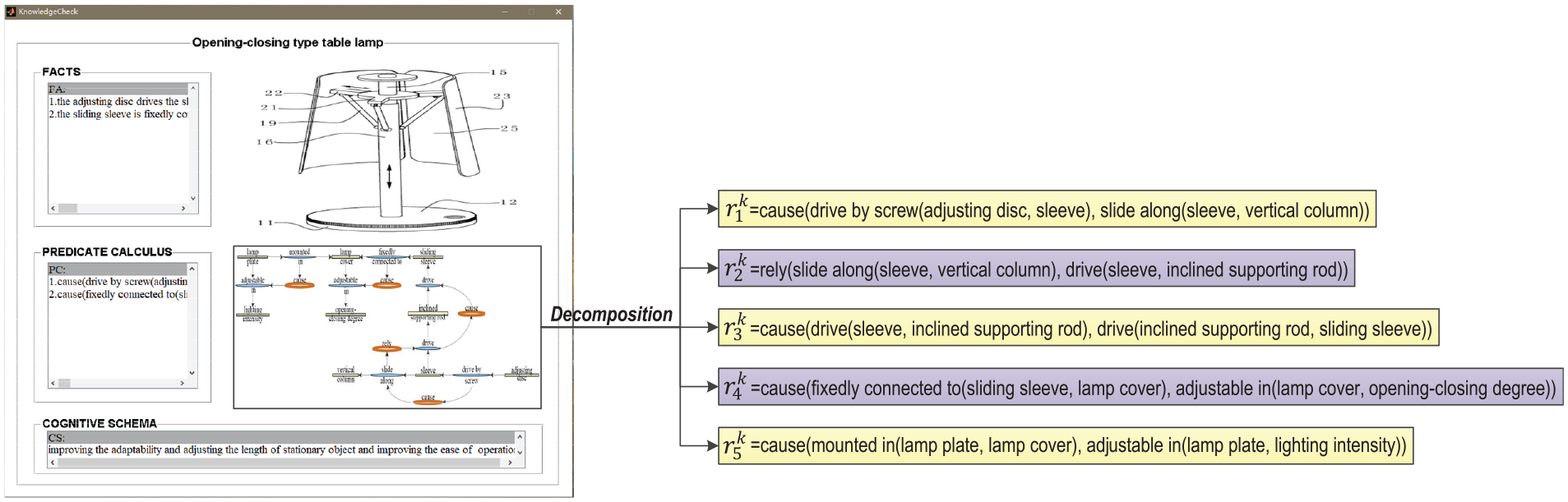
Here, the far-field analogy “opening-closing type table lamp” is taken as an example analogy to implement the structure mapping–based concept generation. Figure 8 shows the representation information of this knowledge entry, and the set
Obviously,
According to the CS of the example design analogy,
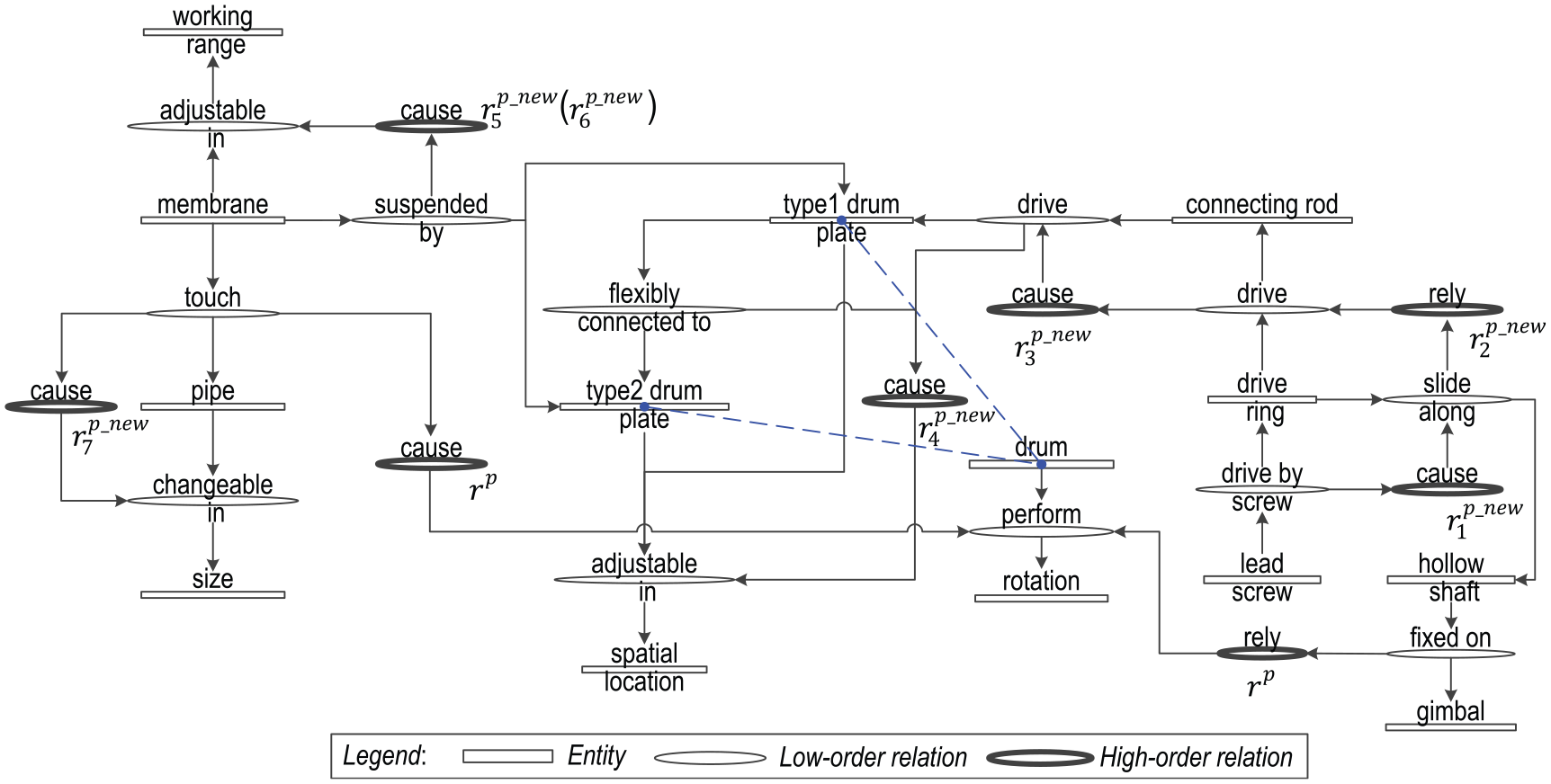
For the above new elements, some adaptive adjustments have been executed on the low-order relations or entities according to the problem context, such as “type 1 drum plate,”“type 2 drum plate,”“membrane,” and “suspended by.” Note that type 1 and type 2 drum plate result from the segmentation of drum. The to-be-adjusted entities or low-order relations are represented as A, B, C, D, and E, which prefigure some possible transformations for
The decomposition of the relational structure of knowledge entry “opening-closing type table lamp.”
The relational structure of the conceptual design solution.
According to the relational structure shown in Figure 9, the drum is segmented into a series of type 1 drum plates and type 2 drum plates. Each type 1 drum plate is suspended with the membrane and could be driven by the connecting rod which is driven by the drive ring, and each type 2 drum plate is also suspended with the membrane and connects type 1 drum plate by a flexible connecting mechanism. Meanwhile, the drive ring driven by the lead screw could slide along a hollow shaft. Based on this information, a technical system was outlined to present the improvement design of the detector subsystem, as shown in Figure 10. In the improvement design, type 1 and type 2 drum plates are, respectively, named as inner and external drum plates. A lead screw (8) matches two drive rings (7) by screw pairs, and both ends of lead screw (8) are, respectively, covered by screw threads with the same pitch but the opposite thread directions. The ends of connecting rod A (4) are, respectively, hinged to drive ring (7) and inner drum plate (2), and the radial motion of inner drum plate (2) is driven by connecting rod A (4). Connecting rod B (9) and connecting rod C (13) compose the flexible connecting mechanism. One end of connecting rod B (9) is rigidly connected to inner drum plate (2), while the other end is hinged to the lower end of connecting rod C (13). To avoid the motion interference between inner drum plate (2) and external drum plate (3), connecting rod C (13) is not only designed as a bending rod but also indirectly connected to external drum plate (3) by the combination of sliding sleeve A (11), sliding sleeve B (12), and cross (10). Specifically, the middle part and the upper end of connecting rod C (13) are, respectively, hinged to sliding sleeve B (12) and sliding sleeve A (11). The three hinge points of connecting rod C (13) are not on the same line so that the occurrence of dead point during the process of connecting rod B (9) driving connecting rod C (13) can be avoided. Cross (10) is rigidly connected to the bottom of external drum plate (3), and sliding sleeve A (11) and sliding sleeve B (12) could respectively slide in the horizontal and the vertical directions on cross (10), which increases the freedom of motion of connecting rod C (13) and enables inner drum plate (2) and external drum plate (3) to realize radial movement sequentially.
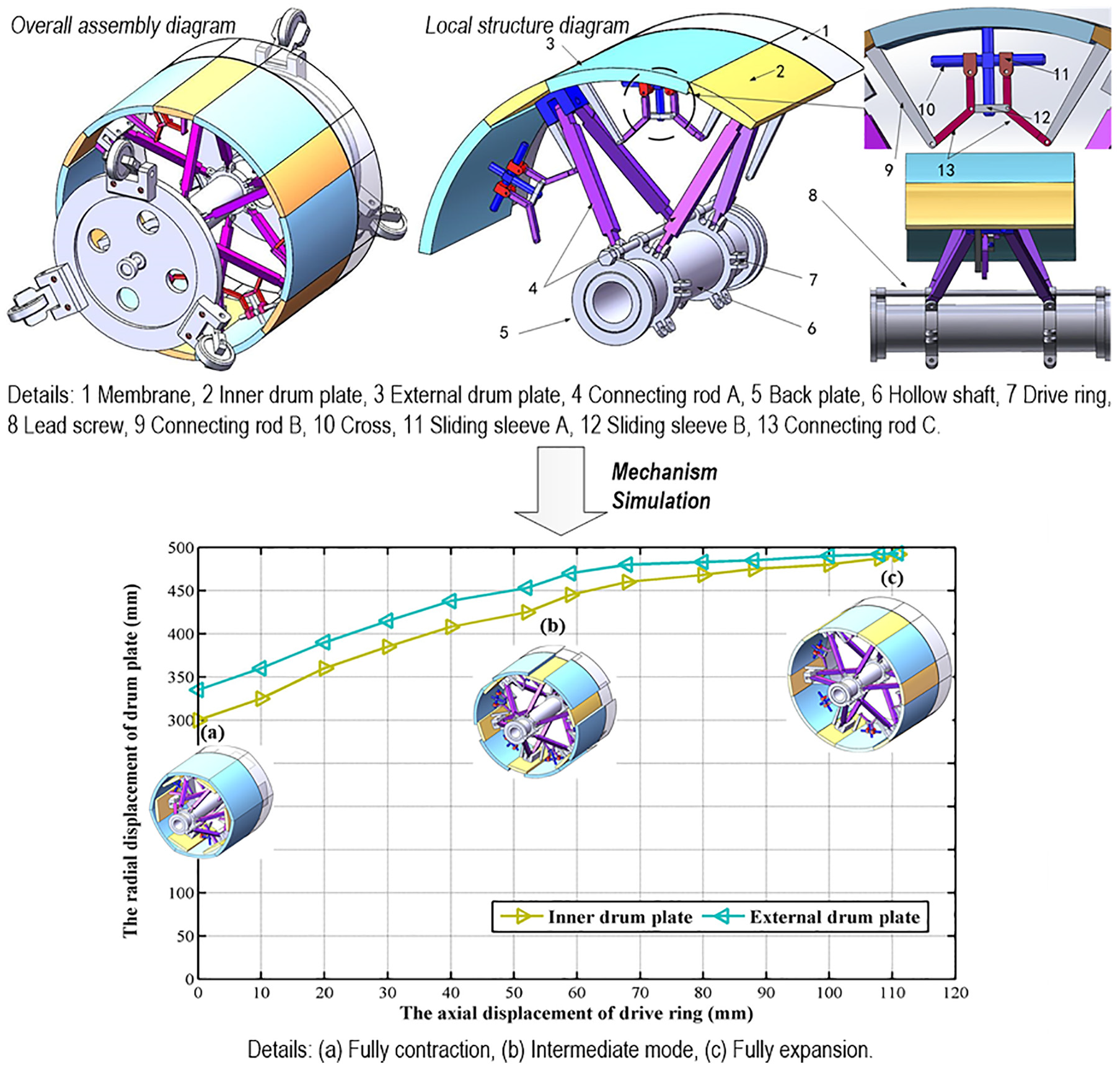
The improvement design of the detector subsystem of the PipeGuard and corresponding mechanism simulation.
Finally, mechanism simulation was carried out to verify the feasibility of the improved design. The detector subsystem is applicable to the leakage detection of pipes with inner diameters ranging from 700 to 1000 mm. Accordingly, the size of components was determined, and the 3D model of detection module was built in SolidWorks. After inserting the driving force and kinematic pair, COSMOSMotion was used to simulate the mechanism. The kinematic simulation diagram is also shown in Figure 10. In the whole motion process, there is no interference between the mechanisms when the detector changes from the fully contraction mode to the fully expansion mode. It can be seen that the radial displacement difference between the inner drum plates and the external drum plates decreases as the axial displacement of the driving ring increases. The diameter of the circumscribed circle of the drum changes from 698.04 to 994.60 mm. In practical engineering application, based on the improved design, a combination of pipe diameter sensor and stepper motor can be used to drive the lead screw in real time, so as to adaptively adjust the size of the detector subsystem according to the size of pipes.
The compared experiment on analogy search
In this section, the efficiency of the structure mapping–based analogical design framework in supporting analogical design is validated by comparing its analogy search performance with that of an existing analogy search method which applies the functional keywords representation. 4 The motivations and reasons to validate the proposed framework based on its analogy search performance are listed below:
Searching design analogy is intended to develop a knowledge space filled with useful stimuli (i.e. analogies), while the use of design analogy denotes using the stimuli to explore a solution space by analogical reasoning. In this sense, the resultant ideation outcomes tend to be influenced by certain aspects of the stimuli. For a given design problem, the quality and novelty of the ideation outcomes tend to be decided by the quality and novelty of the solutions hidden in the stimuli. 39
In the proposed framework, the use of design analogy is driven by the mapping mechanism of relational structure. Existing researches have experimentally or conceptually reported the useful role of relational structure in transferring the biological analogy, 22 promoting the mapping of visual analogy, 40 and maintaining the creativity in consumer product design. 28 Therefore, the validation experiment presented here lays the stress on assessing the analogy search performance of the framework.
The compared experiment was carried out by the following steps:
Extracting functional vocabulary (composed of generic functional verbs) from the abstracts of the 200 patents selected at random, and then applying functional VSM to develop the computational tool which supports searching functional analogies from the patents.
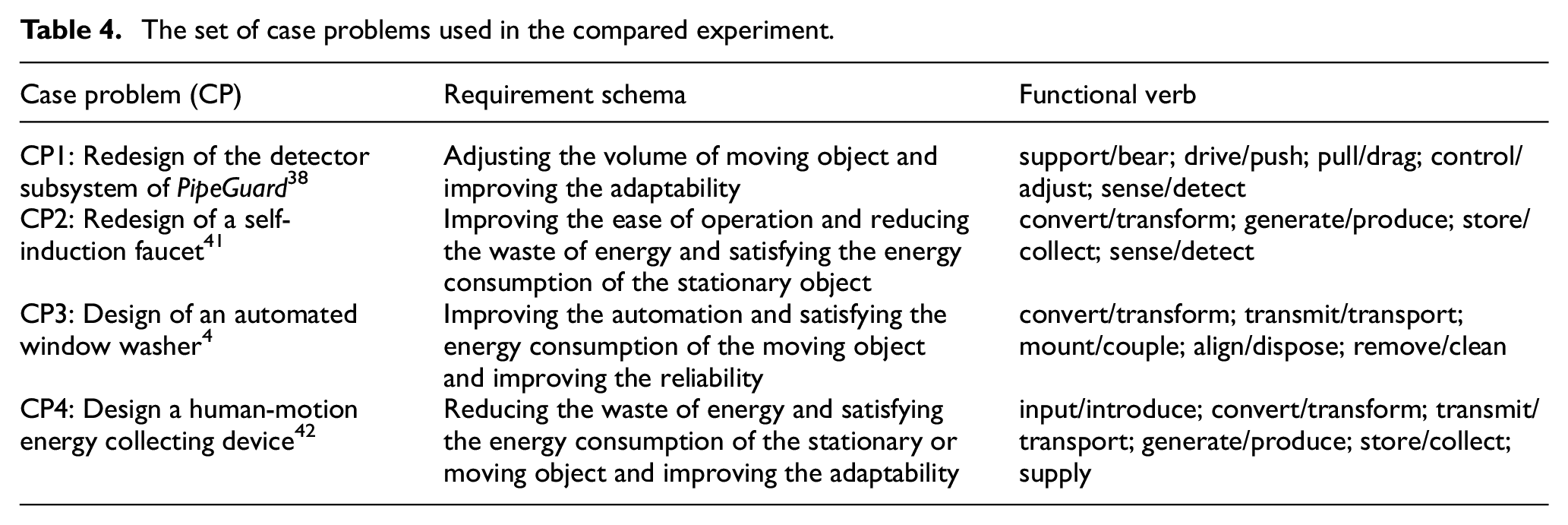
Determining a set of case problems (Table 4), and constructing relational structures and functional models for them, and generating RSs and functional verbs, respectively, used for structural and functional analogy search.
For each case problem, returning top n entries from the patents, respectively, ranked by structural and functional similarity, and assessing the solutions hidden in the returned entries by the metrics of quality and novelty, and statistically analyzing the assessment results.
The set of case problems used in the compared experiment.
Top 40 entries were selected from the patent entries ranked and presented by each analogy search tool (structural or functional), because we found that in this condition, the returned knowledge entry sets could to the maximum extent cover the entries with a certain similarity score. According to the design objective in each case problem, the metrics used by Venkataraman et al. 27 were applied to evaluate the novelty and quality of solutions hidden in the corresponding knowledge entries returned. Novelty and quality of the hidden solutions were evaluated from the documentation of the analogical patents:
Novelty of a solution is a measure of its unexpectedness or unusualness in comparison to the existing ones. Novelty of the hidden solutions is rated on a 4-point scale (0–3), corresponding to no, low, medium, and high novelty. The rating process was performed by a design expert in our team, who had spent enough time on acquiring extensive knowledge of prior art in the design projects of the case problems. Note that this expert did not know his rating outcome would be used for this compared experiment.
Quality is a measure of the feasibility of a solution and how well it fulfills the identified requirements. Quality of the hidden solutions is assessed by the formula
Following the assessment, the average quality and average novelty of the structural/functional analogies were calculated for each case problem. As shown in Figure 11, the functional analogies appear to have a higher average quality than the structural analogies, and this difference is statistically significant (one-way analysis of variance (ANOVA): F = 6.86, p = 0.0396 < 0.05, df = 5). A plausible explanation to this result is that the functional analogies share more functional features with the problem requirements, thus better fulfilling the identified requirements from the level of function to the level of physical structure. Meanwhile, it is observed from Figure 12 that the structural analogies have statistically significant higher average novelty than the functional analogies (one-way ANOVA: F = 85.29, p = 0.000091 < 0.01, df = 5). To explain this effect, we checked and analyzed the design analogies searched and found that the relational structure–based representation could capture some highly novel design analogies coming from the far field but sharing no or very low functional similarity with the given case problems. For example, the knowledge entry in Figure 2 shares very low functional similarity with the second case problem in Table 4, but it is novel and enlightening and with high structural similarity to this problem. A theoretical explanation is that in the relational structure–based representation, the characteristic elements (i.e. the technical effects described by GEPs) used for identifying design analogies are more coarse-grained than the functional keywords, and thus, the proposed representation can associate more potentially useful but nonobvious analogies from a given knowledge source.
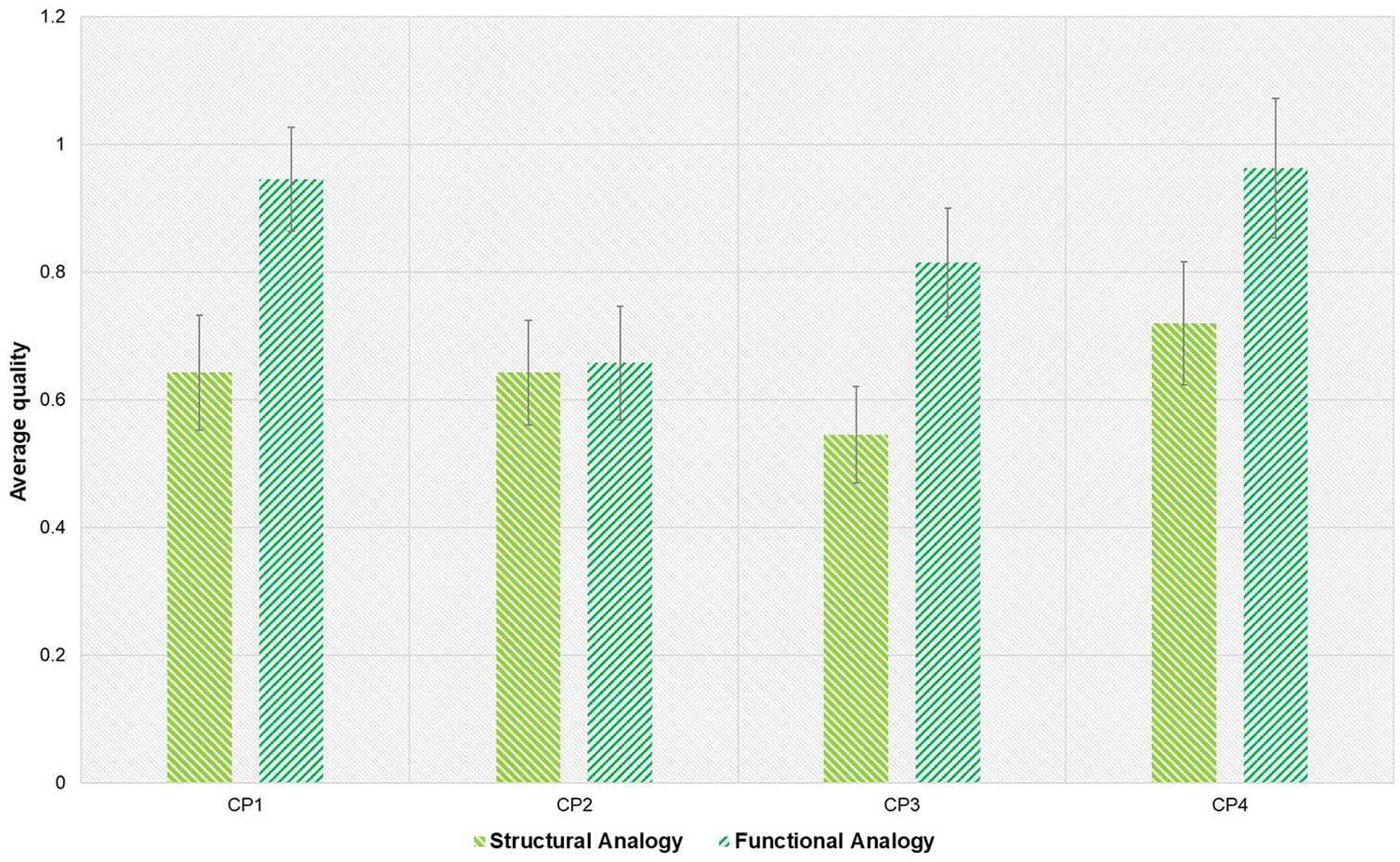
Average quality of the structural/functional analogies searched for the case problems (vertical lines show one standard error).
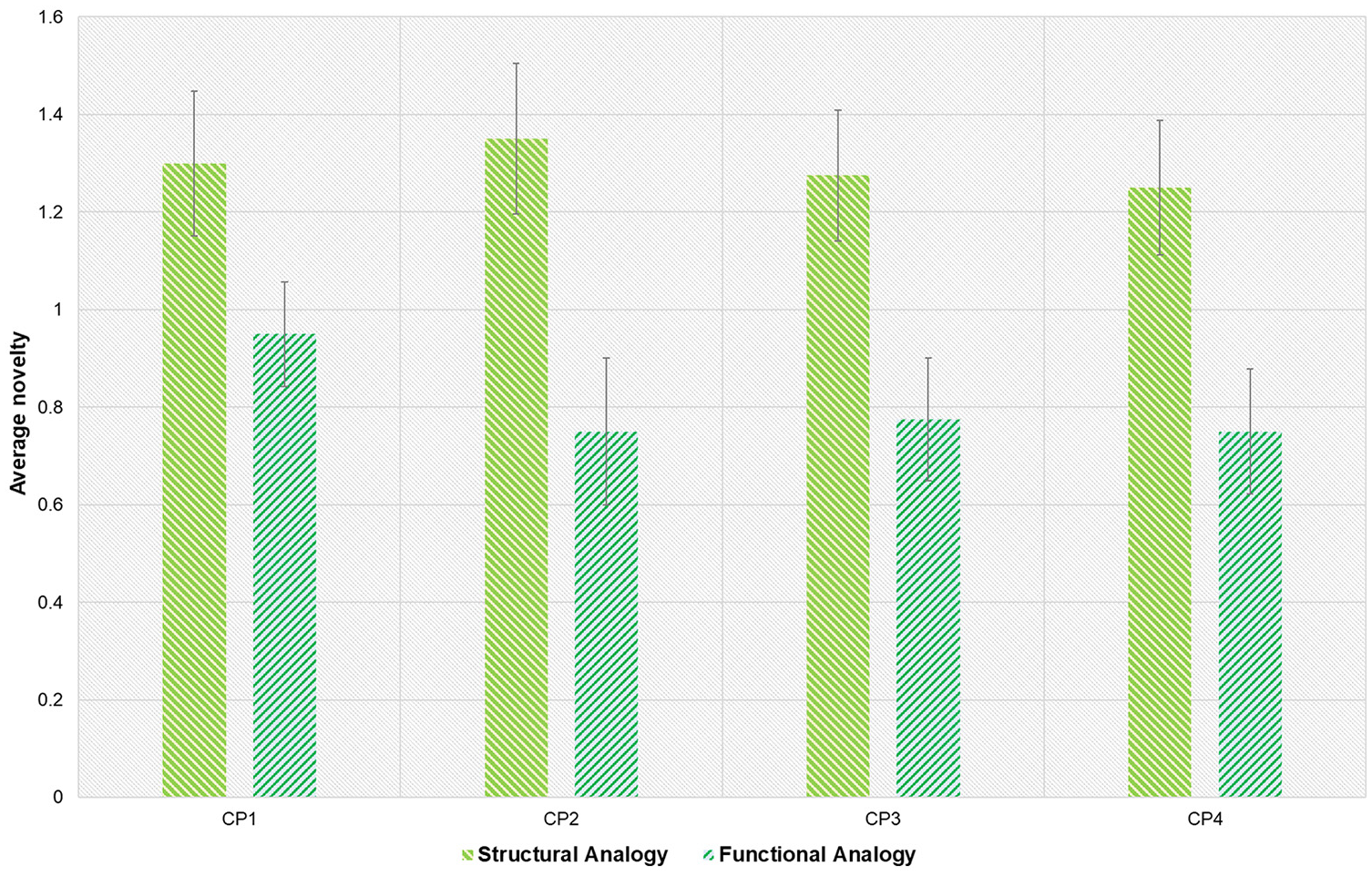
Average novelty of the structural/functional analogies searched for the case problems (vertical lines show one standard error).
Conclusion and future work
The contribution of this work was developing an analogical design framework in accordance with human cognition to assist designers in realizing innovation for product conceptual design. Differing from previous researches, this work proposed a relational structure–based representation to characterize the source analogical knowledge and target design problem, and such representation originated from the structure mapping mechanism of analogical reasoning. Based on this new representation scheme, a structural/schema similarity was defined for design analogy search, and a structure mapping–based concept generation model was constructed to guide the use of design analogy. The advanced natural language processing tools/algorithms were used to extract and generalize the relational structures of design problem and the existing designs hidden in patents. After generalizing the relational structures of design problem and patent knowledge, the RS and the CS were, respectively, described by the domain-independent GEPs, and the schemas worked as the computation medium to enable the identification of design analogies from different technical fields. Finally, two validation studies were carried out to verify the efficiency of the proposed analogical design framework:
In the PipeGuard improvement design case, the process of re-designing the detector subsystem demonstrated the feasibility of the proposed framework in supporting identifying useful design analogies as well as using a design analogy to create conceptual solution. Apparently, as the key element of the proposed framework, the relational structure information exhibited a certain degree of facilitation in the knowledge processing of designing by analogical thinking.
Another validation was a compared experiment, in which the design analogy search performance of the framework was compared against that of a functional keyword representation. It was found that the average novelty of the structural analogies was significantly higher than that of the functional analogies. It was also found that the relational structure–based representation could enable the identification of a part of highly novel design analogies which tended to be skipped by the functional or superficial similarity. Therefore, the proposed framework could effectively support designers to explore novel solution space by analogously using the analogies searched.
It may be difficult to transfer or use the high-novel structural analogies at the level of functionality or superficial feature, but as shown by the design case in section “The improvement design of the detector subsystem of the PipeGuard,” the concept generation model based on structure mapping could facilitate the transferring of such analogies. In the future, experiments involving different designer groups to implement analogical design would be carried out to validate the generality of this framework in the transferring of high-novel structural analogies. Another future work is to develop a computer tool to aid in implementing the structure mapping–based analogical design process, which means the structure mapping–based representation should be transferred into digital issues. For this, the first key point is to automatically extract relational structures from knowledge situations (e.g. patents), so as to represent the situations and then search analogies from them by the similarity defined based on relational structure, and the second key point is to endow the computational system with the ability to organize and manage the extracted relational structure information.
As for the first point, although the current method combining lexical analysis and regular matching was easy to implement the extraction of entities (i.e. nouns and noun phrases) and low-order relation predicates (i.e. verbs and verb phrases) from knowledge texts to construct relational structures, the high-order relations between the low-order relation predicates could not be automatically determined by this method. Of course, the current “manual process of determining high-order relations” did not influence the subsequent identification of GEPs from the relational structures. In the future, a method based on syntactic analysis would be used for the relational structure extraction. By syntactic analysis, the words (e.g. nouns, verbs) or lexical chunks (e.g. noun phrases, verb phrases), as well as the dependency relations between the words or lexical chunks, could be parsed. Then, the low-order and high-order relations, composing the relational structures, could be automatically identified from knowledge texts in the form of some specific semantic structures, such as the subject–verb–object triplets 43 and the causally related verb tuples, 20 corresponding to the low-order relations and the high-order relations, respectively. As for the second point, in the future, a technical effect ontology would be constructed to organize the structural information extracted from knowledge texts. The technical effects described by the GEPs would act as the concepts in this ontology, and the relationships between the concepts would be quantified by the short-text similarity between the technical effects. The technical effect ontology would be used to classify the extracted relational structures or high-order relations in them, which could enable the computational system to efficiently organize and manage the structural information based on the technical effects that can be achieved and then to provide or recommend analogical stimuli (relational structures or high-order relations) according to the RS of design problem.
Footnotes
Declaration of conflicting interests
The author(s) declared no potential conflicts of interest with respect to the research, authorship, and/or publication of this article.
Funding
The author(s) disclosed receipt of the following financial support for the research, authorship, and/or publication of this article: This work was supported by the National Natural Science Foundation of China (Grant No. 51435011).
