




Abstract
Previous studies on health prognosis are exceedingly dependence on the failure data and sensor data of a single component of manufacturing systems, and the holistic health prognosis techniques applicable to whole manufacturing systems still remain a challenge due to its increasingly physical and functional complexity. Therefore, a generalized health prognosis method is presented based on the deep fusion of quality-oriented big data of operational process of manufacturing systems. First, the generalized connotation of manufacturing system health is explained from the aspects of the physical composition and functional characteristics of manufacturing systems, and the quality state task network is proposed to organize quality-oriented big operational data, which improve the state transparency of the manufacturing system and lay the foundation of holistic health prognosis. Second, key characterization parameters in quality state task network are defined. Specifically, the performance state is analyzed based on multistate characteristics by considering the effects of stochastic degradation processes; the product quality state is quantified by using a process model that is established based on monitoring and inspection data; and the task execution state is quantitatively described by analyzing the evolution of task demand among machines. Third, an integrated model is built by integrating the three above-mentioned states as two key indicators, namely, qualified degree and mission reliability, for the comprehensive prognosis of the health of manufacturing systems. Finally, the effectiveness of the proposed approach is verified with a case study on the health prognosis of a cylinder head manufacturing system.
Keywords
Introduction
With the advent of industry 4.0 and big data era, the functions and composition of manufacturing systems are becoming increasingly complex and its comprehensive health prognosis and maintenance is becoming a challenging problem for most of the manufacturers. 1 In addition, accurate health prognosis of manufacturing systems is crucial for its stable operation, which plays a crucial role in production decision-making in a high-quality and intelligent manufacturing environment, such as product quality control, production scheduling, and condition-based maintenance. 2 Especially in the field of condition-based maintenance, health prognosis is necessary and a key technology to acquire the optimal strategy for implementing maintenance activities. 3 With the development of monitoring, sensing, and cloud technologies, massive operational data are produced and used as a basis for modeling of the system running state, where two major research fields have been formed: health prognosis and reliability modeling.
Currently, health prognosis methods can be classified into two approaches: model-based prognosis and data-based prognosis. Model-based health prognosis typically aims to explore the physical process of machine performance degradation. Numerous approaches have been proposed, and many of them were successfully applied in the industry.4, 5 However, model-based prognosis needs to constantly improve the model through an in-depth understanding of health degradation mechanism where the fault type in question is frequently unique and varies from component to component. Establishing an accurate physical model to prognosticate the health of complex industrial system is very difficult and expensive, not meet the development of intelligent manufacturing. In the context of intelligent manufacturing, with the wide application of sensors, operational data can be easily collected. Based on massive operational data, data-driven health prognosis approaches employing mathematical statistics and data mining techniques have been developed for health monitoring of industrial systems. 6 For example, Liu et al. 7 analyzed the health prognosis of machine with multisensor by considering the hidden degradation process as machine state and using adaptive hidden semi-Markov model to obtain the transition probability among health states. Realizing that some indicators are continuously required for improving production quality or productivity, Peng et al. 8 proposed a framework on quality-related fault detection and diagnosis for industrial multimode batch processes. Moreover, the quality data, as the key performance data of manufacturing system operation process, are also being applied in production equipments maintenance policy optimization and manufacturing system health prognosis.9, 10 The advantage of data-based methods is that they fully utilize big operational data and translate them into useful information for diagnostic/prognostic decisions, which can significantly boost efficiency and reduce costs in the industry. However, the efficacy is highly dependent on the accurate comprehension on the meaning of the quantity and quality of health system operational data. In addition, effective diagnosis and prognosis of health state are limited to component-specific properties. Health diagnosis and prognosis of complex manufacturing systems remain a challenge for big operational data.
In contrast, the reliability modeling technology has been widely studied in various industrial fields for various entities from individual components to complex systems.11, 12 Reliability is mainly focused with machine failure and performance degradation. In conventional reliability analysis, the degradation process results in two levels of performance states, namely, working perfectly and complete failure. 13 However, in practice, the performance degradation process of machine may undergo multiple performance states before complete failure, which leads to a multistate characteristic. 14 In addition, modern manufacturing systems are typically composed of several production machines that lead to a multistation characteristic. Furthermore, production tasks are showing variable characteristics with the development of multivariety and small-batch production mode. Therefore, multistate-oriented mission reliability modeling of manufacturing system is an interesting research topic.
Reliability modeling and health diagnosis are related to each other. 15 The health state of components can be characterized from the results of failure diagnosis and reliability assessment. 6 However, many scholars realized that the health of manufacturing systems could not be represented as the combination of individual machine reliability because of the complexity of manufacturing systems.16, 17 Many studies have extended the meaning of manufacturing system reliability. For example, Chen and Jin 13 analyzed the interaction between product Quality and component Reliability (QR-co-effect) in manufacturing process, and proposed a reliability analysis modeling method for manufacturing systems based on quality and reliability interaction effects. Zhang et al. 18 described the relations between the key product characters of the machined part and the key control characters of the process, and proposed the connotation of manufacturing system reliability from the process perspective. He et al. 19 put forward a new connotation of manufacturing system reliability according to the analysis of the relationship among manufacturing system reliability, manufacturing process quality, and product reliability. Lin and Chang 12 defined reliability as the ability of a manufacturing system to satisfy customer requirements based on stochastic flow network. The above-mentioned documents have expanded the connotation of manufacturing system reliability. However, the input and output characteristics and the operating mechanism of the manufacturing system were not analyzed from system engineering perspective. It is difficult to realize the idea of “predictability” of intelligent manufacturing without comprehensive system operation state diagnosis.
In the context of intelligent manufacturing, effective health diagnosis and prognosis provide the prerequisite to proactively implement production scheduling and condition-based maintenance, and then it provides a possibility for predictive production. However, insufficient in-depth study on the connotation of manufacturing system health leads to the inability to effectively organize big operational data, thereby restricting the development of health diagnosis and prognosis for manufacturing systems. The manufacturing system is a complex network structure composed of machines, production tasks, and materials. There are obvious limitations to doing a systematic health diagnosis around a single aspect. Therefore, aims to clarify the dynamic composition of manufacturing systems and establish a system health prediction model with holistic diagnosability, a heuristic generalized connotation of manufacturing system health is provided by considering state information of product quality, task execution, and equipment performance. With the deepening of the research on manufacturing systems, many scholars view to establish an effective model to improve the condition description and prediction of its components in the manufacturing process, such as stream-of-variation, 20 quality flow, 21 and manufacturing system Reliability-operational process Quality-produced product Reliability (RQR) chain, 19 have been proposed to characterize the quality of Work in Process (WIP). At the same time, Kondili et al. 22 proposed the state task network, which is an effective tool with good expansibility to model the operational state of manufacturing system that can clearly represent the complex task flow in manufacturing system. 23 Therefore, in view of the collectability and validity of quality state information, an integrated model named quality state task network (QSTN) is proposed to organize the big operational data and synthetically analyze the state changes of manufacturing system components, and then quantitative models of machine performance state, task execution state, and product quality state are built based on operational data. To promote the development of health prognosis theory on the holistic manufacturing system, a novel approach for health prognosis of manufacturing systems based on QSTN is proposed.
In comparison with previous studies on the perspective of reliability modeling or health prognosis for a manufacturing system, the main contributions of this study are as follows:
A heuristic generalized connotation of manufacturing system health is defined by considering the dynamic composition and operation characteristics of manufacturing system, which covers the state information of product quality, task execution, and equipment performance.
The relationship among production tasks, machine performance, and product quality is analyzed from a system-based view, and the QSTN is proposed to clarify the dynamic interaction between the above elements in the manufacturing process and organize the operational data.
Based on the QSTN, a holistic health prognosis model is put forward from the perspective of stably completing the production tasks and outputting high-quality products.
The rest of the article is organized as follows. The second section explains the theoretic basis of health prognosis for manufacturing systems. The third section presents the development of a joint prognostic model. The fourth section introduces a case study of an automotive cylinder head manufacturing system. The fifth section provides the conclusions.
Theoretic basis of health prognosis for manufacturing systems
The generalized connotation of manufacturing system health
A manufacturing system is a dynamic system consisting of production tasks, WIP, and machine. Therefore, the modeling and description of a dynamic manufacturing system should include three parts: the task execution, the machine performance, and the product quality.
There is an obvious multistation characteristic in the physical composition of modern manufacturing system; the current production mode of small-batch customization specifically determines the variability of the manufacturing task, which leads to complex production task flow in the manufacturing system, and shows a physical multistage characteristic. In addition, during the operation of the manufacturing system, component failure will result in the degradation of the system to perform tasks. However, the system is not completely disabled, as the system has different levels of task execution capabilities, namely, different quantity levels of WIP; the quality state of the products or WIP has significant characteristics of polymorphism, which causes the manufacturing system to show a functional multistate characteristic.
Due to physical multistage and functional multistate in manufacturing systems, component failure is insufficient to characterize the health of the manufacturing system. Considering component performance as a basic factor that affects manufacturing system health is practical. The direct service object of the manufacturing system is the production task. Transmission and evolution of production task, namely, task execution state, exists in the manufacturing system with the effect of qualified rate. Task execution state is a representation of the working state of the manufacturing system. In practice, manufacturing high-quality products has been the main goal of enterprises, whereas product quality as the main output characteristic of the manufacturing system, which are represented on the health of manufacturing systems. Therefore, a heuristic generalized connotation of manufacturing system health should be defined by integrating input and output characteristics (i.e. production task and product quality) and machine performance characteristics. Based on the three above-mentioned aspects, the health of manufacturing system H can be expressed by the following conceptual model

where Q, S, and T represent output product quality, machine performance state, and production task, respectively.
According to the operating mechanism of manufacturing systems, a framework for health prognosis of the manufacturing system is shown in Figure 1.
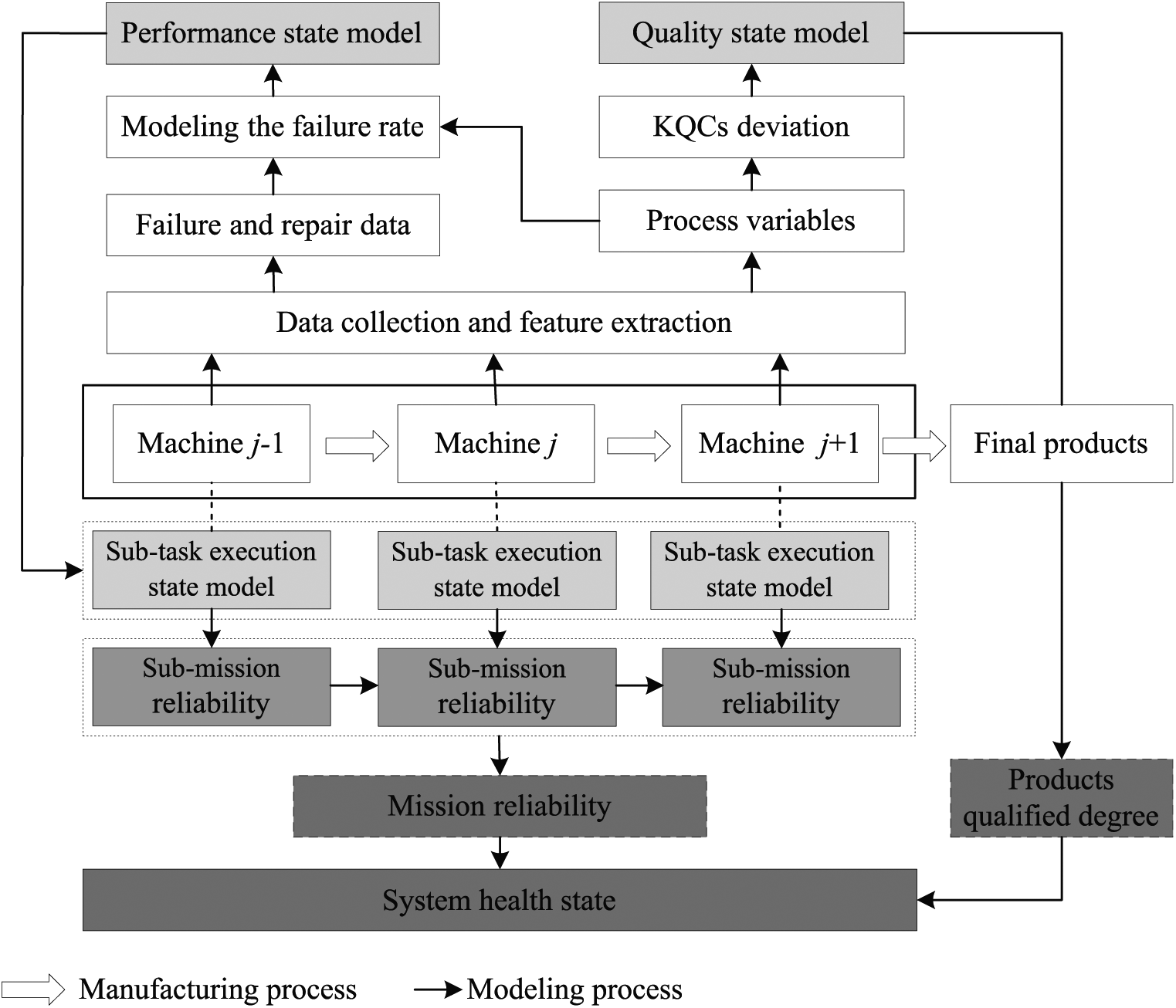
A framework of generalized health prognosis for manufacturing systems.
As shown in Figure 1, three state prediction models are required to be established as prerequisite for health estimation, namely, performance state model, quality state model, and sub-task execution state model. Specifically, the performance state is modeled based on multistate theory, and the effects of stochastic degradation processes are considered; the product quality state is quantified by analyzing the deviation of key quality characteristics (KQCs); and the task execution state is quantitatively described by analyzing the evolution of task demand among machines. Although task execution state is the input characteristic of a manufacturing system, its effect on manufacturing system health cannot be characterized separately. To solve this problem, the sub-mission reliability is defined as the ability of the machine performance to meet production task requirements, which is quantified by integrating the performance state of the machine and the sub-task execution state. Furthermore, the failure dependence of sub-tasks is analyzed, and a copula-based expression for mission reliability is obtained, which is a comprehensive representation of the manufacturing system operating state. Subsequently, the quality state of all KQCs is integrated to obtain the quality index of the output, namely, qualified degree. Finally, manufacturing system health is quantified as the probability that the system completes production task and outputs high-quality product in the current performance state, which is consistent with the ultimate goal of the manufacturing system operation, namely, achieve the specified production tasks and produce required products with high quality. Therefore, it can be expressed as

where Q(t), S(t), and T(t) represent output product quality state, machine performance state, and task execution state, respectively.
QSTN model
To fully characterize the complex operation task network composed of machines, production tasks, and WIP, the relationship among production tasks, machine performance, and product quality is analyzed. Based on previous research, 14 an improved graphical representation of the manufacturing system named QSTN is proposed. The mechanism of QSTN model is shown in Figure 2.
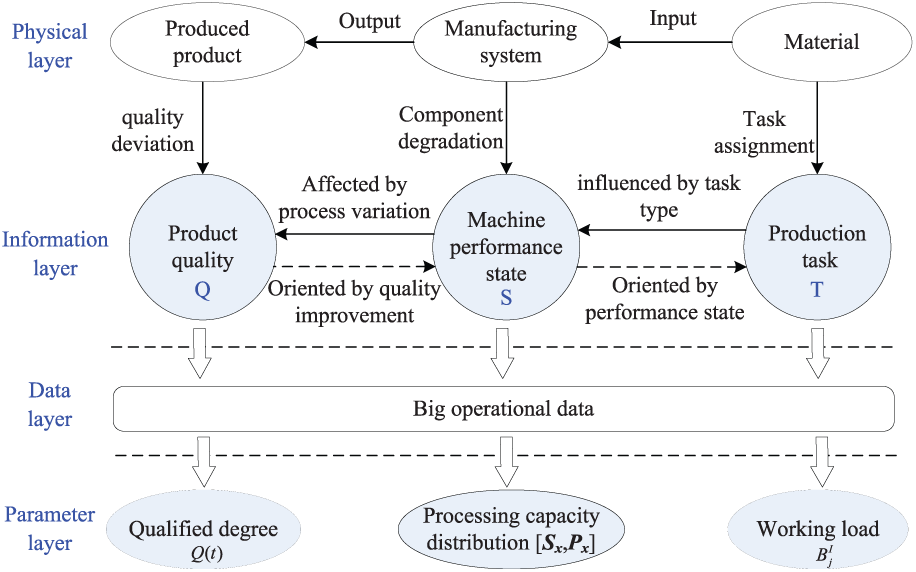
The mechanism of QSTN model.
From a physical standpoint, when given a production task, the required materials are carried to the manufacturing system and processed by multiple stations, which is delivered as final products. In the information layer, the direct service object of the manufacturing system is production task. Due to variability of production task, the performance of machines is characterized by failure rate or reliability, which is not sufficient to describe the running state of the relevant machine during the execution of production tasks. Therefore, based on machine performance polymorphism, the performance state should be quantified in the context of a specific production task, where such modeling results will be guiding the actual production easily. The degradation of component performance will increase the normal and abnormal variations in manufacturing process; these variations should be accumulated and inherited by the WIP, which will result in the deviation of product quality. Conversely, based on the co-effect among task execution states, machine performance states, and production task states, future studies can be carried out on product quality improvement–oriented maintenance strategy for machines and production scheduling optimization for machine performance states.
In the data layer, big operational data are proposed to describe massive data in the manufacturing process. A data set for a production task consists of task data (product quantity, production cycle, etc.), machine performance data (vibration, noise, temperature, radial beat, rotational speed, etc.), and product quality data (KQCs, dimension variation, qualified rate, etc.).
In the parameter layer, three parameters of working load (
The mechanism of QSTN model in Figure 2 describes the overall operational mechanism of the manufacturing system. Considering the multistation characteristic, the detailed QSTN model of a manufacturing system with multiple machines is shown in Figure 3.
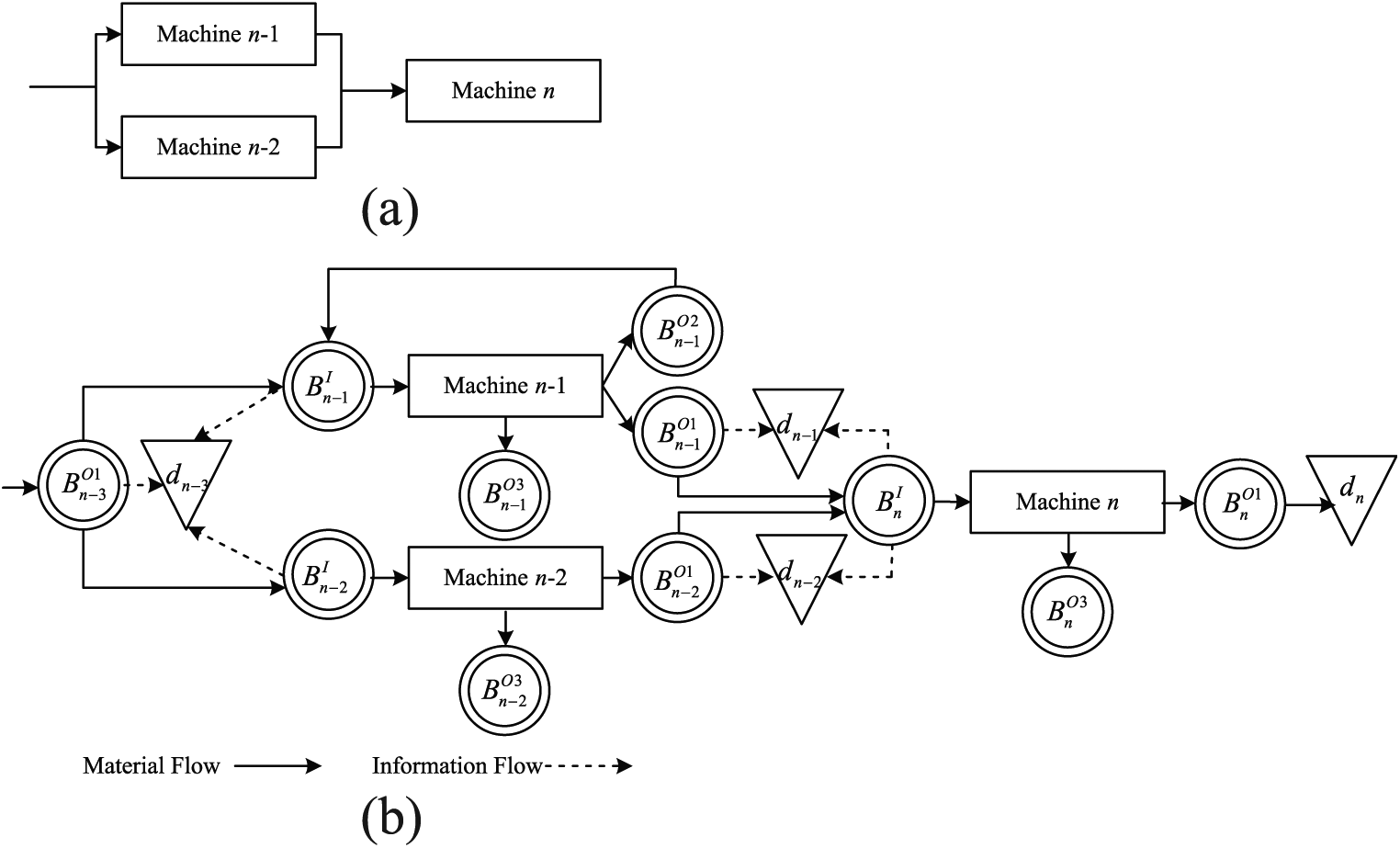
Simplified QSTN representation of a manufacturing system: (a) an example of a local structure manufacturing system and (b) QSTN model of the example manufacturing system.
Figure 3(a) is an example of a local structure manufacturing system. Figure 3(b) is an example of a QSTN model. In QSTN, the solid line represents the material flow, whereas dotted line denotes the information flow. Quality state is the abstract expression of the quality inspection results of raw materials, semi-finished products, and finished products, which is denoted by circles. The quality state can be divided according to three quality states, namely, a good state, a defective repairable state, and a scrapped state, and the quantity of WIP in each quality state is represented by
The QSTN model can clearly characterize machine performance states, task execution states, and quality states of the final product in the manufacturing system. This model improves the clarity of the manufacturing system operating process and provides a theoretical basis to mine valuable information in big operational data. Furthermore, this model provides a new way for predicting and optimizing the health state of the manufacturing system.
This study includes the following assumptions.
The machine is an independent entity, where a reliable inspection station is available for each machine.
Defective products can only be reworked one time, and only qualified products can enter the next machine.
KQCs are independent from each other.
Without loss of generality, if the machine is in ideal state, the set of controllable process variables
The proportion for each failure mode of the machine is constant. Thus, the proportional relationship among parameters
The human factors (human reliability) are not considered in the work.
Development of a joint prognostic model
Modeling of product quality state
Quality is derived from design and is obtained in manufacturing. In the manufacturing process, variations from man, machine, material, method, measurement, and environment should be accumulated and inherited by the WIP, thereby resulting in the deviation of product KQCs. Thus, in addition to degradation of machine performance, the quality of the product is affected by some random noise variables that are not determined by component degradation.
The performance degradation of machines is typically a stochastic process with nonnegative and independent increments, which can be characterized with the gamma process.
24
Set
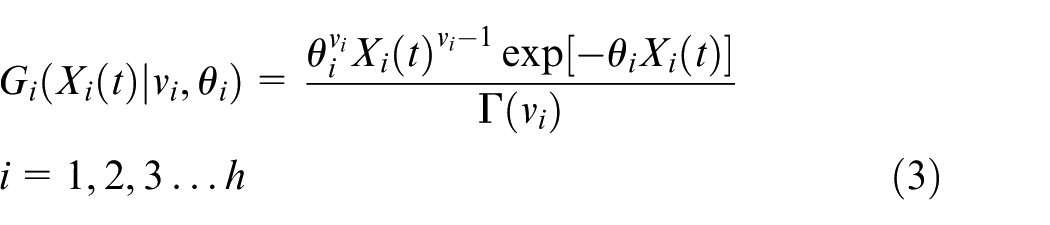
where
Although constant deterioration rate may be unsuitable for the realistic degradation process, let


Let

where
Given

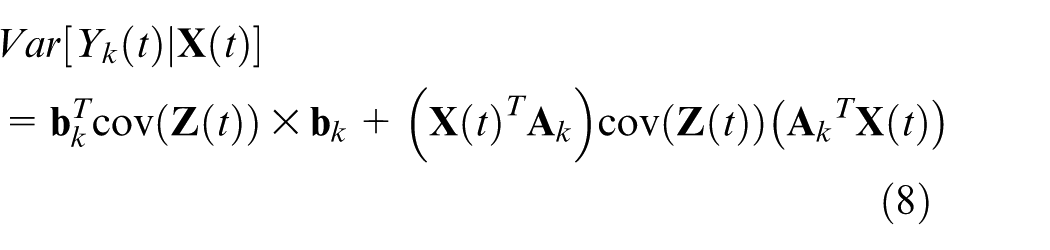
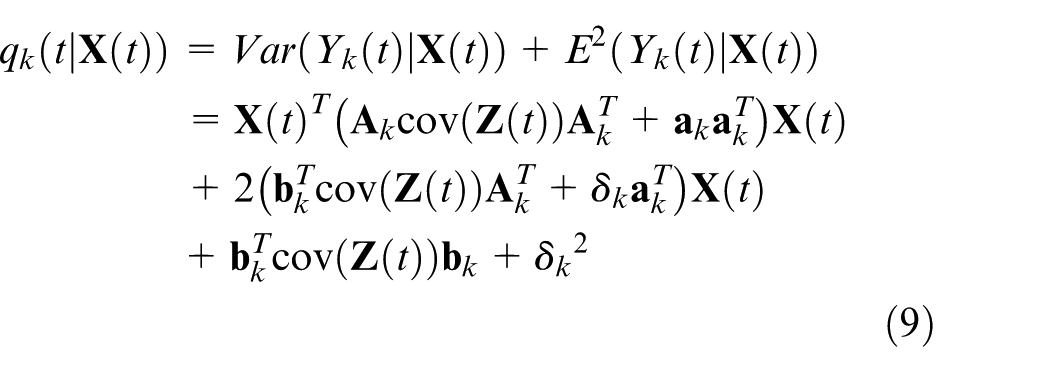
Let
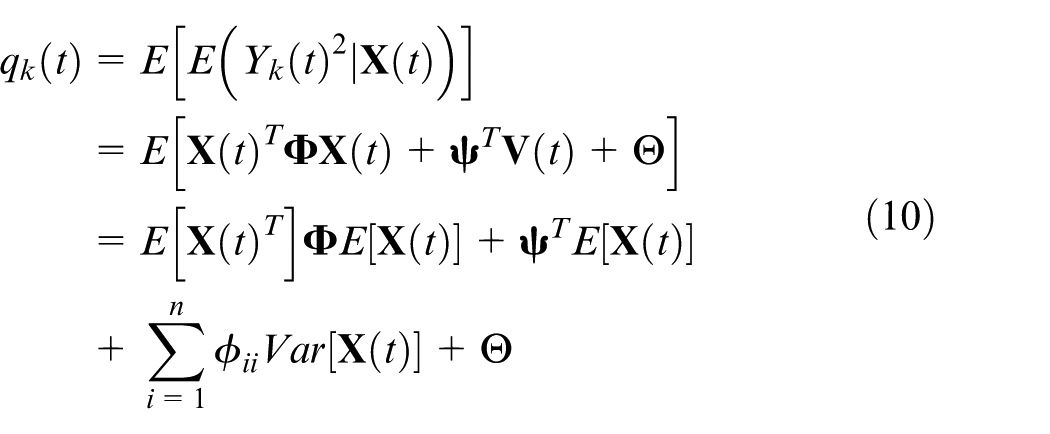
where
Substituting equations (4) and (5) into equation (10) yields

where
For each KQC deviation, there is a threshold value (

where
Then, the qualified degree

Modeling of machine performance state
In the manufacturing process, each machine experiences different degradation process with unique performance degradation characteristics, thus showing the evolution of the failure rate distribution function. Based on polymorphism of machine performance and diversity of processing materials, the performance of the machine is comprehensively analyzed, and the probability of the processing capacity is obtained.
Considering the wide application of Weibull distribution in describing the failure rate function of large mechanical–electrical facilities because of its adaptability, 26 the machine initial failure rate function can be parametrized by Weibull distribution. Considering the effect of performance degradation on the changing rate of machine failure rate, based on the proportional hazard model, 27 the failure rate function is expressed below

where
Due to the randomness of process variable
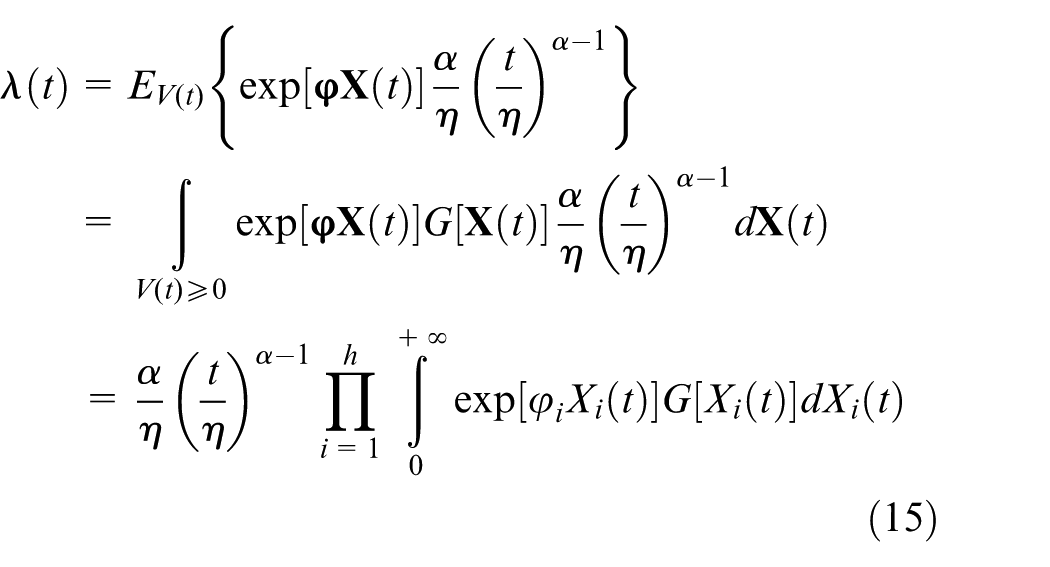
Then, substituting equation (3)
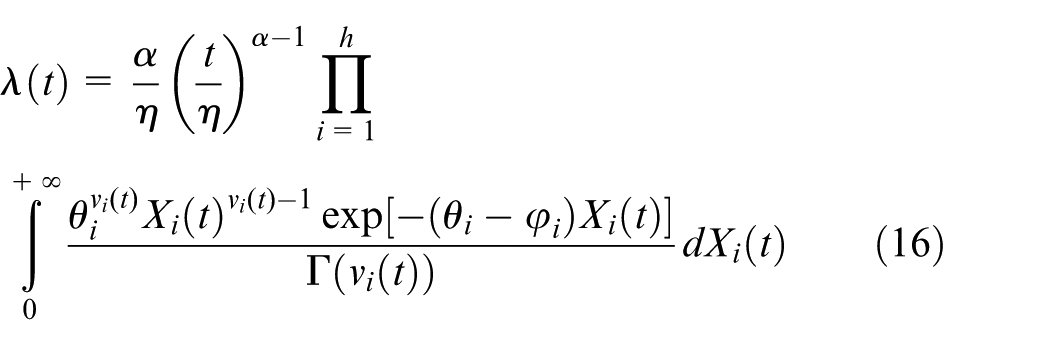
The value of
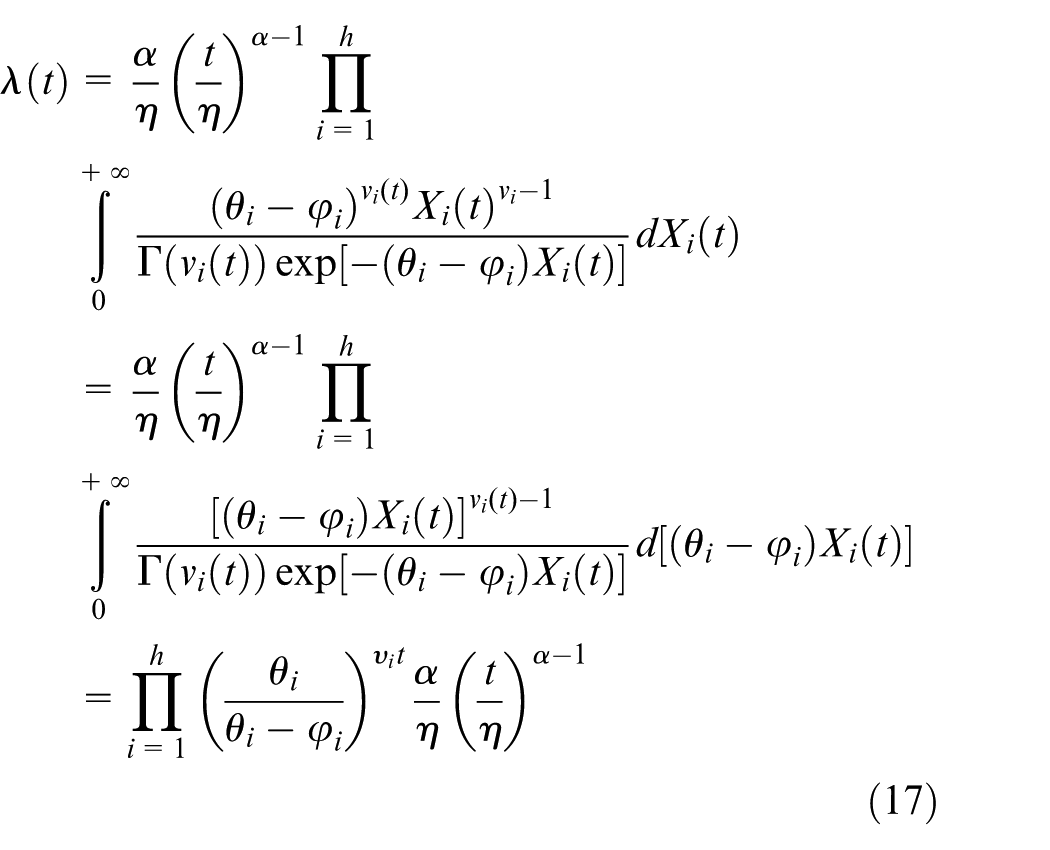
Several failure modes occur during the operation of each machine. Failure modes are classified according to the length of repair, whereas the overall states are divided into a finite number of discrete levels ranging from perfect functioning to complete failure. In combination with the cumulative probability of occurrence of various failure modes, the performance of machines can be transformed in the form of distribution probability of processing capacity (i.e. number of produced items per time unit); it can be represented as
Availability is the ratio of time in which a system or component is functional to the total time it is required or expected to function. Based on the example of probability of processing capacity, the unavailability (

Considering failure rate, the unavailability can also be modeled as follows

where
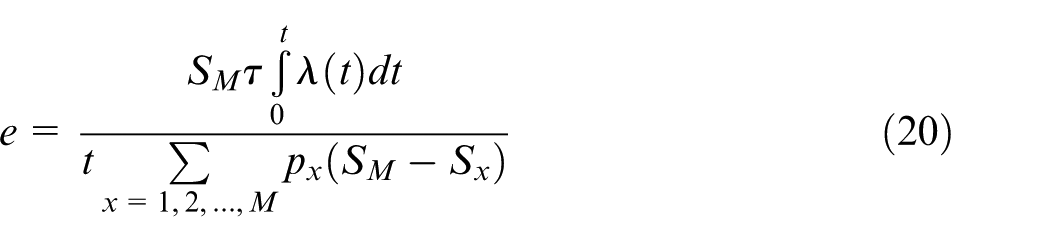
Combining equations (18) and (19), the expression of variable e which related to machine performance can be obtained
Modeling of task execution state
To produce sufficient qualified products for satisfying production task demand d, the primary step is to determine the amount of input materials. According to assumption 2, suppose that
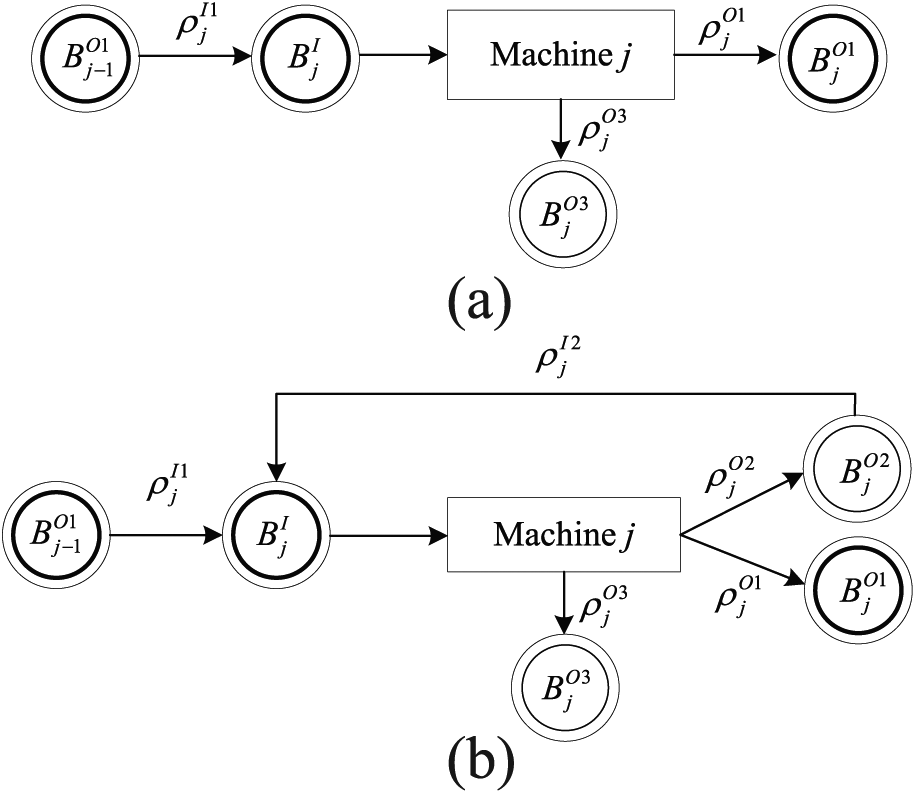
Input and output flow in two machine types: (a) QSTN model of a general machine and (b) QSTN model of a machine with networking process.
The quantitative relationship between input–output parameters in Figure 4 can be expressed as the following matrix form. Matrix in equation (21) expresses the quantitative relationship of the material state change in a general machine, whereas matrix in equation (22) expresses the quantitative relationship in a machine with rework process

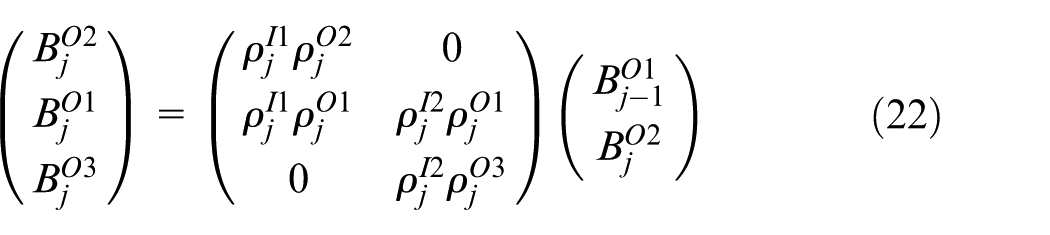
where
When n machines exist in the manufacturing system to meet production task demand d, and the system does not have a rework process, the task execution state can be expressed as

Then evolve the task demands of the upstream machine in which the number is represented by j – 1, we can obtain

When a rework process is required in the machine, the task demands of the upstream machine can be expressed as follows

The task execution state can be expressed below

The evolution of task demands is the same as equation (24).
Integrated model of health prognosis
To predict the health state of the manufacturing system according to the manufacturing system health diagnosis framework shown in Figure 1, the three state models are required to be transformed as two key indicators, namely, product qualified degree and mission reliability index.
According to assumption 3, the qualified degree of the final products can be expressed below

To evaluate mission reliability, the primary step is to quantify the sub-mission reliability, which is defined as the probability that the number of final products is greater than or equal to task demands. The sub-mission reliability can be described as the following equation

In other words, the sub-mission reliability can be defined as the probability that the machine performance (i.e. process capacity) meets the task execution state (i.e. working load). The sub-mission reliability can be described in the following equation

Set

Substituting equation (13) into equation (30) yields

In a flow line production where each machine is an independent entity, a functional dependency may exist among the machines, namely, a correlation among sub-task failures. Copula functions are widely used in correlation analysis of the function and structure in a system, which is discussed by Nelsen. 28 Therefore, a copula-based expression for mission reliability function is analyzed below.
One advantage of the copula function is that the mission reliability can be modeled directly through the univariate marginal functions of the individual sub-mission reliability (i.e.
According to Sklar’s theorem, a copula model assumes the existence of copula C such that

where
When the system has n sub-tasks in series, the copula and marginal sub-task failure distributions are
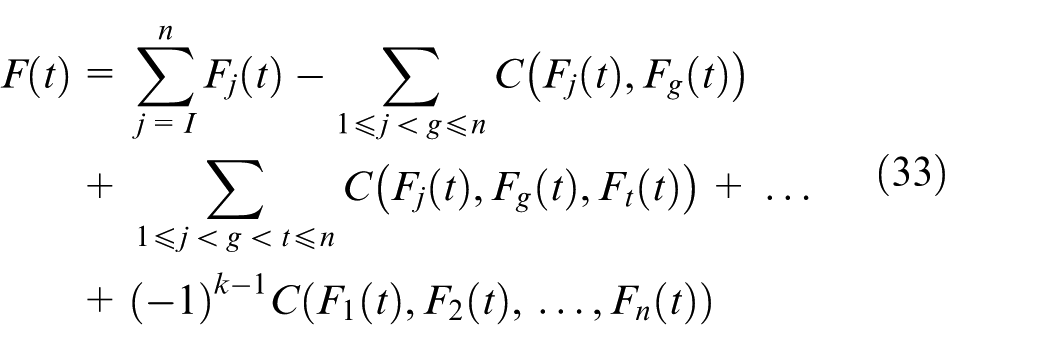
When the system has n sub-tasks of the same kind in parallel, the copula and marginal sub-task failure distributions are

Then, the mission reliability can be expressed as
On the basis of equation (2), the health of a manufacturing system is manifested in its capability of stably accomplishing production tasks and outputting high-quality products. The output must be qualified when quantifying the ability of the system to complete the production task steadily which characterized by mission reliability; while the quantification of qualified degree is about the analysis of quality level of qualified product, its value has nothing to do with the qualified rate or the mission reliability. Therefore, it can be considered that there is statistical independence between

Case study
Backgrounds
Cylinder heads are the key components in the engine. The cylinder head is also a box part with complex structure that requires high precision and complex processing technology in which the quality of machining directly affects the overall performance of the engine. The KQCs of the cylinder head are mainly concentrated in the dimension of each hole that are independent from each other. However, the machining of cylinder head is a typical batch production in series process where the execution state of each machine is relevant and a dependency relationship exists among the sub-mission reliability of each machine. The health prognosis for the manufacturing system is the foundation to ensure the successful completion of production tasks and production of high-quality cylinder head, then realizing the predictive manufacturing. Therefore, three key machines in the cylinder head manufacturing system are selected as an example to validate the efficiency of the proposed method. The KQCs of the final products corresponding to each machine are shown in Figure 5(a), and transform Figure 5(a) in the form of QSTN, as shown in Figure 5(b).
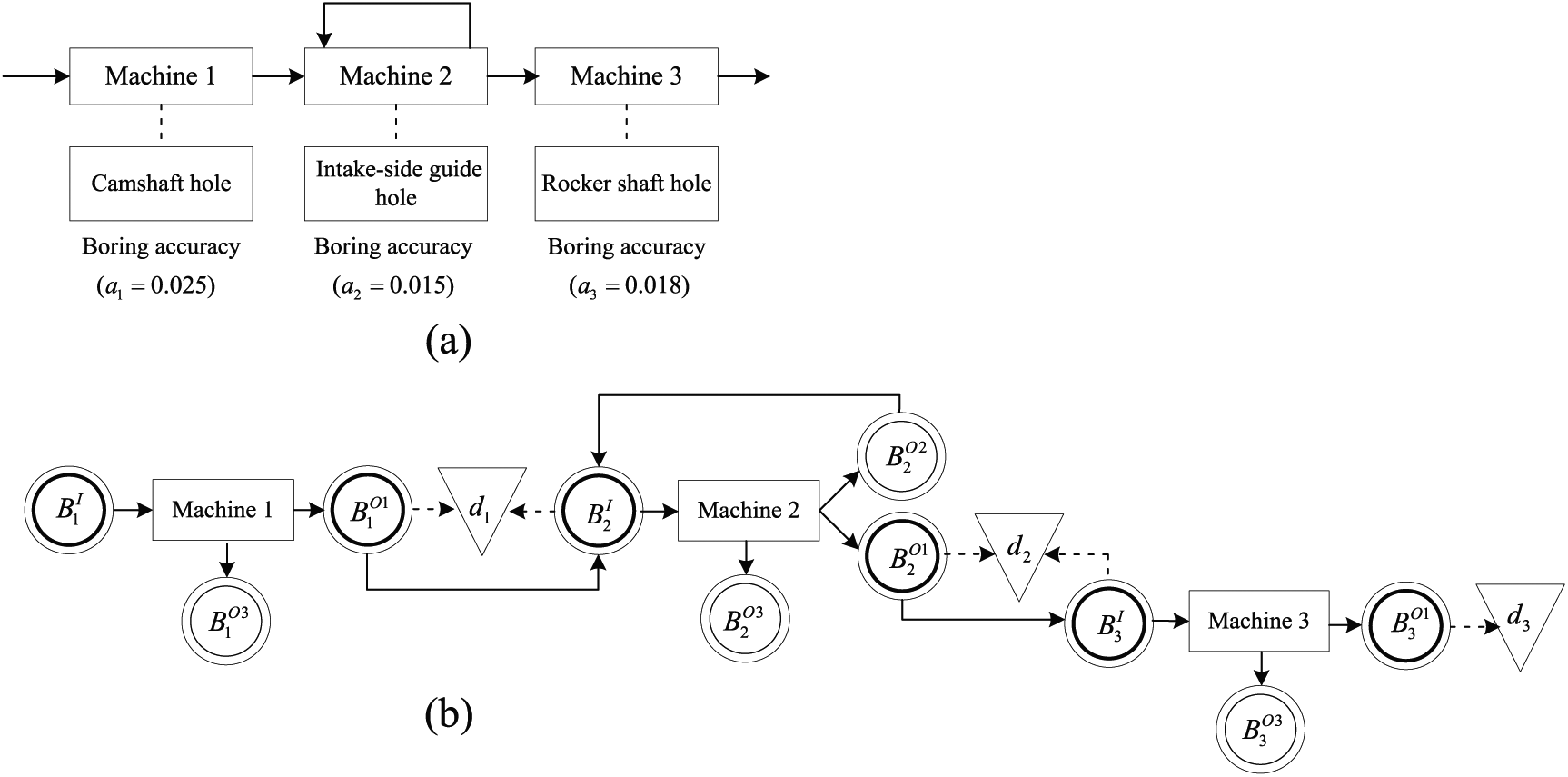
An example of a manufacturing system: (a) a simple example of a three-station manufacturing process and (b) a QSTN model of the case.
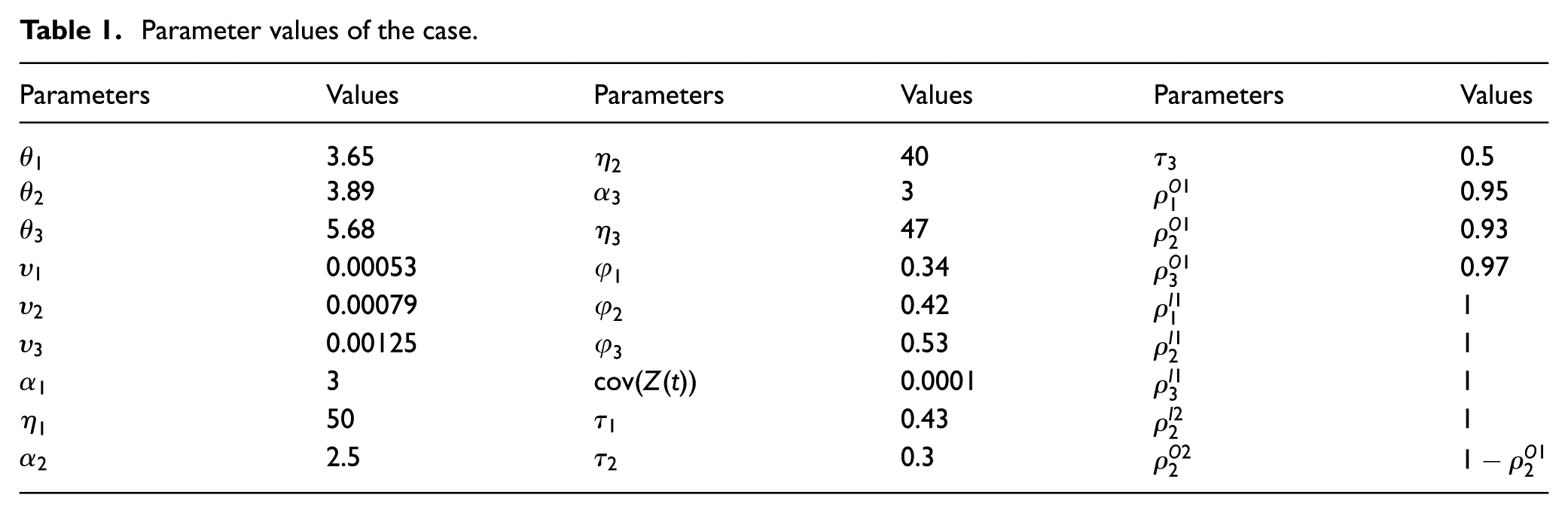
As shown in Figure 5(a), three KQCs are found. KQC deviations



Parameter values of the case.
Numerical example
According to the modeling methods described in the “Development of a joint prognostic model” section, the product quality state, performance state, and task execution state are analyzed as follows.
Quality state analysis
According to the process model shown in equations (36)–(38), the deviations of KQCs are obtained as follows
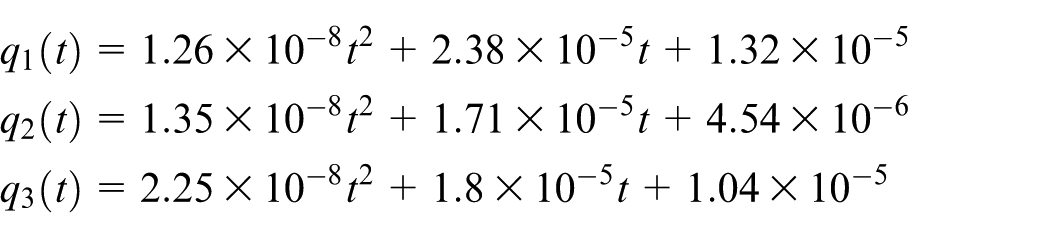
Then, based on equation (13), translate the above expressions into the parameter of qualified degree, which is used to characterize the quality state of product. Obviously, with the increase in machine running time, aging of components will lead to the decrease of the quality of final products. When the system operates more than 580 days, the KQC 3 (i.e. the diameter of rocker shaft hole) of the products will not meet product design requirements. Therefore, the prediction of the final product quality will be carried out only when the system is operating less than 580 days.
Based on the above analysis, quality improvement–oriented maintenance strategy for manufacturing system shown in Figure 2 can be developed to prevent the emergence of a large number of substandard products, thus ensuring the stability of production process and improving production efficiency.
Performance state analysis
According to failure and maintenance data, the proportional relationship among occurrence probabilities of each failure mode is analyzed. Processing capacity states are divided into a finite number of discrete levels based on the loss of processing capacity caused by each failure mode. Finally, the probability of the processing capacity state is obtained as follows
Machine 1:

Machine 2:

Machine 3:

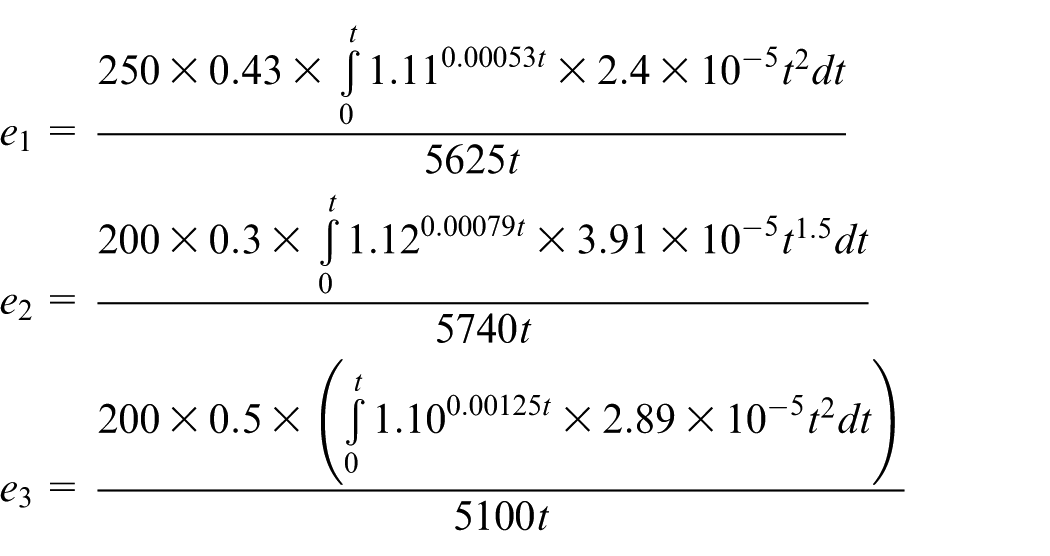
According to equation (20), variables e1, e2, and e3 are obtained
Task execution state analysis
Given a production task demand required as d3 = 180/day for machine 3, the task execution state of machine 3 is calculated

As the input ratio
As a rework process is required in machine 2, the task demand of machine 1 should be first obtained to find the task execution state of machine 2

Then, the task execution state of machine 2 is obtained by equation (26)

Finally, the task execution state of machine 1 is obtained

Health state prognosis
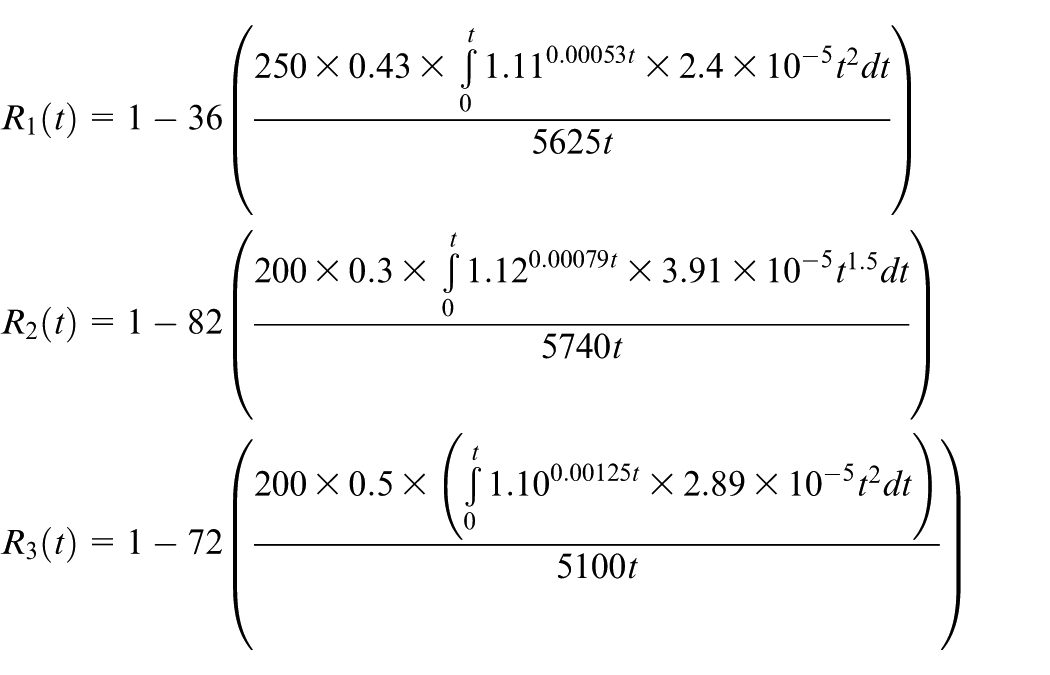
To predict the manufacturing system health, the mission reliability is quantified as follows. First, the sub-mission reliability of each machine is obtained based on equation (31)
The correlations among the three sub-task failures are analyzed by using the copula function. The common copulas are Gauss copula, t copula, Gumbel copula, Clayton copula, and so on, where Gumbel and Clayton copulas are often used to characterize the positive correlation between variables; therefore, Gumbel and Clayton copulas can be used to analyze the positive correlations among sub-task failures based on operational data. To simplify the calculation process, we select Gumbel copula and take sub-task failure probability

It should be noted that the selection of copulas is mainly based on statistics analysis and simulation techniques in practice, as described by Jia et al. 32
The Gumbel copula function parameter (
The sub-task failure probability of the sample data and the joint copula distribution function are shown in Figure 6(a). The combined distribution function value of the sample data of sub-tasks and the estimated value of fitted copula distribution function are compared in Figure 6(b), which can be seen that the fitting effect is significant.
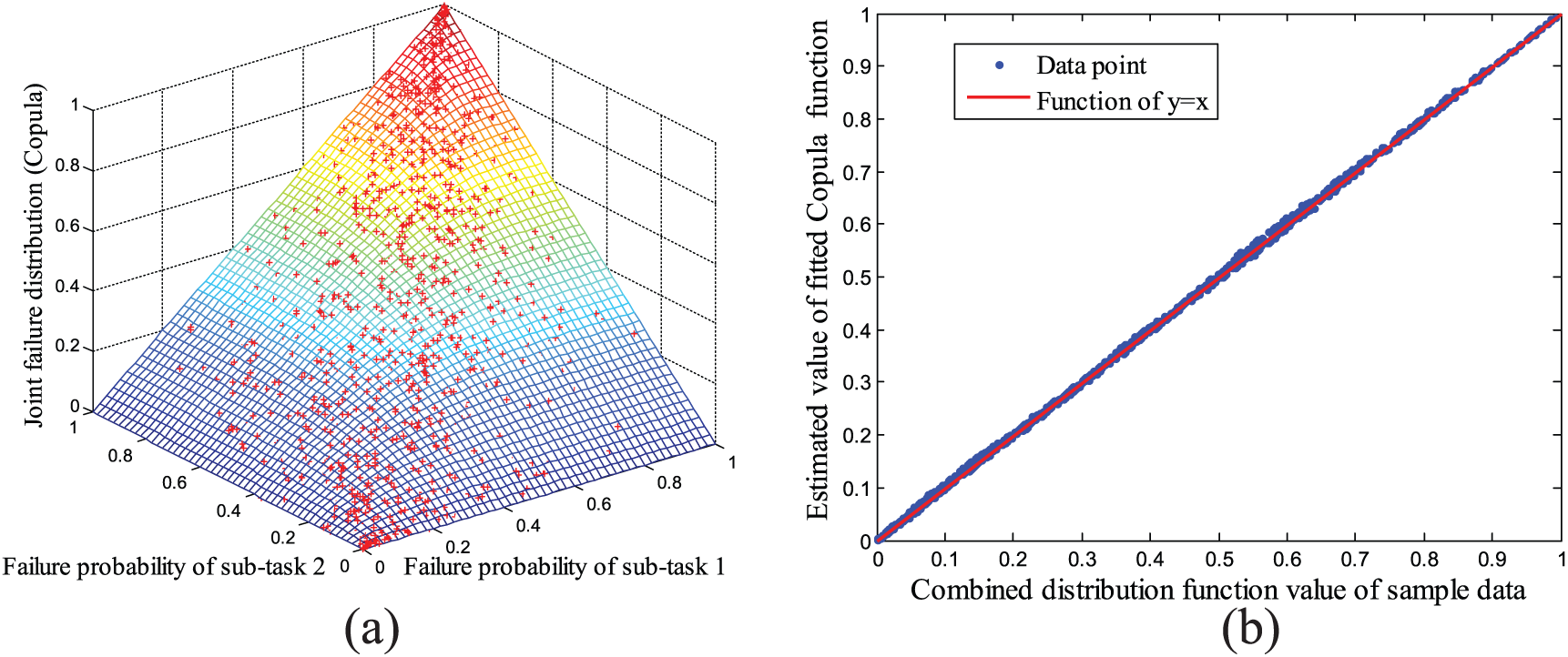
Copula function fitting: (a) scatter diagram of failure probability distribution function and (b) comparison of combined distribution of sample data and fitted copula distribution.
Using the same method to determine the failure correlation among the remaining sub-tasks, the same method is used to determine the correlation coefficient among different sub-tasks,
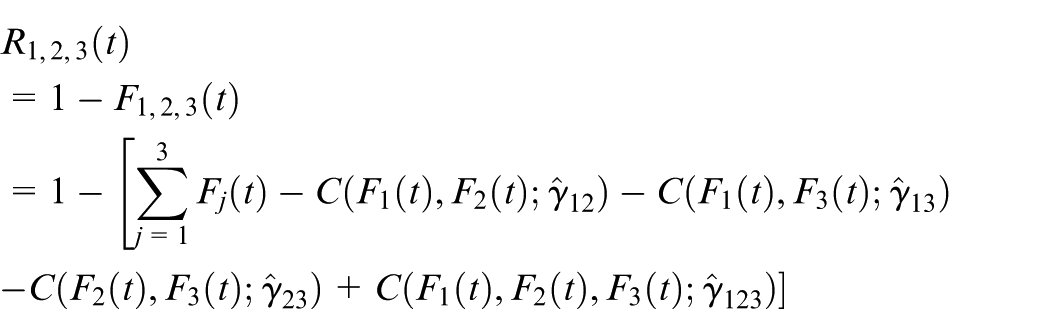
Finally, according to the expression of manufacturing system health shown in equation (35), the changing trend of manufacturing system health is predicted based on two key indicators, qualified degree of final products and mission reliability of the system, as shown in Figure 7.
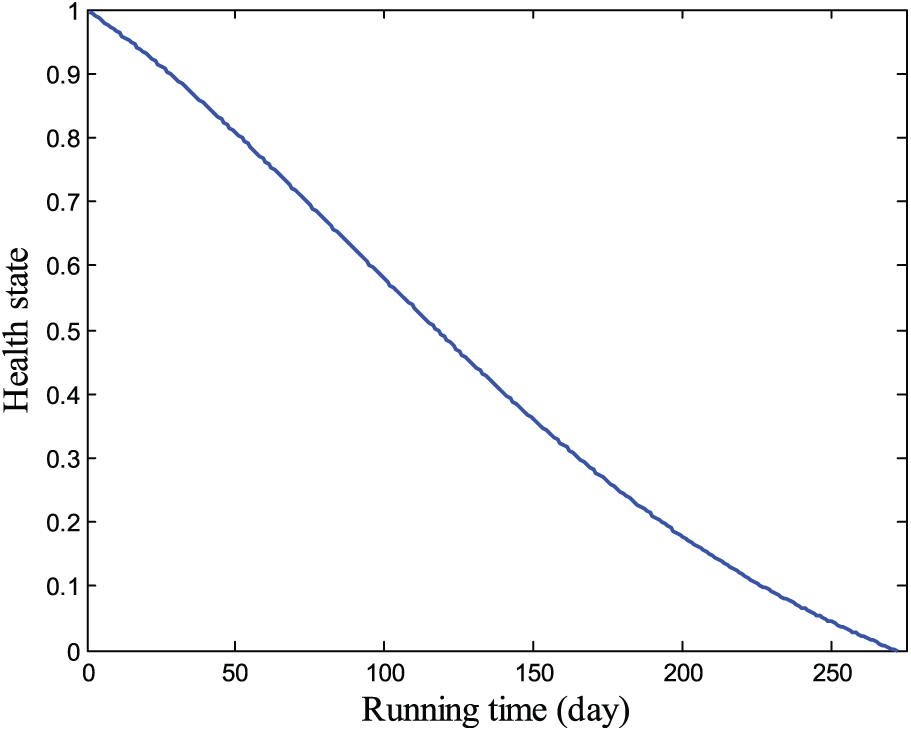
The curve for system health state against time.
With the increase in running time, the health state of the system shows a decreasing trend. This curve comprehensively reflects the machine performance state, product quality state, and task execution state, which can provide scientific reference in the development of production scheduling and predictive maintenance strategy.
Sensitivity analysis and comparative study
To further validate the efficiency of the proposed method, the sensitivity analysis and comparison verification of the model are carried out. Sensitivity analysis is mainly to examine the effect of some critical parameters on the system health state to prove the validity of the model. And the comparative study is to prove that the system-wide general health indicator proposed in this article is scientific in the prediction of manufacturing system health state. That is, the method proposed in this article can better guide production decisions.
The performance state of the machine and the quality state of products are functions of running time, and the effect of running time on the health of manufacturing systems is shown in Figure 7. Therefore, this part mainly analyzes the influence of task execution state and task failure correlation on system health.
First, assuming that performance state, product quality state, and task failure correlation are identical, analyze the change on system health state under different production tasks, as shown in Figure 8(a). Then, assuming that performance state, product quality state, and task execution state are identical, analyze the change on system health state under different task failure correlations, as shown in Figure 8(b).
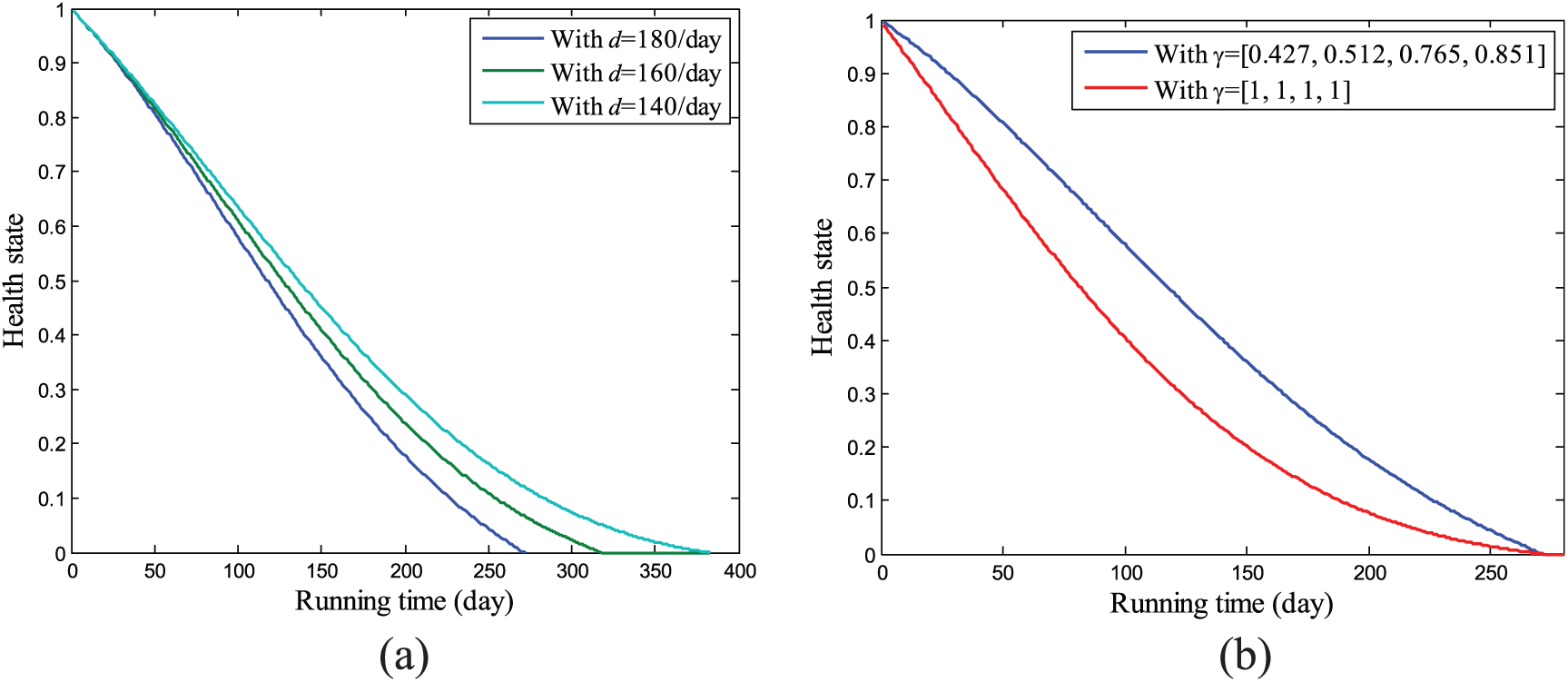
The results of comparative study: (a) the curves for manufacturing system health under different production tasks and (b) the curves for manufacturing system health under different task failure correlations.
Seen from Figure 8(a), by using the proposed method, the system health state has some differences under different task demands. This difference is gradually increased with the degradation of machine performance. Therefore, the proposed method can provide a relevant basis for production scheduling, condition-based maintenance, and other activities.
In Figure 8(b), the blue line represents the curve for system health, whereas the red line indicates the system health curve under completely independent conditions. In practice, the data of task execution process are typically measured individually. When a correlation exists, a part of failure data will be repeated to a certain extent, which leads to health prognosis results lower than the real value.
Then, a comparative study between the proposed method and conventional method 13 for characterizing system health state by component reliability is performed to validate the effectiveness and improvement of the proposed method. MATLAB is used to analyze the changing trend, and the results are shown in Figure 9.
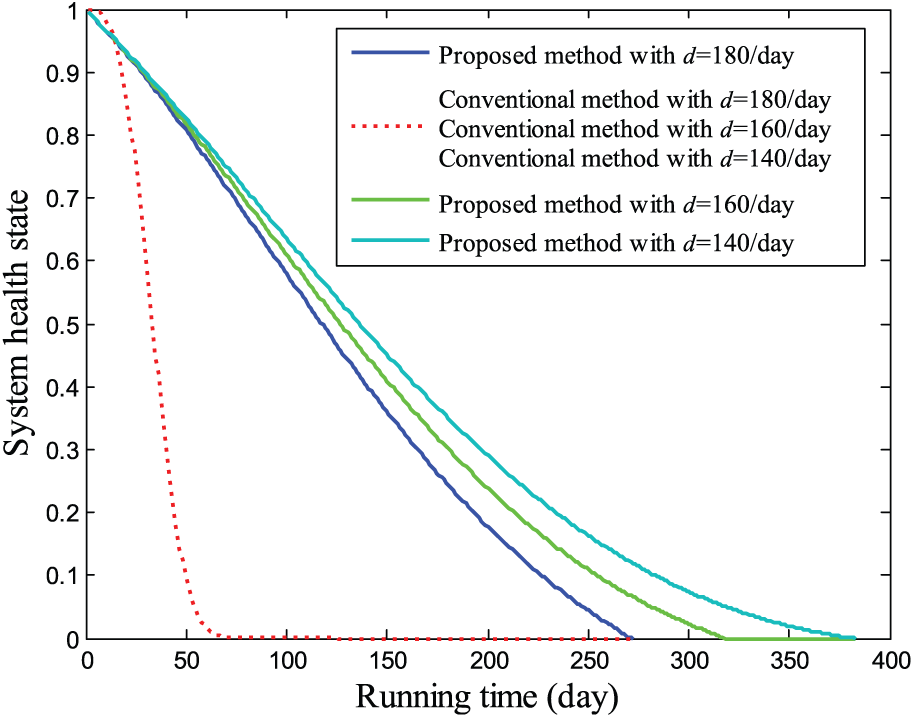
The comparison curves for different manufacturing system health indicators under different production tasks.
The red dotted line in Figure 9 indicates the changing curve of the conventional method under the assumption of the case, whereas the blue solid line shows the changing curve of the system health predicted by employing the proposed method. Seen from Figure 9, the conventional index deteriorated sharply at the beginning of operation and rapidly drops to a low level. Therefore, when we guide the maintenance activities with this indicator, it is obvious that frequent maintenance activities will be arranged. However, in the analysis of the method proposed in this article, we can find that the operation state of the system and quality state of the final product remain at an acceptable level at this stage, namely, the system is in a healthy state. Therefore, using the method proposed in this article to represent the health of the manufacturing system can better meet the actual production situation, and then more reasonable arrangements for preventive maintenance activities, so as to avoid excessive maintenance.
In addition, seen from Figure 9, when employing different production tasks, no differences are observed in the trend of system health characterized by conventional reliability indicator. So, the method presented in this article can fine analyze the changing trend of health state of the system during the execution of different production tasks. Then, more reasonable arrangements for preventive maintenance or scientific production scheduling can be developed according to the health status of the system. However, the conventional reliability indicator discounts the effect of task execution state on the stability of the system operation, obviously cannot achieve this function.
Conclusion
In this study, a novel method for health state prognosis of manufacturing systems is proposed in the context of intelligent manufacturing idea of “prediction and manufacturing” considering physical multistage and functional multistate in manufacturing systems. The generalized connotation of manufacturing system health state is explained based on analyzing the relationship among the quality state of products, the performance state of machines, and the execution state of production tasks. QSTN is proposed to organize big operational data of manufacturing system. On this basis, the quantitative methods of key parameters in the QSTN model are given. The performance state is analyzed based on multistate characteristics by considering the effects of stochastic degradation processes. The product quality state is quantified by using a process model that is established based on monitoring and inspection data; the task execution state is quantitatively described by analyzing the evolution of task demand among machines. Subsequently, the task execution state is integrated with machine performance with multistate characteristic based on the QSTN model. The sub-mission reliability index is obtained to fully display the coordination between the performance of machines and the execution state of the tasks. Furthermore, the copula function is used to analyze the failure correlation of each sub-task, and the mission reliability prediction model of the system is obtained. The prognostic model of the manufacturing system health is obtained by combining the qualified degree of the final products. Finally, the efficiency of the result is validated with a case study on the health prognosis of cylinder head manufacturing system.
However, this study is based on the assumption that KQCs are independent from each other, and the effect of incoming product quality on machine performance is discounted. To improve the portability, two conditions are provided below for future research.
Analyze the correlation between KQCs, and quantify the effect of output quality deviation of the upstream station on the processing quality of downstream products.
Integrating the effect of input product quality on the performance of machine.
Footnotes
Acknowledgements
The authors would like to thank Prof. Xie Min for his comments and help in preparing the early draft of the paper.
Declaration of conflicting interests
The author(s) declared no potential conflicts of interest with respect to the research, authorship, and/or publication of this article.
Funding
The author(s) disclosed receipt of the following financial support for the research, authorship, and/or publication of this article: This study was supported by grant 61473017 from the National Natural Science Foundation of China and a general project (No. 6140002050116HK01001) funded by the National Defense Pre-Research Foundation of China.
