



Abstract
Intelligent quality state analysis is a promising tool to deal with manufacturing big data due to its ability in efficiently processing state signals and providing accurate warning results. Inspired by the idea that uses the change of entropy flow to characterize the quality state change, this article proposes a fluctuation analysis mechanism for quality stability based on state entropy in data-driven manufacturing process. First, the multidimensional space cloud model with a three-tuple feature is constructed to describe quality state fluctuation in which the digital features of entropy and hyper-entropy represent the fluctuations’ uncertainty of quality state. Furthermore, in order to quantitatively analyze the fluctuation degree of process state, the entropy change mechanism is introduced into the manufacturing quality state to calculate the state fluctuation degree. The proposed method is validated by a fan blade machining process dataset, and the result shows that the approach could well monitor the quality state fluctuation and show good effect for process stability analysis, which will provide theoretical evidence for the real-time warning and evaluation for abnormal quality state in manufacturing process.
Introduction
In high-end equipment manufacturing process, the state data fluctuation change is a comprehensive effect of quality dynamic performance in different process stages for equipment system in which the service performance of system directly determines product processing quality. With the development of sensor technology and artificial intelligence technology, the data monitoring system has collected a massive amount of state data to reflect the quality status fluctuation in manufacturing process. The collected data has been grown in an exponential manner, which presents the feature of large capacity, diversity and high speed; this promotes the quality control of manufacturing process into the “big data” era.1,2 Meantime, the process shows a mixed characteristic with the fluctuation randomness and state uncertainty, this may lead to a phenomenon that, even plurality of quality state feature fluctuate in its normal range, it could also produce unqualified products.3,4 Thus, how to effectively extract characteristics from manufacturing big data to construct the quality fluctuation model and accurately analyze the fluctuation change of quality state have currently become an urgent research subject.
Traditionally, the framework of quality feature data-driven state monitor includes mainly three steps: (1) quality feature data acquisition, (2) statistical process control (SPC) control chart-based approach and (3) process monitoring and state warning,5–7 as shown in Figure 1(a). In the quality feature data acquisition step, the machining error samples are independent of each other and with independent and identically distributed (IID) are required. In the second step, SPC aims to analyze and establish an acceptable and stable level based on statistical technique; the principle is that by analyzing whether the fluctuation pattern of control chart is normal or not to judge the process is in a stable state,
8
such as neural network (NN),9,10 principal component analysis (PCA)11,12 and the machining learning (ML) technology.13–15 In the process monitoring and state warning step, by obtaining sufficient sample data, the established control model is used for process stability judgment and parameter estimation to monitor and evaluate the process for various stages. For instance, Zhou et al.
16
adopted weighted least squares support vector machine to build the error propagation model for process capability evaluation method based on sensitivity analysis. Khediri et al.
17
presented a local support vector domain description and kernel k-means clustering algorithm to detect faults with reduced false alarm rates in Etch Metal process. Hu et al.
18
proposed a quality fluctuation analysis method by estimating the variance change point in multivariate production process; the approach could search abnormal signal and provides guidance for identifying assignable causes to ultimately ensure the process quality stability. To address the problem that multi-mode process monitoring has not followed the same distribution, Wang et al.
19
proposed a novel multi-mode data processing strategy called weighted
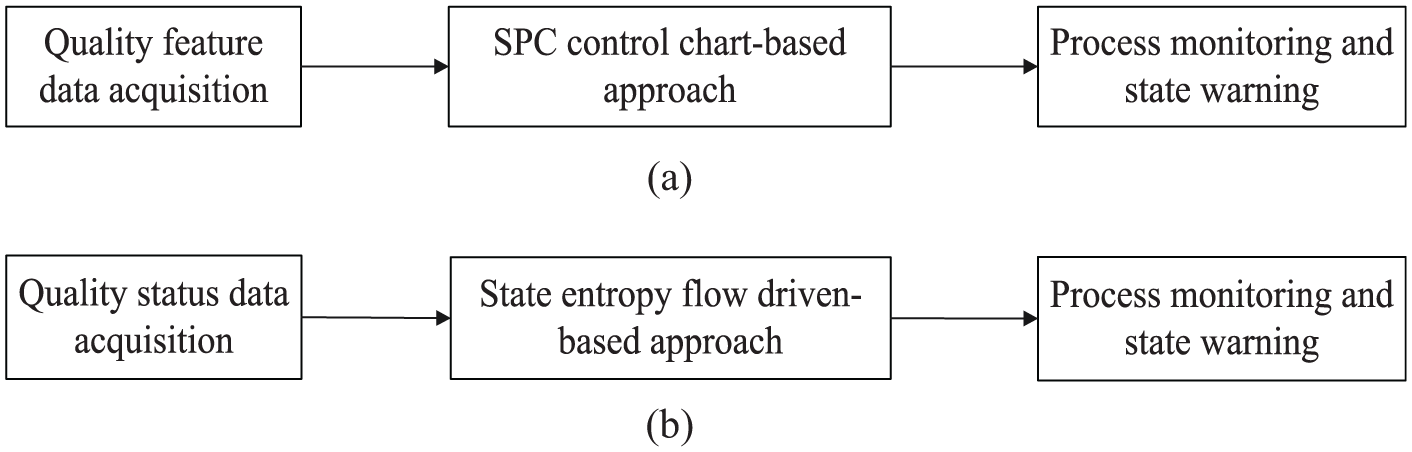
The quality state monitor framework: (a) traditional one and (b) new one.
It can be concluded that many studies have been conducted on quality state monitor and achieved ideal results.20–22 However, these studies may suffer three weaknesses as follows. First, traditional quality monitoring and analysis methods are mainly carried out just based on the output of the process (data of quality feature) but ignores that the process itself changes (data of state feature) during the manufacturing process. Therefore, a great waste of manufacturing resources appears and the monitor effect is difficult to be used for actual manufacturing processing. Second, the data of quality feature-based SPC monitor approach require the quality data obey the same distribution. When the process data are from different distributions, this method may probably not play the role of effective monitoring; on the contrary, it could increase the probability of false alarm and leakage alarm. Third, lacking a comprehensive understanding of manufacturing big data, it is often difficult to ensure monitored quality indicator carrying optimal information to reflect the quality state fluctuation. Thus, it may be difficult to provide a reliable evidence for quality and warning and adjustment in the follow-up manufacturing process.
To overcome these weaknesses, it would be highly desirable to research quality control method from the process state feature using advanced artificial intelligent techniques, rather than from the final quality feature individually. This would make quality state monitor methods less dependent on the process output, so that novel applications could be done faster and, more importantly, to make manufacturing quality control toward state-driven intelligent control. 23
State-driven based quality control method may hold potential to overcome the above shortcomings in traditional quality control method. The basic idea behind state-based control is that using the intelligent method to state modeling, stability analysis and abnormal adjustment to ensure the process stability and its service performance of the system, so as to obtain the state stability and consistency for final product.24,25 Actually, with the rapid development of sensing and communication technology, a large number of data signals that reflected the process state can be easily obtained in the digital manufacturing environment. Since the production of these data accompanied with the formation of processing quality, its change trajectory not only reflects the state change of manufacturing process but also characterizes the product quality fluctuation indirectly.
Inspired by the above idea, this article regards the quality state fluctuation as state flow along with the process ongoing, and a new framework of fluctuation analysis mechanism for quality state stability in data-driven manufacturing process is proposed, which is shown in Figure 1(b). In this framework, the state entropy flow driven-based fluctuation analysis mechanism is presented for quality monitor and warning toward manufacturing big data, which includes two technologies that are fluctuation space modeling for manufacturing process and the state entropy analysis for quality state monitor. Some advantages of this article are listed as follows: (1) the fluctuation space modeling of three-tuple approach combines the certainty of process fluctuation and randomness of state fluctuation together to constitute mutual mapping to realize qualitative analysis for quality state, which releases us from the restrictions on process distribution and makes it easier to build a quality state model and (2) furthermore, the entropy flow principle is adopted into the manufacturing process to quantitatively calculate the fluctuation degree of quality state for abnormal state warning. As a whole, the proposed approach realizes the qualitative and quantitative comprehensive analysis of the process stability and it does not depend on prior knowledge and human labor, which may be suitable for processing quantitative evaluation in the field of quality state stability in manufacturing process.
The rest of the article is organized as follows. Section “Framework of state entropy–driven quality state stability analysis” introduces the proposed logical framework, and the entropy flow-based theoretical modeling is described in section “Proposed entropy analysis mechanism for quality state stability,” which includes cloud pool-driven space model construction for quality state fluctuation and fluctuation analysis mechanism for quality state stability based on state entropy. In section “Entropy flow-based stability analysis strategy,” the fluctuation analysis strategy is analyzed. Section “Case study” provides a case study to validate the effectiveness of proposed method. Finally, conclusion and further work are provided in last section.
Framework of state entropy–driven quality state stability analysis
Manufacturing process for high-end equipment is a multivariable time-varying process, during which the formation of a product can be treated as a process that the state decision variables (process parameters) have a significant impact on output quality characteristic indexes (product quality). When the state variables are interfered by external factors, it would lead to a result that the final product quality characteristic sustained fluctuates around the ideal value up and down. It is the comprehensive effect of quality state fluctuation caused by multistage propagation, coupling, oscillation and superposition of fluctuation source. Because of the existing coupling relationships, one factor change may also cause other influencing factors change, which may lead to a series of change for factors variability and resulting in the emergence of abnormal quality products. To handle that problem, this article proposes a state entropy–based fluctuation analysis mechanism for quality state stability, and the logical framework of the fluctuation analysis mechanism is shown in Figure 2.
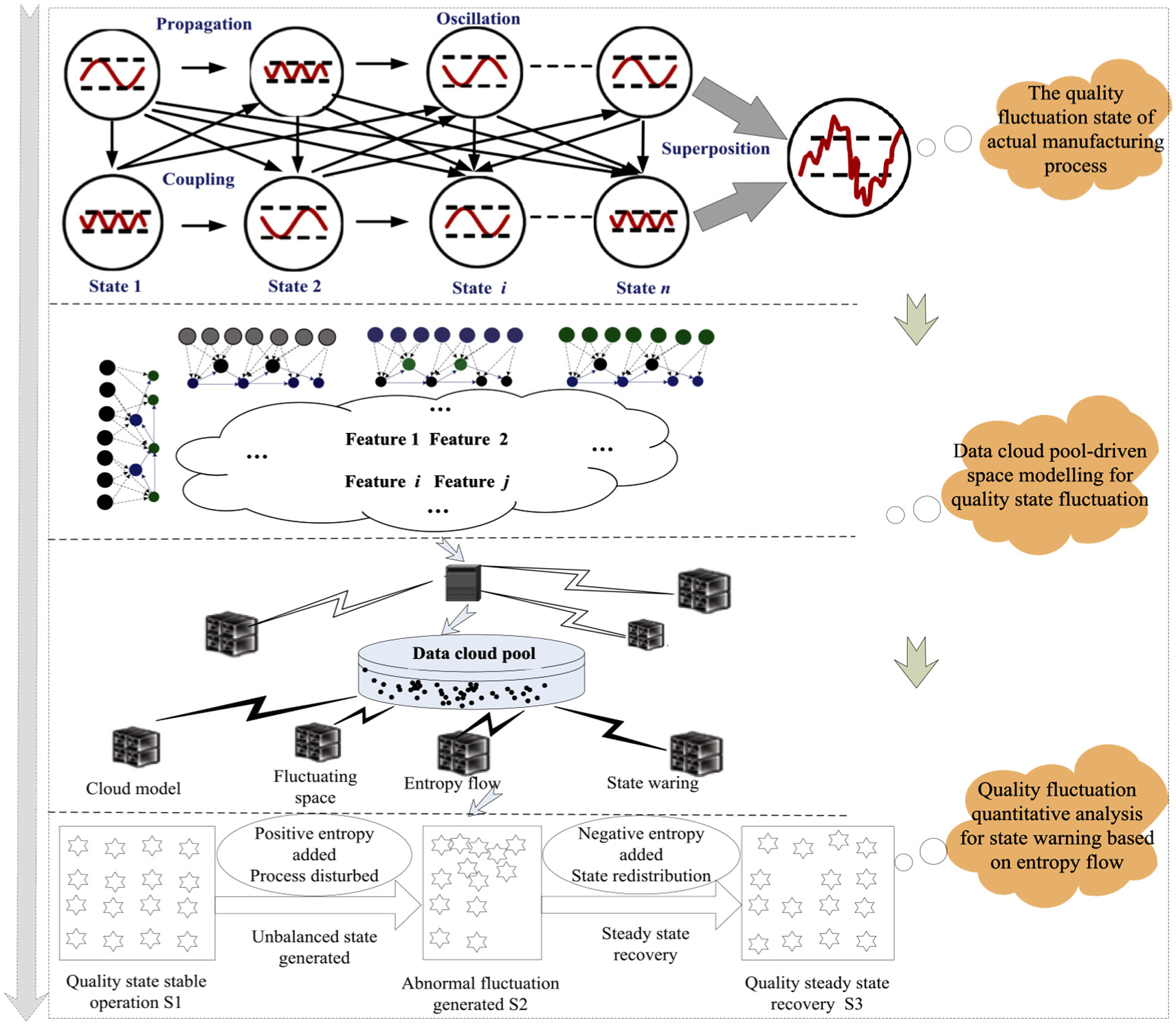
The logical framework of fluctuation analysis mechanism for quality state stability.
As reported in Figure 2, the logical flow of proposed quality stability analysis approach contains two stages, which are cloud pool-driven space model construction based on cloud model and fluctuation mechanism for quality state stability based on state entropy analysis. Specifically, the function and relationship for these two parts are illustrated as follows:
Cloud pool space model construction for quality state fluctuation. This part is to construct the fluctuation space cloud model to qualitatively analyze the quality state. Based on the principle of normal cloud reasoner algorithm, the raw monitor samples of data are generated; the cloud drop set
Fluctuation mechanism for quality state stability based on state entropy analysis. This part is the critical step to realize quality state quantitative calculation. The entropy flow function is built to calculate the entropy value for the current quality state, and thus the change amplitude of total entropy is obtained to quantitatively analyze the fluctuations degree of process state. Moreover, the detailed description of the proposed theoretical method is shown in next section.
In summary, followed by the proposed logic framework, the space fluctuation model of cloud pool is built for quality state data and its three-tuple composition of the cloud digital features reflected the fluctuation of quality state. Furthermore, the entropy flow principle is adopted into the manufacturing process to quantitatively calculate the fluctuation degree of quality state. The proposed method realizes the qualitative and quantitative comprehensive analysis of the process stability, and it does not depend on prior knowledge and human labor, which may be suitable for processing quantitative evaluation in the field of quality state stability in manufacturing process.
Proposed entropy analysis mechanismfor quality state stability
In this learning, we aim to develop a state entropy flow-driven approach for quality fluctuation analysis. There are two key technologies for it, which are cloud pool-driven space model construction for state fluctuation and the fluctuation analysis mechanism for quality stability based on entropy flow.
Cloud pool-driven space model construction for quality state fluctuation
In order to real-time monitor the abnormal fluctuations in manufacturing process, this section presents the fluctuation space modeling based on cloud model method by handling the process state data. First, the model construction process is illustrated to describe the process fluctuation change, then three-tuple set indicators are defined to analyze the process fluctuation. The main process for model construction is shown as follows.
Let

where the distribution
The cloud model consists of three feature parameters
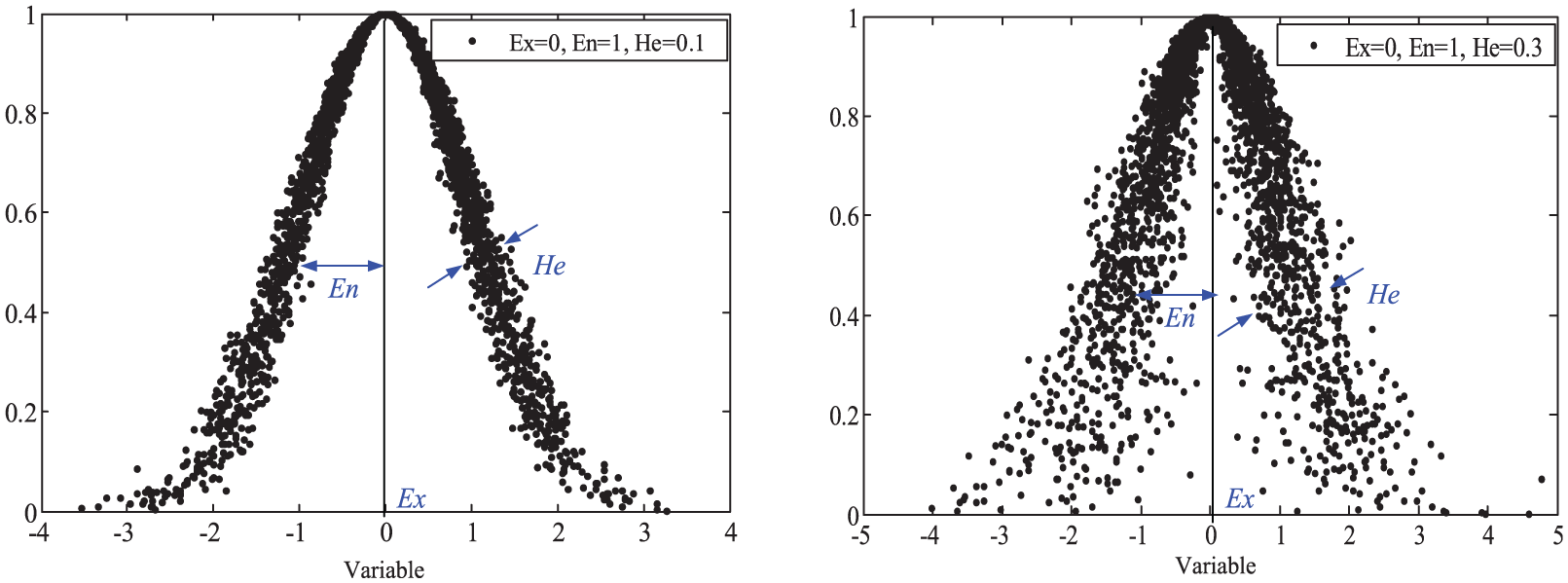
The influence of
In Figure 3, it can be concluded that the greater the
1. Considering
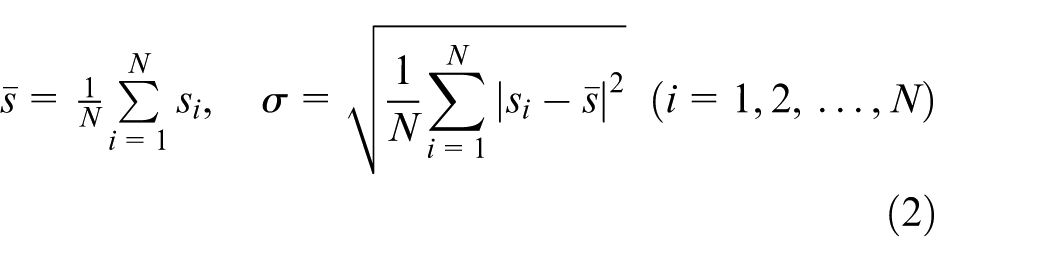
2. Calculating the



where
After the state cloud is established, a three-tuple index
Fluctuation location donates the relative fluctuation degree of the current process, which contains steady-state median fluctuation, steady-state left-side fluctuation and steady-state right-side fluctuation. Fluctuation amplitude donates the degree of deviation between the current state and the steady-state process, which contains three categories of small fluctuation amplitude, medium fluctuation amplitude and large fluctuation amplitude. This index reflects the amount of amplitude of the process fluctuation. The more stable the current process, the smaller the magnitude of quality fluctuations. Maintain degree donates the process quality fluctuation to maintain the smoothness of a certain state, which contains three categories of state: state remains good, state remains general and state remains poor. This indicator mainly related to the state influence factor and equipment state change.
The constructed cloud model combines the certainty of process fluctuation and the randomness of fluctuation state together to constitute mutual mapping. It shows the qualitative analysis for process state fluctuate, which lays the foundation for entropy change-based quantitative analysis of the fluctuation degree in manufacturing process.
Fluctuation analysis mechanism for quality state stability based on state entropy
After constructing the quality state fluctuation space model, the most important task is to quantitatively calculate the fluctuations degree of current process state. Considering the manufacturing process system of high-end equipment can be treated as a dissipative structure,28–30 the total entropy value of the process appears dynamic and changes along with the state variable fluctuation. Thus, the fluctuation mechanism of entropy flow analysis is employed for quality state stability warning in this section.
For the current process state fluctuation in manufacturing process, the entropy of each monitor variable for the multidimensional state process system can be expressed as

where
Based on the relation between entropy and system order, a higher entropy of system corresponds to a lower degree of order and vice versa. To a certain degree, the change in amount of total entropy for the high-end equipment system determines the quality stability of process fluctuation, thus the whole state entropy flow is introduced into manufacturing process to analyze the fluctuation change of quality state, and its calculation steps of the total entropy for the process system are shown as follows.
First, the horizontal matrix of

Then, according to the interaction relation among the quality status factors, the interaction matrix

where
The influence degree for variable factor
For the variable factor
The importance degree of two variable factors
Third, by calculating the ratio of ith factor value to the sum of all factor values, the weight matrix

where
Based on the above three different perspective sources of information integrated, the total state entropy of quality fluctuation for manufacturing process is calculated as follows

In summary, the stability of quality state fluctuation in manufacturing process depends on the entropy change mechanism. According to the bifurcation phenomenon of dissipative structure, 31 the fluctuations for manufacturing process shown in a controlled state at the beginning, and with the time passages and dynamic changes of the manufacturing environment, the process will show three different possible states of fluctuation, as shown in Figure 4.
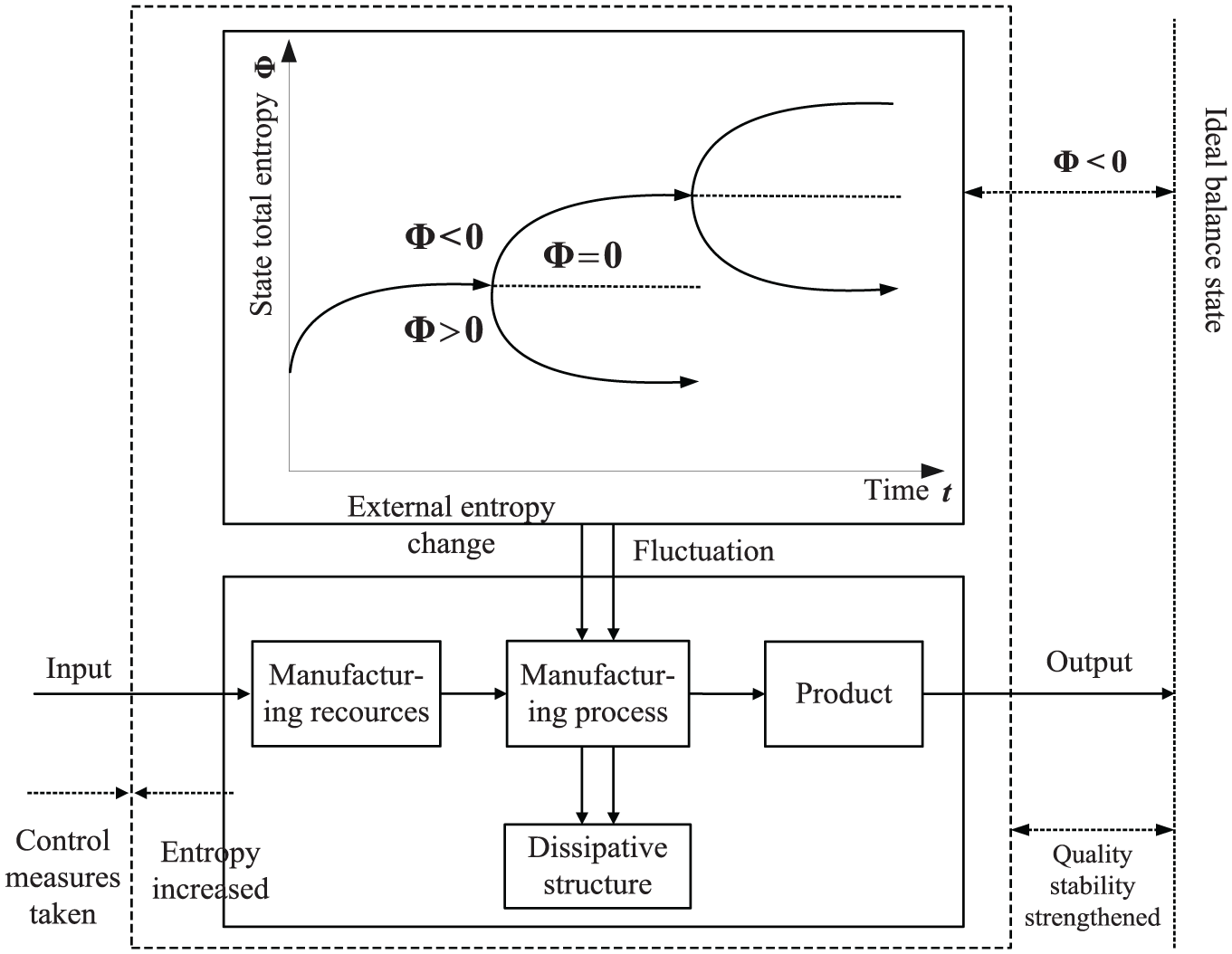
The bifurcation mechanism of quality state fluctuation in manufacturing process.
It can be concluded that when
When
When
Entropy flow-based stability analysis strategy
In summary, this article regards the quality state fluctuation change as a state flow analysis problem, and the state entropy–based analysis technology is adopted to evaluate the fluctuation change of quality state in data-driven manufacturing process. The fluctuation state space cloud model is constructed to qualitatively analyze the status of underlying process change and then state information entropy for the whole process flow is constructed for building state entropy function to accomplish quality state stability quantitative analysis. Figure 5 illustrates the fluctuation analysis strategy based on entropy flow in manufacturing process.
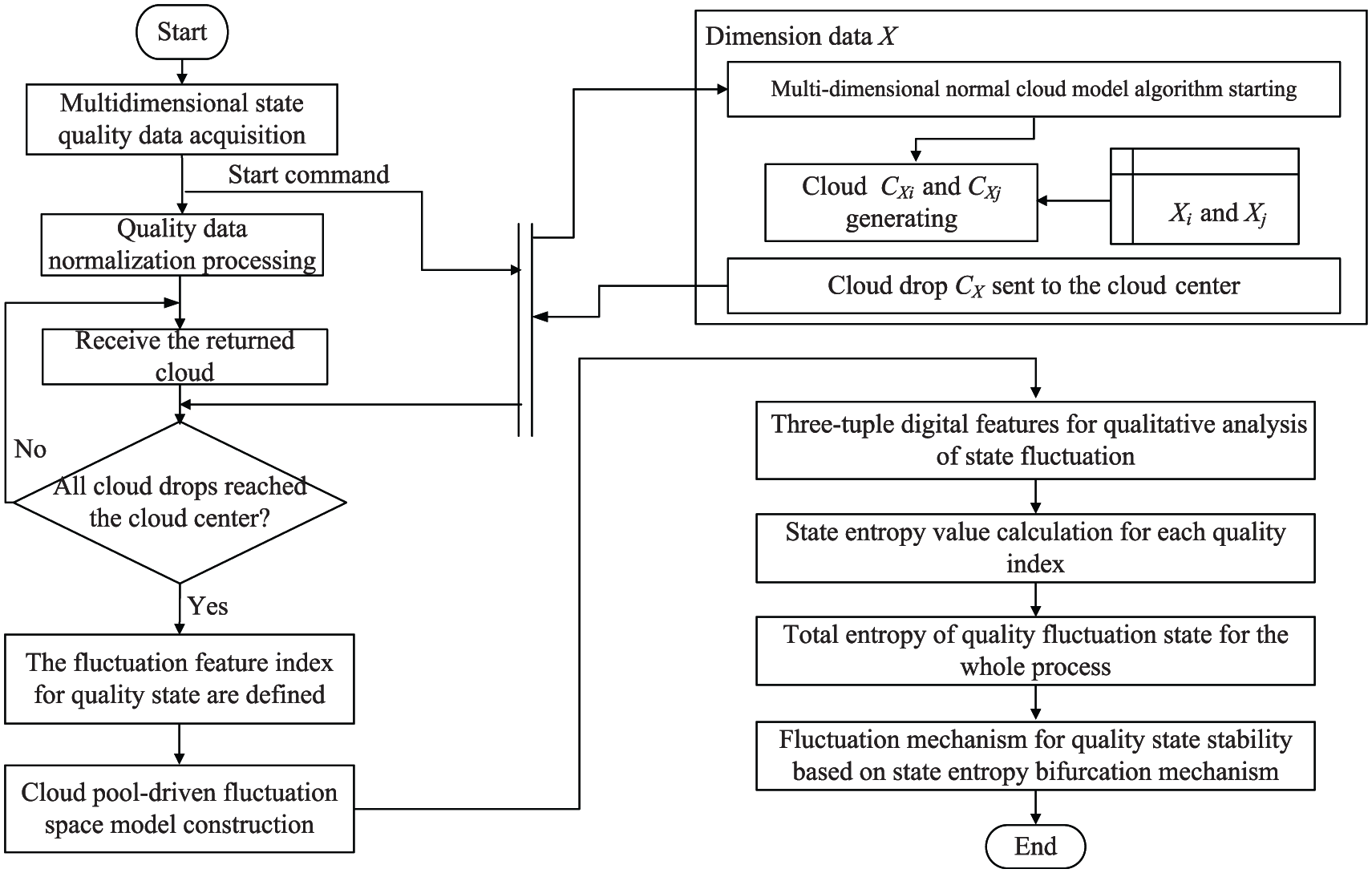
The strategy of entropy flow-based model for quality state stability analysis.
As shown in Figure 5, the fluctuation analysis strategy contains two stages: first, based on the principle of multidimensional cloud reasoner algorithm, the process state variables generate the state cloud drop sets, then the three digital features are calculated for these cloud drop to compose the space fluctuation cloud model, which reflect the qualitative level of quality state fluctuation. Furthermore, three sources of information for process state fluctuation are collected to form the total state entropy for manufacturing process, which will achieve the accuracy in fluctuation analysis mechanism for quality state stability. In this way, the change amplitude of total entropy is obtained to quantitatively analyze the fluctuations degree in manufacturing process.
Case study
In this section, a fan blade machining process dataset is analyzed to validate the effectiveness of proposed approach. In its machining process, the surface profile and roughness are the key quality features which should be strictly controlled. As the key part of blower, machining accuracy of the fan blade has an important influence on its work efficiency, which will cause huge loss if it scrapped cause for quality problem. Thus, in order to reduce the quality loss, it should real-time monitor and analyze the quality state of the cutting parameters to obtain the machining stability, so the state data of fan blade are collected to verify the effectiveness and suitability of entropy flow-based fluctuation analysis mechanism for quality state stability.
Fluctuation space model construction for blade machining process
In a certain batch machining process, there are six vital state variables (depth
The three-tuple feature for four different types of quality fluctuation states.

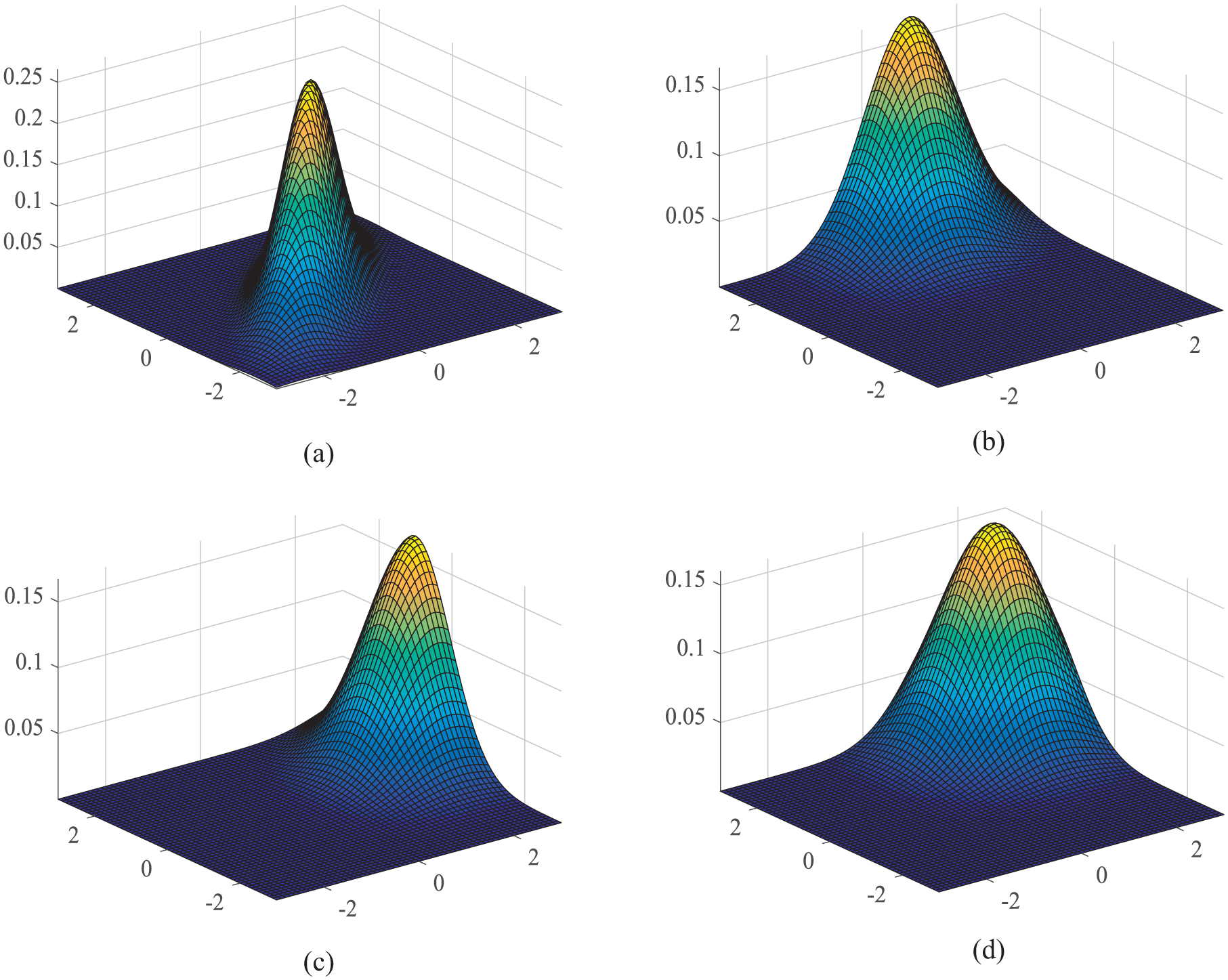
The space cloud model of blade finishing process for four different quality states: (a) the fluctuation space model of state 1, (b) the fluctuation space model of state 2, (c) the fluctuation space model of state 3 and (d) the fluctuation space model of state 4.
It can be seen in Figure 6 that the fluctuation space model for different quality states shows the state differences through three-tuple digital features. More concretely, the center of fluctuating space for Figure 6(a) located near the expectation value and the distribution thickness of its space model are not big. It indicates that the deviation of index data for the processing quality in the state fluctuation space is very small, which is close to the expected value of the steady-state process. In Figure 6(b) and (c), the center of fluctuating space deviated from the ideal position and located on one side of the distribution center, this means the process is in a state of controlled instability. In contrast, Figure 6(d) shows more thickness of spatial distribution than Figure 6(a), it indicates that the process is in a controlled state but with a lower maintain degree, which may easily lead to an abnormal uncontrolled fluctuation. Thus, in order to quantitatively evaluate its process fluctuation, the state entropy fluctuation analysis is further employed to calculate the fluctuation degree of quality state in next section.
Quality state warning based on entropy flow analysis
Without loss of generality, in Figure 6(b), abnormal machining process in the previous section is used to calculate the entropy value change for the quality fluctuation. According to the quality fluctuation space model constructed in previous section, the 2000 groups of state samples are adopted to analyze the abnormal process based on state entropy flow; specifically, the entropy value for each state monitoring variable is calculated based on formula (6). Table 2 shows the entropy calculation result and fluctuation curve of the state variables.
The fluctuation curve of state variable and calculation results of state entropy.
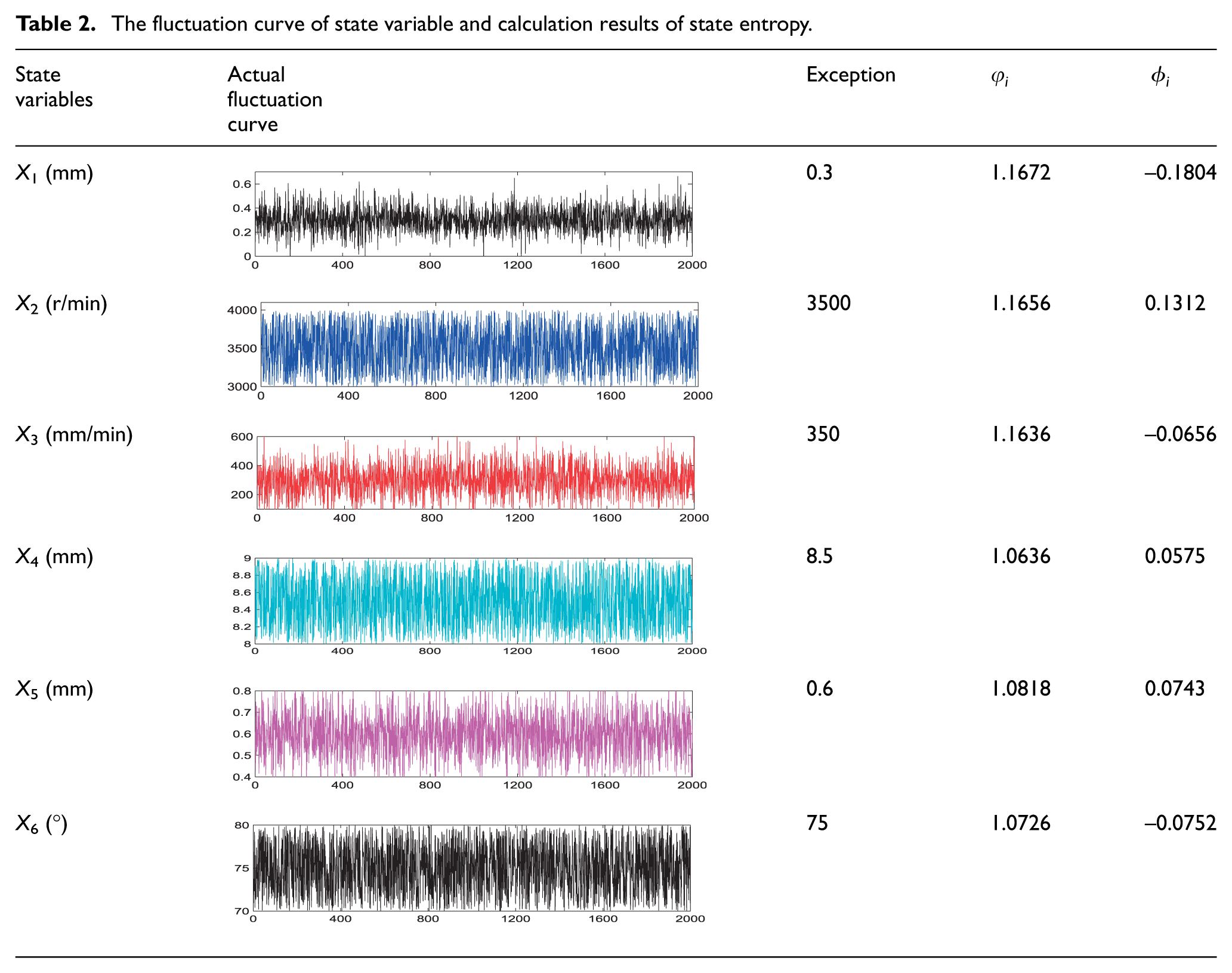
Based on Table 2, the entropy flow for each state variable is calculated, and thus, the entropy matrices of the state monitoring parameters are obtained as
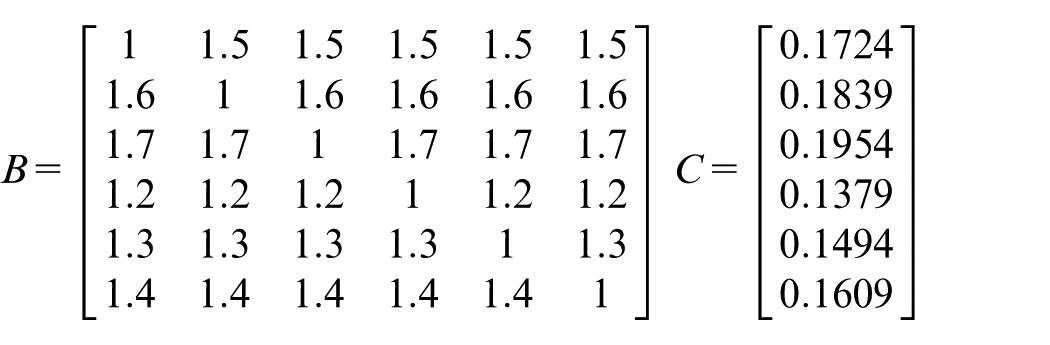
Based on the above calculation, the total entropy value of the quality state in the fine grinding process is calculated through formula (10) and can be obtained as

It can be seen from the computing result that the total entropy of quality state
What should be explained is that this article focuses on the state entropy flow driven-based fluctuation analysis mechanism for manufacturing process, and it is not only limited for fan blade machining process but also suitable for other manufacturing areas such as fast forging production process and metallurgical process. For the high-end equipment manufacturing process, the cloud pool entropy-driven technology is an important way to analyze the quality state stability through state monitor and warning toward manufacturing big data, thus the proposed method is a good method to be chosen.
Conclusion and future work
Aiming at improving the state fluctuation stability for manufacturing process, a state entropy–based fluctuation analysis mechanism for quality state stability is proposed in this article. The contributions are listed as follows:
Cloud pool fluctuation space model is built and a couple of three-tuple cloud digital features are used to feature the fluctuation of quality state. Moreover, the state entropy is adopted to quantitatively calculate the fluctuation degree of quality state. By introducing the bifurcation mechanism, the degree of state stability for manufacturing process fluctuation is calculated to accomplish process state warning.
The proposed method combines cloud pool modeling and the state entropy flow technology together to establish the fluctuation monitor model from both qualitative and quantitative aspects, which achieves a comprehensive analysis for the quality stability.
A case study is provided to validate the effectiveness of proposed method and results show the approach could well monitor the quality state fluctuation and show good effect for process quality state quantitative analysis, which lays the basis for the research of intelligent manufacturing quality control.
However, this article mainly focuses on fluctuation analysis mechanism for quality state stability in data-driven manufacturing process, how to locate the fluctuation source and contain the quality issue is not considered. So future works will focus on two parts listed as follows. One is to explore the entropy flow model to evaluate and contain the quality state fluctuation, in which the entropy sensitivity is considered to be introduced into quality evaluation to contain the quality issue. The other is to extend application areas of proposed method by combining the special requirements in other manufacturing areas.
Footnotes
Acknowledgements
The authors would like to thank the anonymous reviewer for the valuable comments and suggestions that helped improve the quality of this manuscript.
Declaration of conflicting interests
The author(s) declared no potential conflicts of interest with respect to the research, authorship and/or publication of this article.
Funding
The author(s) disclosed receipt of the following financial support for the research, authorship, and/or publication of this article: This work was supported by the National Natural Science Foundation of China under Grant No. 51675418.
