




Abstract
In this article, an integrated production–distribution model is presented for a manufacturer and retailer supply chain under inflationary conditions, permissible delay in payments, deterioration, imperfect production process and inspection errors. We assume that the first-stage inspection of the manufacturer is not perfect and makes inspection errors of Type 1 and Type 2. The second-stage inspection of the manufacturer is at the end of production period without inspection errors. Also, the demand is linear function of time. Once the retailer receives the lot, a 100% screening process of the lot is conducted without inspection errors, and the screening process and demand proceed simultaneously. The main objective is to determine the optimal inspection time and the optimal number of cycle such that the present value of the total cost is minimized. Finally, a numerical example and sensitivity analyses are provided to illustrate the proposed model using a proper algorithm.
Keywords
Introduction
Recently, firms have focused on supply chain management and have been attempting to achieve greater collaborative advantages with their supply chain partners. Since firms realize that inventory across the supply chain can be more efficiently managed through greater cooperation and better coordination, integrated inventory management has recently received a great deal of attention. In practice, suppliers frequently offer retailers many incentives such as a permissible delay in payments to attract new customers and increase sales. The effect of delays in payments in the optimal pricing and inventory control for non-instantaneously deteriorating items has been considered by some researchers. In addition, the effect of inflation and time value of money cannot be ignored in global economics. Furthermore, in real-life situations, there is inventory loss by deterioration and the inventory value is dependent on the product value at the time of evaluation. Deterioration means decay, evaporation, obsolescence, loss of quality or marginal value of commodity. Obviously, deterioration decreases the usefulness of the good from its original condition. The longer the goods are kept in inventory, the higher the deteriorating cost. However, imperfect items are produced due to non-ideal production processes. Therefore, the lot sizes produced/received may contain certain percentage of defective items.
As far as we know, this is the first model in the supply chain models that considers deterioration, defectiveness, inspection errors, permissible delay in payments and inflation in which production is delivered in n equal size shipments after producing all products. An appropriate algorithm is presented to derive the optimal inspection time and the optimal number of cycle such that the present value of the total cost is minimized. A numerical example and sensitivity analyses are provided to illustrate the proposed model.
Following this, notations and assumptions are presented in section “Notations” and “Assumptions.” In section “Model description,” we organize the mathematical models. Then, section “Optimal solution procedure” presented an algorithm to find the optimal inventory variables. The numerical example is provided in section “Numerical example.” Next, a sensitivity analysis is presented in section “Sensitivity analysis.” Finally, discussion of the results as well as directions for future study is presented in section “Conclusion.”
Literature review
In the past, most studies on the supply chain, the vendor and the buyer were considered to be independent from each other with different objectives and self-interest. Because of raising the costs, globalization trend, short life time of products and increasing the importance of quick response to customer’s needs, more attentions has been focused on the integration of the whole supply chain system. Goyal 1 considered an integrated supply chain with one supplier and one buyer for the first time. Lo et al. 2 investigated an integrated supply chain with one manufacturer and one retailer for deteriorating items with assumptions of imperfect items, inflation and partial backordering. Yan et al. 3 developed an integrated production–distribution model in a two-echelon supply chain considering deteriorating item and multiple deliveries. Moussawi-Haidar et al. 4 considered a three-level supply chain, consisting of a capital-constrained supplier, a retailer and a financial intermediary (bank), coordinating their decisions to minimize the total supply chain costs considering delay in payments.
In the previous inventory models, it was assumed that the payment must be made to the manufacturer for items immediately after receiving the supplies. But in real situation, the manufacturer allows a certain delay period to entice the retailer to buy more and does not pay the retailer any interest on the amount during this period. However, during the trade credit period, the retailer earns interest on the payment received for the goods sold and thus accumulates revenue. Therefore, the effects of manufacturer credit policies have received the attention of many researchers. Goyal 5 investigated a single-item inventory model considering a permissible delay in payments. Ouyang et al. 6 considered the inventory model for non-instantaneous deteriorating items with permissible delay in payments. Hu and Liu 7 developed an optimal replenishment policy for the economic production quantity (EPQ) model under permissible delay and allowable shortages. Maihami and Nakhai Kamal Abadi 8 developed an inventory model with assumption of non-instantaneous deterioration items in which delay in payments and partial backlogging is considered. Jana et al. 9 presented an integrated production-inventory model for a supplier, manufacturer and retailer supply chain under conditionally permissible delay in payments in the uncertain environments. Chern et al. 10 derived a vendor–buyer supply chain model with permissible delay in payments under non-cooperative Nash equilibrium.
In the past, most studies on supply chain management and the effect of inflation were not considered. This was due to the belief that most of the decision makers believe that inflation does not have considerable influence on the inventory policy and thus do not consider the effect of inflation on the inventory system. But in real situations, the resource of a firm is highly correlated to the return of the investment. So, the concept of the inflation should be considered especially for long-term investment and forecasting. First, Buzacott 11 considered an economic order quantity (EOQ) model with inflation for the first time. Sarker et al. 12 investigated a model to determine an optimal ordering policy for deteriorating items under inflation, permissible delay of payment and allowable shortage. Sarkar and Moon 13 improved a production-inventory model considering stochastic demand and inflation. Guria et al. 14 proposed an inventory model with inflation and selling price dependent demand under finite and random planning horizon allowing trade credit against immediate part payment. Ghoreishi et al. 15 developed an inventory model for non-instantaneous deteriorating items considering inflation and customer returns. Ghoreishi et al. 16 studied the effects of delay in payments, customer returns and inflation for an EPQ model for non-instantaneous deteriorating items and price- and time-dependent demand.
Currently, deteriorating inventory is becoming more important. Because in real life, most of the products, such as medicine, fruits and vegetables, are deteriorating items. Deterioration plays an important role in inventory management and also in all other elements of the production process where items are stocked or forced to wait due to uncertain demand, technical matters or disruptions of the production process. Ghare and Schrader 17 proposed a model with exponential decay initially. Skouri et al. 18 discussed a model with general ramp-type demand rate, time-dependent (Weibull) deterioration rate and partial backlogging of unsatisfied demand under different replenishment policies. Das et al. 19 developed a production-inventory model for a deteriorating item with stock-dependent demand under two storage facilities over a random planning horizon, which is assumed to follow exponential distribution with known parameter. Wee and Widyadana 20 developed a production model for deteriorating items with stochastic preventive maintenance time and rework considering the first in first out (FIFO) rule with uniform and exponential distribution preventive maintenance time. Sicilia et al. 21 studied a deterministic inventory system for items with a constant deterioration rate, time-dependent demand and shortages.
In the traditional inventory models, it was assumed that 100% of the items are perfect, whereas the produced items may contain defective items because of deficient maintenance, weak production control and so on. Therefore, the screening process is done to distinguish the imperfect items. Also, there could be some imperfect errors in the inspection process. Recently, the imperfect production process has been investigated by many researchers. Rosenblatt and Lee 22 proposed an EPQ model considering imperfect items, where the elapsed time from in-control state to out-control state is assumed to be a random variable. Goyal et al. 23 developed a simple approach for determining an optimal integrated vendor–buyer policy for imperfect items. Khan et al. 24 investigated an EPQ model with imperfect items and imperfect screening process. Sana 25 discussed an integrated production-inventory model for supplier, manufacturer and retailer supply chain, considering perfect and imperfect quality items. Yoo et al.26,27 investigated imperfect production and inspection errors, investment in production and inspection reliability with one-time and continuous improvement and defective disposal with customers’ return. Lee and Kim 28 extended an integrated production–distribution model to determine an optimal policy with both deteriorating and defective items. Table 1 gives the summary of the literature review.
Summary of literature review.
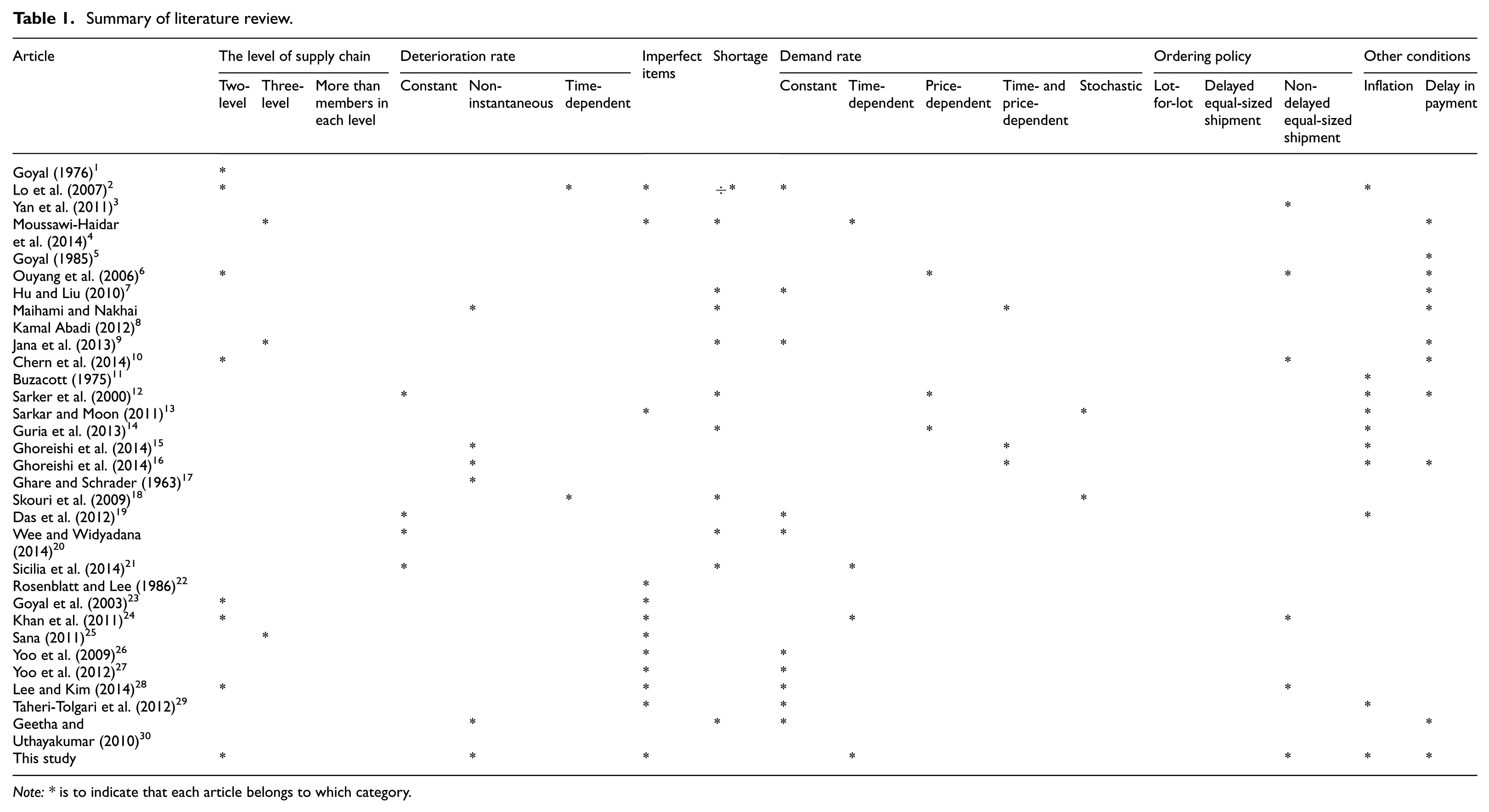
Note: * is to indicate that each article belongs to which category.
In dealing with these shortcomings above, we develop an inventory model for deteriorating items, with imperfect quality, inspection errors and permissible delay in payments in two-level supply chain under inflationary conditions. We assume that demand is time-dependent. Also, we investigated a supply chain with one manufacturer and one retailer, where the production process and inspection process are not perfect. The lot size of Q is produced and inspected at the production rate of p. The production items contain defective items of
Methodology and model building
The following notations are used throughout the article.
Notations
A ordering cost for the retailer
c production cost per unit
D demand rate
H length of planning horizon
M trade credit period
n number of deliveries for the retailer
N number of cycles during the time horizon H
p production and inspection rate of item for the manufacturer,
q order quantity for the retailer
r constant representing the difference between the discount (cost of capital) and the inflation rate
s unit inspection cost for the retailer
T duration of inventory cycle
x setup cost for the manufacturer
Assumptions
The supply chain consists of one manufacturer and one retailer.
The manufacturer offers a certain credit period M. During the time when the account is not settled, the retailer deposits his or her generated sales revenue in an interest-bearing account with rate
It is assumed that the deterioration rate for the retailer is non-instantaneous.
Demand rate is time-dependent and linear,
Shortages are not allowed.
The defective items exist and the percentage defective (α) is a random variable having uniform
The inspection errors give their respective proportions of
It is assumed that the second-stage inspection process of the manufacturer is perfect.
The defective items are treated as a single batch at the end of the first-stage inspection of the manufacturer and removed from inventory.
The defective items are treated as a single batch at the end of the inspection of the retailer’s 100% screening process and removed from inventory.
The planning horizon is finite.
The length of replenishment time of the retailer is larger than the length of inspection time of the retailer and manufacturer, that is,
A constant deterioration rate is a fraction of the on-hand inventory. It deteriorates per unit time and there is no repair or replenishment of the deteriorated inventory during a replenishment cycle.
Production is delivered in n equal size shipments after producing all products.
The planning horizon is divided into N equal cycle of
The length of the production period is larger than or equal to the length of time in which the product exhibits no defective items.
Model description
The manufacturer’s inspection process is done in two stages. The first-stage inspector of the manufacturer generates inspection errors consisting of Type 1 and Type 2. Afterward, the second-stage inspector is done with this assumption that there are no defects after the inspection process. As soon as the retailer receives the order quantity, the 100% inspection process is done in which there are no inspection errors.
Non-integrated policy
Retailer’s model
In this model, the items are produced at the beginning of the period which contains defective items of
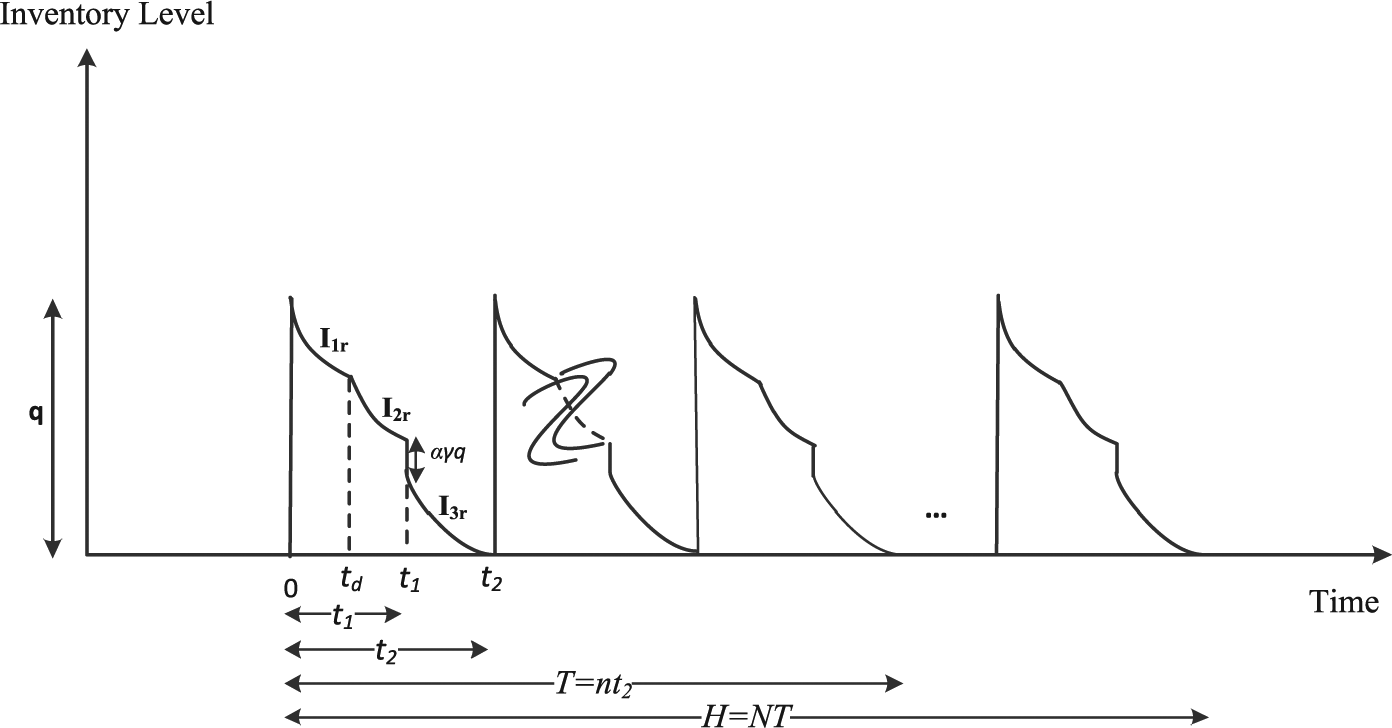
Graphical representation of the retailer’s inventory system.
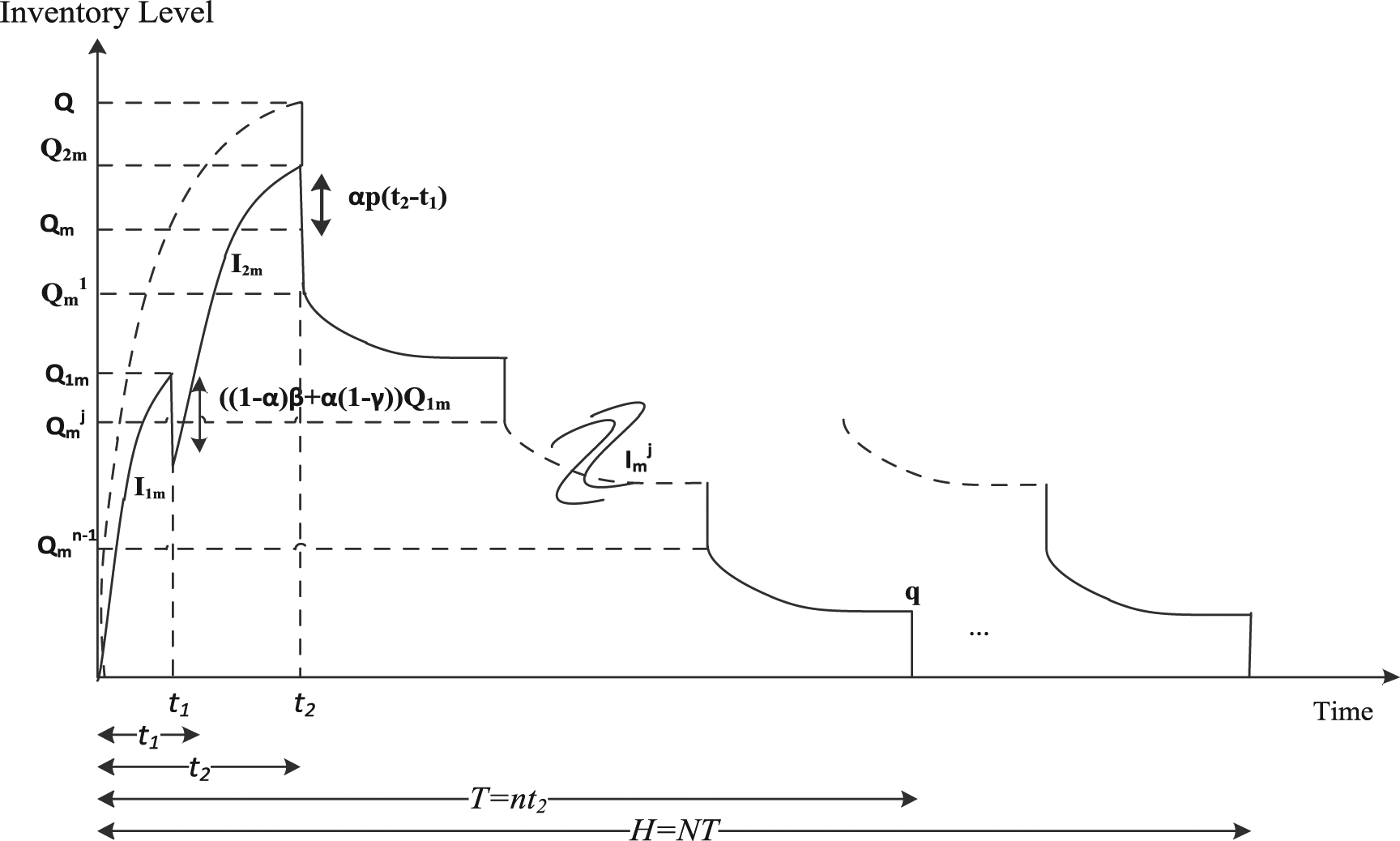
Behavior of the inventory level for the manufacturer.
Now, the presented value of inventory costs can be obtained as follows:
1. The present worth of the ordering cost.
Since the ordering cost in each cycle time is done at the beginning of each cycle T, the present value of ordering cost for the first cycle is k, which is a constant value

2. The present worth of the inspection cost.
The present worth of the inspection cost occurs during the time interval

3. The present worth of the purchasing cost.
We assume this cost occurs at the beginning of

4. The present worth of the holding cost.
The present worth of the holding cost is given as follows

5. The present value of interest payable.
We consider the cases where the length of the credit period is longer or shorter than
Thus, we calculate the present value of interest payable for the items kept in stock under the following three cases.
Case 1: the delay time of payments occurs before deteriorating time or
In this case, payment for the items is settled and the retailer starts paying the interest charged for all unsold items in inventory with rate

Case 2: the delay time of payments occurs after deteriorating time and before inspection time, that is,
The conditions of this case are similar to those for Case 1. Therefore, the present value of interest payable during [0, t 2] is given as follows

Case 3: the delay time of payments occurs after inspection time and before the replenishment time or
In this case, the retailer starts paying the interest for the items in stock from time M to

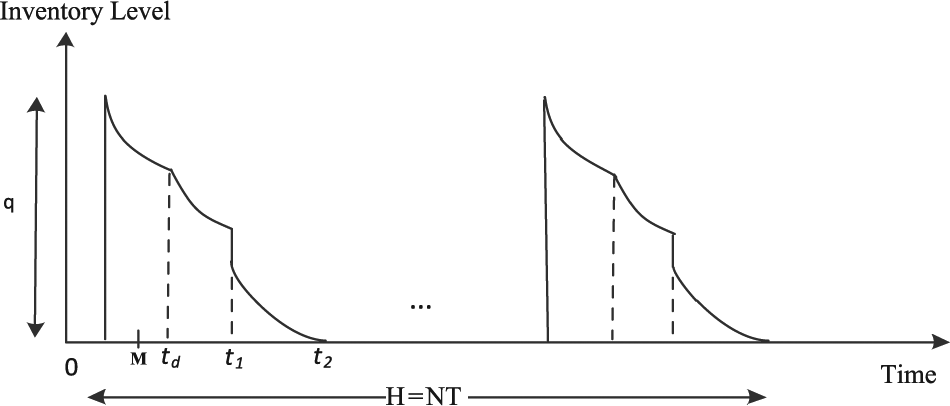
Case 1,
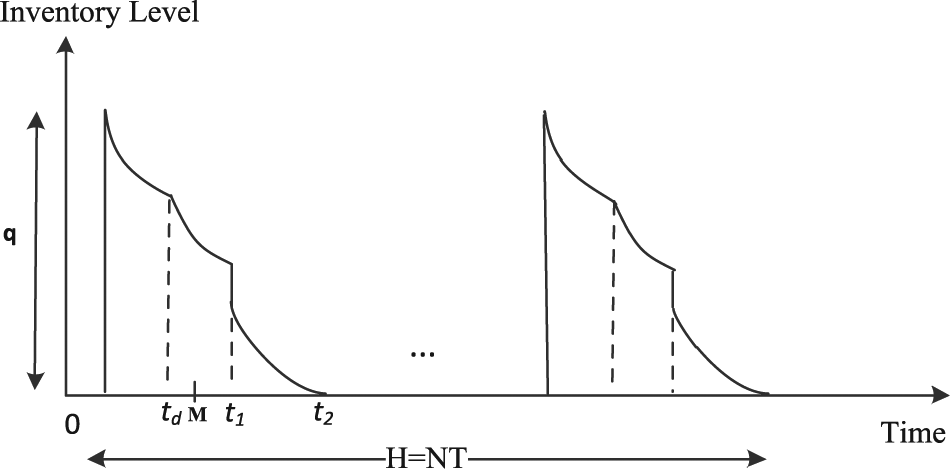
Case 2,
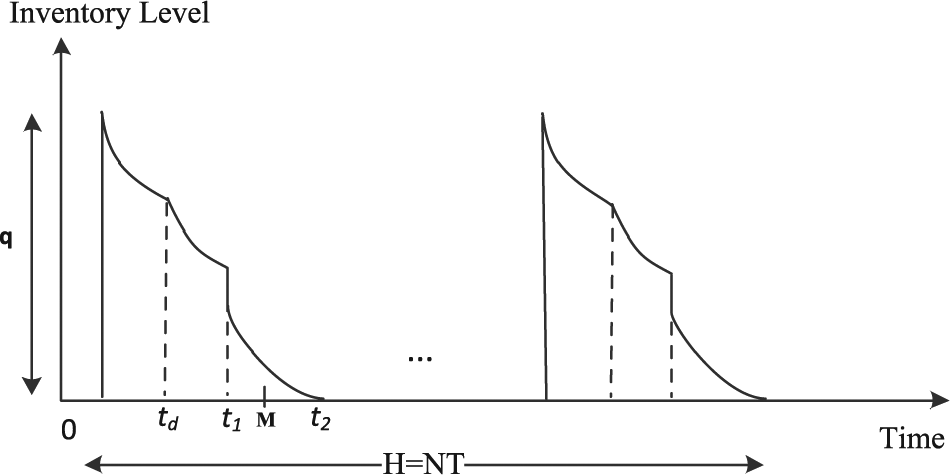
Case 3,
1. The present value of the interest earned.
There are different ways to calculate the interest earned. Here, the approach used by Geetha and Uthayakumar
30
is applied. We assume that during the time when the account is not settled, the retailer sells the goods and continues to accumulate sales revenue and earns interest with rate
Case 1: the delay time of payments occurs before deteriorating time or

Case 2: the delay time of payments occurs after deteriorating time and before production period time, that is,

Case 3: the delay time of payments occurs after production period time and before duration of inventory cycle or

Therefore, the present value of the retailer’s total cost over finite planning horizon, denoted by

The value of the variables

Manufacturer’s model
The manufacturer uses the delay equal-sized shipment policy. The inspection of the manufacturer consists of two stages in which the first stage contains inspection errors. After the inspection process, the items are dispatched to the retailer in n equal size shipments that contain
In the non-production cycle, the change in the inventory level is affected by deterioration and is given in Appendix 3.
The present worth of the individual costs during first cycle of
1. The present worth of the setup cost.
Since setup cost in each cycle time is done at the beginning of each cycle, the present value of that is x for each cycle T, which is a constant value

2. The present worth of the producing cost.
We assume this cost occurs at the beginning of

3. The present worth of the inspection cost.
The present worth of the first inspection stage cost occurs during the time interval [0, t
1]. According to Taheri-Tolgari et al.,
29
we assume it is at the middle of

For the second stage

4. The present worth of the holding cost

5. The present worth of the opportunity interest loss
The present worth of the manufacturer’s opportunity interest loss is given by

6. The present worth of the inspection error cost.
It includes the lost profit of the items that are falsely screened as defective items and removed from the inventory level. It is assumed that the inspection error cost occurs at the end of

It is assumed that all these costs occur once in each cycle. Thus, the present worth of the total cost includes setup cost

We want to minimize

Equation (42) is composed of

Integrated policy
For the integrated policy, it is assumed that the business information between the retailer and the manufacturer can be shared. First, the sum of the cost of the manufacturer and the retailer is derived, then, based on this obtained cost, the optimal solution can be calculated

To find the optimal number of cycles, we calculate the objective function for several N. Also, in order to determine the optimal value of

Optimal solution procedure
We have used the following algorithm to obtain the optimal amount of N and
Step 1. Let
Step 2. Take the partial derivatives of
Step 3. Add one unit to N and repeat Step 2 for new N. If there is no decrease in the new
The necessary condition for minimizing

The sufficient condition below can satisfy the concavity of objective function

Since ETC is a very complicated function due to high-power expression of the exponential function, we can assess it numerically in the following illustrative example. The flow chart of the solution procedure is shown in Figure 6.
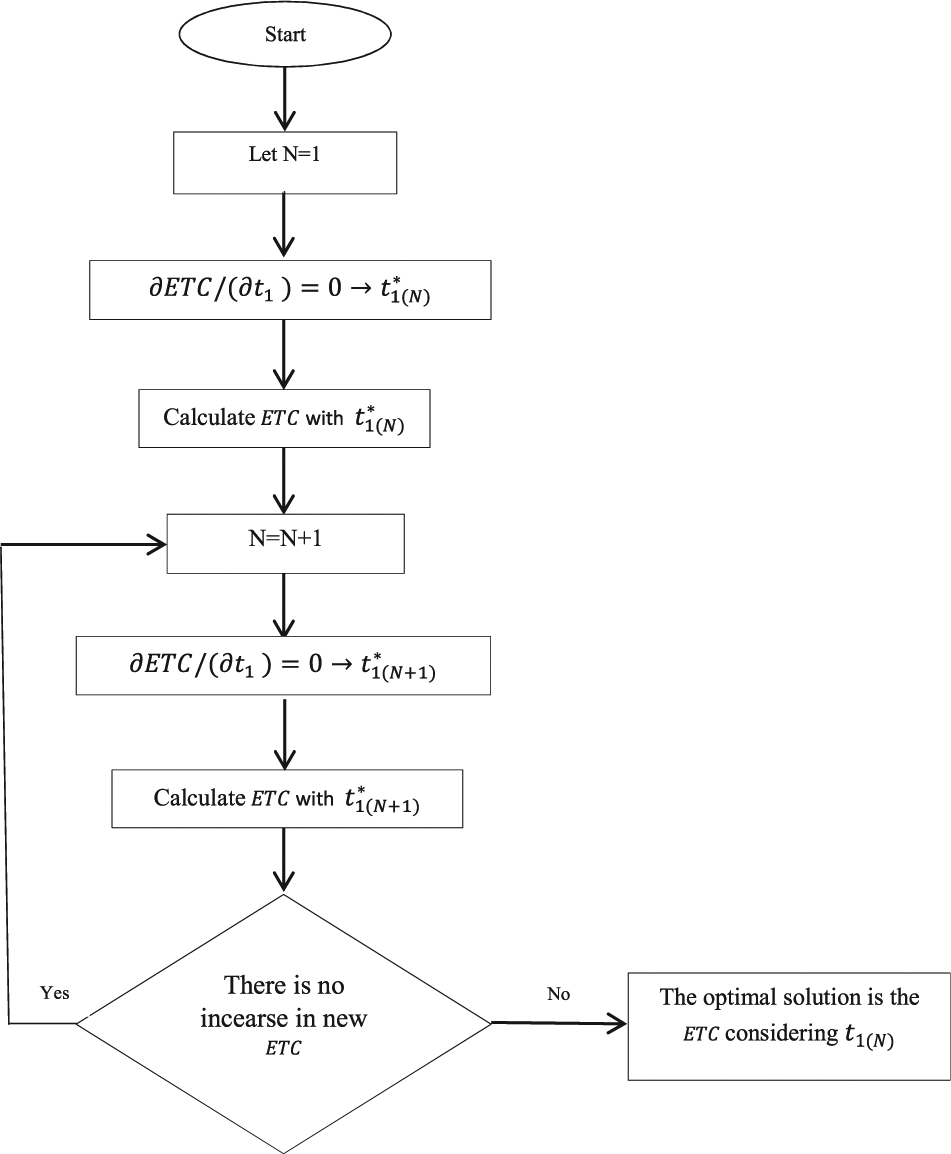
Flow chart of the solution procedure.
Numerical example
The preceding algorithm can be illustrated using the numerical example. The results can be found by applying the Maple 16. The parameters of the numerical example are as follows

c = $20/per unit/per unit time
p = 100 units/per unit time
A = $300/per order
µ = 337 units/per unit time
s = $1/per unit/per unit time
s 1 = 0.5/per unit/per unit time
s 2 = 0.5/per unit/per unit time
X = $500/per production cycle
r = 0.04
H = 10 unit time
n = 4 delivery number/per order



From Table 2, if all the conditions and constraints are satisfied, the optimal solution can be derived. In this example, the minimum present value of total cost of supply chain is found in the third cycle. Therefore, the optimal solution is as follows:
Optimal solution of the numerical example.

Optimal solution.
By substituting the optimal values of

If parameter A reduces, the optimal
Sensitivity analysis
Now, we investigate the impact of parameters on the optimal solution of the model. First, we discuss the effect of instantaneous and non-instantaneous deteriorating items on the optimal solution. With the instantaneous deteriorating rate, the expected value of the total cost of the whole supply chain increases. It means that if the situation of stock improved, the whole cost of the system is decreased (see Table 3).
Results of the example with instantaneous and non-instantaneous deteriorating models.

If the manufacturer does not consider the delay in payments (M = 0), the expected value of the total cost of the whole supply chain increases. As a result, if the retailers wish to increase their profit, they should try to get credit periods for their payments (see Table 4).
Impact of delay in payments (M) on the optimal solutions of the example.

The numerical results of Tables 3 and 4 are summarized in Figures 7 and 8, respectively.
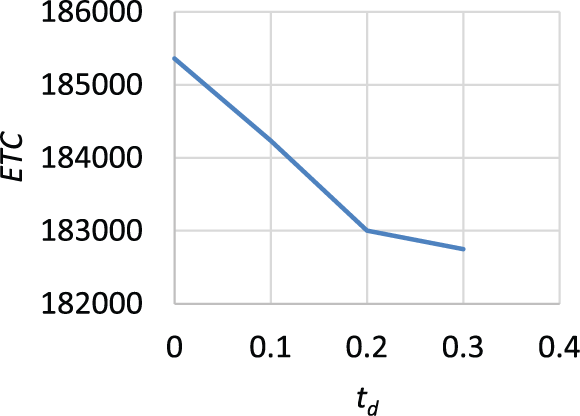
Numerical results of Table 3 which include the impact of instantaneous and non-instantaneous deteriorating models on ETC.
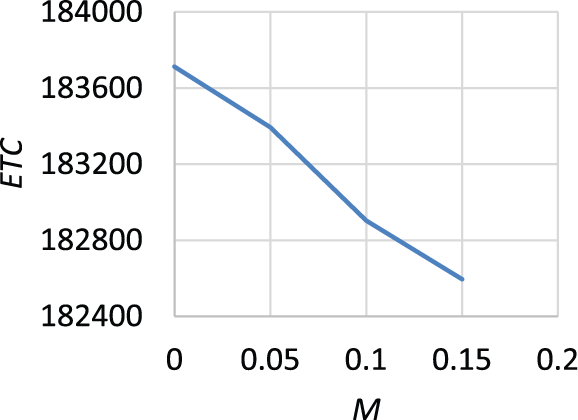
Numerical results of Table 4 which include the impact of delay in payments (M) on ETC.
Third, we investigate the effect of the changes in the value of a, b,
Sensitivity analysis results.
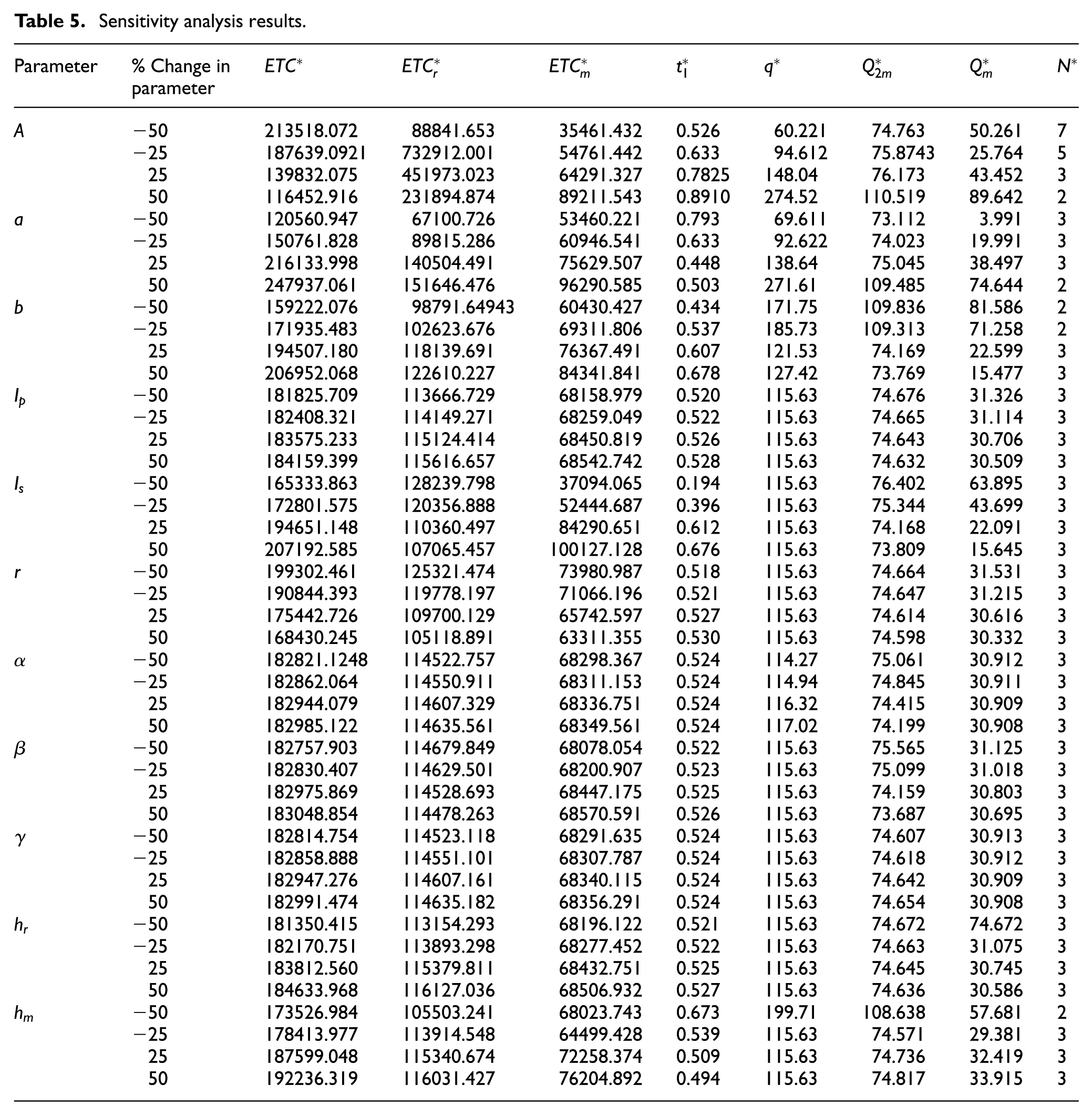
We investigate the effects of the changes in the value of parameters
When the value of parameters a, b,
When the value of parameters M, r and
Conclusion
In this study, an integrated supply chain model for deteriorating items with permissible delay in payments, inflation, imperfect production process and inspection errors is considered. The demand is time-dependent. Also, it is assumed that the deterioration rate for the retailer is non-instantaneous. To the best of our knowledge, this is the first model in integrated supply chain policy models that considers delay in payments, inflation, deteriorating items, imperfect production process and inspection errors. We believe that the proposed model can provide more realistic and general results. The manufacturer has two stages of inspection. The first stage of the manufacturer’s inspection process contains two types of errors, one is that a defective item may be classified to be non-defective, while the other is that a non-defective item may be classified to be defective. The second stage is done at the end of the production period without inspection errors. As soon as the retailer receives the lot, a 100% inspection process of the lot is conducted, and the inspection process and demand proceed simultaneously. The proportion of defective items and the proportion of Type 1 and Type 2 inspection errors are assumed to be random variables.
The expected total cost of the manufacturer, the retailer and the integrated supply chain is derived and a solution procedure, free of using the convexity, is provided to find the optimal solution that minimizes the expected total integrated cost. A numerical example and sensitivity analyses are conducted to illustrate this procedure. Finally, this inventory model can further be extended by taking some features such as price-dependent demand rate, variable deterioration rate, shortages with full or partial backlogging, quantity discounts, multiple products, partial credit trade policy and two warehouses. Also, multi-vendors and multi-buyers’ supply chains and effect of the repair or replenishment of the deteriorated and imperfect items can be directed in future studies.
Footnotes
Appendix 1
The inventory level is affected by the demand during the time interval [0, td
]. Therefore, the differential equation,
With the condition
The inventory level is affected by the deterioration and demand during the time interval
With the condition
Thus, the differential equation below represents the inventory status during the time interval
With the condition
At
Appendix 2
During the production cycle, the change in inventory level of each finished item is influenced by production and deterioration
With the condition
If we put t = t 1 into I 1m (t), the production lot size of manufacturer at the end of the first inspection stage (Q 1m ) will be obtained as follows
And the solution of the differential equation (34) along with the boundary condition,
If we put t = t 2 into I 2m (t), the production lot size of manufacturer at the end of production cycle (Q 2m ) will be obtained as follows
In addition, Q is the production size of the manufacturer without inspection processes and can be expressed as
The relationship between
Appendix 3
In the non-production cycle, the change in inventory level is affected by deterioration
With boundary condition of
According to Figure 2
Also, the lot size at the beginning of cycle of n is 0
Declaration of conflicting interests
The author(s) declared no potential conflicts of interest with respect to the research, authorship and/or publication of this article.
Funding
The author(s) received no financial support for the research, authorship and/or publication of this article.