




Abstract
In this article, efficiency, safety, and industrial emission factors are incorporated into a sustainable supply chain by constructing a multi-objective programming model that jointly minimizes costs, emissions, and employee injuries. The purpose is to give supply chain managers a tool for decision making that is not only based on reducing costs (maximizing profit) but also focuses on environmental protection and social responsibility. Using the weighted-sum approach with weights setting by the analytic hierarchy process, the model is solved by normalization of the minima of the three objectives. A numerical example is presented to test the model. This article has developed a multi-objective model for multi-modes of production facilities. The results show that the developed model for optimizing supply chain improved supply chain sustainability. A new multi-dimension perspective for optimizing supply chain will help experts improve their insights, ideas to have a sustainable supply chain.
Keywords
Introduction
Sustainable development is becoming a worldwide hot topic in academics and practice. “If everyone used energy and resources the same way we do in the Western World, we would need three more earths at least. And we have only one.” 1 Salim 1 states that “unsustainable development has degraded and polluted the environment in such a way that it acts now as the major constraint followed by social inequity that limits the implementation of perpetual growth.” The bad effect of pollution, also on economic wealth, has been examined especially in the context of climate change. The Climate Vulnerability Monitor by the non-governmental organization (NGO) DARA reveals the impact of global warming on every aspect of life. 2 It estimates that in 2010 the global economy has to bear total losses of around 1.2 trillion dollars due to the carbon emission and climate change. Different from other consequences, those losses are also significant in the industrialized world. 2 There are other driving factors, such as customer awareness, media interference, or governmental regulations, that push the development of sustainable solutions. 3 For example, in 2005, the Emissions Trading System had been launched in the European Union. It covers more than 11,000 power stations and industrial plants in 31 countries. Its “cap-and-trade” approach gives high-emitting industry sectors the choice to either cut down on pollution or to bear the cost of buying emission allowances. 4
In academics, sustainable supply chain management (SSCM) has become a new hot topic for research; more and more authors are researching the problem of sustainable supply chain strategy and operations management. A good and well-organized review in sustainable supply chain was investigated by Gunasekaran et al. 5 Pagel and Wu, 6 studied 10 case studies to extend the knowledge of sustainable SCM in practice More recently, there has been a growing emphasis on sustainable supply networks, driving industrial practitioners to also address energy and resource efficiencies and waste minimization. In this perspective, Srai et al. 7 proposed a process maturity model-based alternative to supply network carbon measurement approaches, namely, the systematic review of organizational routines and practices relevant to sustainable manufacturing. In environmental context, an appropriate clinical review was introduced by Baines et al. 8 for integrated combination of products and services. While there is an abundance of supply chain models that integrate economic and environmental goals concerning green supply, 8 there are only a few of them considering the social layer issues. In this area, a great work is done by Valaki et al.; 9 they considered the electrical discharge machining which is one of the most unsustainable machining processes. High specific energy consumption, self-sacrificial electrode, hazardous emissions, toxic dielectric waste, and sludge generation make this process an unsustainable one. For the sake of the mentioned unsustainability, Valaki et al. 9 worked on three sustainability indicators for the electrical discharge machining process, such as environmental impact, personnel health, and operational safety. Wilkinson and Dale 10 also studied five manufacturing systems in the integration of quality, environmental, and health and safety management systems. It was found that the integration of management systems is also seen more readily by those organizations that have operations involving high hazards. For decision making in this context, Rao and Patel 11 presented a novel method in the manufacturing environment in which fuzzy logic and multiple attribute decision making (MADM) were used to solve the model. There are so many researches regarding production and logistic systems, but studies do not consider the health, safety, and rough working conditions objectives. Using different previous research, in this article, the case study introduced by Chen and Andersen 12 in an iron and steel factory is applied. But we consider more than one factory to meet customer demands. In the developed model, several raw materials are supplied from different suppliers, and then the iron and steel factories produce products to meet customer demands. Roughly constructing a multi-objective programming model by concurrently considering mentioned factors, the benefit of sustainable supply chain system optimization based on multiple factors instead of single economic objective is demonstrated.
This article is organized as follows. First, a definition of sustainability in general and SSCM in particular is developed based on the literature review. Then, based on Chen’s research, an optimization model of sustainable supply chain system based on multi-objective programming approach is constructed, and third, the corresponding solution method is developed. Fourth, a numerical example is used to demonstrate the application of the model. Finally, conclusion and future research directions are summarized.
Problem definition and modeling
Supply chain model and problem definition
The optimization problem proposed in this article is simulated from the production facility’s perspective with only one period of time under consideration. In the model, each production facility produces one type of output, which is shipped to a group of customers. The raw materials are sourced from a finite number of suppliers. The suppliers ship the raw materials via different transport modes to the production facility. For the optimization of the supply chain, several assumptions are made as follows:
The supply is organized in a just-in-time manner so that the effect of incoming items inventory can be neglected.
The ordered quantities of all raw materials will meet the needs of the production.
There is more than one type of raw materials sourced from several suppliers.
The production facility, suppliers, and transportation options have capacity constraints.
All suppliers together can fulfill the ordered quantities needed for production and meet the demand of customers.
The demand of the customers is known and the production facility is able to satisfy the demand.
Outgoing items inventory will remain insignificantly small and is therefore neglected.
Transportation costs depend on the distance from suppliers to production facilities, as well as on the quantity shipped.
Production emissions depend on the chosen production method, as well as the produced quantity, while transportation emissions are dependent on the shipped quantity of the respective material and the distance from the suppliers to the production facilities.
Special transportation mode exists for each production facility to customers
Only one transportation mode exists for the demands of each customer from production facilities.
The proposed model gives answers to the following questions (established as decision variables):
How much quantity of the respective raw material should be ordered from which supplier?
How much quantity of a raw material should be shipped using what transport mode from the respective supplier to the production facilities?
Which production method should be chosen?
We considered the three objectives mentioned in Chen and Andersen’s article (efficiency, safety, and emission). There are several measures for efficiency: utilization, productivity, cost reduction, and service level. For the purpose of this article and under the assumptions, minimizing costs will be chosen to represent the economic dimension. The most important ways to estimate environmental impact is the measurement of emissions and pollution. This is the fact due to “more stringent government regulations and increasing awareness of environmental protection among consumers and society.” Probably, the most difficult part is the safety dimension. One of the most commonly adapted metric in this field is the accident and illness number.
Indices and notations
Indices
i (1, …, I) supplier
r (1, …, R) raw material
m (1, …, M) production method
t (1, …, T) transport mode
p (1, …, P) pollutant
n (1, …, N) severity class of injury
J (1, …, j) production facility
S (1, …, s) pollutant S for transportation from production facilities to customers
Decision variables
PMm 1, if production method m is chosen; 0 otherwise
Wkjp 1, if customer demands K from production facility j are met
Cost parameters
Hm hours of work for one unit of product under production method m
L labor cost per hour
DPm depreciation per unit of product, if production method m is chosen
UCm utility cost per unit of product, if production method m is chosen
X quantity of products produced in units (equals demand of product)
di distance from supplier i to the production facility
CTCkjp cost for transportation per kilometer of one unit of product from factory j to customer k from transportation mode p
Pollution parameters
Safety parameters
Constraint parameters
PCAmj capacity of production method m in factory j
SCA capacity of supplier i for raw material r
Developed objective functions
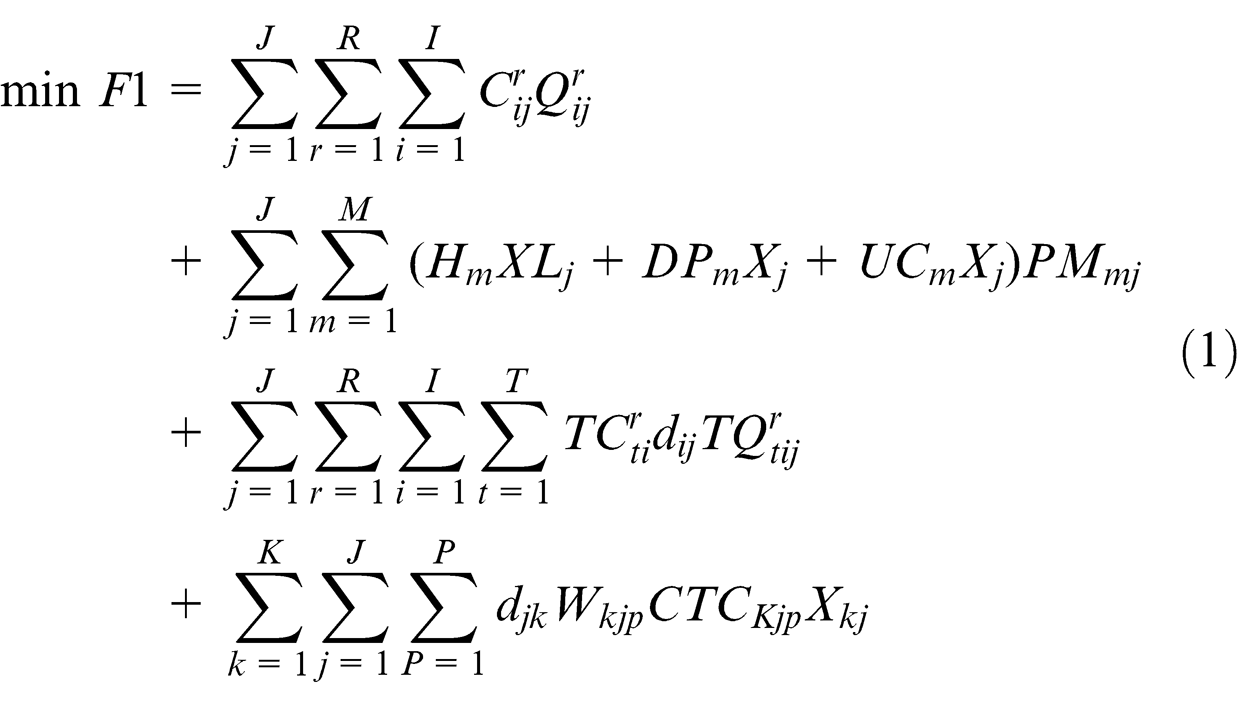
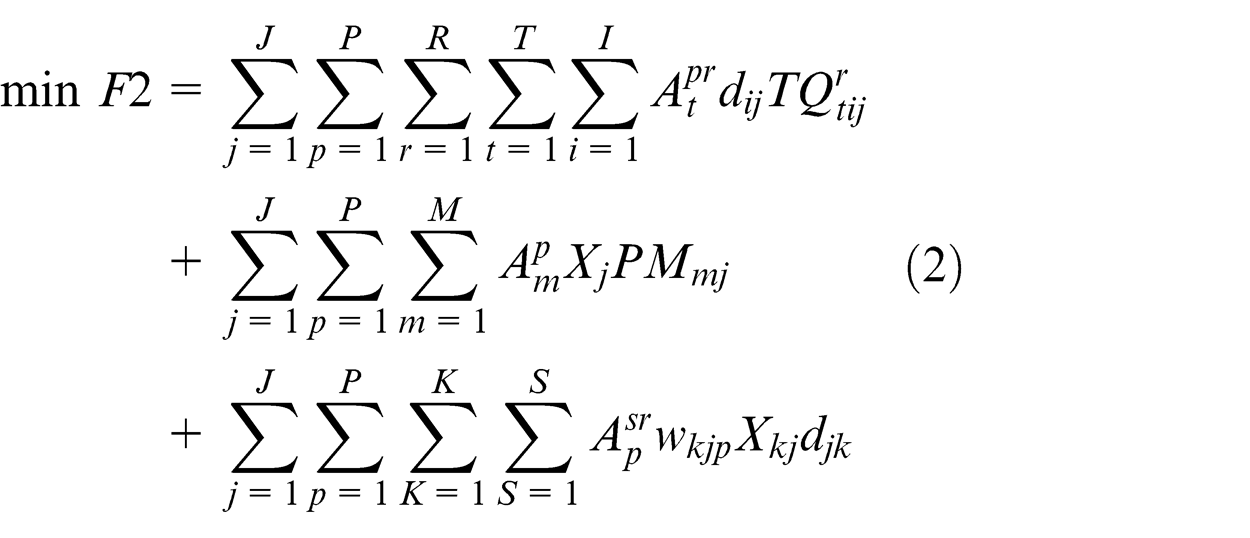
Minimize F1 = Material cost+Production cost+Transportation cost












Numerical example
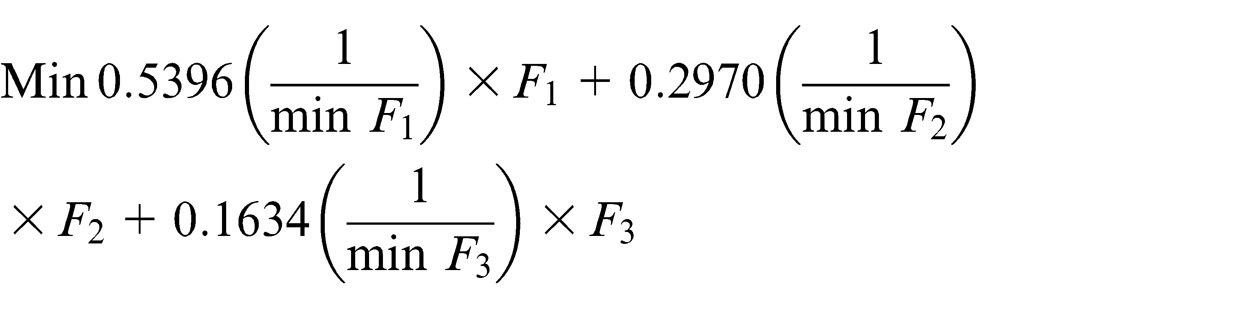
To solve the multi-objective optimization problem, the weighted-sum model is used. According to the calculated weights, the optimization problem can be established

Different methods for normalization exist. We used the method which minimizes the objective functions. Thus, the solution function takes on the following form
Having formulated the multi-objective optimization problem, we can now continue with testing the effectiveness of the model using the example of Cheng’s article. The most important difference regarding Chen’s numerical example is the consideration of multi-production facilities located at different parts of Europe and also transportation modes assigned for each customer. Three hypothesized areas are chosen for potential production facilities (Table 1).
Price of iron and coking coal in 5 regions.

As regards the estimation of distances between the mine and the steel production facilities (dij), for simplification, the air-line distances are used, which are listed in Table 2.
Air-Line Distances between suppliers and regions

For the other items, depreciation of machines, utility costs, labor hours, emission, emission in different transportation modes, and transportation capacity for different transportation modes are assumed to be the same for three hypothesized production facilities for simplification. To set the constraint parameters, production capacity for each production facility is set at 1,000,000 tons for the assessed period. For the injuries, usage of iron ore and coal in production, capacity of different suppliers, capacity of different transportation modes, and amounts of order from different suppliers are considered the same as Cheng’s numerical example.
Model solutions
The model is mixed integer linear problem with integer variables Wkjp and PMm and continuous variables
min F1 = 364,200,000;
min F2 = 678,900.3 (emissions are scaled in tons);
min F3 = 5.6400.
Using the proposed multi-objective optimization model, the production facility’s optimal decision would be to choose production method PM2. Those solutions for the decision variables will lead to total costs of US$243,701,800 (cost per ton of steel US$487.4). Furthermore, a total of 678,000 tons of pollutants are emitted, with production accounting for 357,220 tons and transportation for 329,220 tons. The injury and illness incidence rate will be equal to 5.63. The comparison between Chen’s model and the proposed model is shown in Figure 1. According to the figure, a dramatic increase in each function is related to the distance from production facilities to suppliers. As it is depicted, there is 1.53%, 1.83%, and 1.13% increase of each function (F1, F2, F3) versus Chen’s model.
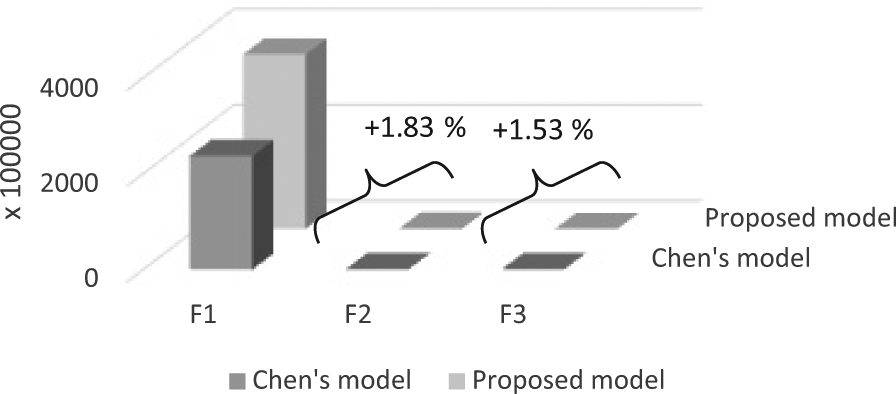
Generated output for each function (sign (+) indicates increase in function output).
Discussion of results
The results of the numerical example show that the developed model is indeed feasible and effective. This is the most important finding. First, it is revealed that a multi-objective optimization approach presents different results from the single-objective functions alone. When the multiple objective optimization model is applied, production method PM2 is identified as the optimal production method. The same outcome can be found when examining the shipped quantities. If only costs are considered, the truck will be chosen much more frequently. If the environmental performance is added to the model, on the contrary, railway transportation becomes the favorable option. The results show that consideration of distances from production facilities to suppliers increases each functions (F1, F2, F3) dramatically. The minimum of costs is at US$364,200,000, but the final amount of money spent in the supply chain equals an amount of US$243,701,800. Those dramatic higher costs are the price one has to pay for a safer and more ecological production and transportation. Still, if the costs would rise enormously, making the company economical uncompetitive, the bad economic performance would outweigh the other factors and the multiple objective optimization model would compute different results. This is the consequence of the simultaneous consideration of all three dimensions for each production facility. PM2 is also chosen for the sake of its advantage in terms of lower costs, better incident rate, and less emission.
Conclusion
In this article, we tried to develop Chen’s model. This article addresses this problem and incorporates the three pillars of sustainability—efficiency, health and safety, and emission—into a supply chain optimization model. The purpose is to give supply chain managers a tool for decision making that is not only based on reducing costs or maximizing profit but also focuses on environmental protection and social responsibility. Research result shows that this idea is feasible. For future research, we think more metrics for each of the dimensions might be considered to better reflect the reality. Also, the model might be extended to accommodate more than one period and/or uncertainty in demand.
Footnotes
Declaration of conflicting interests
The authors declare that there is no conflict of interest.
Funding
This research received no specific grant from any funding agency in the public, commercial, or not-for-profit sectors.