




Abstract
An original equipment manufacturer is studied, which makes new products and re-products (remanufactured and refurbished products) simultaneously. Facing the product diversity, the original equipment manufacturer needs to choose differentiated prices. The monopoly environment is analyzed in single-period and two-period (with invariable market and then variable market) planning horizons, and the optimal pricing strategy for the original equipment manufacturer is characterized. The results of the single-period planning horizon show that remanufactured products not only grab some market share from new and refurbished ones to form “bank run” but also maintain the total number constant and keep the profit increasing, while the refurbished products do it to remanufactured ones but not new ones and make the market growing and the profit increasing. Then, the results of the two-period planning horizon with the invariable market show that there is still “bank run” between new products and re-products. And in the variable market, as the market growth rate increases, the profit and the proportion of re-products increase simultaneously.
Introduction
With depletion of energy and natural resource as well as increasing crisis in environment, recycling and reusing of end-of-life (EOL) products received widespread attention. Many countries have enforced environment legislation charging producers with responsibility for the whole life cycle of their products, in order to conserve resource and protect the environment. In addition, considering economic benefits, more and more enterprises are engaged in the recovery business, which realize value added from the EOL products for recycling.
As is known to all, remanufacturing is a common way of recycling. It is a process in which wasted products are disassembled, and their parts that still have residual life are treated as work blanks used in the production of remanufactured products. And these products often can match the quality and technical feature level of original products or even better.
Refurbishing is another important way of recycling, which is often confused with remanufacturing before. Actually, they are different. The basic technological process of refurbishing is the same as the process of repairing, but it is the industrial development mode of repairing, and the refurbished products will be sold again in consumer market. One benefit of refurbishing is to prolong the working life and average working performance of equipments; another is that refurbishing can relieve the high emissions and high pollution status of wasted equipments. Therefore, there are many potentials for saving energy and reducing emission during refurbishing.
This study is concerned with the remanufacturing and refurbishing operation. A monopoly environment is analyzed, in which the remanufactured, the refurbished and the original products are clearly distinguishable. First, demand functions of various market situations are derived. And the optimal strategies for a monopolist who offers three product types are characterized, unconstrained by the availability of used products. Then, the cases of the market with invariable scale and variable scale are both considered, constrained by used product availability. The analytical insights for all cases are provided.
The rest of this article is organized as follows: In section “Related research,” the related literature and the contributions of this article are discussed. In section “Problem description,” the variables and parameters are described, and the demand functions for three competing products are presented. In section “Single-period planning horizon,” the single-period planning horizon is studied. In section “Two-period planning horizon,” the two-period planning horizon with market scale invariable and market scale variable is studied, respectively. And the conclusions are put forward in section “Conclusion.”
Related research
There are numerous studies on pricing policy for remanufactured products in the current literature, which can be classified into two streams. One examines pricing decision-making under the circumstance of homogeneous demand. In which, the quality and price of remanufactured products are regarded as the same as new ones. And the other examines pricing decision-making under the circumstance of heterogeneous demand. In which, the remanufactured product is clearly differentiated from the new one.
Some of the literature in the first stream focused on the monopoly competition. Majumder and Groenevelt 1 considered a two-period model of remanufacturing, in face of competition between an original equipment manufacturer (OEM) and a local remanufacturer. They assumed that the OEM did not distinguish between new and remanufactured items, but distinguished the local remanufacturer’s items. The research results showed that it was more favorable to use the remanufacturing strategy.
Ferrer and Swaminathan 2 characterized the pricing and production strategies in monopoly and duopoly environments for two-period, multi-period and infinite-horizon settings. They assumed that the remanufactured product had no difference from the new one, and the used products could be reused many times. They showed that the optimal strategies obtained for the two-period problem are quite similar to the results of multi-period problems in most practical environments.
Bulmus et al. 3 presented a two-period model with the competition between an OEM and an independent operator (IO) to characterize the optimal policy, with the assumption that there was no difference between remanufactured products and new ones. They proved that the price of the OEM’s products depended on its own cost structure. And then, when the cost of remanufacturing diminished, the IO had more chance to collect the available cores for remanufacturing. Furthermore, when consumers’ willingness to pay for the remanufactured products decreased, remanufacturing was no longer profitable.
The closed-loop supply chain management was the other research object in the first stream. Savaskan et al., 4 Savaskan and Van Wassenhove, 5 Shi et al. 6 and Huang et al. 7 studied the recycling, pricing and production strategies for the remanufactured products from the perspective of closed-loop supply chain, which had seen important contributions in the study of remanufactured products’ pricing issue.
In most of the above-mentioned literature, it was assumed that remanufactured and new products were not distinguishable. However, remanufactured products were often offered as an alternative to new products at a low price or quality. Because information on remanufactured products was known by consumers constantly and related laws required that remanufactured products must be different from new ones in sale, 8 the same pricing policy did not apply to the market gradually. So, some firms began to choose differentiated prices to sell remanufactured and new products, such as Groupe Michelin. 9
Debo et al. 10 formulated an infinite-horizon model to solve the pricing and production technology selection problem for remanufactured products under the condition of market segmentation. Ferguson and Toktay 11 formulated a two-period model to examine the recovery strategy and study the differential pricing strategy for new and remanufactured products under the conditions of heterogeneous consumer. Vorasayan and Ryan 12 constructed the different price combination for remanufactured and new products according to the heterogeneous demand of consumers.
Atasu et al. 13 analyzed the effects of green segments, OEM competition and product life cycle on remanufacturing decisions. They thought that it was very effective to improve market competitiveness and protect market share by allowing the price discrimination for remanufactured products.
Mitra and Webster 14 analyzed a two-period model with government subsidies, in the case of competition between a manufacturer and a remanufacturer. And then, they characterized pricing decision for the first and the second period with the condition that new and remanufactured products were clearly differentiated.
Ferrer and Swaminathan 15 analyzed the monopoly environment in two-period, multi-period and infinite planning horizons to characterize the optimal pricing and production strategy, with new and remanufactured products clearly differentiated. And they selected the remanufacturing savings as the key parameter to discuss the conditions for implementing remanufacturing strategy.
Jung and Hwang 16 studied the optimal pricing policy of an OEM and a remanufacturer with the cases of competition and cooperation. The results pointed out that the competition between the OEM and the remanufacturer could improve the collection yield of used products and the cooperation between them could improve their profits.
Dan and Ding 17 studied the pricing strategy for new and remanufactured products in single-period and two-period planning horizons with supply of used products restricted, considering that consumers’ willingness to pay for remanufactured products is less than new ones. And then, they analyzed the “bank run” and “market growth” effects developed by remanufactured products.
Ding et al. 18 further studied the optimal pricing for remanufactured products in the two-period planning horizon with market scale changed and discussed the change rules for the remanufacturing rate and profit. This article differs from the aforementioned studies in two aspects. First, we suppose that there is an OEM that makes new, remanufactured and refurbished products, and each product is differentiated from one another. The “bank run” between new products and re-products will be analyzed. Second, the variable market is considered in the two-period planning horizon with three competing products. If the product undergoes two life cycles, the size of the market probably changes due to the technical progress, the emergence of the substitutes and the market diffusion in the life cycle. 19 And the impacts of market growth rate on the optimal policies will be discussed.
Problem description
Aiming at the heterogeneous environment with new, remanufactured and refurbished products, which differs from one another, the OEM can adopt differentiated production and pricing policy to explore potential profit space. So, a monopoly environment is modeled in this article to characterize the pricing policy of the OEM.
Variables and parameters
Three of these parameters, the cost parameter
Demand functions
In what follows, a useful lemma is presented to describe the self-selection quantities associated with the prices of new, remanufactured and refurbished products.
Lemma
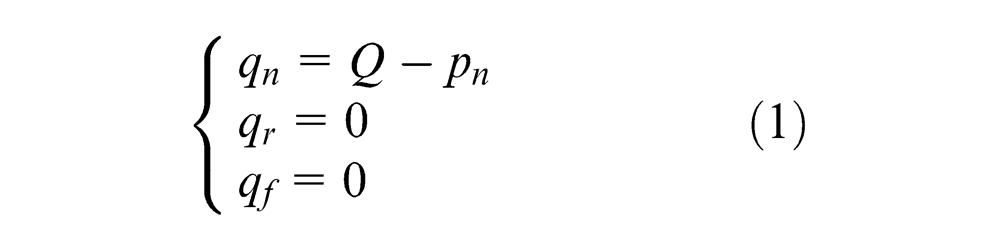
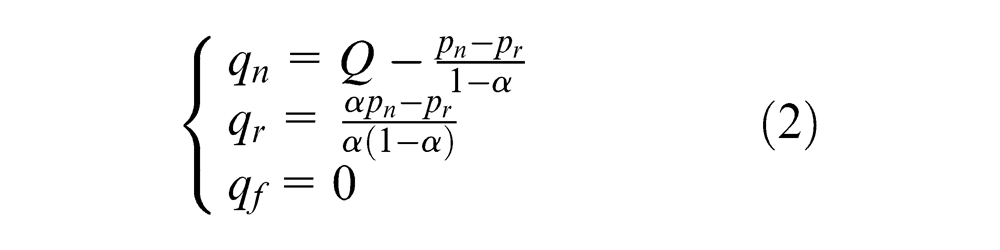
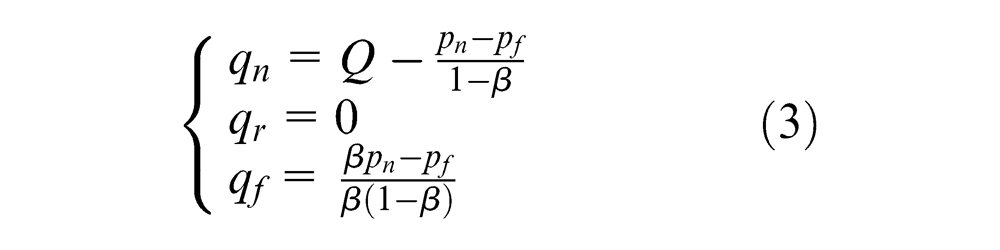
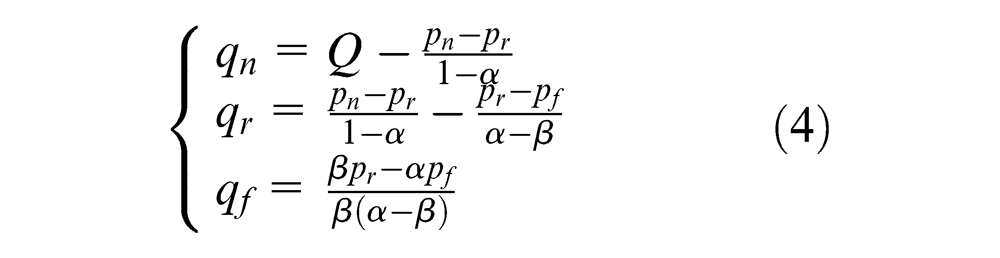
Suppose that three competing products, new (
If
If
If
If
Single-period planning horizon
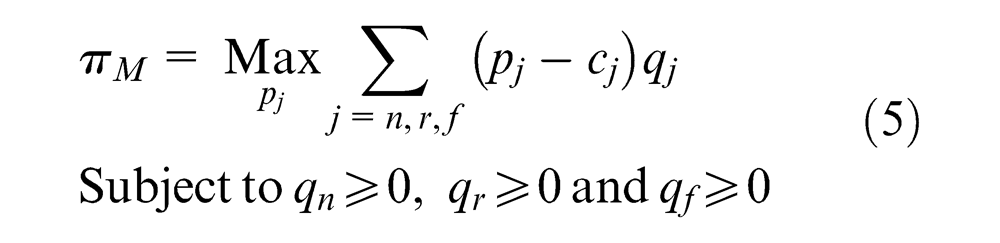
Suppose that there are demands of new, remanufactured and refurbished products in the market at the same time. Based on equation (4), the optimal policy of a monopolist offering a portfolio of new, remanufactured and refurbished products for a single period can be defined. The profit function of the monopolist would be
The Hesse matrix of the objective function equation (5) is
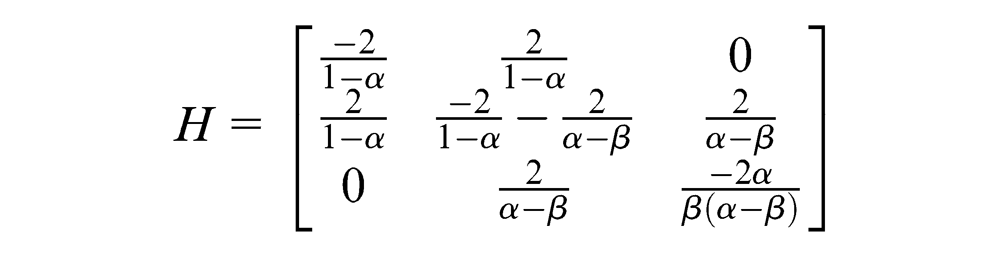
And then, the determinants of the Hesse matrix are
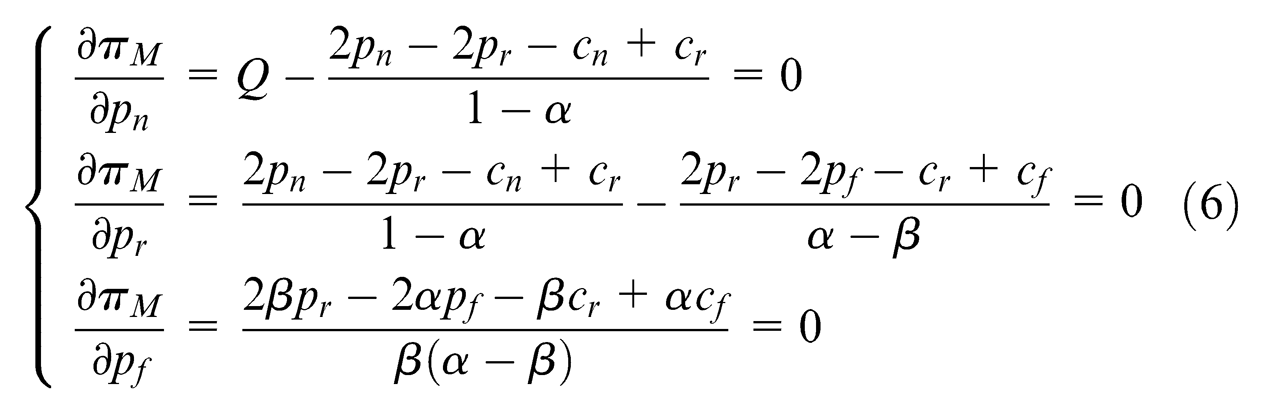
The Kuhn–Tucker conditions of equation (5) can be described as
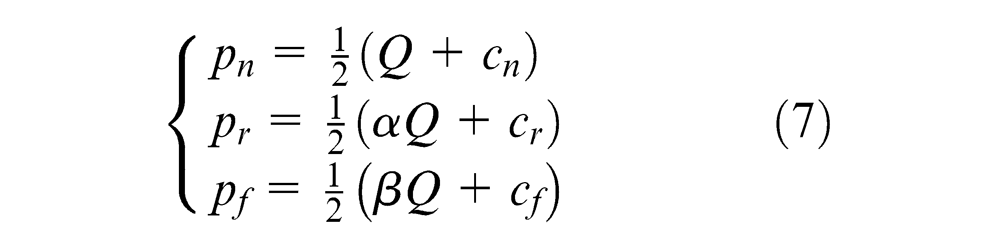
According to the Kuhn–Tucker conditions, the optimal prices are
Based on equations (4) and (7), the optimal quantities can be obtained, they are
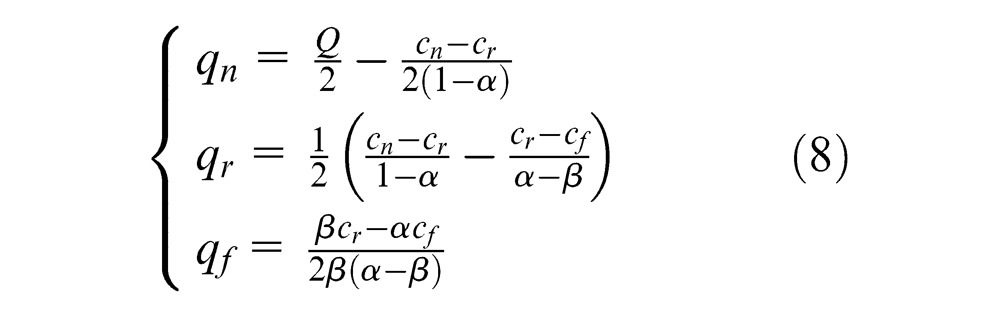
The total quantity is
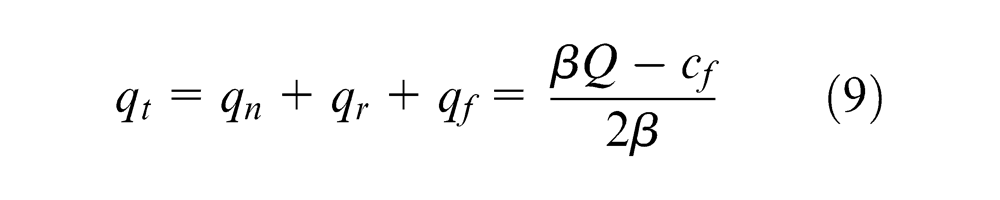
Proof: See Appendix 1
According to case 4 of Lemma, the consumers’ tolerance
Theorem 1
When
Theorem 1 shows that when
Corollary 1
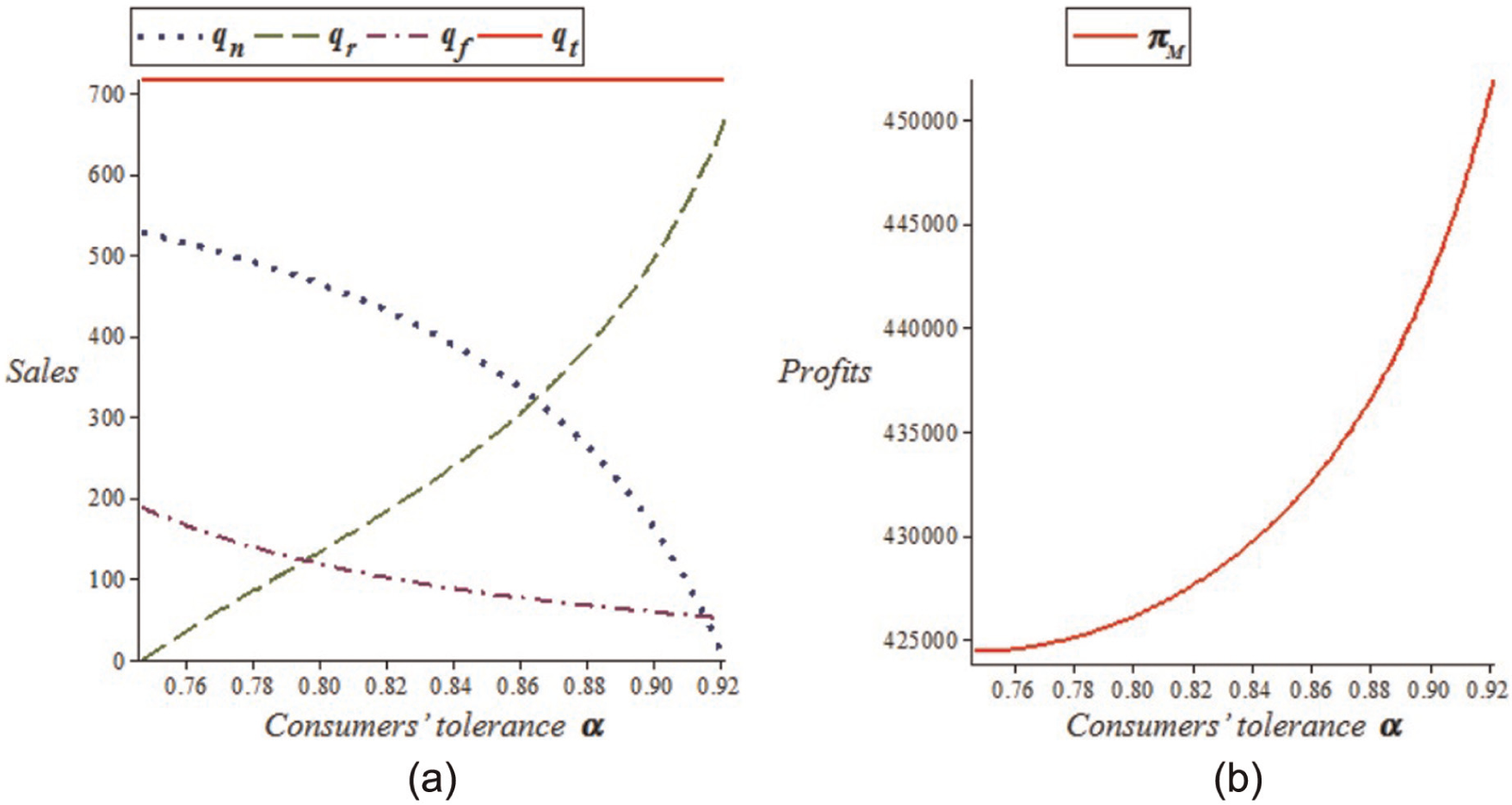
The following example illustrates these policies as the consumers’ tolerance
Influence of
Suppose that
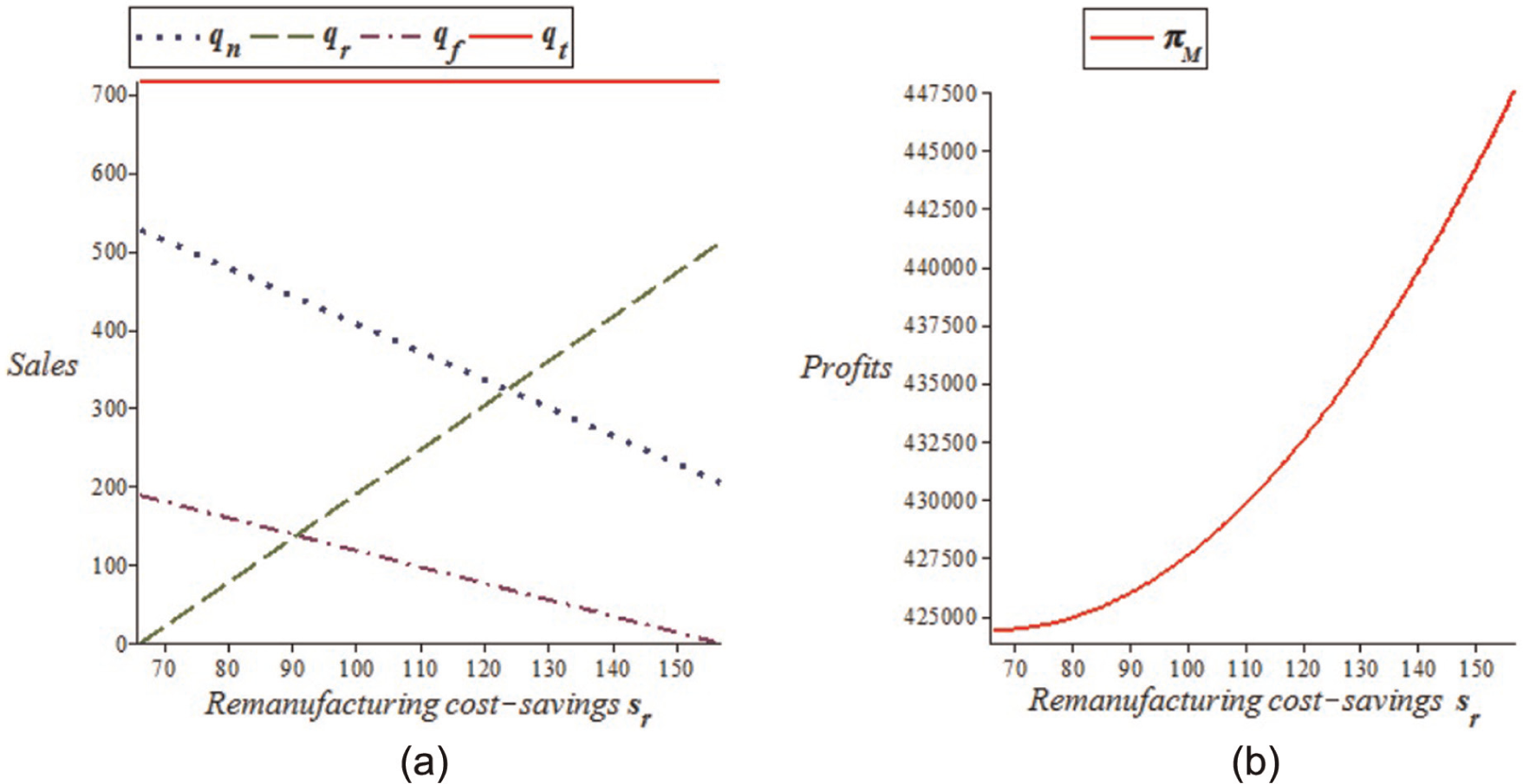
Influence of
Suppose that
Influence of
Suppose that
Influence of
Suppose that
Influence of
Influence of
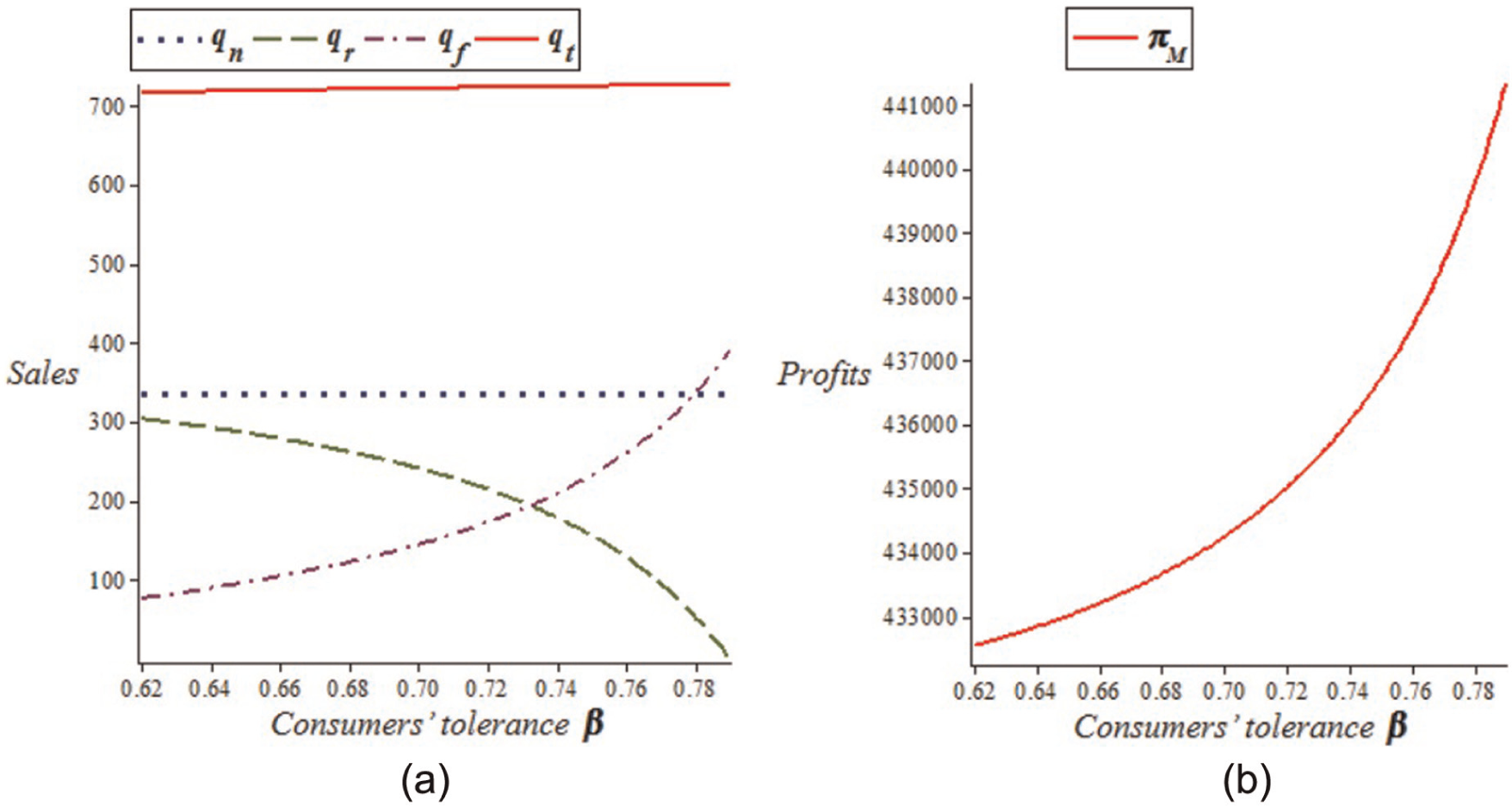
Influence of
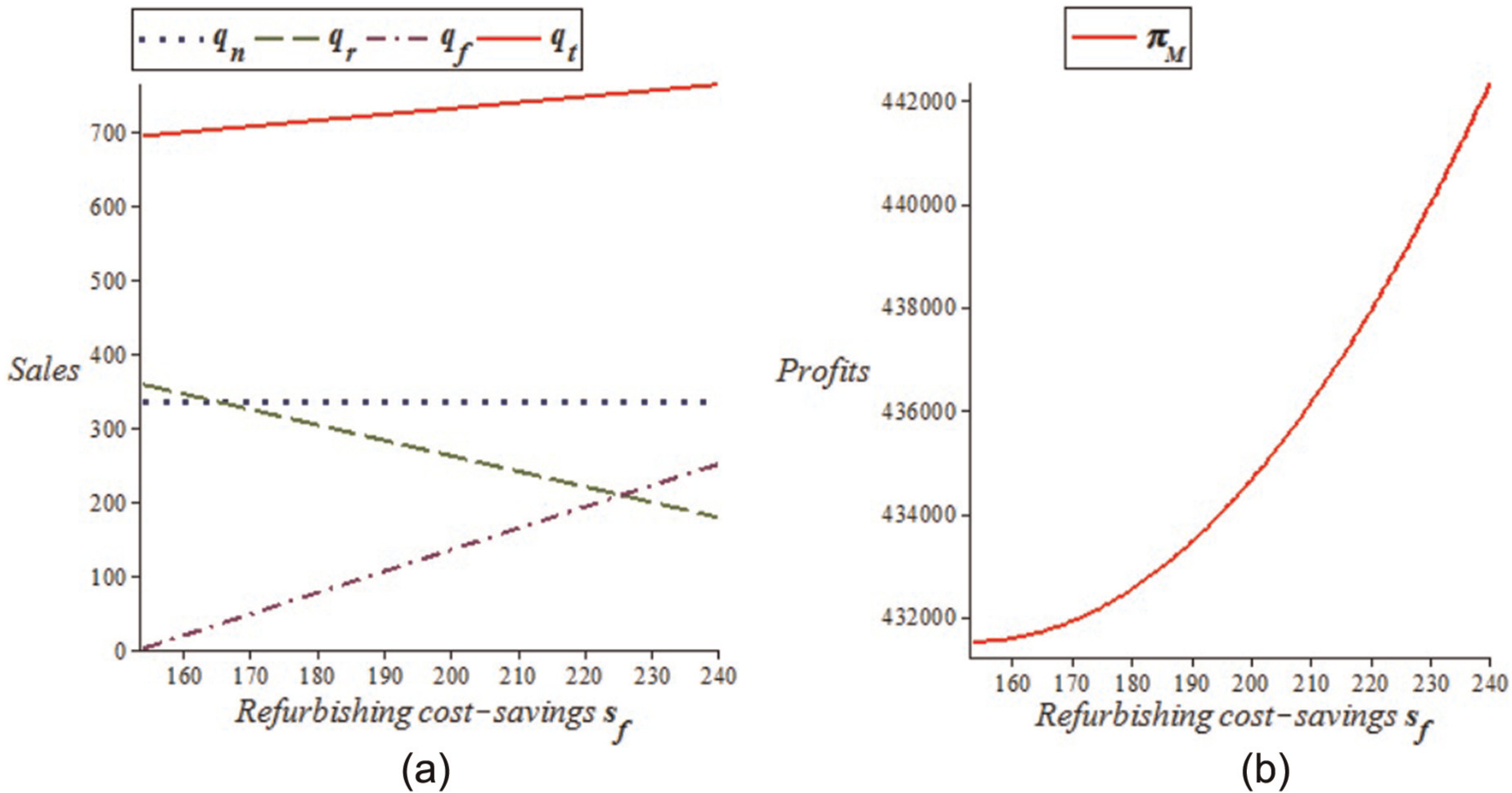
Influence of
There are some interpretations of these figures: As consumers’ tolerance
As consumers’ tolerance
Two-period planning horizon
The pricing policy with adequate supply of used products has been studied in the previous section, but in reality, the supply is not always sufficient, and the number of re-products is affected by the sales of new products in the previous phase. In this section, we suppose that the monopolist has a two-period planning horizon. In which, the monopolist only produces new products in the first period, and new, remanufactured and refurbished products are produced simultaneously in the second period. And this section will be divided into two parts for studying: one is the market with invariable scale and the other is the market with variable scale.
The market with invariable scale
First, suppose that the market scale is invariable in the two-period planning horizon. And the time value of capital should be considered. If the first period is selected as the decision point, the discount coefficient of the second phase can be expressed as
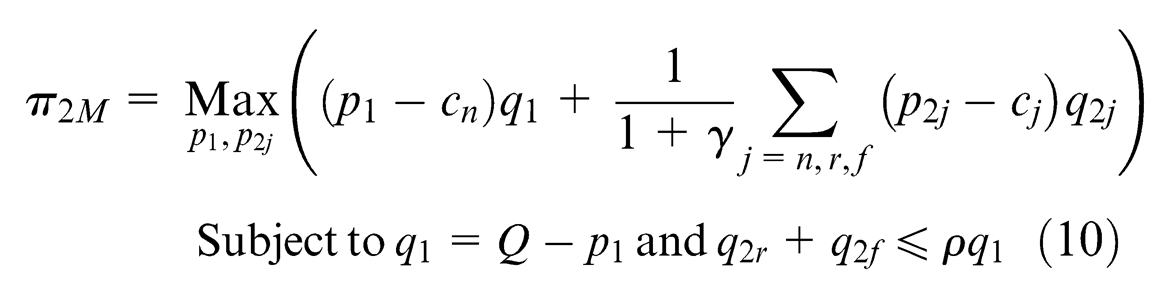
Moreover,
The Lagrange function of equation (10) is
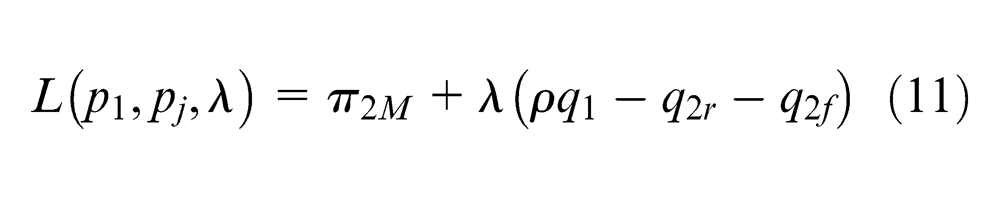
where
According to the previous section, equation (11) also has one and only optimal solution. So, the Kuhn–Tucker conditions of equation (11) are
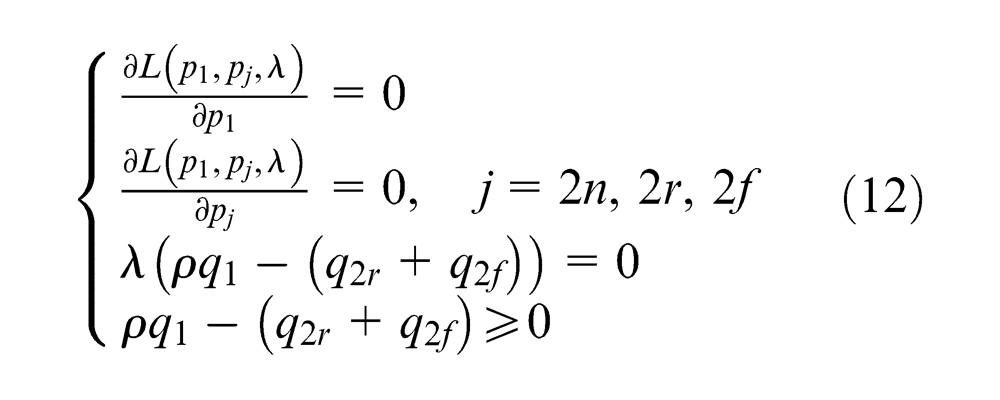
The above Kuhn–Tucker conditions can be solved with two situations.
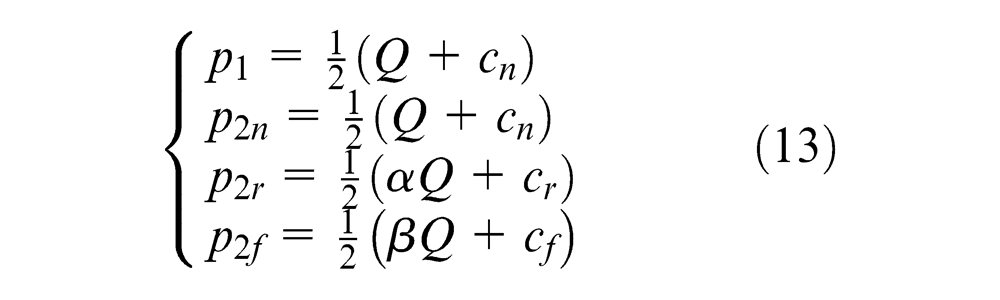
D11
. When
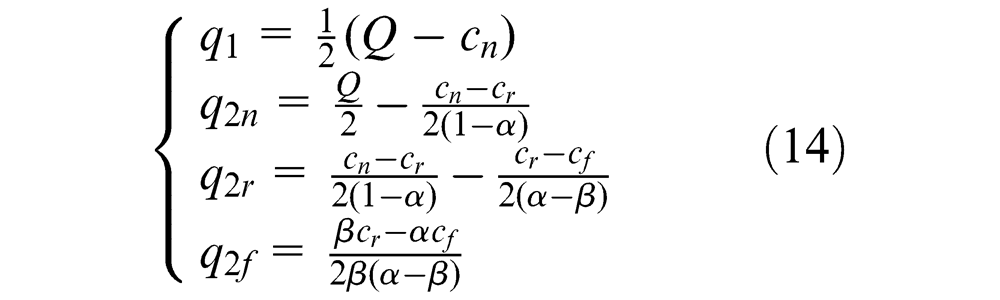
And the optimal sales are
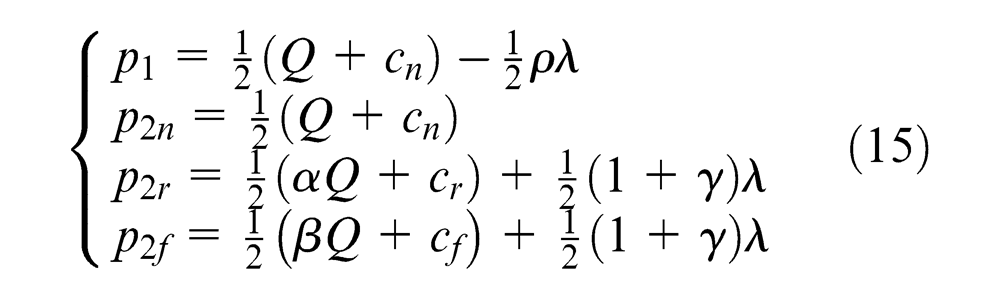
D12
. When
And the optimal sales are
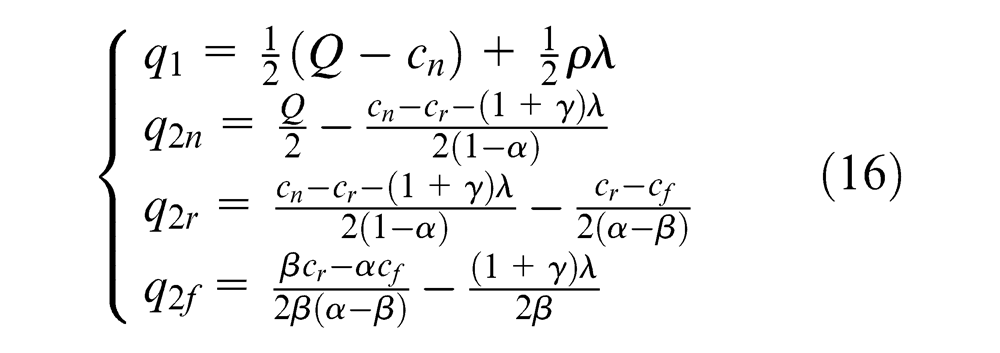
The total sale of the second period is

where

Theorem 2
There is one critical value

Theorem 2 shows that the decision-making of the two-period planning horizon with the invariable market depends on the value of the collection yield
The optimal policy of the two-period planning horizon is affected by not only marginal cost
Corollary 2
When
Corollary 3
When
The previous example is used to illustrate the above conclusions. Hence,
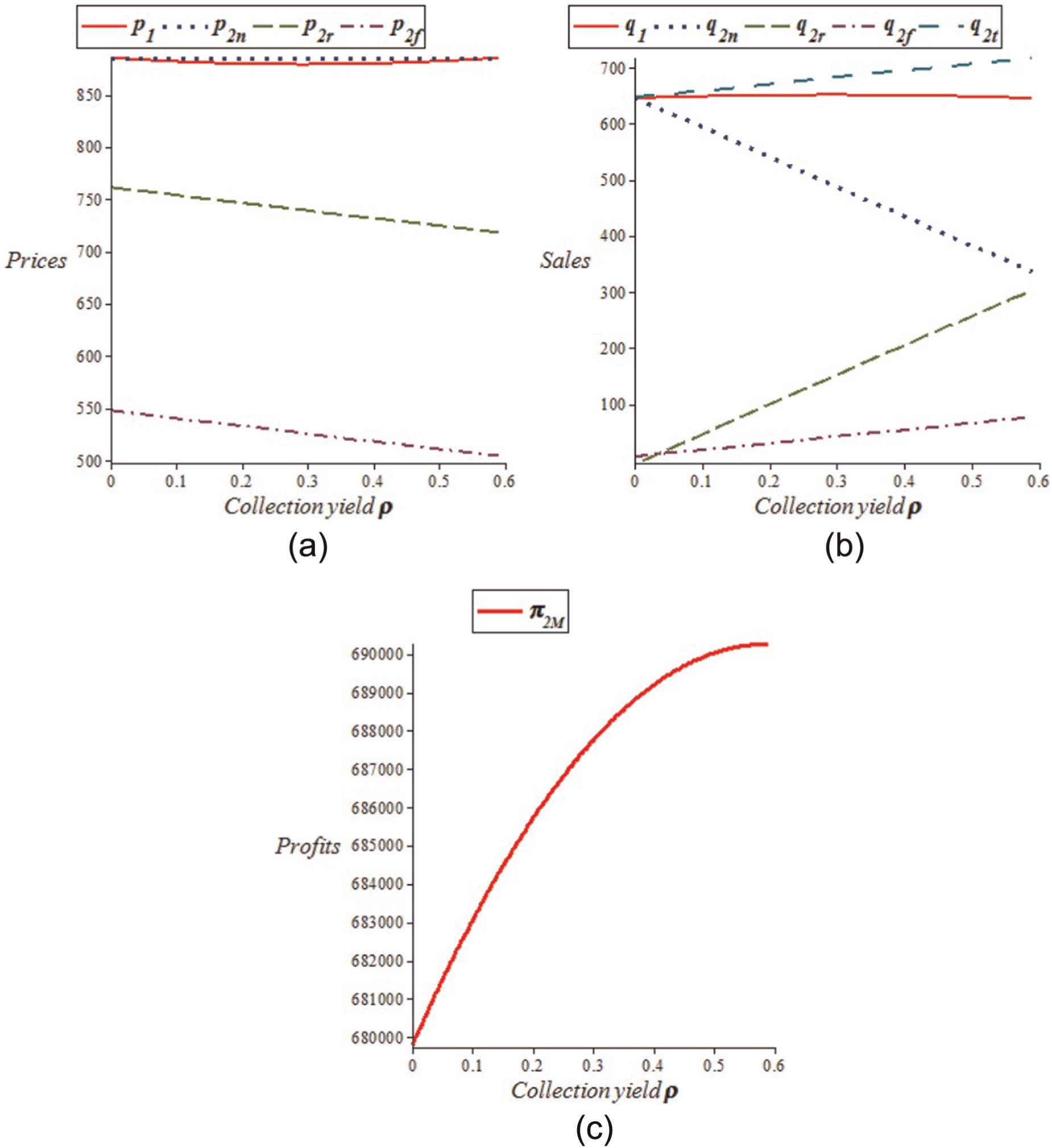
Influence of
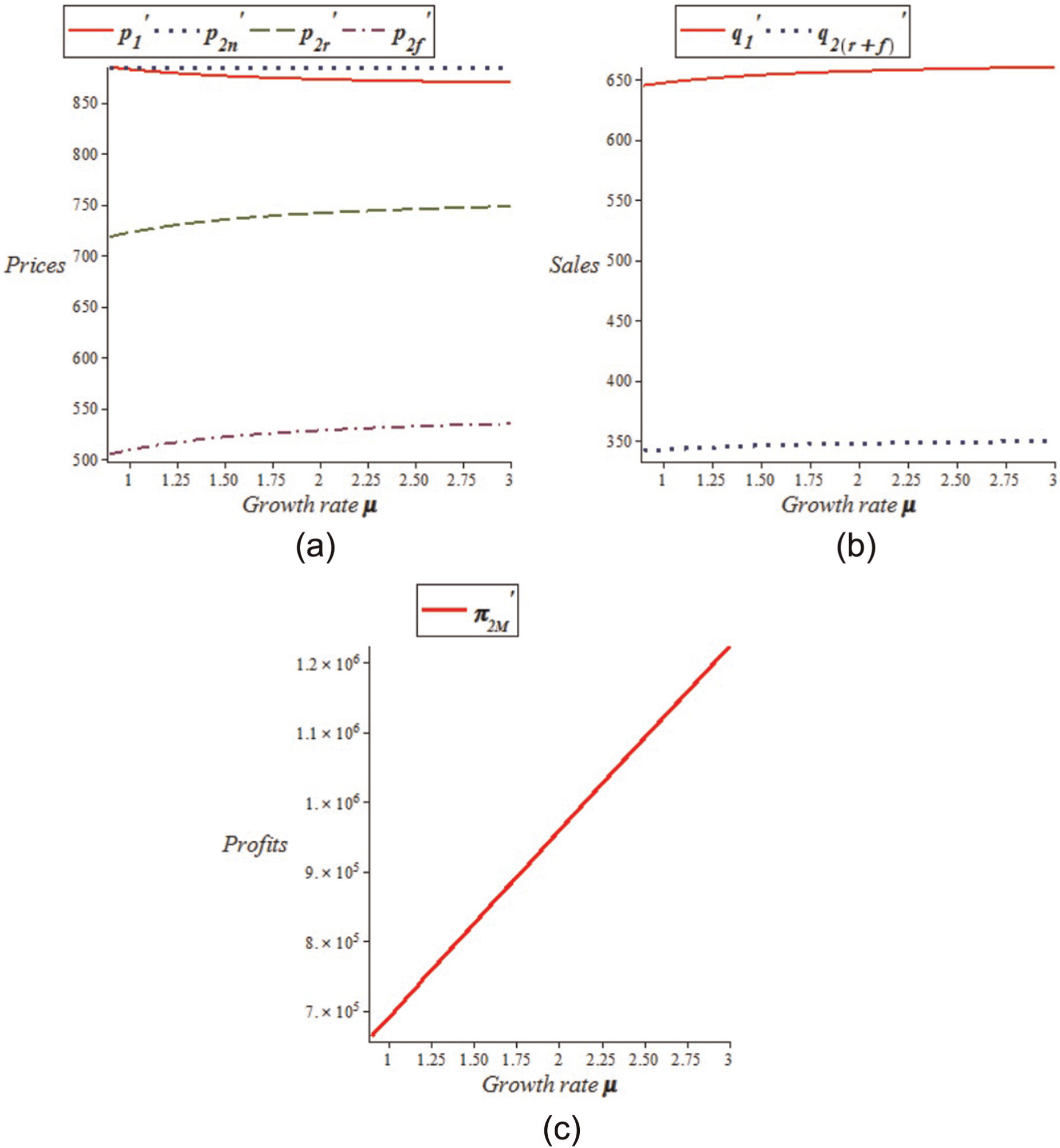
Influence of
If the collection yield satisfies
The market with variable scale
Suppose that the size of potential market in the second period is variable, which can be described as
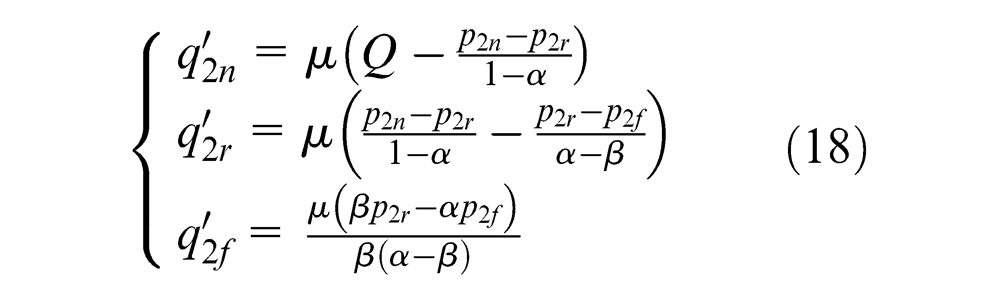
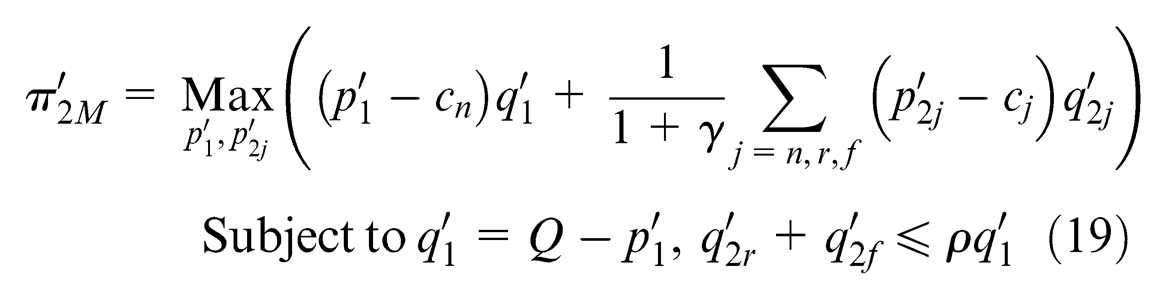
Therefore, the decision-making model is
Moreover,
D21
. When
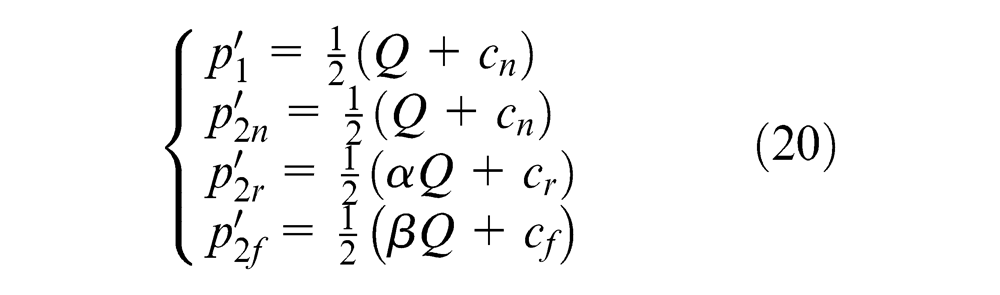
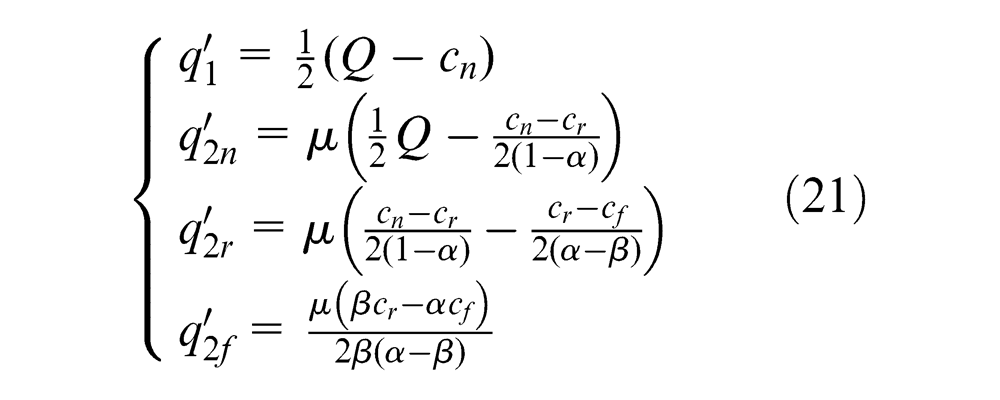
And the optimal sales are
D22
. When
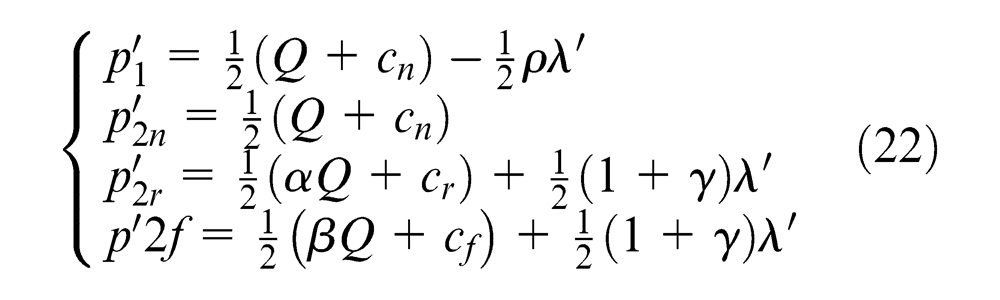
And the optimal sales are
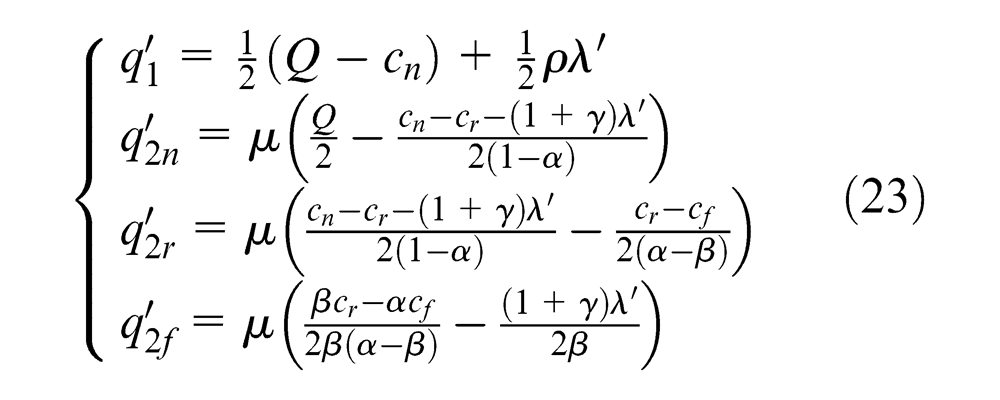
The total sale of the second period is

where

Theorem 3
There is one critical value

Theorem 3 shows that the decision-making of the two-period planning horizon with the variable market depends on the value of the growth rate
Corollary 4
When
Let the monopolist in the previous examples operate with the potential market variable. Hence,
When the market growth rate
Corollary 5
When
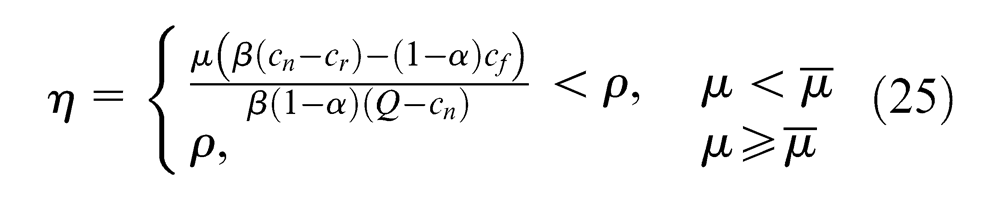
Corollary 5 illustrates that the market growth rate has an impact on the reutilization ratio of the used products. When the market growth rate is lower
Conclusion and future research
Conclusion
This article analyzes a monopoly in which the new, remanufactured and refurbished products are clearly differentiated. The optimal pricing strategies under finite (one and two periods) planning horizons of an OEM are characterized to identify the benefits of remanufacturing and refurbishing for the enterprise.
In the single-period planning horizon, the results show that:
Remanufactured products grab some market share from new and refurbished ones to form “bank run” and maintain the market constant and keep the profits increasing.
Refurbished products form “bank run” on remanufactured ones but not new ones and make the whole market growing and the total profits increasing.
In other words, the monopolist can get more profits, increase the reuse ratio of used products and reduce waste pollution of the environment from remanufacturing and refurbishing. In the two-period planning horizon, the results of the invariable market show that:
There is also “bank run” between the new products and the re-products, deriving from the collection yield
The total profits increase with the increase in the collection yield. And the firm can intensify the recycling efforts by constructing recycling channels and developing recycling marketing strategy to improve its profits.
When the size of the market is variable, the results show that different market growth rates lead to different impacts on decision-making for optimal price. The firm can take appropriate pricing strategy through the forecast of market growth situation to ensure profit maximization:
If the market growth rate is smaller, the prices of re-products are not affected, but the firm’s optimal profits and the reutilization ratio of used products increase with the increase in the market growth rate.
If the market growth rate is higher, the used products can be fully reused, but the firm’s profits are constrained by the quantity of used products. So, in order to ensure profit maximization, it needs to adopt a lower price policy of new products in the first phase to increase sales, ensuring abundant supplies of used products for remanufacturing and refurbishing in the second phase.
Future research
This article assumes that there is an oligopoly market, without considering the influence of competitors for pricing strategies of re-products. But in reality, the complete monopoly market is rare, and the firm often faces the competition derived from the third-party remanufacturers, such as a local remanufacturer, 1 an independent operator2,3 and so on. Therefore, it is significant to study the pricing strategies for re-products considering the competition.
In addition, this article also assumes that there are only two phases for the recycling of used products that are only reused one time. But in practice, it is a multi-stage process to recycle used products, and they can also be reused many times. So, another future research direction is to consider the multi-stage for pricing strategy of re-products. Finally, the optimal pricing strategy of the OEM with three competing products can be studied in closed-loop supply chain systems.
Footnotes
Appendix 1
Acknowledgements
The authors thank the editors and anonymous referees who commented on this article.
Declaration of conflicting interests
The authors declare that there is no conflict of interest.
Funding
This study was financially supported by the Chongqing Science and Technology Research Program (no. cstc2012ggC00001 and cstc2012gg-yyjs00010) and the Fundamental Research Funds for the Central Universities (no. CDJZR12118801) in China.