




Abstract
In order to monitor the degradation statuses of the spindle systems of machine tool during use, a degradation analysis method based on the complexity is proposed. In this article, the workpiece spindle systems of the grinding machine tool are taken as research object. First, the vibration signals of the workpiece spindle systems in X2 direction are monthly measured from April to October. The complexity values per month of the filtered vibration signals in X2 direction are calculated by Lempel–Ziv algorithm and are used as the index to monitor the degradation statuses of the workpiece spindle systems during 6 months running. The results show that the complexity values of the measured vibration signals from April to October gradually increase, and the status of the workpiece spindle systems of the grinding machine tool has a slight degradation. Finally, in order to verify the validity of the proposed method, the degradation bearing data published by Case Western Reserve University are used to verify the feasibility, and the result shows that the complexity is effective to the degradation analysis of the spindle systems of machine tool.
Introduction
The condition detection of the critical components or systems of the devices has attracted extensive attention in the academic research and practical engineering in recent decades and has made great achievements, such as the condition detection of the shaft and bearings of device,1,2 the steam turbine, 3 the coolant system of device4,5 and hydraulic system of device.6,7 Spindle systems are one of the most important components in machine tool, which consist of the spindle, bearings and spindle box. The main function of spindle systems is to transmit the motions and forces during manufacturing. Generally, the workpiece or cutting tool is directly fixed in front of the spindle; thus, the conditions of the spindle systems have a direct impact on the accuracy of the workpiece surface finish. Therefore, the condition analysis of the spindle systems during use is essential.
Usually, the accuracy indexes of the spindle systems of the machine tool refer chiefly to radial run-out, axial run-out and coupling run-out of the spindle. However, the condition of the spindle will change during use, because the friction, wear, fatigue, corrosion, shock and vibration exist in the spindle systems, which lead to the decrease in machining precision and quality. The condition changes in the spindle systems are called “degradation.” Typically, there are four degradation statuses during the life cycle of the spindle systems, as follows: normal status, slight degradation status, degraded deterioration status and failure status. If the statuses of the spindle systems can be real-time monitored, maintenance can be organized effectively to avoid serious failure, and machining precision of the workpiece can be well ensured.
Currently, a variety of methods are used to study the degradations of devices, such as hidden Markov model method, 8 Gaussian mixture model method, 9 logistic regression method, 10 support vector machines method, 11 artificial neural network method, 12 correlation dimension method 13 and approximate entropy method. 14 Among them, hidden Markov model, logistic regression, support vector machines and artificial neural network methods belong to supervised learning methods, which require good condition samples and failed condition samples to train the models. Generally, the life cycle of the machine spindle systems is long, and it is quite difficult to obtain all the failed condition samples in life cycle, so those degradation analysis methods based on failed data are not available for the degradation of the spindle systems. Gaussian mixture model method is a non-supervised learning method, which does not require failed samples to train the model, and degradation can be analyzed by the good condition samples. However, this approach has a flaw for its sensitivity to the choice of eigenvalues, so the Gaussian mixture model method is infeasible to analyze the degradation of the spindle systems.
During the running of the spindle systems, damping and the gap between the spindle and bearings will be changed due to the impact of cutting forces, which will result in the nonlinear behavior of the spindle systems. Thus, the spindle systems are commonly regarded as nonlinear dynamics systems
Correlation dimension, complexity and approximate entropy indexes are commonly used as indexes to analyze nonlinear time series. Correlation dimension and approximate entropy need to reconstruct state space for measuring data, and both methods need to determine the dimension m and the threshold r of the reconstruction state space during the calculating process. When the values of m and r have a change, the calculation results will change, and the calculating process is time-consuming.
Complexity is an index that can be used to estimate the frequency changes in discrete time series. The data proceeding only involves the coarse-grained, comparing and counting operations, which does not require state-space reconstruction of discrete data, and the calculation time of complexity is short. Moreover, the complexity has a strong capacity of resisting disturbance. In this article, a new method based on complexity is applied to study degradation of the spindle system, and the effectiveness of this method is to be verified using degradation data of Case Western Reserve University (CWRU).
Theoretical foundation
Definition of complexity
Lempel and Ziv 15 proposed the complexity definition of the finite time series. The complexity is calculated using the following algorithm: 16
Let P be a binary sequence, P = s(1), s(2), …, s(n) with S and Q denoting two subsequences of P. Let SQ denote the concatenation of S and Q while sequence SQ∏ is derived from SQ after its last character is deleted (∏ means the operation to delete the last character in the sequence). Let V(SQ∏) denote the vocabulary of all different subsequences of SQ∏. Initially for S = s(1), Q = s(2) and the complexity measure is set c(n) = 1, therefore SQ∏=s(1).
In general, for S = s(1), s(2), …, s(r), Q = s(r+ 1), the resulting sequence is SQ∏ = s(1), s(2), …, s(r). Then by inspection, Q∈V(SQ∏) implies that Q is a subsequence of SQ∏, and not a new sequence.
Update Q = s(r+ 1), (r+ 2) and inspect if Q is in V(SQ∏).
Repeat steps 2 and 3 until Q do not belong to V(SQ∏). Now Q = s(r+ 1), s(r+ 2), …, s(r+i) is not a subsequence of SQ∏ = s(1), s(2), …, s(r+i− 1), therefore, increase c(n) by 1.
Thereafter, S is combined with Q forming S = s(1), s(2), …, s(r), s(r+i), …, s(r+i) and Q = s (r+i+ 1).
This procedure has to be repeated until Q is the last character. Finally, the number of different subsequences is the measure of complexity c(n). In order to obtain a complexity measure that is independent of the length of the sequence, c(n) should be normalized. If the number of symbols in the symbol set is

when

For a binary sequence, α = 2, therefore

And c(n) can be normalized via b(n)

c(n) is called L-Z complexity.
Experiment
In order to analyze the degradation statuses of the spindle systems during use, this article used the vibration signals at the workpiece spindle site of grinding machine tool as the analysis object. Until now, the grinding machine tool has run almost every day, and the grinding machine tool did not have any fault. The measure of the vibration signals lasted from April to October (Figure 1).
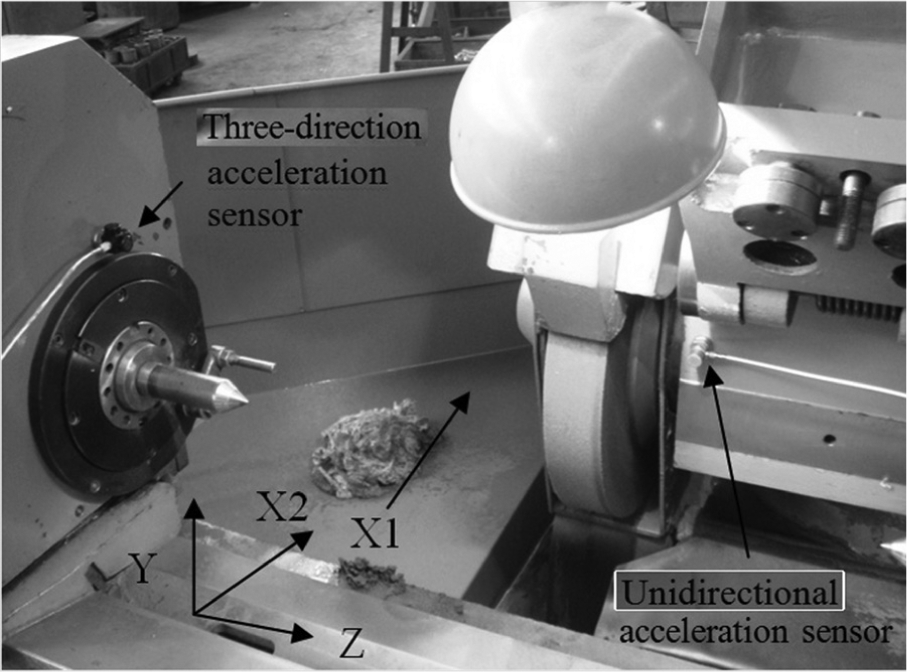
Cylindrical grinder and sensor installation location.
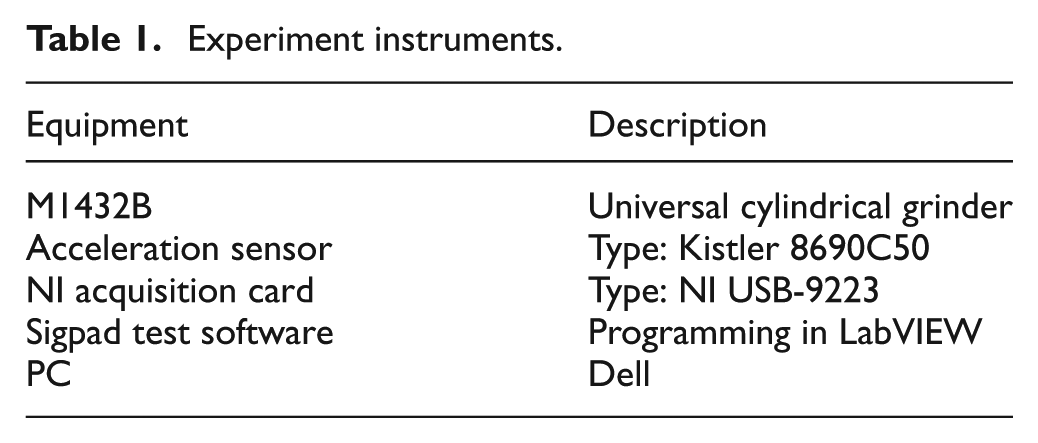
Each month during measurement, the grinding machine tool was run as follows: keeping the grinding wheel spindle stationary, the workpiece spindle was run without load at speeds of 45, 67.5, 90, 112.5 and 135 r/min, respectively. Then the vibration signals of the workpiece spindle in X2, Y and Z directions were measured by acceleration sensor (X2 direction vibration signals were used as research object in this article, which has direct impact on the workpiece surface finish) (Table 1).
Experiment instruments.
A description of data processing based on complexity is given as follows:
Frequency band filtering of vibration signal. According to the inner structure of workpiece spindle systems of M1432B, making a frequency band filtering of the acceleration vibration signals in X2 direction (retaining the frequency range of 0–500 Hz).
Calculating the average values and standard deviations of the complexity of the filtered vibration signals (vibration signals in X2 direction are divided into 20 small segments, and to calculate the complexity of every segment, and then to calculate the average values and standard deviations of complexity) by the L-Z complexity algorithm, the changes in average value and standard deviations of complexity from April to October are shown in Figure 2.
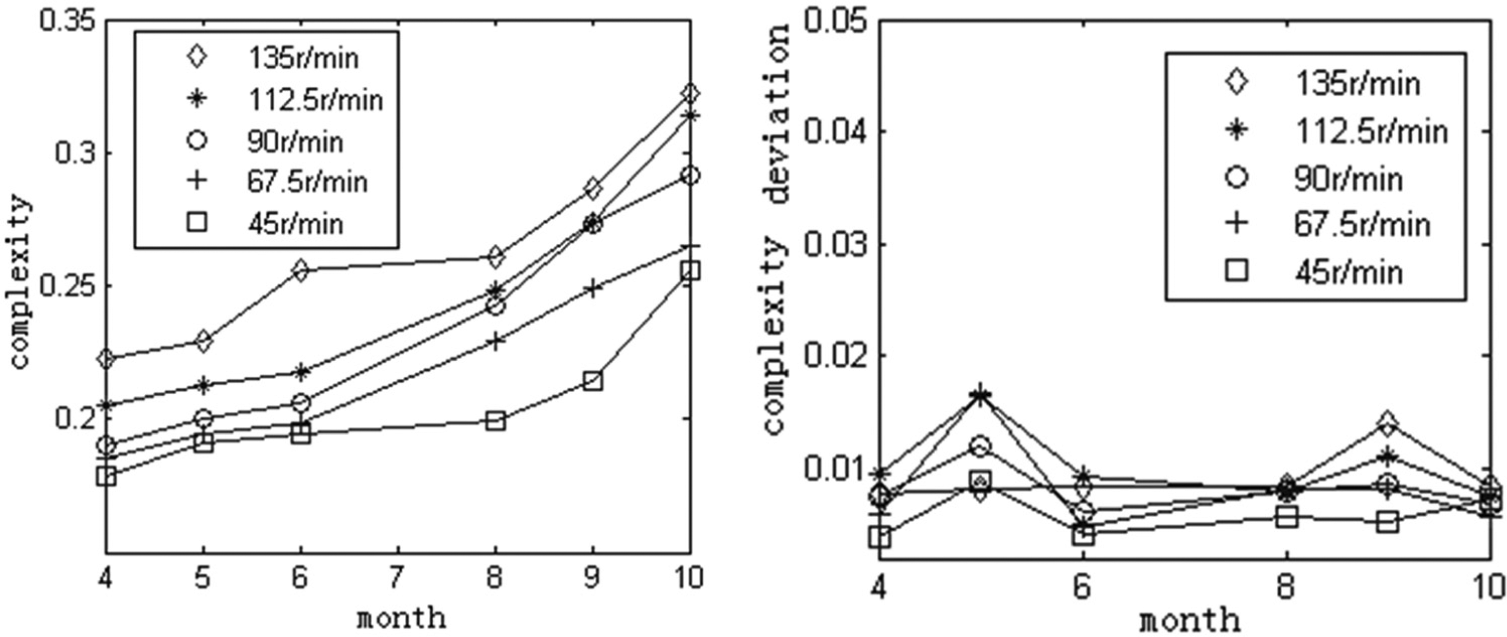
Change in average values and standard deviations of complexity from April to October.
As can be seen from Figure 2, it is clear that higher speed has higher complexity value, and there exists obvious linear relationship between the complexity value and the speed. That is because higher speed leads to increasing frequency components during the analysis frequency band of vibration signals, so does the complexity value. And the complexity of the vibration signals of the workpiece spindle systems has small complexity fluctuations from April to October and demonstrates that the health status of grinding machine spindle systems has slight degradation. It can be seen that the complexity deviations are quite small every month, which means complexity index has a strong capacity of resisting disturbance.
Experimental verification
The experimental platform 17 that contains motor (2 hp), test bearings (driving end bearings), fan and accelerometer, and the sampling frequency is set to 12 kHz. The motor rotates at the speed of 1797 r/min without load, and there exists artificial defect in driving end bearing (defect on inner ring, diameter of 0.007, 0.014, 0.021 and 0.028 in separately and depth of 0.011 in, machined by electric spark). Vibration signal on driving end is collected by accelerometer.
The type of driving end bearing is 6205-2RS JEM SKF, whose detail parameters are listed in Table 2 (in). The fault frequency of each part is listed in Table 3.
Structure parameter of driving end bearing.
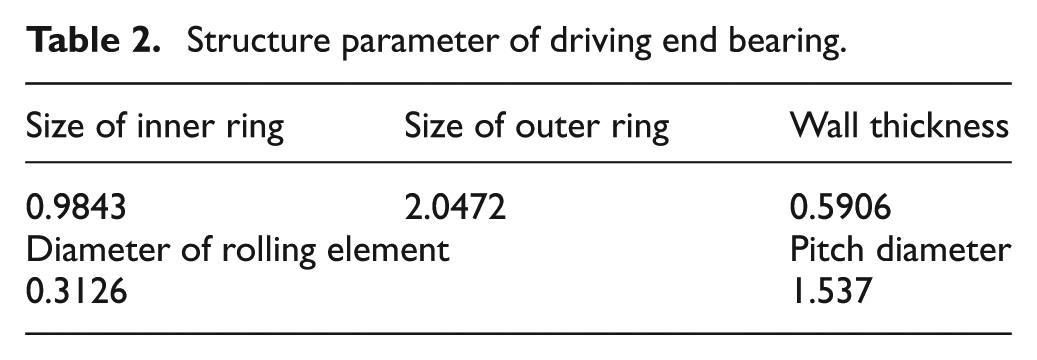
Fault frequency of each component of bearing.
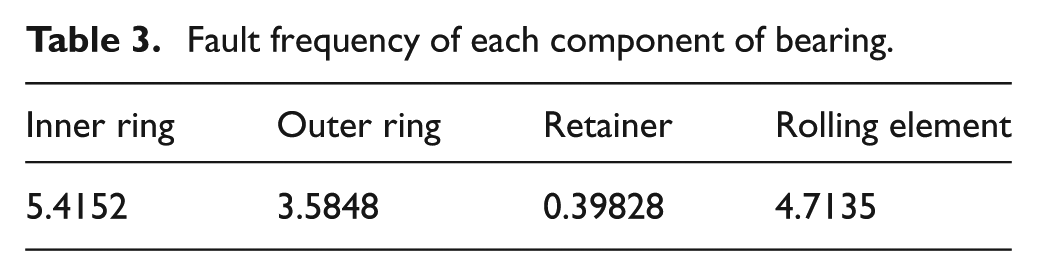
According to Table 3, the corresponding fault frequency of inner ring is approximately 162 Hz (i.e. 1797 × 5.4152/60). Extending the analysis frequency band (selecting the band of 100–200 Hz as research object), and calculating the complexity value of vibration signal in the frequency band according to the complexity algorithm, the results are shown in Figure 3.
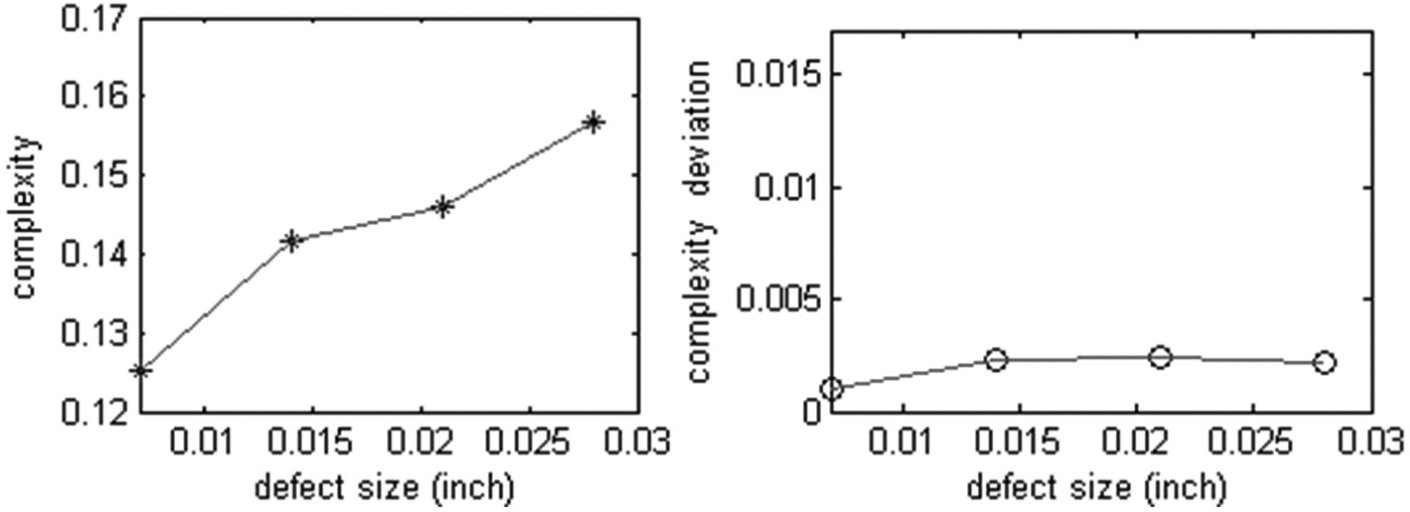
Complexity value of inner ring with different defect sizes.
As can be seen from Figure 3, the complexity value increases as the degeneration of the bearing inner ring grows, which means complexity index is feasible in degeneration analysis. Simultaneously, complexity index is effective to the degeneration analysis of the spindle systems of machine tool.
Conclusion
The following conclusions are drawn:
This article analyzes the degeneration status of the workpiece spindle systems of grinding machine from April to October by complexity index. The results show that there exists degeneration in the workpiece spindle systems.
In order to verify validity of the proposed method, we use the degradation bearing data published by CWRU to verify the feasibility, and the results show that the complexity is effective in degradation analysis.
Footnotes
Acknowledgements
The authors are grateful for the assistance from members of the research team (such as Sun Jiabin, etc), and the suggestions from all the anonymous reviewers and the journal’s editor and associate editor who have greatly aided to improve this article.
Declaration of conflicting interests
The authors declare that there is no conflict of interest.
Funding
The authors are grateful for the supports of National Science and Technology Major Project of Ministry of Science and Technology of China (grant no. 2011 ZX04016-021), National Key Technology Research and Development Program of Ministry of Science and Technology of China (grant no. 2012BAF01B02) and National Science and Technology Major Project of Ministry of Science and Technology of China (grant no. 2012ZX04005031).