




Abstract
An integrated technology pushing and requirement pulling model is presented to address the problem of selecting a suitable portfolio from several candidate multi-function weapon systems in the defence acquisition and manufacturing process. The optimal weapon system portfolios both satisfy the technical effects and compound capability requirements with relative acquisition and manufacturing constraints. In the first stage, multiple criteria analysis is employed to build a portfolio value hierarchal structure from two main perspectives: a five-level set of technology pushing measures and a two-level set of requirement pulling measures. The developmental maturity level of a technology, its functionality, systems, capability, and portfolio are all captured by technology pushing measures, based on an additive multiple criteria model. The requirement satisfaction level of a system or portfolio is obtained by requirement pulling measures based on linear programming optimization and the first-ignorance model, which is founded on expert opinion, using pairwise comparisons. In the second stage, by means of manufacturing cost consumption and capability requirement constraint assumptions, the dominance structure of the portfolios is designed and all the technology and requirement portfolios are generated as a set of Pareto-optimal solutions, through multi-objective integer programming. An illustrative case study is presented to validate the efficiency of the proposed model, and the computational results are further analysed and discussed.
Keywords
Introduction
In an annual research report, Washington announced a marginal increase in less than 1% in its annual military budget, which resulted in a total annual military budget of approximately US$623 billion in fiscal year 2013. However, the US military budget has been above US$600 billion for 6 years, from 2008 to 2013. 1 The sustained annual defence spending planned by the Department of Defense (DoD) has been used to improve weapon system products research, development, production, and manufacturing capabilities to a far greater extent than any other organizations in the world. 2 As a national decision, weapon system selection (WSS) in defence acquisition and manufacturing is vital for improving a nation’s ability to defend its domestic and international security and interests. It can even be considered as crucial as the outcome of a real war 3 Moreover, defence investment budgets have been increased in many countries for new weapon system development and manufacturing, with the aim of reducing the countries’ reliance on foreign weapons procurement in more areas as their defence manufacturing capabilities and technologies mature.2,3
Presently, with an increasing military requirement for joint operations, the ubiquitous interdependence and interaction among systems led the WSS to become System of Systems (SoS) engineering by considering the overall benefit of the selected systems. The traditional emphasis, however, has primarily been on increasingly sophisticated, high-tech system production processes in a certain field, rather than a systematic high-level planning decision. 4 Once a new system is manufactured and added to the existing weapon SoS, the traditional development mode in many cases results in subsequent modifications and revisions that waste the defence acquisition budget and slow the weapon SoS construction process. The system portfolio effect is becoming increasingly profound such that it cannot be ignored in the establishment and development of the weapon SoS project especially in the acquisition and manufacturing process, which is highly sensitive to variations in cost and time. Therefore, portfolio decision-making is required in the acquisition and manufacturing of multiple weapon systems for weapon SoS development.
A portfolio decision analysis (PDA) is a combination of decision analysis and portfolio management for assisting decision makers (DMs) to make an informed evaluation and selection of a subset of competing alternatives, with the aim of contributing to the attainment of multiple, incommensurate, and often conflicting objectives, and in the presence of limited resources and other constraints. 5 Many of the portfolio decision-making problems facing the DMs in military organizations are similar to those of civil and commercial organizations. Often, they face constraints such as limited defence budgets and multiple, incommensurate, or even conflicting objectives.2,5 However, the defence acquisition and manufacturing procedure, simplified as a weapon system portfolio selection (WSPS) problem in this study, is more challenging because of (1) safety reasons, as it is often difficult to test military systems (e.g. weapon of mass destruction) and, therefore, to ascertain their value in realistic operational conditions; 6 (2) the strong relationship between the continual development of advanced technology related to the manufacturing process and predicting future requirements of the military; and (3) the hostile environment, which makes human factors especially important since levels of personal decision risk are often much higher than would be acceptable in civil applications. 6 Therefore, with regard to WSPS, it is necessary to conduct a sound, evidence-based value analysis and take full advantage of the suggestions from DMs in the multi-objective portfolio decision process. This is also the research motivation of this article.
The main contribution of this study is to model and solve the WSPS problem with an integrated technology pushing and requirement pulling (TPRP) methodology framework, which comprises two stages: weapon system portfolio value modelling and WSPS solving based on multi-objective programming. Emphasizing the inherent value structure of a weapon systems portfolio from the technology push and requirement pull perspectives, this approach involves first designing a hierarchal TPRP value model with a five-level set of technology pushing measures (TPMs) and a two-level set of requirement pulling measures (RPMs). With the hierarchal TPRP value model, it accounts for the assessment of the portfolio readiness level (PRL) of a weapon system portfolio through the technology readiness level (TRL)/integration readiness level (IRL) of the related manufacturing technology and the acquisition of the portfolio satisfaction level (PSL)/system satisfaction level (SSL) through experts’ judgments. Interval probability is used to determine SSL from DMs, which will permit key stakeholders to interact independently and simultaneously to achieve more realistic, comfortable, and more sound decisions, even if the future capability requirement is not initially clear. Besides, the approach aims at solving the WSPS problem and determining the best options at the second stage, called technology and requirement (T&R) portfolios in this study, through multi-objective programming. Some key components that are necessary in this stage include system manufacturing cost and capability constraints, a feasible portfolio generation method, and a dominance structure design.
The remainder of this article is organized as follows. Section ‘Literature review’ presents the literature review, previous theories and approaches, and their relationship with our methodology. Section ‘Methodological development’ presents the portfolio selection methodology. Section ‘Weapon system portfolio value modelling’ describes weapon system portfolio value modelling from two perspectives: TPMs and RPMs. Section ‘WSPS problem solving based on multi-objective programming’ introduces WSPS problem solving based on multi-objective programming, which comprises constraint assumptions and feasible portfolio generation, dominance structure design, and computation of T&R portfolios. An illustrative case study with T&R portfolio analysis is conducted in section ‘An illustrative case study ’. Finally, the main conclusions are presented in section ‘Conclusion’.
Literature review
The portfolio selection theory proposed by Markowitz 7 heralded a new era in the study of finance using mathematical tools. It has been subsequently applied by many researchers to select a single optimal alternative out of many, in fields such as research and development (R&D) project selection, 8 capital budgeting in healthcare, 9 and defence acquisition and manufacturing.2,3,6,10–17 With regard to the relevant literature on WSS in defence acquisition and manufacturing, weapon system screening and weapon system ranking enjoy more enduring interest than WSPS. To the best of our knowledge, portfolio selection theory was first applied in the military context by Buede and Bresnick 10 for military project selection. Subsequently, several studies on military portfolio selection emerged, and portfolio selection theory began to be widely applied in the defence acquisition and manufacturing field.
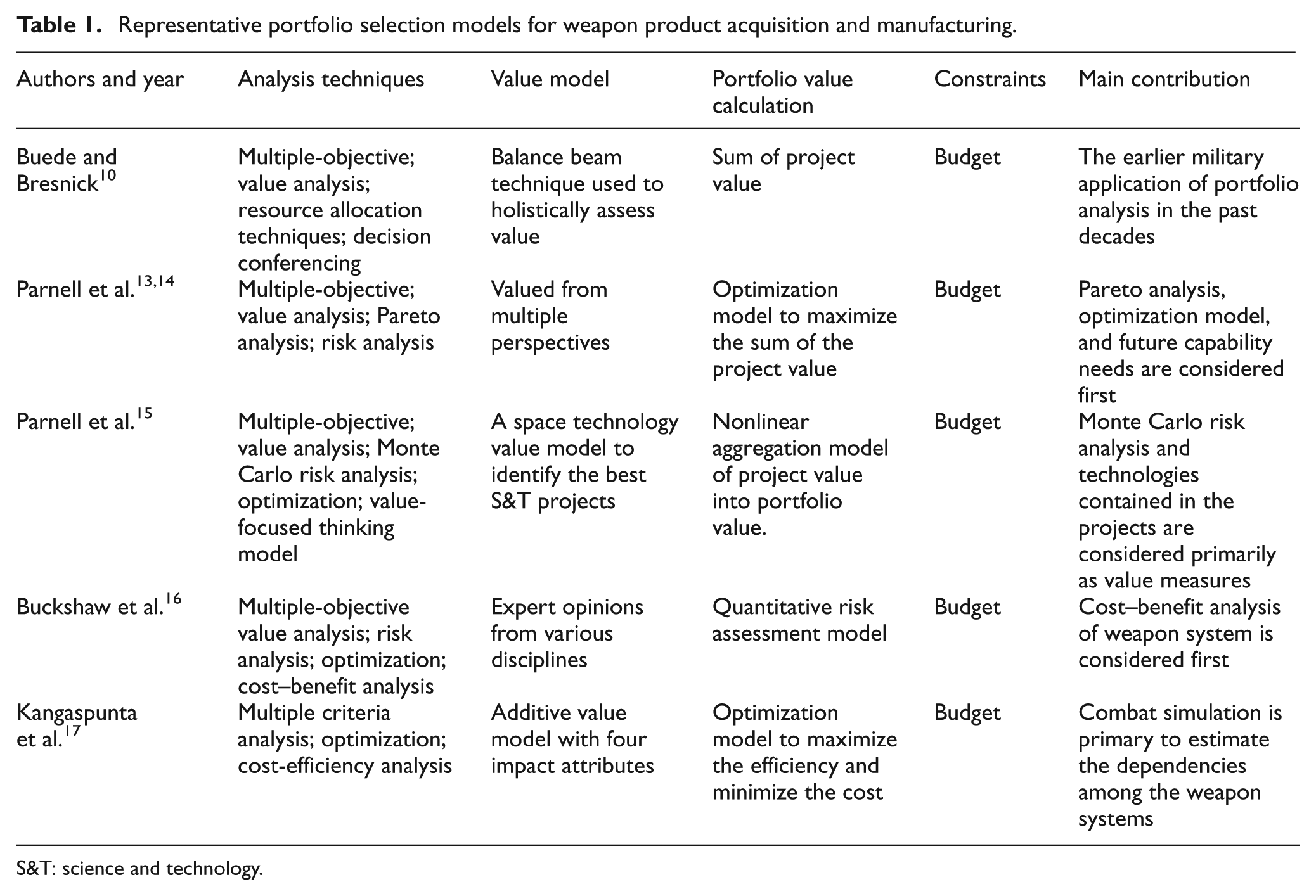
The past 20 years of research on military portfolio selection has essentially focused on WSPS. Although it is frequently termed as military project selection, the project concerns the selection of a new weapon system or the development of an army installation portfolio. The most common analysis techniques include multiple-objective analysis,2,6,10–16 multiple criteria analysis (MCA), 17 value analysis,11–16 optimization,3,13–17 cost-efficiency analysis,16,17 and expert judgments.10,12,16 Additionally, there are other, less frequently utilized techniques such as the Monte Carlo technique, 15 risk analysis,13–16 Pareto analysis,13,14,17 and resource allocation techniques.10,14 Clearly, with an emphasis on mathematical and quantitative elements, the foregoing military portfolio selection processes usually rely heavily on the balance of constraints and value optimization, in which the budget and the additive value model are the most common options. It is clear that with so many existing methods, extensive effort has been incorporated into portfolio maximization addressing multiple objectives. However, as shown in Table 1, the representative contributions made by past research deserve more attention.
Representative portfolio selection models for weapon product acquisition and manufacturing.
S&T: science and technology.
First, while multiple objectives are often transformed into a single objective by using the multiple-objective decision-making (MODM) method, Parnell et al. 13 extended the multiple-objective analysis using the Pareto method and the optimization model to maximize the project’s additive value for future needs. In the past, studies have contributed to some relatively efficient methods2,3,17,18 to search the entire Pareto-optimal set from the feasible portfolio space. Because of the need for multiple objectives, the computation of non-dominated portfolios is often performed by identifying all Pareto-optimal solutions of a multiple-objective integer programming problem. However, the pairwise comparisons in the search process will exponentially increase, thereby making the computation more time-consuming when the number of feasible system portfolios is large. A sorting strategy with regard to cost, presented by Kung et al. 19 and Deb, 20 has proven to be efficient in identifying the Pareto-optimal solutions from vast amounts of feasible options, 17 which is also employed in this study.
Second, the Monte Carlo risk analysis and related technologies14,15 are first considered as value measures in military portfolio selection. The technology effect is an important factor in determining which military portfolio meets the technique-feasibility objective as regards the defence budget constraint. A common term, TRL,21,22 has been used across many US government agencies to assess the developmental maturity of evolving technologies before incorporating them into a system manufacturing process.23,24
Third, Buckshaw et al. 16 proposed a methodology based on the judgment of experts from various disciplines, coupled with a cost–benefit analysis of the weapon systems. Cost–benefit analysis of a weapon system is considered first in WSS. With the capability-based planning (CBP) concept experiencing considerable attention in applications for defence and military acquisitions over the past few years, especially in the planning of weapon systems procurement and manufacturing,25–27 a weapon system that meets future military requirements is considered vital. Capability is defined as the ability to achieve a desired effect under specified conditions, through a combination of systems with corresponding functions that have been created by technology integration, to perform a set of tasks.28,29 Moreover, with regard to the judgment of experts from various disciplines, many of the scores of MCA from the literature are, to some extent, inaccurate and tend to encompass more qualitative comparison judgments than the conclusions of a precise point-valued estimation.30,31
Recently, Kangaspunta et al. 17 identified the value of a weapon system portfolio through combat simulation, to estimate interdependencies. Interdependencies among the systems in a portfolio for defence acquisition and manufacturing can be considered as the integration of technologies based on the ‘techniques view’, and the integration of functions based on the ‘capability view’. IRL 32 (which, like TRL, is denoted as a metric) was first proposed by Gove and colleagues33,34 to evaluate the integration readiness between the two technologies and can be used with a TRL to determine the system readiness level (SRL). Therefore, in this study, an SRL that incorporates the current TRL and IRL scales is employed to measure the technology push effect on a system. However, the multi-function trait of the current system makes the analysis of SRL even more complex. Ramirez-Marquez and Sauser22–24,32,33,35 have elaborated extensively upon the rationale behind the SRL. For a system with multiple functions and multiple capabilities (MFMC), Tan et al.24,35 proposed a hierarchical SRL, where the SRL is defined at three different levels: capability-based SRL (SRL_C), function-based SRL (SRL_F), and whole system-based SRL (composite SRL).
Above all, the literatures are devoid of solutions for measuring the inherent value of a weapon system portfolio by the static property of the system portfolio, rather than with merely subjective criteria.10,13,16 Even when the capability needs and technologies of a military are considered in WSPS by researchers,13–15 the two factors are not given enough weightage to adequately support the entire decision-making process. In addition, benefiting from advanced technologies and integrations, many multi-function weapon systems have been developed and utilized to meet the demand for multi-capability products. It is easy to see that the groundwork of the valuation of weapon systems lies in the maturity of technological development and the achievement of desired military capabilities. Moreover, the traditional approaches failed to recognize the relationship between the manufacturing cost super-addition and SRL, called SSL improvement, considering the cost as only comprising the weapon system price. Finally, an ignorance of the ambiguous information on future capability requirements leads to the low credibility of the point-value scores obtained by experts’ judgment.
Methodological development
The overall TPRP model framework for the WSPS problem in defence acquisition and manufacturing is shown in Figure 1. It clearly reveals that the framework comprises two stages: weapon system portfolio value modelling and WSPS solving based on multi-objective programming. Then, the illustration of the main components of the framework and the reasons for choosing it to solve this problem are given as follows:
1. Weapon system portfolio value modelling.
The military application of PDA often employs value instead of utility, as a measure of the system or portfolio,11–16 the definition of value is determined by the decision objectives. We formulate the weapon system portfolio value model, TPRP, from two perspectives: first, from the technology pushing perspective, and second, from the requirement pulling perspective. A hierarchical TPRP value model is composed of five-level TPMs and two-level RPMs, which can also be primarily classified into two levels: system level and portfolio level. During the five-level TPMs, the TRL and IRL at the same level are the foundations for acquiring the other levels’ measures (function readiness level (FRL), SRL, capability readiness level (CRL), and PRL). TRL and IRL can be obtained as scores through a comparison between the current technology and integration readiness state, and fixed standards. Multiple criteria decision analysis (MCDA) and the additive model are employed in the calculation of FRL, SRL, CRL, and PRL. Without loss of generality, the weights of each sub-criterion at the same level are considered the same. With respect to the two-level requirement pull measures (RPMs), they depend on experts’ judgment to such an extent that the point value and additive average models cannot adequately describe the SSL and its relationship with the PSL. Therefore, interval probability is employed to describe SSL for a certain capability, and the three integration models, IM-Median, IM-Best, and IM-Worst, are built based on three different attitudes to calculate the SSL of all the systems in a portfolio into a PSL.
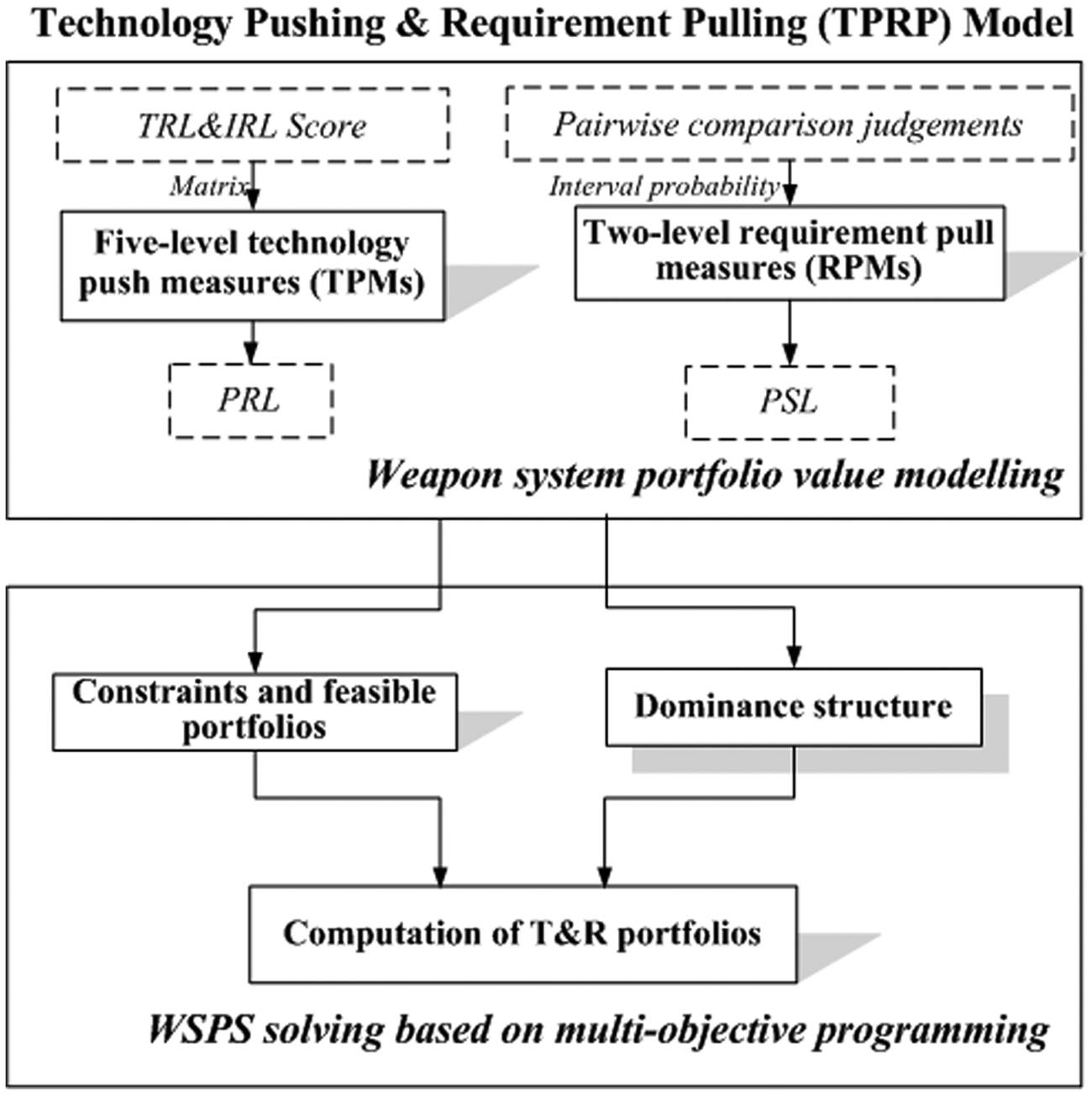
The TPRP model framework.
2. WSPS solving based on multi-objective programming.
WSPS solving based on multi-objective programming in this study is not focused on converting multiple objectives into a single one, but use Pareto analysis to obtain non-dominated portfolios because several recommendations for portfolios are more practical and useful for stakeholders than a single optimal portfolio is, in defence acquisition and manufacturing. During the acquisition and manufacturing process, the constraints of the weapon system portfolio, which are the manufacturing cost and capability types in this study, are used to generate a set of feasible system portfolios from candidate weapon systems. The dominance structure defines the dominated portfolios, which may be discarded from the candidate portfolios, retaining only the non-dominated ones that are referred to, in this study, as T&R system portfolios. The generation of a T&R system portfolio is obtained by maximizing the measures of the system portfolio, subject to the given capability requirement and manufacturing cost constraints.
Compared with the aforementioned solutions and models in the literature review, our portfolio selection methodology offers the following special abilities. First, it explicitly considers the current technology developments (TDs) and future military requirement factors in defence acquisition and manufacturing. Moreover, the impacts of these factors are obtained through not only impersonal TRL/IRL but also the DM’s simultaneous judgments. Second, the generation of a T&R system portfolio is obtained by maximizing the measures of the system portfolio, subject to the given capability requirements and manufacturing cost constraints. This multi-objective programming model and solving algorithm are generic so that the non-dominated system portfolio can be offered even with some other measures and manufacturing constraints. Third, our methodology accommodates an abundant and valuable T&R portfolio analysis including PRL/PSL comparison at different cost levels, key system portfolio analysis, and cost strategy influence analysis on weapon system acquisition and manufacturing. Finally, the methodology can optimize the available information to achieve an almost accurate decision when the future military application is ambiguous. This is very important and useful because, in practice, experts are more comfortable when expressing their preference than when given a precise result.
Weapon system portfolio value modelling
TPRP value model based on MCDA
A TPRP value model based on an MCDA, shown in Figure 2, depicts the measures of a system and a system portfolio from two different perspectives: technology push and requirement pull. The technology pushing and requirement pulling (TPRP) model extends the SRL hierarchy to two levels: portfolio level and system level. Thus, it is evident that the WSPS problem should balance the PRL and PSL of a candidate weapon system portfolio during the entire selection process. An ideal system portfolio is one that optimizes both the maturity and the extent of satisfaction with a certain capability requirement.
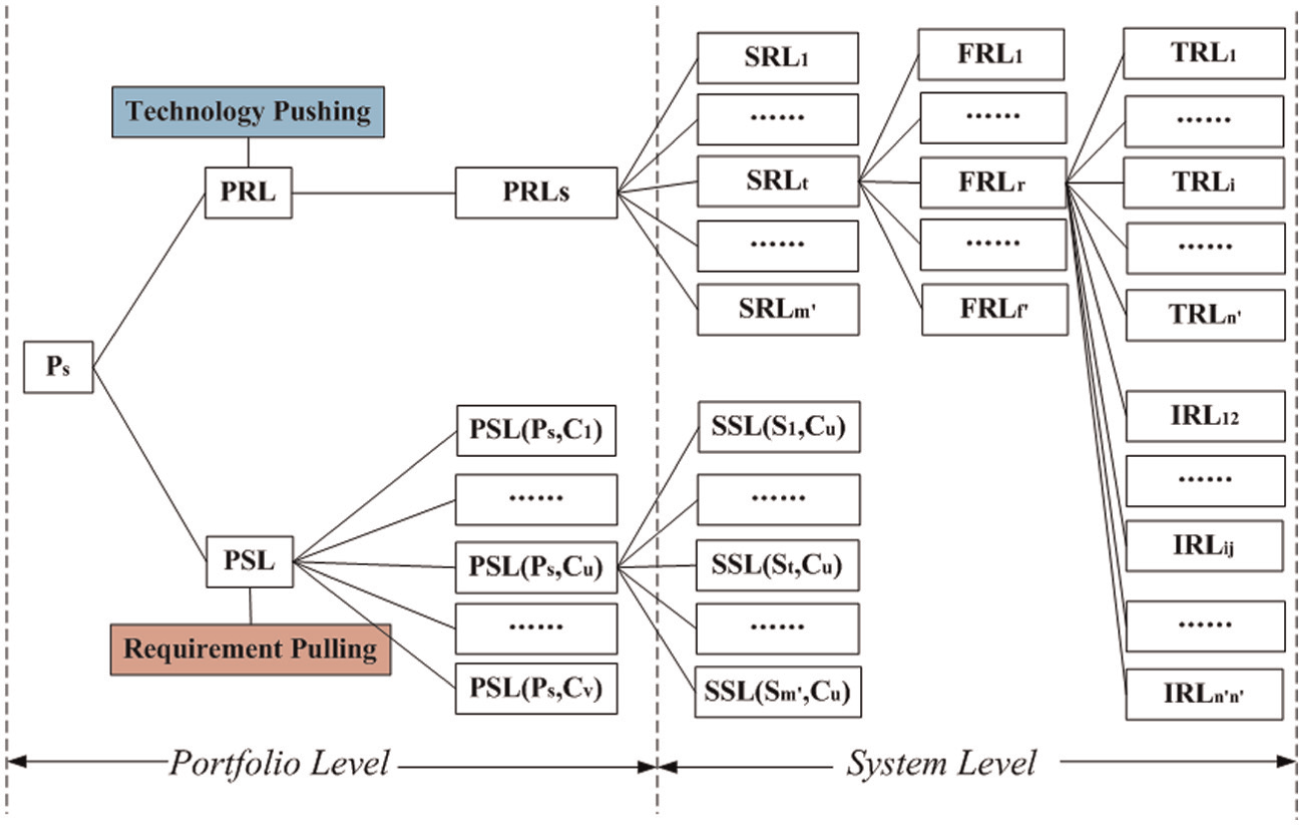
The value model structure of a system portfolio.
As discussed, the TPRP value model revealed that one should consider the following issues when obtaining the criteria value for each level.
TRL and IRL are foundational measurements. Because the FRL is influenced by low-level technologies and their integrations, it can be considered as a conjunct result of the TRL and IRL. Its definition and calculation are based on an additive value function, which is similar to that in the extant literature23,32,33 about
The calculation of SRL by FRL involves two assumptions: (1) the system developmental level is determined by the developmental level of the multiple functions it contains and (2) the different FRL values stem from the fact that individual functions have different effects on a system. Calculating an SRL, this process should take into account all the functions, and an additive value function is used in this process, which is similar to the definition of
The understanding of the relationship between systems and capabilities in this study is similar to the definition in Department of Defence Architecture Framework Version 2.0 (DoDAF V2.0),
28
but different from Tan’s consideration in the hierarchical SRL.
34
When a portfolio is selected, its fitness is determined by the utilities supplied by a series of multi-function systems, based on various technologies and integrations. Calculating a CRL, this process should take into account all the functions containing a certain capability as its ‘subsystem’ measurement; the additive value function is also used in this process. The capability is a high-level emergence behaviour of a certain number of functions supplied by the corresponding systems. Thus, the CRL of a capability is determined by the FRL of all the constitutional functions within a capability. Assume that a capability comprises the first
There is only one final measure, PRL, to indicate the value of a weapon system portfolio from the technology pushing perspective. Obviously, the PRL can be measured by its ‘subsystem’ measurement, SRL, and its definition and calculation are similar with the composite SRL given in the literature.24,35 Assume that p (
SSL depends on ambiguous military requirements and experts’ judgments to such an extent that the point value and additive average models cannot adequately describe the SSL and its relationship with the PSL. Therefore, the interval probability is employed to describe SSL for a certain capability, and three integration models, IM-Median, IM-Best, and IM-Worst, are built based on three different attitudes to calculate the SSL of all the systems in a portfolio into a PSL. Considering that there are k (
The definition of PSL in a function form represents the extent of a weapon system portfolio to satisfy a certain capability. If there are multiple capability requirements, the number of PSL results of a weapon system portfolio is equal to that of the capability requirements. It worth noting that the component abilities of the multi-capability requirements, which represent the expected effects that the system portfolio should achieve in future operations and support, are coexistent with the others, but independent of each other. Therefore, we do not intend to integrate the different PSLs for multi-capability requirements into a single one.
Here, a value model with
Five-level technology push measures via TRL and IRL
Consequently, the effect of technology pushing in this study is assessed by five technology pushing measures (TPMs): TRL, FRL, SRL, CRL, and PRL (see Table 2). The TRL and IRL are assumed to have the following properties:21–24,32–37
A system has n technologies and any two technologies have potential for integration.
The TRL for any technology has 10 potential integral values, 0–9.
The IRL for any integration has 10 potential integral values, 0–9.
Five-level TPMs and their definitions.
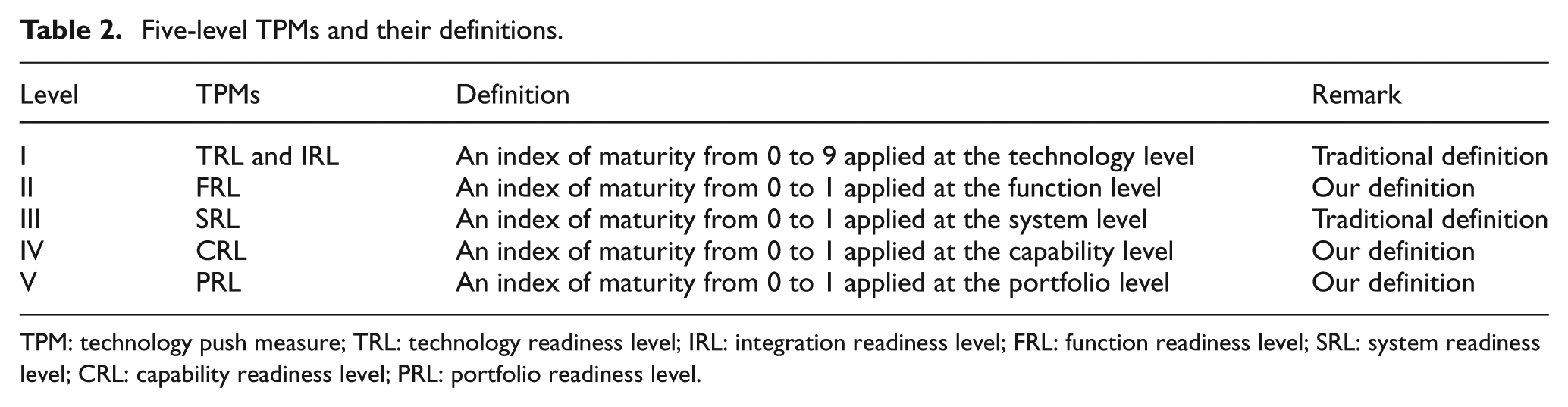
TPM: technology push measure; TRL: technology readiness level; IRL: integration readiness level; FRL: function readiness level; SRL: system readiness level; CRL: capability readiness level; PRL: portfolio readiness level.
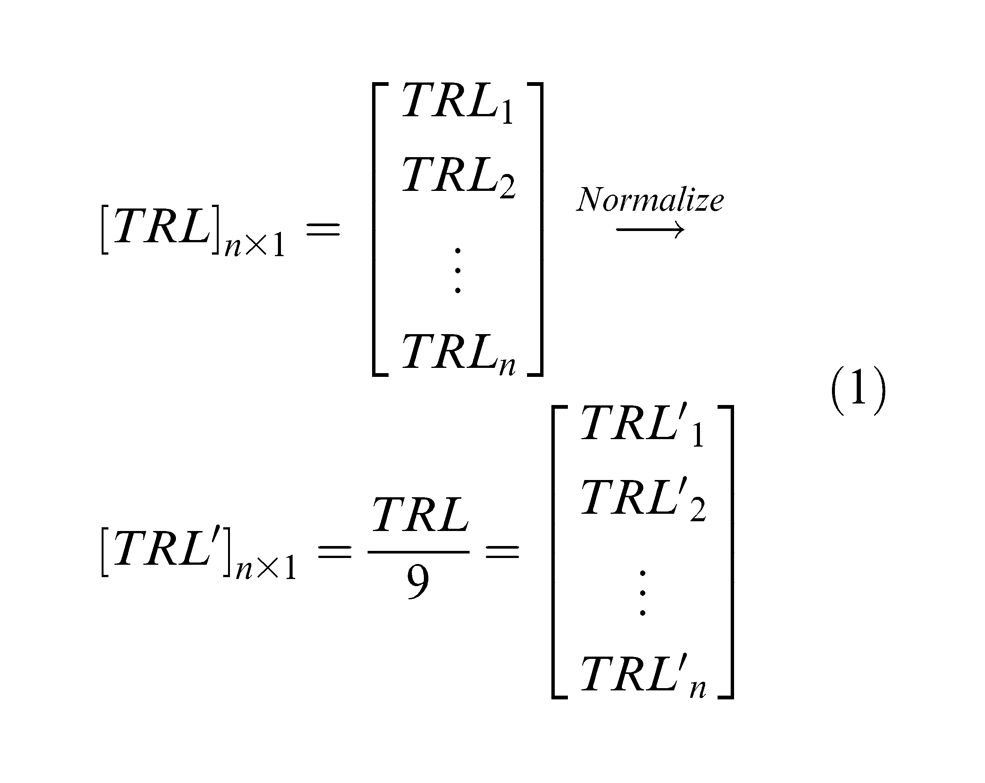
Assuming there are n technologies contained within the candidate systems, mathematically, the procedure for obtaining a PRL based on the five-level TPMs is as follows:
1. TRL is defined in equation (1) as a vector, and the value of
2. IRL is defined in equation (2) as a matrix, where
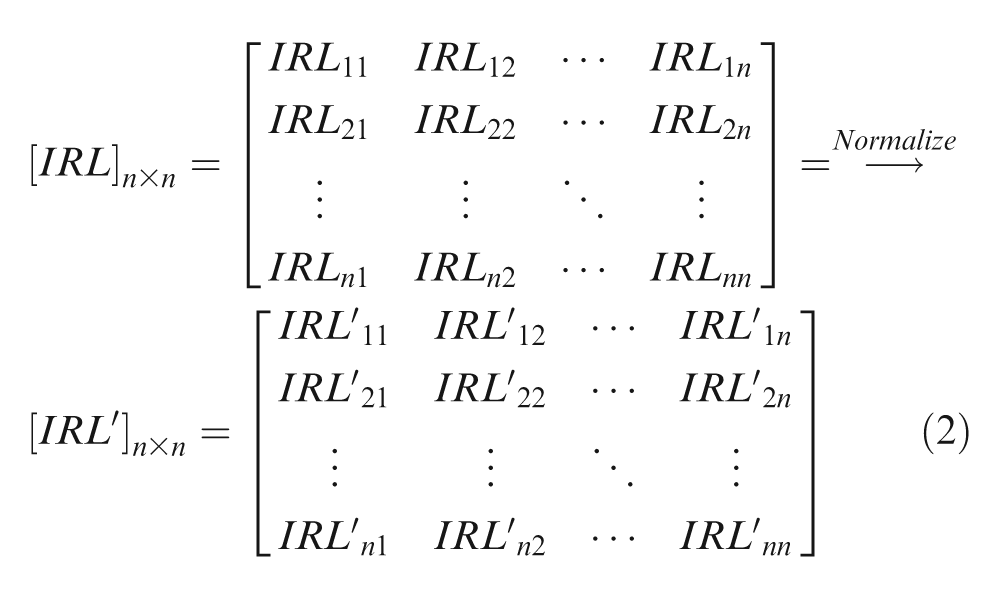
Note that
3. To calculate the FRL of each function, we assume that there are f functions supplied by all the technologies and their integrations and the FRL of the function r is denoted as
At first, the product of the TRL and IRL matrices is denoted as ITRL matrix given as the following formula
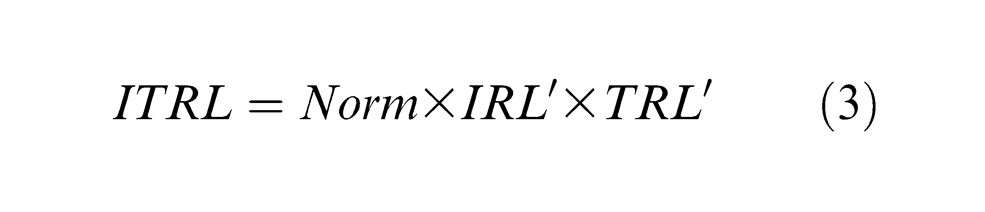
where Norm is a diagonal matrix
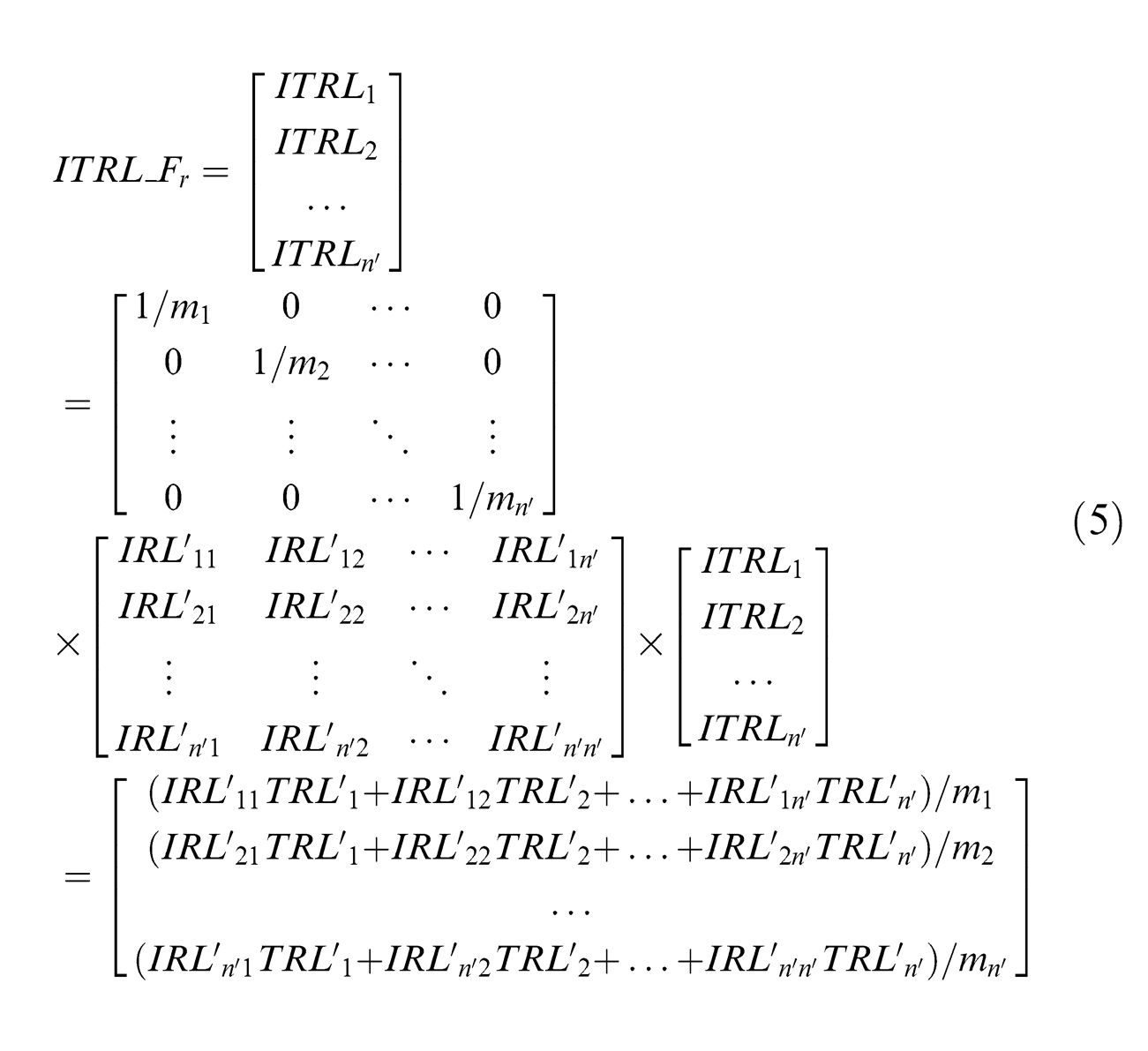
We then assume that the technologies and integrations contained in a function are only subsets of all the technologies, set

where
Definition 1
Considering that there are
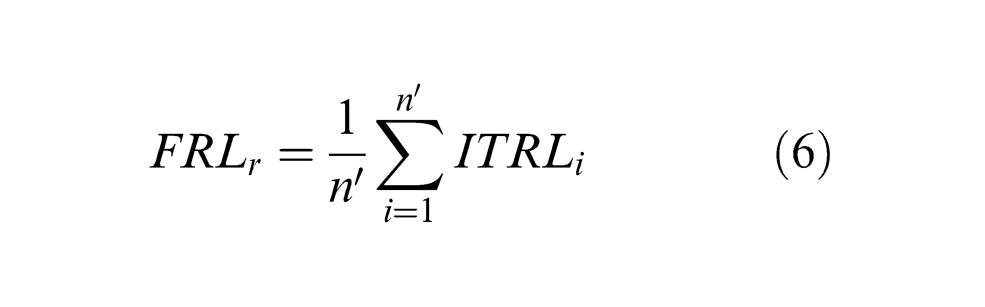
4. Calculate the SRL of a system. The SRL of the system
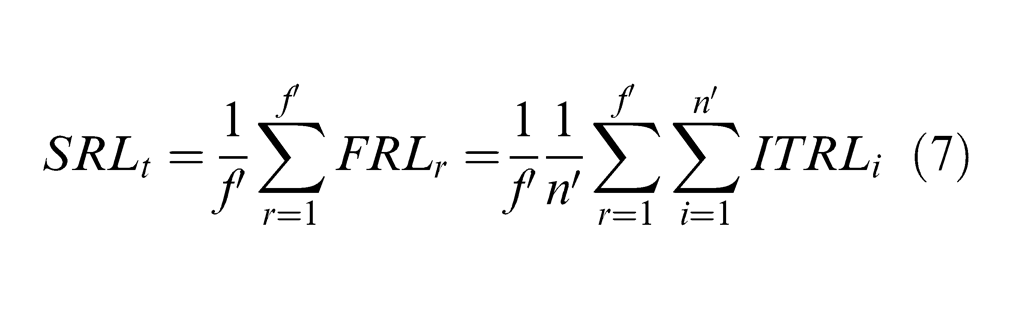
5. Calculate the CRL of a capability.
Definition 2
The readiness level of capability
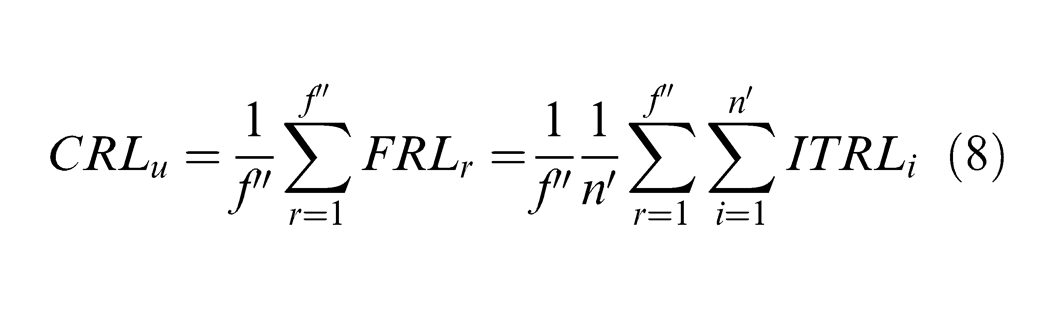
To the best of our knowledge, this definition and formula for the CRL are proposed by our study first. The core thoughts and calculation are also based on an additive value function and multiple criterion decision.
6. Calculate the PRL of a portfolio.
Definition 3
The readiness level of portfolio
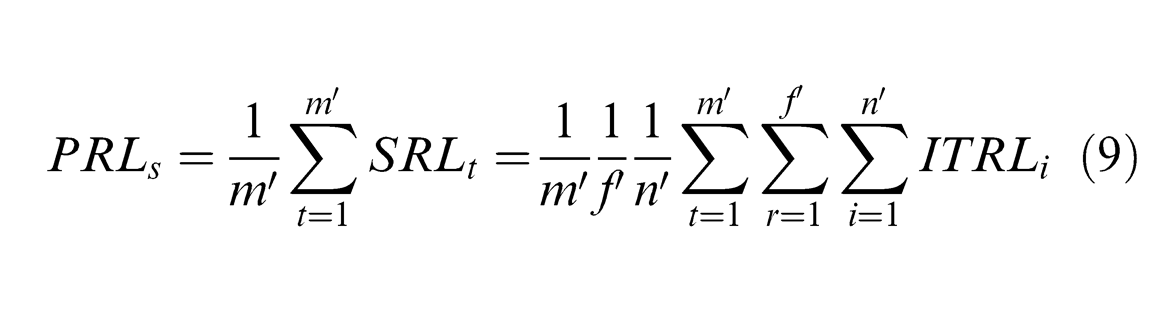
The five-level TPM is a comprehensive and useful index to indicate where a weapon system portfolio is, in its developmental cycle. Corresponding to the SRL scale definitions in much of the literature,23,24,35 the common definitions of SRL, PRL, and the corresponding terms are provided in Table 3.
The scale of SRL, PRL, and their definitions.
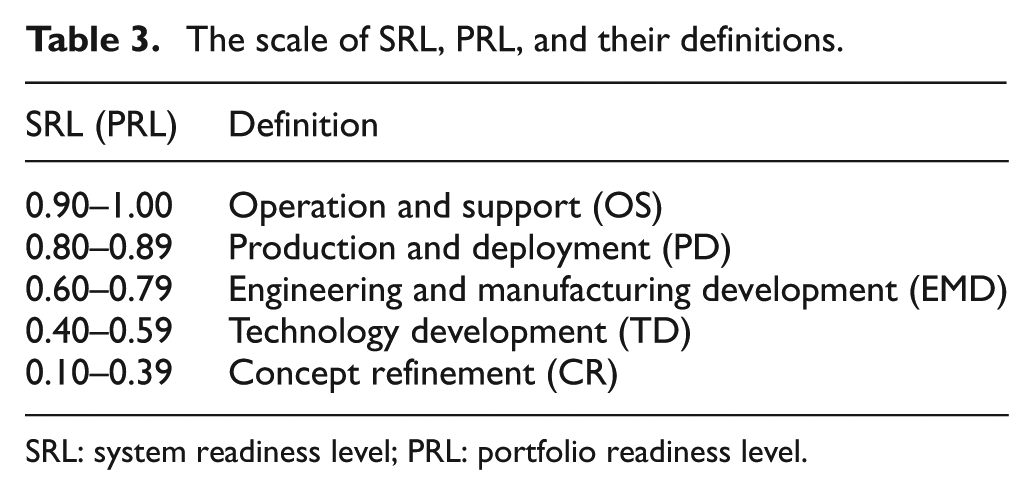
SRL: system readiness level; PRL: portfolio readiness level.
Two-level RPMs via SSL and PSL
In this section, a two-level requirement pulling measures (RPMs) is proposed to indicate the overall satisfaction level of the system with multi-capability requirements, with two components: SSL and PSL. Presented first are the definitions of SSL and the procedure to obtain an SSL from expert opinions on system pairwise comparisons. Second, the PSL is defined and three integration models are proposed, corresponding to three different decision-making attitudes. Through the two-level RPMs, the satisfaction of a system portfolio with a certain capability can be acquired to indicate its value from a requirement pull perspective.
Since the SSL is a measure corresponding to a system and a certain capability, its expression is given as a function with two parameters. PSL is proposed in the same way.
Definition 4
The capability requirement is an expected result of the systems portfolio to execute a series of future tasks. Therefore,
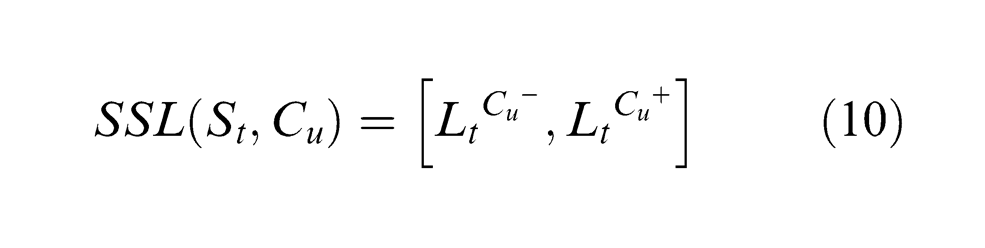
where the upper and lower bounds of
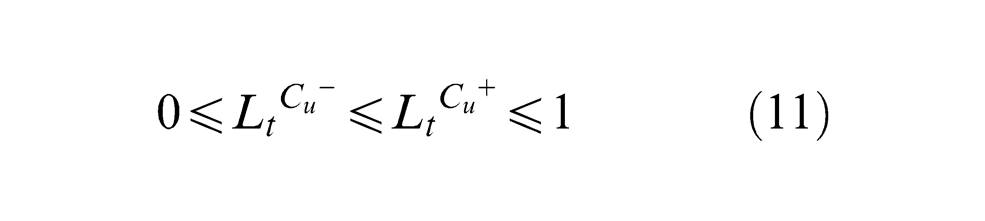
It is clear that
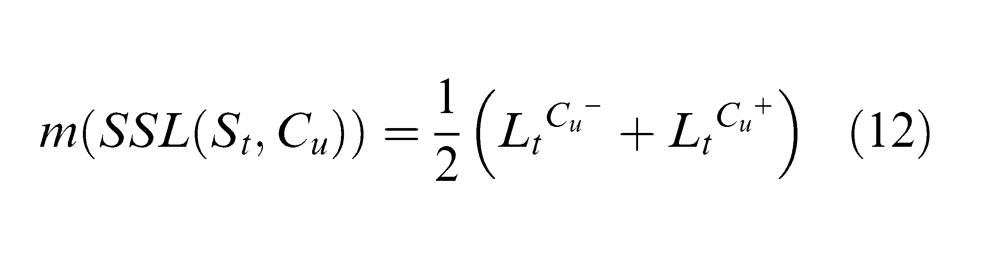
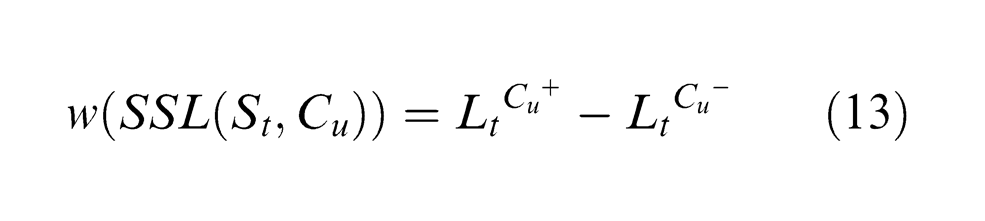
For all the k systems, there are interval probability sets containing k elements
Definition 5
For
Theorem 1
The interval set
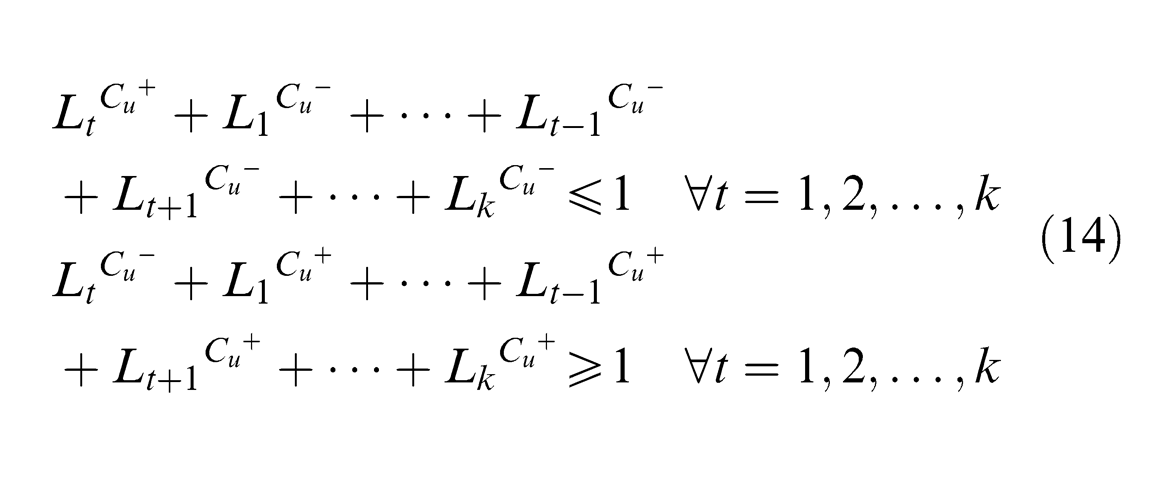
See Appendix 1 for the proof.
Definition 6
The first-ignorance of
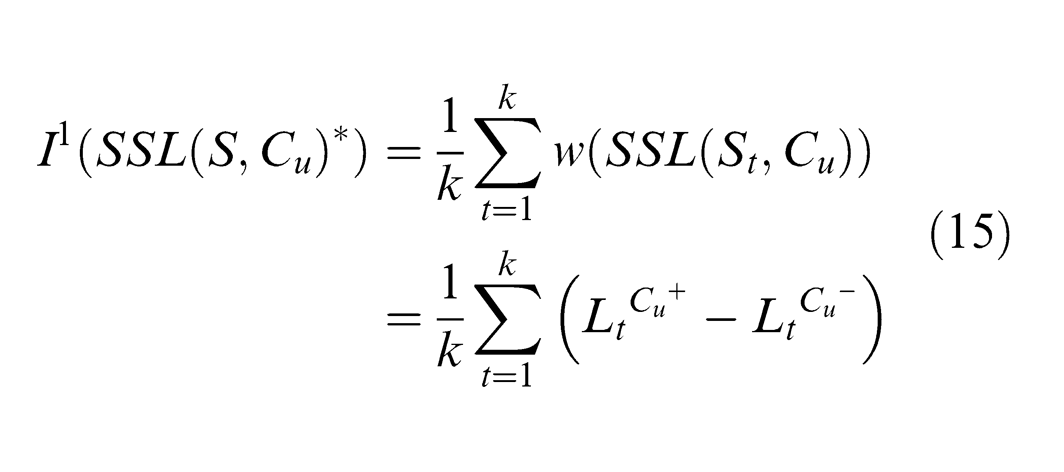
Similar definitions and theorems have been used in the literature39,40 as the constraints and operations of the interval probability.
When there is little information available for the experts to predict
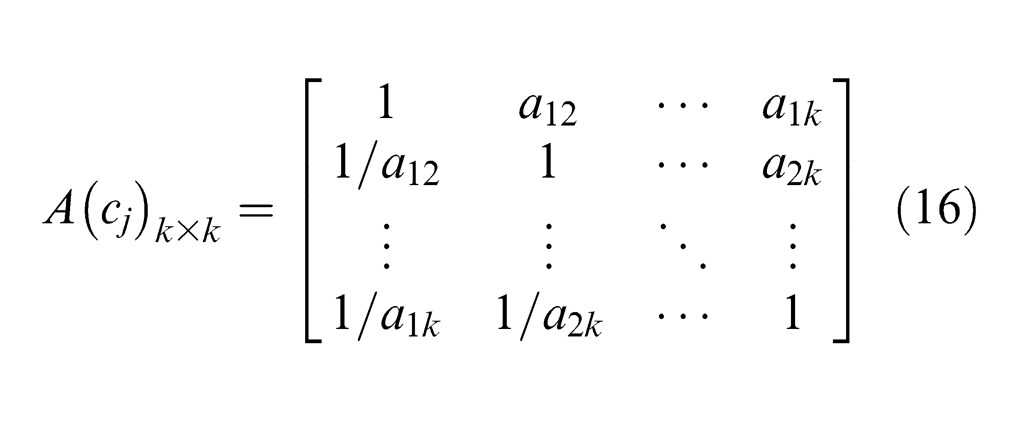
Considering the pairwise comparison process for each pair of candidate systems in a finite set
As shown in Figure 3, an axis for ath with a number 1–9 depicts the possible judgment scores from experts. ath = 1 represents that St and Sh have the same possibility to satisfy a certain capability requirement, ath = 3 indicates that St is fairly more likely to satisfy a certain capability requirement than Sh, ath = 5 means that St is a little more likely to satisfy a certain capability requirement than Sh, ath = 7 denotes that St is much more likely to satisfy a certain capability requirement than Sh, and when ath = 9, St is most likely to satisfy a certain capability requirement. The other numbers, that is, 2, 4, 6, and 8 are used analogically. Additionally, an assumption must be noted to explain the relationship between ath and aht.
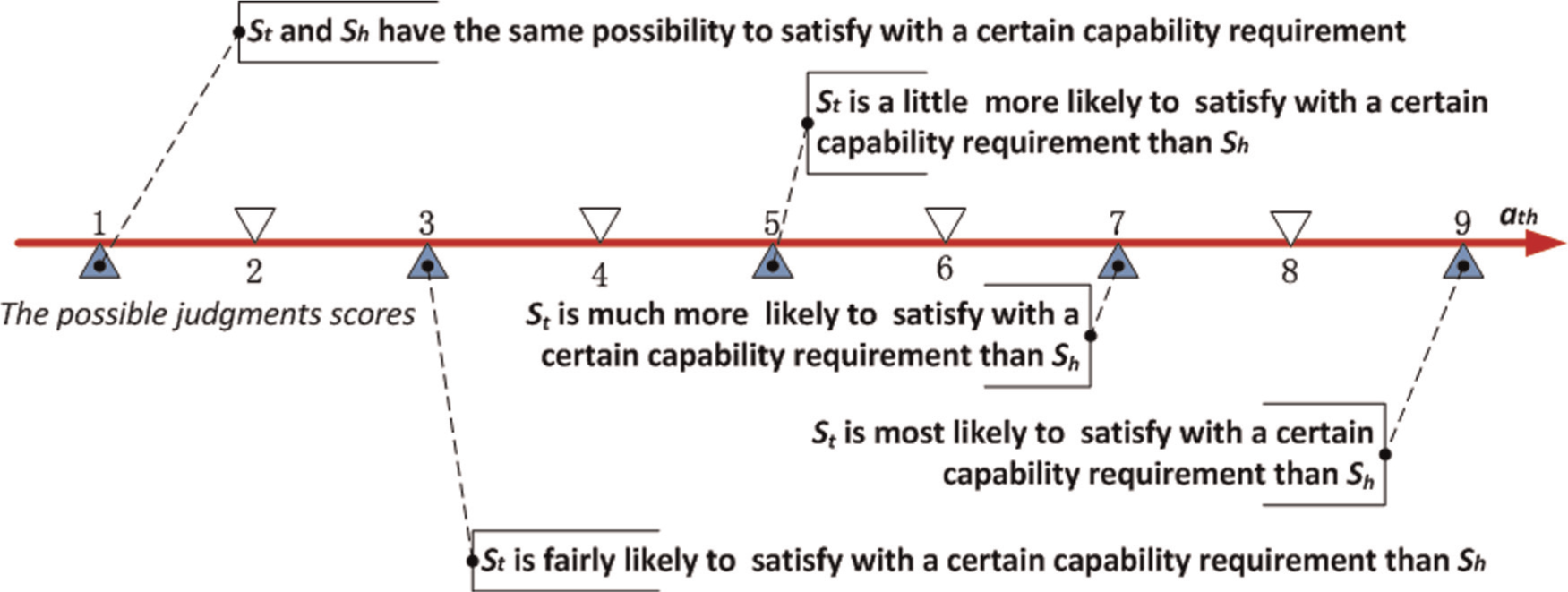
The possible judgment score axes and the explanations of the scores.
Assumption 1
The comparison results ath and aht hold the condition ath*aht = 1.
This means that when an expert makes a comparison, it is not possible that in the first comparison St will be more likely to satisfy a certain capability requirement than Sh, but in the second comparison, Sh and St have the same possibility to satisfy a certain capability requirement.
Next, we have a
Assumption 2
Even if there are multiple experts, there is only one
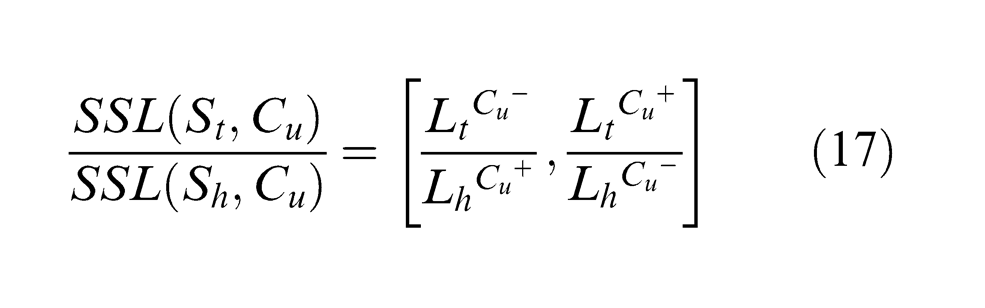
The interval ratio
Assumption 331,44,45,48
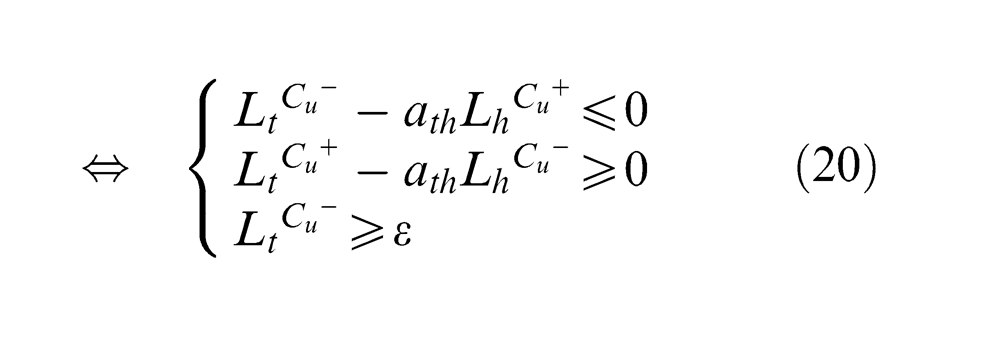
The given pairwise comparison ath should belong to the estimated interval ratio
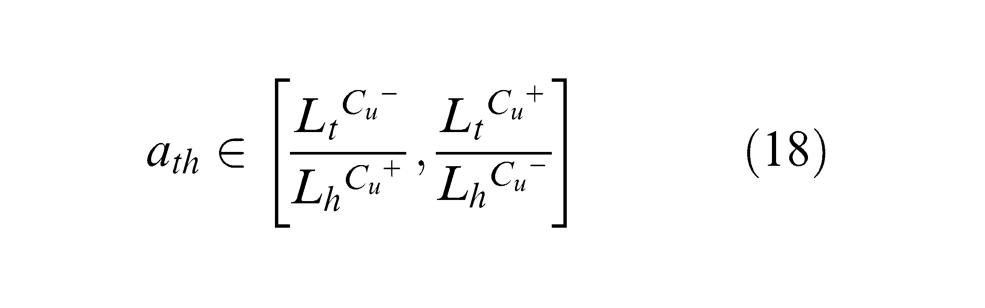
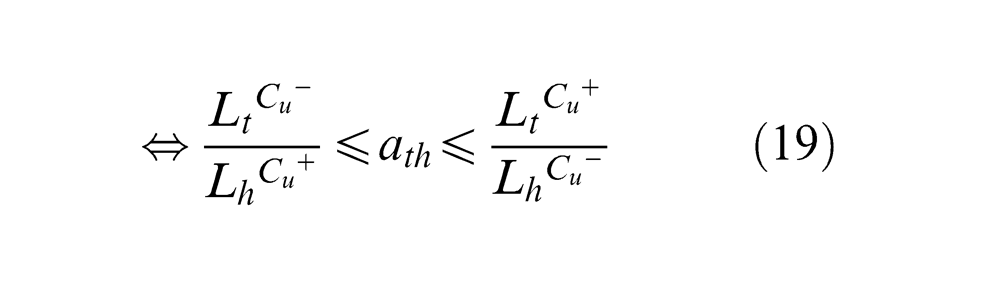
where
To determine the interval set
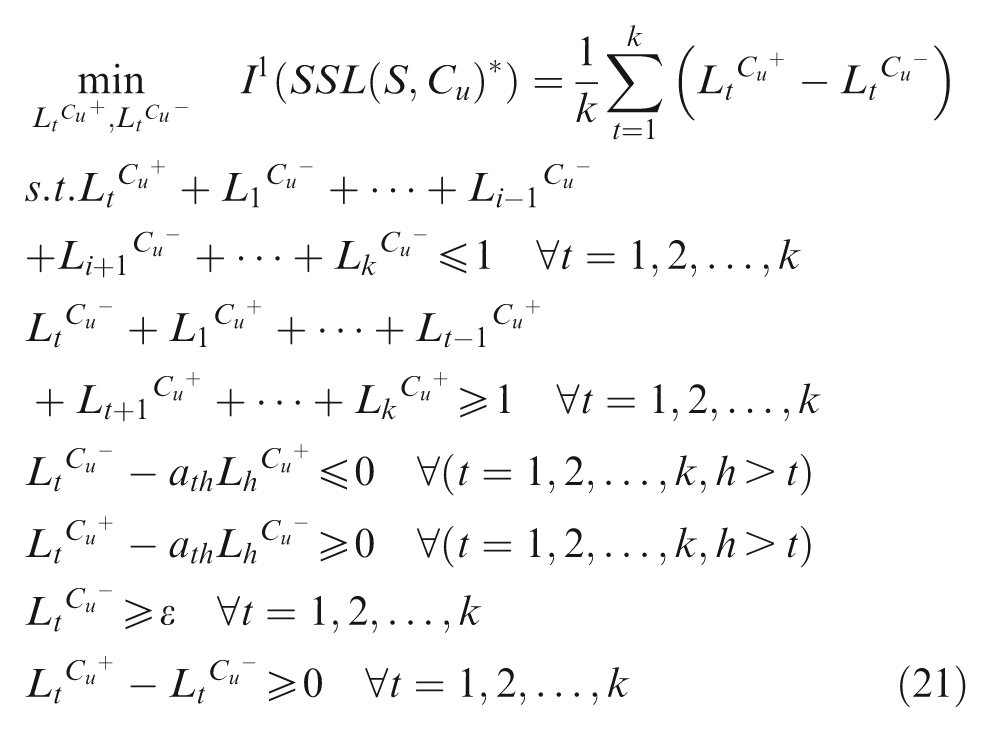
Definition 7
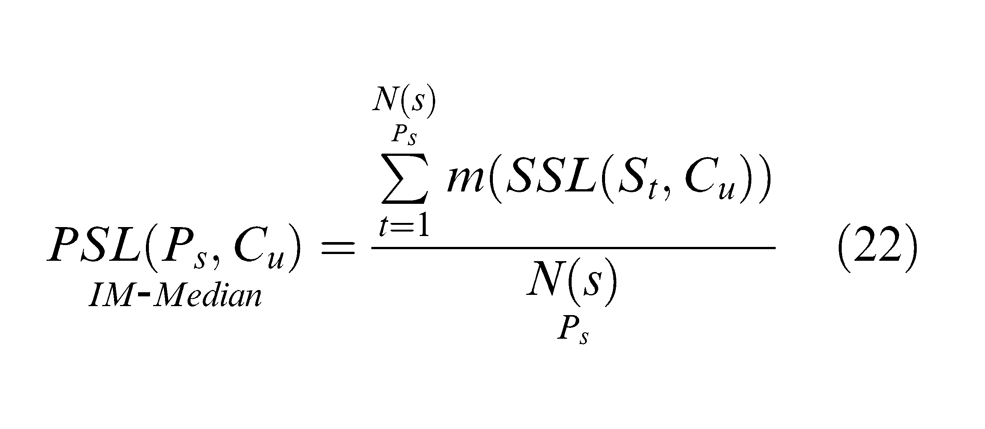
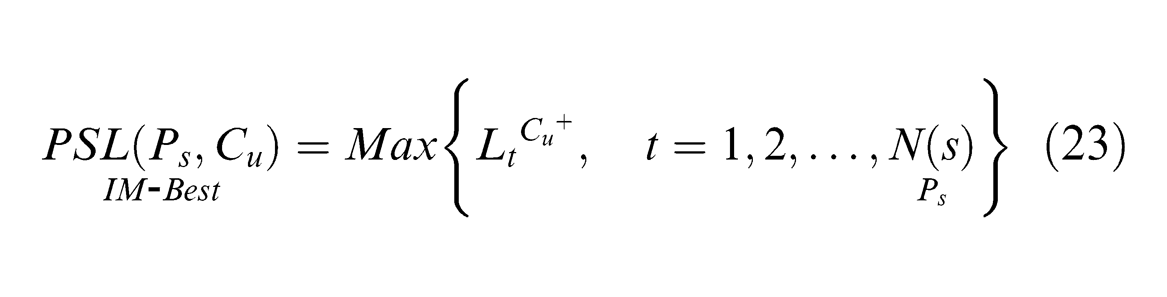
The PSL,
[IM-Median Model]
[IM-Best Model]
[IM-Worst Model]
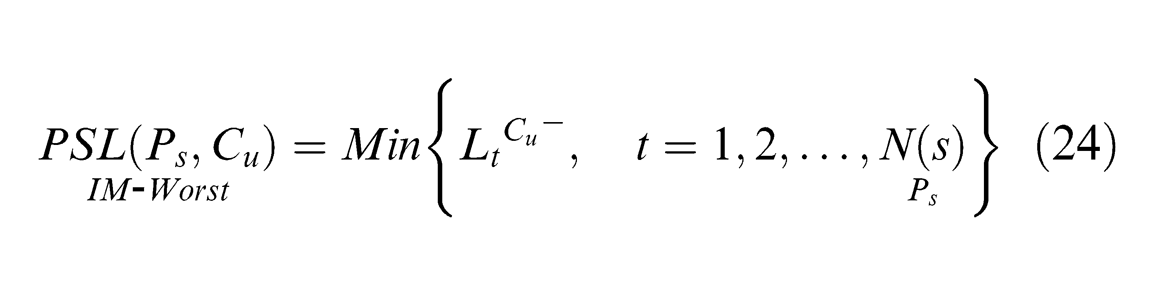
where
In fact, equations (23) and (24) define the upper and lower bounds of a
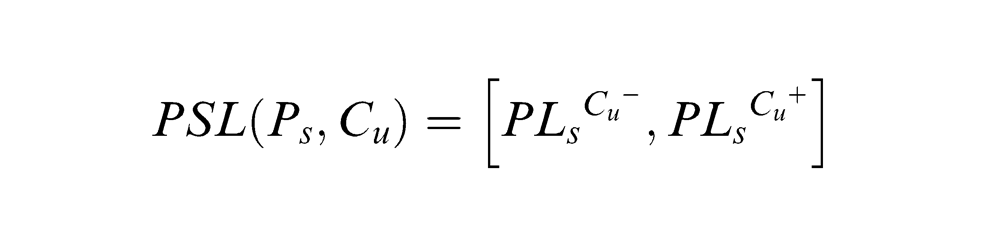
where the upper and lower bounds,
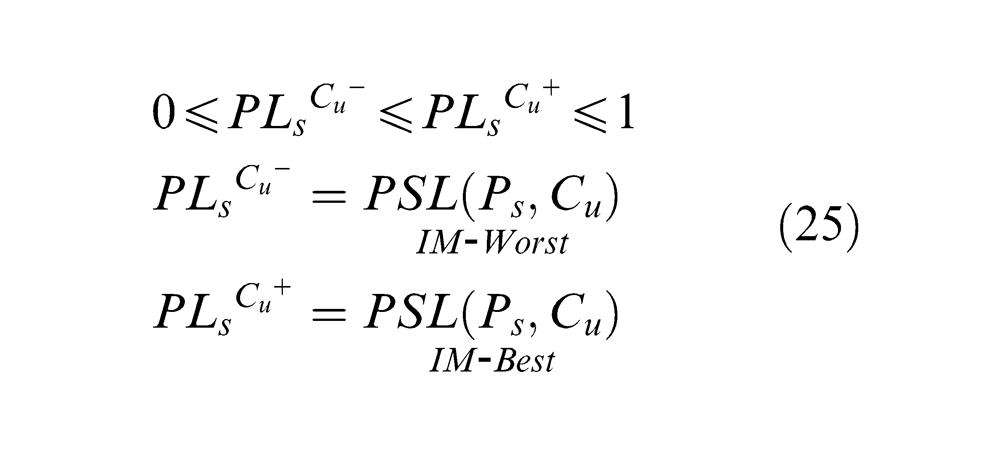
WSPS problem solving based on multi-objective programming
In this section, the WSPS problem is solved through the use of a multi-objective integer programming model. First, the constraint assumptions are given and a set of feasible portfolios are generated. The dominance structure is then defined in order to identify which weapon system portfolios are T&R portfolios (non-dominated). Finally, multi-objective integer programming is conducted to obtain the T&R portfolios.
Constraint assumptions and feasible portfolios
Another important component in the TPRP model is concerned with addressing the constraints of the weapon system portfolio during the acquisition and manufacturing process, which can be used to generate a set of feasible system portfolios from candidate weapon systems. Generally, a portfolio,
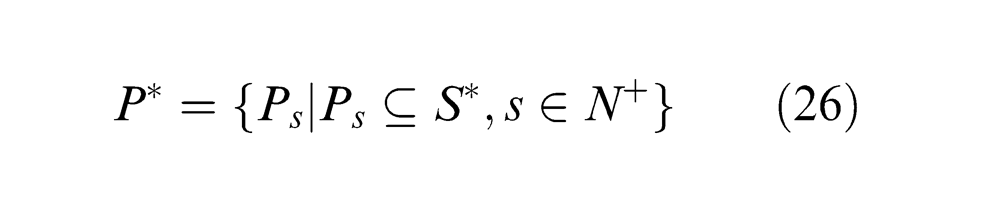
The set of feasible portfolios
Therefore, a weapon system portfolio is feasible if its cost does not exceed the specified budget constraints and the portfolio can completely satisfy
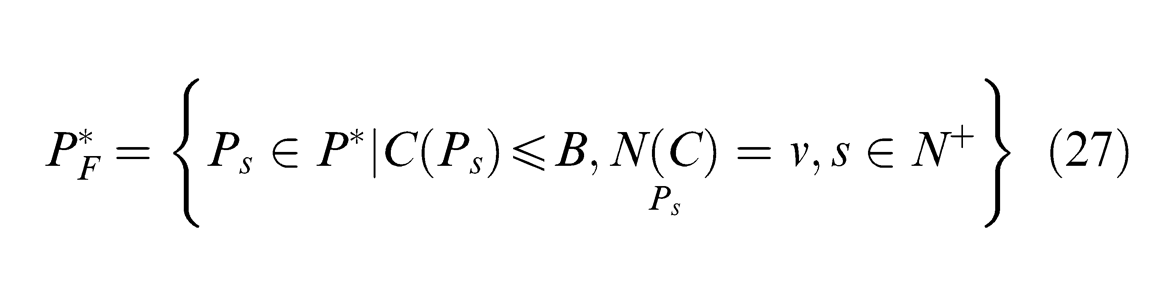
where the matrices
Dominance structure
Generally, dominated portfolios may be discarded from the candidate portfolios, retaining only the non-dominated ones, which are referred to, in this study, as T&R system portfolios. To identify the relationship between a pair of system portfolios, three relative definitions are given to determine the whole set of T&R portfolios.
Definition 8
Define the relationship
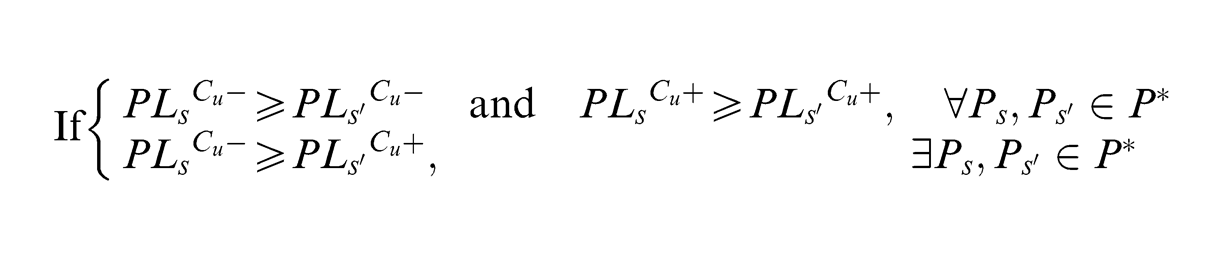
then we can say
Definition 9
Let
Definition 1017,18,46
A feasible
Computation of T&R portfolios
The generation of a single T&R weapon system portfolio is easily realized through maximizing the measures of the system portfolio, subject to the given capability requirement and cost constraints. However, the computation of all the T&R portfolios is complex and time-consuming process in which the

Therefore, a portfolio,
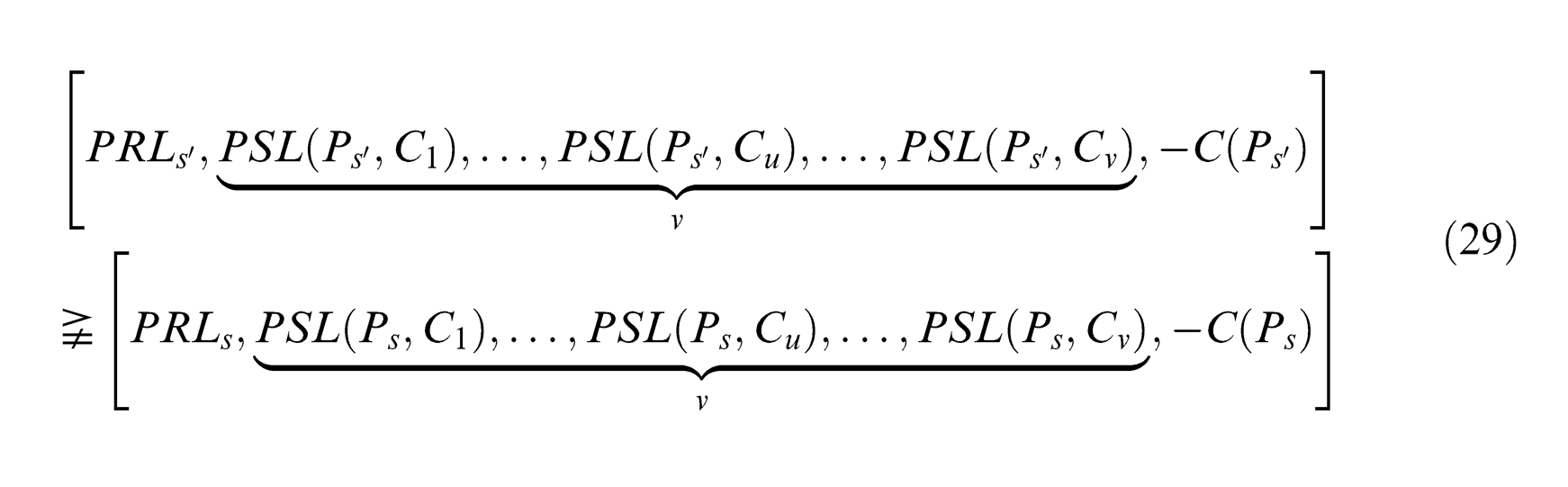
where the relationship ≩ between the two vectors is consistent with the dominance structure given by Definition 9 and Definition 10. Equation (29) can be used to ascertain the T&R portfolio through pairwise comparisons between any pair of weapon system portfolios. The algorithm is given as follows, based on a sorting strategy to construct a T&R portfolio set: 17
Step 1: assume that the number of the feasible portfolios in
Step 2: the initialization of the T&R portfolios set, s.
Step 3: the iterations are carried out through all the portfolios
While
The index s increases to s + 1.
If
Set
Step 4: set
The algorithm reduces the number of pairwise comparisons by sorting the feasible portfolios in descending order with regard to their cost. It is worth noting that the algorithm used in this study is a bit different from those commonly found in the literature. 17 We use a feasible portfolio set as the initial solution space, instead of the entire possible portfolio. This difference makes the algorithm work more efficiently by reducing the number of pairwise comparisons.
An illustrative case study
Case overview
Candidate weapon system description: based on the scenario carried out by Kangaspunta et al., 17 the illustrative example, which is adopted from the case examined in Sauser et al. 22 and Tan et al. 24 to show the SRL approach, demonstrates the application of the proposed TPRP model for WSPS. The goal of the case study is to analyse and assess which of various combinations of indirect fire systems would make the optimal T&R portfolios by supporting the future mechanized infantry forces to fulfil a series of capabilities.
More specifically, the candidate weapon systems indexed by
In total, the technologies and their integrations contained in 10 candidate weapon systems are put together to form a candidate weapon systems diagram using a technological perspective. As shown in Figure 4, there are 20 technologies and 21 integrations in 10 separate weapon systems.
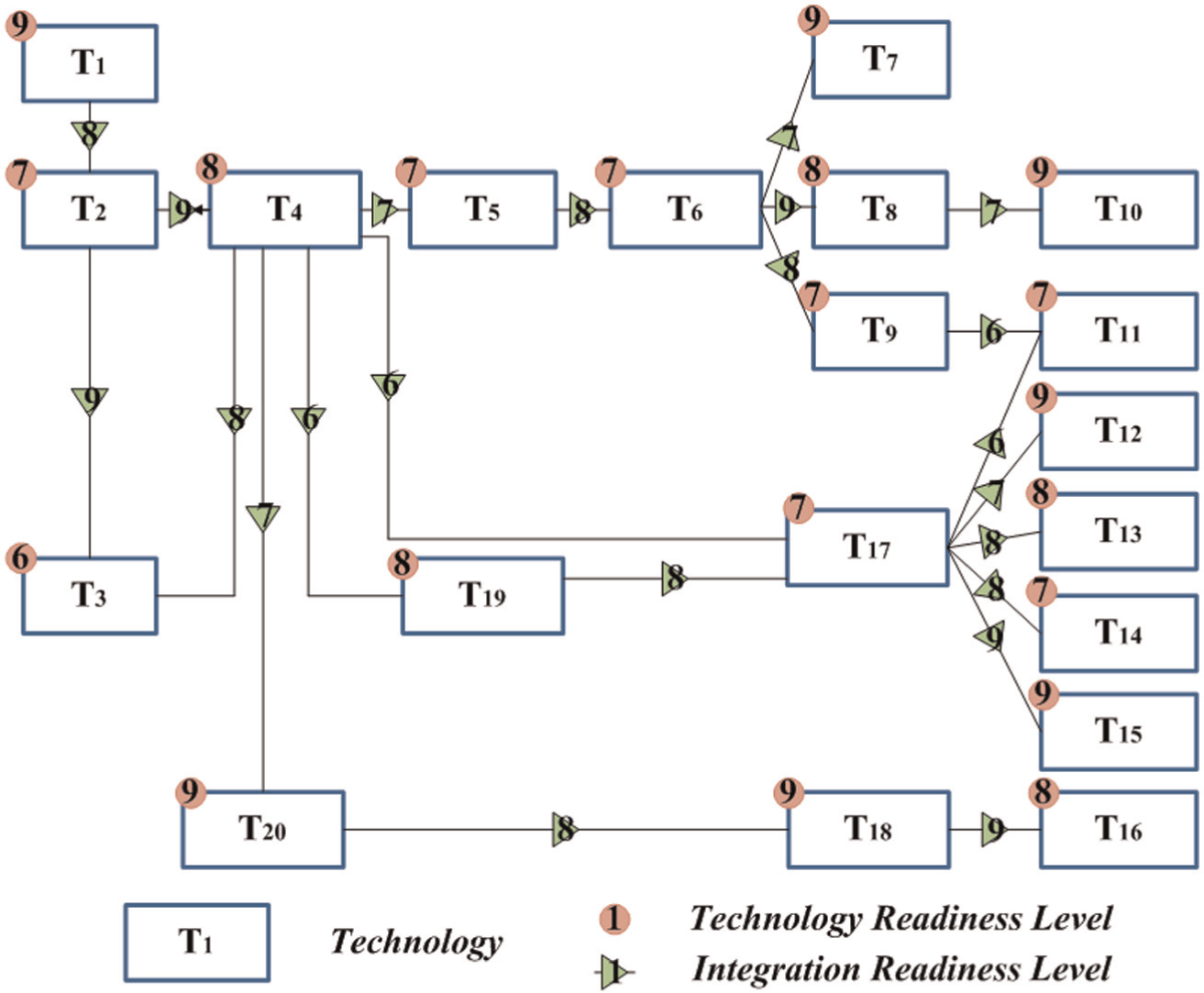
Candidate weapon systems diagram with a technological perspective.
2. Constraint assumption: the TPRP model considers both the manufacturing cost and the required capabilities as constraints of the feasible portfolios. Therefore, with regard to the first constraint, Tables 4 and 5 show the cost for maturing the technologies and their integrations. It is worth noting that most of the original levels of every technology and integration given by Tan et al. 24 are so low that the systems and portfolio cost very little, which leads to an effective reduction in the manufacturing cost constraints and a lower weapon system portfolio maturity level. Therefore, we adopt the TRL and IRL of every technology and integration with an increase of 1 in Figure 4.
The cost for TRL upgrade.
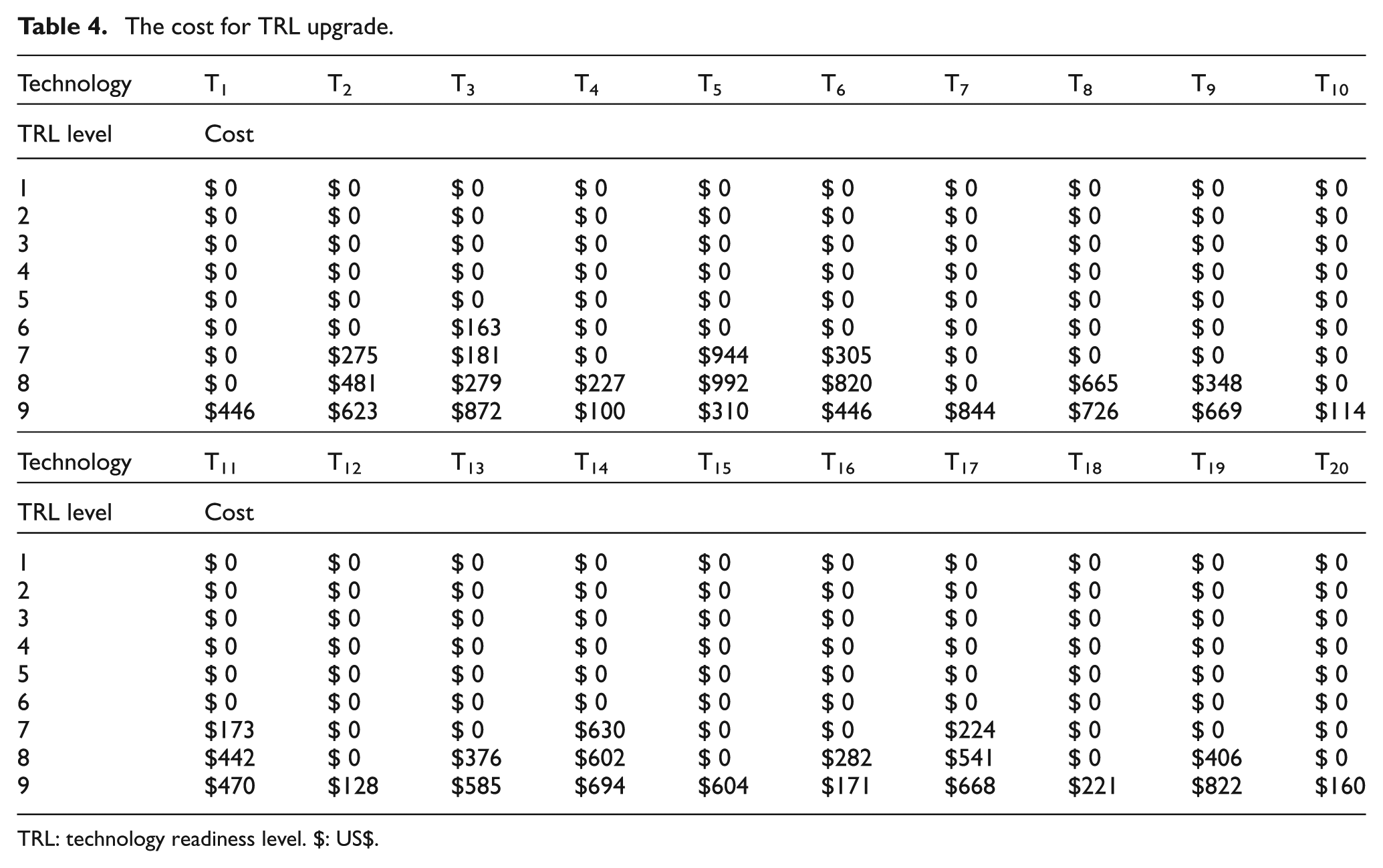
TRL: technology readiness level. $: US$.
The cost for IRL upgrade.
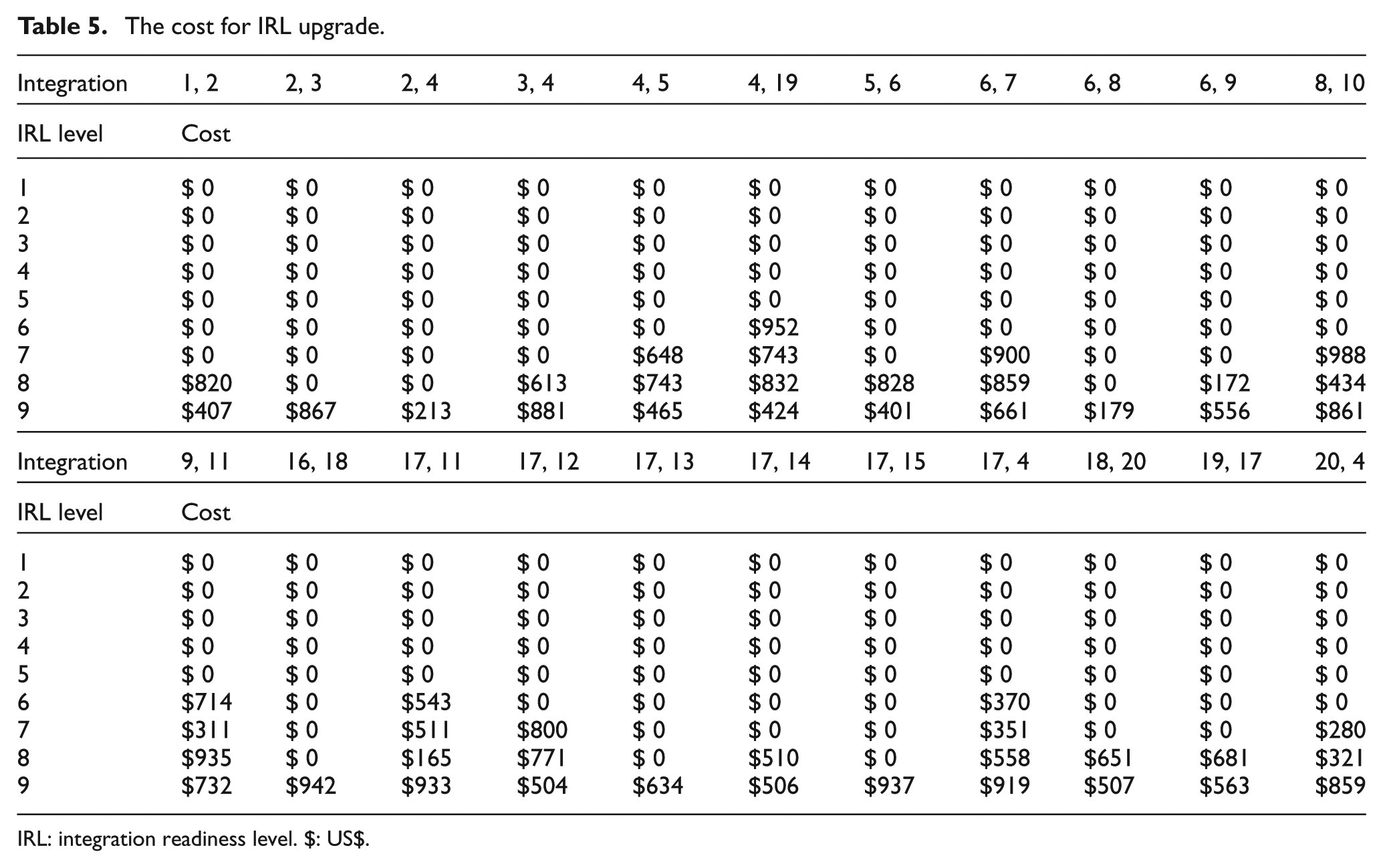
IRL: integration readiness level. $: US$.
As shown in Tables 4 and 5, the cost is given in thousands of dollars (e.g. US$1000). Taking the costs of technology 2, technology 3, and their integrations as an example, it will take US$623,000 and US$872,000 for the upgrade of technologies 2 and 3, respectively, from levels 5 to 9, but US$867,000 is required for their integration.
With regard to the capability requirement constraint, the weapon system portfolio should meet the four capability requirements in future operations. The required capabilities, indexed by
3. Weapon system functions: as illustrated in the case study by Tan et al.,
35
only the shaded technologies and their corresponding integrations are taken into account in evaluating the maturity of the corresponding capability of a function. According to Definition 2 in this study, the emerging capabilities are the results of system functions, rather than the causes. Hence, we adopted Tan’s definition of function and its corresponding capability in the candidate weapon system diagram for the technological perspective. The shaded technologies and their corresponding integrations are considered when evaluating the maturity of the corresponding function of a weapon system. A simple illustration of
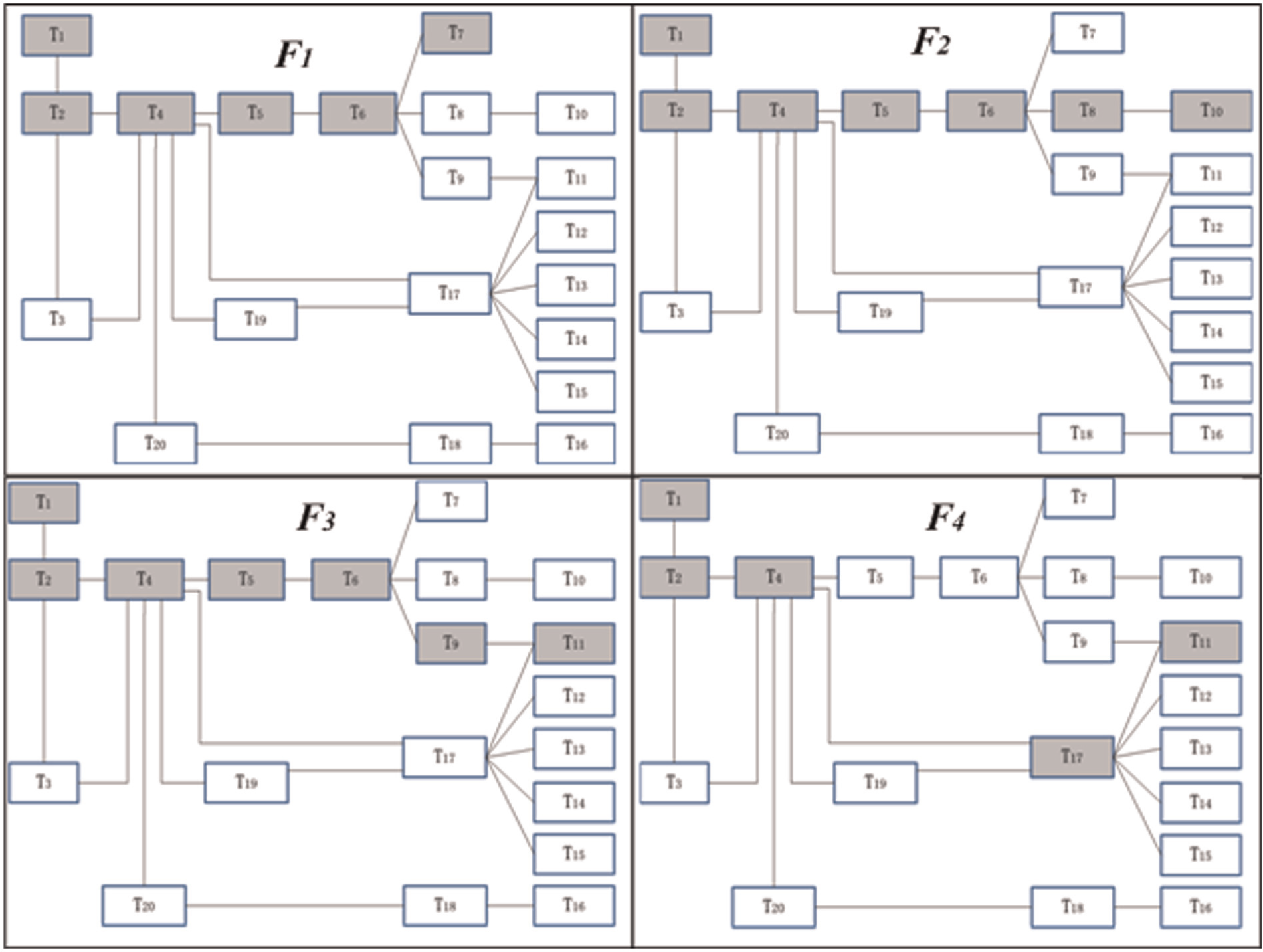
A simple illustration of the functions.
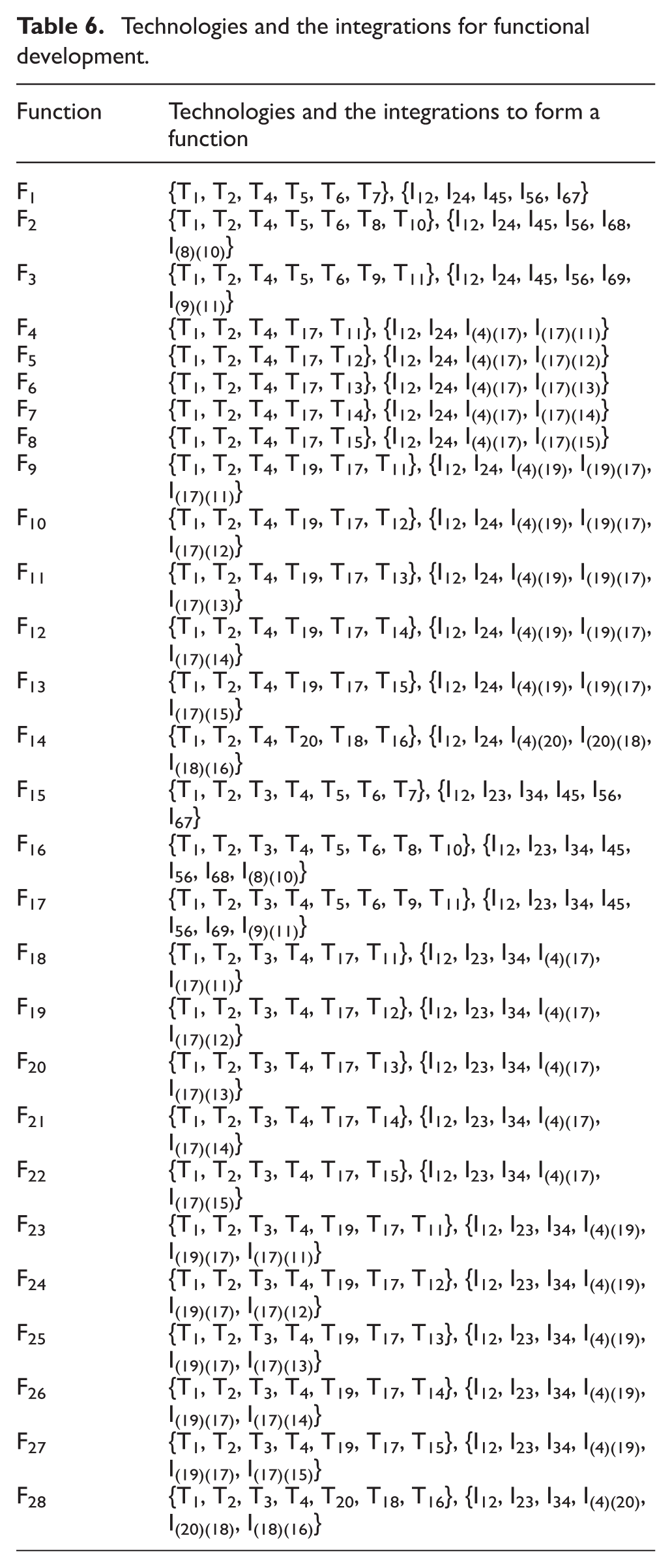
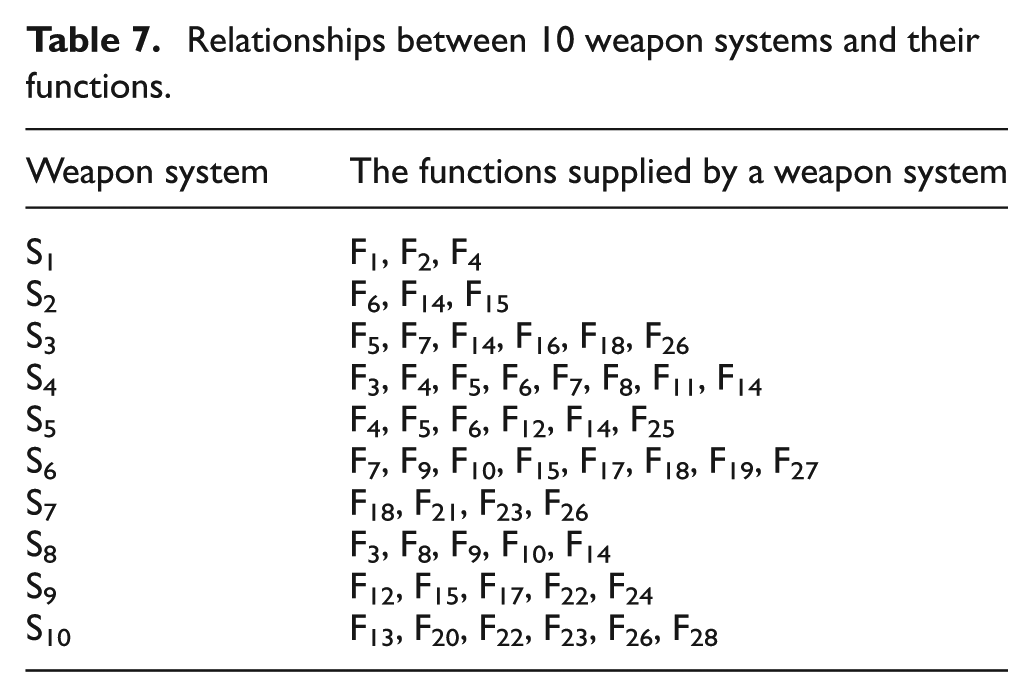
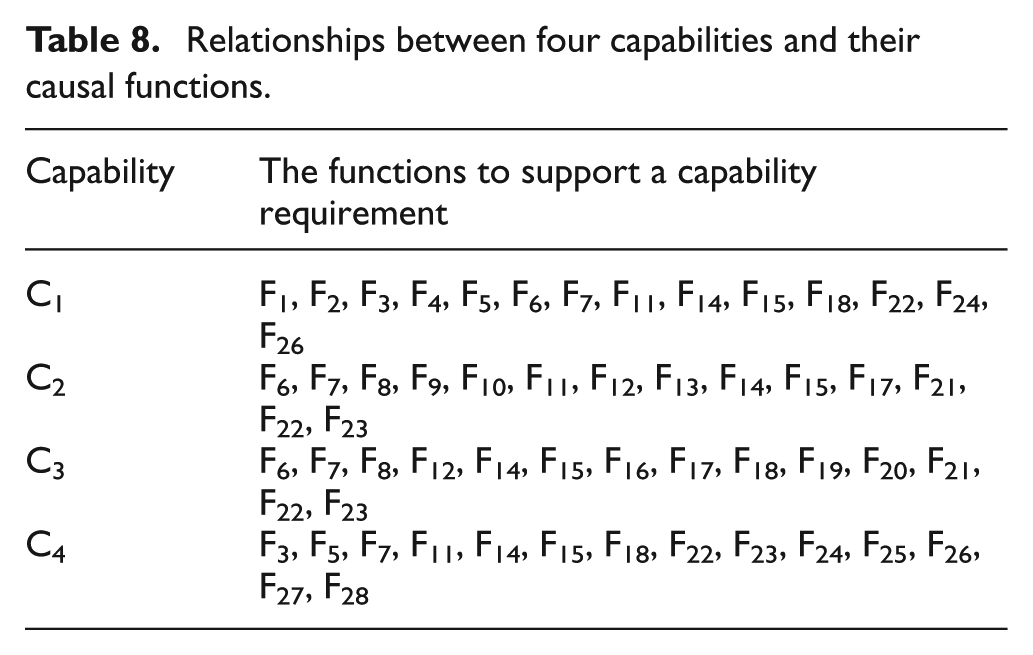
As depicted in Table 6, there are 28 functions, formed by the 20 technologies and their integrations, by the terms of our definition. The 10 weapon systems supplying 28 functions can satisfy four of the capability requirements. The functions supplied by each weapon system are shown in Table 7, and the relationships between the four capabilities and their causal functions are shown in Table 8. For example, the development of function F4 requires technology {T1, T2, T4, T17, T11} and the integrations among them {I12, I24, I(4)(17), I(17)(11)}. I12 represents the integration between T1 and T2, while I(17)(11) represents that between T17 and T11. The weapon systems that possess the function F4 are S1, S4, and S5. However, only capability C1 can be obtained through the function F4.
4.
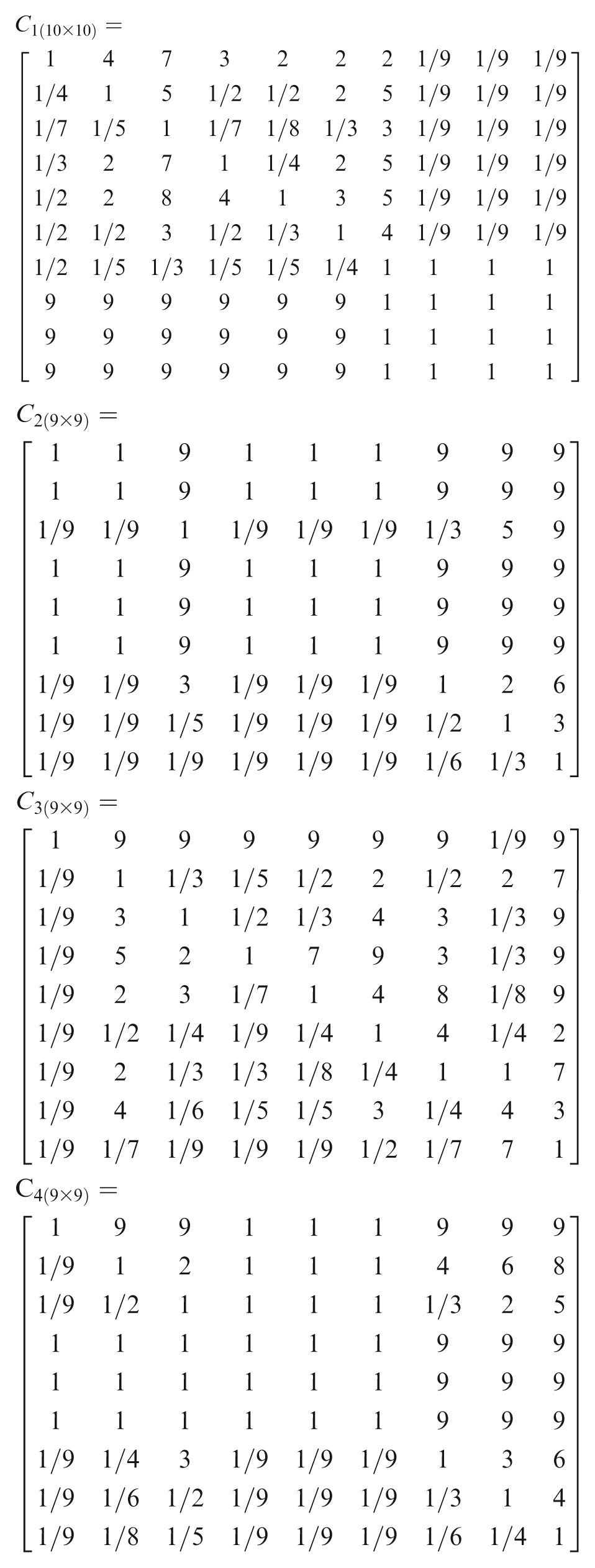
For example, as shown in C1(10×10), the experts believe that system S1 is significantly more likely to satisfy capability C1 requirements than S3, and more likely than S4. However, when compared with S8, S9, and S10, it is least likely to satisfy the capability C1 requirements.
Technologies and the integrations for functional development.
Relationships between 10 weapon systems and their functions.
Relationships between four capabilities and their causal functions.
T&R portfolio analysis
Based on the TPRP model, 55 T&R weapon system portfolios are selected from the 1022 feasible portfolios. It is easy to see that about 95% of feasible portfolios are discarded because at least one of the T&R weapon system portfolios is higher than those in the 95% on all the five measures:
The PRL values of all the T&R weapon system portfolios are shown in Figure 6, where the 55 T&R portfolios are marked in red. All the PRL values are dispersed in the interval
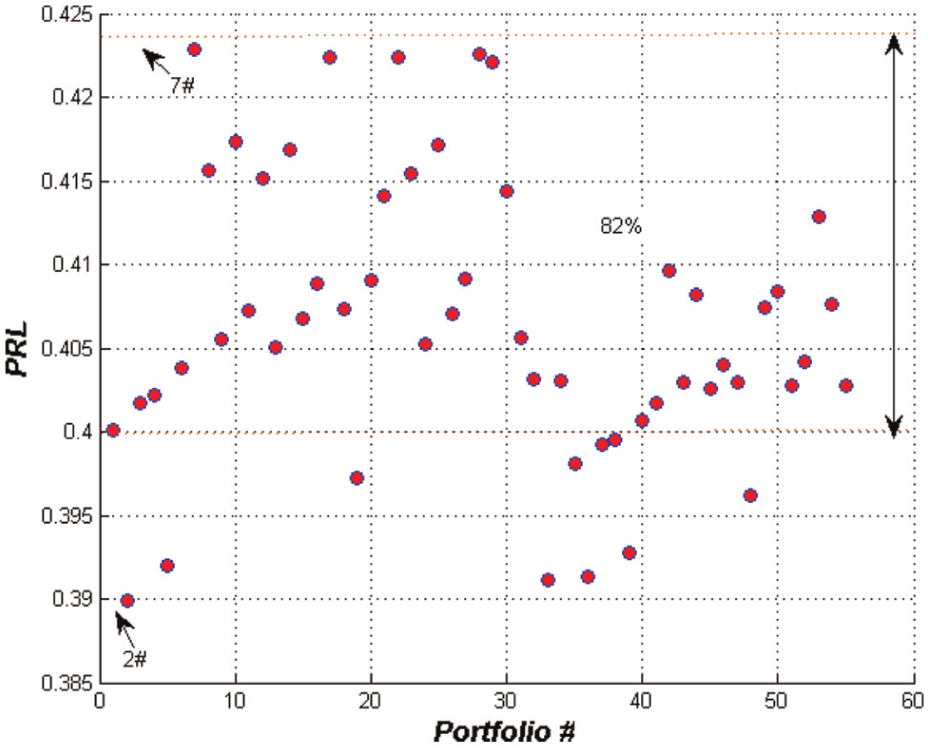
PRL of all the T&R weapon system portfolios.
Regarding the PRL boundary of all the T&R portfolios, portfolio P7 = {S5} ranks the highest and P2 = {S7, S9} ranks the lowest. Since there is only one system, S5, in portfolio P7, the PRL7 is completely determined by SRL5. Similarly, P2 comprises S7 and S9. SRL7 and SRL9 are so low, relatively, that their average stays at the bottom of the PRL value.
The CRL1–CRL4 values of the T&R system portfolios are illustrated in Figure 7 and can be easily sorted into two types, although the values generally fluctuate around 0.4. On the one hand, the CRL values for both the reconnaissance and intelligence capability (C1) and the action capability (C4) are almost equivalent among all the T&R system portfolios, with only a slight fluctuation. On the other hand, the CRL values of the orientation capability (C2) and the command and decision capability (C3) obviously vary in the T&R system portfolios, both showing a similar recurrent tendency towards change. Portfolio P7 has outstanding performances in CRL for all four capabilities. Next, portfolio P34 = {S1, S8}; the CRL34 ranks top in the orientation capability and in the command and decision capability. Meanwhile, portfolio P21 has a high readiness level in orientation capability because of its component systems S3 and S4.
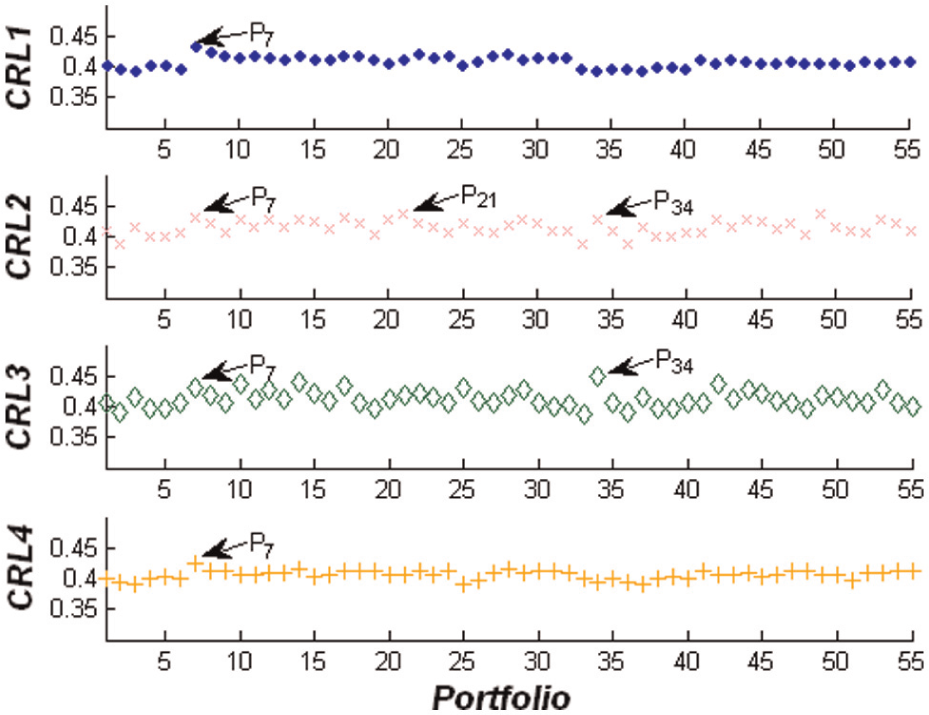
CRL 1, CRL2, CRL3, and CRL4 of all the T&R weapon system portfolios.
PSL(Ps, Cu) value for C1–C4 of all the T&R weapon system portfolios is shown in Figure 8. With regard to PSL(Ps, Cu) value in C1–C4, the maximum of the T&R portfolios is approximately 0.45 and the median values of PSL(Ps, Cu) in C1–C4 are almost 0.25. For instance, PSL(P7, Cu) values in C1–C4 have the point value 0.448, which is nearly the highest. Portfolio P27 = {S2, S6} and portfolio P28 = {S2, S5} have the same PSL(Ps, Cu) values in C1–C4, but the uncertainties of these values are vastly different. The values of PSL(Ps, C2) and PSL(Ps, C4) are exactly 0.25, but PSL(Ps, C3) ranges widely [0.05, 0.45]. Portfolio (P32 = {S2, S3, S6, S9}) has the lowest median value and the PSL(P33, Cu) values in C2–C4 are clear point values.
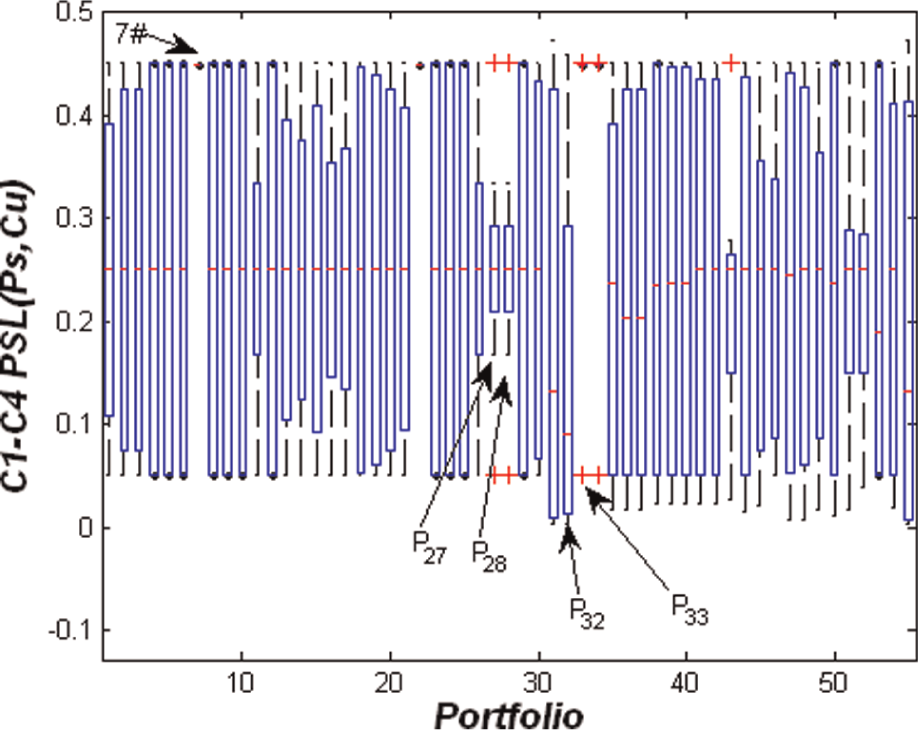
PSL(Ps, Cu) in C1–C4 of all the T&R weapon system portfolios.
Figure 9 shows the relationship between PSL(Ps, Cu) and CRLu in C1–C4 of all the T&R weapon system portfolios. Although the value of CRLu in C2–C4 increases from 0.38 to 0.44, the median values of PSL(Ps, Cu) in C2–C4, for the most part, stay at 0.25. Thus, if the values of the CRLu in C2–C4 do not thoroughly exceed the development phase, a slight increase cannot sufficiently improve the satisfaction level of the capability requirements. However, with the increased CRL1 value, the median value of PSL(Ps, C1) increases sharply from 0.125 to 0.45.
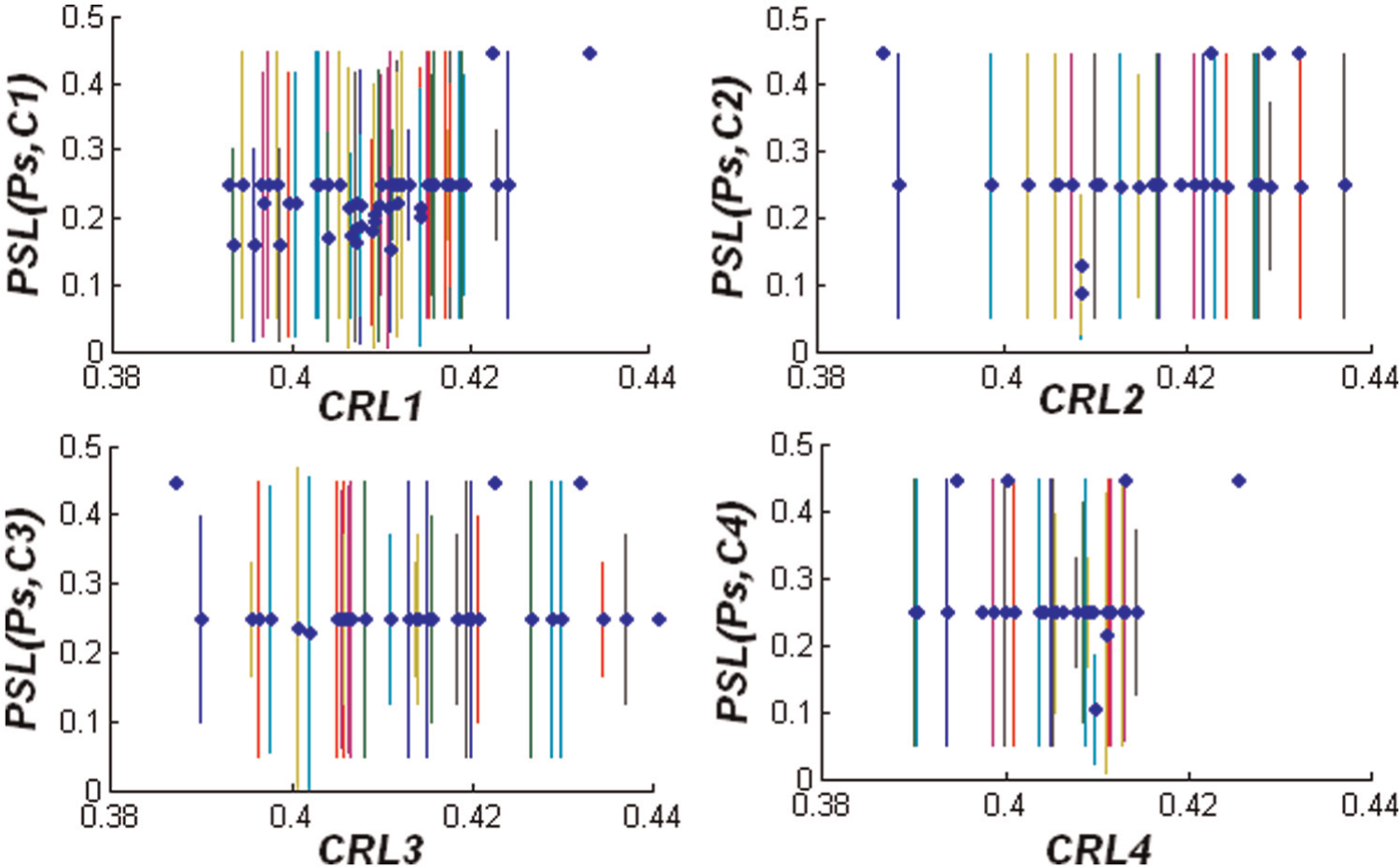
PSL(Ps, Cu) and CRLu in C1–C4 of all the T&R weapon system portfolios.
A majority of the cost values of all the T&R weapon system portfolios lie between approximately US$ 0.4 × 10⁸ and 1.0 × 10⁸, as shown in Figure 10. The developmental cost of portfolio P32 = {S2, S3, S6, S9} ranks the highest, with US$126,700,000, and portfolio P22 = {S2} ranks at the bottom, with US$16,270,000; meanwhile, portfolio P7 = {S5} has a relatively low cost value, with US$27,252,000.
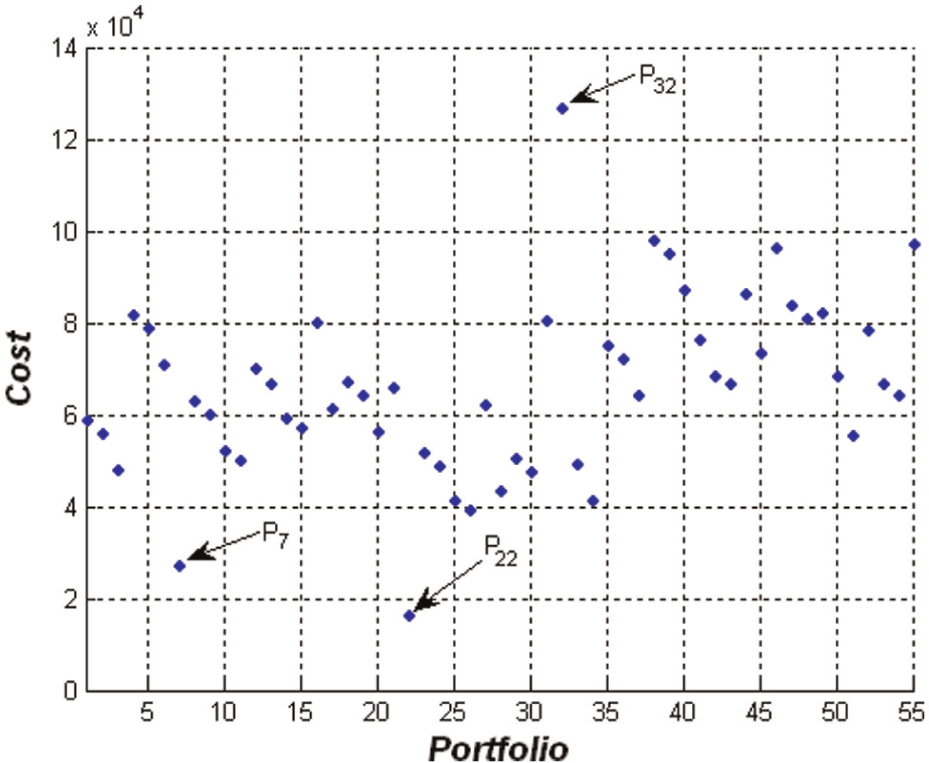
Cost of all the T&R weapon system portfolios.
The values of CRLu and PSL(Ps, Cu) in C1–C4, with the increase in cost consumption, are shown in Figures 11 and 12, respectively. Overall, the influence of the increasing cost consumption from US$16,270,000 to US$126,700,000 by the improvement of CRLu and PSL(Ps, Cu) is inconspicuous. In Figure 12, some values of PSL(Ps, Cu) in C1–C4 even decrease with an increasing cost consumption, from US$16,270,000 to US$39,340,000. Therefore, it is easy to see that inefficient investments and unwise allocations cannot match up with the capability requirements. Instead, it leads to a decrease in the weapon system PSL.
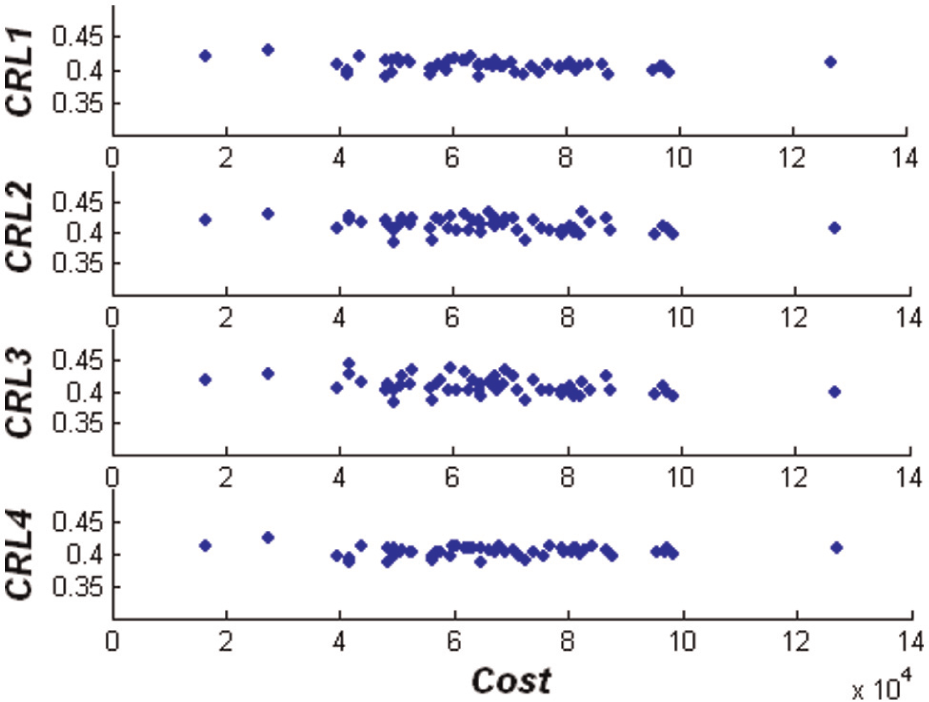
The CRLu values in C1–C4 with the increase in cost consumption.
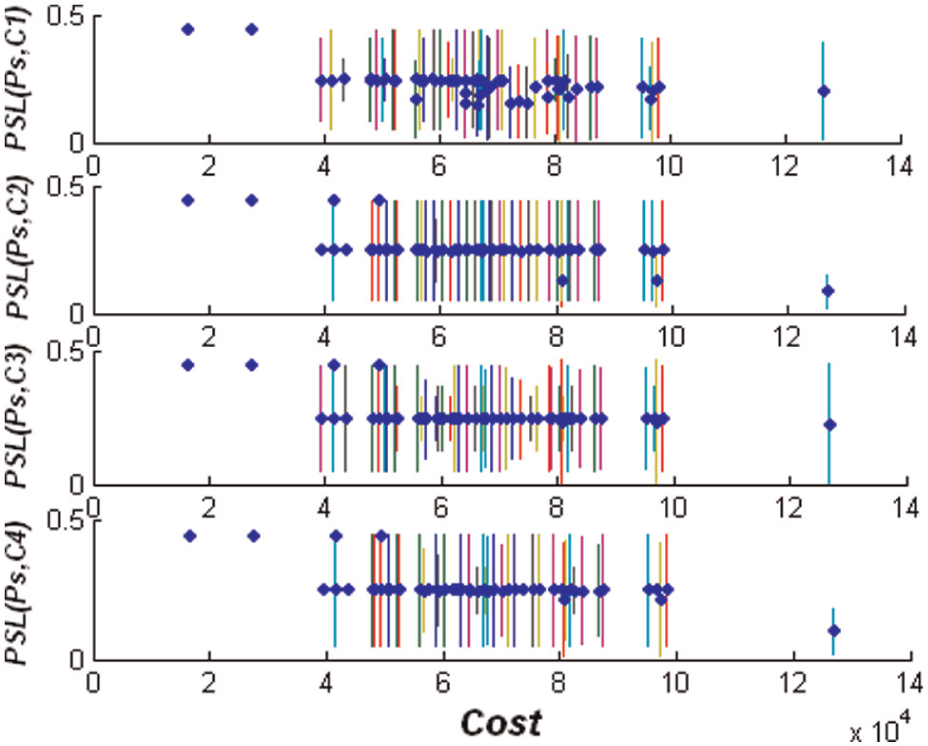
The PSL(Ps, Cu) values in C1–C4 with the increase in cost consumption.
Discussion
The TPRP model focuses on the effects of technology push and requirement pull when DMs determine whether or not a weapon system portfolio should be reserved or discarded during the defence acquisition and manufacturing process. With an illustrative example in a combat scenario, 55 combinations of indirect fire systems were selected and evaluated, to identify the best among them (T&R portfolios) in supporting the mechanized infantry forces to fulfil a series of capabilities: reconnaissance and intelligence, orientation, command and decision, and action capabilities. Some highlighted results of this case study can be summarized as follows:
Effect of key technologies and integration push: the additive value model is used universally in the definitions of FRL, SRL, CRL, and PRL, which leads to average results for these variables. However, the multiplicative operation between TRL and IRL influences the FRL with a germination effect, especially for some key technologies and integrations. For example, T2 appears in the technology sets of all the functions and, caused by its relatively low TRL value (TRL2 = 7), the FRL of all the functions cannot rank high. Besides, there are some other key technologies and integrations with low readiness levels, as shown in Figure 5, such as T6 = 7, T17 = 7, I4(17) = 6, and I4(19) = 6. Therefore, even if most of the TRL and IRL values are above 6 after our modification to the original data, the SRL and PRL of the T&R weapon system portfolios are still relatively low because of the key technologies and integration push effect.
Effect of capability requirement pull: the four capability requirements assumed in this study are independent of each other and are of equal importance. These four requirements (reconnaissance and intelligence, orientation, command and decision, and action capabilities) are the constituent abilities that cannot be absent in a standard operation procedure. Therefore, we do not integrate the four capabilities into a single entity. However, the independence of all the capability requirements is common in the practical analysis and utilization. Moreover, with the increasing number of requirements, the aggregation of the capability requirement is becoming more necessary. Generally, it can be proven that the four capability requirement measures used in this study are stricter than the one capability requirement measure, gained by aggregation. Therefore, the effect of the capability requirement pull in the case study is comparatively successful.
Role of the capability number constraint: the number of the feasible indirect fire system portfolios is almost equivalent to that of the possible portfolios; however, as a distinctive component of the TPRP model, the capability number constraint is still valuable and significant in practical utilization. Once the capability requirements are ascertained, it is easy for experts to discard any worthless weapon system portfolios with fragmentary inherent functions. Because of the wide application of multiple functions weapon systems in this case study, systems may even have eight functions, as is the case in S6 and S4. These weapon system portfolios easily provide complete functionality and satisfy the four capability requirements. Therefore, the role of the capability-complete constraint is not completely considered.
Role of the cost constraint: in the case study, once a technology or integration appears in a function, a certain manufacturing cost is produced. The cost is accelerated in a system through the combination of several component functions; the cost of a portfolio is the same throughout the gathering of its component systems. Since technologies and integrations are treated equally, the cost of one system does not have precedence over another. In fact, with regard to cost consumption, the allocation programming and control of available costs are of great importance in many fields. As a result, even if the cost level increases, there is a clear decrease in the PSL(Ps, Cu) values in C1–C4, as shown in Figure 12. Therefore, avoiding inefficient cost allocation is very necessary in WSPS.
Conclusion
The TPRP model for WSPS accounts for the inherent value of weapon system portfolios from the technology push and requirement pull perspectives in defence acquisition and manufacturing. It explicitly notes that the ‘value’ of a system is not only related to its availability but also to its capability. In other words, value is achieved when the component technologies of the system are maturely developed and integrated with each other, as well as when the system can meet with multiple capability requirements. In terms of design, the TPRP model provides a reasonable and comprehensive approach to carrying out the selection of weapon systems. The developmental maturity level of a technology, function, system, capability, or portfolio is captured by five-level TPMs, based on an additive multi-criterion model. The requirement satisfaction level of a system or portfolio is obtained by two-level RPMs, based on a linear programming optimization and first-ignorance model founded on expert opinions on pairwise comparisons. In addition to the T&R system portfolios, the TPRP model also shows the PRL, PSL, and the costs of all the T&R system portfolios, as well as how these variables influence each other.
Although the portfolio value structure modelling and multi-objective integer programming are complex and time-consuming, the TPRP model offers several advantages. First, it emphasizes the innovative outlook that the current developmental state of component technologies and integrations strongly influence whether a weapon system portfolio should be reserved or discarded, and whether it can satisfy the focal military capability requirement. Second, the number of multi-capability requirements is considered a fundamental constraint of the weapon system portfolio in a standard operational procedure. It directly reduces the scale of the set of feasible portfolios at the beginning of the computation of the T&R portfolio. Finally, the TPRP model accommodates an uncertain satisfaction level with the interval probability elicited from expert opinions, which is significant and valuable in practical decision-making.
Improvements can be made for future studies in the following ways. First, more attention should be given to the universal application of the additive model in the definitions of FRL, SRL, CRL, and PRL, and the aggregation model can be more flexible and innovative. Second, we will investigate the different weights of each capability requirement on how to influence the final T&R system portfolio set. Finally, the set of the T&R system portfolios is obtained by pairwise comparisons between portfolios; thus, it is necessary to persevere to reduce the solution time of the dynamic programming algorithms and improve quality.
Footnotes
Appendix 1
Acknowledgements
We are grateful to the anonymous reviewers for their valuable comments and construction criticism.
Declaration of conflicting interests
The authors declare that there is no conflict of interest.
Funding
This work was supported by the National Natural Science Foundation of China: Reasoning and Learning Approach to Evidential Network with Application under Grant no. 71201168 and Hunan Provincial Innovation Foundation for Postgraduate under Grant no. CX2013B023.