




Abstract
Customer’s emotional requirements get more and more attention in the product development. While this has been addressed by technologies, like kansei engineering, the difficulty remains in handling the differences of an individual kansei. This cognitive dissonance commonly occurs in interactions between design domain and consumer domain. Correct understanding of customer feelings and subsequently relating them to product design elements is helpful for improving design quality. This article proposes a fuzzy cognitive model to establish synesthesia between customer and designer. The novel model can improve the accuracy of requirement transmission and assist design activities. The feasibility of this method is verified by an example of mobile phone. It will find application in product conceptual design and evaluation.
Introduction
Consumer requirement is the source of product design. As the transformation of product centric to user centric, consumer emotional requirements, or the so-called kansei needs, have become one of the most important concerns in product design nowadays. 1 Many companies have built their online customer center to hear the voice of customer (VoC). While inefficient customer knowledge utilization would render the data collected useless, causing databases to become “data dumps.” 2 How to effectively process and use data is becoming increasingly important.
As already pointed out by several authors, the major limit of an innovation driven by the VoC is that “customers do not know clearly about what they want in the future.” 3 Customers generally use nontechnical words to describe their needs or wants. 4 However, experts’ judgments might not always reflect consumers’ needs and preferences. 5 For instance, he or she orders the engineers to paint with the “natural” color on the outer surface of a pot, but the engineers have difficulty understanding what color “natural” is. 6 In this regard, the kansei engineering approach has been widely advocated by researchers in handling consumer’s emotional requirements. A large number of approaches, which are more or less relevant to kansei engineering, have been proposed.7–9 But the difficulty remains in handling the differences of an individual kansei. 10 Another problem is that consumer perceptions of a product design may not conform to the affection initially expected by designers. This cognitive dissonance commonly occurs in interactions between the design domain and the consumer domain, which leads to the risk that a product design may fail before it enters the market. 11
This article explores the sources of the influencing factors and the relationship between consumer characteristics and product perceptual image. A powerful technique or model for establishing synesthesia between customers and designers is presented by fuzzy cognitive model (FCM). The novel model can also provide sufficient capability to improve the accuracy of requirement transmission and assist design activities.
Methodologies
Kansei engineering
Kansei engineering is defined as “translating technology of a consumer’s feeling and image for a product into design elements.” The semantic differential (SD) method proposed by Osgood has been widely used in kansei engineering to address the relationships between emotions and products. Nonetheless, the SD method has a critical limitation where it assumes that the kansei words used in an experiment should be understood consistently by all the participants. 1 However, limited by past experience information that people stored in their brains, not all kansei words, can be understood consistently. The cognitive dissonance not only exists among consumers, but also exists between consumers and designers. As shown in Figure 1, there are three places where distortion in requirement transmission takes place.
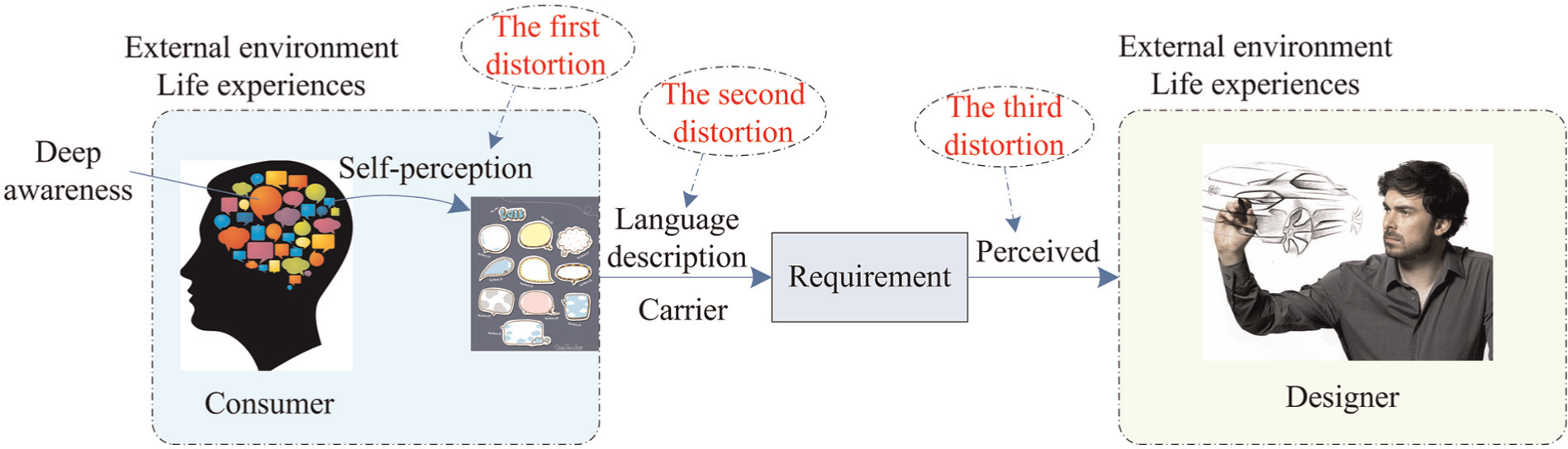
Cognitive dissonance between consumers and designers on kansei words.
Fuzzy clustering
There are more or less cognitive differences between different individuals. The factors that affect customer cognitive behavior are complex, but most of them originate from customers’ life experience. It is unrealistic to design a product considering each individual’s cognitive behavior in product development. As a powerful unsupervised method for analysis of data and construction of models, fuzzy clustering can be used to address the high-dimensional and nonlinear of customer data. Appropriate subdivision of the customers by means of fuzzy clustering can effectively improve the operability of the method.
Fuzzy cognitive map
Consumer perceptions of the product are nonlinear and fuzzy. Fuzzy cognitive maps introduced fuzzy measure in description of causality, which allowing it to express logical meaning more natural. It is suitable for direct or high-level knowledge representation. This article establishes a computational model by fuzzy cognitive map so that consumer perception pattern can be formally expressed and analyzed. This is essentially an extension or generalization of Kansei engineering (KE).
FCM
Many studies have provided methods to combine psychology and computer science for user needs research. In conceptual design phase, most research has focused on cognitive dissonance between customers; they modify the product design to enhance consumer satisfaction through multiple evaluation. Few people concerned about how to reduce the distortion of demand in the transmission from consumers to designers. This study attempts to build a FCM to provide customer kansei demand to designers with visual perception pattern and reference design elements. By doing this, the distortion caused by cognitive dissonance can be reduced, and design quality can be improved. As shown in Figure 2, FCM is composed of consumer, motivation, product design elements and kansei words by association.
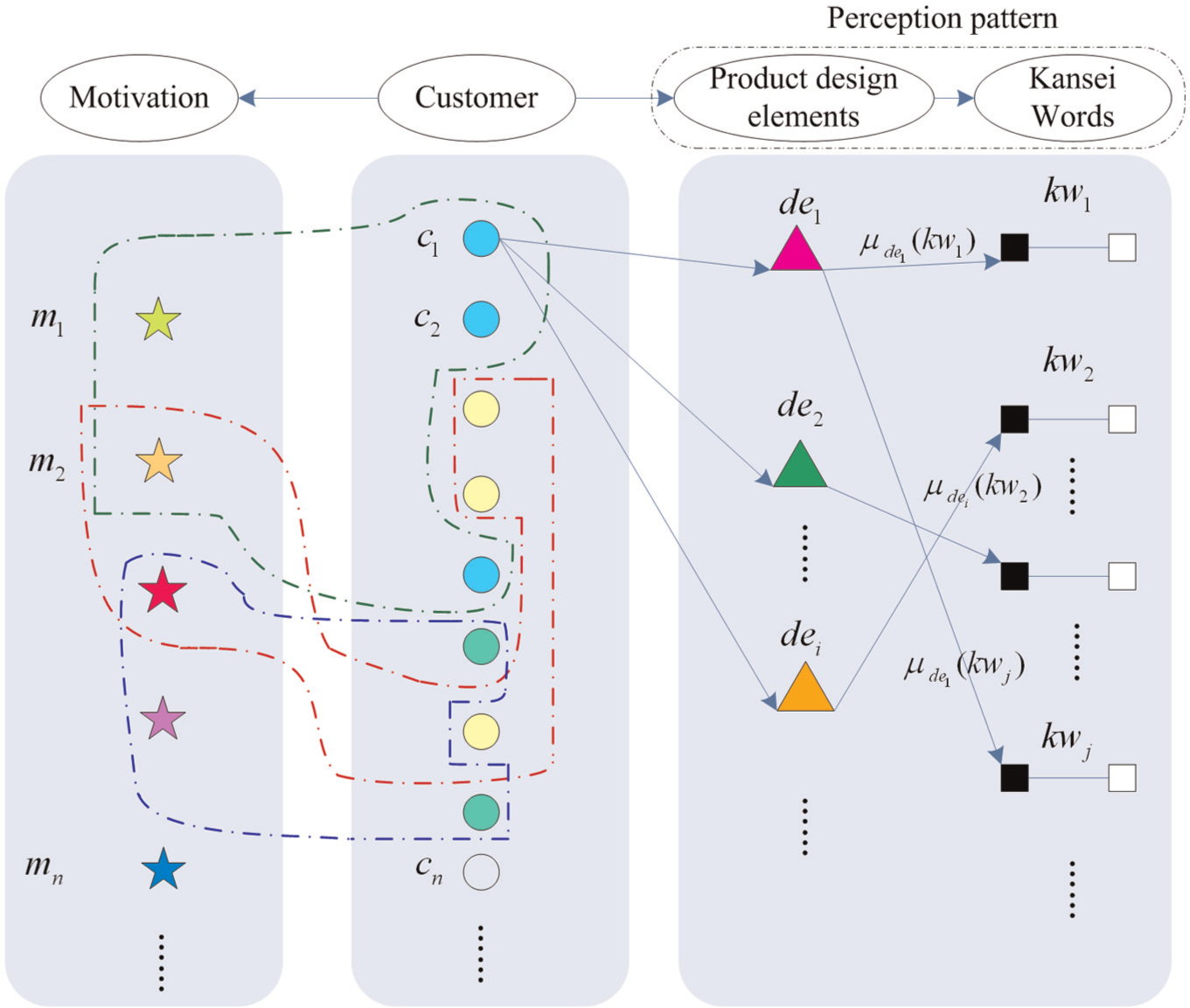
Fuzzy cognitive model of the consumers’ emotional requirement.
Consumer motivation and clustering
According to Maslow’s hierarchy of needs theory, the product meets consumer needs at different levels by its functionality, usability, appearance and so on. However, in addition to the consumer’s own characteristics (lifestyle, social role, values, education, personality, occupation, race, age, gender, family and so on) and life experience, the authors believe that product using motivation is also an important characteristic affecting consumer perception. It can be easily understood as “the product should make me become fashionable in … scenario” or “the product should help me to finish something in … scenario” or “the product should make me feel happy in … scenario.” According to customer characteristics and product using motivation, customers are divided into different groups. Effective clustering will achieve a good balance in individual differences and operability.
Design fuzzy cognitive map
Free association is a human advanced feature that can express deep desires and innermost thoughts. And these ideas exist in the human brain can often give designers more inspiration. Therefore, design elements in Figure 2 include not only the actual product design elements, but also include graphic images available through metaphor extraction technology. The specific processes are as follows:
Step 1. Collecting product-related emotional expressions to form kansei words library;
Step 2. Let some expert customers associate every kansei word freely, depict the image that pops in mind and put actual design elements together to form design elements library;
Step 3. Test the target consumers to build the relationship among consumer, kansei words and product design elements.
Membership function
The emotional intensity of customer to product design elements in fuzzy cognitive map can be identified by the degree of membership. Make
Usage of FCM
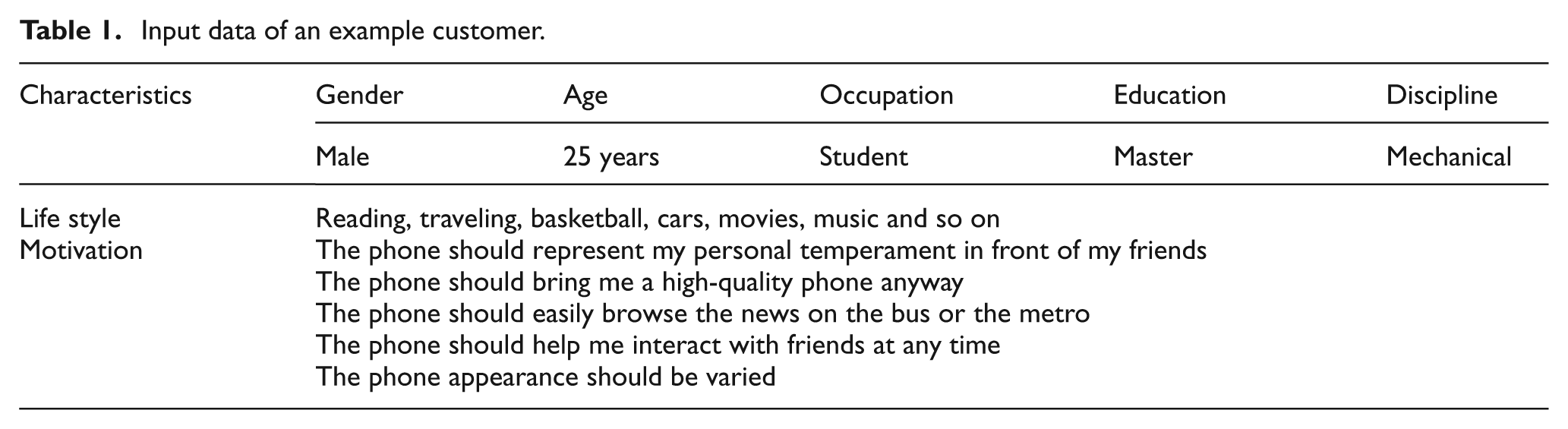
This article uses the concept design case of a mobile phone to verify the feasibility of the proposed model. Young men between ages of 18 and 28 years were chosen as the phone’s target consumer, and the phone is positioned as a “personality, fashion, simple, technology, elegant, exquisite.” First, 25 pairs of mobile phone-related kansei words and a lot of design elements were collected. Then, a survey has been carried out with 200 valid responses. They were divided into six groups based primarily on lifestyle, education, personality, occupation, age, gender and product using motivation. Then, let each group rate on the design elements in kansei words and fuzzy cognitive map of each group were established, respectively. Another target customer was chosen for the verification. He was fuzzy matched to a certain group according to his characteristics and product using motivation. The design elements which has the membership greater than 0.6 (this value can be set by the designers themselves) in the “personality, fashion, simple, technology, generous, delicate” dimensions were selected as reference to designers. Experimental results show that the provided design elements basically consistent with user expectations. Table 1 shows the input data of an example customer. Figure 3 shows the provided design elements and the design scheme which has applied the elements.
Input data of an example customer.
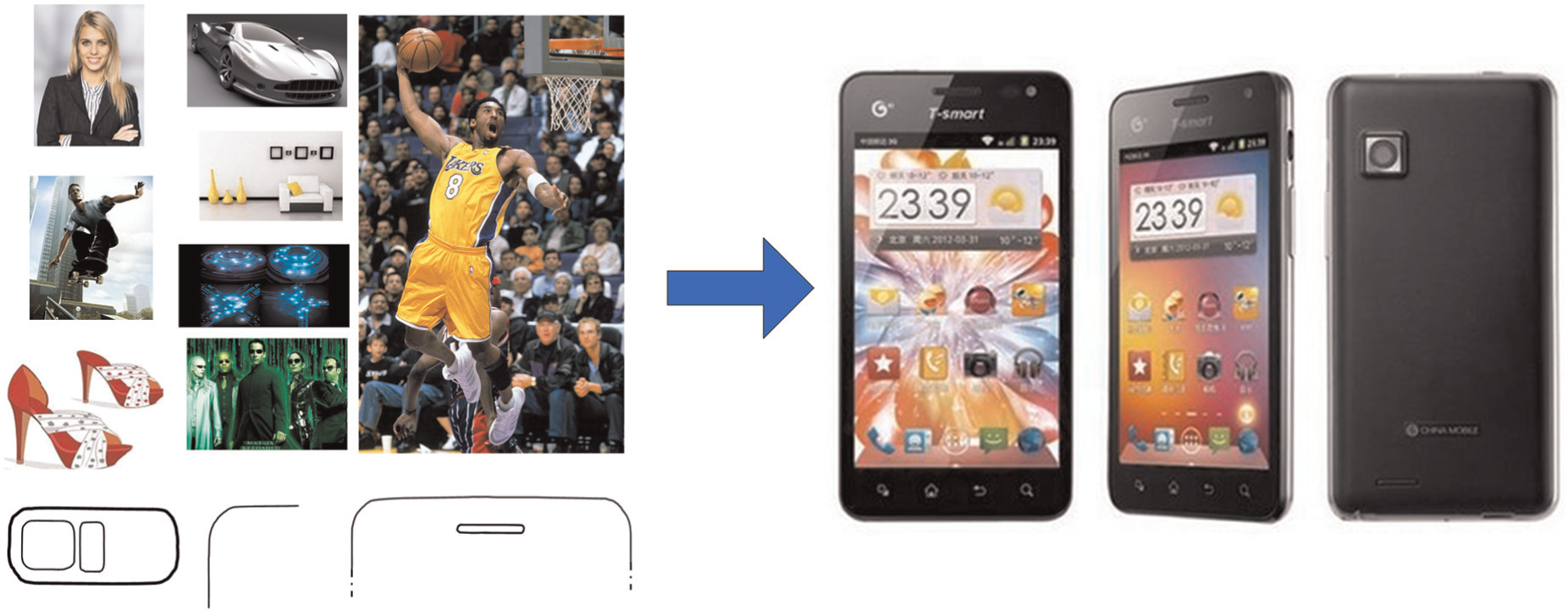
Provided design elements and the design scheme.
Conclusion
The study aims to discover a regularity that exists among customer attributes, motivation and perception pattern. This article discusses the relationship between impact factors of individual differences and the perception pattern and presents a novel information processing method using FCM. Based on the model, emotional requirements of the customers were passed to the designers in graphic language. It can be used to improve the accuracy of requirement transmission and promote design quality. More detailed results will be presented in the future.
Footnotes
Declaration of conflicting interests
The authors declare that there is no conflict of interest.
Funding
This work was supported by the National “Twelfth Five-Year” Plan for Science & Technology Support program of China (grant numbers 2012BAF12B09 and 2012BAH32F04).