




Abstract
Aiming at the phenomenon of bottleneck shifting in job shop, this article presents the findings on the coupling relationship among the bottleneck shifting factors. We first defined the chain probability to show the relation that the change of one bottleneck shifting factor causes the changes of other factors in job shop. Then, we used three variables (time-capability, time-load, and quality-assurance) and the transaction probability to describe the changes of the factors. Considering the interaction among the bottleneck shifting factors, we established the independent contributions and comprehensive contributions, showing how the changes of various shifting factors may impact the bottleneck shifting phenomenon interactively. Finally, an instance of analysis of the coupling relation of several bottleneck shifting factors in some job shop is given to test the validity and rationality of the method established in this research.
Introduction
Bottleneck shifting is caused by the changes in the factors of the shop floor, such as machine breakdown, uncertain processing time, and the change in the process capability index of machines. In this article, we define the factors in the shop floor that cause bottleneck to shift as the bottleneck shifting factors. How much the bottleneck shifting factors impact the position of the bottleneck in jobs shop depends on the measurement of bottleneck degree. Most of the research has proposed a lot of ways to detect the bottleneck1–10 in the time domain, such as machine activity time, machine blocking/starvation time, and the throughput. Liu et al. 11 suggested that the bottleneck is influenced not only by processing/nonprocessing time on machine but also by the quality of the product produced by a machine. Low quality on the machine may cause the machine to be the weakest node in the whole manufacturing system, which is another kind of bottleneck due to product rejection or the cumulation of the errors. Nowadays, little attention has been paid to the factors underlying occurrence of bottleneck. Nakata et al. 12 presented three kinds of bottlenecks based on the appearance cycles and showed how the reasons (the change of factors) cause different bottlenecks indirectly. Yan et al. 10 proposed four buffer states of the manufacturing cell to show the relationship between the buffer and the bottleneck.
The rest of this article is organized as follows: Section “The chain probability among bottleneck shifting factors” introduces the chain probability among the changes of bottleneck shifting factors, and when unambiguous, we eliminate “the changes.” Two kinds of chain relations are described: independent chain and mixed chain. Section “The description of the bottleneck shifting factor” provides a method to describe the bottleneck shifting factors, including the state of the factor and the transition from one state to another state. Section “The interaction among bottleneck shifting factors” analyzes the interaction among bottleneck shifting factors. Section “The contribution degree of the bottleneck shifting factor” constructs the contribution degree to measure the effect of the factors on the bottleneck degree. Section “Case studies and results” reports the case studies and the results. The conclusions and the future directions for research are presented in section “Conclusions.”
The chain probability among bottleneck shifting factors
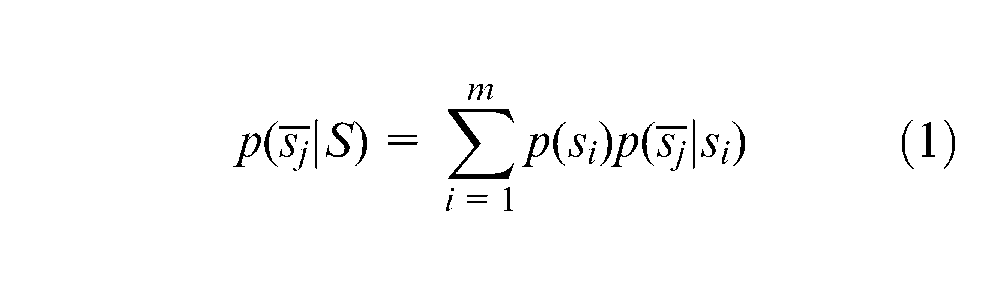
The bottleneck shifting factors do not occur independently, which means that the occurrence of one bottleneck shifting factor may cause the other factors to occur. We define the original factor as the chain subject factor and the consequent factors as the chain object factor. One chain subject factor may cause several chain object factors to occur, and one chain object factor may be caused by several chain subject factors jointly.
Suppose there are
Independent chain relationship. The chain subject factors independently cause the chain object factors. The chain probability model is given as follows
Mixed chain relationship. Some chain subject factors independently cause the chain object factors, while other chain subject factors jointly cause the chain object factors. Suppose the chain object factor
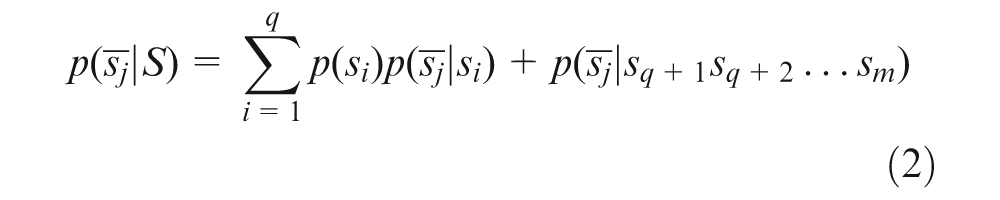
In equation (2),
The description of the bottleneck shifting factor
The variables of the bottleneck shifting factor
From our previous research basis, 11 the Bottleneck Index, regarded as the capability of the manufacturing cell becoming the bottleneck, reflects the degree that the production capability satisfying the production load (workload) in either the time or the quality domain. In this index, use the time-capability variable and the time-load variable to represent the changes of production capability and production load in the time domain, respectively; use the quality-assurance variable to represent the capability that whether the manufacturing cell can meet the quality requirement. The specific model is shown in the following.
Time-capability variable
This variable denotes the change of the available time in the manufacturing cell induced by the bottleneck shifting factors. For example,
Time-load variable
This variable denotes the change of the production load in the manufacturing cell in the time domain induced by the bottleneck shifting factors. For example, the arrival of an urgent order causes the additional time-load in the manufacturing cell
Quality-assurance variable
This variable denotes the change of the quality-assurance capability of the manufacturing cell induced by the bottleneck shifting factors. Quality-assurance capability includes two meanings: the ability to ensure qualified products and the ability to ensure the stability of product quality function. Therefore, quality-assurance capability can be characterized by the defect rate and the process capability index synthetically.
14
For example, the staff rescheduling and the alteration of the process quality standard may lead to the change in quality-assurance capability of the manufacturing cell. In this case,
The state space transition probability of the bottleneck shifting factor
It is shown that the bottleneck shifting factors have randomness and can transfer dynamically among various states with some probability. This means that the transition process of the bottleneck shifting factors, to some extent, is a random process and obeys Poisson’s process. 11 When the current state of the factor is known, their future state only bears on the current state and not on the past state. Therefore, the change process of bottleneck shifting factors has Markov property. Markov chain can be used to describe the dynamic system with the discrete or continuous parameter. Wang et al. 15 used the Markov chain to describe the transition probability of the system from one state to another state. Through this analysis, the state space of one bottleneck shifting factor can be divided into finite scenarios with the time parameters being continuous. Therefore, a finite dimensional Markov chain with the continuous time parameter can be constructed to describe the state space and transition probability of the bottleneck shifting factors.
The interaction among bottleneck shifting factors
When some bottleneck shifting factors occur at the same time, the comprehensive influence on the production capability/load is not the linear summation of the influence of every single factor but complicated and nonlinear. Some bottleneck shifting factors occur simultaneously, which may have the positive stimulation effect on the production capability or load, while other bottleneck shifting factors may have the negative stimulation effect on the production capability or load.
Suppose there are
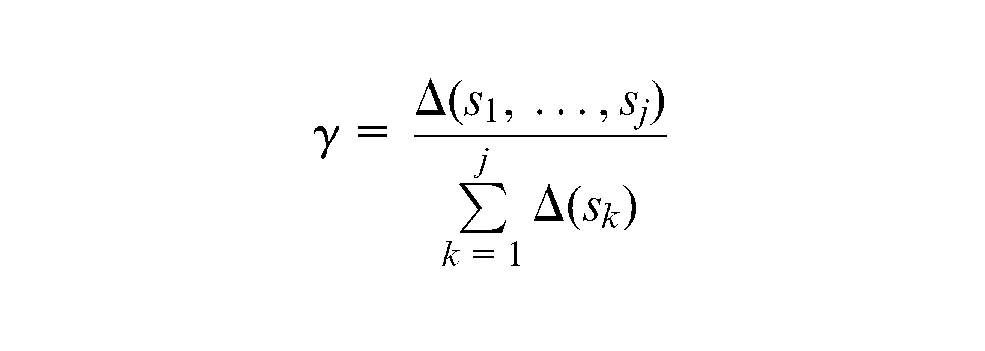
There exists time-capability interaction degree
The contribution degree of the bottleneck shifting factor
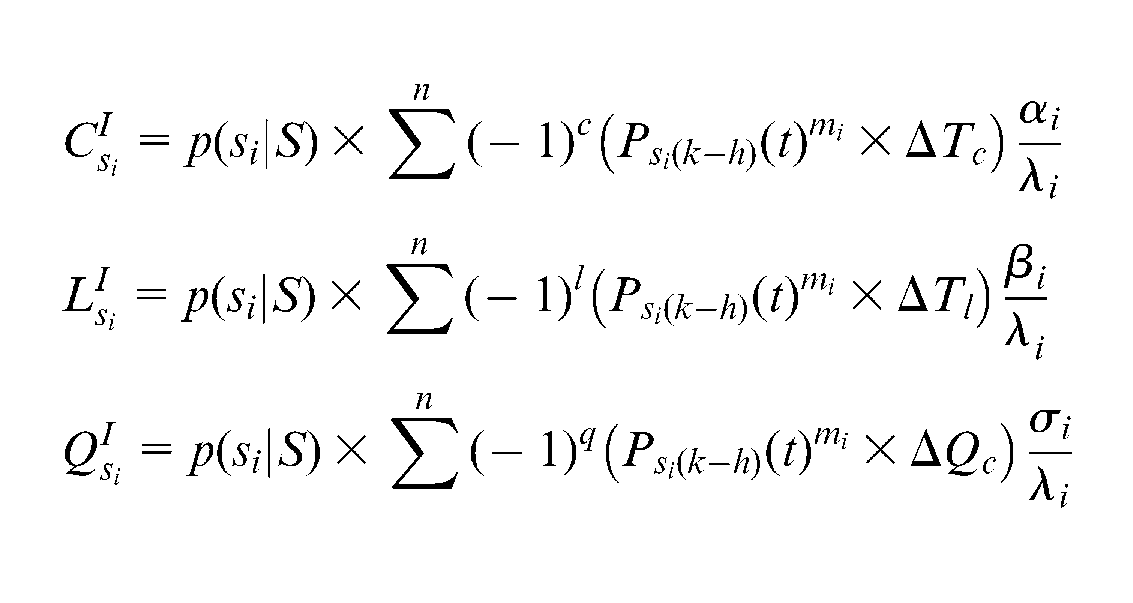
The contribution degree of the bottleneck shifting factor denotes the effect of the bottleneck shifting factors on the production capability/load, by considering the occurrence probability of the factors, the transition probability of the state spaces, and the interaction among the factors.
Independent contribution degree
The independent contribution degree denotes the degree of the effect of the single bottleneck shifting factor on the production capability and the load, and this degree can be measured by the time-capability–independent contribution degree, time-load–independent contribution degree, and quality-assurance–independent contribution degree from the time and the quality domain, respectively.
Let
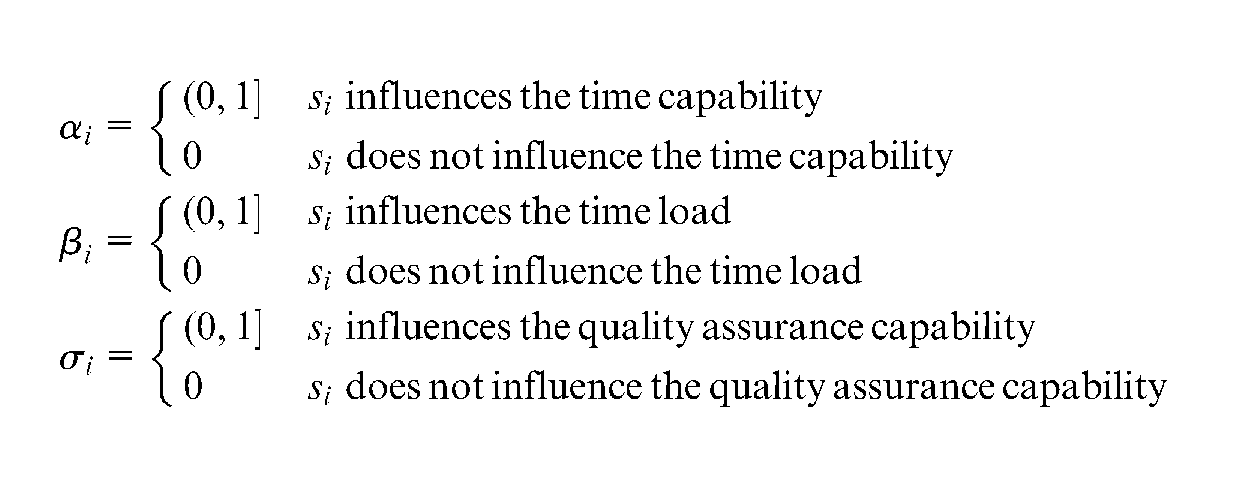
Suppose that the state duration time of the bottleneck shifting factor obeys exponential distribution with
Comprehensive contribution degree
The comprehensive contribution degree denotes the degree of the effect of several bottleneck shifting factors that occur simultaneously on the production capability and the load by considering the interaction among the factors. The specific models of time-capability, the time-load, and the quality-assurance comprehensive contribution degrees are given as follows
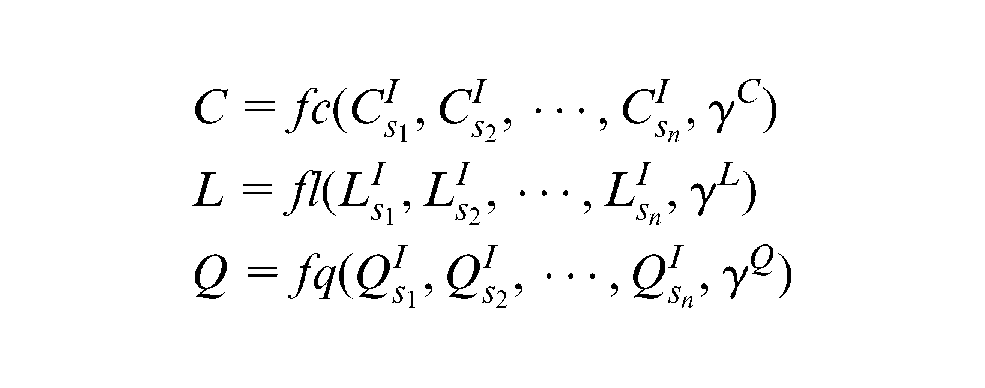
The solution of the comprehensive contribution degree
The occurrence of the bottleneck shifting factors has the parallelism property and the cross property in the time domain, and the comprehensive contribution degree of these factors is not the linear summation of each independent contribution degrees. Therefore, the comprehensive contribution function is unable to be created as a unique analysis model for predicting the comprehensive contribution.
The neural network can approximate any continuous function and obtain a good approximation result. It has strong fault-tolerance and self-learning function. 16 Therefore, adopt the neural network to solve the contribution function, which can realize the prediction of the comprehensive contribution degree.
The solution of the contribution function is a one-way flow process, and the factors of the same layer are independent. According to this characteristic, the feed-forward neural network should be selected. In the feed-forward neural network, the back-propagation (BP) neural network can achieve any continuous mapping with strong nonlinear mapping capability and flexible network structure, and the prediction accuracy is higher.
17
The BP neural network with single hidden layer can approximate any nonlinear function and obtain good approximation results. Through large sample training of the network, its evaluation error is smaller and extrapolating ability is stronger.
16
Therefore, for the comprehensive contribution function, two 3-layer BP neural networks should be constructed. The number of input layer neurons is the number of parameters of ability contribution function, denoted by
The sigmoid function is used as the network excitation function to calculate the output of the hidden layer and output layer, in order to realize the solution of the contribution function. The BP network works with the error BP mode. If the inaccuracy between the output of output layer
Before training, in order to improve the performance of the neural network model, the sample data must be chosen seriously to ensure the quality and quantity. Simultaneity, in order to ensure that the sigmoid function really play a nonlinear transfer, to guarantee that the network has enough input sensitivity and good fitting property, to improve the convergence speed of the network, and to increase the stability of the model, the data should be normalized, so that it falls between [0, 1] or [−1, 1].
Case studies and results
This section describes an example of a manufacturing shop where five products A, B, C, D, and E are processed on five machines
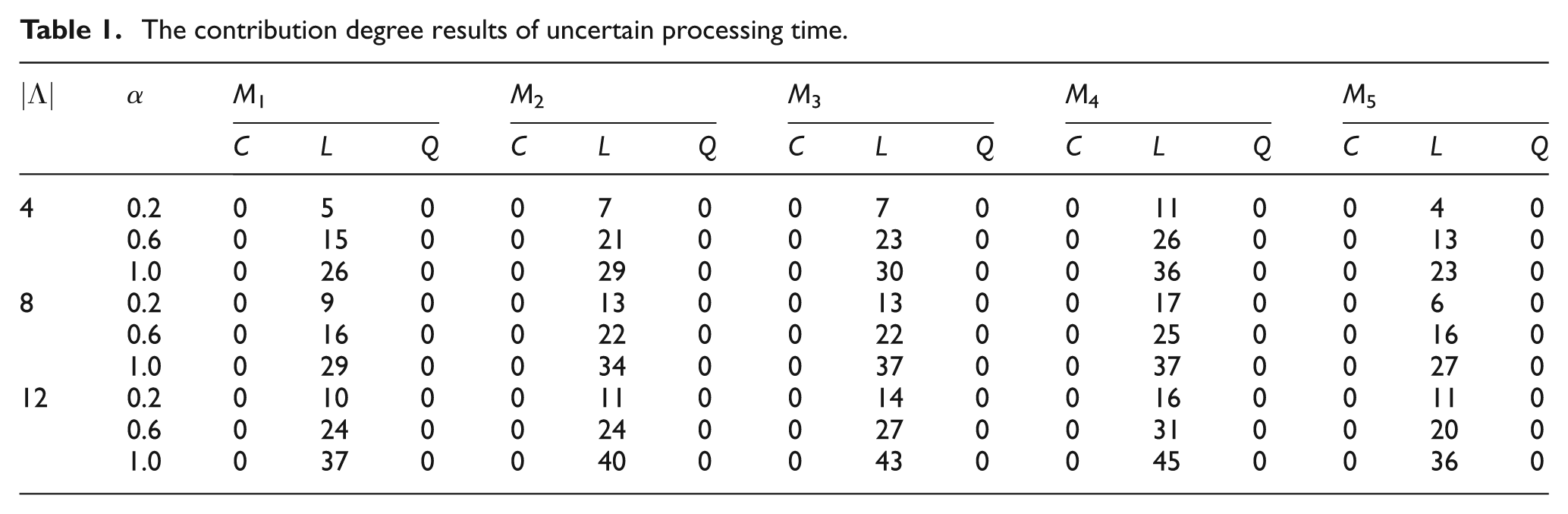
Our first case was designed to show that the result is only one chain subject factor in the shop floor, without any chain object factor. Let
The contribution degree results of uncertain processing time.
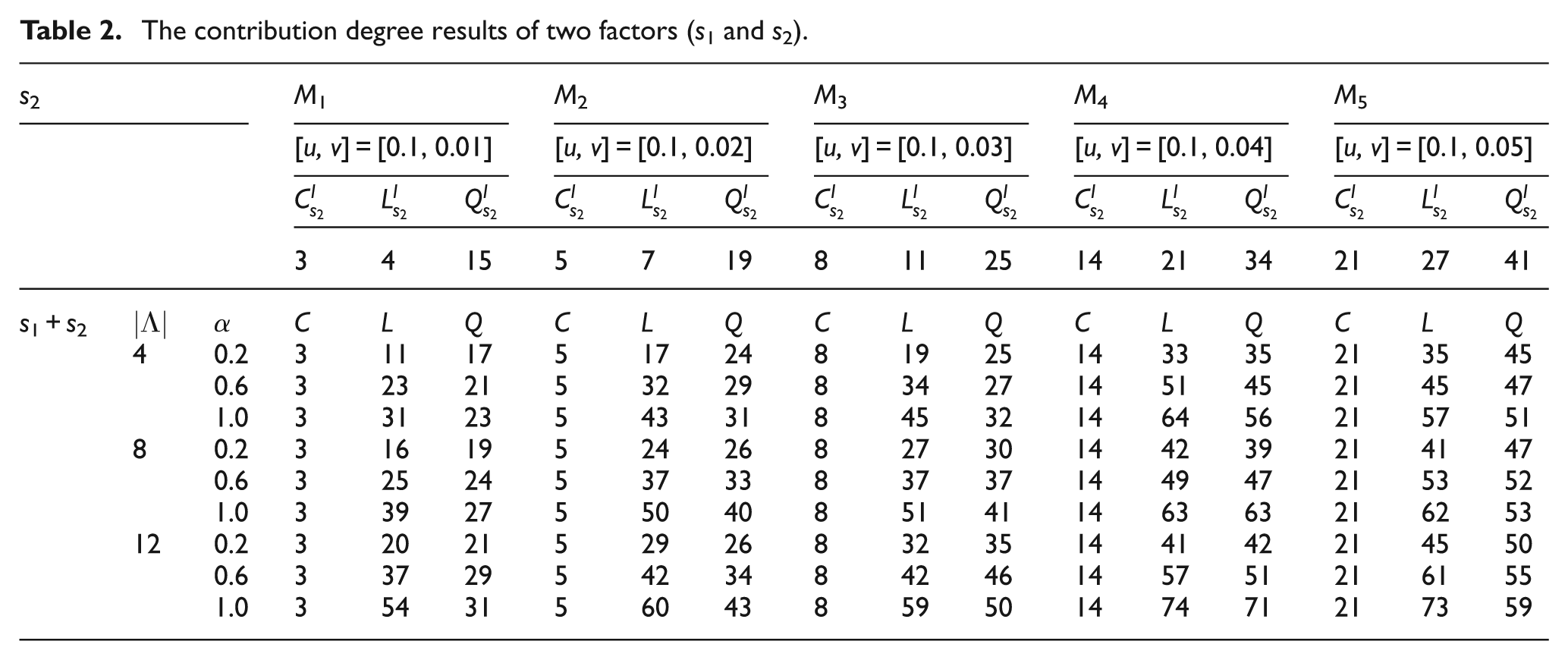
To further test the method, add one bottleneck shifting factor
The contribution degree results of two factors (s1 and s2).
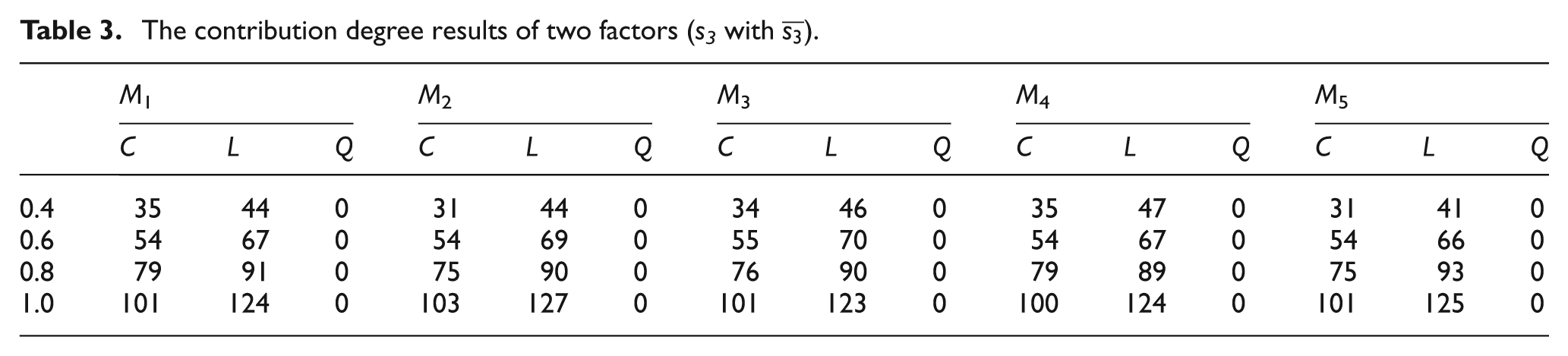
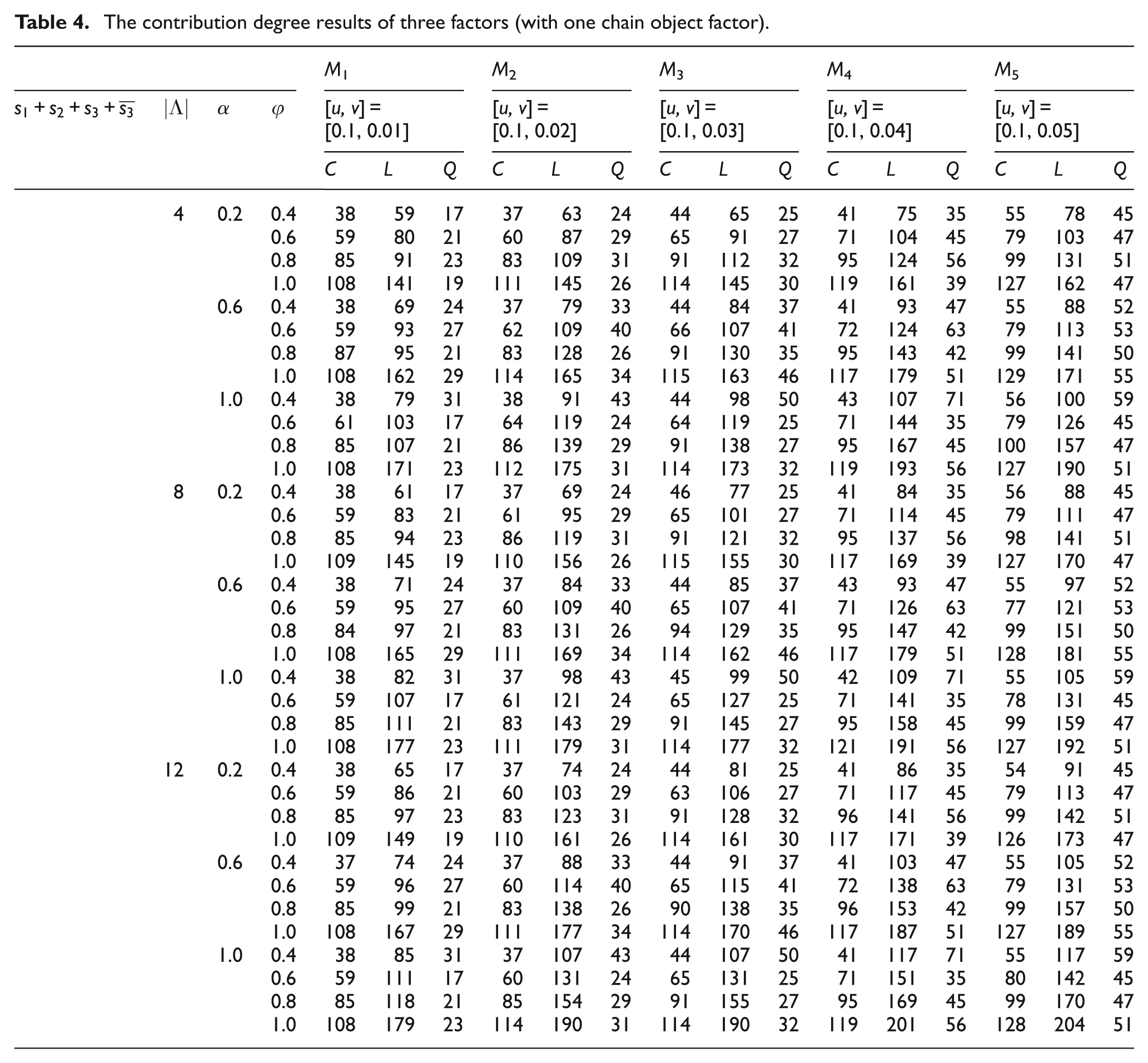
Consider to add the third bottleneck shifting factor
The contribution degree results of two factors (s3 with
The contribution degree results of three factors (with one chain object factor).
Use Arena 11.0 to simulate the condition of the shop floor in order to verify the rationality of this method. Because there is few methods to obtain the value of the production capability and quality-assurance, in this case, just test and obtain the production load. In Table 5, the first subcolumn in each machine column is the production load (unit: seconds) without any bottleneck shifting factors, the second subcolumn is the load under the condition described above, and the third subcolumn is the relative error between the comparison results and the computation results as shown in Table 4. It is clear that all relative errors do not exceed 13%; therefore, the method proposed in this article is effective. The uncertain processing time has the most effect on the accuracy of this method. The more the number of scenarios in the processing time, the greater the value of the relative error.
The comparison between the simulation results and the computation results.
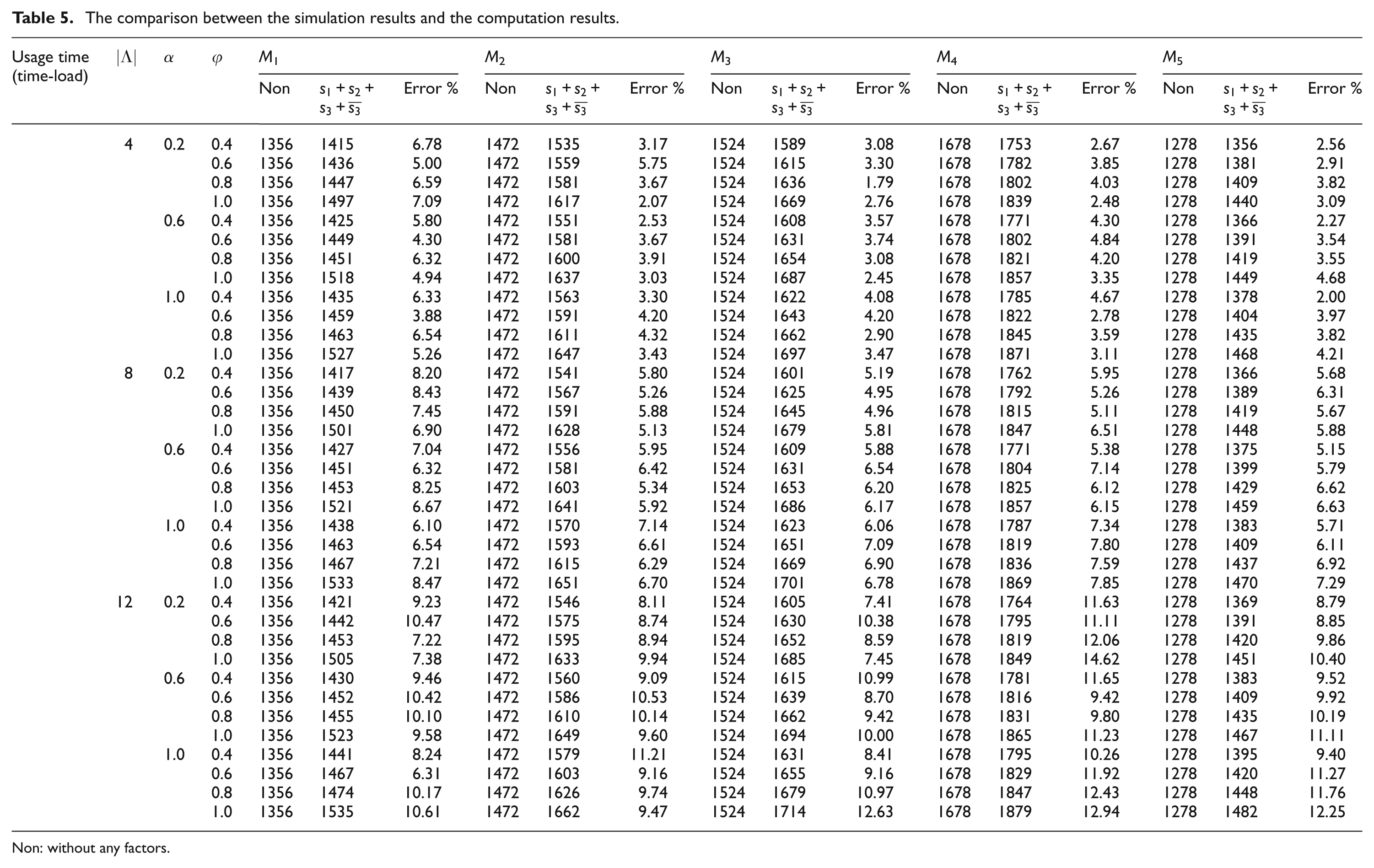
Non: without any factors.
Conclusions
This article has focused on the coupling relationship among the bottleneck shifting factors in job shop. We have constructed the contribution degree to measure the effect of the bottleneck shifting factors on the production capability, the production load, and the quality-assurance that are the three main parts in measuring and detecting the production bottleneck. 11 It is a useful method to show the relationship between the bottleneck shifting factors and the phenomenon of bottleneck shifting.
The change of the processing time only effects time-capability (only one aspect). The machine performance degradation affects all three aspects and has the interaction with the processing time in all three aspects. The change of the order of product has no effect on the quality-assurance. It has no interaction with the machine performance degradation in the time-capability and the quality-assurance. Further research should explore more bottleneck shifting factors and the more explicit relationship between the changes in factors and the bottleneck degree.
Footnotes
Declaration of conflicting interests
The authors declare that there is no conflict of interest.
Funding
This work was supported by the Major State Basic Research Development Program of China (973 Program; grant no. 2011CB013406), the National Natural Science Foundation of China (grant no. 71071046), and the National Scholarship Fund by China Scholarship Council.