




Abstract
The aim of this article is to introduce a strategic view of engineering operations. The reported research began with developing a theoretical foundation from the literature. Key elements of the theoretical framework and their relations have been enriched and extended through case studies with 28 UK-based engineering organisations. The case studies suggested three essential strategic elements of engineering operations such as (1) a coherent vision of how to compete through engineering, (2) a consistent pattern of decision-making and (3) a contingent fit with the contextual environment. Typical decision frames have been observed around these strategic elements. This article contributes to an improved understanding of operations strategies with engineering cases. The findings will be useful for scholars studying manufacturing and engineering management, as well as for practitioners who are looking for a strategic approach to enhance their engineering performance.
Background and introduction
Engineering makes a major contribution to the economy and society through transforming new technologies and ideas into innovative products and services with a wide range of activities along the whole engineering value chain from research, design, development and production, to delivery, service, support, recycling and disposal. 1 Enhancing engineering performance has been a high strategic priority for UK manufacturers to thrive in the competitive global economy.2–4 But how to effectively manage engineering operations in the current business environment is poorly understood in companies of different sizes and from different sectors.5–7
This is largely due to the lack of a strategic view of engineering operations in theory and practice. The traditional concepts of operations strategies focused mainly on manufacturing operations,8–14 but paid rather little attention to the unique nature of engineering, for example, heavily relying on the intangible know-how or skills of engineers,15,16 emphasising effective problem solving,17,18 demanding quick response to the changing environments and requiring cross-boundary collaborations.19,20 Such features will lead to decision frames with unique perceptions of the acts, outcomes and contingencies associated with engineering strategies. 21 Recent studies on engineering operations addressed some strategic issues from various perspectives, such as engineering design techniques22–24 and engineering management practices,25–27 for example. But a strategic view of engineering operations is missing.
This article aims to address the above-mentioned knowledge gap by identifying the essential strategic elements of engineering operations and understand the associated decision framing through case studies. Twenty-eight UK-based engineering organisations were studied including engineering designers, engineering manufactures and engineering services providers along the full spectrum of the engineering value chain. 1 After this introduction, the authors will set out to develop a theoretical foundation based on the existing literature, followed by introducing the research approach. The case studies will then be reported with an emphasis on the main strategic problems and their theoretical implications. In the end, this article will summarise the key findings and set directions for the future research.
Literature review
Essential elements of a strategy
The traditional strategic management literature suggested essential elements of a strategy in three main areas: strategy as a coherent vision of how to compete, a consistent pattern of decision-making and a contingent fit with the external environment.
First, a strategy determines the long-term goals of an organisation. 28 It provides an intuitive vision or a perspective consisting of a chosen position and an ingrained way of perceiving the world.29,30 Many successful organisations rely less on strategic planning that focuses on how to allocate resources to improve its profitability; instead, they compete through implementing strategic intent because it is relatively stable over time and leaves room for reinterpretation as new opportunities emerge. 31
Second, a strategy has been considered as the adoption of courses of decision to achieve the long-term goals of an organisation. 28 It could be a deliberate plan of actions to deal with a situation or a consistent pattern of behaviours emerging without preconception. 32 An influential development in the area is the configuration approach that assumes that the essential elements of an organisation should be logically configured into internally consistent groupings to achieve its strategic goals.33–35 However, there is also a large literature on decision-making and the kinds of factors that perhaps prevent an ideal view of what the basis for decisions should be, for example, rationalisation, cost–benefit calculations or value maximisation.36–38
Third, a strategy has also been considered as a process of reaction and adaptation responding to external forces or a cognitive process about how to deal with inputs from the contextual environment. 30 How organisations respond to their environment has been interpreted with an adaptive cycle of aligning the choices of strategies, technologies and capabilities, organisational structures and environment. 39 Scholars writing on dynamic capabilities held the similar premise that in changing environments, an organisation will perform better with dynamic capabilities to create, integrate and reconfigure resources into new sources of competitive advantages.40–42
Capabilities, configurations and contingencies of operations strategies
The above strategic elements, together with their performance implications, formed the foundation of typical strategic management frameworks, for example, Chandler’s structure–strategy thesis, 28 the structure–conduct–performance paradigm 43 and Pettigrew’s process–content–context framework. 44 These theoretical constructs have been discussed in the operations management literature from three main perspectives: capabilities, configurations and contingencies.
In a capability view, it is generally accepted that the foundations of operations strategies have been developed by looking into the different ways in which firms were choosing to compete in different situations. 9 The research in this area concerned about understanding what the operations function must accomplish to support a firm’s corporate strategy. 8 Manufacturing strategists argued that firms should compete through developing and exploiting competitive manufacturing capabilities, and manufacturing would play an increasingly important role from implementing and supporting, to driving business strategies in an evolutionary manner. 45 Competitive priority has been an important concept on this account that allows manufacturers to focus on tasks essential to their success.8,46 Operations strategists depicted various visions of how to compete through manufacturing with a set of capability dimensions or competitive priorities such as cost, quality, dependability, flexibility, reliability and innovativeness.9,12,45,47,48 Scholars also identified operations strategies with different combinations of these competitive priorities, for example, the caretakers, marketers and innovators, 49 or the niche differentiator, broad market differentiator, cost leader and lean competitor. 50
In a configuration view, operations strategies are expected to describe commonly used paths to gaining competitive advantages, 50 which are composed of tight constellations of mutually supportive elements.34,51 Manufacturing strategists often develop their arguments from a set of plans and policies that determine the capability of a manufacturing system and specify how it will operate to meet manufacturing objectives. Skinner proposed five key decision areas, including plant and equipment, production planning and control, labour and staffing, product design and engineering, and organisation and management. 8 These decision areas have been used to guide managers to achieve manufacturing objectives through a series of inter-related and consistent choices reflecting the competitive priorities and trade-offs implicit in a firm’s competitive situation. This list of strategic choices has later been expanded to include the structural elements such as capacity, facilities, production equipment and vertical integration and the infrastructural elements such as human resources policies, quality systems, production planning and control, performance measurement, organisation and new product introduction. 45 These strategic choices have also been boiled down to a process category including process technology, trade-offs embodied in process, role of inventory, capacity, size, timing and location and an infrastructure category including functional support, operations planning and control systems, work structuring, payment systems and operational structure. 47 In general, scholars writing on manufacturing strategies articulated the importance of a consistent, coherent operations strategy in achieving lower cost, better reliability or faster responsiveness than competitors in the long run. 12
In a contingency view, no strategy is universally superior in different environmental or organisational contexts. The performance of an organisation is determined by the fit (also known as co-alignment or congruence) between its strategies, capabilities and contextual environments. 39 Six perspectives of fit have been suggested in strategic management research, that is, moderation, mediation, matching, gestalts, profile deviation and co-variation. 52 The literature reported differences between environmental fit that concerns on matching organisational structures and processes to external settings and internal fit that concerns on the internal complementarities of organisational structures and processes. 53 Sometimes, efforts to maintain environmental fit may prevent or destroy internal complementarities, or the emphasis on internal consistency may detract managers from changes outside the organisation. Some scholars argued that manufacturing strategies are useful only to the extent that they either improve the congruence between operations and its environments or lead to greater consistence among the elements that define operations. 54 Four categories of contingency factors affecting the result of implementing best practices have been suggested as national context and culture, firm size, strategic context and other organisation context. 55
Key strategic issues in engineering operations
The primary concern of engineering is fundamentally different from that of manufacturing or basic research in the tasks, outputs and required knowledge. Engineering tasks usually come from external sources such as industry or government instead of being chosen by an engineer.16,20 The outputs are often one-off designs or solutions for the benefit or convenience of people rather than a scientific enquiry or theory purely to improve our understanding of the world or to fulfil the discovery desire of a researcher. The required knowledge, that is, engineering expertise or know-how, is often intangible and embedded in different parts of an organisation or a group of organisations.18,19 Such unique nature of engineering would lead to decision frames with unique perceptions of the acts, outcomes and contingencies associated with engineering strategies. 21
Based on the above-mentioned strategic management studies and the operations strategies literature, some strategic issues in engineering operations have been addressed in the knowledge domains such as research and development (R&D) management, innovation and new product/process development. The literature identified different types of strategies for R&D and innovation, for example, R&D to create new knowledge or to commercialise the existing knowledge; 56 innovation focusing on the duplication and diversification of technological capabilities 57 or open innovation strategies. 58 Such developments have been summarised into three types of innovation strategies by focusing on global growth and local presence and searching for optimum efficiency and effectiveness supported by appropriate organisation structures, innovation processes, resource allocation and innovation cultures.59,60
Making strategic decisions in engineering operations may also benefit from studies on the working environments, required capabilities, organisation structures and coordination mechanisms of new product/process development. Examples include the use of virtual teams, 61 the development of centres of excellence,62,63 and industrial initiatives of concurrent engineering, 22 collaborative engineering 25 and product life cycle management. 23
Studies on the strategic capabilities, configurations and contingencies of engineering operations contribute to a useful theoretical foundation for our investigations into the main strategic tasks. Figure 1 presents a conceptual framework of the key strategic issues, which suggests three key areas of investigation to answer the main research question: How do companies effectively develop their engineering strategies in the current business environment?
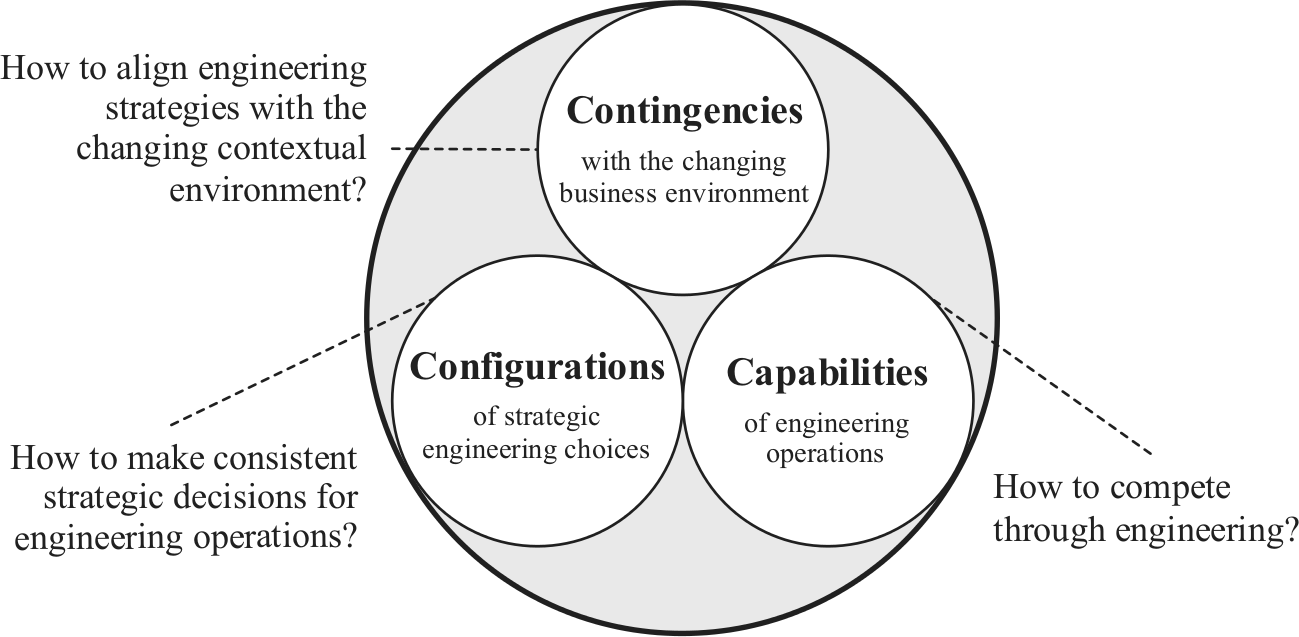
Conceptual framework.
How to compete through engineering?
Shaping a vision of how to compete through engineering is particularly important in the current business environments. UK companies are now trying to transform their home operations towards a knowledge-based model that requires engineering skills and expertise to play a driving role in delivering customer value rather than simply supporting manufacturing activities. 3 Ongoing developments include the trend of servisitation in the manufacturing sectors, 64 the emergence of the advanced engineering sectors 2 and the transaction towards sustainable industrial systems. 65 Such developments would require companies to rethink about the changing role of their engineering operations and thus reforming their engineering strategies in a new contextual environment.
How to make consistent strategic decisions for engineering operations?
UK companies are now trying to focus on higher value-added operations and out-source low-value operations through global supply networks. 66 However, engineering capabilities are often dispersed with different parts of the business and deeply embedded in an organisation or a group of organisations with low mobility. This makes outsourcing decisions particularly complex and difficult in engineering operations. At the same time, engineering offshoring becomes a popular solution to deal with shrinking engineering resources in the developed countries or to benefit from increasing engineering capabilities overseas. This may allow companies to take advantage of low-cost resources in a short term, but such decisions will have far-reaching and complex consequences in the future. 18
How to align engineering strategies with the changing contextual environment?
Engineering tasks are often unique, and the working environments are unpredictable. At the same time, the rapidly changing markets and emerging technologies bring new business processes and novel concepts of operations that are radically different from the traditional way of managing engineering activities. It is therefore particularly challenging to maintain strategic contingencies in engineering operations. To deal with the accelerating pace of technology exploitation and the demand for changes in implementation, engineering managers have to enhance their decision-making processes with a more dynamic and proactive approach. 4
Research approach
The case study approach was adopted considering the descriptive nature of this research and the complexity of the research tasks.67,68 The reported research began with exploring the essential strategic elements of engineering operations through a systematic literature review and scoping interviews with academics, consultants and industrialists. Since a consistent understanding of engineering strategies is missing in the existing literature, a preliminary conceptual framework (see Figure 1) was developed to guide the case studies. Key elements of the framework and their relations have been enriched and extended through case studies and pilot application projects. The theory-building process ended when the theoretical framework was mature, that is, when additional case data would not lead to any significant changes to the framework, especially the three sets of theoretical elements focusing on contexts, capabilities and configurations of engineering strategies.67,69
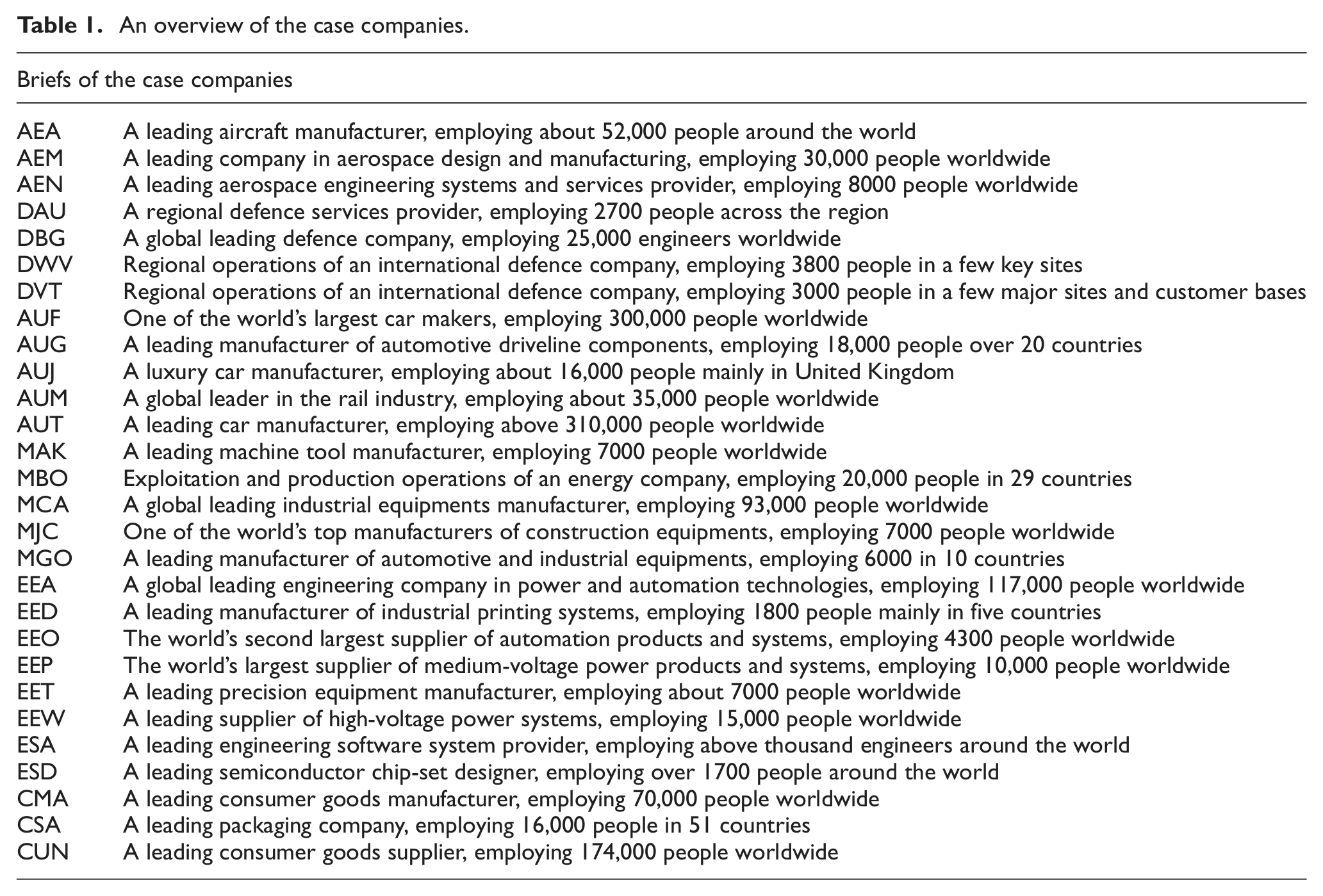
The cases were selected from a database of over 5000 companies managed by the host organisation. Three main case selection criteria were used to put together a theoretical sample consisting of engineering operations in different contextual situations and thus allowing a broad scope of exploration. 68 First, the case companies are perceived as leading players in their sectors. Second, engineering has been an area of strategic importance in the case companies. Third, the case companies are willing to support this research with top management engagement. Table 1 presents an overview of the 28 selected cases. Most of the case studies were completed in the recent 3 years with support from a team of academics and industrial fellows. Key research findings have been developed into a set of strategic guidance through pilot application projects in some of the case companies, for example, AUG, DBG, DWV, CSA and EEA. The projects were mainly conducted by industrial fellows affiliated to the host organisation, and the researchers were involved as facilitators or observers helping to improve the feasibility, usability and utility of the facilitation tools. 70
An overview of the case companies.
Case data were collected mainly through semi-structured interviews and supplementary studies of company documents. Interviewees were managers with an overview of their engineering operations, for example, corporate strategist, head of engineering or group engineering director. They were named by the case companies. Altogether, over 60 senior managers have been interviewed following a case study protocol focusing on the essential strategic elements of engineering operations (see Figure 1). Examples of the interview questions are as follows:
Q1. Could you please describe the main functions of your engineering operations? What makes your engineering operations different from other functional areas, for example, manufacturing, research or after sale services? Why?
Q2. Does your organisation have an engineering strategy? How will engineering contribute to the competitiveness of your businesses?
Q3. What are the main tasks (and key elements) of your engineering strategy? How the strategic choices have been made?
Q4. Has your engineering strategy been regularly reviewed or updated? How often? Do you follow a formal/informal process for this?
Q5. We would like to develop a set of tools to help managers to analyse their current engineering strategies and formulate new engineering strategies for future success. May I have your advice or suggestion on the appropriate format or necessary content of such tools?
Q6. Is there anything else you would like to say?
Collected data were analysed through an inductive process of categorisation focusing on the key elements of the theoretical framework.71,72 Main categories and subcategories were created by searching the case data, identifying the key words, classifying them into common themes and updating the theoretical elements with emerging themes. Through this process, the cases were grouped into four clusters (see Table 2) to facilitate the analysis of main themes or patterns emerging from a big number of case studies.13,73
Four clusters of cases.
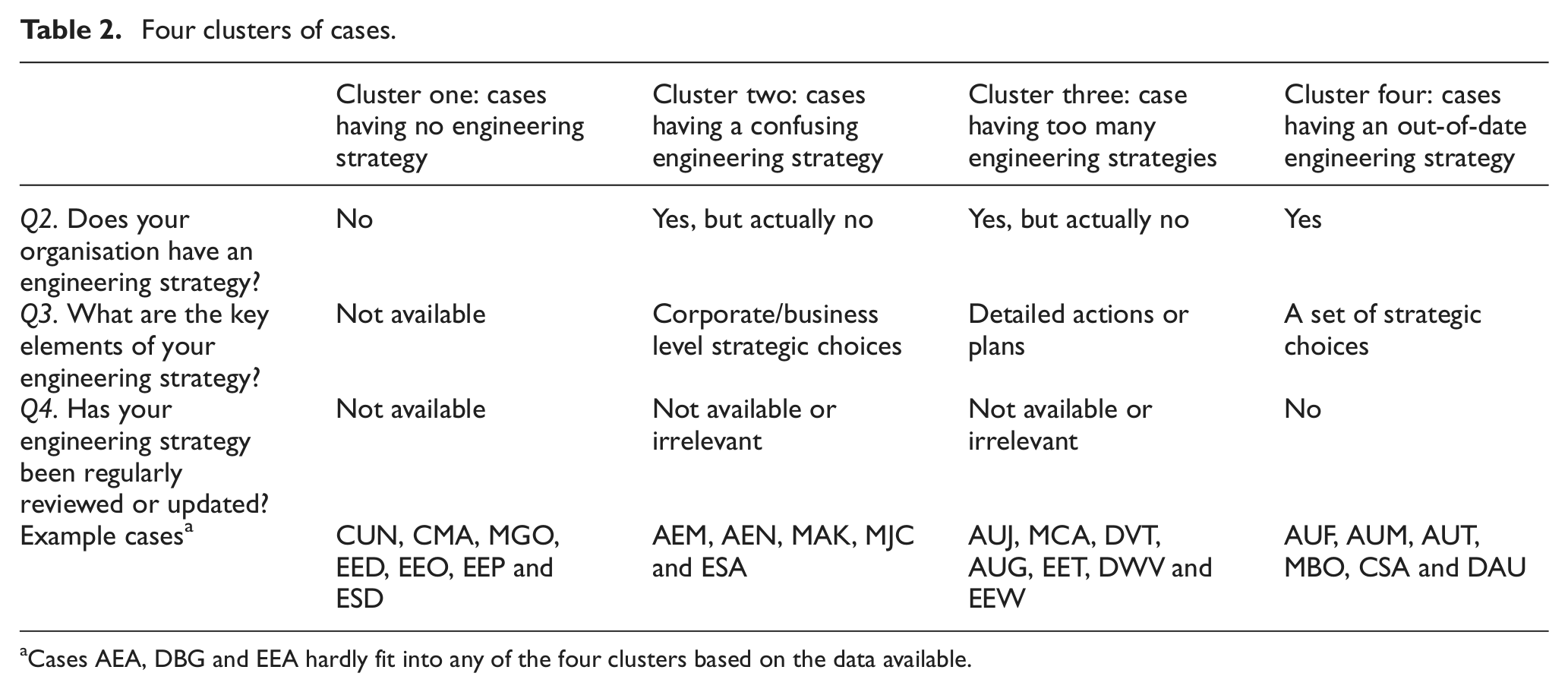
Cases AEA, DBG and EEA hardly fit into any of the four clusters based on the data available.
Classification techniques employed to form the clusters were based on the capability, configuration and contingency aspects of the conceptual framework, that is, answers to the three main interview questions (Q2–Q4). Independent academics, consultants and industrial experts were involved in the theoretical development process by advising on the research approach and reviewing the data analysis process and the outcomes and thus improving the reliability and validity of this research.
Case studies
Key strategic issues in engineering operations
This section will first introduce the main strategic issues observed in the four clusters of cases and then discuss their theoretical implications through cross-cluster analysis.
Cluster one: cases having no engineering strategy
Managers have been warned about the danger of not having a proper strategic positioning and being ‘stuck in the middle’. 29 This happened in several case companies, where engineering played a supporting role under the umbrella of R&D (cases EED, EEP and ESD), manufacturing (cases MGO, EEO and CMA) or supply chain management (case CUN). The value of engineering is largely invisible to the top management in these organisations because their engineering resources were dispersed worldwide or jointly owned with external partners. These cases suffer from declining engineering capabilities and have to rely on external engineering resources. For example, a consumer goods manufacturer once had a central engineering team but later the resources were dispersed with different product categories and regional operations around the world. Driven by the pressures of global competition, the manufacturer launched a series of initiatives to bring together dispersed engineering expertise by establishing common technology platforms or forming communities of practice. But the transformation towards global engineering operations lags far behind other business activities, and a real global engineering strategy is non-existent yet.
Cluster two: cases having a confusing engineering strategy
Potential risks of having a confusing strategy were reported in a manufacturing context 12 and for international R&D activities. 56 This also happened in the case companies where engineering plays a dominant role (cases AEM, AEN, MAK, MJC and ESA). For example, the engineering managers of a construction equipment manufacturer answered ‘yes’ confidently when they were asked: ‘do you have an engineering strategy?’ But their answers were virtually about the mission or objectives for the whole organisation rather than engineering specific. The managers could hardly differentiate engineering from other operations areas or articulate engineering’s contribution to the overall business clearly. Such companies confuse engineering strategies with the corporate strategy or business strategies. They often suffer from unclear strategic priorities and thus struggling with low efficiency in engineering operations.
Cluster three: cases having too many engineering strategies
The researchers came across case companies that had a lot of ‘engineering strategies’, for example, cases DWV, DVT, AUG, AUJ, MCA, EET and EEW. An engineering manager once introduced 18 engineering strategies in an interview focusing on specific issues such as implementing new engineering tools or raising the awareness of engineering function across the business. He was struggling to differentiate an engineering strategy from the action plans to support or deliver the strategy. Without a clear strategic orientation, the action plans were often inconsistent with each other, and their implications to the business objectives were sometimes incompatible. Having so many ‘strategies’ led to conflicts between engineering teams with different operations priorities. Possible means to avoid such conflicts have been discussed in the manufacturing strategy literature,12,47 which may shed light on how to solve some similar problems in an engineering context.
Cluster four: cases having an out-of-date engineering strategy
The lack of strategic contingencies has been a main problem in operations management.54,55 Not surprisingly, the researchers came across case companies with engineering strategies that were obsolesced or out of date, for example, cases DAU, AUF, AUM, AUT, MBO and CSA. These case companies would update their business strategies regularly, but their engineering strategies were unchanged for a long time. Sometimes, it was due to the resistance of engineering managers to make radical changes to their established way of working after restructuring programmes or major mergers and acquisitions, for example, cases DAU and AUF. Sometimes, it was because the engineering function was not able to keep up with the evolving corporate strategies, for example, cases AUT, AUM and BMO. In case CSA, it was simply because engineering managers were not involved in the business strategy development process at all. Mismatches between engineering capabilities and business objectives became a major threat in these organisations.
Cross-case analysis towards an analytical framework
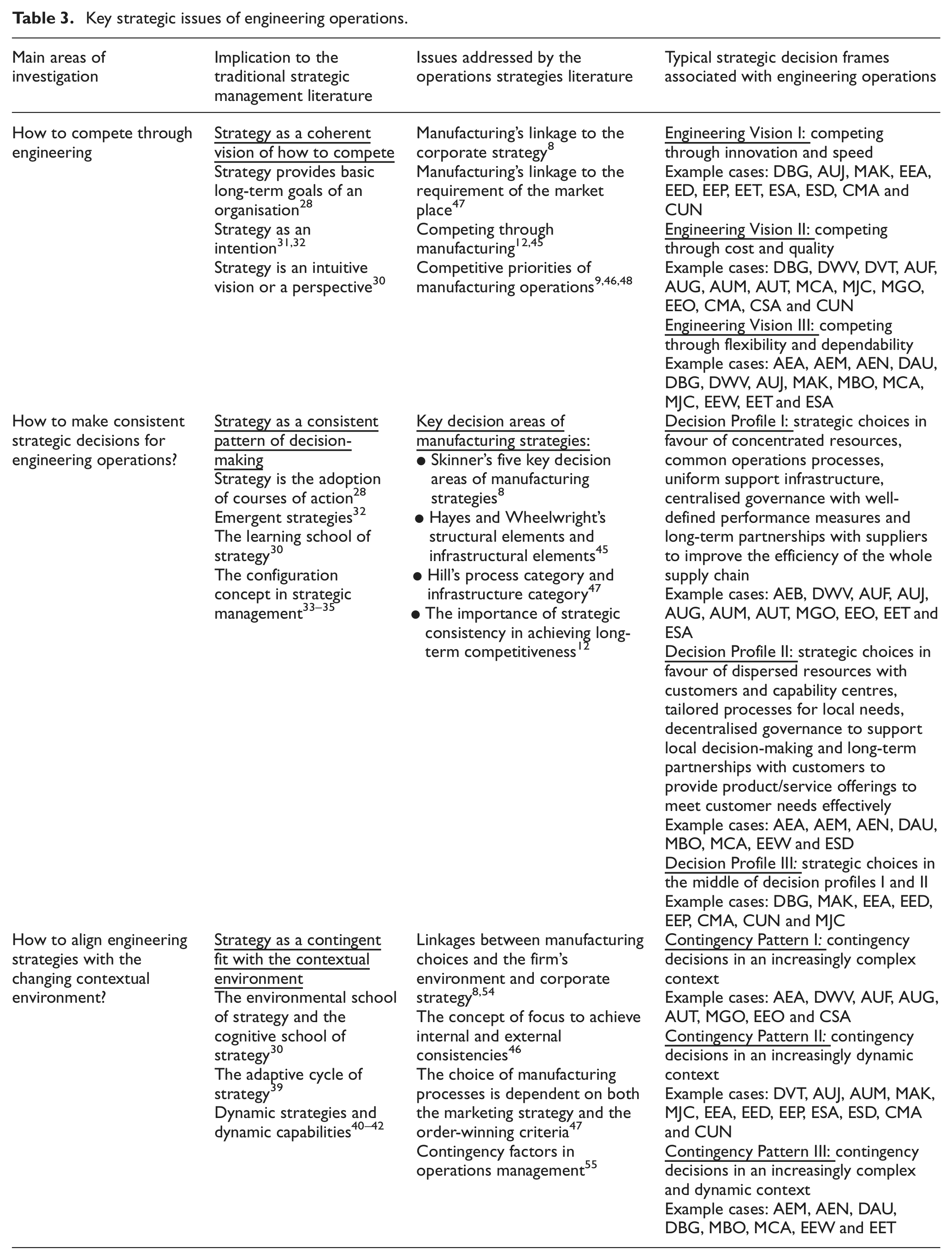
Implications of the case study observations have been analysed from the three theoretical perspectives suggested by the conceptual framework. Table 3 presents the key strategic issues observed in the case companies’ engineering operations as well as indicating their linkages to the existing strategic management theories.
Key strategic issues of engineering operations.
How to compete through engineering?
Engineering operations in the case companies become increasingly invisible to decision-makers due to the involvement of intangible skills and know-how dispersed around the world. Engineering strategies in the case companies are expected to provide a coherent vision of how to compete through engineering by visualising engineering’s contribution to the overall competitiveness of the companies. Such a vision is also expected to indicate its linkage to the corporate strategy or business strategies and provide guidance for managers to define the required capabilities, desired performance and competitive priorities of their engineering operations.
The concept of engineering value chain has been used to improve the visibility of different types of engineering activities by articulating their contribution to the customer value. A basic engineering value chain model consists of engineering activities spanning from idea generation and selection, to design and development, production and delivery, service and support, and recycling and disposal. Tailored models were adopted in some case companies by expanding or focusing on some particular segments according to their business needs. Three typical decision frames have been observed along the engineering value chain:
Engineering Vision I: competing through innovation and speed. Research and design-oriented engineering activities tend to emphasise competitive priorities such as innovation and speed.
Engineering Vision II: competing through cost and quality. Production-oriented engineering activities usually pay a lot attention to competitive priorities such as cost and quality.
Engineering Vision III: competing through flexibility and dependability. Service and support-oriented engineering activities tend to emphasise competitive priorities such as flexibility and dependability.
How to make consistent strategic decisions for engineering operations?
Engineering operations in the case companies are increasingly complex due to the expanding scope of engineering expertise required for effective problem-solving as well as the involvement of multiple organisations within global supply networks. Lack of clarity has been a main challenge for managers to successfully achieve business objectives with a wide range of engineering decisions. For a consistent pattern of decision-making in engineering operations, the case companies have dedicated numerous efforts in clarifying key strategic decision areas and specifying their linkage to business objectives and the required engineering capabilities. The case study observations suggested key strategic decisions of engineering operations within five main areas, including engineering resources, operations processes, external relationships, support infrastructure and governance systems.
Table 4 presents some example choices observed from the case studies that form the basis of a wide range of decision frames associated with engineering strategies. Three typical decision profiles have been observed along these five decision areas:
Key engineering strategy decision areas.
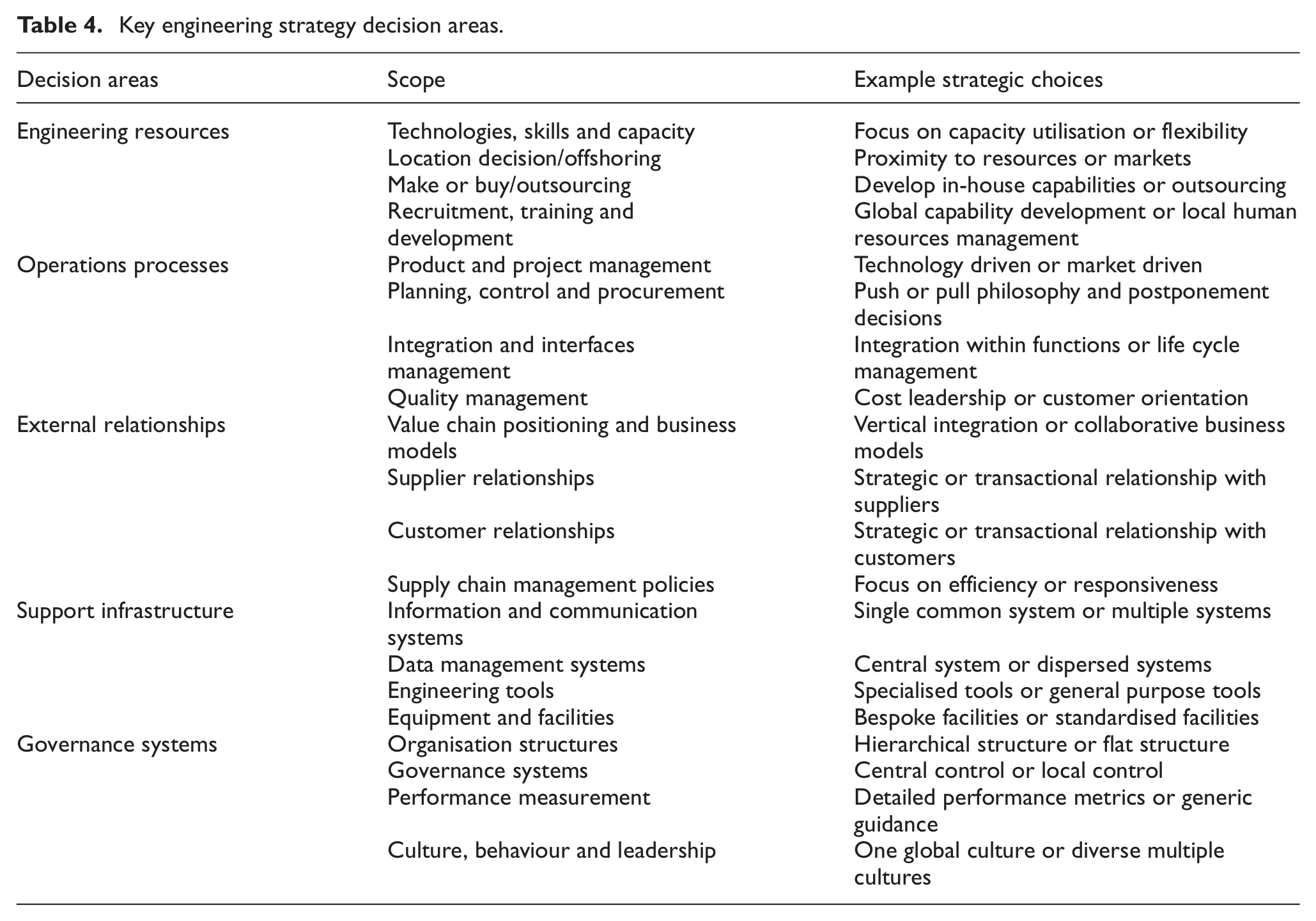
Decision Profile I. The case companies tend to emphasise strategic choices in favour of concentrated resources, common operations processes, uniform support infrastructure, centralised governance with well-defined performance measures and long-term partnerships with suppliers to improve the efficiency of the whole supply chain.
Decision Profile II. The case companies tend to emphasise strategic choices in favour of dispersed resources with customers and capability centres, tailored processes for local needs, decentralised governance to support local decision-making and long-term partnerships with customers to provide product/service offerings to meet customer needs effectively.
Decision Profile III. This profile was in the middle of the aforementioned two profiles. On one hand, the case companies with this decision profile need to be close to leading technology bases or customer bases and leave room for creativity and diversity. On the other hand, the case companies need a certain degree of critical mass to develop leading capabilities in core engineering areas, as well as some level of standardisation to guide the often random and unpredictable innovation activities.
How to align engineering strategies with the changing contextual environment?
Engineering operations require a dynamic decision-making process to cope with rapidly changing customer needs and emerging technologies. Lack of contingency has been a main challenge for most of the case companies to effectively align engineering capabilities with the changing contextual environment. The case companies have strived for the congruence (or co-alignment) between engineering decisions and the contextual environment through continuously examining contextual changes and updating engineering strategies in response to the changes. Echoing the traditional contingency theories,13,55,74 the case study observations suggested two sets of contextual factors that are critical to the formation and implementation of engineering strategies. One was about the complexity of engineering operations, that is, the heterogeneity and range of activities relevant to engineering operations. The contextual complexity of the case companies has been influenced by the nature of the products, processes and organisations for which their engineering systems serve. The other was about the dynamics of engineering operations, that is, the degree of changes relevant to engineering operations. The contextual dynamism of the case companies has been influenced by the nature of the technology environments, markets and industries within which their engineering systems operate. The case studies suggested three typical contingency patterns:
Contingency Pattern I. Strategic decisions in an increasingly complex context often emphasise the integration and efficiency of engineering operations. The relevant practices include resource rationalisation, high capacity utilisation, common operations processes, centralised governance, common support systems and lean supply chain management.
Contingency Pattern II. Strategic decisions in an increasingly dynamic context often emphasise the learning ability and innovativeness of engineering operations. The relevant practices include enhancing technology leadership, adaptable processes, autonomous governance, dedicated support systems and close relationship with leading customers, main suppliers and external research organisations.
Contingency Pattern III. Strategic decisions in an increasingly complex and dynamic context often emphasise the adaptation ability and flexibility of engineering operations. The relevant practices include global presence of engineering resources, customised processes, local control with central influence, tailored support tools for local needs and agile supply chain management.
Further discussions on the key research areas
It is expected that this research would help to shape a strategic view of engineering operations. For this purpose, a conceptual framework has been developed to present the key strategic issues in engineering operations from the perspectives of contexts, capabilities and configurations (see Figure 1 and Table 3). Based on this framework, Figure 2 suggests a set of research propositions (P1–P3) that may hopefully provide step stones for the further developments and refinements of engineering strategies in the future.
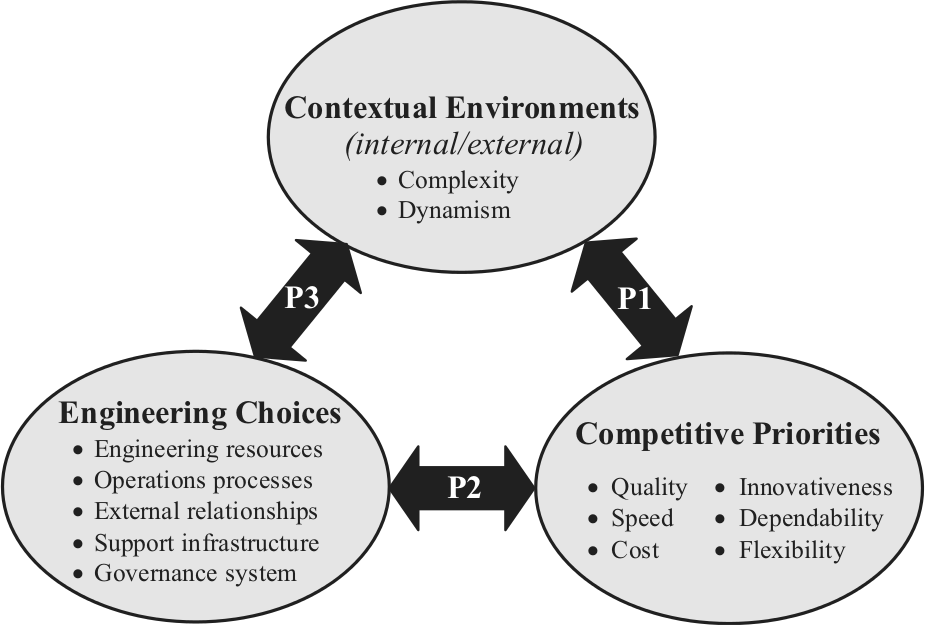
A suggestive research agenda and main research areas.
Complexity and dynamism of the contextual environment determine the selection of competitive priorities in engineering operations (P1)
The choice of organisational strategies includes not only the establishment of structural forms but also the manipulation of environmental features and the choice of relevant performance standards. Contextual environments consist of external and internal factors contributing to the complexity and dynamism aspects of environmental contingencies. P1 would first call for further investigations to understand how to effectively use engineering strengths as a competitive weapon for achieving business goals.8,10,45 Second, P1 would suggest a close examination of the contextual factors that determine the selection of a particular type of engineering strategies. Third, it would be useful to explore the emergence of ‘generic engineering strategies’ as a point of reference by taking suggestions from manufacturing strategists.49,75
Selection of competitive priorities influences engineering choices in the key strategic decision areas (P2)
The top-down approach has formed the basis for many observations on how to develop manufacturing strategies.8,45,47,51 An essence of this approach or its alternative forms 10 has been about matching manufacturing choices with the chosen competitive priorities to achieve business or corporate goals.45,46,76 P2 would suggest engineering strategists to adopt this popular approach with caution, considering a stronger reverse link from engineering choices to competitive priorities. A simple transfer of the typical forms of manufacturing operations (e.g. product, project, batch, assembly line or continuous flow) may not work automatically, because the underlying volume–variety patterns play a less significant role in an engineering setting. The case studies would encourage managers to understand different kinds of engineering activities and their value creation mechanisms, which may have a strong implication in selecting competitive priorities and thus making engineering choices.
Contextual environments constrain engineering choices (P3)
Strategists paid rather little attention to the linkage between environment and structure because strategic choices may reduce the relationships between environment and structure to insignificance; 34 a weak link has been observed between structure and environment 50 or organisation structure might not be tightly linked to organisational practices. 77 In contrast to such observations, the case studies indicated much stronger and more complex links between engineering choices and the contextual environment. A main reason perhaps is that engineering choices are based on a financial model different from that of manufacturing, with less burdens of fixed cost items such as expensive equipments or sophisticated facilitates, for example, that is, a less significant sunk-cost effect. 78 This may however lead to a problem for the case companies, especially those from the mature sectors, to justify the strategic importance of engineering simply by calculating its contribution to the overall cost of a product or project.
Managerial implications
Engineering managers are often expected to resolve strategic problems with no or very little guidance on how to do so. It seems that the decision-maker who carefully answers the question ‘what do I really want?’ will eventually achieve coherent preferences in decision-making. 21 This oversimplified approach is arguably infeasible or inadequate due to the overwhelming complexity and vast variations of strategic choices associated with engineering operations.
The current research highlighted the essential strategic elements of engineering operations with a primary objective of guiding managers to make effective strategic decisions. The conceptual framework and the associated decision frames can help managers to analyse their current engineering strategies or formulate new engineering strategies for future success by focusing on the three key task areas. This section will offer a set of guidance in the context of a defence engineering company, coded as DBG in Table 1. In the recent years, DBG launched a programme to review its global engineering operations at a strategic level with two main objectives: (1) to deliver fit-for-purpose, innovative capability to meet customer requirements and (2) to achieve DBG’s overall strategic objectives. The programme has been focused on three key task areas.
Task 1: creating a strategic vision of how to compete through engineering
Task 1 requires managers to create a strategic vision for their engineering operations to effectively support the corporate strategy through articulating what engineering should do to achieve the main business objectives, including the key capabilities areas and competitive priorities. If a company has different business divisions or operations areas, managers need to translate the group-level engineering vision into divisional or sub-level engineering visions to reflect their particular business needs.
For example, DBG’s engineering strategy review programme began with articulating what engineering should do to support the main business objectives. A strategic vision of engineering operations was created to support the following corporate strategy (In most of the case companies, a statement of the corporate strategy was available and the key business objectives were well defined. If not, the top management would develop such a statement collectively with all the key functions including engineering, marketing, corporate management and so on): Our vision, at a group level, is to be the premier global defence, security and aerospace company. Our mission is to deliver sustainable growth in shareholder value through a commitment to total performance. Our strategic objective is to deliver total performance, representing the commitment to customer focus, financial performance, programme execution and responsible behaviour, which enables us to be agile in developing the business, and adapting its capabilities to the changing priorities of customers.
Through its corporate engineering council chaired by the chief operations officer, the above-mentioned statement was translated into a vision of ‘what this means to engineering’, including three main objectives to achieve the vision: Our engineering operations aim to deliver innovative, enduring, affordable and timely capability to our customers, through development of, and collaboration across, our global engineering resources and thus create sustainable growth in share holder value. This vision will be achieved through (1) maintaining high professional standards throughout the engineering lifecycle; (2) delivering continuous capability improvement in our people, processes and technology; and (3) exploiting the knowledge and experience of the global engineering resource through collaboration.
This group-level engineering vision and objectives were then translated into divisional/regional engineering visions and objectives to reflect their capabilities and specific business needs. The following is an example of the engineering vision of a regional business division: Our aim is to be the government’s through life capability management partner for the armoured fighting vehicle fleet. We will be a focused and high performance engineering function with a common capability ethos delivering unsurpassed through life integration capability. We will achieve this vision by providing products designed to meet customer expectations and built to a high standard quality, delivered on-time and at the lowest achievable cost; providing in-service support ensuring high availability and continued improvements; and providing intelligent supplier capability through developing options to assist the customer in meeting front line requirements.
Task 2: making consistent engineering choices in the key decision areas
Task 2 focuses on developing a consistent decision profile along the five main decision areas. The decision-making process concerns about how to achieve the engineering vision and objectives, as well as the possible transformation process if the current engineering system cannot support the objectives. A configuration approach helped to improve the internal consistency among the engineering choices. Managers with different responsibilities collectively proposed configuration options by combining alternative engineering choices with reference to the three typical decision profiles or some good practices if available. The options were then evaluated against their supportiveness for the engineering vision and key objectives. An ideal (or congregated) configuration was created by developing a common ground based on the highest ranking options to support the engineering vision.
Task 3: aligning engineering strategy with the contextual environment
Engineering strategy development should be considered as a dynamic, iterative process, which involves the tasks of shaping a vision, making strategic choices and aligning to contextual changes. Managers need to identify the internal and external factors driving contextual changes. These factors will be interpreted from the aspects of dynamism and complexity and then matched with the key strategic decision areas. The response from individual decision areas will feed into the process to shape a new engineering vision, which will consequently trigger a new round of strategic choices to support the vision.
For example, the external changes of customer requirements and markets were summarised in a business division of DBG, as follows: The defence market has changed over the last ten years, slowly moving towards ‘support engineering’ driven solutions … This means that we now have a customer base that is very well educated regarding what drives their support engineering methodology … We have a world-wide customer base with a very wide variety of needs. Communication links with the customer are vital in the early stages of a project and throughout the process.
Internal changes were identified in the following: The business driven requirements are aimed at meeting the customer/market requirements and following overall business vision of the group. Key requirements include: (1) to enhance our business performance with the provision of the best available skills, tools and resources; (2) to create a culture which is performance focused, motivational and enjoyable; (3) to adapt and change to facilitate continuous improvement in our business performance; (4) to grow our business profitably; and (5) to invest in leading edge technology and business solutions for competitive advantage and customer satisfaction.
The above-mentioned contextual changes were interpreted from the aspects of dynamism and complexity. Key factors influencing the contextual dynamism include the following: (1) customers require quick response, (2) the increasing importance of suppliers, (3) rapidly changing core technologies and (4) the defence industry is moving towards service and support engineering. Key factors influencing contextual complexity include the following: (1) the ongoing trend towards system integration in defence products and services, (2) the need for engineering processes based on total through life management and (3) the need for an organisational structure that is performance focused and customer driven. These contextual changes were then matched with main engineering capability areas to work out what these changes mean to their engineering operations. The response from individual capability areas was fed into the process to shape a new engineering vision, which consequently triggered a new round of strategic decisions to support the vision.
Conclusion
This article reveals that the lack of a strategic view of engineering operations has led to visibility, clarity and contingency problems in companies of different sizes and from different sectors. Based on the reported case studies with UK-based engineering organisations, this article introduced a strategic view of engineering operations to address the major strategic issues in the current business environment. Associated with the intangible nature of engineering and the lack of visibility in engineering operations, an engineering strategy provides a coherent vision of how to compete through engineering by visualising engineering’s contribution to the overall business and articulating its linkage to the corporate strategy. Associated with the complex nature of engineering and the lack of clarity in engineering operations, an engineering strategy involves a consistent pattern of decision-making within the areas of engineering resources, operations processes, external relationships, support infrastructure and governance system. Associated with the reactive and adaptive natures of engineering and the lack of contingency in engineering operations, an engineering strategy ensures the congruence between engineering strategy decisions and the changing contextual environments.
This article contributes to an improved understanding of operations strategies with engineering cases. It provides a conceptual framework to present the key strategic elements of engineering operations from the perspectives of contexts, capabilities and configurations. Based on this framework, three key research areas have been identified to suggest an agenda for the further developments and refinements of engineering strategies. This will eventually extend the traditional concepts of operations strategies that were mainly focused on manufacturing operations.9,12 It is also expected that the current research may contribute to a new body of knowledge that focuses on engineering operations and that likely bridges engineering and manufacturing management, as well as other innovation and technology management areas in the future.59,60
This article would suggest four main directions for further investigation beyond the limited scale and scope of the reported research project. First, the authors are cautious about the theoretical contribution of a case study-based research approach and would therefore like to suggest a following-up theory testing research. That will be based on large-scale empirical data from a broader scope of industry sectors to identify common decision frames and draw generic conclusions useful to engineering operations in a particular situation. Second, the reported research was mainly focused on UK-based engineering organisations. It would be logically appropriate to carry out comparative studies in other countries, especially developed countries in a different industrial setting or emerging countries with increasing engineering capabilities. Third, the reported research was focused on the rational side of engineering strategies. However, the rational choice model of decision-making has long been challenged by psychologists or sociologists.38,79 This would suggest a promising research area by focusing on the behavioural or political aspects of engineering operations. The last but not the least, the reported research was focused mainly on firm-level issues. Considering the strategic importance of engineering to economies and societies around the world,3,18 it would be of great value to extend the scope of research to address engineering issues at an industry level or at a country level, in order to answer questions like how to strategically develop and sustain high-value engineering capabilities for an industry or in a country?
Footnotes
Funding
This research has been supported by the Seventh Framework Programme of the European Union through Marie Curie Actions IRSES Europe-China High Value Engineering Network (EC-HVEN), Grant No. PIRSES-GA-2011-295130.