




Abstract
This article examines some of the recent theological critiques of the movement of technological human enhancement known as ‘transhumanism’. Drawing on the comparisons between grace and technology often found in the theological discourse on transhumanism, this article argues that the Thomistic distinction between healing grace and elevating grace can not only supplement the theological analysis of transhumanism and its ethical implications, but also help Christian theologians and ethicists become more aware of how the phenomenon of technology may have implicitly shaped the contemporary understanding of ‘grace’ as well as the task of theology as a spiritual and indeed ethical practice.
Introduction
Recent years have witnessed a surge in interest in the controversial movement of technological human enhancement known as ‘transhumanism’, not only in the academic study of the intersection between religion and science, but also in Christian theology and ethics. 1 Much of the existing theological engagements with transhumanism have offered doctrinal and ethical assessments of various technological processes and ambitions, often characterising transhumanism as some kind of secularised parody or even heresy of traditional Christian theology. As opposed to these theological critiques, this article seeks to examine a number of meta-theological questions concerning the nature and practice of theological inquiry in light of the recent theological engagement with transhumanism. Accordingly, instead of drawing on literature from transhumanist theorists, this article engages primarily with the theological discourse on technological human enhancement.
By reflecting on the comparisons between grace and technology often found in the recent theological discourse on transhumanism, this article seeks to consider how the phenomenon of ‘technology’ may have unconsciously shaped the practice of theological reflection. Drawing on Thomas Aquinas’s account of grace and nature as a model to help our understanding of the relation between technology and human nature that is key to debates concerning transhumanism, this article argues that the Thomistic distinction between healing and elevating grace can not only supplement the theological analysis of transhumanism and its doctrinal and ethical implications; moreover it can help us become more aware of how the phenomenon of ‘technology’ may have implicitly shaped—or even ‘technologised’—the contemporary understanding of ‘grace’.
The Theologisation of Technology
While there are many issues surrounding the transhumanist movement and many types of human enhancement technologies, much of the theological discussions of transhumanism have largely focused on the hypothetical process of ‘mind uploading’: the belief that human consciousness can be uploaded to computer systems to replace the biological human body altogether and thereby attaining some form of ‘cybernetic immortality’.
2
This transhumanist account of radical life extension is perhaps most famously espoused by the contemporary American inventor Ray Kurzweil, who envisions that this mode of cybernetic ‘eternal life’ will be imminently realised at the moment which is often called the ‘Singularity’, when computers or machines acquire a mode of super-intelligence which far exceeds human intelligence as we know it. As Kurzweil writes in his controversial work The Singularity is Near: The Singularity will allow us to transcend these limitations of our biological bodies and brains. We will gain power over our fates. Our mortality will be in our own hands . . . The Singularity will represent the culmination of the merger of our biological thinking and existence with our technology, resulting in a world that is still human but that transcends our biological roots. There will be no distinction, post-Singularity, between human and machine or between physical and virtual reality.
3
All this discussion of transcending our limitations or indeed our finitude, of attaining immortality through disembodied existence (or at least non-biological existence), as well as the quasi-eschatology of the moment of ‘Singularity’ obviously raises many interesting and timely theological questions.
One notable way in which theological scholarship has approached transhumanism is to highlight the parallels between the transhumanist aspiration to achieve immortality and the Christian understanding of salvation and eternal life. In fact, the leading Christian scholar of transhumanism Ronald Cole-Turner goes so far as to claim that ‘transhumanism’ has its genealogical roots in Christian soteriology. To quote Cole-Turner at some length: [T]ranshumanism is a Christian concept. Its origin lies in Christianity, not in technology. The word itself goes back to the poet Dante, who invents the word in an attempt to describe just how great a transformation lies ahead for human beings as they make their way by grace to glory. How can a mere mortal speak of the glory that lies ahead? For Dante, a new word is needed; and so he writes: ‘Trasumanar significar per verba non si poria’ (Paradiso canto 1, line 70) [‘to go beyond the human is something that cannot be described in words’] . . . Dante’s trasumanar is a novel alternative to more traditional words like theosis and divinization.
4
Following this etymological link, Cole-Turner argues that ‘At its core, transhumanism is authentically and essentially Christian. Its theological foundations rest squarely in the core of Christian revelation.’
5
However, Cole-Turner also notes: Transhumanism and Christianity divide, however, on how we think about the cause of the changes that lie ahead for humanity. For transhumanists, the cause or the agent of human transcendence is technology. For Christians, it is grace, the underserved goodness of God who gives life and wholeness to the creation.
6
Here we find a comparison between grace and technology as the means by which one attains immortality or some kind of human perfection that is often found in the theological discourse on transhumanism—one that is found not only in Cole-Turner’s influential scholarship, but also in the work of Ted Peters, a leading Lutheran theologian and science-religion scholar who is comparatively more critical of transhumanism.
According to Peters’s Lutheran-Augustinianism, the transhumanist faith in technological progress is reminiscent of a Pelagianistic belief in the possibility of attaining moral progress or indeed moral goodness through human effort without the help and guidance of grace: ‘No amount of increased intelligence will redeem us from what the theologians call sin’. 7 With this crypto-Pelagian tendency to play down or altogether overlook the human condition of sin, Peters argues that transhumanism is not only at risk of projected unrealistic utopian accounts of a technological future, but it is also, more importantly, in danger of magnifying human capacities for destruction: ‘our capacity to tarnish what is shiny, to undo what has been done, to corrupt what is pure’. 8
In addition to its ethical consequences, Peters argues that transhumanism’s belief in progress and its utopian optimism to move beyond human finitude and the human need for grace—and ‘leave sin behind’—is also problematic for its doctrinal implications for soteriology.
9
To quote Peters’s powerful account at some length: From the theological perspective, the world within which we live is fallen, subject to corruption, deterioration, and destruction. The only human being we have come to know is the sinful human being, and no amount of technology will fix this within history . . . The fallen or corrupt dimensions of life on Earth need addressing, and the Christian doctrines of grace, forgiveness, and transformation are aimed at confronting sin. To simply live forever in our fallen state, as [transhumanism proposes] in cybernetic immortality, would not constitute redemption. If anything, it would give corruption an everlasting license.
10
As opposed to attaining immortality or even ‘divinity’ by means of technology, Peters emphasises that ‘divinization is the result of divine grace and not an autonomous human achievement’. 11
Technology as Grace?
But is it fair to simply assert that ‘transhumanism’ is a kind of secularised vision of Christian theosis which seeks to replace divine grace with human technology? Does the aspiration to improve the living conditions of human beings through technology always amount to some ‘transhumanist’ crypto-soteriology? What is the difference between technological human enhancement and using technology to improve one’s health and well-being?
The distinction between technological ‘enhancement’ and regular ‘therapy’ is addressed in the theological discourse on transhumanism by both Cole-Turner and Peters. For Cole-Turner, ‘if we are going to address the topic of enhancement at all, we find ourselves drawing the therapy/enhancement distinction in order to limit the scope of the subject matter before us’.
12
Indeed, such a distinction between technological enhancement and therapy is one that is drawn by Peters in his theological critique of transhumanism: By ‘therapy’ we mean healing . . . restoring health. By ‘enhancement’ we refer to medical measures that improve an individual’s functioning or improve the human species beyond what had previously been thought to be its norm . . . Enhancement is distinguished from therapy here because it involves efforts to make someone not just healthy, but better than healthy. More than offering a cure, enhancement optimizes attributes or capacities beyond what good health requires.
13
However, as opposed to the simple twofold division between therapy and enhancement drawn by Cole-Turner, Peters speaks of ‘transhumanism’ as taking a further ‘third’ step beyond both therapy and enhancement: Beyond enhancement, the open arms of transhumanism seem to be welcoming us . . . Through genetic technology, information technology and nanotechnology transhumanists believe the possibility exists for us to greatly enhance the healthy lifespan of persons, increase intelligence, and make ourselves happier and more virtuous. The key is to recontextualise humanity in terms of technology . . . This leads to a vision of posthuman future characterized by a merging of humanity with technology as the next stage of our human evolution . . . We are on the brink of becoming more than human, say the transhumanists.
14
As we saw earlier in the theological scholarship on transhumanism, technology is often portrayed as a kind of transhumanist parallel or parody of the theological notion of ‘grace’ in Christian thought. 15 Following these comparisons, we can further see how the categorisation of therapy, enhancement and transhumanism can be mapped alongside Thomas Aquinas’s teachings on grace.
In question 109 of the first part of the second part of the Summa Theologiae, 16 the opening question of the so-called ‘Treatise on Grace’ (QQ. 109–114), Aquinas makes a distinction between healing grace (gratia sanans) and elevating grace (gratia elevans). 17 Whereas healing grace restores humans to an un-fallen state of natural perfection where humans can perform perfect actions in accord with their natural capacities (e.g., the acquired virtues of prudence, justice, temperance and courage), elevating grace brings the human to an elevated—or, as it were, enhanced—state in which the human can ‘carry out works of supernatural virtue’, as Aquinas puts it in article 2. 18 Or as he remarks later in article 9: grace is ‘a habitual gift whereby corrupted human nature is healed [sanetur], and after being healed is lifted up [elevetur] so as to work deeds meritoriously of everlasting life, which exceed the capability of nature’. 19
Like therapy, healing grace restores the human to its pre-lapsarian ‘natural’ state—it, so to speak, ‘undoes’ the effects or disease of sin, whereas elevating grace brings about an elevation or even an ‘enhancement’ of human nature to a kind of ‘supernatural’ state in which the human can perform actions in accord with their ultimate supernatural end of eternal life which exceeds the proportion of human nature. Put somewhat bluntly: therapy is to enhancement what healing grace is to elevating grace. 20
But what about transhumanism as what Peters calls a ‘third step’ beyond therapy and enhancement? As we saw in the works by Cole-Turner and Peters, there is a somewhat unclear line between technological human enhancement and transhumanism: Cole-Turner does not categorically distinguish the two while Peters defines transhumanism as the state of enhancement in which humanity becomes merged with technology (and even thereby attaining a form of immortality). Paralleling Peters, we may say that Aquinas speaks of the beatific life as a mode of graced existence that mirrors transhumanism: a super-natural state in which the human is in union with God as a ‘full participation of Divinity’ (plenam participationem divinitatis).
21
As Aquinas puts it: the gift of grace surpasses every capability of created nature, since it is nothing short of a participation in the Divine Nature [participatio divinae naturae], which exceeds every other nature . . . God alone deifies [deificet], bestowing a partaking of the Divine Nature by a participated likeness.
22
Not unlike Kurzweil’s account of the Singularity as ‘the merger of our biological thinking and existing with our technology, resulting in a world that is still human but that transcends our biological roots’, 23 the ‘union with God’ as a supernatural participation in the Divine Nature envisioned by Aquinas is a ‘merger’ of our created nature with divine grace or indeed God’s Divine Nature, 24 one where the deified human creature is ‘still human’—still distinctly created—but nonetheless ‘transcends’ our ‘biological roots’ or indeed our natural capabilities of created nature. 25 It is none other than the deified state of (trans)human existence which ‘surpasses every capability of created nature’ and ‘exceeds every other nature’ that Cole-Turner identifies with Dante’s notion of trasumanar: ‘to go beyond the human . . . something that cannot be described in words’. 26
As such, Aquinas’s twofold distinction between (1) healing grace and (2) elevating grace as well as his account of (3) grace as a deifying participation in God can provide us with a typological model that parallels the characterisation of technology as (1) therapy, (2) enhancement and (3) transhumanism found in the theological discourse on transhumanism, 27 as represented in Table 1.
Grace and Technology.
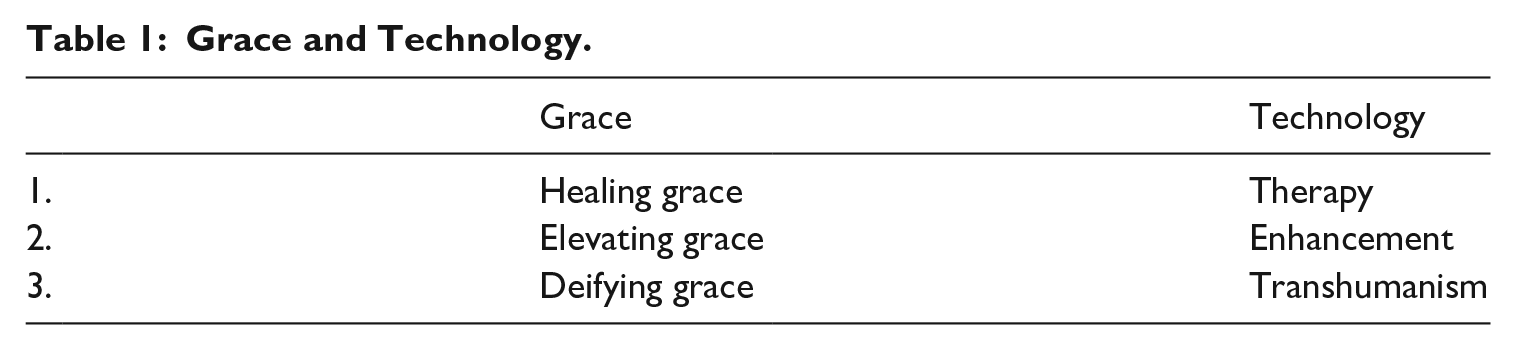
But aside from providing a theological model to schematise the categories of therapy and enhancement (and transhumanism), as we shall see in the next section, Aquinas’s typology of healing and elevating grace can also help us further examine the extent to which transhumanist technology can be understood as a form of ‘secular’ grace which confronts or even removes human sin.
Grace as Technology?
In a recent article, Simeon Zahl raises a number of insightful theological questions about the possibilities of the elimination of sin through technological enhancement.
28
Commenting on the transhumanist goals of modifying human affects, desires or even moral character through gene therapy and neuro-technology, Zahl asks: Could Christians enhance their way out of the desire for another person’s spouse that is talked about in the Ten Commandments and in the Sermon on the Mount? . . . Does this mean Christians will in principle be able to ‘hack’ the sin of adultery in the future, using technology to preclude it as a physiological and psychological possibility, if they so choose? . . . [If antidepressants can enable] a depressed parent to give their child loving attention . . . does it mean that antidepressants are helping us, in a quite concrete way, to sin less, and to become more sanctified? To put it bluntly: are such enhancement technologies a kind of immanent means of grace?
29
According to Zahl, even if technology can help us ‘alter our relationship to particular sins’ and ‘avoid some behaviours traditionally associated with sin’, technological enhancement ‘will only ever be able to change the body in relation to future sin. Soteriologically speaking, it will not be able to undo the moral reality of suffering and damage done in the past.’ 30
Following Peters, Zahl argues that ‘even if you could change specific dimensions of these human propensities, . . . sin will always find new ways to manifest’. 31 Although technological enhancement can, in theory, ‘perhaps’ facilitate ‘specific dimensions of sanctification’ by reducing or even—altogether removing—the human tendency of committing future sins, for Zahl, transhumanist technology cannot eradicate humanity’s sin(s) of the past; it cannot eliminate the original sin of Adam.
Here perhaps one can take a more speculative step beyond Zahl: even if transhumanist technology can in some sense ‘heal’ humanity of its fallen tendency to sin and somehow restore humanity to an ‘unfallen’ state where humans can perform perfect actions in accord with their natural end, in principle, technology still cannot replace grace insofar as grace does not simply ‘heal’ human nature but moreover ‘elevates’ it: to the extent that finite human beings have a supernatural end that is beyond their natural capacity, grace is still needed for ‘sinless’ humanity to fulfil their telos. 32 As such, even if technological enhancement can somehow make humanity ‘sinless’ or even attain some form of immortality, given that such ‘unfallen’ human nature would still require grace to attain to humanity’s ultimate end which exceeds its natural capacity, 33 technologically ‘healed’ humans would in principle remain ‘finite’ insofar as they are in need of divine help to attain their end. 34 Insofar as it is an extension of technology or indeed an outworking of ‘natural’ human reason, technological human enhancement is by definition within humanity’s natural capacities—it remains proportionate to the nature and limitations of finite human beings. 35
In this regard, on a ‘meta-theological’ note, the technological human enhancements envisioned by transhumanism is important for theology and ethics not only as a set of possible ethical dilemmas and problems to which Christian theologians and ethicists may develop some contemporary ‘Christian response’ or even some theological ‘solution’, but also ‘as a useful tool for reflecting on a number of specific theological and ethical questions’. 36 Indeed, as we have seen in this section, the engagement with transhumanism can provide Christian theology with hypothetical scenarios as speculative thought experiments—not dissimilar to the counterfactual reasoning in medieval scholasticism—to reflect on a number of theoretical issues such as the relation between grace and nature or even the distinction between sin and finitude. 37
However, despite the many comparisons between technological human enhancement and theosis in the recent theological literature on transhumanism, the theological comparison between grace and technology has perhaps focused on grace purely in terms of ‘healing’ and not in terms of ‘elevating’ or indeed ‘deifying’—which may partly explain the recurring worries that technology can somehow replace grace and thereby ‘leave sin behind’. While it may be argued that there is in principle no chance—or indeed no ‘danger’—that technology can ultimately fully replace grace, this does not mean that technology has no effects on humans’ receptivity to grace. 38
For instance, the American philosopher of technology Albert Borgmann argues that insofar as ‘modern technology [is] an approach to reality that aims at transparency and control’, it has severe effects on the receptivity to grace in contemporary technological society: Grace is always undeserved and often unforeseen, and a culture of transparency and control systematically reduces, if it does not occlude, the precinct of grace. A technical term for what lies beyond prediction and control is contingency. What we need to recover, then, as a condition of receiving grace, is the realm of significant contingency.
39
Although Borgmann (writing in 2002) does not mention human enhancement technology, it may be argued that modern technological culture’s aim to eliminate contingencies is exemplified by the transhumanist goal of making death optional or indeed controllable: to radically reduce or conceal the sense of contingency that is intrinsic to factical human existence. Indeed, here we may recall Kurzweil’s aspirational transhumanist vision: ‘We will gain power over our fates. Our mortality will be in our own hands.’ 40
What Borgmann’s account on grace highlights is how ‘technology’ impacts human beings not just as a concrete ‘ontic’ phenomenon of science and engineering, but as what may be called an ‘ontological’ understanding of being—what Borgmann calls ‘an approach to reality’. 41 Borgmann’s ‘ontological’ understanding of technology is deeply influenced by Martin Heidegger, for whom ‘technology’ is a particular way of thinking which enframes and orientates the modern mind. 42 While it is not the goal of this article to expound Heidegger’s complex account of ‘technology’, 43 the German philosopher’s influential critical assessment of modern technology can provide us with an interesting ‘meta-theological’ perspective to further evaluate the conception of ‘grace’ in the recent theological discourse on transhumanism. 44
As Martin Gessmann succinctly summarizes Heidegger’s account of technology: Technology in Heidegger’s sense equals technical thinking, and technical thinking is, in turn, identical to technical problem-solving. To solve a problem ‘technically’ means to look for a solution that is rationally comprehensible and therefore impossible to surpass.
45
When considered in light of this (albeit much simplified) Heideggerian perspective, we can see that there is another way in which technology as ‘an approach to reality’ or indeed a way of thinking as ‘technical problem-solving’ may affect our understanding of grace. 46 For if grace is understood primarily—or even exclusively—as an instrumental ‘solution’ to the problem of sin, 47 then it may be argued that the comparison between grace and technology in the theological discourse on transhumanism has been unconsciously shaped by the problem-solving paradigm of modern ‘technological’ thinking: as if grace was merely some kind of problem-solving mechanism or technological device whose sole function or purpose is to ‘heal’ or ‘solve’ the ‘problem’ of sin. 48
The Technologisation of Theology
While such a ‘post-Heideggerian’ characterisation of a ‘problem-solving’ doctrine of grace is admittedly hyperbolical, it may be argued that a ‘technological’ outlook that sees grace merely as an instrumental solution to sin runs the risk of defining grace not by the goal to which it elevates humanity—what Aquinas calls the participation in the Divine Goodness, 49 but inversely by the very ‘problem’ of sin which grace ‘solves’. 50 To this extent, a ‘technological’ conception of grace which focuses principally or even purely on the functional or mechanical aspects of ‘healing’ grace and overlooks the ‘elevating’ dimension of grace would be one that is reflective not only of the dominance of instrumentalism but also the oblivion and rejection of teleology in contemporary and modern thinking. 51
As opposed to the pre-modern Aristotelian account of ‘intrinsic’ teleology as the goal-orientated behaviour which belongs to something by virtue of what it is,
52
Simon Oliver points out that if teleological thinking remains in the dominant modern—post-Newton—outlook, it is at best an ‘extrinsic’ teleology: Such teleology has an extrinsic source. Typically, human artefacts—chairs, cars and the like—exhibit extrinsic teleology. As such, extrinsic teleology can also refer to functionalism; an entity’s goal lies beyond itself because it is a means to an end. A car, for example, is not an end in itself, but rather has transport as its goal.
53
As we can see from Oliver’s examples of human artefacts or even technological products, this ‘functionalism’ or ‘extrinsic’ teleology is one that underlies the way we understand technology—or even the way we understand ‘technologically’—in the modern world: This is teleology understood in terms of ‘design’ and which, for Aristotle, belongs to the realm of human artefacts. Nature is not an artefact and, for Aristotle, art only imitates nature. In modernity, nature came to be understood as imitating art, for example in the rise of mechanical cosmologies which were viewed as a kind of natural theology to prove the existence of the designer God.
54
In addition to this modern conception of God as an extrinsic designer, perhaps we may also note that the modern functionalist account of extrinsic teleology may be found underlying recent comparisons of technology to grace. 55 Parallel to the mechanistic conception of the natural world as a set of artefacts in early modern natural philosophy, perhaps there is latent technological understanding of grace as a problem-solving device in the late modern theological discourse on transhumanism: just as nature is understood as an imitation of artefact, grace is understood as an imitation of technology. 56
In light of this, to paraphrase Ted Peters’s characterisation of transhumanism as an endeavour to ‘recontextualise humanity in terms of technology’, one may question whether the theological discourse on transhumanism has had an unconscious tendency to ‘recontextualise grace in terms of technology’. 57 Such a ‘technological’ recontextualisation or even ‘technologisation’ of grace has significant ethical implications not just for one’s understanding of grace and its relation to transhumanist technology or indeed to salvation, but more importantly for the habits of thought which undergird and orientate one’s understanding of particular doctrines such as grace and salvation. 58
As argued above, there is in principle no immediate ‘danger’ that human enhancement technology should be able to eliminate the human need for grace. The true ‘danger’ of technology lies not in its potential to ‘replace’ grace, but instead in its latent abilities in shaping or enframing one’s way of thinking—including one’s theological reflections. This is precisely what Cole-Turner identifies as the greatest challenge that technology poses to Christian theology: Our challenge is not defined mainly in terms of the technologies of human enhancement or in objecting to its use. Our concern is how a culture of human enhancement, bolstered and empowered by technology, perverts our expectations about how best to live and what Christianity has to offer.
59
As if echoing Borgmann’s Heideggerian insights on modern technology as ‘a culture of control’ which subtly orientates our ways of thinking, Cole-Turner’s ‘cultural’ understanding of technology highlights the powers of technology to ‘pervert’ our theological and ethical reflections. 60
As opposed to a ‘technological’ conception of grace as a problem-solving mechanism, a re-emphasis on the ‘elevating’ character of grace can recover a teleological understanding of grace as something that structures one’s habits of thought and orientates one’s way of thinking—as Aquinas puts it, that which orientates or moves (moveatur) one’s intellect towards the Divine. 61 However, unlike the controlling or ‘enframing’ effects of technology on modern thinking (at least as understood by Heidegger and Borgmann), grace is not some rigid mechanism of thought that is extrinsically imposed on the human intellect or indeed on human nature. 62
As Aquinas so famously says in the Summa Theologiae: just as ‘grace does not destroy nature but perfects it, [so] natural reason should minister to faith’.
63
This analogy between grace/nature and faith/reason is key to Aquinas’s understanding of the task and practice of theological reflection, as A. N. Williams notes: The significance of this analogy lies in the thoroughness with which Thomas integrates theological reflection into the general pattern of humanity’s journey to God. Nature’s fulfilment by grace now appears as the paradigm by which we are to understand the mind’s reflection on God.
64
To rephrase Williams’s Thomistic account of grace in light of Cole-Turner’s cautionary words about the cultural challenge of technological human enhancement: as opposed to technology, grace does not destroy or ‘pervert’ (to use Cole-Turner’s word) human nature but perfects it; grace is the ‘paradigm’ by which the human mind is oriented towards a mode of theological reflection that is integrated in the ‘general pattern’ of ‘how best to live’. 65 More specifically, in relation to our current discussion on transhumanism, rather than contextualising grace in terms of technology, grace may be regarded as the ‘paradigm’ or indeed ‘context’ by which we are to understand technology and how it relates to the human telos of participating in the Divine. To paraphrase Peters again, we are to ‘recontextualise humanity in terms of grace’—instead of technology—and in turn also ‘recontextualise technology in terms of grace’. 66
Conclusion
While advancements and developments in technology raise a number of important specific ethical issues for theological reflection, from a ‘meta-theological’ perspective, the contemporary ‘technological context’ presumed and exemplified by the transhumanist movement also provides a number of new venues and platforms for articulating the continued relevance and significance of theological insight in the contemporary world as well as a number of hypothetical scenarios and speculative thought experiments for Christian theology and ethics to refine its theories and arguments. However, despite all these opportunities provided by our contemporary ‘technological context’, one must not overlook how technology as a cultural ‘context’ or even an ontological ‘approach to reality’ enframes and orientates one’s habits of thought. Indeed, as we have seen in this article’s analysis of the characterisation of grace and technology in the recent theological discourse on transhumanism, there is some potential danger of the theologisation of technology inverting into a latent technologisation of theology where theological discourse may have been unwittingly shaped or ‘contextualised’ by ‘technological’ (or even ‘secular’) ways of instrumental thinking. 67
As opposed to a ‘technological’ understanding of grace or even the whole enterprise of theology as some kind of problem-solving mechanism, a renewed ‘teleological focus’ on the ‘elevating’ grace can remind us that, as a supernatural gift from God, grace is in no danger of ever being replaced by human-made technologies insofar as such technologies remain products of ‘natural’ human reason and proportionate to the limitations of humans’ natural capacities.
68
Moreover, at a meta-theological level, a renewed Thomistic appreciation of both the healing and elevating aspects of grace can further remind us that the ethical task of theology is not solely to solve some problem or to liberate human subjects from certain conditions (important as that may be), but to orientate one’s habits of thought and way of life to the Divine as their telos. To quote Williams again: Thomas’ teleological focus acts not only as a corrective to an inverted spirituality but also . . . serves both as a caution against apologetic and against a sterile intellectualism . . . The teleological [guidelines of his theology] invite us to consider God and beatific vision as the end of both humanity and of all theology.
69
Just as grace is the ‘paradigm’ of God-oriented thought, theology is, in the words of Jean-Pierre Torrell, before all else ‘an expression of a God-informed life’. 70
Just as grace must never be simply (and negatively) defined by the ‘problem’ of sin which it ‘solves’ but defined by the telos of participation in the Divine, theology must not be ‘technologically’ understood as some problem-solving mechanism: like grace, theology must be understood and practised with the view of God as its final end. 71 Echoing Cole-Turner’s concerns that technological culture can ‘pervert’ our ways of thinking and Peters’s critique of transhumanism’s agenda ‘to recontexualise humanity in terms of technology’, this article has argued that while the engagement with technological transhumanism has produced many fruitful theological insights, theology must not allow itself to be ‘positioned’ by technology or indeed by the contemporary ‘technological’ reason of problem-solving. 72 Instead, the theological and ethical reflections of technology and the use of technology must be understood or even ‘recontextualised’ in terms of grace as the ‘paradigm’ of God-oriented thinking.
Although the radical application of technology to modify or ‘enhance’ human ‘nature’ may be ethically suspect from a theological perspective, as many theological commentators acknowledge, the human use and invention of technology is by no means inherently sinful. Indeed, as Zahl and others have pointed out, the careful deployment of technology can facilitate spiritual growth in the life of grace. 73 In light of this, the Thomistic typology of healing/elevating/deifying grace can not only supplement the existing categorisation of technology as therapy/enhancement/transhumanism, it can moreover serve as a ‘paradigm’ for the ethical evaluations of how we may use technology—including human enhancement technology—in view of the human telos of participating in the Divine Nature. Instead of allowing technology to enframe or ‘contextualise’ theological and ethical reflection, theology must orientate itself in grace as its ‘paradigm’ of thought in its engagement with transhumanism and any other ‘contextual’ issues. It is only with the teleology of grace that theology can discern the ethical and spiritual implications of technological human enhancement, and indeed realise the ethical and spiritual task of theology as a theocentric way of life. 74
Footnotes
1.
See, for instance, Michael Burdett and Victoria Lorrimar (eds), ‘Deification and Creaturehood in an Age of Biotechnological Enhancement’, Studies in Christian Ethics 32.2 (2019).
2.
For a recent overview of the relevant literature, see Ted Peters, ‘Radical Life Extension, Cybernetic Immortality, and Techno-salvation. Really?’, Dialog 57.4 (2018), pp. 250–56.
3.
Ray Kurzweil, The Singularity is Near: When Humans Transcend Biology (New York: Viking Press, 2005), p. 9.
4.
Ronald Cole-Turner, ‘Going beyond the Human: Christians and Other Transhumanists’, Theology and Science 13.2 (2015), pp. 150–61 (150–51).
5.
Cole-Turner, ‘Going beyond the Human’, p. 151.
6.
Cole-Turner, ‘Going beyond the Human’, pp. 154–55.
7.
Ted Peters, ‘Progress and Provolution: Will Transhumanism Leave Sin Behind?’, in Ronald Cole-Turner (ed.), Transhumanism and Transcendence: Christian Hope in an Age of Technological Enhancement (Washington, DC: Georgetown University Press, 2011), p. 82.
8.
Peters, ‘Progress and Provolution’, p. 64.
9.
Peters, ‘Progress and Provolution’.
10.
Ted Peters, ‘Imago Dei, DNA, and the Transhuman Way’, Theology and Science 16.3 (2018), p. pp. 353–62 (357).
11.
Peters, ‘Imago Dei, DNA, and the Transhuman Way’, p. 359.
12.
Ronald Cole-Turner, ‘Introduction: The Transhumanist Challenge’, in Ronald Cole-Turner (ed.), Transhumanism and Transcendence: Christian Hope in an Age of Technological Enhancement (Washington, DC: Georgetown University Press, 2011), p. 3.
13.
Ted Peters, ‘Perfect Humans or Trans-Humans?’, in Celia Deane-Drummond and Peter Scott (eds), Future Perfect? God, Medicine and Human Identity (London: T&T Clark, 2010), p. 17.
14.
Peters, ‘Perfect Humans or Trans-Humans?’, p. 18.
15.
See also Brent Waters, ‘Whose Salvation? Which Eschatology? Transhumanism and Christianity as Contending Salvific Religions’, in Ronald Cole-Turner (ed.), Transhumanism and Transcendence: Christian Hope in an Age of Technological Enhancement (Washington, DC: Georgetown University Press, 2011), pp. 163–75.
16.
Hereafter cited as ST. Unless stated otherwise, quotations from ST follow the Fathers of the English Dominican Province translation, 2nd edn, 22 vols. (London: Burns, Oates and Washbourne, 1912).
17.
ST I-II.109.2. Cf. John Rziha, Perfecting Human Actions: St. Thomas Aquinas on Human Participation in Eternal Law (Washington, DC: Catholic University of America Press, 2009), p. 141: ‘Thomas makes a distinction between healing grace and elevating grace. Whereas healing grace perfects humans to perform perfect actions in accord with their natural end, elevating grace perfects humans to perform actions in accord with their divine end.’
18.
ST I-II.109.2.
19.
ST I-II.109.9.
20.
Aquinas notably compares the way in which ‘human nature . . . can be raised by the help of grace to a higher end’ to how ‘a man . . . can recover his health by the help of medicines’ (ST I-II.109.5, ad 3).
21.
ST III.1.2: ‘the full participation of the Divinity, which is the true bliss of man and end of human life . . . is bestowed upon us by Christ’s humanity’. Cf. ST I-II.110.1: ‘[Grace] is a special love, whereby [God] draws the rational creature above the condition of its nature to a participation of the Divine Good.’
22.
ST I-II.112.1, translation modified. For instances where Aquinas characterises grace as participation in the Divine Nature (participatio divinae naturae), see ST I-II.110.3–4; I-II.113.9; I-II.114.3; II-II.19.7; III.2.10, ad 1; III.3.4, ad 5; III.62.1–2.
23.
Kurzweil, The Singularity is Near, p. 9.
24.
See A. N. Williams, ‘Mystical Theology Redux: The Pattern of Aquinas’ Summa Theologiae’, Modern Theology 13.1 (1997), pp. 53–74 (60–61): ‘Thomas does not use the term union in these articles, but as the Secunda Pars progresses, it becomes clear that he is thinking of beatitude in terms of a particular kind of union . . . the union he is envisaging is not an ontological melding, the absorption of one party into the other, or their joining to form a tertium quid. Rather, he is thinking in terms of a union in which two distinct entities are brought into a lasting relation that destroys neither.’
25.
Another important aspect of Aquinas’s account of the deified or glorified state of ‘(trans)human’ existence is his teachings on bodily resurrection, according to which glorified human existence will have a human body made up of flesh and bones, albeit one that will not have any defects and no longer require the consumption of food or drink. See Aquinas, Compendium Theologiae, aa. 153–59.
26.
Cole-Turner, ‘Going beyond the Human’, p. 151.
27.
While he does speak of deifying (deificet) in his discussion of grace (as we saw above in ST I-II.112.1), Aquinas does not draw a sharp distinction between ‘elevating’ and ‘deifying’ grace—not dissimilar to the blurry line between therapy and enhancement (or even transhumanism) in the classifications of Cole-Turner and Peters. See also Aquinas’s threefold account of ‘natural knowledge’, ‘knowledge of grace’ and knowledge of the ‘eternal vision’ in In II ad Corinthios III, 18, lect. 3, n. 115 (Commentary on the Letters of Saint Paul to the Corinthians, trans. F.R. Larcher, B. Mortensen and D. Keating [Lander, WY: The Aquinas Institute, 2012], p. 445). Cf. ST I.93.4, where Aquinas argues that the imago Dei inheres in humanity in a continuum consisting of three levels (nature, grace and glory).
28.
Simeon Zahl, ‘Engineering Desire: Biotechnological Enhancement as Theological Problem’, Studies in Christian Ethics 32.2 (2019), pp. 216–28.
29.
Zahl, ‘Engineering Desire’, p. 223.
30.
Zahl, ‘Engineering Desire’, p. 226.
31.
Zahl, ‘Engineering Desire’, p. 228.
32.
Cf. Rziha, Perfecting Human Actions, p. 141; ST I-II.109.2.
33.
See Eugene Rogers, Aquinas and the Supreme Court (Oxford: Wiley-Blackwell, 2013), pp. 126, 130: ‘Even in the garden of Eden the nature of Adam and Eve worked by grace . . . Nature can be graced or fallen, but not neutral. Nature ungraced and unfallen is, in Aquinas’s theology, a counterfactual condition . . . Ungraced is not an option for unfallen nature.’
34.
Cf. Michael Burdett, Eschatology and the Technological Future (London: Routledge, 2015), p. 217: ‘Despite transhumanism’s denial of death as an ultimate feature of human life, all it can offer is a prolonged finite existence’ (emphasis added).
35.
Cf. Zahl, ‘Engineering Desire’, p. 227. See also note 56 below.
36.
Zahl, ‘Engineering Desire’, p. 227.
37.
For if technology can ‘heal’ humanity of its sinful fallenness, then enhancement technology can also in theory potentially uncover ways in which grace elevates humanity beyond its finite (‘sinless’) natural capacity to perform the supernaturally infused theological virtues of faith, hope and charity: in other words, uncovering the difference between ‘grace’ and ‘(pure) nature’. However, drawing a clear-cut distinction between a ‘healed’ sinless but finite nature and an ‘elevated’ finite ‘graced nature’ in terms of the acquired ‘natural’ virtues and infused ‘supernatural’ virtues might be problematic from a Thomistic perspective, for it would be phenomenologically very difficult—or even impossible—to distinguish healing grace from elevating grace, since ‘healing and elevating grace are [always] infused together, in the world of corrupted nature there is no such thing as perfect natural participation in the eternal law that is not accompanied by supernatural participation by grace’. Rziha, Perfecting Human Actions, p. 230.
38.
Although it is theoretically possible that technological enhancement can help humans perform perfect actions in accord with their natural capacities and thereby attain their natural end, to the extent that such enhancement technologies would do so by reducing one’s tendency to commit future sins, they also could be said to affect or indeed limit one’s freedom, which would in turn (negatively) interfere with one’s capacity to be open to the divine and to be ‘cooperative’ with the divine help of grace. For a related discussion on how so-called ‘moral enhancements’ may negate human freedom, see John Harris, How to be Good: The Possibility of Moral Enhancement (Oxford: Oxford University Press, 2016). I thank one of the anonymous reviewers for these insights.
39.
Albert Borgmann, ‘Contingency and Grace in an Age of Science and Technology’, Theology Today 59.1 (2002), pp. 6–20 (6).
40.
Kurzweil, The Singularity is Near, p. 9.
41.
Borgmann, ‘Contingency and Grace’, p. 6.
42.
See Albert Borgmann, Technology and the Character of Contemporary Life (Chicago, IL: University of Chicago Press, 1984).
43.
For a discussion of Heidegger’s understanding of technology in relation to transhumanism, see Burdett, Eschatology and the Technological Future, pp. 181–94.
44.
While Heidegger admittedly associates the genealogical origins of modern technology with Christian theological metaphysics (particularly Aquinas’s), Andrew Mitchell points out that the notion of ‘grace’ figures predominantly in Heidegger’s reflections on technology in his later philosophy. See Andrew J. Mitchell, ‘The Exposure of Grace: Dimensionality in Late Heidegger’, Research in Phenomenology 40.3 (2010), pp. 309–30, especially pp. 309, 311: ‘Heidegger’s reflections on grace culminate in the years 1949–54 where grace names a figure for the ineluctable exposure of existence. . . [Heidegger’s] four-lecture cycle in Bremen from 1949 entitled Insight Into That Which Is, shows the pivotal role that grace plays in his thinking. In fact, it could not be more pivotal, showing itself as it does at the center of Heidegger’s darkest and most rigorous assessment of contemporary technology.’ See Martin Heidegger, Bremen and Freiburg Lectures: Insight Into That Which Is and Basic Principles of Thinking, trans. Andrew J. Mitchell (Bloomington, IN: Indiana University Press, 2012), pp. 54, 69. See also the discussion of the parallels between the Orthodox theological view of sin and Heidegger’s position on technology in Byron Kaldis, ‘Techno-Science and Religious Sin: Orthodox Theology and Heidegger’, Sophia 47.2 (2008), pp. 107–28.
45.
Martin Gessmann, ‘Heidegger and National Socialism’, in Andrew J. Mitchell and Peter Trawny (eds), Heidegger’s Black Notebooks (New York: Columbia University Press, 2017), pp. 117–18.
46.
See also the popular cultural critique of the technological industry’s obsession with problem-solving as ‘solutionism’ in Evgeny Morozov, To Save Everything Click Here: The Folly of Technological Solutionism (New York: Public Affairs, 2014).
47.
The notion of ‘instrumental’ here is not to be confused with Aquinas’s notion of ‘instrumentality’ (see ST III.62.1, ad 2; I-II.112.1, ad 1 and ad 2) as found in his account of Christ’s human nature (ST I-II.112.1, ad 1; III.2.6, resp. and ad 4) and in his teaching on the sacraments as ‘instruments’ of grace (ST III.62.1–5, III.64.1–5). For Aquinas, to be an ‘instrument’ is ‘to be moved by the principal agent, yet diversely, according to the property of its nature’ (ST III.18.1, ad 2). Just as a cutting tool may be ‘enhanced’ in being used—or indeed ‘moved’—by a craftsman in accord with more perfect or ‘enhanced’ projects in his mind (i.e., the telos of the cutting tool), so too ‘grace allows humans to be moved to a more perfect end . . . The dissimilarity between this “enhanced” cutting tool and humans perfected by grace is that whereas the cutting tool only becomes like the craftsman inasmuch it shares in the movement of the craftsman, humans through grace become like God not only by their actions sharing in the divine movement, but also by their nature sharing in divine nature.’ Rziha, Perfecting Human Actions, p. 151; cf. p. 141.
48.
The polemical characterization of ‘problem-solving’ grace here is parallel to what Todd Billings calls ‘the “negative” tendencies of western accounts of sin and grace’, which the contemporary discussions of theosis—including the recent theological engagement with technological human enhancement—seek to avoid or indeed overcome. J. Todd Billings, ‘John Milbank’s Theology of the Gift and Calvin’s Theology of Grace: A Critical Comparison’, Modern Theology 21.1 (2005), p. 104, n. 73.
49.
In this regard, it may be said that grace is for Aquinas not just an instrumental ‘means’ but also in some sense the ‘end’ or telos of human nature. See ST I-II.110.2, ad 2: ‘the participation of the Divine Goodness, which is grace . . . it is the expression or participation of the Divine Goodness’.
50.
After all, for Aquinas, sin is the departure from the human teleological orientation towards the good—sin is defined in terms of the good and not vice versa, as he remarks in his discussion of grace in ST I-II.109.2, ad 2: ‘To sin is nothing else than to fail in the good which belongs to any being according to its nature.’
51.
Indeed, unlike the transhumanist account of technological enhancement, the theological notion of graced elevation is inherently teleological: it is defined by a teleological orientation to the Divine or, as Aquinas simply puts it, the Good (Summa Contra Gentiles I.37–41; cf. ST I.5–6). The ‘elevation’ of humanity through grace is a mode of teleological perfection which involves a final goal or end—the telos of participating in the Divine Goodness, whereas the mechanistic vision of transhumanism appears to have no fixed positive end-goal for technological human enhancement aside from a negatively-defined overcoming or ‘healing’ humans of the ‘disease’ of death—‘solving’ the ‘problem’ of human finitude. Cf. Charles T. Rubin, ‘What is the Good of Transhumanism?’, in Bert Gordijn and Ruth Chadwick (eds), Medical Enhancement and Posthumanity (Dordrecht: Springer, 2008), pp. 137–56.
52.
Simon Oliver, ‘Teleology Revived? Cooperation and the Ends of Nature’, Studies in Christian Ethics 26.2 (2013), pp. 158–65 (159).
53.
Oliver, ‘Teleology Revived?’, p. 160.
54.
Oliver, ‘Teleology Revived?’, p. 160; emphasis added.
55.
Oliver further suggests that the conception of intrinsic and extrinsic teleology has great theological implications for the doctrine of grace. Although it is beyond the scope and goal of this article to enter into the controversial debate on whether grace is intrinsic or extrinsic to human nature for Aquinas, it is worth noting that an ‘intrinsicist’ may draw an additional contrast between grace and technology in terms of intrinsic and extrinsic teleology: whereas the teleological orientation of an artificial product of human invention and technology is ‘extrinsic’ (the purpose or telos of the artifice is superadded to its nature exteriorly from an external agent), grace is not an extrinsic addition to human nature. It is instead ‘the fullest expression of someone’s inner nature’, as Oliver puts it: ‘Aquinas’s doctrine of grace does not involve the establishment of a teleology which is wholly foreign and external to nature’. Simon Oliver, ‘Aquinas and Aristotle’s Teleology’, Nova et Vetera 11.3 (2013), pp. 849–70 (866, 868). In short, whereas the teleological orientation of technology is extrinsic, especially with regards to the technological ‘enhancement’ of human nature, grace teleologically perfects the intrinsic nature of the human being who ‘naturally desires the vision of the divine substance’ (Aquinas, Summa Contra Gentiles, III.57.4, cf. III.59.1).
56.
According to Oliver, insofar as the artificial and technological are always an imitation of the natural, technology is always mimetic and never ‘new’: it will always simply be a ‘literal’ extension of nature. However, since grace is always ‘new’ and exceeds nature, it exists in an ‘analogical’ relationship to nature. I am grateful to Professor Oliver for this insightful qualification when I presented an earlier version of this paper at Durham.
57.
Peters, ‘Perfect Humans or Trans-Humans?’, p. 18.
58.
Aquinas’s account of nature and grace is closely related to his ethical doctrine of habits and virtues. As A. N. Williams puts it: ‘The link between nature and grace is, in a sense, the theory of habits, for when grace becomes ingrained, second nature as it were, the result is virtue’. A. N. Williams, The Ground of Union: Deification in Aquinas and Palamas (Oxford: Oxford University Press, 1999), p. 72. See also Simon Oliver, ‘The Sweet Delight of Virtue and Grace in Aquinas’s Ethics’, International Journal of Systematic Theology 7.1 (2005), especially pp. 58–66.
59.
Ronald Cole-Turner, ‘Theosis and Human Enhancement’, Theology and Science 16.3 (2018), pp. 330–42 (340), where Cole-Turner further notes vividly: ‘The danger is that theosis will be seen as little more than the Christian’s alternative to human enhancement technology. If so, then like all forms of enhancement, it will amount to little more than our religious-sounding feel-good message. In all likelihood, this sermon has already been preached: “They have their technologies of human enhancement, but we have Jesus. We have salvation, which is much better.”’
60.
See also Cole-Turner, ‘Introduction: The Transhumanist Challenge’, p. 7: ‘our use of technology changes the way we see the world around us . . . technologies change the way we see ourselves’.
61.
See ST I-II.109.1, resp. and ad 3: ‘For the knowledge of any truth whatsoever man needs Divine help, that the intellect may be moved by God to its act . . . We always need God’s help for every thought, inasmuch as He moves the understanding to act; for actually to understand anything is to think, as is clear from Augustine (De Trinitate XIV.7).’
62.
See note 55 above.
63.
ST I.1.8, ad 2.
64.
Williams, ‘Mystical Theology Redux’, pp. 59–60.
65.
Although liberation theologians obviously focus on the issue of ‘how best to live’ in many ways, as A. N. Williams points out, liberation theology as a whole often lacks a theocentric teleological focus, and thus one may argue that liberation theology’s alternative focus on ‘liberation’ is thereby nothing more than a ‘technological’ mode of problem-solving. See Williams, ‘Mystical Theology Redux’, pp. 69–70. See also the critical discussion of ‘Transhumanism as a Liberationist Movement’ in Michael L. Spezio, ‘Human or Vulcan? Theological Consideration of Emotional Control Enhancement’, in Ronald Cole-Turner (ed.), Transhumanism and Transcendence: Christian Hope in an Age of Technological Enhancement (Washington, DC: Georgetown University Press, 2011), pp. 148–51.
66.
Cf. Peters, ‘Perfect Humans or Trans-Humans?’, p. 18.
67.
Cf. King-Ho Leung, ‘The Picture of Artificial Intelligence and the Secularization of Thought’, Political Theology 20.6 (2019), pp. 457–71.
68.
While this argument may be complicated by Christian transhumanists who may want to advocate a ‘sacramental’ understanding of technology as an ‘instrument of grace’, such a ‘sacramental’ view of ‘graced’ technology would be consistent with the claim that technology cannot replace grace insofar as ‘sacramental’ technologies are themselves graced. See also note 47 above.
69.
Williams, ‘Mystical Theology Redux’, pp. 68–69.
70.
Jean-Pierre Torrell, Saint Thomas Aquinas. Volume 2: Spiritual Master, trans. Robert Royal (Washington, DC: Catholic University of America Press, 2003), p. 13.
71.
Cf. ST I.1.4: ‘[T]heology is more interested in divine realities than in human acts. Theology only addresses human acts in so far as through them man orients himself toward the perfect knowledge of God’ (as translated in Torrell, Saint Thomas Aquinas, p. 12).
72.
Cf. John Milbank’s critical account of the ‘secular positioning of theology’ in Theology and Social Theory: Beyond Secular Reason, 2nd edn (Oxford: Blackwell, 2006), p. 1.
73.
See Andrew Pinsent and Sean Biggins, ‘Catholic Perspectives on Human Biotechnological Enhancement’, Studies in Christian Ethics 32.2 (2019), pp. 187–99 (196): ‘[The use of technology can foster] spiritual growth in the life of grace . . . For instance, heaters and air conditioners are employed in many parts of the world to avoid distracting extremes of temperature in places of prayer, and artificial stimulants like coffee are often consumed before early morning devotions.’
74.
Earlier versions of this article were presented at the Society for the Study of Theology (SST) annual conference at the University of Warwick in April 2019 and at Durham University’s Research Seminar in Theology and Ethics in October 2019. I am grateful to the University of Chester’s Arts and Humanities Staff Research Fund for supporting my attendance of the 2019 SST conference and for the insightful comments from Michael Burdett, Adam T. Morton, Simon Oliver, Robert Song, Simeon Zahl, and the two anonymous reviewers.