




Abstract
The pursuit of public governance by public administration institutions requires the requisite expertise, which may be in short supply. We offer a novel study of expertise mobilization in trans-governmental administrative networks and ask: How is administrative expertise shared in European trans-governmental networks, and what explains the structure of interactions and the over-time dynamics? We answer these questions by theorizing and empirically analyzing interactions among European Union member states in the Technical Assistance and Information Exchange instrument. Established by the European Commission, its purpose is to assist member states in implementing and enforcing the EU acquis. We develop a theoretical framework on temporal robustness of administrative networks, which encompasses networks’ ability to combine stability and change over time. We demonstrate that trans-governmental administrative networks allow for the coexistence of stable roles of member states within agile network structures, even amid political perturbations and discontinuities.
Keywords
Introduction
The European Union (EU) supports public administration reforms in its current and prospective member states, as well as third countries worldwide (Shyrokykh, 2023). Such international public administration collaboration typically aims to share best practices of EU member states, particularly in policy areas where they have greater competence (e.g., the EU single market and regulations). EU public sector expertise is one of the key resources for public administration reforms available at the level of member states, which can be used both internally by peer member states, and externally by the EU’s partners in close vicinity and those further away.
Established in 1996, the Technical Assistance and Information Exchange (TAIEX) instrument is an exchange program for experts in institutional capacity-building that addresses multiple policy areas (European Commission, 2025a). Originally established as an instrument for on-demand support to candidate countries willing to undertake public administration reforms, it has since expanded to cover EU member states and all third countries (Shyrokykh, 2023). This exact ability of the instrument to adjust its foci and scope of activities makes it especially interesting for a study of continuity and change in EU public administration networks.
The quality of public administration is one of the five fundamental enlargement criteria in the EU, alongside respect for fundamental human rights, democratic institutions, the rule of law, and a functioning economy. TAIEX is one of the key instruments of public administration reform. Compared to other instruments, such as public administration sector reforms of the 2010s, which the EU drove in the context of the fiscal and economic crisis (Ongaro, 2024), TAIEX participation is voluntary for both donors and recipients of expertise. Knowing how TAIEX interactions are structured can help us gain new insights into the potential and limitations of such trans-governmental administrative infrastructures.
While the use of TAIEX has received some scholarly attention in works on EU-third country relations (e.g., Freyburg, 2015; Koeth and Casillas, 2020; Shyrokykh, 2023), there is little knowledge of how this instrument is used among member states. It is particularly surprising in light of existing evidence suggesting that public administration networks might trigger socialization among civil servants (Schrama, 2022), even in unfavorable contexts such as authoritarian ones (Freyburg, 2015). Existing works also suggest that, similarly to international organizations, international public administration instruments can create an organizational structure where decision-making takes place (Trondal, 2016). However, the question of how such transnational public administration cooperation comes into being remains little addressed. Moreover, whereas extant literature has examined the effectiveness of European administrative networks, less attention has been paid to collective action in European administrative networks over time (Mastenbroek et al., 2024; Powell et al., 2005; Schrama et al., 2024). To fill this void and shed light on network formation, we ask: How is administrative expertise shared in European administrative networks, and what explains the structure of interactions and the over-time dynamics? To answer the research questions, the study draws on two sets of literatures: on administrative network and organization theory. Together, these literatures both enable theorizing temporal robustness in European administrative networks as well as adding relevance to practice since organizational theory may serve as a theory of organizational design (see Egeberg and Trondal, 2018).
The article makes two distinct contributions. First, it makes a theoretical contribution to public administration and policy networks literatures by demonstrating that trans-governmental administrative networks feature the co-existence of stable roles of individual member states and agile structures of expertise exchange networks. Jointly, the stability of roles and agility of structures constitute temporal robustness of administrative networks (Padgett and Ansell, 1993). We define temporal robustness as the ability to maintain multiple repertoires (e.g., the co-existence of stabile roles and agile structures in the case of TAIEX) over time that can be flexibly deployed to meet time-varying contexts (Ansell et al., 2024). The study establishes the organizational foundation for temporal robustness in trans-governmental administrative networks in which such networks harbor organizational infrastructures for stability and change. Second, the article offers a novel empirical study of the TAIEX instrument of the European Commission (Commission), which is one of the key administrative expertise exchange programs that addresses multiple policy areas in the context of the implementation and enforcement of EU acquis. Over the past three decades, TAIEX mobilized over 40,000 experts in more than 26,000 expertise-sharing events (European Commission, 2025b).
Gaining new knowledge on robustness and change in administrative networks is important for two main reasons. First, although some works exist (Padgett and Ansell, 1993), most focus on the flexibility of public administration networks, offering only a partial understanding of the phenomenon. Networks’ ability to combine robustness and change needs further theorization, exploring the causes and the consequences of diverse repertoires. Second, networks are not merely empirical phenomena, but also a theoretical lens for understanding how new governance systems at the EU level function in the context of EU complexity. Ignoring public administration networks would overlook one of the ways of EU governance.
We define administrative networks as webs of interactions that take place between actors who are empowered with agency and autonomy (Carlier et al., 2024; Nowell and Milward, 2022: 7). These networks can serve as expertise hubs and arenas for the distribution of knowledge and norms for “good governance”, helping countries acquire new information and the necessary skills (Levi-Faur, 2011). Moreover, the definition we adopt underscores networks’ fluidity, allowing countries to join and leave them, or to increase or decrease their participation therein. Combining administrative network and organization theory literatures allows us to theorize how administrative networks may be flexible and rigid at the same time. We theorize how administrative networks may allow for the co-existence of the stability of member states’ roles and the agility of network structures, which is jointly conceptualized as temporal robustness. Robustness is thus a property of a system that persists over time and emphasizes the ability to maintain multiple repertoires that can be flexibly deployed to meet changing circumstances, thus, embedding the requisite flexibility necessary for future evolution by keeping options open for exploration. We therefore theorize the co-existence of flexibility and rigidity in how European administrative networks form. To hypothesize networks’ temporal robustness – e.g., in response to critical junctures -, and by combining policy networks literature and organization theory, we suggest the possibility of the co-existence of political rigidity and flexibility in administrative networks. We posit that mobilization in administrative networks is determined by fixed in time country-specific characteristics of individual public administrations, as well as by changing over time regulatory needs of member states.
We trace interactions over time and across countries, identifying the critical junctures. As the TAIEX instrument has increasingly evolved to address capacity gaps, we offer a comprehensive analysis of the structure of administrative expertise exchange in European administrative networks and explain it. Despite its impressive track record, the instrument has been under-studied in scholarly literature due to the lack of data. Using a unique dataset of all TAIEX events from 2006 to 2020, we test the temporal robustness of the network empirically in situations of political perturbations and discontinuities - which are EU (dis-)integration exemplified by Brexit and two waves of EU enlargement.
The article proceeds as follows. First, by combining organization theory and network governance theory, we theorize temporal robustness of administrative networks. Second, we describe the TAIEX instrument and how it is used by EU member states. Third, the research strategy is set up, including introducing methods and data. Fourth, the article describes the networks and their temporal robustness in situations of political perturbations and discontinuities. In conclusion, we discuss the study’s key contribution and an agenda for further research.
Theorizing temporal robustness of administrative networks
This section is brought in three consecutive steps. The first step describes the role of administrative networks in the European administrative system. Then, we outline the general argument on temporal robustness. The final step proposes two hypotheses that individually highlight theoretical expectations about the structure of interactions (edges) within administrative networks and the role of attributes of actors (nodes) for temporal robustness of networks.
Step I
Administrative networks are webs of relations in which different interdependent nodes (i.e., states and related agencies) with multiple linkages (i.e., interactions) emerge to solve complex problems (McGuire and Agranoff, 2011). Networks organize transactions by bringing together part-time participants in a mutual exchange of expertise. Networks are typically seen as fundamentally rooted in a non-hierarchical relational perspective, and they typically involve multiple actors who are empowered with agency and autonomy (Carlier et al., 2024; Nowell and Milward, 2022: 7). At the same time, access to expertise in networks is unequal; whether or not a beneficiary state obtains expertise depends on its capacity to identify an expertise gap and formulate a request to the Commission.
The role of experts in EU policy-making is key for two particular reasons. First, the ability of the EU to effectively enforce EU regulations is largely determined by national administrative capacities (Ongaro, 2024). EU regulations cover an increasing span of policy areas, ranging from competition, artificial intelligence, and climate to external affairs and security cooperation. While the body of EU regulations expands, implementation and enforcement become increasingly challenging for national public administration due to a shortage of administrative expertise, which in turn may lead to bureaucratic overburdening within states and regulatory backlogs and differentiation (Mastenbroek and Martinsen, 2018). Administrative networks can assist member states with the implementation and enforcement of EU acquis, as well as to bridge the gap between the ever-growing body of EU policies and national implementation and enforcement. Ongaro (2024) systematically traces the development of such instruments throughout two decades, demonstrating their key role in European integration. By pooling administrative resources, such networks facilitate the exchange of tailor-made expertise, ultimately leading to the implementation of reforms and regulatory convergence among member states, as well as increased European integration (Blauberger and Rittberger, 2015; Ongaro, 2024; White, 2022). Second, since new EU member states have weaker public administrations than older ones, subsequent EU enlargements have exacerbated the overall disparity in public administration capacities within the EU (Goetz and Margetts, 1999; Randma-Liiv and Drechsler, 2017). As a result, both increased policy complexity and the disparity in public administrations, which is partly due to EU enlargements, may lead to uneven acquis implementation in the EU over time. Administrative networks can be instrumental in addressing both by sharing expertise and know-how (Sabel and Zeitlin, 2008; Seabrooke, 2014; Stone, 2002a, 2002b, 2013).
In TAIEX, agency and autonomy are characteristics of participating national administrations rather than individual civil servants or state agencies participating in expertise exchange. Therefore, we treat repeated interactions within the TAIEX instrument as a trans-governmental network, in which the decision-making power regarding whether to request and provide expertise is a responsibility of national administrations. The national contact points in donor countries are tasked with verifying requests from experts to be registered in the TAIEX Expert Database. Likewise, the national contact points within the beneficiaries help state institutions identify knowledge gaps and request expertise.
Conceptual ambiguity in the extant literature on the definition of networks requires a conceptual specification (Börzel, 1998; Molin and Masella, 2016; Siciliano et al., 2021). This study follows the policy networks research tradition as outlined by Molin and Masella (2016), as well as Isett et al. (2011), Kapucu et al. (2014), and Siciliano et al. (2021) which is distinct from other literatures, such as the network management, collaborative networks (Chen and Hustad, 2024), and the network governance. We conceive of networks as patterns of repeated interactions among actors empowered with agency and autonomy, involved in policy decision-making or implementation processes. This approach views networks as sets of actors and the relationships among them (Siciliano et al., 2021). This conceptualization has two empirical implications that shape our research strategy. First, it stresses the importance of repeated interactions (or links) that take place among actors involved in networks (Agranoff and McGuire, 2001; Molin and Masella, 2016; Siciliano et al., 2021). Secondly, it focuses on the participation of actors who have agency and autonomy and are entrusted with policy decision-making or implementation (Molin and Masella, 2016). In line with this conceptual specification, we focus on patterns of interactions between individual states, tracing how the structure of the interactions changes over time in response to critical junctures. We provide more details on our research strategy in the next section.
Step II
The theoretical framework combines the arguments from organization theory and policy network literatures. Although these literatures posit somehow conflicting propositions on how administrative networks form and evolve, they may be combined to explain resource mobilization in such networks. Whereas organization theory may account for country-specific roles in administrative networks, the policy network arguments may account for the structure of interactions in networks. Jointly, the two literatures may account for how and when expertise is shared in European administrative networks. First, literature on policy networks suggests that networks are flexible and adaptive, which helps them address complex issues (Agranoff and McGuire 1999; McGuire, 2002). From this perspective, networks can be seen as capable of pooling necessary resources that provide partners with essential administrative expertise (Li and Huang, 2023). Secondly, organization theory emphasizes the possibility of temporal persistence of organizational patterns (Egeberg and Trondal, 2018). Organizational features are thus likely to persist and systematically enable and constrain certain behavioral choices in administrative networks. This is empirically illustrated, for example, by public administration reforms in Central and Eastern Europe (CEE), which were characterized by slow progress in absorbing EU policies due to the communist past and different administrative traditions (Meyer-Sahling and Yesilkagit 2011).
The concept of temporal robustness comes closest to the concept of dynamic resilience earlier introduced by Ansell and Trondal (2017) and robust action as introduced by Padgett and Ansell (1993). Ansell and Trondal (2017) distinguish between static and dynamic resilience where static resilience is used to maintain and restore equilibrium conditions. To achieve order and stability and by reducing uncertainty and complexity, networks that follow this strategy will strive to bounce back to their prior basics. By contrast, dynamic resilience does not draw a sharp distinction between stability and change (Easton, 1965; Farjoun, 2010). Rather, organizations may flexibly and pragmatically use stability to help them change and use change to help them stabilize (Ansell, 2011). Here, the resilience of networks is enhanced by improving their fitness or compatibility vis-à-vis evolving conditions. Dynamic resilience emphasizes the importance of building flexibility into organizational arrangements by absorbing complexity and incorporating requisite variety (Ansell and Trondal, 2017).
Building on the dynamic resilience approach, temporal robustness emphasizes the importance of maintaining multiple repertoires over time that can be flexibly used to meet time-varying contexts (Ansell et al., 2024). Rather than a sharp distinction between minor path-dependent incremental change and major punctuated transformations, temporal robustness anticipates administrative networks to be shaped by both the time-invariant characteristics of individual states participating in the network and time-dependent contextual factors. The extant literature suggests that temporal robustness may be characteristic of networks in different policy areas. For example, a recent study of COVID-19 crisis response shows how transboundary networks combined “core government functions” and agile crisis response units and skills (Mazzucato et al., 2021). In our study, we thus suggest that temporal robustness refers to the ability of networks to combine stability and change across time. To account for both patterns, organization theory, and policy network literature are outlined.
First, organization theory suggests that organizational features may persist over time because governance processes and human behavior reflect stable organizational routines (Egeberg and Trondal, 2018; Olsen, 2017). Premises for choices within organizations are based on previous experiences encrypted in organizational rules and articulated in the architecture of the organization (Olsen, 2017). Organizational features are thus likely to systematically enable and constrain stable behavioral choices and governing processes, making certain policy outcomes more likely than others (Egeberg and Trondal, 2018). In other words, from the standpoint of organization theory, stability, and continuity can be expected in how administrative networks form and evolve. Contemporary research in organization theory has been particularly interested in the explanatory role of organizational structure (Egeberg and Trondal, 2018). Organizational structures are defined as a set of rules and the distribution of tasks among a set of roles (Scott and Davis, 2016). The structure submits how power and accountability should be allocated and shapes actors’ behavior by offering them “a systematic and predictable selection of problems, solutions, and choice opportunities” (March and Olsen, 1976: 13). Organizational features are moreover not assumed to have direct societal impacts but to yield indirect effects by shaping policy processes within governing organizations.
Second, unlike organization theory, which expects stability and continuity in how networks form, policy networks theory suggests that networks are designed to be flexible and adaptive (Agranoff and McGuire, 1999; McGuire, 2002). Policy networks are often established to facilitate decision-making in relation to cross-border challenges and situations when joint problems require policy solutions from interdependent actors (cf. McGuire, 2002). Existing studies suggest that pooled resources are shared in networks in such a way as to manage external dependencies and provide support for less advanced partners (Molin and Masella, 2016; Shyrokykh et al., 2023). We build on the theoretical approach which conceives of the distinctive feature of policy networks as patterns of interactions that take place between decision-makers to address common policy challenges (Molin and Masella 2016; Siciliano et al., 2021). 1 Thus, policy networks theory expects administrative networks to be flexible patterns of interaction that are mobilized to address shifting challenges in an agile way by pooling and sharing resources.
Step III
We may thus hypothesize flexibility in the structure of interaction and stability in country-specific patterns of interaction. First, the policy network approaches build on the recognition of the interdependence of actors and flexibility in the governance of multi-jurisdictional problems. The ability to solve joint problems by adapting to changing conditions is seen as one of the main functions of administrative networks (McGuire, 2002; Rhodes and Marsh, 1992). From this vantage point, administrative networks are expected to be functionally relevant, flexible, and responsive. Thus, we expect cooperation within the TAIEX instrument to be flexible and directed at addressing the most pressing issues within its competence, particularly, in the context of enlargement as the TAIEX instrument was initially established to support public administration reforms during accession. The main idea of the instrument was that states with stronger public administration should share their expertise with candidate countries. Thus, in contrast with the homogeneity argument in the policy networks literature (e.g., Ingold and Fischer, 2014; Mastenbroek et al., 2024; Vantaggiato, 2022), TAIEX interactions are more likely to be formed among heterogeneous countries. Each wave of EU enlargement represents a pivotal moment for the EU and for the public administrations of both new and existing member states. For new member states, accession requires immediate efforts to implement and enforce the EU acquis effectively. Meanwhile, for the public administrations of existing member states, enlargement involves additional resource investment to assist new members in aligning their administrations with EU standards. Existing member states may have an immediate interest in helping new members, as a lack of synchronization in public administration could affect not only the performance of EU bodies but also the ability of new member states to implement and apply EU regulations in key sectors, such as cross-border mobility of goods and labor. The latter would serve as a collective cost for the remaining member states. Therefore, ensuring that new member states adopt and adhere to established EU administrative norms and standards helps existing member states prevent future regulatory problems. Therefore, we expect to detect the variation in the structure of the TAIEX network around enlargement waves:
Administrative networks demonstrate variation in cooperation structure over time.
Second, we hypothesize that country-specific formal and informal structures like administrative capacity and administrative culture may allow for stability in administrative networks. Administrative capacity and administrative culture are difficult to change rapidly, even when the political situation changes fast. Extant literature demonstrates that the administrative culture of CEE post-communist countries has long-term effects on how they absorb EU policies (Meyer-Sahling and Yesilkagit, 2011). Thus, despite changes in government and policy priorities, the effects of administrative capacity and administrative culture are likely to persist over time (Bevir and Rhodes, 2007). Organization theory suggests that the supply of stable organizational structures is likely to foster stable behavioral and governing patterns. Organizational capacity-building, for instance, can supply government institutions with the leverage to act with long-term horizons irrespective of changing conditions (Trondal and Peters, 2013). Similarly, highly institutionalized administrative cultures and traditions may contribute to country-specific network behavior (Peters, 2021). From this vantage point, administrative culture and administrative capacity at the domestic level would generate country-specific stable patterns of interaction in networks that do not change rapidly over time even when politically structural changes take place. Therefore, we hypothesize that:
Administrative networks have country-specific patterns that persist over time.
In sum, by theorizing the evolution of the structure of interactions in the network as well as the role of actors’ attributes in this process, our research design zooms in on nodes (countries) and edges (interactions) between them and how the structure of their interaction may change across time.
Research design
This section outlines the research context of the study and the methods and data deployed for analysis.
Research context
Adopting the policy network approach as described above, we treat administrative networks as clusters of national administrations that are repeatedly involved in interaction in order to jointly address policy challenges. TAIEX is one of the key instruments available for EU member states for administrative expertise exchange (European Commission, 2025b). Originally established as an instrument to support candidate countries with public administration reforms, it has since been used by member states to improve their public administration practices (Commission, 2021). While the use of the instruments received some scholarly attention in external Europeanization studies (e.g., Freyburg, 2015; Shyrokykh, 2022), there are no studies on how this instrument is used by member states. The TAIEX instrument was created in 1996 to support the then-candidate states of Central and Eastern Europe for EU accession. Between 2004 and 2006, the instrument evolved further to cover neighboring regions. Since 2015, the coverage of TAIEX expanded further creating TAIEX-REGIO, TAIEX-SRSP, and the Environmental Implementation Review programs which exclusively address cooperation between member states. The TAIEX-REGIO was created in cooperation with DG for Regional and Urban Policy. It facilitates the short-term exchange of know-how between experts involved in the management of the European Regional Development Fund and Cohesion Fund. The TAIEX-SRSP was launched in cooperation with the DG for Structural Reform Support and aims to facilitate the implementation of administrative reforms. And TAIEX-EIR was launched to provide peer-to-peer expertise exchange between local, regional, and national environmental authorities of member states addressing issues such as the circular economy, waste management, nature protection, biodiversity, and green infrastructure.
TAIEX cooperation is demand-driven: once a state institution (e.g., an agency, a ministry, etc.) identifies its needs, it submits a cooperation request (European Commission, 2025a). The Commission then matches this request with an expert from the public administration of another state. To serve as an expert, an official can register in the TAIEX database, which is verified by a national contact point, before the Commission can match the expert and the request. In this way, TAIEX relies on a network of experts experienced in the acquis implementation and enforcement (European Commission, 2025a). Most administrative cooperation happens in bilateral settings (Schneider and Illan, 2020: 10). Less cooperation takes place in the multi-country format when more than one beneficiary participates in expertise-exchange events. TAIEX provides expertise and knowledge transfer through short-term (i.e., a few days) study visits, workshops, and expert missions. However, this cooperation does not extend to providing assistance with funding or equipment (European Commission, 2025a).
Method and data
By conceiving of policy networks as patterns of repeated interactions that take place between actors involved in a policy decision-making process (Molin and Masella, 2016), there are two distinct empirical implications. First, it stresses the importance of repeated interactions that take place among administrations involved in networks (Agranoff and McGuire, 2001; Molin and Masella, 2016). Therefore, the empirical analysis emphasizes the regularity of interactions (to which we return in more detail later). Second, it focuses on the participation of state-related actors who steer decision-making processes rather than the engagement of various actors from different segments of society.
To identify the structure of interactions between member states, we build on a unique dataset of event-level cooperation within TAIEX. “An event” refers to an instance of interaction; it reflects which country was a beneficiary and which country was a provider of expertise in the network in the particular instance of cooperation. We obtained the dataset on request from the Commission, the Directorate-General for Neighborhood and Enlargement Negotiations (DG NEAR). The access was negotiated via email, and the necessary data was provided as requested by the authors. The data includes information on all instances of interaction between all EU member states covering 15 years (2006–2020) within the TAIEX instrument. Each row in the dataset is an event. It also specifies the donor and beneficiary countries of this cooperation, the event ID, the policy area, and the date it took place.
The data availability determines the time period analyzed in this article. Although the available data does not cover the years before “the big bang” enlargement of 2004 and the immediate year after it, it nevertheless allows us to capture the structure of interactions since 2006, as well as those around the 2007 and 2013 enlargements and around Brexit. The data allows us to conduct an exhaustive investigation of the structure of cooperation over time. Existing works acknowledge the lack of studies on network development over time (Powell et al., 2005; Siciliano et al., 2021). Detecting changes in network structure over time, we can effectively test our hypotheses about the consequences of critical junctures, as well as the role of national public administrations’ characteristics for collective action.
Since most cooperation occurs in bilateral settings, we disregard instances that occurred in multilateral settings. The data used for this study captures bilateral links between beneficiaries and donors of expertise. Jointly, the beneficiaries and donors compose a complex network of expertise exchange. In line with the adopted policy network approach, we focus on the patterns of interactions between member states within TAIEX. More specifically, we treat repeated interaction in TAIEX as a network tracing longitudinally how the structure of the integration changes over time.
We use descriptive network analysis to detect the structure of interactions between member states and how it changes over time. Since agency is a key characteristic of a node in a network, the TAIEX network represents interactions between national administrations rather than individual persons. Although the ultimate participants in the cooperation are individuals representing state institutions, the focus of TAIEX is designed to be on strengthening the capacity of states; additionally, the exchange is coordinated by national contact points at government ministries, typically of foreign affairs ministries. 2
For structure-oriented studies, graph analysis techniques are suggested as the most suitable as they can illustrate the overall patterns of interactions (edges) between different actors (nodes) and the consequences of underlying contexts for nodes, edges, or both (Nowell and Milward, 2022: 8–9). In structural-oriented analysis, nodes (or actors) are assumed to have the agency to create or remove an edge (a link) (Nowell and Milward, 2022: 9). Visualization of network structure is a particularly powerful tool because it can identify individual new edges and illustrate that the evolution of networks follows new entrants, changed behavior or incumbent nodes (Powell et al., 2005: 1189).
More precisely, we use the directed graphs approach to visualization of the so-called outgoing links (i.e., a link from a donor to a beneficiary). This allows us to detect between which member states administrative expertise is shared. Each country can be a donor and a beneficiary at the same time. In line with the adopted theoretical approach, networks require repeated participation of member states’ representatives (rather than a one-off instance of interaction between nodes). Therefore, in the analysis, we pay particular attention to the most regular links between a donor and a beneficiary of administrative expertise in the network.
Analysis
To test our hypotheses, we conduct two analyses. First, we examine the overall structure of interactions. Second, we analyze temporal dynamics in administrative networks and country-specific patterns to reveal how network structure evolves in the context of political discontinuity. Jointly, the analysis puts the concept of temporal robustness to the test.
To describe the general pattern of repeated interactions we visualize regular links between donors and beneficiaries (Figure 1). By “regular”, we mean that one instance of cooperation between a donor and a beneficiary must have occurred at least once a year each year.
3
The purpose is not to detect all links but to detect repeated interactions. Neither is the purpose to detect active donors who engage with multiple beneficiaries. Rather, we are interested in the strongest links between a donor and a beneficiary state, as emphasized by the definition of networks that we adopt (cf. Agranoff and McGuire, 2001; Molin and Masella, 2016; Siciliano et al., 2021). Visualization of administrative networks between EU member states in TAIEX, 2006–2020.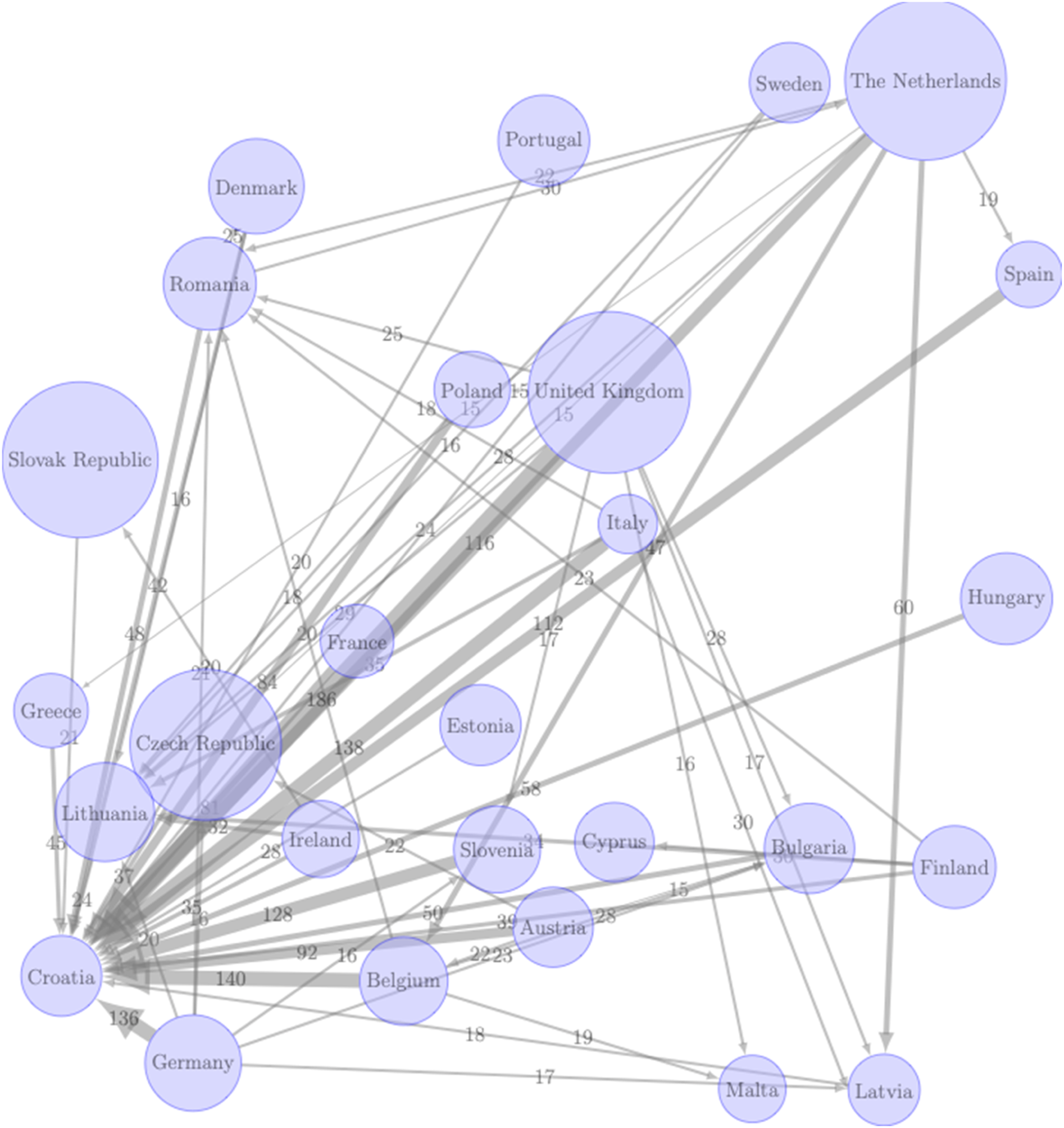
Figure 1 illustrates the structure of the network; the strongest links exist between new member states and their more senior peers. The elements of interest in the graph are: the thickness of the links and their direction. The thickness of the links reflects the regularity with which cooperation has taken place. The more frequent the cooperation is, the thicker the links are. We also provide the actual number of events on the links themselves. The direction of the links means that one state provided expertise for another state. Note that the node sizes are automatically adjusted to fit the country names, and the node spacing is automatically adjusted to minimize overlaps.
As predicted, expertise is regularly transferred within the TAIEX network from older member states to newer ones such as Croatia, Romania, Lithuania, and Bulgaria. Interestingly, Figure 1 also shows that recently joined member states share their experiences with other newly joined member states. Thus, Slovenia, Poland, Estonia, Hungary, and Latvia, which joined the EU in 2004, share their administrative expertise with Croatia, which joined in 2013. Here, Slovenia and Latvia are two interesting cases. While receiving regular administrative support from the UK, the Netherlands, and Germany, they are regular contributors to expertise exchange with Croatia. This demonstrates that administrative networks serve not only as an opportunity for younger member states to catch up with their more advanced peers but also as a means of sharing the most recent accession experience with countries in a similar context.
Figure 1 also shows that all member states, apart from Luxembourg, regularly participate in TAIEX events. As a small country with a limited public administration, Luxembourg may lack the administrative resources to share with other member states. Another possible reason for their non-involvement may be that experts from higher-paying countries might feel less motivated to serve as experts, since the Commission offers equal compensation for all experts. As a result, experts from lower-paying countries may be more inclined to register as experts. This might serve as an additional dimension of inequality in administrative networks and requires future detailed analysis in future works.
Figure 1 also shows that donors that have the strongest links are Belgium, Germany, Italy, Slovenia, Spain, the UK, and the Netherlands (cf. appendix Table 1). These countries vary in the size of public sector employment as well as in the quality of governance. For example, the UK, Belgium, and Slovenia have higher levels of government employment (Mackie, Moretti and Stimpson, 2021); the UK, Belgium, Germany, and the Netherlands have higher levels of government effectiveness (Thijs et al., 2018); and Germany and Spain have a large proportion of public sector employees who are civil servants (Mackie, Moretti and Stimpson, 2021). The public sector performance in the Netherlands, the UK, Germany, and Belgium traditionally rank highest in the EU (Mackie, Moretti and Stimpson, 2021).
Thus, having more resourceful public administrations, in terms of funding, effectiveness, and the size of public sector employment, these member states might be more inclined to engage in administrative expertise exchange through TAIEX, as shown in Figure 1. The patterns of repeated interactions, as illustrated in Figure 1, suggest that strong state capacity and the size of the public sector in member states may determine whether their administrative expertise can be shared with others. Additionally, the observed pattern may result from the fact that, up until 2015, only accession countries and new member states participated as beneficiaries in TAIEX. The 2015 reforms, which expanded the instrument to include all member states, can be seen as part of the EU-driven public sector reforms that have occurred mainly since the second half of the 2010s and were driven by both exogenous and endogenous crises (Ongaro, 2024), as well as changes in the dynamics between EU institutions and member states (Ladi and Wolff, 2021). Opening the instrument to all member states has somewhat altered the structure of cooperation, which we discuss in more detail below.
Hypotheses testing
An interesting dynamic is revealed when analyzing administrative cooperation between member states over time. Figure 2 depicts three periods: (a) 2007–2008, when Bulgaria and Romania joined the EU, (b) 2013–2014, when Croatia joined, and (c) 2019–2020, years around Brexit. Three main reasons justify the selection of the three periods. First, the TAIEX instrument was designed to address the needs of accession countries, making the selection of time periods around enlargement years a natural choice. Second, we focus on the years around Brexit, as the UK has historically been among the top contributors to the TAIEX instrument. The focus on this period allows us to test our hypothesis about continuity and change. Lastly, the timeframe analyzed is limited by data availability. To generate interpretable results and capture regular administrative interactions, we build a link between a donor and a beneficiary if they have had at least three instances of cooperation per year.
4
Similar to the above, the purpose is not to detect all links but to detect the strongest ones. Visualization of interaction within the TAIEX network, selected years.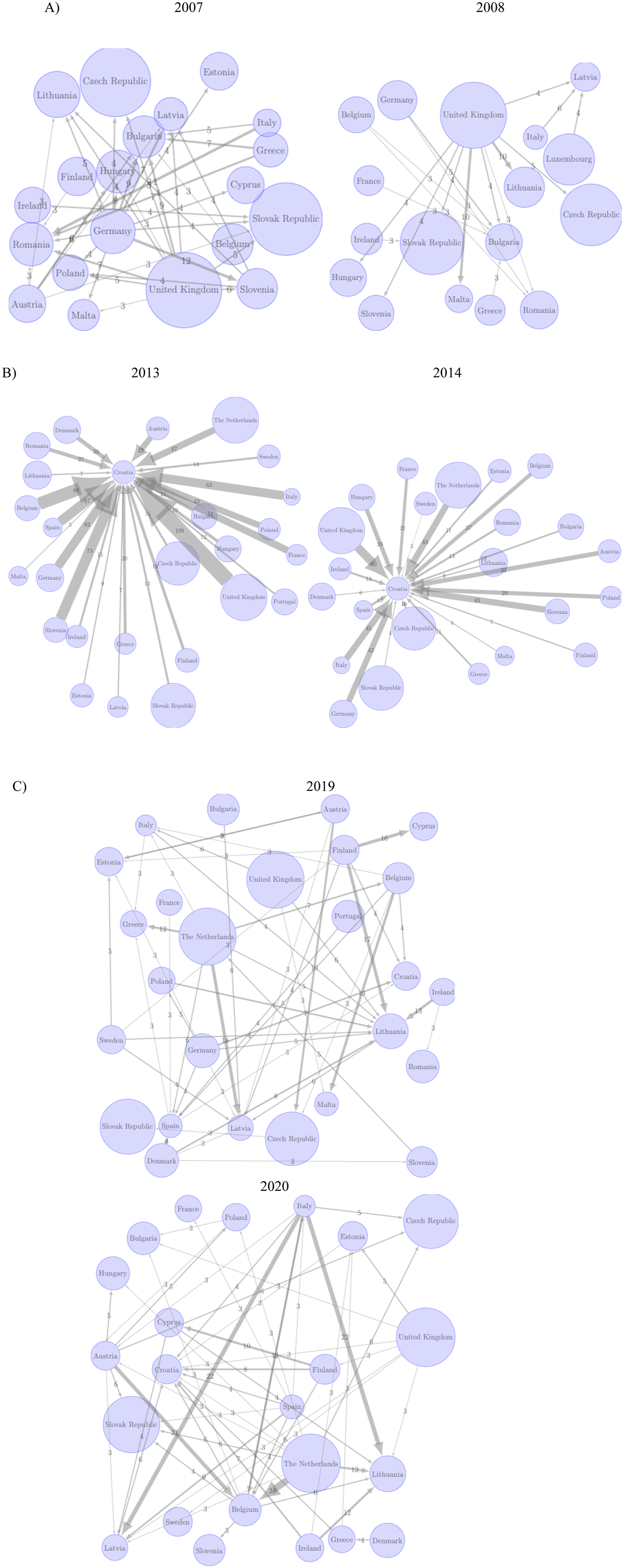
When examining the structure of administrative networks over time, we find that patterns of interaction indeed vary over time. Thus, following the 2007 enlargement (Figure 2(a)), in addition to the member states that joined in 2004 (i.e., Estonia, Latvia, Lithuania, Poland, the Czech Republic, Hungary, Slovakia, Slovenia, Cyprus, Malta), Bulgaria and Romania were the primary beneficiaries in the TAIEX network. During the period from 2013 to 2014, Croatia was the primary beneficiary of expertise exchange provided within TAIEX. However, the cooperation structure in this network later bounced back, covering Bulgaria, Romania, Slovakia, Lithuania, Latvia, and the Czech Republic, whose administration still needed assistance from TAIEX (Figure 2(c)). This also suggests that administrative reform processes do not end with EU accession; instead, demand for administrative reforms persists over time. Even more so, “old” member states with strong public administrations benefit from the instrument: Figure 2(c) demonstrated that countries like the Netherlands, Italy, and Belgium, which typically have been donors (Figure 1), since the instrument became available to them, also benefit from expertise shared in it.
Figure 2 shows that administrative networks are particularly used by those member states that were in greatest need of administrative assistance, especially in the years following their EU accession. With time, however, networks bounce back, assisting other countries whose public administrations also need assistance (see also appendix table 2). The TAIEX instrument was designed to help European integration and it is still following the enlargement logic. TAIEX, thus, targets primarily new member states, helping them cope with EU policy complexity. Since the capacity of member states to effectively apply and enforce EU regulations is largely determined by their administrative capacity, administrative networks mobilize to help new member states’ ability to cope with the growing body of EU regulations. Thus, in line with our first theoretical expectation (H1), we observe that administrative networks within TAIEX are agile and primarily target new member states.
Moreover, Figure 2 reveals interesting patterns in the roles of individual member states in administrative networks. Although the structure of the administrative networks tends to be fluid, the roles of member states are much more stable over time, which is in line with our second theoretical expectation (H2). For example, we observe that the UK has played a prominent role in the networks consistently over time by supporting public administrations in Central and Eastern Europe. Despite Brexit – without any doubt, a critical juncture for the EU—the UK was one of the most active donors in new member states within TAIEX. Thus, in 2019 and 2020, while the UK was negotiating its exit from the EU, it remained among the most prominent contributors to administrative expertise exchange. At the same time, however, we observe that the contribution of the UK gradually decreases over time (cf. Figure 2(b) and (c)). Brexit, therefore, may have had serious repercussions for the availability of assistance on the quality of public administration in newer EU member states, especially those of Central and Eastern Europe. The Netherlands, Germany, Belgium, Denmark, and to a lesser extent Italy and Austria, also demonstrate stable roles in administrative networks.
Lastly, our overall results show that, despite the literature typically describes TAIEX as a non-hierarchical instrument (Shyrokykh, 2023), there are clear patterns of inequality and power dynamics in the patterns of interaction: some countries are most of the time “students”, and other countries are most of the time “teachers”, although the instrument allows EU member states to combine both roles. Even among older EU member states, a symbolic hierarchy and inequality persist, with Southern and Eastern European states more frequently serving as beneficiaries of expertise from their Western counterparts.
In a nutshell, we detect agility in the structure of administrative cooperation in TAIEX (H1), but also patterns of stability in the roles of individual member states (H2). In line with our first hypothesis, we demonstrate that the structure of administrative networks is flexible—that administrative networks are established to address country-specific needs in the years following EU accessions. At the same time and in line with our second hypothesis, member states tend to have stable roles in these agile networks even despite political discontinuity as demonstrated with Brexit. A case in point is the UK: even profound political changes had no rapid effect on its role in TAIEX, although it has a gradual effect over time (cf. appendix table 2). Apart from the combination of stable roles and agile structures, administrative networks also allow member states to combine repertoires in which the same member state can be both a donor and a beneficiary. And many states do both.
Discussion and conclusion
Administrative reforms are at the core of the accession process; however, the need to reform public administration does not disappear after EU accession. On the contrary, as the volume of the EU acquis grows, national public administrations need to develop new expertise to be able to implement and enforce the changes effectively. This study shows how administrative expertise is shared in trans-governmental administrative networks among member states. Drawing on literature from policy network and organization theory, we developed and empirically tested a theoretical framework on temporal robustness of administrative networks, which encompasses networks’ ability to combine stability of state characteristics and changing administrative needs over time. Using the case of TAIEX, we show that administrative networks can be temporally robust: allowing maintain states’ stable roles, while permitting donor-benefit relations to be flexible. While the functional flexibility and political rigidity in networks are often conceived of as mutually exclusive in extant literature (e.g., Ansell et al., 2024), we demonstrate that flexibility and rigidity might co-exist in trans-governmental administrative networks. Our findings align with a recent work by Ongaro (2024), which demonstrates a governance shift within the EU: from coercion to more enabling and supportive public sector reforms in member states. We provide yet another illustration of the paradigmatic shift in the EU’s internal governance.
The study makes two distinct contributions to extant literature. Theoretically and more generally, the study contributes to the public administration and policy network literatures by demonstrating that EU administrative networks may feature the co-existence of stable roles of individual member states and agile structures of networks despite political perturbations and discontinuities. While the roles of individual member states remain stable over time in such networks, the structure of cooperation within these networks is agile. We thus argue that stabile roles and structural agility may coexist and establish temporal robustness in trans-governmental administrative networks. Moreover, given that organizational structures are argued to also serve as design instruments (see Egeberg and Trondal, 2018), we may subsequently infer that temporal robustness may be subject to organizational design and thus relevant for practice. Furthermore, the observations of the study establish the organizational foundation for temporal robustness in trans-governmental administrative networks, in which such networks harbor organizational infrastructures for stability and change. Empirically, we offer a novel study of the TAIEX instrument, building on a unique dataset. The study offers the first systematic longitudinal study of one the European public administration instrument available for expertise exchange globally, that offers theoretical relevance beyond the context of the EU.
We detect four potent directions for future research. First, using inferential network analysis, further studies might examine the effects of expertise exchange in administrative networks on the overall quality of governance in member states. Do such networks help member states bridge the gap between the ever-increasing number of EU regulations and the state’s capacity to implement and enforce them? The unique longitudinal data introduced in this article provides an opportunity to address this question. Second, future studies should examine the bilateral links between new member states’ administrations to advance fine-grained knowledge of such trans-governmental cooperative patterns in public administration. In particular, what explains the bilateral patterns in expertise exchange? The possibility of the mechanism of solidarity and normative homophily (Ingold and Fischer, 2014) requires scholarly attention.
Third, future works should examine how the evolution of the instrument, opening it up to participation of all third countries, has affected the dynamics in administrative networks, and whether, as a result, the Commission faces more difficulties in allocating experts to member states. The implications of this decision require an in-depth investigation using evidence from recent years. Lastly, building on in-depth interviews with national public administrations, future works should establish why some countries remain mostly donors (e.g., the Netherlands, Denmark, Germany, Ireland), or beneficiaries (e.g., Croatia, Hungary), and others mix the two roles (e.g., Lithuania, Latvia, Estonia, Malta).
Supplemental Material
Supplemental Material - Stable roles and agile structures: Temporal robustness in public administration networks
Supplemental Material for Stable roles and agile structures: Temporal robustness in public administration networks by Karina Shyrokykh, Jarle Trondal in Public Policy and Administration
Footnotes
Acknowledgments
Earlier versions of this article were presented at Stockholm University at the Global and Regional Governance research seminar in April 2023 and the Higher Seminar in International Relations in February 2023. We thank Mark Rhinard, Lisa Dellmuth, Jonas Tallber and other participants of these seminars for their helpful comments.

Funding
The authors received no financial support for the research, authorship, and/or publication of this article.
Declaration of conflicting interests
The authors declared no potential conflicts of interest with respect to the research, authorship, and/or publication of this article.
Data Availability Statement
Supplemental Material
Supplemental material for this article is available online.
Notes
References
Supplementary Material
Please find the following supplemental material available below.
For Open Access articles published under a Creative Commons License, all supplemental material carries the same license as the article it is associated with.
For non-Open Access articles published, all supplemental material carries a non-exclusive license, and permission requests for re-use of supplemental material or any part of supplemental material shall be sent directly to the copyright owner as specified in the copyright notice associated with the article.
