




Abstract
This aim of this article is to trace the concept of ‘social value’ in public procurement (purchasing by the public sector from private and third sector contractors of goods, services and works) in the UK through four decades of the incorporation of social objectives, primarily in the form of equality and diversity requirements, into public purchasing from the practice of contract compliance. It is important to better understand the derivation and meaning of the widely-adopted but poorly-defined concept of social value as it becomes increasingly common in public policy on procurement. We argue that the policy of contract compliance used in the 1980s contained an explicit intention to advance social justice through public spending, rooted in philosophical conceptions of social justice that recognise structural inequalities on the basis of race and gender, but which have been diluted in the contemporary adoption of social value. Our historical analysis suggests that using public procurement to achieve social justice and equality objectives became an ideological battleground between those with opposing views of the role of the state in tackling disadvantage. The main contribution of the article is a framework for conceptualising the relationship of social justice and ideas of value within social procurement that we apply to the historical period under discussion.
Introduction
The use of public spending power to achieve social objectives, beyond the services or goods being bought, is an area of public policy that has gone in and out of fashion depending on prevailing political leadership and economic circumstances. Yet the idea of ‘buying social justice’ (McCrudden, 2007) through public procurement is not new, and in the UK dates back to 19th century efforts to ensure ‘fair wages’ for employees of government contractors (Bercusson, 1978). This article traces the current popularity of ‘social value’ in the practice of public procurement (purchasing by the public sector from private and third sector contractors, usually through competitive bidding, of goods, services and works) in the UK through four decades of earlier iterations of ‘buying social justice’, from the practice of contract compliance in the 1980s to the present. Contract compliance originated in the US in the 1960s as a means of tackling race inequality in employment by requiring firms contracting with the US government to set targets for ethnic minority employment, and was adopted in parts of the UK to address race inequality in the 1980s and to counter religious discrimination in Northern Ireland in the 1990s.
Public procurement is a major area of public policy – accounting for about a third of public sector spending, or £296 billion in 2019/20 (House of Commons Library, 2022) – yet its adoption for social purposes (referred to here as social procurement) is only slowly emerging as a focus for academic research, with the conceptual framework still under-developed. In this article we propose that public procurement is a potentially powerful tool for addressing long-standing labour market inequalities, but present evidence to suggest that ‘buying social justice’ is something of an ideological battleground between those with opposing views of the role of the state in tackling social and economic disadvantage. These views are analysed using a conceptual framework based on notions of value (economic, public and social) and social justice, in order to answer the question: how are ideas of value and social justice reflected in public procurement since the 1980s to the present day?
The significance of this discussion for public policy scholars is two-fold. Firstly, the concept of social value is now widely adopted in public sector purchasing in the UK, following the passing of the Public Services (Social Value) Act 2012 and has become a requirement of all central government purchasing (Cabinet Office, 2020). Secondly, it lacks clear definition in legislation, academic literature and in practice. Social value has been subjected to only limited academic critique in the public or social policy literature, risking the emergence of a poorly-defined policy instrument (Haux, 2022). It has been acknowledged that philosophical thought has been limited in public administration scholarship (Ongaro and Yang, 2024). Where value has been considered in public policy debate it is acknowledged that there is no unified conceptualisation, but a plurality of frames that form a ‘public values universe’ (Beck et al., 2007) that requires an interdisciplinary perspective (Van der Wal et al., 2015) and which often conflict (Nabatchi, 2018).
Therefore, this article contributes an interdisciplinary historical analysis of four decades of social procurement policy and practice, which reveals how conflicts between different conceptualisations of value have resulted in the dilution of concern to address inequalities of race and gender and considers whether the contemporary iteration of social value can achieve social justice for groups historically disadvantaged in the labour market. The article examines published sources to draw its conclusions, primarily academic literature and government policy documents relevant to UK public procurement policy and practice. In seeking to understand how ideas of social justice and value have shaped the practice of public procurement in recent decades, we used academic search tools such as Web of Science and Google Scholar, as well as targeting relevant public policy journals, for articles using the terms ‘contract compliance’, ‘social procurement’, ‘social justice’ and ‘social value’. ‘Public value’ also emerged from the literature as a related concept, particularly pertinent to the public administration and management fields, with some links to the later concept of social value. Government public procurement policy documents that cover social procurement, social value and equality and diversity were also included in our searches. Our purpose was not to undertake a systematic review of the literature, but rather to identify the key conceptual and historical junctures that informed the development of social procurement policy and practice in the UK from the 1980s to the present, in particular the equality dimension. The 1980s was chosen as the point at which contract compliance began to be used to address race and gender inequalities by some public authorities in the UK.
This analysis forms the first part of a research project examining the use of public procurement to advance employment equality in England, Scotland and Wales.
1
The research was motivated by an interest in whether the under-representation of women and ethnic minorities in the construction sector could be tackled through public procurement policy, which led to a broader question about the historical relationship between equalities practice, social justice and public procurement, explored here. The article first develops our framework built upon the concepts of value and justice as they relate to decisions about public spending. This framework (see Figure 1) then structures the analysis of the adoption of social procurement, divided into three historical periods covering the 1980s until the 2024 general election. It is clear from this historical analysis that earlier practices of social procurement (known as contract compliance) focused on reducing race and gender inequality, while later strategies were broadened as legislation and policy sought to tackle other forms of disadvantage, including religion and socio-economic inequality. The article argues that policies connecting public procurement to explicit equality objectives underpinned by the concept of social justice can be effective in reducing disadvantage and offer a more promising route to social change than the pursuit of the more amorphous ideas of public and social value. Framework of social justice and value in the development of social procurement.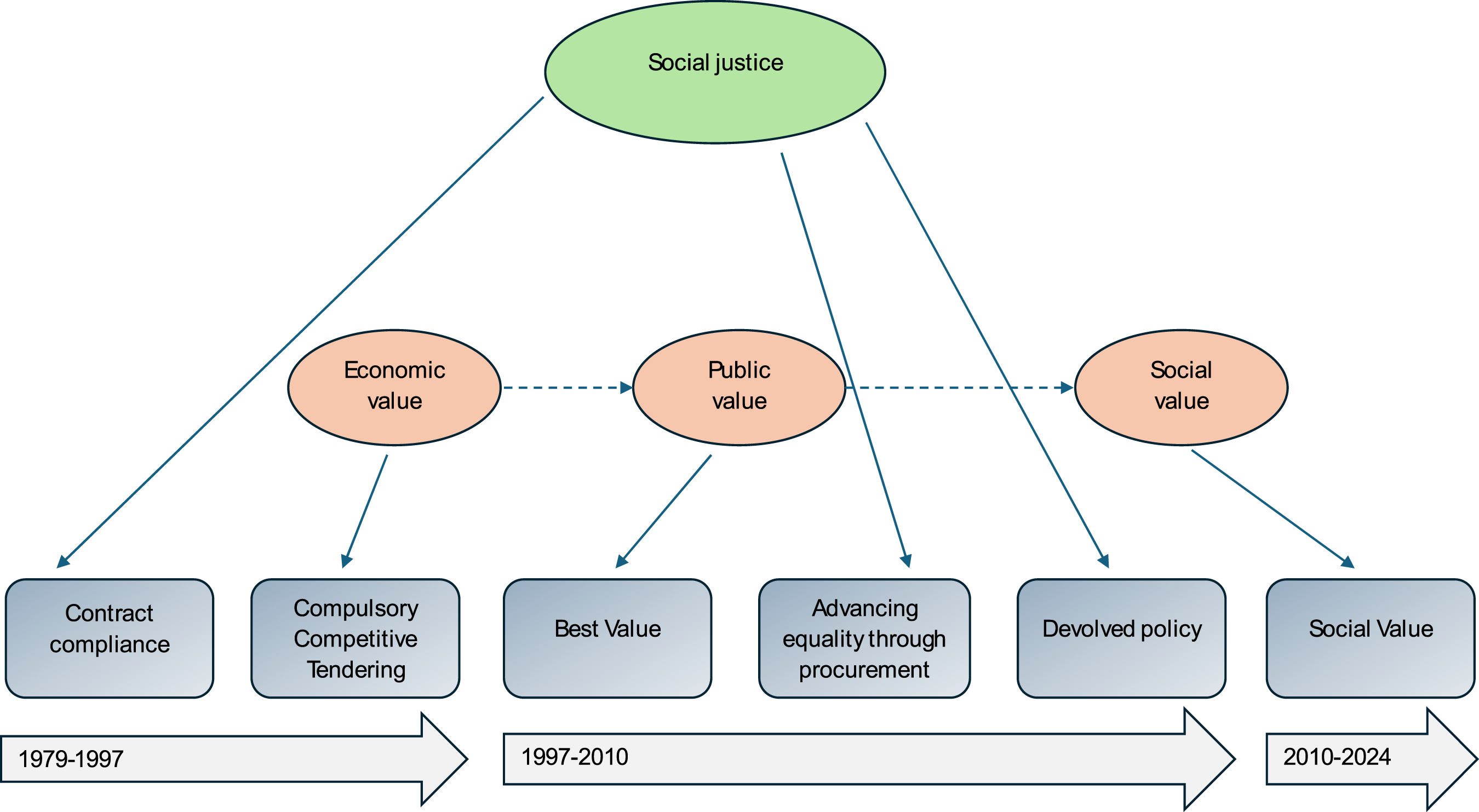
Conceptualising justice and value in public spending
This section develops a framework for an examination of the development of social procurement policy and practice in the UK over the last four decades outlining two parallel but sometimes competing concepts that underpin approaches to public spending, based on notions of justice and value.
Social justice and equality
The concept of social justice is contested and has been the subject of widely varying interpretations and political uses, often with little engagement between political philosophers’ theoretical definitions and its application to social policy problems (Burchardt and Craig, 2008). An influential starting point is Rawls’s definition of justice as ‘the way in which the major social institutions distribute fundamental rights and duties and determine the division of advantages from social co-operation’ (1971, p. 6, cited in Burchardt and Craig, 2008). Fraser (1995) distinguished between a politics of recognition and a politics of redistribution that emphasised the distinction between recognition of rights for disadvantaged or minoritised groups on the basis of categories of gender, ethnicity, sexuality, disability, among others, and the material redistribution of resources, typically following class-based patterns. However Young (2008, p. 94) argues that this distinction is “too polarising”, preferring “the politics of difference” (see Young, 1990) to distinguish positional difference and cultural difference. Lister (2008) similarly rejects the need to prioritise redistribution or recognition, believing that in relation to addressing poverty, which has typically relied on the redistributive paradigm, the understanding of poverty should also focus on recognition and respect, in particular acknowledging the lack of respect which many experiencing poverty feel from others, including the state.
Nabatchi (2018, 61-63) notes that values pluralism does not only pose philosophical challenges but also has implications for governance and proposes four values frames that might typify different approaches to public values: political, legal, organizational and market, with equality falling within the political frame. Examples of the political pluralism proposed by Nabatchi’s values frames can be identified in the Labour Party’s 1994 Commission on Social Justice and later Conservative Party rejection of government intervention (Burchardt and Craig, 2008).
Connecting social justice to procurement and favouring an interventionist frame, McCrudden (2007) sets out a number of economic and political arguments for linking equality objectives to procurement practice, two of which are underpinned by social justice rationales. He suggests that it is the government’s responsibility to remedy the increased inequality experienced by women and ethnic minority workers as a result of its own procurement policies, specifically contracting out public services (Escott and Whitfield, 1995). Furthermore, procurement that adopts equality aims can support the supply of the ‘public good’ of equality by incorporating legally protected equality characteristics. Social justice is, therefore, viewed as a public good that will not be adequately supplied by the market in the absence of government intervention and which may be especially important at times of public spending cuts.
Economic value
As public procurement involves decisions about spending public funds – often termed ‘taxpayers’ money’ – it rightly attracts public scrutiny. A key concern is whether it achieves ‘value for money’. This raises an essential question of how value is defined, with a common answer based on notions of economic value. Economic value – its derivation, definition and measurement – has long been a central concept and major source of debate in the discipline of economics, ranging from the classical ideas of Adam Smith and Karl Marx that labour produces value, to neoclassical views of value stemming from utility and scarcity, which determine price as a direct measure of value. A primarily economic understanding of value has always placed government (as well as household production) outside of the production boundary – the sphere in which economic value is created according to Mazzucato (2019), who argues that government has traditionally been seen as simply an enabler or regulator of value production by the market.
Mazzucato (2019) instead asserts that government should be seen not only as an enabler of value creation, but as a producer, through investment and in leading the creation of markets, essential to the measurement of GDP. She argues that a deeper understanding of public value is needed in economics, as something created by a whole society not only the private sector, with a shift in ideas about the nature of value itself. For her, “public values are those providing normative consensus about (1) the rights, benefits and prerogatives to which citizens should (and should not) be entitled; (2) the obligations of citizens to society, the state, and one another; (3) and the principles on which governments and policies should be based” (Mazzucato 2019, 265). Thus, rather than distinguishing between economic, public and social value, she argues that conceptualisations of value within economics need to be broadened to incorporate public and social benefits.
Public value
In the 1990s academics and practitioners in the field of public management developed a broader understanding of ‘value for money’ to include public value in order to guide public sector priorities and spending decisions. Public value was defined as “what we believe is valuable . . . and requires public resources, with improved ways of understanding what our ‘publics’ value and how we connect to them” (Moore, 1995; cited in Williams and Shearer, 2011, 1371). This definition highlights the link between public spending and value, indicating that what ‘we’ value requires public resources. However, ‘we’ here refers to public managers, locating the responsibility for identifying what “our ‘publics’ value” within the sphere of public sector management and administration.
Despite the difficulties of identifying and defining ‘public’, ‘value’ and ‘values’, at its core is the distinction between what the public values, and what adds value to the public sphere (Benington, 2011). Implicit in this distinction is an argument that to integrate divergent values and belief systems and draw on a range of experience, achieving public value may involve consultation with service users, community or third sector groups (Erridge, 2007; Kelly et al., 2002).
The ideas underpinning public value, while somewhat amorphous and open to contestation depending on which public policy frame is dominant (Nabatchi, 2018), align with a shift away from a primarily economic view of value as the sole objective of public procurement, towards a view that permits wider social considerations of how value should be considered in relation to public spending.
Social value
The concept of social value as currently used in social procurement does not have clear theoretical origins, and we suggest below that it may have developed out of thinking on public value. As an economic concept, social value was discussed by Schumpeter (1909) more than a century ago to distinguish between exchange value to individuals and the value that society might put on the exchange of goods. Jain et al. (2020) suggest that a sociological view of value was first proposed by Weber, arguing that individuals and/or groups of individuals create value rationally for themselves and others, which leads to social action. Like public value, the emphasis on the social nature of value moves away from an abstract economic understanding of value that seeks objectivity and measurement.
Tracing the more recent emergence of social value in public policy, we can observe its development from debates about public value. For example, Mulgan (2010, 2011), frequently uses the terms public value and social value interchangeably, suggesting that social value may have derived from the former concept. We concur with others that further research is needed on the links between social value and the concept of public value (Jain et al., 2020).
Public administration and management scholars are starting to develop conceptualisations of social value as it relates to procurement (Barraket et al., 2016; Jain et al., 2020; Selviaridis et al., 2023) and particularly construction projects (Gidigah et al., 2022; Gyadu-Asiedu et al., 2024; Raiden et al., 2019). One example is Jain et al.’s (2020) study which interviewed stakeholders in order to produce a definition and a framework for policy makers and practitioners to use in social value creation. They arrive at a common definition of “a value that demonstrates change(s) in the live(s) of an individual or groups of individuals when tangible and intangible resources are employed at grassroots level by social actors, ultimately creating social change within the society” (ibid, p. 885).
While this and other interpretations of social value are underscored by a desire for social change for an individual or group, we suggest that without clear theoretical or philosophical origins, the concept of social value lacks the political commitment to advancing social justice based on understandings of structural inequality, as already outlined.
An example here is that the lack of a definition of social value in the Public Services (Social Value) Act 2012, which simply requires local authorities in England and Wales to consider the “economic, social and environmental well-being” of the area in spending decisions, – contributes to confusion about what social value amounts to in practice and has been found to hinder implementation (Barraket et al., 2016; Cabinet Office, 2015).
Developing a framework of social justice and value in social procurement
The preceding discussion has shown how the concept of social justice starts from philosophical and political principles that seek to reduce inequality and promote fairness in society, while ideas of social value in relation to public procurement have emerged in response to a dissatisfaction with a sole focus on economic value, and aim to utilise public spending as a tool for supporting broader policy goals. The figure below illustrates how these parallel concepts relate to the development of key policies affecting social procurement over the past four decades, which is discussed in the following sections.
History of social procurement as a policy tool
Using the framework set out above, the article sets out to answer the question of how different frames of value are related to social justice, reflected in public procurement over the past four decades. It traces the history of the adoption of public procurement to tackle social inequality in the UK from the 1980s to the current period, identifying three periods of national and local government policy. Although the UK was affected by European procurement regulation during this period (which has been covered elsewhere, see (Calleja, 2015; Sarter, 2015), the focus of this article is an in-depth discussion of UK policy shifts. The three periods are characterised as: local versus central government: the battle over social justice and value (1979 to 1997); the reinterpretation of value and the economic benefits of equality (1997 to 2010); and the ‘burden’ of equality replaced by social value (2010 to 2024). Figure 1 illustrates that the first period is characterised by the practices of contract compliance (based on a social justice orientation) and Compulsory Competitive Tendering (prioritising economic value). The period from 1997 to 2010 sees priority given to Best Value (a public value approach), advancing equality and social justice through procurement and devolved policy. The final period emphasises the social value approach in public procurement, developed from economic and public value frames.
Local versus central government: the battle over social justice and value (1979 to 1997)
The election of a Conservative government led by Prime Minister Margaret Thatcher in 1979 marked a radical change in policy for central government and the local state, moving firmly towards an economic, market-led, frame of public values shaped by public choice theory. It ushered in a period of cuts to public expenditure, a reduction in the size of the public sector through privatisation (Millward, 2010) and contracting out of public services to private sector providers (Pinch and Patterson, 2000), which had a particularly adverse impact on low-paid women working in public services, many of whom were from ethnic minorities (Escott and Whitfield, 1995). A further ideological intent of Thatcherism was to increase central control over the activities of local authorities, to “prevent the emergence of sites of dissent around the alternative policies of the urban left” (Painter, 1991, p. 192). In this context, the scene was set for a battle over public spending between local government and the central state, in which contract compliance became the focus.
Contract compliance for social justice
The origins of contract compliance can be traced to the United States. It has been defined as “procedures employed by government agencies, either central or local, to ensure that the companies to which they give contracts to supply services or goods, or to whom they give grant assistance, are pursuing equal opportunities policies as employers” (Fee et al., 1998, p. 80).
In the UK, working against the tide of the radical economic frame adopted by the Conservative government, the practice was adopted in the 1980s by several Labour-controlled local authorities, including the Greater London Council (GLC) (Carr, 1987) as a way to address race and gender inequalities. This required all suppliers to complete questionnaires demonstrating that they were in compliance with the race and gender equality codes. It is suggested that approximately one in five local authorities – primarily Labour-controlled – adopted formal contract compliance policies, often giving preference to contractors using local labour (McCrudden, 2007). These local authorities saw an opportunity to apply the proactive element of the Race Relations Act 1976 that went beyond simply outlawing discrimination and placed a duty on local authorities to seek to eliminate race discrimination and promote equality of opportunity in all their actions. The approach taken by the GLC was to require that contractors comply with the Commission for Racial Equality and Equal Opportunities Commission Codes of Practice, which although not legally enforceable, provided guidance on practices covering recruitment, promotion, disciplinary and grievance procedures, and positive action among others, that would comply with sex and race discrimination legislation (Carr, 1987).
In direct opposition to the prevailing public choice theory-led economic frame adopted by central government and offering a clear example of the way that conflicting frames of value can often co-exist (Nabatchi 2018), the motivation for these policy choices was rooted in social justice objectives, supported by both legislation and a political position that viewed the role of government and the state as protecting the welfare of citizens and reducing group inequality, especially in the provision of public services. As McCrudden (2007) argued, from this perspective it was clearly the role of local government to supply the ‘public good’ of equality, which is particularly important in times of public spending cuts and restructuring of public service provision, as we will see next.
In the UK, while contract compliance policies were supported by trade unions and opposition parties, they were not popular with the Confederation of British Industry and the Conservative Party (Carr, 1987; McCrudden, 2007). At the time, ministers recognised that plans to outlaw the practice would amount to amending the Race Relations Act 1976 which placed a duty on local authorities to seek to eliminate race discrimination and promote equality of opportunity in all their actions, and so backed down (Carr, 1987). However, Margaret Thatcher was not deterred and the Local Government Act 1988 was passed, prohibiting local authorities from taking ‘non-commercial matters’ into consideration in contracting (Fee et al., 1998) and reasserting what Nabatchi (2018:64) describes as the legal values frame to limit public administrative discretion.
Contract compliance was effective, according to evidence from the US examined by Erridge and Fee (1999), who found several studies concluding that organisations subject to the regulations employed proportionally more black people and white women than did comparable organisations not contracted under the regulations.
Compulsory competitive tendering and the reassertion of economic/market value
The legislation barring the inclusion of ‘non-commercial matters’ in contracting reasserted the primacy of economic considerations in public procurement. This represented a distinctly different view of the role of government from that held by local authorities who believed they had a responsibility to promote social justice and advance equality for disadvantaged groups. Instead, the policy espoused by central government saw local government as inefficient, with adherents advising that the State should be kept small and have limited powers over market behaviour, representing the prevailing economic orthodoxy that government should be merely an enabler or regulator of value production by the market (Mazzucato, 2019; Nabatchi, 2018). In this view, the aim of public procurement should only be to purchase what is needed at a decent price and under transparent conditions, with decisions made on the basis of ‘value for money’, interpreted mostly as the lowest price. Efficiency and good governance may be impeded by the inclusion of social policies in procurement, which adds bureaucracy and potential inconsistencies (McCrudden, 2007).
As part of reducing the role of local government, the policy of Compulsory Competitive Tendering (CCT) was rolled out. CCT required designated services to be subjected to a periodic process of market testing, in which in-house bidders would compete with private sector organisations to provide specified services. The scheme introduced market competition into public service provision with the aim of reducing costs and improving efficiency and gave significant enforcement powers to government ministers to ensure that local authorities complied (Vincent-Jones, 1999). The impact on public sector employment was a reduction in jobs, lower pay, and worsening of terms and conditions of those providing public services, with women, ethnic minority workers and black women in part-time jobs especially badly affected (Dickens, 1997; Escott and Whitfield, 1995).
The 1988 legislation that barred the inclusion of non-commercial factors in public sector contracting exempted six questions on race equality, to comply with the 1976 race equality legislation. The questions were limited to matters such as whether the bidder complied with its statutory obligations under the Race Relations Act 1976, but allowed councils to ask firms to supply documents evidencing their policy on race relations. Although nearly two-thirds of councils were using the six questions in pre-qualification questionnaires for firms tendering for contracts, only 17% assessed answers to these questions and few monitored compliance (Orton and Ratcliffe, 2004). During this period, therefore, little use was made of contract compliance to advance equality or social justice.
The reinterpretation of value and the economic benefits of equality (1997 to 2010)
In 1997 a Labour government was elected to Westminster, ending a long period of Conservative administration. The New Labour government led by Prime Minister Tony Blair represented a changed Labour Party that was shedding many of its traditional beliefs, including a commitment to public ownership. It did not reverse many of the Conservative policies that it had been against while in opposition, but in areas relating to public value and social justice, there were significant differences, such as its policy on Best Value for local government and the approach to advancing equality of opportunity.
Best value
A revised conceptualisation of value in local government functions emerged during this period. CCT had attracted widespread criticism for producing poor quality services and for detrimental impact on working conditions, particularly for women employees (Fee et al., 1998). Labour’s election manifesto contained a commitment to abolish CCT and to ‘modernise’ local government and improve service delivery under its ‘Best Value’ regime. Much has been written about the similarities and differences between CCT and Best Value, but in relation to public procurement for social ends, a key distinction is that Best Value was less restrictive regarding the use of contract compliance (Fee, 2002). Moving towards what Nabatchi (2018) describes as an organizational public values frame, Best Value retained the importance of driving down costs, but alongside increasing service standards, and was considered to have brought in a new approach to performance and partnership working in its early phase (Bovaird, 2000). Best Value required consultation with the public to determine their needs and priorities (Boyne, 1999) so was thus squarely in line with the concept of public value.
The White Paper on Best Value identified five aspects of performance: cost, efficiency, effectiveness, quality and fair access, which would include “the fair allocation of services between different groups in the population (e.g., between age groups, males and females, ethnic and income groups)” (Boyne, 1999, p. 3). The Best Value regime prompted renewed interest in using procurement to promote social objectives, with further impetus provided by guidance in 2001 stating that local authorities could continue to ask questions on race and to extend these to include gender, disability, religion, age, and sexual orientation (Orton and Ratcliffe, 2004). Guidance encouraged local authorities to work with commercial partners “to promote equality in employment and raise awareness of how the application of equal opportunities to staff recruitment and management can bring commercial and other benefits” (ODPM, 2003, p. 46). The operation of Best Value therefore widened what constituted value for the public by acknowledging the role of local government in promoting social justice whilst the reference to commercial benefits indicates a qualified ‘business case’ rationale for promoting equality.
Advancing equality through procurement
The removal of barriers to ethnic minority participation in the labour market was a focus for the Labour governments of 1997 to 2010 (Orton and Ratcliffe, 2005), and public procurement was seen as a measure to achieve this, based on evidence of success from the US and the GLC (McCrudden, 2007). Guidance was produced by the CRE for local authorities and contractors (CRE, 2003a, 2003b). A pilot project in three government departments to assess the potential for procurement to address race inequality was considered to have potential for expansion, although its impact was limited, in part due to little monitoring of outcomes (Djan Tackey, Barnes, Fearn and Pillai, 2009). Policy on public procurement was later broadened to other aspects of equality, including reducing the gender pay gap (Women and Work Commission, 2006). Equality was a policy objective of the Labour government, justified in social justice terms to address longstanding inequalities on the basis of gender and ethnicity. However, like Best Value, it was frequently framed as contributing to efficiency and business benefits, particularly in the case of legislative interventions (Dickens, 2007). Public procurement is a case in point. Government guidance on equality and procurement stated: “Achieving value-for-money and delivering wider benefits such as equality objectives often go hand in hand. Procuring goods and services that work well by taking account of, and catering for, users’ and communities’ diverse needs, at good value-for-money, is what good procurement is all about” (OGC, 2008, p. 3). The guidance emphasised legal obligations to comply with the public sector equality duties to have due regard to the need to eliminate unlawful disability, gender and race discrimination and to promote equality of opportunity during the practice of procurement.
At a regional level, there was a return to the practice of contract compliance to address race equality when in 1998 a group of six local authorities in the West Midlands established a Common Standard on race equality that contractors had to adopt to win council contracts. The Standard represented a new joint approach to contract compliance, encouraged by the Commission for Racial Equality (CRE), that pooled expertise and resources and provided consistency to councils and contractors. The introduction of the Standard was motivated by social justice concerns, with the objective of improving the employment prospects of ethnic minorities in the region (Orton and Ratcliffe, 2004). By 2001 over 2500 companies had been assessed and an evaluation found some good results (Orton and Ratcliffe, 2005). The scheme produced engagement with equalities issues among firms that previously did not have an equal opportunities policy; a renewed commitment and strategy among those with equal opportunities statements, and the updating of existing policies.
This period therefore produced a shift away from a predominantly economic conception of value, to one that recognised wider social considerations under Best Value, although constrained by a requirement to ensure value for money. Similarly, the commitment to advancing equality for disadvantaged groups assumed the language of ‘business benefits’ to pursuing equality (Dickens, 2007), placing equality beneath neo-liberal policies of control of public expenditure in the policy hierarchy (Orton and Ratcliffe, 2005).
Devolved policy
Between 1997 and 2010 the devolution of powers to the governments of Northern Ireland, Scotland and Wales accelerated and policy on social procurement diverged significantly. Northern Ireland was the first to adopt public procurement to achieve socio-economic goals, particularly addressing religious discrimination, and Scotland and Wales later introduced substantial legislation on social procurement (discussed elsewhere, (Wright et al., 2024). Section 75 of the Northern Ireland Act 1998 introduced a statutory obligation on government to have due regard to promote equality of opportunity, with an unequivocal statement from the Equality Commission for Northern Ireland (the statutory equality body) that procurement was included as a key function of public authorities and subject to the duty (McCrudden, 2007). The Fair Employment and Treatment (NI) Order 1998 extended the policy of contract compliance, supporting fair employment through measures including targets to remedy under-representation, penalties and economic sanctions on employers, such as barring a firm from contracting with public bodies until it complied with employment standards (Fee, 2002).
Public procurement thus was a considerable focus of attention of the Northern Ireland Executive, which concluded that ‘best value for money’ could also include social, economic and environmental goals, in addition to price (McCrudden, 2007). Socio-economic inequality overlapped with religious discrimination, with unemployment disproportionately affecting Catholics due to their concentration in areas of high unemployment. The unemployment pilot project, initiated in 2002, obliged contractors to present a plan for facilitating the recruitment and training of those who had been unemployed for at least 3 months, including details of employment terms and conditions, training arrangements and recruitment, resulting in 51 new jobs for the unemployed (Erridge, 2007; McCrudden, 2007). This represented a clear social justice approach to procurement policy.
The ‘burden’ of equality replaced by social value (2010 to 2024)
The Conservative-Liberal Democrat Coalition government that took office in 2010 chose not to implement the specific duty in relation to procurement provided for in the Equality Act 2010, passed in the final days of the Labour government (McCrudden, 2011). Indeed, the government signalled its view that the public sector equality duty (PSED) was “burdensome” to business by reviewing the PSED, as part of its “red tape challenge” to eliminate unnecessary regulation. Although the review found little evidence that the PSED was a burden to local authorities or contractors (Stephenson, 2014), the then equalities minister, Maria Miller, persisted in declaring her intention to put an end to the “gold-plating” of equality activity by public authorities (Wright and Conley, 2013).
These indications of the Conservative-led government’s stance towards further equality legislation – and the emphasis on regulation as a “burden” on both the public and private sectors – represented a return to a market frame of public values and with it the belief in less directive and interventionist government of the Conservative governments of the 1980s and 1990s. However, a purely economic approach to decisions on public spending and policy priorities was not possible, given public concern about socio-economic inequality and social exclusion.
It was in this context that Conservative MP Chris White introduced a private members’ bill that intended to support social enterprises (or third sector organisations) to win public contracts in competition with larger contactors. The resulting Public Services (Social Value) Act 2012 was severely limited (Floyd, 2013) but did introduce the concept of ‘additionality’, which has since been widely used to include social inclusion as a form of public value.
Another way in which social value has developed since the 2012 Act has been in central government contracting, through the Social Value Model introduced in 2020 (Cabinet Office, 2020), requiring all central government procurement activity to explicitly evaluate the possibility for achieving social value, rather than just ‘consider’ it as required by the Act. The Model covers five themes, including two explicitly addressing inequality, on tackling economic inequality and equal opportunity. As with previous Labour governments, the focus of equality policy is on areas that contribute to economic growth and advancement, rather than on addressing social injustices per se.
Nevertheless, the approach contained in the Model is somewhat at odds with the government’s 2021 procurement policy statement that included a reprise of earlier warnings of ‘gold-plating’ by public authorities. This reminded contracting authorities of the necessary “balance” between social value and delivery of the core purpose of the contract. Although the pursuit of social value in public procurement represents a shift from the 1980s- 1990s Conservative economics-only approach to value, the ideological opposition to the pursuit of equality through public procurement persisted, alongside antipathy to the objectives of the public sector equality duty and rejection of social justice rationales for equality action.
Discussion: From social justice to social value
Using the conceptual framework of value and justice in public procurement shown in Figure 1, the article identifies three periods of government policy towards the use of public procurement to tackle social inequality, revealing tensions between local and central government. Our analysis is consistent with Nabatchi’s (2018) values frames, in particular: political, which includes equality (social justice), and organizational and market (economic, public and social value), while recognising that different frames may operate in parallel or be inconsistent. However, we find that Nabatchi’s use of a legal frame can form part of both political and market frames of public value in relation to equality. Equality policy became a legal and ideological battleground in the period of Conservative rule in the 1980s and 1990s, fought using the weapon of public spending power. We saw how Labour-controlled councils’ pursuit of social justice objectives using contract compliance was outlawed in 1988, while concepts of value in public spending were firmly restated as economic. The role of the state was reaffirmed as pursuing a solely economic measure of value, following traditional economic thinking about government as an enabler and not a producer of value, which is achieved by the market.
During the second period identified, Labour governments reinterpreted value in local government spending under the Best Value regime, underpinned by ideas of public value that were concerned with offering better value to the public and understanding what local citizens wanted. Labour took a proactive ideological position on advancing equality of opportunity for disadvantaged groups including women, ethnic minorities and the disabled – consistent with a model of social justice that recognised the structural inequalities associated with group-based difference (Young, 1990, 2008) – and in its latter years promoted public procurement as a policy tool for this purpose. Yet while there may have been discernible social justice motivation for Labour equality policy, seeking to improve equality of outcomes for disadvantaged groups, this was qualified by an emphasis on the economic rationales – or ‘business case’ – for equality actions.
Between 1997 and 2010 devolution continued and Northern Ireland took advantage of these powers to apply central government purchasing policy to the inequalities faced by the Catholic community, aiming to reduce unemployment. This approach exemplified Mazzucato’s (2019) view that the role of government is to produce value for the public and society, operationalised in this instance by positive action on behalf of groups disadvantaged in the labour market, representing a combination of recognition and distributive paradigms of social justice that address structural group-based inequalities (Young, 1990, 2008).
Since 2010 we have seen a return to equality policy as a legal and ideological battleground, particularly in warnings over the purpose of contracting by public authorities. A business rationale for equality continued to dominate under the Coalition and Conservative governments and has become the widely-accepted discourse in business (Department for Business, Innovation and Skills, 2013). This is consistent with the emphasis on social value in central and local government contracting that is operating with an ill-defined notion of social value that seeks to balance social, environmental and economic considerations. While we have illustrated a move away from a sole emphasis on economic value, in practice economic value underpins subsequent concepts. In this sense, social value is not the substitution of the economic by the social, but a socialisation of the economic in which social aspects are connected with the overarching economic foundations.
The article echoes findings from research in the US that contract compliance can be effective in advancing equality (Erridge and Fee, 1999) in showing some successful outcomes in the UK, often supported by the use of legislation, such as in Northern Ireland (Erridge, 2007; McCrudden, 2011) and the West Midlands (Orton and Ratcliffe, 2005), but also sometimes restricted by legislation as in the Local Government Act 1988.
Conclusion
The article addressed the question of how ideas of value and social justice were reflected in procurement practice from the 1980s until the change of government in 2024. Using a framework (see Figure 1) of two parallel concepts of value and social justice to understand the motivations for policy affecting social procurement, our historical analysis showed a distinction between the underpinning ideas of social justice and those relating to value, that broadly mapped onto different political views of the role of the state. More specifically, our framework revealed the relationship between the underpinning values of social justice that drove the practice of contract compliance in the 1980s and 1990s and explicit equality policies adopted by the 1997-2010 Labour governments and the devolved administrations in Scotland and Wales, in comparison to the emergence of social value from concepts of economic and then public value which lacked a structural analysis of group based inequalities, and which we argue is therefore less effective.
In line with public value theorists (e.g. Beck Jørgensen and Bozeman, 2007; Nabatchi, 2018; Van der Wal, Nabatchi and De Graaf, 2015) who emphasise the plurality of competing positions in relation to what is valuable, value in public procurement is defined by distinct political conceptualisations of what is public good, which shift between political administrations of central government and between central and local government. Although we argue that social justice motivations provide a stronger basis for policy interventions to address race and gender inequality than, for example, considerations of social value, empirical findings from our research (Wright et al., 2023) indicate that there are many committed procurement practitioners in the UK interpreting social value broadly to include equality actions on the basis of local needs and priorities. However, as history shows us, such activity is dependent on political commitment to making this a priority, but currently there are only weak legal or policy drivers to do so. It remains to be seen whether the election of a Labour government in the UK in July 2024 produces a further policy shift, presaged by the commitment to a new National Procurement Plan, with mandatory inclusion of social value that covers treating workers equally and effective equality policies (Labour Party, 2024, pp. 22–23).
This article has drawn attention to philosophical conceptualisations of social justice which recognise group-based and structural inequality based on both distributive and recognition paradigms (Fraser, 1995; Lister, 2008; Young, 1990, 2008), to demonstrate the distinction between the social justice objectives of earlier contract compliance policies that explicitly sought to reduce inequalities on the basis of race, gender and religion, and the loosely-defined aims and practices of social value as adopted by both public sector commissioners and private firms seeking public contracts. We believe that integrating such philosophical conceptualisations of value and social justice into public policy (Ongaro and Yang, 2024) offers a more promising route to effective equality outcomes from social procurement than the pursuit of amorphous conceptualisations of social value that are ultimately contingent on opposing public values frames. As a contribution to scholarship in this area, we hope that our analysis of the origins of the increasingly popular notion of social value – and its limitations – will assist other public policy researchers to critique this concept further and to develop empirical analyses of its effectiveness in practice and that our framework will be useful in this regard. While the focus of this article has been on the UK, social value is also being taken up in other jurisdictions, especially within the construction sector, shown in articles covering Australia, the Netherlands, Sweden, and Ghana, for example (Gidigah et al., 2022; Gyadu-Asiedu et al., 2024; Raiden et al., 2019). Therefore it is increasingly important for scholars to appreciate its underlying assumptions and history.
Footnotes
Declaration of conflicting interests
The author(s) declared no potential conflicts of interest with respect to the research, authorship, and/or publication of this article.
Funding
The author(s) disclosed receipt of the following financial support for the research, authorship, and/or publication of this article: This work was supported by the UKRI Economic and Social Research Council (grant number ES/V014226).
