




Abstract
Public sector commissioning has risen rapidly to prominence as the central mechanism for the ‘purchase’ of services in an increasingly mixed economy of public services in the UK and this has wide-ranging consequences for non-state actors including those in the third sector. Academic consideration of commissioning has been rather fragmented, concerned with particular service fields or sectors. This paper provides an overview, with a focus on the relationship between the state and the third sector. The paper begins by questioning whether commissioning is really ‘new’ or a continuation of existing trends around procurement and contracting and whether it constitutes a genuinely transformative relationship between the state and third sector. It considers some core debates about the likely impact of commissioning on the third sector and its relationship with the state. In doing so, the paper advances two main arguments: that commissioning remains highly fragmented in policy and practice, between different localities and scales of government; and that there is a tension within commissioning policy between the ‘rhetoric’ of the ‘full cycle’ approach based on needs assessment and planning, and what appears to be an emerging reality of resource-constrained, large-scale and Payment by Results-based contracting. These raise real concerns for organizational and service quality outcomes.
Introduction
The concept and discourse of commissioning has grown rapidly in prominence in UK public policy and public services in recent years, with particular resonance in discussions about the state’s engagement of third sector and other non-state actors delivering in an increasingly mixed economy of public services (Dominey, 2012; Murray, 2011). Commissioning is not a sudden innovation nor arguably a passing policy fad, but rather is consistent with wider international and historical trends towards the diversification of providers within public services, and dissatisfaction with existing contracting models (especially in relation to state–third sector organization (TSO) relationships). In an international context, the term ‘commissioning’ is rarely used and would be considered to be part of processes of externalization, contracting out or privatization (Ramia and Carney, 2005). But the prominence given to commissioning has an important national UK dimension and is closely linked to a number of active debates, especially the rise of interest in ‘technologies’ that are concerned to specify and reward particular outcomes, in particular Payment by Results (PbR), commissioning for outcomes and the related ideas of Social Impact Bonds and social return on investment (Sturgess et al., 2011).
These developments have in turn been driven by doubt over the ability of states to bear the costs of welfare spending and particularly to control and reduce demand in the context of fiscal stresses on public spending (Bartlett, 2009). In the UK, it has been given particular prominence by the arrival of the 2010 Coalition Government which has stated its intention to make commissioning, rather than the improvement and indeed expansion in funding of public sector delivery, the focus for reform and reshaping of a wide part of the landscape of public services. Principally in its Open Public Services White Paper, it set out a core emphasis on commissioning at the heart of public service strategy, diversification and ‘personalization’ and greater use of PbR systems and outcomes-based commissioning (HM Government, 2011).
However, it is important to not be seduced by the apparent novelty of these approaches, and a central aim of this paper is to question the extent to which commissioning is really new by contextualizing it in the recent development of approaches to the ‘purchasing’ of services by the state. For instance, ‘commissioning’ may simply be a new name for what is actually the continuance of relatively unchanged forms of contracting with non-state actors. Secondly, and relatedly, the paper questions the extent to which commissioning represents an attempt to fashion a genuinely new relationship between the state and non-state actors that might transform the long-term nature of public services. And thirdly, it begins to consider what it might mean for the third sector in particular, by examining a set of debates about whether it will be adversely or positively affected. One of the themes running through the paper is that commissioning is a difficult topic to get to grips with because it is still in development in theory and in practice, is dispersed across the public service landscape and operates at different scales between the national and local. It also differs in how well embedded it is in different policy fields, and there is little sense of common approach, shared professional standards or best practice across the public sector. The paper identifies a tension running through public policy around commissioning between the ‘rhetoric’ of the ‘full cycle’ approach based on needs assessment and planning, and what appears to be an emerging reality of resource-constrained, large-scale and PbR-based contracting which perhaps borrows some of the language of commissioning to gain legitimacy. All of these themes are likely to have considerable salience in public policy debates.
The paper first addresses the ‘what’ question by outlining how commissioning is defined and discusses some normative debates that have taken place about what commissioning should be. It then covers first, the emerging policy context for commissioning in the UK including its rapid rise in the last decade; and secondly, some indications to how policy is being taken up around the country and between different public agencies. This is an under-researched area and much remains to be explored. The third section looks at what is known about the way commissioning is developing in practice including key barriers and problems that have been identified in the academic and policy debate about the role of the third sector in commissioned services. Finally, the conclusion picks up on the central tension raised above and includes some consideration of the key challenges for research in relation to commissioning.
What is public sector commissioning in the UK and where did it come from?
The arrival of commissioning must be situated in the historical context of the widespread adoption of New Public Management (NPM)-inspired reforms from the 1980s onwards that led initially to an emphasis on the contracting out of services through the Compulsory Competitive Tendering (CCT) regime (Entwistle and Martin, 2005). Criticisms and indeed outright opposition to this led to a softening of the stance towards contracting out and a greater emphasis on partnership and collaborative procurement approaches, expressed in particular through the adoption of the Best Value regime, Public-Private Partnerships and the Public Finance Initiative. There was also a parallel rise in the 1990s of a more general partnership discourse in relation to third sector involvement in public service delivery, expressed most clearly in the state–voluntary sector Compact (Bovaird and Downe, 2006; Carmel and Harlock, 2008; Entwistle and Martin, 2005; Lewis, 2005). The general shift underlying this was of state withdrawal from direct provision, expressed perhaps most concisely in Osborne and Gaebler’s (1993) prescription that governments should steer, but not row – and commissioning is consistent with this principle. Turning more specifically to commissioning, a useful and oft-referenced definition is that of the Cabinet Office (2006: 5) who define it as ‘the cycle of assessing the needs of people in an area, designing and then securing an appropriate service’ (see also Dominey, 2012; Kimantas and Dawson, 2008). This definition resurfaced in the Coalition Government’s Green Paper on Commissioning (Cabinet Office, 2010: 7), although the word ‘outcomes’ was used instead of ‘service’. The imagery of a commissioning ‘cycle’ has had longstanding resonance, and as Bovaird et al. (2012) found the widespread adoption of commissioning across Government involved acceptance of the basic cycle model, although there was considerable variation in the specific emphasis accorded to parts of the cycle between different departments. Indeed, the Cabinet Office has even presented commissioning in an even more stripped down version as ‘understand-plan-do-review’ (see Figure 1(b) for a similar scheme). Moreover, one of the consistent stresses within the commissioning policy debate has been the distinction with ‘procurement’ (Martikke and Moxham, 2010; Tanner, 2007). As Macmillan puts it: Procurement is the range of processes involved in purchasing goods and services from provider organizations, in whatever sector. Commissioning is a broader set of service delivery processes which involve consultation, needs assessment and service planning and design. If procurement is about shopping, commissioning is about deciding what to buy and how. (2010: 9)
The commissioning cycle model.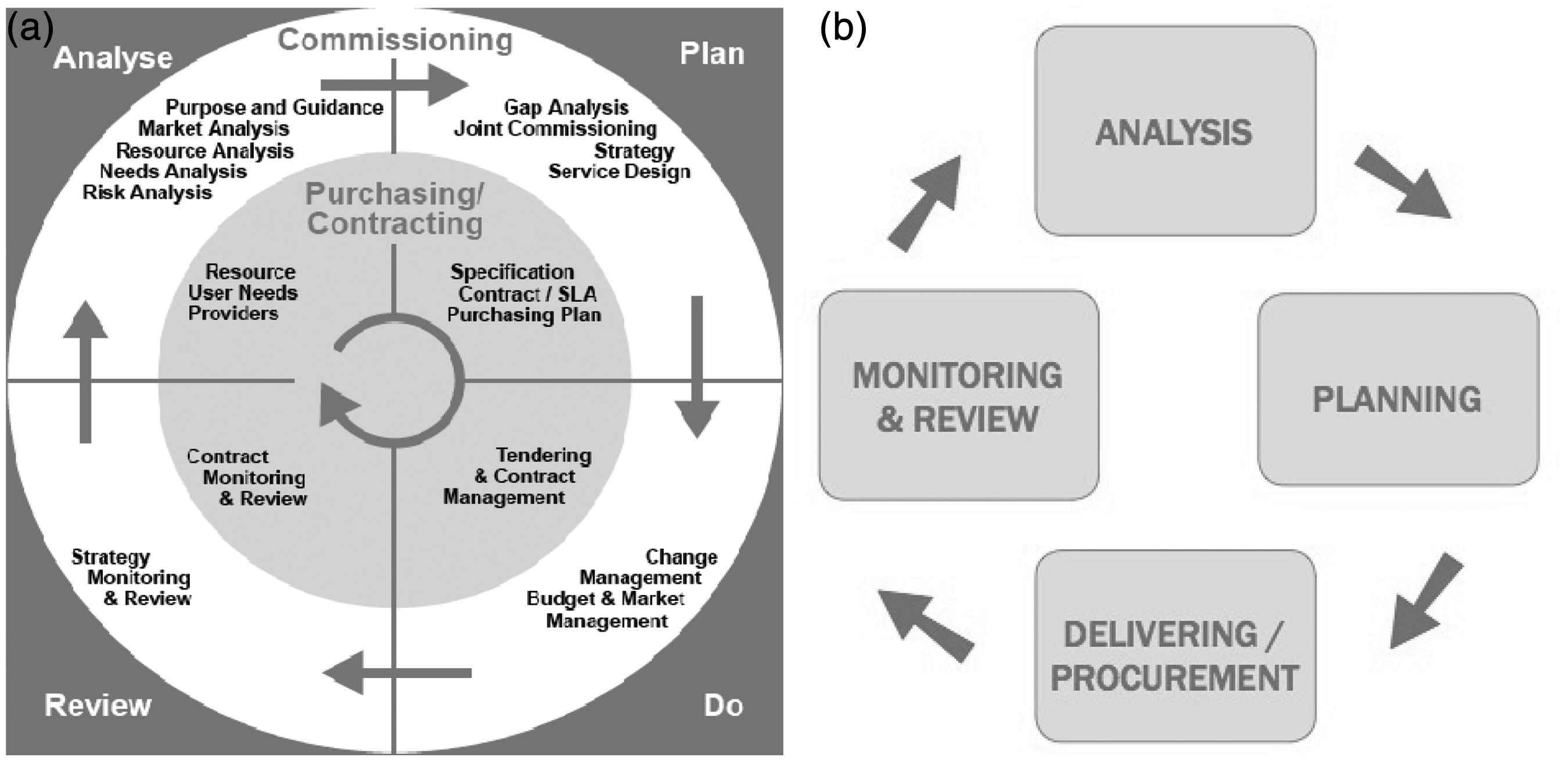
As Bovaird and Davies (2011) point out, commissioning in the `old' public administration was originally more akin to a straightforward procurement or purchase decision; whereas the ‘first wave’ of modern commissioning was associated with the introduction of CCT in the 1980s which embedded the ‘purchaser–provider’ split as an enduring aspect of public service reform and which was always a key tenet of the NPM more generally. Bovaird and Davies identified the ‘second wave’ as a shift to ‘strategic commissioning’ associated with the Every Child Matters White Paper and the development of a strategic commissioning framework for the Children’s Act (2004). From this point, the concept of strategic commissioning rapidly spread across government particularly in those departments concerned with personal services, and the language of commissioning has come to dominate political and practice discourse.
Viewed as a policy agenda, commissioning can be interpreted as a top-down policy driver attempting to fundamentally recast how public services should be delivered, albeit one which has filtered quickly out and down with much less resistance than for instance CCT (see Bovaird and Downe, 2006, for a historical comparison). But despite the apparently widespread influence of commissioning, in the UK there is a complex and multi-tiered aspect to service delivery due to a balance of responsibilities between central government, local government and Executive Agencies of government, who themselves have often been organized on regional lines. Thus, bearing in mind that Bovaird et al. (2012) found considerable diversity in understandings of commissioning within central government, the picture as policy diffuses further is likely to be even more confused. And needless to say, diversity in policy is likely to be followed in short order by diversity in implementation and in practice. For the third sector (and in addition private and other public agencies) who might want to provide commissioned services, the picture of who is commissioning services, is likely to be an intricate one.
Generally the concept of strategic commissioning appears to have emerged as the dominant discourse, consistent with the broad NPM principle of the purchaser–provider split and the ‘enabling state’, implying that the state continues to step back from direct delivery. However, there has been unhelpful confusion as to whether delivery is part of, or quite separate from commissioning. The Labour era central government policy documents reviewed by Bovaird et al. (2012) are inconsistent: some explicitly separate ‘commissioning’ from ‘providing’ while others state that delivery is part of the commissioning cycle. Arguably more important though is that a number of additional agendas have been loaded onto commissioning, including the New Labour government’s stress on inter-agency and cross-sector partnership working, the aspiration to better involve citizens in design of services including the rise of interest in personalization (Lewis, 2005; Needham, 2010), and the growing interest in commissioning for outcomes rather than outputs (Bovaird and Davies, 2011; Sturgess et al., 2011). When it comes to the third sector, the Labour government acknowledged that it might deserve special consideration in policy. The Department for Communities and Local Government (CLG) (2006) proposed government adopt ‘intelligent’ commissioning meaning that the sector could expect sustainable and longer term funding with a level playing field with the private sector and a framework that could allow innovation to flourish. Similarly, the Office for the Third Sector (2006) advocated ‘commissioning principles’ that essentially posited a framework that involved a strategic focus on outcomes, a diversity of providers and the involvement of service users and providers in the full cycle. Third sector-based reports have advocated improved commissioning processes in specific service fields such as welfare to work that take better account of the third sector’s contribution (and might result in more commissioning from the sector) (Third Sector Task Force, 2009). NAVCA (2010) favours the idea of intelligent commissioning, describing it as practices that enable good outcomes for people, that are value for money, and that enable genuine collaboration between commissioners, the voluntary sector and service users.
One of the legacies of this earlier policy development has been confusion in practice over the core meaning of commissioning. Although there has been more experience of commissioning in the health and social care policy arenas, Checkland et al. (2012: 540) were still moved to comment that ‘we also found that both commissioners and providers struggled with the more fundamental ideas underpinning commissioning’, suggesting that shared understanding is far from the norm. In the health field in particular, further uncertainty is caused by the potentially profound institutional upheaval caused by a combination of funding reductions and the structural reform of the National Health Service (Dickinson and Miller, 2011). Colloquially it is very likely to mean ‘being purchased to provide a service’, but this muddies the waters with procurement. Commissioning proper should mean ‘where the cycle operates in full’ but where the reality falls short or is circumvented in some way – is the implication that the term should not be used? Commissioning might be intrinsically unstable in its meaning, and seeking a consensual definition could be doomed to failure. There is also a potential conflict – particularly in local government, and especially now that deep budget reductions are being made – between commissioning as something that is about securing cost savings and driving outsourcing, and where commissioning is more a description of something more collaborative, trust-based and networked and about participative planning for social outcomes. It may be useful to view commissioning as operating on a continuum – between ‘intelligent/collaborative’ commissioning on one side and ‘commissioning on price/procurement’ on the other.
Public sector commissioning in the Coalition era: Is there a coherent picture?
The 2010 Coalition Agreement not only set out the Government’s overriding priority to reduce the structural deficit in one parliament but also embarked on a social agenda under the banner of ‘Big Society’ – essentially a rebalancing of the responsibilities of state, civil society and individuals (Alcock, 2012; Taylor-Gooby and Stoker, 2011). It was relentlessly criticized for its vagueness, the perception that it was merely cover for an effort to shrink the state, and a lack of clarity about how it might be achieved. Nevertheless, the ‘Big Society’ was cautiously welcomed by third sector representative bodies and those organizations that might have expected an enhanced role in public services, or else welcomed the opportunity for less ‘targetry’ or centralized bureaucracy. The Coalition’s Green Paper on Modernising Commissioning (Cabinet Office, 2010) was in the spirit of the Big Society and set out aims to devolve commissioning where possible and promote greater diversity in order to ‘drive efficiency, effectiveness and innovation in public services by opening more public service areas to civil society organizations’ (p. 9); though also to make wider use of PbR. The subsequent Open Public Services White Paper (HM Government, 2011) had a stronger, more ideological steer which continued the emphasis on commissioning as a mechanism, as well as achieving decentralization as an aim. Two further key principles – choice and diversity of provision – define the general context for the organization and delivery of services that in contrast to the ‘old centralized approach’ is marked by a ‘range of providers competing to offer a better service’ (pp. 7–9). Another two principles relate more to governance and values: ensuring both fairness of access and accountability, particularly in terms of democratic accountability. The Paper also recognized the relevance of scale, grouping public services into those commissioned at the individual, neighbourhood and national level. At the same time, the wider policy picture, particularly in relation to the controversial Health and Social Care Bill, has been widely interpreted as about opening up public services to greater competition, particularly from the private sector in the context of an ideological shrinking of the scale and scope of the state (Taylor-Gooby and Stoker, 2011). The alliance of the deficit reduction agenda with public sector ‘cuts’ has undoubtedly enhanced the politicized nature of the debate about the future shape of public sector commissioning.
The growing emphasis on commissioning for outcomes was a feature of both New Labour and Coalition policy on commissioning. This approach is in distinction to the detailed specification of service content and activity levels and reflects a growing impatience with the limitations of traditional command and control, target setting and related monitoring. The principal mechanism that is emerging is PbR, in which contract payments are conditional on achievement of specified outcomes – an approach that has become most established in employment services (Rees et al., 2013). The White Paper clearly stated Government’s intention to introduce PbR in a wide range of public services including criminal justice, public health and drug and alcohol treatment. PbR is also an intrinsic part of the Social Impact Bond approach that so far has been piloted in one prison, aiming to reduce reoffending rates (Dominey, 2012). PbR therefore is distinct from commissioning as a process; however, it seems that for many non-governmental actors, PbR will become increasingly central to the experience of being contracted by the state.
The development of commissioning as a key mechanism in the state–third sector funding relationship needs to be set within the wider picture of state funding and in particular the longer term trend towards the use of contracts rather than grants for funding services through the third sector (Carmel and Harlock, 2008). The 1990s saw a sustained increase in public funds flowing to the sector, continuing into the first decade of the 21st century. Public funding rose rapidly from £8.4bn in 2000/2001 to £12.8bn in 2007/2008 and had reached £13.6bn by 2009/2010, the latest date at which figures are available (Clarke et al., 2012). The second significant part of this story has been the steady shift in emphasis from grant to contract funding. In 2009/2010, £3.1bn of the statutory funding was received as grants, down from 4.6bn in 2000/2001. Meanwhile, contract funding increased over the period from £3.8bn to £10.5bn. Thirdly, funding to the third sector represents a small proportion of overall Government purchases of goods and services – in 2009/2010 contracted spending by central government was 5.3% of the total. However, significantly, the proportion, at 8.8%, is higher for local government (Clarke et al., 2012). Finally, a minority of charities receive any state funding: in 2008, 36% of TSOs received any public income. Around 18% received income from local sources, 5% from national sources and 14% from both (Clifford et al., 2012). Little is known, however, about how much of these flows of funding are specifically controlled through commissioning processes, and this is a major challenge for understanding the wider significance and development of commissioning.
National government policy and commissioning practice is likely therefore to be one important, but far from the only determinant of the commissioning experience for the third sector. As the figures above suggest, local government is the more important part of the state from the third sector perspective. A recent survey found that 81% of council leaders and chief executives expect their strategic commissioning role to increase in the near future. The same survey showed that 65% said that more contracts would go to the VCS (White, 2011). However, as this report makes clear, the actual diffusion and impact of these policies under discussion as far as local policy and reality is far from certain – and the interaction of local government with commissioning practice in other public services is also highly complex and uncertain in a time when profound public service reforms are occurring (Miller, 2013). What we can suggest is that councils have reacted to the commissioning agenda in different ways, some with enthusiasm and some in a spirit of resistance (Bovaird and Downe, 2006) – but that there is a lack of research evidence of different approaches taken by councils. Pro-commissioning councils can be identified as those which have publicly proclaimed themselves as ‘commissioning councils’ or have adopted aspirational titles such as ‘Total Commissioning’ or brands such as the ‘EasyJet’ council. Dissenting councils have adopted alternative broad strategies such as co-operative or mutual (‘John Lewis’) council models. Some, most notably Suffolk County Council, have been forced to row back from the most radical models of outsourcing through commissioning following strong local opposition. It can be argued that there is further group who have resisted through inertia or withdrawal.
A clear message from this is the likelihood of very considerable divergence in approach, particularly at a time when Government has lifted a range of national regulatory practices (for example, Comprehensive Area Assessments and the abolition of the Audit Commission). However, it must also be stated that such aspirations may not necessarily translate into support for the third sector -- they may facilitate, whether by design or not, a more general process of outsourcing that may equally benefit the private sector. On the other hand, there is also evidence that local authorities find contracting with the third sector more congenial and have often been supportive of their local third sector, through inter alia the existence of designated officers to support the sector and third sector policies and market support – and these individual elements may contribute to an improved commissioning interface between the local government and the third sector (Martikke and Moxham, 2010). There is also already very considerable divergence of experience in different service areas, particularly a much longer history of diversity and commissioning in social care, resulting from the Community Care Act, 1992. As a result, nearly a third of UK public services that are delivered by charities are in health and social care (Dickinson et al., 2012). In addition, there is uncertainty about whether the new Public Services (Social Value) Act (2012) will have its intended impact of making the commissioning of services from the third sector a more level playing field by ensuring that public authorities properly take into account ‘economic, social and environmental well-being’ when awarding public services contracts (Teasdale et al., 2012).
Towards commissioning in practice: What might commissioning mean for the third sector?
A theme of recent literature on the commissioning of the third sector has been a sense of ‘mutual incomprehension’ whereby public sector organizations lack awareness of the services that TSOs can offer as well as the limitations they face (Martikke and Moxham, 2010); while TSOs lack awareness of the opportunities available or how to engage more effectively in commissioning processes, or are simply under-prepared (Stevenson et al., 2010). Much research in recent years has questioned the extent to which TSOs are ‘commissioning-ready’, that is, geared up to winning contracts for services. In response, they have been exhorted to become more ‘professional’ (Bubb and Michell, 2009), and invest in and demonstrate skills and attributes such as the ability to work in partnership, maintain strong relationships with the local community and service users; achieve targets and outcomes; and to be flexible and aware of new agendas (Packwood, 2007; Tanner, 2007). Despite widespread recognition of ‘barriers’ in the New Labour era, and direct investment and support for the sector through the National Programme for Third Sector Commissioning (Audit Commission, 2007), concerns about these issues appear to have endured (Hedley and Joy, 2012). The remainder of the paper considers, in more detail, the most relevant issues for the third sector, as expressed in both policy and academic debates. Some of these have significant continuities with longer running issues concerning the sector in recent decades, others seem to be more connected to the specific policies and political juncture created by the Coalition Government.
Commissioning and competitive dynamics: Competition versus collaboration?
One of the main fears around the influence of public sector commissioning on the third sector is its emphasis on competition, central to the introduction of quasi-markets, and thus its role as a key driver of intensified competition between organizations at a local level and between TSOs and organizations in other sectors. As Buckingham found in the case of the Supporting People programme and homelessness charities in Southampton, England, the introduction of competitive tendering enhanced competition between organizations, who increasingly viewed kindred organizations as competitors for contracts, where previously there had been a strong ethos of collaboration to provide effective services for their clients (Buckingham, 2009). The trust at the heart of good inter-organizational relationships seemed to be a key victim: ‘competing for tenders was indeed undermining trust and long-established relationships between VOs’ (Buckingham, 2009: 248). However, in this account, it is not entirely clear that whether it is only the commissioning element driving competition, or equally a declining resource base; or indeed whether providers to a degree just perceive their environment as more competitive. Similar problems of perspective link to a further competitive dynamic of concern to some in the sector: that through commissioning smaller and more local organizations will be muscled out by large national charities, and thus the small organizations and their embedded characteristics such as local knowledge and trust will be lost to the service system (Milbourne, 2009).
Closely linked to this is the dynamic element to organizational change, with many organizations under pressure to professionalize, bureaucratize and scale up, raising a familiar set of fears about mission drift and isomorphism (discussed in the next section).
Similarly, in the criminal justice field commissioning is, haltingly, becoming a reality; but is often viewed by public sector prison staff as a threat, leading to hostility towards TSOs (Mills et al., 2011). Commissioning is closely aligned with the perception of an increasingly competitive environment: ‘Increased competition between sectors to provide services has clearly started to affect relationships and partnership working on the ground’ (p. 200). Equally, the research suggested that from a third sector perspective it was very unclear whether commissioning would lead to increased opportunities, with TSOs expressing frustration at the unpredictability of ‘constant policy change’ leaving them ‘fragile and nervous’ (p. 201). Smaller, specialist organizations were viewed as particularly at risk, and thus the diversity of the relevant ‘ecosystem’; and potential responses to this, including entering into consortia or partnerships, can be time consuming and risky. The rhetoric of commissioning emphasizes transparency, contestability and a fair playing field but many argue that this is far from the case in reality – in the case of criminal justice there is a particularly strong perception that the private sector has a competitive advantage. Yet in criminal justice, the public sector can have advantages over TSOs because of their ‘monopoly’ over information and can block information sharing, are less financially stretched because they can’t go bankrupt and have the infrastructure already in place to deliver projects quickly (Mills et al., 2011). On the other hand, TSOs seem to have some competitive advantages, like experience of bidding and responding rapidly to opportunities. But all of this is subsumed in an environment in which it is still very uncertain in terms of how commissioning will actually play out in different prisons and at different scales, particularly in relation to forthcoming reforms promising a ‘rehabilitation revolution’ in Probation services (Ministry of Justice, 2013).
Closely related here are arguments about professionalization – that is that smaller organizations might be very valuable (by some metric such as trust with communities or clients, or engagement with excluded groups) but are less able to prove this in commissioning processes and do not have the capacity and professionalism to engage successfully in the commissioning cycle. However, the question that needs to be asked is, are these effects caused by commissioning per se, or by the adoption of procurement, tendering exercises, or by contracting more generally. To put it another way: is the strategic commissioning approach sufficiently novel to be the key driver of these enhanced competitive dynamics? Arguably, the dynamics of commissioning-related competition are complex and it is likely to be analytically difficult to separate out the impacts that result directly from a strategic commissioning approach and those more generic effects arising from contracting with the public sector.
The impact of commissioning on independence, mission and organizational values
The justification for the wider involvement of the third sector in public service delivery has hinged on its supposed unique and distinctive qualities, in addition to a (sometimes implicit) critique of public sector shortcomings (Bubb and Michell, 2009; Buckingham, 2009; Macmillan, 2010, 2013). A generic list of these advantageous qualities would typically include flexibility, ability to innovate, closeness to and understanding of the needs of specialist client groups and the exhibition of an ethos of care that might involve going well beyond the basic requirements of a contract. Both New Labour Government and Coalition Government have shown such continuity in extolling these virtues that there may be some suspicion that they are attracted to TSOs as service providers as much because of the relatively high level of public trust invested in them; and that perhaps, as Salamon (1995) put it, the sector is surrounded by a ‘myth of pure virtue’. However, the UK Public Accounts Select Committee was sceptical of the general claims made for the sector, arguing that ‘[t]oo much of the discussion is still hypothetical or anecdotal. Although we received a great volume of response to our call for evidence, much of it admitted that the evidence was simply not available by which to judge the merits of government policy’ (PASC, 2008: 3). This remains the case, though it is worth pointing out the difficulty of establishing robust frameworks for assessing the relative strengths and performance of organizations from different sectors when delivering comparable services.
Nevertheless, it remains the case that threats to these valued attributes have long been a feature of discussions about public service delivery by the third sector, including threats to independence as a result of contractual requirements and monitoring, goal distortion and mission drift (Kendall and Knapp, 1996; Lewis, 2005). Few academic studies have mentioned commissioning explicitly but it is clear that the same concerns apply. Bruce and Chew (2011) argue that competitive pressures are increasing, a process they call marketization in which ‘VCOs are adopting management approaches and values of the private (for-profit) sector as a means to respond to their changing environment, in particular to market-based government policies’; which ‘risk[s] social mission drift, confused accountability and erosion of charitable values’ (pp. 155–156). However, these concerns over independence are certainly not new and echo the debate over the ‘contract culture’ in the 1990s, a debate which seems to resurface when the sector has perceived itself to be under threat or enhanced pressure (Macmillan, 2010). Martikke and Moxham (2010) found that not only a large majority of their respondents perceived commissioning as a threat to their organizational independence as well as to their reputation, but also many of the specific problems they experienced related as much to the contracted nature of the service delivery as to the process of commissioning more specifically.
It is difficult at this early stage of commissioning to discern the likely impacts on the third sector, but it is useful to think in terms of two dimensions: the vertical, referring to the general policy context and overall relationship between the state and third sector, and the horizontal, the more detailed practice and mechanics of local commissioning and contracting. With regards to the first, taken together the policy around ‘any qualified provider’, the formal abandonment of the Compact, the de-prioritizing of Office for Civil Society, and for instance, ministerial statements about the experience of providers in the Work Programme, suggest that the Coalition Government does not seek a partnership relationship with the sector in which its attributes are ‘protected’ and fostered, but rather a ‘de-coupled’ and market-based one (Alcock, 2010; Macmillan, 2013). Instead, TSOs might be viewed by Government as easily substitutable delivery agents within service delivery systems. Further, the notion at the heart of the procurement phase of commissioning that there should be transparent competition, means that TSOs might feel the need to be increasingly professional, to scale up to build capacity (including through consortia (Charity Commission, 2011)), and to enact cultural and organizational value changes that are perceived to be problematic by some (McCabe, 2012). On the other hand, as noted, commissioning could be an opportunity for many TSOs, and the implications of the Social Value Act may be beneficial for the sector also if a more level playing field is achieved. A further more positive slant may be that commissioning (as opposed to narrow competitive tendering and procurement) may allow the development of more trusting and long-term relationships between commissioners and providers, especially at the local level. The general sense, however, is that because of public sector cuts and the decline of grant giving, there has been a growth of pressures to ‘chase’ contracts through commissioning processes that increase the risk of mission drift, goal distortion and/or bifurcation within some organizations. Finally, the pressure to demonstrate impact and prove outcomes may again favour those who are more ‘professional’, linking to the long-running fears about professionalization, scaling up/merging of organizations and ‘Tescoisation’ (McCabe, 2012).
The second, horizontal, dimension relates to mechanisms, and in particular the pressures associated with the rise of PbR and the Prime contractor model, as well as potentially the increasing adoption of commissioning for outcomes. As Buckingham (2009) notes, although the general concerns about state control are not new, the actual mechanisms through which control is exerted can be quite subtle and specific, and it may well be the exact processes that are changing. The concept of isomorphism suggests that TSOs take on the structures and practices of their (statutory) funders (Bovaird and Downe, 2006); while the governmentality perspective tends to focus on technologies of control and self-regulation (Larner and Butler, 2005). It is certainly possible that commissioning will involve these processes and could intensify these trends, while accepting that diversity of practice means considerable divergence of exact mechanisms – the actual effects seem likely to depend on the form of commissioning that is happening in practice. To take one high-profile example, in the Work Programme, a national UK welfare to work scheme, the isomorphic pressures acting on TSO subcontractors may be quite intense, deriving mainly from the pressure on all subcontractors, regardless of sector, to deliver results under a very tight financial regime. Given the dependence of Prime contractors on their subcontractors delivering results, there are likely to be very strict and intrusive performance management practices that ‘force’ organizations to converge around similar approaches in terms of organizational strategy and even the specific content of services. Pressure to deliver, and the financial consequences of failure, could easily see organizations subverting their mission, or even finding themselves delivering outcomes that many other stakeholders in society regard as socially undesirable. These issues are considered in more detail in the next section.
The new commissioning landscape: ‘Prime’ contracting and PbR
At the heart of the new approach to commissioning promoted by the Coalition Government appears to be an effort to fundamentally reshape the way government deals with providers of public services, including but not restricted to those from the third sector. We can see this in the discussion of Open Public Services above: the New Labour era concern to specify how commissioning is done, and the invocation of partnership working has been de-prioritized in policy; instead, the elements of openness, any ‘qualified provider’, competition and especially the use of PbR and outcomes have been strongly promoted. Moreover, this new ‘commissioning landscape’ appears to be presaged on new ways to disperse risk away from the state and therefore to manage and contain it; and as noted, it cannot be divorced from the political context of deficit reduction and public sector retrenchment. Therefore, it would be short-sighted to not consider the mechanisms at the heart of the commissioning relationship and the impact they may have on the sector.
To date, these issues have been particularly evident in the Work Programme – representing in many ways the realization of Coalition policy for outsourced public service on PbR lines. Closely linked has been the move to the Prime-subcontractor model, which is based on the idea that the Prime has the scale, financial capacity and risk appetite to manage a very large PbR contract. Indeed, there is some evidence that over time developments in the commissioning of welfare to work have tended towards the increasing dominance of private sector organizations and increasing reliance on scale (Rees et al., 2013). Thus, the functioning of the Work Programme may presage future developments across a wide array of ‘open’ public services. The current contracting and financing arrangements mean that: (a) the resources available to provide services to jobseekers, and particularly the likelihood of referring individuals to specialist providers, are extremely constrained; (b) perverse incentives remain endemic, arguably written into the welfare to work model, and exacerbated by a low resource system, and not solved by the attachment of variable fees to benefit customer groups and (c) TSOs are influenced by powerful isomorphic pressures, into working in similar ways, and delivering similar interventions to organizations from the private sector in particular. Finally, there have been widespread concerns that Primes ‘offload’ risk down onto subcontractors, contradicting one of the key justifications for the Prime model that Primes shield subcontractors from most of the risk inherent in PbR systems (Hedley and Joy, 2012). These issues cast doubt on the ability of TSOs to be a source of innovation and to continue to offer the ‘comparative advantage’ that it has long been argued they offer (Clifford et al., 2012). There is some evidence that these regimes are viewed as being particularly problematic for the third sector. A recent survey suggested that 55% of the TSOs surveyed believed that PbR would have a negative effect on financial security and expressed scepticism that new mechanisms would improve outcomes for beneficiaries – grants were viewed far more favourably than PbR or tariff-based contracts (Hedley and Joy, 2012). Respondents also expressed a strong preference for being subcontracted by other charities rather than by private sector organizations and believed that charities run bidding processes in a much fairer way than either private organizations or public commissioners.
The longer term impact on the service delivery ‘system’ is more speculative but nevertheless important, given the third sector’s position in civil society and in advocating on behalf of beneficiaries and citizens. The wider strategic concern is that the new commissioning landscape might bring about a gradual disintegration (and therefore diminution in the quality) of services, enhanced complexity and a negative effect on outcomes for individuals. As Milbourne (2009) pointed out, a key rationale for the move to strategic commissioning was to move towards longer term contracts that supported collaboration across service areas and sectors. Under the previous government, she identified that major barriers include inflexibility in statutory organizations, competitive funding arrangements, differential power relations and lack of trust (Milbourne, 2009). It seems though that the Coalition version of commissioning may intensify these interlinked aspects. The general consequences of the increased competitive and risk environment might be reduced trust, collaboration, real threats to smaller and less professional organizations and hence a decline in diversity and the effectiveness of the local ‘ecosystem’ of partnership. Meanwhile, competition that results in local TSOs losing out to nationals and private sector organizations might mean an elimination of those organizations that most embody distinctive characteristics of trust, innovation, responsiveness and reach. These dynamic and difficult to manage trade-offs are central to the demands on local authorities in particular to pay attention to their ‘market shaping’ role. Unfortunately, little is really known about how well equipped public sector organizations are to fulfill this task. Once again though, there is a clear tension between a vision of ‘intelligent’ commissioning which includes market stewardship and one which favours economies of scale, private sector supply chain management practices and PbR.
Conclusion
This paper set out firstly to ask what if anything is new about commissioning as distinct from well-established processes referred to variously as outsourcing, externalization, competitive tendering and public sector contracting. In common with Painter (2013), surveying the wider public service reform agenda, it finds evidence of both continuum and dichotomy between the New Labour and Coalition eras, as well as the importance of commissioning as one ‘political narrative’. However, a deeper and more uncertain issue is the shifting and much debated relationship between the state and the third sector and the seeming impact this might have on the latter (Carmel and Harlock, 2008; Lewis, 2005). In short, one interpretation of commissioning is as an intensification of existing trends in this relationship, with increased emphasis on the market mechanism, competition and market-making. As the review presented in this paper suggests, commissioning seems likely to raise similar kinds of issues for TSOs, and by extension their clients and beneficiaries, as these existing trends have. On the other hand, it would be short-sighted to suggest that commissioning doesn’t at least have the potential to offer – through the consideration of social value for instance – a more open and collaborative approach than the narrow procurement approach. It may even be an opportunity for the third sector to gain an advantage, given the emphasis in commissioning on a whole cycle approach that can value and bring in the sector’s strengths in needs analysis, community and user engagement, and in demonstrating its ability to achieve social outcomes and impact (Miller, 2013).
A common theme developed in this paper is that there is an ambiguity in whether commissioning is driving a fundamental change in the form of the relationship between the state and the sector – what has been referred to here as the vertical dimension. An empirical challenge is to consider whether the content of that relationship is really changing. But it will be important, though difficult, to also distinguish the horizontal dimension, which will be dominated by the actual mechanisms at the heart of commissioning processes. For TSOs themselves, it will likely be the ‘hard’ contracting elements that shape their experience of ‘being commissioned’ much more significantly than the policy or political rhetoric. In particular, these are likely to involve a set of interlinked issues relating to the mechanisms that are being employed in commissioned public services, most notably the rise of PbR, other relatively novel forms of contracting, and intensifying forms of risk dispersal. Although it is early days, taken together they raise concerns about the longer term impacts on TSOs and by extension the sorts of services and outcomes they seek to deliver, as well as their wider role in society. Essentially, the focus should not only be on the new commissioning landscape and its organizational implications, to the exclusion of a consideration of the type of commissioned services (in terms of quality, equity and sustainability) that result.
There are a number of key areas of uncertainty and concern for those parts of the sector who do or wish to engage in commissioning processes. The first is that it is likely to be very unclear the extent to which commissioning represents a genuine break with existing practice or the continuance of ‘business as usual' under a new guise. It is also very hard to establish, given the huge variance in policy and practice, between different scales of government, and different localities, any general pattern and therefore policy message. This issue is complex – there is the sense in which even if commissioning is the ‘name of the game’ in any given locality or service area, it may be subverted by local political preference and tradition, or by the strength of local ties and personal relationships. Additionally, even if commissioning is pursued in ‘good faith’ and in the spirit of implementing the full commissioning cycle, the understandable pressures to procure services that are value for money in an era of ‘austerity’ may lead to contracts going to the best-priced option, which may often be providers from the private sector or large national charities willing to ‘loss lead' on individual contracts. Such a scenario may lead stakeholders to believe that commissioning offers nothing new and to become disillusioned with it. In this context, the – still contested and subjective – notions of social value, impact and outcomes (and how to measure them) become particularly relevant and probably, politicized (McCabe, 2012).
Finally, given the rise of commissioning as a central theme of governance and service delivery modernization, it is difficult to unpack from a range of closely related issues, many of which are of particular concern to TSOs. These have been noted throughout the paper, and include the use of PbR, Prime contracting and risk transfer/dumping, the general trend to market-based mechanisms, and the role of the concept of social value, and they make it difficult to assess whether commissioning is the real issue at stake. All of these issues raise pressing concerns for research, in terms of how such closely related processes can be unpacked in practice. It would likely entail a local, specific and embedded approach, which would make generalizations difficult. Underlying all of this is a deeper question about the political context and direction of travel, and the need for a picture that includes different forms of public sector commissioning across service fields, and alertness to temporal dynamics. Commissioning may be regarded as successful for TSOs, and citizens, in some contexts, at some times. In significant parts of public services, one key trend may be the development of ‘commissioning’ based on long-term outcomes paid by results, with the large-scale Prime contractor model, in which the third sector plays a highly subservient and dependent role. Finally, it will be difficult to make these enquiries in a time of profound and destabilizing change caused by public service restructuring and financial stringency.
Footnotes
Acknowledgements
The author would like to thank several colleagues at TSRC who commented on earlier drafts of the paper.
Funding
The support of the Economic and Social Research Council (ESRC), the Office for Civil Society (OCS) and the Barrow Cadbury UK Trust is gratefully acknowledged. This work was part of the programme of the joint ESRC, OCS Barrow Cadbury Third Sector Research Centre.