




Abstract
Current research demonstrated that many factors affect public satisfaction of government services. One central challenge for scholars is that citizen satisfaction is a multi-dimensional concept, yet most empirical tests focus on a small number of factors, and do not account for the simultaneous effects of the many factors. In this study, we present a comprehensive approach that accounts for this multi-dimensionality, and views satisfaction as dependent on two categories of factors: service-specific attributes, and performance comparisons. We assess the multi-dimensional nature of citizen satisfaction with a conjoint experiment, a methodological tool that allows us to test the causal effect of multiple factors operating at the same time. We use the conjoint design to investigate citizen satisfaction from every-day government services. The findings suggest that citizen satisfaction is driven by both groups of variables. Also, we find evidence for a negativity bias in public evaluations when service-specific attributes are involved: individuals' reported satisfaction is more sensitive to negative information like higher costs or unprofessional behavior by service providers compared to positive description of these factors. At the same time, we find that factors in the performance comparisons category create more balanced effects on satisfaction with respect to the information valence. The analysis reveals the drivers of public satisfaction of government services and the importance of key factors. The use of a conjoint design provides a more appropriate tool to tackle the multi-dimensional nature of a central public administration concept of citizen satisfaction.
Keywords
Introduction
Citizen satisfaction with government services is one of the fast-growing research areas in the literature of public administration and policy. A central focus in this literature revolves around the factors that drive variations in citizen satisfaction levels. These factors can be external such as service characteristics or demographic and political variables (Jilke 2018; Vigoda-Gadot and Mizrahi 2006; Zhang et al., 2022), or internal determinants led by research on the Expectancy Disconfirmation model (EDM) that emphasizes the role of perceptions and pre-conceived expectations (James 2007; James and Van Ryzin 2017; Van Ryzin 2006).
Studying both internal and external ‘paths’ covers multiple dimensions and provides a strong analytical view of the concept of citizen satisfaction. However, many of these studies only test the effects of a single or a small number of factors. This approach limits potential implications as the focus on a single factor or a small number of factors means that the effects of ‘other’ drivers of citizen satisfaction are ‘thrown into the error term’.
In this study, we focus on citizen satisfaction as a multi-dimensional concept, and posit that citizens’ views are likely to vary due to a combination of multiple factors operating simultaneously. As such, we explore the questions of how do multiple factors that operate concurrently affect individuals’ evaluations of public services? Do some factors have more consistent effects than others? And under what conditions do these effects persist?
To answer these questions, we organize the multitude of explanations described in the literature into a conceptual framework that consolidates the main factors, and clarifies the multi-dimensional nature of citizen satisfaction. Drawing insights from citizen satisfaction research, our conceptual framework describes two broad categories of factors: first, service attributes or characteristics (e.g. costs, completion time), and second, performance comparisons (e.g. considering past performance to evaluate current services). In addition, we build on insights on the prevalence of a negativity bias in the effects of information framing on public views and explore how both positive and negative valence information shape reported satisfaction.
We test our conceptual framework with a conjoint experiment (Hainmueller et al., 2014), a design that is ideally suited to answer causal inference questions for multi-dimensional concepts. The analysis focuses on assessing the various factors in both categories, and explaining what drives variations in public satisfaction levels. The main benefit of this experimental design is that it has the capacity to capture the multi-dimensional nature of citizen satisfaction by testing the causal effects of multiple factors operating at the same time. The use of a conjoint experiment “frees us” from the constraints of focusing on only a small number of treatments (i.e. factors), and strengthens our ability to draw relevant causal inferences. Our results demonstrate that citizens rely on factors in both categories when assessing performance, albeit each category has different effects. In particular, we find that the negativity bias is a unique feature that is more prevalent when citizens use service-specific attributes to evaluate performance. On the other hand, a more balanced effect on citizen satisfaction is evident when performance comparisons are involved in the assessments.
This research adds to the literature by assessing the causal effects of multiple factors proposed by studies of citizen satisfaction, and presenting a broad organizing framework that better clarifies the multi-dimensional nature of citizen satisfaction. We also demonstrate the use of a methodological tool, a conjoint experiment, to test a central concept in the public administration literature, and assess how different factors that operate concurrently shape public views of government performance. Lastly, the research has practical implications for public officials, as the findings demonstrate how different types of service information may shape citizen satisfaction and thus guide policymakers about the design and implementation of government services.
Studying citizen satisfaction
The literature on citizen satisfaction of government services is vast and describes how citizens, as consumers of public services, evaluate government performance. Scholars of public administration and policy have introduced several approaches to explain how citizens form their evaluations (Jilke and Baekgaard 2020). First, the institutional view explores satisfaction as a direct assessment of actual performance of public services. This approach focuses on measuring views of services such as education, health care, public safety, and even routine-type services such as the cleanness of streets (Cheon et al., 2021; Favero and Meier 2013; Song and Meier 2018; Van Ryzin et al., 2008).
The second approach builds on the institutional model and integrates a crucial component into the analysis of citizens’ evaluations - their expectations of the services. The Expectations-Disconfirmation Model (EDM) accounts for prior expectations when evaluating services. Adopting the logic proposed by Oliver (1980), the idea is that citizens have a certain level of expectations from government services, and the measure of satisfaction is a function of the gap between these early expectations and actual performance. In other words, the degree of fit, that is whether expectations are confirmed or not, is the central aspect in deriving variations in citizen satisfaction. This model has gained considerable support from multiple studies across many policy areas (Filtenborg et al., 2017; Hjortskov 2019; James 2007; Petrovsky et al., 2017; Roch and Poister 2006; Van Ryzin 2013).
Recently, a third approach emerged. Termed the cognitive-psychological model, this approach incorporates certain psychological aspects, implicit in many cases, that can shape individuals’ evaluations. Scholars have demonstrated how implicit attitudes which are automatic and, in some cases, unconscious lead individuals to view public services as inefficient and inflexible and thus bias their evaluations of performance (Marvel 2016). Others find that variations in performance evaluations are a function of the framing and presentation of information, or internal factors like motivated reasoning (Andersen and Hjortskov 2016; Baekgaard and Serritzlew 2016; Jilke and Baekgaard 2020; Olsen 2015). 1
Each of the three approaches has its relative strength: The institutional approach relies on evaluating services based on mostly objective-type information. The EDM and cognitive-psychological model add to that view by offering perception-based or cognition-focused (and thus more subjective) angles as they incorporate aspects such as individuals’ expectations and other elements that shape perceptions of performance. Overall, the three approaches provide strong analytic lenses to study citizen satisfaction.
Nevertheless, many of these empirical studies have focused on one or a small number of factors to explain public evaluations of services, and few studies have simultaneously tested the multitude of factors as documented in the literature. This presents a modeling issue as studies emphasize certain factors over others with no clear reasoning to why. In addition, in the real-world, when citizens evaluate the performance of government agencies or services, many of these factors operate at the same time. As such, a more realistic estimation of what drives variations in satisfaction levels should employ a similar testing strategy.
This study addresses both issues. First, we build on the vast literature of citizen satisfaction and describe a framework that organizes the main factors into two broad categories that help clarify the multi-dimensionality of this concept. Then, we employ a methodological solution to assess the multi-dimensional nature of citizen satisfaction - a conjoint experiment (Hainmueller et al., 2014; Hainmueller and Hopkins 2015). This research design allows us to test for the causal effects of multiple factors within a single empirical design.
Citizen satisfaction: A multi-dimensional conceptual framework
The literature on citizen satisfaction offers several avenues to explain individuals’ evaluations of government performance. In each of these explanations, a number of factors drive variations in reported satisfaction levels. In other words, citizen satisfaction is a complex, multi-dimensional concept that is dependent on a variety of factors. In order to present clearer and more organized insights from this diverse array of research, in this section, we subsume existing knowledge about citizen satisfaction into a framework that consists of two broad categories of explanations. A critical guide in structuring these categories is a focus on factors that are relevant to multiple services that the vast majority of citizens encounter regularly. At the same time, we recognize that we do not present an exhaustive list of all theoretical factors on this topic.
2
The first category emphasizes service-related attributes (direct information about the service). The second category focuses on comparison-type indicators related to either past performance or current service delivery.
3
An outline of our organizing framework is depicted in Figure 1. Citizen satisfaction factors: An organizing framework.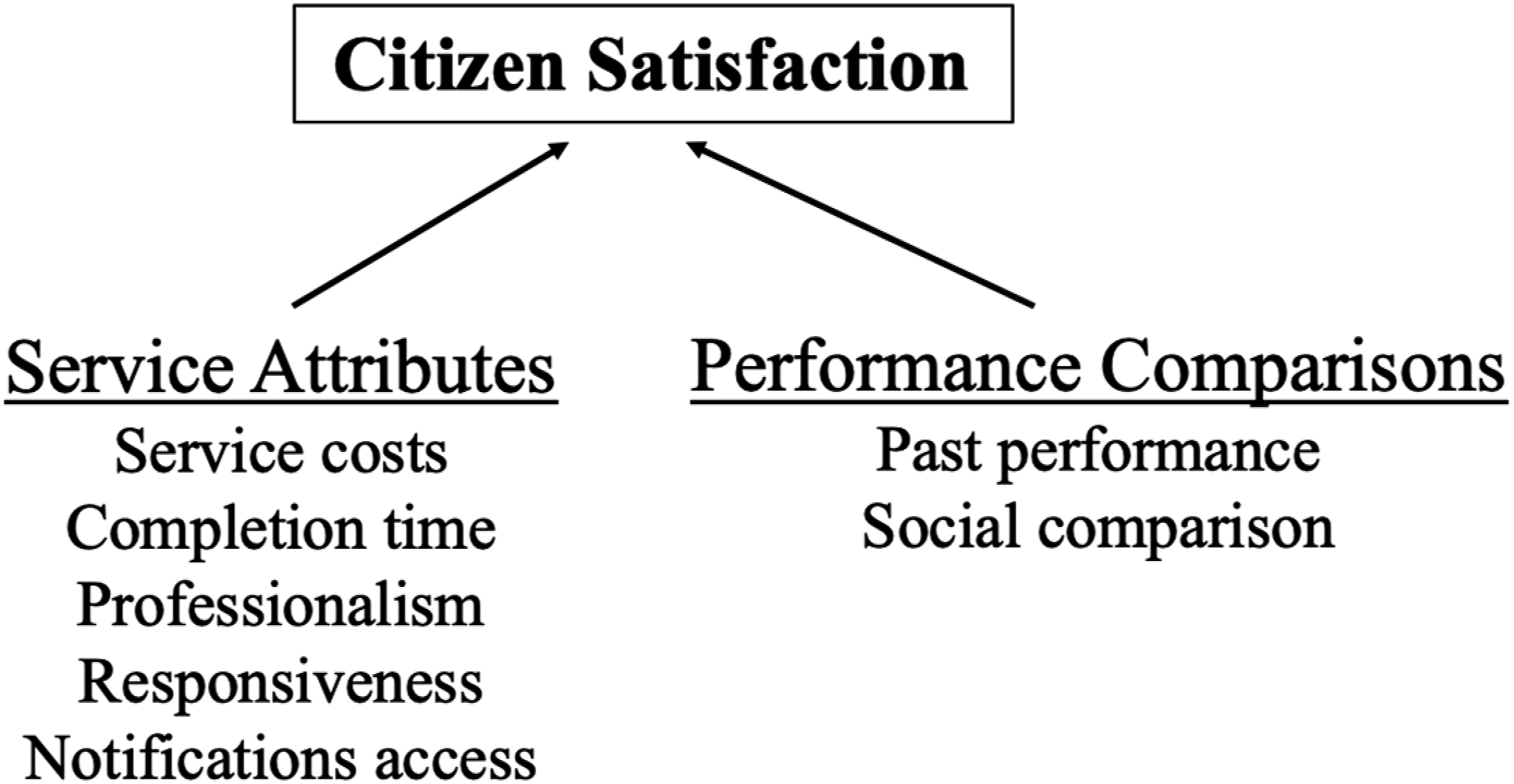
Service Attributes
Citizens’ ability to assess government performance depends, at least partially, on the information they possess or obtain about the relevant services. Our first conceptual category represents information that directly describes the service in-question (Mikkesen 2021). The factors in this category fit closer with the institutional model contending that people’s evaluations are based on direct, and observable, elements that citizens use to judge the relevant services. For instance, Van Ryzin et al. (2008) surveyed citizens about the cleanness of streets in New-York, and correlated these responses to objective ‘scorecards’. Similarly, scholars used surveys and archival data to assess public education (Charbonneau and Van Ryzin 2012; Song and Meier 2018), police and emergency services, roads maintenance and more (Kelly and Swindell 2002; Swindell and Kelly 2000).
The first factor in category is
Another factor in this category is
The third factor in this category focuses on the service providers themselves.
The service attributes category includes two additional factors that serve a more complementary role. These are elements that keep citizens informed and allow them to learn about the service in question.
Responsiveness
Previous work on satisfaction has shown that slow response by police officers negatively affect views of police performance (Coupe and Griffiths 1999; Poister and McDavid 1978). Studies that explore public service quality describe citizens’ encounters with service providers as critical since the latter must satisfy demands and requests presented by the former (Bartels 2013). Nie and Wang (2022) explore government responsiveness in China and show that the style of response also matters and can lead to positive or negative satisfaction. Wu (2021) demonstrate how communication technology system improved satisfaction level. By default, this type of system offers improved responsiveness to citizens’ requests and thus has a positive effect on satisfaction levels (for online responsiveness, see Noesselt (2014)).
Notifications on service
For citizens, accessibility of information regarding public services is important as it helps them stay informed about changes that may affect their daily lives. When local governments grant easy access to information, and improve communications with the public about services, it helps citizens and increases their level of satisfaction (Ho and Cho 2017; James 2011; Ma 2017). Noda (2021) shows that actively providing such information can offset decreases in levels of satisfaction among citizens. We posit that providing easier access to information by offering notifications about the relevant services can increase satisfaction levels among citizens.
Performance comparisons
A second set of factors described in the literature fit within a category we term Performance comparisons. These factors are more perceptual in nature and depend on residents’ experiences of government services. Our logic for this second category is based on the fact that while evaluations of services depend on direct information related to said service (the attributes category), citizens also heavily rely on their pre-conceptions of how public services should be provided. In other words, citizens form expectations about service delivery and use those to judge government performance. This is the essence of the EDM approach (James 2007; Petrovsky et al., 2017; Van Ryzin 2013) and within our framework it describes two factors that set those expectations and the subsequent evaluations of services.
Past performance
Also termed historical comparisons, this factor is viewed as one of the core pillars of studies using EDM to describe the formulations of expectations about a service, and then comparing it to post-service delivery (Oliver 1980). Hjortskov (2019) posits that views of past performance are central to the formation of expectations. His analysis finds that perceptions of past performance are critical driver of performance evaluations and satisfaction of current services. Similarly, Favero and Kim (2021) describe past performance as a central driver of predictive expectations. Their work suggests that individuals use their views of past performance to set-up expectations about a how public service (education in their case) should be delivered. Other studies of the EDM also show the important role of past performance information (Andersen and Hjortskov 2016; James 2011; Zhang et al., 2022).
Social comparisons
This factor describes how individuals use their views of the performance of other organizations to assess the performance of the organizations in-question (Olsen 2017). The social comparison factor accounts for how citizens compare public services to a similar context and how it shapes their satisfaction levels (also termed benchmarking in performance management (Charbonneau and Van Ryzin 2015)).
Early work on performance evaluations introduce the idea of comparing performance to some standard as a key to conduct such analytic exercise. The comparison uses a reference point (Kahneman and Tversky 1979) to evaluate a current scenario. This logic is also rooted in social comparison theory (Festinger 1954) arguing that individuals compare their views to those in a similar context. One relevant application of this idea is when citizens look at neighboring jurisdictions when assessing local organizations’ performance (Hansen et al., 2015). Studying public education, Favero and Kim (2021) show how social comparisons play a key role in developing views of services in the form of expectations about performance and the associated evaluations (see also Rutherford et al. (2020)). 4 In this paper, we explore this factor by asking respondents to compare certain services in their location to an equivalent service provided in a similar context (a comparable city in terms of most demographic characteristics).
Information valence and service satisfaction
The factors described in our organizing framework represent different types of information that citizens are either exposed to or obtain, and that helps them evaluate government performance. A complementary aspect is related to the information itself (in either category), and focuses on the concept of valence. That is, whether the information is positive or negative in its content. For instance, professionalism can be presented and perceived as “better than expected” or “worse than expected”, and that in turn affects people’s evaluations.
Most evidence in studies of citizen satisfaction points to a negativity bias in the evaluations of public services (Noda 2021; Olsen 2015). Based on research in psychology, a negativity bias implies that negative information and events are more salient, potent and dominant in individuals’ minds than positive ones (Fournier et al., 2020; Rozin and Royzman 2001). Adopted into studies of performance evaluations, the bias points to an asymmetry in the effects of good and bad performance information on citizens’ views. In particular, studies show that negative valence information is more powerful in its effects than a positive one (Boyne et al., 2009; James 2011; James and John 2006; James and Moseley 2014).
We build on this empirical evidence and account for the role of a negativity bias by positing that the valence of the information that citizens obtain would matter for their stated satisfaction level. Primarily, we expect that any factor described with a negative valence is likely to have a stronger effect on reported (dis)satisfaction level compared to when that factor is described with a positive valence. As an example, consider costs within the service attributes category. Integrating the negativity bias logic, we expect negative information, that is higher costs, to be more powerful in shaping satisfaction than positive valence - lower costs of service. The same pattern is expected with factors in the performance comparisons category. For instance, describing past performance of a service as positive is likely to have weaker effect than a negative valence of the same factor.
Following the description of the organizing framework and the expected role of the negativity bias, we detail several propositions for the empirical section. For the service attributes category, we test five hypotheses:
For the performance comparisons category, we test two additional hypotheses:
Experimental design
An important contribution of this study is the use of a methodological tool that captures the multi-dimensional nature of complex concepts (such as citizen satisfaction) and offers a strong measurement tool for the purposes of causal inference. We design a conjoint experiment (Hainmueller et al., 2014) in which respondents evaluate a series of public services and report their degree of satisfaction.
Research in public administration and policy has turned to this method to explore questions related to the labor market (Gallego and Marx 2017), recruitment of public service employees (Pedersen et al., 2023), housing (Hankinson 2018), and welfare reforms (Häusermann et al., 2019). Behavioral public administration studies employ this design to investigate the public’s hiring preferences of civil servants (Jankowski et al., 2020), the accountability of public sector actors (Aleksovska et al., 2022), choices of street-level bureaucrats (Jilke and Tummers 2018), and the determinants of guerrilla government actions (Hollibaugh et al., 2020).
Conjoint experimental designs present several advantages in this study. One of the main benefits of using a conjoint experiment is the ability to test the independent causal effects of multiple components (treatments) simultaneously and estimate the relative effect of each of them (Green and Rao 1971). A related reason to employ such tools is their power to estimate multiple causal effects simultaneously, which mirrors the way decisions are made in the real-world with the inherent trade-offs and the interplay of different characteristics of the decision-making environment (Hainmueller et al., 2014). Finally, these designs limit the effect of social desirability bias since they allow respondents to justify their decisions using multiple reasons (Hainmueller and Hopkins 2015; Horiuchi et al., 2021).
Design attributes and levels.
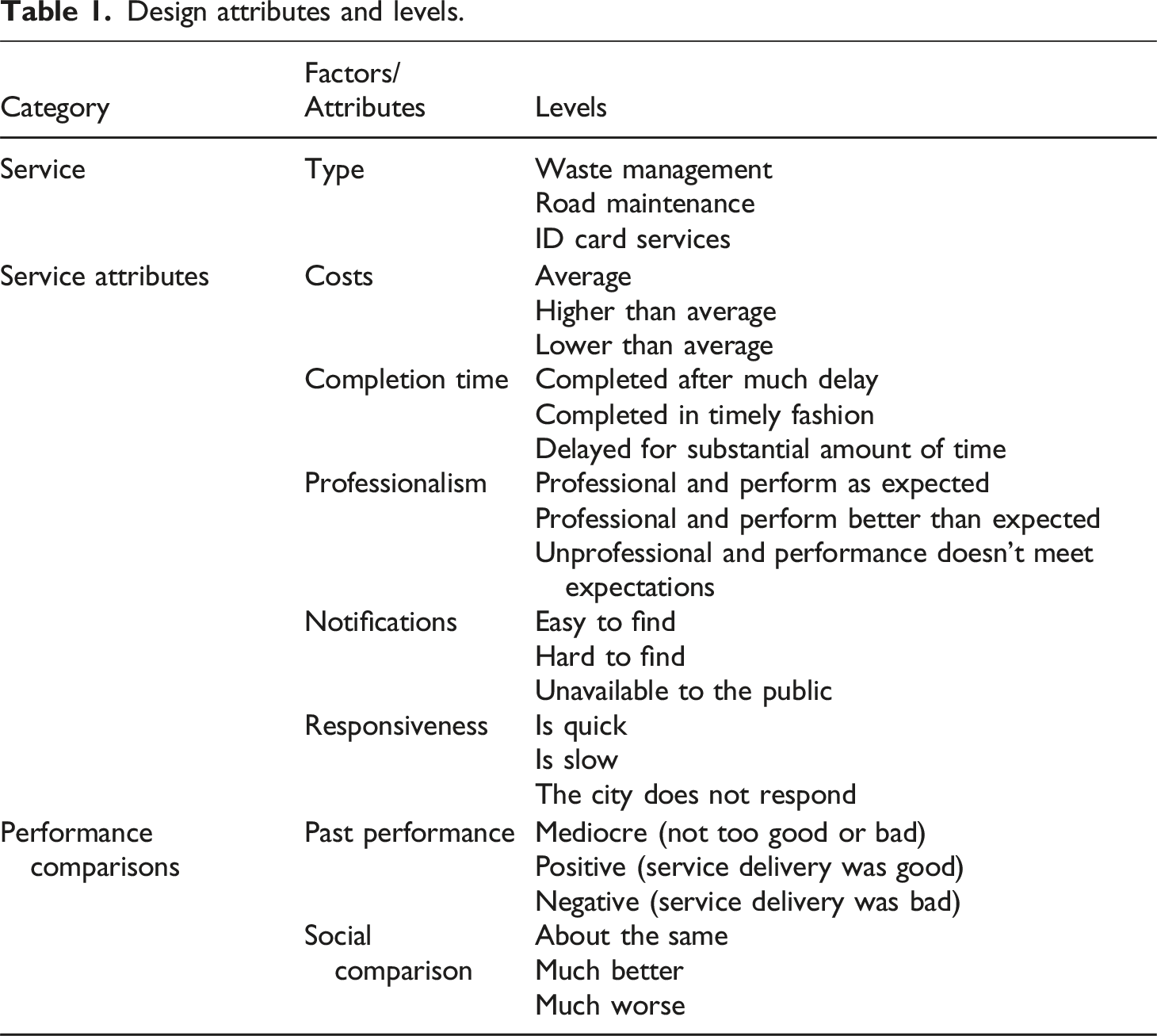
In the experiment, we randomize the levels of each of the eight factors to generate the profiles for each service that are presented to respondents. In Figure 2 below, we display example screenshots of the introduction screen and two randomized scenarios that respondents are asked to rate. The survey instrument.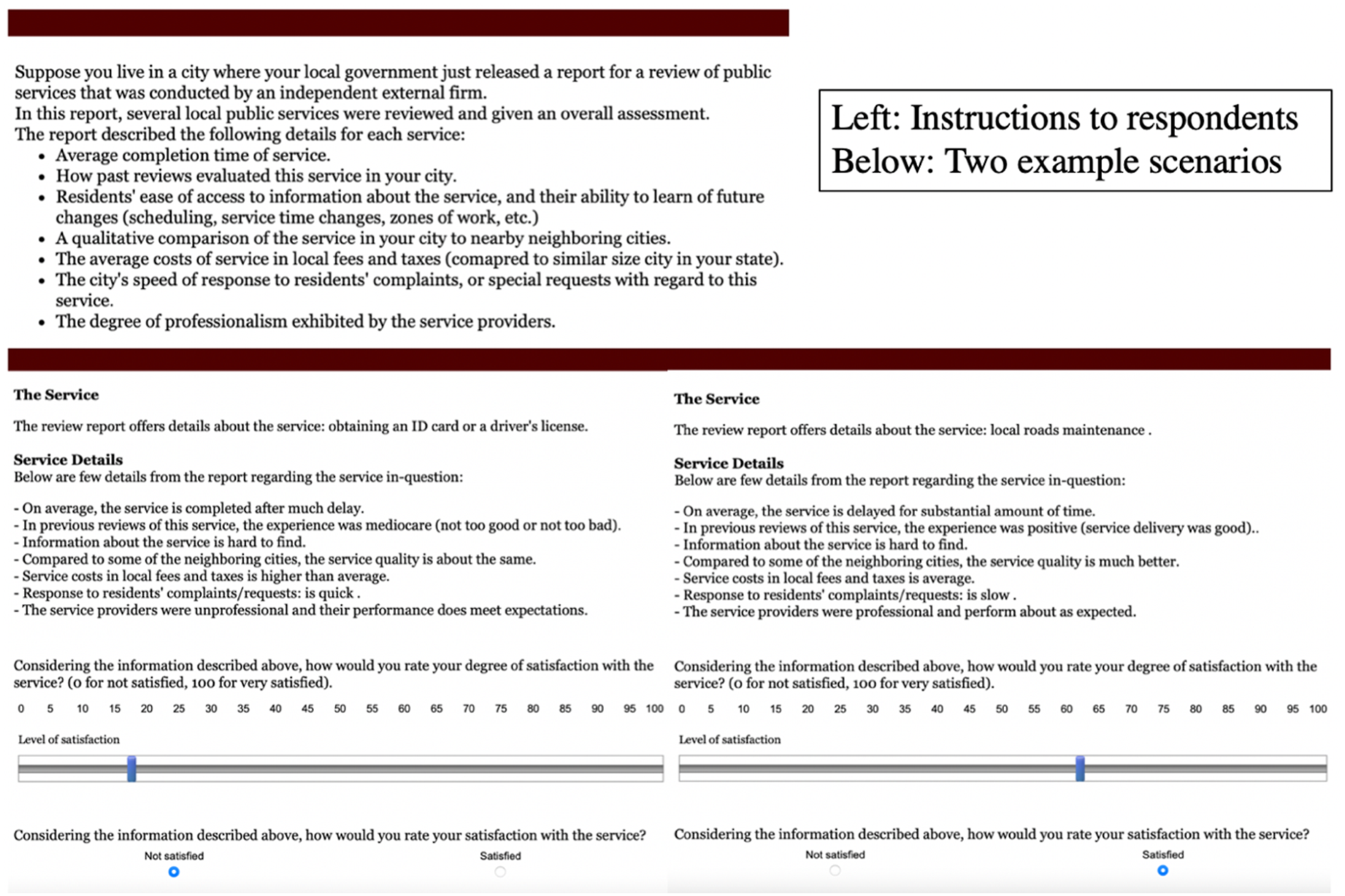
Data
We utilize Amazon Turk services to recruit a national sample of 1050 participants during February 2022. Despite its limitations, the use of Amazon Turk is prevalent in public administration literature (Funk et al., 2023; Meier et al., 2022; Stritch et al., 2017), and past work demonstrates that participants in these surveys provide relatively similar results to national representative samples (Coppock 2019; Robinson and Kelley 2020).
sample characteristics.
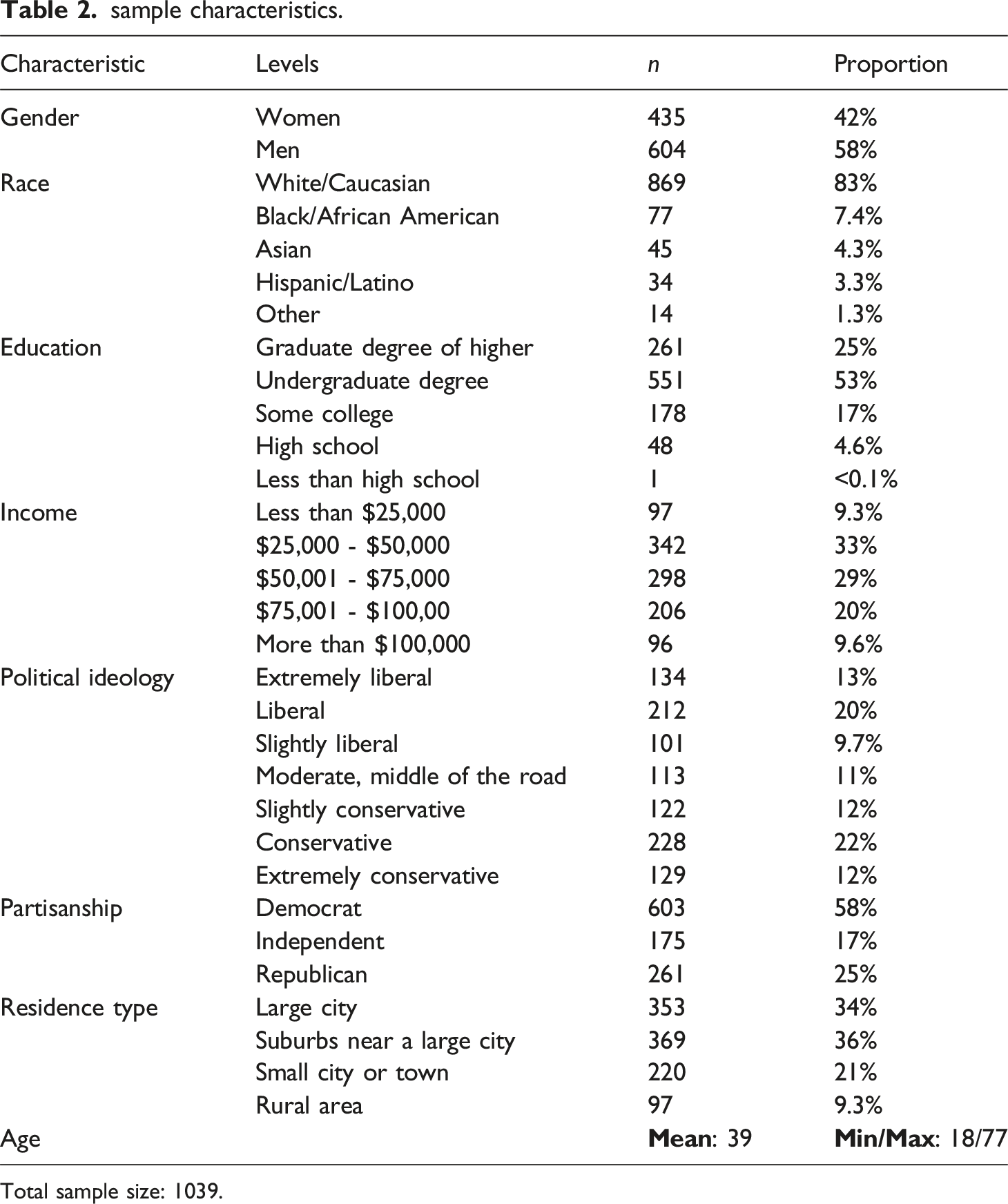
Total sample size: 1039.
Estimating citizen satisfaction
In the experiment, each respondent completes six decision tasks to evaluate different public services. We employ two types of measures for the main dependent variable of citizen satisfaction. First, a forced-choice binary indicator in which respondents select (for each service) whether they are satisfied or not. Second, we use a more sensitive type measure and ask respondents to rate their degree of satisfaction on a 0-100 scale.
Our empirical analysis of the experimental data focuses on a causal quantity of interest, the Average Marginal Treatment Effect (AMCE) which represents how much the probability of a quantity of interest would change on average if one presented attribute switched from one level to another. Thus, we utilize the AMCE quantity and estimate the effect of the different levels of each factor on the degree of respondents’ satisfaction from a public service. With these measures, a positive effect means that a factor increases the probability that respondents would report greater satisfaction from a service, while a negative effect reduces this probability. The AMCE quantity allows us to evaluate an aggregate relationship between attributes and preferences, and it represents the causal effect of a particular attribute (for extended methodological discussion see Bansak et al. (2022)).
Results
We conduct a conjoint analysis to assess the effects of all factors on the degree of satisfaction reported by respondents. For this analysis, our dependent variable is the continuous measure of satisfaction (0-100 scale). Across all respondents and treatments, the mean satisfaction level is 57, and the standard deviation is 24.6. While the conjoint analysis tests all factors simultaneously, we present the results using separate plots for a clearer interpretation of the effects of each factor and its levels. 8
Prior to presenting the factors described in our framework, we discuss the type of service factor. In the experiment, we randomize three different services (waste management, local roads maintenance, and obtaining identification cards) and include this factor within the conjoint analysis to assess whether satisfaction depends on the type of service citizens evaluate. We find that individuals’ satisfaction levels are not a function of the type of service. Compared to the reference category of road maintenance, the AMCEs of waste management (
Citizen satisfaction: Service attributes
The first category of factors (service attributes) includes a total of five factors: the completion time of service delivery (whether completed on-time or delayed), costs (in local taxes and fees), the degree of professionalism exhibited by service providers, the access to general notifications about a service, and the extent of responsiveness to residents’ requests. For a clearer presentation of the results, we depict the AMCEs of all factors in this category using separate panels for each conceptual factor.
Figure 3 displays the service attributes category. To interpret the results, we compare each level of the factors (presented in separate panels) to a reference category - positive values indicate an increase in satisfaction, negative values point to decreased satisfaction. Overall, the analysis of this category points to an asymmetric effect of service attributes. Across all factors in this category, the effect is stronger in one direction (primarily negative) and is either fairly weak or null in the other direction. Service Attributes category.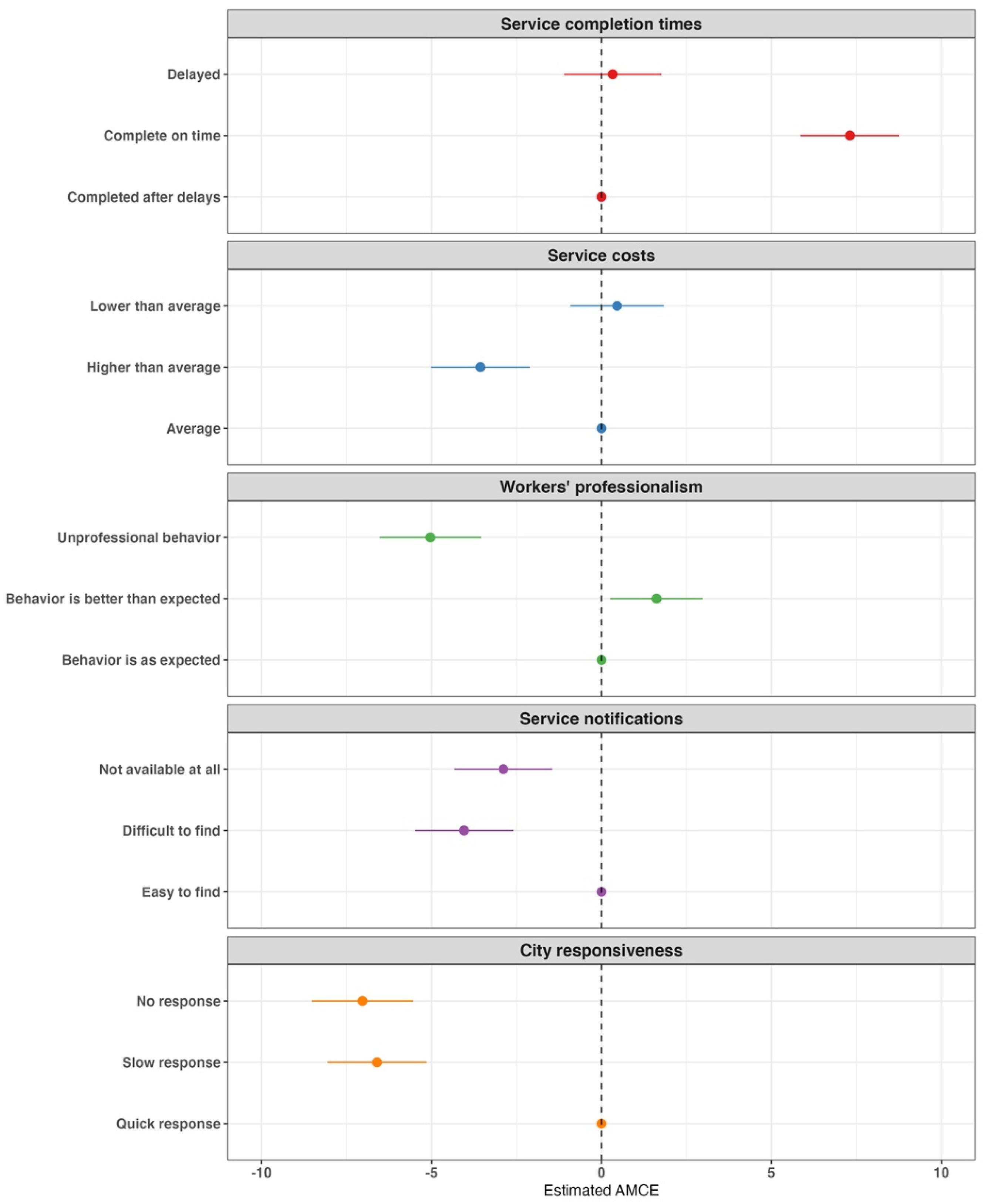
Beginning with the service completion times factor, when a service is completed on time, it has a positive effect on satisfaction compared to the reference category (completed after delay). The estimator (
Similar to completion time, the costs and professionalism factors also exhibit this asymmetry, only the direction of effects is negative. When service costs are higher than average, satisfaction is lower. This negative effect decreases the reported satisfaction by 6%. At the same time, we find that when costs are lower than average, the effect is no different than zero. Similarly, when evaluating the attribute of service providers’ professionalism, unprofessional performance has a (negative) significant effect (
The bottom panels of Figure 3 present the AMCEs for the factors we described as complimenting this category. First, when citizens struggle to find relevant information about services (notifications panel), the effect is negative (
We also find negative effects for the responsiveness factor. A lack of response to residents’ complaints or requests is associated with a lower performance evaluation (
The findings in this section focus on factors in the service attributes category, and provide evidence to support hypotheses
Citizen satisfaction: Performance comparisons
In our organizing framework, satisfaction also varies due to a second category of factors - performance comparisons. This category includes two factors that describe how pre-conceptions of government services may shape variations in individuals’ satisfaction levels.
The first factor focuses on past performance as affecting the pre-conceptions of satisfaction. The second factor includes a comparison of the service in question to a similar context, that is respondents’ compare the described services to an equivalent service in a similar town in terms of the main demographic characteristics. We depict the results of both factors in the two panels of Figure 4. Performance Comparisons category.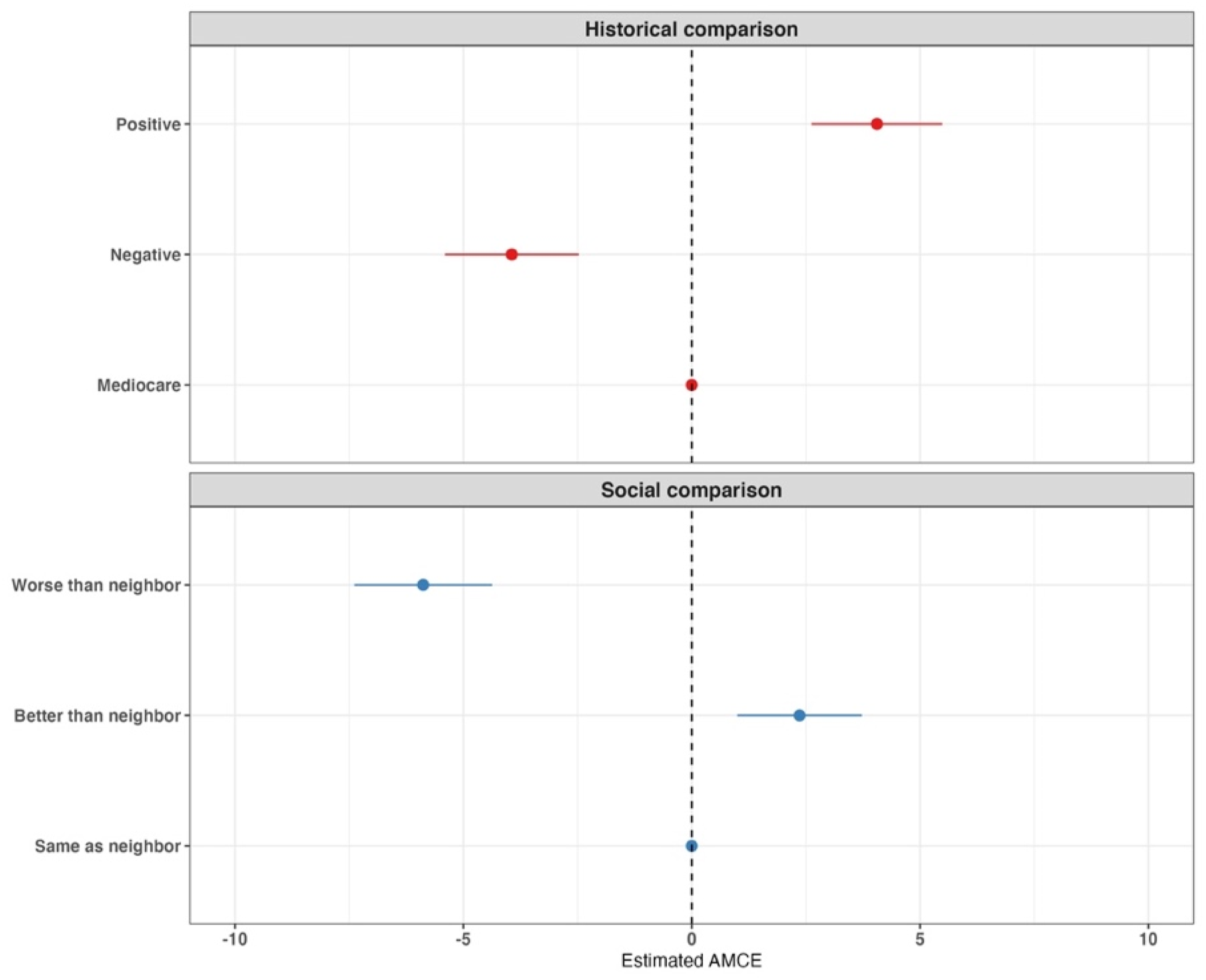
The top panel displays the historical comparison factor: past performance. When the review report describes past performance as positive compared to a reference category of mediocre, the effect on satisfaction is positive (
A similar trend is evident for the social comparison factor in the bottom panel. When comparing local services to similar cities, and the external review report describes local services as much better, it has a positive effect (
Taking the results of both factors together, we find evidence that partially support our hypotheses about past performance (
Robustness checks
In order to increase our confidence in the results, we performed various robustness checks focusing on the main outcome of citizen satisfaction. A second set of tests focuses on the conjoint instrument itself.
Citizen satisfaction - Alternative measures
Our survey instrument included two additional measures for satisfaction: a binary, forced-choice indicator in which respondents selected whether they are satisfied or not from the described service (see example in Figure 2). A second measure asks about service quality (Sivakumar et al., 2014; Van Ryzin 2013) for each of the six randomized scenarios. Responses for the quality indicator are measured on a 1-7 scale (from “Not good” to “High Quality”). We conduct a conjoint analysis estimating the AMCEs for both of these measures and find that the results are consistent across all factors.
Figure 5 displays the effects of all factors based on the binary satisfaction measure (circle shapes) as well as service quality indicator (diamond shapes). Similar to the main findings, when using either alternative measures, the type of service factor does not affect the reported satisfaction (red markers). Factors in the service attributes category such as completion times, costs and professionalism (purple markers) exhibit an asymmetric effect (negative for most factors, positive for completion time). We also find more balanced effects for the performance comparisons factors (blue markers). These results increase our confidence in the main analysis as the effects of the different factors mirror the ones we discussed earlier and are consistent across multiple measures of citizen satisfaction. AMCEs for alternative citizen satisfaction measures.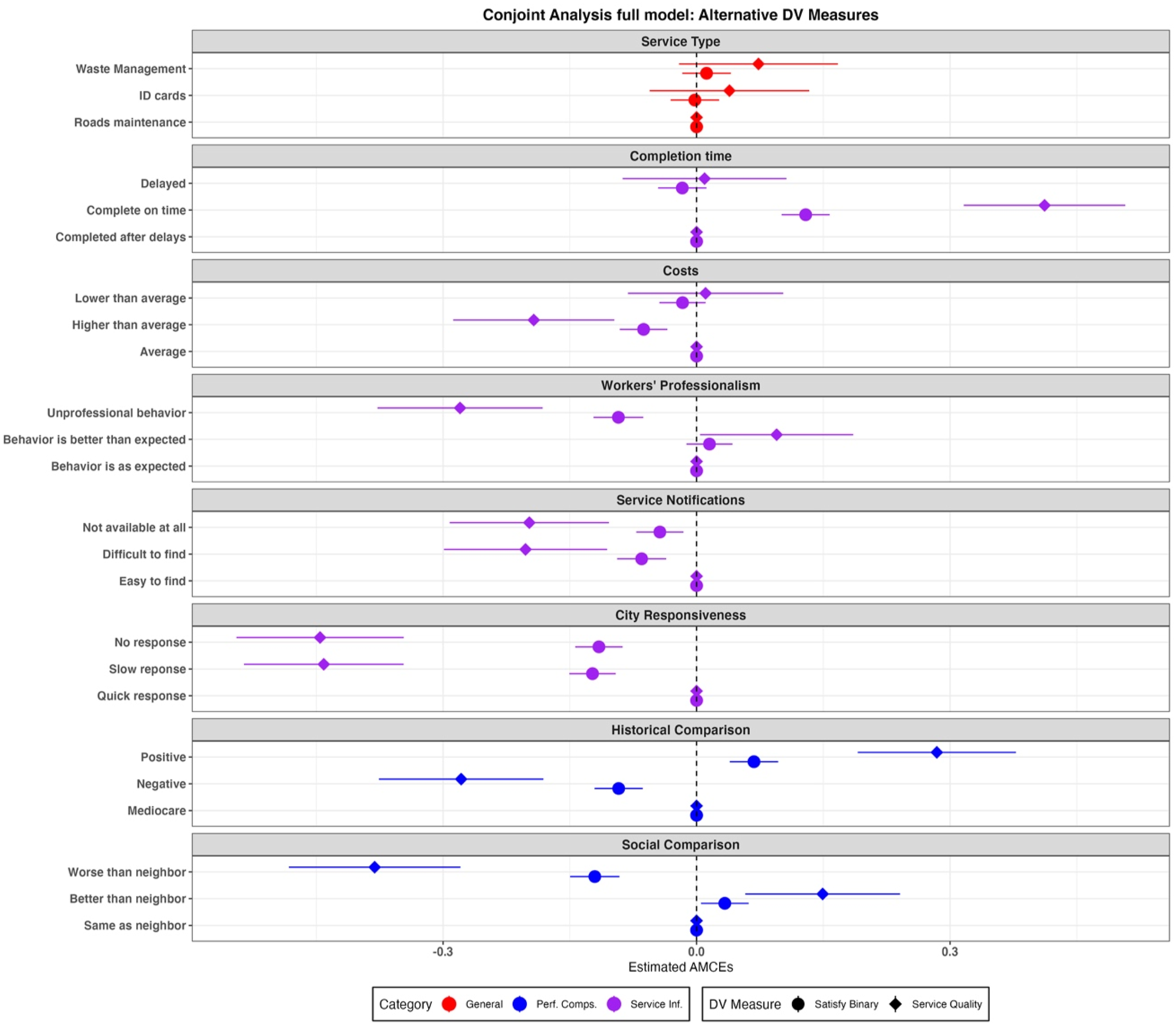
Conjoint design tests
The use of a conjoint experiment is a central contribution of this study. Therefore, we conduct several tests to increase our confidence in the strength of the results based on the instrument.
First, studies using conjoint designs discuss the potential risk of respondents’ fatigue as participants are asked to complete multiple decision tasks (Horiuchi et al., 2018). One solution to this concern is to estimate all the results based on the first few conjoint comparisons (Häusermann et al., 2019). We conduct the conjoint analysis based on the first three comparisons (half of the decision tasks in the design). Overall, the results are consistent with the analysis of the full six comparisons. Figure 6 displays the effects of all factors based on the first three decision tasks (dependent variable is the continuous satisfaction measure). While some factors display effects that are smaller in magnitude than the full analysis (based on six decision tasks), the direction of all the results is consistent. AMCEs for three decision tasks.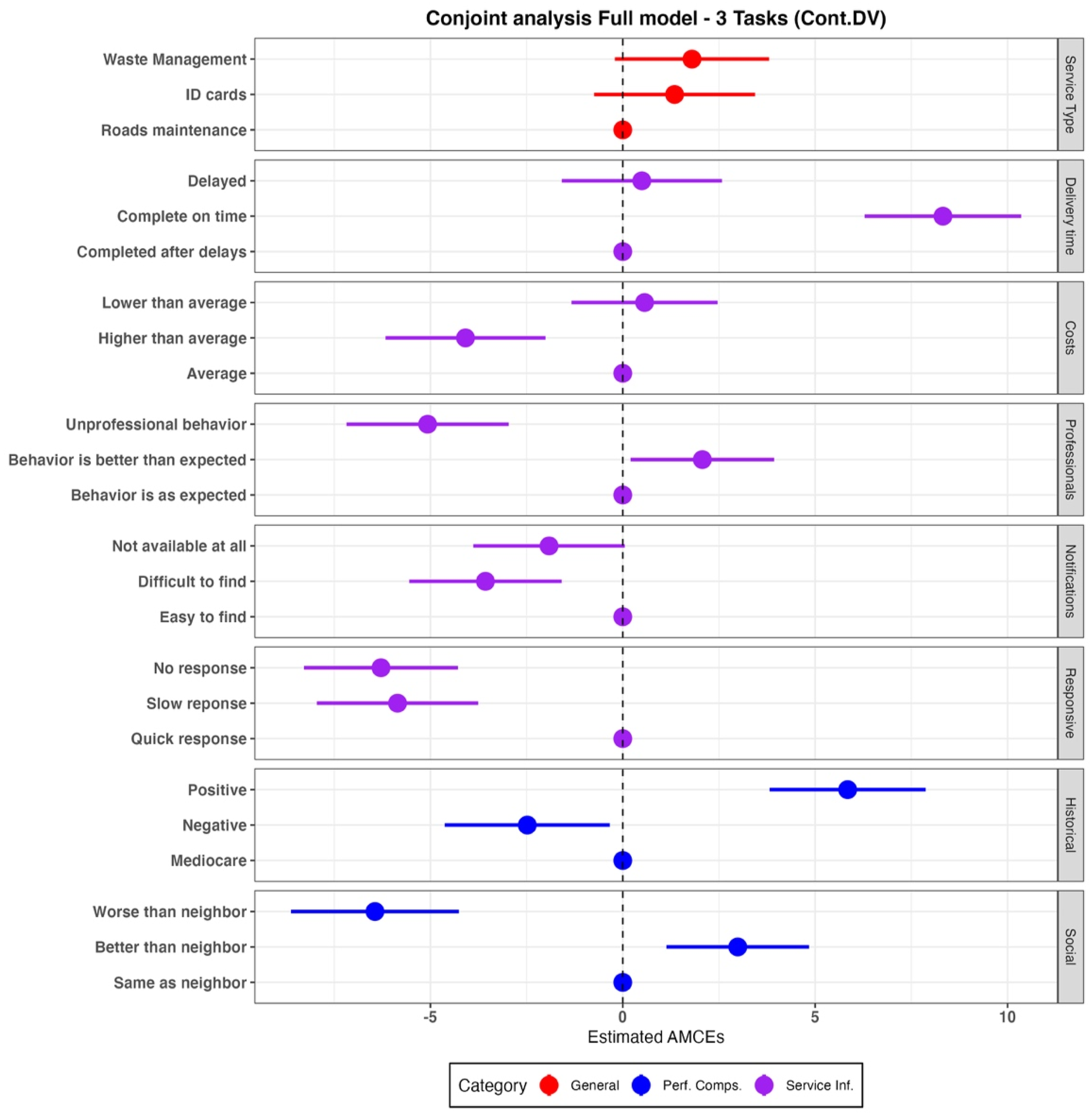
Second, random and balanced assignment of treatments among the respondents is a critical aspect of good experimental work. With the conjoint design, there are multiple treatments and conditions to account for. Thus, it is important to ensure a fairly balanced assignment of the treatments to properly examine the various factors. Using the ‘cregg’ package in R to estimate conjoint designs, we employ a diagnostics procedure that calculates the frequency of displaying the different experimental treatments. In essence, this procedure tests whether the assignments of randomized treatments are balanced. The results of the test across all our factors show that assignment of treatments is balanced: the mean frequency of treatment assignment is 2078, the lowest level was assigned 1976 times, and the highest was assigned 2191 times. These results increase our confidence in the validity of the findings across all the empirical analysis.
Discussion
The findings of the empirical analysis demonstrate how multiple factors, as described in our organizing framework, affect citizens’ satisfaction from public services. We cluster the existing explanations into two broad categories, test both positive and negative valence information, and find evidence that factors in both categories shape public evaluations of government services.
Citizen satisfaction is a multi-dimensional concept, meaning that public evaluations of services are a function of multiple factors that operate concurrently. We employ a conjoint experiment that allows us to demonstrate different causal effects for all these separate factors. In particular, we find that factors in the service attributes category display an asymmetric effect while the performance comparisons factors have a more balanced influence.
Our analysis reveals that most factors in the service attributes category exhibit asymmetric effects on reported satisfaction. Stated differently, only one type of valence of the provided information affects respondents’ satisfaction levels. For instance, the timing of service delivery has a positive and substantial impact on evaluations (Brown and Coulter 1983). Beyond that, while positive valence information on completion time increases satisfaction by 13%, negative information (i.e. reading about delays) does not have a consistent effect on satisfaction levels. The other factors in this category display similar asymmetry in their effects, albeit the direction is negative. We find that the behavior of service providers (Gazor et al., 2012; Wu 2021) and costs (Baekgaard 2015) are important attributes. When this information has a negative valence (i.e. high costs or unprofessional behavior), satisfaction levels decrease. At the same time, for professional behavior or low costs (positive valence), the effects on satisfaction are marginal to null. The asymmetric effect of service attributes are also evident for the complementary factors of responsiveness (Coupe and Griffiths 1999; Nie and Wang 2022; Poister and McDavid 1978) and access to service notifications (Ho and Cho 2017; James 2011; Noda 2021) which both reduce satisfaction when the information is negative.
The results of this category have both theoretical and practical implications. From a theory standpoint, we expand on existing work regarding the negativity bias in performance evaluations (James 2011; James and Moseley 2014) with the asymmetric role of negative valence information. In particular, we show that the ‘dominance’ of a negative effect is more potent for a certain type of information. Therefore, not all service information is likely to be detrimental for performance evaluations. Yet, when learning about different attributes of public services, citizens are more likely to highlight the negative valence over the positive one.
In addition, the analysis of our conjoint experiment offers a particular outlook that citizens have on public services. In other words, citizens have certain baseline views or expectations (James 2007; Petrovsky et al., 2017; Van Ryzin 2013) about public services (costs, how providers should behave, etc.). The negative valence information results suggest that when these baseline views are not met, the effect on satisfaction is detrimental. On the other hand, the results of the factors described with a positive valence suggest that even when those expectations are met (i.e. performance is positive), satisfaction remains average as citizens view it as ‘the default’ for government performance. For policy practitioners, this suggests that for the most common public services, citizens possess attitudes of “don’t make things worse” which is not a good outlook. The ‘low bar’ of some attributes like service completion time further emphasizes this point as it suggests that citizens have gotten used to delays and are less critical of it. The results of our work in this category paint a rather disturbing picture for government services that every citizen uses and encounters routinely.
The second category we explore (performance comparisons) consists of two factors that are based on the experience of services and more directly relate to citizens’ perceptions of how services should be delivered. Unlike the service attributes category, the performance comparisons factors show more symmetric effects on satisfaction as both positive and negative valence information shift performance evaluations (Olsen 2015). Our findings of historical (Favero and Kim 2021; Hjortskov 2019) and social comparisons (Olsen 2017; Rutherford et al., 2020) demonstrate that both positive and negative valence information affect satisfaction.
The findings of relative balanced effects of the performance comparisons factors are further compounded by their magnitude. In other words, shifting from negative to positive valence and vice versa translates to a change of 14%–15% in reported satisfaction. This is an important finding and suggest that such factors, which are more perceptual in nature, play a critical role in performance evaluations and bolster claims offered by studies on the EDM (James 2011; Van Ryzin 2006) regarding the role of perceptions and expectations in driving variations in citizen satisfaction.
A second implication of these findings addresses an issue raised by James (2011) with regards to detecting the magnitude of a negativity (or positivity) bias. Olsen (2015) explores this issue by discussing the idea of equivalence framing (i.e. providing positive and negative valence information). Our conjoint design is similar to Olsen (2015) as we display information that has both positive and negative valence. However, we also describe a comparable neutral point (i.e. describing past performance as mediocre). We find that the past performance information has a roughly similar size effect on satisfaction levels as it either increases or decreases satisfaction by approximately 7% compared to the neutral point. In other words, the experimental design provides an answer to the question of the size of a bias (either positive or negative). In addition, in both of his experiments, Olsen (2015) finds about 20% difference in satisfaction when shifting from positive to negative valence. In our study, the results of both performance comparison factors are similar - the change from a negative to a positive valence information results in a 14%–15% increase in satisfaction.
Conclusions
In this study, we explore the concept of citizen satisfaction and employ an advanced methodological tool to estimate the relationships among various factors that drive variations in public satisfaction of government services. Based on an organizing framework that consolidates multiple explanations from the literature of citizen satisfaction, we design a conjoint experiment to assess the factors that shape public evaluations of government performance.
The findings demonstrate that citizen satisfaction is shaped by both service-specific attributes and performance comparisons information. More interestingly, we find evidence that a negativity bias is more likely for a certain type of service information, primarily service-related attributes. At the same time, service information that is more perceptual like social comparisons display a more balanced effect and can either increase or decrease satisfaction contingent upon the valence of the information.
Our study offers several contributions to research on citizen satisfaction. First, studies in public administration presented many factors that shape citizen satisfaction (Jilke and Baekgaard 2020; Zhang et al., 2022), thus demonstrating the multi-dimensionality of this concept. Yet, not many studies conduct empirical tests that account for that multi-dimensional nature. We leverage the strengths of an advanced method, conjoint experiment, to assess multiple relationships among factors that define this multi-dimensional concept using a randomized controlled design (Hainmueller et al., 2014). The findings show the simultaneous effects of different factors on public evaluations of government performance. Second, we add to work that demonstrate the emergence of a negativity bias in citizen satisfaction (Noda 2021; Olsen 2015) and show it is more likely to be prevalent for a certain type of information. Third, studies highlighted the challenge of measuring the magnitude of the negativity bias (James 2011). Our experimental design offers an approach that helps answer the question of the magnitude of the bias in citizens’ evaluations.
From a practical perspective, our findings point to a rather grim view of government performance for the most routine services. The service attributes results suggest that citizens expect delays, and are pleasantly surprised (i.e. more satisfied) when services are completed on time. Low costs and responding to inquiries do not improve the situation, while high costs and slow response make things worse. Policy practitioners and public managers can rely on these results to get a better sense of public preferences, and devote more attention and resources to the implementation of routine and daily encounters with residents.
While our results offer several contributions to research on citizen satisfaction, there are also limitations to our work that future research can expand upon. First, our main objective in this study is to explore how multiple factors shape reported satisfaction. As such, we only partially explore another interesting question of which factor is the most powerful, or what is the order of factors in terms of their magnitude. Future work should employ other analytical tools that allow to answer this question more directly and thus discuss the order or importance of the factors that drive citizen satisfaction. A related issue is the factors explored in our framework. As mentioned earlier, we decided to focus on general factors that are common to most routine services that citizens encounter often. Therefore, we do not test all the factors that are discussed in the literature. Future work may include other factors in an adjusted version of our framework and also explore the magnitude of these factors. Third, we tested three services that are common and known to most residents. While we do not find any effects for the type of service, future work can use an adjusted version of our framework to explore services like education or law enforcement and thus expand the state of knowledge on citizen satisfaction. Lastly, we recruit a convenient sample using MTurk. The majority of our sample characteristics fit common MTurk respondents, and some are different. At the same time, other than age, none of the individual factors affect reported satisfaction. We call for replication of our work using more representative samples to further strengthen our conclusions about the factors shaping citizen satisfaction in the US and beyond.
Public administration research on citizen satisfaction provides various insights about the factors that drive public evaluations of government performance. Integrating the use of advanced methods to empirically test those factors can demonstrate the multi-faceted nature of citizen satisfaction, and guide public officials where more resources should be invested to improve the array of services provided as part of government-citizens interactions.
Footnotes
Declaration of Conflicting Interests
The author(s) declared no potential conflicts of interest with respect to the research, authorship, and/or publication of this article.
Funding
The author(s) received no financial support for the research, authorship, and/or publication of this article.
Ethical statement

Data availability statement
The data that support the findings of this study are available from the corresponding author upon request.