




Abstract
This study examines how public employees and citizens exercise administrative discretion in a dilemma. To identify and compare the moral reasoning underlying discretionary choices, we conducted a conjoint experiment among public employees, future civil servants, and lay citizens in Germany. In the conjoint, respondents were forced to prioritize between two equally eligible welfare claimants. Claimants’ profiles vary concerning attributes reflecting earned-deservingness (e.g., non-self-inflicted welfare dependency), need-deservingness (e.g., dependent children), and attributes that can be used for unlawful discrimination (e.g., nationality). While some signs of discrimination exist, need-deservingness is the most important factor shaping respondents’ prioritization choices. More importantly, we find no substantial differences in prioritization choices among public employees and citizens, indicating congruence in moral reasoning. From these findings, we conclude that efforts to reflect on national prejudices in the education of civil servants should be intensified, and a renewed emphasis on administrative ethics is required to equip public employees with the ability to make impartial yet balanced judgments in administrative dilemmas.
Keywords
Introduction
Discretionary decision-making in individual cases is a regular feature of administrative action (Lipsky, 1980; Zacka, 2017). It allows administrative decision-makers to consider differences between individual cases and develop solutions catering to the individual situation. Administrative discretion is a necessary yet controversial instrument, allowing for potential abuse and spurious unequal treatment. To prevent the latter, impartiality is a central norm of administrative decision-making. However, although “justice as impartiality” (Mendus, 2008: 427) is a central public service norm in modern Western bureaucracies, treating all citizens formally equally will not always lead to just decisions (Rivera and Knox, 2023; Rothstein and Teorell, 2008). How public employees and citizens deal with administrative decision-making dilemmas in which resorting to blunt impartiality does not provide a just solution is at the center of this study.
To what extent administrative discretion requires an understanding of what is right and wrong is a longstanding debate in administrative ethics. Dating back to the exchange between Friedrich (1940), who believed in the necessity of an internal moral compass that all civil servants should have, and Finer (1941), who warned that civil servants’ making decisions based on their “inward personal sense of moral obligation” open up the doors for “a new despotism.” (Finer, 1941: 340). This distinction, emphasizing either a normative or structural perspective on administrative ethics, is also reflected in what Rohr (1989) coined the “low” and the “high road” of administrative ethics. According to this conceptualization, the “low road” is about administrators’ neutrality and following the political regime’s values. Instead, the “high road” concerns individuals’ moral integrity and the application of universal ethical principles upon which administrative decisions should rest (Raadschelders and Chitiga, 2021: 402).
Existing research in behavioral public administration mostly focused on the “low road”, investigating discrimination in administrative discretion as a violation of administrative neutrality and rule compliance. This research reveals cases where administrative decision-makers are biased or discriminate against clients (Einstein and Glick, 2017; Hemker and Rink, 2017; Pfaff et al. 2021). However, it also shows that multiple principles of justice are effective in administrative discretion. Merit, for example, plays a major role in prioritizing applicants for a position in the civil service (Jankowski et al. 2020), and clients’ attributes of deservingness matter, for example, for teachers’ willingness to give students extra help (Jilke and Tummers, 2018). Expanding on this line of research, this study seeks to unfold the moral reasoning applied in administrative decision-making in prioritizing clients’ social needs. It examines discretionary decision-making in cases where the decision maker is forced to choose – referring to Rohr’s (1989) terminology – on the “high road” of administrative ethics.
Although administrative ethics have always been a topic of administrative science (Hassan et al., 2014; Moon and Christensen, 2022; Thompson, 1985), empirical evidence on moral reasoning in discretionary decision-making among civil servants and citizens is meager. Morally charged conflicts decided within the framework of administrative discretion, however, are likely to increase as conflicts over the distribution of scarce resources intensify in mature welfare states. In particular, debates about welfare recipients’ deservingness are heated quickly and too often devolve into populist arguments (Busemeyer et al., 2022). Against this background, looking at the common moral foundations of prioritizing social needs seems all the more important.
This study argues that a certain degree of congruence in the exercise of administrative discretion between administrators and those being administrated is important for legitimacy, compliance, and co-production, especially when the discretionary decision involves moral judgment (Rivera and Knox, 2023). Prioritization decisions that align with citizens’ sense of justice are more likely to garner support than decisions that deviate systematically from citizens’ moral convictions. However, and this is important, consistency in moral judgment between public employees and citizens is not an end in itself. Rather, it is necessary to identify the normative quality of the motives – illegal discrimination or client deservingness – that underlie the prioritization decision.
In order to test which motives guide discretionary behavior in a moral dilemma, we create a conjoint experiment that puts public employees and lay citizens into a situation where they must prioritize between two legally equally eligible welfare claimants (Hainmueller et al., 2014). The respondents are confronted with the hypothetical decision to prioritize the allocation of an indivisible good between these two claimants. The profile of the two claimants varies with respect to attributes that reflect earned-deservingness (e.g., non-self-inflicted welfare dependency) and need-deservingness (e.g., family with dependent children) as well as a set of ascriptive attributes that can be a source of unlawful discrimination (e.g., age, gender, nationality). Conducting the same conjoint experiment on a sample of public employees, future civil servants, and lay citizens enable us to shed empirical light on the moral reasoning applied in this specific case of administrative discretion.
The study proceeds as follows. In the next section, we review public-private sector differences in discrimination and deservingness in administrative decision dilemmas to derive a set of hypotheses. The third section presents the experimental design, data set, and estimation strategy. The fourth section summarized the empirical findings. The last section concludes with a discussion of the theoretical and practical implications.
Theoretical framework
Administrative discretion in moral dilemmas
Modern bureaucracies in Western democracies are based on the Weberian rational-legal rule (Mendus, 2008: 427). Following the Weberian “ideal”, administrative justice is equated with impartiality. At the same time, blunt impartiality will not always lead to just decisions, as individual circumstances may be more complex than a purely impartial application of the law could properly reflect (Rothstein and Teorell, 2008). In these occasions, administrative discretion allows decision-makers to consider differences between individual cases and develop solutions catering to the individual situation.
Administrative discretion becomes particularly apparent in welfare administration (e.g., Senghaas, 2021). The welfare state’s mission is to provide goods and services that are a prerequisite for activities that every member of a society should be able to carry out at some collectively agreed minimum level (Mac Cárthaigh, 2014: 460–461). In this process, Lipsky (1980: 15) argues, societies “to a degree [...] not only [seek] impartiality from its public agencies but also compassion for special circumstances and flexibility in dealing with them.” Discretion allows administrators to be compassionate and “respond to the human dimension of situations” (Lipsky, 1980: 15). Administrative discretion opens room for acknowledging differences, helping to reach the policy goals at the heart of welfare legislation instead of bluntly equalizing cases (Rothstein and Teorell, 2008: 178). In such instances, officials cannot stay neutral; they must make moral decisions themselves, or as Rohr (1989: 64–68) would put it, exercise administrative discretion on the „high road“ of administrative ethics.
Despite the rich literature on public sector values (e.g., Neo et al., 2023) and administrative ethics (Moon and Christensen, 2022; Raadschelders and Chitiga, 2021), empirical evidence on moral reasoning among civil servants and citizens is meager. In an early vignette experiment, Wheeler and Brady (1998) compare public and private sector employees’ predispositions to prefer deontological or consequentialist forms of ethical reasoning. Contrary to their initial expectations, they found no difference between the two groups. We pick up this research interest and take a slightly different perspective on the topic as we argue that consistency between the discretionary decisions made by civil servants and citizens is important to establishing and maintaining trust in public authorities. If decisions are perceived to deviate systematically from lay citizens’ moral convictions, it could lead to a loss of trust, causing citizens to be less willing to comply with administrative decisions. 1
This study cannot discuss the various definition of ethics and moral reasoning, as it is not a philosophical exploration (Raadschelders and Chitiga, 2021: 402). Instead, it acknowledges that administration discretion can follow very different motives, ranging between legitimate differentiation and unlawful discrimination. Discrimination implies that administrative decision-makers grant or deny a public service based on illegitimate factors, including the client’s age, gender, or nationality. Differentiation means that administrative decision-makers respond to the “human dimensions of situations” (Lipsky, 1980: 15) to make just decisions.
Public-private sector differences in discrimination
Although comprehensive anti-discrimination and equal-opportunity laws are in place (OECD, 2015), discrimination in public service provision still occurs (Einstein and Glick, 2017; Jilke et al., 2018; Pfaff et al., 2021). For the German case, Hemker and Rink (2017) find that German welfare offices’ response quality is significantly lower for requests from non-natives. On the other hand, Grohs et al., (2016: 161) show that German administrators in municipal offices do not commit systematic ethnic discrimination. Instead, they find a tendency for positive bias (also referred to as positive discrimination) as male citizens with a Turkish name asking for information received better service orientation than females with a Turkish name. In another correspondence experiment, Adam et al. (2022) confronted administrators in municipal offices with requests about organizing a political rally, randomizing whether the rally was about the promotion of or opposition to same-sex marriage. Again, no systematic discrimination is identified.
So far, little is known about whether discrimination varies between sectors. In a conjoint experiment comparing public hiring preferences among civil servants – both junior and senior – and private sector employees, Jankowski et al. (2020) find that hiring decisions are primarily based on meritocratic attributes rather than discrimination. Likewise, the correspondence experiment by Villadsen and Wulff (2018) finds no evidence that public sector organizations are less discriminatory than their private sector counterparts. A related conjoint experiment by Adam et al. (2021) compares discrimination against mobile EU citizens between citizens and a subsample of public administrators. Their study suggests that discrimination occurs and that the discriminatory behavior of public administrators is similar to that of the general population.
Although solid empirical evidence is lacking, a common normative expectation remains that public employees should discriminate less than their private sector counterparts. For individuals occupying a public office, the requirement of impartiality applies very strictly, at least while acting as a servant of the state (Mendus, 2008: 427; Lipsky, 1980: 14). Therefore, one would expect impartial, non-discriminatory decision making to be more prominent in the work ethic of public employees. Furthermore, unlike private companies, public sector organizations operate in an environment of extensive political and societal scrutiny (Boyne, 2002: 98). Public organizations and their employees must adhere to many formal decision-making procedures and are subject to tight control mechanisms that limit their autonomy to act (Boyne, 2002: 101). The institutional environment also encourages the adoption of the norm to act impartial and non-discriminatory in cases of administrative discretion. Therefore, our first hypothesis is:
(Discrimination): Compared to lay citizens from the private sector, public employees and prospective public employees are less likely to base their prioritization decisions on discriminatory attributes of welfare claimants.
Deservingness and public-private sector differences
Public opinion research shows that citizens’ perception of the deservingness of welfare recipients plays a significant role in their willingness to allocate welfare benefits (Heuer and Zimmermann, 2020; Reeskens and Meer, 2019). The overall findings from this strand of research suggest that citizens regard claimants to be more deservingness of welfare benefits with a decrease in control a person has over her or his situation, higher levels of a grateful attitude towards the help offered, an increased level of reciprocity, a smaller social distance between the claimant and the respondent’s social status and increasing levels of a welfare recipient’s perceived need (Van Oorschot, 2000: 36).
While numerous studies have addressed how clients’ deservingness cues affect citizens’ attitudes, few have addressed how deservingness cues affect bureaucrats’ attitudes and behaviors toward welfare recipients (Kullberg, 2005). Kallio and Kouvo (2015) surveyed street-level bureaucrats and citizens in Finland on the perceived deservingness of welfare recipients. They find that both groups consider welfare recipients as needy and that any citizen could become dependent on welfare at some point. Senghaas (2021) suggests that job center advisors rely on experiential cues such as appearance and self-presentation to interpret clients‘ deservingness. Our study corroborates these results by making different deservingness cues explicit and testing their causal effect on prioritization decisions.
To do so, we built on Jilke and Tummers (2018: 228–231), as they systematically transferred the concept of deservingness to public administration. Drawing on the concept of social categorization, Jike and Tummers (2018: 227) develop a model according to which cues activate street-level bureaucrat’s notions of deservingness, namely earned-deservingness cues (i.e., hardworking client) and needed-deservingness cues (i.e., client in need of help). 2 Need-deservingness means that “clients are seen as worthy of investing time and resources because they are perceived to be in need of help” (Jilke and Tummers, 2018: 231) due to their living conditions and social disadvantages. The underlying motive to help a client based on need-deservingness is charity or altruism. An example of need-deservingness would be a low-income family with dependent children or individuals with severe health conditions. Under earned-deservingness, “clients are seen as worthy [of help] because they have shown high effort” (Jilke and Tummers, 2018: 231) towards managing their situation. Here the underlying motive for help is reciprocity. An example of earned-deservingness would be somebody who diligently worked his entire adult life, only to find herself unemployed shortly before retirement.
The relationship between discriminatory behavior and sector affiliation is well-established in the literature (Adam et al., 2021; Villadsen and Wulff, 2018). In contrast, the potential effect of need- and earned-deservingness cues in the case of prioritization in a moral dilemma is far less compelling. Kallio and Kouvo’s (2015) study on the perceived deservingness of welfare recipients, for example, expects that due to professional training and education, public employees will see welfare recipients as more deserving than citizens who lack experience with the welfare system and an understanding of administrative decision-making. Extending on this line of reasoning, we hypothesize that public employees are more capable of incorporating overarching policy objectives into their decisions than citizens. This expectation is also supported by the Public Service Motivation (PSM) literature, where unconditional compassion for the well-being of one’s fellow citizens, especially those in need, is considered an essential element of state employees’ motivation (Perry 1996: 7). Hence, a sole focus on earned-deservingness should be less prevalent in public employees’ prioritization decisions, so that they are expected to put greater weight on claimants’ need-deservingness to enhance social equity (Frederickson, 2010). Hence, our second set of hypotheses states:
(Need-deservingness): Compared to lay citizens from the private sector, public employees and prospective public employees base their prioritization decisions more on the need-deservingness of the welfare claimants.
(Earned-deservingness): Compared to public employees, lay citizens from the private sector base their prioritization decisions more on the earned-deservingness of the welfare claimants.
Research design
To test the hypotheses derived above, we designed a paired conjoint experiment (Hainmueller et al., 2014) that simulates a discretionary decision in which respondents must prioritize between two legally equally eligible welfare claimants. The challenge is that different cues of clients’ deservingness and attributes that can be used for unlawful discrimination are often conflated (Jilke and Tummers, 2018: 232). The conjoint enables researchers to independently randomize client attributes and capture the causal effect of each attribute separately (Jilke and Tummers, 2018, 227). In contrast to conventional surveys, conjoint designs are less prone to social desirability bias and have therefore been applied in public administration research, for example, to identify the effect of client attributes on prioritizing public service delivery (Döring and Jilke, 2022; Jilke and Tummers, 2018), or on prioritizing applicants in public hiring (Jankowski et al., 2020; Meyer-Sahling et al., 2021).
In this study, subjects have to decide between two fictional social welfare recipients who are in need of a prepayment to satisfy an exceptional need. In legal terms, both claimants are equally eligible for the prepayment. However, the case manager can only grant one prepayment immediately due to budget constraints, and the other claimant must wait for four weeks. 3 The welfare claimants randomly vary according to a set of attributes reflecting claimant characteristics that can be used for unlawful discrimination and the claimants’ earned- and need-deservingness. After being given this information, respondents are asked to decide which of the two welfare claimants should receive the prepayment first (Online Appendix A). The decision setting is repeated eight times, with the characteristics of the claimants repeatedly randomized in each new round.
Multi-dimensionality of clients’ attributes
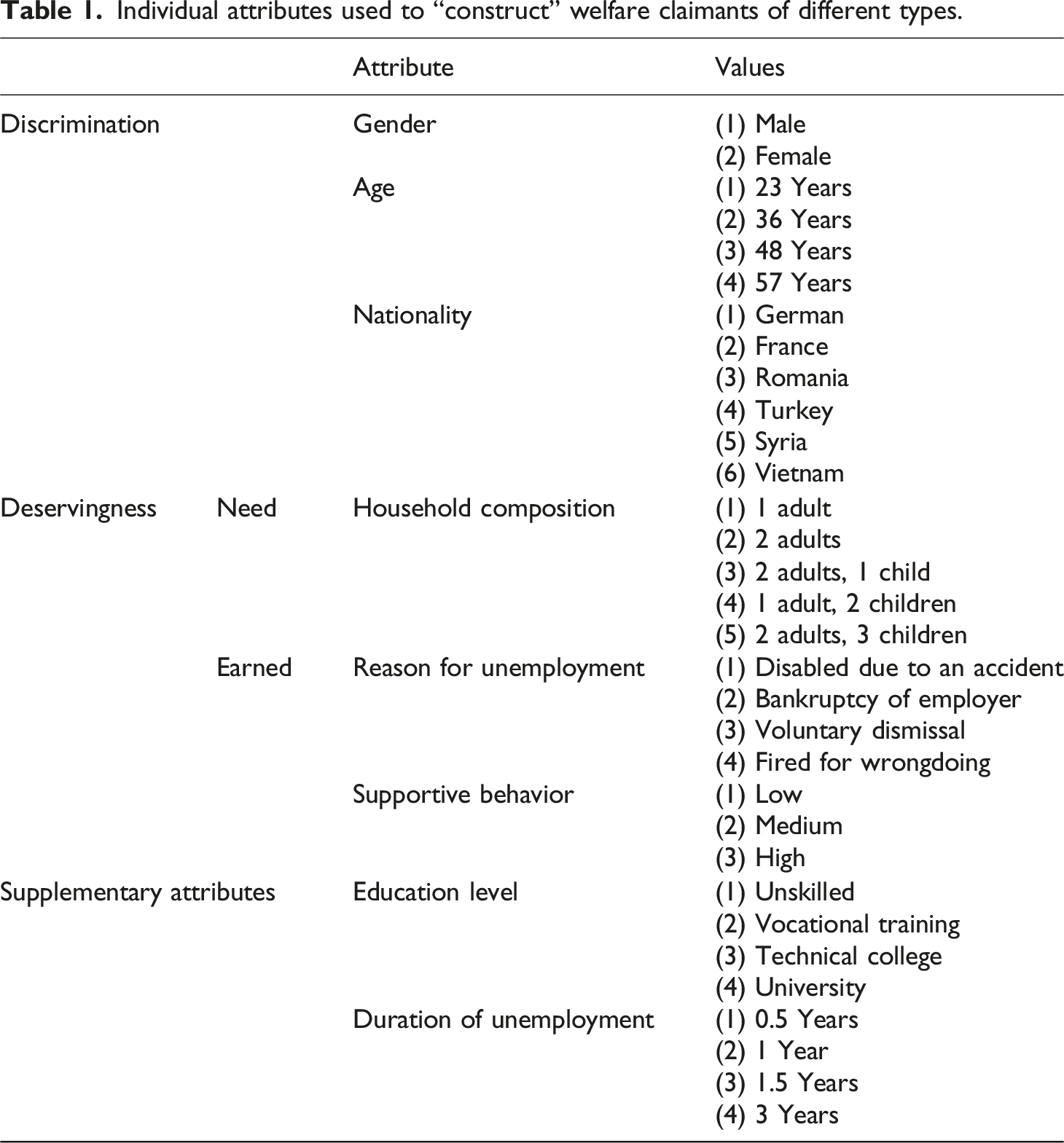
Individual attributes used to “construct” welfare claimants of different types.
Discriminating attributes
We use gender, age, and nationality as attributes that can only illegitimately be used to make differences between claimants. 4 To examine whether an individual’s age is a source of discrimination, we divided our hypothetical claimants into four life and working phases. Claimants in the first group are considered to be at the beginning of their vocational careers and are 23 years old. Claimants in the second and third groups are expected to have reached a stable employment situation and are 36 and 48 years old. The fourth group is most likely at the end of their professional career, close to retirement, and 57 years old. Claimants’ gender is operationalized binary, as male or female.
The attribute ‘nationality’ contains different nationalities that vary in their cultural proximity to the (German) majoritarian community. We use France as the country with the most significant similarity to Germany due to its regional proximity and related culture and history. Immigrants of Turkish origin represent the largest migrant population in Germany. Although some of the Turkish population in Germany is already in its third generation, recent research shows that it is still less integrated than other groups of immigrants (Diehl et al., 2013). Immigrants from Romania are afflicted with numerous stereotypes in Germany and are often accused of exploiting the German welfare state services. We regard the last two nationalities, Syrian and Vietnamese, as groups with the highest cultural distances. We used Vietnam as a comparison group to examine whether a Muslim background influences decision-making. The attribute ‘German’ was weighted twice when constructing our vignettes to avoid comparing minority groups with each other too often. Therefore, the welfare recipients had German citizenship in two out of seven cases and another nationality in five out of seven.
Deservingness attributes
We use three attributes to account for clients’ deservingness. Need-deservingness is captured by the number and type of people currently living in the household of the welfare claimant. To differentiate, we distinguish between a single household, a household of two adults, a household of two adults (parents) and one kid, and a household of two adults (parents) and three kids. In addition, we consider a single household with two kids, mirroring the situation of single parents. Two additional attributes operationalize earned-deservingness: First, an attribute indicating why someone became unemployed and hence a welfare recipient, and second an attribute capturing how well claimants cooperated with the social welfare administration in the past. Claimants who lost their jobs due to a work accident or bankruptcy of their employers are expected to be considered more deserving than those responsible for their situation themselves. The level of cooperation captures reciprocity as the attitudinal component of earned-deservingness. Here, we vary how well welfare claimants cooperate with the welfare administration operationalized by punctuality and completeness of documents.
Samples
Summary of samples.
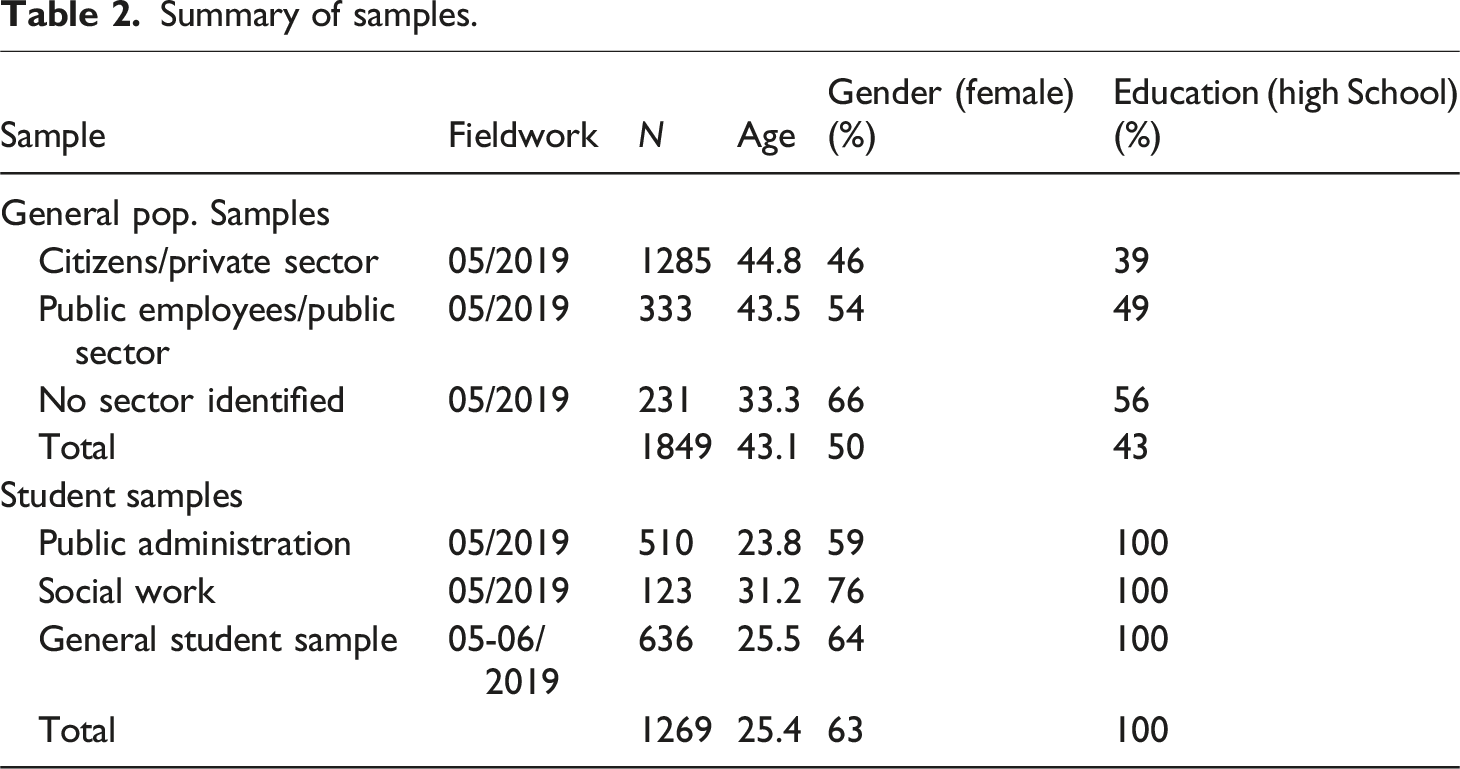
The student sample comprises three groups: ‘public administration’, ‘social work’, and ‘general student sample’. The subsample ‘public administration’ includes undergraduate and graduate students from a University of Public Administration (Niedersächsisches Studieninstitut für kommunale Verwaltung). Municipal administrations and the state fund the University of Public Administration. A training contract with one of these funding institutions is a precondition for student admission. After graduating, these students become tenured civil servants in the municipal administration they already work for. The University of Public Administration distributed the survey to all students enrolled in the study programs General Public Administration (Bachelor), Public Management (Bachelor), and Local Public Management (Master). Of the 1258 students contacted by the University’s administration, 557 participated in the survey. This corresponds to a response rate of approximately 46%. After data cleaning and speeder control, 510 cases were available for analysis.
For the student sample ‘social work’, we recruited students from a University for Social Work (Evangelische Hochschule für Soziale Arbeit & Diakonie). The University for Social Work is a church-sponsored university offering higher training for management tasks in social services. The University offers Bachelor’s and Master’s degree programs in social work with different thematic emphases. Most graduates work as social workers or as social pedagogues in governmental and non-governmental institutions. 147 of the 523 enrolled students took part in our survey. This is a response rate of about 28%. We excluded 20 students after data cleaning and speeder control, leaving 127 cases for our analysis.
The ‘general student sample’ includes students from different fields of study at a University in Northern Germany (Universität Hamburg). The survey invitation was sent to 2031 enrolled students of the University’s opt-in subject pool run by the University’s behavioral social science laboratory. 815 pool members replied and received the link to the survey. A total of 772 students took part in our survey. Among other things, we asked students to report on their study program. This information was hand-coded and then classified by study field. Of the total sample, 228 students came from economics, 183 students from social sciences, 119 from the sciences, and 93 from humanities. 46 students were allocated to law, 35 to tech, and 12 to other subjects. As a result of data cleaning and speeder control, we dropped 56 students from the sample.
The three student samples were deliberately selected based on the relevance of respondents’ characteristics to the research question. Experiments conducted on student samples may be criticized for a lower external validity. However, at least two reasons justify the choice for this study. First, students enrolled in public administration or social work make a conscious choice for a career in the public sector. Second, the student samples have a high degree of homogeneous composition compared to civil servants in the general population sample. This is particularly useful for analyzing group decision behavior. Students from all three subsamples were allowed to participate in a lottery with a chance to win Amazon gift cards worth between 25 and 250 Euros. In three separate lotteries, 7000 Euros was paid out to the participants.
Empirical results
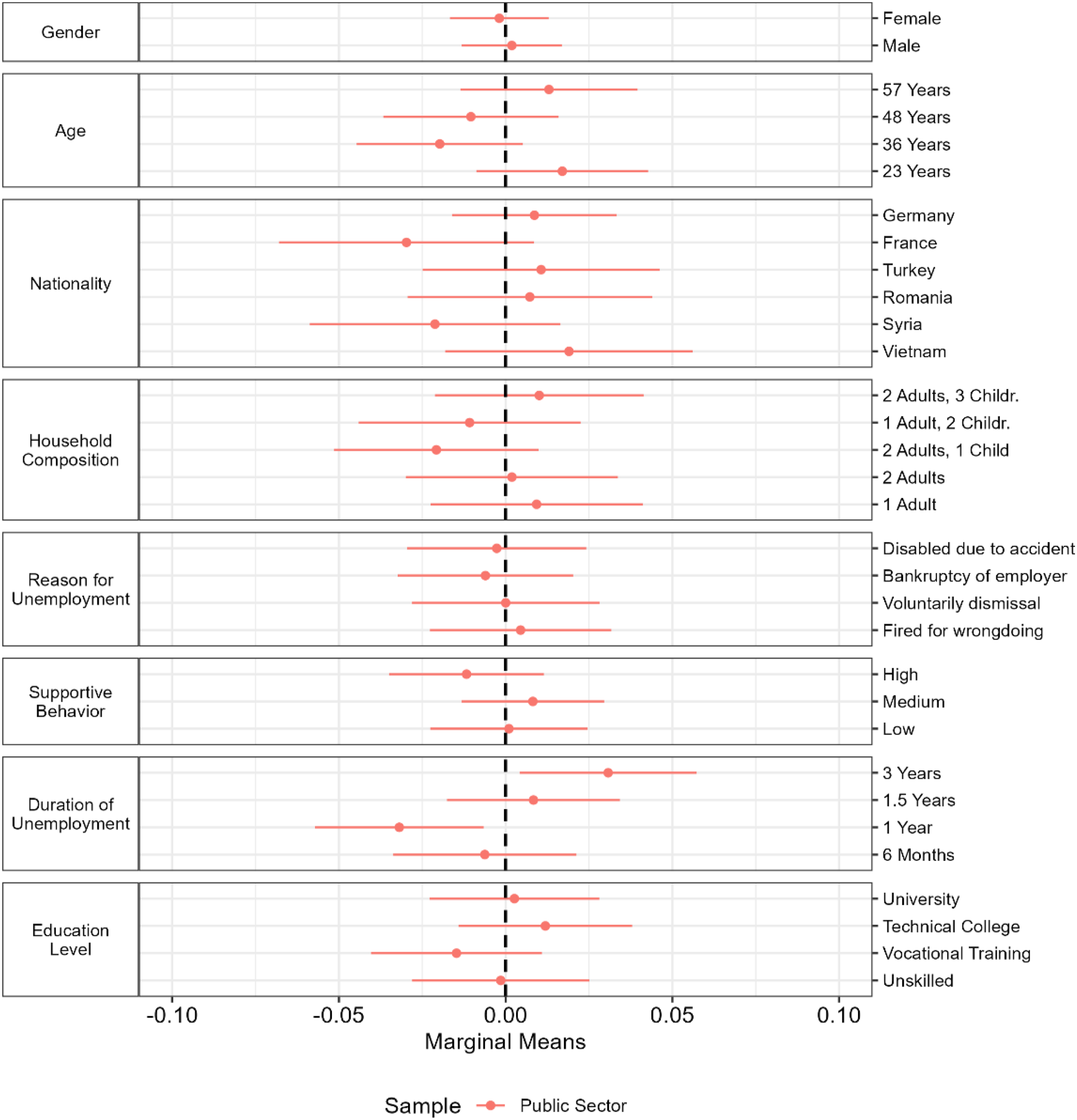
To interpret the experimental results, we report the marginal means (Figures 1 and 3) and the differences in marginal means (Figures 2 and 4) of the eight conjoint attributes for the general population and student samples. Marginal means greater than 0.5 indicate an above-average probability of being chosen for the prepayment. Since our theoretical expectations focus on group differences, we also display the difference in marginal means for the general population sample (Figure 2; public employees vs citizens from the private sector) and the three groups in the student sample (Figure 4; students of social work, public administration, and general student sample). In Figure 2, private sector respondents serve as the reference category, meaning that the estimates show whether public sector respondents have a higher (positive values) or lower (negative values) preference for a certain level compared to private sector respondents. In Figure 4, students of public administration serve as the reference category. Baseline results from the general population sample. Note: Horizontal lines are 95% confidence intervals. Differences in marginal means from the general population sample. Note: Reference category: private sector. Horizontal lines are 95% confidence intervals.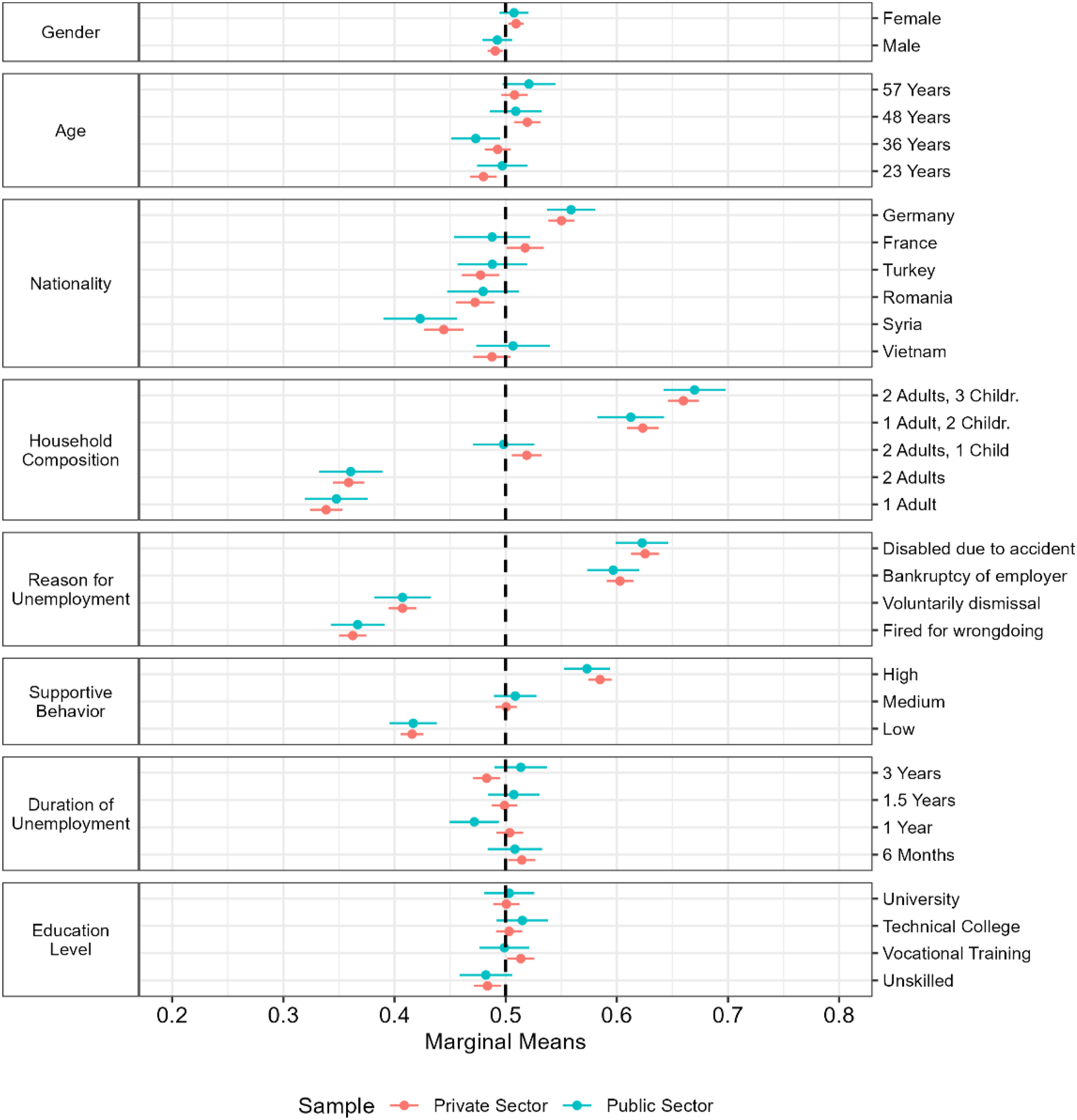
Discrimination
H1 expects public employees and future civil servants to be less prone to base their prioritization decision on attributes that reflect unlawful discrimination. Looking at the three attributes assigned to discrimination (age, gender, nationality) in the general population sample (Figures 1 and 2), we find almost no significant marginal effects for gender and age comparing public employees and citizens from the private sector. Citizens minimally prefer a female to a male claimant, while 23-year-old claimants are slightly disadvantaged. Public employees slightly disfavor 36-year-old claimants and favor the oldest group, aged 57. Since older people are more difficult to reenter the labor market than younger ones, it may seem legitimate to prioritize older clients over younger ones. Figure 2, however, shows that neither of the differences between the two subgroups (public employees vs citizens from the private sector) are significant. Looking at the attribute capturing nationality, we find signs of discrimination against people from Syria and positive discrimination towards claimants with German citizenship in both groups. Remarkably, public employees and citizens treat these two specific nationalities similarly, as there are no significant differences in the discrimination effect when the two groups are compared (Figure 2). For the other nationalities, we find no significant discrimination effects.
Concerning the three student samples (Figures 3 and 4), we find no effects for gender and age but some minor effects for claimants’ national backgrounds. Unlike in the general population sample, the student groups show varying decision patterns: Public administration students slightly favor German natives and discriminate against claimants from Syria while being indifferent towards other nationalities. Social work students, in contrast, give out the prepayment for the exceptional good significantly less often to Germans and favor people from Syria instead. Students from the general student sample behave comparably; however, the effects are insignificant. The positive discrimination of social work students toward Syrians could be because they are predominately perceived as refugees and therefore considered more in need. Baseline results from student sample. Note: Horizontal lines are 95% confidence intervals. Differences in marginal means from the student sample. Note: Reference category: Public administration students. Horizontal lines are 95% confidence intervals.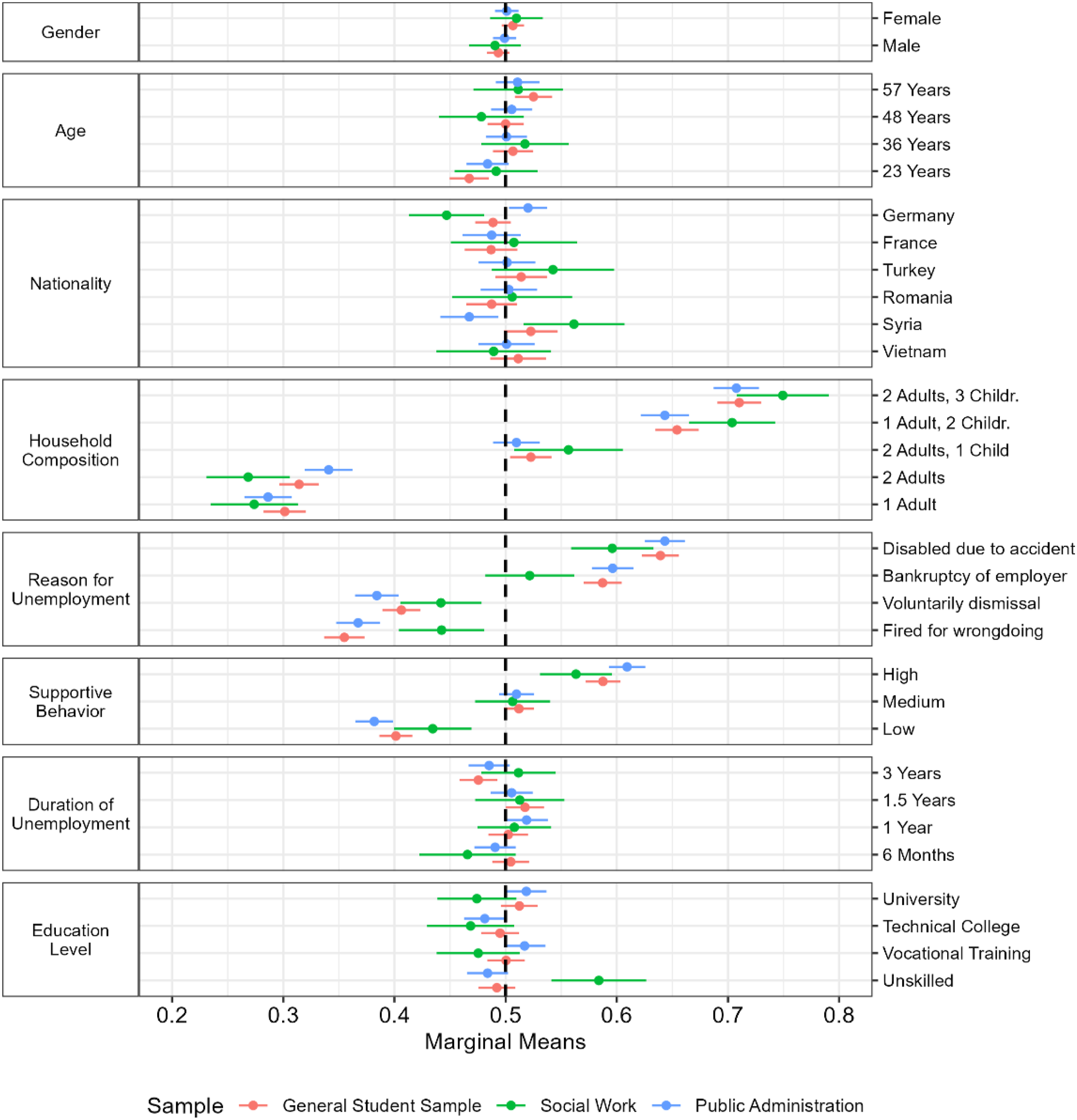
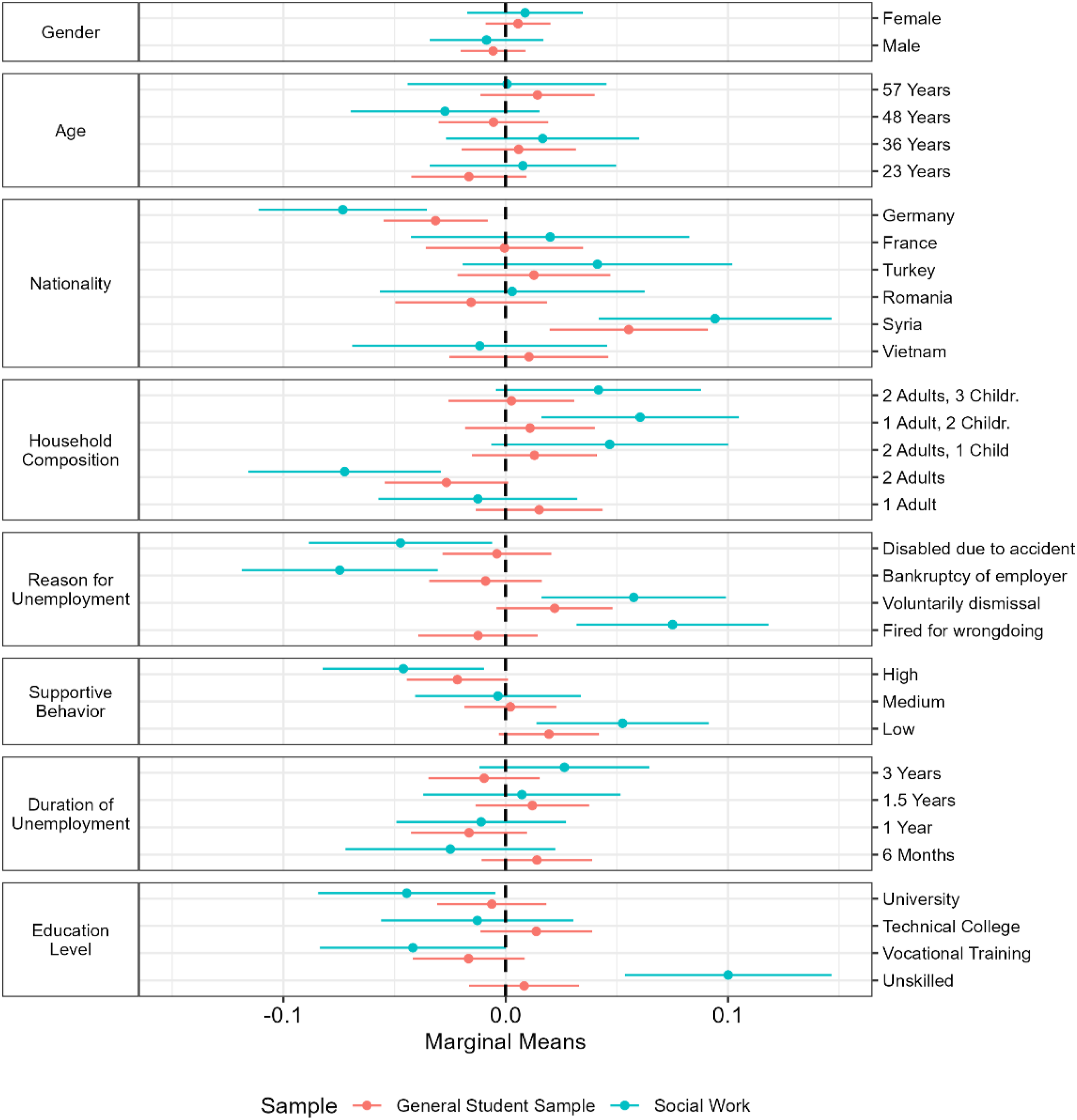
In sum, we see no significant results regarding H1 in the general population (public employees vs citizens from the private sector). Respondents from both subgroups behave similarly, slightly favoring claimants from Germany and disadvantaging Syrians. Citizens additionally show weak signs of favoritism toward French claimants and discrimination against people from Turkey and Romania. Public administration students also tend to discriminate against Syrians and favor German claimants. For the other two student groups, we observe the opposite choice behavior. Hence, the data shows discriminatory bias in respondents’ prioritization decisions; however, contrary to H1, this bias is similar among public employees and citizens.
Deservingness
According to H2a/b, public employees and future civil servants are expected to be more attentive to need-deservingness, while citizens and students from the general student sample are expected to be more attentive to attributes connected to earned-deservingness. Figure 1 shows that both groups, public employees and citizens from the private sector, react similarly to the attribute of need-deservingness. The household composition and the involvement of children are the most substantial driving factors in their prioritization decisions. Singles and childless couples have poor chances of prepayment, and single parents and families with three children have comparably high chances of receiving the advance payment.
In terms of earned-deservingness, we also find similar decision patterns. Involuntary unemployment has a positive effect on the prioritization of a claimant. Both groups, public employees and citizens from the private sector, prioritize claimants that are unemployed because of an accident or the bankruptcy of their employer over claimants that are responsible for being unemployed. The effect of claimants’ cooperative behavior, capturing the second aspect of earned-deservingness, is also similar in both groups; cooperative behavior is rewarded, and uncooperative behavior decreases the chance of being prioritized. Again, however, there are no signs that public employees and citizens from the private sector respond differently to claimants’ need- and earned-deservingness attributes (Figure 2).
Patterns in the student samples are similar to those in the general population sample. Nevertheless, there are some notable differences between student groups (Figures 3 and 4). Like the general population sample, need-deservingness based on household composition significantly impacts prioritization choices. Singles and childless couples again have the lowest chance to get the prepayment, and single parents and families with three children have the highest. Interestingly, future social workers make no differences between the two types of childless households but react strongly if more than one child is present. The other two student samples differentiate more sharply between the five household types. For earned-deservingness, we find a lower level of responsiveness among future social workers. Losing a job due to wrongdoing or voluntary dismissal still reduces the chance of being chosen for the prepayment but significantly less than in the general student sample. Cooperative behavior is rewarded in all student samples, but public administration students show higher levels of responsiveness here. They act slightly more punitively towards low levels of cooperation.
To summarize, we find no substantial differences in the general population sample’s reaction to claimants’ need- and earned-deservingness. Circumstances of need are more relevant for the prioritization decision in both groups. For the student samples, we find some evidence that social work students react differently to need-deservingness and react less firmly to attributes of earned-deservingness. Public administration students act slightly more punitively and rewarding compared to students of the general student sample. Contrary to H2a/b, claimants’ earned- and need-deservingness has similar effects on public employees’ and citizens’ prioritization choices.
Robustness
It is necessary to consider sample differences in the demographic composition to compare public and private sector employees in the general population. For example, the proportion of female workers in the public sector is higher than in the private sector (∼55% vs ∼45%). The share of people with a high school diploma (Abitur) is s higher in the public sector (∼50%) than in the private sector (∼39%). Against this background, one could argue that a sample bias could drive the findings. To address this problem, we reweight the two samples based on observable characteristics so that both samples are identical concerning the socio-demographic characteristics. Specifically, we use the entropy balancing technique developed by Hainmueller (2012), outperforming other weighting and matching techniques (Zhao and Percival, 2017). The weights are estimated for the private sector employees in such a way that they resemble the distribution of the public sector employees. The balancing is based on age categories, gender, region (East vs West Germany), and political ideology (left-right placement). Figure A2, which displays the results of the conjoint experiment based on the reweighted samples, corroborates the robustness of the main findings. In other words, the differences between the two groups are unaffected by differences in observable characteristics.
Furthermore, we test the conditional relationship between need-deservingness and clients’ nationality. One might argue that the impact of clients’ household composition could be conditional on clients’ nationality. To explore this, we estimated the interaction between these two attributes. To reduce the complexity, we used binary coding for the household composition in children and no children and citizenship into German and foreign. Introducing an interaction between these two attributes for the general population sample and the student sample does not alter any substantive findings (Figures A3 and A4). The presence of children positively influences the prepayment irrespective of the claimant’s nationality in both comparison groups. In the general population sample, however, Germans are always preferred to foreigners, regardless of whether the respondent works in the private or the public sector.
Discussion and conclusion
Since Max Weber, impartiality has been considered a critical virtue of modern state bureaucracies to obtain citizens’ support and legitimacy. However, sometimes just bureaucratic decisions require more than a commitment to blunt equality (Mendus, 2008), especially in welfare administration. There are cases in which civil servants need to act impartially while simultaneously being able to differentiate between claimants when necessary (Rothstein and Teorell, 2008: 177). This study examined how public employees and citizens exercise administrative discretion in a moral dilemma when resorting to impartiality does not provide a just solution. Expanding on behavioral research on administrative discretion (Jilke and Tummers, 2018) and administrative ethics (Raadschelders and Chitiga, 2021; Rivera and Knox, 2023), this study argues that public employees’ moral reasoning should, to some extent, correspond with citizens’ sense of administrative justice to maintain societal legitimacy. To identify and compare public employees’ and lay citizens’ moral reasoning in discretionary behavior, we designed a conjoint experiment where respondents were put into an ethical dilemma as they had to make a discretionary decision between two equally eligible welfare claimants in a situation of social need.
Empirical results can be summarized in two points. First, the initial expectation that public employees are less likely to base their prioritization decisions on discriminatory attributes of welfare claimants than lay citizens from the private sector (H1) is not confirmed. There is no systematic difference in the effect of attributes that can be used for unlawful discrimination between the public and private sectors. Instead, we find evidence of discrimination based on recipients’ nationality in the general population and in the student samples. In the general population sample, public and private sector employees show weak signs of positive discrimination against German welfare recipients and negative discrimination against some Non-German recipients, particularly claimants from Syria. This observation is consistent with prior evidence by Adam et al. (2022) and Villadsen and Wulff (2018), finding that public employees’ discriminatory attitudes and behavior are similar to that of lay citizens. Interestingly, however, a reversed discrimination pattern emerges within the student sample. Here, social work students and students from the general student sample positively discriminate against Syrians and negatively against German welfare recipients compared to public administration students. An explanation might be that welfare recipients from Syria are perceived as especially needy among students due to the Syrian civil war. Students of social work and students in the general student sample respond more sensitively to this cue than public administration students.
Second, we hypothesized that public employees are expected to put greater weight on welfare recipients’ need-deservingness (H2a), whereas lay citizens are more responsive towards earned-deservingness (H2b). The data shows no systematic difference in how public employees and citizens respond to claimants’ earned- and need-deservingness that would support this claim. Instead, findings are consistent with empirical results by Jilke and Tummers (2018), Kallio and Kouvo (2015), who find no differences in public employees’ and citizens’ perceptions of the deservingness of welfare recipients and Wheeler and Brady (1998), who find no differences between the two groups on their predispositions towards deontological or consequentialist ethics. Moreover, the effect of discriminatory attributes is much weaker than the impact of earned-deservingness and need-deservingness. Hence, public employees and citizens consider claimants’ earned-deservingness, but need-deservingness remains the most important factor influencing the decisions to prioritize exceptional needs.
Before considering potential implications, we need to discuss the limitations of this study. First, the evidence provided in this study is based on hypothetical prioritization decisions that cannot be mapped directly to real-world decisions (Jilke and Tummers, 2018; 236). Future research might study real prioritization choices based on observational data if it were possible to get hold of this information, which is politically sensitive. Second, in the general population survey, we had to rely on respondents’ self-reported sector affiliation and had little insight into occupational differences for more fine-grained analysis. Third, this study focused on prioritizing social needs in a positively framed situation of providing additional support. Future research could test moral reasoning also in negative frames, e.g., the sanctioning of welfare recipients for non-cooperative behavior. Fourth, different understandings of deservingness could exist across different welfare state regimes and administrative traditions (Laenen et al. 2019). Further research might move beyond the German case of a Weberian administrative regime and study the prioritization of exceptional needs from a cross-country perspective.
This study is the first to compare the role of discrimination and deservingness in public employees’ and citizens’ discretionary behavior in a moral dilemma. Overall, the result indicates a congruence in the discretionary behavior of public employees and ordinary citizens. Thus, the question remains, why are there no substantial differences despite administrative theories would suggest otherwise? We can only speculate at this point, but maybe the impact of self-selection into the public sector and professional training and experience in the public sector is simply overrated in administrative science. Civil servants are primarily regular members of society. They have learned and internalized the implicit and explicit cultural and institutional norms that shape social interactions, just like all other citizens. Given that this conformism – people’s tendency to adapt their behavior to suit group norms (Forsyth, 2012) – applies to all members of society alike, we see a similar force of general social norms in all our subjects, regardless of their sector affiliation. This interpretation is consistent with recent behavioral evidence on public employees’ moral behavior (Sulitzeanu-Kenan et al., 2021), risk behavior (Tepe and Prokop, 2018), and extant research finding only marginal sector differences in self-reported PSM (Christensen and Wright, 2011).
What do these findings mean for public administration? We think the implications are twofold: First, as we see some discriminatory behavior among public employees and students of public administration, efforts should be intensified to reflect on national prejudices, especially in the education of civil servants (Moon and Christensen, 2022). This challenge will become even more critical for public administration as Western societies become more diverse. Second, the results of this study are also a plea for paying more attention to administrative ethics, which has become more of a niche topic in the wake of New Public Management (NPM). There has been enormous technological advancement in developing digital public service assistance systems. Most standardized citizens’ requests will likely be delegated to such systems. The future role of many public employees will be to monitor these processes and step in when the digital citizen-state interaction fails or algorithmic advice is inconclusive. Both are more likely to happen in cases where administrators must “respond to the human dimensions of situations” (Lipsky, 1980: 15). Thus, we can expect future public employees will have to take care increasingly of “challenging” and non-standardized client cases, which require them to make impartial and yet just assessments. A core challenge to administrative ethics is to equip civil servants with the skills to make balanced judgments within the scope of the discretionary powers granted to them.
Supplemental Material
Supplemental Material - Prioritizing exceptional social needs. Experimental evidence on the role of discrimination and client deservingness in public employees’ and citizens’ discretionary behavior
Supplemental Material for Prioritizing exceptional social needs. Experimental evidence on the role of discrimination and client deservingness in public employees’ and citizens’ discretionary behavior by Brian Dietrich, Michael Jankowski, Kai-Uwe Schnapp, and Markus Tepe in Public Policy and Administration.
Footnotes
Declaration of conflicting interests
The author(s) declared no potential conflicts of interest with respect to the research, authorship, and/or publication of this article.
Funding
The author(s) disclosed receipt of the following financial support for the research, authorship, and/or publication of this article: This work was supported by the Deutsche Forschungsgemeinschaft; Schn1282/5-1.

Supplemental Material
Supplemental material for this article is available online.
Notes
References
Supplementary Material
Please find the following supplemental material available below.
For Open Access articles published under a Creative Commons License, all supplemental material carries the same license as the article it is associated with.
For non-Open Access articles published, all supplemental material carries a non-exclusive license, and permission requests for re-use of supplemental material or any part of supplemental material shall be sent directly to the copyright owner as specified in the copyright notice associated with the article.
