




Abstract
This is the introductory article to the special issue ‘Religion as an explanatory factor in public administration: Directions for research’. We make the argument that religion matters for understanding public administration, and that the manifold relationships between religion and public administration deserve more systematic investigation. We present and critically consider the papers of this special issue with the goal of delineating the contours of a proposed research programme for advancing the study of the relationships between religion and public administration. We also notice the risks associated with the study of the influence of religion on public administration, and we argue for an ethics of responsibility in engaging with this important field of scholarly inquiry.
Introduction
This special issue makes the argument that religion matters for public administration (hereafter: PA). It has been observed that ‘while the relationship of the religious to the political has been given wide attention in the social sciences literature, there seems to be a gap as regards specifically the relationship of religion in its social and public dimension to public administration as a field of social scientific inquiry and an area of professional activity’ (Ongaro and Tantardini, 2023a). The aim of this special issue is to take a step in the direction of filling this gap (the book from which the previous quote is drawn is another contribution in the same direction – see also Ongaro and Tantardini, 2023b).
This introductory article to the special issue - Religion as an explanatory factor in public administration: Directions for research - presents and critically considers the papers of this special issue with the goal of delineating the contours of a proposed research programme for advancing the study of the relationship of religion and public administration, by leveraging on the contribution each paper of this special issue makes to the advancement of this area of scholarly inquiry.
The special issue articles: building bricks towards a research programme
The article by Ongaro and Tantardini (2024, this issue) contributes by developing a literature review of the scholarly publications between 1960 and 2020 in all the English-language peer-reviewed journals with a 2017 Impact Factor (IF) of 0.75 or greater or within the top fifty English-language peer-reviewed journals in the public administration, business/management, and political science subject areas, in which ‘religion’, ‘spirituality’ and ‘faith’ are mentioned in either the title or abstract. It identifies 10 themes, each providing an angle from which to examine the manifold relations between religion, faith, spirituality and PA, thus shedding light on certain aspects of public administration at the level of the individuals (Micro-level), the level of organisations (Meso-level) or the level of the broader configuration of public governance (Macro-level).
Two complementary publications stem from the literature review article published in this special issue. In the first one, a book-length work, Ongaro and Tantardini (2023a) first present an overarching theoretical model of the influence of the religious on PA, an influence mediated also by the religious regime of a given country. Second, they apply their theoretical model to 10 themes at the micro-, meso-, and macro-levels, elaborated from the article presented in this special issue and refined by including the so-called ‘grey’ literature. Finally, they develop, at least in part and at least speculatively, eight new themes whose exploration would be fruitful for advancing public administration knowledge.
18 thematic areas in the analysis of the influence of religion on public administration.
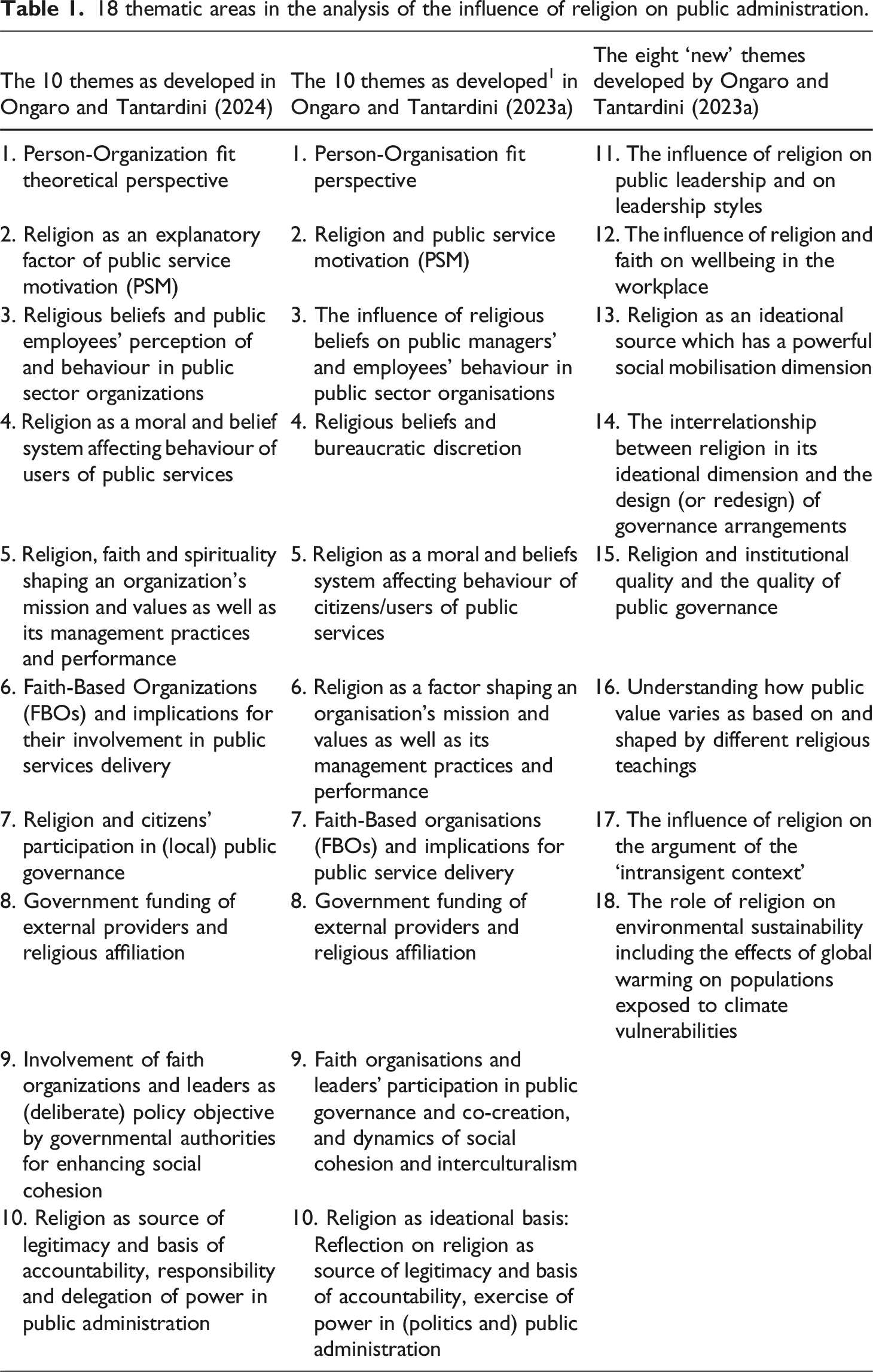
Some of these themes have received little attention in the extant literature (or in a few instances: no attention at all). The article by Alibašić (2024, this issue) makes one important step forward by substantiating one under-researched theme, namely the role of religion on environmental sustainability including the effects of global warming on populations exposed to climate vulnerabilities, by delving into the complex interplay between religion and public governance for environmental protection, and it does so for one major world religion - Islam. The paper analyses 45 reports, plans, and government documents from 2017 to 2023 from 11 countries within the Islamic world and evaluates their respective climate resilience and sustainable development objectives. The study found that countries that have robust economies, comprehensive educational institutions, pluralistic societies, inclusive governments, and liberal religious regimes tend to be positively associated with stronger sustainable development and climate resilience planning.
The article by O’Connor and Shahwan (2024, this issue) further develops a theme which has been explored in a number of scholarly works, but which is ripe for further inquiry: namely, the influence of religion on representative bureaucracy and bureaucratic discretion. The paper aims to answer two important research questions: ‘Does active representation on behalf of a religious identity exist? And if so, what does it look like?’ To answer these research questions, the authors identify four ideal types of possible ways in which active representation on behalf of a religious identity can manifest itself, and collect data from mid-level civil servants in several Ministries of the administration of the Palestinian Authority 2 . They find that the majority of respondents actively represent their religious identity within the bureaucracy.
What are the prospects for developing this research programme further? Two editor-commissioned articles published in this special issue point toward two promising directions for future enquiry. The first lies in building adequate research infrastructures and opportunities for scholarly work to engage collaboratively and in teamwork to develop coherent and cumulative research for furthering the programme. This path for developing the research programme is exemplified in the paper by Drechsler et al. (2024, this issue), which reports on a major externally-funded research project about the relationship between one of the world religions – Islam – and a major topic in PA, namely the creation of Public Value. The project has enabled important empirical investigation of religious practices that shape and embody what has been termed ‘Islamic PA’ (Drechsler, 2013: Drechsler et al., 2024/this issue). This paper provides an exemplar demonstrating the establishment of crucial research infrastructures to support such ambitious research work. This involves securing adequate funding (in the case, a major Templeton Foundation grant), ensuring a sufficient time horizon, addressing issues related to assembling a researchers’ team, and establishing a cohesive theoretical-empirical framework (in the case of this project, rooted in ‘positive public administration à la t’Hart, that is, with an explicit, normative focus on cases of ‘success’). All of this to develop research in the focused area with the widest possible scope in both space (worldwide) and time horizon (both present and past experiences are investigated), to ultimately fill the gaps in the literature that we identify in our proposed research programme. The eventual development of a portfolio of such projects (encompassing other topics, and other world religions) is central to the development of the research programme on the relationship of religion and PA in the long run.
The second direction of inquiry lies in interrogating a substantial challenge for this entire intellectual venture, namely addressing the core issue of the incommensurability between the religious experience and social sciences observations. Kay (2024, this issue) explores indispensable conceptual-theoretical and methodological problems for advancing research on religion and PA. Kay explores the question of whether there are essential properties that a social phenomenon must possess for it to be a religion (the issue of essentialism vs non-essentialism in defining religion), and discusses the implications of adopting either theoretical approach. Shifting from defining to theoretical issues, Kay aims at refining the framework advanced in the book by Ongaro and Tantardini (2023a), by distinguishing religious beliefs from intentions, that is, by analytically distinguishing motivational mechanisms from intentional mechanisms (thereby unpacking and distinguishing these two mechanisms, which are encompassed in the broader notion of “religion as personality system” that is used in the framework proposed by Ongaro and Tantardini, 2023a), partly in view of attempting to bridge the gap between believers’ essentialist conception of their faith and PA researchers who tend to adopt – or are driven by PA research conventions to adopt – a non essentialist conception of religion. The paper by Kay also discusses the implications of secularism (in its different versions) as an essential premise of western PA to then delve into the implications of dropping the secularist hypothesis for studying religion and PA in (some) non-western contexts. The very rich and – we would argue – path-setting contribution by Kay then turns to address critical methodological issues for researching the relationship of religion and PA. First, Kay argues that research into this area may well entail adopting a multi-theoretic approach to the study of religion in PA, varying case by case according to the different ambitions of research, such as developing explanations against the standards of intelligibility and authenticity as well as the objectives of goodness of fit, parsimony, and causality. Different forms of inference may ‘make sense’ according to different research thrusts and purposes/rationales. Kay then revisits the well-known debate about methodological agnosticism and methodological naturalism in the social scientific study of religion and dissects the respective pros and cons of methodological agnosticism and methodological naturalism in relation to PA standards of social scientific inquiry, ultimately leaning towards a pragmatist, eclectic, ad hoc (vs a rigid either/or) approach to researching PA and religion.
Finally, Kay argues for the importance of distinguishing between explanations drawn in the terms that would be used by the people being studied, and the ones drawn in language that will be recognised by the readers of the research. These considerations bring to the fore the issue of the difference between beliefs and epistemic knowledge, and whose beliefs, and at what logical-ontological level; we here further notice that recent developments in the philosophy of religion focused on revisiting key issues of knowledge and belief in and for human thinking and acting (Antognazza, 2024) provide very promising paths for the development and refinement of broader and deeper theoretical frameworks which may underpin this area of inquiry: the time may be ripe for a more integrated approach combining philosophy, religious studies and theology, and PA studies (Ongaro, 2020, 2021). We also notice that in a partly similar vein, van Steden (forthcoming) points out the significance of the key concept of resonance for ‘making sense’ of the social scientific inquiry of administrative phenomena when the religious experience is the key driver of change in such phenomena, or at least when the religious dimension is encompassed into the explanatory framework. Jointly, these theoretical and methodologically-orientated contributions provide solid bricks on which to build the edifice of a research programme on religion and PA. Ultimately, Kay dissects the pros and cons of different theoretical and methodological approaches, thereby outlining the tough choices for researching PA and religion and advancing the research programme that is being proposed here.
Combined, these two editor-commissioned papers - the contributions by Drechsler et al., this volume, and by Kay, this volume - indicate and substantiate how the research programme proposed here may develop, both practically and theoretically.
There is, however, one last aspect which requires thought and attention: the responsibility of researchers investigating this, potentially extremely ‘sensitive’, research area (Ongaro and Tantardini, 2024a).
Advancing the research programme: ethics and responsibility
There are risks associated with the study of the influence of religion on public administration. First, as in any academic endeavour, the risks of personal bias(es) and the risk of subjective selection and interpretation of sources, data, or phenomena may undermine the validity of the research (Albanese, 1988). In the study of religion and public administration, biases may be present in two manifestations: on the one hand, a religious bias, which may favour the researcher’s religion of adherence, and, on the other hand, a ‘secularistic’ bias, which may purposefully neglect the influence of the religious on the study of public administration (or conceive of it in a negative light). This latter risk is closely related to the risk of ‘reductionism’ in the (scientific) study of religion (Segal, 1994), whereas the ‘origins, function, meaning, and even truth of religion [are analysed] in secular rather than religious terms’ (p. 4), thence precluding a more transcendent (and religionist) understanding of faith and religious practice and its implications and influence on public administration (Gregory, 2006). Third, there is a risk that this area of research is prone to being instrumentalised: religion - history repeatedly teaches us - can be used instrumentally for purposes of gaining and retaining power, and as ideological tool for justification of abusive behaviours, including repression of social groups whether domestically or internationally (the countless ‘holy wars’ that have been invoked over the history of humankind). Researchers in this area have an additional responsibility to strive to create the conditions, to the best of their possibilities, to prevent their research from being exploited in an instrumental way. This point has been made very effectively by Van Putten (2024, p. 2), who notices that: religion easily can become an instrument for state activity. Given that PA already is driven by instrumental rationality, there is a real risk that religion could be used as a tool to further the state’s agenda. This instrumentalization of religion can undermine the authenticity and true essence of religious beliefs and practices. Advocates of research in religion and PA must constantly emphasize the intrinsic and non-instrumental dimension of religion in public life.
We fully agree with this assessment and wish to echo here this admonishment by van Putten.
For all these reasons, engaging in this research programme requires an ethics of responsibility – Verantwortungsethik as Weber formulated it (1919/1946), in which ‘one has to give an account of the foreseeable results of one’s action’ (p. 120). Weber’s ethical stance is ‘adequate to [a] morally serious endeavor in a world characterized by inevitable and irresolvable value conflict’ (Starr, 1999: p. 409). This is a crucial and appropriate condition for pursuing such a research programme. Both in Weber, but even more explicitly in Niebuhr (1963), one of the ‘elements’ or ‘significant components’ of an ethics of responsibility is the element of accountability. For Niebuhr (1963) the element of accountability refers to two aspects: (1) as in Weber (1919/1946), Niebuhr refers to the subjective aspect of accountability – ‘Responsibility lies in the agent who stays with his action, who accepts the consequences in the form of reactions and looks forward in a present deed to the continued interaction’ (p. 64) – but also Niebuhr refers to accountability in terms of the object – the ‘responsible self is driven as it were by the movement of the social process to respond and be accountable in nothing less than a universal community’ (p. 88). This interconnected, interrelated, and mutual relationship between responsibility and accountability, and its two elements, is also at the basis of the code of conduct or standards of several societies and associations of academics involved in the study of religion. For example, it is the case of the American Academy of Religion 3 , or, even more explicitly, the American Sociological Association 4 . Only through an ethics of responsibility, it is possible to avoid the risks delineated above in the study of the influence of religion on PA.
Finally, we should notice that the thrust of the proposed research programme is to focus on the influence of religion on PA. And this is what research so far in PA seems to have been doing, including the studies presented in this special issue, which focus on aspects like: the influence of religion on the motivation and behaviour of elected and tenured officials, as well as street-level bureaucrats and citizens-users of public services (micro-level); the influence of religion on public and non-profit sector organisations, broadly intended, and the organisational networks into which they are embedded (meso-level); and on the ideational influence of religion on public administrative systems (macro-level). However, and importantly, we would argue that also the other direction of inquiry – the influence of PA on the public dimension of religion – is worth developing, to which the same considerations about ethics and responsibility would apply. This area of inquiry may include research on the role of the government and other public institutions and public powers in regulating the extent of publicness/privateness of religion, including the endorsement of a specific faith as the state religion; the role of government in regulating religious education in the (public) school system; the role of government in promoting interfaith relations as a way to promote social cohesion or to bring peace among religious groups; and many others.
The ultimate goal of this research programme would be to complement the one we are here proposing, in order to generate knowledge and understanding about the entire gamut of the manifold and fascinating relationships between the religious and the administrative.
Footnotes
Declaration of conflicting interests
The author(s) declared no potential conflicts of interest with respect to the research, authorship, and/or publication of this article.
Funding
The author(s) received no financial support for the research, authorship, and/or publication of this article.
