




Abstract
As the key to digital transformation, artificial intelligence is believed to help achieve the goal of government as a platform and the agile development of digital services. Yet we know little about its potential role in local governance, especially the advances that AI-supported services for the public sector in local governance have ventured and the public value they have created. Combining the digital transformation concepts and public value theory, we fill the gap by examining artificial intelligence (AI) deployment in the public sector of a pilot city of digital transformation in China. Using a mixed-method approach, we show how AI configurations facilitate public value creation in the digital era and identify four dimensions of AI deployment in the public sector: data integration, policy innovation, smart application, and collaboration. Our case analysis on these four dimensions demonstrates two roles that AI technology plays in local governance—“AI cage” and “AI colleague.” The former builds the technology infrastructure and platform in each stage of service delivery, regulating the behaviors of frontline workers, while the latter helps frontline workers make decisions, thus improving the agility of public service provision.
Introduction
Over the past two decades, governments around the world have recognized the significance of accelerating digital transformation (Agarwal, 2018). With the emergence of highly integrative technologies such as artificial intelligence (AI), governments have gone beyond merely digitizing front-end services and have begun to pursue “government as a platform” (GaaP) and the agile development of digital services. Such initiatives aim to fundamentally reengineer government operations, processes, and systems (UN DESA, 2020).
As an integral part of the information revolution (Bock et al., 2020) and a pillar of agile governance (Deloitte, 2021), AI systems are “autonomous, can operate without human intervention, and can learn and identify patterns to make decisions and to reach different conclusions based on the analysis of different situation” (Gomes De Sousa et al., 2019). AI in government involves the “design, building, use, and evaluation of algorithms and computational techniques to improve the management of public agencies” (Valle-Cruz et al., 2019). It is believed to have the potential to help governments provide seamless public service delivery, generate greater public value from data, and achieve agility. In particular, scholars and practitioners in public administration expect AI to address the problems caused by large hierarchical organizational structures and to facilitate government–citizen interactions related to delays in performance (Egger et al., 2017; Zuiderwijk et al., 2021). Prior research has discussed the applications and challenges of using AI in the public sector and whether its configuration increases citizen satisfaction (Wirtz and Müller, 2019; Zheng et al., 2018). Yet we know little about how AI affects local governance, especially the advances that AI-supported services for the public sector in local governance have ventured and the public values they have created.
We address this gap by examining the deployment of AI technology in the local government of Shenzhen—a pilot city of digital transformation in China. Combining digital transformation concepts and public value theory, we explore how Shenzhen government employs AI to improve performance, facilitate collaboration, and stimulate responsiveness, especially at the local level. We use a mixed method that combines topical modeling and qualitative analysis to probe artificial intelligence-related policies in Shenzhen. We find that the government pays more attention to the operational public service related to the internal benefits than the strategic one which highlights the delivery of value outside the public sector, although service-oriented government transformation is rhetorically common. We identify four dimensions of AI deployment in the public sector: data integration, policy innovation, smart application, and collaboration.
We then analyze two complex cases to illustrate AI configurations in these four dimensions. Our case analysis shows that strategic public value can be achieved via the creation and delivery of operational public value. In addition, AI technology plays two main roles in local governance—“Artificial Intelligence cage” and “Artificial Intelligence colleague.” “Artificial Intelligence cage” builds the technology infrastructure and platform for public service provision. Public workers perform tasks within the “cage,” which regulates their behaviors and increases their efficiency. “Artificial Intelligence colleague” helps frontline workers make decisions, which increases the agility of public service provision. We conclude that AI nudges local governments to create greater public value in the digital era.
The remainder of the article is structured as follows. The next section reviews the relevant literature. The subsequent sections describe the research design and empirical analysis. The final section discusses the findings and concludes.
Literature review
Research on the role of AI in local governance falls into three streams of literature: (1) GaaP and agile government, (2) the rise of AI in the public sector, and (3) configuring AI for public value creation. This section discusses each in turn.
Government digital transformation: GaaP and agile government
Government as a platform can be defined as “the whole ecosystem of shared APIs and components, open standards and canonical datasets, as well as the services built on top of them and governance processes that (hopefully) keep the wider system safe and accountable” (Pope, 2019: 6). It involves governments building an adaptive, integrative, and data-connected platform to meet the surge in service demand; policymakers and public managers must then periodically revisit the policies and service provision methods (O’Reilly, 2011).
Previous studies on GaaP discuss the principles and concepts of the processes and challenges associated with GaaP (Brown et al., 2017; Janssen and Estevez, 2013; Janowski, 2015; Kim et al., 2022). However, there is little empirical evidence; most focus on the nascent stage of GaaP, such as the motivations or drivers of participation (Ma, 2013; Mergel, 2017; Tolbert et al., 2008) and the platforms that mediate between citizens and the government (Lee and Kwak, 2012; Li et al. 2021; Li et al., 2020). The limited number of studies in this area highlight the governments’ back-end nature or orchestrating role in GaaP based on the experiences of pioneering countries such as the United Kingdom (Brown et al., 2017), the U.S. (GAO, 2012; HUD, 2018), Italy (Cordella and Paletti, 2019), and the Russian Federation (Styrin et al., 2022). The GaaP not only indicates the architecture of transparent, participatory, and collaborative government (Ansell and Gash, 2018); it also generates a public sector reform that requires an agile working approach in public administration.
The agile working approach or agile government, as a driver to achieve GaaP, is a new public project management paradigm (Deloitte, 2021; National Academy of Public Administration, 2020). This paradigm contrasts agility with the traditional “waterfall” working approach that follows rigid plans and implements projects in strict sequential order (Mergel et al., 2021). The agile government emphasizes tackling uncertainty and fluid situations in an adaptive, flexible, iterative, and responsive way to avoid costly failures (Mergel, 2016; Mergel et al., 2018).
Many governments now recognize that agility is the best way to achieve GaaP. In practice, the agile working approach has mainly been deployed in response to emergencies. In the context of the recent German refugee crisis, Eckhard et al. (2021) demonstrate how a fluid and hybrid setting of administrative practices results in more flexible and participatory actions in crisis management. Moon (2020) and Kim (2021) show that an agile-adaptive approach might be a path forward for responding to the pandemic based on the experiences of South Korea. Agile initiatives are also gradually emerging across government functions. For instance, as part of its agile governance practice, Denmark has made it mandatory to assess whether new legislation is digitally ready based on seven principles developed by the Danish Agency for Digitization, supplemented with five principles for agile regulation (Ministry of Industry, Business and Financial Affairs, Denmark, 2018). The Reserve Bank of India has launched a regulatory sandbox to allow fintech companies to test innovative products and services for agile regulation (Reserve Bank of India, 2018). In these cases, governments leverage new integrative technologies such as AI, deep learning, and advanced algorithms to build platforms to provide better services and achieve agility.
Since GaaP indicates a fundamental reengineering of government, it requires both the transformation of the public sector’s management approach that caters to evolving public needs and governance on information and communication technologies (ICTs). While current discussion on agility mainly focuses on the national governments’ principles and strategies in introducing the agile approach into the public sector. Few studies combine these concepts into a unified framework, and there is limited empirical evidence on how local governments seek to make their operations more agile to support the GaaP. This article represents a first step towards filling this gap.
The rise of AI in the public sector
Governments worldwide have begun to deploy AI technology to improve e-government, build GaaP, and achieve agile governance in the digital era (Valle-Cruz et al., 2019). Artificial Intelligence is used in the public sector to design, build, use, and evaluate algorithms and computational techniques to improve public management and policymaking. As the key to AI, algorithms are the building blocks to help the public sector achieve efficient, low-cost, or “neutral” solutions that harness big data. Algorithms have been applied in various sectors, such as transportation (Kouziokas, 2017), mental health services (Zhu et al., 2022), criminal justice (Whitford et al., 2020), and policing (Meijer et al., 2021). Substantial studies in this field continue the agenda of innovation and focus on the drivers and barriers of AI adoption and application in the public sector (Kankanhalli et al., 2019; Mikalef et al., 2022a; Neumann et al., 2022; Schaefer et al., 2021; Wang et al., 2022b).
With regard to the effects of AI, recent studies demonstrate that adopting algorithms improves efficiency and effectiveness but produces risks such as bias, discrimination, and a lack of democratic control (Fountain, 2022; Peters, 2022; Saldanha et al., 2022). For instance, the algorithms’ bias may challenge public accountability, reinforce historical discrimination, and favor a particular orientation, due to the black-box nature of some machine-learning algorithms (Busuioc, 2021; Janssen and Kuk, 2016a; Liu et al., 2019). The lack of algorithmic transparency may also jeopardize citizen trust (Grimmelikhuijsen, 2022). Some scholars argue that such inherent challenges of the algorithms can be mitigated through unraveling the imperceptibility, materiality, and governmentality of how algorithms work (Janssen and Kuk, 2016b), and thus the algorithmic governance or AI governance becomes more and more important.
From a public administration perspective, algorithmization changes the public sector’s working approach. Introducing AI into public management challenges traditional bureaucratic principles, including decision-making process, bureaucrats’ discretionary power, etc. (Bullock, 2019; Janssen et al., 2022; Ranerup and Henriksen, 2022). For instance, AI algorithms are often used to augment decision-making process. Janssen et al. (2022) use an experimental approach to compare decision-making with and without algorithmic support and show that selecting appropriate algorithms and training decision-makers are key factors in increasing accountability and transparency.
In addition, workers are frequently replaced due to the automation of some public services (Dickinson and Yates, 2021; Sun and Medaglia, 2019). Scholars use the term “algorithmic bureaucracy” to describe new bureaucratic systems strengthened by smart technology and highlight the complex roles of AI in assisting citizens with their service needs and helping frontline workers (Vogl et al., 2020; Wang et al., 2022a). For instance, AI-enabled public services could proactively provide services, instead of citizens asking for the services themselves (Kuziemski and Misuraca, 2020). The automation of AI overlaps with the orderliness subdimension of more conscientious public employees, resulting that employees cannot reap the benefits of working with AI, which further makes the management complicated (Tang et al., 2022). The removal of human decision-makers through automation with AI could also improve the legitimacy and trust in the delivery of public services, particularly for citizens who distrust bureaucratic decisions (Miller and Keiser, 2021).
However, most prior research is normative and exploratory based on the experiences of developed countries. More exploration of AI implementation results and how it helps generate public value and strengthen digital capacities is needed. These insights will enrich our understanding of governments’ digital transformations around the world.
In sum, the concepts of GaaP, agile governance, and AI in the public sector are integral aspects of government digital transformation. Government as a platform focuses on building a platform that enables participation and collaboration in order to provide high-quality public services. Agility changes traditional working approaches and helps the bureaucracy adapt to the on-demand service environment and uncertainty (Chatfield and Reddick, 2018). AI is an algorithmic tool that is employed to achieve the GaaP and agile governance goals. This article draws on these concepts and explores how a pilot city in China has employed AI technology to achieve digital transformation in the public sector.
Configuring AI for public value creation
Public value theory has increased its popularity since Moore’s (1995) seminal work. It shifts the focus of public management from internal organization operation to society—from service production to the fulfilment of public expectations (Moore, 1995). The central concept of this theory is the “creation of public value,” which is defined as the impact on public needs that are collectively identified and selected through democratic means. This includes “what the public values” as well as “what adds value to the public sphere” (Benington and Moore, 2011; Ongaro et al., 2021). It highlights that public management strategies focused on public value creation require not only specific organizational capabilities and resources to deliver services but also legitimacy and sustainability (Alford and Hughes, 2008). Therefore, although Moore’s seminal work does not directly relate to digital government transformation, it provides a solid foundation to study the transformation from digital technology configuration in the public sector.
As a kind of organizational configuration, digital government transformation has increasingly embraced public value theory in response to the roaring demands of citizens for better public service delivery (Cordella and Bonina, 2012). Creating public values as a priority means using new information technology such as AI and related ICT-enabled reform as a way to achieve good governance (Brewer et al., 2006). Several studies in this field have illustrated how public value theory or framework can help to rethink the public service delivery in digital government and reconsider its implications for public administration (Liang et al., 2019; Panagiotopoulos et al., 2019; Wang et al., 2021). For instance, Cordella and Paletti (2019) show how GaaP, which is configured as a platform of platforms, shall be managed to create public value better and highlight the significant managerial mechanism of orchestration that can support public value creation. Mergel et al. (2021) demonstrate that agile working ways imply being more responsive to public values, and adoption of agility can therefore achieve higher-valued outcomes for organizations.
AI, as the key to achieving GaaP and agile governance goals, can be viewed as an enabler for new organizational configuration from the public value perspective. Previous studies on AI and public value theory discuss operational issues such as the heuristic debate on how AI should be configured. On the one hand, the deployment of AI-enabled services is likely to increase government efficiency and citizen satisfaction (Miller and Keiser, 2021; Wirtz and Müller, 2019). Such innovation could also facilitate collaboration, reduce administrative burden, and thus create public value (Chatterjee et al., 2022). On the other hand, the inherent opacity of AI prompts the ethical challenges of AI, calling for democratic control (Janssen and Kuk, 2016b). Another strand of literature focuses on operationalizing the public value creation concept on AI-enabled reform, exploring the measurement of different types of public value and digital strategy formulation process (Scupola and Mergel, 2022), and highlighting the positive impacts of AI-enabled services on citizen satisfaction (Chatterjee et al., 2022). While so far, literature in this field has treated public value as a by-product of the investment in digital transformation. Except for several seminal works (e.g., Scupola and Mergel, 2022; Twizeyimana and Andersson, 2019), public value creation in the digital transformation of public administration is still underexplored empirically.
Examining public value creation in digital transformation is related to the nature of public services and the level of administrative control required to deliver the expected value. Articulating values that shape the expectations and assumptions of policymakers have a direct impact on the policymaking process and discretion of lower-level public managers and frontline workers. Thus, in this study, drawing on the interactive and connected relationship of GaaP, agility, and AI, we employ public value theory to examine the AI configuration of a pilot city in China to provide a normative foundation for what public values AI configurations can create.
Scholars in public value school have suggested that public value is related not only to the efficiency of the actions carried out by the public sector but also to the effectiveness of the achievement of government programs in relation to certain democratic outcomes (Bonina and Cordella, 2009; Moore, 1995). In this sense, the public value perspective also focuses on the possibility for networked community governance and co-creation of the public services, highlighting the democratic process and strategic management of the new technology (Benington and Moore, 2011; Ferlie and Ongaro, 2022; Ongaro et al., 2021). Thus, we argue that AI configuration in the public sector is a matter of achieving values in both efficiency and certain democratic outcomes. In line with this thought, scholars divide ICT-related public value into two categories: operational public value and strategic public value (Cordella and Bonina, 2012; Liang et al., 2019). The former reflects efficiency improvement in operation and maintenance, and the latter reflects the strategic social goals and government transformation. Following Liang et al. (2019: 5), we define the two kinds of public value as follows. The AI-enabled operational public value means the fact that AI effectively improves digital government transformation challenges (e.g., high investment and information silos), as reflected in reduced administrative burden, the improved efficiency of GaaP, and the reduced technological difficulty of information sharing and collaboration (Sallehudin et al., 2016). The AI-enabled strategic public value means using AI to transform public administration services from operating in isolation to cross-departmental collaborative interaction. It is reflected in public service quality improvement, service-oriented government transformation, etc. (Bannister and Connolly, 2014; Janowski, 2015; Klievink et al., 2016). Figure 1 shows our conceptual framework. Conceptual framework.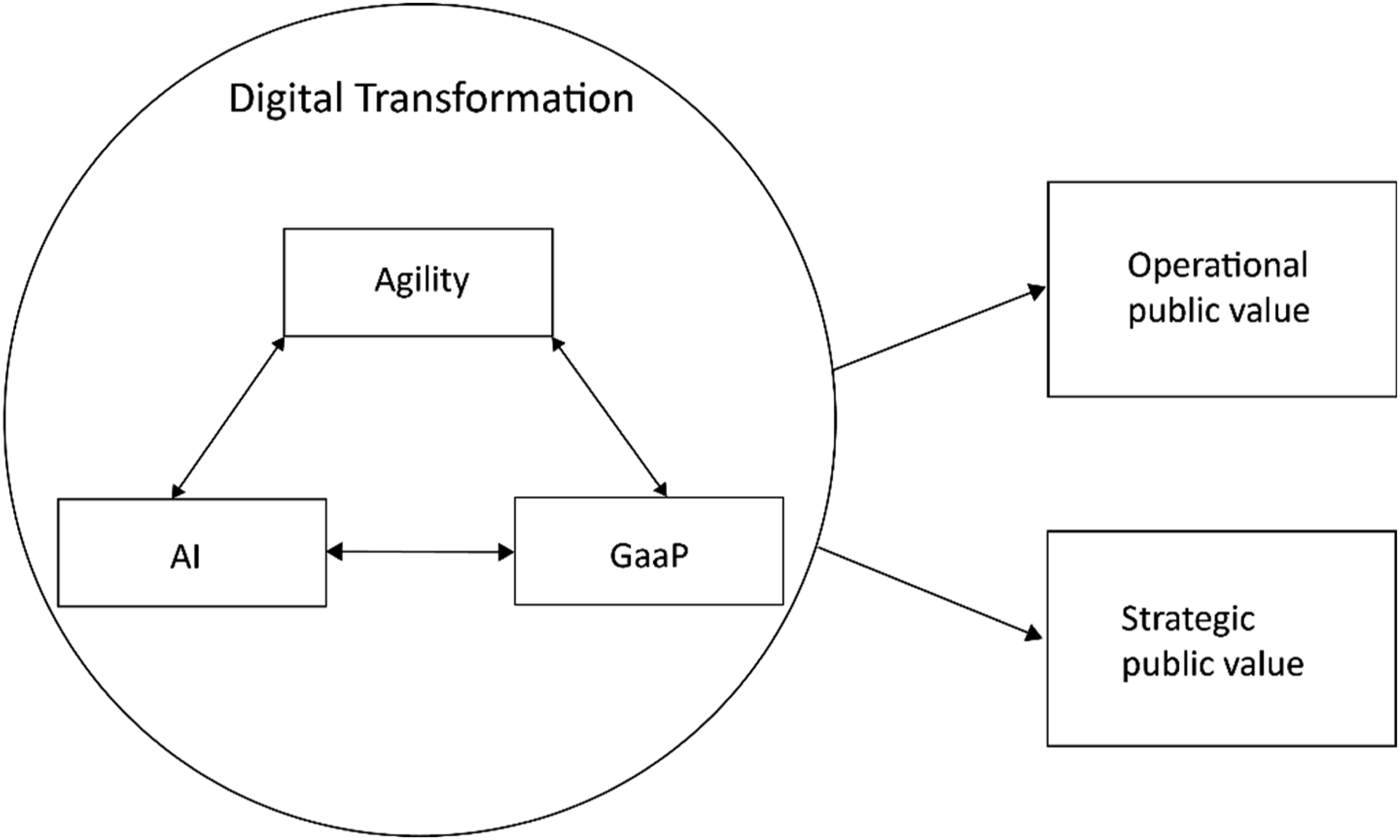
Research design
We use an exploratory sequential case study research approach with interpretive tradition (Miles and Huberman, 1994) to investigate the AI-related public reforms in the context of digital transformation initiatives in a pilot city—Shenzhen, China. The case of Shenzhen was purposefully selected as an intrinsic case that was highly suitable to help us understand the problem and analyze the research questions (Creswell and Creswell, 2018; Mills, Durepos, and Wiebe, E., 2009; Stake, 1995; Yin, 2014). The intrinsic case is often exploratory in nature and selected because it has been identified as special according to predefined theoretical criteria (Taber, 2014: 1860).
We selected Shenzhen as an intrinsic case for two reasons. First, China has been one of seven Asian pioneers to join the UN’s E-Government Development Index club in 2020 (UN DESA, 2020). The experience of a pilot city in China can offer valuable insights into how developing countries accelerate their digital transformations at the local level. Second, as one of the most developed cities in China, Shenzhen municipality has ranked first in e-government development across the key cities since 2019. Note that the interpretation and exploration based on the experiences of Shenzhen cannot represent all cities in China. Instead, the dimensions or values detailed in the findings may be found across diverse stages of AI deployment in the public sector. In general, the findings from this study should be considered not with the aim of generalizability but as an opportunity to learn about the meaningfulness of how AI changes the working approach in the public sector and create public value (see Stake, 2005: 451).
In particular, we use a mixed sequential research design that combines topic modeling and qualitative analysis as proposed by Isoaho et al. (2021) to explore our research question. In a sequential design, data are analyzed separately and in consecutive phases of the research process (Creswell and Creswell, 2018). We started with the Latent Dirichlet allocation (LDA) method to ensure the analysis was rigorous without human bias. Latent Dirichlet allocation is a typical unsupervised topical modeling method that can automatically discover latent themes in a collection of documents based on the probability of the word distribution within documents and topic distribution over words (Blei et al., 2003; Blei, 2012). We implemented this method using experts who qualitatively interpreted, analyzed, and conducted case studies to provide meaningful analysis. Our study’s sequential design allowed the LDA and qualitative analysis methods to complement each other and contribute to a more insightful analysis.
Note that our LDA analysis depends on the input data (here, policy documents) one feeds the algorithm. Although policy documents cannot reflect all kinds of AI innovation, given the bottom-up characteristics of AI development in China (Zeng, 2021), focusing on policy documents is still meaningful. They provide insights into the government attention and priority, clarify the main actors and key arguments for and against an issue, and present directions of future development (Guenduez and Mettler, 2023; Wilson, 2022).
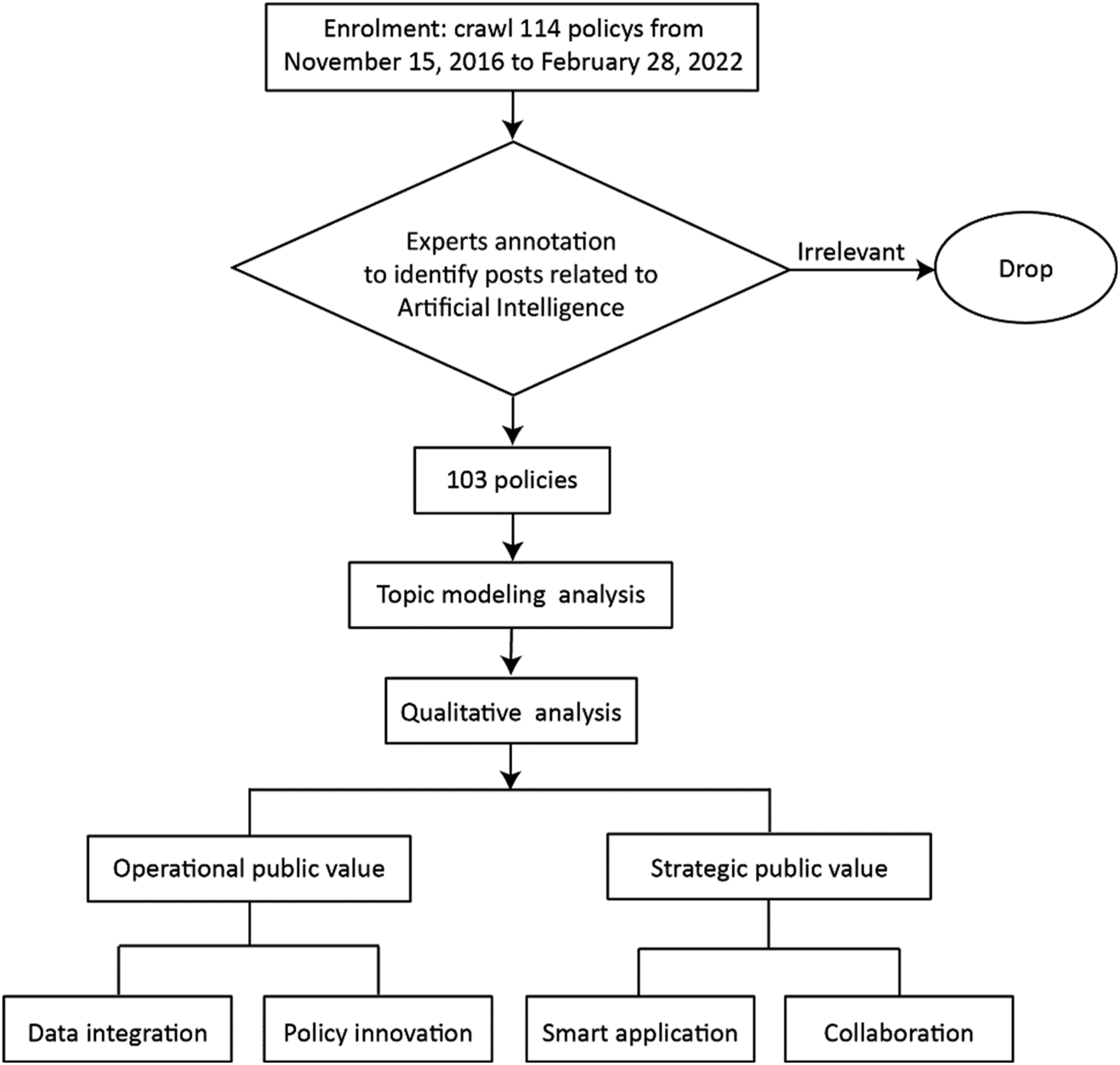
The sequential research design involved the following steps (see Figure 2 for an overview of our methodology). 1. We first crawled policy documents composed and published by government agencies on AI from Chinese government websites between 2016 and 2022. We collected a total of 114 policy documents—29 from the Guangdong provincial government, 33 from the Shenzhen municipal government, and 52 from district governments in Shenzhen. 2. We identified the textual data related to AI. Three research assistants independently read and annotated all the policy documents and determined whether each was about the deployment of AI in the public sector or not. They only selected documents that addressed local governance issues; those about industrial policy related to AI or policies for hi-tech industries were excluded. If at least two coders decided that a document was relevant to AI deployment in the public sector, it was retained for the next-step analysis. 3. We performed the topic modeling analysis and selected a nine-topic model. To decide on the number of topics K, we tested LDA at different levels (K = 5, 6, 7, 8, 9, 10, until 30). We chose the nine-topic model because it provided the best results. 4. We used the human coding approach to qualitatively analyze the keywords as well as the related policy content informed by the output of the topic modeling analysis. Three assistants—with in-depth knowledge of AI policies and public value creation—independently read the topic modeling outputs, summarized the policies, categorized various types of public value, and identified dimensions. From this information, we identified four dimensions along which the Shenzhen government deploys AI in the public sector—data integration, policy innovation, smart application, and collaboration. 5. Two complex cases in Shenzhen were presented and analyzed based on the four identified dimensions. An overview of the study’s research methodology.
Empirical analysis
LDA analysis
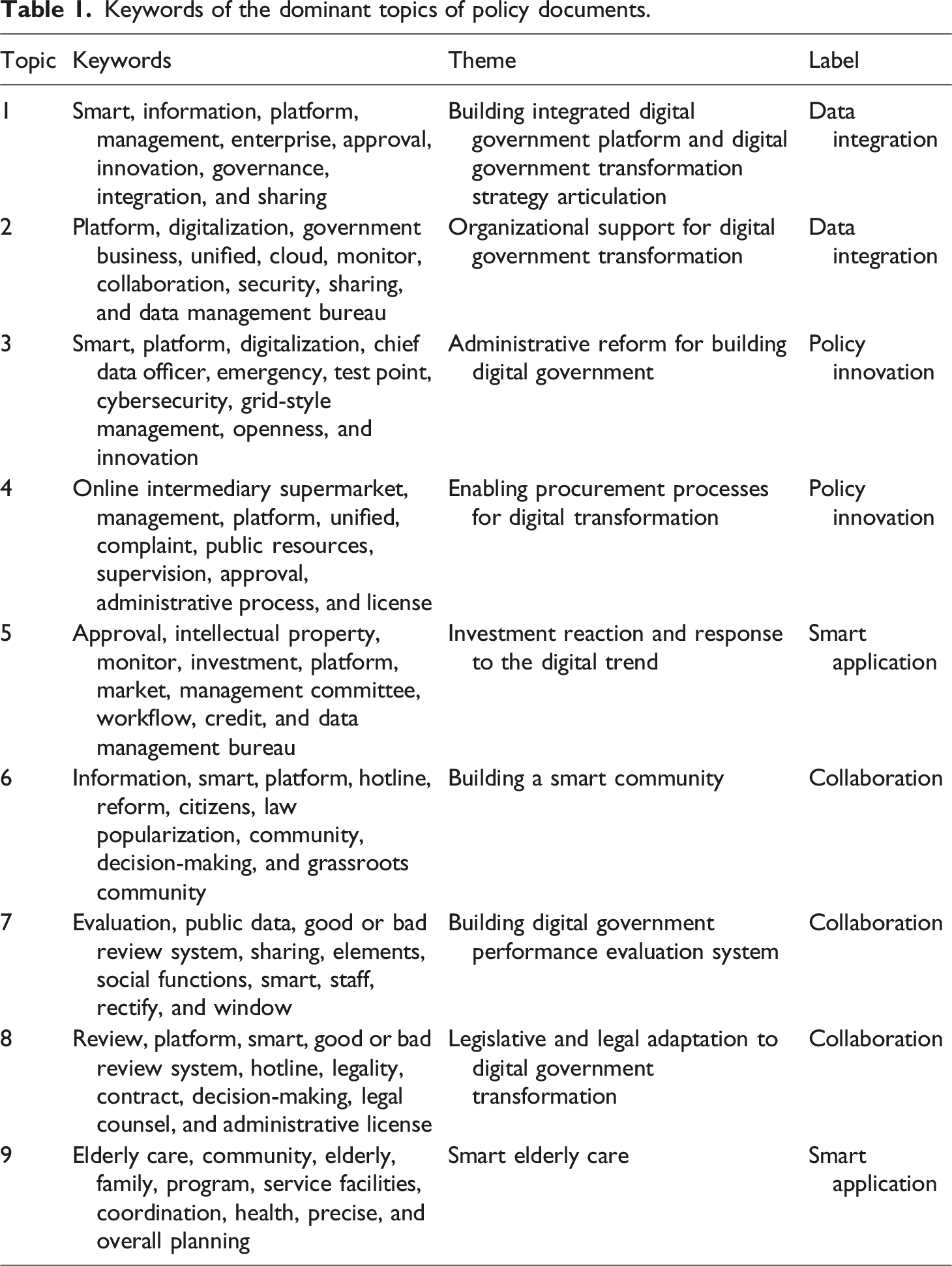
We used LDA topical modeling to analyze the content of the 103 policy documents extracted from the original policy pool. The LDA results are recognized by an inter-topic distance map shown in Figure 3 using Sievert and Shirley’s (2014) method. It visualizes how similar or distinct the topics are and the relative size of the topics. As shown in Figure 3, the size of each bubble represents frequency (i.e., the bubble size is proportional to the number of words in that given topic); the location of the bubbles demonstrates topic similarity (i.e., the program plots the topics on a multidimensional scale to gauge how similar each topic is to the others); and the colors of the bubbles represent the different types of public value the topic is related to. Table 1 shows the detailed keywords of the nine dominant topics (from the most to least important). We then qualitatively analyze both their constituent words and the policy statement relating to these topics. Thus, the qualitative and quantitative aspects of the analysis cannot be neatly separated; they are instead integrated as two sides of the same coin. The inter-topic distance map of the policy documents. Keywords of the dominant topics of policy documents.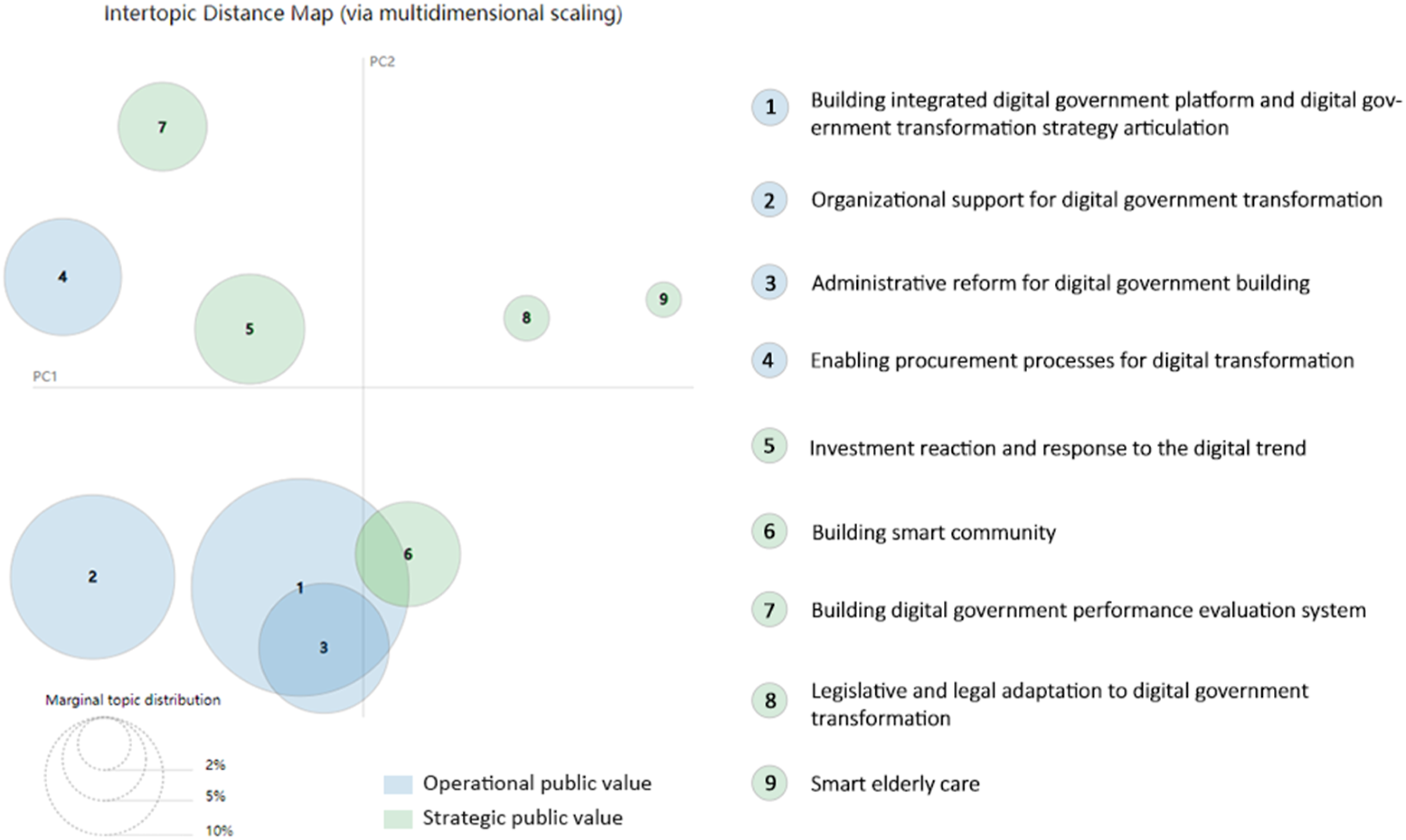
We distinguish between topics (i.e., themes, which are summarized from a single topic) and topic categories (i.e., labels, which indicate a specific AI deployment dimension containing a group of topics). The results with the combination of different keywords can provide clues to help discern the policy meaning, strategies, and public value. Based on our conceptual framework (see Figure 1) and qualitative analysis, we categorized the topics (i.e., themes) into operational public value and strategic public value first and identified four dimensions (i.e., labels) in which governments deploy AI to reform the public sector.
Some literature has shown that IT values in support of public service are developed over time. For achieving strategic public value, operational improvement acts as an effective intermediate in establishing a sequential connection between operational and strategic performance (Chatterjee et al., 2022; Zhang et al., 2016). Thus, the operational public service for the citizens’ benefit is perceived to impact the achievement of strategic public values in the context of AI deployment in the public sector. Our LDA and qualitative analyses also show that the two kinds of public values cannot separate. In our qualitative analysis, we categorize the related text into different types of public value based on the areas and actions the text focuses on. The different colors of bubbles in Figure 3 show the two types of public value. We find that government pays more attention to the operational public service related to the internal benefits at this stage than the strategic one which highlights the delivery of value outside the public sector. At the same time, claims like generating strategic public value to achieve service-oriented government transformation are quite common in some texts related to operational public value.
We then identified four dimensions (i.e., labels) in which governments deploy AI to reform the public sector based on the different types of public value they want to achieve: data integration, policy innovation, smart application, and collaboration. Local governments are motivated to adopt AI technology to enable data integration (45% of the documents), policy innovation (26% of the documents), and collaboration within the government or between the government and citizens or other stakeholders (25% of the documents). For instance, the government established the “good or bad review system,” which allows customers (citizens) to evaluate frontline workers’ attitudes and the government’s service delivery methods. AI policy documents that mention this system focus on how to integrate customers’ feedback with multiple agencies and share the data within the government to either solve the problem in a coordinated fashion or to improve the algorithms or services based on the feedback. Only 4% of the documents discussed smart applications of AI.
Keywordsrelated to data integration (e.g., platform, integration, data sharing, digitalization, government business, and unified) reflect local efforts to build platforms and share data resources. Keywords concerning policy innovation (e.g., chief data officer, test point, online intermediary supermarket, and innovation) indicate the launch of several important policy innovations, such as arranging chief data officers in four district governments as test points for digital governance and setting the online intermediary supermarket for government procurement. Such innovation and data integration reform represent the provision of operation public service, focusing on the efforts of the government to solve the information silos, optimize process, and improve efficiency. For smart applications, the keywords are mainly about social services such as smart community, elderly care, precise, and data management bureau. Local governments employ AI technology to build smart communities and help those in need. Finally, keywords related to collaboration include collaboration, the public, workflow, legal counsel, review system, etc. They show that the government employs AI to increase government responsiveness and facilitate civic engagement.
Note that although the location of bubbles indicates topic similarity in Figure 3, it does not mean that similar topics (themes) have the same labels. For instance, theme 1 (building integrated digital government platform and digital government transformation strategy articulation) and theme 3 (administrative reform for building digital government) overlap but are labeled differently in the qualitative analysis. We labeled theme 3 as policy innovation since the policy documents discussed the creation of the chief data officer and the related administrative reform, while theme 1 was about data integration and data sharing. Similarly, theme 6 (building a smart community) has the same label as theme 8 (legislative and legal adaptation to digital transformation)—collaboration—but their content is less similar. Theme 6 shares more similarities with theme 1 (data integration). This indicates that the application and implementation of these four dimensions are intertwined rather than independent.
Case analysis: Shenzhen experience
We selected two representative cases in Shenzhen to explore the role of AI in local governance. Each case reflects a combination of the AI deployment dimensions identified in the previous section. Case I is the Unified Management in One Network by Pingshan government, which assesses the local government’s efforts to adopt AI to attain data integration, policy innovation, and collaboration. Case II is the Open Data Policy Lab. in Futian, which sought to use AI to achieve policy innovation, smart application, and collaboration.
Case I: The unified management in one network (Pingshan government)
In 2019, Pingshan district government in Shenzhen built a “unified management in one network platform.” This “platform” essentially works like a “terminal”: it combines online and offline public services delivery, integrates various types of data across functional agencies within the public sector, and assembles both public demands (e.g., safety production, environmental protection, and transportation) and demands from the private sector (e.g., license application, tax remission). Figure 4 is a screenshot of one of the interfaces of the unified management platform, which displays the real-time events that the government is processing, the location of the places involved, etc. The interface of the unified management platform. Source: CCTV news on 11 June 2020.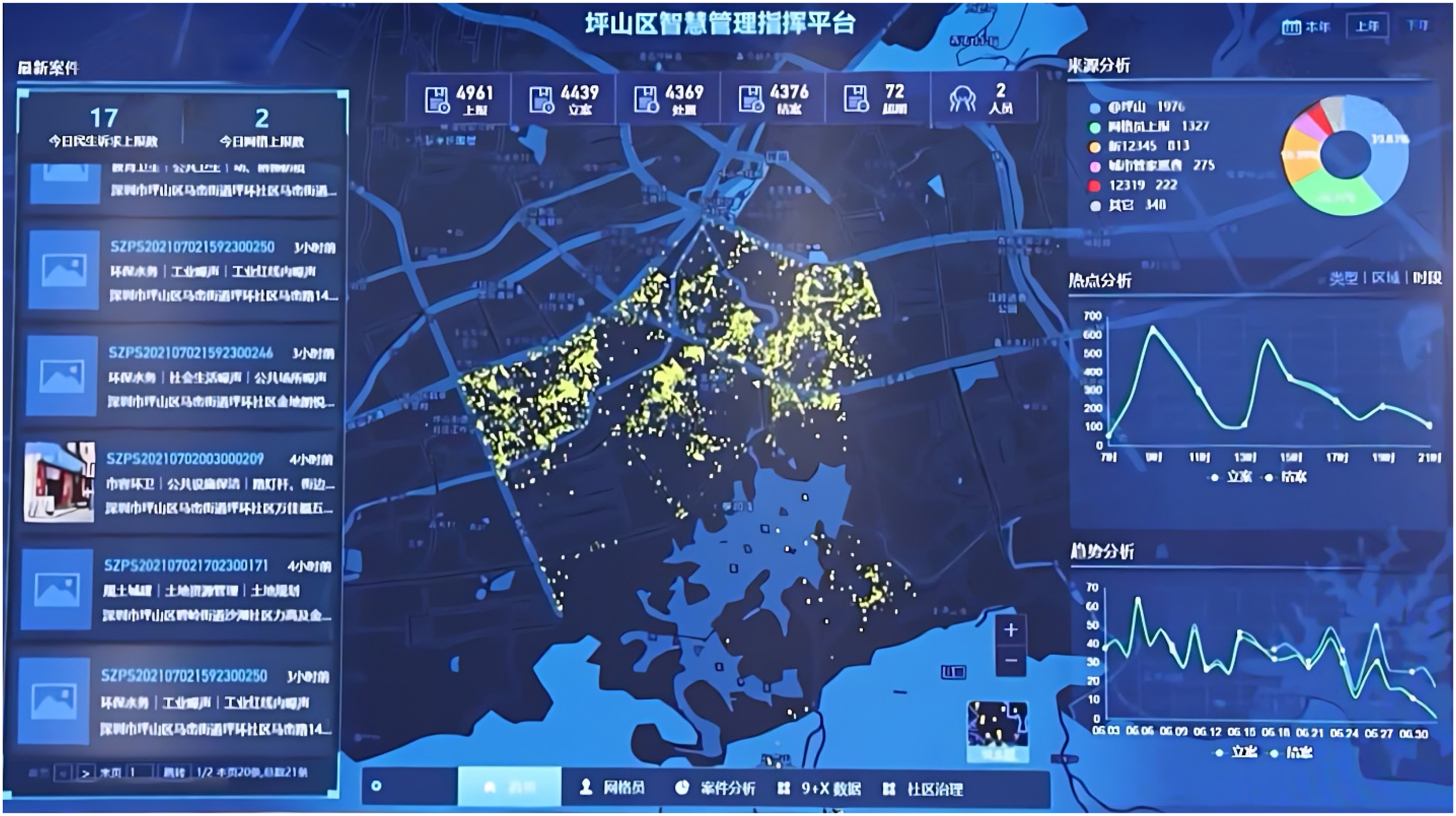
Data integration
The government initially established multiple channels such as government hotlines and portals for citizens to express opinions, demands, and complaints. This information from citizens was always scattered and duplicated. Without information integration and inter-agency coordination, government resources were probably wasted in dealing with this dispersed information. The “One Network Platform” integrated previous reporting and complaint channels into this smart terminal. With the help of AI, the terminal analyses and processes all the information (mainly the livelihood public services-related information) synthetically.
Based on integrated data analysis and algorithms, the unified management platform can smartly assign tasks to the relevant functional agencies and frontline workers. Once these tasks have been distributed to the agencies and their workers, the frontline workers must take responsibility for the tasks and work out a solution before a deadline set by the terminal. The terminal will issue a warning if a task is not completed on time. During the task processing, the platform records all of the frontline workers’ procedures and actions. For instance, the workers need to reply to citizens’ complaints or demands via the platform from intake to resolution. This recorded data will contribute to future data analysis and algorithm design. If several citizens (customers) continue to report the same problem, such as traffic jams on the same road or water pollution in the same region, the terminal will inform upper-level decision-makers to get involved in tracking or handling the issue. Every morning, the terminal will send briefings to decision-makers, and they can know the issues the public pay attention to in time and respond via the mobile system dedicatedly. Thus, the AI’s data integration function will solve the buck-passing problem among government departments, breaking through the fragmented bureaucracy.
Collaboration
Governments dealing with citizens’ demands are a collaborative process in which citizens participate by contributing information, and governments respond by investing capital/human resources. The unified management platform has not only connected front-end service users (citizens) and back-end government workers; it also has the ability to alert the public agencies to adopt agile working approach. The platform can adjust its responses accordingly, thus intensifying government–citizen collaboration. All the processes and interactions are iterative. For instance, if the terminal accumulates several complaints or requests from citizens, the algorithm will remind the relevant agencies to improve their solutions.
While building the platform, the Pingshan district government issued a handbook articulating the responsibilities of different functional agencies in handling citizens’ demands. It will be revised annually based on the algorithm analysis to adapt to changing citizens’ demands and bureaucratic capacity. Previously there were always coordination problems or information asymmetry among various functional agencies. Citizens do not know which agency to report to about different issues. For example, citizens never know whether they should issue noise complaints to the environmental protection bureau or the housing and construction authority. These two agencies always pass the buck regarding such complaints. The handbook clarifies such situations, which helps optimize the collaborative process. Note that such kind of collaboration will also contribute to the function of data integration that how the terminal assigns the tasks will depend on the articulation of the handbook.
Another example is the “AI + video” function engaged in the platform. There is a large amount of video data in the city. The platform can automatically detect problems through the video using AI, such as problems of hawking and garbage overflow. The platform then pushed the notification to the relevant departments for processing the issue. To our knowledge, until 2022, the platform has applied 20 algorithms to detect urban problems automatically.
Moreover, based on the terminal’s algorithmic analysis, Pingshan district government has optimized the collaborative process by establishing a mechanism to coordinate certain policies and centralize the rectification of complex events. The terminal will create a leading unit to make unified replies or specific policies.
Policy innovation
To protect online privacy, Pingshan district government has enacted public data regulations such as Administrative Measures for the Classification of Government Affairs Data in Pingshan District and the Pingshan District Chief Privacy Officer System. In addition, innovatively, the government has established a team of 63 chief privacy officers and 61 privacy commissioners to handle data security issues resulting from data sharing and opening. Pingshan government has also adopted an innovative way to manage public data: it categorized different levels of public data within the government (e.g., conditional sharing data, sensitive sharing data, unconditional sharing data, and desensitized data) and used a centrally managed distributed data exchanging method to manage it. Only eligible agencies can access the data.
AI cage
In this case, AI builds the foundation for a data integration platform that strengthens government–citizen collaboration and fuels policy innovation. The government agency that is assigned a task on the platform is responsible for the issue until a solution is found—a “first-assigned responsibility system” to ensure accountability. The progress bar is updated in real-time to allow both citizens (customers) and bureaucrats to monitor it. The government has reported that the terminal has helped increase working efficiency and standardized the procedures of frontline workers. It has reduced the average processing time for a citizen’s demand to 1/60 of the previous time taken. 1 Some citizens’ inquiries have been achieved “in a second.” In this sense, AI works as a “cage” to monitor frontline workers.
Note that the AI cage is subject to alteration. A key characteristic of AI technology is its ability to learn from continuous real-time data inputs and adjust its response strategies accordingly (Vogl et al., 2020). Doing so requires both advanced algorithms and effective input from human agents. Therefore, the local government has adopted an agile working approach to adapt to changing situations. For instance, the government initially required responses within one working day, which was hard to achieve for some complicated issues. It then categorized events by the level of urgency and set different response times based on algorithmic analysis.
Meanwhile, the building of a platform can optimize the process and reform the internal working procedures, indicating the generating of operational public value. The collaboration with citizens and the spirit of alteration show the more responsive and inclusive directions that the government wants to be transformed.
Case II: Open data policy lab (Futian government)
Although local governments have recognized the significance of ICT-enabled innovation, they frequently lack the resources, expertise, and capacity to understand, assess, and keep up with the fast-changing technologies—often leading to policy gaps or under-regulation (or both), resulting in missed opportunities or policy failures. Therefore, sandboxes and experiments that permit evidence-based decision-making and the adaptive deployment of digital technologies can help address these challenges. Most of the practices that test using sandboxes are now limited to a small number of fields like financial technology. Few practices in public management use this method. Futian district government in Shenzhen initiated the policy innovation and set the sandboxes for public service provision.
Policy innovation
In 2019, the Futian government built the Open Data Policy Lab. Following Polvora and Nascimento (2021)’s framework, policy labs, as a kind of government innovation, act as silo breakers by standing as unique connectors between several relevant parties, or bringing together different disciplines and other sources of knowledge. The Open Data Policy Lab. in Futian worked on alternative ways to analyze and co-create solutions for specific issues in the back-end of public sector innovation. It regularly released AI application scenarios, provided data, equipment, venues, and other testing environments (i.e., sandboxes). It invited excellent AI institutions to open up offices in Futian to accelerate the implementation of AI technology in the city. In this sense, the Policy Lab. provides an incubator for effective collaboration and producing smart applications.
Collaboration
The lab has built secure sandboxes to develop AI applications for the public sector. These sandboxes integrate the testing environment, resource coordination, and precious government data resources. Focusing on the needs of AI application scenarios on the “economy, livelihood issues, and public management,” the policy lab has publicly released around 40 application requirements, including those related to the environment, public services, elderly care services, public safety, health, and epidemic prevention and control. As an experimental method, sandboxes encourage collaboration and co-design of the policies between government and private enterprises or other stakeholders. The sandboxes cover the environments for five major fields of AI, such as big data analysis, video recognition, knowledge graph, text processing, and voice processing, attracting nearly 60 outstanding enterprises such as Alibaba Cloud, iFLYTEK, and SenseTime to cooperate. In doing so, engaging more professionals or stakeholders can co-produce the digital transformation to achieve strategic public values.
Smart application
The Futian government has adopted several applications developed in the sandboxes. The AI robots project is a typical case. These robots have cleaned the streets during the pandemic. They undertake high-intensity operations in crucial prevention and control areas such as nucleic acid detection points, quarantined buildings, high population density villages, public toilets, markets, and transfer stations. The robots have solved the labor shortage problem during the pandemic, improved working efficiency, and reduced the infection risk for frontline workers.
Another project from the sandboxes is the “AI government employee,” which combines the technologies of robotic process automation (RPA) and AI. The “RPA + AI” robot can simulate a human’s operation of a computer mouse and keyboard. It works without interruption to automate the process of tasks according to the given rules. The RPA software robot can also act as a “ferry car” between various systems and applications, solving the problem of missing interfaces and automating data migration without affecting the original IT system structure.
For example, Figure 5 displays the simple workflow change after introducing an RPA + AI robot to the process of license application and filing of drainage and sewage pipe network. Previously, the staff had to manually input information and find, enter, check, scan, and print the data and documents. This process took nearly 10 min, and each staff member had to handle more than 60 cases per day. After the introduction of the robot, the window staff now only needs to enter the credit code of the applicant unit, and the robot automatically finds and processes the information. The whole process takes 1–2 min with a constant speed and a low error rate. The workflows of manual processing and AI government employee.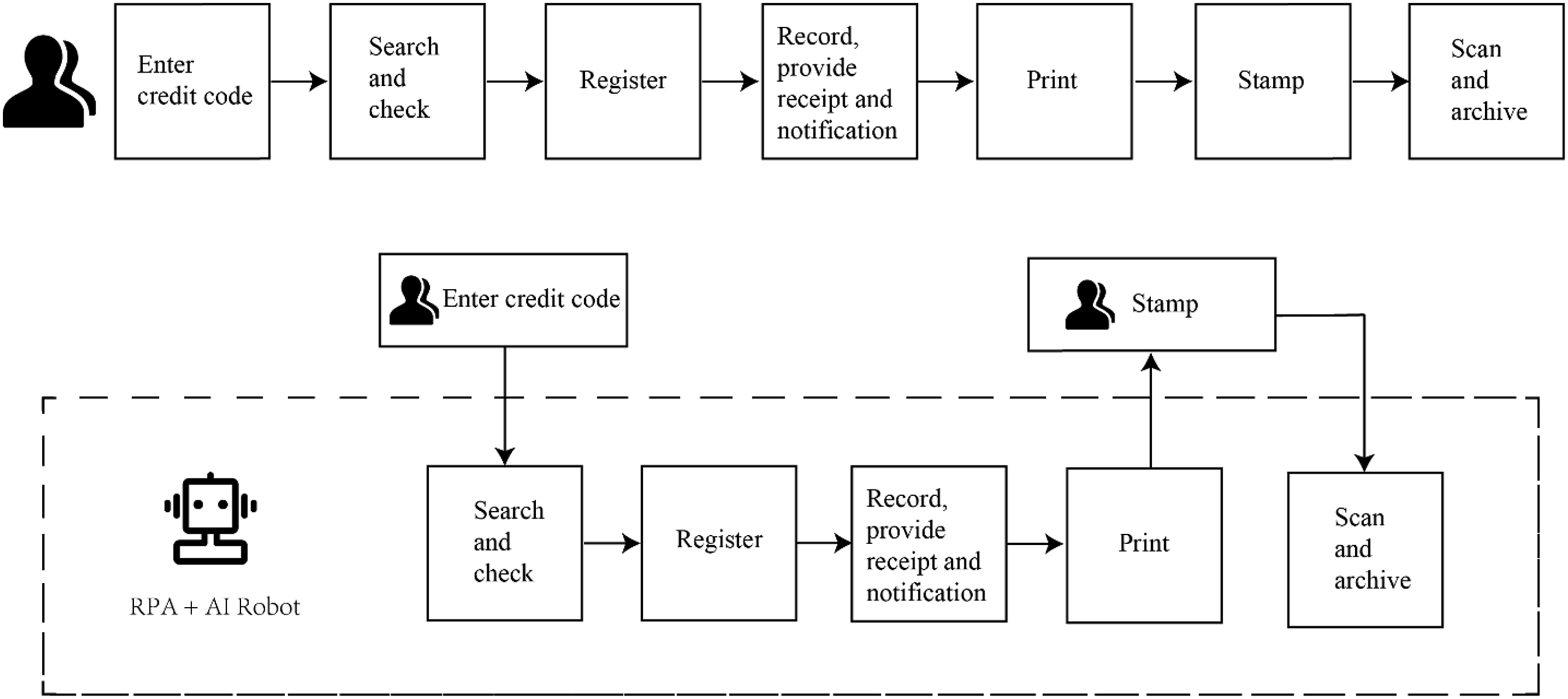
AI colleague
In the Futian case, the government employs AI for policy innovation and smart applications. Sandboxes facilitate the collaboration between the government and hi-tech companies and boost innovation, encouraging the provision of strategic public services. The AI robots effectively help frontline workers solve labor shortage problems. The AI government employees help the window staff shorten their working time and increase their working efficiency. In this sense, the AI works as a “colleague” to help frontline workers deliver services and make decisions.
Discussion and conclusions
We set out to understand how AI affects local governance, especially the advances that AI-supported services for the public sector in local governance have ventured and the public values they have created. To explore this empirical puzzle, we build a framework from a holistic perspective combining digital transformation concepts and public value theory. We applied it in the investigation of Shenzhen as an intrinsic case of the local government that was able to create public value via AI configuration in the public sector. This study, therefore, contributes to filling the gap on how public value is created in the digital transformation.
Research implications
This article makes several theoretical and empirical contributions. First, the study theoretically connects the concepts of agility, GaaP, and AI in digital transformation and public value into one theoretical framework. To our knowledge, this is one of the first studies in this area, as previous studies either focus on the orchestration role of AI in GaaP (Cordella and Paletti, 2019), the agile working approach, or the adoption of AI on citizen satisfaction (Chatterjee et al., 2022). Our findings demonstrate how these concepts interact with each other from a holistic perspective to generate public value.
Our analysis shows that the government pays more attention to the operational public value creation related to the internal benefits than the strategic one, highlighting the delivery of value outside the public sector, although service-oriented government transformation is rhetorically common. Additionally, four dimensions of AI deployment are identified in the public sector: data integration, policy innovation, smart application, and collaboration. The case analyses show that AI plays two roles in local governance—an “AI cage” that regulates frontline workers’ activities and an “AI colleague” that helps frontline workers make decisions. Both functions contribute to local governance by optimizing workflows, improving public service provision, and enabling intensive government–citizen collaboration.
In addition, agile governance, as a new framework to describe a government’s working approach, involves efficiently responding to evolving public needs by moving away from the traditional “waterfall” bureaucratic method (Mergel et al., 2021). The need for agile governance acknowledges that governments not only provide services to their constituents but they must also proactively provide citizen-driven services designed to accommodate specific individual needs or collaborate with citizens. Most prior empirical studies have discussed agile approaches to designing, producing, and deploying government software (e.g., Mergel, 2019; Soe and Drechsler, 2018). This study goes beyond the principles of agile software development and advances the literature by highlighting the iterative dynamics of policy agendas of AI and how it helps make governance agile. Meanwhile, we show that although officials only change the internal working process, agility initiated by AI shapes how the government discovers demands and then integrates the changing needs of the public into general public value. The agile working process deeply values the voices of both staff and citizens.
Finally, the findings enrich our understanding of how AI operates in the public sector and the coproduction of digital transformation. AI deployment enhances governments’ ability to provide quality services and create innovative solutions for social problems. Previous discussions of AI in the public sector focus on the oversight of algorithmic outputs and algorithmic accountability (Busuioc, 2021; Meijer et al., 2021), AI’s challenges to bureaucracy and discretion (Bullock, 2019), issues of “algorithmic bias” (Harvard Law Review, 2017), or the determinants of adopting AI technology in developed countries (Coulthart and Riccucci, 2022; Mikalef et al., 2022b). Few studies have explored its role in local governance or how it helps strengthen digital capacities to deliver people-centric service. This article demonstrates the critical relationship between AI technology and frontline workers, highlighting the new types of government–citizen collaboration generated by digital transformation. Artificial Intelligence indeed solves the problem of service performance with delay. It communicates the voices of the public to the government to help speed up the decision-making process. Meanwhile, this article illustrates the increased opportunities of collaborative governance to co-produce public values in the digital era. Our findings show that human–machine interactions can enhance collaborative problem-solving and create value for all collaborators in the innovation process.
Practical implications
Several practical recommendations can be derived from this study. First, the experiences of Shenzhen have shown how GaaP, agility, and AI configuration work together to help the digital transformation create public value successfully. An important recommendation is that policymakers and public managers engaged in government digital transformation need to consider applying the holistic approach to make transformational efforts. Digital transformation is not merely the use or deployment of new ICTs but a reinvention of government in operations, processes, and systems. The policymakers can also regard AI configuration as an instrument and a starting point to change the working approach and generate the operational public value first to increase their commitment to digital transformation. Engaging more public or other stakeholders in the agile working process could co-produce strategic public value.
Second, our study shows the critical relationship between AI and frontline workers. Public managers should pay attention to AI’s different roles in new human–machine interactions. AI colleague or AI cage calls for different capabilities of frontline workers. Public managers should be aware that training frontline workers or reducing the friction between human–machine interactions should be critical in digital transformation.
Finally, nowadays, assessments of digital transformation maturity in cities in developing countries are in the early stages. Cities are essentially a collection of human, social, economic, and cultural networks; a sense of belonging and togetherness can be fostered in such settings. The collaborative processes supporting social cohesiveness and development should be further optimized. To this end, this study provides empirical insights into how the public value of digital transformation is generated by the Shenzhen government. Shenzhen’s experiences may be helpful for policymakers and practitioners in other developing countries in implementing digital transformation as they provide guidance on how public value is empirically created.
Limitations and future research
Our study suffers at least three limitations, which suggest avenues for future research. First, it lacks rigorous empirical evidence of public satisfaction with which to test the effectiveness of AI adoption. It also fails to consider inclusiveness and equity issues related to AI adoption, such as whether the government uses AI to help disadvantaged groups. Future research should examine citizens’ perceptions and attitudes toward AI usage in the public sector and assess whether AI-related policies adequately consider inclusiveness and equity.
As the second limitation, our study is limited to the city of Shenzhen and, therefore, is subject to limited generalization. We were not able to test differences among government departments, such as organizational culture, leadership, etc. Future research should feature comparative studies and examine the potential synergies of AI deployment at multiple levels of government and in different regions.
Finally, the findings presented here are primarily based on government websites and secondary data such as government policy documents and news releases. However, policy documents cannot reflect all kinds of AI innovation due to the bottom-up characteristics of AI development in China (Zeng, 2021). We also lack empirical evidence on whether AI makes mistakes etc. Nevertheless, we claim that focusing on policy documents and successful cases is helpful since it provides insights into government attention, the public value they prefer to generate, and the successful experiences. Future studies should conduct fieldwork and in-depth interviews to explore underlying interactions between frontline workers and AI (such as the united platform), how AI affects government operations and decision-making, etc.
Footnotes
Declaration of conflicting interests
The author(s) declared no potential conflicts of interest with respect to the research, authorship, and/or publication of this article.
Funding
The author(s) received no financial support for the research, authorship, and/or publication of this article.
